Archive
11/07/2013 – Ephemeris – The Big Dipper’s lowest appearance in the north
Ephemeris for Thursday, November 7th. The sun will rise at 7:28. It’ll be up for 9 hours and 54 minutes, setting at 5:23. The moon, 3 days before first quarter, will set at 9:32 this evening.
The entire Big Dipper is at its lowest in the sky at 9 p.m. with the Dipper’s bowl centered due north under the pole star Polaris. The southernmost star of the Big Dipper is the star at the tip of the handle, named Alkaid. Alkaid will be at its lowest at 11:20 this evening, 4 degrees above the horizon for Traverse City, so is circumpolar, meaning it doesn’t set in the IPR (Interlochen Public Radio) listening area. The star name is Arabic and means something like the Chief of the daughters mourning at the Bier. The bier is the bowl of the dipper supporting, I suppose, the body of their father or mother. To the Anishinabek native peoples around here the Big Dipper was the Fisher or Fisher Star, a weasel like creature, whose bloody tail swept over the maple trees, turning their leaves red.
Times are for the Traverse City/Interlochen area of Michigan. They may be different for your location.
Addendum
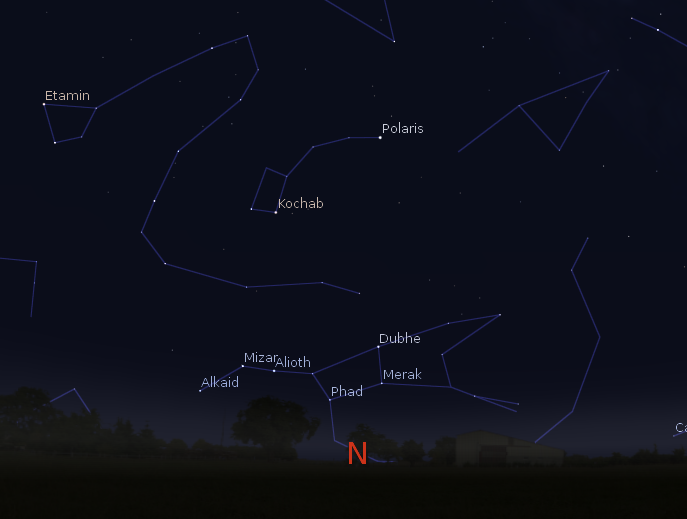
The Big Dipper low in the north at 9 p.m. November 7, 2013. Created using Stellarium.
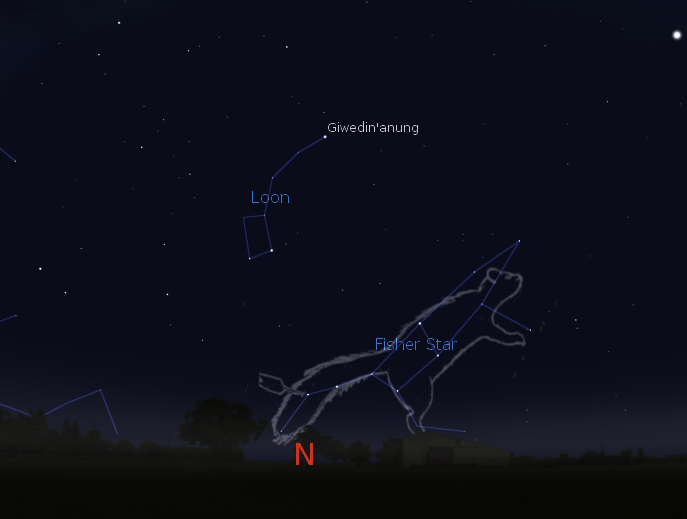
Fisher Star paints the autumn trees red at 11:20 p.m. November 7, 2013. Created using Stellarium.
For the story of the Fisher Star click here.
10/28/2013 – Ephemeris – The constellation Perseus the hero
Ephemeris for Monday, October 28th. The sun will rise at 8:15. It’ll be up for 10 hours and 21 minutes, setting at 6:36. The moon, 2 days past last quarter, will rise at 2:54 tomorrow morning.
About a third the way from the east northeastern horizon to the zenith at 9 p.m. and below the letter W shaped constellation of Cassiopeia the queen is Perseus the hero. It’s kind of a odd shape for a hero, To me it looks like a chicken running across the road. To those who’s imagination doesn’t run to poultry, its shape is also like the Greek letter pi. It’s two brightest stars are Mirfak and Algol the demon star. Look at the area around Mirfak with binoculars and you will see a large group of stars just below naked eye visibility. It’s called the Alpha Persei association. That because Mirfak is Alpha Persei. The group is about 560 light years away, which means, though close, are farther away than the Pleiades, below and right of them.
Times are for the Traverse City/Interlochen area of Michigan. They may be different for your location.
Addendum
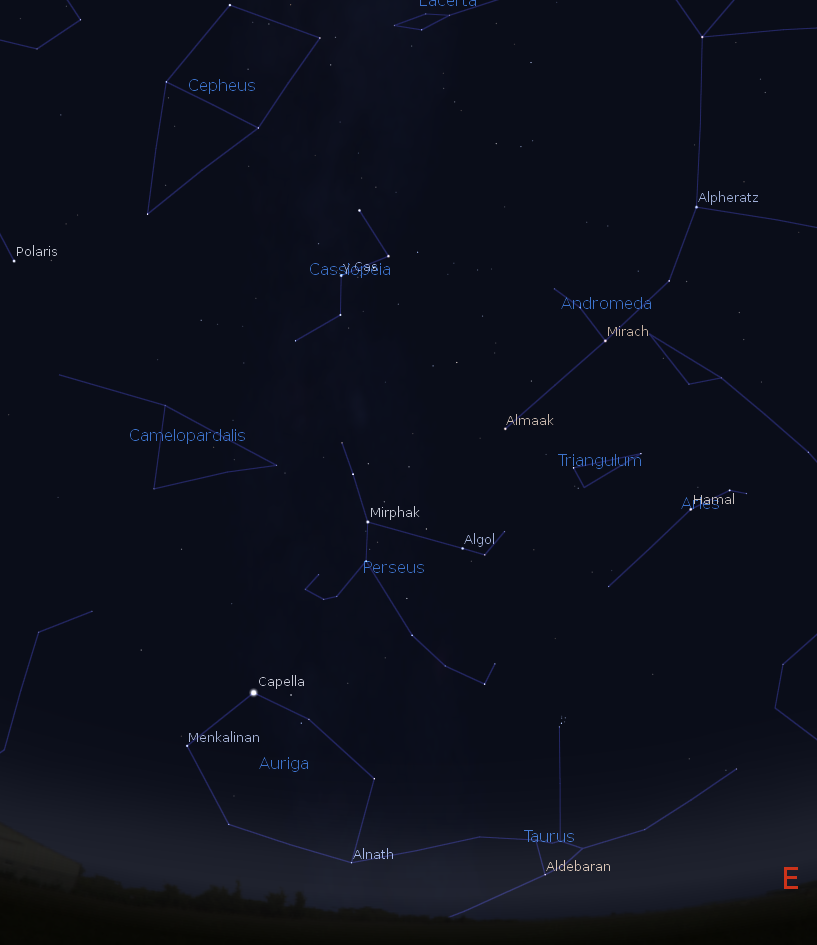
Perseus finder chart. Note the star Mirfak is spelled Mirphak on the chart. Created using Stellarium.
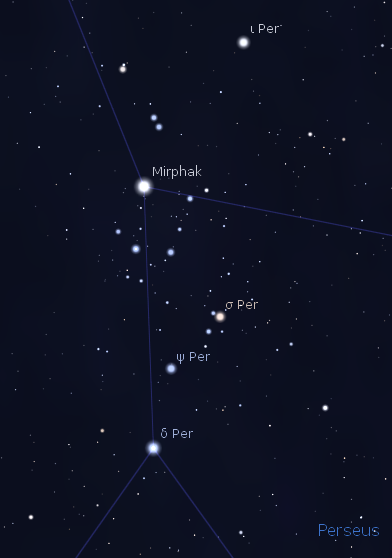
Alpha Persei Association. Created using Stellarium.
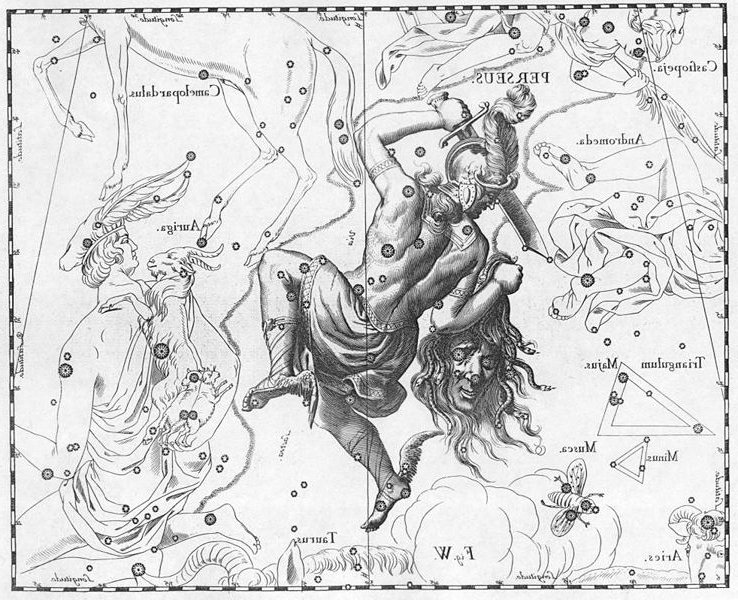
Perseus and the head of Medusa from the 1690 Uranographia by Johannes Hevelius. Image found with the article on Algol in Wikipedia.
10/24/2013 – Ephemeris – The Pleiades or Seven Sisters
Ephemeris for Thursday, October 24th. The sun will rise at 8:09. It’ll be up for 10 hours and 33 minutes, setting at 6:42. The moon, 2 days before last quarter, will rise at 11:01 this evening.
We’re a month into autumn. Looking to the east northeast low in the sky at 9 p.m. there will be a hazy patch of light, or a tiny dipper of stars, depending on your eyesight and sky conditions. This is the Pleiades or seven sisters of Greek mythology. The Pleiades has a rich mythology in all cultures, which we will check out occasionally until they leave the night skies in the spring. The Pleiades is a star cluster, where stars are formed at the same time, in this case about 100 million years ago. It has left its cloud of gas and dust from which the stars formed, however long exposure photographs show that the Pleiades is passing through another thin cloud of gas and dust. The Pleiades is one of the closest star clusters to us at 425 light years.
Times are for the Traverse City/Interlochen area of Michigan. They may be different for your location.
Addendum
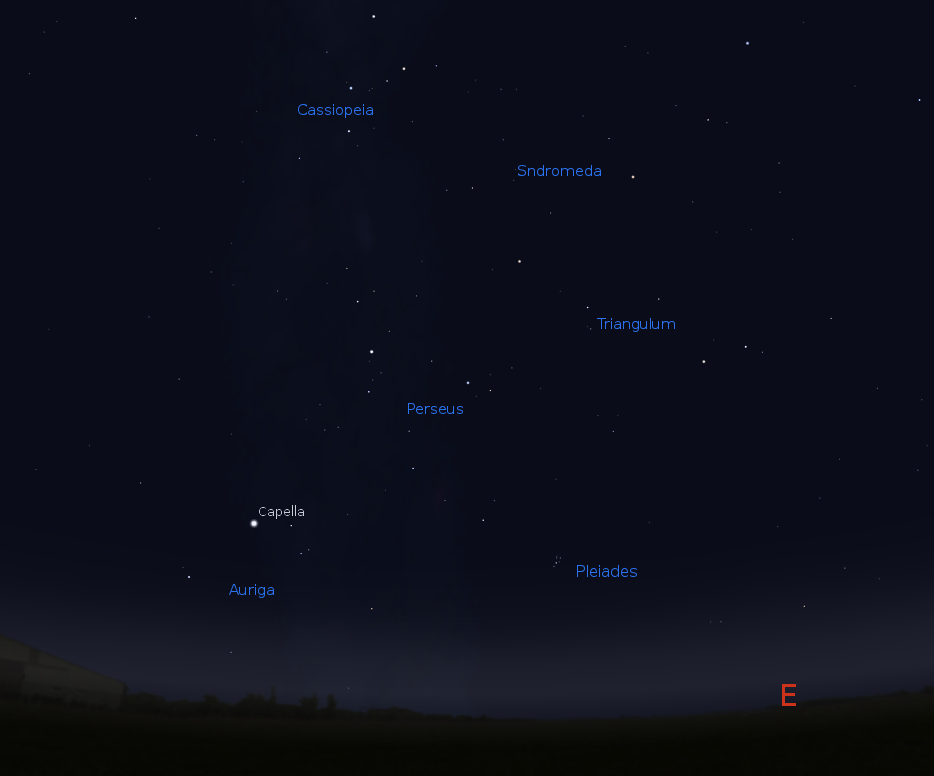
Looking to the east northeast at the Pleiades: 9 p.m. on October 24, 2013. Created using Stellarium,
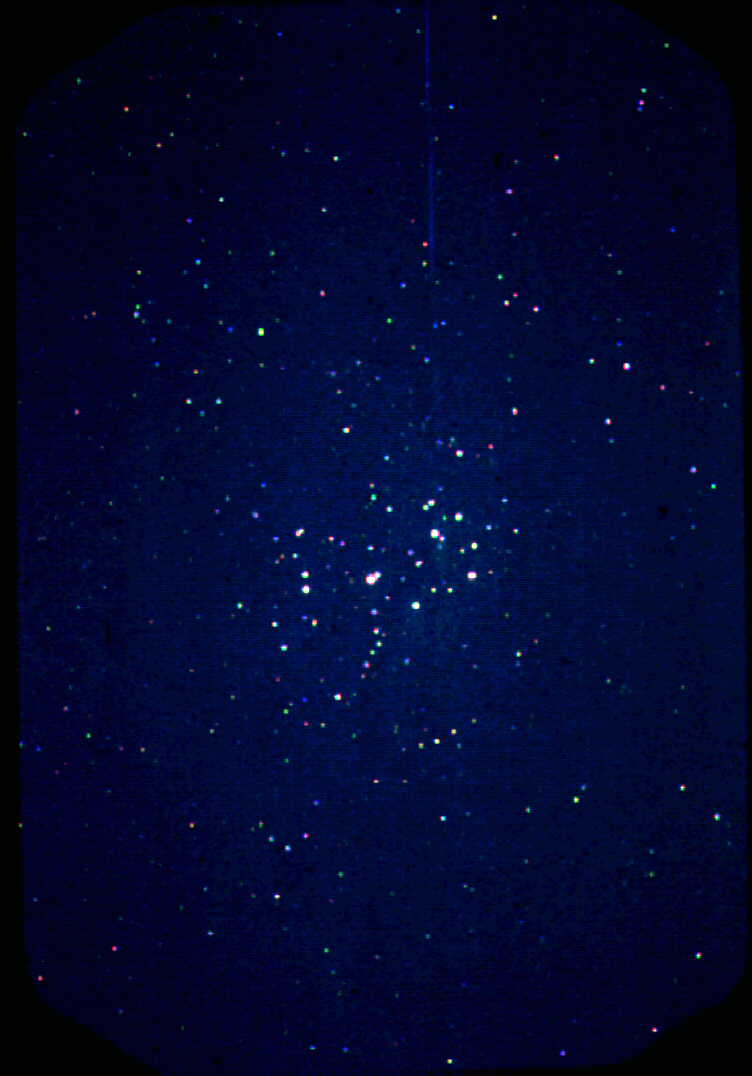
The Pleiades, about what you’d see in binoculars.
09/30/2013 – Ephemeris – The constellation of Cassiopeia the queen
Ephemeris for Monday, September 30th. The sun will rise at 7:39. It’ll be up for 11 hours and 44 minutes, setting at 7:24. The moon, half way from last quarter to new, will rise at 4:07 tomorrow morning.
The stars of the autumn skies slowly are replacing the summer stars from the east. Look in the northeastern sky by 9 p.m. and you can find the W shaped constellation of Cassiopeia the queen. Cassiopeia is so far north that it never sets for us in Michigan. It is opposite the pole star Polaris from the Big Dipper. There’s a dim star that appears above the middle star of the W which turns the W into a very crooked backed chair. Cassiopeia, in Greek mythology, represents a queen of ancient Ethiopia, the W represents the profile of her throne. She enters in to the great autumn story whose other characters are also seen in the stars as the constellations Andromeda, Pegasus, Perseus, Cetus and her husband Cepheus.
Times are for the Traverse City/Interlochen area of Michigan. They may be different for your location.
Addendum
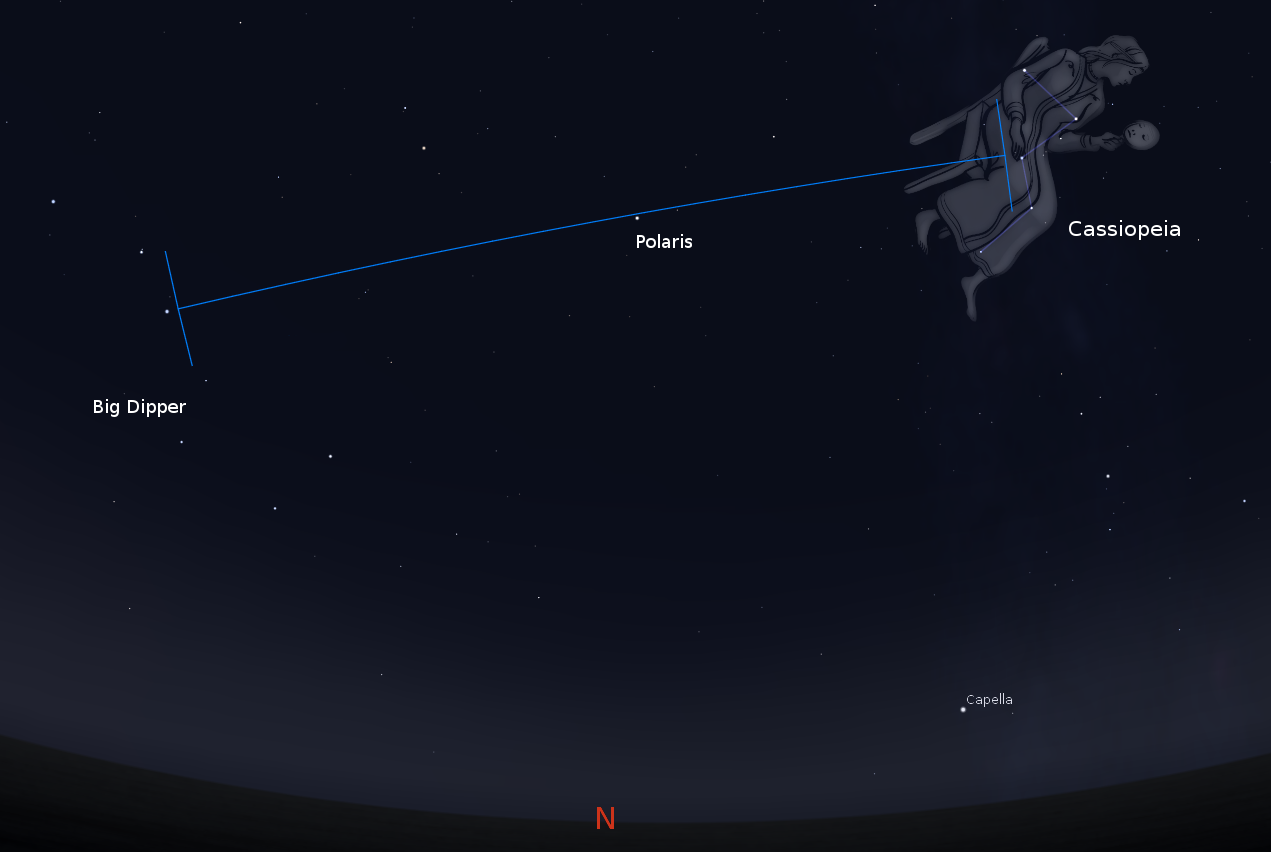
Cassiopeis, in the northeast is opposite Polaris from the Big Dipper. For 9 p.m. on September 30th. Created using Stellarium. Artistic credit: Johan Meuris. Click to enlarge.
09/26/2013 – Ephemeris – The Milky Way is crossing overhead
Ephemeris for Thursday, September 26th. The sun will rise at 7:34. It’ll be up for 11 hours and 57 minutes, setting at 7:31. The moon, at last quarter today, will rise at 12:17 tomorrow morning. | At 10 this evening the Milky Way will pass directly overhead. The bright star Deneb of the Summer Triangle and at the head of the Northern Cross is directly overhead at that time. Deneb is incidentally the tail of Cygnus the swan. The Milky Way stretches from the northeast to the southwest where the Teapot of Sagittarius is tipping, pouring out its tea on the horizon. The Milky Way can be enjoyed with the naked eye, binoculars or telescope. With the naked eye, we see it as the pre-scientific cultures did. The Milky way was a pathway of milk, the path that the American Indian warriors journeyed to the hereafter, the stars their camp fires shining in the night. In reality it is what we can see of our galaxy.
Times are for the Traverse City/Interlochen area of Michigan. They may be different for your location.
Addendum
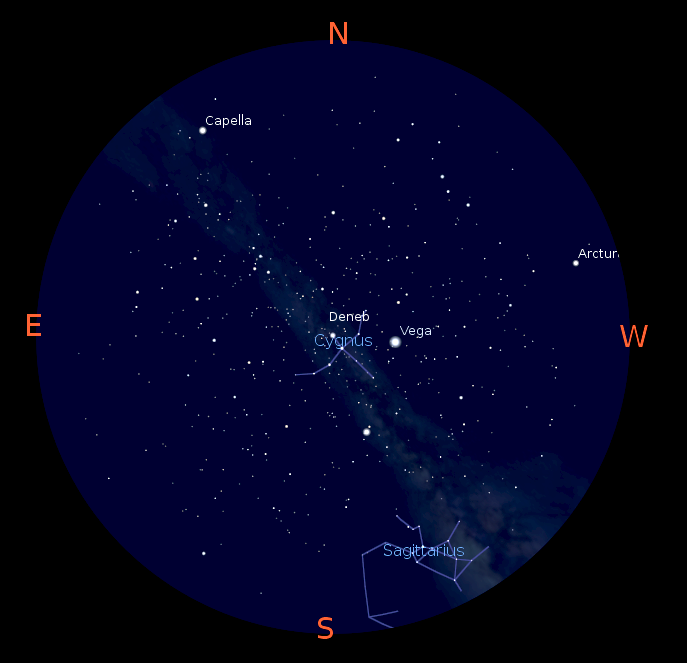
The Milky Way crosses the sky overhead at 10 p.m., September 26, 2013. Horizon to horizon view. Created using Stellarium.
09-24-2013 – Ephemeris – The dragon in the sky
Ephemeris for Tuesday, September 24th. The sun will rise at 7:32. It’ll be up for 12 hours and 3 minutes, setting at 7:35. The moon, 2 days before last quarter, will rise at 10:40 this evening.
High in the northern sky at 9 p.m. lies a twisted constellation, that of Draco the dragon. This dragon is more like the snakelike Chinese dragon than the dinosaur like dragon of European legend. At least that’s how I see it. I find it better to start at the tail of Draco, to trace him out in the stars. Draco’s tail starts between the bowl of the Big Dipper and the Little Dipper. The Dragon is seen in a line of stars that extends parallel to the handle of the Big Dipper before curving around the bowl of the Little Dipper to the east then bends back toward the west. The head of Draco is an odd box of stars near the bright star Vega, nearly overhead. Though not made up of very bright stars, Draco has an easy shape to trace.
Times are for the Traverse City/Interlochen area of Michigan. They may be different for your location.
Addendum
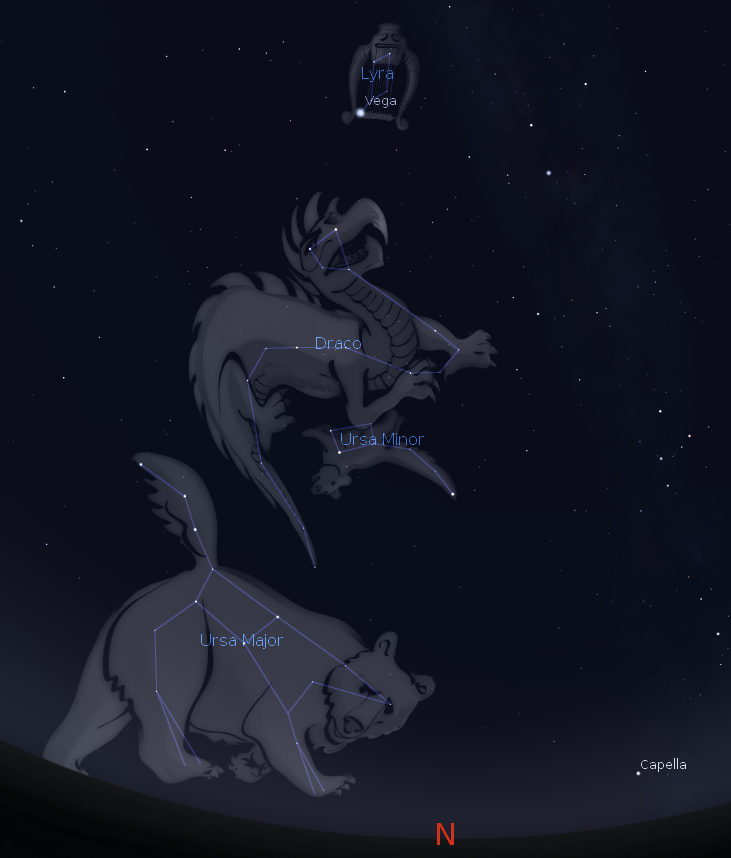
Draco and neighboring constellations at 9 .m. September 24, 2013. Created using Stellarium. Constellation art by Johan Meuris.
09/05/2013 – Ephemeris – The constellation of Andromeda, the chained maiden
Ephemeris for Thursday, September 5th. The sun will rise at 7:09. It’ll be up for 13 hours and 1 minute, setting at 8:11. The moon is new today, and won’t be visible.
In the east at 10 this evening can be found a large square of stars, the Great Square of Pegasus the flying horse. The square is standing on one corner. What look like its hind legs stretching to the left from the left corner star is another constellation, Andromeda the chained maiden. She is seen in the sky as two diverging curved strings of stars that curve upward. She was rescued by the hero Perseus, a nearby constellation, riding his steed Pegasus. Andromeda’s claim to astronomical fame is the large galaxy seen with the unaided eye just above the upper line of stars, the Great Andromeda Galaxy, two and a half million light years away. To the unaided eye the galaxy appears as a small smudge of light. In binoculars the galaxy is a delicate spindle of light.
Times are for the Traverse City/Interlochen area of Michigan. They may be different for your location.
Addendum
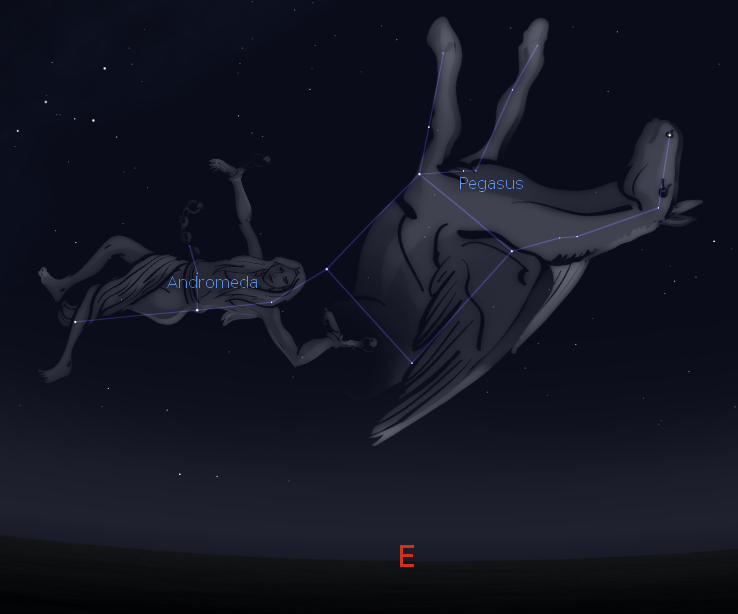
Andromeda and Pegasus images in the stars at 10 p.m. September 5, 2013. Created using Stellarium. Drawing by Johan Meuris.
The constellation lines in Stellarium omit the top strong of stars I see in Andromeda. I’m working on changing that.
09/03/2013 – Ephemeris – The constellation of Pegasus the flying horse
Ephemeris for Tuesday, September 3rd. The sun will rise at 7:07. It’ll be up for 13 hours and 7 minutes, setting at 8:14. The moon, 2 days before new, will rise at 6:20 tomorrow morning.
A reminder that the end of summer is approaching is located in the east around 10 p.m. It’s one of the great autumn constellations: Pegasus the flying horse of Greek myth. Its most visible feature is a large square of four stars, now standing on one corner. This feature, called the Great Square of Pegasus, represents the front part of the horse’s body. The horse is quite aerobatic, because it is seen flying upside down. Remembering that fact, the neck and head is a bent line of stars emanating from the right corner star of the square. Its front legs can be seen in a gallop extending to the upper right from the top star of the square. In Mythology Pegasus was born of the blood of Medusa, decapitated by the hero Perseus, seen as a constellation rising in the northeast.
Times are for the Traverse City/Interlochen area of Michigan. They may be different for your location.
Addendum
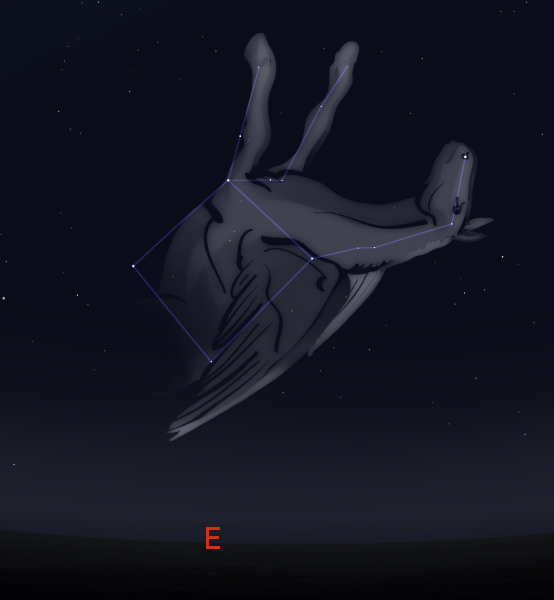
Pegasus image in the stars at 10 p.m. September 3, 2013. Created using Stellarium. Drawing by Johan Meuris.
08/26/2013 – Ephemeris – The constellation of Delphinus the dolphin
Ephemeris for Monday, August 26th. The sun rises at 6:58. It’ll be up for 13 hours and 30 minutes, setting at 8:29. The moon, 2 days before last quarter, will rise at 11:22 this evening.
With Nova Delphinus in our skies let’s take a look at this celestial dolphin. Located below the eastern edge of the Summer Triangle of three of the brightest stars in the sky, which is overhead in our sky at 10 p.m., is the tiny constellation of Delphinus the dolphin. Delphinus’ 6 stars in a small parallelogram with a tail, really does look like a dolphin leaping out of the water. The parallelogram itself has the name Job’s Coffin. The origin of this asterism or informal constellation is unknown. Of the dolphin itself: the ancient Greeks appreciated this aquatic mammal as we do, and told stories of dolphins rescuing shipwrecked sailors. The nova can be spotted in binoculars using the chart at http://www.skyandtelescope.com or below.
Times are for the Traverse City/Interlochen area of Michigan. They may be different for your location.
Addendum
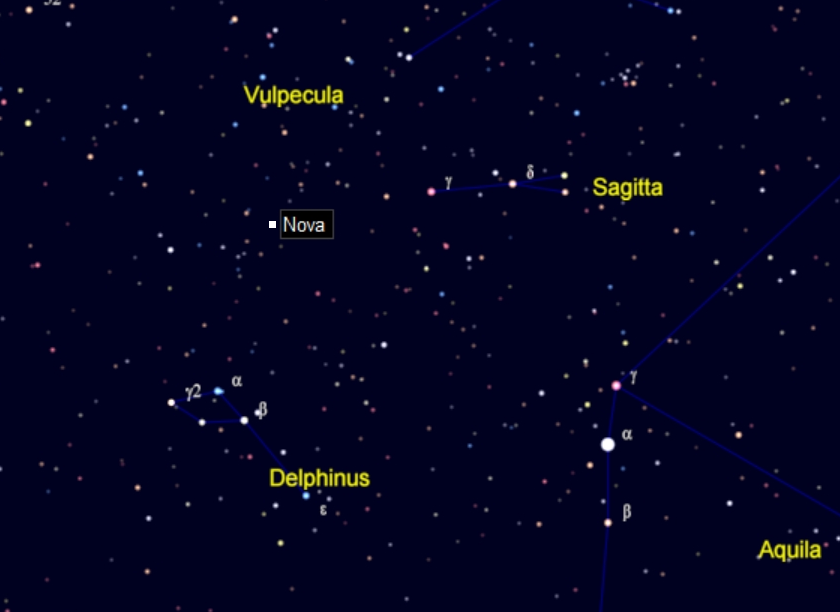
My finder chart for Nova Delphinus 2013. Created using Carte du Ceil (Sky Charts)
The dot for the Nova will show it brighter than it is. It should be fading now.
08/08/2013 – Ephemeris – The wonders located in Scutum the shield
Ephemeris for Thursday, August 8th. The sun rises at 6:37. It’ll be up for 14 hours and 20 minutes, setting at 8:58. The moon, 2 days past new, will set at 9:28 this evening.
The teapot pattern of stars that is the constellation of Sagittarius lies at the southern end of the Milky Way this evening. It appears that the Milky Way is steam rising from the spout. The area above Sagittarius in the brightest part of the Milky Way is the dim constellation of Scutum the shield. Don’t bother looking for the stars that make up the constellation; what’s important is the star clouds of the Milky Way. Scan this area with binoculars or small telescope for star clusters and nebulae or clouds of gas. In binoculars both clusters and nebulae will appear fuzzy, but a small telescope will tell most of them apart. Even if you’ve never been able to find anything in your telescope, put on the lowest power eyepiece you have and scan back and forth for these wonders.
Times are for the Traverse City/Interlochen area of Michigan. They may be different for your location.
Addendum
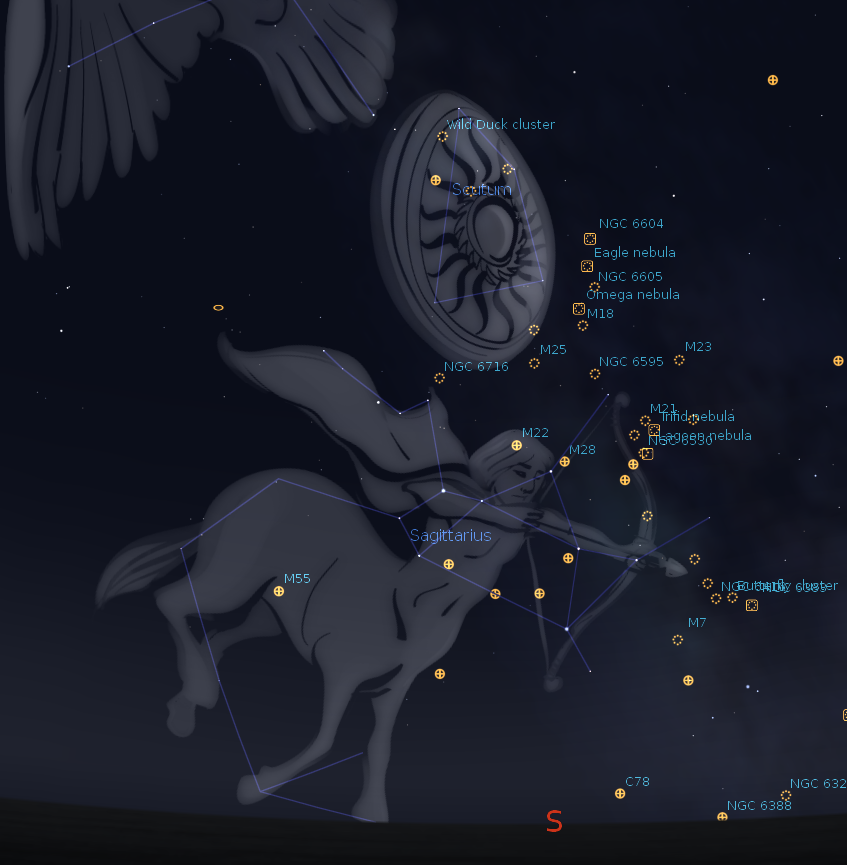
Binocular and telescope deep sky objects in Scutum and Sagittarius. Created using Stellarium.
The symbols mean:
Circle with embedded cross – Globular star cluster (Very old compact star cluster)
Open dotted circle – Open or galactic star cluster (Young loose star cluster)
Square – Nebula (Here emission nebulae. In many cases with associated open clusters)
Ellipse – Galaxy
 Bob Moler's Ephemeris Blog