Archive
04/18/2014 – Ephemeris – The constellation Coma Berenices
Ephemeris for Good Friday, Friday, April 18th. The sun rises at 6:53. It’ll be up for 13 hours and 37 minutes, setting at 8:31. The moon, 3 days past full, will rise at 12:21 tomorrow morning.
High in the southeast at 10 p.m. is a tiny and faint constellation of Coma Berenices, or Berenice’s hair. In it are lots of faint stars arrayed to look like several strands of hair. The whole group will fit in the field of a pair of binoculars, which will also show many more stars. The hank of hair was supposed to belong to Berenice, Queen of Egypt, of the 3rd century BCE. Coma Berenices is the second closest star cluster to us at only 250 light years away, after the Hyades, the face of Taurus the bull now setting in the west. It’s in an odd spot for a galactic star cluster, that’s supposed to lie in the plane of the Milky Way. It actually lies at the galactic pole. That’s an illusion because it’s so close to us. It’s still really in the plane of the Milky Way.
Times are for the Traverse City/Interlochen area of Michigan. They may be different for your location.
Addendum
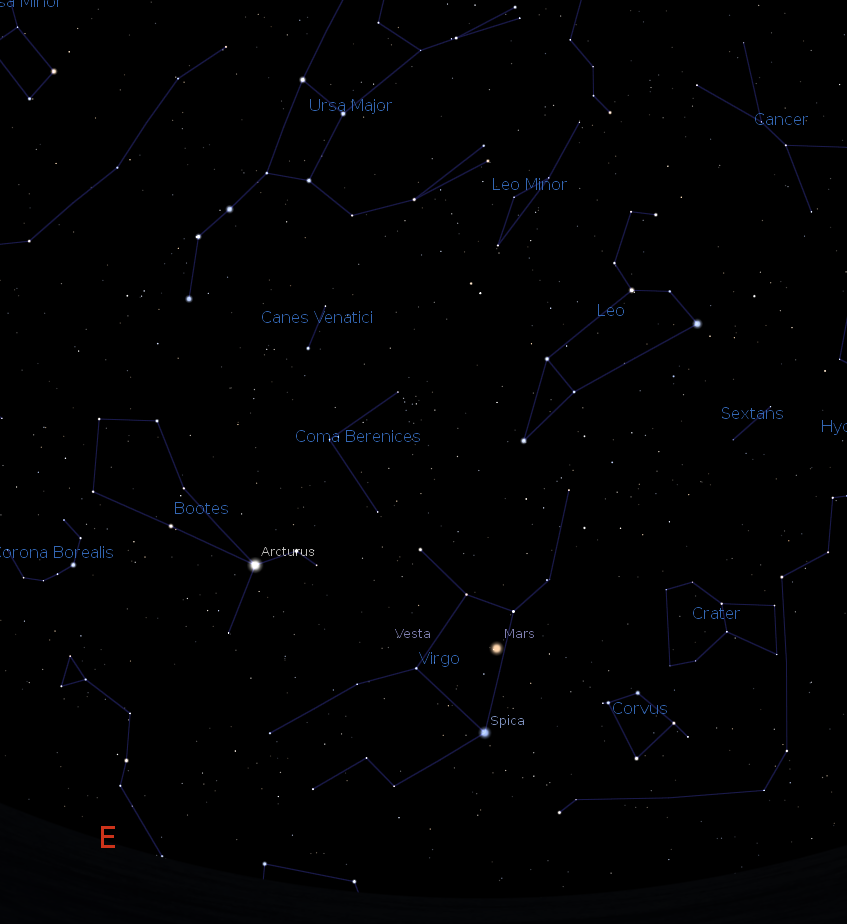
Coma Berenices finder chart for 10 p.m. April 18, 2014. Created using Stellarium.
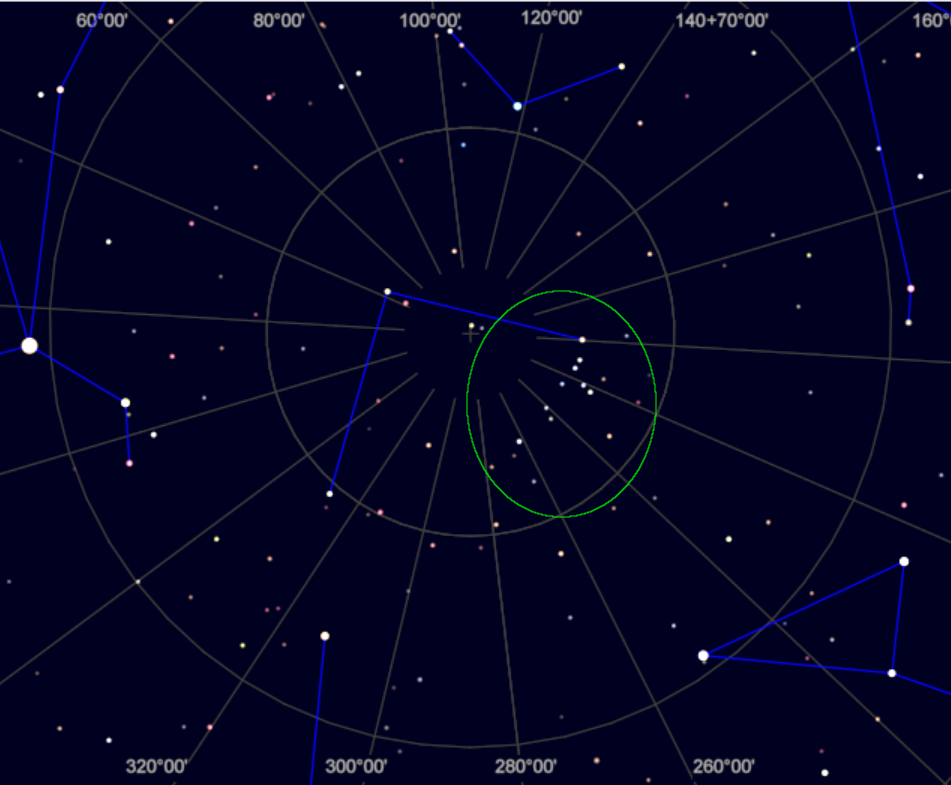
Coma Berenices and galactic coordinates showing how close to the galactic pole it is. Created using Cartes du Ciel
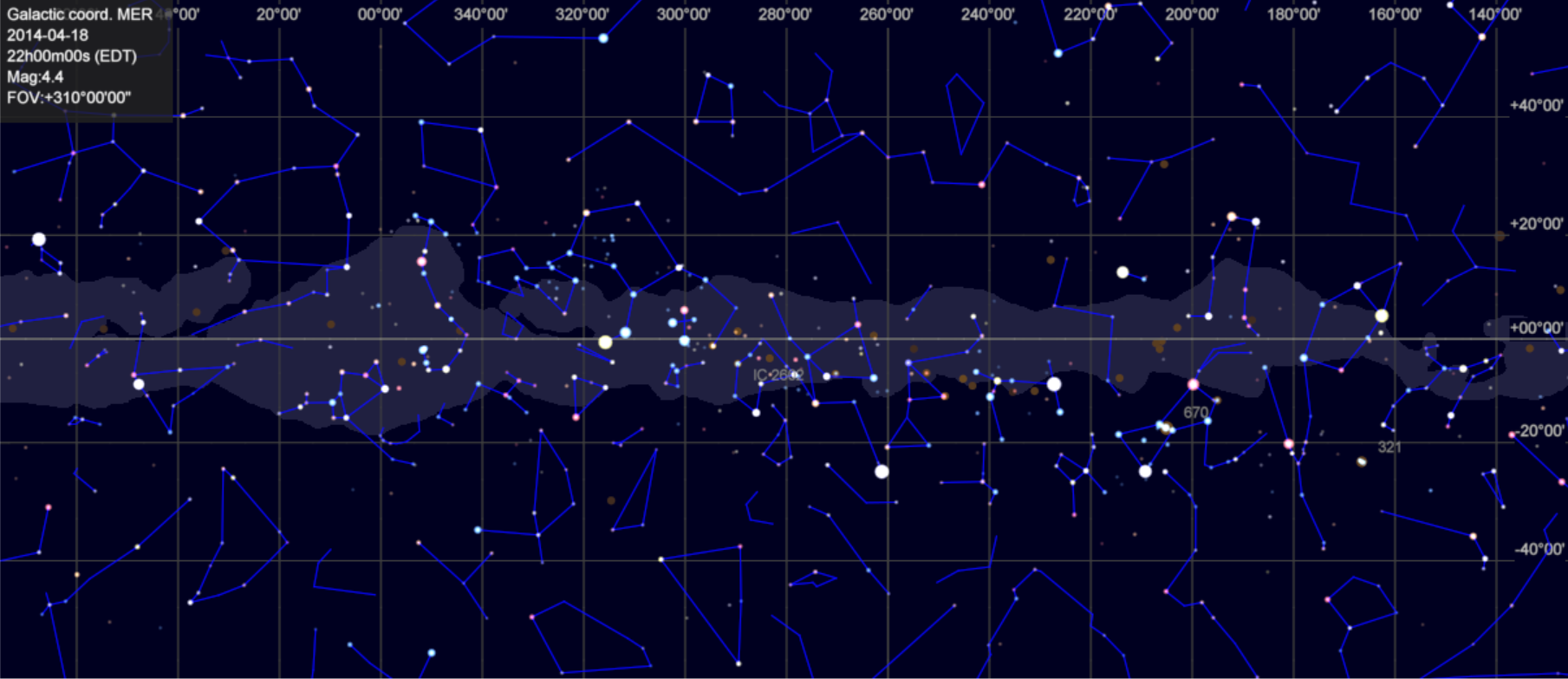
Mercator projection of the Milky Way and some bright open or galactic clusters (brown disks). See how the distribution hugs the milky band. Clusters farther away are either close to us or very old for open clusters. Created using Cartes du Ciel.
04/17/2014 – Ephemeris – Leo and the bright star Regulus
Ephemeris for Thursday, April 17th. The sun rises at 6:54. It’ll be up for 13 hours and 34 minutes, setting at 8:29. The moon, 2 days past full, will rise at 11:19 this evening.
High in the south at 10 p.m. is a pattern of stars that’s in the shape of a backward question mark. This informal star group or asterism, is also called the sickle. It is the head and mane of the official zodiacal constellation of Leo the lion. To the left is a triangle of stars is his hind end. The bright star at the bottom of the question mark, or end of the sickle’s handle is Regulus, the “Little King Star”, alluding to the lion’s status as the king of the jungle. Regulus is about 79 light years away and is a 4 star system that exists as two star pairs. The bright star Regulus itself and a companion too close to be imaged directly in telescopes, and a nearby pair of dim stars make up the system. The Moon often passes in front of Regulus, since it’s close its path.
Times are for the Traverse City/Interlochen area of Michigan. They may be different for your location.
Addendum
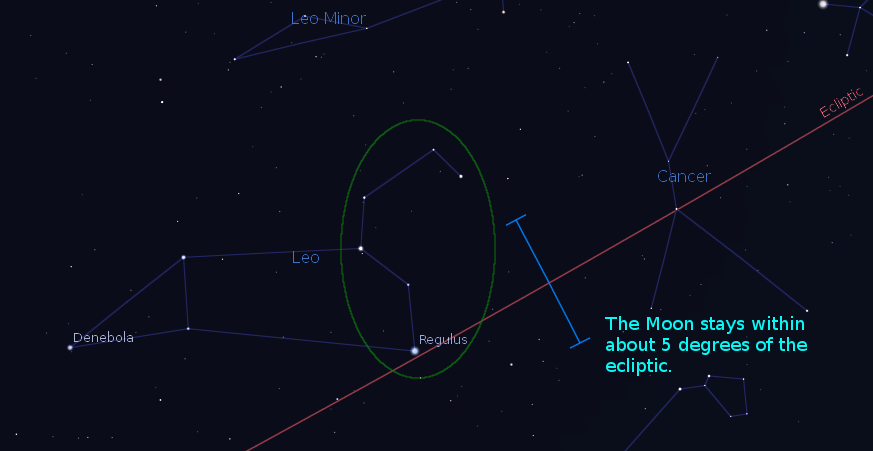
Leo’s sickle and backward question mark asterisms circled in green. Note that it is within the range of the moon’s orbit so it can be covered or occulted by the Moon. Created using Stellarium.
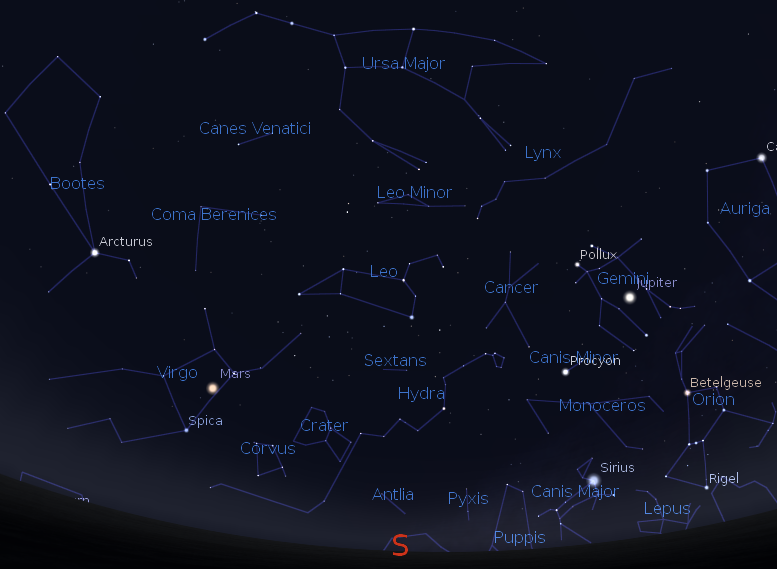
Leo finder chart for 10 p.m. April 17, 2014. Created using Stellarium.
03/24/2014 – Ephemeris – The spring constellation of Leo the lion
Ephemeris for Monday, March 24th. The sun will rise at 7:38. It’ll be up for 12 hours and 21 minutes, setting at 7:59. The moon, 1 day past last quarter, will rise at 4:09 tomorrow morning.
Tonight about 10:00 the constellation of Leo the lion can be seen half way up the sky in the east-southeast. The head and mane of a male lion is seen as a backward question mark. This pattern of stars is also called the sickle. The bright star that is the dot at the bottom is Regulus, the “Little King Star”. To the lower left is a triangle of stars that is the lion’s hind end with the star Denebola at the far end. It is said that the reason the figure of a lion came to be seen in the stars here is because lions came from the desert, driven by the heat, to drink from the river Nile the time of the year that the sun was in this part of the sky. Leo is one of the constellations of the Zodiac. Leo can also be found by first locating the Big Dipper high in the northeast. Imagine a hole drilled in the bowl of the dipper and the water will fall on Leo’s back.
Times are for the Traverse City/Interlochen area of Michigan. They may be different for your location.
Addendum
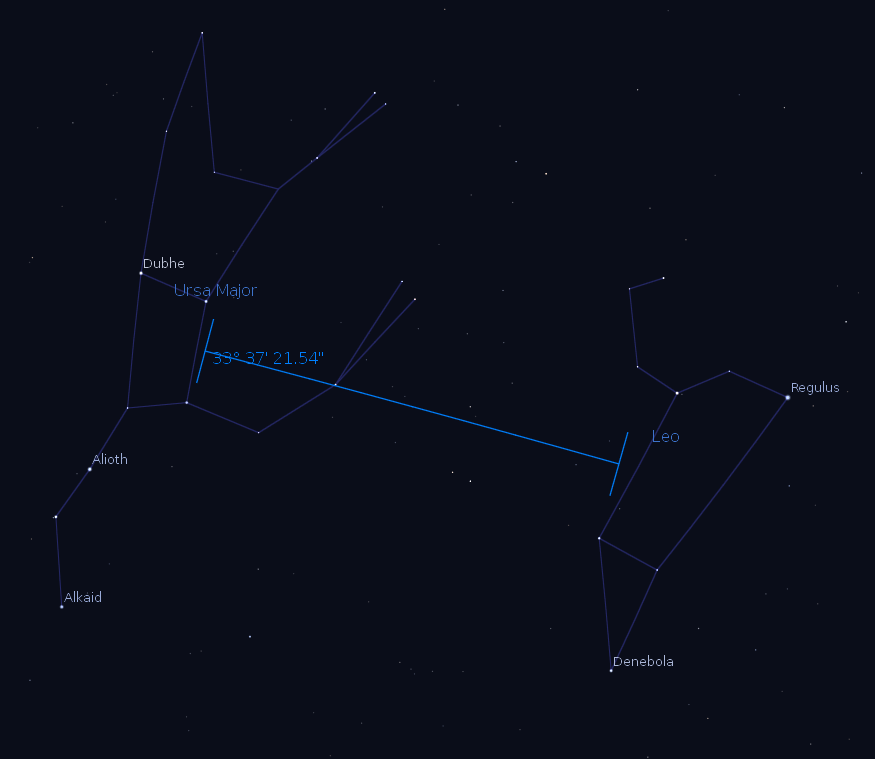
Leo and the Big Dipper (Ursa Major) using the angle measuring tool as an arrow. Date: March 24, 10 p.m. Created using Stellarium.
03/03/2014 – Ephemeris – The dim zodiacal constellation of Cancer the Crab
Ephemeris for Monday, March 3rd. The sun will rise at 7:16. It’ll be up for 11 hours and 16 minutes, setting at 6:33. The moon, 2 days past new, will set at 9:44 this evening.
At 9 this evening, the faint constellation, and member of the Zodiac, Cancer the crab is located in the south-southeast half way between the bright stars Castor and Pollux of the constellation Gemini, high in the south and the bright star Regulus in Leo the lion in the east Cancer is very dim, looking like an upside-down Y. In the center of Cancer is a fuzzy spot to the unaided eye. In binoculars or a low power telescope this fuzzy spot becomes a cluster of stars. It is the Beehive cluster. At 525 light years away, it is one of the closest star clusters, but more distant than the Pleiades and Hyades the face of Taurus the bull. Back a few thousand years ago Cancer was the farthest north of the constellations, Gemini has that honor today.
Times are for the Traverse City/Interlochen area of Michigan. They may be different for your location.
Addendum
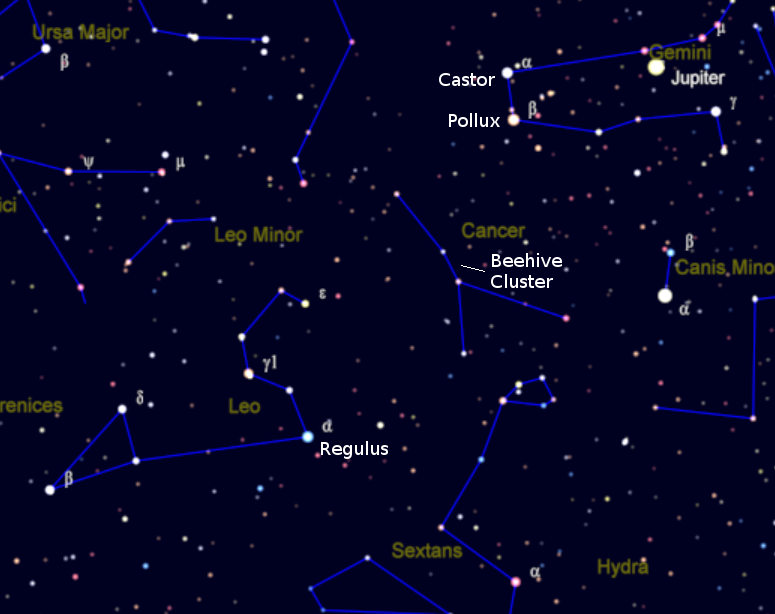
The constellation Cancer the crab at 9 p.m. March 3, 2014. Created using Cartes du Ciel (Skycharts).
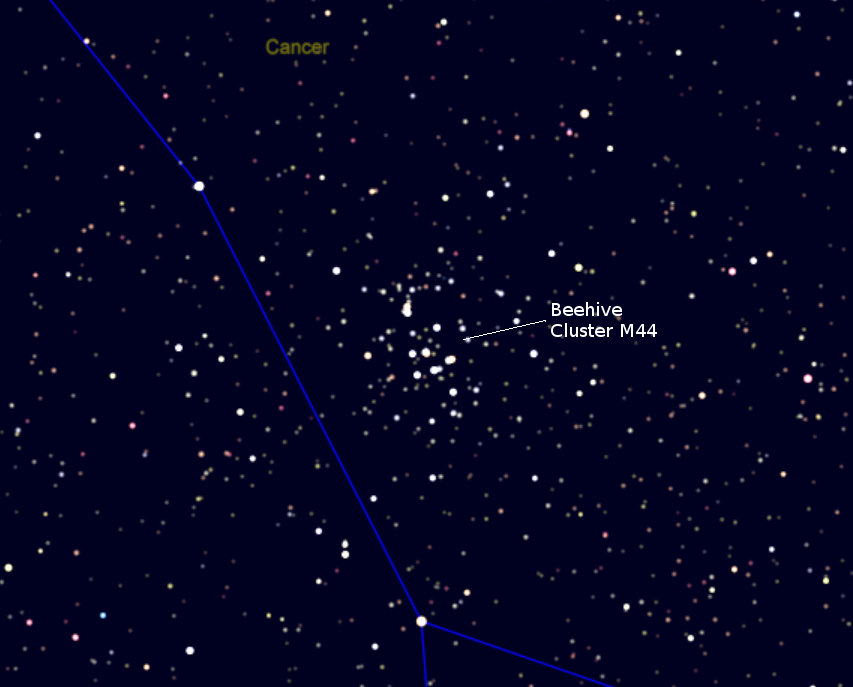
The Beehive star cluster, M44. Its ancient name was the Praesepe or manger when glimpsed by the naked eye. Created using Cartes du Ciel (Skycharts)
02/27/2014 – Ephemeris – Lepus the hare, the rabbit that got away
Ephemeris for Thursday, February 27th. The sun will rise at 7:23. It’ll be up for 11 hours and 4 minutes, setting at 6:27. The moon, 2 days before new, will rise at 6:36 tomorrow morning.
Orion, the central winter constellation is seen in the south at 9 p.m. He is a hunter, but he’s preoccupied with the charge of Taurus the bull from the upper right. At Orion’s feet, and unnoticed by him is the small constellation of Lepus the hare. It’s very hard to see a rabbit in its eight dim stars: however, I do see a rabbit’s head ears and shoulders. A misshapen box is the head and face of this critter facing to the left. His ears extend upwards from the upper right star of the box, and the bend forward a bit. Two stars to the right of the box and a bit farther apart hint at the front part of the body. In Lepus telescopes can find M79, a distant globular star cluster, one of the few of these compact star clusters visible in the winter sky.
Times are for the Traverse City/Interlochen area of Michigan. They may be different for your location.
Addendum
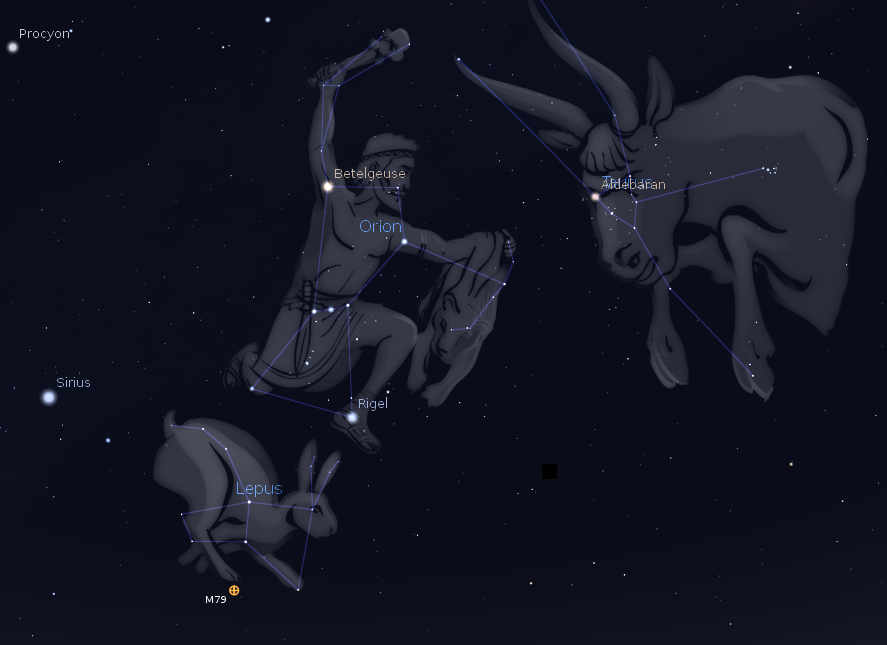
Lepus the hare as imagined in Stellarium. I haven’t added the four stars in the ears as I saw it based on the older Sky and Telescope magazine star charts.
Globular star cluster M79 is very distant: 41,000 light years from us and 60,000 light years from the center of the Milky Way. It possibly was a member of the Canis Major Dwarf Galaxy that seems to have become entangled with our own Milky Way galaxy. That’s what massive galaxies do to smaller, less massive dwarf galaxies: “Resistance is futile, you will be assimilated”.
02/20/2014 – Ephemeris – Winter Circle plus 1
Ephemeris for Thursday, February 20th. The sun will rise at 7:34. It’ll be up for 10 hours and 43 minutes, setting at 6:18. The moon, 2 days before last quarter, will rise at 12:27 tomorrow morning.
The winter skies are blessed with more first magnitude stars than any other season. Six of these stars lie in a large circle centered on the seventh. This circle is up at 9 p.m. Starting high overhead is Capella in Auriga the charioteer. Moving down clockwise is Aldebaran in the face of Taurus the Bull. Then down to Orion’s knee we find Rigel. Down and left is the brightest star of all Sirius the Dog Star in Canis Major, lowest of these stars in the south-southeast. Moving up and left is Procyon in Canis Minor, Above Procyon is Pollux in Gemini the twins. All these are centered on Betelgeuse the bright red star in Orion’s shoulder. The interloper this year is Jupiter which is situated in Gemini and outshines them all.
Times are for the Traverse City/Interlochen area of Michigan. They may be different for your location.
Addendum
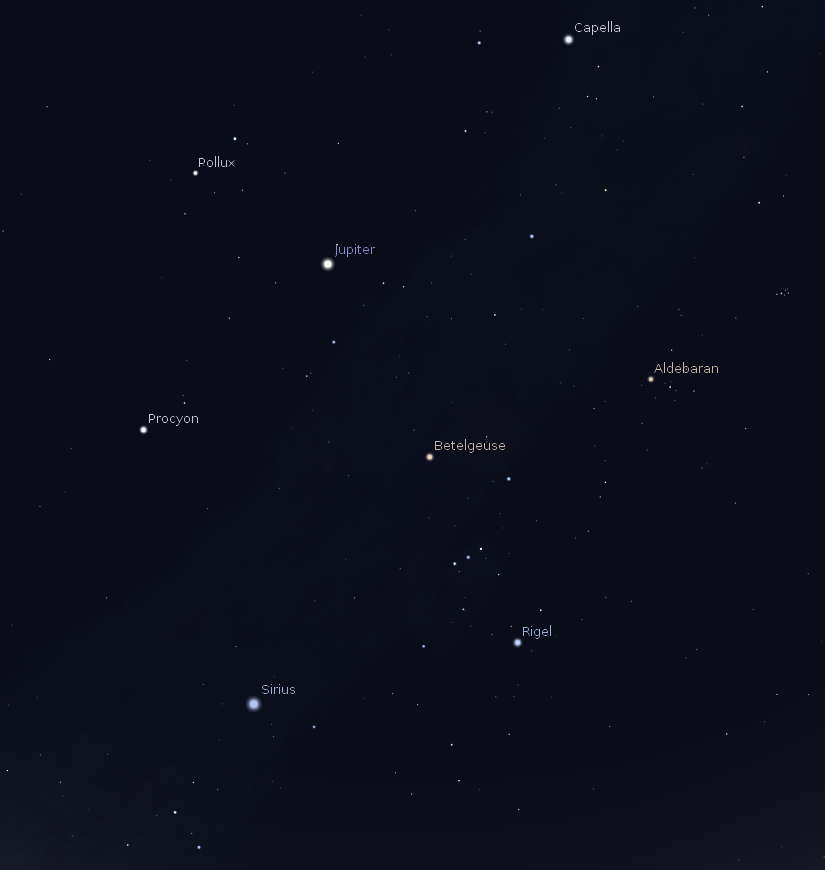
The Winter Circle plus Jupiter at 9 p.m. on February 20, 2014. Created using Stellarium.
02/18/2014 – Ephemeris – Gemini and the summer solstice
Ephemeris for Tuesday, February 18th. The sun will rise at 7:38. It’ll be up for 10 hours and 37 minutes, setting at 6:15. The moon, half way from full to last quarter, will rise at 10:19 this evening.
The constellation Gemini lies above and left of Orion in the southern evening sky. Jupiter is now seen against its stars. Gemini is called the twins and its head stars at the upper left of the constellation are Castor and Pollux. Pollux is to the lower left of Castor. Stick figures of the lads can be seen extending to the lower right of these stars. Currently the place in the sky where the sun is on the winter solstice is just to the right of Castor’s big toe. So it would seem that the sun is entering Gemini on the first day of summer, not Cancer as the astrologers would tell you. That solstice point is moving westward at one degree every 71.6 years, a motion called precession. I checked two astronomy programs and that point has now moved into Taurus the bull.
Times are for the Traverse City/Interlochen area of Michigan. They may be different for your location.
Addendum
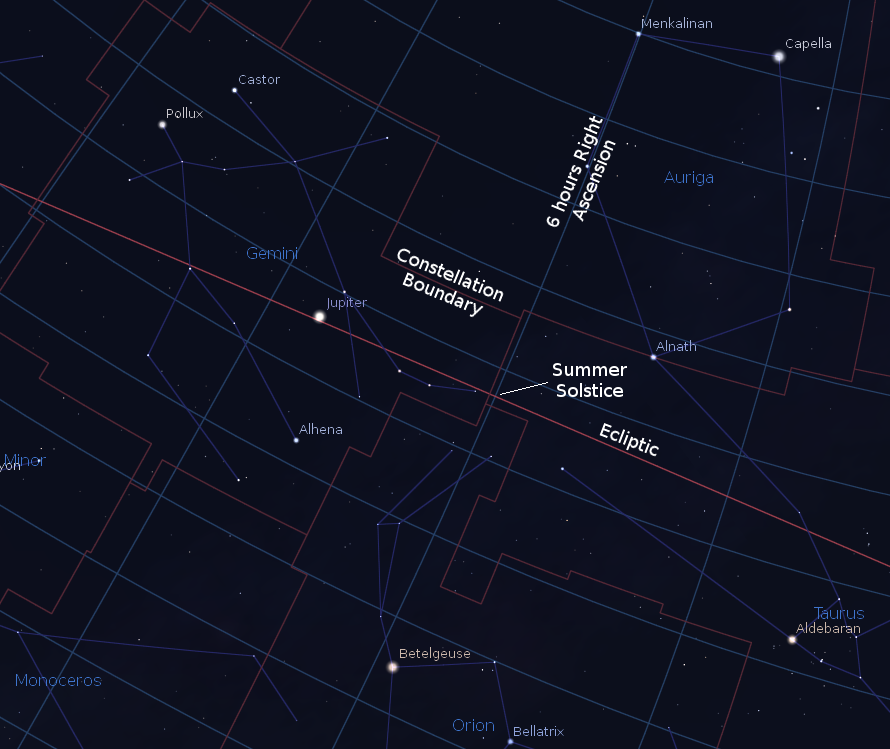
The constellation Gemini and the summer solstice point in the sky. Created using Stellarium.
The summer solstice point in the sky is the intersection of the ecliptic, the suns path in the sky and the 6 hour line of right ascension which is like longitude on the earth. The other blue lines are lines are lines of declination which is like latitude in the sky. Note also that the summer solstice point is the point on the ecliptic closest to the blue declination line which is the 25º north declination line. It’s at approximately 23½º north declination, right over the earth’s 23½º north latitude line also known as the Tropic of Cancer.
Back a couple of thousand of years ago the sun was entering the constellation of Cancer, off our image to the left, on the first day of summer. Since then the summer solstice point has moved westward against the stars at one degree every 71.6 years. This is due to what is called general precession, of the slow wobble of the earth’s axis caused by the pull of the Moon and Sun on the Earth’s equatorial bulge. This torques the earth and causes the 26,000 year wobble, like a spinning top. Since back then the solstice point passed all the way across Gemini and in 1989 entered the territory of Taurus.
02/03/2014 – Ephemeris – Why we don’t see unicorns anymore
Ephemeris for Monday, February 3rd. The sun will rise at 7:58. It’ll be up for 9 hours and 55 minutes, setting at 5:54. The moon, 3 days before first quarter, will set at 10:58 this evening.
Among all the constellations in the sky of animals real and mythical, there is also a unicorn. It’s called Monoceros, and inhabits the southern sky at 9 p.m. bounded by Orion on the right, Canis Major, the great dog below and Canis Minor, the little dog to the left. Unfortunately for observers without optical aid Monoceros, though large, is devoid of any but the faintest stars. Maybe that’s why no one sees unicorns anymore. It has many faint stars because the Milky Way runs through it. To the telescope it is a feast of faint nebulae or clouds of gas and dust, the birth place of stars, including the red rose of the Rosette Nebula, and the strange and tiny Hubble’s Variable Nebula. It contains no bright stars, but a wealth of wonders below the surface so to speak.
Times are for the Traverse City/Interlochen area of Michigan. They may be different for your location.
Addendum
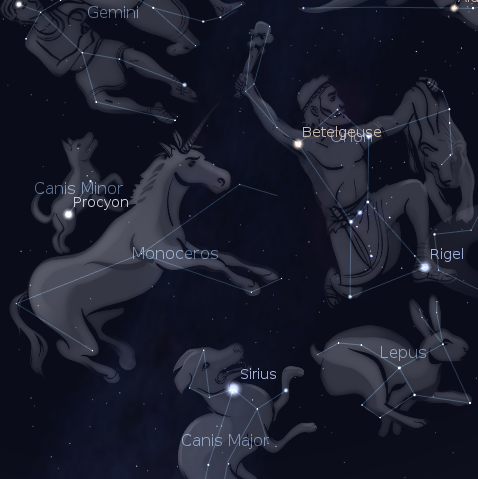
Moniceros the unicorn. See really, really dim stars. Created using Stellarium.
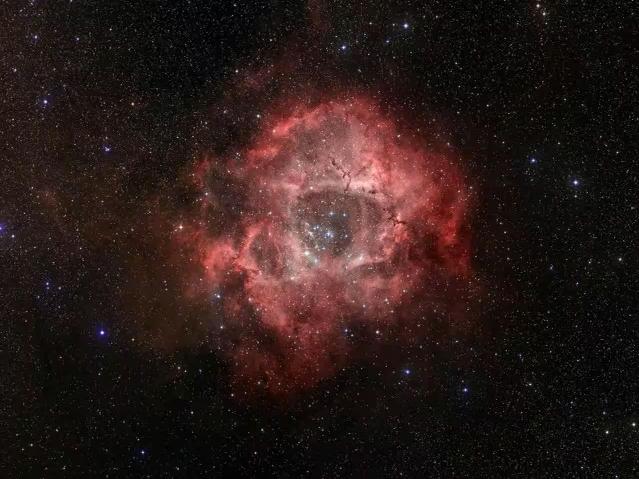
Rosette Nebula in the infrared from the Spitzer Space Telescope. Credit: NASA/JPL/Caltech
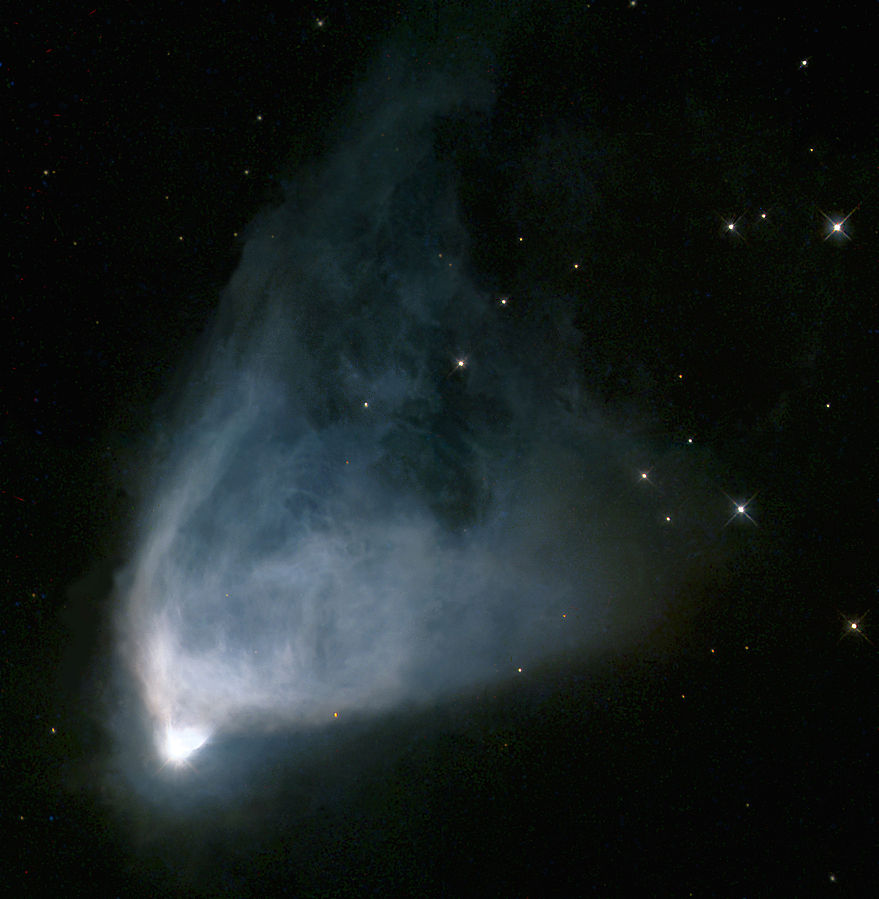
Hubble’s Variable Nebula photographed appropriately enough by the Hubble Space Telescope. Credit: NASA/ESA and The Hubble Heritage Team (AURA/STScI).

Another nebula: The Cone Nebula as seen with the Hubble Space Telescope. Credit ESA/Hubble
01/24/2014 – Ephemeris – The constellation of Auriga the charioteer
Ephemeris for Friday, January 24th. The sun will rise at 8:09. It’ll be up for 9 hours and 30 minutes, setting at 5:40. The moon, at last quarter today, will rise at 2:37 tomorrow morning.
The constellation Auriga the charioteer is nearly overhead at 9 p.m. It is a pentagon of stars, with the brilliant star Capella at one of its corners. Capella represents a she goat he’s carrying. A narrow triangle of stars nearby Capella is her kids. The Kids is an informal constellation or asterism. Within and near that pentagon, binoculars and telescopes will find several star clusters, groups of hundreds of stars born in the clump we still see them in. These star clusters will appear as fuzzy spots in binoculars. One called M38 is near the center of the pentagon. Another, M36 is to the east of it. Still another star cluster, M37, is farther east, just outside the pentagon. The M designations come from Charles Messier who 2 centuries ago ran into them while looking for comets.
Times are for the Traverse City/Interlochen area of Michigan. They may be different for your location.
Addendum
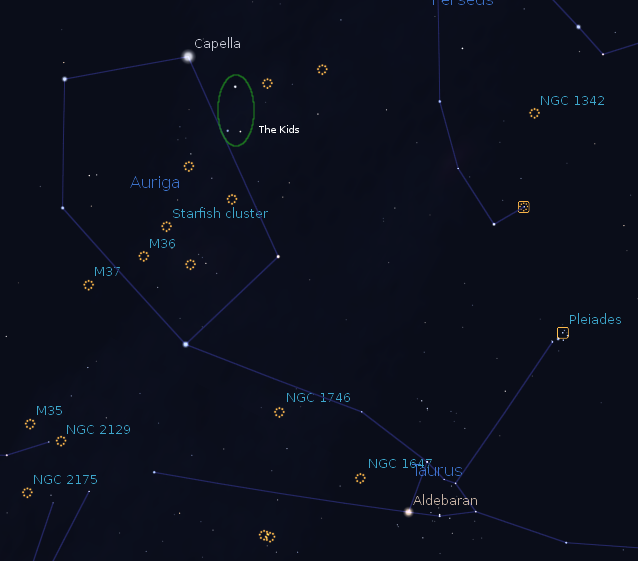
Auriga the charioteer with Taurus below. M38 here is called the Starfish Cluster, a name I am unfamiliar. Created using Stellarium.
01/23/2014 – Ephemeris – The river Eridanus
Ephemeris for Thursday, January 23rd. The sun will rise at 8:10. It’ll be up for 9 hours and 28 minutes, setting at 5:38. The moon, 1 day before last quarter, will rise at 1:31 tomorrow morning.
There is a long and sinuous constellation that’s part of the winter sky. It is Eridanus, which depicts a river. The river starts near the lower right corner of Orion, near the bright star Rigel and flows to the right then down near the southern horizon, then it meanders below the horizon. One has to travel to the far southern United States or even farther south to see the southern terminus of the river, the bright star Achernar. Writers over the ages have seen here the Nile and the earth circling river Ocean of the flat earth days. One of its stars is close to us and famous. It’s Omicron 2 Eridani a triple star system and the fictional home to Mr. Spock and other Vulcans of the Star Trek franchise. No real planet has been found there. Yet.
Times are for the Traverse City/Interlochen area of Michigan. They may be different for your location.
Addendum
Note: In previous posts about Eridanus I had identified Epsilon Eridani and the fictional Mr. Spock’s home star. It’s actually Omicron 2 according to Gene Roddenberry himself.
Speaking of Vulcan, Star Trek fans nominated Vulcan for one of the names for Pluto’s latest two satellites, apparently forgetting that Vulcan was borrowed from Roman mythology as the god of fire, and the history of astronomy. Pluto and its satellites are some of the coldest bodies in the solar system, and the International Astronomical Union (IAU) had designated that the satellites carry on the Pluto and Hades or underworld theme. Anyway, in the mid 19th century some astronomers thought they discovered a planet that resided inside the orbit of Mercury and named it appropriately, Vulcan. If anything is ever found orbiting inside Mercury, it may get the name Vulcan. As for the names of the latest two moons of Pluto, they are Styx named after the the River Styx; and Kerberos, Greek for Cerberus the three headed dog that guards the entrance to Hades. Harry Potter fans may know this creature better as “Fluffy”.
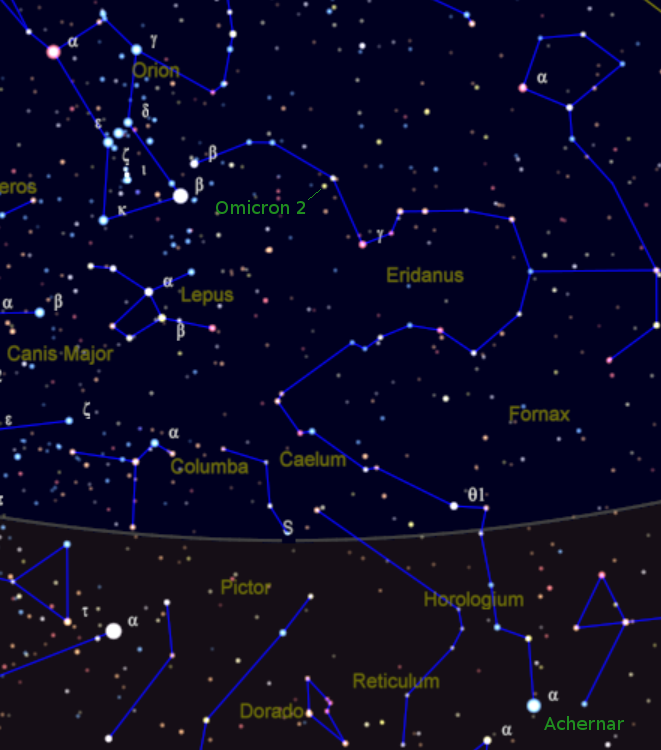
The constellation of the river Eridanus above and below the horizon for 9 p.m. on January 23, 2014. Created using Cartes du Ciel (Sky Charts).
 Bob Moler's Ephemeris Blog