Archive
05/28/2013 – Ephemeris – Boötes the bear chaser
Ephemeris for Tuesday, May 28th. Today the sun will be up for 15 hours and 14 minutes, setting at 9:17. The moon, half way from full to last quarter, will rise at 12:34 tomorrow morning. Tomorrow the sun will rise at 6:02.
Appearing high in the southeastern sky at 10:30 tonight is the kite shaped constellation of Boötes the herdsman. The bright star Arcturus is at the bottom of the kite, pointed to by the arc of the handle of the Big Dipper, overhead. In one story Boötes represents a young hunter named Arcas, son of Callisto, a beautiful young lady who had the misfortune of being loved by Zeus the chief Greek god. Zeus’ wife Hera, found out about it, and since she couldn’t punish Zeus, turned Callisto into an ugly bear. Arcas, unaware of why his mother disappeared in his youth was about to kill the bear when Zeus intervened and placed them both in the sky. Now Arcas as Boötes chases the Great Bear forever around the pole of the sky each day and night.
Times are for the Traverse City/Interlochen area of Michigan. They may be different for your location.
Addendum
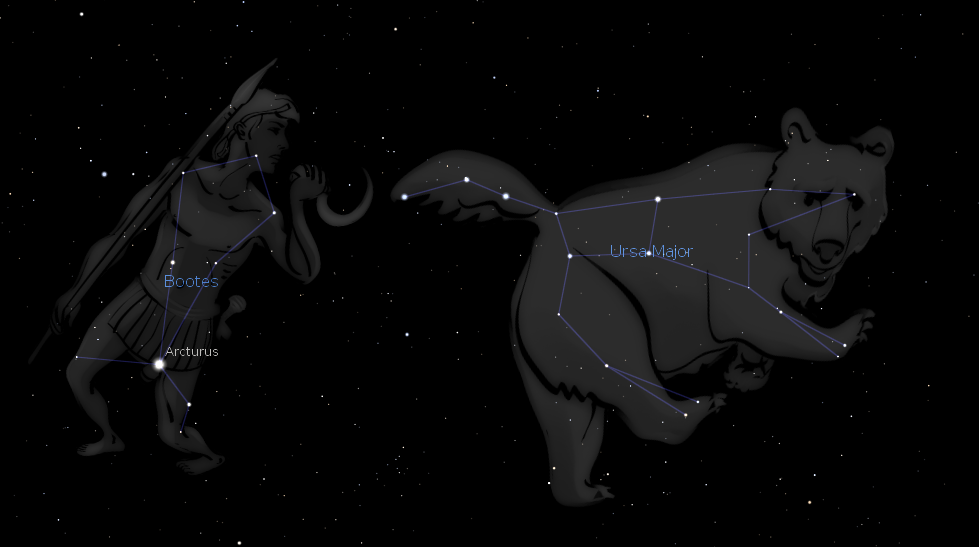
Bootes and Ursa Major high overhead on late spring evenings at 11 p.m. Created using Stellarium.
05/14/2013 – Ephemeris – How to find two bright spring stars.
Ephemeris for Tuesday, May 14th. Today the sun will be up for 14 hours and 47 minutes, setting at 9:02. The moon, 4 days before first quarter, will set at 12:48 tomorrow morning. Tomorrow the sun will rise at 6:14.
The Big Dipper, now pretty much overhead points to several stars and constellations. It’s handle points to two bright stars. First we follow the arc of the handle to the bright orange star Arcturus, the 4th brightest night time star. The reason I say night time is that the sun is a star also but by definition is not out at night. The arc to Arcturus is a how to find Arcturus and a clue to its name. Arcturus, high in the east southeast, lies at the base point of the kite shaped constellation of Boötes the herdsman. From Arcturus, straighten out the arc to a spike and one soon arrives at Spica a blue-white star in Virgo the virgin, now low in the southeast. Saturn is to its left this year. Spica is also sometimes pronounced “Speeka”.
Times are for the Traverse City/Interlochen area of Michigan. They may be different for your location.
Addendum
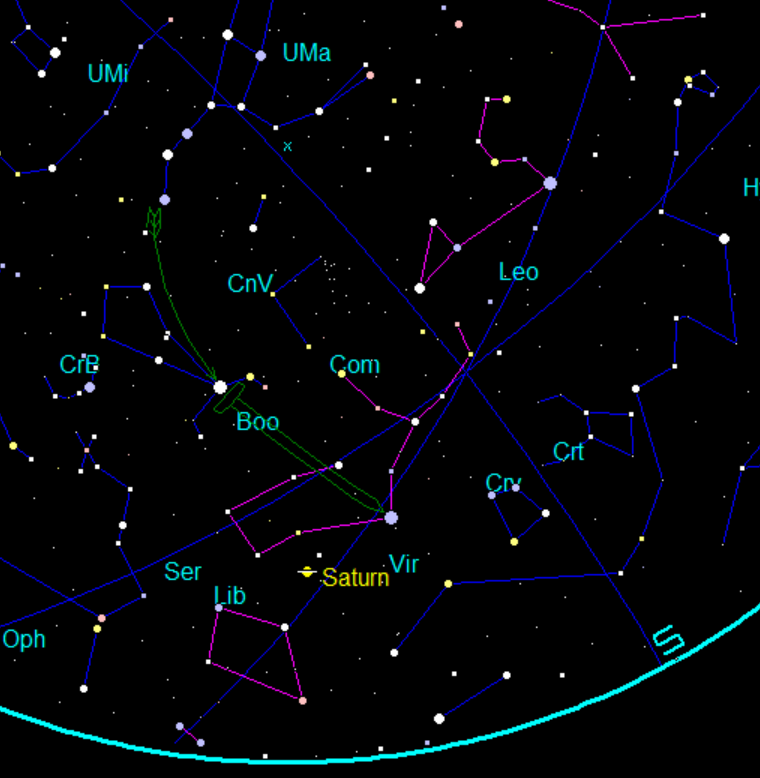
My program that shows the arc to Arcturus and spike to Spica.
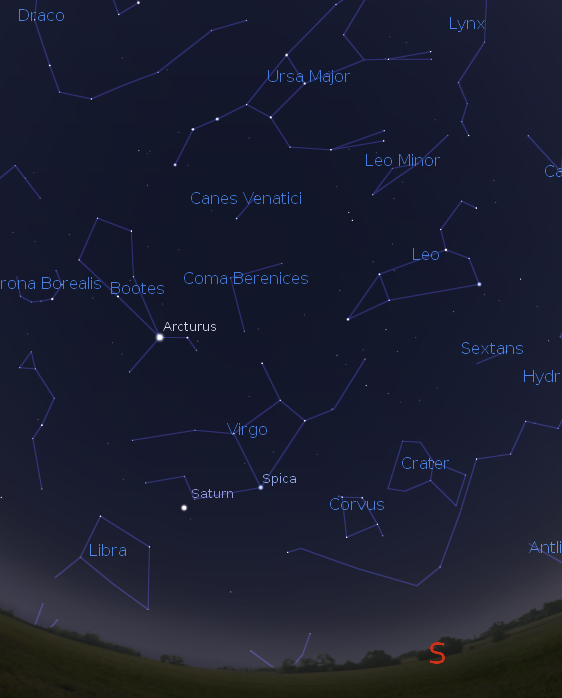
A more realistic view of the same part of the sky. Created using Stellarium.
05/07/2013 – Ephemeris – Berenice’s celestial hairdo
Ephemeris for Tuesday, May 7th. The sun rises at 6:24. It’ll be up for 14 hours and 30 minutes, setting at 8:54. The moon, 2 days before new, will rise at 5:33 tomorrow morning.
High in the south southeast at 10 p.m. is a tiny and faint constellation of Coma Berenices, or Berenice’s hair. In it are lots of faint stars arrayed to look like several strands of hair. The whole group will fit in the field of a pair of binoculars, which will also show many more stars. The story behind it was that Berenice was the Queen of Egypt, whose husband was away at war. This was in the days when the Greeks ruled Egypt after Alexander conquered it. She offered her golden tresses to the gods for the king’s safe return. The hair, was placed in a temple. However the offering disappeared when the king returned. Ever since then the constellation of Coma Berenices has been seen to commemorate the queen’s sacrifice.
Times are for the Traverse City/Interlochen area of Michigan. They may be different for your location.
Addendum

Coma Berenices via Stellarium
05/06/2013 – Ephemeris – The Constellation Leo the Lion and its meaning to the ancients
Ephemeris for Monday, May 6th. The sun rises at 6:25. It’ll be up for 14 hours and 28 minutes, setting at 8:53. The moon, 3 days before new, will rise at 5:03 tomorrow morning.
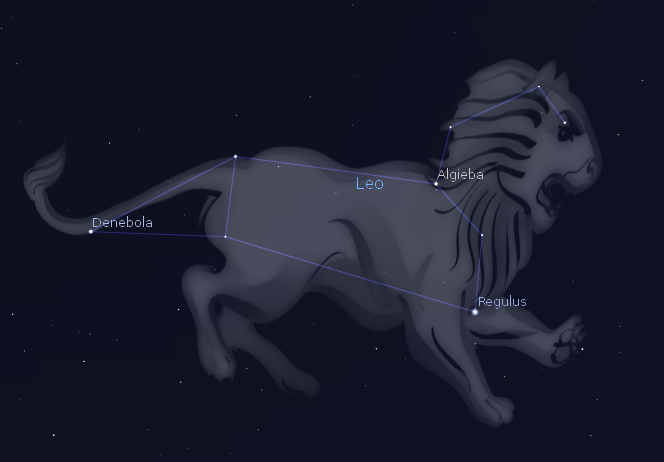
Leo the lion’s image as displayed by Stellarium for May 6, at 10 p.m. due south.
The constellation of Leo the lion is seen in the south at 10:30 p.m. Regulus lies at the bottom of a backwards question mark of stars that are his head and mane. This backwards question mark is also known as the asterism or informal constellation of the Sickle. To the left of the Sickle is a triangle of stars that are his haunches. As the lion is the king of beasts it is fitting that its brightest star Regulus means “Little King Star”. It was thought in ancient Egypt that the heat of summer, when the sun was in Leo drove the lions to drink the waters of the Nile. The lion was also the symbol of the Israelite tribe of Judah, from Jacob’s prophesy in Genesis, and as such may have played a part in the origin of the Star of Bethlehem.
Times are for the Traverse City/Interlochen area of Michigan. They may be different for your location.
04/11/2013 – Ephemeris – The Big Dipper and Ursa Major the Great Bear
Ephemeris for Thursday, April 11th. The sun will rise at 7:04. It’ll be up for 13 hours and 17 minutes, setting at 8:22. The moon, 1 day past new, will set at 10:01 this evening.
The Big Dipper is now nearly overhead in the northeast at 10 p.m. The seven bright stars are second to Orion in the west as the seven brightest stars in a constellation. If you looked up a list of constellations, you’d find that the Big Dipper isn’t there. Ursa Major or the Great Bear is the constellation of which the Big Dipper is a part. The seven bright stars of the dipper is the rump and long tail of this constellation. The rest of the bear, including his head and legs are delineated by dimmer stars. An anatomical problem is its long tail, which was drawn in by the ancients of the old world. Many Native Americans, also saw a bear in the stars here, but the handle of the dipper became three hunters following the bear.
Times are for the Traverse City/Interlochen area of Michigan. They may be different for your location.
Addendum
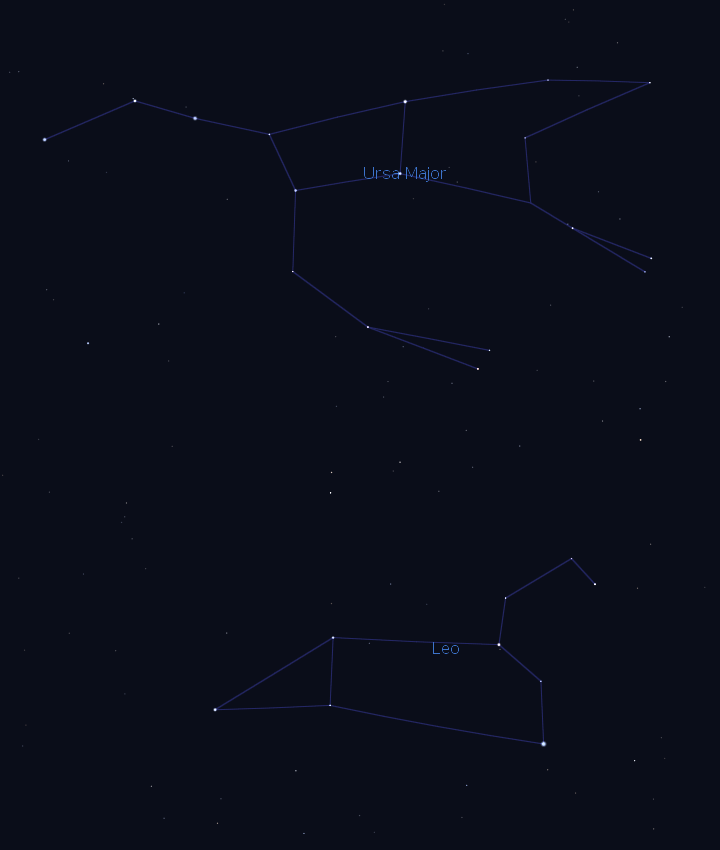
The Big Dipper part of Ursa Major with Leo right below in spill range. This is for 10 p.m. on April 11, 2013. Created using Stellarium.
04/09/2013 – Ephemeris – Hydra the water snake
Ephemeris for Tuesday, April 9th. The sun will rise at 7:08. It’ll be up for 13 hours and 11 minutes, setting at 8:20. The moon, 1 day before new, will rise at 7:01 tomorrow morning.
In the southwest to southeastern sky at 11 p.m. can be found the constellation of Hydra the water snake. Unlike the monster of the same name this Hydra has but one head, which is its most distinctive part. After 10 p.m. look to the south to southwest. The head of Hydra is located below a line from the constellation Leo the Lion in the south and Gemini high in the west southwest. Hydra’s head is a small but distinctive group of 6 stars that make a drooping loop to the right. The rest of Hydra wends its way just above the southern horizon ending under Virgo below the star Spica and ends near Saturn. To astronomers constellations have distinct boundaries like congressional districts, and Hydra is one long Gerrymander*.
Times are for the Traverse City/Interlochen area of Michigan. They may be different for your location.
Addendum
* Gerrymander – A method of drawing Congressional Districts of supposed equal population so that it benefits the party in power at the time. Names after Governor Gerry of Massachusetts in 1812 when one of the districts he drew looked like a salamander. I checked Wikipedia and we ain’t the only ones. Actually Hydra is quite linear, being a snake. It is the longest constellation. Actually Eridanus and Draco are more crooked.
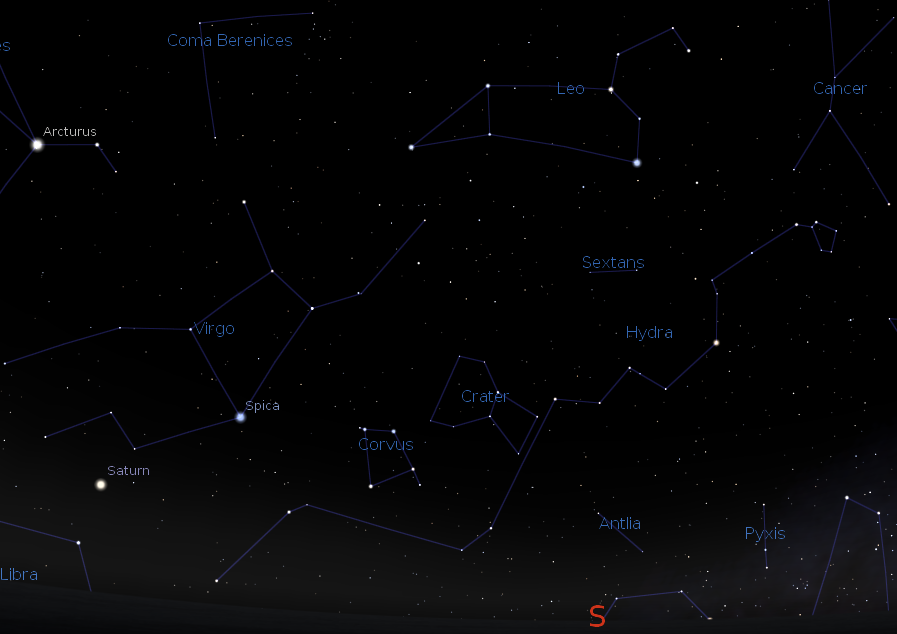
Hydra the water snake seen at 11 p.m. on April 9, 2013. Created using Stellarium.
Below are the official boundaries of Hydra and the nearby constellations.
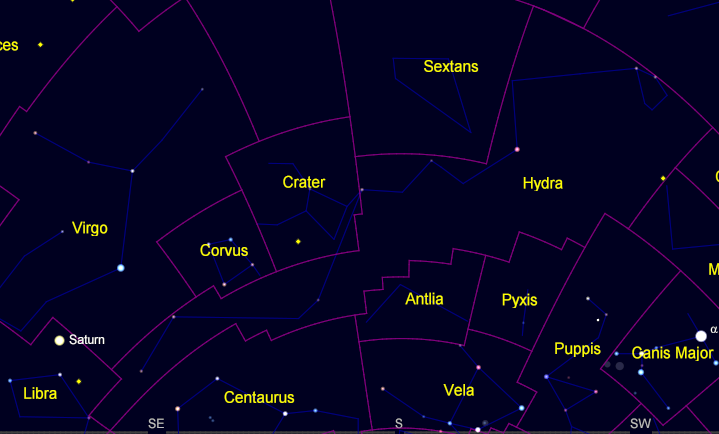
Hydra boundaries according to the International Astronomical Union. Created using Cartes du Ciel.
04/08/2013 – Ephemeris – The constellation Leo the lion
Ephemeris for Monday, April 8th. The sun will rise at 7:10. It’ll be up for 13 hours and 8 minutes, setting at 8:18. The moon, 2 days before new, will rise at 6:32 tomorrow morning.
Besides the advancing sunset times and warming temperatures, there’s another sign that spring is here. That’s the appearance of the constellation Leo the lion high in the southeast in the evening. The front of this beast is a backward question mark of stars with the bright star Regulus as the dot at the bottom. That’s his head, mane and chest. His haunches are a triangle of stars to the left, This year the planet Saturn is to the left of the Regulus. A way to find Leo is to remember that cat’s aren’t supposed to like water. Find the Big Dipper high in the northeast and imagine drilling a hole in the bottom of the bowl. The water will fall on Leo’s back. Also you’ll notice the stars of spring to the east are more sparse than those of winter to the west.
Times are for the Traverse City/Interlochen area of Michigan. They may be different for your location.
Addendum
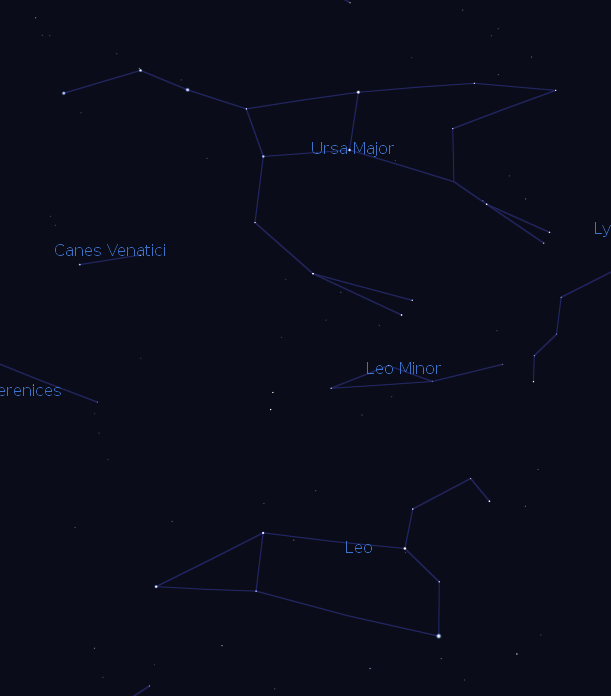
Leo and Ursa Major (Big Dipper) for 10 pm on April 8, 2013. Created using Stellarium.
04/01/2013 – Ephemeris – Orion the Fool
Ephemeris for April Fools Day, Monday, April 1st. The sun will rise at 7:22. It’ll be up for 12 hours and 47 minutes, setting at 8:10. The moon, 2 days before last quarter, will rise at 2:25 tomorrow morning.
Orion is one of the two constellations mentioned in the Bible, that have been deciphered. These are mentioned in the Book of Job. In the King James translation of the Bible the star Arcturus is mentioned. Modern scholars have changed that to the Bear, that is the Great Bear, Ursa Major, of which the Big Dipper is a part. The star cluster Pleiades, our Seven Sisters are also mentioned. There is no agreement of what Mazzeroth and the Mansions of the South are. The translation of Orion from the original Hebrew fits the day today. It’s Kesil, which means fool. Considering the mythology of Orion, a very minor character of Greek mythology, he was indeed, if not a fool, very unlucky in love.
Times are for the Traverse City/Interlochen area of Michigan. They may be different for your location.
Addendum
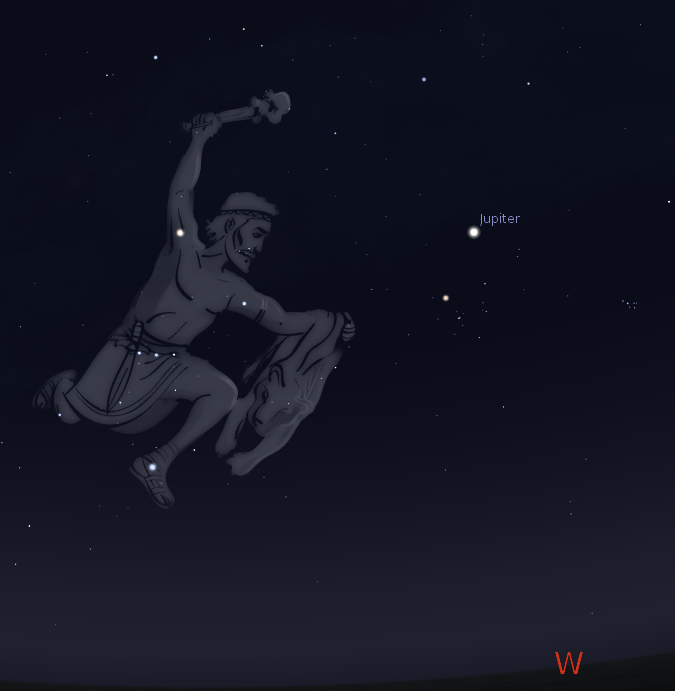
Orion the fool at 10 p.m. on April 3, 2013. Created using Stellarium. Note the Pleiades at the extreme right edge of the picture
03/07/2013 – Ephemeris – The zodiacal constellation Cancer the crab
Ephemeris for Thursday, March 7th. The sun will rise at 7:08. It’ll be up for 11 hours and 29 minutes, setting at 6:38. The moon, 3 days past last quarter, will rise at 4:57 tomorrow morning.
At 9 this evening, the faint constellation, and member of the Zodiac, Cancer the crab is located in the south half way between the bright stars Castor and Pollux of the constellation Gemini, high in the south and the bright star Regulus in Leo the lion in the southeast. Cancer is very dim, looking like an upside-down Y. In the center of Cancer is a fuzzy spot to the unaided eye. In binoculars or a low power telescope this fuzzy spot becomes a cluster of stars. It is the Beehive cluster also cataloged as M44. At 577 light years away, according to the latest measurements, it is one of the closest star clusters, but more distant than the Pleiades and Hyades the face of Taurus the bull. Before it was seen in a telescope the cluster was known as Praesepe, the manger.
Times are for the Traverse City/Interlochen area of Michigan. They may be different for your location.
Addendum
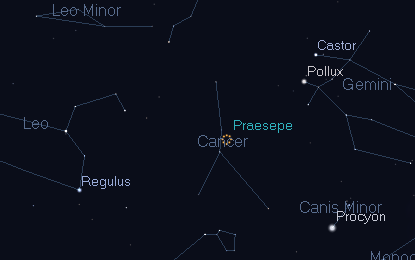
Cancer Finder Chart. Created using Stellarium.
03/04/2013 – Ephemeris – The Winter Circle
Ephemeris for Monday, March 4th. The sun will rise at 7:14. It’ll be up for 11 hours and 20 minutes, setting at 6:34. The moon, at last quarter today, will rise at 2:34 tomorrow morning.
The winter skies are blessed with more first magnitude stars than any other season. Six of these stars lie in a large circle centered on the seventh. This circle is up all evening now that we are in the heart of winter. Starting high overhead is Capella in Auriga the charioteer. Moving clockwise and downward, we come to Aldebaran in the face of Taurus the Bull and brighter nearby Jupiter. Then down to Orion’s knee we find Rigel. Down and left is the brightest star of all Sirius the Dog Star in Canis Major Orion’s large hunting dog, lowest of these stars in the south. Moving up and left there is Procyon in Canis Minor Orion’s other hunting dog, Then above is Pollux in Gemini the twins. All are centered on Betelgeuse in Orion.
Times are for the Traverse City/Interlochen area of Michigan. They may be different for your location.
Addendum
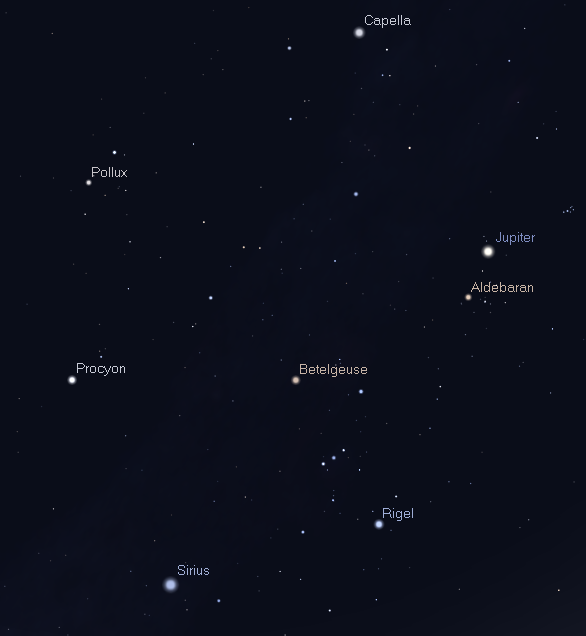
The Winter Circle and Jupiter for March. Created using Stellarium.
 Bob Moler's Ephemeris Blog