Archive
08/06/2013 – Ephemeris – The constellation of Sagittarius: centaur or teapot?
Ephemeris for Tuesday, August 6th. The sun rises at 6:34. It’ll be up for 14 hours and 26 minutes, setting at 9:00. The moon is new today, and won’t be visible.
The Milky Way runs from north to south through the heavens at 11 p.m. You’ll notice that the Milky Way is brighter and broader just above the horizon in the south. In that glow in the south is a star pattern that looks like a stout little teapot, with a bright stream of the Milky Way rising from the spout, which faces the west. This pattern of stars is the major part of the constellation called Sagittarius. According to Greek mythology Sagittarius is a centaur with a bow and arrow poised to shoot Scorpius the scorpion to the right. This centaur is named Chiron, the most learned of the breed, centaurs usually being a rowdy bunch. The center of the pin wheel of our galaxy lies hidden beyond the stars near the spout of the teapot.
Times are for the Traverse City/Interlochen area of Michigan. They may be different for your location.
Addendum
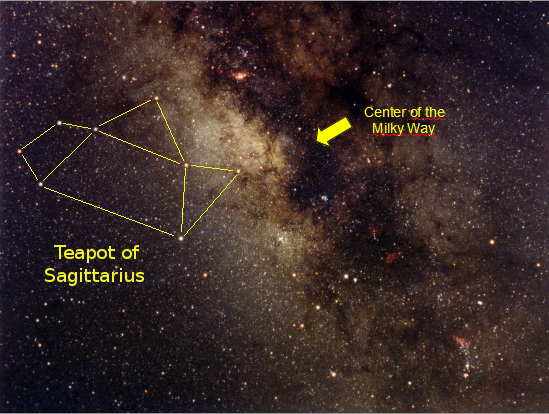
Location of the center of the Milky Way behind gas and dust clouds and the Teapot of Sagittarius.
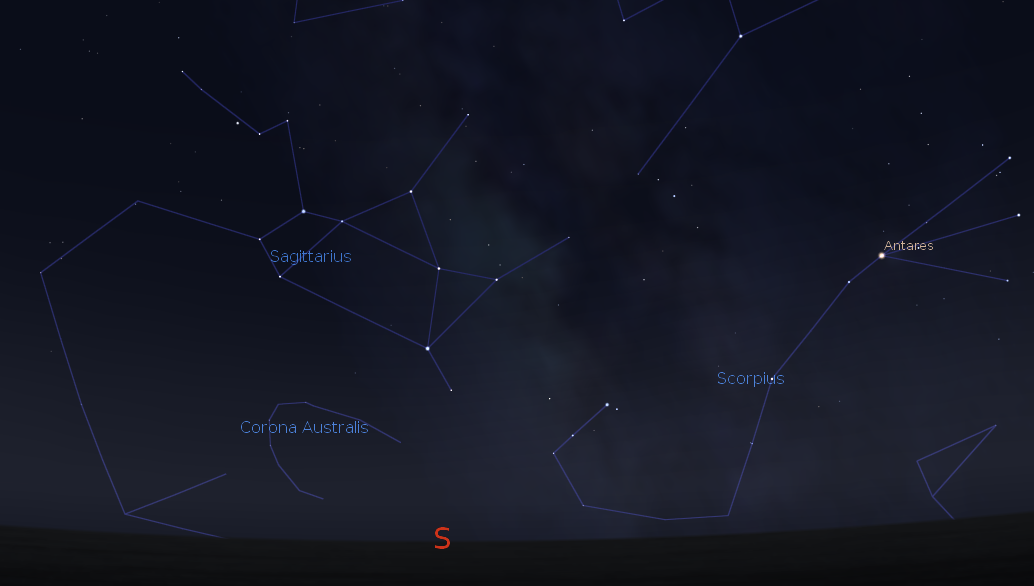
Sagittarius and Scorpius at 11 p.m. on August 6, 2013. Created using Stellarium.
08/05/2013 – Ephemeris – The celestial swan
Ephemeris for Monday, August 5th. The sun rises at 6:33. It’ll be up for 14 hours and 28 minutes, setting at 9:02. The moon, 1 day before new, will rise at 6:28 tomorrow morning.
High in the east as it gets dark flies the constellation of Cygnus the swan. This constellation is also known as the Northern Cross. The cross is seen lying on its side with the bright star Deneb, member of the Summer Triangle, at the head of the cross to the left. The rest of the cross is delineated in the stars to the right. As a swan, Deneb is the tail, the stars of the crosspiece of the cross are the leading edges of wings as Cygnus flies south through the Milky Way. There are faint stars that also define the trailing wing edges. It is a very good portrayal of a flying swan, like the mute swans we see on the wing around here. In Cygnus we are looking in the direction that the sun is traveling as it orbits the center of the Milky Way galaxy.
Times are for the Traverse City/Interlochen area of Michigan. They may be different for your location.
Addendum
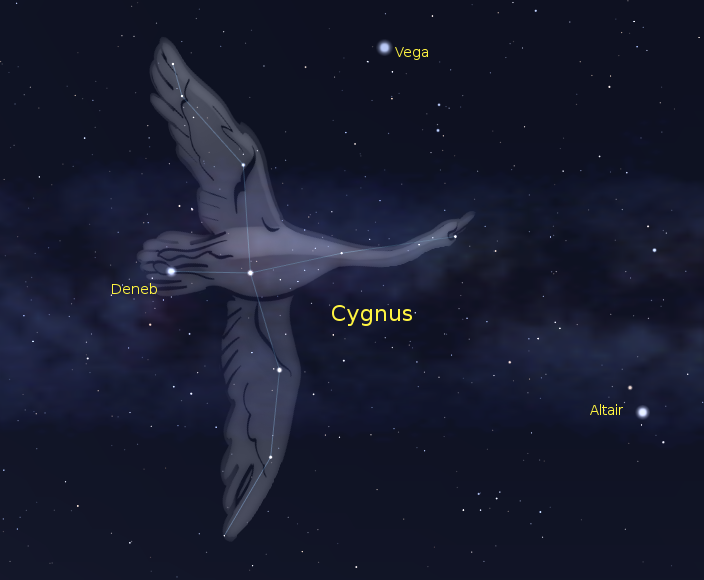
Cygnus The Swan Created using Stellarium.
07/29/2013 – Ephemeris – The constellation Aquila the eagle
Ephemeris for Monday, July 29th. The sun rises at 6:25. It’ll be up for 14 hours and 45 minutes, setting at 9:11. The moon, at last quarter today, will rise at 12:46 tomorrow morning.
Aquila the eagle is a constellation that lies in the Milky Way. It’s in the southeastern sky as it gets dark. Its brightest star, Altair is one of the stars of the Summer Triangle, a group of three bright stars seen now in the eastern sky in the evening. Altair, in the head of the eagle, is flanked by two slightly dimmer stars, the shoulders of the eagle. The eagle is flying northeastward through the Milky Way. Its wings are seen in the wing tip stars. A curved group of stars to the lower right of Altair is its tail. Within Aquila the Milky Way shows many dark clouds as part of the Great Rift that splits it here. The other summer bird is Cygnus the swan, above and left of Aquila, flying in the opposite direction, southward.
Times are for the Traverse City/Interlochen area of Michigan. They may be different for your location.
Addendum
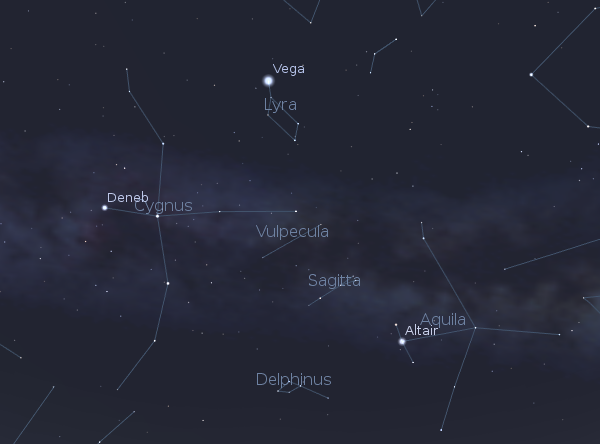
Aquila with the other constellations in the Summer Triangle. Created using Stellarium.
07/11/2013 – Ephemeris – Ophiuchus the serpent bearer
Ephemeris for Thursday, July 11th. Today the sun will be up for 15 hours and 19 minutes, setting at 9:27. The moon, 3 days past new, will set at 10:56 this evening. Tomorrow the sun will rise at 6:09.
The crescent moon will appear to the right of the planet Venus before 10:45 p.m. Tonight. The red star Antares shines in the south at 11 p.m. In the area of sky above it lies a large constellation of faint stars called Ophiuchus, the serpent bearer. Ophiuchus represent the legendary physician Aesculapius. The constellation shape is like a large bell, which reminds me of the head, shoulders and arms of a fellow that’s holding the snake like a weight lifter struggling to pull up a heavy barbell. Serpens, the constellation of the serpent is in the sky in two sections. The front end lies to the right as Serpens Caput, and wends its way up the right side of Ophiuchus. Serpens Cauda, the tail rises to the left of Ophiuchus. It’s a rewarding sight, and not that hard to spot.
Times are for the Traverse City/Interlochen area of Michigan. They may be different for your location.
Addendum
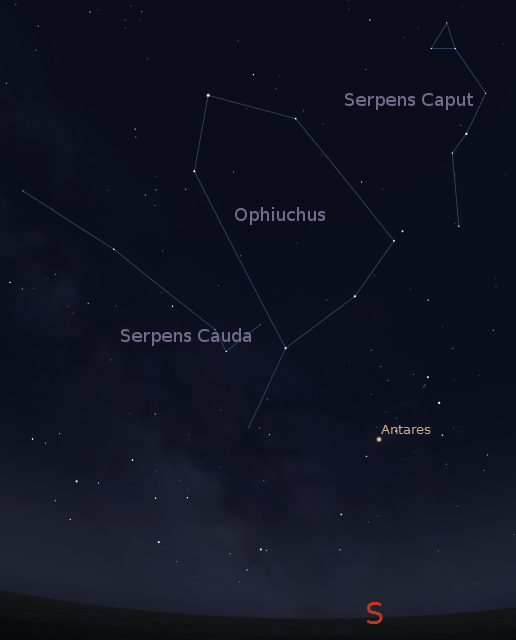
Ophiuchus and Serpens at 11 p.m.. Created using Stellarium.
07/09/2013 – Ephemeris – Thank goodness this is as close as scorpions get to northern Michigan
Ephemeris for Tuesday, July 9th. Today the sun will be up for 15 hours and 21 minutes, setting at 9:28. The moon, 1 day past new, will set at 9:58 this evening. Tomorrow the sun will rise at 6:07.
Crawling just above the southern horizon at 11 p.m. is the zodiacal constellation of Scorpius the scorpion. His heart is the red giant star Antares. Its facing the west or right with a short arc of three stars as its head. His body and tail drop to the left and scrape the horizon before curving up to the critter’s poisonous stinger of two stars. It really makes a great scorpion. One story of the scorpion concerns Orion the hunter the great winter constellation. In that story Orion was killed by the sting of a scorpion. Therefore Orion and Scorpius are never seen in the sky at the same time. That is certainly true around here and for the Greeks, whose legend it is. However if one travels far enough south that is no longer true.
Times are for the Traverse City/Interlochen area of Michigan. They may be different for your location.
Addendum
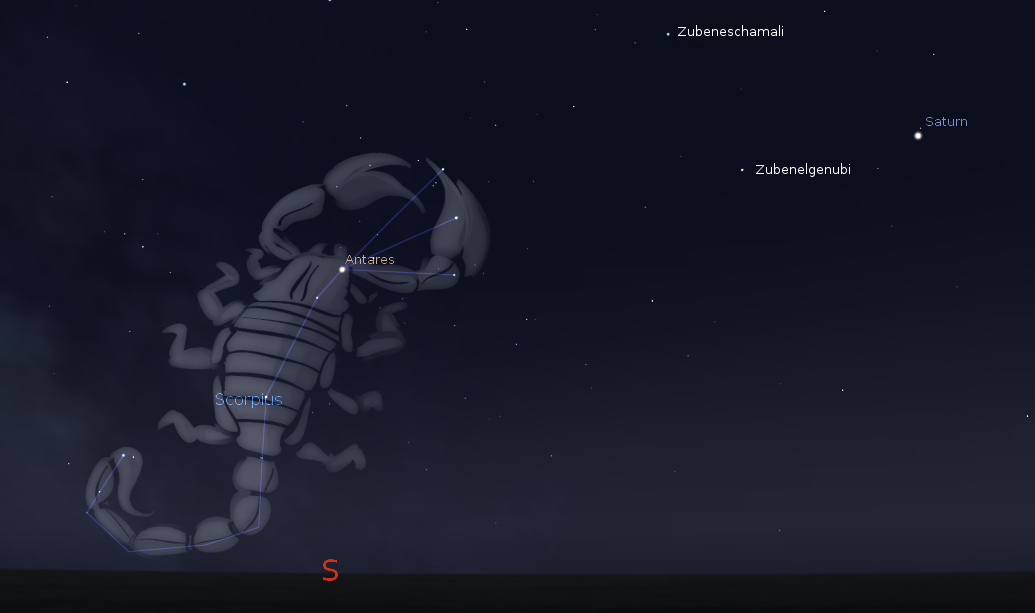
Scorpius at 11 p.m. on July 9, 2013. Credit Stellarium. I don’t agree with the artist’s drawing of the scorpion. To me it’s larger. The arc of three stars in the drawing’s right claw to me is its head and start of the claw appendages. I’ve added two star names from the constellation of Libra to the right. The Arabic translation of Zubeneschamali and Zubenelgenubi is North Claw and South Claw respectively. At one time Scorpius was larger than it is depicted today. Click on the image to enlarge.
07/02/2013 – Ephemeris – Lyra the harp in Greek mythology
Ephemeris for Tuesday, July 2nd. Today the sun will be up for 15 hours and 29 minutes, setting at 9:31. The moon, 2 days past last quarter, will rise at 2:45 tomorrow morning. Tomorrow the sun will rise at 6:02.
High in the east at 11 p.m. can be found a bright star just above a small, narrow, but very distinctive parallelogram of stars. They are the stars of the constellation Lyra the harp. The bright star is Vega the 5th brightest night-time star. To the Romans the star Vega represented a falling eagle or vulture. Apparently they never made the distinction between the two. It is a pure white star and serves as a calibration star for color and brightness. The harp, according to Greek mythology, was invented by the god Hermes. The form of the harp in the sky, is as he had invented it: by stretching strings across a tortoise-shell. Hermes gave it to his half-brother Apollo, who in turn gave it to the great musician Orpheus.
Times are for the Traverse City/Interlochen area of Michigan. They may be different for your location.
Addendum
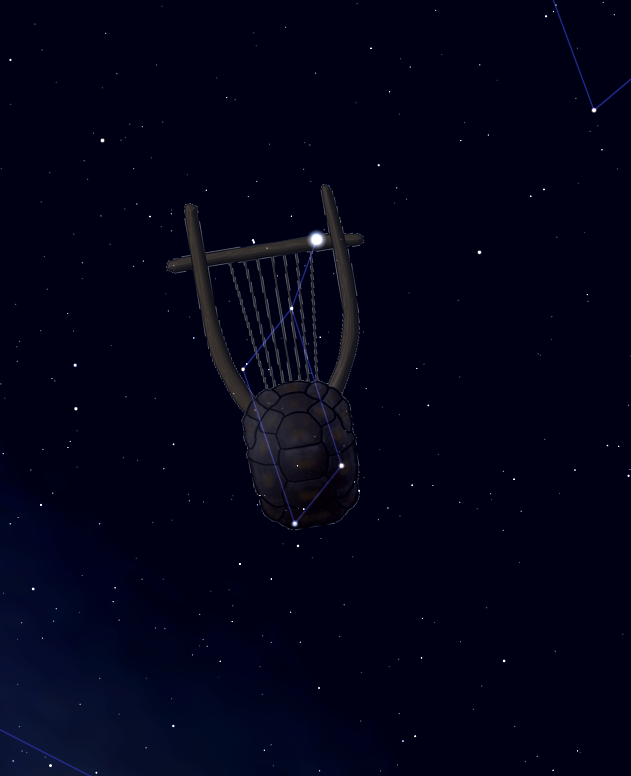
Lyra as a tortoise-shell harp. Created using Stellarium and free clip art.
Annotated Lyra:
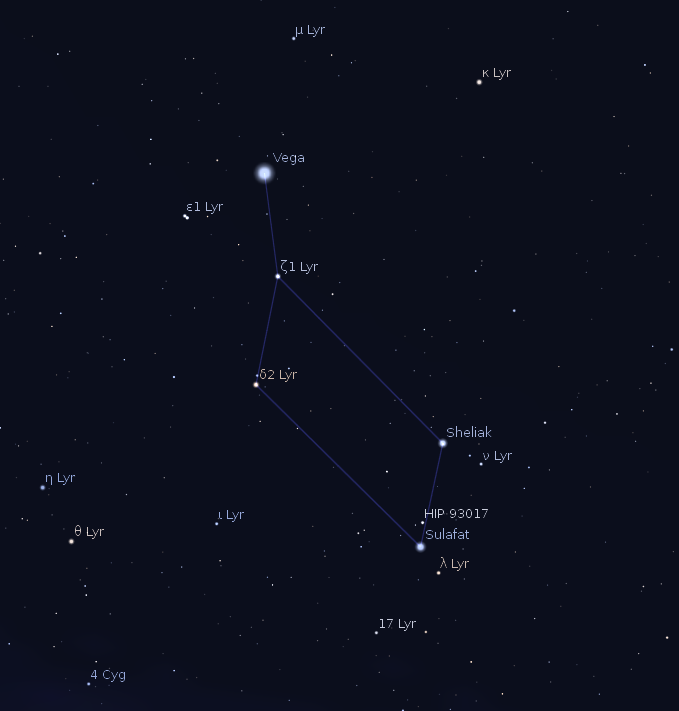
Magnified view of Lyra. Created using Stellarium.
06/28/2013 – Ephemeris – Vega and Lyra the harp
Ephemeris for Friday, June 28th. Today the sun will be up for 15 hours and 31 minutes, setting at 9:31. The moon, 2 days before last quarter, will rise at 12:43 tomorrow morning. Tomorrow the sun will rise at 6:00.
One of the first stars visible when twilight fades is Vega. It will be east of the zenith and is perfectly white. Another bright star with a yellow-orange hue is to the west of the zenith. That’s Arcturus. We’re concentrating on Vega now. It is in a small constellation called Lyra the harp or lyre. Just off to the southeast of Vega as it gets dark is a narrow parallelogram of stars that make up the body of this celestial instrument. A dim star next to Vega completes the constellation. Take good look at it in binoculars and the star near Vega appears as two. It’s Epsilon Lyrae. Each can be split again in a telescope. Lyra has another wonder, but that will have to wait for another time.
Times are for the Traverse City/Interlochen area of Michigan. They may be different for your location.
Addendum
Magnified view of Lyra. Created using Stellarium.
Epsilon Lyra is the closest star to Vega. Look closely, because it’s double. The funny characters next to “Lyr” are lower case Greek letters Epsilon is the Greek letter “e”. The one next to it is the slightly brightest star of the pair. The Greek letter designations are from Johannes Bayer’s 1603 atlas. The number designations are Flamsteed numbers. There’s other stars with proper names. The HIP number is from the Hipparcos catalog, a relatively new catalog.
06/05/2013 – Ephemeris – Then there were two… planets that is, in the west
Ephemeris for Wednesday, June 5th. Today the sun will be up for 15 hours and 25 minutes, setting at 9:23. The moon, 3 days before new, will rise at 4:43 tomorrow morning. Tomorrow the sun will rise at 5:58.
The early evening will be taken up with Venus and Mercury low in the west northwest at about 10:15 p.m. Mercury is above and left of Venus by about 5 degrees, about half the width of your fist at arms length. Jupiter is out of it now, setting at 10:07. We’ll see it next in late July in the morning sky. Venus will set at 10:49, and Mercury will set at 11:16 p.m. Holding forth in the south will be Saturn this evening, the brightest star-like object in the constellation Virgo appearing yellowish to the left of the extremely blue-white star Spica. Saturn will pass due south at 11:01 p.m., and will set at 4:19 tomorrow morning. I’ll talk about star and planet colors on tomorrow’s program.
Times are for the Traverse City/Interlochen area of Michigan. They may be different for your location.
Addendum
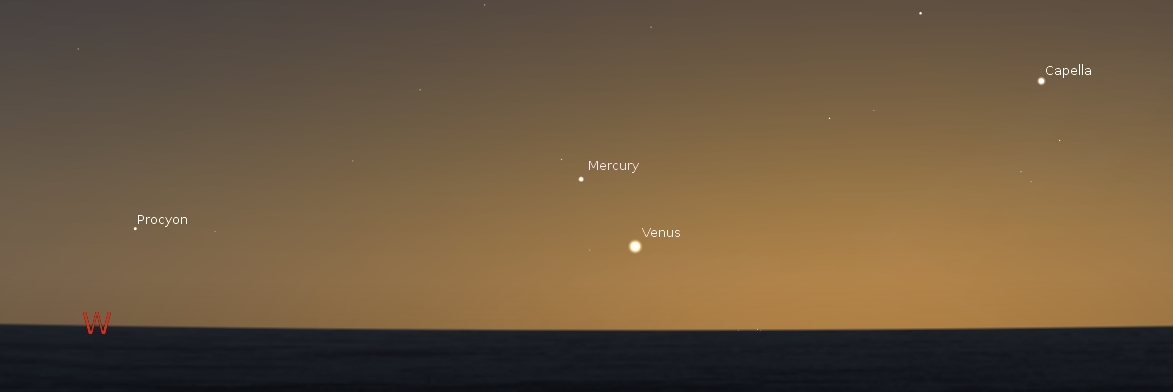
Mercury and Venus seen in the west northwest after sunset. Here it’s 10:15 p.m. on June 5, 2013. Created using Stellarium.
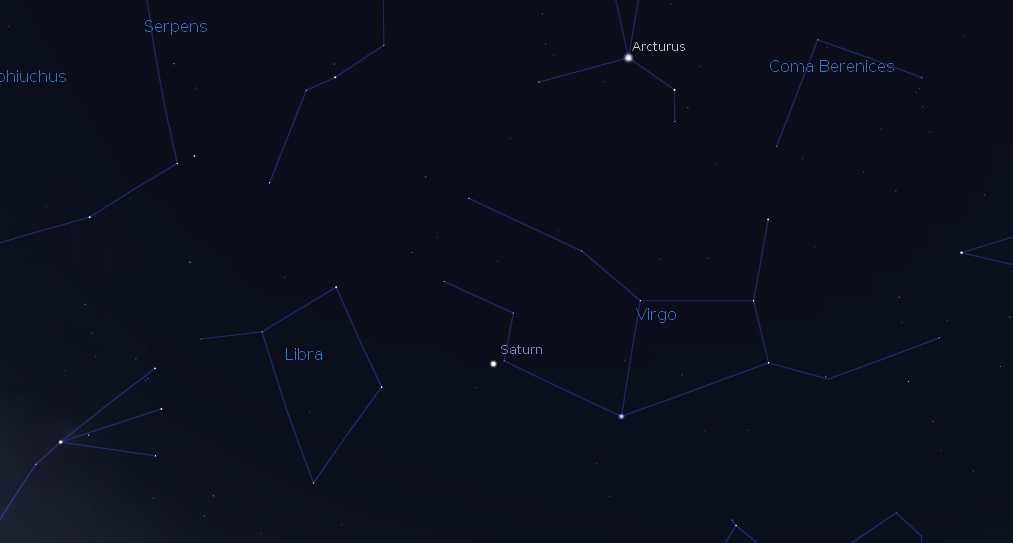
Looking south at Saturn and surrounding constellations at 11 p.m. on June 5, 2013. Created using Stellarium.
06/03/2013 – Ariadne’s crown is our Corona Borealis
Ephemeris for Monday, June 3rd. Today the sun will be up for 15 hours and 23 minutes, setting at 9:22. The moon, 3 days past last quarter, will rise at 3:36 tomorrow morning. Tomorrow the sun will rise at 5:58.
Here we go, starting Ephemeris’ 39th trip around the sun with the constellation of Corona Borealis, the Northern Crown. In the east at 11 this evening it can be seen as small nearly circular constellation. It is just below and left of Boötes, the kite shaped constellation off the handle of the Big Dipper. According to Greek myth the crown was given by the god Dionysus to the princess Ariadne, daughter of King Minos of Crete. The crown is more like a tiara with the bright star Gemma also known as Alphecca at the front. While stars suggest that the crown is diamond studded, the meaning of Gemma, a blossom suggests to me that Corona Borealis is a floral crown. It is known in many lands as many different things.
Times are for the Traverse City/Interlochen area of Michigan. They may be different for your location.
Addendum

Corona Borealis with Boötes. Created with Stellarium.
05/30/2013 – Ephemeris – The constellation of the harvest, Virgo
Ephemeris for Thursday, May 30th. Today the sun will be up for 15 hours and 17 minutes, setting at 9:19. The moon, 1 day before last quarter, will rise at 1:42 tomorrow morning. Tomorrow the sun will rise at 6:00.
Tonight in the sky: to the south, with the bright Saturn to the left of the bright star Spica is the constellation and member of the of the zodiac: Virgo the virgin. Virgo is a large constellation of a reclining woman holding a stalk of wheat. The bright star in the center of the constellation, Spica, is the head of that spike of wheat; and as such it ruled over the harvest in two of Virgo’s guises as the goddesses Persephone and Ceres. Virgo is also identified as Astraea the goddess of justice. The constellation of Libra, the scales, which she is associated with, is found just east of her low in the southeast. Early Christians saw Virgo as the Virgin Mary. Virgo is the host to a grand cluster of galaxies.
Times are for the Traverse City/Interlochen area of Michigan. They may be different for your location.
Addendum
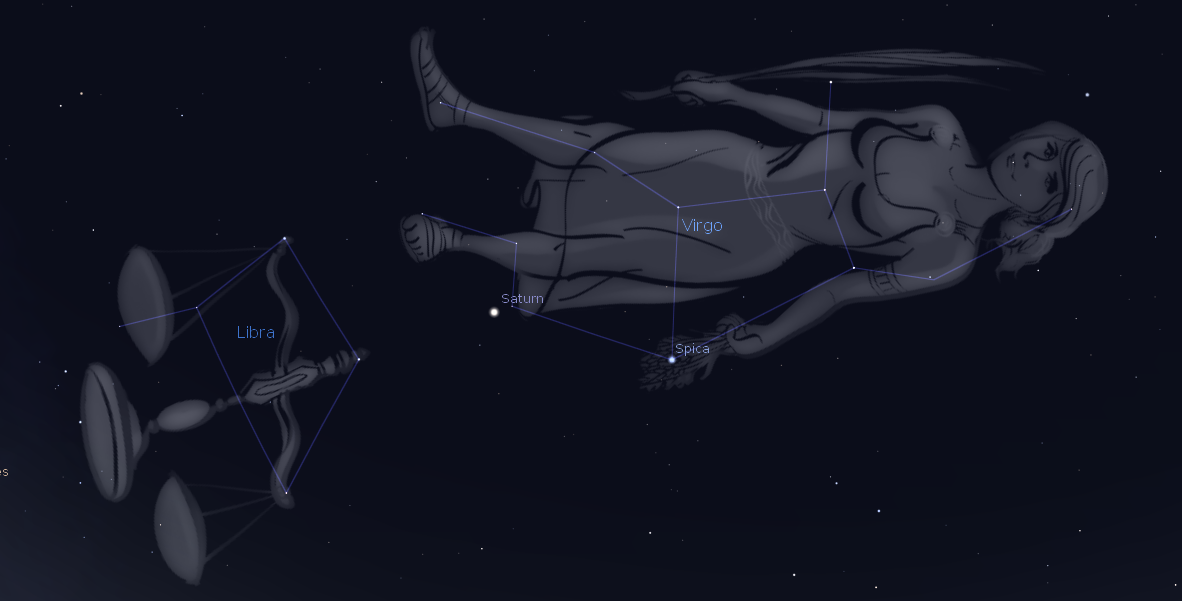
Virgo, Saturn and Libra at 11 p.m. on May 30, 2013. Created using Stellarium.
 Bob Moler's Ephemeris Blog