Archive
02/07/2013 – Ephemeris – The brother stars Castor and Pollux
Ephemeris for Thursday, February 7th. The sun will rise at 7:53. It’ll be up for 10 hours and 6 minutes, setting at 6:00. The moon, 3 days before new, will rise at 6:22 tomorrow morning.
At 9 p.m. the constellation of Gemini the twins will be seen high in the southeast. The namesake stars of the two lads are the two bright stars at the top of the constellation. Pollux the pugilist, or boxer, is the lower of the two, while Castor, the horseman, is the other star, or rather a six star system. In telescopes two close stars may be seen each is a spectroscopic binary, meaning the lines of two stars can be seen in the spectrum. A faint nearby spectroscopic binary also belong. Pollux, though a single star, does have at least one planet, one over twice the mass of Jupiter orbiting the star at a distance somewhat greater than Mars is from the sun. Pollux is 34 light years away while Castor is 50 light years away. Not too far away as stars go.
Times are for the Traverse City/Interlochen area of Michigan. They may be different for your location.
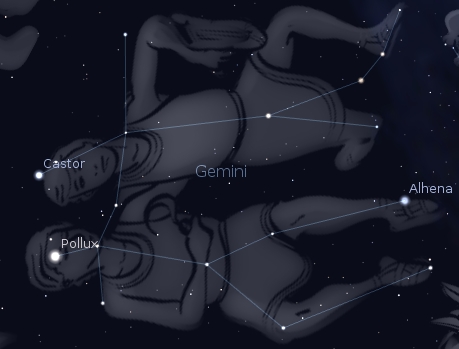
Gemini with Castor and Pollux. Created with Stellarium.
Addendum
02/05/2013 – Ephemeris – The bright stars Castor and Pollux of Gemini
Ephemeris for Tuesday, February 5th. The sun will rise at 7:56. It’ll be up for 10 hours and 1 minute, setting at 5:57. The moon, 2 days past last quarter, will rise at 4:42 tomorrow morning.
The constellation Gemini, the Twins is visible high in the southeast at 9 p.m. The namesake stars of the two lads, will be on the upper left edge of the constellation, diagonally aligned. Castor is to the upper right, while Pollux, a slightly brighter star is below left. Lines of stars from castor and Pollux to the lower right delineate the lads. In Greek mythology Castor and Pollux were twins, and half brothers, Castor was fathered by a mere mortal, while Pollux was fathered by Zeus in the famous Leda and the swan affair. The brothers, however were inseparable, and when Castor was killed during the quest for the Golden Fleece, Pollux pleaded with Zeus to let him die also. Zeus granted his wish, so both appear in the sky together forever.
Times are for the Traverse City/Interlochen area of Michigan. They may be different for your location.
Addendum
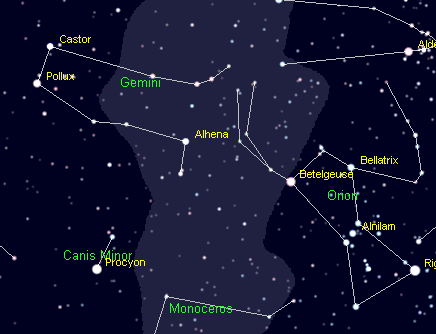
Gemini and Orion. Created using Cartes du Ciel
02/04/2013 – Ephemeris – The celestial unicorn
Ephemeris for Monday, February 4th. The sun will rise at 7:57. It’ll be up for 9 hours and 58 minutes, setting at 5:56. The moon, 1 day past last quarter, will rise at 3:41 tomorrow morning.
Among all the constellations in the sky of animals real and mythical, there is also a unicorn. It’s called Monoceros, and inhabits the southeastern sky at 9 p.m. bounded by Orion on the right, Canis Major, the great dog below and Canis Minor, the little dog to the left. Unfortunately for observers without optical aid Monoceros, though large, is devoid of any but the faintest stars. Maybe that’s why no one sees unicorns anymore. It has many faint stars because the Milky Way runs through it. To the telescope it is a feast of faint nebulae or clouds of gas and dust, the birth place of stars, including the red rose of the Rosette Nebula, and the strange and tiny Hubble’s Variable Nebula. It has a wealth of wonders below the surface so to speak.
Times are for the Traverse City/Interlochen area of Michigan. They may be different for your location.
Addendum
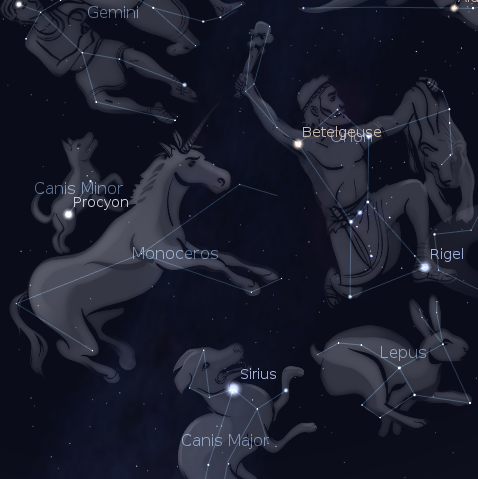
Moniceros the unicorn. Created using Stellarium.
01/25/2013 – Ephemeris – The star names of Orion
Ephemeris for Friday, January 25th. The sun will rise at 8:08. It’ll be up for 9 hours and 33 minutes, setting at 5:42. The moon, 1 day before full, will set at 7:23 tomorrow morning.
The constellation of Orion the hunter is visible in the south at 9 p.m. The stars of Orion are interesting in themselves. Starting at the top left of the seven bright stars of Orion’s torso is Betelgeuse the bright red star, whose name means something like “Armpit of the Giant”. The star in Orion’s other shoulder is Bellatrix the “Amazon Star”. Below are the three stars of Orion’s belt, from left to right; Alnitak, Alnilam and Mintaka. Their names mean “Girdle”, “Belt of Pearls”, and “Belt” respectively. Down to Orion’s knees we look on the left to the star Saiph which means “Sword”, though it is some ways from the stars of Orion’s sword. Finally there’s the bright blue-white star Rigel whose name means “left Leg of the Giant”.
Times are for the Traverse City/Interlochen area of Michigan. They may be different for your location.
Addendum
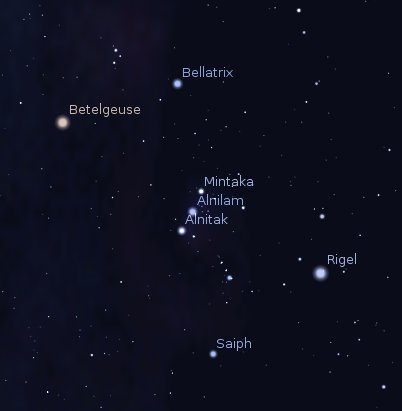
Orion with star names
01/22/2013 – Ephemeris – Sirius the Dog Star
Ephemeris for Tuesday, January 22nd. The sun will rise at 8:10. It’ll be up for 9 hours and 27 minutes, setting at 5:37. The moon, half way from first quarter to full, will set at 5:23 tomorrow morning.
The brightest star-like object in the evening sky is Jupiter high in the sky now. The second brightest star-like object is Sirius, also known as the Dog Star. It also is the brightest night-time star in our skies period. Tonight at 9 p.m. it’s located low in the southeastern sky. The Dog Star name comes from its position at the heart of the constellation Canis Major, the great dog of Orion the hunter. The three stars of Orion’s belt tilt to the southeast and point to Sirius. The name Sirius means ‘Dazzling One’ or ‘Scorcher’, a reference to its great brilliance and twinkling. Its Egyptian name was Sothis, and its appearance in the dawn skies in late June signaled the flooding of the Nile, and the beginning of the Egyptian agricultural year.
Times are for the Traverse City/Interlochen area of Michigan. They may be different for your location.
Addendum
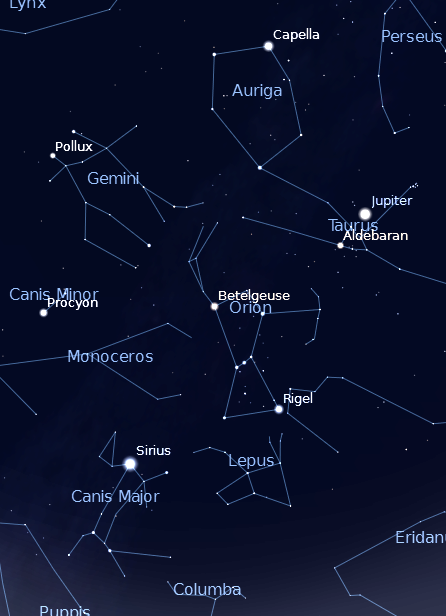
Winter Circle and Jupiter with Sirius at the bottom. Created using Stellarium.
01/21/2013 – Ephemeris – MLK Day, Jupiter above the Moon tonight
Ephemeris for Martin Luther King Day and Inauguration Day, Monday, January 21st. The sun will rise at 8:11. It’ll be up for 9 hours and 24 minutes, setting at 5:36. The moon, 3 days past first quarter, will set at 4:33 tomorrow morning.
Today is the holiday commemorating the life of Dr. Martin Luther King Jr., and his struggle for civil rights. Today we will have the second inauguration of the first African American President. Another chapter in the struggle for the equality of all people. Back before the Civil War, runaway slaves used the stars to steer their flight northward. The prominent pattern of northern stars that aided their journey was the Drinking Gourd. We know it as the Big Dipper. which is starting to rise higher in the northeast. Also in the sky tonight the planet Jupiter will appear above the moon, their closest approach will be at 10:30 p.m. For us closest approach will be at 2 moon diameters. A couple of thousand miles south of here the moon will cover the planet.
Times are for the Traverse City/Interlochen area of Michigan. They may be different for your location.
Addendum
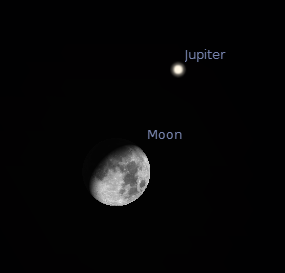
Jupiter and the moon at 10:30 p.m. January 21, 2013. Created using Stellarium.
01/14/2013 – Ephemeris – Lepus the hare, overlooked by Orion
Ephemeris for Monday, January 14th. The sun will rise at 8:16. It’ll be up for 9 hours and 11 minutes, setting at 5:27. The moon, 3 days past new, will set at 9:23 this evening.
Orion, the central winter constellation is seen in the southern sky this evening. He is a hunter, as artists depict him, he is preoccupied with the charge of Taurus the bull from the upper right. At Orion’s feet, and unnoticed by him is the small constellation of Lepus the hare. It’s very hard to see a rabbit in its eight dim stars: however, I can see a rabbit’s head ears and shoulders. A misshapen box is the head and face of this critter facing to the left. His ears extend upwards from the upper right star of the box, and the bend forward a bit. Two stars to the right of the box and a bit fart
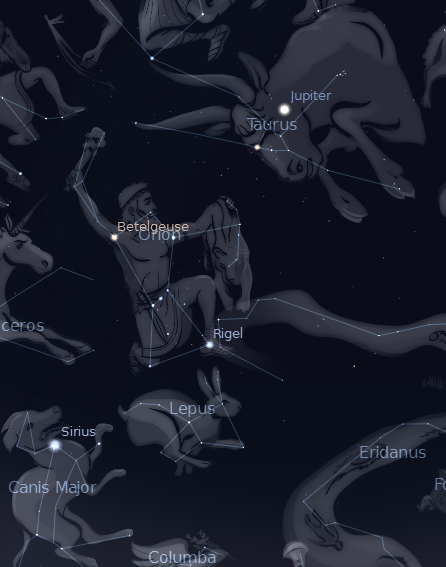
Orion facing Taurus letting Lepus escape with Jupiter in 2013. Created using Stellarium.
her apart hint at the front part of the body. In Lepus telescopes can find M79, a distant globular star cluster, one of the few visible in the winter sky.
Times are for the Traverse City/Interlochen area of Michigan. They may be different for your location.
Addendum
01/11/2013 – Ephemeris – Sirius the Dog Star
Ephemeris for Friday, January 11th. The sun will rise at 8:17. It’ll be up for 9 hours and 6 minutes, setting at 5:23. The moon is new today, and won’t be visible.
The brightest star-like object in the evening sky is Jupiter high in the south around 9 p.m. The second brightest star-like object is Sirius, also known as the Dog Star. It also is the brightest night-time star in our skies period. Tonight at 9 p.m. it’s located low in the south southeastern sky. The Dog Star name comes from its position at the heart of the constellation Canis Major, the great dog of Orion the hunter. The three stars of Orion’s belt tilt to the southeast and point to Sirius. The name Sirius means ‘Dazzling One’, a reference to its great brilliance and twinkling. Its Egyptian name was Sothis, and its appearance in the dawn skies in late June signaled the flooding of the Nile, and the beginning of the Egyptian agricultural year.
Times are for the Traverse City/Interlochen area of Michigan. They may be different for your location.
Addendum
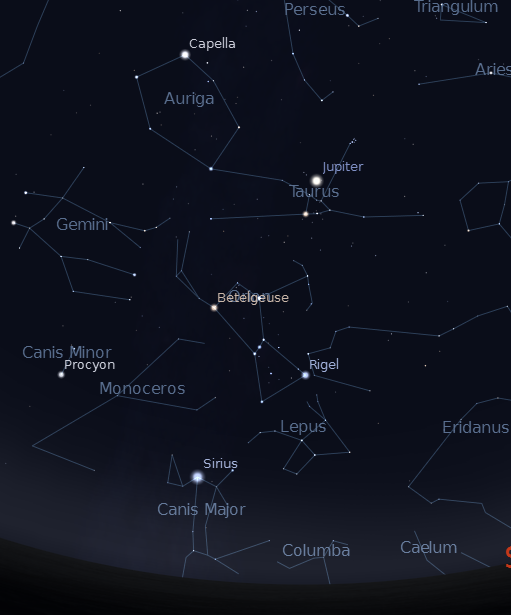
Sirius, Jupiter and the winter stars and constellations at 9 p.m. Created using Stellarium.
12/25/2012 – Ephemeris – Why do we celebrate Christmas today?
Ephemeris for Christmas Day, Tuesday, December 25th. The sun will rise at 8:18. It’ll be up for 8 hours and 49 minutes, setting at 5:07. The moon, 3 days before full, will set at 6:40 tomorrow morning.
Merry Christmas. But why is this Christmas day? The Gospel of Luke puts Christ’s birth in the spring, during lambing season, the only time the Shepherds would be out with their flocks at night. It is said that Christians move the birthday celebration of Jesus to a time when the Romans were naturally celebrating: The time when the sun was going to return northward once again after the winter solstice. Christians could celebrate in a time of general merriment. That festival was Saturnalia. It honored the god Saturn, the god of hospitality. That’s quite a makeover of the Greek titan Cronos, who ate his children. Saturn did that too, but had reformed. The solstice was just the beginning of winter but spirits were buoyed by the return of the sun.
Times are for the Traverse City/Interlochen area of Michigan. They may be different for your location.
12/14/2012 – Ephemeris – The constellation of the river Eridanus
Ephemeris for Friday, December 14th. The sun will rise at 8:12. It’ll be up for 8 hours and 50 minutes, setting at 5:02. The moon, 1 day past new, will set at 6:58 this evening.
There is a long and sinuous constellation that’s part of the winter sky. It is Eridanus, which depicts a river. The river starts near the lower right corner of Orion, near the bright star Rigel and flows to the right then down near the southern horizon, then it meanders below the horizon. One has to travel to the far southern United States or even farther south to see the southern terminus of the river, the bright star Achernar. Writers over the ages have seen here the Nile and the earth circling river Ocean of the flat earth days. One of its stars is close to us and famous. It’s Epsilon Eridani host to at least two large planets and the home to the fictional Mr. Spock and other Vulcans of the Star Trek franchise. Trouble is the star is too young and any earth-like planets would be in unstable orbits.
Times are for the Traverse City/Interlochen area of Michigan. They may be different for your location.
Addendum
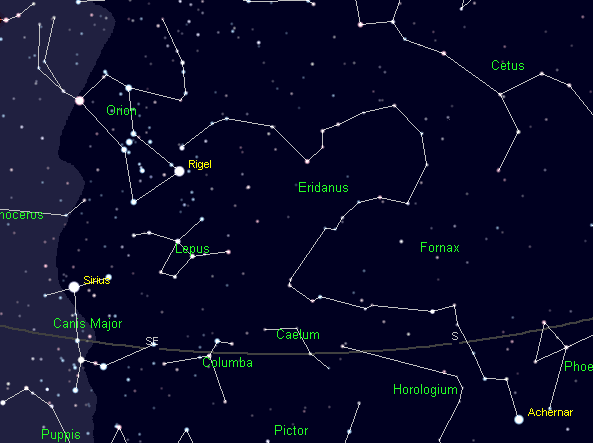
The constellation Eridanus the river, both above and below the horizon. Created using Cartes du Ciel.
 Bob Moler's Ephemeris Blog