Archive
Ephemeris: 05/02/2024 – All about the constellation of Boötes and Ursa Major
This is Ephemeris for Thursday, May 2nd. Today the Sun will be up for 14 hours and 19 minutes, setting at 8:49, and it will rise tomorrow at 6:29. The Moon, 1 day past last quarter, will rise at 4:27 tomorrow morning.
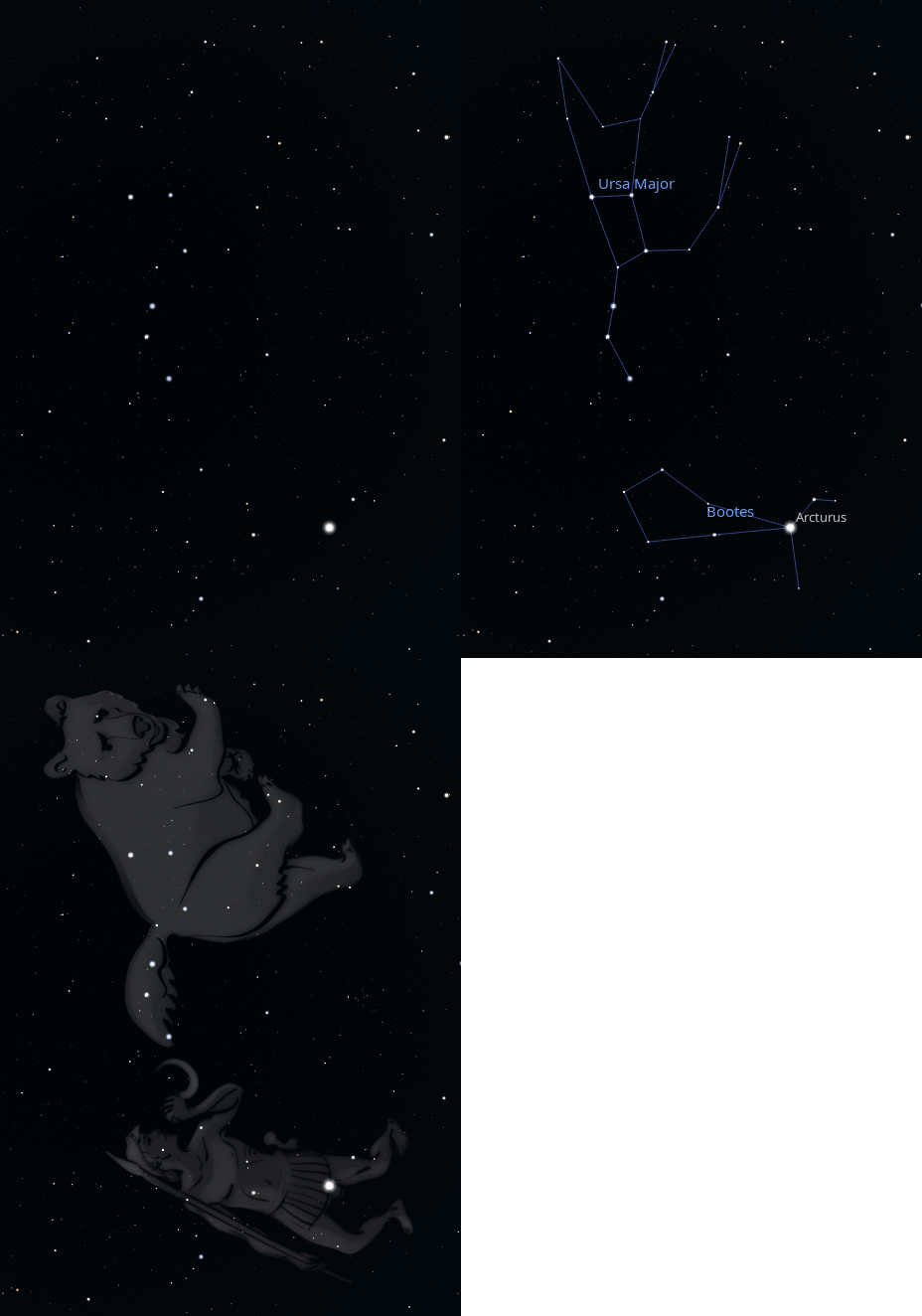
Seen in the east at 10:30 p.m. tonight is the kite shaped constellation of Boötes the herdsman. The bright star Arcturus is at the bottom of the kite to the right. It is pointed to by the arc of the handle of the Big Dipper, higher in the east. Boötes represents a young hunter named Arcas, son of Callisto, a beautiful young lady who had the misfortune of being loved by Zeus the chief of the Greek gods. Zeus’ wife Hera, found out about it, and since she couldn’t punish Zeus, turned the poor woman into a bear. Arcas, many years later, unaware of the events surrounding his mother’s disappearance was about to kill the bear when Zeus intervened and placed them both in the sky to save her, as Arcas still pursues her across the sky nightly.
The astronomical event times given are for the Traverse City/Interlochen area of Michigan (EDT, UT–4 hours). They may be different for your location.
Addendum

Ephemeris: 04/29/2024 – Corona Borealis, the Northern Crown
This is Ephemeris for Monday, April 29th. Today the Sun will be up for 14 hours and 11 minutes, setting at 8:46, and it will rise tomorrow at 6:33. The Moon, 2 days before last quarter, will rise at 2:58 tomorrow morning.
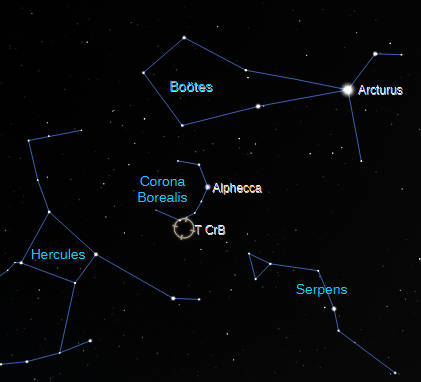
About a third of the way up the sky in the east at 10 p.m. can be found a small but easily spotted constellation of Corona Borealis, the Northern Crown. It is located just below the kite shaped constellation of Boötes, with its bright star Arcturus at the right. The Northern Crown is a three-quarter circle of stars, like a tiara, with a brighter star Alphecca at the bottom. Alphecca in Arabic means “The bright star of the broken ring of stars”, which is an accurate description of it. Check it out now for later this year we expect to have a bright star appear just below it. That star is T Coronae Borealis a recurrent Nova or exploding star. They occur when a white dwarf star is orbiting with a large red giant star and accumulating gas from that red giant star until it explodes.
The astronomical event times given are for the Traverse City/Interlochen area of Michigan (EDT, UT–4 hours). They may be different for your location.
Addendum
Ephemeris: 04/25/2024 – Finding Hydra, the longest constellation
This is Ephemeris for Thursday, April 25th. Today the Sun will be up for 14 hours exactly, setting at 8:41, and it will rise tomorrow at 6:39. The Moon, 2 days past full, will rise at 11:00 this evening.
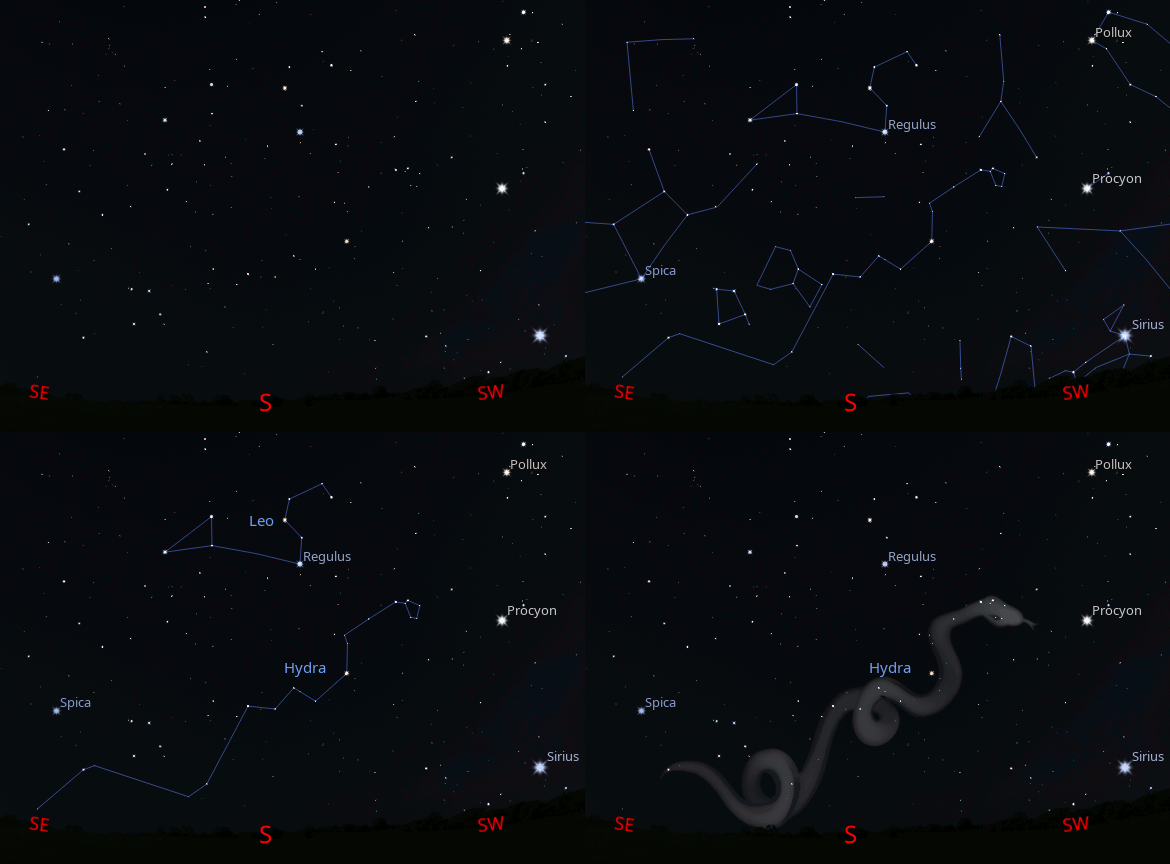
Stretching from midway up the sky in the southwest to low in the southeast at 10 p.m. can be found the constellation of Hydra the water snake, the longest constellation of all. Unlike the monster of the same name that Hercules slew, this Hydra has but one head, which is its most distinctive part. The head of Hydra is located between the bright stars Procyon in the southwest. Which is above the brighter star Sirius low in the sky, and Regulus in Leo the lion, higher in the south. Hydra’s head is a small but distinctive group of 6 stars that make a drooping loop to the right. The rest of Hydra wends its way in a reasonably straight line down to the southeastern horizon.
The astronomical event times given are for the Traverse City/Interlochen area of Michigan (EDT, UT–4 hours). They may be different for your location.
Addendum
Ephemeris: 03/26/2024 – The dimmest constellation of the Zodiac is Cancer the crab
This is Ephemeris for Tuesday, March 26th. Today the Sun will be up for 12 hours and 29 minutes, setting at 8:03, and it will rise tomorrow at 7:31. The Moon, 1 day past full, will rise at 9:44 this evening.
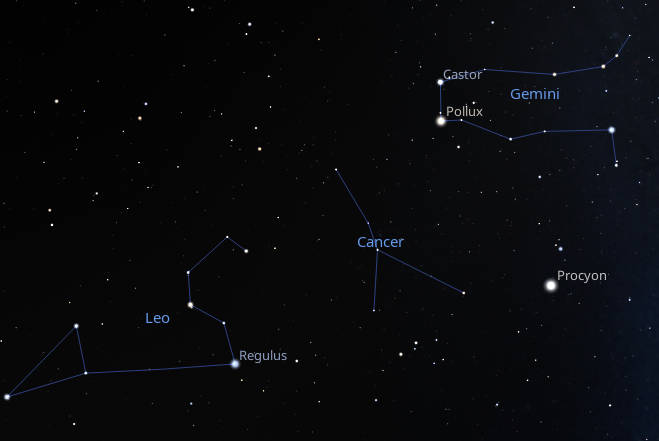
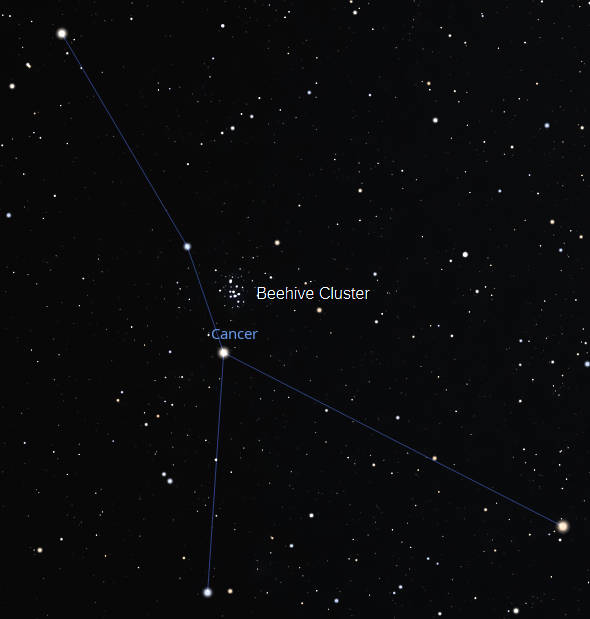
The dimmest constellation of the Zodiac is Cancer the crab. It is located high in the southeast at 9 PM between the backwards question mark that is the front of Leo the lion towards the lower left and Castor and Pollux of Gemini to the upper right. Its claim to more modern astronomical fame is the star cluster within it called the Beehive Cluster also known in ancient times as Praesepe the manger which looks like a fuzzy spot to the naked eye. In binoculars or a small telescope it shows up as a rather sparse open cluster of stars and to me the whole cluster appears somewhat triangular like an old-fashioned beehive. The Beehive cluster is relatively close to us at about 610 light years away.
The astronomical event times given are for the Traverse City/Interlochen area of Michigan (EDT, UT–4 hours). They may be different for your location.
Addendum
Ephemeris: 03/12/24 – The story of the twins of Gemini
This is Bob Moler with Ephemeris for Tuesday, March 12th. Today the Sun will be up for 11 hours and 46 minutes, setting at 7:45, and it will rise tomorrow at 7:57. The Moon, 2 days past new, will set at 11:07 this evening.
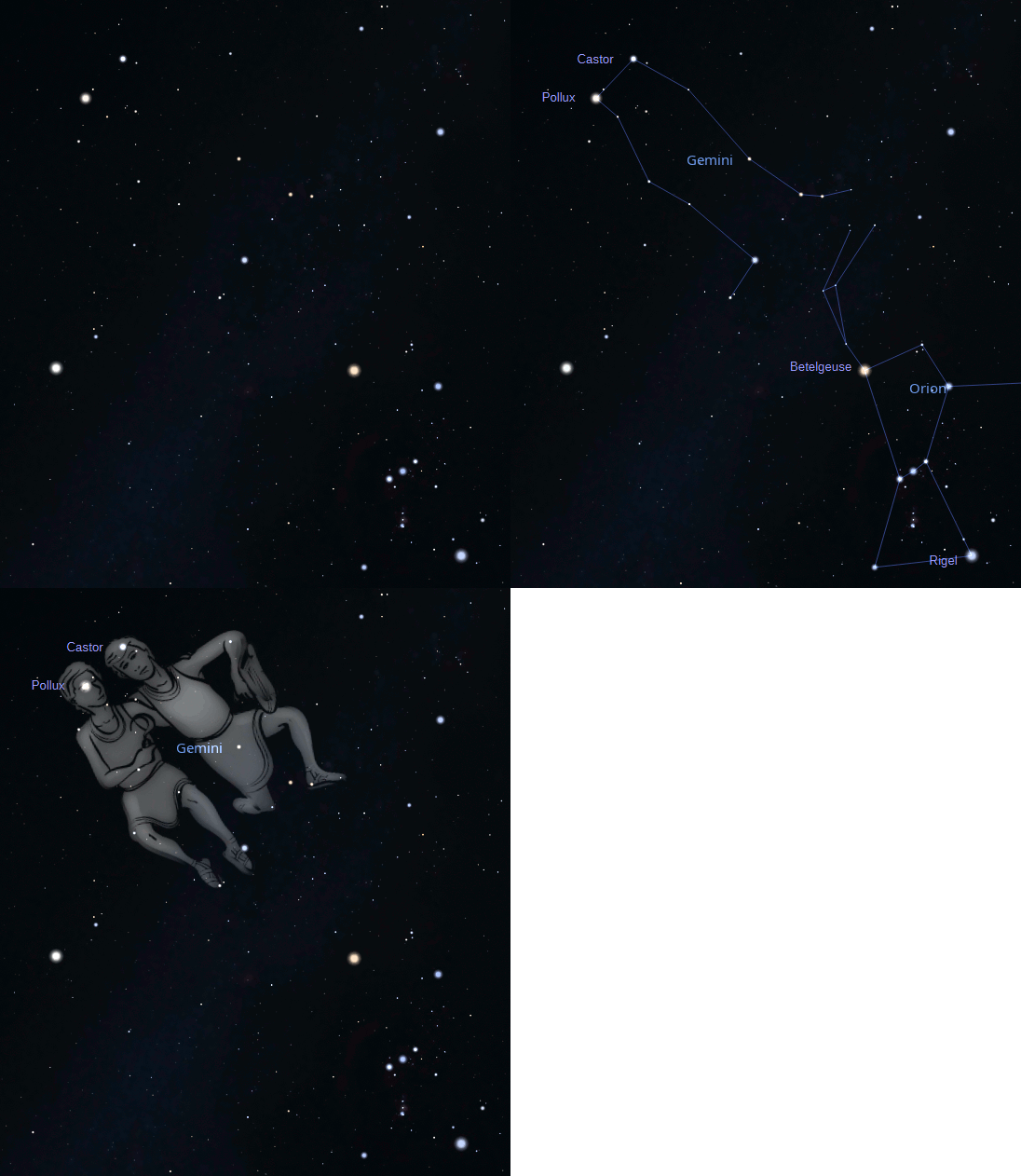
A week ago I talked about how to find the constellation of Gemini the twins above and to the left of the constellation Orion. Today I’ll talk about their story. Gemini the twins are fraternal twins, Castor and Pollux. Their namesake stars are the brightest in Gemini, with Castor above and the brighter Pollux below and left. Pollux was fathered by the god Zeus who raped his mother in the Leda and the Swan incident, while Castor was fathered by a mortal. They both went on the quest for the Golden Fleece with Jason and the Argonauts. Unfortunately Castor was killed. Pollux loved his brother so much he petitioned Zeus for him to die also and join Castor in the underworld. Instead, Zeus placed them both in the sky where we see them as Gemini.
The astronomical event times given are for the Traverse City/Interlochen area of Michigan (EDT, UT–4 hours). They may be different for your location.
Addendum

Ephemeris: 03/07/2024 – There’s a unicorn in there somewhere
This is Bob Moler with Ephemeris for Thursday, March 7th. Today the Sun will be up for 11 hours and 30 minutes, setting at 6:39, and it will rise tomorrow at 7:06. The Moon, 3 days before new, will rise at 6:35 tomorrow morning.
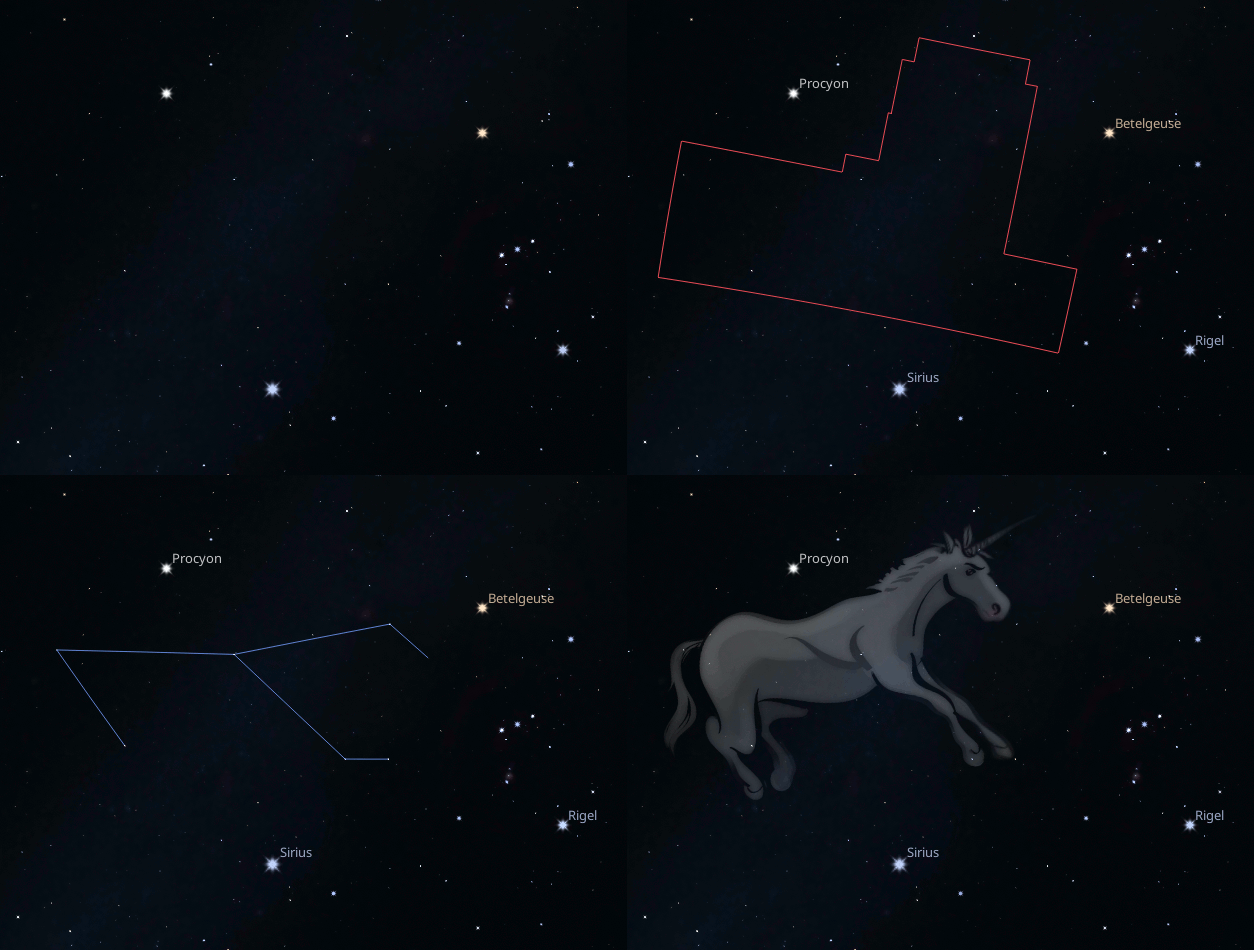
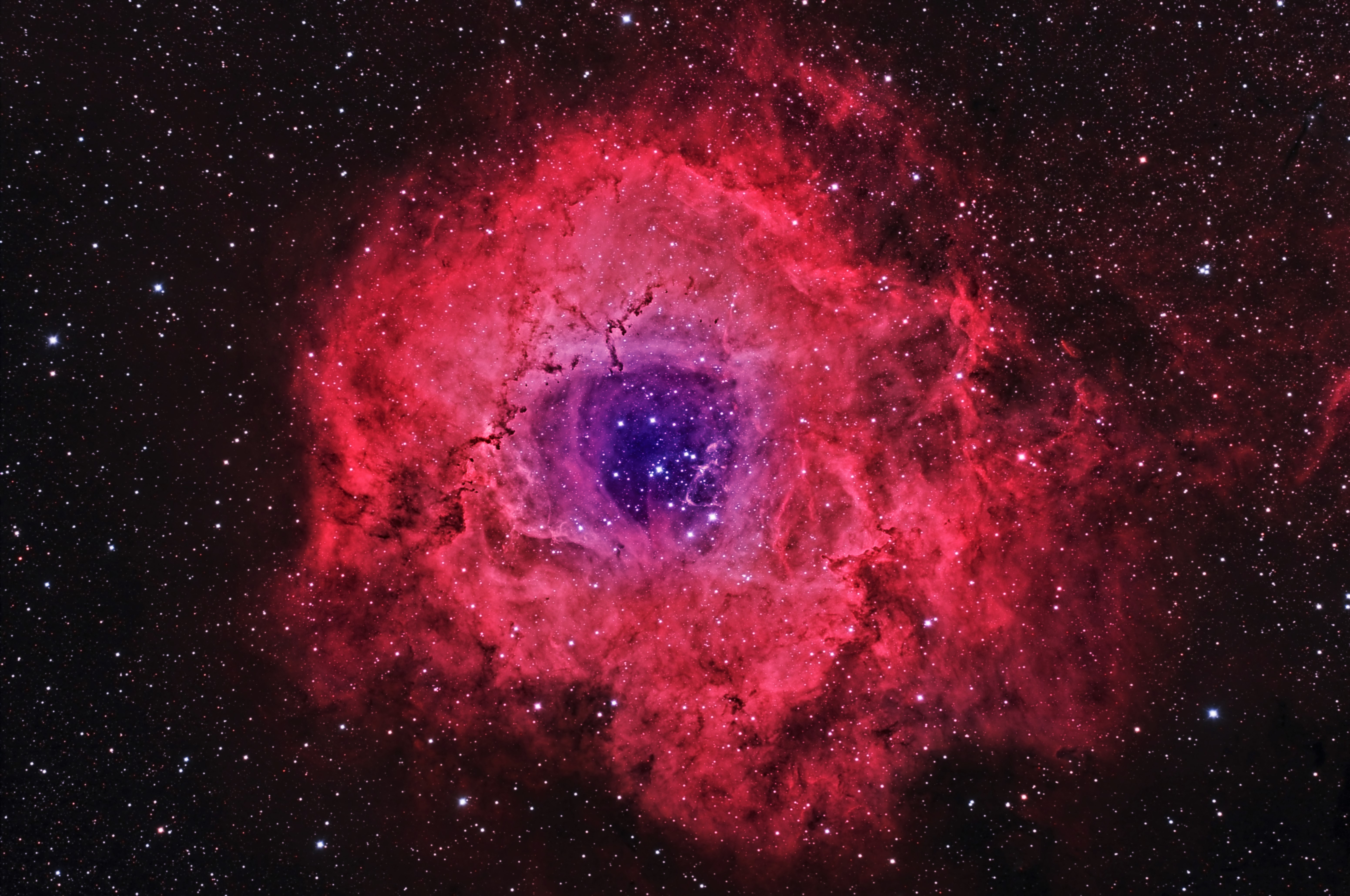
The constellation of Monoceros the unicorn is located in an area of sky to the left of Orion so it’s in the south at 8 pm, inside the Winter Triangle of stars, Betelgeuse in Orion; Sirius in the Great Dog, Canis Major; and Procyon in Canis Minor. If you don’t see anything there, it’s OK. Nobody sees real unicorns any more anyway. Are there any real unicorns? Anyway, there’s a great number of nebulae here in the Milky Way that runs through it, which unfortunately are too faint to be seen with amateur telescopes. However, it is a gold mine for amateur astronomers who are also astrophotographers using time exposures to record the faint nebulae here, including the famous Rosette Nebula!
The astronomical event times given are for the Traverse City/Interlochen area of Michigan (EST, UT –5 hours). They may be different for your location.
Addendum
Ephemeris: 03/05/2024 – Finding Gemini the twins
This is Ephemeris for Tuesday, March 5th. Today the Sun will be up for 11 hours and 24 minutes, setting at 6:36, and it will rise tomorrow at 7:10. The Moon, 2 days past last quarter, will rise at 5:22 tomorrow morning.
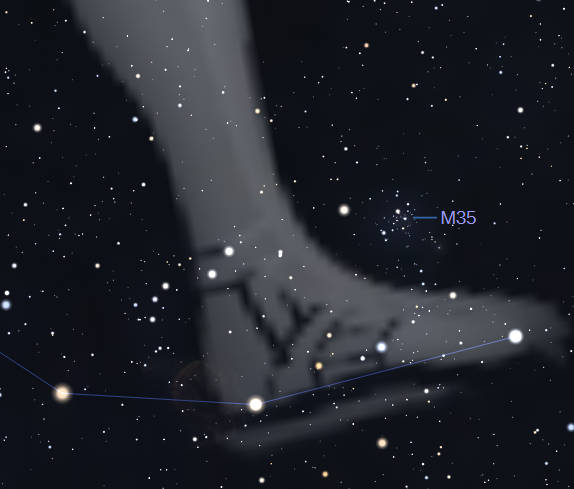
The constellation of Gemini the twins can be seen high in the south at 8 pm tonight. It’s located above and left of the constellation of Orion. The two brightest stars at the upper left of the constellation have the twin’s names. They are Castor, the one to the upper right and Pollux the brighter one to the lower left. I tend to see the constellation as the two lines of stars from Castor and Pollux running down toward Orion as a silhouette of these two boys standing together. Others see them as two stick figures. At the bottom of the line of stars emanating from Castor, what I consider Castor’s foot, is a lovely star cluster which is visible in binoculars as a little fuzzy spot, but a telescope will show a great number of stars here called Messier 35 or simply M35.
The astronomical event times given are for the Traverse City/Interlochen area of Michigan (EST, UT –5 hours). They may be different for your location.
Addendum
Ephemeris: 03/04/2024 – The evening skies are a-changing
This is Ephemeris for Monday, March 4th. Today the Sun will be up for 11 hours and 21 minutes, setting at 6:35, and it will rise tomorrow at 7:12. The Moon, 1 day past last quarter, will rise at 4:30 tomorrow morning.
Tonight at 8 pm Orion is in the south. This will be the last month that we will be able to enjoy Orion in the evening sky, because by month’s end he will begin to dip low in the west in the evening twilight. Even though it’s not quite spring, the central constellation of that season, Leo the lion, is already rising in the east. It has cleared the horizon at 8 this evening. The backwards question mark of Leo’s head, mane and front part of his body is easily spotted in the east now with the bright star Regulus at the bottom. The Big Dipper is in the northeast, also rising higher, and signaling via the Anishinaabek constellation there of the Fisher Star, announcing the maple sugaring season.
The astronomical event times given are for the Traverse City/Interlochen area of Michigan (EST, UT –5 hours). They may be different for your location.
Addendum
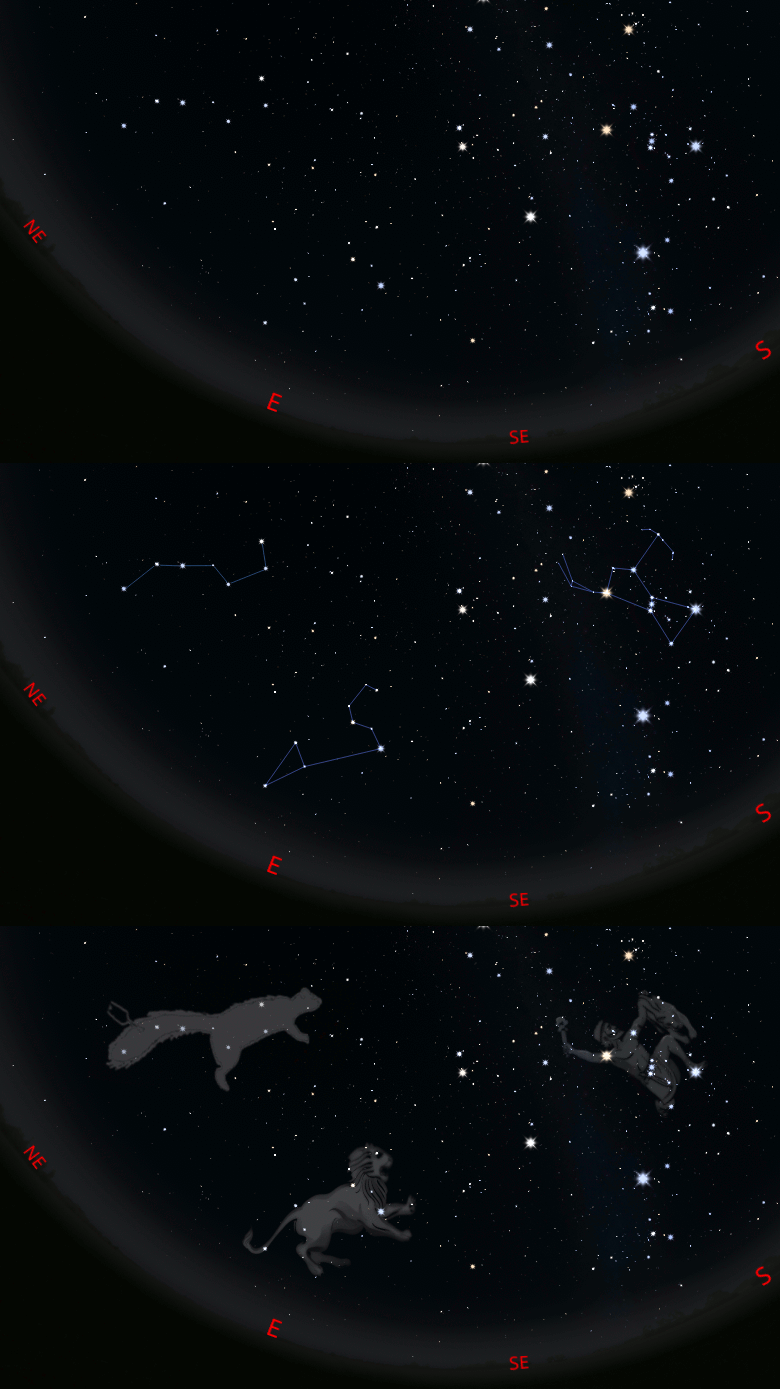
Looking to the east-southeast at 8 pm we look at three star groups or constellations. From left to right we have the Big Dipper and the Fisher Star in the northeast. Centered in the east we have Leo the lion. And on the right, just west of south, we have Orion the central winter constellation. Click or tap on the image to enlarge it. Credit: Stellarium, and using LibreOffice Draw, and GIMP.
Ephemeris: 02/23/2024 – The rabbit in the Moon
This is Bob Moler with Ephemeris for Friday, February 23rd. Today the Sun will be up for 10 hours and 50 minutes, setting at 6:21, and it will rise tomorrow at 7:29. The Moon, 1 day before full, will set at 7:52 tomorrow morning.
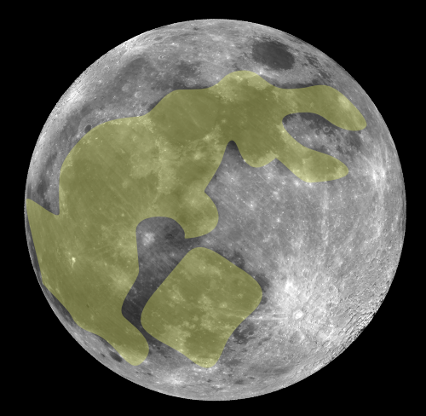
Even though it is a day before full the moon, will be full at 7:30 tomorrow morning. So tonight will be the closest that we’ll see the full moon this lunation. If one looks at the Moon most of us can see the face of the Man in the Moon. A rabbit, can also be seen. To the Chinese the rabbit here was named Yutu also known as the Jade Rabbit, the pet of the moon goddess Chang’e. To them, it was a rabbit pounding medicine with a mortar and pestle. At 8 o’clock tonight it resides along the left side of the Moon. Its head and body are seen in the dark areas of the Moon we call seas. Its ears are near the top of the moon at 8:00 with his head and body bent down on the left. Near the bottom of The moon is the mortar and pestle with which he’s pounding medicine.
The astronomical event times given are for the Traverse City/Interlochen area of Michigan (EST, UT –5 hours). They may be different for your location.
Addendum:
Ephemeris: 02/08/2024 – Up the river
This is Ephemeris for Thursday, February 8th. Today the Sun will be up for 10 hours and 7 minutes, setting at 6:00, and it will rise tomorrow at 7:52. The Moon, 1 day before new, will rise at 8:09 tomorrow morning.
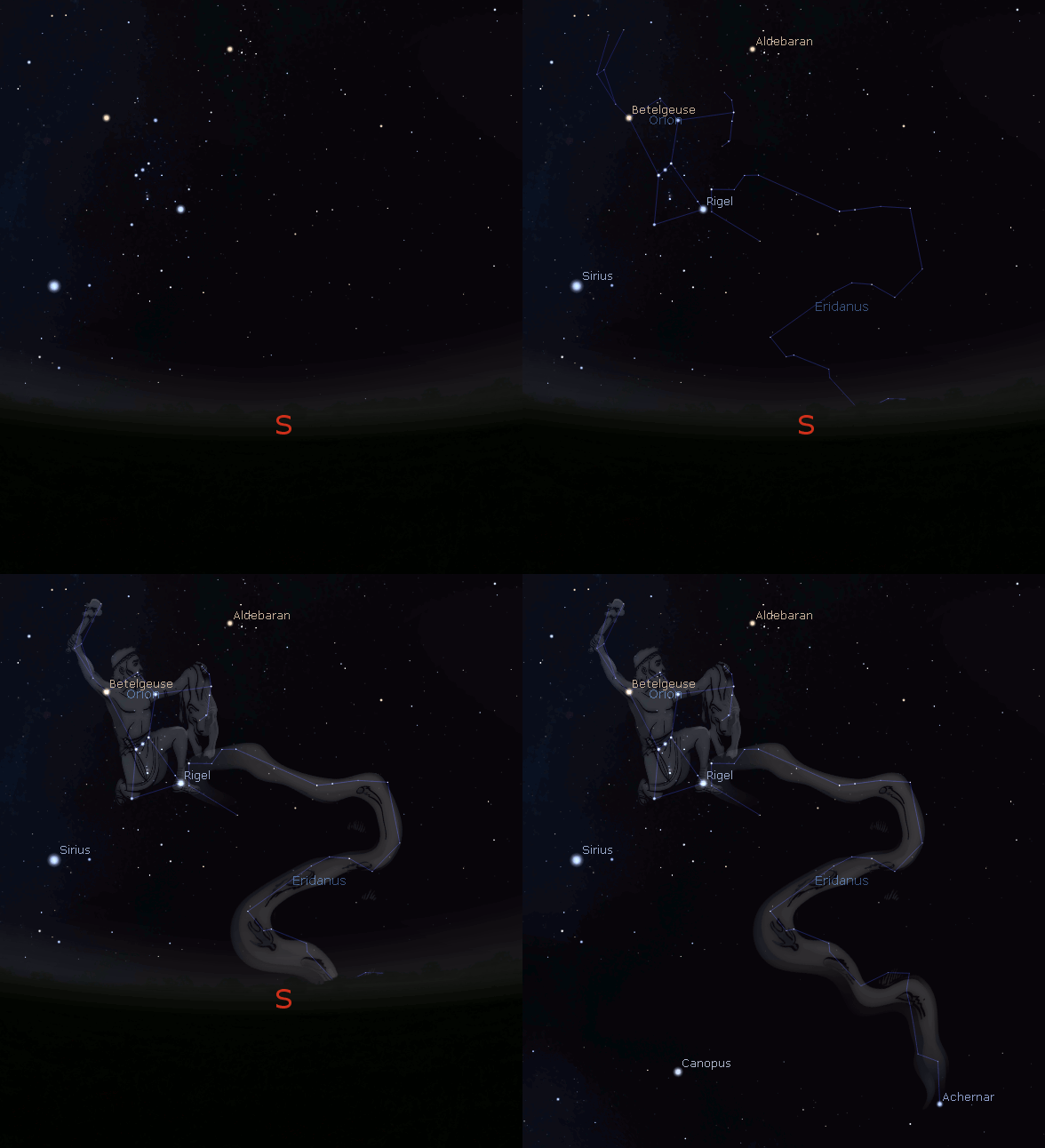
One of the more obscure constellations around is Eridanus, which depicts a river. The river starts near the lower right corner of Orion, near the bright star Rigel and flows to the right then down near the southwestern horizon, then it meanders along the horizon to the south before turning below the horizon. One has to travel to the far south to see the southern terminus of the river, the bright star Achernar. Writers over the ages have seen here the Nile and the Earth circling river Ocean of the flat earth days. Achernar is actually two stars, the brightest was discovered to be the flattest star known, due to its rapid spin. The dimensions of Achernar A has been determined to be twice as wide across its equator than from pole to pole. It’s 139 light years away.
The astronomical event times given are for the Traverse City/Interlochen area of Michigan (EST, UT –5 hours). They may be different for your location.
Addendum
 Bob Moler's Ephemeris Blog