Archive
Ephemeris Extra: 03/12/2025 – Almost everything you wanted to know about lunar eclipses

What is a lunar eclipse?
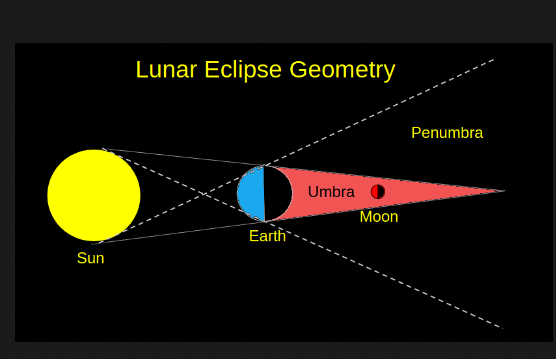
There are two types of eclipses. Eclipses of the Sun or solar eclipses, and eclipses of the Moon, or lunar eclipses. They are both related, in that they involve the Sun the Earth and the Moon. In the solar eclipse the Moon casts its shadow on the Earth at new moon. The lunar eclipse is the Earth casting its shadow on the full Moon. Since the Sun is an extended object, that is not a point, it has two shadows according to astronomers. If you take a look at your shadow in the sunlight cast on the ground, you will notice that your shadow is fuzzy. The fuzziness comes from the fact that your body is only blocking out part of the sunlight on the edges. That part of the shadow is called the penumbra.
There are three types of lunar eclipses. The penumbral eclipse is when the Moon is too far north or south of the umbra and just enters the penumbra. A partial eclipse is where the moon again is too far and south but close enough to have part of it skirt the umbra. And total eclipse is when the Moon becomes completely immersed inside the earth’s umbral shadow.
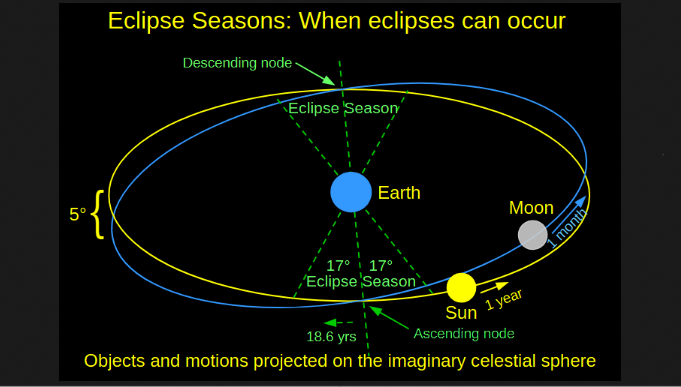
If one checks an almanac, one would find that eclipses generally come in pairs, one of each type, about two weeks apart separated by about six months. The times when eclipses can appear are called eclipse seasons lasting 35 days, about six months apart. They occur as often as they do, because the Moon has an orbit around the Earth that is more aligned with the Earth’s orbit of the Sun than it is the Earth’s equator like most moons of planets. The moon’s orbital plane deviates from the Earth’s orbit by 5 degrees. The intersection of those two orbital planes is called the line of the nodes. Eclipses can only occur when the Sun and the moon are near those nodes at the same time this could occur when the Sun is within 17° of the node.
Lunar eclipses throughout history
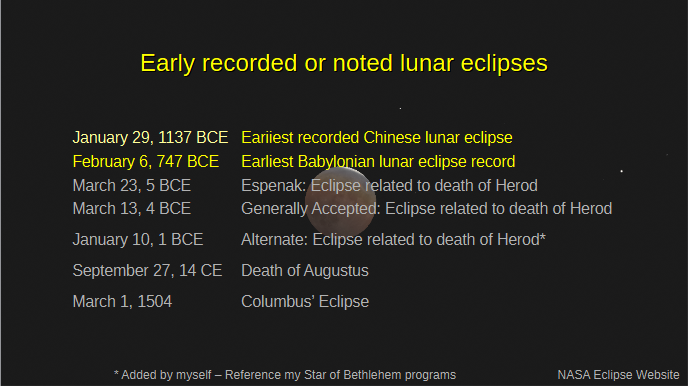
Humans have been observing eclipses both lunar and solar for millennia. And as they got more sophisticated they recorded them. The Chinese were especially good at this. The earliest recorded Chinese lunar eclipse was January 29th 1137 BCE. No, obviously they did not use the dating system we use today. It was usually in whatever year of a particular monarch’s reign that it happened in, and historians had to go back and figure out when that was. I found out that at least two that I know of the earliest lunar eclipses were actually solar eclipses. I found out using the app Stellarium by actually setting the date back to then, and finding out what kind of eclipse it was.
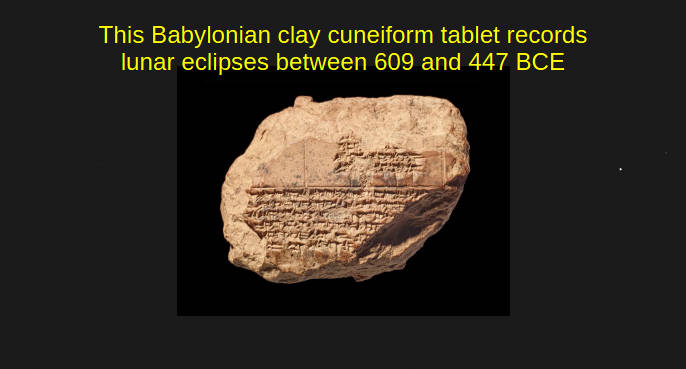
The Babylonians became astute observers and recorders of astronomical events including of course eclipses. By the 4th century BCE they had discovered a method to compute when eclipses occurred by a specific cycle of when they reoccurred, which I will talk about shortly.
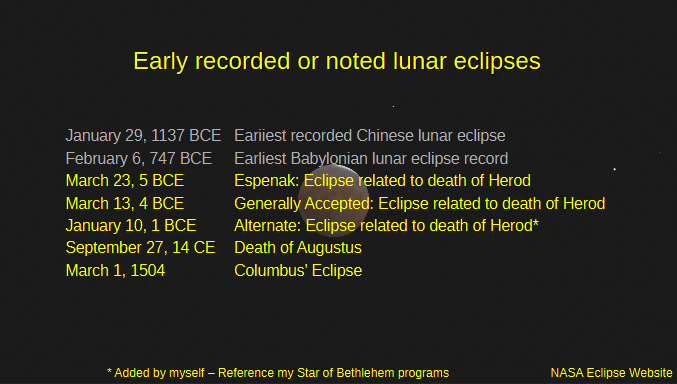
Continuing with our early recorded or noted lunar eclipses, we have 3 eclipses in 5, 4 and 1BCE, which are related to the death of King Herod the Great in Judea, around the time of the birth of Christ. In my biennial programs to the Grand Traverse Astronomical Society at Christmastime, where I discuss the Star of Bethlehem I referenced the latter two. They are also mentioned by David Hughes in his book The Star of Bethlehem. The first one is provided by Fred Espenak, recently retired from NASA, and now owns the website called MrEclipse.com. Most historians place the death of King Herod in 4 BCE, after the March 13th 4 BCE lunar eclipse. The source for this is the Jewish historian Josephus in his work Antiquities of the Jews. In it, he relates that King Herod died after a lunar eclipse but before Passover. The Jewish Calendar is a lunar calendar and Passover occurs at full moon, so the period during when Herod died is an integral number of lunar months before Passover. The 4 BCE eclipse occurs 1 lunar month before Passover. Josephus also records two chapters worth of palace intrigue of Herod’s court between the eclipse and Passover. To my mind and to many others, that is too short a period for all the events to have taken place, and the eclipse was partial visible early in the morning. The 1 BCE eclipse is total and allows 3 to 4 months for the palace intrigue to take place as Josephus describe it. I’ll get to Columbus’ eclipse in a bit, but first we’ll take a look at how eclipses can be predicted, which is the essence of the Columbus’ eclipse.
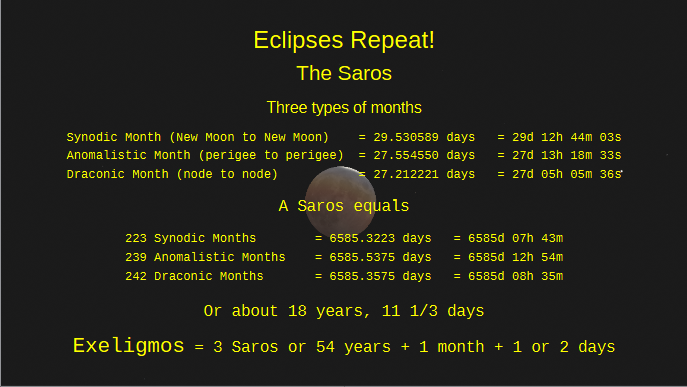
We know the Babylonians have been observing and recording eclipses since the 8th century BCE from their cuneiform tablets. By the 4th century BCE they had figured out that eclipses repeat themselves every 18 years and 11 and a third days. It seems they did this by observing lunar eclipses because that one third day in the saros. It keeps solar eclipses from being visible from the same location until 3 saros periods elapse that’s where we get the exeligmos where three saros periods equals 54 years and a month. With lunar eclipses if one sees a lunar eclipse in the early evening, one saros later, the next eclipse of the series will be visible in the morning before dawn.
The saros happens to be the confluence of three separate kinds of lunar months. The first is the synodic month which is also called a lunar month, is from new moon to new moon. It is the period that lunar calendars are based on. The next kind of month is the anomalistic month which is perigee to perigee that is this is the closest point to the earth back to its closest point to the earth one orbit later this is two days shorter than the synodic month. The third kind of month is the draconic month, which is the moon’s orbit from one node back to the same node.
Over the period of saros these separate months coincide within a very few hours. But since they don’t coincide exactly, the eclipses of the Cerro series the moon or the moon’s shadow actually moves northward or southward each saros period. And since we see more than one set of eclipses every 18 years, actually at least two of each a year, there are 36 or so separate saros series running at the same time.
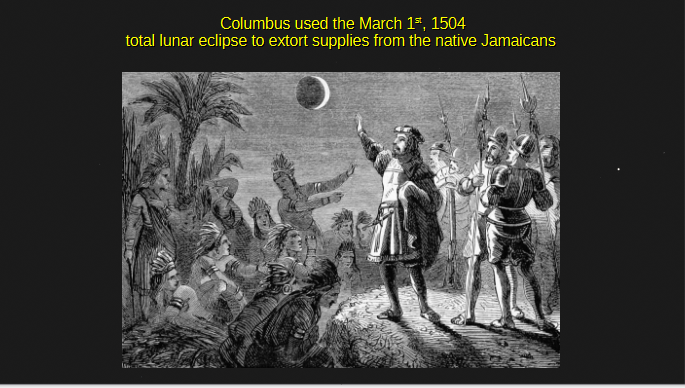
Columbus’ 4th voyage to the new world started out with four ships. After exploring the islands in I think the coast of South America, he ended up on Jamaica with no ships. At first, he had friend relations with the native Jamaicans, however over time that worsens when this crew began to harass, attack, and kill the native peoples, so they refused to give Columbus any more food or supplies. Columbus’s crew were on the brink of starvation when he checked an almanac and found out that soon there would be a total eclipse of the Moon. And on that fateful night he told the natives that unless he was given some supplies his God was going to take away the Moon. And that night the Moon did indeed begin to be devoured, that is the Moon began its entry into the Earth’s shadow. Columbus told them that unless they provided him with food and supplies his God was going to take away the Moon, and if they did provide him with supplies immediately he would consult with his God and see what he could do. The natives acquiesced and brought him food and supplies. Eventually within a couple of hours the Moon did indeed emerge from the earth’s shadow, and it was restored just as Columbus had said.
Notable modern lunar eclipses
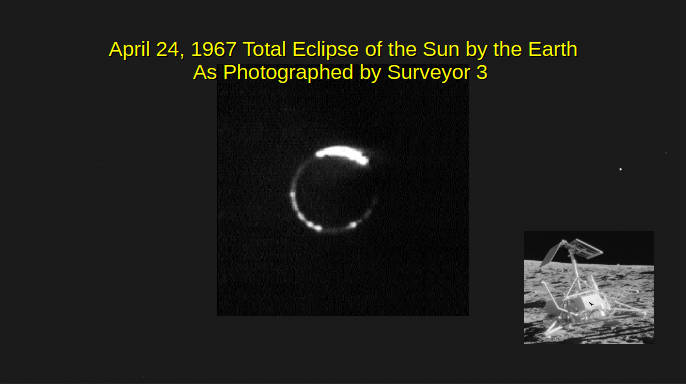
When we have a lunar eclipse, entities on the Moon see a solar eclipse. However, the Earth is 4 times larger than the Moon so that the totality of the solar eclipse lasts a long time, and the Earth covers much more than just the disk of the Sun. The Surveyor program was a lunar exploration program in preparation for the Apollo manned landings. Surveyor 3 landed on the moon just before a lunar eclipse, so one of its photographs was to look back at the Earth and take a look at it during totality of the solar eclipse. We know the Moon appears red, generally, when it’s eclipsed, and what Surveyor saw was the Earth with a red ring around it showing the combined sunrises and sunsets all around the earth at that time. The atmosphere of the Earth bends sunlight into the earth’s shadow. Blue light is scattered out, so we have red sunsets, and sunrises, so that is the color of the light that reaches the Moon. The amount of light we see on the Moon during totality depends on how clear the Earth’s atmosphere is at that time.
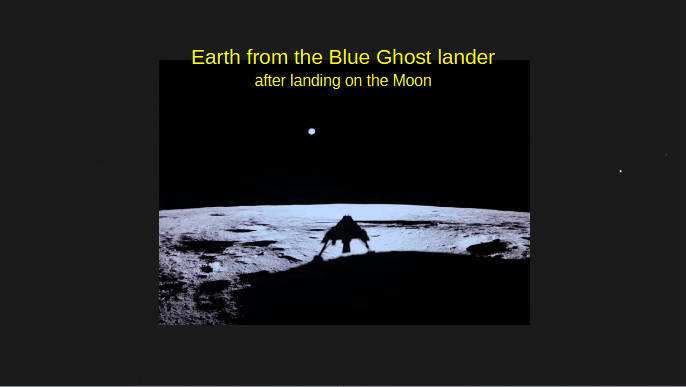
Firefly Aerospace’s Blue Ghost Lander, which is spending this lunar day on the Moon will be attempting to photograph the Earth and the solar eclipse while we are enjoying our lunar eclipse this Friday morning.
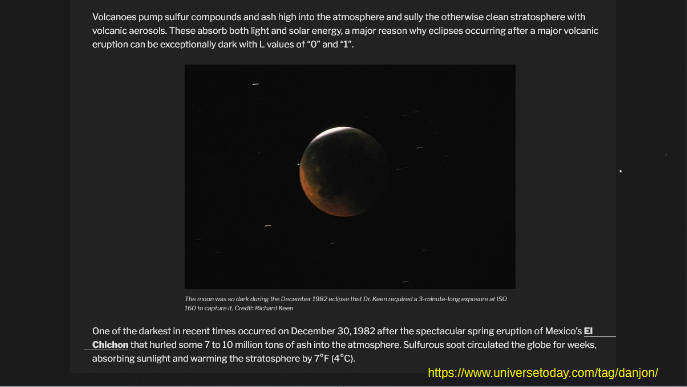
There were two total lunar eclipses visible from northern Michigan in 1982. Also that year, in April, a volcano named El Chichon, in southern Mexico erupted in a massive explosion sending a great deal of volcanic ash into the stratosphere. The earth’s shadow during the July 6th total lunar eclipse, to my eyes, didn’t look as uniform as it usually did, I assume because of the amount of dust in the atmosphere, and not being spread out quite as much as it would be later on. The second lunar eclipse was in the early morning hours of December 30th. And amazingly, here in Northern Michigan the sky was clear. I got out and looked over in the west to the Moon and didn’t see it at all. There was kind of a very faint glow in the constellation of Gemini, but that was all. I went to the Joseph H Rogers observatory to observe the Moon with the telescope. The moon was there but very, very dim. I could not see any of the red that shows up in the image above with the Moon being so dark. With the Moon being in Gemini, there were a lot of background stars since it was adjacent to the Milky Way. I was able to see many occultations of the stars as the moon moved against the background stars of the sky.
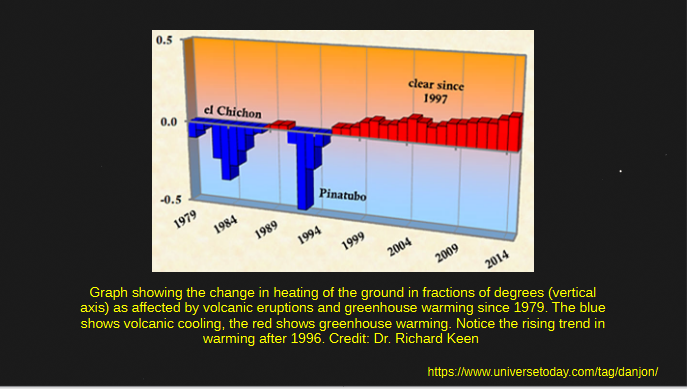
Above is a chart of the heating of the ground or lack of it caused by volcanic ash in the atmosphere in the 80s and 90s. We had two massive volcanic explosions the first El Chichon, in 1982, which I’ve already mentioned, and in 1991 Mount Pinatubo in Philippines, and how the volcanic ash caused cooling. It would also cause the dark lunar eclipses we saw. Since then even though this graph only goes to 2014 our lunar eclipses have been fairly bright, the red coloring obviously showing very well during totality.
The March 14, 2025 total lunar eclipse
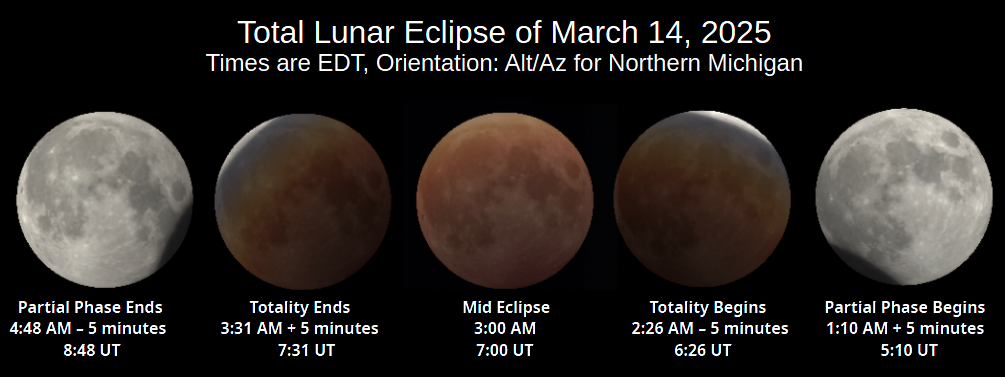
The image above shows the progress of the March 14th 2025 total lunar eclipse, at least the phases having to do with the Earth’s inner shadow, the umbra. The sequence moves from right to left as it moves through the Earth’s shadow. The penumbra will show itself about half an hour before the partial phase begins, as a sort of a dimming of the Moon in the side towards the umbra, so it will not appear uniformly illuminated. The partial phase begins at 1:10 AM, The next image is taken 5 minutes before totality, which will begin at 2:26 AM. We’re looking at just before totality begins, so you can tell where the shadow is. Mid eclipse is at 3:00 AM. I’ve increased the brightness of that image so it actually shows better, but it will be dimmer than the outer edges of the umbra. Totality will end at 3:31 AM and that image is what it should look like 5 minutes after that time. And the partial phase will finally end at 4:48 AM. For the next half hour you might be able to see the effects of the penumbra. Seeing the slight shading of the penumbra is easier if one uses sunglasses, which will reduce the glare of the still bright Moon and enhancing the shadow effect.
Ephemeris Extra: 07/02/2024 – A closer look at Corona Borealis
Adapted from an article that ran in the Stellar Sentinel, the July 2024 newsletter of the Grand Traverse Astronomical Society.
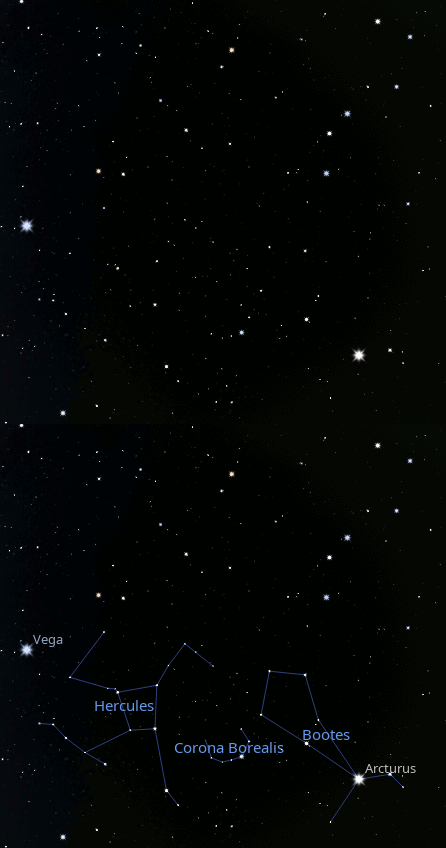
A small constellation is getting a lot of attention this year because we expect a bright nova to appear in it sometime in the next few months. The constellation is Corona Borealis, the Northern Crown. It is a small constellation between the Boötes and the bright star Arcturus and Hercules, and farther off to the east the bright star Vega. Corona Borealis contains seven stars in the 2/3 circle of stars. Its brightest star is the third star from the right. It’s the second magnitude star called Alphecca. In Arabic, it means The Bright Star of the Broken Ring of Stars, which is a pretty good description of it. It is also known as Gemma though it sounds like a gem in a crown, it actually means blossom which would appear in a floral crown.
In Greek mythology the crown was given to the Princess Ariadne. The story goes like this. During the time of the Minoan civilization on Crete, It was ruled by King Minos, whose daughter was Ariadne. The Minoans apparently had defeated Athens in battle and had extracted tribute from them. That yearly tribute being the sacrifice of the young man or maiden to enter the Labyrinth which was home to a monster called the Minotaur. In this story a fellow by the name of Theseus from Athens was sent to Crete to face the Minotaur. He fell in love with Ariadne, but he had to enter the Labyrinth, so she provided him with a spool of thread so he could find his way back out again after he had slain the Minotaur, if he was able to. He entered the Labyrinth and found the Minotaur. Theseus was able to slay the beast, and was able to follow the thread back out. Theseus and Ariadne fled to the Island of Naxos where he married her. However, he soon abandoned her. As consolation, the god Dionysus gave her a crown. She kept the crown until she remarried, and it was placed in the sky where we see it today.
For the Anishinaabe native peoples of our area Corona Borealis becomes the Sweat Lodge. Other indigenous peoples of North America see these stars as circles of maidens, or other circles. To the Aborigines of Australia who see Corona Borealis very low in the north, it’s Woomera, the boomerang.
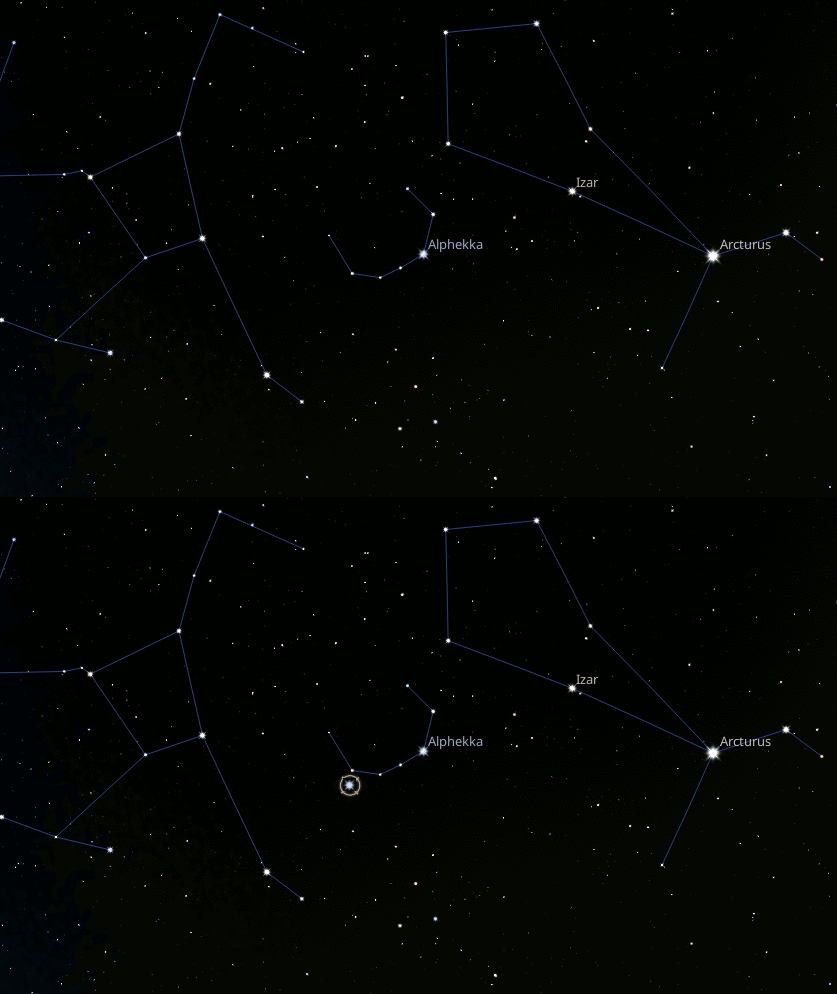
The constellation has two famous variable stars. The one we’re expecting to flare up this year, up to second magnitude as a nova, is T Coronae Borealis (T CrB), sometimes called the Blaze Star. It was recorded in 1866 and at even earlier times, and was naked eye for eight days, dropping a half magnitude per day. It also blazed forth in 1946, making it one of the few known recurrent novas. In 1946 the star, normally 10th magnitude, barely visible in binoculars, underwent a slight dimming about 11 months before it blazed forth as a nova. This has already happened last year, so we are expecting it soon to blaze forth again. It will appear to the lower left, just outside the circle of stars in the crown, and will grow as bright as Alphecca.
Novas, also in the case of T CrB, are close binary stars containing a large star and a white dwarf. A white dwarf is a star at the end of its life, and has run out of hydrogen or other light elements in its core to keep it sustained. So it shrinks down to about the size of the Earth, even though it has the mass of the Sun or a little more. It orbits with the larger star and is basically siphoning off gas from that large star onto its surface, enough gases accumulate on the star for a thermonuclear reaction to occur, and it becomes a nova, brightening thousands of times for a few days. The white dwarf survives to do it all over again in some cases.
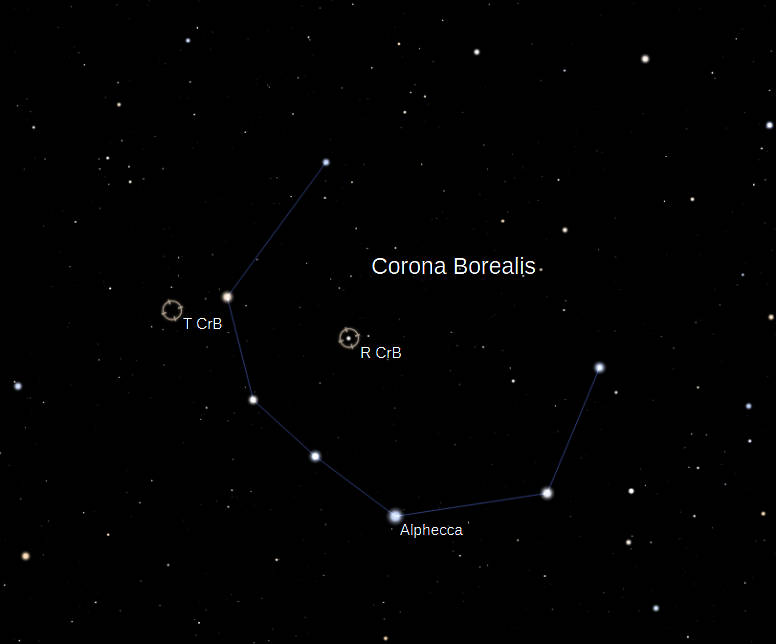
Corona Borealis’ other famous variable star is R Coronae Borealis, a star that’s normally about 6th magnitude that irregularly dips down to 10th or even dimmer. The mechanism for this appears to be that the star is surrounded by clouds of dust that periodically block it from our view.
If you’re interested in observing variable stars, check out the American Association of Variable Star Observers: https://www.aavso.org/
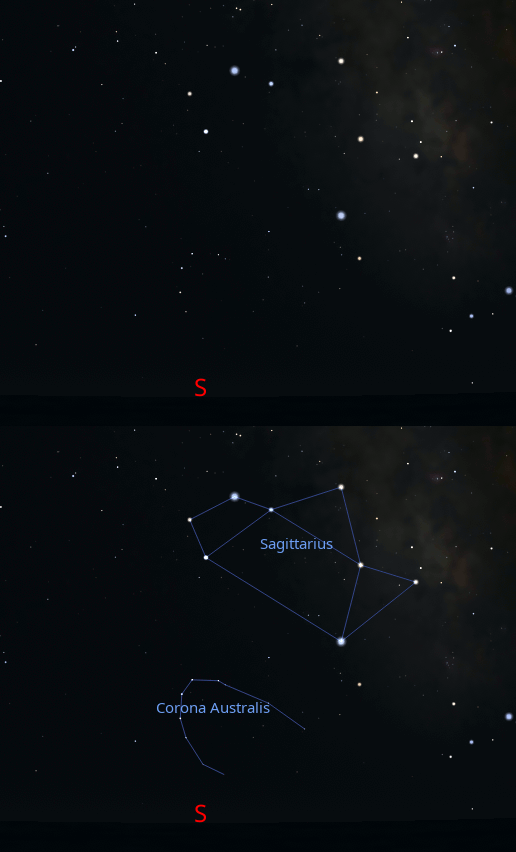
If there’s a Northern Crown, there should be a Southern Crown, and there is. It is Corona Australis made of dim stars, and it is located just below the constellation of Sagittarius, right below the Teapot asterism, which is very low on our southern horizon after midnight this month, but better seen in August.
Ephemeris Extra; 5/11/2024, 9 PM EDT Aurora alert for the 13th
Last night in our area there was an incredibly bright display of the Northern Lights or Aurora Borealis. It was cloudy where I was, although my granddaughter was able to get photographs of it with her smartphone. That was the result of an X type flare on the Sun on the 8th resulting in a coronal mass ejection or CME, which arrived here on Earth two days later.
Earlier today there was another X type flare on the Sun. So we expect on Monday the 13th to have another possibility of seeing an aurora. Auroras occur during geomagnetic storms caused by the Earth being intercepted by one of these CME’s. Check spaceweather.com for any news of auroras and check the Current Auroral Oval image. Click on it to get the forecast of the possibility of seeing an aurora in your area. It is from the NOAA Space Weather Prediction Center. If the oval covers your location, and it’s night, or is close, check the sky.
Ephemeris Extra: 03/03/2024 – Tips for viewing the April 8, 2024 total solar eclipse
What is a solar eclipse?
Solar eclipses or eclipses of the Sun occur in about one in six new moons. However, one must be in the right part of the Earth to see them, which is why they may seem rare.
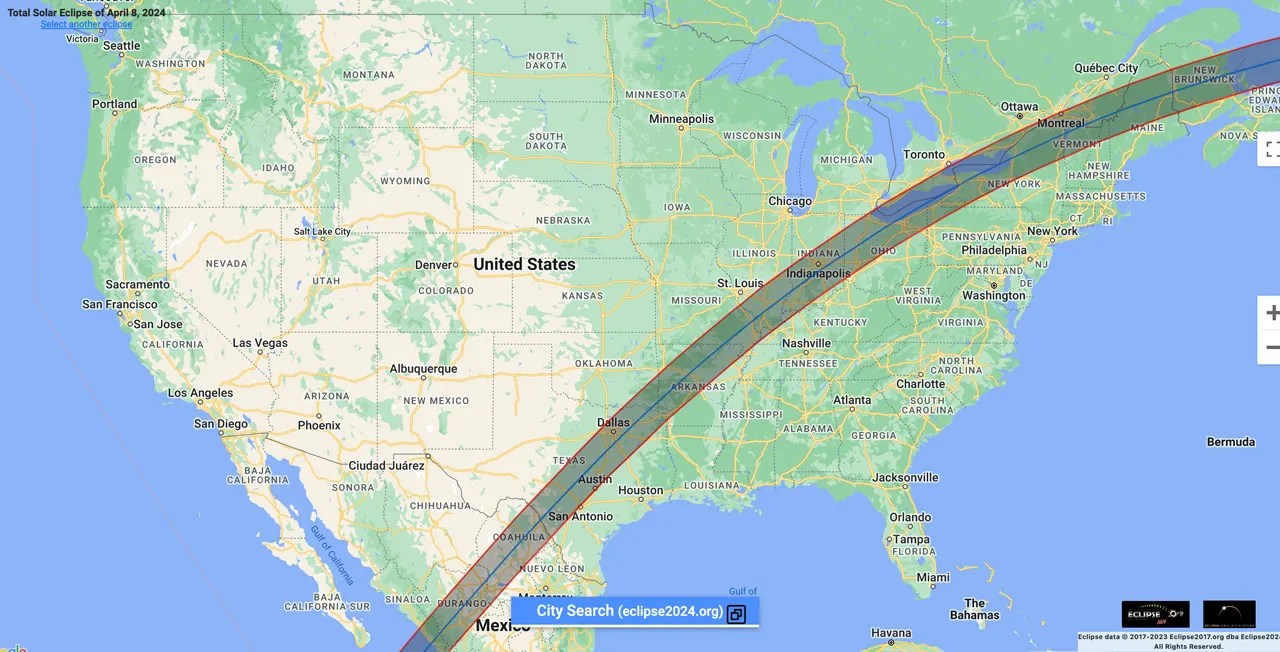
In a solar eclipse the moon’s shadow is cast upon the Earth. Because the Sun is a disk, the Moon’s shadow is fuzzy with sometimes a dark core. The fuzzy outer part of the shadow is called the penumbra. Observers there will see the Sun partially covered by the Moon, a partial eclipse. Observers in the dark core of the shadow are in the umbra, and see the face of the Sun completely covered by the Moon, a total eclipse. The maximum length of totality is never more than about seven minutes. Maximum for this eclipse will be 4 minutes 28 seconds in Mexico. The maximum length of the partial eclipse would be about 2 ½ hours.
What can be seen?
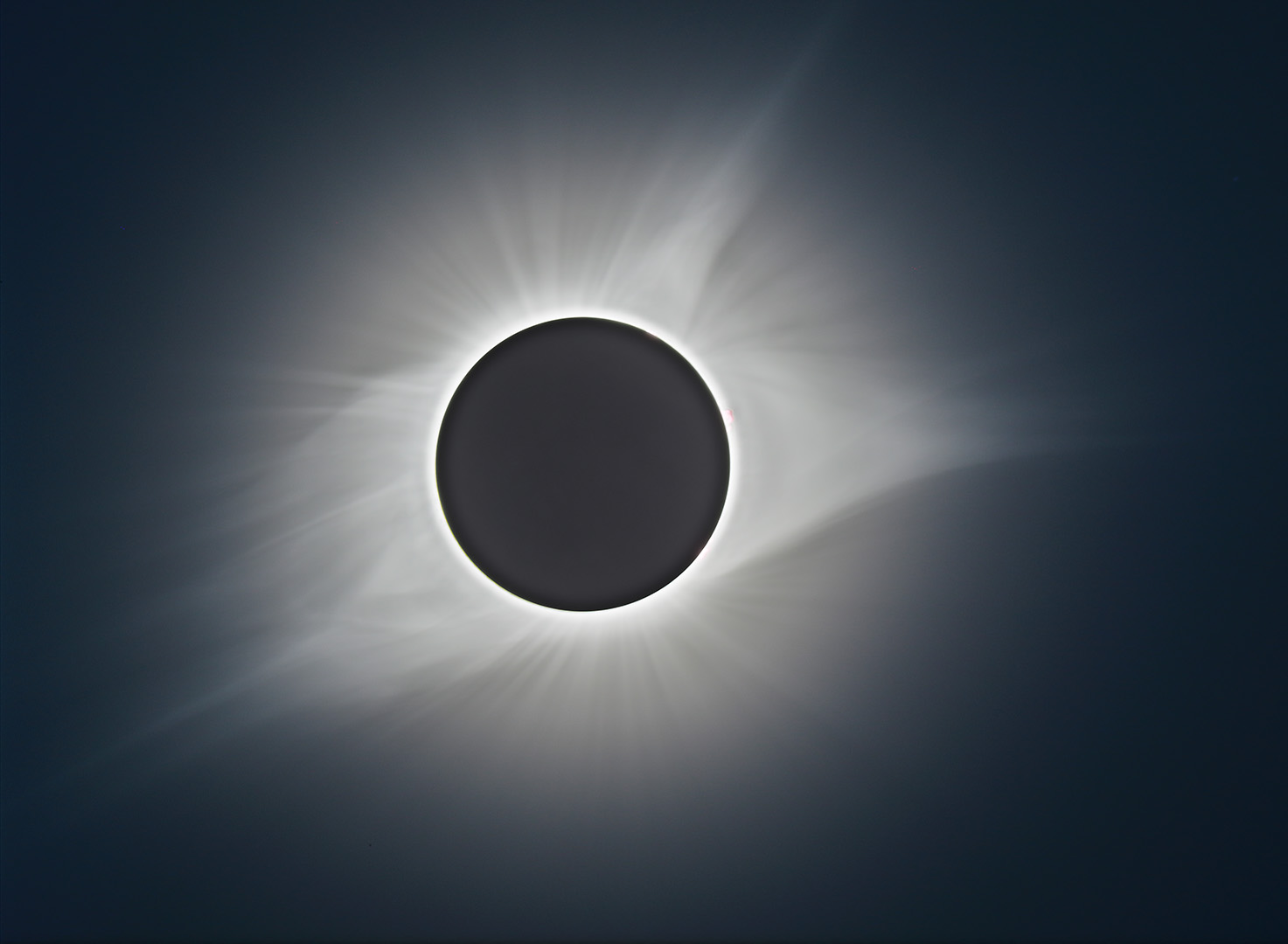
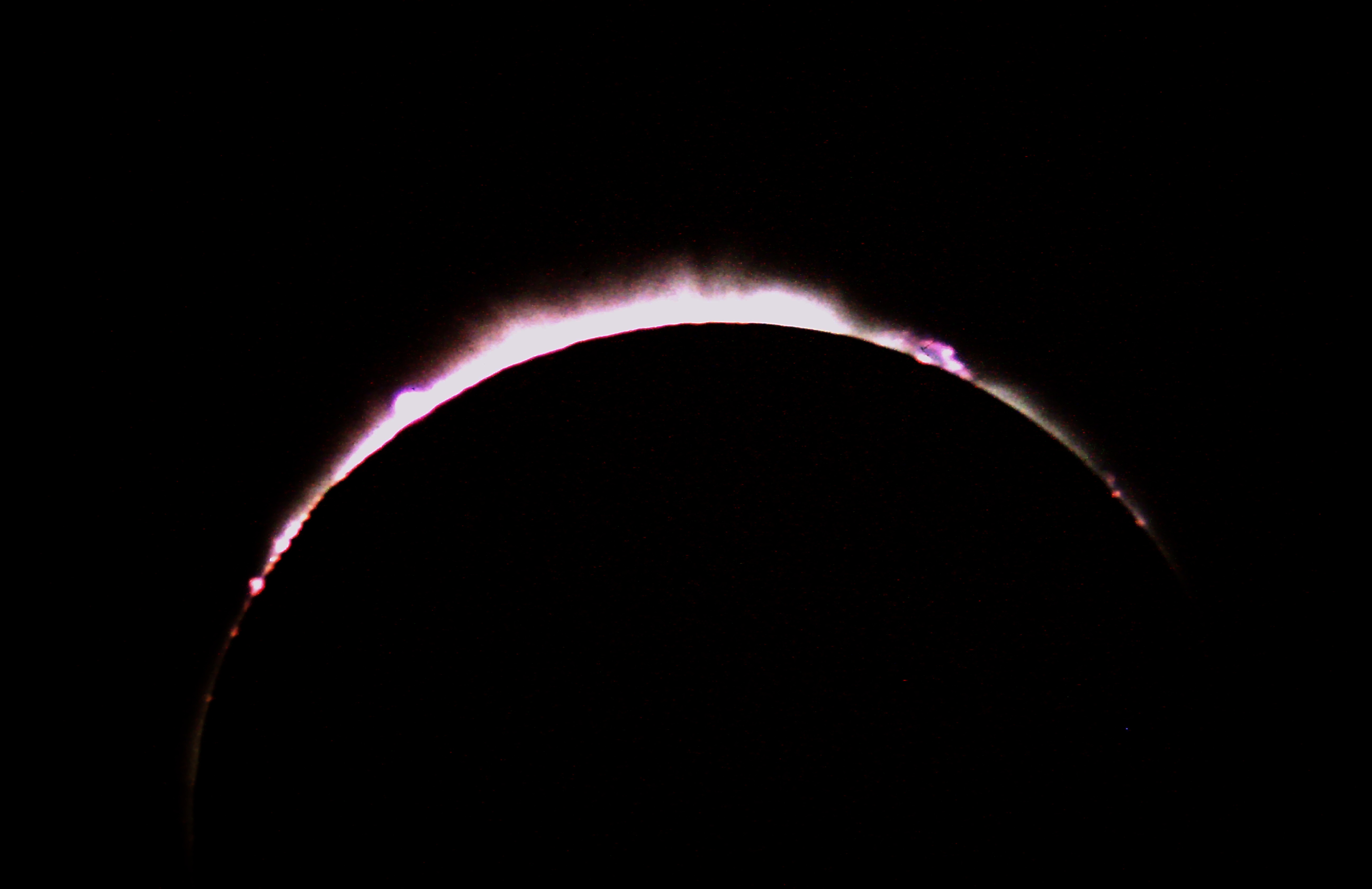
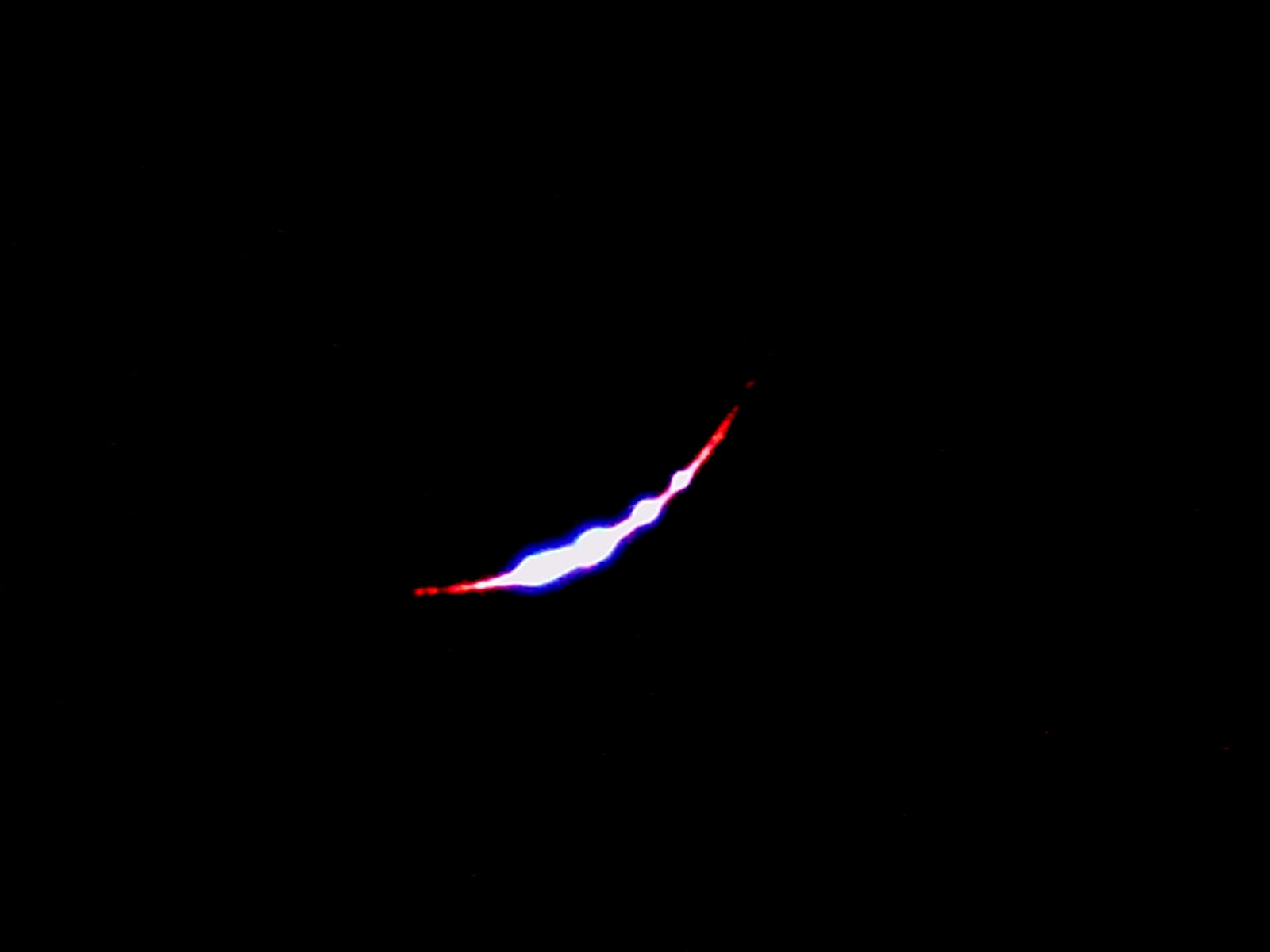
The outer three layers of the Sun are potentially visible to us: photosphere, chromosphere, and corona. The photosphere is the bright ball of the Sun we normally see. Looking at it for any length of time will cause blindness. Never look at the Sun’s photosphere without an approved solar filter. The other two layers can be seen during the totality of a solar eclipse. A thin red layer of gas with flame-like protrusions called prominences just above the photosphere and can normally be seen in a Hydrogen Alpha solar telescope, but easily seen in binoculars just after totality starts and before it ends. The corona is a silvery white extended solar atmosphere that can be seen out to several solar radii out from the edge of the Moon. Its shape changes hour to hour, and sometimes minute by minute.
All around you strange things happen as the Sun is covered by the Moon.
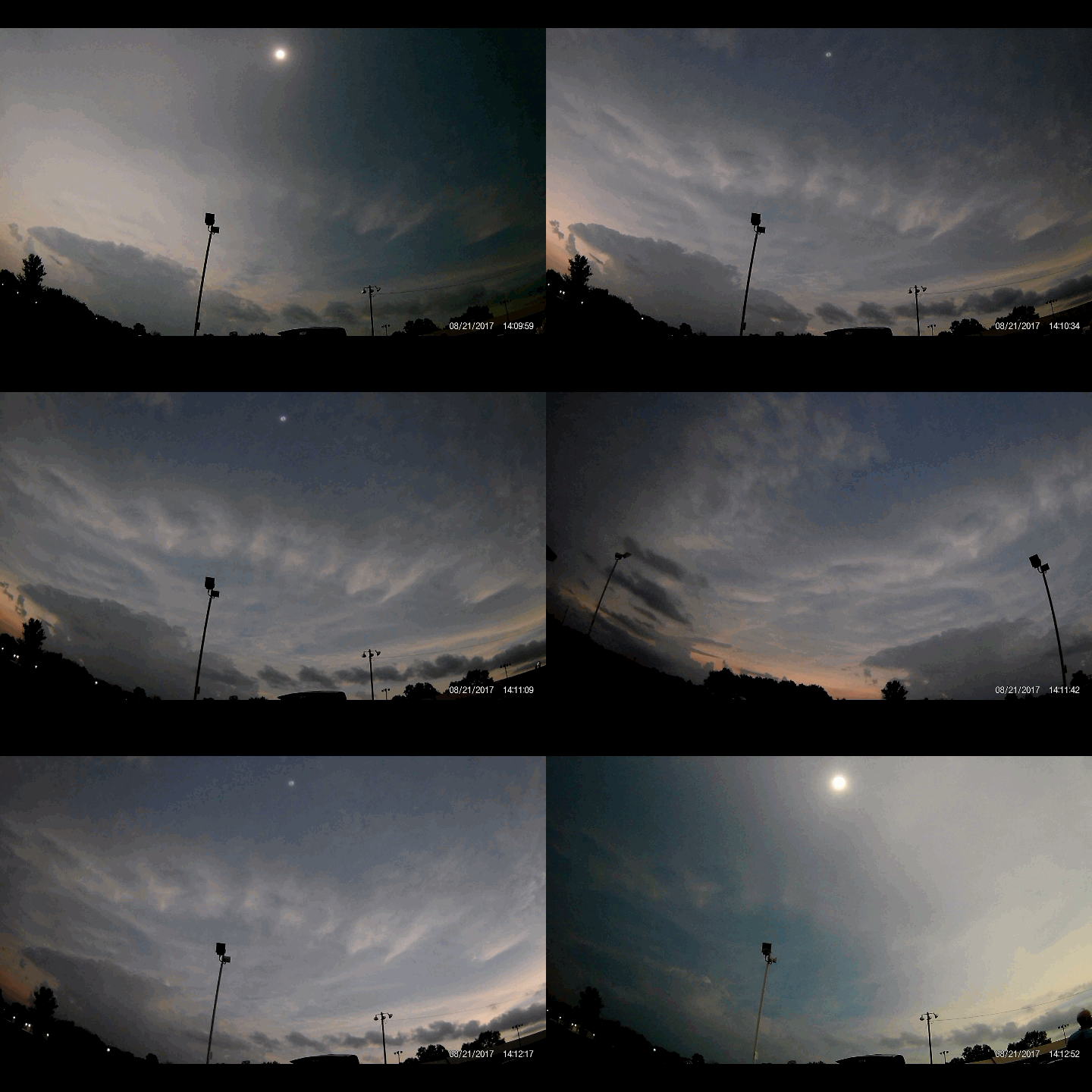
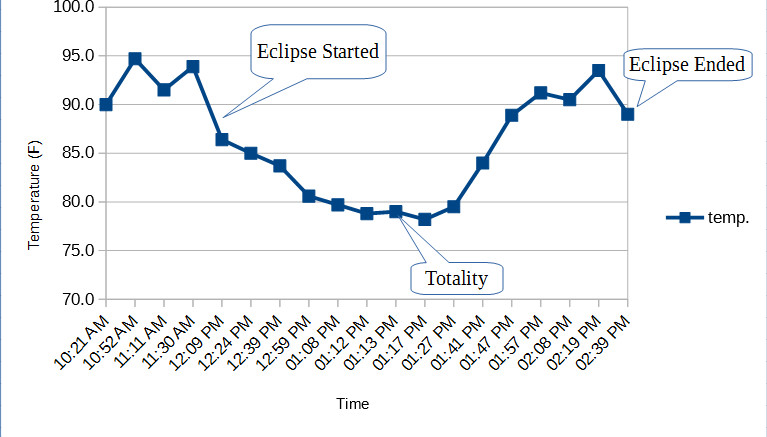
- The temperature will drop as the Sun is covered. It will be interesting to record the drop and recovery before, during and after the eclipse. Even a deep partial eclipse like what we’ll see locally will show a drop.
- Nearing totality the Sun’s light will appear somewhat yellow in hue. The revealed part of the Sun when it is mostly covered by the Moon is cooler and yellower than the central part. This is called limb darkening.
- As totality approaches and the sky darkens, streetlights will turn on.
- Also Chickens and other birds will go to roost. In the country cocks will crow before and after totality. Mosquitoes will think it’s twilight and will come out in mosquito prone areas for a snack.
- Shadow bands will be projected on flat smooth surfaces in near maximum phases of the partially eclipsed Sun. These are very subtle and are caused by atmospheric turbulence and the nearly pinpoint illumination by the Sun. It took me four total eclipses in order to be able to spot the effect on the tarmac of an airport. The nearest analog of this is seeing the shadow pattern on the bottom of a swimming pool on a sunny day, but very much fainter.
- Look for Venus (15° lower right) and Jupiter (30° upper left) of the Sun during totality. Just before, during and after totality look around at the sky and the incoming and outgoing umbral shadow.
- Check out the colorful horizon effects.
Viewing the partial solar eclipse

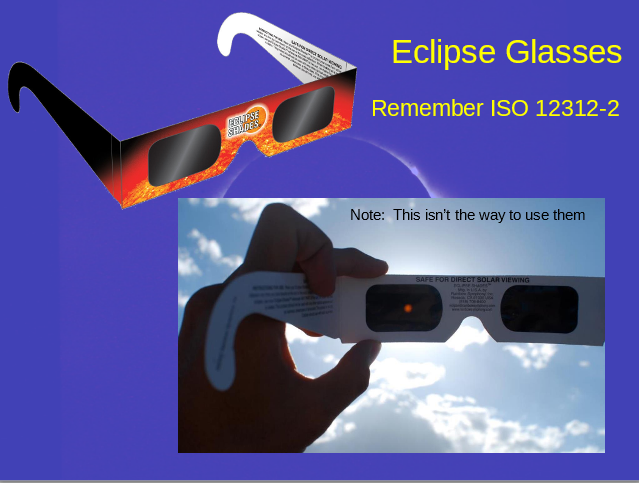
They are especially difficult to use, especially for people who wear glasses and can’t remove them because they are near-sighted.
Personally I do not recommend them, instead relying on one of the projection methods.
Be especially careful about children using them.
Remember the ISO 12312-2 compliance that should be printed on them.
Never look directly at the partially eclipsed Sun without an approved solar filter. Solar filters must comply with ISO 12312-2 and transmit no more than 0.0032% of sunlight, and preferably less. Items sold as Eclipse viewing glasses must state that they comply with ISO 12312-2. People like me who wear glasses will find gaps above and below the frames of these filters where the Sun can get in, so must be used with extreme caution. No eclipse is worth your eyesight. The damage caused by looking directly at the Sun may not be known for several days after exposure, then it’s too late. I never use these filters, and prefer to project the Sun’s image on a white screen.
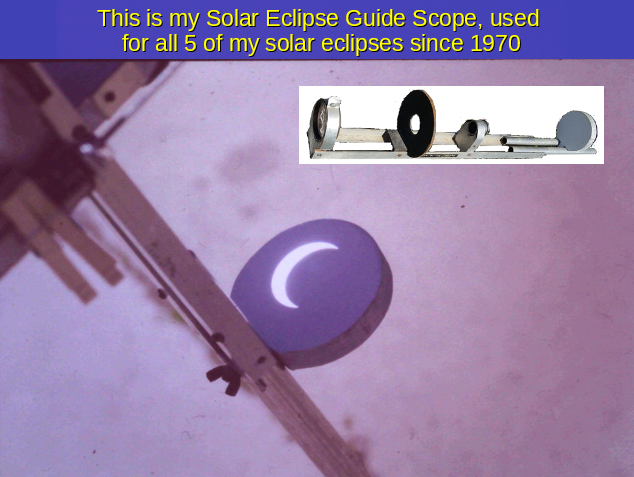
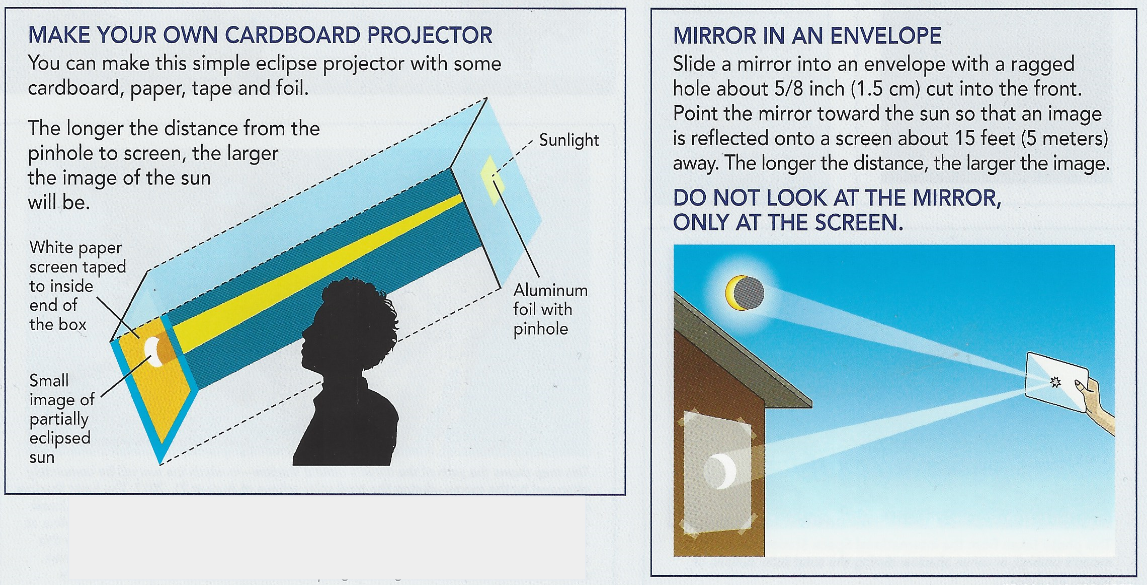
Pinhole projection is an easy way to project the Sun’s image. Depending on how far you want to project the image the larger the pinhole the farther and larger (and dimmer) the image can be. “Pinholes” up to 1/4 inch and maybe even half an inch can be used if you’re projecting it 10 feet or more. One can even use a mirror in an envelope with a small hole punched in it with the paper punch to project the sun’s image on the shady side of a building. That way many people can view the eclipse safely. Also try different size holes to get the best combination of size and brightness of the image. Unlike the illustration above it is best to mount the mirror on a tripod, or other support somehow, rather than holding it to keep the image steady. Using this method, the Sun’s motion due to the Earth’s rotation can be seen. Also, large sunspots may also be visible.
Local Circumstances
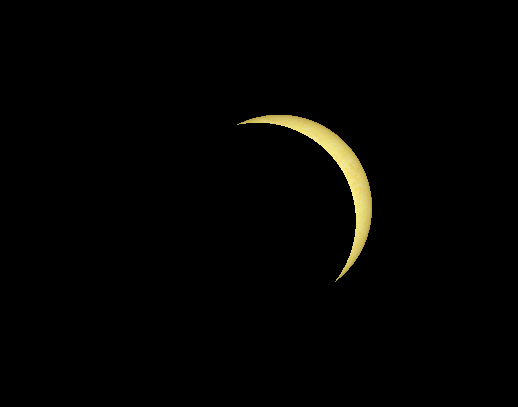
Local eclipse times for Traverse City: Starts (first contact) 1:58 p.m. Maximum 3:12 p.m. 89% covered Ends (last contact) 4:25 p.m. Times for other localities in northern Michigan will be within a minute or two of these values. It may be a minute or two after first contact for the first bite of the Moon to become discernible.
Eclipse2024.org provides an interactive map of the April 8, 2024 eclipse on the Internet to allow the display of eclipse times for any location: https://eclipse2024.org/eclipse_cities/statemap.html
Eclipse2024.org provides an interactive map of the April 8, 2024 eclipse on the Internet to allow the display of eclipse times for any location: https://eclipse2024.org/eclipse_cities/statemap.html.
Ephemeris: 01/25/2024 – Where is the full moon in winter?
This is Ephemeris for Thursday, January 25th. Today the Sun will be up for 9 hours and 31 minutes, setting at 5:41, and it will rise tomorrow at 8:08. The Moon, at full today, will rise at 5:30 this evening.
The exact time that the Moon will be full, at least to the nearest minute is 12:54 this afternoon. Have you ever noticed the placement of the full moon in the sky between winter and summer? The full moon near the winter solstice moves very high at midnight, while the full moon near the summer solstice is seen quite low in the south. For the Moon to be full, it must be nearly opposite the Sun in the sky, so we see it fully illuminated as the Sun does. The Moon’s orbit is close to the Sun’s apparent path in the sky, the ecliptic, which is the projection of the Earth’s orbit of the Sun. So the Moon now is near, and actually a bit north of, where the Sun will be 6 months from now in mid to late July.
The astronomical event times given are for the Traverse City/Interlochen area of Michigan (EST, UT –5 hours). They may be different for your location.
Addendum
Ephemeris Extra: Taurus and its two bright star clusters
Based on an article published in the November 2023 issue of the Stellar Sentinel the newsletter of the Grand Traverse Astronomical Society.
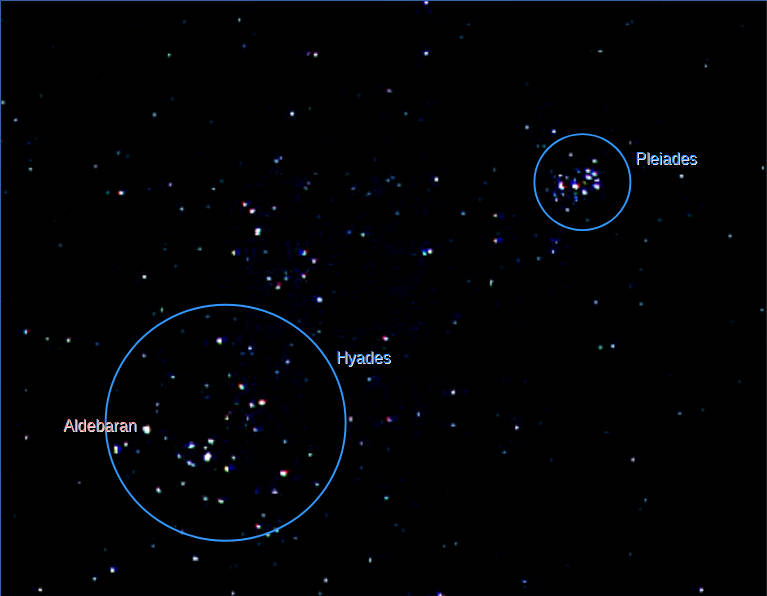
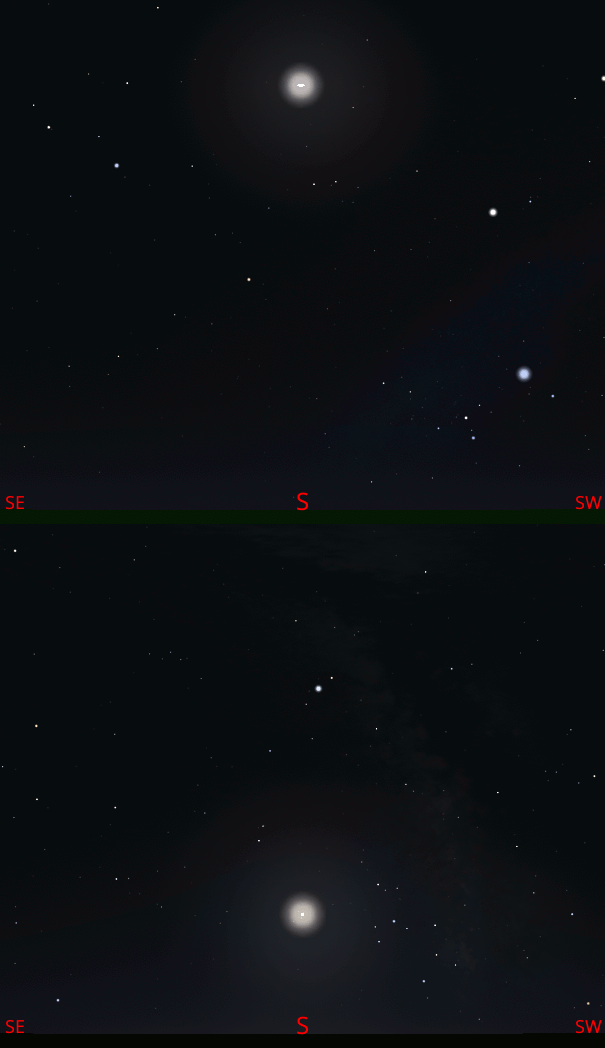
In my October presentation to the society I talked about the stars of autumn, moving generally from the constellations close to summer and ending pretty much against the constellations of winter ending with the constellation of Taurus and with the wonderful Pleiades or Seven Sisters. In this article I’ll take a little bit closer look at the Pleiades and especially the Hyades, the face of Taurus the bull.
On the previous page is a family portrait of the Pleiades and Hyades. Yes, family portrait. In Greek mythology, the Hyades are the half sisters of the Pleiades. The god Atlas is their father, Pleione seems to be the mother of the Pleiades, and Aethra is the mother of the Hyades. In astronomical terms the Hyades would then be the older sisters of the Pleiades.
The Hyades is a star cluster that is 153 light years away. It is the closest star cluster to us and somewhat over 6 times the age of the Pleiades. The younger and splashier Pleiades are around 444 light years away, and only 100 million years old. Whereas the Hyades are over 600 million years old. The Pleiades still contain hot blue-white stars which have died out by the time of the age of the Hyades. The brightest star of the letter V of stars is Aldebaran, Taurus’ angry bloodshot eye. It doesn’t belong to the Hyades, being about half the distance.
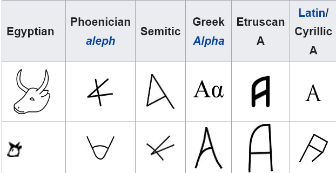
While the Hyades is not as splashy as the Pleiades are and has less of a role in mythology. However, it did play an important part in history when Taurus was the first constellation of the Zodiac some 4,000 years ago, due to precession of the equinoxes. This is because the letter A, the first letter of our alphabet is taken from the stars of the face of Taurus the bull in what looks to us like a V. But it was turned around to be the A we have today. Back then it was called Aleph the first letter of the alphabet for middle eastern cultures.
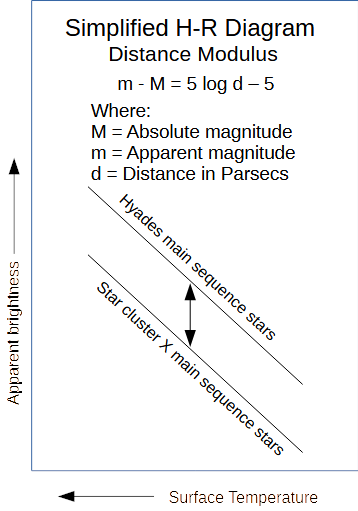
The Hyades is also important in astronomical history in that it helps us measure distances to more distant star clusters. The Hyades was the only star cluster close enough to measure its distance by the parallax method before the advent of the European Space Agency’s Hipparcos and Gaia satellites. If one matches stars on the Hertzsprung-Russell diagram of intrinsic brightness versus surface temperature with other star clusters the stars of the main sequence, where stars spend most of their lives burning hydrogen. The difference in the brightness of the main sequence stars gives the measure of how other star clusters measure up as far as distance since the main sequence is a relatively narrow distribution of stars. This works only with star clusters because there are many stars at the same distance which happen to be about the same age. And enough stars to establish the main sequence since stars at later stages of life may have the same temperature, but vastly different brightnesses.
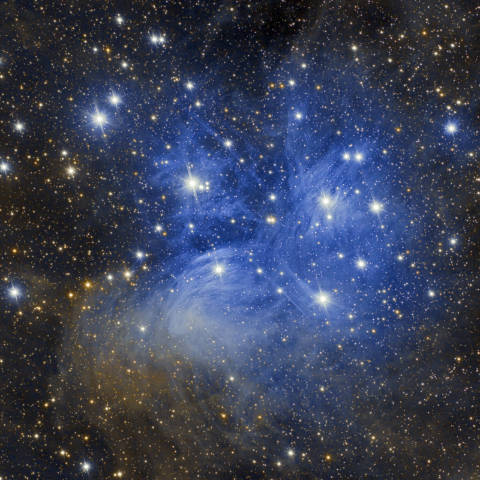
The Pleiades are so large that most telescopes will not allow one to see all the brighter stars at once, so binoculars are the best way to view them. At a dunes star party a few years ago, before COVID, I used my 11-inch (279 mm) Newtonian telescope, which has a 55 inch (1,397 mm) focal length, with a 40 millimeter eyepiece to view the Pleiades. A 40 millimeter eyepiece in that scope gives too low a magnification to use the entire diameter of the primary mirror. All the light doesn’t make it into the eye. That eyepiece gave me about 35 times magnification, so the main stars of the cluster fit into the field of view. The photograph above is nice and all that, but looking with the eye visually at the Pleiades, even with binoculars, you’ll notice something quite different from the photographs. In photographs to make a star brighter you make it bigger. But the eye has a much greater dynamic range. The stars are incredibly brilliant blue white-points of light in the case of the Pleiades. Absolutely beautiful, much more beautiful than any photograph. Not to disparage photographs, but photographs can do what the eye cannot. That is, store light to bring out very faint objects and details. So, let’s take a final look at the Pleiades in a photograph by GTAS member Dan Dall’Olmo.
Ephemeris Extra: 01/02/2024 – Two remarkable astronomical events for 2024
Ephemeris Extra posts are freestanding posts not tied to a specific Ephemeris radio program on Interlochen Public Radio
Total Solar Eclipse, April 8th
The big astronomical event of 2024, for us in Michigan, will be the total eclipse of the Sun, on the afternoon of Monday, April 8th. The path of totality will just clip the southeastern corner of Michigan by a few miles, so if you want to see the best of totality you need to leave the state. Totality is when the Moon completely covers the brilliant face of the Sun and allows the Sun’s silvery corona to be seen. Totality is the only part of the eclipse that can be viewed without eye protection or by projection.
Two relatively nearby large cities that will see totality are Indianapolis and Cleveland. Parts of Indianapolis will get to see more than 4 minutes of totality. Cleveland will see a little less. The closer you are to the center line of that path the longer totality will last.
For an interactive map of the eclipse path on the Internet, go to eclipse2024.org/eclipse_cities/statemap.html
Weather is always a concern for eclipses. In general the farther south one goes the better the chances there are for clear skies. But all bets are off for eclipse day: It’s gonna be is what it’s gonna be. My current inclination is to head southwest along the eclipse path.
For those staying home and not chasing the shadow of the Moon will see a partial eclipse here with up to 87% of the Sun being blocked by the Moon.
Comet Tsuchinshan-ATLAS
We expect to see a new bright comet in October: C/2023 A3 (Tsuchinshan-ATLAS), otherwise known in this article as A3 for short. It may be the brightest comet to appear in our Northern Michigan skies since Comet Hale-Bopp in 1997, and a good deal brighter than 2020’s Comet NEOWISE. At least we’re hoping.
This comet was discovered last January by the station Xi Yi of the Purple Mountain Observatory in China, and a month later by the ATLAS search program on Maui. ATLAS is an acronym for the apocalyptic sounding Asteroid Terrestrial-Impact Last Alert System.
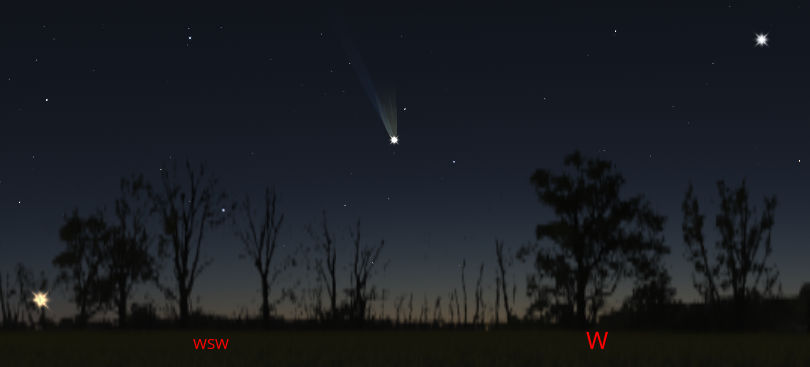
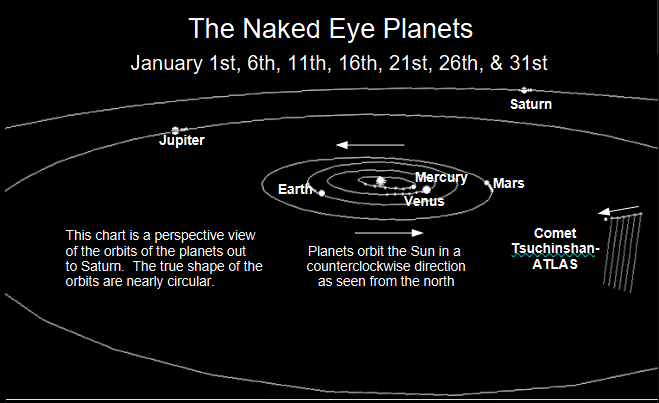
A3 will best be visible from Northern Michigan toward mid-October in the evening, not long after sunset. The comet is expected to reach magnitude 0 at it’s closest to the Sun in late September. However, we will be seeing it best as it’s leaving the vicinity of the Sun. By mid-October its magnitude will have dropped to magnitude 1 which is still pretty bright, and it will be moving at a high angle away from the setting Sun, so it will rapidly increase its distance from the Sun and the horizon faster than it fades in the latter part of October. That is, if it behaves itself. Comets are notoriously fickle in their brightness so we won’t know until we actually see it how bright it’ll be, or how bright or long its tail will be. As of this writing (Mid-December) A3’s brightness is tracking as predicted, at about 16th magnitude. As of January 1st its distance from the Sun was 4.24 AU, about 1 AU inside Jupiter’s orbit. 1 AU (Astronomical Unit) is the mean distance between the Earth and the Sun. The comet can be followed on Seiichi Yoshida’s Weekly Information about Bright Comets webpage: http://www.aerith.net/comet/catalog/2023A3/2023A3.html
Ephemeris Extra: 01/01/2024 – Previewing January skies
This post didn’t make it into a radio program, so enjoy.
We start a new year and a month. The daylight hours start slowly getting longer and will accelerate during the month. Daylight hours in Interlochen and Traverse City will increase from 8 hours and 52 minutes on the 1st to 9 hours and 46 minutes on the 31st. The sunrise time will decrease from 8:20 am on the 1st to 8:03 am at month’s end. The sunset times will increase from 5:12 pm on the 1st to 5:49 pm on the 31st. Along with that the altitude of the sun at noon will increase from 22 degrees tomorrow to nearly 28 degrees at month’s end. It will be a degree lower for folks in the Straits area because they are a degree of latitude farther north. Local noon, by the way for Interlochen and Traverse City is around 12:51 p.m. in January.
The astronomical event times given are for the Traverse City/Interlochen area of Michigan (EST, UT –5 hours). They may be different for your location.
January Evening Star Chart
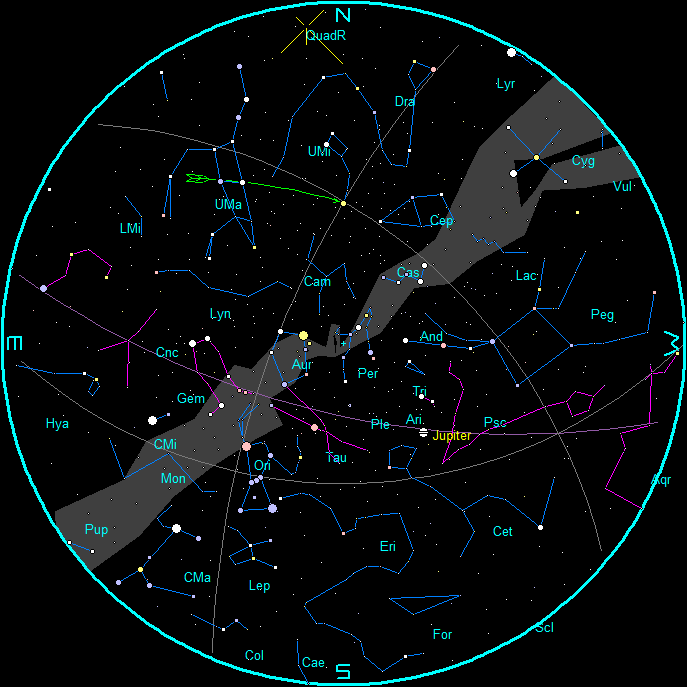
The planets and stars are plotted for the 15th at 9 p.m. EST in the evening and 6 a.m. for the morning chart. These are the chart times. The brilliant planet Venus will enter the sky at the chart time during the latter half of the month in the southwest. Note that Traverse City is located approximately 45 minutes behind our time meridian, West 75° longitude. (An hour 45 minutes behind our daylight saving time meridian during EDT).
January Morning Star Chart
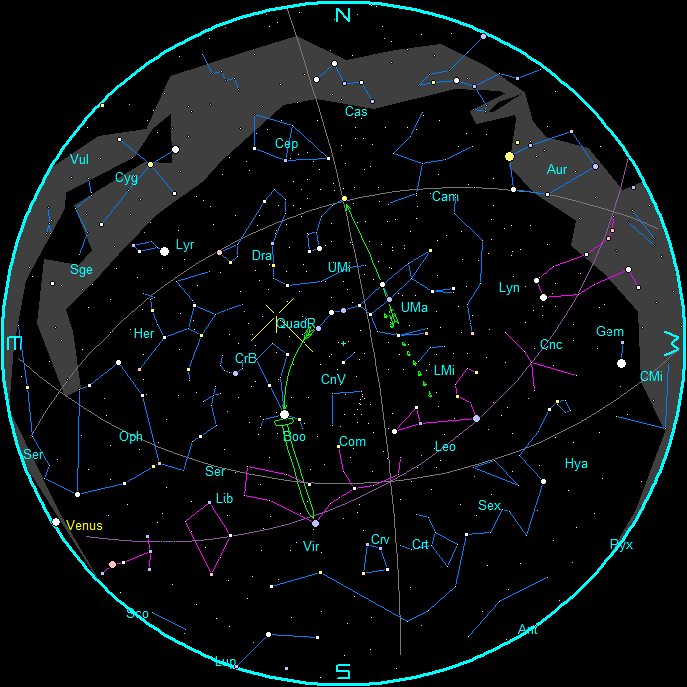
For a list of constellation names to go with the abbreviations click here.
- Pointer stars at the front of the bowl of the Big Dipper point to Polaris the North Star.
- The leaky bowl of the Big Dipper drips on Leo.
- Follow the arc of the handle of the Big Dipper to the star Arcturus, then
- Follow the spike to Spica.
- QuadR on the star charts is the radiant of the Quadrantid meteor shower which peaks on the 4th at 3:20 a.m. EST (8:20 UT).
Twilight Limits, Nautical and Astronomical
| EST | |||||||
| Morning | Twilight | Evening | Twilight | Dark | Night | Moon | |
| Date | Astro. | Nautical | Nautical | Astro. | Start | End | Illum. |
| 2024-01-01 | 6h35m | 7h11m | 18h22m | 19h01m | 19h01m | 22h59m | 0.68 |
| 2024-01-02 | 6h35m | 7h11m | 18h22m | 19h02m | 19h02m | – | 0.59 |
| 2024-01-03 | 6h35m | 7h11m | 18h23m | 19h03m | 19h03m | 0h01m | 0.50 |
| 2024-01-04 | 6h35m | 7h11m | 18h24m | 19h03m | 19h03m | 1h05m | 0.40 |
| 2024-01-05 | 6h35m | 7h11m | 18h25m | 19h04m | 19h04m | 2h10m | 0.30 |
| 2024-01-06 | 6h35m | 7h11m | 18h26m | 19h05m | 19h05m | 3h19m | 0.21 |
| 2024-01-07 | 6h35m | 7h11m | 18h27m | 19h06m | 19h06m | 4h31m | 0.13 |
| 2024-01-08 | 6h35m | 7h11m | 18h28m | 19h07m | 19h07m | 5h45m | 0.07 |
| 2024-01-09 | 6h35m | 7h10m | 18h29m | 19h08m | 19h08m | 6h35m | 0.02 |
| 2024-01-10 | 6h35m | 7h10m | 18h30m | 19h09m | 19h09m | 6h35m | 0.00 |
| 2024-01-11 | 6h35m | 7h10m | 18h31m | 19h10m | 19h10m | 6h35m | 0.01 |
| 2024-01-12 | 6h35m | 7h10m | 18h32m | 19h11m | 19h11m | 6h35m | 0.04 |
| 2024-01-13 | 6h34m | 7h09m | 18h33m | 19h12m | 20h14m | 6h34m | 0.10 |
| 2024-01-14 | 6h34m | 7h09m | 18h34m | 19h13m | 21h36m | 6h34m | 0.18 |
| 2024-01-15 | 6h34m | 7h09m | 18h35m | 19h14m | 22h55m | 6h34m | 0.28 |
| 2024-01-16 | 6h33m | 7h08m | 18h36m | 19h15m | – | 6h33m | 0.39 |
| 2024-01-17 | 6h33m | 7h08m | 18h37m | 19h16m | 0h12m | 6h33m | 0.51 |
| 2024-01-18 | 6h33m | 7h07m | 18h39m | 19h17m | 1h28m | 6h33m | 0.62 |
| 2024-01-19 | 6h32m | 7h07m | 18h40m | 19h18m | 2h44m | 6h32m | 0.72 |
| 2024-01-20 | 6h32m | 7h06m | 18h41m | 19h20m | 3h59m | 6h32m | 0.81 |
| 2024-01-21 | 6h31m | 7h06m | 18h42m | 19h21m | 5h12m | 6h31m | 0.88 |
| 2024-01-22 | 6h30m | 7h05m | 18h43m | 19h22m | 6h18m | 6h30m | 0.94 |
| 2024-01-23 | 6h30m | 7h04m | 18h44m | 19h23m | – | – | 0.98 |
| 2024-01-24 | 6h29m | 7h04m | 18h46m | 19h24m | – | – | 1.00 |
| 2024-01-25 | 6h28m | 7h03m | 18h47m | 19h25m | – | – | 1.00 |
| 2024-01-26 | 6h28m | 7h02m | 18h48m | 19h26m | – | – | 0.98 |
| 2024-01-27 | 6h27m | 7h01m | 18h49m | 19h28m | 19h28m | 19h44m | 0.95 |
| 2024-01-28 | 6h26m | 7h00m | 18h51m | 19h29m | 19h29m | 20h48m | 0.90 |
| 2024-01-29 | 6h25m | 7h00m | 18h52m | 19h30m | 19h30m | 21h51m | 0.83 |
| 2024-01-30 | 6h24m | 6h59m | 18h53m | 19h31m | 19h31m | 22h53m | 0.76 |
| 2024-01-31 | 6h24m | 6h58m | 18h54m | 19h32m | 19h32m | 23h57m | 0.67 |
Twilight calendar was generated using Cartes du Ciel (Sky Charts).
See my blog post: Twilight Zone for the definitions of the different periods of twilight here: https://bobmoler.wordpress.com/2018/09/27/.
NASA Calendar of Planetary Events
   Date      Time    Event
Jan  1  Mo            Venus: 37.4° W
     1  Mo  10:28 am  Moon Apogee: 404900 km
     2  Tu   6:59 pm  Perihelion:  .9833 AU
     3  We  10:30 pm  Last Quarter
     4  Th   4:15 am  Quadrantid Shower: ZHR = 120
     4  Th   1:52 pm  Moon Descending Node
     4  Th   6:06 pm  Moon-Spica: 2.2° S
     6  Sa   7:35 pm  Venus-Antares: 6.3° N
     8  Mo   9:24 am  Moon-Antares:  .8° S
     8  Mo   3:12 pm  Moon-Venus: 5.9° N
    10  We   2:04 am  Moon South Dec.: 28.2° S
    11  Th   6:57 am  New Moon
    12  Fr   8:59 am  Mercury Elongation: 23.5° W
    13  Sa   5:35 am  Moon Perigee: 362300 km
    14  Su   4:31 am  Moon-Saturn: 2.1° N
    17  We   9:05 am  Moon Ascending Node
    17  We  10:53 pm  First Quarter
    18  Th   3:40 pm  Moon-Jupiter: 2.9° S
    20  Sa   8:25 am  Moon-Pleiades:  .9° N
    22  Mo  10:44 pm  Moon North Dec.: 28.2° N
    24  We   2:00 pm  Moon-Pollux: 1.9° N
    25  Th  12:54 pm  Full Moon
    25  Th   3:04 pm  Moon-Beehive: 3.6° S
    27  Sa  10:48 am  Mercury-Mars:  .2° N
    29  Mo   3:14 am  Moon Apogee: 405800 km
    31  We   3:17 pm  Moon Descending Node
Feb  1  Th            Venus: 30.8° W

All event times are given for UTC-5 Eastern Standard Time.
Sky Events Calendar by Fred Espenak and Sumit Dutta (NASA’s GSFC),
http://eclipse.gsfc.nasa.gov/SKYCAL/SKYCAL.html.
If you go to the above site you can print out a list like the above for the entire year or calendar pages for your time zone.
Sun and Moon Rising and Setting Events
LU              Ephemeris of Sky Events for Interlochen/TC
January, 2024    Local time zone: EST
+-----------------------------------------------------------------------+
| DATE |  SUN     SUN  DAYLIGHT|   TWILIGHT*    |MOON  RISE OR    ILLUM |
|      |  RISE    SET    HOURS |  END    START  |PHASE SET** TIME FRACTN|
+=======================================================================+
|Mon  1| 08:20a  05:12p  08:52 | 06:22p  07:09a |      Rise 10:58p   70%|
|Tue  2| 08:20a  05:13p  08:53 | 06:23p  07:09a |      Rise 12:01a   61%|
|Wed  3| 08:20a  05:14p  08:54 | 06:24p  07:09a |L Qtr Rise 01:04a   51%|
|Thu  4| 08:20a  05:15p  08:55 | 06:25p  07:10a |      Rise 02:10a   42%|
|Fri  5| 08:20a  05:16p  08:56 | 06:26p  07:10a |      Rise 03:18a   32%|
|Sat  6| 08:19a  05:17p  08:57 | 06:27p  07:09a |      Rise 04:30a   23%|
+------+-----------------------+----------------+-----------------------+
|Sun  7| 08:19a  05:18p  08:58 | 06:28p  07:09a |      Rise 05:45a   15%|
|Mon  8| 08:19a  05:19p  09:00 | 06:29p  07:09a |      Rise 06:58a    8%|
|Tue  9| 08:19a  05:20p  09:01 | 06:30p  07:09a |      Rise 08:04a    3%|
|Wed 10| 08:18a  05:21p  09:02 | 06:31p  07:09a |      Rise 08:59a    1%|
|Thu 11| 08:18a  05:23p  09:04 | 06:32p  07:09a |New   Set  05:25p    1%|
|Fri 12| 08:18a  05:24p  09:06 | 06:33p  07:09a |      Set  06:49p    3%|
|Sat 13| 08:17a  05:25p  09:07 | 06:34p  07:08a |      Set  08:14p    9%|
+------+-----------------------+----------------+-----------------------+
|Sun 14| 08:17a  05:26p  09:09 | 06:35p  07:08a |      Set  09:36p   17%|
|Mon 15| 08:16a  05:27p  09:11 | 06:36p  07:08a |      Set  10:55p   26%|
|Tue 16| 08:16a  05:29p  09:12 | 06:37p  07:07a |      Set  12:12a   37%|
|Wed 17| 08:15a  05:30p  09:14 | 06:38p  07:07a |F Qtr Set  01:28a   48%|
|Thu 18| 08:15a  05:31p  09:16 | 06:40p  07:06a |      Set  02:43a   59%|
|Fri 19| 08:14a  05:33p  09:18 | 06:41p  07:06a |      Set  03:59a   69%|
|Sat 20| 08:13a  05:34p  09:20 | 06:42p  07:05a |      Set  05:11a   79%|
+------+-----------------------+----------------+-----------------------+
|Sun 21| 08:12a  05:35p  09:22 | 06:43p  07:05a |      Set  06:17a   86%|
|Mon 22| 08:12a  05:37p  09:24 | 06:44p  07:04a |      Set  07:14a   93%|
|Tue 23| 08:11a  05:38p  09:27 | 06:45p  07:03a |      Set  08:00a   97%|
|Wed 24| 08:10a  05:39p  09:29 | 06:47p  07:03a |      Set  08:36a   99%|
|Thu 25| 08:09a  05:41p  09:31 | 06:48p  07:02a |Full  Rise 05:30p  100%|
|Fri 26| 08:08a  05:42p  09:33 | 06:49p  07:01a |      Rise 06:37p   98%|
|Sat 27| 08:07a  05:43p  09:36 | 06:50p  07:00a |      Rise 07:43p   95%|
+------+-----------------------+----------------+-----------------------+
|Sun 28| 08:06a  05:45p  09:38 | 06:52p  06:59a |      Rise 08:47p   91%|
|Mon 29| 08:05a  05:46p  09:41 | 06:53p  06:59a |      Rise 09:50p   84%|
|Tue 30| 08:04a  05:48p  09:43 | 06:54p  06:58a |      Rise 10:53p   77%|
|Wed 31| 08:03a  05:49p  09:46 | 06:55p  06:57a |      Rise 11:56p   69%|
+-----------------------------------------------------------------------+
* Nautical Twilight
** Moonrise or moonset, whichever occurs between sunrise and sunset
Generated using my LookingUp for DOS program.
Ephemeris Extra: Star Party Tomorrow night, 10/21/2023, if it’s clear
Update: 10/21/2023 The Star Party has been canceled due to weather (clouds)
This was the last planned star party at the Sleeping Bear Dunes this year. Look for star parties in 2024. Also, there will be a star party after the Grand Traverse Astronomical Society meetings, November 3rd and December 1st, of course weather permitting, at Northwestern Michigan College’s Joseph H. Rogers Observatory. The observatory is located south of Traverse City on Birmley Road. Meetings start at 8 pm, and are not weather dependent, with observing after (approximately 9 pm) if it’s clear. Topic of the meeting programs: November: A documentary video Jack Newton’s Journey to the Stars. Jack Newton (1942-) is a Canadian amateur astronomer and pioneering astrophotographer. December: Ancient Greek astronomy.
Original Post Below
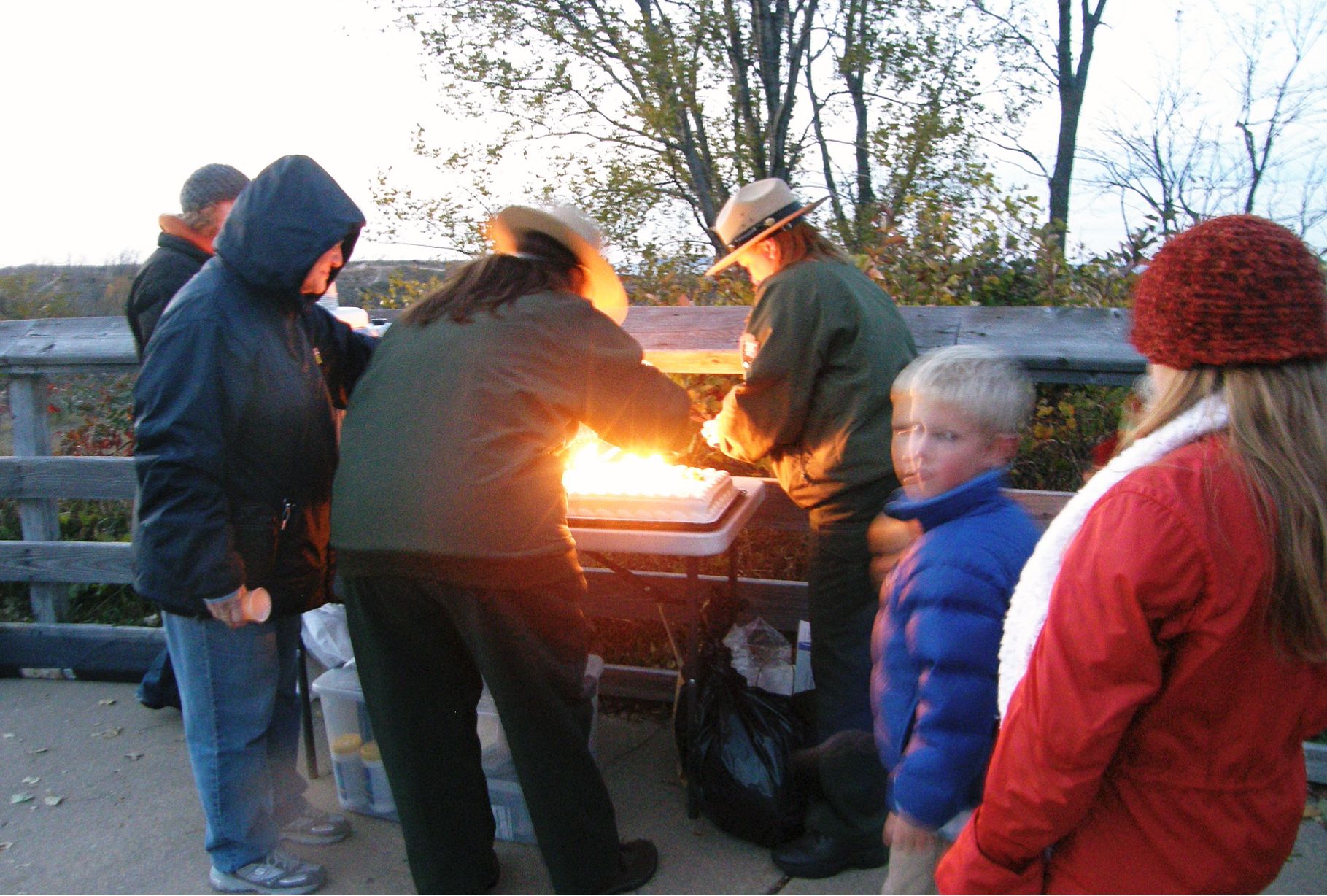
Members of the Grand Traverse Astronomical Society will team up with the park rangers of the Sleeping Bear Dunes National Lakeshore for the last star party of the year celebrating the park’s 53rd anniversary. It will take place at the Dune Climb. Of course, it will only occur if it is clear or partly cloudy. It starts at 4 pm with solar observing using personal and the society’s solar telescopes. Starting at 7 pm it will be dark enough to view the first quarter Moon, followed a bit later with Saturn, and still later with Jupiter. The brighter wonders beyond the solar system will be also be visible later.
Ephemeris: 10/17/2023 – How the Fisher paints the trees with their fall colors
This is Ephemeris for Tuesday, October 17th. Today the Sun will be up for 10 hours and 54 minutes, setting at 6:55, and it will rise tomorrow at 8:01. The Moon, 3 days past new, will set at 8:12 this evening.
The tree leaves are beginning to turn to reds and yellows as we advance into autumn. The native Anishinaabek peoples, whose homeland we share, have a story about how that came to be. Of how a magical weasel-like creature called the Fisher or, in their native language, Ojiig, brought summer to the Earth from Skyland. For his trouble, he was shot with an arrow in his only vulnerable spot, his tail. As he fell to Earth Gichi Manitou, the Great Spirit, caught him and placed him in the sky where we see the Great Bear and the Big Dipper. Every late autumn night we see his tail, the handle of the dipper, slowly swooping down to the horizon where his bloody tail paints the trees with their autumn colors.
The astronomical event times given are for the Traverse City/Interlochen area of Michigan (EDT, UT – 4 hours). They may be different for your location.
Addendum
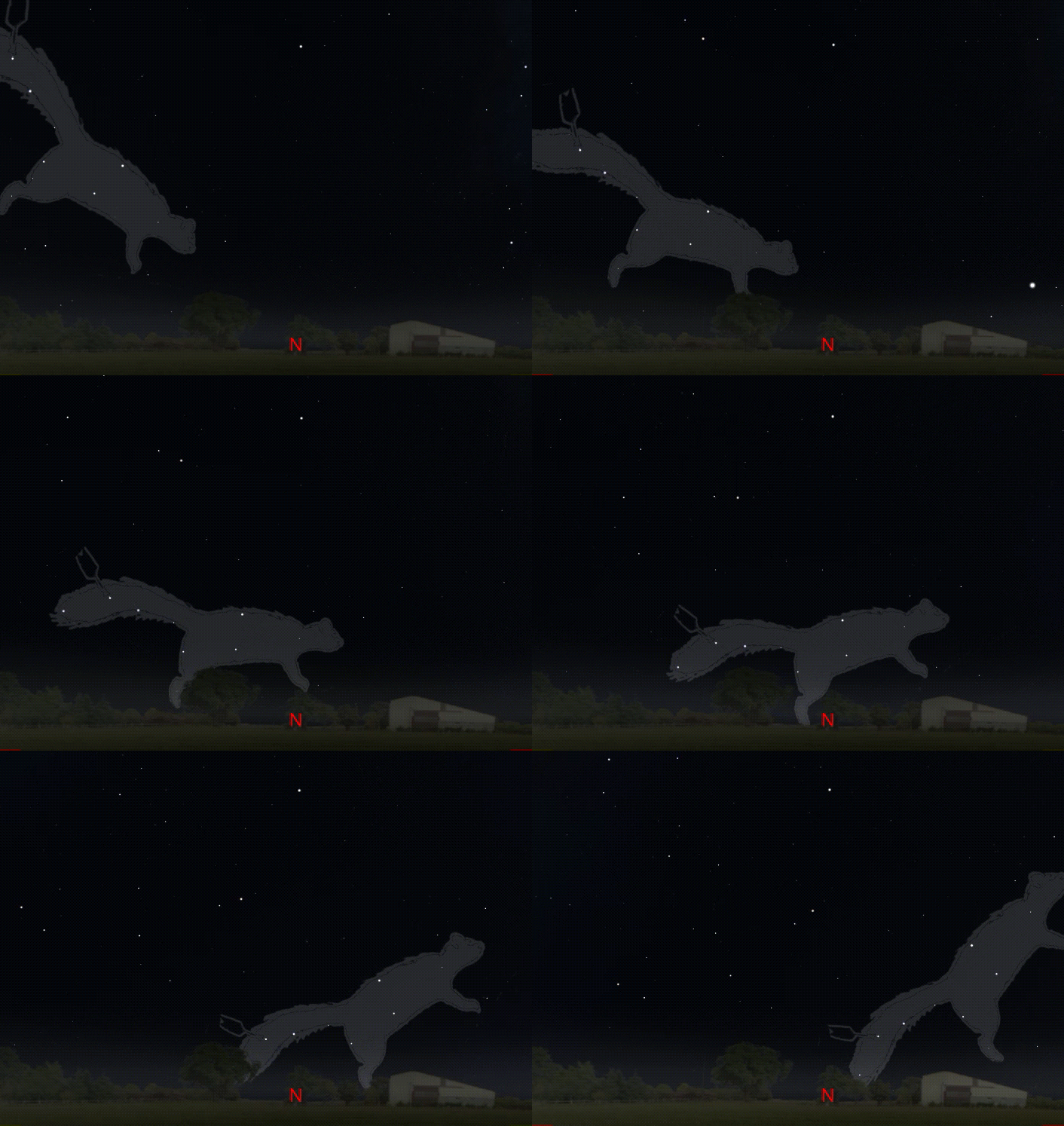
For my take on how the Fisher brought summer to the Earth, click here.
Extra: About last Saturday’s partial solar eclipse
Last Saturday I went to the Betsie Valley District Library in Thompsonville, MI for the partial solar eclipse that was visible from that location. Unfortunately, it was cloudy. It wasn’t solid clouds, so there probably was a chance at seeing something. What I did was to give an alternate program about the total solar eclipses I’ve traveled to since 1963, and a look at next April’s total solar eclipse. I was getting ready to finish up when I noticed that there were shadows outside. That meant that the Sun was out. We stopped there and went outside and got to witness at least the maximum part of the eclipse. We had about 15 minutes before the clouds came in again. So we were able to see at least part of this partial eclipse.
 Bob Moler's Ephemeris Blog