Archive
12/28/2020 – Ephemeris – Some astronomical events of 2020
This is Ephemeris for Monday, December 28th. Today the Sun will be up for 8 hours and 50 minutes, setting at 5:09, and it will rise tomorrow at 8:19. The Moon, 1 day before full, will set at 8:01 tomorrow morning.
Let’s look at some astronomical and space news for this past year. A year ago the bright red star in the constellation Orion Betelgeuse underwent an unprecedented amount of dimming. It had pretty much recovered its brightness since. The best idea was that it ejected a cloud of dust that obscured part of the star from us. NASA’s Commercial Crew program came through this year with the successful launching of two crews to the International Space Station aboard the SpaceX Falcon 9 rocket and Crew Dragon Capsule. Boeing stood down this year after the failure of their uncrewed Starliner capsule to reach the space station last December. They will try another uncrewed attempt in a few months. I’ll have more tomorrow.
The event times given are for the Traverse City/Interlochen area of Michigan. They may be different for your location.
Addendum
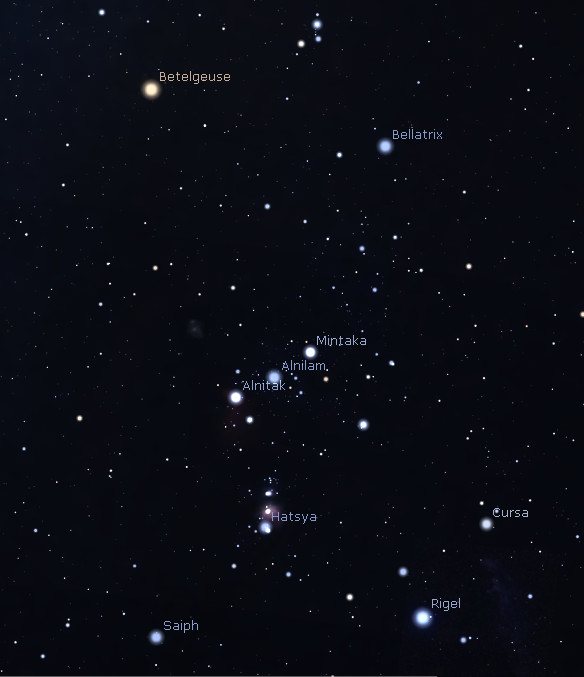
Orion’s named stars including the belt stars. Betelgeuse is the bright red in the upper left. Created using Stellarium.
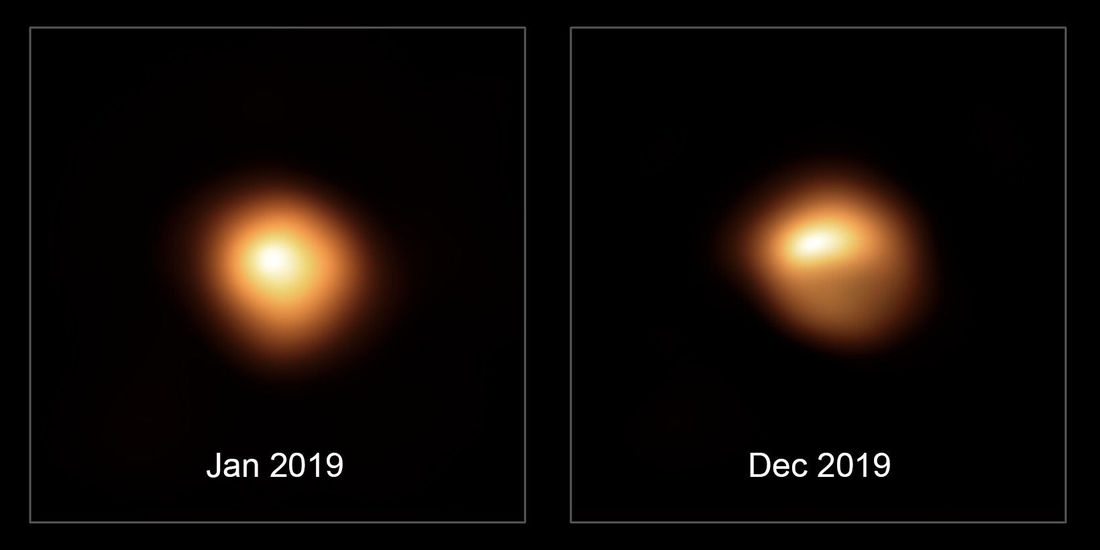
This comparison image shows the star Betelgeuse before and after its unprecedented dimming. The observations, taken with the SPHERE instrument on ESO’s Very Large Telescope in January and December 2019, show how much the star has faded and how its apparent shape has changed. Betelgeuse is one of the few stars close and large enough to be able to image its disk. Credit: ESO/M. Montargès et al.

Astronauts Shannon Walker, Victor Glover, and Mike Hopkins, and astronaut Soichi Noguchi inside the Crew Dragon capsule. Credit: SpaceX.

SpaceX Crew-1 Dragon capsule docking with the International Space Station. Credit: NASA
12/25/2020 – Ephemeris – Did the “Star” of Bethlehem appear in 3 BC and again in 2 BC?
Merry Christmas, this is Bob Moler with Ephemeris for Christmas Day, Friday, December 25th. Today the Sun will be up for 8 hours and 48 minutes, setting at 5:07, and it will rise tomorrow at 8:19. The Moon, halfway from first quarter to full, will set at 4:53 tomorrow morning.
Many writers of the 2nd and 3rd centuries AD place Jesus’ birth around 2 BC, which had to be before Herod the Great’s death, which I suggest was in 1 BC marked by to a total lunar eclipse. In 3 and again in 2 BC there were star-like conjunctions or apparent joinings of the planets Jupiter and Venus against the backdrop of the constellation of Leo the Lion. A lion is related to Judah, son of Jacob by a blessing the latter gave his 12 sons in Genesis. The first conjunction occurred in August of 3 BC in the morning sky. In June the next year the two planets got together again, this time in the evening sky, just after Jesus would have been born in the lambing season of spring.
The event times given are for the Traverse City/Interlochen area of Michigan. They may be different for your location.
Addendum
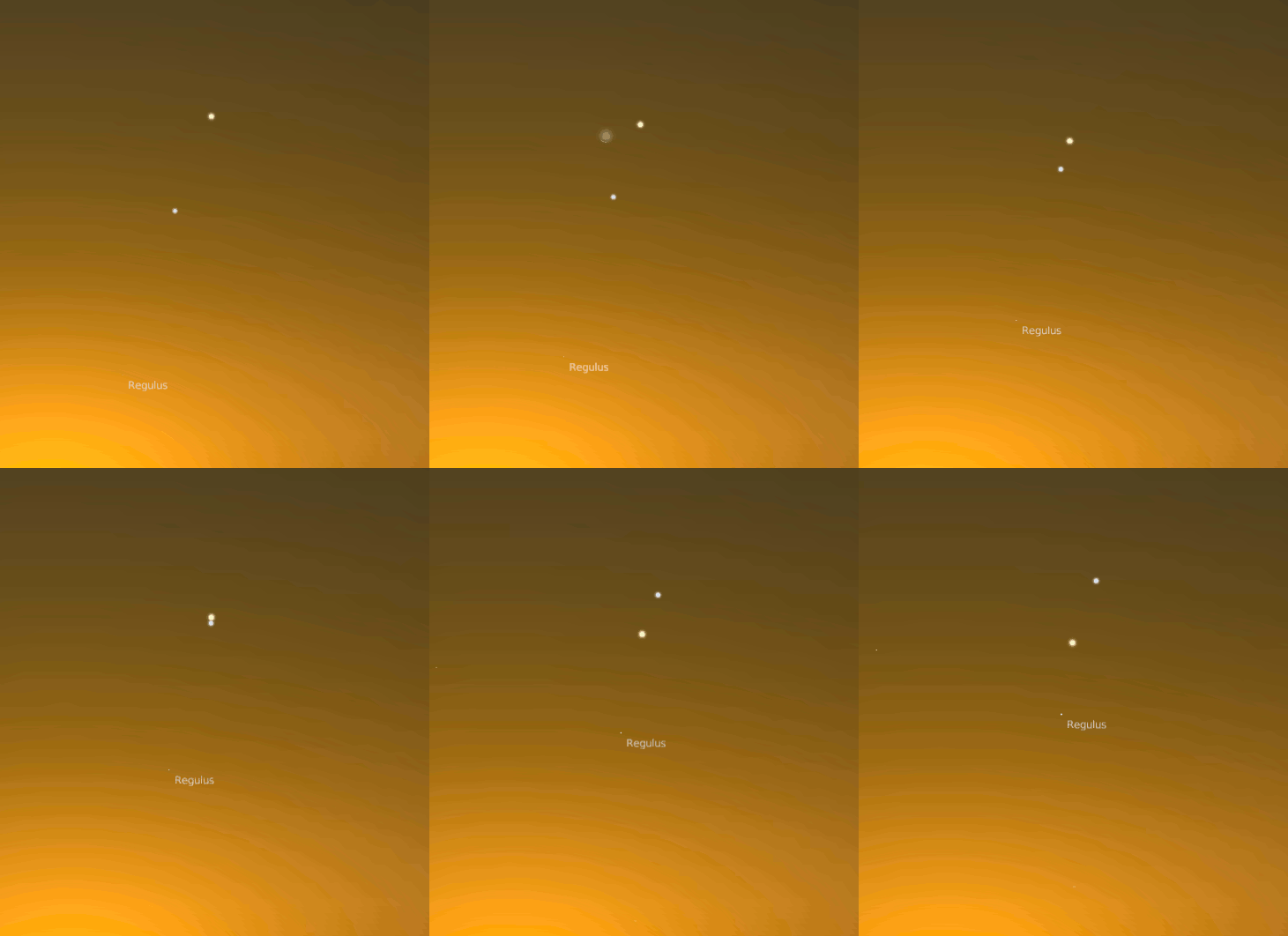
Here is an animation created using Stellarium of Jupiter and Venus, the brighter of the two seeming to coalesce on August 12, 3 BC in the early morning twilight. The ghostly image popping up in the second frame is the thin crescent Moon showing earth shine. Created using Stellarium and GIMP.
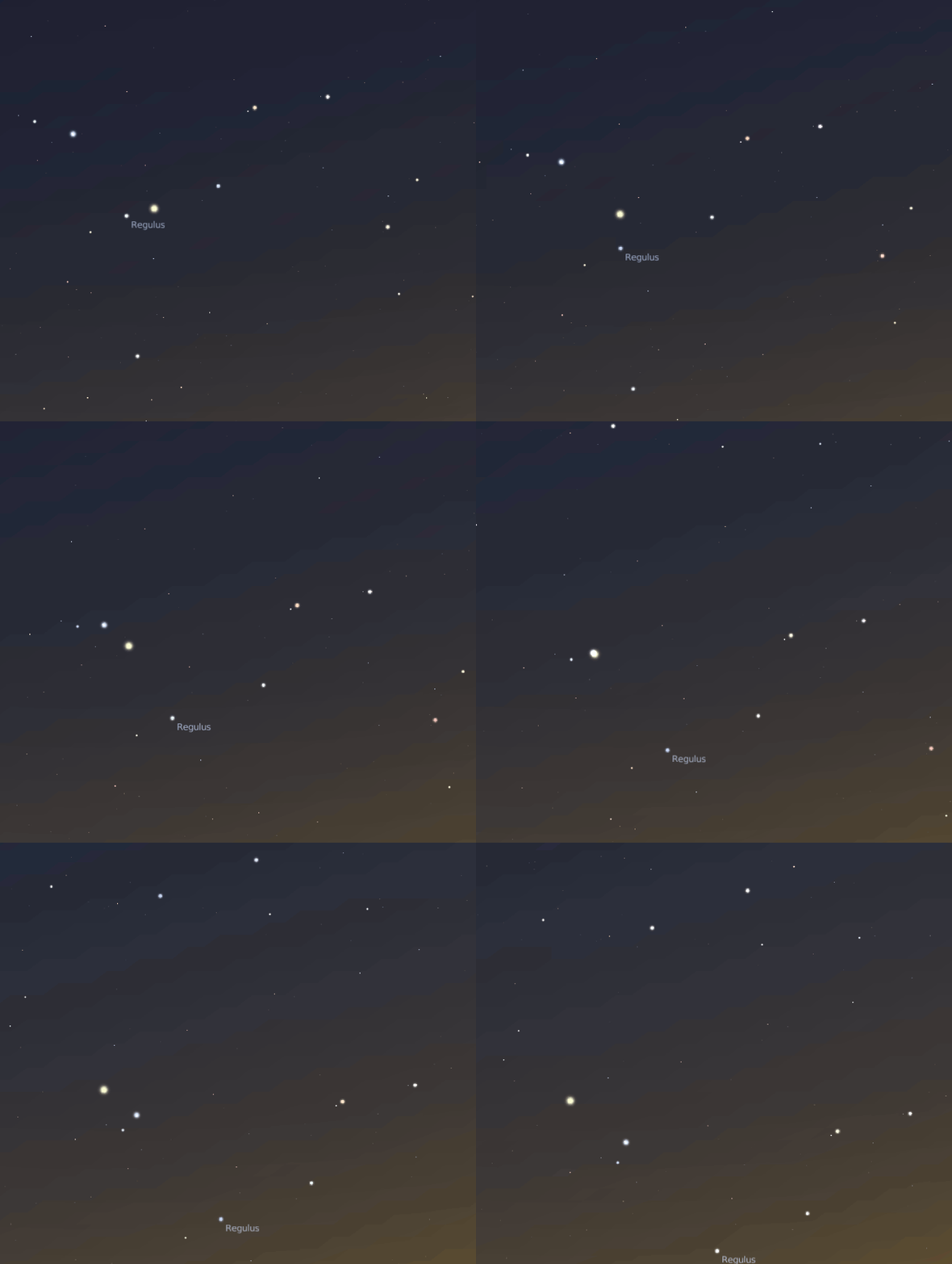
On June 16th 2 BC, this time in the evening, Venus and Jupiter seem to coalesce as one, at least to the naked eye. Regulus (The Little King star) is the brightest star in Leo the lion. To the upper right of it is the Sickle, the front part of the lion and his head and mane. Created using Stellarium and GIMP.
12/24/2020 – Ephemeris – Was the Star of Bethlehem a triple conjunction of Jupiter and Saturn in 7 BC?
This is Bob Moler with Ephemeris for Christmas Eve, Thursday, December 24th. Today the Sun will be up for 8 hours and 48 minutes, setting at 5:07, and it will rise tomorrow at 8:18. The Moon, 3 days past first quarter, will set at 3:50 tomorrow morning.
For many years the most popular theory for the origin of the Star of Bethlehem was a triple conjunction of Jupiter and Saturn in 7 BC. This is because, due to Earth’s motion, other planets from our view point seem to reverse course when we pass them or are being passed in the circular racetrack of the solar system. When Jupiter and Saturn approach each other just before they go retrograde or reverse course they have a chance to pass each other, backup and pass again, then going forward to pass a third time. Jupiter and Saturn did that last in 1981, so it’s a reasonably rare occurrence, especially when it happens in front of the constellation Pisces which was supposedly related to the Jews.
The event times given are for the Traverse City/Interlochen area of Michigan. They may be different for your location.
Addendum
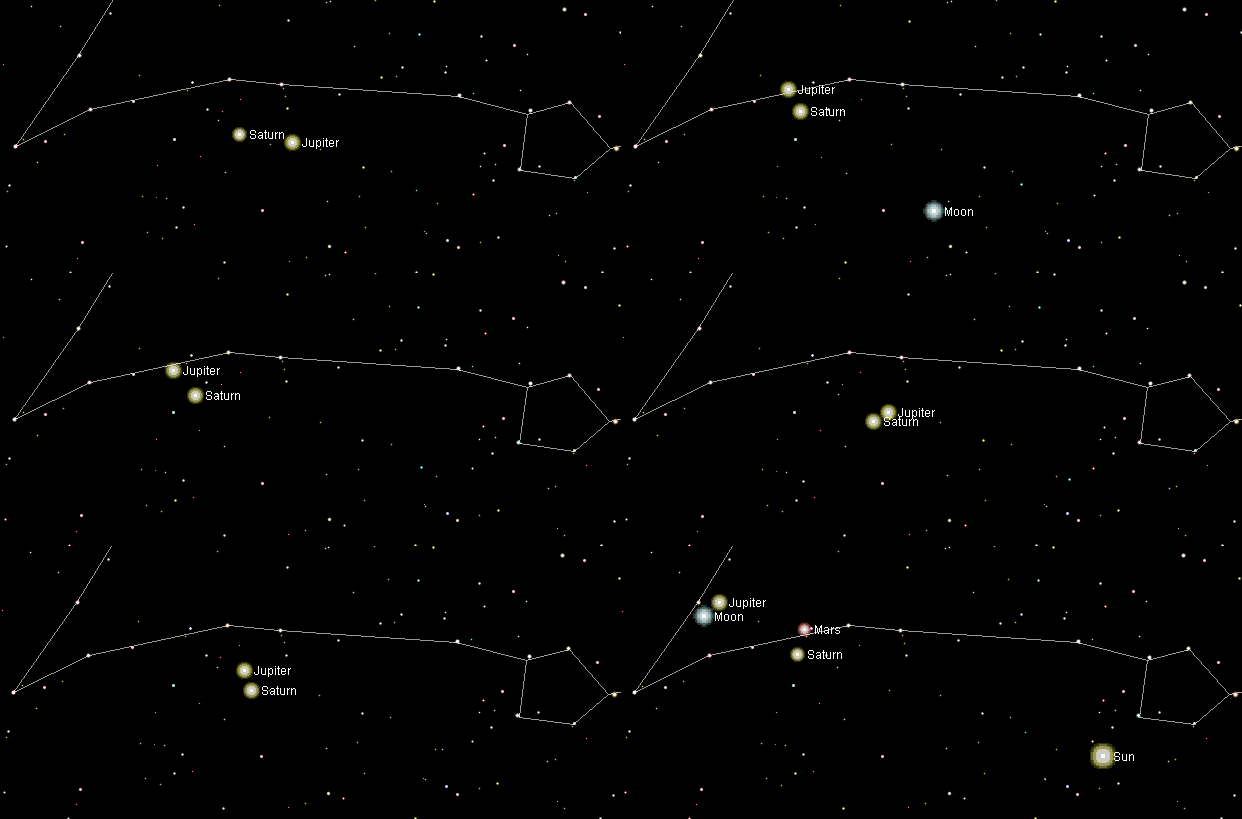
Jupiter and Saturn pass each other three times from May to December in 7 BC against the constellation of Pisces. Reload the page to replay the animation. Created using Cartes du Ciel (Sky Charts) and GIMP.
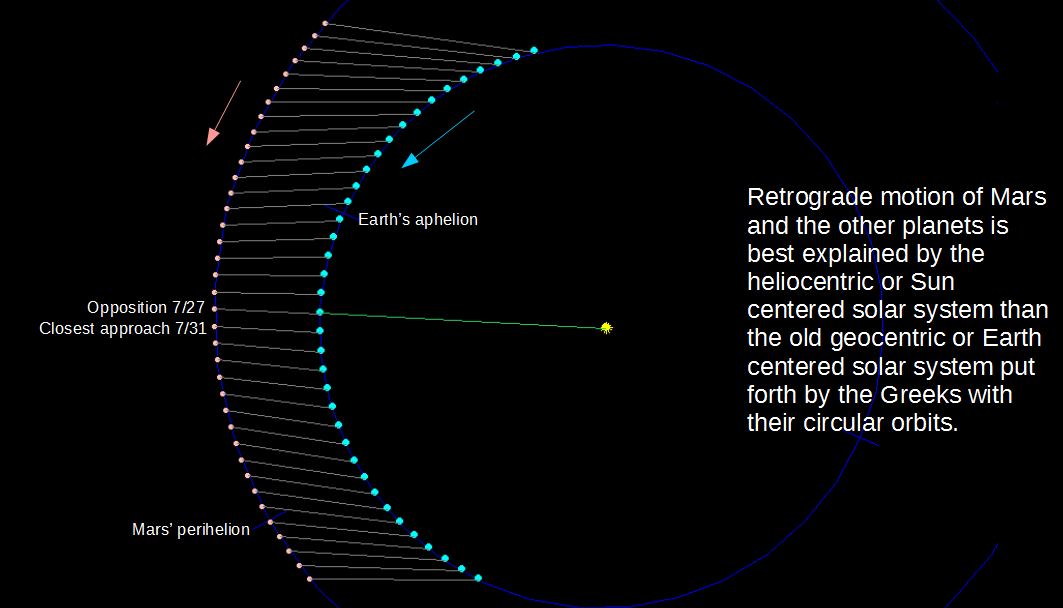
Retrograde motion illustrated using Mars in 2018. Created using my LookingUp program.
12/23/2020 – Ephemeris – Let’s look for the naked-eye planets for this Christmas week
This is Ephemeris for Wednesday, December 23rd. Today the Sun will be up for 8 hours and 48 minutes, setting at 5:06, and it will rise tomorrow at 8:18. The Moon, 2 days past first quarter, will set at 2:49 tomorrow morning.
Let’s look for the naked-eye planets for this week. Jupiter and Saturn are both low in the southwestern sky around 6 pm. Jupiter is the very bright one. Below and right of it is the dimmer Saturn it by a quarter of a degree or half a moon width. They crossed paths for us two nights ago, in 20 years, though not as close. They can still be seen in the same low power telescope field. Saturn will now set first tonight at 7:20 pm with Jupiter following a minute later. Quite high in the southeast and above the 9 day old Moon at that hour will be Mars, still in Pisces. Mars’ distance is increasing to 76 million miles (123 million km) away. It will set at 2:41 tomorrow morning. Brilliant Venus will rise at 6:33 am in the east-southeast as it seems to retreat slowly toward the Sun, but actually it’s heading way around behind the Sun.
The event times given are for the Traverse City/Interlochen area of Michigan. They may be different for your location.
Addendum
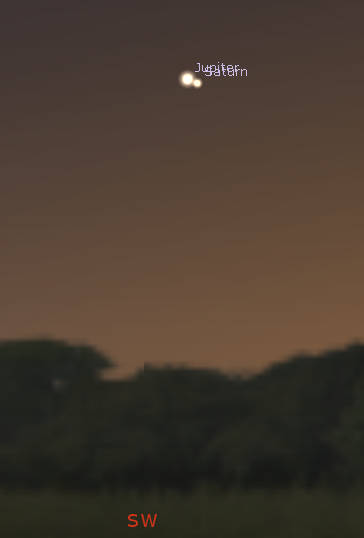
Jupiter and Saturn in twilight at 6 pm or a bit less than an hour after sunset tonight December 23, 2020. Created using Stellarium.
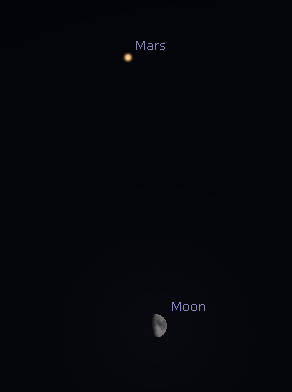
Mars will be seen above the Moon tonight. This is the appearance of both at 6 pm, tonight, December 23, 2020. Created using Stellarium.
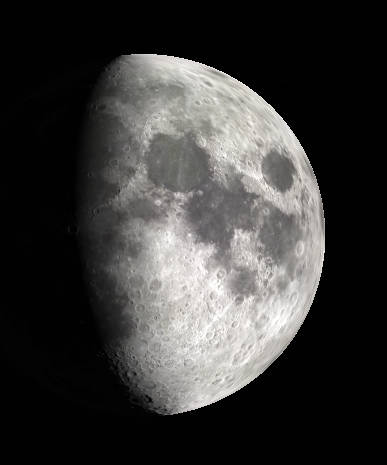
The gibbous Moon as it might be seen in binoculars this evening at 6 pm December 23, 2020. Created using Stellarium.
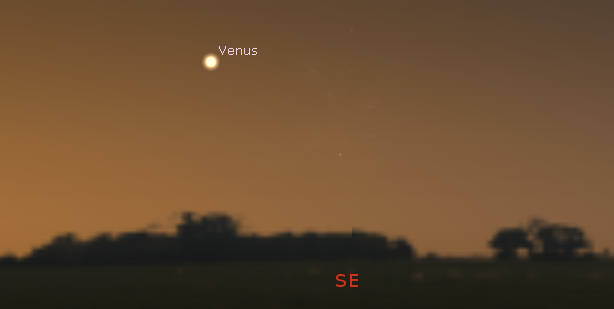
Venus low in the southeast at 7:30 am December 24, 2020. The morning sky is not as friendly to morning planets as it was earlier in autumn. Created using Stellarium.
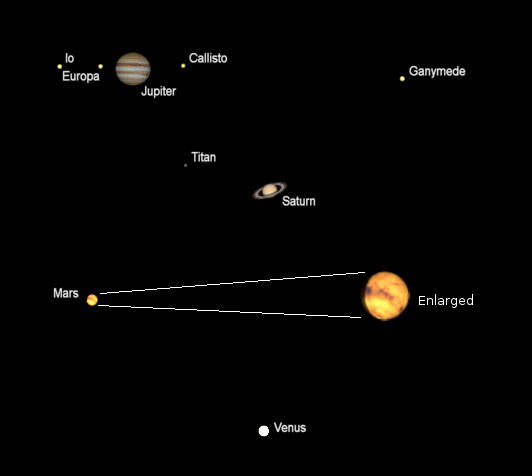
The planets as seen in a telescope (north up) with the same magnification for the night of December 23/24, 2020. Times of the display are: Jupiter, Saturn, and Mars, 6 pm; Venus, 7:30 am. Apparent diameters: Jupiter, 33.18″; Saturn, 15.32″, rings, 35.70″; Mars, 11.32″, and Venus 10.89″. Mars also displays an enlargement showing surface detail. Mars was closest to the Earth this go-a-round on October 6. The ” symbol means seconds of arc (1/3600th of a degree.) I will no longer show planets whose diameters drop below 10″, or are too close to the direction of the Sun to observe. Created using Cartes du Ciel (Sky Charts).
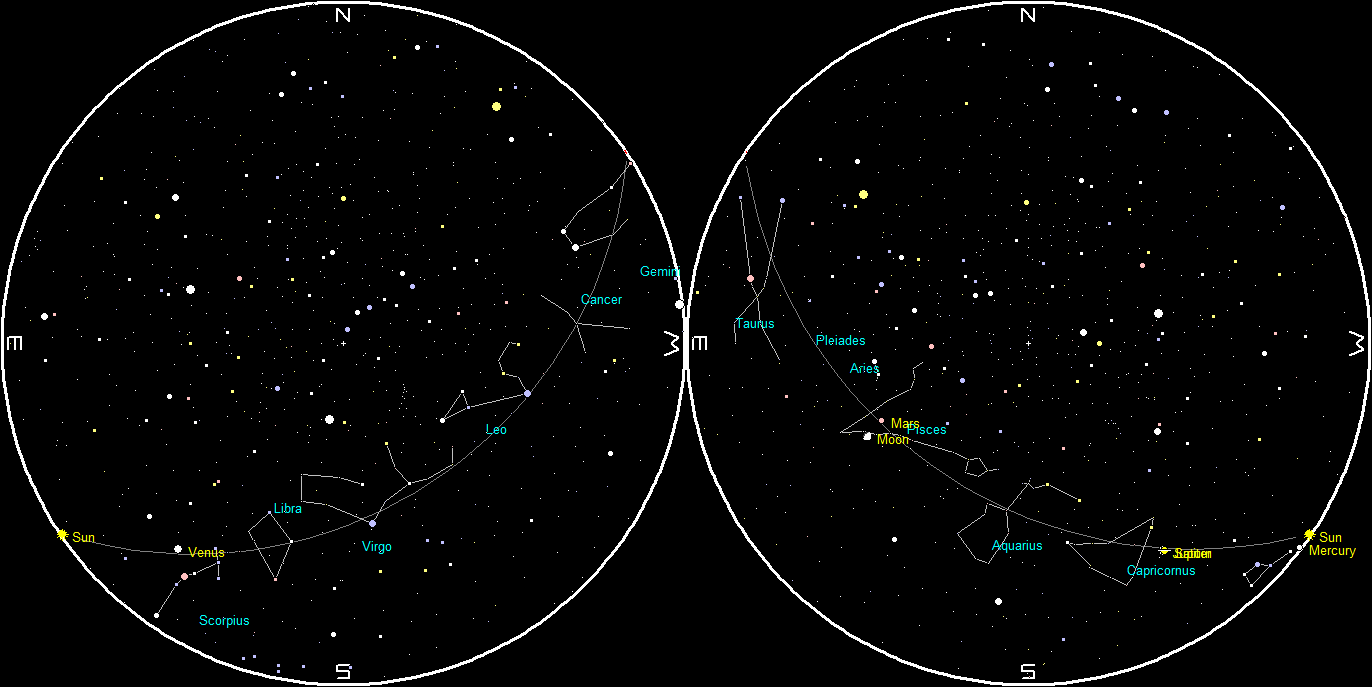
Planets and the Moon at sunset and sunrise of a single night starting with sunset on the right on December 23, 2020. The night ends on the left with sunrise on the 24th. I’m afraid that the labels for Jupiter and Saturn will overlap, since the planets are very close. Click on the image to enlarge. Created using my LookingUp program.
12/22/2020 – Ephemeris – Winter is going to be colder before it starts to warm up in a little over a month
This is Ephemeris for Tuesday, December 22nd. Today the Sun will be up for 8 hours and 48 minutes, setting at 5:05, and it will rise tomorrow at 8:18. The Moon, 1 day past first quarter, will set at 1:47 tomorrow morning.
Now that winter is here, it’s going to get snowier and colder even though the amount of heat the Northern Hemisphere gets from the Sun bottomed out yesterday. There are two consequences of the Earth’s axial tilt with regard to the Sun on the winter solstice. First, the Sun is only up 8 hours 48 minutes. Second at its highest at local noon the Sun is so low, only 22 degrees above the horizon around here that its heat is spread out over a greater area so is diluted to only 40% of the peak heat we get from the Sun at noon on the summer solstice. And on the summer solstice the Sun stays up almost six and three-quarters of an hour longer. Even though it doesn’t feel like it at our latitude winter is 4 days shorter than summer. You’ll find out why in less than two weeks.
Addendum
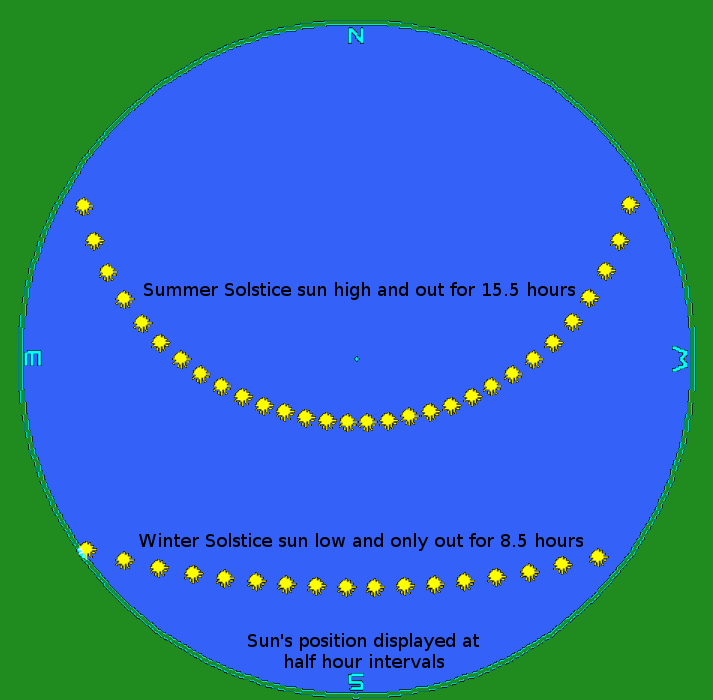
Comparing the sun’s path at the summer and winter solstices. This is a stereographic representation of the whole sky which distorts the sky and magnifies the size of the sun’s path near the horizon.
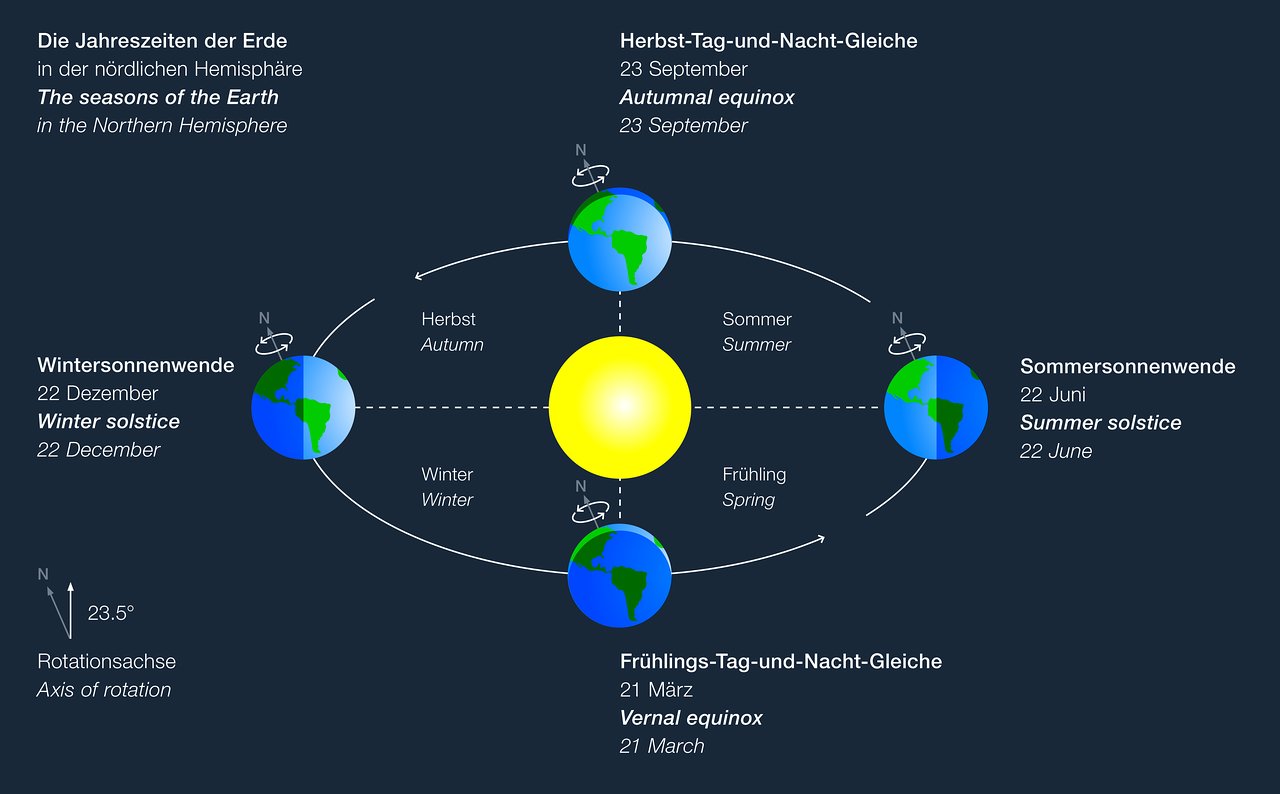
Earth’s position at the solstices and equinoxes. This is an not to scale oblique look at the Earth’s orbit, which is nearly circular. The Earth is actually farthest from the Sun on July 4th. Click on the image to enlarge. Credit: ESO (European Southern Observatory which explains the captions in German and English.
12/18/2020 – Ephemeris – Winter begins Monday morning
This is Ephemeris for Friday, December 18th. Today the Sun will be up for 8 hours and 48 minutes, setting at 5:03, and it will rise tomorrow at 8:16. The Moon, 3 days before first quarter, will set at 9:29 this evening.
Monday will host two astronomical events. The second will be the extremely close conjunction or appearing together of the planets Jupiter and Saturn, which I’ll talk about then. But first, at 5:02 Monday morning winter will begin with the winter or December solstice. The word solstice means Sun stand still. On or about December 21st, the Sun appears to stop moving southward measured at noon and will begin moving northward again. All this is the result of the Earth’s 23 ½ degree axial tilt and our motion around the Sun. Our area of the globe is now receiving less energy from the Sun to support our temperatures, and they will continue to fall for the next month or so even as the Sun rises higher and stays out longer.
The event times given are for the Traverse City/Interlochen area of Michigan. They may be different for your location.
Addendum
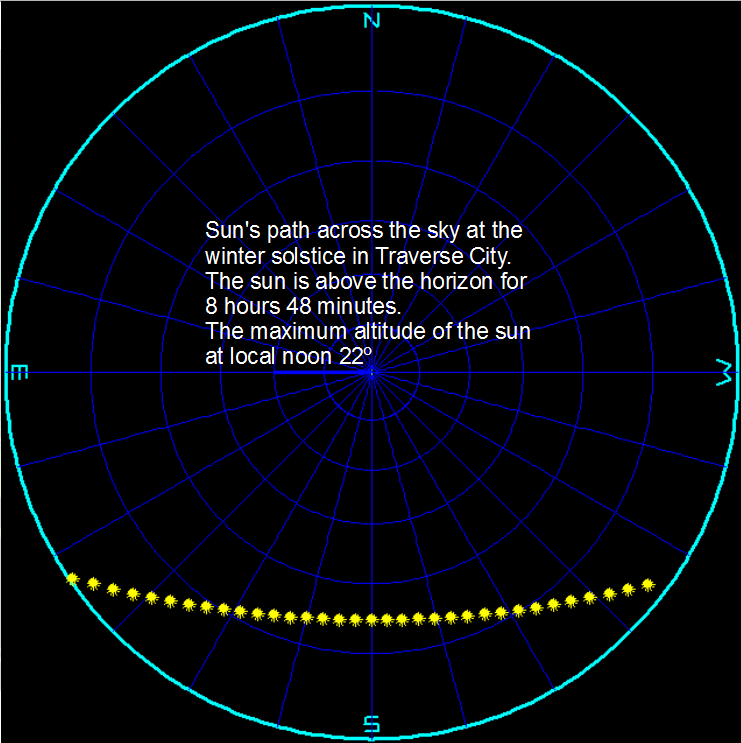
The sun’s daily path through the sky from horizon to horizon on the first day of winter, the winter solstice. Credit My LookingUp program.
12/17/2020 – Ephemeris – Betelgeuse, Betelgeuse… Nope not saying it again
This is Bob Moler with Ephemeris for Thursday, December 17th. Today the Sun will be up for 8 hours and 48 minutes, setting at 5:03, and it will rise tomorrow at 8:15. The Moon, 3 days past new, will set at 8:18 this evening.
The constellation Orion the hunter will have completely risen by 8 pm this evening. The leftmost bright red star in his shoulder is Betelgeuse. It’s phonetically spelled name (Beetle Juice) made the title of a movie in 1988. A year ago it’s dramatic dimming for a while caused some to wonder that it was about to explode in a supernova. Betelgeuse does normally vary a bit in brightness, but that was the most ever recorded. It’s a red giant star with a mass of 16 to 19 times the Sun’s. Its distance is thought to be about 550 light years away. It is difficult to measure the distance of single bright stars, even with satellites. Its age is maybe 8 to 8 ½ million years old out of a life expectancy of 10 million years, compared to the Sun’s 10 billion year life expectancy.
The event times given are for the Traverse City/Interlochen area of Michigan. They may be different for your location.
Addendum
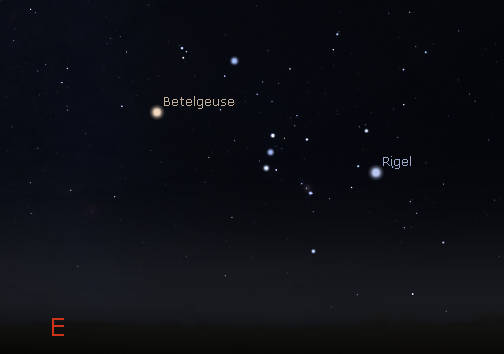
Orion at 8 pm or about 3 hours after sunset in mid December. Its seven brightest stars make an unmistakable pattern with only Betelgeuse and Rigel labeled. Created using Stellarium.
This comparison image shows the star Betelgeuse before and after its unprecedented dimming. The observations, taken with the SPHERE instrument on ESO’s Very Large Telescope in January and December 2019, show how much the star has faded and how its apparent shape has changed. Credit: ESO/M. Montargès et al.
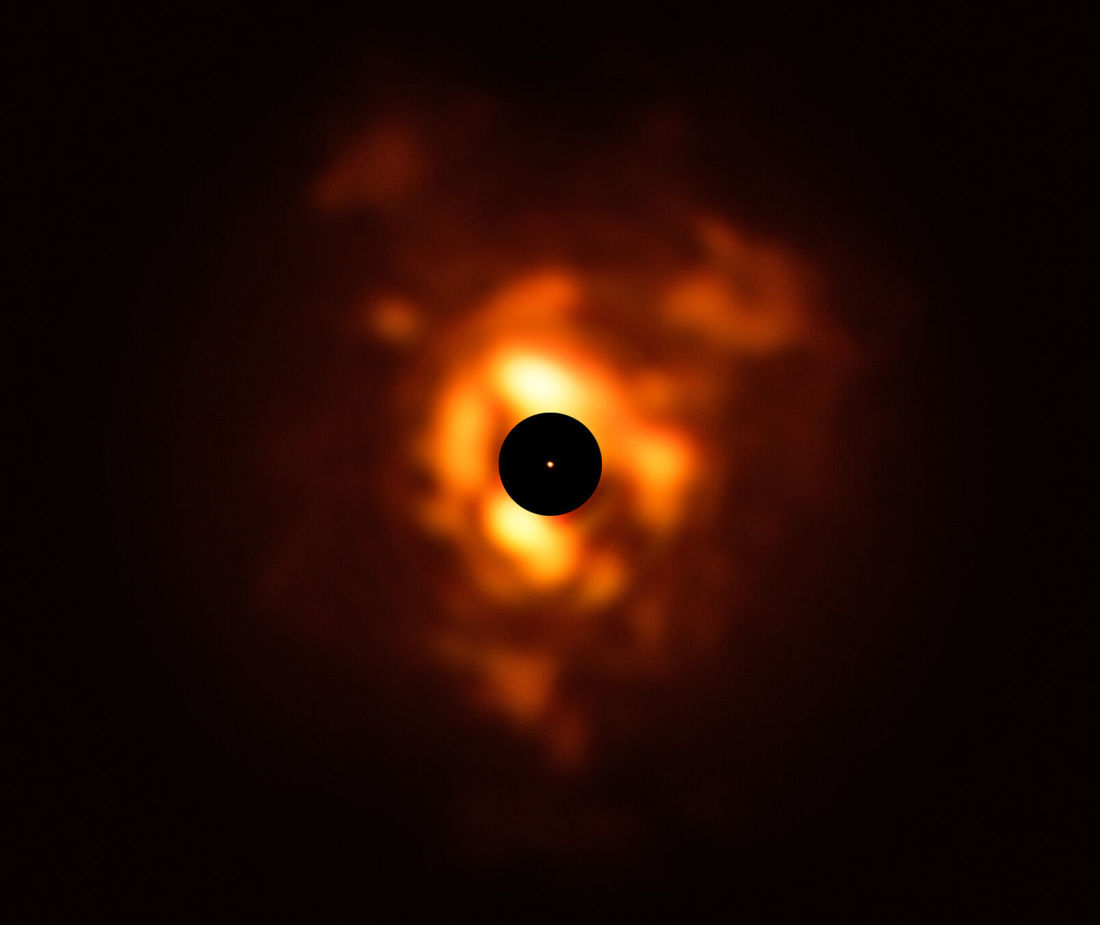
An image of the star Betelgeuse taken in infrared shows it’s surrounded by a vast cloud of dust that erupted from the surface (the bright star itself is masked out, though an image of it has been superposed there for scale — the star is about the size of the orbit of Jupiter, over a billion km wide). Credit: ESO/P. Kervella/M. Montargès et al., Acknowledgement: Eric Pantin via Phil Plait’s Bad Astronomy blog on syfy.com.
12/16/2020 – Ephemeris – Let’s look for the naked-eye planets for this week
This is Bob Moler with Ephemeris for Wednesday, December 16th. Today the Sun will be up for 8 hours and 48 minutes, setting at 5:03, and it will rise tomorrow at 8:14. The Moon, 2 days past new, will set at 7:09 this evening.
Let’s look for the naked-eye planets for this week. Jupiter and Saturn are both low in the southwestern sky from 6 to 7 pm. Jupiter is the very bright one. Above and left it by half a degree or one moon width will be dimmer Saturn. Below them tonight will be the thin crescent Moon. They will cross paths for us on the evening of December 21st and be seen in the same low power telescope field that evening. Jupiter will set first tonight at 7:40 pm with Saturn following four minutes later. Quite high in the southeast at that hour will be Mars, still in Pisces. Mars’ distance is increasing to 71 million miles (114 million kilometers) away. It will set at 2:55 tomorrow morning. Brilliant Venus will rise at 6:16 am in the east-southeast as it seems to retreat slowly toward the Sun, but actually it’s heading way around behind the Sun.
The event times given are for the Traverse City/Interlochen area of Michigan. They may be different for your location.
Addendum
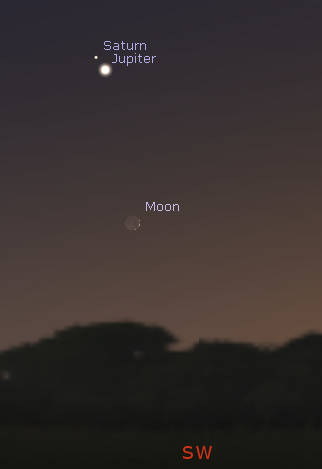
Jupiter and Saturn with Moon at 6 pm tonight December 16, 2020. Created using Stellarium.
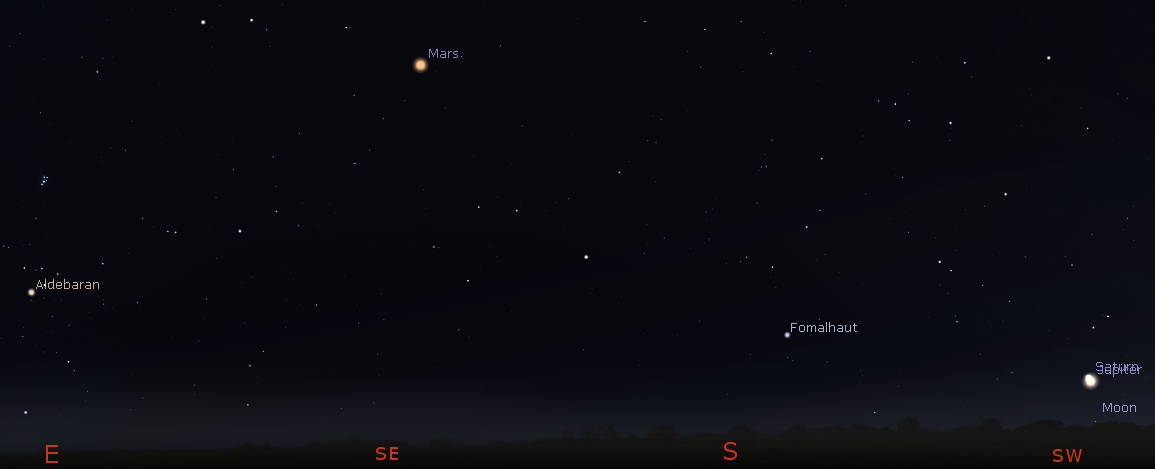
Evening planet panorama showing Mars, Jupiter, Saturn and the Moon setting at 6:30 pm December 16, 2020. Click on the image to enlarge. Created using Stellarium.
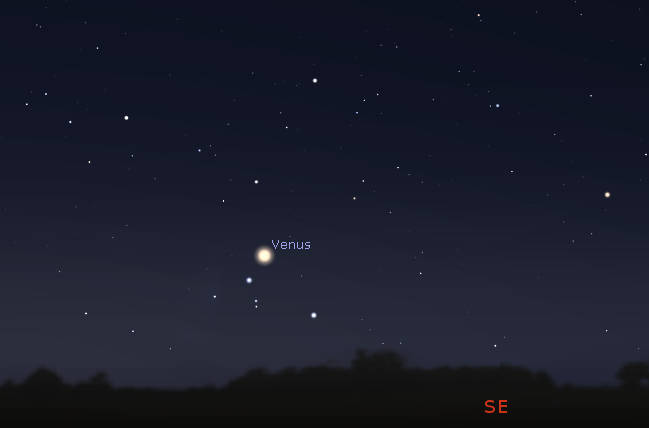
Venus low in the southeast at 7 am December17, 2020. Venus is all by its lonesome in the morning sky. No need for a panorama, so we’re zoomed in a bit. The morning sky has is not as friendly to morning planets as it was earlier in autumn season as we embark into winter next week. Created using Stellarium.
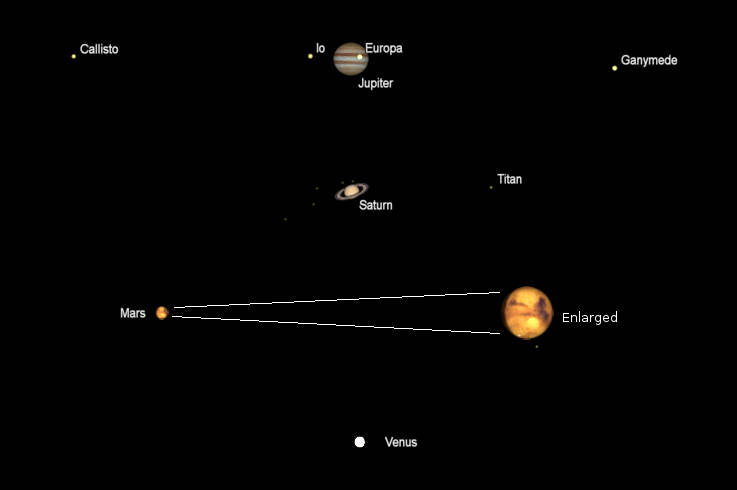
The planets as seen in a telescope (north up) with the same magnification for the night of December 16/17, 2020. Times of the display are: Jupiter and Saturn, 6 pm and Mars, 8 pm; Venus, 7 am. Apparent diameters: Jupiter, 33.49″; Saturn, 15.41″, rings, 35.90″; Mars, 12.20″, and Venus, 11.10″. Europa is transiting Jupiter and will be generally invisible. Mars also displays an enlargement showing surface detail. Mars was closest to the Earth this go-a-round on October 6. The ” symbol means seconds of arc (1/3600th of a degree.) Created using Cartes du Ciel (Sky Charts).
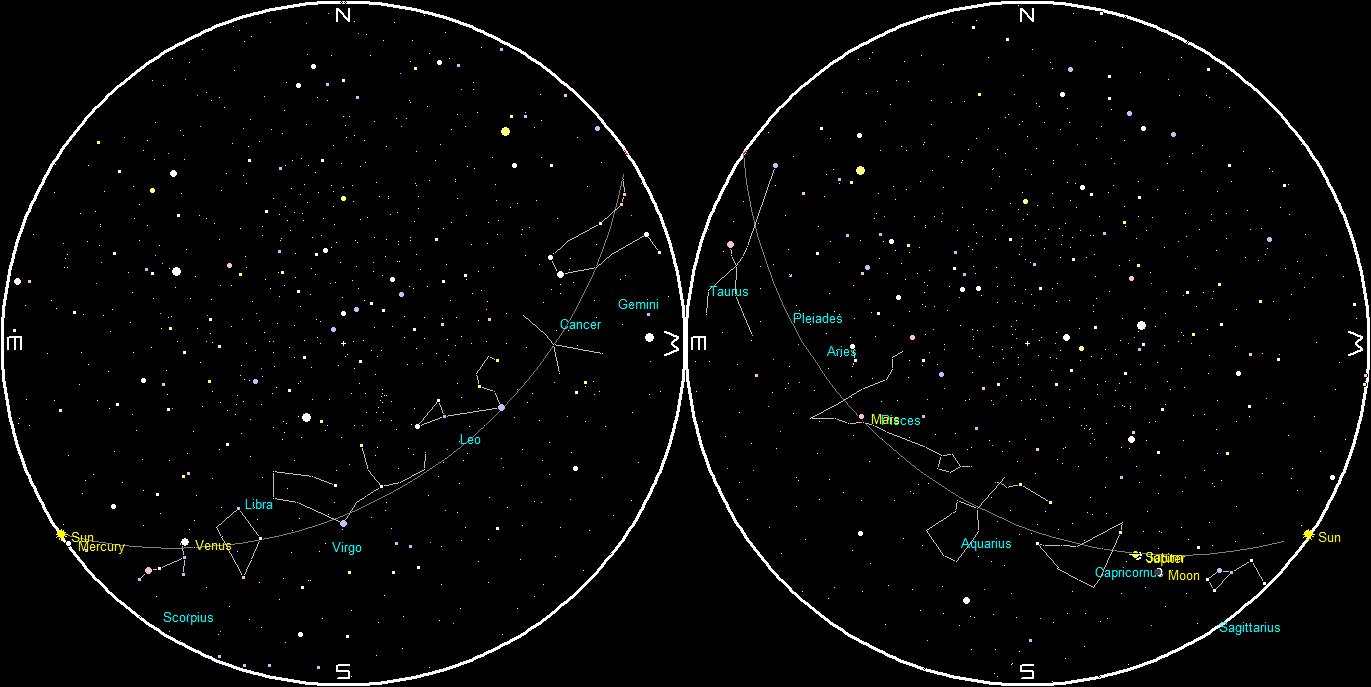
Planets and the Moon at sunset and sunrise of a single night starting with sunset on the right on December 16, 2020. The night ends on the left with sunrise on the 17th. I’m afraid that the labels for Jupiter and Saturn will overlap, since the planets are getting very close. Click on the image to enlarge. Created using my LookingUp program.
12/15/2020 – Ephemeris – Hyades, the face of Taurus the bull
This is Ephemeris for Tuesday, December 15th. Today the Sun will be up for 8 hours and 49 minutes, setting at 5:02, and it will rise tomorrow at 8:14. The Moon, 1 day past new, will set at 6:03 this evening.
The face of the constellation Taurus the bull looks like the letter V sideways above the rising Orion the Hunter in the east at 9 p.m. The bright star at the tip of a letter V of stars is Aldebaran. Look with binoculars at the letter V shape and you will see the stars of the Hyades star cluster The Hyades is the closest star cluster to us, at about 153 light years. And is important for that reason. Before satellites like Hipparcos and Gaia the Hyades was the only star cluster that could be directly measured by a technique called parallax, using the radius of the Earth’s orbit as one side of a surveyors enormous triangle. Its many stars at the same distance were used to determine distances of star clusters even farther away. Additional techniques based on the distance of the Hyades allowed us to measure distances to the nearest galaxies.
The event times given are for the Traverse City/Interlochen area of Michigan. They may be different for your location.
Addendum
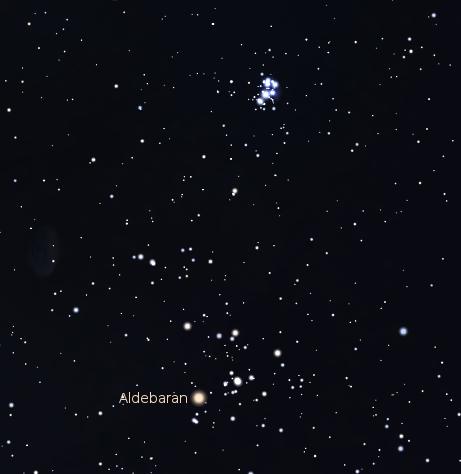
Aldebaran in the ‘V’ shape of the Hyades (The face of Taurus the bull) with the Pleiades above. Aldebaran is not part of the Hyades, being about halfway between us and the cluster. Created using Stellarium.
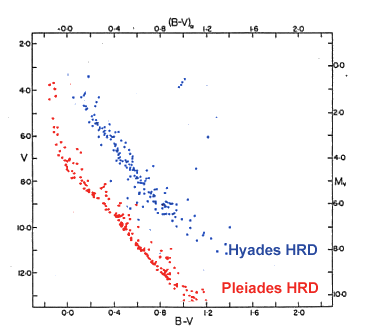
HR diagram showing the Hyades and Pleiades. Credit: European Southern Observatory.
The Hertzsprung–Russell diagram or HR diagram is one of the great astronomical tools developed in the early 20th century by plotting stars by surface temperature horizontally (hot to cool, left to right) and brightness vertically. It turns out that stars in the prime of life and shining via converting hydrogen to helium lie on a diagonal line from hot and bright from the upper left to cool and dim to the lower right. The line is called the main sequence. In plotting the Hyades stars against other star cluster stars the vertical displacement of the main sequence line is a function of the relative distances of the two star clusters from us. This is just one of the uses of the HR diagram.
12/14/2020 – Ephemeris – A total solar eclipse will occur today
This is Ephemeris for Monday, December 14th. Today the Sun will be up for 8 hours and 49 minutes, setting at 5:02, and it will rise tomorrow at 8:13. The Moon is new today, and won’t be visible.
Some lucky folks in South America, specifically located in a narrow path crossing Chile and Argentina will see a total eclipse of the Sun in a few hours. For us, the Moon is too far south to cover the Sun. This is the last eclipse of the year. We will get to see part of the next solar eclipse to occur. On the morning of June 10th, next year the Sun will rise as it is partially eclipsed for Michigan, with the Moon already leaving the Sun’s disk. That eclipse will not be total, but an annular eclipse, with the Moon too far away to cover the Sun completely, leaving a bright ring or annulus of the Sun, what some describe as a ring of fire. That effect will be seen in western Ontario, through the arctic, ending in Siberia.
The event times given are for the Traverse City/Interlochen area of Michigan. They may be different for your location.
Addendum
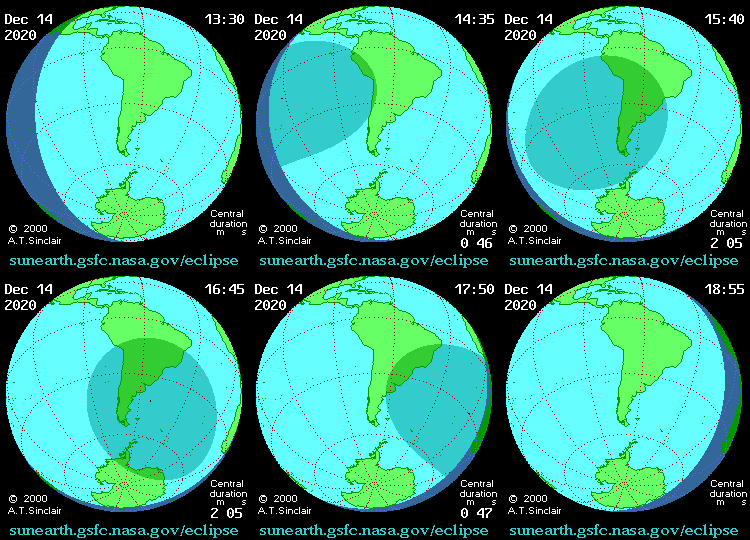
Animation of the path of the December 14, 2020, total solar eclipse. The penumbra of the Moon’s shadow is shown in gray, where the Sun will be partially eclipsed. The black dot near the center of the penumbra is the Moon’s umbra, where the face of the Sun is totally eclipsed. Credit: NASA/Goddard Space Flight Center.

