Archive
08/13/2020 – Ephemeris – Sagittarius the archer, morphs into a teapot
This is Bob Moler with Ephemeris for Thursday, August 13th. Today the Sun will be up for 14 hours and 7 minutes, setting at 8:50, and it will rise tomorrow at 6:44. The Moon, 2 days past last quarter, will rise at 1:53 tomorrow morning.
Due south and low in the sky at 10:30 p.m. now is one of my favorite asterisms the Teapot of the constellation Sagittarius. Sagittarius classically represents a centaur with a bow and arrow aimed at the heart of the constellation Scorpius to its west. I can find the bow and arrow here, but the half man half horse figure of the centaur eludes me. However the stout little teapot of the children’s song is quite obvious, with its base, lid on top, handle to the left and the spout to the right. To make things more realistic the bright Milky Way seems to rise like steam from its spout. As the night goes on the Teapot slides westward and appears to tilt, pouring its tea on the southwestern horizon. Jupiter and Saturn are just to the left of it now.
The event times given are for the Traverse City/Interlochen area of Michigan. They may be different for your location.
Addendum
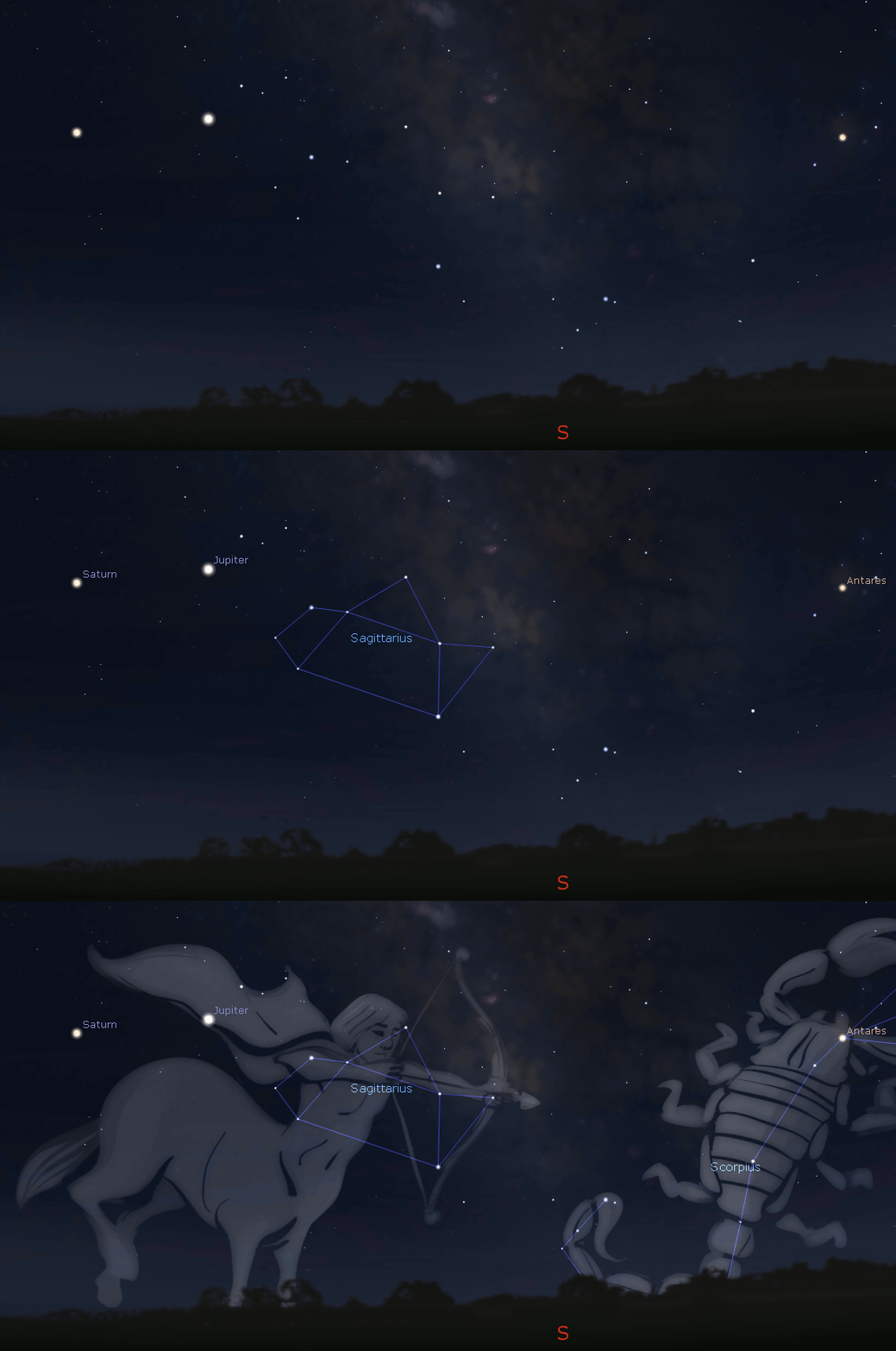
Sagittarius-Teapot finder animation for 10 pm August 13, 2020. Click on the image to enlarge. Created using Stellarium and GIMP.
08/12/2020 – Ephemeris – Let’s look at a the naked-eye planets for this week
This is Ephemeris for Wednesday, August 12th. Today the Sun will be up for 14 hours and 10 minutes, setting at 8:52, and it will rise tomorrow at 6:43. The Moon, 1 day past last quarter, will rise at 1:16 tomorrow morning.
Let’s look at a the naked-eye planets for this week. Jupiter and Saturn are both low in the south-southeastern sky at 10 pm. Jupiter is the very bright one. To the left of it will be Saturn. They now seem to be separating a bit due to the Earth’s motion now, but they will cross paths in December. Both planets will be up most of the night with Jupiter setting first at 4:02 tomorrow morning and Saturn following at 4:44 am. The next planet visible will be Mars which will rise at 11:22 pm. Its now down to 54.3 million miles (87.5 million kilometers) away, as the Earth slowly overtakes it at the rate of about 3.4 million miles (5.4 million kilometers) a week. Brilliant Venus will rise at 3:09 am in the east-northeast and is as far west from the Sun as it can get today.
The event times given are for the Traverse City/Interlochen area of Michigan. They may be different for your location.
Addendum
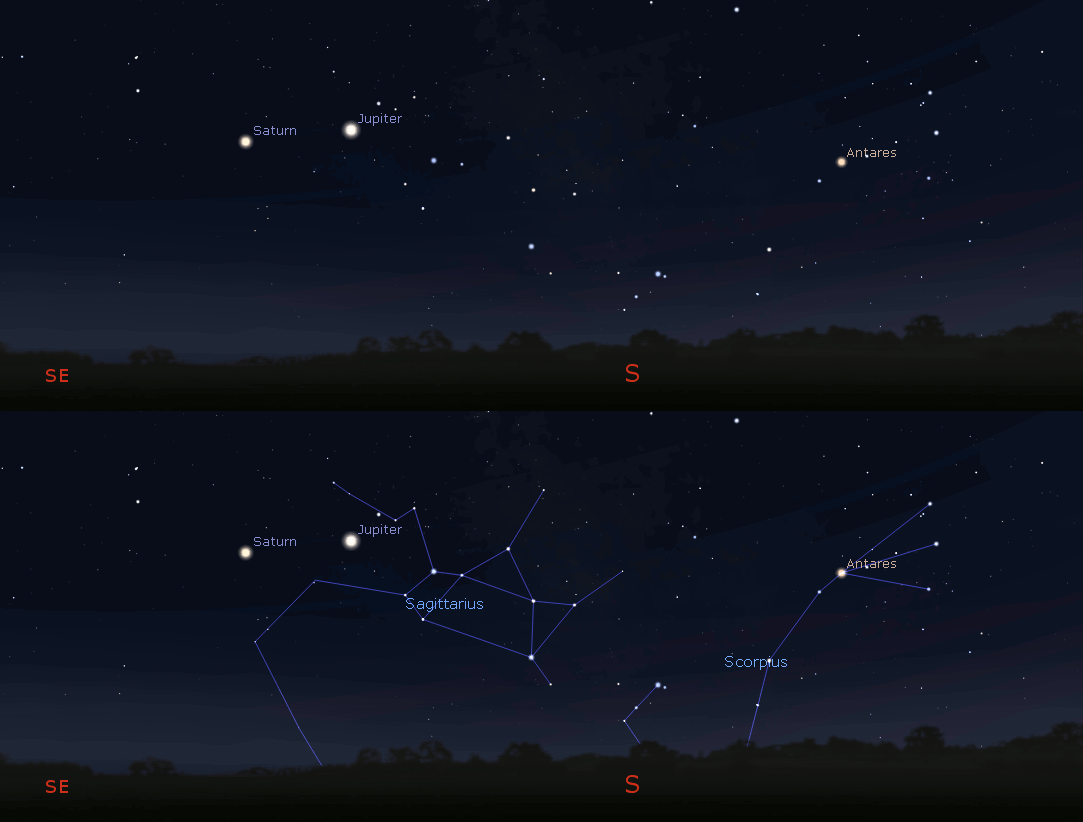
Jupiter and Saturn animation at 10 pm with Sagittarius and Scorpius constellation lines. Click on the image to enlarge. Created using Stellarium and GIMP.
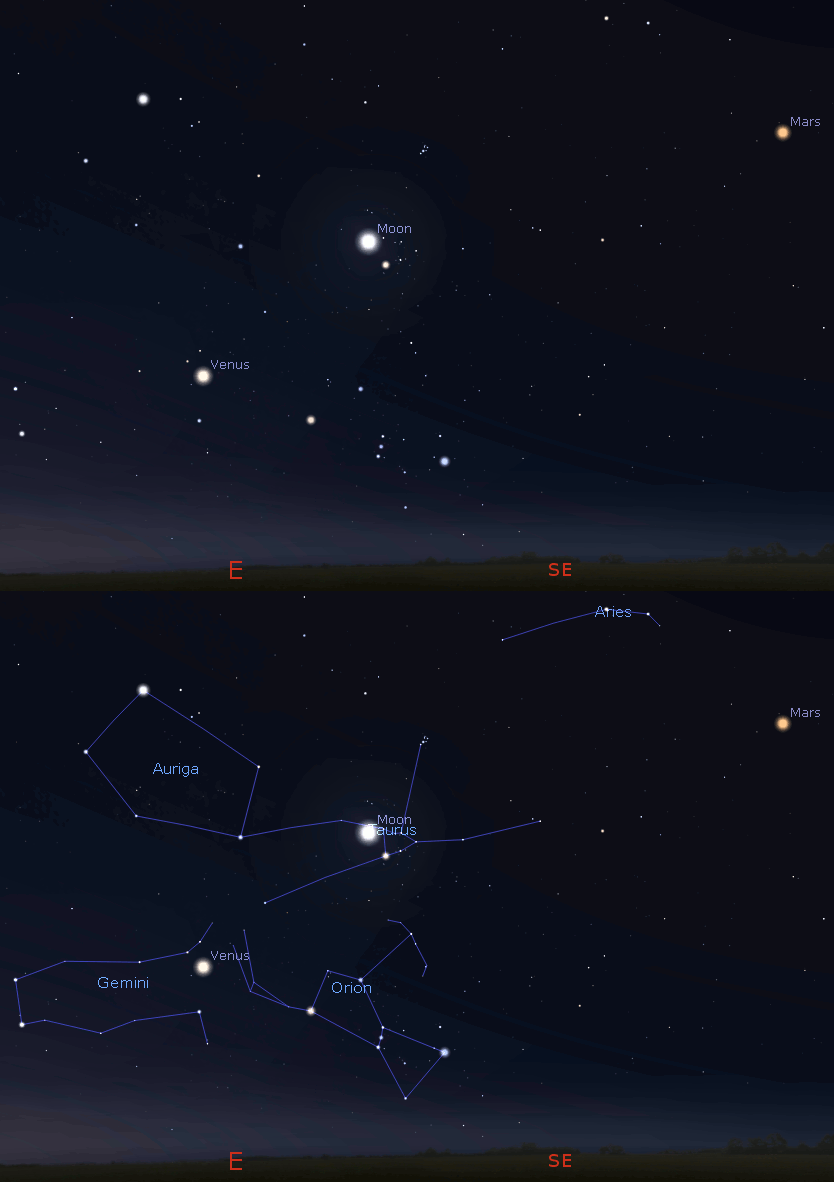
The morning planets and the Moon as seen at 5:30 am or about an hour before sunrise tomorrow morning August 13, 2020 with and without the lines delineating nearby constellations. Click on the image to enlarge. Created using Stellarium.
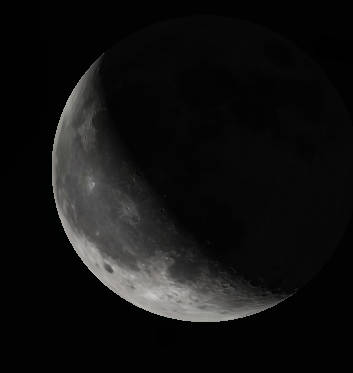
The Moon as it might be seen in binoculars at 5:30 am tomorrow August 13, 2020. Created using Stellarium.
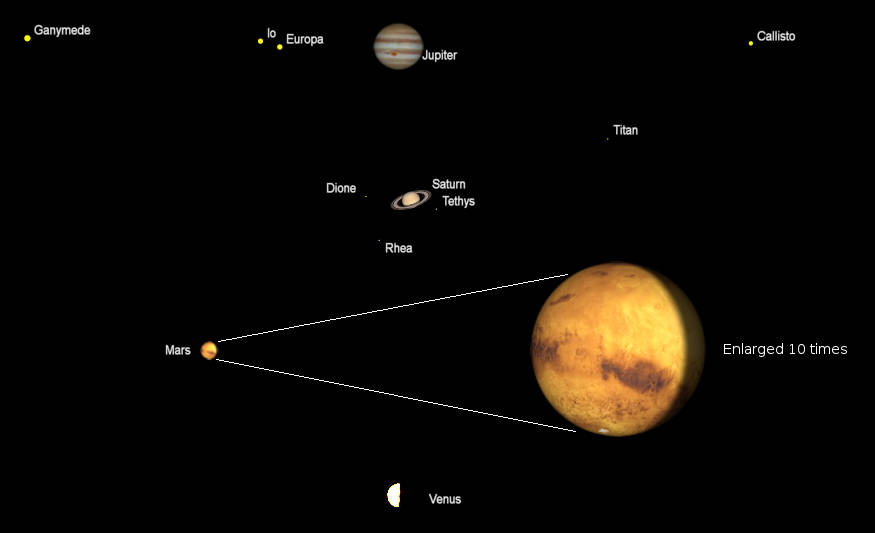
The planets as seen in a telescope (north up) with the same magnification (Jupiter and Saturn) tonight at 10 pm August 12 and (Venus and Mars) 5:30 am tomorrow August 13, 2020. Apparent diameters: Jupiter, 46.31″; Saturn, 18.32″, rings, 42.67″, Mars, 16.18″, and Venus 23.49″. Mars also displays an enlargement showing surface detail. The ” symbol means seconds of arc (1/3600th of a degree.) Created using Cartes du Ciel (Sky Charts).
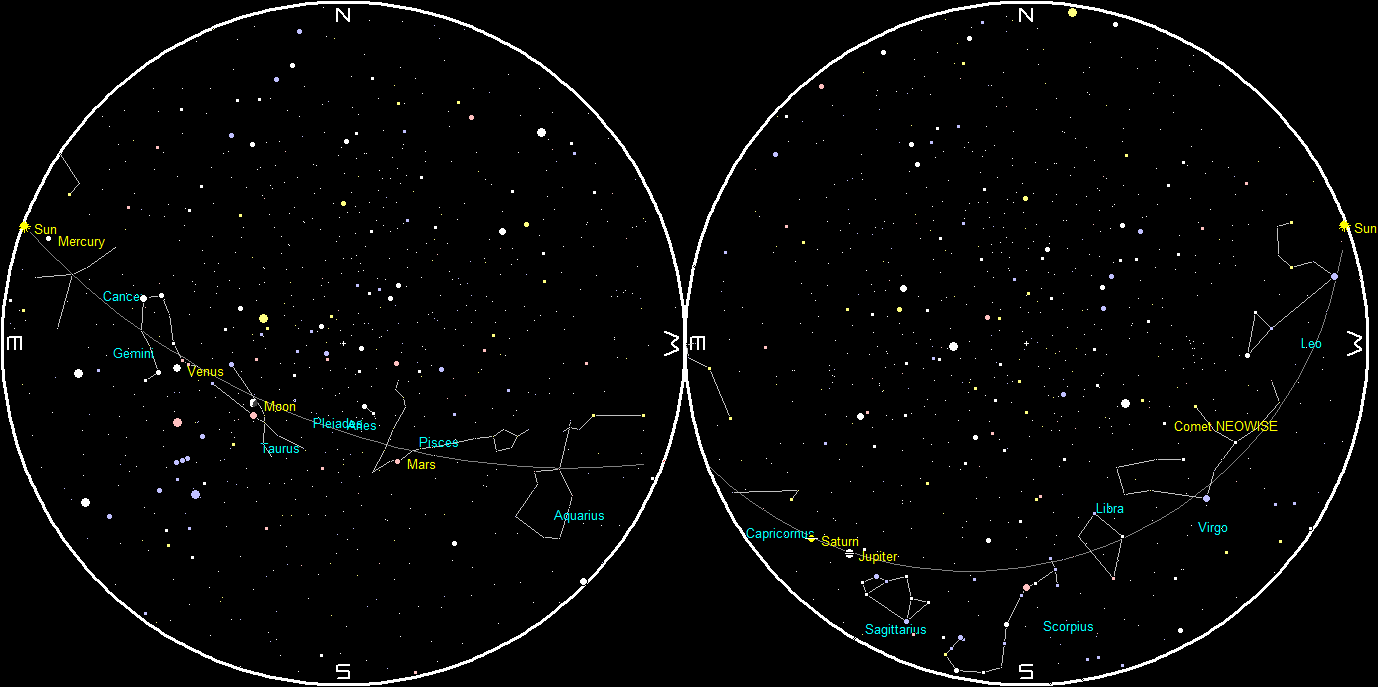
Planets and the Moon at sunset and sunrise of a single night starting with sunset on the right on August 12, 2020. The night ends on the left with sunrise on the 13th. Click on the image to enlarge. Created using my LookingUp program.
08/11/2020 – Ephemeris – Tonight is the peak of the Perseid Meteor shower
This is Bob Moler with Ephemeris for Tuesday, August 11th. Today the Sun will be up for 14 hours and 12 minutes, setting at 8:53, and it will rise tomorrow at 6:42. The Moon, at last quarter today, will rise at 12:46 tomorrow morning.
This evening and tomorrow morning we should see the peak of the Perseid Meteor Shower. There is the expected broad peak of the shower which for us is after sunrise. However the meteoroid stream isn’t monolithic. Each pass of the comet in the inner solar system superimposes its debris on the general stream, so we will have increased activity all night tonight and even into the next few mornings. In general Perseid meteors will be seen to come from the northeast. The evening view will be not hampered by the Moon until it rises at 12:46 am which will drown out the dimmer meteors. The best time to view is from about 10 or 10:30 pm to 12:46 am. The Perseids are the most active meteor shower visible in warm weather, with a possible over 50 meteors per hour.
The event times given are for the Traverse City/Interlochen area of Michigan. They may be different for your location.
Addendum
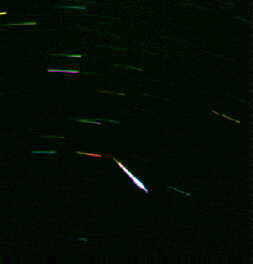
My best Perseid photo. From the 1970’s.
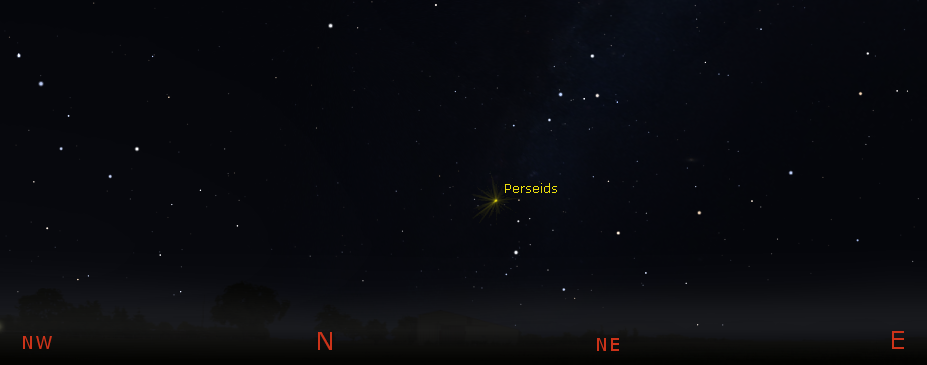
Perseid radiant at 11 pm, August 11th at the top of the constellation of Perseus, below the W shaped constellation of Cassiopeia. Click on the image to enlarge. Created using Stellarium.
08/10/2020 – Ephemeris – The celestial eagle: Aquila
This is Bob Moler with Ephemeris for Monday, August 10th. Today the Sun will be up for 14 hours and 15 minutes, setting at 8:55, and it will rise tomorrow at 6:41. The Moon, 1 day before last quarter, will rise at 12:20 tomorrow morning.
Aquila the eagle is a constellation that lies in the Milky Way. It’s in the southeastern sky as it gets dark. Its brightest star, Altair is one of the stars of the Summer Triangle, a group of three bright stars dominating the eastern sky in the evening now. Altair, in the head of the eagle, is flanked by two slightly dimmer stars, the shoulders of the eagle. The eagle is flying northeastward through the Milky Way. Its wings are seen in the wing tip stars. A curved group of stars to the lower right of Altair is its tail. Within Aquila the Milky Way shows many dark clouds as part of the Great Rift that splits it here. The other summer bird is Cygnus the swan above and left of Aquila, flying in the opposite direction.
The event times given are for the Traverse City/Interlochen area of Michigan. They may be different for your location.
Addendum
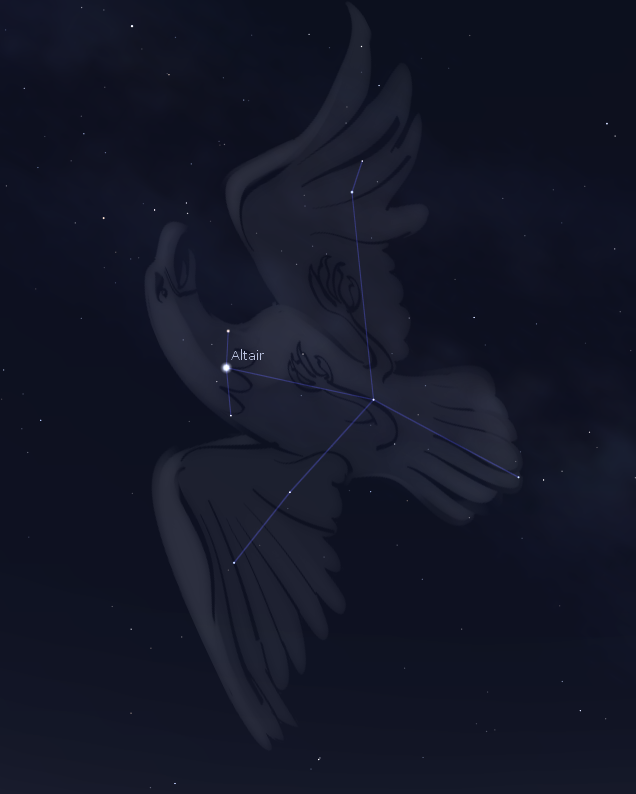
Aquila the Eagle in the southeastern sky. Created using Stellarium.
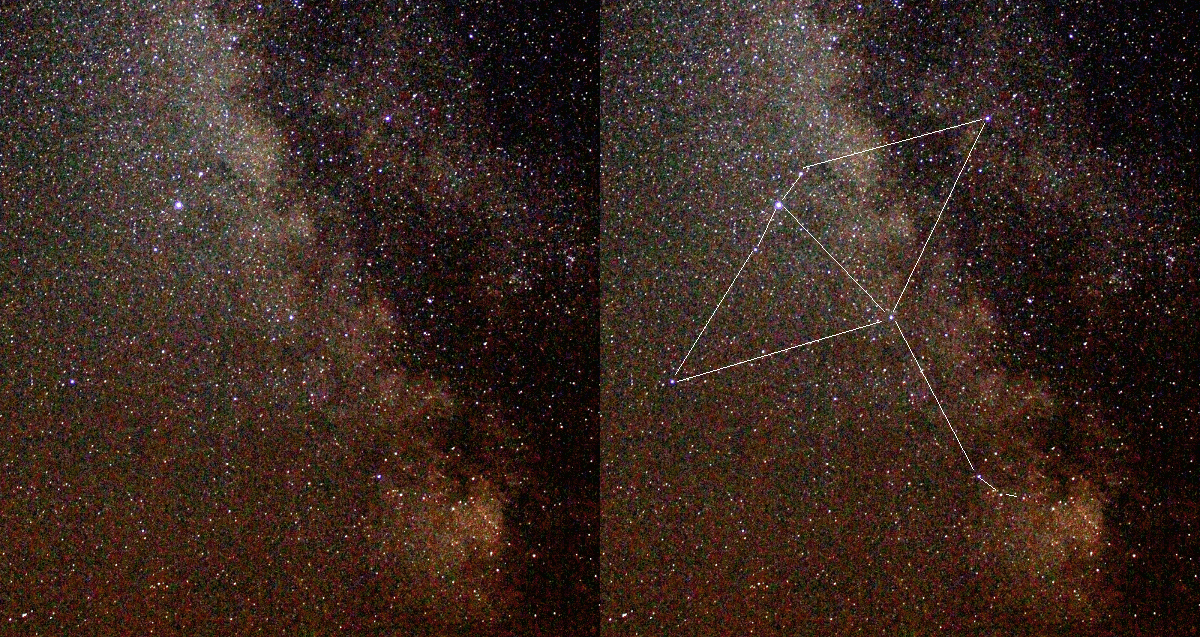
Annotated and animated photograph taken of Aquila August 13, 2018 during the Perseid meteor shower. Alas, no Perseids in this photograph. Taken by me and processed using Registax and GIMP.
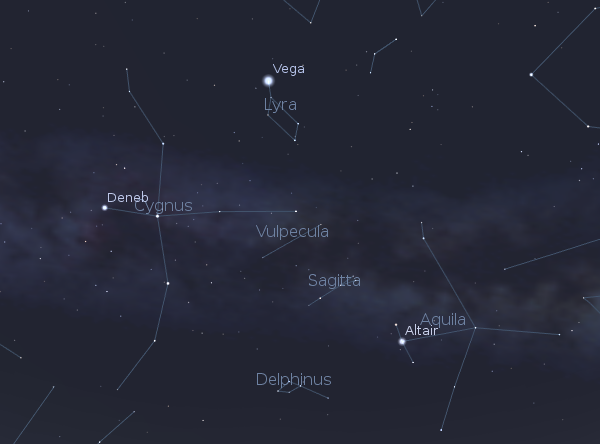
Deneb with the other stars and constellations in the Summer Triangle. Created using Stellarium.
08/07/2020 – Ephemeris – An online astronomy meeting and star party tonight
This is Ephemeris for Friday, August 7th. Today the Sun will be up for 14 hours and 23 minutes, setting at 8:59, and it will rise tomorrow at 6:37. The Moon, half way from full to last quarter, will rise at 11:16 this evening.
The Grand Traverse Astronomical Society will host a virtual meeting tonight at 9 pm followed by a virtual star party at 10 pm. It is via the Zoom app a link can be found on the society’s website gtastro.org. It will be hosted by Dr. Jerry Dobek, astronomy professor at Northwestern Michigan College. During a virtual star party the images are produced real time or near real time using a telescope mounted CCD camera. That is if it’s clear. Images of dimmer objects like star clusters or nebulae, what we call DSOs or deep sky objects may take exposures of several seconds or minutes to build up an image. But have the advantage of being in color. We are quite color blind at low light levels.
The event times given are for the Traverse City/Interlochen area of Michigan. They may be different for your location.
08/06/2020 – Ephemeris – Looking at Saturn through a small telescope
This is Bob Moler with Ephemeris for Thursday, August 6th. Today the Sun will be up for 14 hours and 25 minutes, setting at 9:01, and it will rise tomorrow at 6:36. The Moon, 3 days past full, will rise at 10:55 this evening.
The planet Saturn is just to the left or east of Jupiter in the southeastern evening sky. In steadily held binoculars Saturn is not star-like, but it’s not round either. It’s a small oval dot. The oval or ellipse is due to its rings of small icy bodies that orbit the planet over its equator. A telescope in needed to appreciate those rings to their fullest extent. Saturn’s largest moon Titan will be visible tonight in line with the eastern extent of the rings. Saturn, like the Earth has an axial tilt. In its case it’s 26 degrees. And the rings orbit over Saturn’s equator. So as Saturn orbits the Sun in it’s nearly 30 year orbit the aspect of the rings change over that period. The ellipse shape of the rings are getting thinner now, and in 5 years they will be seen to disappear for a bit.
The event times given are for the Traverse City/Interlochen area of Michigan. They may be different for your location.
Addendum
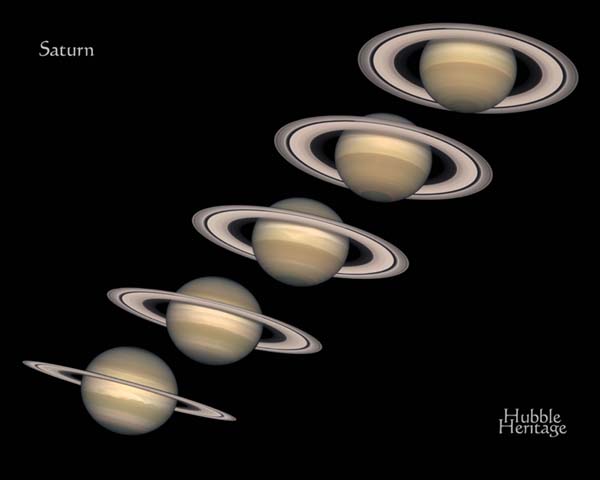
How the appearance of the rings change as Saturn orbits the Sun. The rings were at their widest in 2017. They are closing and will be edge-on again in 2025. When edge-on the rings literally disappear. Despite being 150,000 miles wide as we look at the planet, they are generally less than 66 feet (20 meters) in thickness. Credit: NASA Hubble.
08/05/2020 – Ephemeris – Let’s look at the naked-eye planets for this week
This is Bob Moler with Ephemeris for Wednesday, August 5th. Today the Sun will be up for 14 hours and 28 minutes, setting at 9:02, and it will rise tomorrow at 6:35. The Moon, 2 days past full, will rise at 10:32 this evening.
Let’s look at the naked-eye planets for this week. Jupiter and Saturn are both low in the southeastern sky in the evening. Jupiter is the very bright one. To the left of it will be Saturn. They now seem to be separating a bit due to the Earth’s motion now, but they will cross paths in December. Both planets will be up most of the night with Jupiter setting first at 4:33 am tomorrow morning and Saturn following at 5:14 am. The next planet visible will be Mars which will rise at 11:43 pm. Its now down to 57.7 million miles (92.9 million km) away, as the Earth slowly overtakes it at the rate of about 3.4 million miles (5.5 million km) a week. Brilliant Venus will rise at 3:09 am in the east-northeast as our Morning Star.
The event times given are for the Traverse City/Interlochen area of Michigan. They may be different for your location.
Addendum
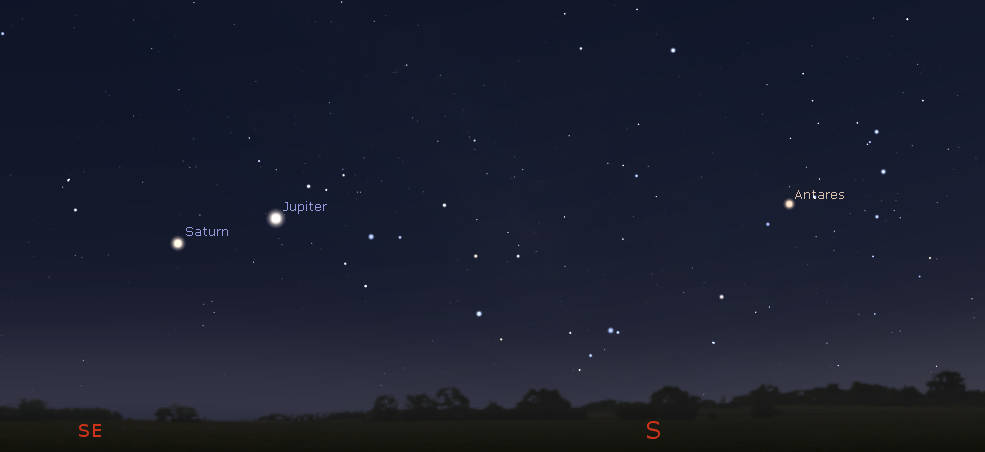
Evening planets Jupiter and Saturn seen in the southeast along with the constellations of Sagittarius (looks like a teapot) and Scorpius at 10 pm, about 45 minutes after sunset tonight August 5, 2020. Click on the image to enlarge. Created using Stellarium.
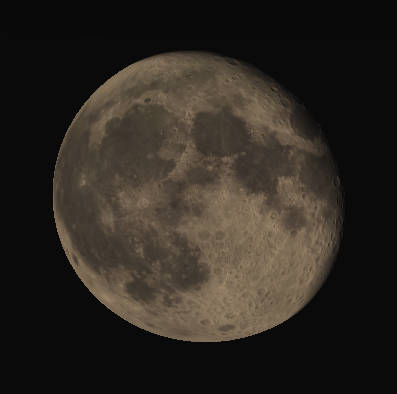
The Moon as it might be seen in binoculars at 11 pm tonight August 5, 2020, about a half hour after it rises. Created using Stellarium.
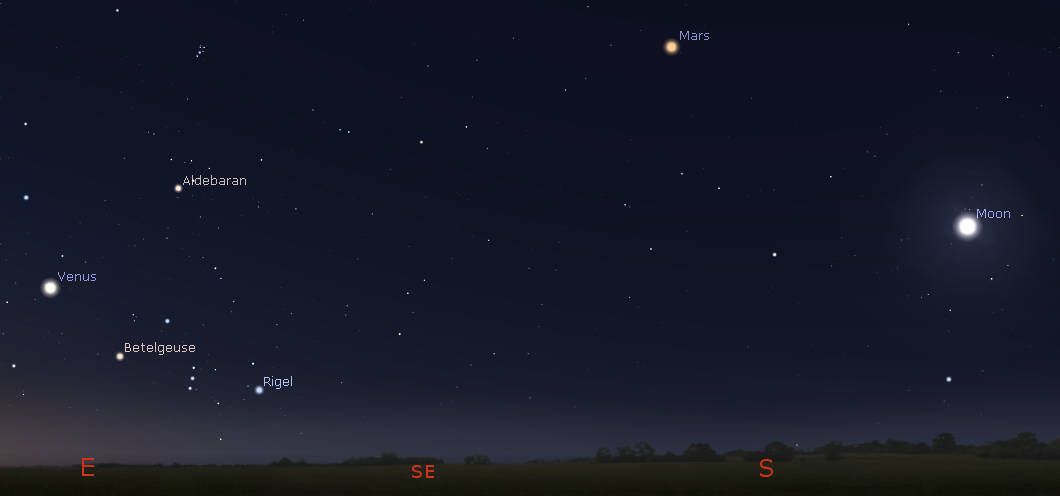
The morning planets and the Moon as seen at 5:30 am or about an hour before sunrise tomorrow morning August 6, 2020. Note the winter constellation of Orion rising in the east with its two brightest stars Betelgeuse and Rigel labeled. Click on the image to enlarge. Created using Stellarium.
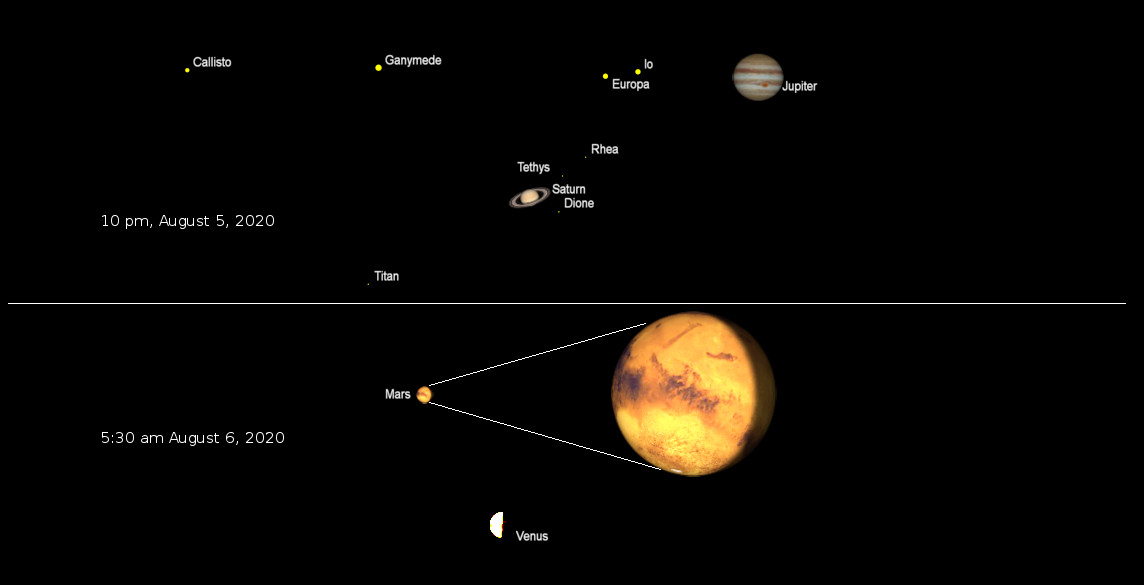
The planets as seen in a telescope (north up) with the same magnification tonight and tomorrow, August 5/6, 2020. Apparent diameters: Jupiter, 46.85″; Saturn, 18.40″, rings, 42.85″ at 10 pm. Mars, 15.26″, and Venus 25.46″. At 5:30 am. Mars also displays an enlargement showing surface detail. The ” symbol means seconds of arc (1/3600th of a degree.) Created using Cartes du Ciel (Sky Charts).
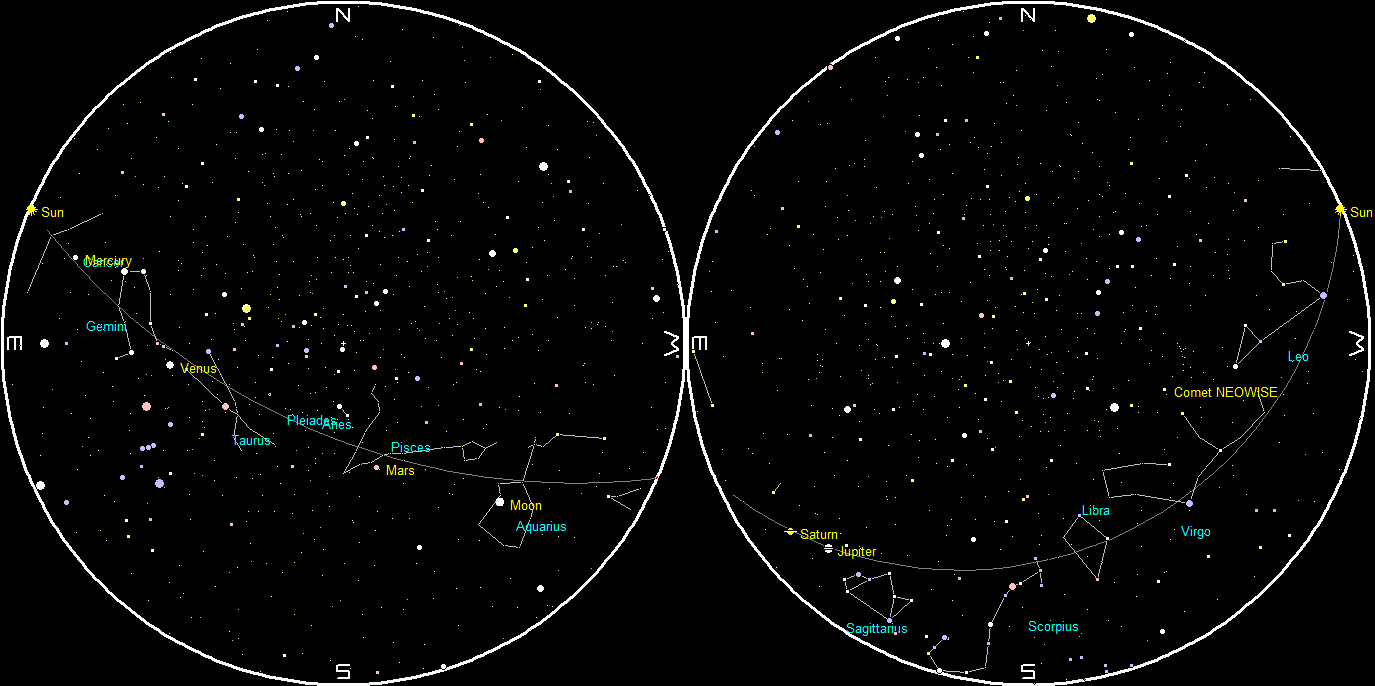
Planets and the Moon at sunset and sunrise of a single night starting with sunset on the right on August 5, 2020. The night ends on the left with sunrise on the 6th. Click on the image to enlarge. Created using my LookingUp program.
08/04/2020 – Ephemeris – Viewing Jupiter and its moons with binoculars or small telescope
This is Ephemeris for Tuesday, August 4th. Today the Sun will be up for 14 hours and 30 minutes, setting at 9:03, and it will rise tomorrow at 6:34. The Moon, 1 day past full, will rise at 10:06 this evening.
The planet Jupiter is a fine object to view with just about any optical aid be it a pair of binoculars, spotting scope or telescope. In binoculars, if held steady or mounted on a tripod Jupiter itself will no longer look star-like, but a tiny disk. Several of Jupiter’s moons can also be seen. With a telescope four of them can be seen, the same four Galileo discovered 410 years ago. At 10 pm they will be in the same order of distance from the planet that they actually are. The two nearest will be on the west side of the planet Io the closest, the Europa the next moon out. On the east side there is the third farthest Ganymede, and farthest out is Callisto. Their orbits are nearly edge on to us, so they shuttle from one side to the other of the planet.
The event times given are for the Traverse City/Interlochen area of Michigan. They may be different for your location.
Addendum
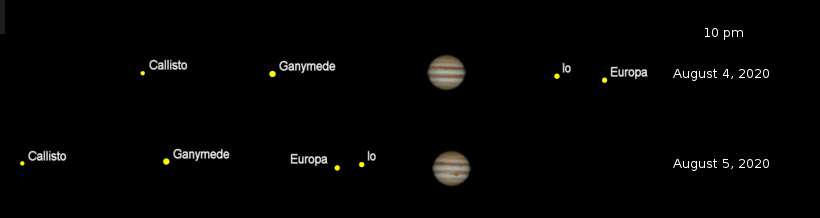
Jupiter and its Galilean moons for tonight and tomorrow night August 4 & 5, 2020. Those moons really move from night to night. This is shown north at the top, east to the left. Based on telescope design the image presented could be inverted, mirror image or both. Created using Cartes du Ciel (Sky Charts).
Due to the lack of time (59 seconds) I could only cover the moons. I’ll address Jupiter’s cloud features at another time. Can’t wait? Here’s a link: https://bobmoler.wordpress.com/2018/05/22/05-22-2018-ephemeris-seeing-detail-on-the-face-of-jupiter-with-a-small-telescope/
08/03/2020 – Ephemeris – What is the Perseverance Rover going to do on Mars?
This is Ephemeris for Monday, August 3rd. Today the Sun will be up for 14 hours and 33 minutes, setting at 9:05, and it will rise tomorrow at 6:33. The Moon, at full today, will rise at 9:35 this evening.
The Mars Perseverance Rover looks a lot like the Curiosity Rover that landed on Mars in Gale Crater almost exactly 8 years ago (Earth years that is). It has more and better cameras, some different tools on its arm. It will have a laser like Curiosity. It can take core samples and store them in sealed tubes for later return to the Earth. It has an experimental helicopter drone named Ingenuity that must, like the rover be autonomous since it cannot be controlled in real-time from the Earth. The main mission this time is to look for signs of life in a spot we know water had flowed in the ancient past. The surface water and the life is long gone, but there might be signs that it might have been present in the distant past before Mars lost most of its atmosphere and water.
The event times given are for the Traverse City/Interlochen area of Michigan. They may be different for your location.
Addendum
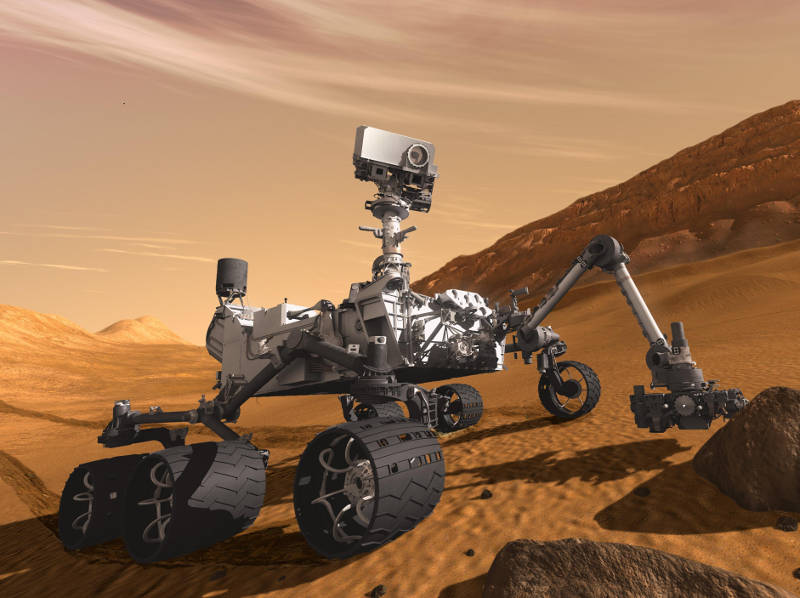
Artist rendition of the Mars 2020 “Endurance” Rover. Credit NASA.
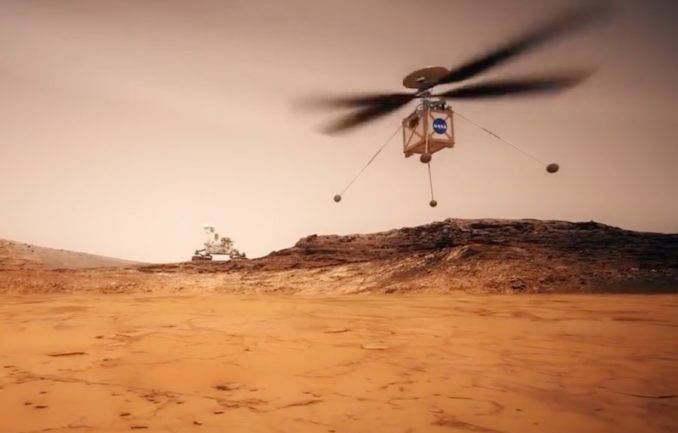
Artist’s concept of the Mars Helicopter “Ingenuity”. Credit: NASA/JPL-Caltech.
07/31/2020 – Ephemeris – Previewing August skies
This is Bob Moler with Ephemeris for Friday, July 31st. Today the Sun will be up for 14 hours and 40 minutes, setting at 9:09, and it will rise tomorrow at 6:29. The Moon, 3 days before full, will set at 4:04 tomorrow morning.
Let’s look ahead at the month of August in the skies. Daylight hours will decrease from 14 hours and 38 minutes tomorrow to 13 hours 15 minutes on the 31st. The altitude of the Sun at local noon, that is degrees of angle above the horizon will decrease from 63 degrees tomorrow to just over 53 degrees on the 31st. Straits area listeners can subtract one more degree from those angles. Local noon, when the Sun is due south, is about 1:43 p.m. The big event of the month will be in the late evening sky: The Perseid meteor shower will be best seen on the evening of the 11th before the Moon rises at 12:46 am. August is the first of my two favorite months for viewing the wonders of the summer Milky Way.
The event times given are for the Traverse City/Interlochen area of Michigan. They may be different for your location.
Addendum
August Evening Star Chart
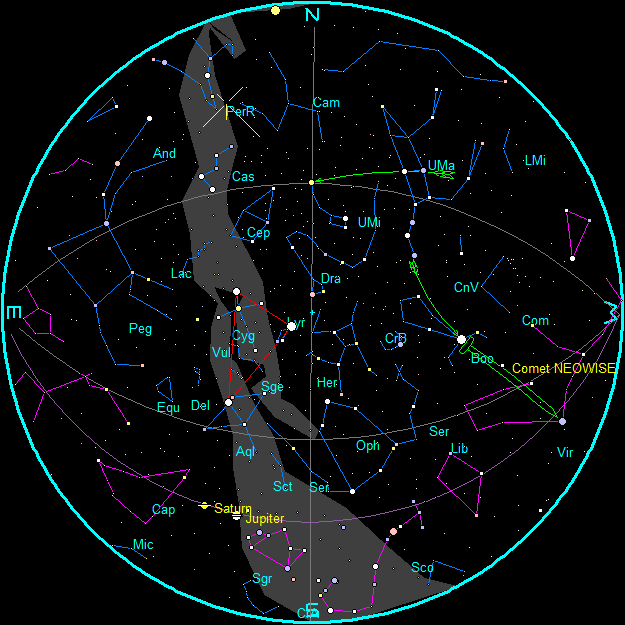
Star Chart for August 2020 (10 p.m. EDT August 15, 2020). Click on image to enlarge. Created using my LookingUp program.
The planets and stars are plotted for the 15th at 10 p.m. EDT in the evening and 5 a.m. for the morning chart. These are the chart times. Note that Traverse City is located approximately 45 minutes behind our time meridian, West 75° longitude. (An hour 45 minutes behind our daylight saving time meridian during EDT). To duplicate the star positions on a planisphere you may have to set it to 1 hour 45 minutes earlier than the current time.
Note the chart times are for the 15th. For each week before the 15th add ½ hour (28 minutes if you’re picky). For each week after the 15th subtract ½ hour. The planet positions are updated each Wednesday on this blog. For planet positions on dates other than the 15th.
August Morning Star Chart
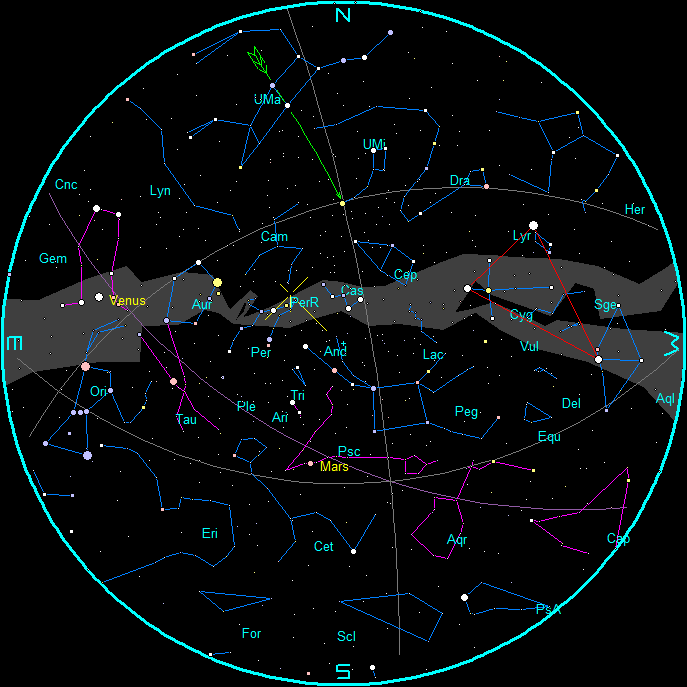
Star Chart for August mornings 2020 (5 a.m. EDT August 15, 2020). Click on image to enlarge. Created using my LookingUp program.
For a list of constellation names to go with the abbreviations click here.
- Pointer stars at the front of the bowl of the Big Dipper point to Polaris the North Star.
- Leaky dipper drips on Leo.
- Follow the arc of the handle of the Big Dipper to the star Arcturus, and
- Extend like a spike to Spica.
- The Summer Triangle is in red.
- PerR is the radiant of the Perseid meteor shower (Peaks on the 12th)
Twilight Limits, Nautical and Astronomical
| EDT | |||||||
| Morning twilight | Evening twilight | Dark night | Moon | ||||
| Date | Astro. | Nautical | Nautical | Astro. | Start | End | Illum. |
| 2020-08-01 | 4h31m | 5h19m | 22h26m | 23h14m | 4h04m | 4h31m | 0.93 |
| 2020-08-02 | 4h33m | 5h21m | 22h24m | 23h12m | – | – | 0.98 |
| 2020-08-03 | 4h35m | 5h22m | 22h23m | 23h10m | – | – | 1 |
| 2020-08-04 | 4h37m | 5h24m | 22h21m | 23h08m | – | – | 1 |
| 2020-08-05 | 4h39m | 5h25m | 22h19m | 23h06m | – | – | 0.97 |
| 2020-08-06 | 4h41m | 5h27m | 22h18m | 23h04m | – | – | 0.93 |
| 2020-08-07 | 4h43m | 5h28m | 22h16m | 23h01m | 23h01m | 23h16m | 0.87 |
| 2020-08-08 | 4h44m | 5h30m | 22h14m | 22h59m | 22h59m | 23h36m | 0.8 |
| 2020-08-09 | 4h46m | 5h31m | 22h12m | 22h57m | 22h57m | 23h57m | 0.71 |
| 2020-08-10 | 4h48m | 5h33m | 22h10m | 22h55m | 22h55m | – | 0.62 |
| 2020-08-11 | 4h50m | 5h34m | 22h09m | 22h53m | 22h53m | 0h20m | 0.52 |
| 2020-08-12 | 4h52m | 5h36m | 22h07m | 22h51m | 22h51m | 0h46m | 0.42 |
| 2020-08-13 | 4h54m | 5h37m | 22h05m | 22h48m | 22h48m | 1h16m | 0.33 |
| 2020-08-14 | 4h56m | 5h39m | 22h03m | 22h46m | 22h46m | 1h53m | 0.23 |
| 2020-08-15 | 4h57m | 5h40m | 22h01m | 22h44m | 22h44m | 2h39m | 0.15 |
| 2020-08-16 | 4h59m | 5h42m | 21h59m | 22h42m | 22h42m | 3h35m | 0.08 |
| 2020-08-17 | 5h01m | 5h43m | 21h57m | 22h39m | 22h39m | 4h40m | 0.03 |
| 2020-08-18 | 5h03m | 5h45m | 21h55m | 22h37m | 22h37m | 5h03m | 0 |
| 2020-08-19 | 5h05m | 5h46m | 21h53m | 22h35m | 22h35m | 5h05m | 0.01 |
| 2020-08-20 | 5h06m | 5h48m | 21h52m | 22h33m | 22h33m | 5h06m | 0.04 |
| 2020-08-21 | 5h08m | 5h49m | 21h50m | 22h30m | 22h30m | 5h08m | 0.1 |
| 2020-08-22 | 5h10m | 5h50m | 21h48m | 22h28m | 22h53m | 5h10m | 0.19 |
| 2020-08-23 | 5h12m | 5h52m | 21h46m | 22h26m | 23h20m | 5h12m | 0.29 |
| 2020-08-24 | 5h13m | 5h53m | 21h44m | 22h24m | 23h51m | 5h13m | 0.41 |
| 2020-08-25 | 5h15m | 5h55m | 21h42m | 22h22m | – | 5h15m | 0.53 |
| 2020-08-26 | 5h17m | 5h56m | 21h40m | 22h19m | 0h27m | 5h17m | 0.64 |
| 2020-08-27 | 5h18m | 5h58m | 21h38m | 22h17m | 1h09m | 5h18m | 0.75 |
| 2020-08-28 | 5h20m | 5h59m | 21h36m | 22h15m | 1h59m | 5h20m | 0.83 |
| 2020-08-29 | 5h22m | 6h00m | 21h34m | 22h13m | 2h56m | 5h22m | 0.91 |
| 2020-08-30 | 5h23m | 6h02m | 21h32m | 22h10m | 3h58m | 5h23m | 0.91 |
| 2020-08-31 | 5h25m | 6h03m | 21h30m | 22h08m | 5h04m | 5h25m | 0.96 |
Twilight calendar was generated using Cartes du Ciel (Sky Charts).
See my blog post: Twilight Zone for the definitions of the different periods of twilight here: https://bobmoler.wordpress.com/2018/09/27/.
NASA Calendar of Planetary Events
    Date     Time    Event
Aug 1  Sa            Venus: 45.2° W
    1  Sa  04:47 am  Moon South Dec.: 24.1° S
    1  Sa  04:14 pm  Mercury-Pollux: 6.7° S
    1  Sa  07:30 pm  Moon-Jupiter: 1.6° N
    2  Su  09:17 am  Moon-Saturn: 2.4° N
    3  Mo  11:59 am  Full Moon
    9  Su  03:57 am  Moon-Mars: 0.8° N
    9  Su  09:51 am  Moon Apogee: 404700 km
   11  Tu  12:45 pm  Last Quarter
   12  We  09:02 am  Perseid Meteor Shower: ZHR = 90
   12  We  08:59 pm  Venus Greatest Elongation: 45.8° W
   14  Fr  03:22 pm  Moon Ascending Node
   15  Sa  09:01 am  Moon-Venus: 4.2° S
   15  Sa  04:40 pm  Moon North Dec.: 24.2° N
   17  Mo  10:47 am  Mercury Superior Solar Conjunction
   18  Tu  10:41 pm  New Moon
   21  Fr  06:59 am  Moon Perigee: 363500 km
   25  Tu  01:58 pm  First Quarter
   27  Th  07:52 am  Moon Descending Node
   28  Fr  10:06 am  Moon South Dec.: 24.2° S
   28  Fr  09:33 pm  Moon-Jupiter: 1.5° N
   29  Sa  12:40 pm  Moon-Saturn: 2.3° N
Sep 1  Tu            Venus: 44.7° W
All event times are given for UTC-4 hr: Eastern Daylight Saving Time.
Sky Events Calendar by Fred Espenak and Sumit Dutta (NASA’s GSFC),
http://eclipse.gsfc.nasa.gov/SKYCAL/SKYCAL.html.
If you go to the above site you can print out a list like the above for the entire year or calendar pages for your time zone.
Sun and Moon Rising and Setting Events
LU              Ephemeris of Sky Events for Interlochen/TC
August, 2020    Local time zone: EDT
+-----------------------------------------------------------------------+
| DATE |  SUN     SUN  DAYLIGHT|   TWILIGHT*    |MOON  RISE OR    ILLUM |
|      |  RISE    SET    HOURS |  END    START  |PHASE SET** TIME FRACTN|
+=======================================================================+
|Sat  1| 06:29a  09:07p  14:38 | 10:23p  05:14a |      Set  05:04a   97%|
+------+-----------------------+----------------+-----------------------+
|Sun  2| 06:30a  09:06p  14:35 | 10:21p  05:15a |      Set  06:09a   99%|
|Mon  3| 06:31a  09:05p  14:33 | 10:19p  05:17a |Full  Rise 09:35p  100%|
|Tue  4| 06:33a  09:03p  14:30 | 10:17p  05:18a |      Rise 10:06p   98%|
|Wed  5| 06:34a  09:02p  14:28 | 10:16p  05:20a |      Rise 10:32p   94%|
|Thu  6| 06:35a  09:01p  14:25 | 10:14p  05:21a |      Rise 10:55p   89%|
|Fri  7| 06:36a  08:59p  14:23 | 10:12p  05:23a |      Rise 11:16p   82%|
|Sat  8| 06:37a  08:58p  14:20 | 10:10p  05:24a |      Rise 11:36p   75%|
+------+-----------------------+----------------+-----------------------+
|Sun  9| 06:38a  08:56p  14:18 | 10:09p  05:26a |      Rise 11:57p   66%|
|Mon 10| 06:39a  08:55p  14:15 | 10:07p  05:27a |      Rise 12:20a   57%|
|Tue 11| 06:41a  08:53p  14:12 | 10:05p  05:29a |L Qtr Rise 12:46a   47%|
|Wed 12| 06:42a  08:52p  14:10 | 10:03p  05:30a |      Rise 01:16a   38%|
|Thu 13| 06:43a  08:50p  14:07 | 10:01p  05:32a |      Rise 01:53a   28%|
|Fri 14| 06:44a  08:49p  14:04 | 09:59p  05:33a |      Rise 02:39a   20%|
|Sat 15| 06:45a  08:47p  14:01 | 09:58p  05:35a |      Rise 03:35a   12%|
+------+-----------------------+----------------+-----------------------+
|Sun 16| 06:46a  08:46p  13:59 | 09:56p  05:36a |      Rise 04:40a    6%|
|Mon 17| 06:48a  08:44p  13:56 | 09:54p  05:38a |      Rise 05:53a    2%|
|Tue 18| 06:49a  08:42p  13:53 | 09:52p  05:39a |New   Set  08:58p    0%|
|Wed 19| 06:50a  08:41p  13:50 | 09:50p  05:40a |      Set  09:30p    1%|
|Thu 20| 06:51a  08:39p  13:47 | 09:48p  05:42a |      Set  09:59p    5%|
|Fri 21| 06:52a  08:37p  13:44 | 09:46p  05:43a |      Set  10:26p   12%|
|Sat 22| 06:54a  08:36p  13:42 | 09:44p  05:45a |      Set  10:52p   20%|
+------+-----------------------+----------------+-----------------------+
|Sun 23| 06:55a  08:34p  13:39 | 09:42p  05:46a |      Set  11:20p   30%|
|Mon 24| 06:56a  08:32p  13:36 | 09:40p  05:48a |      Set  11:51p   42%|
|Tue 25| 06:57a  08:30p  13:33 | 09:38p  05:49a |F Qtr Set  12:26a   53%|
|Wed 26| 06:58a  08:29p  13:30 | 09:36p  05:51a |      Set  01:09a   64%|
|Thu 27| 06:59a  08:27p  13:27 | 09:34p  05:52a |      Set  01:58a   74%|
|Fri 28| 07:01a  08:25p  13:24 | 09:32p  05:53a |      Set  02:56a   83%|
|Sat 29| 07:02a  08:23p  13:21 | 09:30p  05:55a |      Set  03:58a   90%|
+------+-----------------------+----------------+-----------------------+
|Sun 30| 07:03a  08:22p  13:18 | 09:28p  05:56a |      Set  05:04a   95%|
|Mon 31| 07:04a  08:20p  13:15 | 09:26p  05:58a |      Set  06:10a   98%|
+-----------------------------------------------------------------------+
* Nautical Twilight
** Moonrise or moonset, whichever occurs between sunrise and sunset
Generated using my LookingUp for DOS program.

