Archive
02/25/2020 – Ephemeris – Mercury at inferior conjunction with the Sun today
Ephemeris for Fat Tuesday, February 25th. Today the Sun will be up for 10 hours and 56 minutes, setting at 6:24, and it will rise tomorrow at 7:26. The Moon, 2 days past new, will set at 8:27 this evening.
A bit more than two weeks ago Mercury was visible in the evening twilight at its greatest elongation from the Sun, then at 8:37 this evening it will pass between the Earth and the Sun and enter the morning sky. The event is called an inferior conjunction. That’s not a dig on the quality of the event. Indeed an inferior conjunctions are more important and can produce a transit of the planet across the Sun. A rare and formerly important event when we were trying to determine the distance to the Sun. In astronomy an inferior planet is one that orbits the Sun inside the Earth’s orbit. A superior planet orbits the Sun farther than the Earth. It’s not a sign of quality. The best time to spot Mercury in the morning is in August to October, so we’ll miss Mercury this time.
The times given are for the Traverse City/Interlochen area of Michigan. They may be different for your location.
Addendum
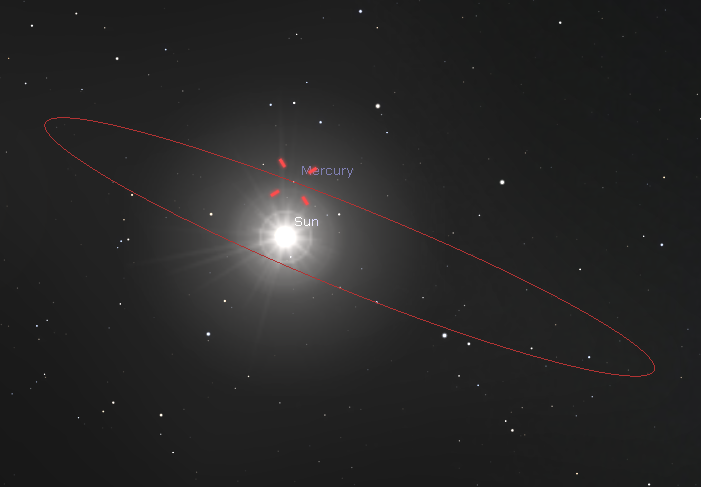
Mercury about 7 hours before inferior conjunction February 25, 2020 near local solar noon. The last inferior conjunction of Mercury on November 11, 2019 Mercury passed across the Sun’s disk in a transit. The red ellipse is Mercury’s orbit as seen From the Earth. It’s orbit is tilted about 7 degrees from the Earth’s orbit, so transits are fairly rare events. Created using Stellarium.
02/24/2020 – Ephemeris – Conflict in the skies: Orion vs. Taurus
Ephemeris for Monday, February 24th. Today the Sun will be up for 10 hours and 53 minutes, setting at 6:23, and it will rise tomorrow at 7:27. The Moon, 1 day past new, will set at 7:26 this evening.
The classical constellation figures of Orion the hunter and Taurus the bull appear to be interacting in the sky. Orion is in the south at 9 p.m. An angry Taurus, a bit above him in the southwest, appears to be charging at Orion who appears to be facing him with lion skin shield and an upraised club. Orion’s two hunting dogs, canes major and minor, appear to be unconcerned. The face of Taurus the bull is a letter V shape of faint stars with a bright reddish star at the upper left tip of the V called Aldebaran the bull’s angry bloodshot eye. There’s no mythological story that goes with this. Both Orion and Taurus have their own myths associated with them separate from their apparent clash in the heavens.
The times given are for the Traverse City/Interlochen area of Michigan. They may be different for your location.
Addendum
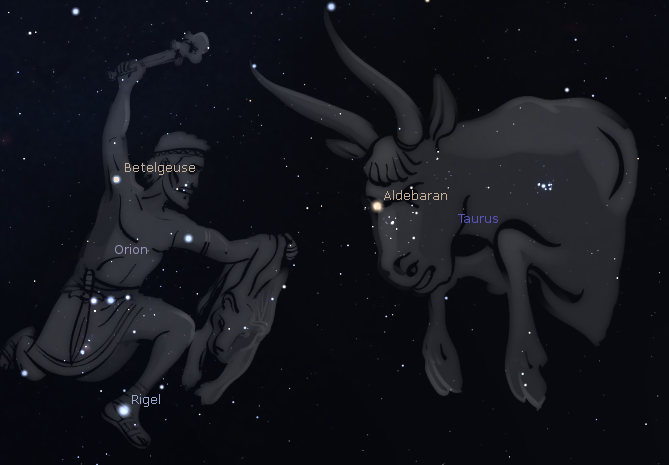
Conflict in the skis: Taurus is charging Orion. Seen at 9 p.m. in late February. Created using Stellarium and the dimming of Betelgeuse in GIMP.
02/20/2020 – Ephemeris – The Winter Triangle
Ephemeris for Thursday, February 20th. Today the Sun will be up for 10 hours and 41 minutes, setting at 6:17, and it will rise tomorrow at 7:34. The Moon, 3 days before new, will rise at 6:53 tomorrow morning.
I usually talk about the Winter Circle of bright stars, but some other astronomers talk about the Winter Triangle. The stars involved are Betelgeuse in the hunter Orion, Sirius in Canis Major, Orion’s large hunting dog, and Procyon in Canis Minor, his other small hunting dog. These three stars enclose a rather blank piece of sky with the faint Milky Way running through it and the equally invisible constellation of Monoceros the unicorn. The Summer Triangle has three bright stars with no other close competition. The Winter Triangle has 4 other bright stars near it. Any three of these would make a nice triangle. One of these stars, Betelgeuse has been the news recently because it is dimming to an unprecedented degree.
The times given are for the Traverse City/Interlochen area of Michigan. They may be different for your location.
Addendum
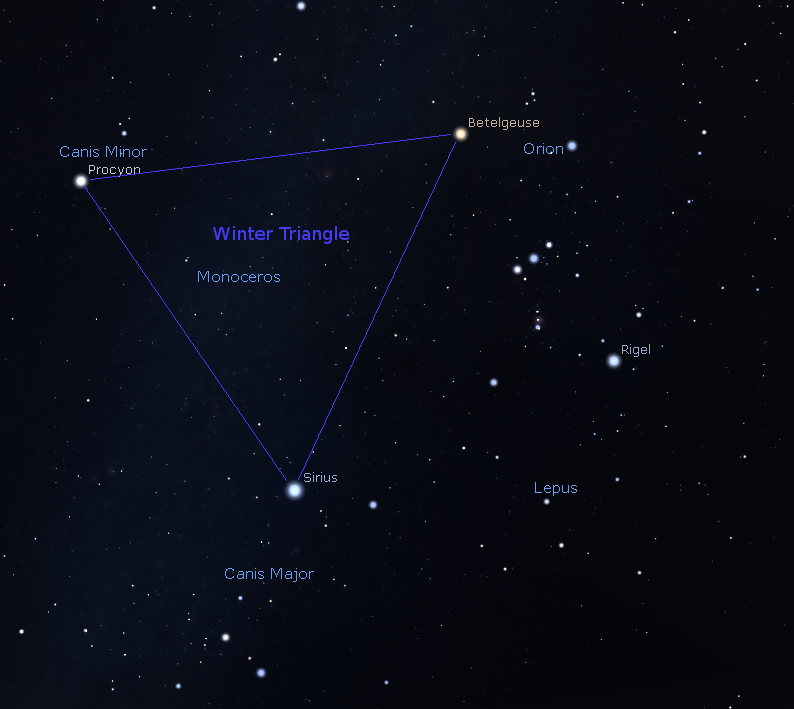
The Winter Triangle. It enclose a pretty blank space where Monoceros the unicorn lies. Created using Stellarium with my annotations for the Winter Triangle. By the way, Betelgeuse is currently only as bright as Bellatrix, the star next to the “n” in Orion.
02/19/2020 -Ephemeris – Let’s take a look at the bright planets
Ephemeris for Wednesday, February 19th. Today the Sun will be up for 10 hours and 38 minutes, setting at 6:16, and it will rise tomorrow at 7:36. The Moon, half way from last quarter to new, will rise at 6:12 tomorrow morning.
Let’s look at the naked-eye planets for this week. Venus is our evening star shining brightly in the southwest in the early evening. It will set at 10:03 p.m. Mercury is fading and will set only 58 minutes after the Sun. Mars is visible in the morning sky and will rise in the southeast at 4:34 a.m. It’s not very bright because it’s 167 million (268 million km) miles away, but it’s getting slowly closer to the Earth at the rate of about 4 million miles (6 million km) a week. Jupiter will rise at 5:32 a.m. Lastly, Saturn will rise at 6:04 tomorrow morning with the thin crescent Moon underneath it*. Jupiter will continue to approach Saturn throughout this year until their paths cross on December 21st.
The times given are for the Traverse City/Interlochen area of Michigan. They may be different for your location.
* Moon placement in this morning’s program was in error. The Moon is near Jupiter this morning, not tomorrow morning.
Addendum
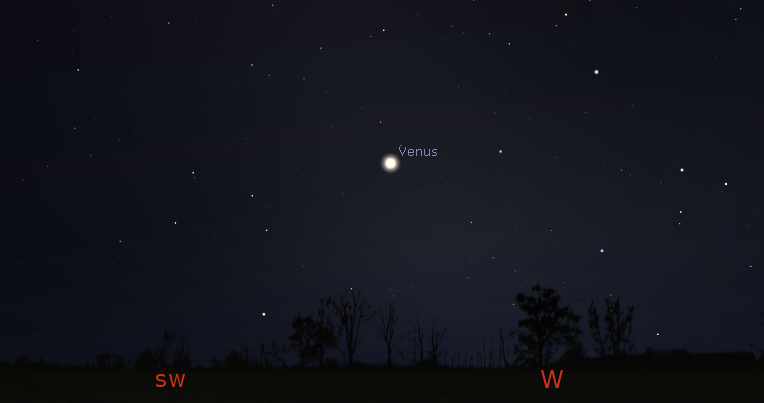
Venus and zodiacal light at 7:30 p.m. this evening February 19, 2020. The zodiacal light will appear more prominent in the next month or so. Here it’s mostly silhouetting the foreground trees. Check my prior posts for zodiacal light. I’ll cover it again in about a month. Created using Stellarium.
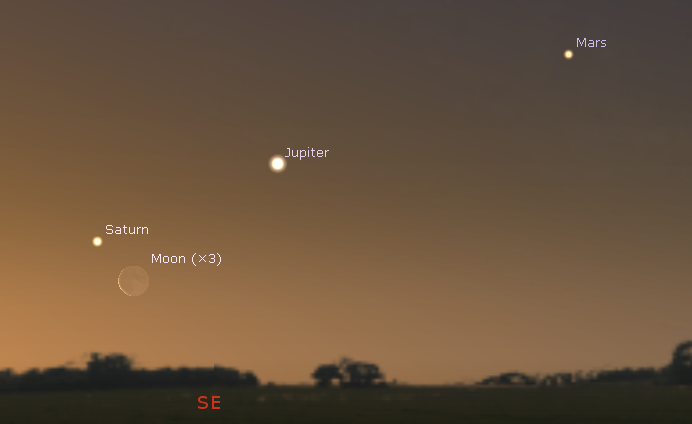
Morning planets and the Moon tomorrow morning at 7 a.m. February 20, 2020. Note that the Moon is 3 times its normal size. Created using Stellarium.
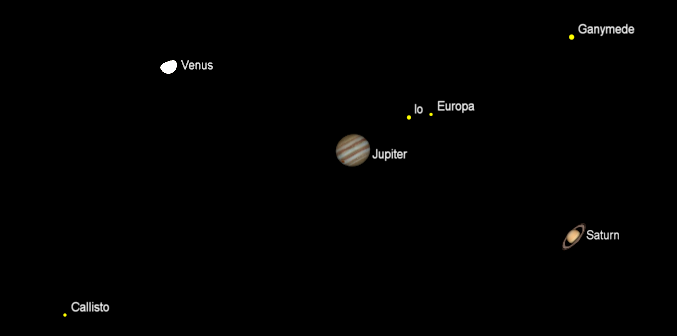
The planets as seen in a telescope with the same magnification. Venus in the evening and Jupiter and Saturn in the morning. Apparent diameters: Venus, 17.5″; Jupiter, 33.5″; Saturn, 15.4″, rings, 35.7″.
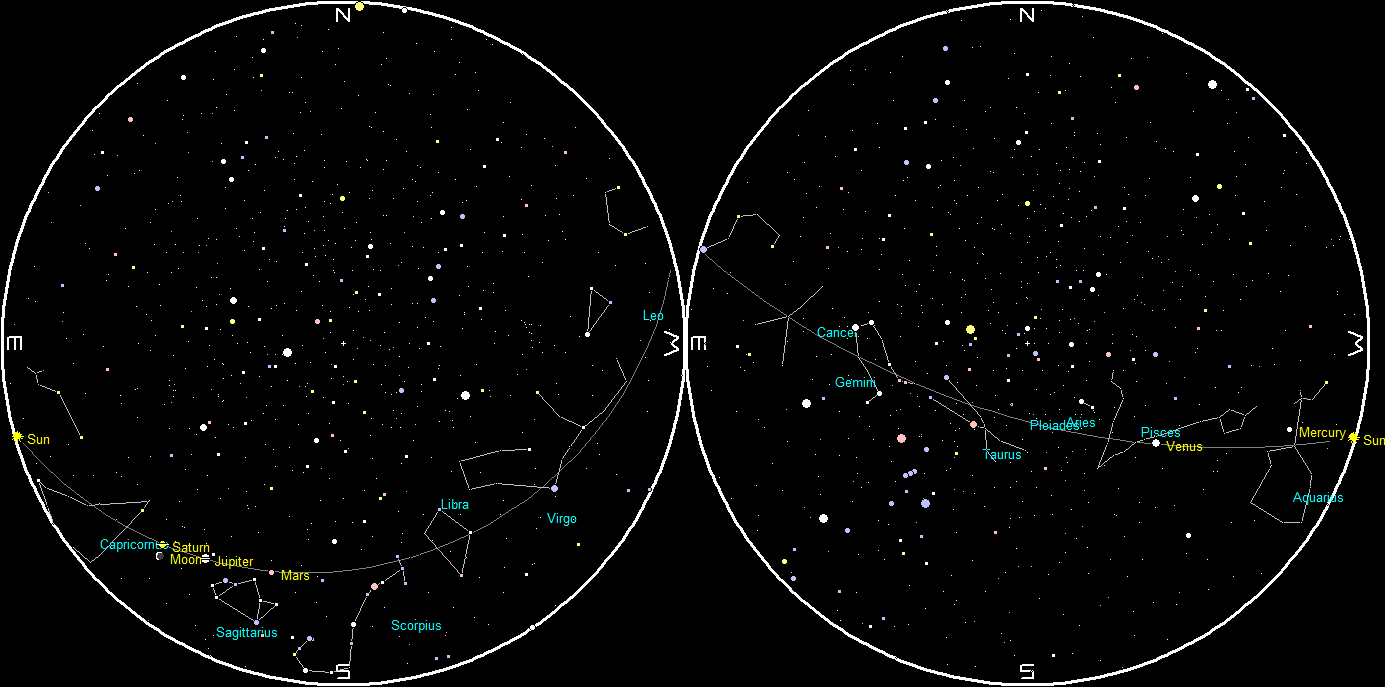
Planets and the Moon at sunset and sunrise of a single night starting with sunset on the right on February 19, 2020. The night ends on the left with sunrise on the 20th. Click on the image to enlarge. Created using my LookingUp program.
02/18/2020 – Ephemeris – Orion in three cultures
Feb 18. This is Bob Moler with Ephemeris for Tuesday, February 18th. Today the Sun will be up for 10 hours and 35 minutes, setting at 6:14, and it will rise tomorrow at 7:37. The Moon, 3 days past last quarter, will rise at 5:24 tomorrow morning.
We observe the constellation of Orion in the south at 9 p.m. and think of the hapless Greek hero. To the Hebrews it was Kesil, the fool who built the tower of Babel hoping to reach heaven. To the Anishinaabe native peoples of this place it is the Wintermaker whose rising in the evening announces the coming of winter. Where Orion’s arms carry a lion skin shield and a club, the Wintermaker’s arms are exaggerated and extend from Aldebaran in Taurus to Procyon in Canis Minor, embracing just about all of the winter sky. Two other Anishinaabe constellations are entering the skies at this time in the east and northeast, to announce the coming of spring. One the pleasures and the other the dangers.
The times given are for the Traverse City/Interlochen area of Michigan. They may be different for your location.
Addendum
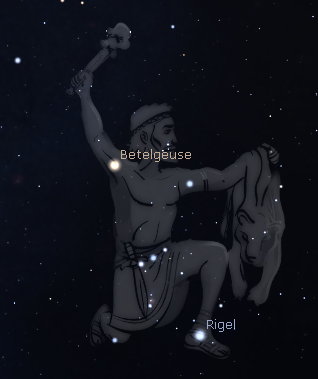
Orion as he is seen tonight at 9 p.m. Created using Stellarium.

The Wintermaker stretches his arms wide to embrace the winter stars. Created using Stellarium. Wintermaker figure from Ojibwe Sky Star Map by A. Lee, W. Wilson, C. Gawboy. Stellarium contains the constellation art from many cultures.
02/17/2020 – Ephemeris – A look at Orion and his hunting dogs
Ephemeris for President’s Day, Monday, February 17th. Today the Sun will be up for 10 hours and 32 minutes, setting at 6:13, and it will rise tomorrow at 7:39. The Moon, 2 days past last quarter, will rise at 4:27 tomorrow morning.
The great winter constellation or star group Orion the Hunter, is located in the southern sky at 9 p.m. His elongated rectangle of a torso is vertical. In the center of the rectangle are three stars in a line that make his belt. As a hunter, especially one of old, he has two hunting dogs. The larger, Canis Major can be found by following the three belt stars of Orion down and to the left. There lies the brilliant star called Sirius, also known as the Dog Star. It’s in the heart of a stick figure dog lower in the south facing Orion that appears to be begging. Canis Minor is just two stars found by extending Orion’s shoulder stars eastward where we find bright Procyon, the little dog star in the southeast.
The times given are for the Traverse City/Interlochen area of Michigan. They may be different for your location.
Addendum
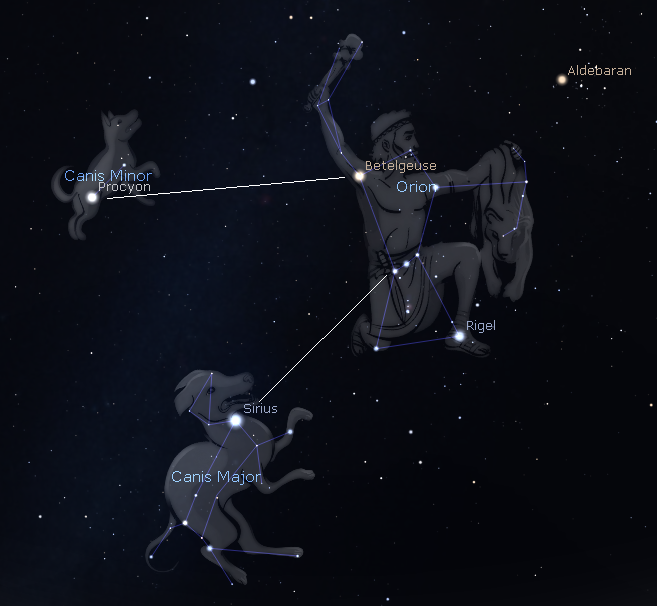
Orion and his hunting dogs with pointers as seen at 9 p.m. in mid February. Created using Stellarium.
02/13/2020 – Ephemeris – Orion’s Belt stars
This is Ephemeris for Thursday, February 13th. Today the Sun will be up for 10 hours and 21 minutes, setting at 6:07, and it will rise tomorrow at 7:45. The Moon, 2 days before last quarter, will rise at 11:48 this evening.
Orion’s belt of three stars is one of the most noticeable star groupings in the sky. There are no other group of three bright stars in a straight line visible anywhere else in the sky. The star’s names from left to right are Alnitak, Alnilam and Mintaka. They are actually a bit farther away than the other bright stars of Orion. Alnilam, the center star, is over three times the distance of red giant Betelgeuse above them and over twice as far as blue white giant star Rigel below them. Alnilam is 375 thousand times brighter than the Sun according to the SIMBAD Astronomical Database. These three stars were also known as Frigga’s Spindle by the Norsemen. Frigga also known as Freya is the goddess from which we get the name of the day of the week Friday.
The times given are for the Traverse City/Interlochen area of Michigan. They may be different for your location.
Addendum
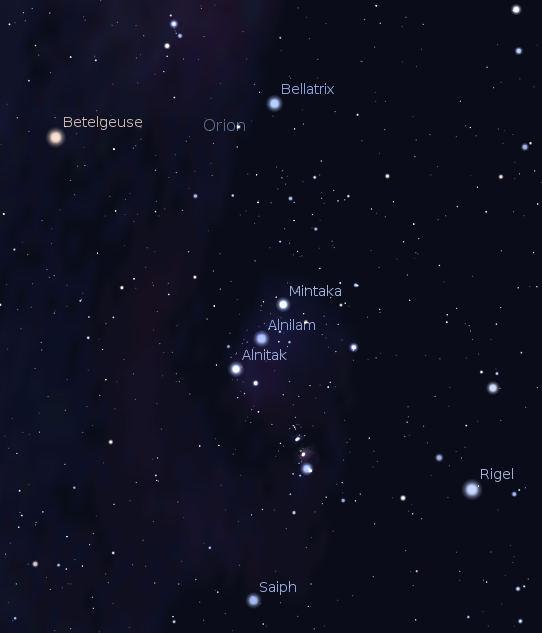
Torso of Orion centered on his belt. The torso of Orion is more upright this month. But I’m leaving it tilted so the star names don’t over print the stars. Created using Stellarium.
02/12/2020 – Ephemeris – A look at the bright planets after a month
Ephemeris for Wednesday, February 12th. Today the Sun will be up for 10 hours and 18 minutes, setting at 6:06, and it will rise tomorrow at 7:46. The Moon, half way from full to last quarter, will rise at 10:32 this evening
It’s been a month since we’ve viewed the bright planets, so let’s have a look. Brilliant Venus is dominating the evening sky in the southwest until it sets at 9:47 p.m. Less noticed is tiny Mercury, below and right of Venus and near the horizon, perhaps best seen in binoculars. It will set at 7:41 p.m. In the morning sky Mars is first to appear and will rise in the east-southeast at 4:40 a.m. It’s brighter than it was last month, it’s 27 million miles closer at 171 million miles. Jupiter will rise at 5:54 a.m. in the east-southeast. This second brightest planet is approaching Saturn in our skies, and will continue until near Christmas. Saturn itself, will rise at 6:30 a.m. in the east-southeast.
The times given are for the Traverse City/Interlochen area of Michigan. They may be different for your location.
Addendum
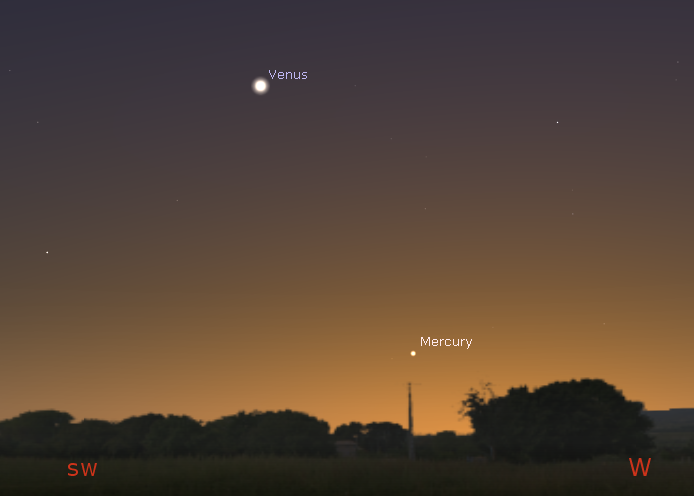
Venus and Mercury in the twilight at 6:45 p.m. Created using Stellarium.
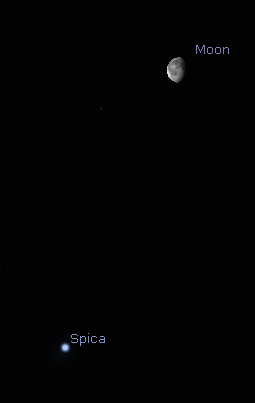
The Moon and Spica at 7 a.m. in the southwest. Created using Stellarium.
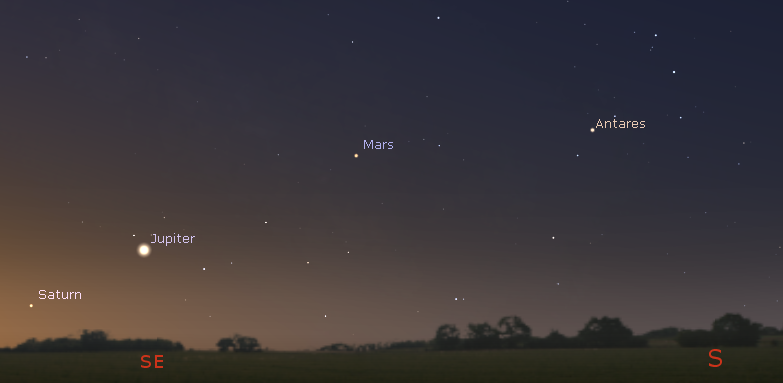
The morning planets at 7 a.m. Created using Stellarium.
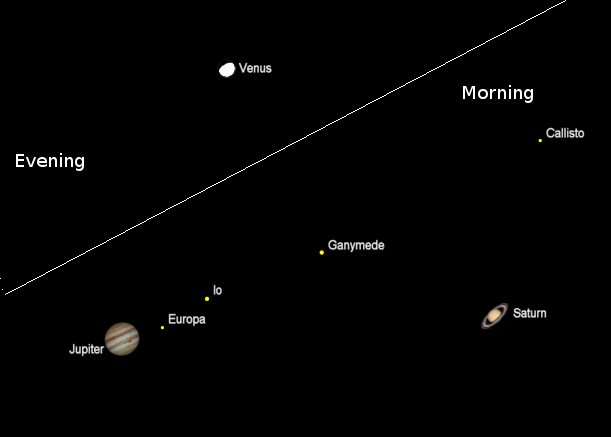
Telescopic views of the planets at the same magnification with Venus tonight at 6:45 p.m. February 12, 2020. Mercury is too small to show a disk at this magnification. At 7 a.m. on the 13th Mars is too tiny to show a disk. Twilight is too bright and Saturn is too low to show its moons. But Jupiter’s Great Red Spot is turned toward the Earth. Can you spot it? Created using Cartes du Ciel (Sky Charts).
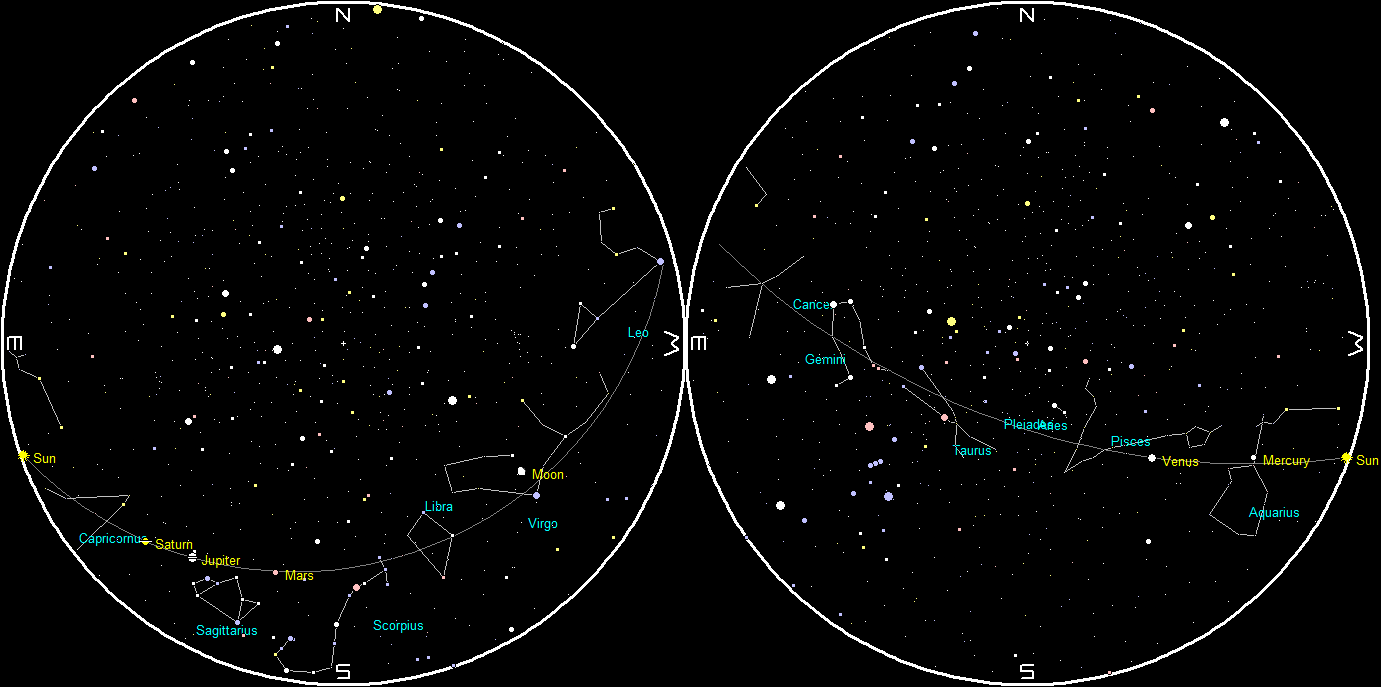
Planets and the Moon at sunset and sunrise of a single night starting with sunset on the right on February 12, 2020. The night ends on the left with sunrise on the 13th. Click on the image to enlarge. Created using my LookingUp program.
02/11/2020 – Ephemeris – The elusive planet Mercury is appearing in the evening twilight
I’m back with Ephemeris for Tuesday, February 11th. Today the Sun will be up for 10 hours and 15 minutes, setting at 6:05, and it will rise tomorrow at 7:48. The Moon, 2 days past full, will rise at 9:15 this evening.
The elusive planet Mercury is making it first evening appearance in the sky for this year. Yesterday was its greatest eastern elongation from the Sun of 18 degrees angular distance. It hasn’t changed much for tonight, but will shortly start creeping back towards the Sun. Mercury should be spotted by 6:30 in the evening way below and right of the much brighter Venus in the western sky. It might take binoculars to spot that early, but 15 minutes later it should be visible without them, but be much lower in the sky. Mercury has an 88 day orbit of the Sun, but we are viewing it from another moving planet, so greatest elongations and conjunctions with the Sun occur at roughly 116 day intervals, known as the synodic period.
The times given are for the Traverse City/Interlochen area of Michigan. They may be different for your location.
Addendum
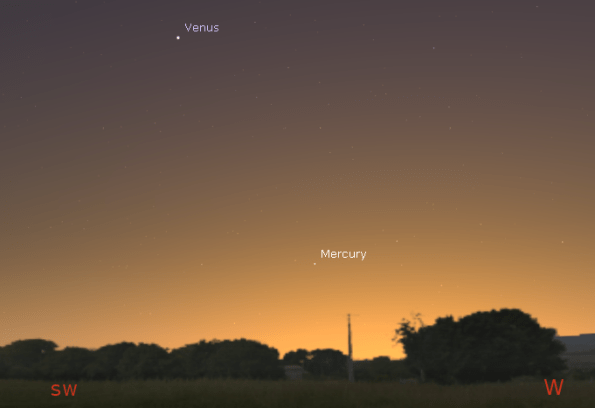
Venus and Mercury in the western sky at 6:30 p.m. (about 25 minutes after sunset) Created using Stellarium.
01/10/2020 – Ephemeris – Eclipses today and to come
I usually create these posts on the evening before the Ephemeris program airs on Interlochen Public Radio, though I record and post the audio programs the prior Sunday evening. Wednesday we learned that my 102 year old mother-in-law Edith DelRaso was back in the hospital wit pneumonia after being released from the hospital for the same complaint This time it was worse. My daughter, younger granddaughter and I headed south to Grand Rapids. This lady had outlived all her many siblings, her husband and all but one of his siblings, and two of her three children, including my wife Judy. She was ready to go. At about 5:15 p.m. she breathed her last peacefully. After a couple of hours with the gathered family we headed out to a favorite restaurant. The weather in the Grand Traverse Area was worsening, so I got talked into staying in GR with my brother and his wife, and to head back today, so I missed posting this last night. As a sad coincidence my niece’s father-in-law had a massive heart attack and eventually died at about the same time in Detroit. A sad day all around.
On with the show.
Ephemeris for Friday, January 10th. Today the Sun will be up for 9 hours and 2 minutes, setting at 5:21, and it will rise tomorrow at 8:18. The Moon, at full today, will rise at 5:20 this evening.
Later on this afternoon there will be a lunar eclipse, one of 4 this year. All of these are penumbral eclipses where the Moon misses the dark inner shadow of the Earth and skims through the outer partial shadow, where the Sun’s light is only partially obscured by the Earth, showing a slight dusky appearance on the side nearest the dark shadow. Being daytime the Moon will not have rises for use to see it. We will be able to witness the last two. The first of these is early in the morning hours of July 5th and be barely visible, the second will be in the morning hours of November 30th. There will be two solar eclipses, neither of which will be visible here. However, next year there will be a solar eclipse where the Sun will rise partially eclipsed here and we’ll see the last half hour of it.
The times given are for the Traverse City/Interlochen area of Michigan. They may be different for your location.
Addendum
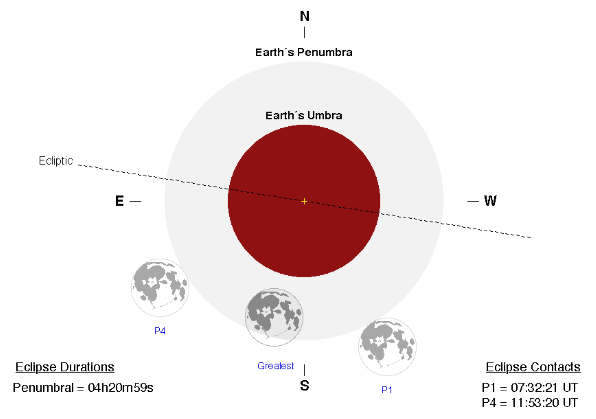
Our best penumbral lunar eclipse this year, November 30, 2020. Subtract 5 hours from the UTC contact times to get Eastern Standard Time. Excerpted from a NASA/GSFC graphic by Fred Espenak.

The Sun will rise in eclipse at 6:05 a.m. June 10, 2021 in the Grand Traverse Area. The last37 minutes of the eclipse will be visible from around here. Created using Stellarium.
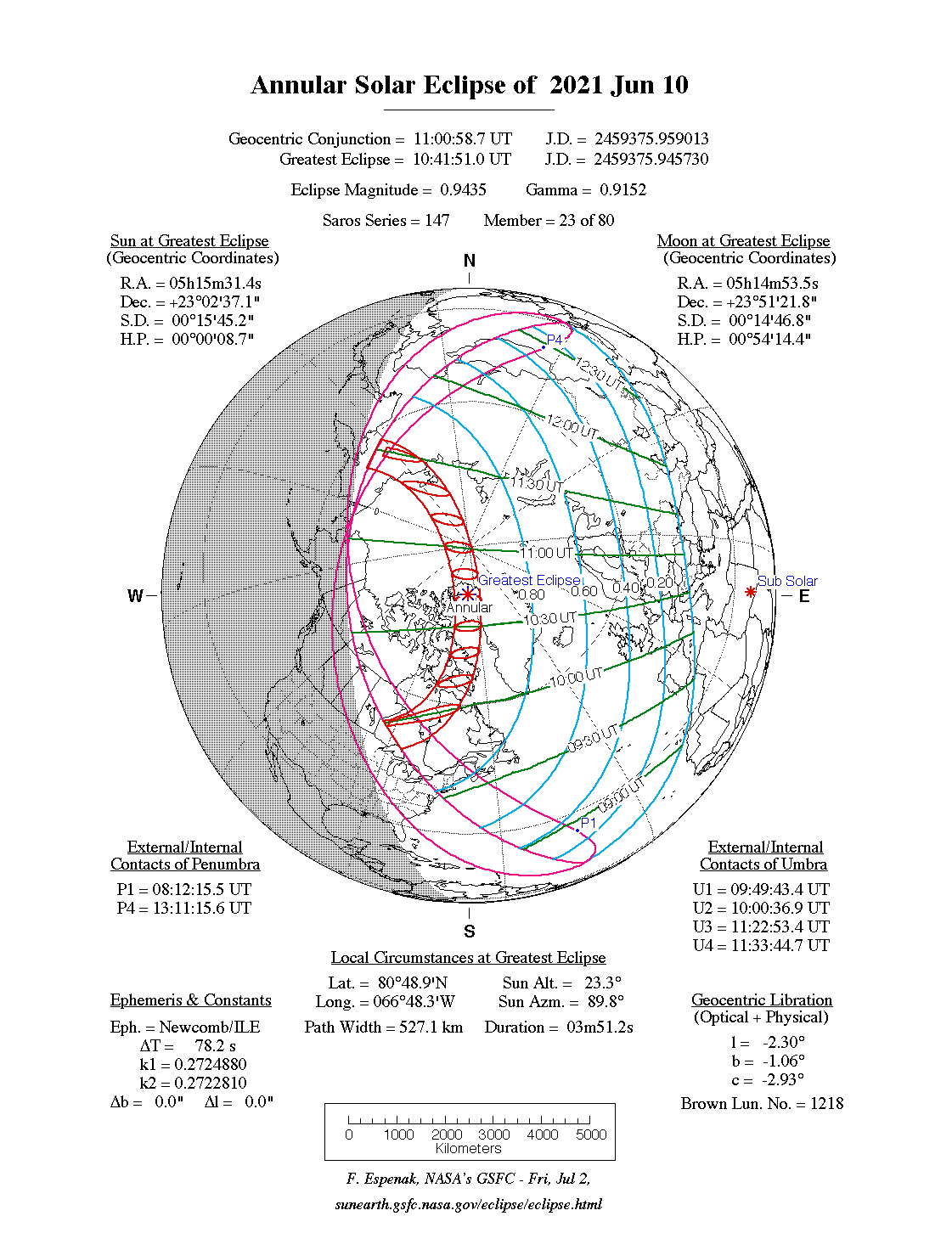
Eclipse map for the June 10, 2021 Annular Eclipse. Click on the image to see the original PDF. Credit NASA/GSFC Fred Espenak.

