Archive
09/05/2019 – Ephemeris – A contest to name the Mars 2020 Rover
Ephemeris for Thursday, September 5th. Today the Sun will be up for 13 hours and 2 minutes, setting at 8:12, and it will rise tomorrow at 7:10. The Moon, at first quarter today, will set at 12:09 tomorrow morning.
The Mars 2020 Rover is in final preparation to be launched late next year, and its time to give it a name. Prior rover names were Sojourner, Spirit, Opportunity and the currently operating Curiosity rover. NASA is holding a contest open to U.S. K through 12 students in public, Private and Home School, to submit a name with a short essay of up to 150 words why that name should be chosen. Deadline is November 1st. Nine names will be chosen and then the whole world will vote to pick the winner. For contest details use your favorite Internet browser and type in “go (dot) nasa (dot) gov forward slash name2020”. NASA also has a way to have your name sent to Mars with the Rover.
The times given are for the Traverse City/Interlochen area of Michigan. They may be different for your location.
Addendum
From Sarah Marcotte of the JPL Mars team. Please share this contest announcement with any interested K-12 student…
—————
Name NASA’s Next Mars Rover!
NASA’s Mars 2020 rover needs a name! Any K-12 student in U.S. public, private, and home schools has a chance to name the next Mars rover bound for the Red Planet in July 2020.
To enter the contest, students submit their rover name and a short essay (max 150 words) to explain the reasons why their chosen name is the best. The contest closes Nov. 1, 2019. For contest entry and details, visit the Name the Rover site. : https://www.futureengineers.org/nametherover
Interested adults, especially with STEM experience can sign up to be a judge on this page.
Not in the U.S.? In January 2020, people all over the world will have an opportunity to vote on the nine finalist names.
Help us spread the word by downloading and printing an eye-catching flyer for teachers or students!
Read more about the Mars 2020 mission.
visit: go.nasa.gov/name2020

09/04/2019 – Ephemeris – Looking for the bright planets this week
Ephemeris for Wednesday, September 4th. Today the Sun will be up for 13 hours and 5 minutes, setting at 8:14, and it will rise tomorrow at 7:09. The Moon, 1 day before first quarter, will set at 11:32 this evening.
Let’s look at the planets for this week. Mars, Venus and Mercury are too close to the Sun to be seen. Venus and Mercury are on the evening or east side of the Sun, Mars is on the west or morning side. Bright Jupiter will be in the south-southwestern sky as it gets dark. With steadily held binoculars a few of the 4 largest satellites of Jupiter can be seen. Three of the four of Jupiter’s Galilean satellites can be spotted in telescopes early this evening tonight. However the innermost moon Io will move from in front of the planet at 10:15 p.m. Jupiter will set at 12:11 a.m. Saturn, the ringed planet, will be in the southern sky in the evening. It will pass the meridian, due south at 9:48 p.m. and will set at 2:14 a.m.
The times given are for the Traverse City/Interlochen area of Michigan. They may be different for your location.
Addendum
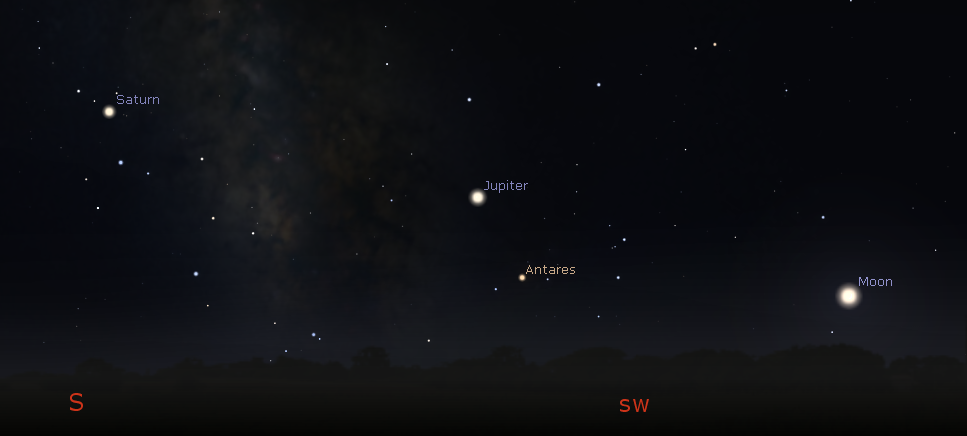
Jupiter, Saturn and the Moon with the bright stars of the southern summer sky at 10 p.m. September 4, 2019. Click on the image to enlarge. Created using Stellarium.
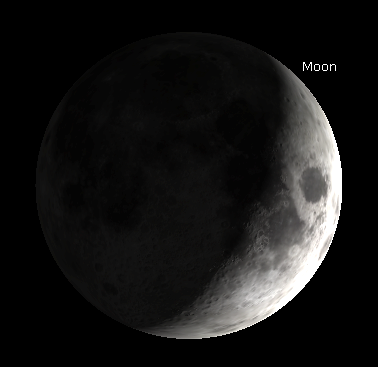
The crescent Moon as it might appear in binoculars or a small telescope tonight at 10 p.m. September 4, 2019. Created using Stellarium.
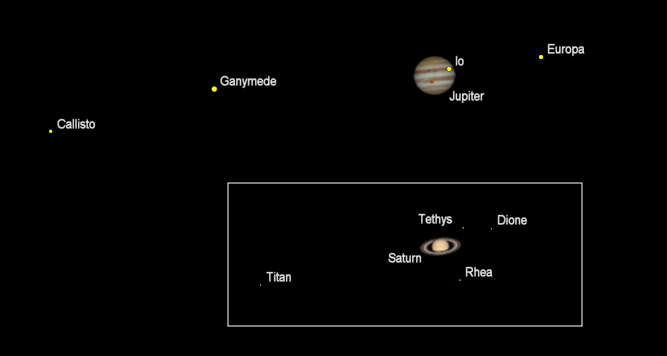
Telescopic views of Jupiter and Saturn with the same magnification at 10 p.m. September 4, 2019. Io started a transit at 8:03 p.m. or 0:03 tomorrow UT, not visible from here. The shadow begins to cross Jupiter at 9:21 p.m., 01:21 UT. The transit ends at 10:15 p.m., 2:15 UT. The shadow leaves the planet at 11:33 p.m., 3:33 UT. The moons are much dimmer than what shows here so spotting the moon and shadow against the face of Jupiter is difficult. The Great Red Spot will cross Jupiter’s central meridian at 10:17 p.m., 2:17 UT. Created using Cartes du Ciel (Sky Charts).
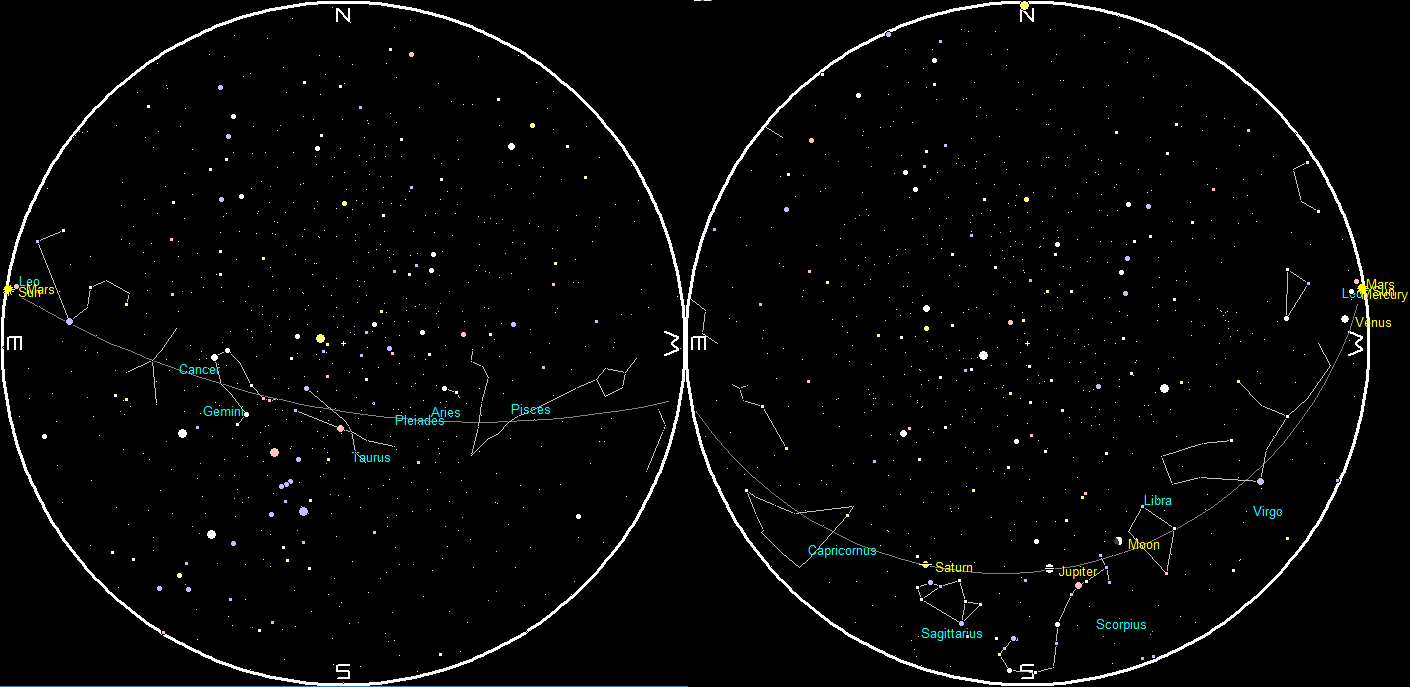
Planets and the Moon at sunset and sunrise of a single night starting with sunset on the right on September 4, 2019. The night ends on the left with sunrise on the 5th. Click on the image to enlarge. Created using my LookingUp program.
09/03/2019 – Ephemeris – Yesterday and today conjunctions of Mars and Mercury with the Sun
Ephemeris for Tuesday, September 3rd. Today the Sun will be up for 13 hours and 8 minutes, setting at 8:16, and it will rise tomorrow at 7:08. The Moon, 2 days before first quarter, will set at 10:59 this evening.
Yesterday morning Mars passed in conjunction with the Sun. For astronomers Mars was either just north or south of the Sun. In this case it was north of the Sun, moving from the evening or east side of the Sun to the west or morning side. Later this evening Mercury will pass in superior conjunction with the Sun. Mercury, being an inferior planet, that is one whose orbit is within Earth’s orbit of the Sun can pass between the Earth and the Sun in what we call an inferior conjunction or around the back side of the Sun in superior conjunction. In doing so Mercury is moving from the morning to the evening sky. Today the SOHO satellite will show both planets, the Sun and even Venus in its coronagraph.
The times given are for the Traverse City/Interlochen area of Michigan. They may be different for your location.
Addendum
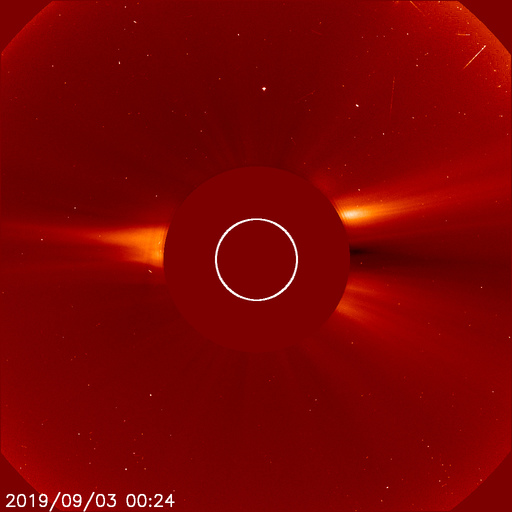
Solar and Heliospheric Observatory (SOHO) LASCO C2 Coronagraph image of the solar atmosphere at 8:24 p.m. September 2, 2019. A disk, called an occulting disk covers the bright Sun. The white circle is the size of the Sun’s photosphere. The white dot just about directly above the Sun is Mars, which is slowly heading to the right (west).
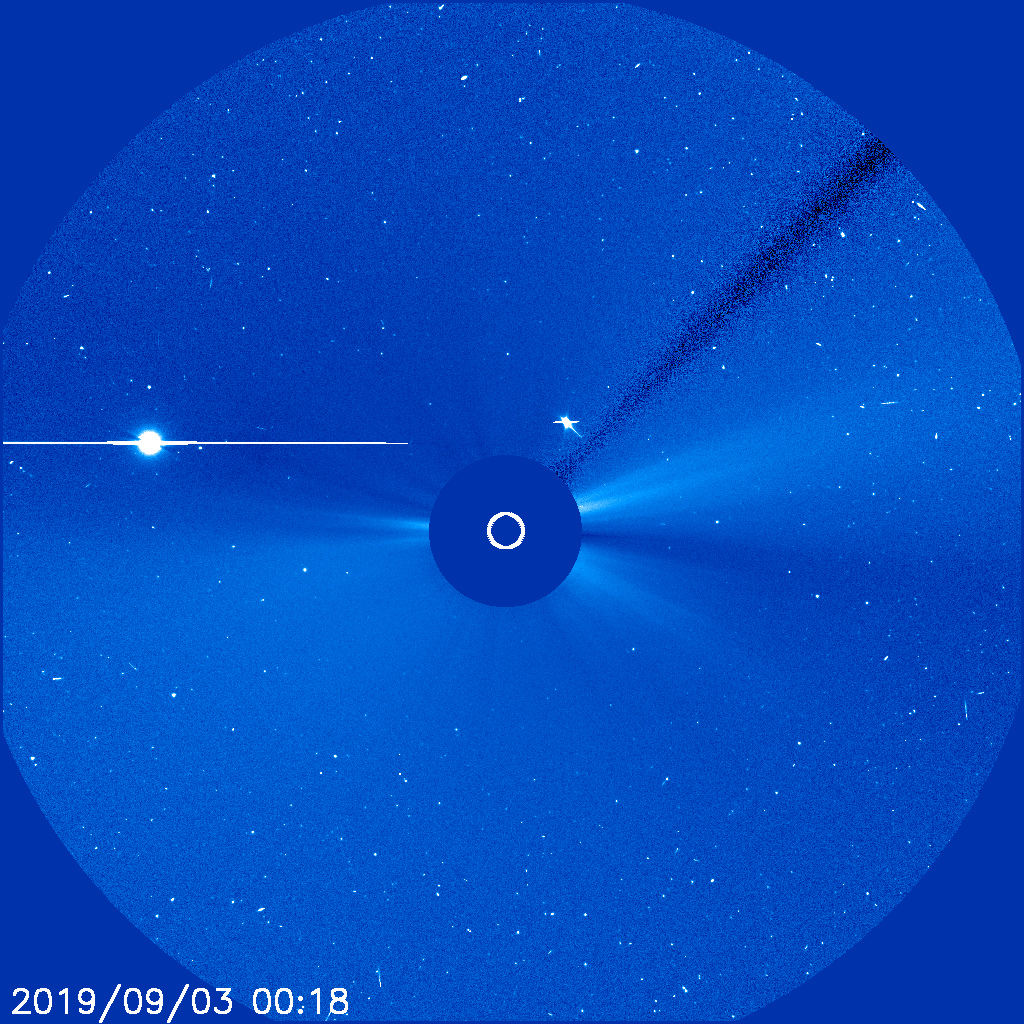
SOHO LASCO C3 Coronagraph image of the solar atmosphere at 8:14 p.m. September 2, 2019. A disk, called an occulting disk covers the bright Sun. The white circle is the size of the Sun’s photosphere. Venus is the bright object to the left. It passed superior conjunction of the Sun back on September 14th. Mercury is just to the upper right of the occulting disk. Both planets are heading to the left (east).
09/02/2019 – Ephemeris – Previewing September Skies
Ephemeris for Labor Day, Monday, September 2nd. Today the Sun will be up for 13 hours and 11 minutes, setting at 8:18, and it will rise tomorrow at 7:07. The Moon, half way from new to first quarter, will set at 10:29 this evening.
Let’s look at to the skies of September which started yesterday. The Sun will moving at its greatest speed in its retreat to the south. Daylight hours in the Interlochen/Traverse City area will drop from 13 hours and 11 minutes today to 11 hours 46 minutes on the 30th. The altitude of the Sun above the southern horizon at local noon will be 53 degrees today, and will descend to 42 degrees on the 30th. The Straits area will see the Sun a degree lower. The season of summer is getting short, so enjoy it while you can. Summer ends and autumn begins at 3:49 a.m. on September 23rd. Mars is in conjunction with the Sun today and Mercury will be in conjunction with the Sun tomorrow.
The times given are for the Traverse City/Interlochen area of Michigan. They may be different for your location.
Addendum
September Evening Star Chart
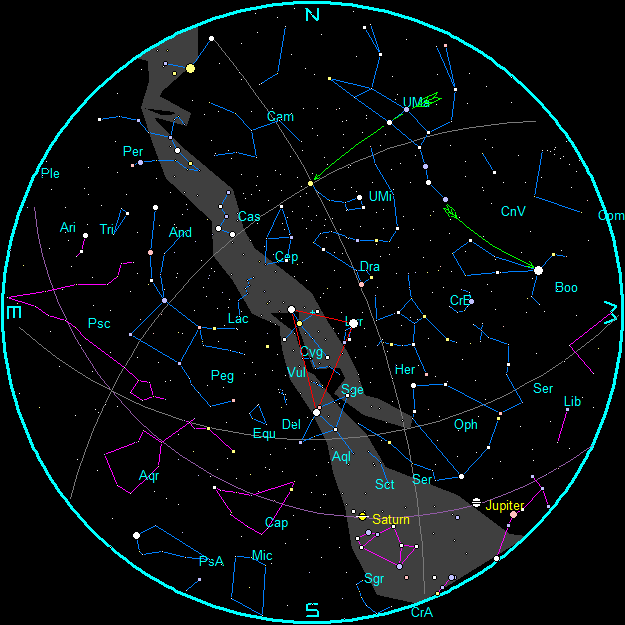
Star Chart for September 2019 (10 p.m. EDT September 15, 2019). Click on image to enlarge.Created using my LookingUp program. Click on image to enlarge.
The planets and stars are plotted for the 15th at 10 p.m. EDT in the evening and 5 a.m. for the morning chart. These are the chart times. Note that Traverse City is located approximately 45 minutes behind our time meridian, West 75° longitude. (An hour 45 minutes behind our daylight saving time meridian during EDT). To duplicate the star positions on a planisphere you may have to set it to 1 hour 45 minutes earlier than the current time.
September Morning Star Chart
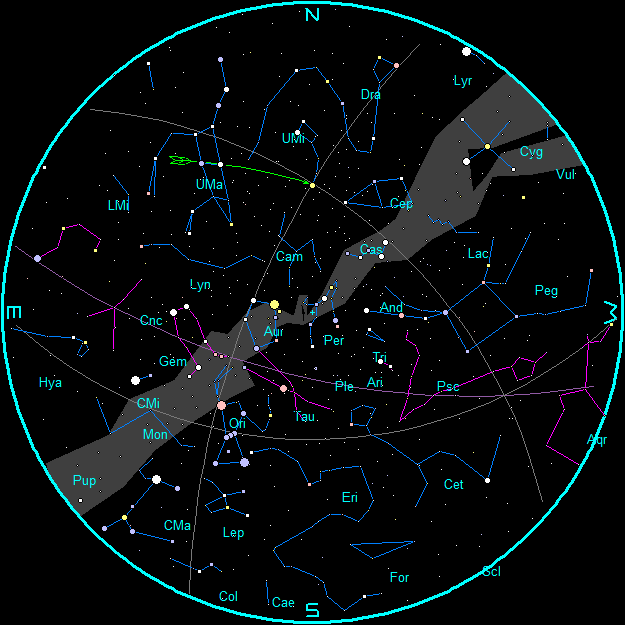
Star Chart for September mornings 2019 (6 a.m. EDT September 15, 2019). Click on image to enlarge. Created using my LookingUp program.
For a list of constellation names to go with the abbreviations click here.
- Pointer stars at the front of the bowl of the Big Dipper point to Polaris the North Star.
- Leaky dipper drips on Leo.
- Follow the arc of the handle of the Big Dipper to the star Arcturus.
- The Summer Triangle is in red.
Twilight Limits, Nautical and Astronomical
| EDT | |||||||
| Traverse City | Morning twilight | Evening twilight | Dark night | Moon | |||
| Date | Astro. | Nautical | Nautical | Astro. | Start | End | Illum. |
| 2019-09-01 | 5h25m | 6h04m | 21h29m | 22h08m | 22h08m | 5h25m | 0.08 |
| 2019-09-02 | 5h27m | 6h05m | 21h27m | 22h05m | 22h29m | 5h27m | 0.17 |
| 2019-09-03 | 5h28m | 6h06m | 21h25m | 22h03m | 23h00m | 5h28m | 0.27 |
| 2019-09-04 | 5h30m | 6h08m | 21h23m | 22h01m | 23h33m | 5h30m | 0.37 |
| 2019-09-05 | 5h31m | 6h09m | 21h21m | 21h59m | – | 5h31m | 0.48 |
| 2019-09-06 | 5h33m | 6h10m | 21h19m | 21h56m | 0h10m | 5h33m | 0.59 |
| 2019-09-07 | 5h35m | 6h12m | 21h17m | 21h54m | 0h52m | 5h35m | 0.69 |
| 2019-09-08 | 5h36m | 6h13m | 21h15m | 21h52m | 1h40m | 5h36m | 0.78 |
| 2019-09-09 | 5h38m | 6h14m | 21h13m | 21h50m | 2h32m | 5h38m | 0.86 |
| 2019-09-10 | 5h39m | 6h16m | 21h11m | 21h48m | 3h29m | 5h39m | 0.92 |
| 2019-09-11 | 5h41m | 6h17m | 21h09m | 21h45m | 4h29m | 5h41m | 0.92 |
| 2019-09-12 | 5h42m | 6h18m | 21h07m | 21h43m | 5h30m | 5h42m | 0.96 |
| 2019-09-13 | 5h43m | 6h20m | 21h05m | 21h41m | – | – | 0.99 |
| 2019-09-14 | 5h45m | 6h21m | 21h03m | 21h39m | – | – | 1 |
| 2019-09-15 | 5h46m | 6h22m | 21h01m | 21h37m | – | – | 0.99 |
| 2019-09-16 | 5h48m | 6h23m | 20h59m | 21h35m | – | – | 0.96 |
| 2019-09-17 | 5h49m | 6h25m | 20h57m | 21h33m | 21h33m | 21h45m | 0.91 |
| 2019-09-18 | 5h51m | 6h26m | 20h55m | 21h30m | 21h30m | 22h11m | 0.85 |
| 2019-09-19 | 5h52m | 6h27m | 20h53m | 21h28m | 21h28m | 22h42m | 0.77 |
| 2019-09-20 | 5h53m | 6h29m | 20h51m | 21h26m | 21h26m | 23h19m | 0.67 |
| 2019-09-21 | 5h55m | 6h30m | 20h49m | 21h24m | 21h24m | – | 0.57 |
| 2019-09-22 | 5h56m | 6h31m | 20h47m | 21h22m | 21h22m | 0h03m | 0.46 |
| 2019-09-23 | 5h57m | 6h32m | 20h45m | 21h20m | 21h20m | 0h57m | 0.35 |
| 2019-09-24 | 5h59m | 6h34m | 20h43m | 21h18m | 21h18m | 2h01m | 0.24 |
| 2019-09-25 | 6h00m | 6h35m | 20h41m | 21h16m | 21h16m | 3h12m | 0.14 |
| 2019-09-26 | 6h01m | 6h36m | 20h39m | 21h14m | 21h14m | 4h30m | 0.07 |
| 2019-09-27 | 6h03m | 6h37m | 20h37m | 21h12m | 21h12m | 5h49m | 0.02 |
| 2019-09-28 | 6h04m | 6h39m | 20h35m | 21h10m | 21h10m | 6h04m | 0 |
| 2019-09-29 | 6h05m | 6h40m | 20h33m | 21h08m | 21h08m | 6h05m | 0.01 |
| 2019-09-30 | 6h07m | 6h41m | 20h32m | 21h06m | 21h06m | 6h07m | 0.06 |
Twilight calendar was generated using Cartes du Ciel (Sky Charts).
See my blog post: Twilight Zone for the definitions of the different periods of twilight here: https://bobmoler.wordpress.com/2018/09/27/.
NASA Calendar of Planetary Events
     Date   Time    Event
Sep  1 Su           Venus: 5.2° E
     2 Mo  6:18 am  Mars Conjunction
     3 Tu  9:26 pm  Mercury Superior Conj.
     5 Th 11:10 pm  First Quarter
     6 Fr  2:52 am  Moon-Jupiter: 2.4° S
     8 Su  5:39 am  Moon South Dec.: 22.5° S
     8 Su  9:53 am  Moon-Saturn: 0°
     8 Su  1:35 pm  Moon Descending Node
    10 Tu  2:18 am  Neptune Opposition
    13 Fr  9:32 am  Moon Apogee: 406400 km
    14 Sa 12:33 am  Full Moon
    20 Fr 12:14 pm  Moon-Aldebaran: 2.8° S
    21 Sa 10:41 pm  Last Quarter
    22 Su  9:54 pm  Moon North Dec.: 22.7° N
    23 Mo  2:30 am  Moon Ascending Node
    23 Mo  3:49 am  Autumnal Equinox
    24 Tu  5:15 pm  Moon-Beehive: 0.4° S
    27 Fr 10:27 pm  Moon Perigee: 357800 km
    28 Sa  2:26 pm  New Moon
    29 Su 12:13 am  Mercury-Spica: 1.3° N
Oct  1 Tu           Venus: 13.1° E
All event times are given for UTC-4 hr: Eastern Daylight Saving Time.
Sky Events Calendar by Fred Espenak and Sumit Dutta (NASA’s GSFC),
http://eclipse.gsfc.nasa.gov/SKYCAL/SKYCAL.html.
If you go to the above site you can print out a list like the above for the entire year or calendar pages for your time zone.
Sun and Moon Rising and Setting Events
 LU                  Ephemeris of Sky Events for Interlochen/TC
 September, 2019    Local time zone: EDT
 +-----------------------------------------------------------------------+
 | DATE |  SUN     SUN  DAYLIGHT|   TWILIGHT*    |MOON  RISE OR    ILLUM |
 |      |  RISE    SET    HOURS |  END    START  |PHASE SET** TIME FRACTN|
 +=======================================================================+
 |Sun  1| 07:04a  08:19p  13:14 | 09:26p  05:58a |      Set  10:00p   10%|
 |Mon  2| 07:06a  08:18p  13:11 | 09:24p  05:59a |      Set  10:29p   18%|
 |Tue  3| 07:07a  08:16p  13:08 | 09:22p  06:01a |      Set  10:59p   28%|
 |Wed  4| 07:08a  08:14p  13:05 | 09:20p  06:02a |      Set  11:32p   38%|
 |Thu  5| 07:09a  08:12p  13:02 | 09:18p  06:03a |F Qtr Set  12:09a   49%|
 |Fri  6| 07:10a  08:10p  12:59 | 09:15p  06:05a |      Set  12:52a   59%|
 |Sat  7| 07:11a  08:08p  12:56 | 09:13p  06:06a |      Set  01:39a   69%|
 +------+-----------------------+----------------+-----------------------+
 |Sun  8| 07:13a  08:07p  12:53 | 09:11p  06:07a |      Set  02:32a   77%|
 |Mon  9| 07:14a  08:05p  12:50 | 09:09p  06:09a |      Set  03:29a   85%|
 |Tue 10| 07:15a  08:03p  12:47 | 09:07p  06:10a |      Set  04:29a   91%|
 |Wed 11| 07:16a  08:01p  12:44 | 09:05p  06:11a |      Set  05:29a   96%|
 |Thu 12| 07:17a  07:59p  12:41 | 09:03p  06:13a |      Set  06:30a   99%|
 |Fri 13| 07:19a  07:57p  12:38 | 09:01p  06:14a |      Set  07:31a  100%|
 |Sat 14| 07:20a  07:55p  12:35 | 08:59p  06:15a |Full  Rise 08:36p   99%|
 +------+-----------------------+----------------+-----------------------+
 |Sun 15| 07:21a  07:53p  12:32 | 08:57p  06:17a |      Rise 08:58p   97%|
 |Mon 16| 07:22a  07:51p  12:29 | 08:55p  06:18a |      Rise 09:21p   93%|
 |Tue 17| 07:23a  07:50p  12:26 | 08:53p  06:19a |      Rise 09:45p   87%|
 |Wed 18| 07:24a  07:48p  12:23 | 08:51p  06:21a |      Rise 10:11p   80%|
 |Thu 19| 07:26a  07:46p  12:20 | 08:49p  06:22a |      Rise 10:42p   71%|
 |Fri 20| 07:27a  07:44p  12:17 | 08:47p  06:23a |      Rise 11:19p   62%|
 |Sat 21| 07:28a  07:42p  12:14 | 08:45p  06:24a |L Qtr Rise 12:03a   51%|
 +------+-----------------------+----------------+-----------------------+
 |Sun 22| 07:29a  07:40p  12:10 | 08:43p  06:26a |      Rise 12:57a   40%|
 |Mon 23| 07:30a  07:38p  12:07 | 08:41p  06:27a |      Rise 02:01a   30%|
 |Tue 24| 07:32a  07:36p  12:04 | 08:40p  06:28a |      Rise 03:13a   20%|
 |Wed 25| 07:33a  07:34p  12:01 | 08:38p  06:29a |      Rise 04:30a   11%|
 |Thu 26| 07:34a  07:33p  11:58 | 08:36p  06:31a |      Rise 05:49a    5%|
 |Fri 27| 07:35a  07:31p  11:55 | 08:34p  06:32a |      Rise 07:09a    1%|
 |Sat 28| 07:36a  07:29p  11:52 | 08:32p  06:33a |New   Set  07:56p    0%|
 +------+-----------------------+----------------+-----------------------+
 |Sun 29| 07:38a  07:27p  11:49 | 08:30p  06:34a |      Set  08:25p    2%|
 |Mon 30| 07:39a  07:25p  11:46 | 08:28p  06:36a |      Set  08:55p    7%|
 +-----------------------------------------------------------------------+
 * Nautical Twilight
 ** Moonrise or moonset, whichever occurs between sunrise and sunset
Generated using my LookingUp for DOS program.
08/30/2019 – Ephemeris – Astronomy events at the Sleeping Bear Sand Dunes tomorrow
Ephemeris for Friday, August 30th. Today the Sun will be up for 13 hours and 20 minutes, setting at 8:23, and it will rise tomorrow at 7:03. The Moon is new today, and won’t be visible.
The second Sun and star party in August at the Sleeping Bear Dunes National Lakeshore will be held at the Dune Climb tomorrow if it is reasonably clear. The solar portion will start at 4 p.m., while dark sky viewing will start at 9 p.m.. It will be hosted by the Park Rangers and the Grand Traverse Astronomical Society. The society’s new solar telescope can generally tease out some interesting detail from the currently quiet Sun. Later on the wonders of the Milky Way, which will span the skies from horizon to horizon will be seen, along with the planets Jupiter and Saturn. The park has one of the darkest skies in the Lower Peninsula, and the Milky Way is especially impressive this time of year.
The times given are for the Traverse City/Interlochen area of Michigan. They may be different for your location.
Addendum
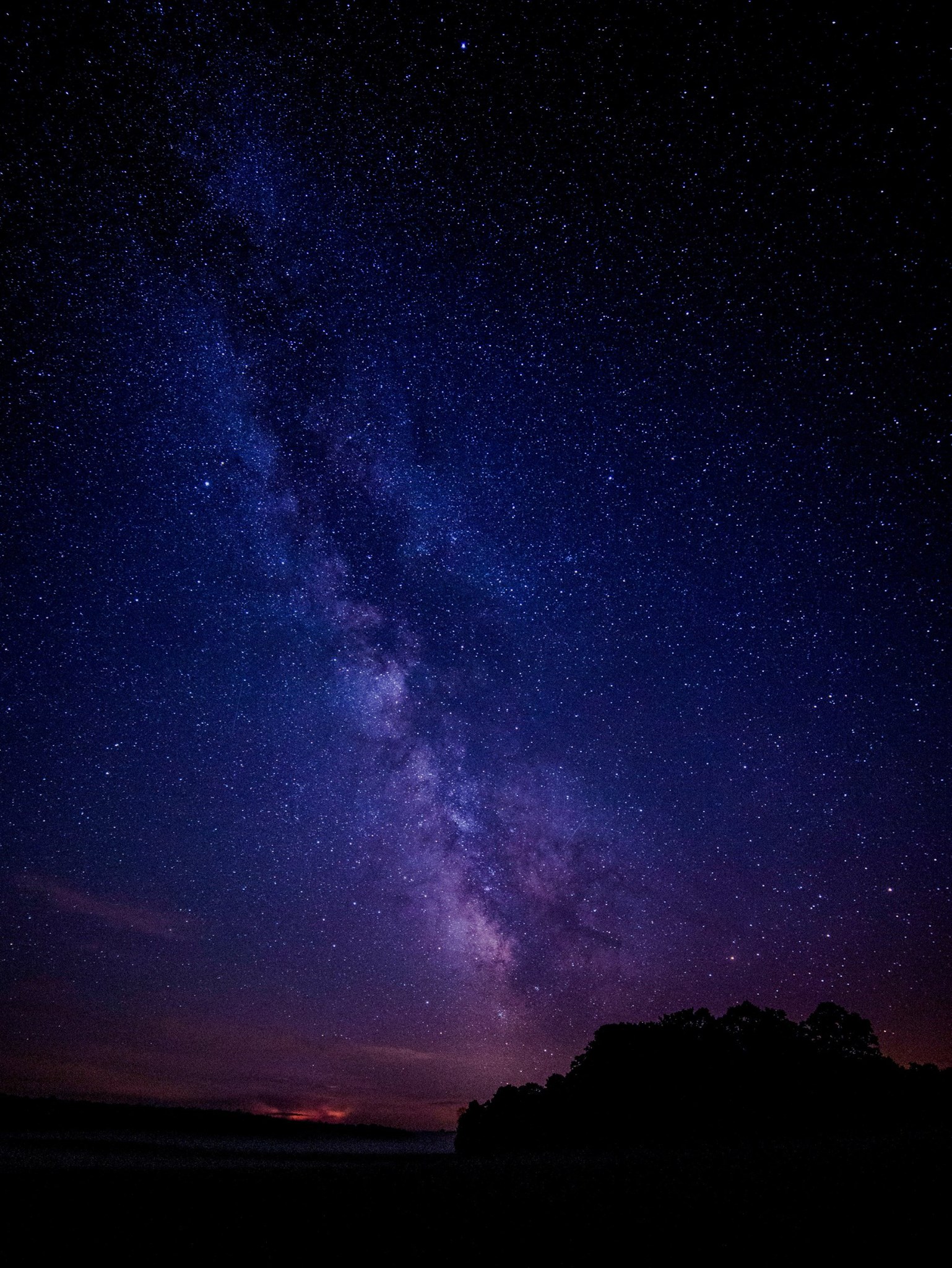
The Milky Way from the Sleeping Bear Dunes four years ago by Mark Stewart. This year Jupiter and Saturn would also be in this photograph.
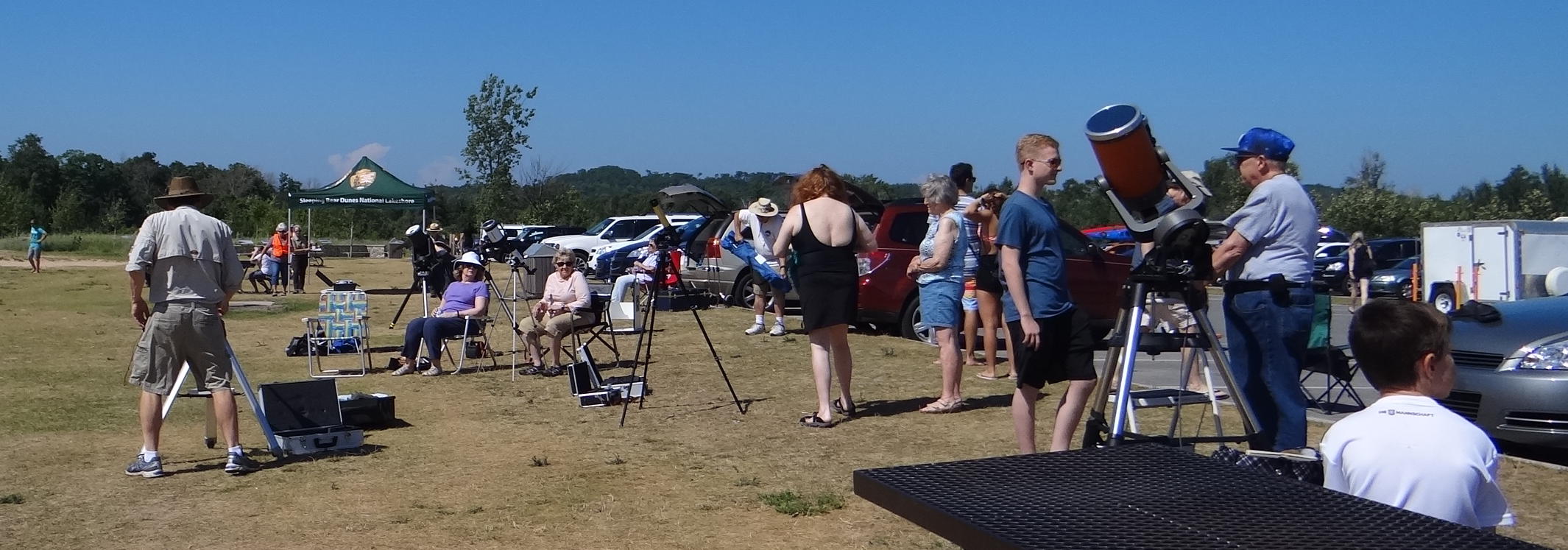
A Sun Party at the Dune Climb. Credit: Eileen Carlisle.

This in the beginning of setup for the October 21, 2917 star party at the dune climb. Taken early while there was enough light. The dune blocks up to 12 degrees from the southwest to northwest, but the rest of the horizon is quite low. Photo by the author.
The weather for this event is very iffy, so if it is cancelled members of the GTAS will have their telescopes at the Dune Climb Sunday night, if it is clear, to view the sky. Though not an official star party, campers and the public to view the heavens. For a voicemail on the status of the star party on Saturday please call 231-326-4700, ext. 5005.
08/29/2019 – Ephemeris – To astronomers constellations are just areas of the sky
Ephemeris for Thursday, August 29th. Today the Sun will be up for 13 hours and 23 minutes, setting at 8:25, and it will rise tomorrow at 7:02. The Moon, 1 day before new, will rise at 7:00 tomorrow morning.
What are constellations? I talk about them all the time on this program. There are 88 officially recognized constellations by the International Astronomical Union. Most, in the northern sky come from the ancient Greeks, and are given Latin names. For professional astronomers the constellations mark out specific areas of the sky in an interlocking set of puzzle pieces. In some cases it looks like there’s some gerrymandering with the shapes. Some star to star lines drawn do seem to represent the namesake, like Scorpius the scorpion. Most don’t. Stars of a constellation generally are not near one another, they’re just in the same direction from us. Asterisms, or informal star groups, like the Big Dipper however do look like what they represent.
The times given are for the Traverse City/Interlochen area of Michigan. They may be different for your location.
Addendum
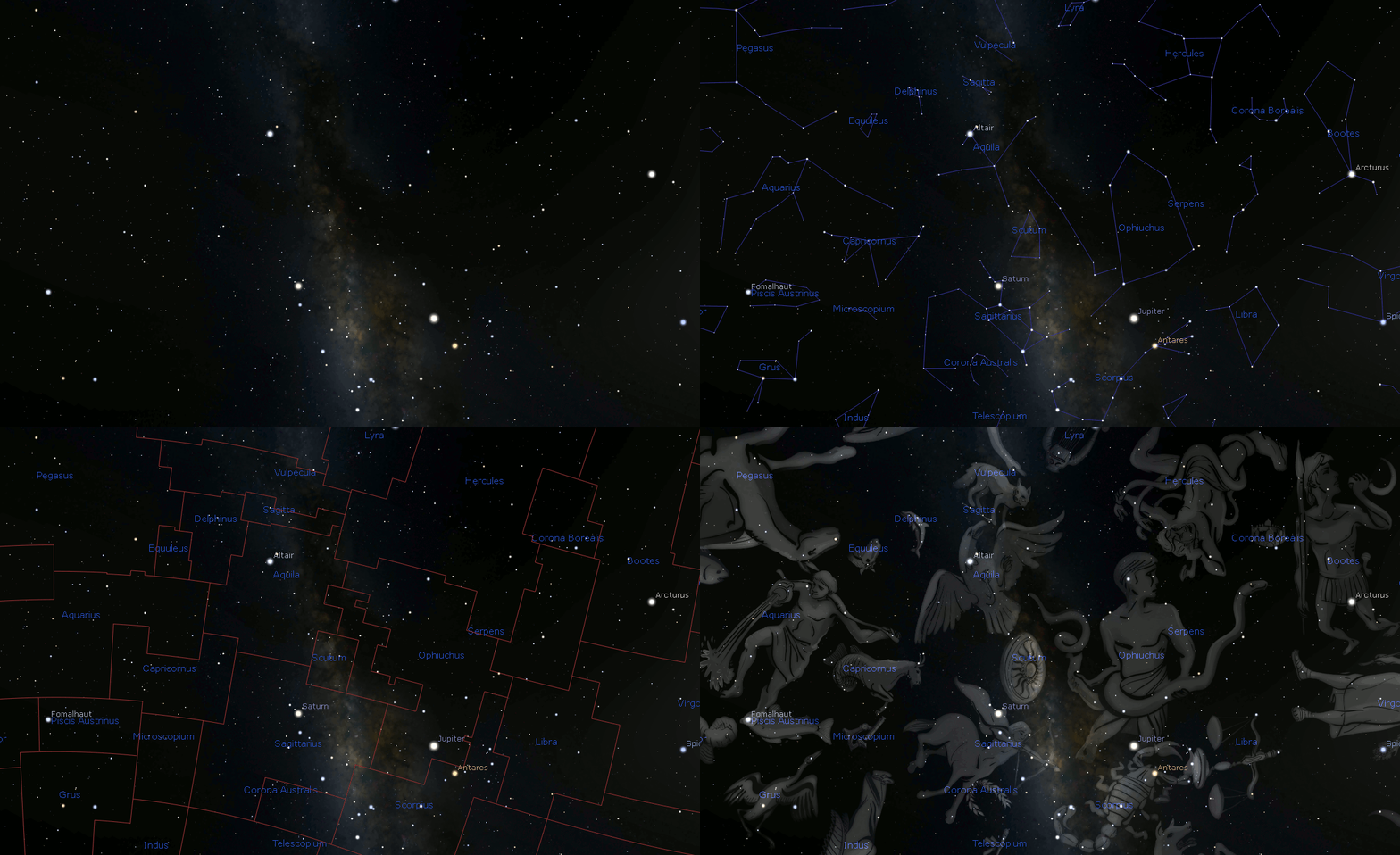
Summer constellations showing stars, lines, boundaries, and figures in succession. Click on the image to enlarge. Here you can see that Jupiter is in Ophiuchus, not Scorpius. Created using Stellarium and GIMP.
08/28/2019 – Ephemeris – Looking at and for the 5 brightest planets
Ephemeris for Wednesday, August 28th. Today the Sun will be up for 13 hours and 26 minutes, setting at 8:27, and it will rise tomorrow at 7:01. The Moon, 2 days before new, will rise at 5:40 tomorrow morning.
Let’s look at the planets for this week. Mars, Venus and Mercury are too close to the Sun to be seen. Venus is on the evening or east side of the Sun, as is Mars which will pass conjunction with the Sun next Monday. Bright Jupiter will be in the south-southwestern sky as it gets dark. With steadily held binoculars a few of the 4 largest satellites of Jupiter can be seen. All four of Jupiter’s Galilean satellites can be spotted in telescopes tonight: one on the east and three west of the planet. Jupiter will set at 12:37 a.m. Saturn, the ringed planet, will be in the southern sky in the evening. It will pass the meridian, due south at 10:17 p.m. and will set at 3:12 a.m. Mercury will enter the evening sky next Tuesday.
The times given are for the Traverse City/Interlochen area of Michigan. They may be different for your location.
Addendum
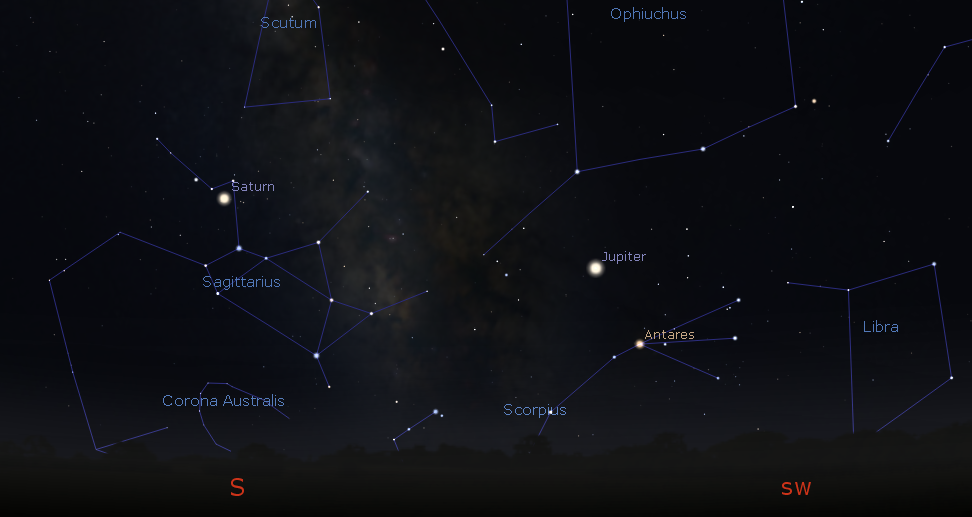
Jupiter and Saturn with the constellations of the southern summer sky at 10 p.m. August 28, 2019. Click on the image to enlarge. Created using Stellarium.
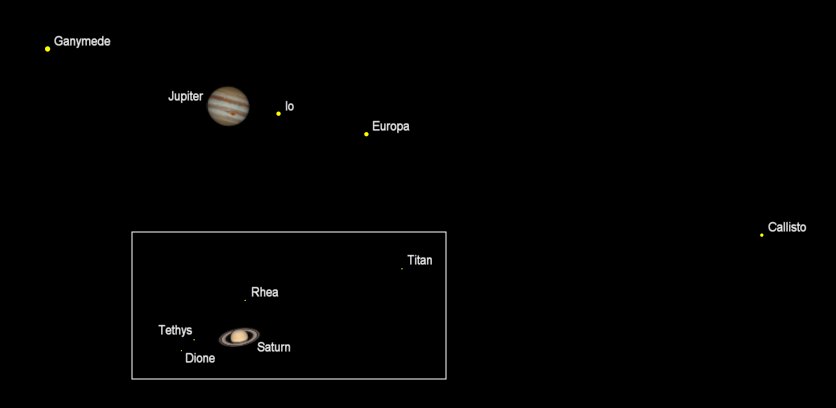
Telescopic views of Jupiter and Saturn with the same magnification at 10 p.m.August 28, 2019. Created using Cartes du Ciel (Sky Charts).
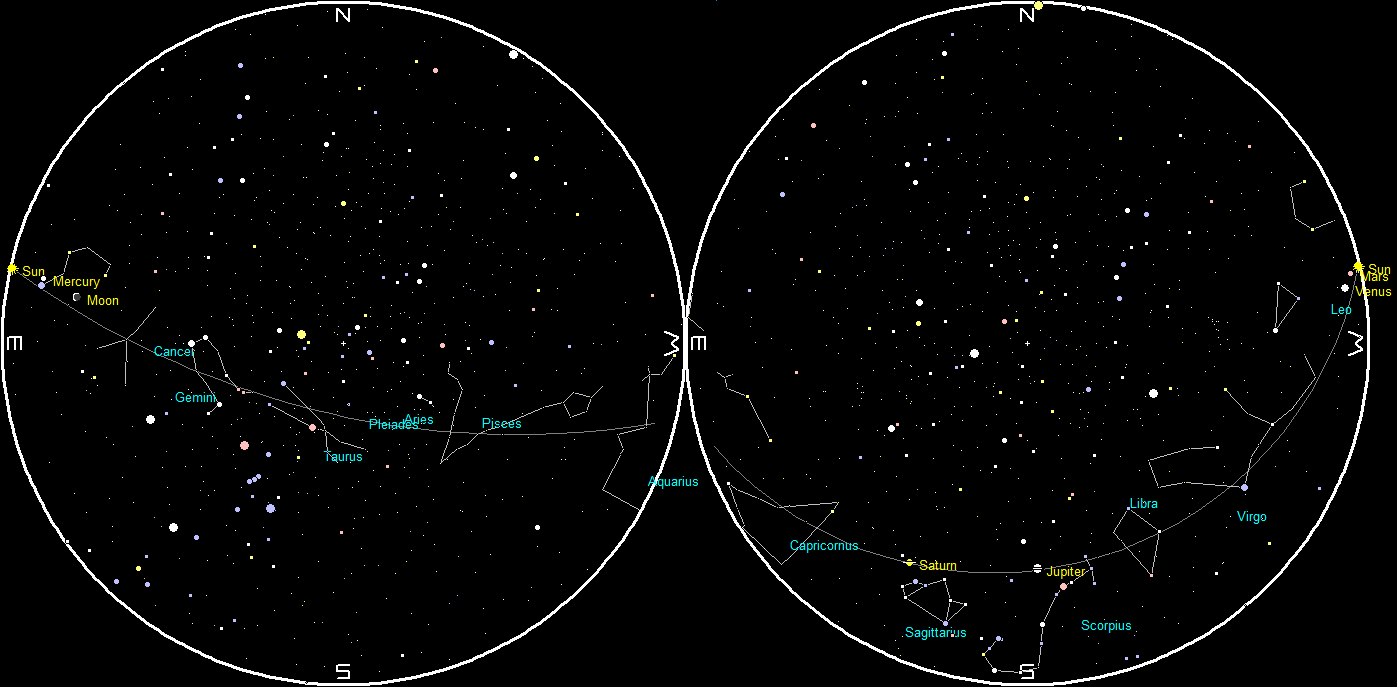
Planets and the Moon at sunset and sunrise of a single night starting with sunset on the right on August 28, 2019. The night ends on the left with sunrise on the 29th. Click on the image to enlarge. Created using my LookingUp program.
08/27/2019 – Ephemeris – The obscure constellation of Scutum the shield
Ephemeris for Tuesday, August 27th. Today the Sun will be up for 13 hours and 29 minutes, setting at 8:28, and it will rise tomorrow at 7:00. The Moon, 3 days before new, will rise at 4:23 tomorrow morning.
In the southern sky between the Teapot of Sagittarius below and Aquila the Eagle with its southernmost star of the Summer Triangle lies Scutum the shield of John Sobieski the Polish king who stopped the advance of the Turks at Kalenberg in 1683. The Polish half of me is very proud. Scutum is one of two official constellations which are related to real persons. The other one is Coma Berenices, a hank of the Egyptian Queen Berenice’s hair. However the stars here are so dim and embedded in the glow of the Milky Way as to be nearly impossible to discern. Scutum lies in one of the richest portions of the Milky Way, wonderful to scan with binoculars and telescopes for star clusters and nebulae or clouds of dust and gas.
The times given are for the Traverse City/Interlochen area of Michigan. They may be different for your location.
Addendum
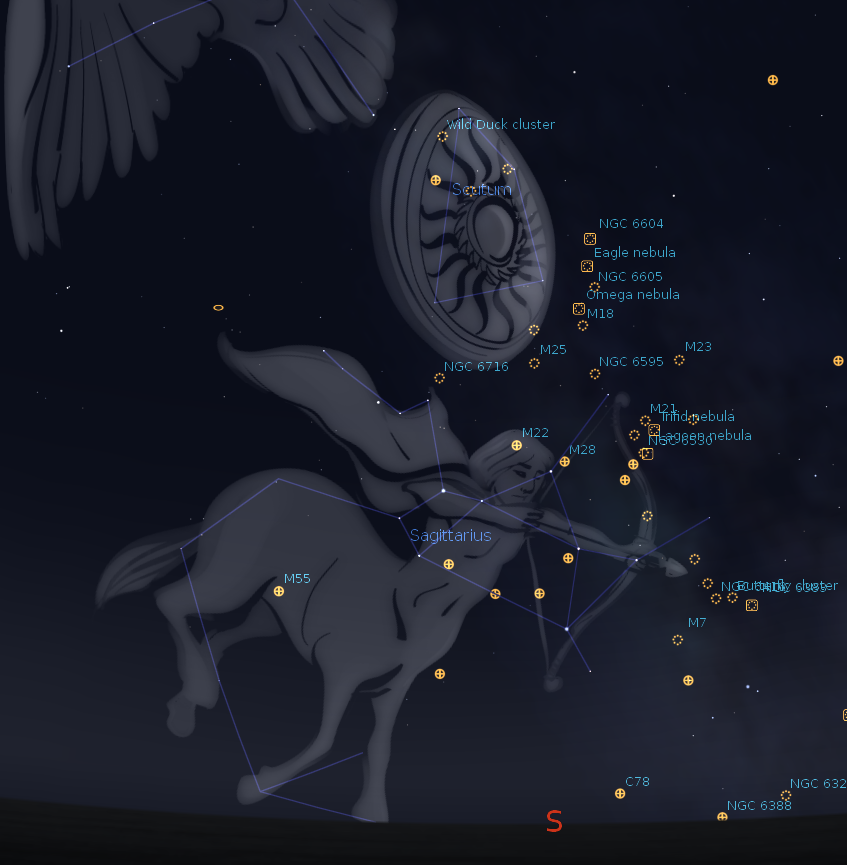
Binocular and telescope deep sky objects in Scutum and Sagittarius. Created using Stellarium.
08/26/2018 – Ephemeris – The Great Rift
Ephemeris for Monday, August 26th. Today the Sun will be up for 13 hours and 32 minutes, setting at 8:30, and it will rise tomorrow at 6:59. The Moon, 3 days past last quarter, will rise at 3:13 tomorrow morning.
High overhead the Milky Way is seen passing through the Summer Triangle of three bright stars. Here we find the Milky Way split into two sections. The split starts in the constellation of Cygnus the Swan or Northern Cross very high in the east. The western part of the Milky Way ends southwest of the Aquila the eagle. This dark dividing feature is called the Great Rift. Despite the lack of stars seen there, it doesn’t mean that there are fewer stars there than in the brighter patches of the Milky Way. The rift is a great dark cloud that obscures the light of the stars behind it. Sometimes binoculars can be used to find the edges of the clouds of the rift, as stars numbers drop off suddenly. This is especially easy to spot in Aquila the eagle.
The times given are for the Traverse City/Interlochen area of Michigan. They may be different for your location.
Addendum
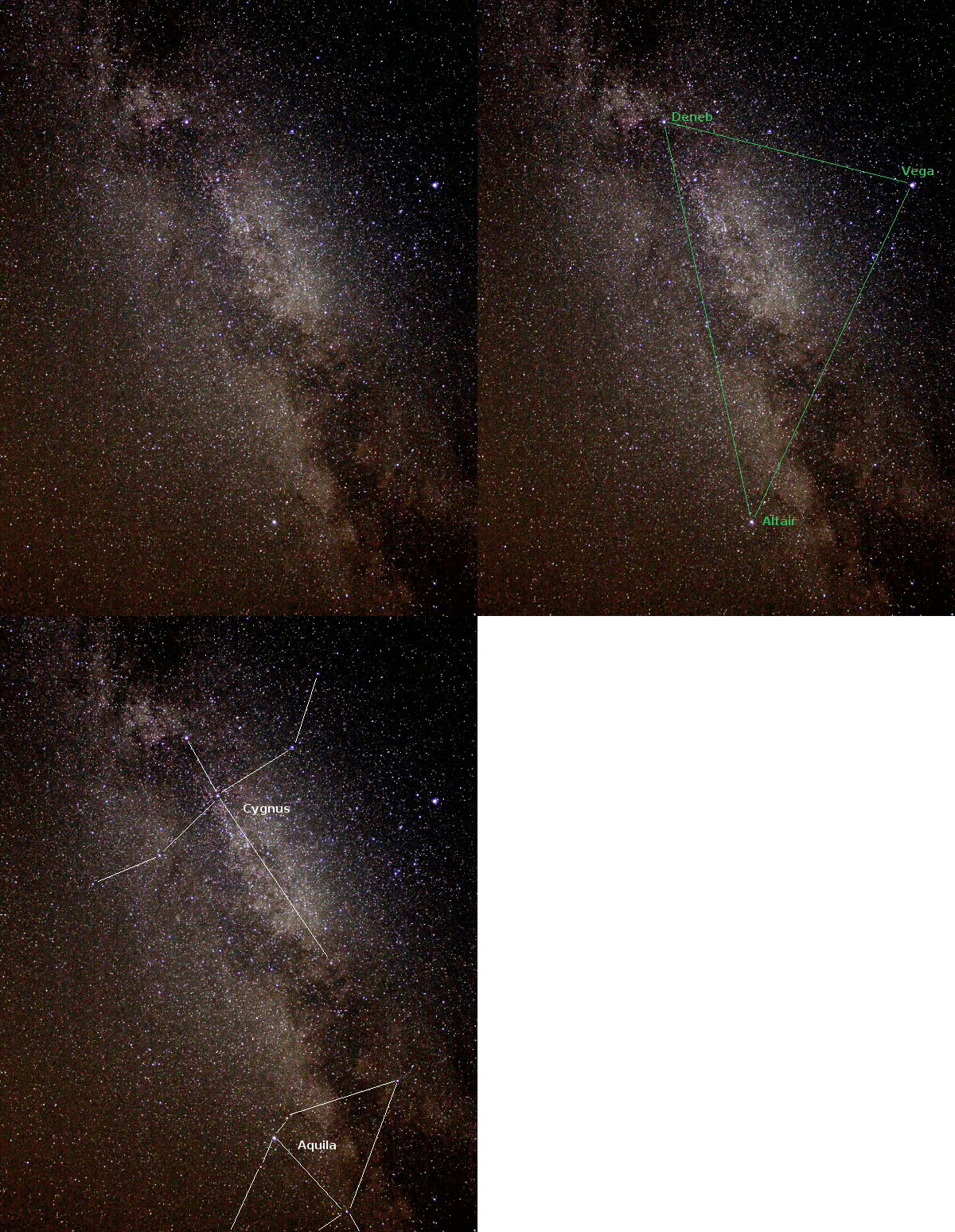
The Great Rift finder animation as seen in the Summer Triangle, also showing the constellations of Cygnus the swan and the the northern part of Aquila the Eagle. This image a stack of 5 30 second exposures taken the morning of the Perseid meteor shower the is year in a vain attempt to capture some meteors.
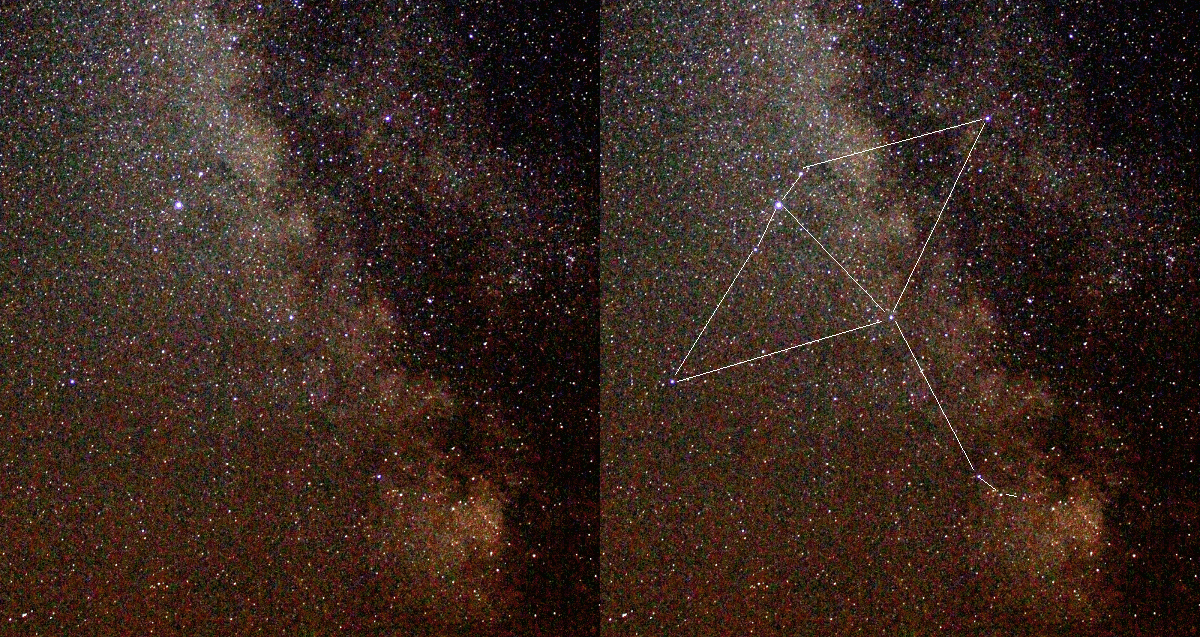
Annotated and animated photograph taken of Aquila August 13, 2018 during the Perseid meteor shower. Alas, no Perseids in this photograph. Taken by me and processed using Registax and GIMP.
08/23/2019 – Ephemeris – Two small constellations around the Summer Triangle
Ephemeris for Friday, August 23rd. Today the Sun will be up for 13 hours and 41 minutes, setting at 8:35, and it will rise tomorrow at 6:55. The Moon, at last quarter today, will rise at 12:43 tomorrow morning.
Located below the eastern edge of the Summer Triangle of three of the brightest stars in the sky, which is overhead in our sky at 10 p.m., is the tiny constellation of Delphinus the dolphin. Delphinus’ 6 stars in a small parallelogram with a tail, really does look like a dolphin leaping out of the water. The parallelogram itself has the name Job’s Coffin. The origin of this asterism or informal constellation is unknown. Of the dolphin itself: the ancient Greeks appreciated this aquatic mammal as we do, and told stories of dolphins rescuing shipwrecked sailors. There’s another tiny constellation to the right of Delphinus, Sagitta the arrow a small thin group of 5 stars, which represents Cupid’s dart. Above-right of Sagitta binoculars will find a little star group called the Coat hanger.
The times given are for the Traverse City/Interlochen area of Michigan. They may be different for your location.
Addendum

Delphinus and Sagitta finder animation. Created using Stellarium and GIMP.
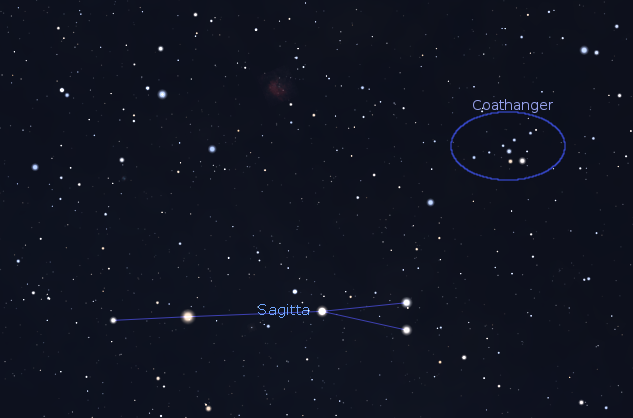
Closeup of Sagitta and the binocular asterism the Coathanger. Created using Stellarium.

