Archive
10/17/2018 – Ephemeris – Where are the bright planets tonight?
Ephemeris for Wednesday, October 17th. The Sun will rise at 8:00. It’ll be up for 10 hours and 53 minutes, setting at 6:54. The Moon, 1 day past first quarter, will set at 1:33 tomorrow morning.
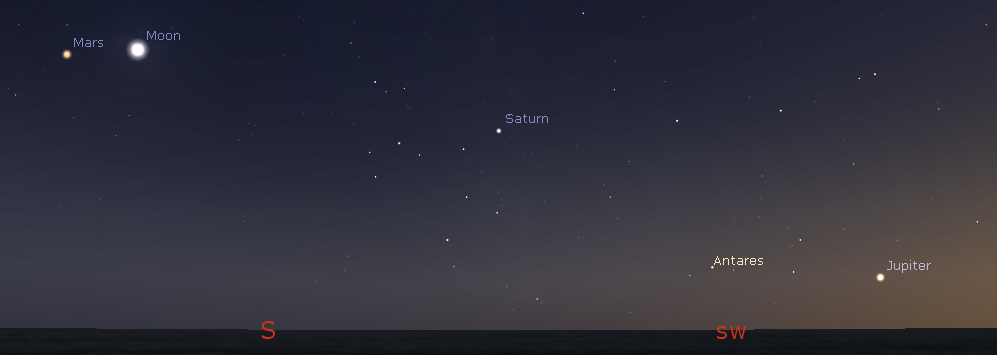
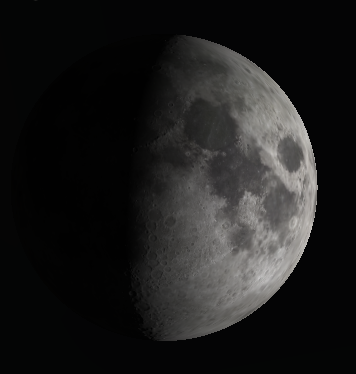
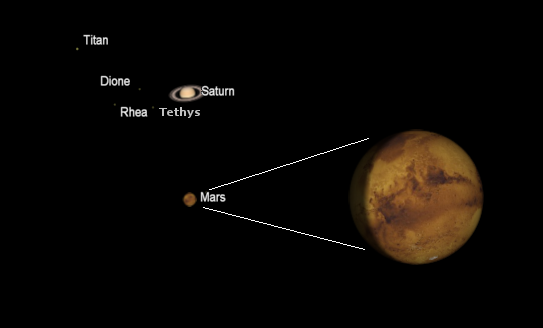
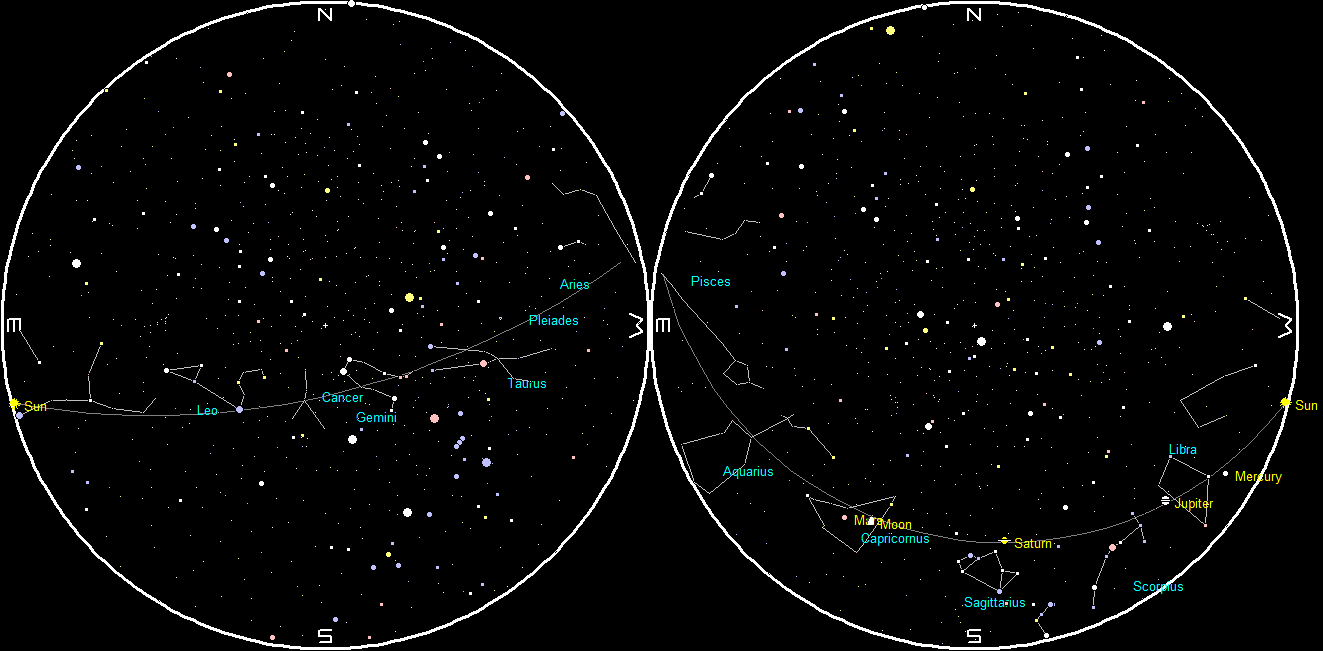
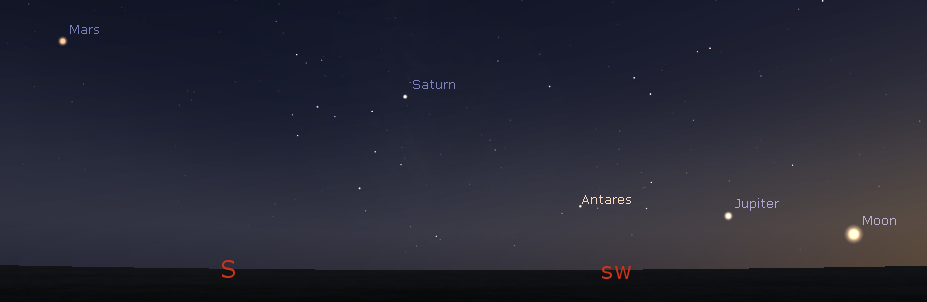
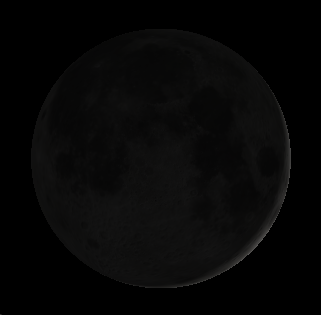
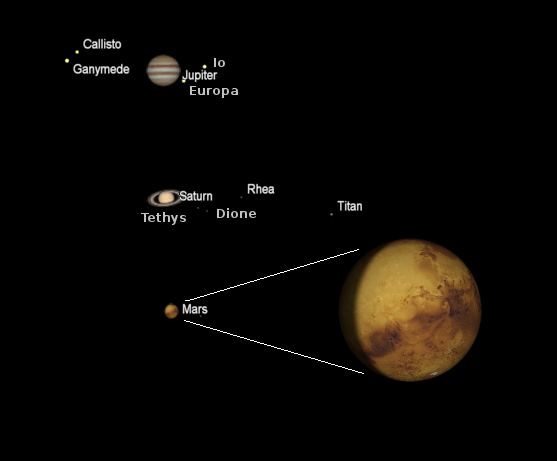
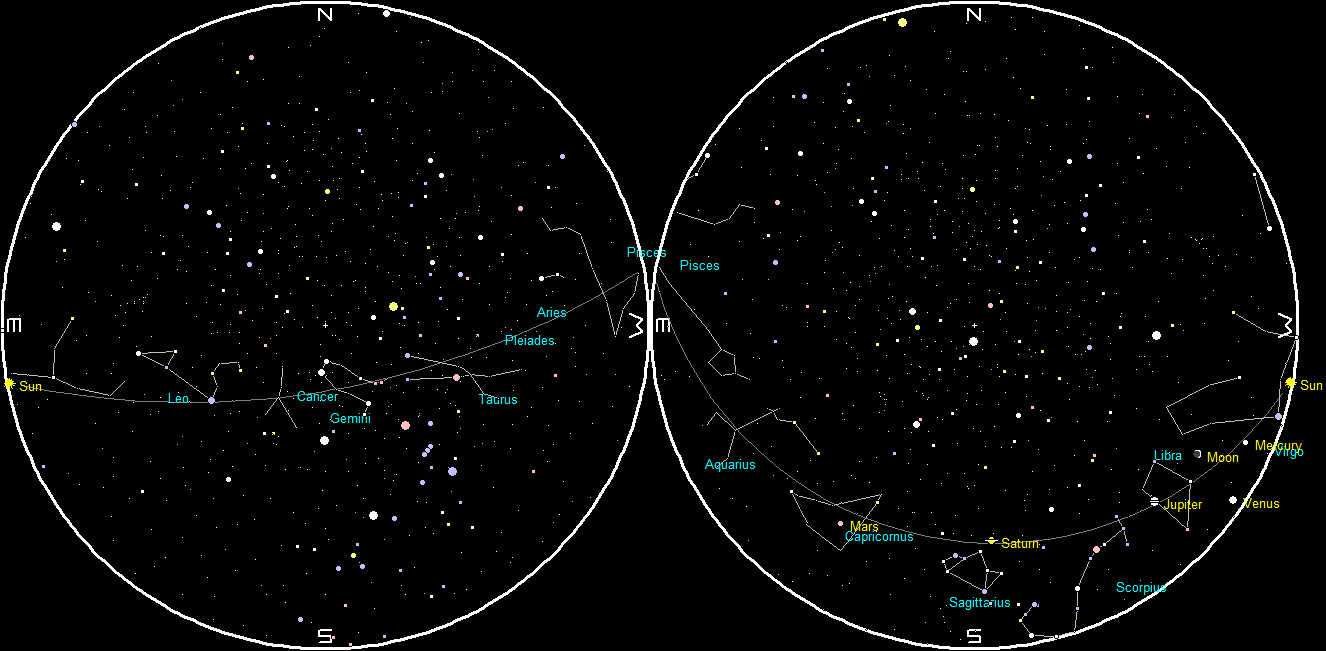
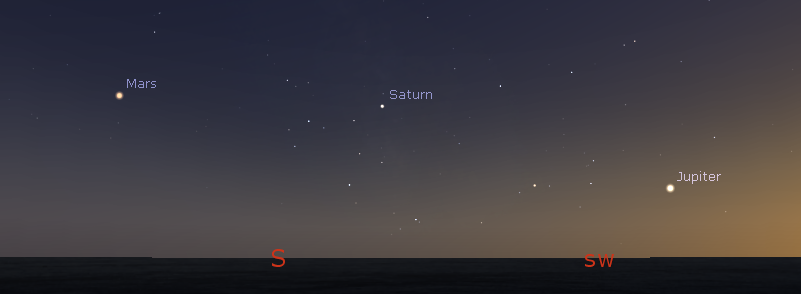
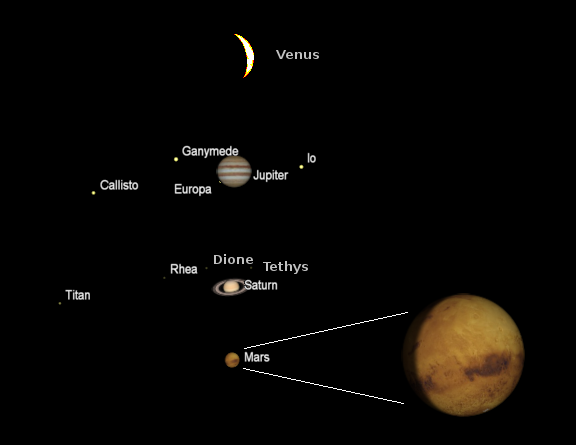
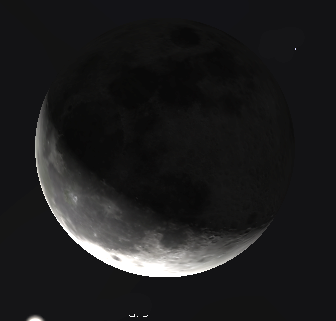
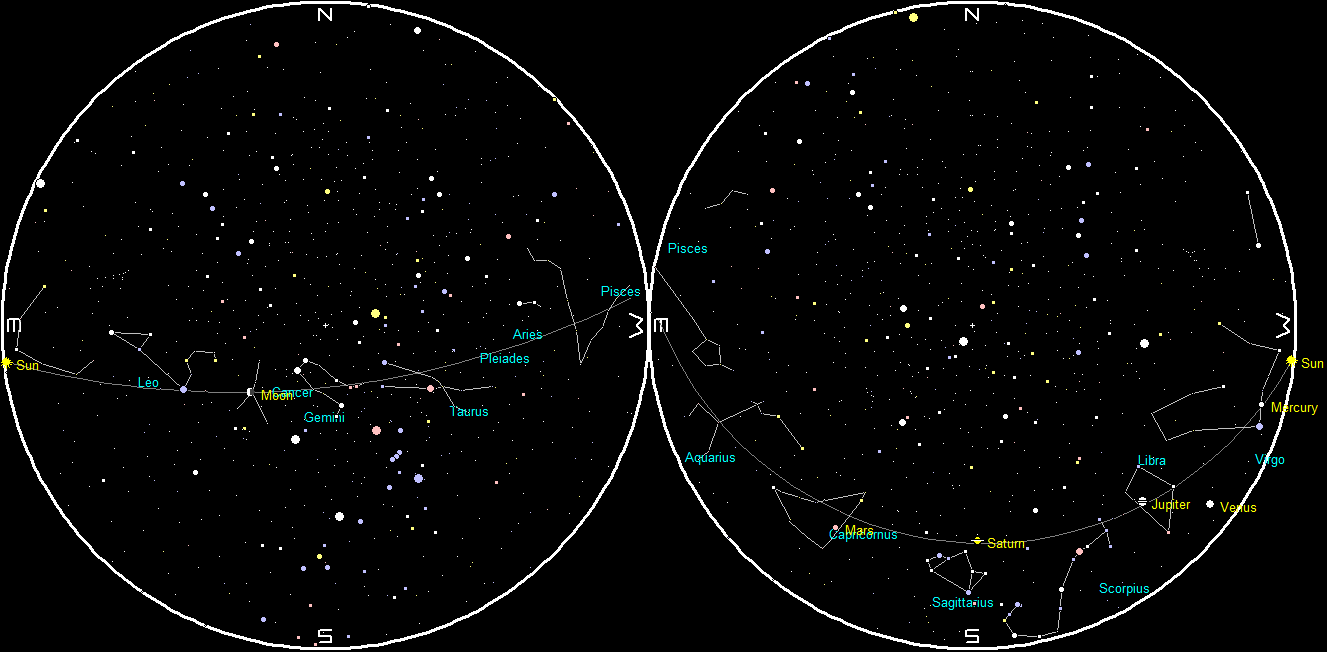
Let’s look at the bright planets for tonight. Three of them are visible in the evening sky. Venus though still officially an evening planet sets before the Sun because it is south of the Sun’s path. Jupiter will be very low in the west-southwest as skies darken. It will set at 8:16 p.m. Saturn, the ringed planet, will start the evening low in the southwestern sky and will set at 10:39 p.m. Mars will be low in the south as the skies darken tonight. and is now 64.6 million miles (104.0 million km) away. Mars will be due south at 9:04 p.m., and it will set at 2:03 a.m. Tonight Mars will be east or left of the waxing gibbous Moon. Mars is picking up speed moving eastward, crossing the constellation of Capricornus this month.
The times given are for the Traverse City/Interlochen area of Michigan. They may be different for your location.
Addendum
10/16/2018 – Ephemeris – Soyuz failure makes for problems for the ISS
Ephemeris for Tuesday, October 16th. The Sun will rise at 7:59. It’ll be up for 10 hours and 56 minutes, setting at 6:56. The Moon, at first quarter today, will set at 12:36 tomorrow morning.
Last Thursday the 11th a cosmonaut, Alexy Ovchinin and an astronaut, Nick Hague were launched toward the International Space Station by a Russian Soyuz rocket. At about the time the four first stage boosters separated from the second stage, something happened, and the capsule containing the men was weightless instead of being boosted by the second stage of the rocket. The Soyuz has an escape system, so the descent capsule separated from the protective shroud and the orbital module on top of it and the service module below it. To make a landing downrange. The men are safe, but the three persons in the ISS must return by mid-December, whether or not they are relieved as their Soyuz capsule cannot be safely flown after that.
The times given are for the Traverse City/Interlochen area of Michigan. They may be different for your location.
Addendum
The above with the exception of the last line is what goes out on the 59 second length of my radio program. What follows is a more complete explanation of the problems in store for the International Space Station as the Russians attempt to determine the cause of the failure, fix the problem and begin flying again.
Cosmonauts and astronauts visiting the International Space Station generally use the same Soyuz that brought them up and docked to the station to return to the Earth. It happens that the reaction control thrusters used to orient the spacecraft use hydrogen peroxide (H2O2) as a monopropellant. It decomposes into oxygen and steam when in contact with a catalyst to provide thrust. However, hydrogen peroxide is unstable if left to itself, slowly decomposing. This gives the Soyuz a useful lifetime of about 200 days on orbit. The current crew of Sergey Prokopyev, Serena M. Auñón-Chancellor, and Alexander Gerst was launched from Baikonur, Kazakhstan on June 8, 2018. The 200 days runs out in late December. Their original scheduled return date was December 13th.
Scott Manley on YouTube has more information: https://www.youtube.com/watch?v=cpqq0i4w_fM
10/15/2018 – Ephemeris – The Japanese spacecraft Hayabusa2 is exploring the asteroid Ryugu.
Ephemeris for Monday, October 15th. The Sun will rise at 7:58. It’ll be up for 11 hours even, setting at 6:58. The Moon, 1 day before first quarter, will set at 11:43 this evening.
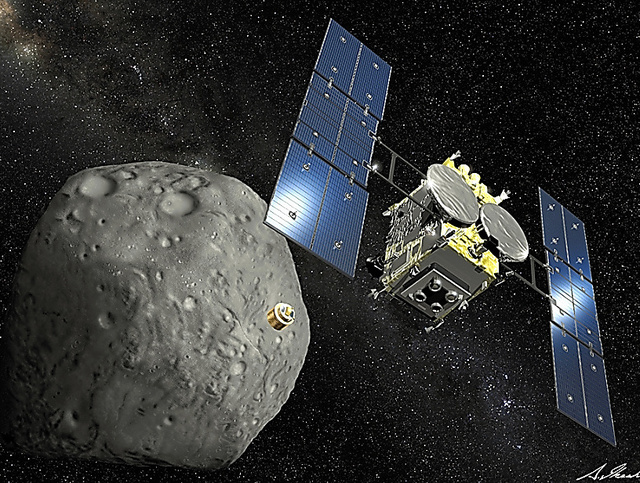
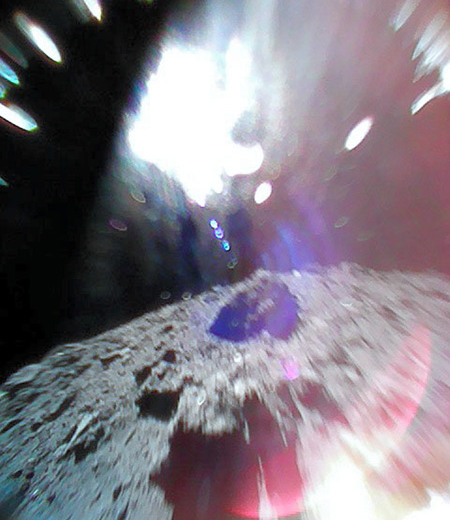
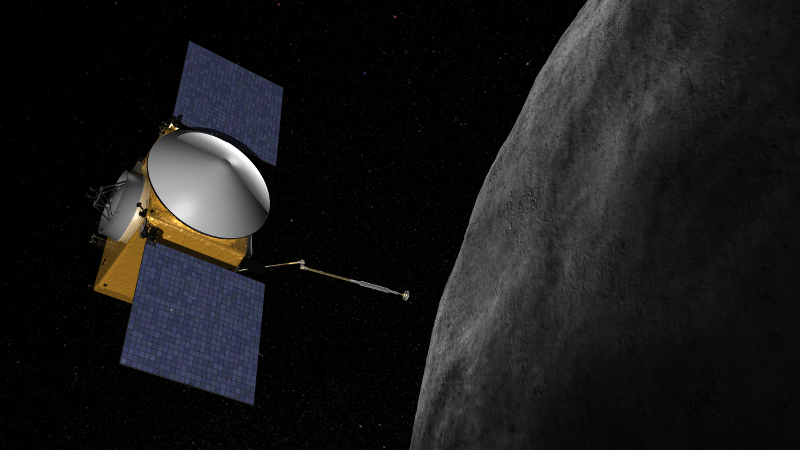
The Japanese asteroid sample return mission Hayabusa2 is in the midst of operations at the near-earth asteroid Ryugu. It dropped three rovers that hopped across its surface and later this month will take the first of three samples. Hayabusa means peregrine falcon in Japanese. It will stay at the asteroid until late next year, it then will make a year-long trip back to the Earth, landing in the Outback of Australia. NASA’s own OSIRIS-REx asteroid sample return mission is currently approaching the near-earth asteroid Bennu. It will orbit the asteroid for over a year and can make up to three attempts to take a sample of the asteroid for return to Earth. It is to land at the Utah Test and Training Range in September of 2023.
The times given are for the Traverse City/Interlochen area of Michigan. They may be different for your location.
Addendum
10/12/2018 – Ephemeris – The Moon’s phases
Ephemeris for Friday, October 12th. The Sun will rise at 7:54. It’ll be up for 11 hours and 8 minutes, setting at 7:03. The Moon, halfway from new to first quarter, will set at 9:31 this evening.
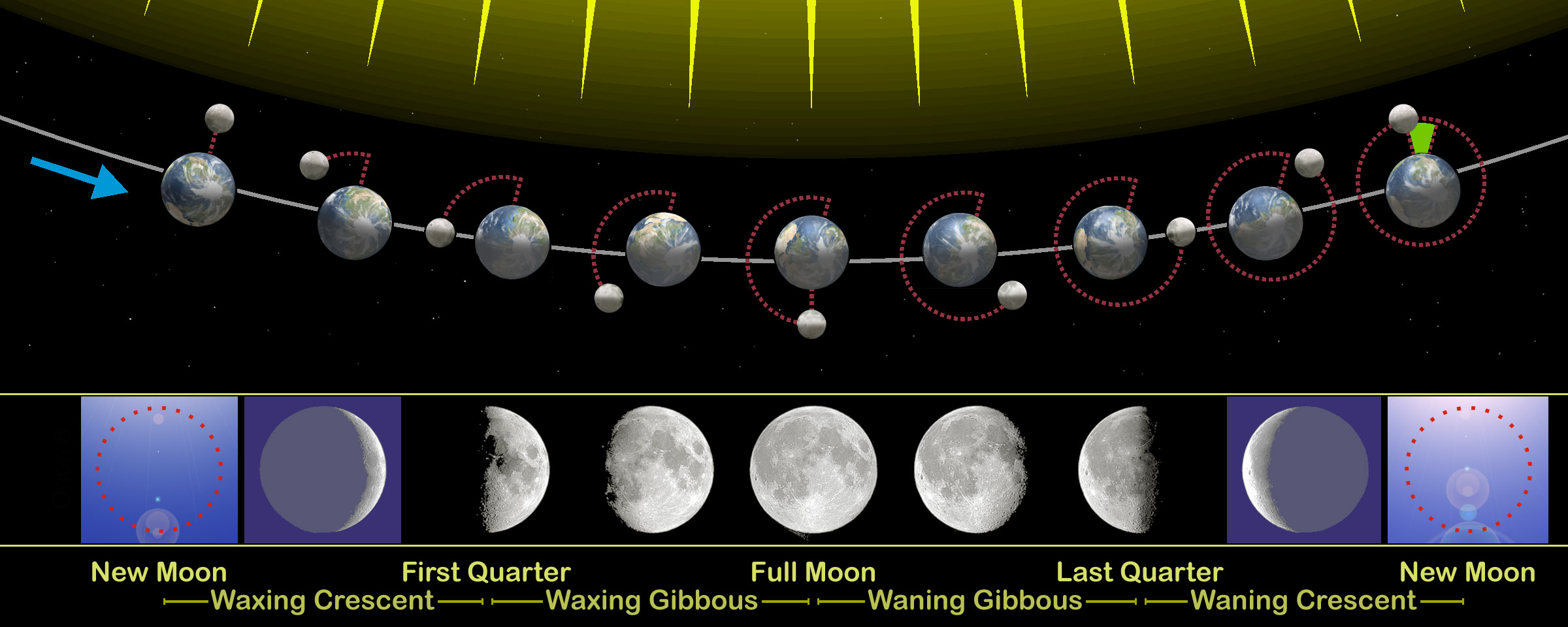
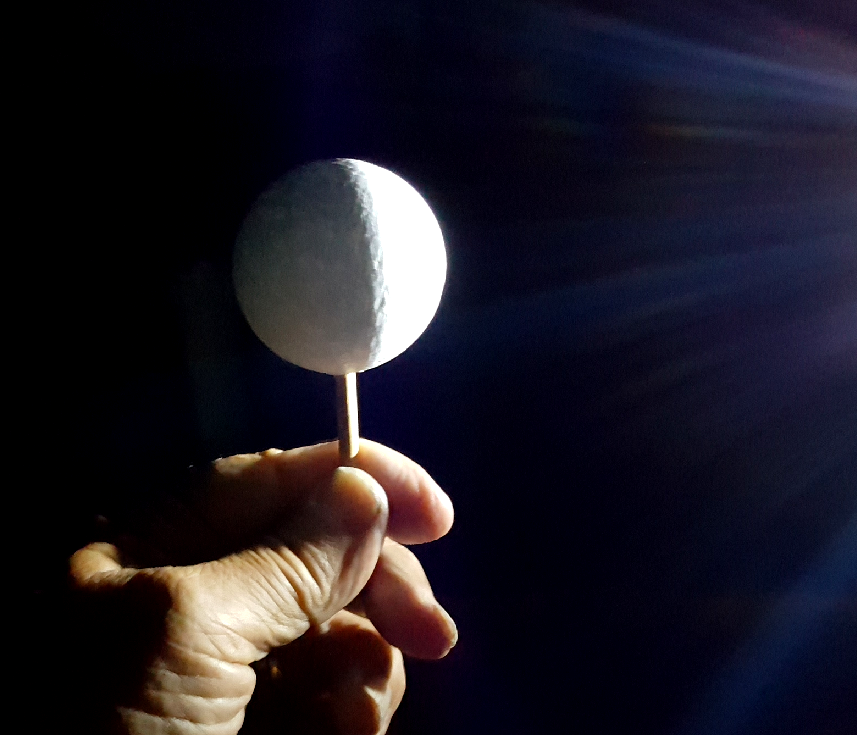
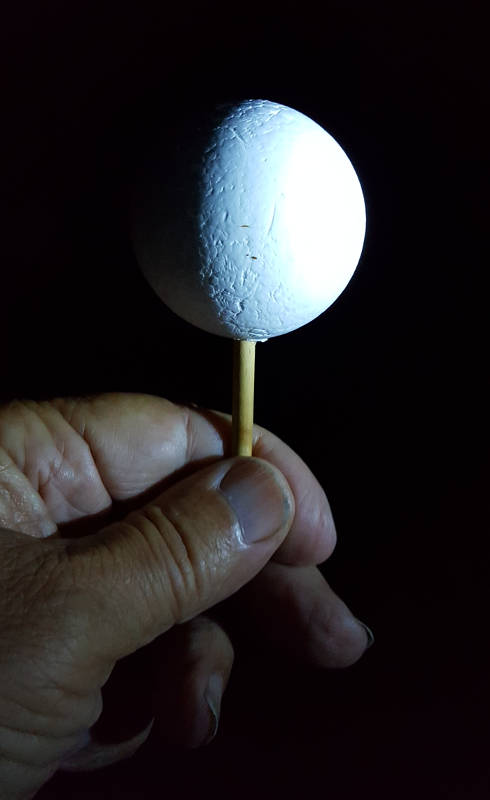
The Moon’s changing appearance over the month may seem to be mysterious at first glance. Maybe because one may think that the objects in the sky are somehow different from the familiar objects we see around us on the Earth. In ancient times, especially the Greeks thought that everything in the heavens halfway perfect and spotless. They explained the definite markings we see as the man-in-the-moon as a reflection of the Earth by a spotless Moon. The Moon’s phases are simply light and shadow on a ball in the sunlight. Sometimes, when the Moon appears in the daytime, take a small ball, like a golf ball and hold it up to the Moon, while the ball is also in sunlight, and the small ball will exhibit the same phase as the Moon.
The times given are for the Traverse City/Interlochen area of Michigan. They may be different for your location.
Addendum
10/11/2018 – Ephemeris – Pegasus the aerobatic horse
Ephemeris for International Day of the Girl, Thursday, October 11th. The Sun will rise at 7:53. It’ll be up for 11 hours and 11 minutes, setting at 7:05. The Moon, 3 days past new, will set at 8:56 this evening.
Rising ever higher in the east at as it gets dark around 9 p.m. can be found one of the great autumn constellations: Pegasus the flying horse of Greek myth. Its most visible feature is a large square of four stars, now standing on one corner. This feature, called the Great Square of Pegasus, represents the front part of the horse’s body. The horse is quite aerobatic because it is seen flying upside down. Remembering that fact, the neck and head is a bent line of stars extending from the right corner star of the square. Its front legs can be seen in a gallop extending to the upper right from the top star of the square. From the left star extend, not hind legs but the constellation of Andromeda, an important constellation in its own right. The Anishinaabek peoples native to this region saw ab upright Moose (Mooz) here.
The times given are for the Traverse City/Interlochen area of Michigan. They may be different for your location.
Addendum
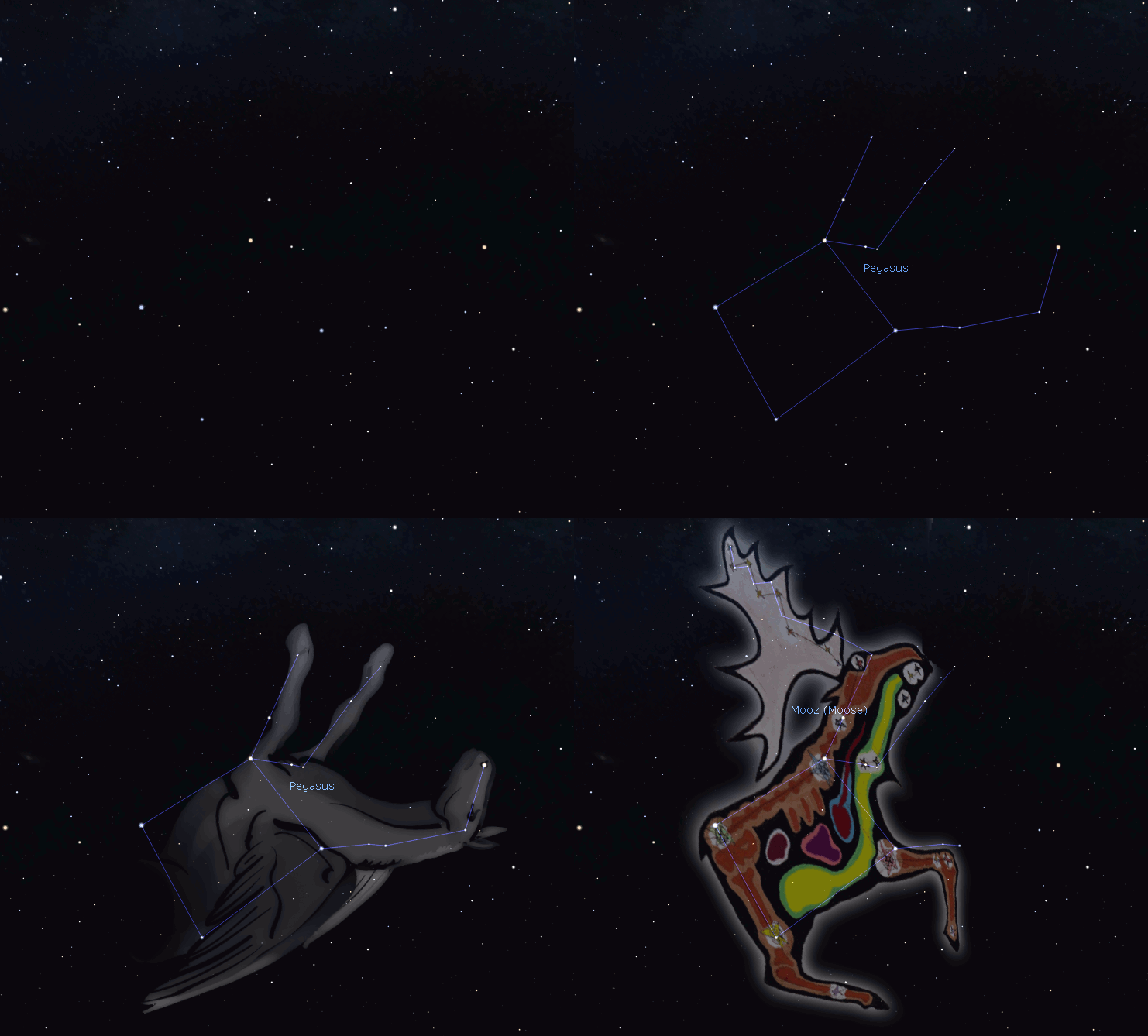
The constellation art is part of the latest versions of Stellarium. Ojibwe (Anishinaabek) constellation art by Annette S Lee and William Wilson from Ojibwe Sky Star Map Constellation Guide, ISBN 978-0-615-98678-4.
10/10/2018 -Ephemeris – Where are the bright planets for this week?
Ephemeris for Wednesday, October 10th. The Sun will rise at 7:51. It’ll be up for 11 hours and 14 minutes, setting at 7:06. The Moon, 2 days past new, will set at 8:23 this evening.
Let’s look at the bright planets today. Three of them are visible in the evening sky. The brilliant Venus will be just too low to spot, setting 9 minutes after the Sun. The problem isn’t its separation from the Sun, but it is also south of the Sun’s path. Jupiter will be in the west-southwest as it gets dark. The big planet will set at 8:40 p.m. Saturn will start the evening low in the southwestern sky and will set at 11:05 p.m. Mars will be low in the south as the skies darken tonight. and is now 60.5 million miles (97.4 million km) away. Mars will be due south at 9:19 p.m., and it will set at 2:03 a.m. Mars is beginning to pick up speed moving eastward, crossing the constellation of Capricornus this month.
The times given are for the Traverse City/Interlochen area of Michigan. They may be different for your location.
Addendum
10/09/2018 – Ephemeris – Ada Lovelace Day
Ephemeris for Ada Lovelace Day, Tuesday, October 9th. The Sun will rise at 7:50. It’ll be up for 11 hours and 17 minutes, setting at 7:08. The Moon, 1 day past new, will set at 7:53 this evening.
Ada Lovelace Day is dedicated to Lord Byron’s daughter as the first computer programmer more than a century before the computer as we know it was invented. She worked with Charles Babbage as he designed his Analytical Engine, which would have been the world’s first truly general purpose computer, mechanical though it was. The day is also dedicated to women in the STEM fields: Science, Technology, Engineering, and Math. Two days from now, the 11th will be the International Day of the Girl, promoting the education and possibilities of 52% of the population that aren’t male. Some of the female astronomers I follow on Twitter are astrophysicist Dr. Katherine Mack as @AstroKatie, planetary radar astronomer Alessondra Springmann as @sondy, planetary scientist Carolyn Porco, @carolynporco. These are a few, and in my field of computer programming, I celebrate the late Admiral Grace Hopper.
The times given are for the Traverse City/Interlochen area of Michigan. They may be different for your location.
Addendum

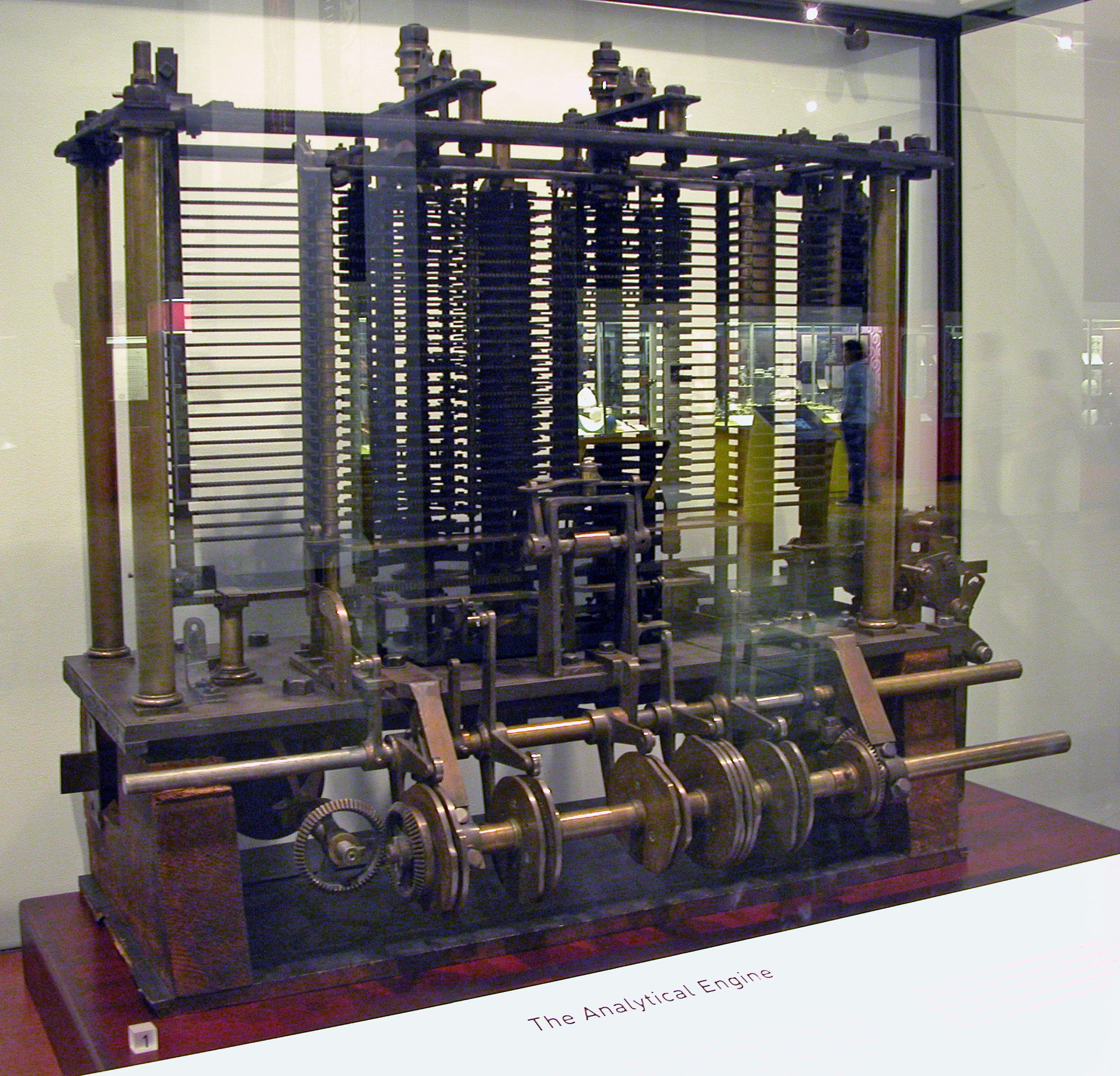
The analytic Engine was designed to be programed with punch cards.
10/05/2018 – Ephemeris – All about telescopes for the gift giving season
Ephemeris for Friday, October 5th. The Sun will rise at 7:45. It’ll be up for 11 hours and 30 minutes, setting at 7:15. The Moon, halfway from last quarter to new, will rise at 4:28 tomorrow morning.
We at the Grand Traverse Astronomical Society get asked a lot about what kind of telescope to get for their beginning astronomer, whether young or old. With the gift-giving season coming upon us, now is the time to plan ahead. This month’s meeting at 8 p.m. at the Northwestern Michigan College’s Rogers Observatory there will be several types of telescopes there, including one of mine*. There is no right telescope, but there are lots of wrong telescopes, and its not always the telescope itself, but the mounting that’s the problem. Society members will show you what the various telescopes can do, what you need, and don’t need. What’s the best telescope for what price range.
The times given are for the Traverse City/Interlochen area of Michigan. They may be different for your location.
* I’m currently suffering from a sprained wrist, so I may not be able to bring in my 11″ Dobsonian telescope, but will bring in a much smaller (3″) telescope of similar design instead.
10/03/2018 – Ephemeris – This week’s look at the bright planets
Ephemeris for Wednesday, October 3rd. The Sun will rise at 7:43. It’ll be up for 11 hours and 36 minutes, setting at 7:19. The Moon, 1 day past last quarter, will rise at 2:02 tomorrow morning
Let’s look at the bright planets today. Three of them are visible in the evening sky. The brilliant Venus will be just too low to spot, setting 29 minutes after the Sun. The problem isn’t its separation from the Sun, but it is also south of the Sun’s path. Jupiter will be in the southwest as it gets dark. The big planet will set at 9:03 p.m. Saturn will start the evening low in the south-southwest sky and will set at 11:31 p.m. I will be giving a talk about Saturn tonight at the Main branch of the library in Traverse City at 7 p.m. Mars will be low in the south-southeast as the skies darken tonight. and is now 56.7 million miles (91.3 million km) away. Mars will be due south at 9:34 p.m., and it will set at 2:03 a.m.
The times given are for the Traverse City/Interlochen area of Michigan. They may be different for your location.
Addendum
10/02/2018 – Ephemeris – I will give a talk on Saturn at the Traverse Area District Library tomorrow night
Ephemeris for Tuesday, October 2nd. The Sun will rise at 7:42. It’ll be up for 11 hours and 39 minutes, setting at 7:21. The Moon, at last quarter today, will rise at 12:55 tomorrow morning.
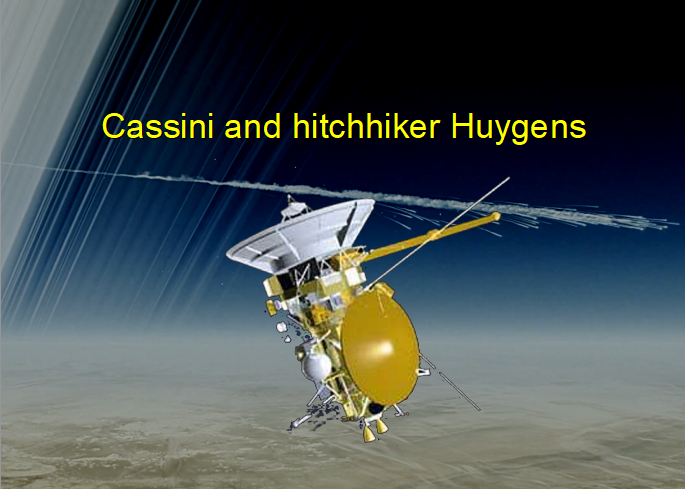
Tomorrow night October 3rd at 7 p.m. I’ll be giving a talk at the main branch of the Traverse Area District Library on Woodmere Avenue, about the amazing discoveries made about Saturn, its rings and moons by the Cassini spacecraft and its Titan lander Huygens, spanning 7 years to get there and 13 orbiting Saturn among its rings and moons. The spacecraft made a planned plunge into Saturn’s atmosphere a year ago. The illustrated talk is called Remembering Cassini. Besides the numerical data sent back were images, some of which were made into videos, such as the landing of the Huygens probe on Titan. After the talk, if it will be clear, Saturn will be visible in the telescopes of the Grand Traverse Astronomical Society, along with other wonders of the skies.
The times given are for the Traverse City/Interlochen area of Michigan. They may be different for your location.
Addendu