Archive
03.14/2017 – Ephemeris – It’s Pi Day!
Ephemeris for Pi Day 3.14, Tuesday, March 14th. The Sun will rise at 7:56. It’ll be up for 11 hours and 51 minutes, setting at 7:47. The Moon, 2 days past full, will rise at 10:04 this evening.
Welcome to Pi Day. I had some NASA inspired links posted on this blog this past Sunday for your enjoyment. Also simply do an Internet search for Pi Day and lots of fun information and activities will be listed. I remember an exercise in high school calculating pi with an inscribed polygon in a circle of ever increasing numbers of sides. Somewhere in there I messed up and came out with an answer that didn’t quite get there. This was in the years B.C. that is Before Calculators. Speaking of round things, Jupiter will rise this evening followed by the Moon and the star Spica in the east. They will all be up by 10:30. Jupiter is not yet an evening planet, since it is not up by sunset. It’s still seen in the morning sky.
Times are for the Traverse City/Interlochen area of Michigan. They may be different for your location.
Addenda
Had I known in the tenth grade this strategy to calculate pi, I could have saved myself a lot of grief. Simply google calculate pi with toothpicks. One of the hits was this from Science Friday: https://sciencefriday.com/articles/estimate-pi-by-dropping-sticks/*. Basically it’s by dropping lots of toothpicks on a piece of paper with parallel lines spaced the length of the toothpicks apart. The total number of toothpicks dropped times two divided by the number of toothpicks that cross a line will approximate pi. The more drops, the closer to pi one gets.
- In the formula in the link, if the length of the toothpicks equals the distance between the lines, those terms drop out of the formula.
Grouping of Jupiter, the Moon and the star Spica
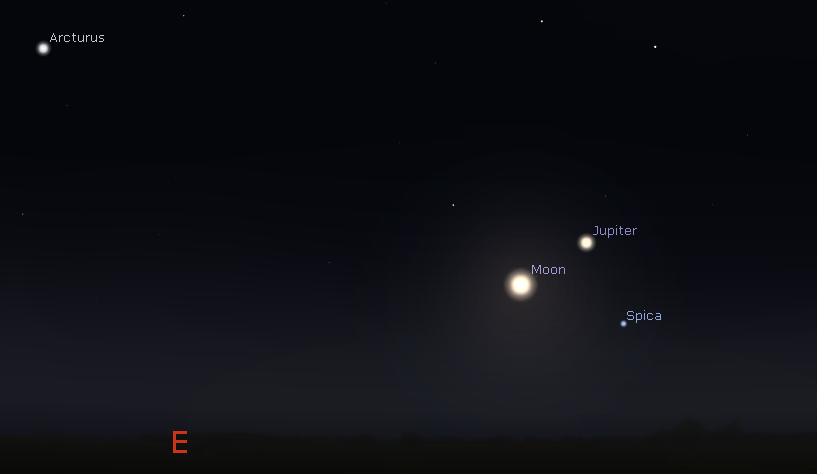
Jupiter, the Moon and the star Spica at 11 p.m. March 14, 2016. Since the Moon moves eastward about its diameter an hour. So observers east or west of here will see the Moon in a different position in relation to these other two bodies. Created using Stellarium.
03/13/2017 – Ephemeris – More thoughts about yesterday’s time change
Ephemeris for Monday, March 13th. The Sun will rise at 7:58. It’ll be up for 11 hours and 48 minutes, setting at 7:46. The Moon, 1 day past full, will rise at 9:03 this evening.
We are now plunged back into dark mornings like we were two month’s ago thanks to the start of Daylight Saving Time. However we are only a week from the vernal equinox, the first day of spring here in the northern hemisphere. However some of my blog followers down under will experience the start of autumn on that day. For us in the next three months the sunrise time will back down 2 hours, and will rise around 6 a.m. Our sunset times will advance a bit less than that, an hour and 45 minutes. The lopsidedness is a consequence of both the Earth’s axial tilt and its slightly elliptical orbit. We are moving somewhat away from the Sun now and are slowing down a bit. It’s all kind of hard to explain, but makes perfect sense… eventually.
Times are for the Traverse City/Interlochen area of Michigan. They may be different for your location.
Addendum
Well, I’m going to try to explain it now.
If one visits most observatories, there will be a clock, usually in the dome that doesn’t seem to read the correct time. We have one in Northwestern Michigan College’s Rogers Observatory’s dome. It only agrees with the time on your watch for an instant on October 16th. It’s called a sidereal clock and it measures Earth’s rotation with respect to the stars, and it gains approximately 4 minutes a day compared to our normal clocks which are geared to the Sun.
The Earth and all the planets orbit the Sun in a counterclockwise direction when seen from the north. Also the Earth and most of the planets spin also in a counterclockwise direction. The exceptions are Venus and Uranus. Most large satellites like our Moon also orbit their planets in a counterclockwise direction. From the surface of the Earth these bodies appear to generally move eastward, while the celestial sphere mirror reflects our eastward rotation by appearing to move east to west.
The Sun appears to move about one degree a day eastward. (360° / 365 days = 1° approximately). The Earth rotates through 15° an hour (360°/24 hours = 15° and 60 minutes in an hour / 15 = 4 minutes to rotate a degree). So on average and approximately after the Earth rotates back to the same point with regard to the stars, it has to rotate and extra degree to catch up to the Sun, which takes 4 more minutes, which is why the solar day is 4 minutes longer than a sidereal day. (Well, 3 minutes 55.9084 seconds if you want to get picky about it!)
Of course it’s not that simple. It never is that simple. This would all work out if the Earth orbited the Sun in a uniform circle and the Earth had no axial tilt. The Earth’s tilt is also called obliquity. The Sun would appear to move uniformly over the Earth’s equator. That Sun, called the mean Sun is what we base our solar time on, not the real Sun. However the Earth’s orbit is elliptical, with the Earth moving fastest at its perihelion or closest point to the Sun, around January 3rd, and slowest at aphelion or farthest point around July 4th. Also the Earth’s axial tilt is 23 ½ °, and is only on the equator two days a year March 20th and September 23rd.
Ever see this funny figure 8 in the Pacific Ocean on old globes?
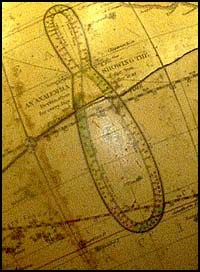
Illustration 1. An Analemma graphically demonstrating the actual Sun’s relation to the mean Sun during the year.
Both eccentricity and obliquity work together to produce the analemma as seen in the diagram below. This figure 8 can actually be photographed in the sky by exposing the same frame of film at regular intervals, or stacking images of the same area of the sky over a year at the same time of day. There are plenty of examples using an Internet search engine to search for analemma images. It is one way to illustrate the equation of time, which is the correction one must make to a sundial reading to get to the correct local mean solar time. To that one must add or subtract one’s offset from the time zone’s time meridian. See Friday’s post.
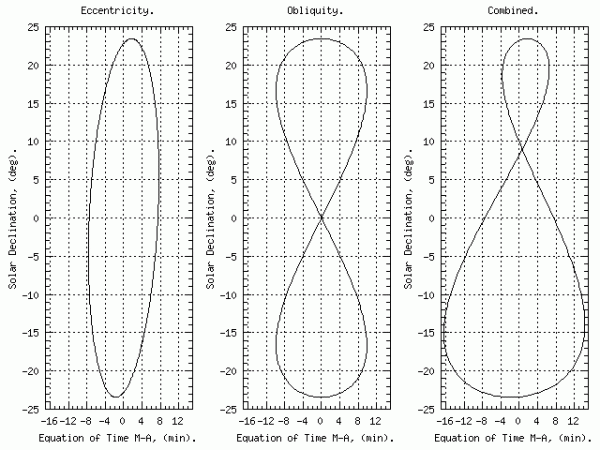
Illustration 2. How eccentricity of the Earth’s orbit and obliquity combine to affect the analemma. The effects add at the bottom near the winter solstice and subtract near the summer solstice.
The above diagram was taken from Ethan Siegel’s Starts with a Bang blog: http://scienceblogs.com/startswithabang/2010/12/17/celebrate-this-winter-solstice/ which also explains it.
The equation of time can be found in tabular form for easy sundial correction, or in a linear graphical form as seen below.
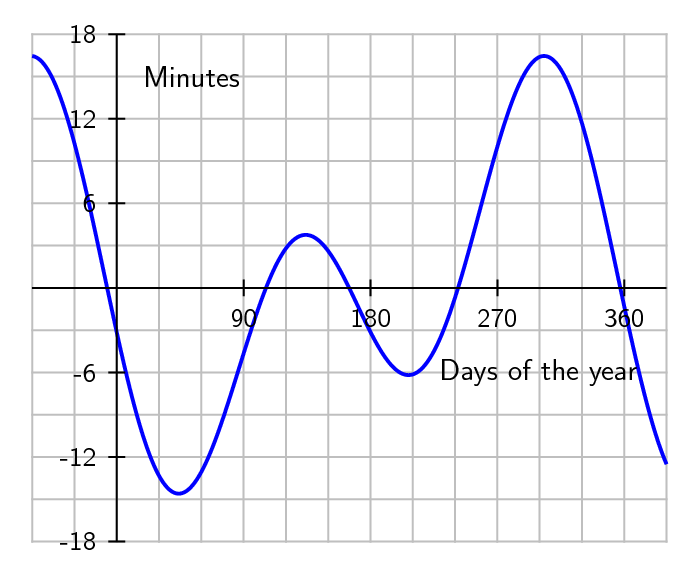
Illustration 3. Linear representation of the equation of time
Actually the biggest effect on the equation of time, is especially near the solstices is the Earth’s obliquity (axial tilt). Below we see how the Sun’s declination affects how fast it appears time wise.
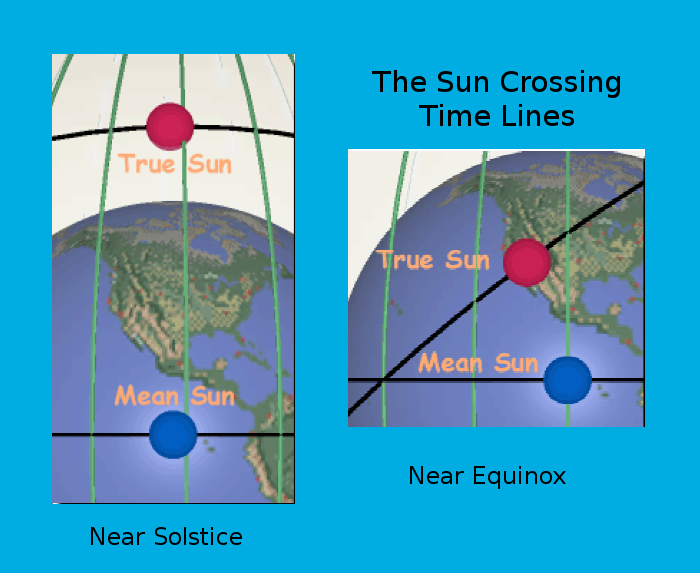
Illustration 4. How the Sun’s declination affects how rapidly it appears to cross time lines (meridians).
Declination of celestial objects is the same as latitude on the Earth. A star whose declination is the same value as one’s latitude will cross at the zenith once a day. In illustration 4 note that the near the solstices the time lines (meridians) are closer together, so the Sun will pass them faster than when near the equinoxes where the time lines are farther apart and the Sun is moving somewhat diagonally, taking longer to cross the time lines. In time only east-west motion counts.
Looking at Illustration 2, I’ve added arrows at the top (northern) and bottom (southern) extremities of each analemma source to give some idea of the Sun’s apparent speed at the solstices. At the bottom, near the December solstice the eccentricity speed of the Sun adds to the obliquity speed increasing the effects at that part of the analemma lobe, making it bigger. At the June solstice end of things eccentricity speed is in the opposite direction, slowing the Sun down.
So what? This affects the dates of the earliest and latest sunrises and sunsets. Here are those dates and time values for us here in northern Michigan (specifically the Interlochen/Traverse City area):
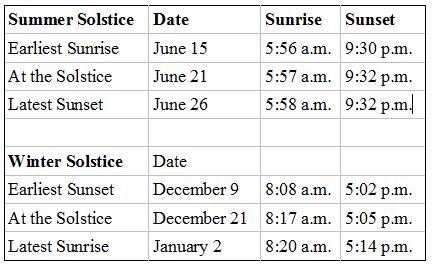
Table of Earliest and Latest Sunrises and Sunsets during the year for Interlochen/Traverse City area of Michigan.
All this may make little difference to our modern lives, governed by the atomic clocks in Paris and Fort Collins, Colorado, divorced as they are from the Earth’s actual rotation and the Sun except for the inclusion of the occasional leap second, like we had last December 31st. To folks like me who are amateur astronomers and have (or had in my case) a day job, it would’ve been nice to have, on the summer solstice, astronomical evening twilight end before midnight.
I hope this helped rather than confused you. What do you think? drop me a comment.
03/10/2017 – Ephemeris – Daylight Saving Time starts Sunday
Ephemeris for Friday, March 10th. The Sun will rise at 7:03. It’ll be up for 11 hours and 39 minutes, setting at 6:42. The Moon, 2 days before full, will set at 6:38 tomorrow morning.
Daylight saving time will begin this Sunday at 2 a.m. That means “spring forward”, setting our clocks ahead an hour. Did you know that we spend more time under daylight time than standard time. Standard time only lasts about 4 months and one week. The rest of the time, nearly 8 months is spent under daylight time. According to theory, anyway, one’s time meridian should run in the middle of its time zone. Right now our standard time meridian of 75 degrees west longitude runs through Philadelphia, 5 hours west of the prime meridian of Greenwich. Come Sunday our time meridian will be 60 degrees west longitude, in the Atlantic at our latitude, and further to the north just touches the eastern tip of Nova Scotia. In relation to the actual Sun we will be an hour and 43 minutes behind it, which is why sundials don’t tell the correct time around here.
Times are for the Traverse City/Interlochen area of Michigan. They may be different for your location.
Addendum
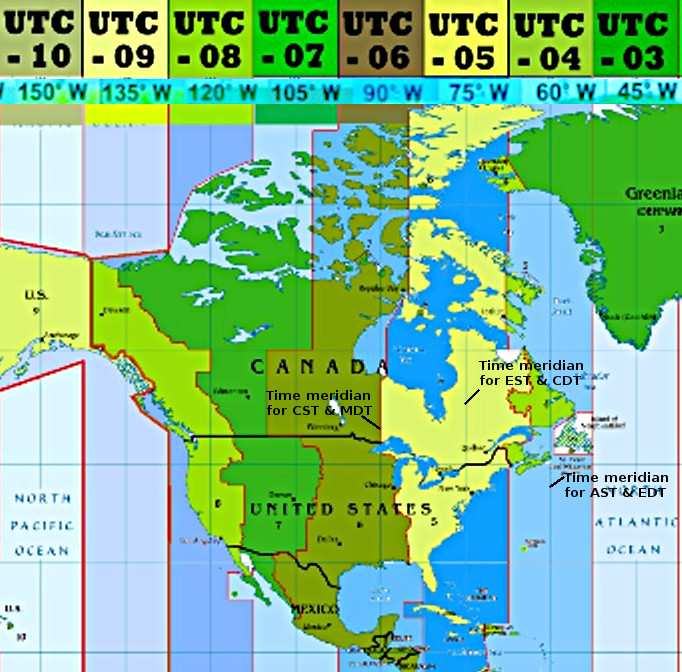
Time zones with their meridians for North America.
03/09/2017 – Ephemeris – More on the definition of a planet controversy
Ephemeris for Thursday, March 9th. The Sun will rise at 7:05. It’ll be up for 11 hours and 35 minutes, setting at 6:41. The Moon, 3 days before full, will set at 6:03 tomorrow morning.
Last Friday’s Weekly Space Hangout, on Google Hangouts featured Dr. Alan Stern, principal Investigator of the New Horizons Mission to Pluto and beyond. Dr. Stern considers himself a planetary scientist, rather than an astronomer, and doesn’t much care for the IAU or International Astronomical Union’s definition of a planet. To him and other planetary scientists: if it’s round and not a star… it’s a planet. They’re are more concerned about what it is than where it is, or what it’s orbiting. Planetary science encompasses geology, climatology, chemistry, and astrobiology among others. For instance astrobiology is looking at the origin of life on the Earth and looking for life on other worlds like the planet Mars and at least three moons, Jupiter’s Europa and Saturn’s Enceladus and Titan.
Times are for the Traverse City/Interlochen area of Michigan. They may be different for your location.
Addendum
Check out last Friday’s Weekly Space Hangout here
For the latest on astronomical, space events and discoveries this is a good place to go.
03/08/2017 – Ephemeris – Bright planet Wednesday
Ephemeris for Wednesday, March 8th. The Sun will rise at 7:07. It’ll be up for 11 hours and 32 minutes, setting at 6:39. The Moon, 3 days past first quarter, will set at 5:24 tomorrow morning.
Let’s check out the bright planets for this week. Venus and Mars are in the evening sky. At 7:30 p.m. these planets will be seen in the western sky. Venus is unmistakable as the brilliant evening star, Mars will be left and above it and much dimmer. Venus exhibits a dazzling crescent in small telescopes and binoculars now. It looks like a tiny Cheshire Cat grin. Telescopes, however can turn that grin into a frown. It will set at 9:01 p.m. while Mars will set at 10:12. Jupiter will rise in the east at 9:22 p.m. It will also be seen in the morning in the southwest above the star Spica. Saturn can be glimpsed this and tomorrow mornings in the south-southeast before 6:30 a.m. It will rise tomorrow at 2:53 a.m. in the east-southeast.
Times are for the Traverse City/Interlochen area of Michigan. They may be different for your location.
Addendum
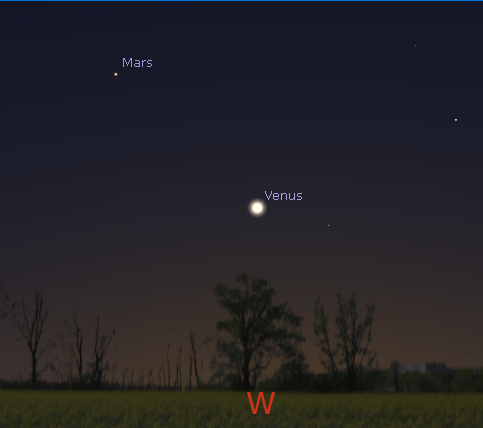
Venus and Mars in the west at 7:30 p.m. March 8, 2017. Created using Stellarium.
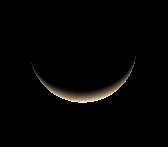
The thin sliver of Venus as it might appear in a telescope tonight March 8, 2017. I processed the image to overexpose it as it would appear in a telescope. Created using Stellarium.
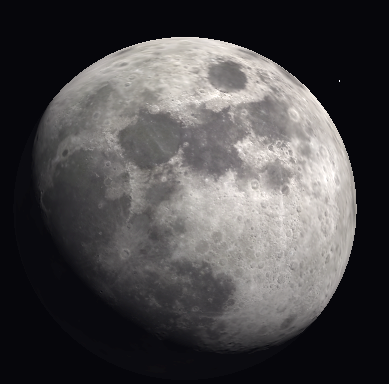
The gibbous Moon as it might look in binoculars. 7:30 p.m. March 8, 2017. Created using Stellarium.
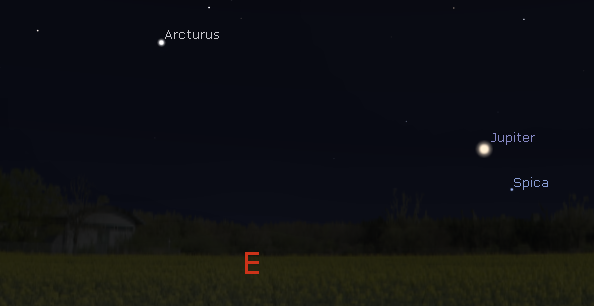
Jupiter rising in the east at 10:30 p.m. near the star Spica. Created using Stellarium.
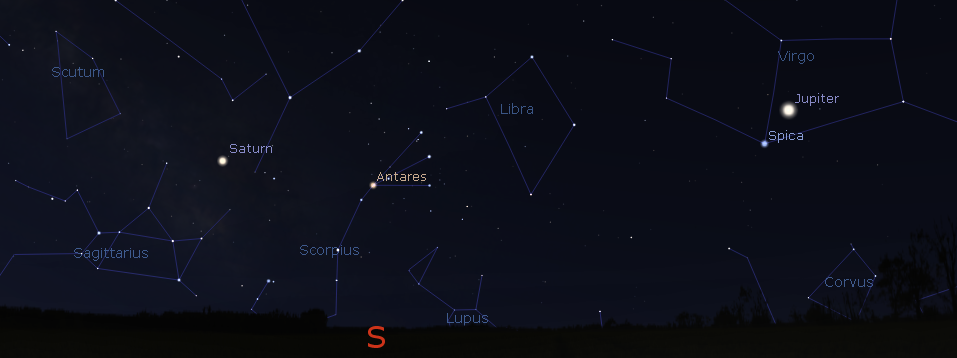
Jupiter in the southwest above the star Spica with Saturn the south-southeast at a.m. tomorrow morning, March 9, 2017. Created using Stellarium.
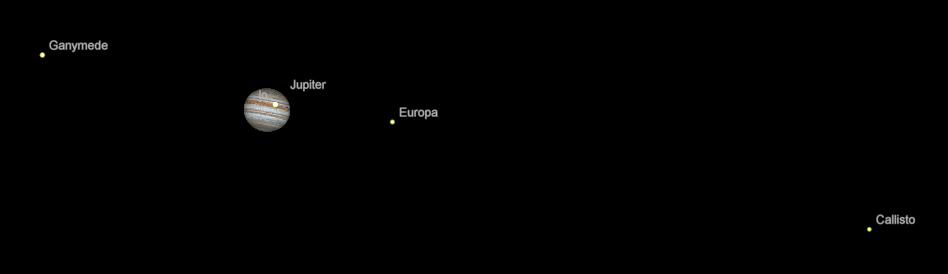
Jupiter and its moons at 6 a.m. (11:00 UT) March 9, 2017. Note that Io is transiting the planet at that time. See the list of events for it below. Created using Cartes du Ciel (Sky Charts).
Events related to the Io transit in the early morning of March 9, 2017
Io’s shadow starts to cross the face of Jupiter: 9 Mar 2017 8:54 UT or 3:54 a.m. EST
Io’s transit of Jupiter starts: 9 Mar 2017 9:35 UT or 4:54 a.m. EST
Io’s shadow leaves the face of Jupiter: 9 Mar 2017 11:05 UT or 6:05 a.m. EST
Io’s transit of Jupiter ends: 9 Mar 2017 11:44 UT or 6:44 a.m. EST
Above times are from Project Pluto: https://www.projectpluto.com/jevent.htm. Shadow crossings and transits are difficult to observe. The beginnings and endings of transits are visible as the satellite disappears and reappears at the edge of the planet.
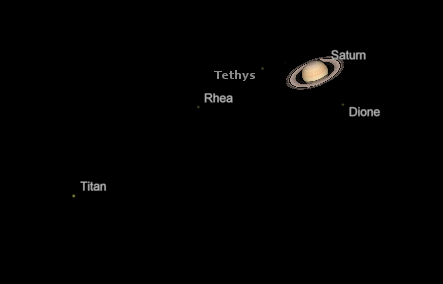
Saturn and its brightest moons as they might appear in telescopes tomorrow morning at 6 a.m. March 9, 2017. Created using Cartes du Ciel (Sky Charts).
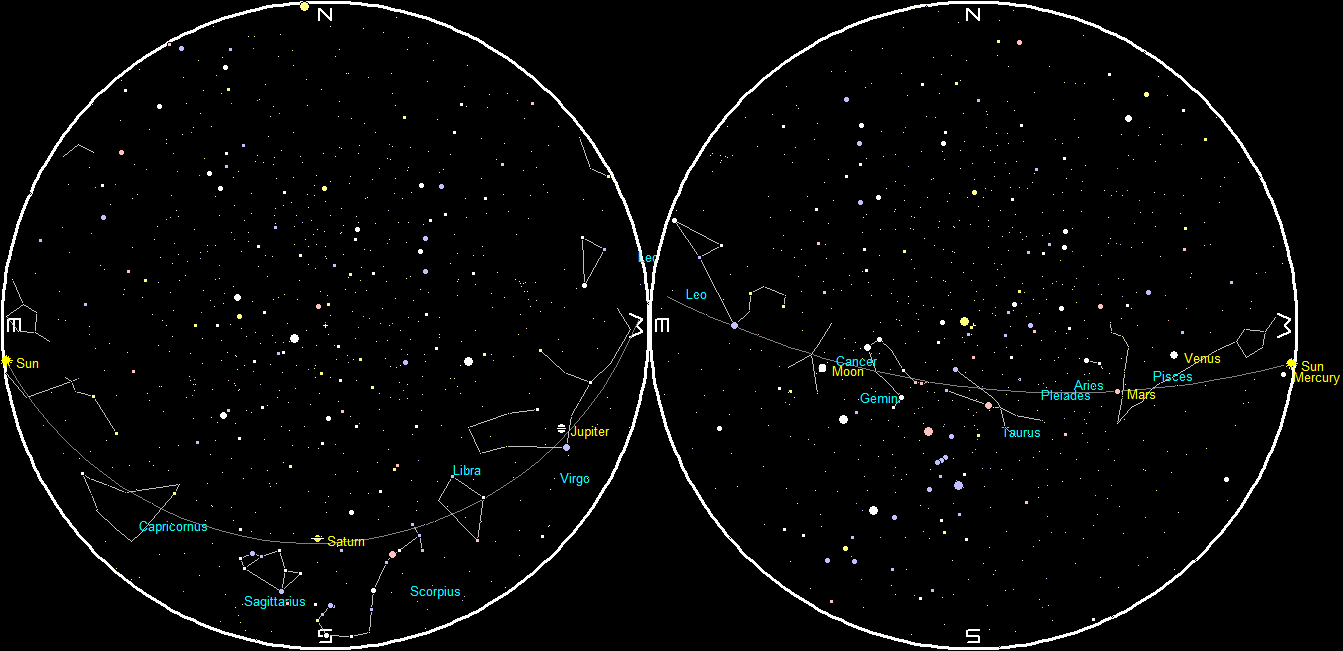
Planets and the Moon at sunset and sunrise of a single night starting with sunset on the right on March 8, 2017. The night ends on the left with sunrise on March 9. Click on image to enlarge. Created using my LookingUp program.
03/07/2017 – Ephemeris – The Moon tonight – the crater Copernicus
Ephemeris for Tuesday, March 7th. The Sun will rise at 7:08. It’ll be up for 11 hours and 29 minutes, setting at 6:38. The Moon, 2 days past first quarter, will set at 4:39 tomorrow morning.
Looking at the Moon tonight the brightest feature on the left side of the moon is the big splash mark left by the impact that created the crater Copernicus. The proper term is ejecta blanket that can be noticed by the naked eye or binoculars. Although it is most visible during full moon, because it is really made of small craters that are most visible when we see them from the direction of the Sun, so they are not shadow filled and brighter than normal. Copernicus is on the south edge of a great lava plain called Mare Imbrium, the Sea of Showers. There’s a large crater on the north edge named after the Greek philosopher Plato. At the upper left edge is the Laplace promontory the point of the Bay of Rainbows to be revealed tomorrow night.
Times are for the Traverse City/Interlochen area of Michigan. They may be different for your location.
Addendum
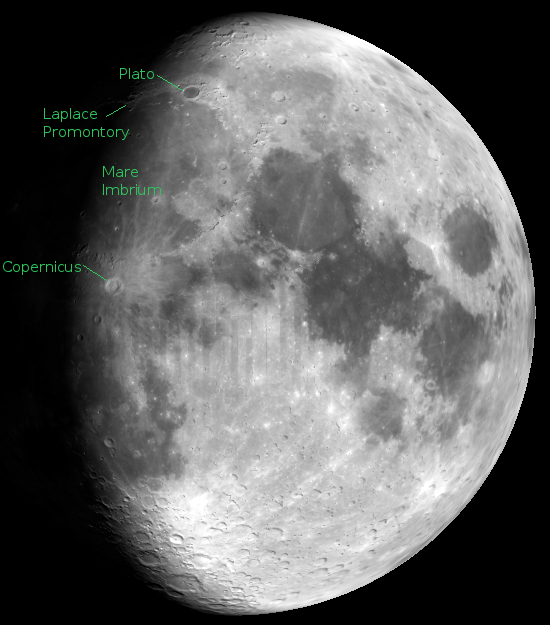
The Moon featuring Copernicus, Plato, Laplace Promontory and Mare Imbrium at 9 p.m., March 7, 2017. Created using Virtual Moon Atlas.
03/06/2017 – Ephemeris – TRAPPIST-1 The star with seven earth-sized planets
Ephemeris for Monday, March 6th. The Sun will rise at 7:10. It’ll be up for 11 hours and 26 minutes, setting at 6:37. The Moon, 1 day past first quarter, will set at 3:47 tomorrow morning.
The big astronomical news of two weeks ago was the announcement of a star system that had at least 7 earth-sized planets. And that three of them were in the habitable zone of their dim red dwarf star. The designation of the star is TRAPPIST-1, a Belgian telescope in South America that has nothing to do with monks. TRAPPIST is the acronym for the telescope’s rather long name. Confirmation of all the planets, their sizes and mass was carried out by NASA’s Spitzer Infrared Telescope trailing the Earth in solar orbit. Needless to say this star system will be the object of intense study as larger and more sophisticated ground and space based telescopes come on line in the next few years.
Times are for the Traverse City/Interlochen area of Michigan. They may be different for your location.
Addendum
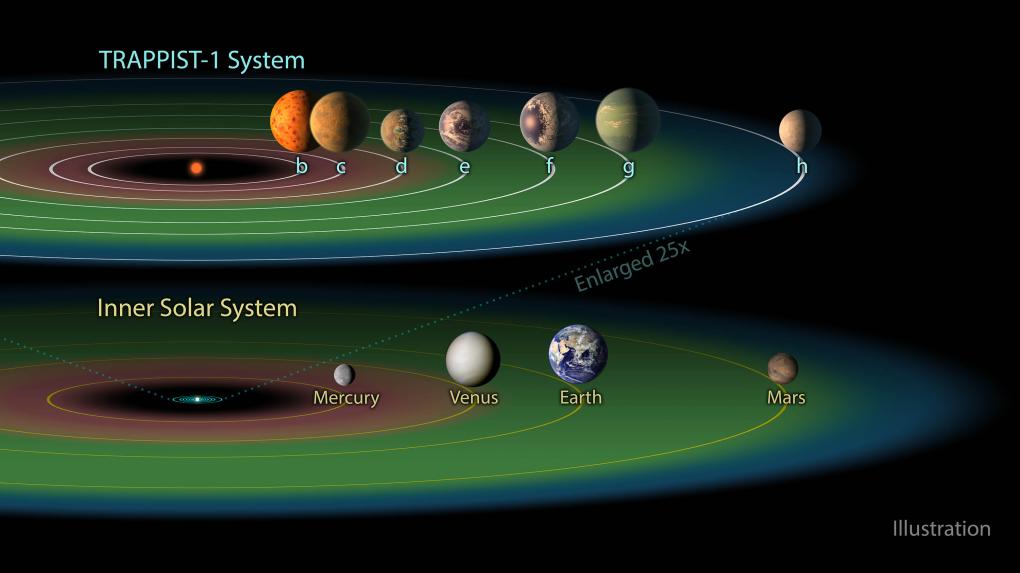
Comparison of the TRAPPIST-1 planetary system with our own inner solar system. The green zone is the habitable or Goldilocks zone Credit: NASA/JPL-Caltech/R. Hurt, T. Pyle (IPAC)
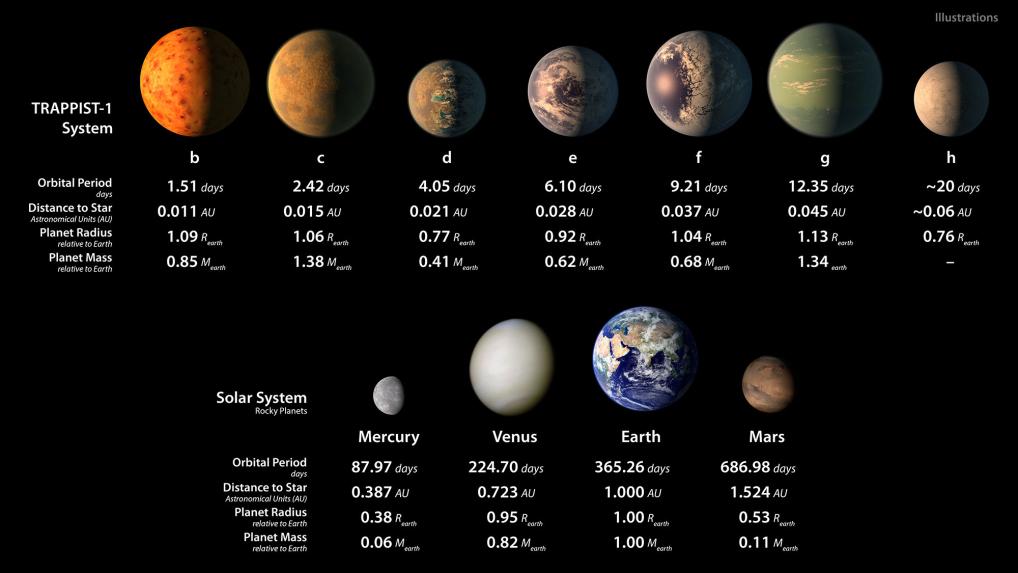
What is currently known about the TRAPPIST-1 Planets. Comparison of the TRAPPIST-1 planetary system with our own inner solar system. Credit: NASA/JPL-Caltech/R. Hurt, T. Pyle (IPAC)
Note that the surface features of these planets are in the eye of the illustrator. They are currently black shadows seen on the face of the star that they cross.
Planet g looks closest to the Earth’s density of the habitable zone planets. The problem I’d have is if I lived there at 12.35 days per year I’d be 2220 years old.
Entice your great-great-great-great grandkids with this travel poster:
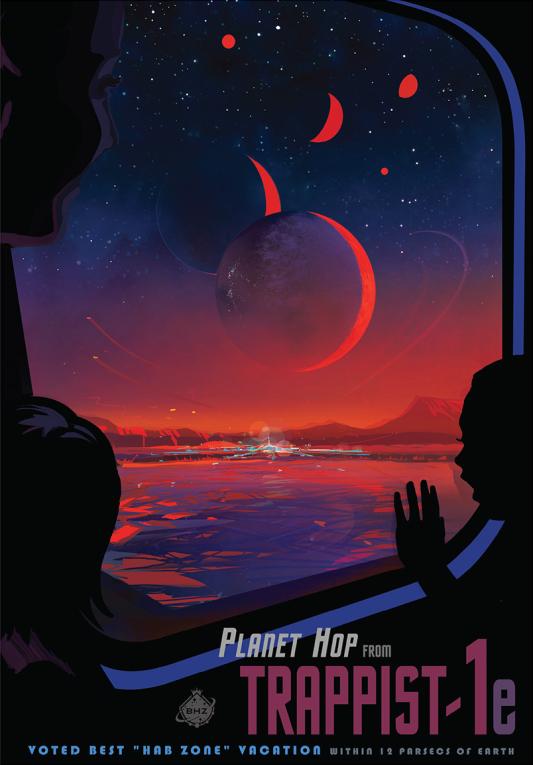
Planet Hop from TRAPPIST-1e. Maybe not next door like Proxima b, but just down the block. only 39 light years away.
For more information:
On the Spitzer site you can find:
Images
Videos (b-roll and annotated/narrated)
Planet surface maps and starfield backdrop image
http://www.spitzer.caltech.edu/trappist-1
On the JPL site you can also find:
Exoplanet Travel Poster
VR tour of TRAPPIST-1d surface
Additional videos
https://exoplanets.nasa.gov/trappist1/
On the ESO site you can also find:
Even more videos and graphics
http://www.eso.org/public/news/eso1706
Play around with the TRAPPIST-1 and other extra solar planetary systems with NASA’s Eyes: https://eyes.nasa.gov/eyes-on-exoplanets.htm.
Replay the news conference announcing the TRAPPIST-1 discovery from February 22, 2017:
http://www.ustream.tv/recorded/100200725.
03/02/2017 – Ephemeris – Saturday night’s occultation of the bright star Aldebaran
Note: this program is for a very specific location in the northern lower peninsula of Michigan. The occultation of Aldebaran is visible from most of the United States except Alaska and Central America. For predictions for your locations you can use a planetarium type program like Stellarium, Cartes du Ciel (Sky Charts), which can be downloaded free from the right column on this blog page, or the commercial planetarium program of your choice. Make sure the program is zoomed in so the Moon is actual size, and set for your location, and play around with the time.
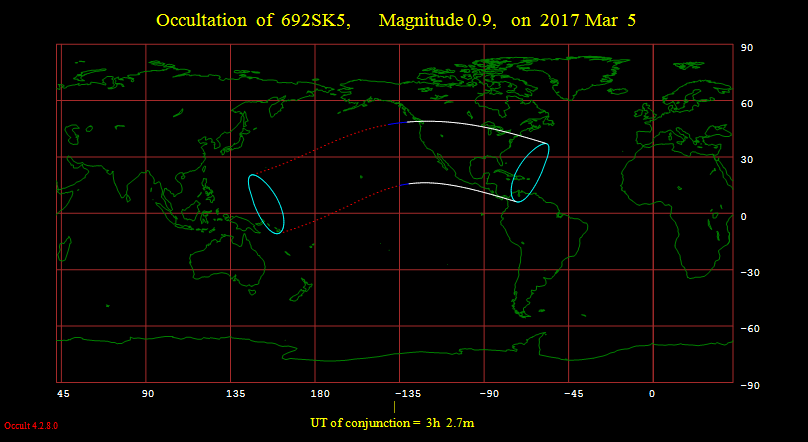
Path of the occultation of Aldebaran for March 4-5, 2017. Note where the top edge of the path goes. Right through northern Michigan.
On to the program:
Ephemeris for Thursday, March 2nd. The Sun will rise at 7:17. It’ll be up for 11 hours and 14 minutes, setting at 6:32. The Moon, 3 days before first quarter, will set at 11:26 this evening.
Saturday night just after 11 p.m. the upper right edge of the Moon will just cover the bright star Aldebaran, the angry red eye of Taurus the bull. That is for some of us. For those of us south of a line from Leland to just south of Mancelona and off across the state the Moon will occult or hide the star. For those north of that line Aldebaran will just miss the Moon. Start looking at 11 p.m. or so. The center of the occultation as it I called is about 11:13 p.m. The farther south of that line you are the longer the occultation will last. At 11 p.m. the star will be just off the upper right edge of the Moon.
Times are for the Traverse City/Interlochen area of Michigan. They may be different for your location.
Addenda
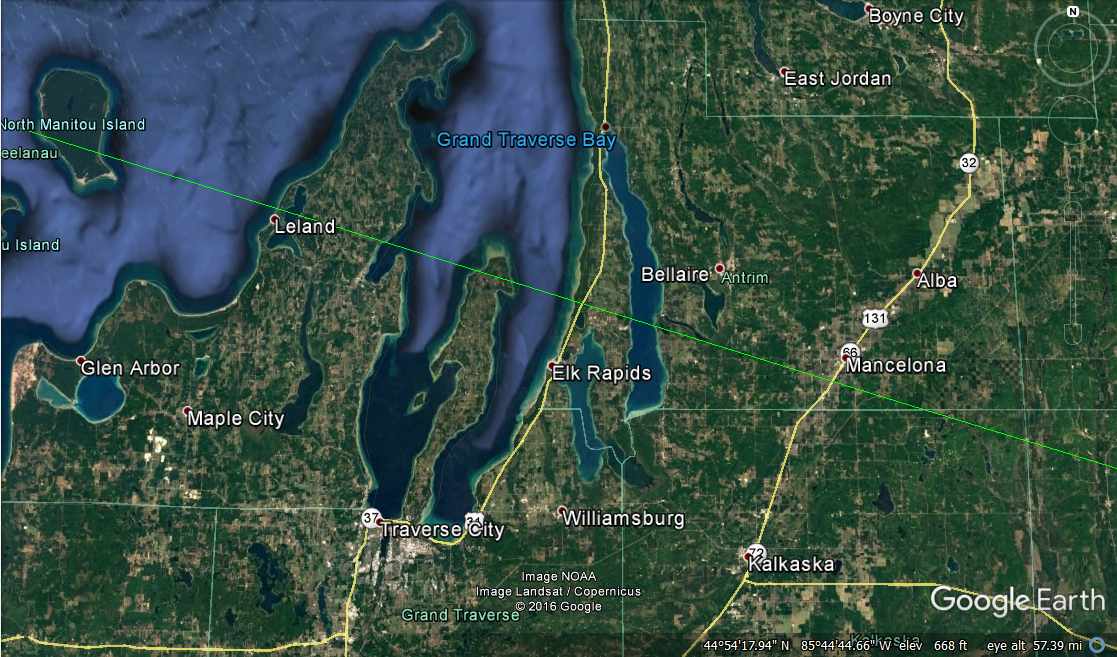
The north limit of the occultation zone as it passes through the Grand Traverse Region. Locations north of the green line will not see an occultation, Locations south of that line will see the occultation. Map credit Google Earth.
The file to load for this occultation map overlay is: http://ephemeris.bjmoler.org/ZC692-2017-Mar-5.kmz.
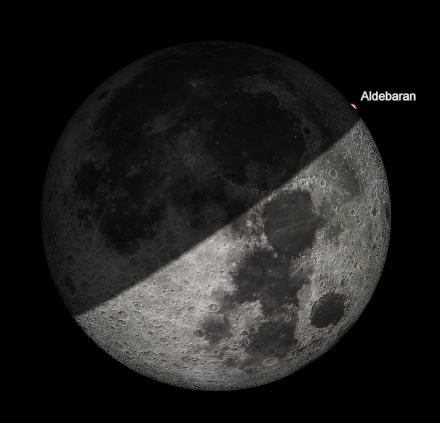
The point of the mid occultation from the NMC Observatory. Note that in reality Aldebaran would be completely covered by the Moon. This is the Moon and Aldebaran as they would be seen in the west at that time. Created using Cartes du Ciel (Sky Charts).
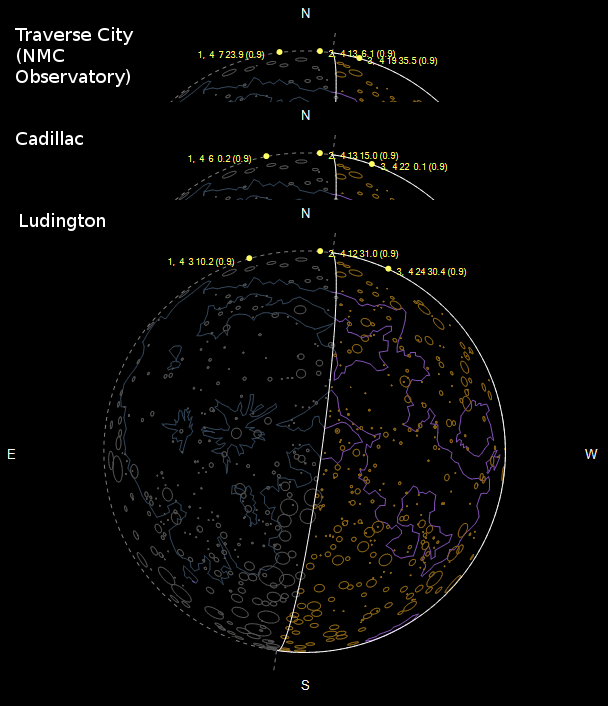
The occultation of Aldebaran as seen from three sample locations in the IPR listening area. Credit IOTA’s Occult4 program. The Moon is shown in equatorial orientation.
Here’s the legend for the labels:
# H M S (Mag)
#: 1 First contact, Aldebaran disappears
2 Middle of the occultation
3 Last contact, Aldebaran reappears
H: hour UT, 4 = 11 p.m. EST
M: Minute
S: Second
Mag: Magnitude of the star, 0.9 (First magnitude star)
An article I wrote about this occultation in the March 2017 issue of the Grand Traverse Astronomical Society newsletter The Stellar Sentinel:
The Grazing Occultation of Aldebaran, March 4th
Late Saturday night March 4th the Moon will pass in front of, or not the bright star Aldebaran. The “or not” depends on where you are.
The event is called an occultation. The word comes from occult, which, despite its baggage, simply means hidden. When one celestial body moves in front of another and completely covers it an occultation occurs. In actuality a total solar eclipse is an occultation. However a lunar eclipse is still an eclipse as we see it, but an occultation as the Sun sees it.
Above there’s a map of the Leelanau and Old Mission peninsulas and a bit of the Lower Peninsula of Michigan with a line drawn across it from north of Leland to just south of Mancelona. That is the calculated northern limit of the occultation. Observers within a mile of so of that line could see Aldebaran winking in and out as it’s light encounters mountains and passes through valleys at the northern limb of the Moon.
Even though we’ve landed humans on the Moon and have mapping satellites orbiting it, there is still a need to add more data to the accumulated knowledge we have of the surface and position of the Moon. Observers in a coordinated effort can be set up perpendicular to the graze line and using coordinated time signals produce a map of the edge of the Moon.
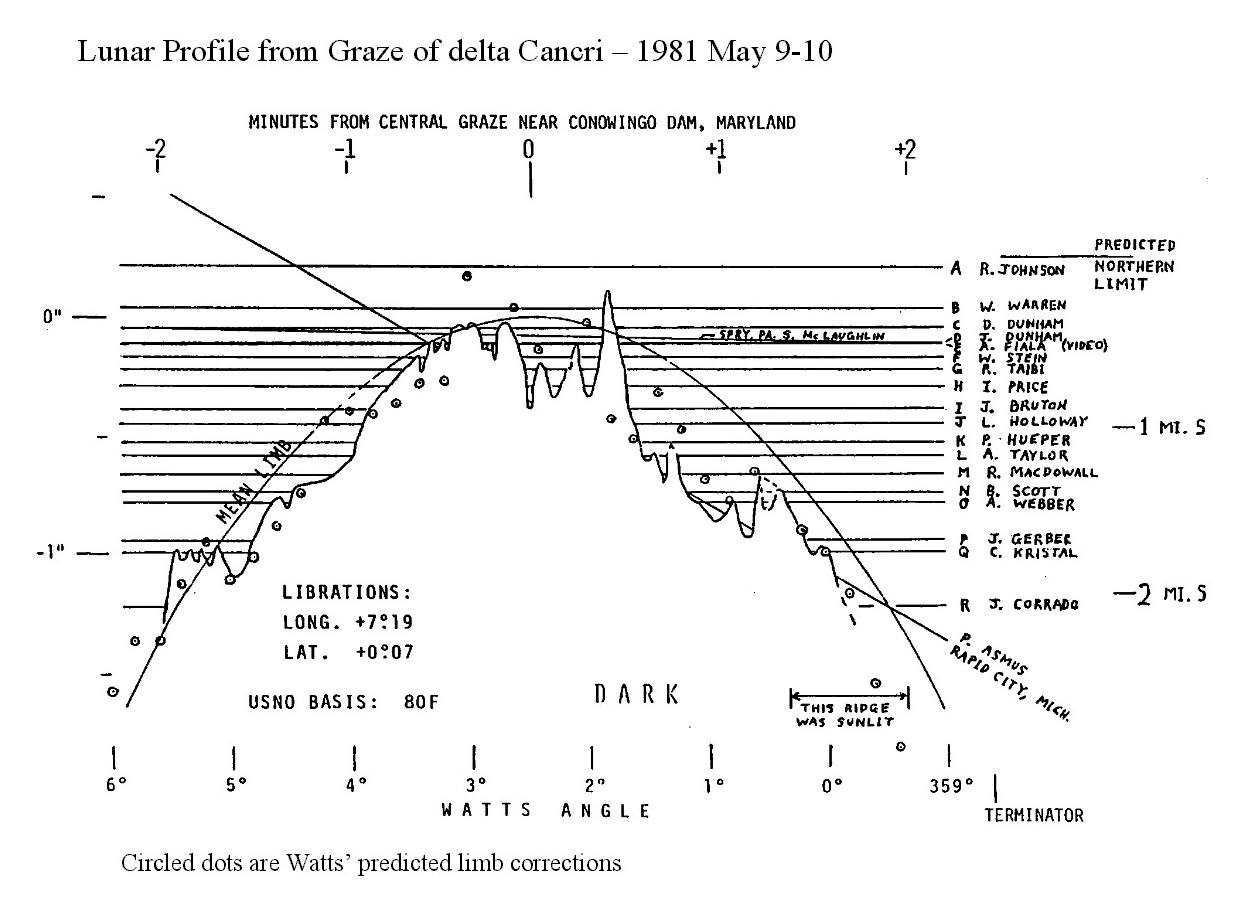
Plot of the results of a grazing occultation of Delta Cancri on May 9-10, 1981. Each horizontal line is one observer’s timings. From “An Introduction to Grazing Occultations” at http://www.lunar-occultations.com/iota/Graze.htm.
03/01/2017 – Ephemeris – It’s Bright Planet Wednesday!
Ephemeris for Ash Wednesday, Wednesday, March 1st. The Sun will rise at 7:19. It’ll be up for 11 hours and 11 minutes, setting at 6:30. The Moon, 3 days past new, will set at 10:14 this evening.
Let’s check out the bright planets for this week. Saturn can be glimpsed this and tomorrow mornings in the southeast before 6:30 a.m. It will rise tomorrow at 3:19 a.m. in the east-southeast. Jupiter can be seen in the southwest these mornings above the star Spica, and later tonight. The giant planet will rise in the east at 9:52 p.m. Venus and Mars are in the evening sky. At 7:30 p.m. these planets will be seen in the western sky. Venus is unmistakable as the brilliant evening star, Mars will be left and above it and much dimmer. The Moon will be left of it tonight.. Venus will set at 9:26 p.m. while Mars will set at 10:13. Venus exhibits a dazzling crescent in small telescopes and binoculars now.
Times are for the Traverse City/Interlochen area of Michigan. They may be different for your location.
Addendum
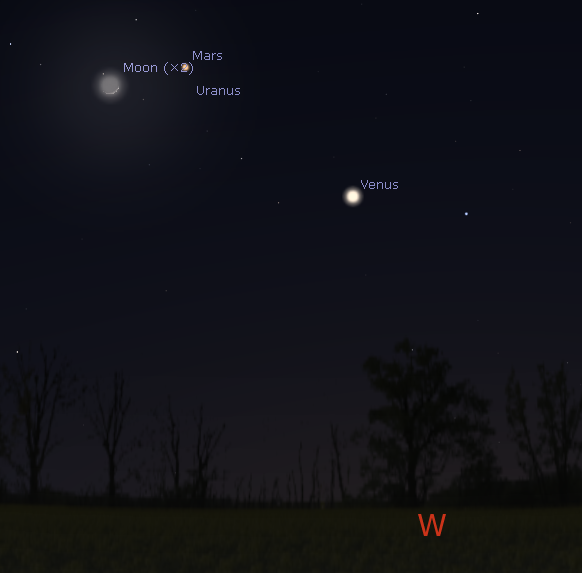
Venus. Mars and the Moon in the west at 7:30 p.m. March 1, 2017. The Moon is twice its actual size for clarity. Created using Stellarium.
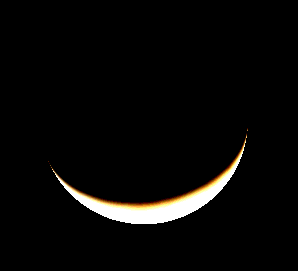
Venus as it might appear in a telescope tonight March 1, 2017. I processed the image to overexpose it as it would appear in a telescope. Created using Stellarium.
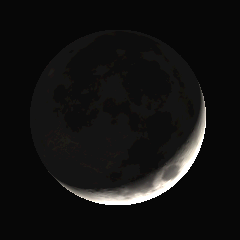
The crescent Moon with earth shine as it might look in binoculars. 7:30 p.m. March 1, 2017. Created using Stellarium.
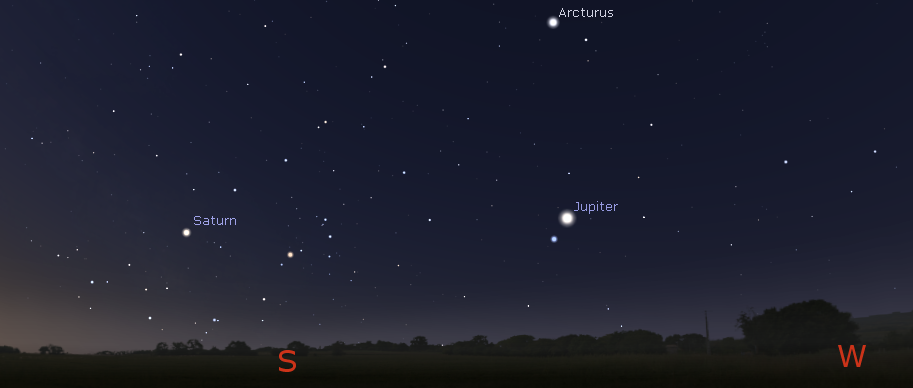
Jupiter in the southwest above the star Spica with Saturn in the south at 6:30 a.m. tomorrow morning, Match 2, 2017. Created using Stellarium.
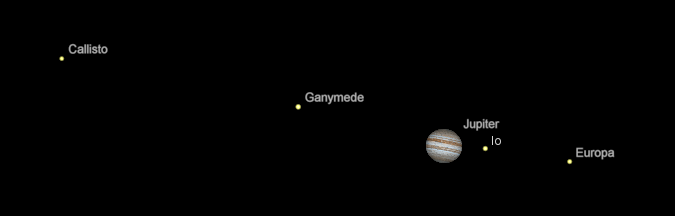
Jupiter and its moons as they might appear in telescopes tomorrow morning at 6:30 a.m. March 2, 2017. Created using Cartes du Ciel (Sky Charts).
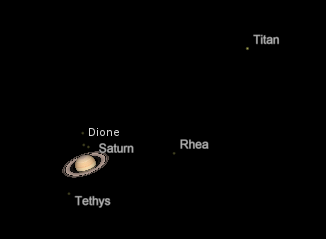
Saturn and its brightest moons as they might appear in telescopes tomorrow morning at 6:30 a.m. March 2, 2017. Created using Cartes du Ciel (Sky Charts).
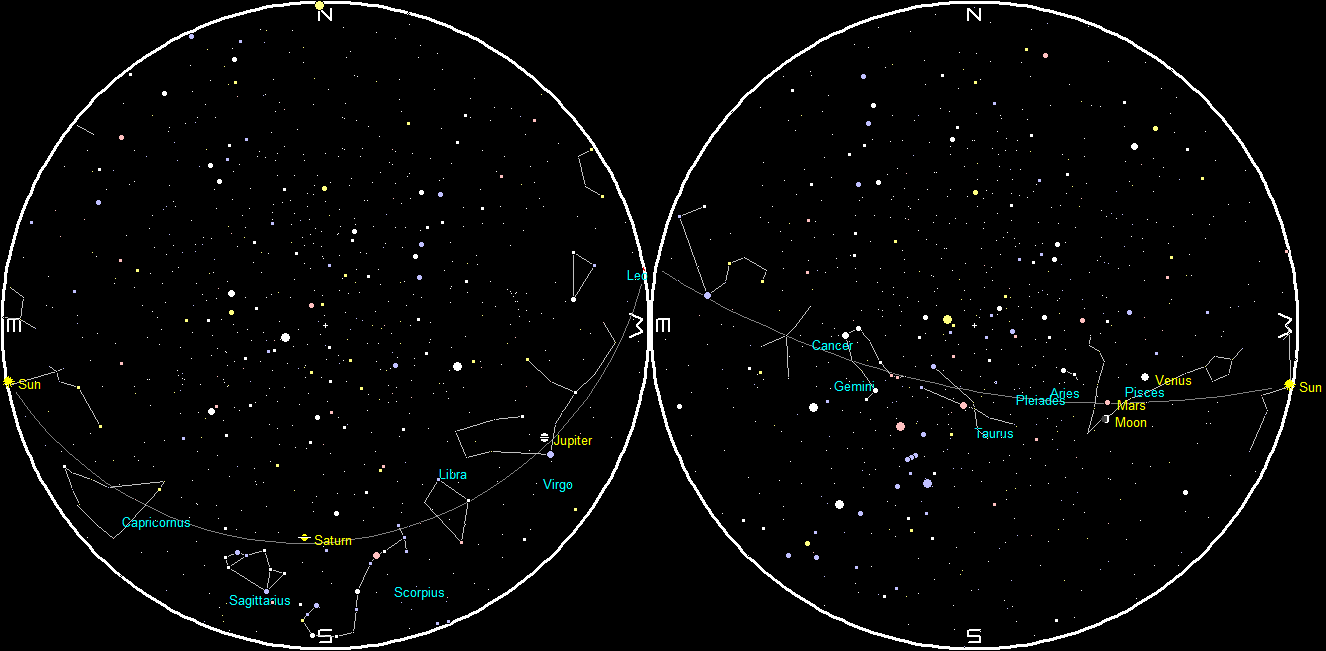
Planets and Moon at sunset and sunrise of a single night starting with sunset on the right on March 1, 2017. The night ends on the left with sunrise on March 2. Click on image to enlarge. Created using my LookingUp program.

