Archive
03/29/2017 – Ephemeris – It’s Wednesday, do you know where your bright planets are?
Ephemeris for Wednesday, March 29th. The Sun will rise at 7:28. It’ll be up for 12 hours and 38 minutes, setting at 8:06. The Moon, 2 days past new, will set at 10:10 this evening.
In the evening sky tonight, replacing Venus will be the elusive planet Mercury. This tiny planet might be seen to the upper right of the Sun’s setting point starting about 9 p.m. It will set at 9:49 p.m. Mars is still hanging on, in the west, and will set at 11:10 p.m. The thin sliver of a crescent Moon is seen left of and above Mercury and Below Mars tonight. This might be a good time to spot Earth shine on it’s night side. Jupiter will rise in the east at 8:47 p.m. a half hour before the star Spica, which it will be seen to hang out with this year. Jupiter will be still seen in the morning sky low in the southwest at 6 a.m. Saturn at the same time is in the south above the Teapot figure of Sagittarius. It will rise tomorrow at 2:33 a.m. in the east-southeast.
Times are for the Traverse City/Interlochen area of Michigan. They may be different for your location.
Addendum
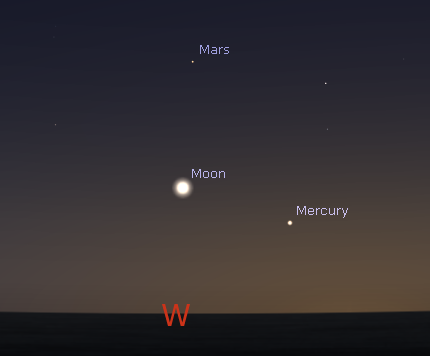
Mercury, Mars and the Moon low in the west at 9 p.m. March 29, 2017. Note the Moon as seen below is a thin crescent which cannot be displayed properly at this scale. Created using Stellarium.
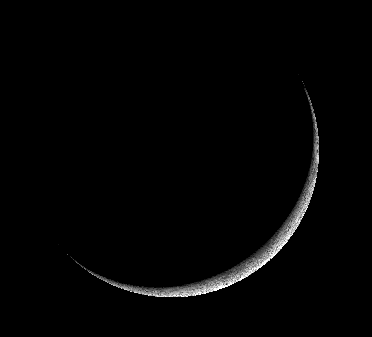
The thin crescent Moon at 9 p.m. March 29, 2017. Created using Hallo Northern Sky. The program does not have the capability to show earth shine to fill out the rest of the sphere which may be detected with the naked eye or in binoculars.
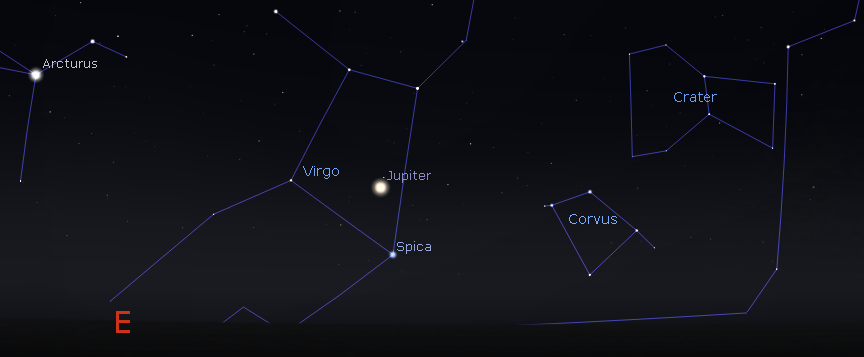
Jupiter low in the east-southeast at 10 p.m. tonight, March 28, 2017. Created using Stellarium.
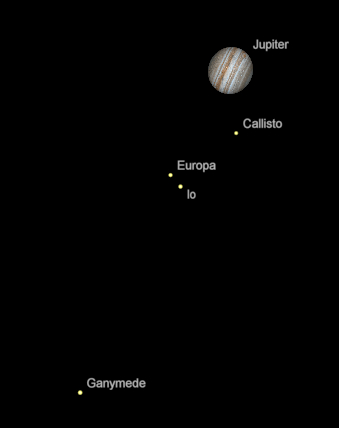
Jupiter and its moons tonight March 29, 2017 at 10 p.m. Created using Cartes du Ciel (Sky Charts).
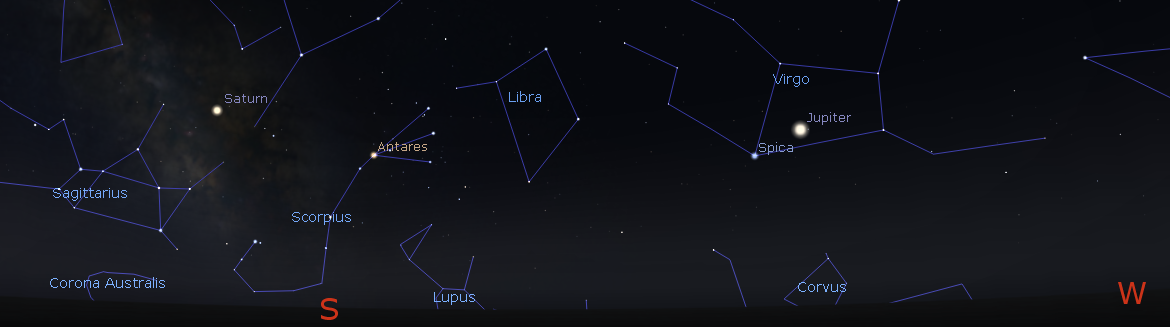
Jupiter and Saturn with the morning constellations of summer at 6 a.m. tomorrow morning March 30, 2017. Created using Stellarium.
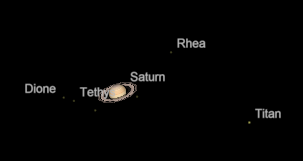
Saturn and its moons at 6 a.m. March 30, 2017. It is shown at the same scale as Jupiter above. Created using Cartes du Ciel (Sky Charts).
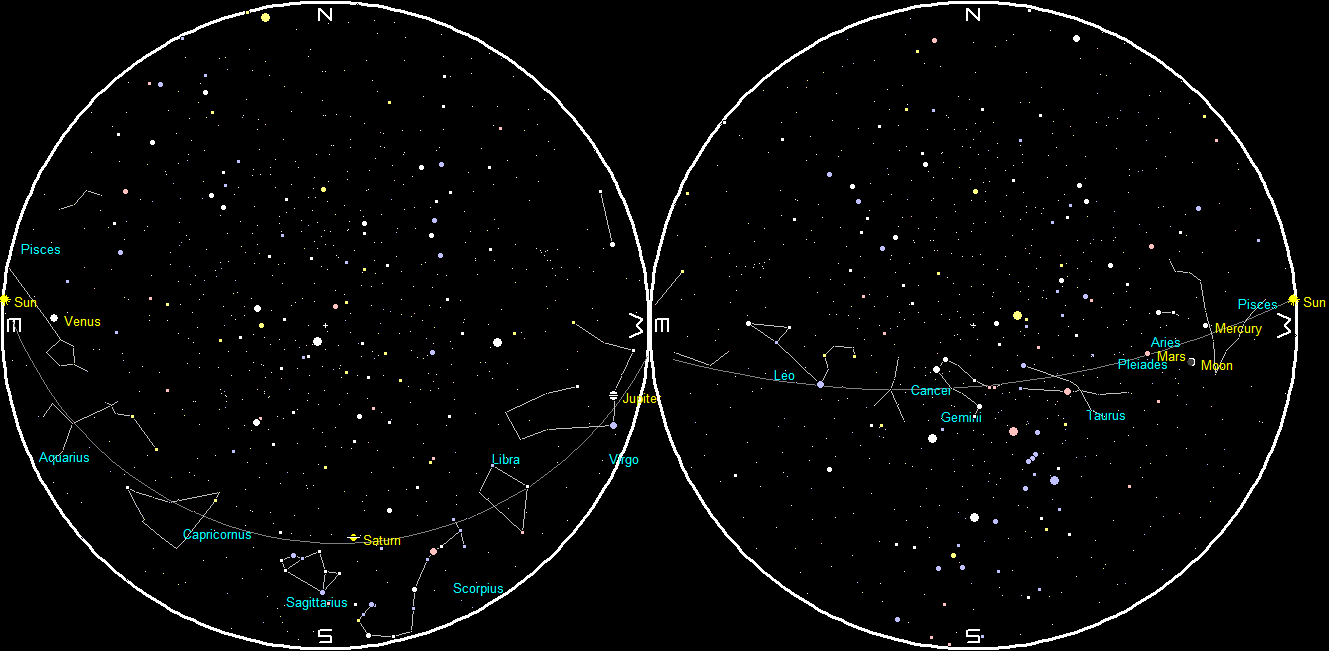
Planets and the Moon at sunset and sunrise of a single night starting with sunset on the right on March 29, 2017. The night ends on the left with sunrise on March 30. Click on the image to enlarge. Created using my LookingUp program.
03/28/2017 – Ephemeris – Mercury is visible in the evening sky now
Ephemeris for Tuesday, March 28th. The Sun will rise at 7:30. It’ll be up for 12 hours and 35 minutes, setting at 8:05. The Moon, 1 day past new, will set at 8:56 this evening.
Mercury is in the evening sky now for it’s spring appearance. Mercury is best seen when it’s near its farthest from the Sun on spring evenings and autumn mornings. Mercury will reach its greatest elongation east of the Sun this coming Saturday with a 19 degree angle of separation from the Sun. This tiny planet is brighter before eastern elongating than after it. I find that the optimal time to look for Mercury is about 45 minutes after sunset. That makes it about 8:50 p.m. At that time Mercury will be low in the west only 9 degrees above the horizon. That’s a bit less than the width of a fist held at arm’s length above the lake or sea horizon, or the base of distant trees that are on your level. Mercury will be visible for about a week or so.
Times are for the Traverse City/Interlochen area of Michigan. They may be different for your location.
Addendum
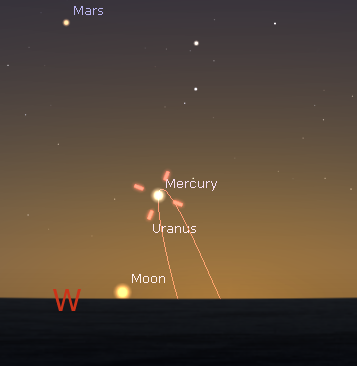
Mercury near the western horizon at 8:50 p.m. or 45 minutes after sunset. Also shown is its orbit as it appears tonight. The Moon and Uranus are not actually visible in the twilight glare. Mars will be visible a bit later. The Moon will appear between Mercury and Mars tomorrow night. Created using Stellarium.
03/27/2017 – Ephemeris – 5 more new moons before the Great American Total Solar Eclipse!
Ephemeris for Monday, March 27th. The Sun will rise at 7:32. It’ll be up for 12 hours and 31 minutes, setting at 8:04. The Moon is new today, and won’t be visible.
The Moon will be officially new at 10:57 this evening. Later this year there will occur at total solar eclipse visible from a narrow path the crosses the United States from Oregon to South Carolina. It will cross the cities of Casper Wyoming, Kansas City, just south of St Louis, Carbondale, Illinois; Nashville, Columbia and Charleston South Carolina. Carbondale is about the closest spot to us at about 600 miles. We will see about 75-80 percent of the Sun blocked by the Moon here in northern Michigan. The is generally a solar eclipse about every six new moons, the exception is an occasional solar eclipse on two consecutive new moons, except they will occur in opposite polar regions and are rarely total. The Moon’s orbit is tilted by 5° to the Sun’s path. This time the Moon is way south of the Sun.
Times are for the Traverse City/Interlochen area of Michigan. They may be different for your location.
Addendum
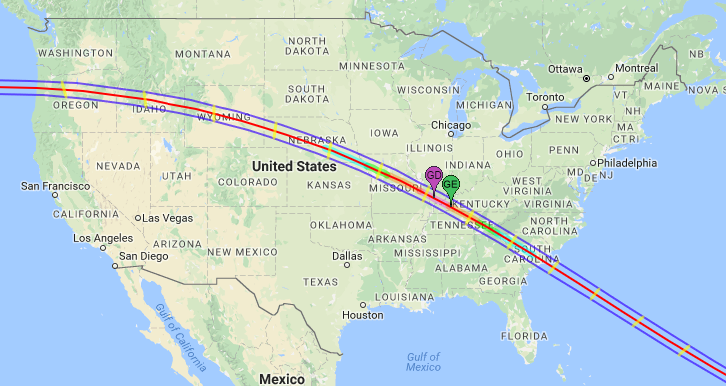
A screen cap of the map showing the path of totality of the August 21, 2017 total solar eclipse from NASA’s eclipse page. Credit: NASA and Google Maps.
The points are GE greatest eclipse, path width 71.27 miles (114.7 km); and GD greatest duration of totality, 2 minutes and 40.2 seconds.
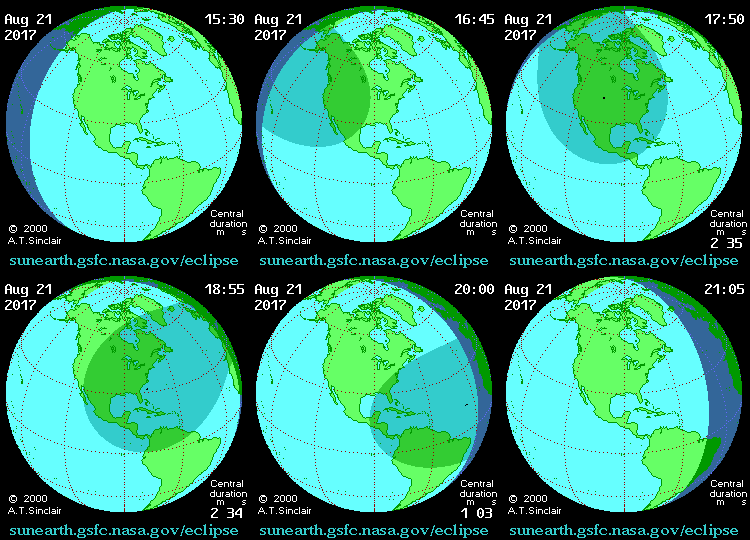
An animation of the Moon’s shadow as it will cross the Earth’s surface August 21, 2017. Credit A.T. Sinclair/NASA
NASA’s Eclipse page: https://eclipse2017.nasa.gov/
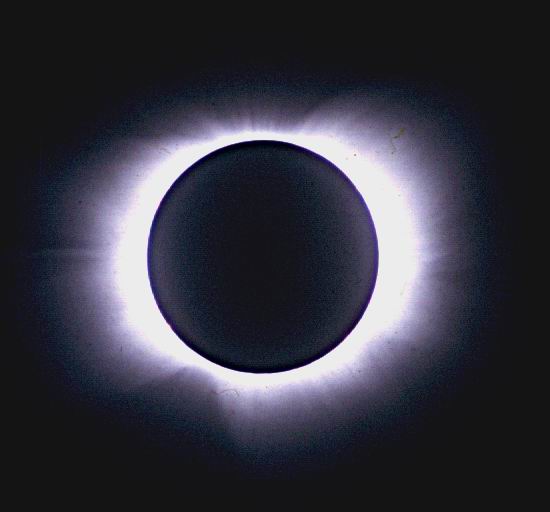
The solar corona displayed during the July 10, 1072 total solar eclipse from Prince Edward Island. Credit Bob Moler.
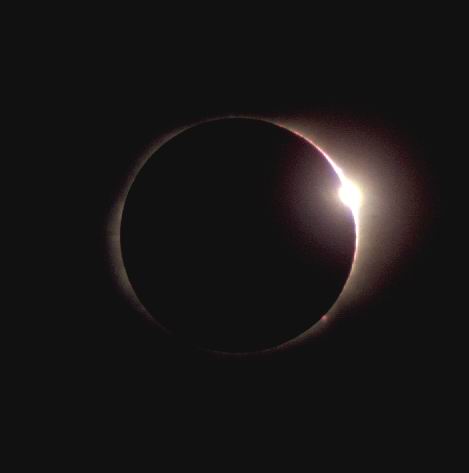
Diamond ring at the end of totality of the total solar eclipse July 10, 1972. Credit Bob Moler.
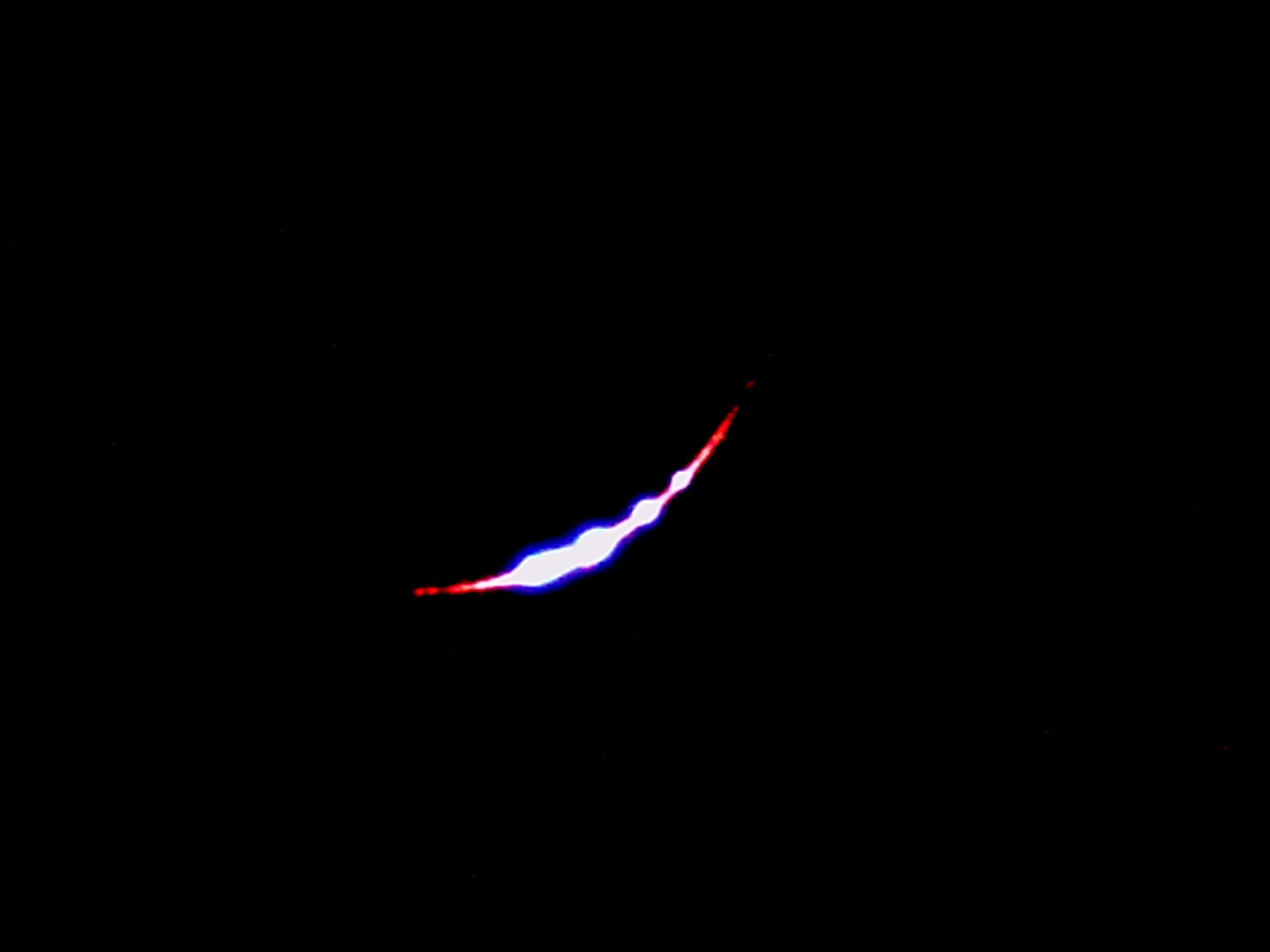
Baily’s Beads – sunlight streaming through the valleys at the edge of the Moon at the end of totality, March 7, 1970, outside Bladenboro NC. Credit Bob Moler.
On May 5th, I’ll be giving a talk about the upcoming total solar eclipse. How to enjoy its partial phases here and along the path of totality.
03/24/2017 – Ephemeris – Finding Leo
Ephemeris for Friday, March 24th. The Sun will rise at 7:37. It’ll be up for 12 hours and 22 minutes, setting at 8:00. The Moon, 3 days before new, will rise at 6:24 tomorrow morning.
At 10 p.m. the spring constellation of Leo the lion will be high in the east-southeast. It can be found by locating the Big Dipper high in the northeast and imagining that a hole were drilled in the bowl to let the water leak out. It would drip on the back of this giant cat. The Lion is standing or lying facing westward. His head and mane are seen in the stars as a backwards question mark. This group of stars is also called the sickle. The bright star Regulus is at the bottom, the dot at the bottom of the question mark. A triangle of stars, to the left of Regulus, is the lion’s haunches. Leo contains some nice galaxies visible in moderate sized telescopes. The stars in Leo’s part of the sky are sparser than those in the winter sky.
Times are for the Traverse City/Interlochen area of Michigan. They may be different for your location.
Add info on Mercury in the evening sky.
Addendum
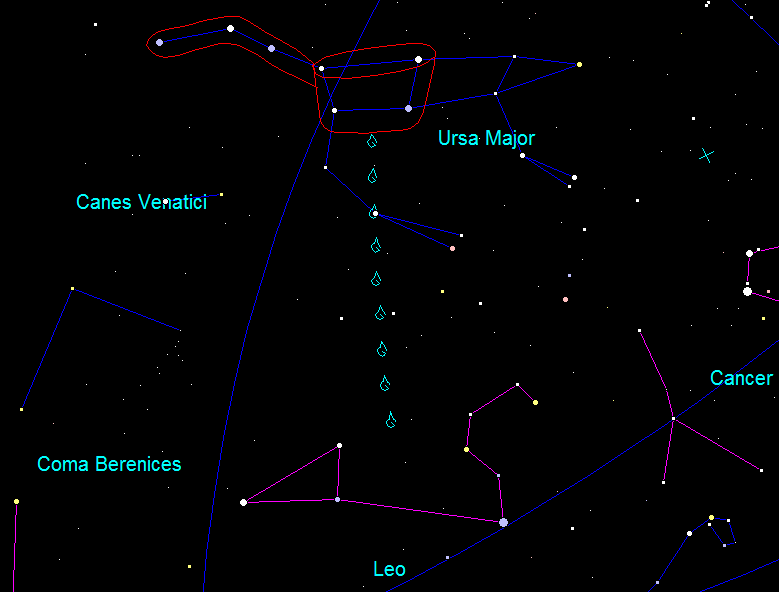
Leaky Big Dipper drips on Leo. Created using mu LookingUp program.
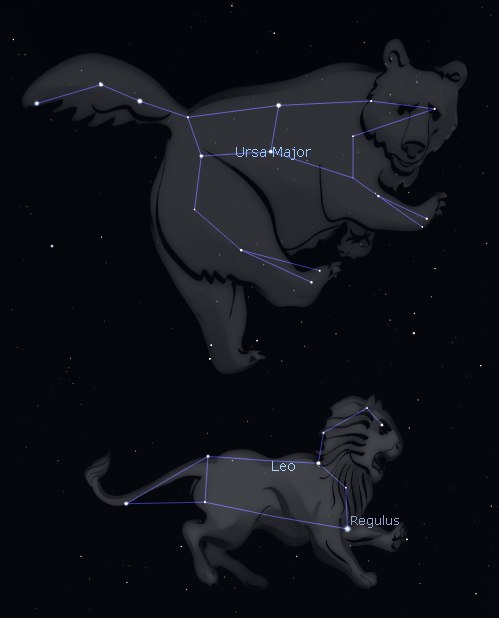
Ursa Major with the Big Dipper in her hind end and Leo. Created using Stellarium and GIMP.
03/23/2017 – Ephemeris – a single headed Hydra
Ephemeris for Thursday, March 23rd. The Sun will rise at 7:39. It’ll be up for 12 hours and 19 minutes, setting at 7:59. The Moon, 3 days past last quarter, will rise at 5:48 tomorrow morning.
In the southern evening sky can be found the constellation of Hydra the water snake. Unlike the mythical monster Hercules fought of the same name this Hydra has but one head, which is its most distinctive part. At 9 p.m. look to the south. The head of Hydra is located directly to the left of Procyon the bright star in Orion’s little dog Canis Minor, and to the right of the star Regulus in Leo. Hydra’s head is a small distinctive group of 6 stars that make a loop and the snake’s slightly drooping head. At that time the sinuous body of Hydra sinks below the horizon in the southeast. As it gets later in the evening the rest of Hydra’s body will slither to just above the southeastern horizon below the planet Jupiter this year and the bright star Spica in the constellation of Virgo.
Times are for the Traverse City/Interlochen area of Michigan. They may be different for your location.
Addendum
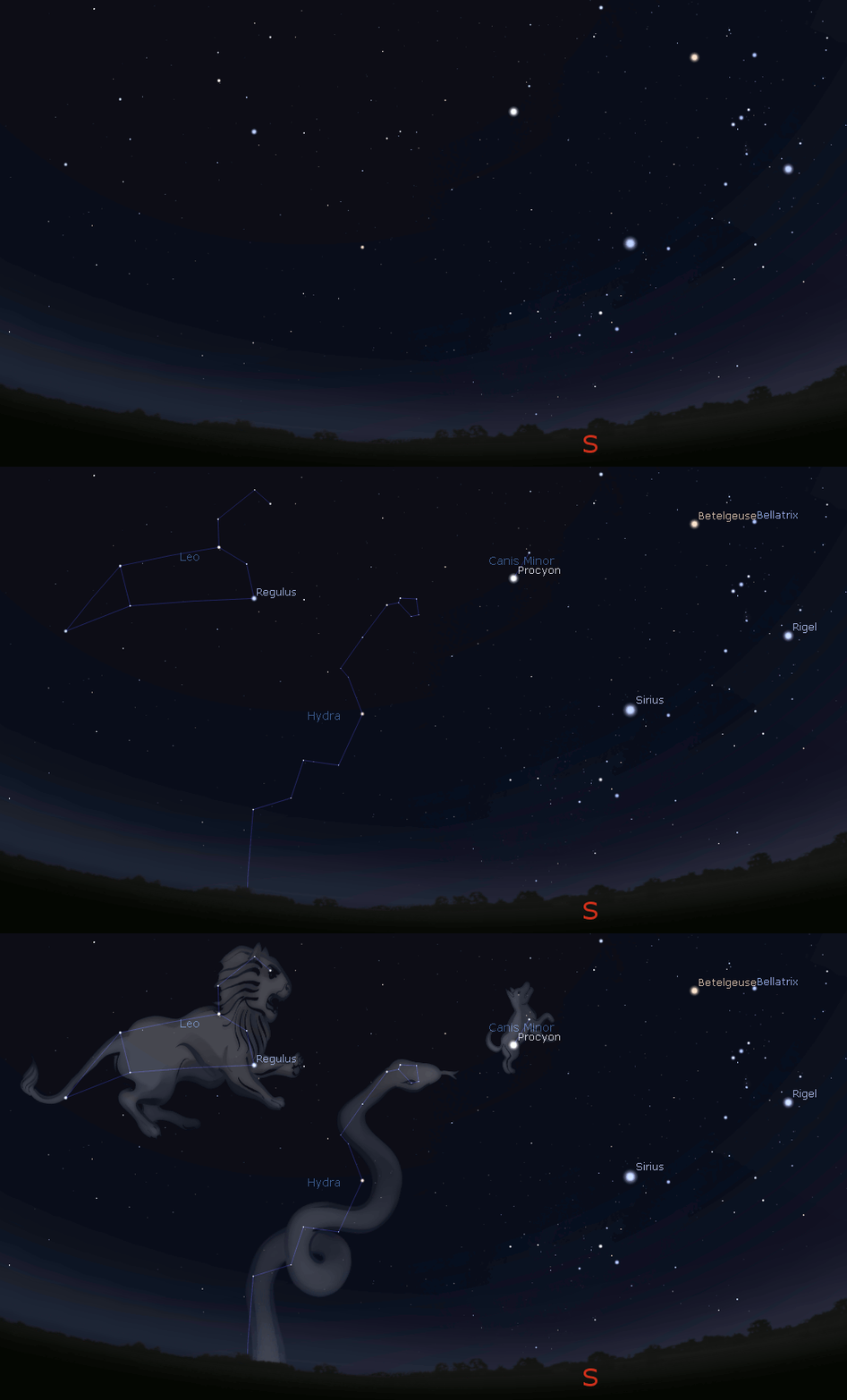
Finding Hydra animation for 9 p.m. March 23rd 2017. Created using Stellarium. Click on image to enlarge.
03/22/2017 – Ephemeris – Wednesday is bright planet day but we seem to be missing one of them
Ephemeris for Wednesday, March 22nd. The Sun will rise at 7:41. It’ll be up for 12 hours and 16 minutes, setting at 7:57. The Moon, 2 days past last quarter, will rise at 5:09 tomorrow morning.
It’s still dark enough to see the morning planets again during these Ephemeris play times. But it won’t last. Jupiter will be seen in the morning in the southwest above the star Spica. It will rise tonight at 9:19 p.m. in the East. Saturn can be glimpsed this morning above the Teapot figure of Sagittarius in the south. It will rise tomorrow at 3 a.m. in the east-southeast. The crescent Moon will be in the east-southeast. In the evening sky tonight Venus is essentially gone, just 3 days from passing inferior conjunction, it might be seen to the upper right of the Sun’s setting point. I once spotted it this close to conjunction in the bright twilight. It will set at 8:35 p.m. Mars is still hanging on, in the west, and will set at 11:11 p.m.
Times are for the Traverse City/Interlochen area of Michigan. They may be different for your location.
Addendum
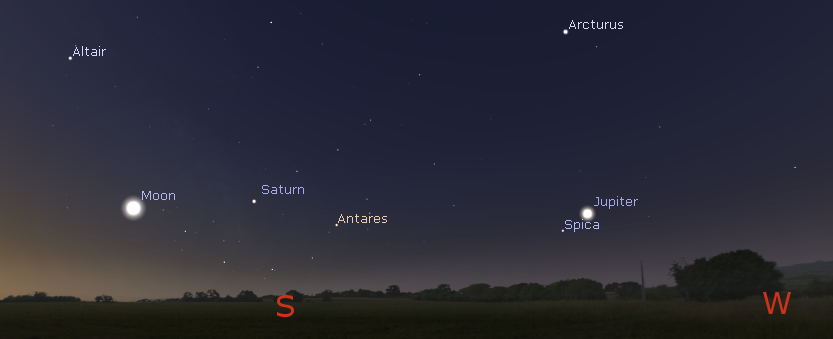
Jupiter, Saturn and the crescent Moon at 7 a.m. this morning March 22, 2017. Created using Stellarium.
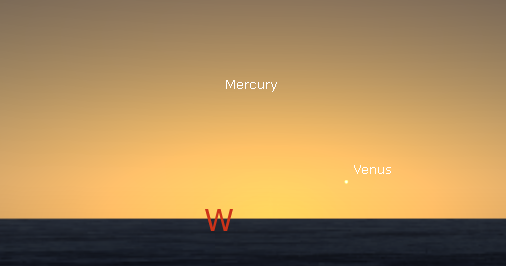
Venus at 15 minutes after sunset on a flat horizon 3 days before inferior conjunction from 45 degrees north latitude. Venus is seen at 3 degrees, 24 minutes above the horizon and practically invisible. Mercury is getting ready for its appearance in the west next week. We will visit it in more detail on Friday. Created using Stellarium.
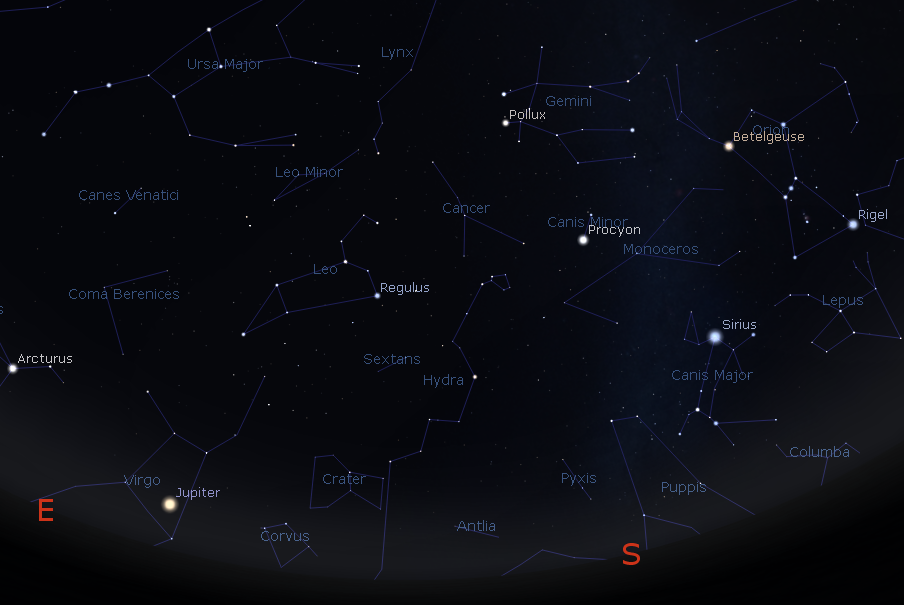
Jupiter rising and the constellations of winter and spring at 10 p.m. this evening March 22, 2017. Created using Stellarium.
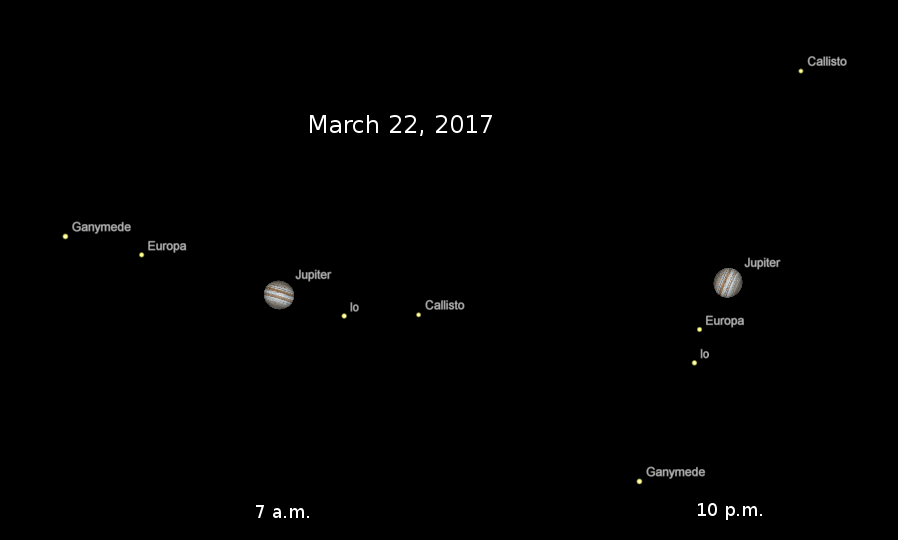
Jupiter and its moons at 7 a.m. and 10 p.m. today, March 22, 2017. orientation of Jupiter is as it appears on the sky at those times. Created using Cartes du Ciel (Sky Charts).
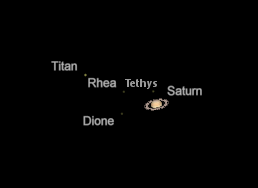
Saturn and its moons at 7 a.m. March 22, 2017. It is shown at the same scale as Jupiter above. Created using Cartes du Ciel (Sky Charts).
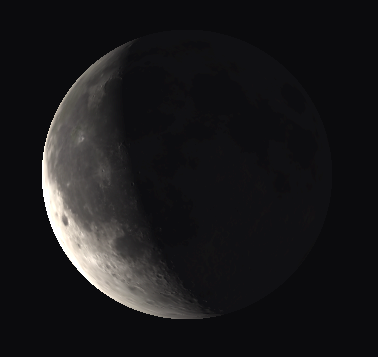
The waning crescent Moon at 7 a.m. as it might be seen in binoculars. Created using Stellarium.
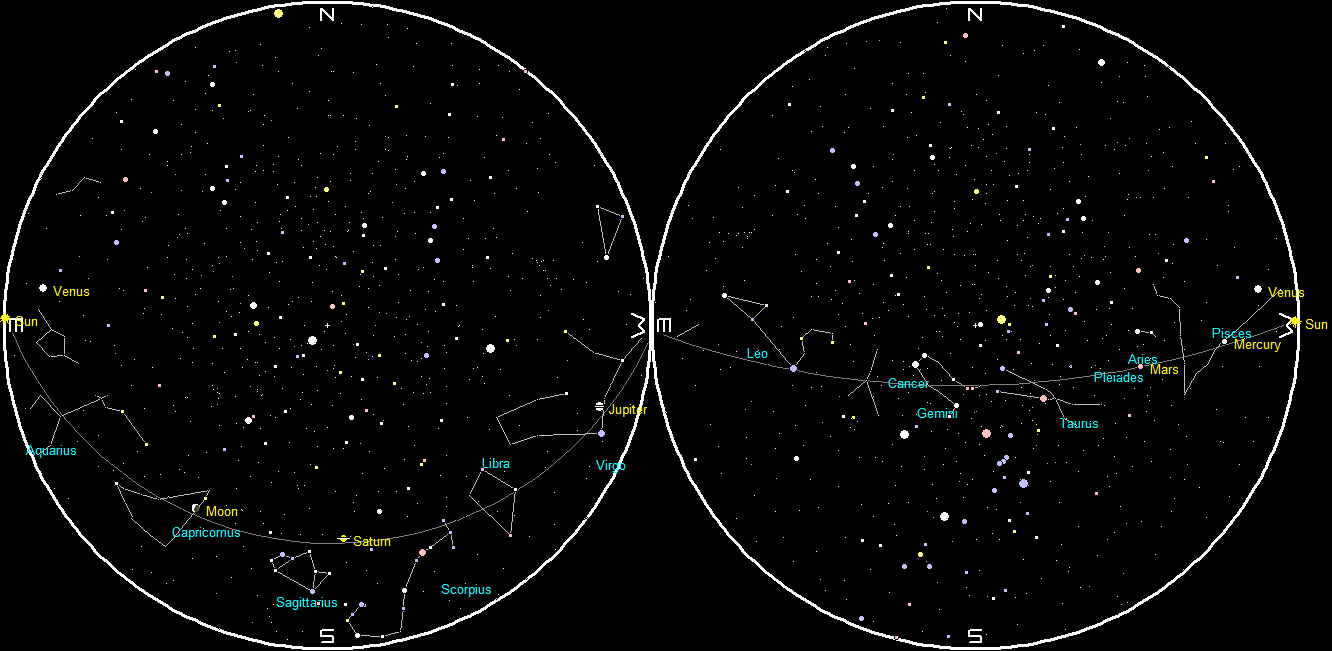
Planets and the Moon at sunset and sunrise of a single night starting with sunset on the right on March 22, 2017. The night ends on the left with sunrise on March 23. Note that Venus is visible at both sunrise and sunset at least on these charts. Click on image to enlarge. Created using my LookingUp program.
03/21/2017 – Ephemeris – Let’s find Cancer the crab
Ephemeris for Tuesday, March 21st. The Sun will rise at 7:43. It’ll be up for 12 hours and 13 minutes, setting at 7:56. The Moon, 1 day past last quarter, will rise at 4:26 tomorrow morning.
At 10 this evening, the faint constellation, and member of the Zodiac, Cancer the crab is located in the south half way between the bright stars Castor and Pollux of the constellation Gemini, high in the south and the bright star Regulus in Leo the lion in the southeast. Cancer is very dim, looking like an upside-down Y if it’s stars can be made out. In the center of Cancer is a fuzzy spot to the unaided eye. In binoculars or a low power telescope this fuzzy spot becomes a cluster of stars. It is the Beehive cluster. At 577 light years away, according to the latest measurements, it is one of the closest star clusters, but more distant than the Pleiades and Hyades the face of Taurus the bull off in the west.
Times are for the Traverse City/Interlochen area of Michigan. They may be different for your location.
Addendum
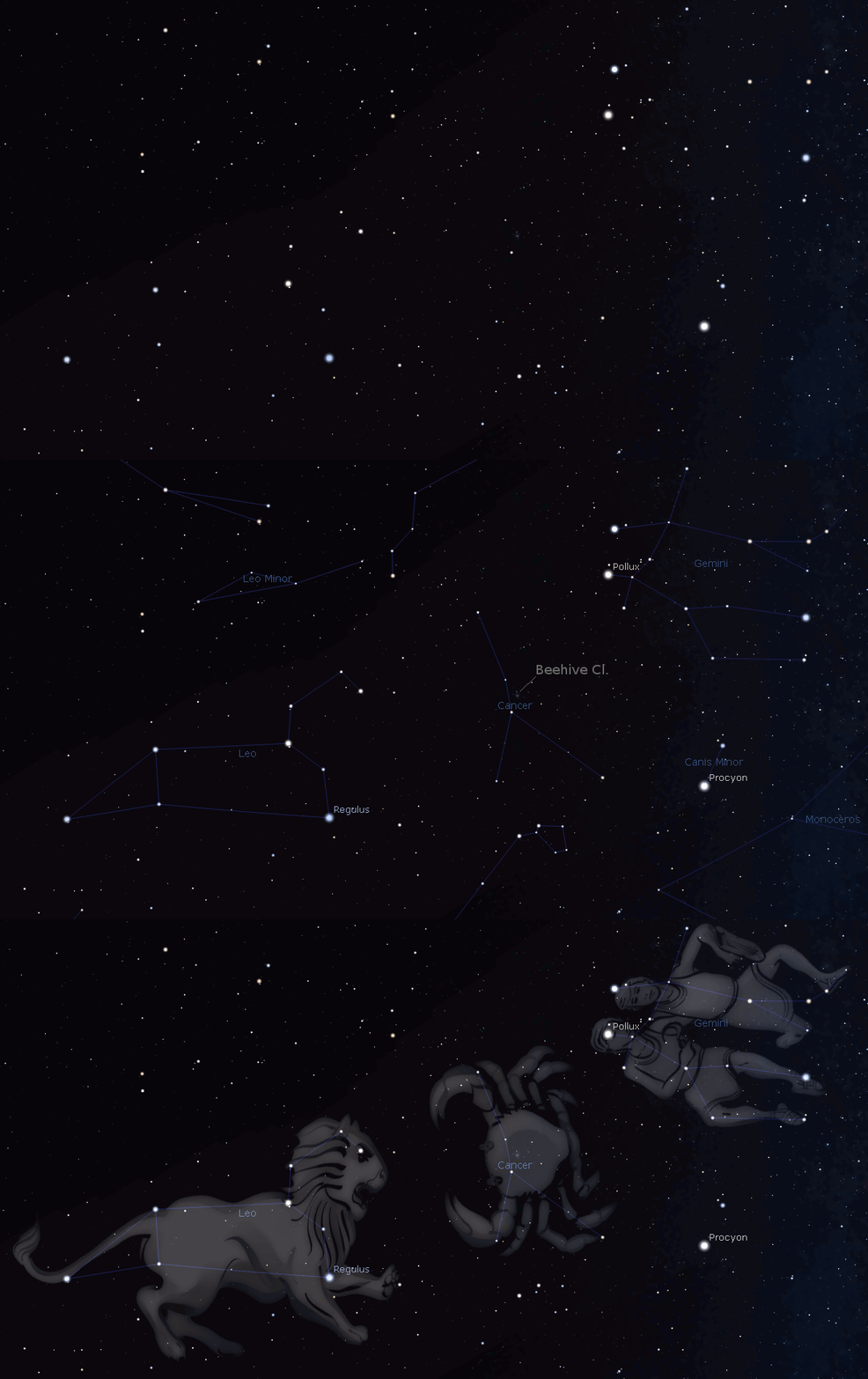
Cancer the crab finder chart. Note the beehive cluster, also known to amateur astronomers as M44, along with other catalog names. Created using Stellarium and GIMP.
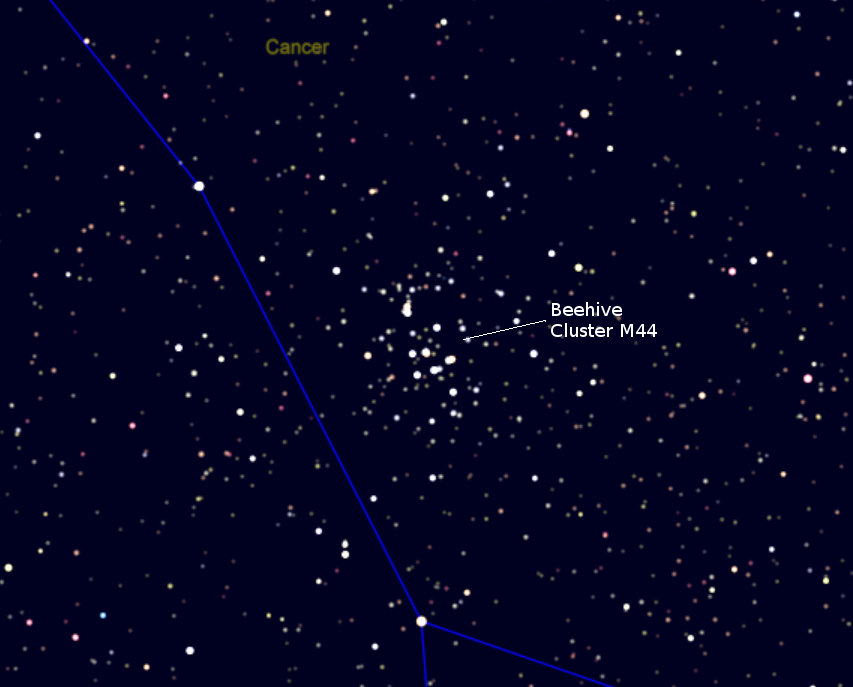
The Beehive star cluster, M44. Its ancient name was the Praesepe or manger when glimpsed by the naked eye. Created using Cartes du Ciel (Skycharts)
03/20/2017 – Ephemeris – Spring starts today!
Ephemeris for Monday, March 20th. The Sun will rise at 7:45. It’ll be up for 12 hours and 10 minutes, setting at 7:55. The Moon, at last quarter today, will rise at 3:39 tomorrow morning.
This morning, at 6:29 (10:29 UT) the sun crosses overhead at the earth’s equator as it appears to head north, starting for us the season of spring. It’s the vernal equinox. As you can tell from my intro, we’re already above 12 hours of daylight, and we’ll add another 3 plus hours of daylight before summer begins in three months. We are already adding about 3 minutes a day of daylight to that goal now, the maximum rate. With the Sun out longer and its ascension higher in the sky each day, it is rapidly adding energy to the northern hemisphere. We don’t feel that immediately. While the land rapidly absorbs heat, the oceans and lakes, especially the Great Lakes are a big heat sink, taking a very long time to warm up.
Times are for the Traverse City/Interlochen area of Michigan. They may be different for your location.
Addendum
This March equinox also is the beginning of autumn for folks south of the equator.
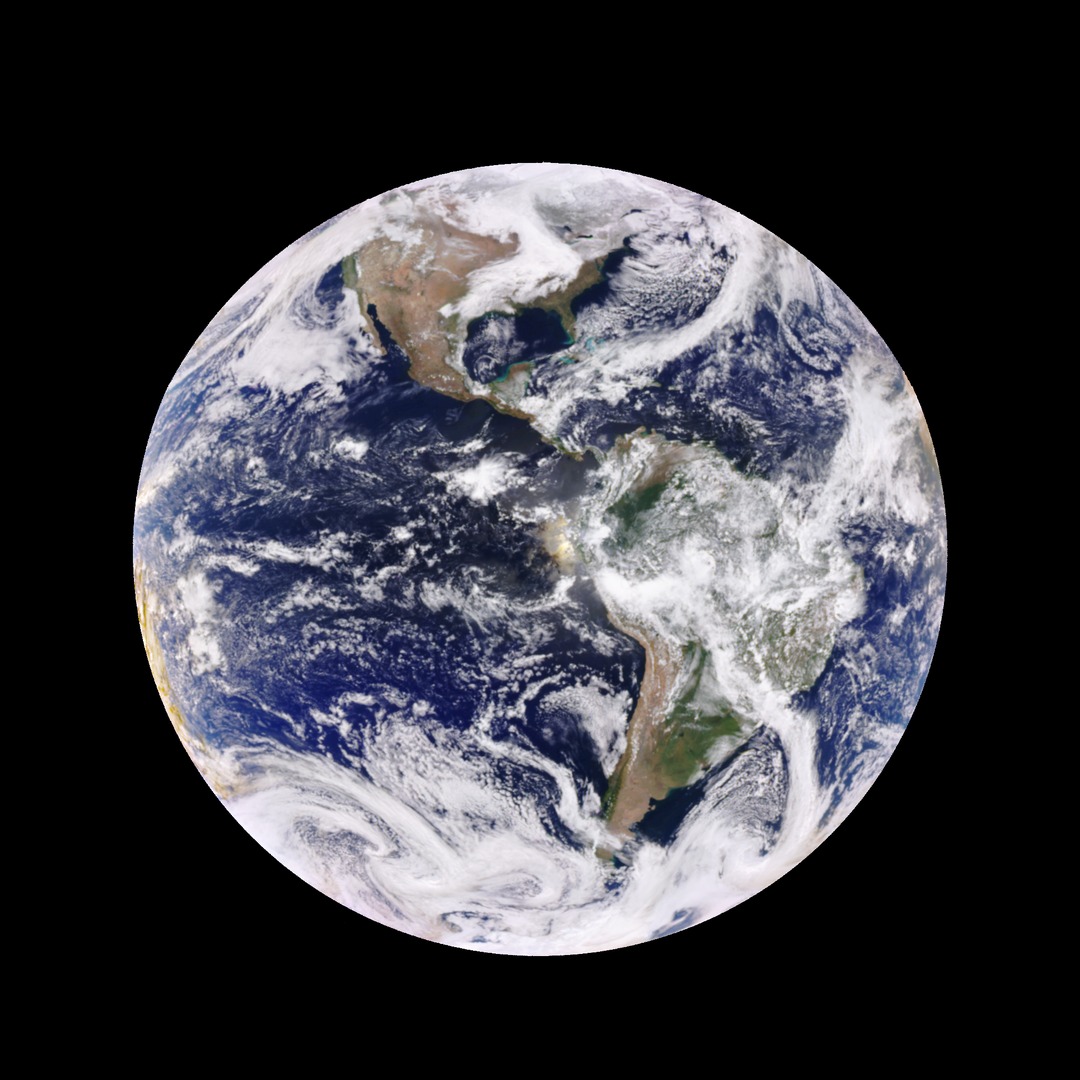
Image from the DISCOVR satellite in halo orbit at the Earth-Sun L1 point, nearly a million miles (1.6 million km) sunward of the Earth. as of March 17, 2017. As usual Michigan is covered by a cloud. Credit NOAA/NASA.
03/16/2017 – Ephemeris – Curly Tail, The Great Underwater Panther
Ephemeris for Thursday, March 16th. The Sun will rise at 7:52. It’ll be up for 11 hours and 57 minutes, setting at 7:50. The Moon, half way from full to last quarter, will rise at 12:03 tomorrow morning.
The Anishinabek people of the Great Lakes Region, which includes the Ottawa, Chippewa and Ojibwe Indians have two constellations of winter that I know of. The first is The Winter Maker which uses many of Orion’s stars plus Procyon the Little Dog Star. It rises in the eastern skies in the evening as winter is beginning. The second is the Curly Tail, the Great Underwater Panther. Which uses the stars of Leo the lion’s backward question mark as its tail and the small knot of stars that are the head of Hydra the water snake below Cancer as its head. I imagine this constellation was a warning to youngsters to keep off the thinning ice of spring, lest they fall in and be snatched by the great underwater panther that lives beneath the ice.
Times are for the Traverse City/Interlochen area of Michigan. They may be different for your location.
Addendum
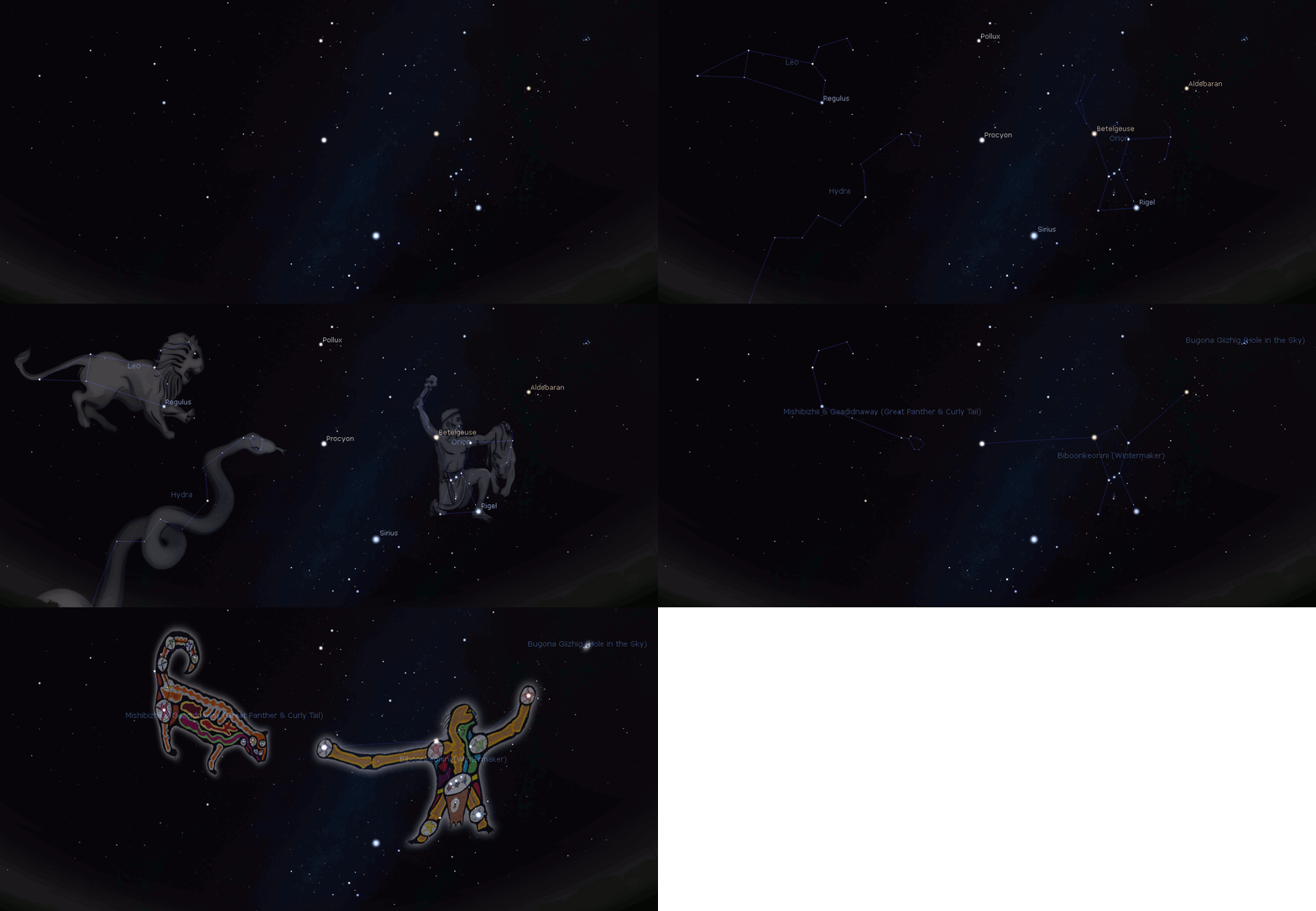
An animated GIF rotating between an unannotated star field facing south at 10 p.m. March 16th.; Western constellation names and lines for Orion, Hydra, and Leo; Western constellation art, Ojibwe constellation names and lines; and Ojibwe constellation art. Created using Stellarium. The Ojibwe constellation art is supplied as part of the latest version of Stellarium. Click on the image to enlarge.
The source for the Ojibwe constellation art is from Ojibwe Sky Star Map Constellation Guide (An introduction to Ojibwe Star Knowledge) by Annette S. Lee, William Wilson, Jeffrey Tibbetts, and Carl Gawboy, ISBN 978-0-615-98678-4. The illustrations are by Annette S. Lee and William Wilson. There is also a poster sized star map available. It should be available in book stores locally, or at Amazon. I found my copy at Enerdyne in Suttons Bay.
Also shown is the Pleiades, which to the Ojibwe is Hole in the Sky, which has to do with the Shaking Tent Ceremony. The Pleiades is also known as the Sweating Stones, the heated stones used in the Sweat Lodge Ceremony. In the later spring sky the Sweat Lodge itself is seen in the stars of the Western Corona Borealis.
Note: As far as tribe names go: Ottawa = Odawa, and Chippewa = Ojibwe.
03/15/2017 – Ephemeris – Wednesday is bright planet day. Do you know where your planets are?
Ephemeris for Wednesday, March 15th. The Sun will rise at 7:54. It’ll be up for 11 hours and 54 minutes, setting at 7:48. The Moon, 3 days past full, will rise at 11:04 this evening.
It’s dark enough to see the morning planets during these Ephemeris programs again. But it won’t last. Jupiter will be seen in the morning in the southwest above the star Spica, with the bright waning gibbous moon above and left of them. It will rise tonight at 9:50 p.m. in the east. Saturn can be glimpsed this morning above the Teapot figure of Sagittarius. It will rise tomorrow at 3:37 a.m. in the east-southeast. In the evening sky tonight Venus, low in the west, is diving toward the Sun, though it will pass north of the Sun. Actually the thin crescent is showing it, canted a bit to the left, rather than to the right as you’d expect. Ten days and it’s officially outta here, and into the morning sky. Mars is still hanging on, way above Venus in the west.
Times are for the Traverse City/Interlochen area of Michigan. They may be different for your location.
Addendum
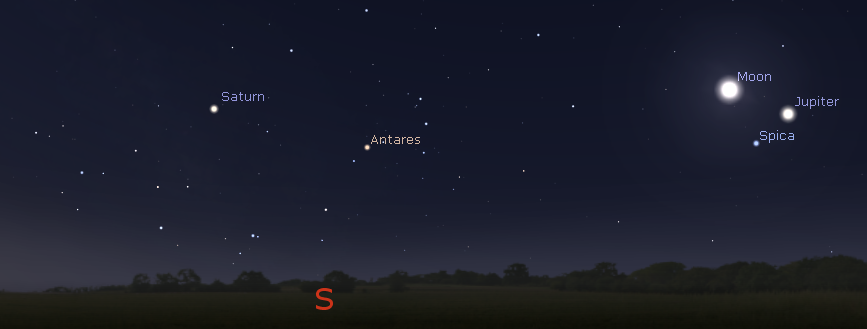
Jupiter, Saturn and the Moon at 7 a.m. this morning, March 15, 2017. Created using Stellarium.
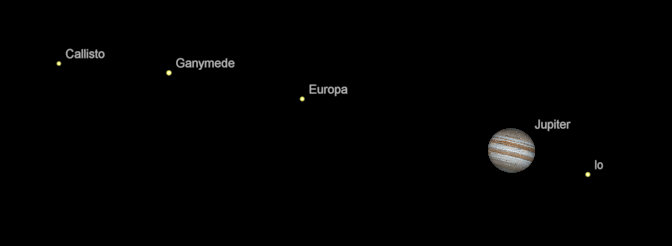
Jupiter and its moons at 7 a.m. (11:00 UT) March 15, 2017. Created using Cartes du Ciel (Sky Charts).
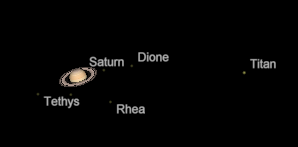
Saturn and its brightest moons as they might appear in telescopes this morning at 7:00 a.m. (11:00 UT) March 15, 2017. Shown at the same magnification as Jupiter above for comparison of apparent sizes. Created using Cartes du Ciel (Sky Charts).
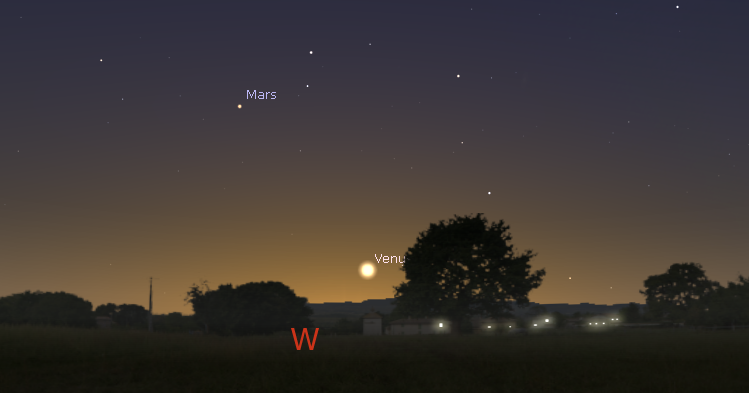
Venus and Mars in the west at 8:30 p.m. this evening March 15, 2016. Venus is only 10 days from inferior conjunction with the Sun. Created using Stellarium.
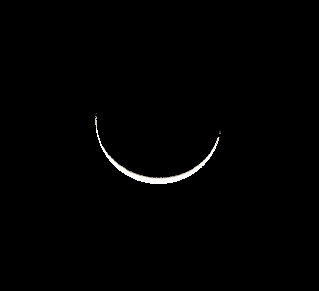
Venus as it might appear in a telescope at 8:30 p.m. March 15, 2017. Created using Hallo Northern Sky.
This is the first time I’ve used an image from Hallo Northern Sky (HNSKY) I found Hallo Northern Sky a few years ago and found it difficult to use, but its operation has improved with newer releases. It looks bare bones, like my LookingUp program, but I have yet to plumb all its depths. It’s really quite sophisticated. More clinical than pretty. I have a link to it on the right under Free Astronomical Software. It produces a better skinny crescent Venus than the other software I have.
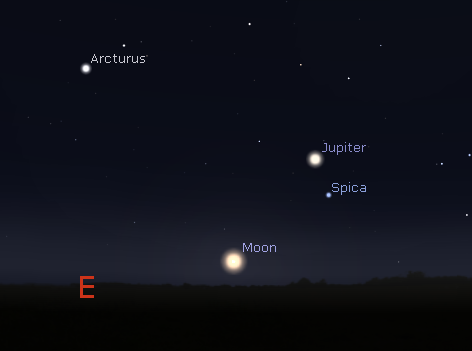
Jupiter, Spica and the Moon in the eastern sky at 11:30 p.m. tonight March 15, 2017. Created using Stellarium.
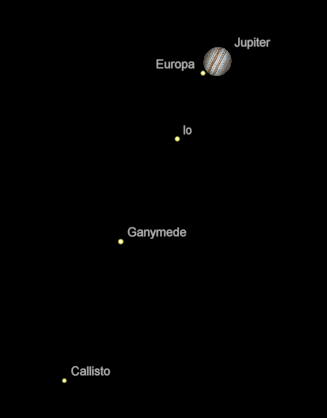
Jupiter and its Moons tonight March 15, 2017 at 11:30 p.m.. I noticed Europa’s shadow was cast on the planet. It’s a bit too low in the sky to be seen here in northern Michigan, but easier to see east of here, and as it rises higher. See the table of events below. Created using Cartes du Ciel (Sky Charts).
Europa: Shadow crossing start: 16 Mar 2017 2:46 UT
Europa: Transit start: 16 Mar 2017 3:55 UT, 15 Mar 11:55 p.m. EDT
Europa: Shadow crossing end : 16 Mar 2017 5:15 UT, 1:15 a.m. EDT
Europa: Transit end : 16 Mar 2017 6:15 UT, 2:15 a.m. EDT
Satellite events were obtained from Project Pluto.
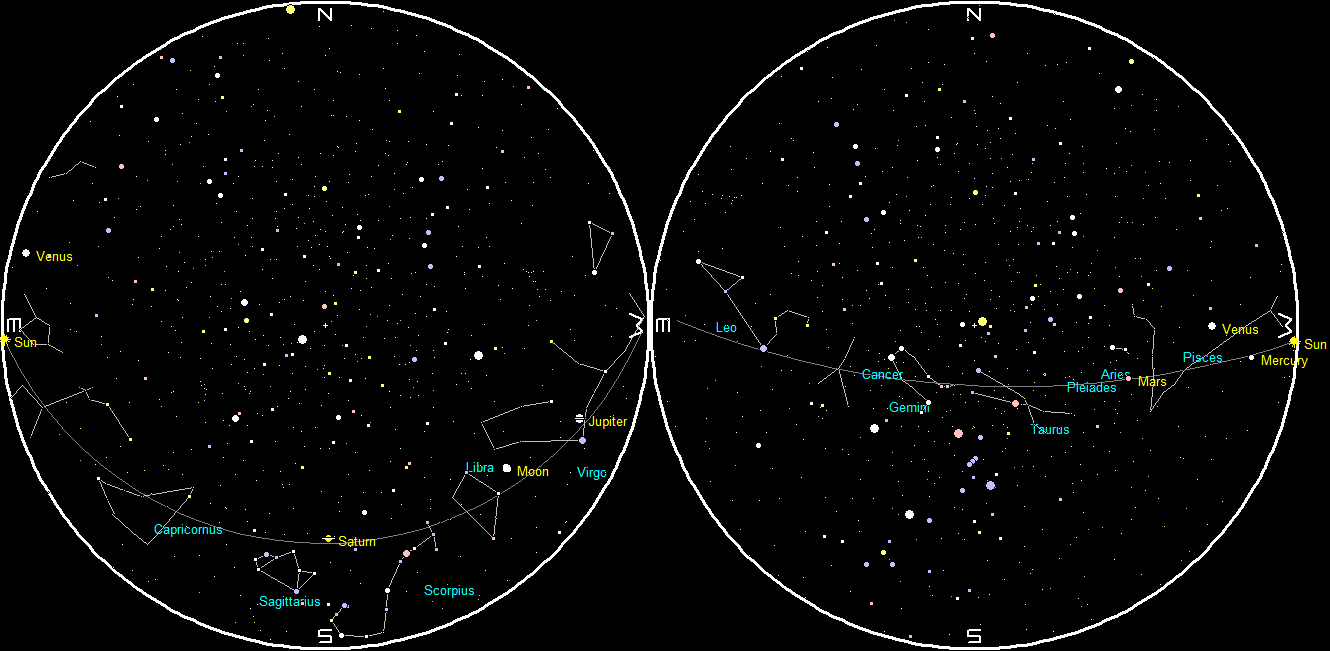
Planets and the Moon at sunset and sunrise of a single night starting with sunset on the right on March 15, 2017. The night ends on the left with sunrise on March 16. Note that Venus is visible at both sunrise and sunset at least on these charts. It will rise only 13 minutes before the Sun, so would not actually be visible. Click on image to enlarge. Created using my LookingUp program.
Venus appears 8° 20′ north of the ecliptic (path of the Sun in the sky) now. This is due to the fact that Venus’ orbit is slightly tilted to the Earth’s orbit by 3.3 degrees, and now it is extremely close to us at only 27 million miles (43.5 million km) from us, a lot closer than Mars ever gets to us.

