Archive
03/09/2015 – Ephemeris – The Big Dipper, a sign of spring
Ephemeris for Monday, March 9th. The Sun will rise at 8:06. It’ll be up for 11 hours and 34 minutes, setting at 7:40. The Moon, 4 days before last quarter, will rise at 11:43 this evening.
There’s a sign of spring appearing in the sky, rising high in the northeast. It’s the Big Dipper standing on its handle. In the native story of the Fisher Star, it’s the sign that it’s time for the maple sugar season. The Big Dipper is part of Ursa Major the great bear or a weasel-like creature called Fisher or Fisher Star. Draw a line through the bottom of the bowl of the dipper as if it leaks, and it will drip on the back of Leo the lion in the southeast. The handle of the Big Dipper will arc to Arcturus after 10 p.m. when that star rises. The most important guide that the Big Dipper provides is to point to Polaris, the north star. The two stars at the front of the bowl of the dipper point to Polaris, that alone of all the stars appears fixed in the north.
Times are for the Traverse City/Interlochen area of Michigan. They may be different for your location.
Addendum
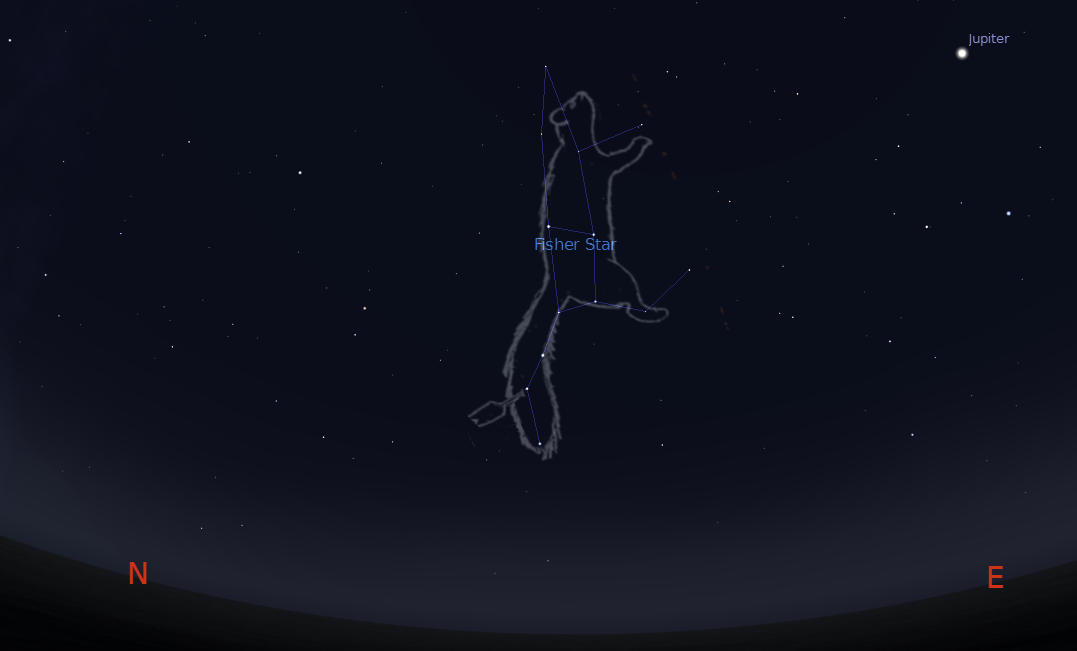
The Big Dipper, part of Ursa Major and also part of Fisher Star in the northeastern sky at 9 p.m. March 9, 2015
For the story of Fisher Star follow this link.
03/06/2015 – Ephemeris – Learn about this year’s adventures in exploring the soiar system tonight
Ephemeris for Friday, March 6th. The Sun will rise at 7:12. It’ll be up for 11 hours and 24 minutes, setting at 6:36. The Moon, 1 day past full, will rise at 7:47 this evening.
This evening yours truly will be giving a program at the monthly meeting of the Grand Traverse Astronomical Society at 8 p.m. at Northwestern Michigan College’s Rogers Observatory. It’s entitled Asteroids and Dwarf Planets and Comets, oh my! It’s about the three solar system bodies being visited this year by spacecraft from NASA and the European Space Agency. The asteroid is Ceres, which the Dawn spacecraft entered orbit of today. The dwarf planet is Pluto which is the target of a summer flyby by the New Horizon spacecraft. The comet is 67P/Churyumov–Gerasimenko orbited by ESA’s Rosetta spacecraft. There will be a star party at 9 p.m. following the meeting.
Times are for the Traverse City/Interlochen area of Michigan. They may be different for your location.
Addendum

Apologies to MGM.
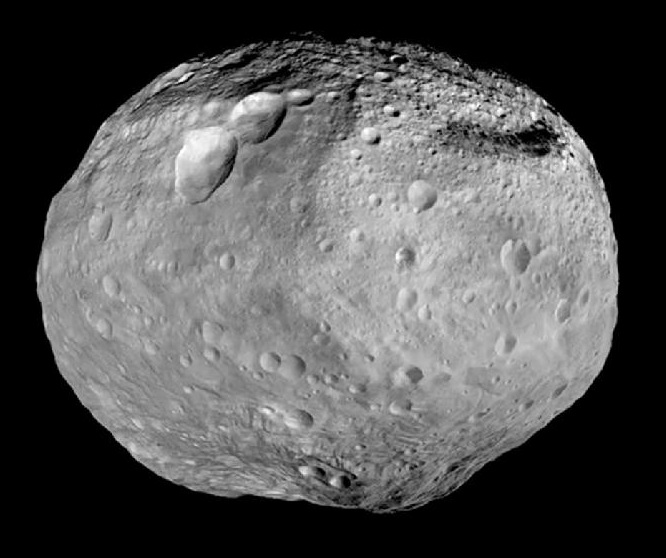
Looking back at Vesta as Dawn headed off to Ceres. Credit: NASA/JPL-Caltech/UCAL/MPS/DLR/IDA
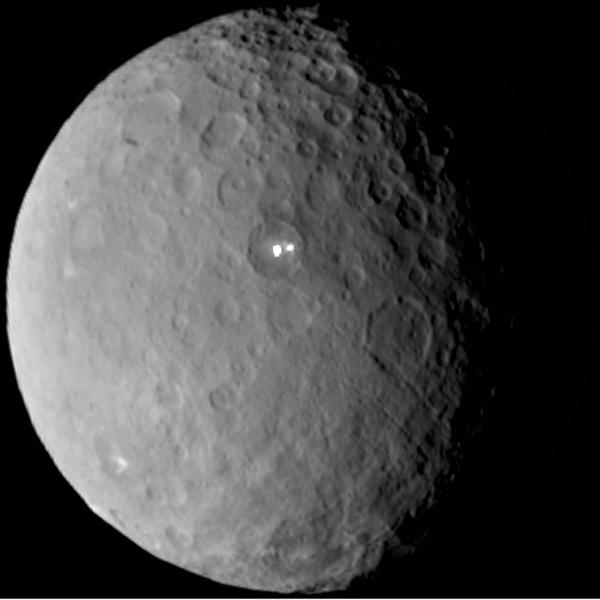
The bright spot is two. Picture taken February 19, 2015 from 29,000 miles (46,700 km). Credit: NASA/JPL-Caltech/UCLA/MPS/DLR/IDA.
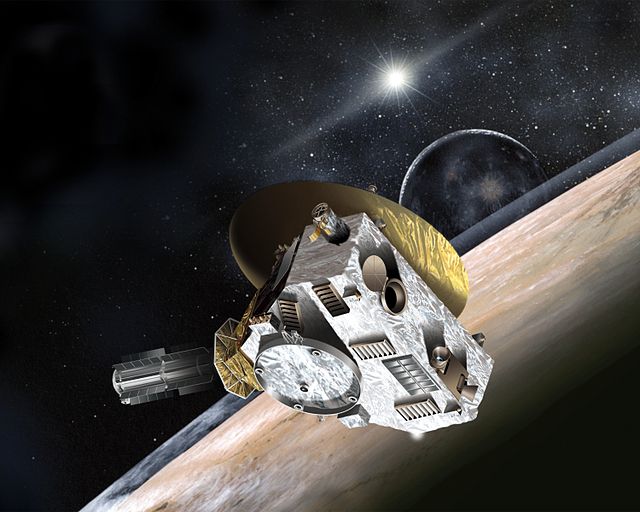
Artist conception of the New Horizons spacecraft at Pluto. Credit: NASA/Johns Hopkins University Applied Physics Laboratory/Southwest Research Institute
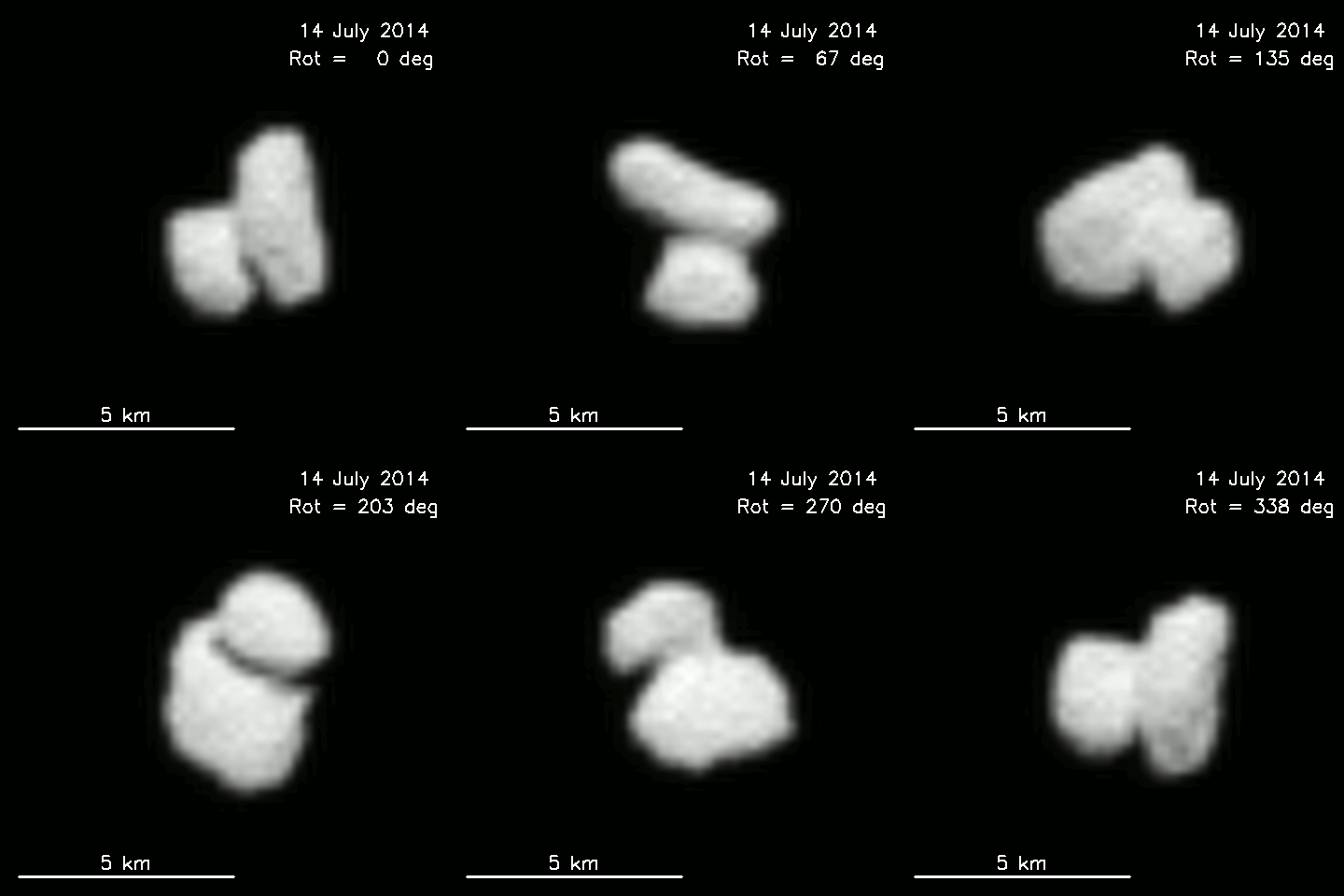
An animation of Comet 67p/Churyumov–Gerasimenko rotation on July 14, 2014. The 30 pixel wide image has been smoothed. The Rotation rate is 1 rotation every 12.4 hours. Credits: ESA/Rosetta/MPS for OSIRIS Team MPS/UPD/LAM/IAA/SSO/INTA/UPM/DASP/IDA
03/05/2015 – Ephemeris – Tonight’s moon is the smallest full moon of the year
Ephemeris for Thursday, March 5th. The Sun will rise at 7:13. It’ll be up for 11 hours and 21 minutes, setting at 6:35. The Moon, at full today, will rise at 6:48 this evening.
We’ve heard all about the supermoon, when the moon is at its closest. This is supposedly best seen when the full moon is rising. Of course the rising moon or sun, or the setting of these bodies look larger than normal due to an optical illusion. Well tonight’s full moon is the opposite. The Moon is at apogee, which is the farthest it gets in its orbit of the Earth. It’s 253 thousand miles (406 thousand km) from Earth. So the Moon should be, let me see, a mini-moon? So the Moon should appear small as it rises tonight. So if it’s clear tonight you might check out the moon. Does it appear as large as it usually does? Or does it appear smaller? The moon, being alone in the sky lacks anything else to compare its size to. It makes estimations difficult.
Times are for the Traverse City/Interlochen area of Michigan. They may be different for your location.
Addendum
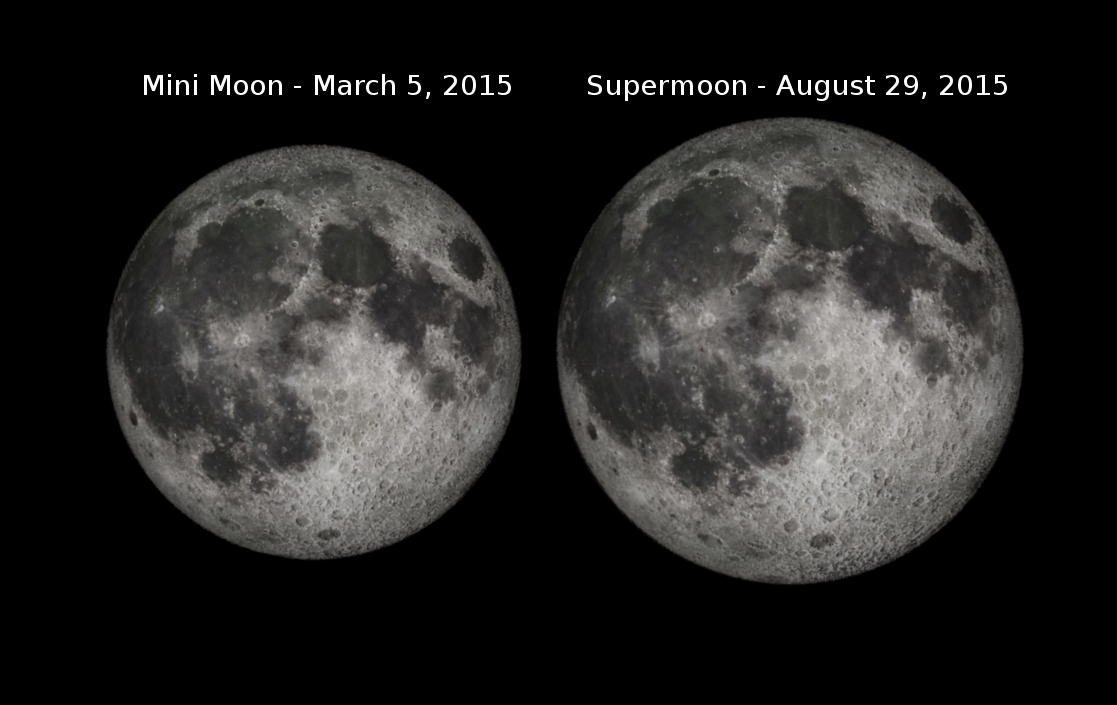
Here are the full mini and supermoons of the year. Created using Cartes du Ceil (Sky Charts)
03/04/2015 – Ephemeris – Our weekly look at the bright planets
Ephemeris for Wednesday, March 4th. The Sun will rise at 7:15. It’ll be up for 11 hours and 18 minutes, setting at 6:34. The Moon, 1 day before full, will set at 6:59 tomorrow morning.
Lets take a look at the bright planets for this week. Brilliant Venus is in the west by 7:30 p.m. It will set at 9:13 p.m. It’s separating from Mars which appears below and right of it. The Red Planet will set tonight at 8:47 p.m. Jupiter will appear In the southeastern sky in the evening. It will be up just about all night, and will set at 6:16 a.m. It’s near the sickle-shaped head of Leo the lion, and it’s the brightest star-like object in the sky. In telescopes tonight the moon Io will be behind Jupiter and will pop into sunlight a bit away from the planet at 9:39 p.m. Tomorrow night the 5th the moon Europa will duck behind Jupiter at 8:48 p.m. After that only 3 of the moons will be visible, until 12:57 a.m. when Europa will appear on the other side.* Early risers will be able to spot Saturn which will rise in the east-southeast at 1:25 a.m. It’s in the south at 6 a.m.
Times are for the Traverse City/Interlochen area of Michigan. They may be different for your location.
* Due to a date mix up the radio program may be incorrect. The occultation of Europa on the 5th being set on the 4th. The Io occultation is since added.
Addendum
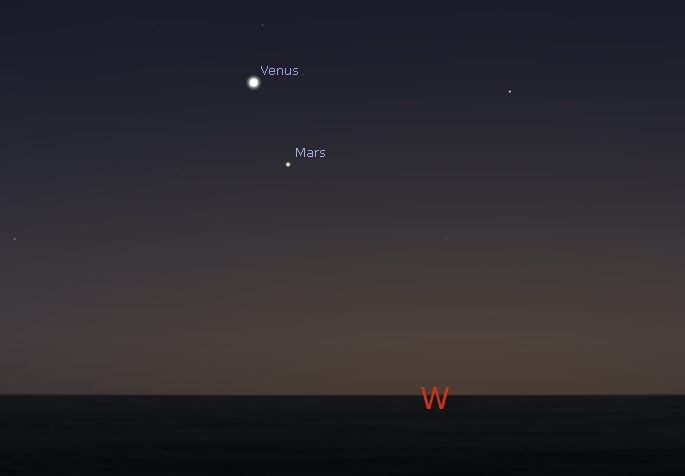
Venus and Mars in the west at 7:30 p.m. on March 4, 2015. Created using Stellarium.
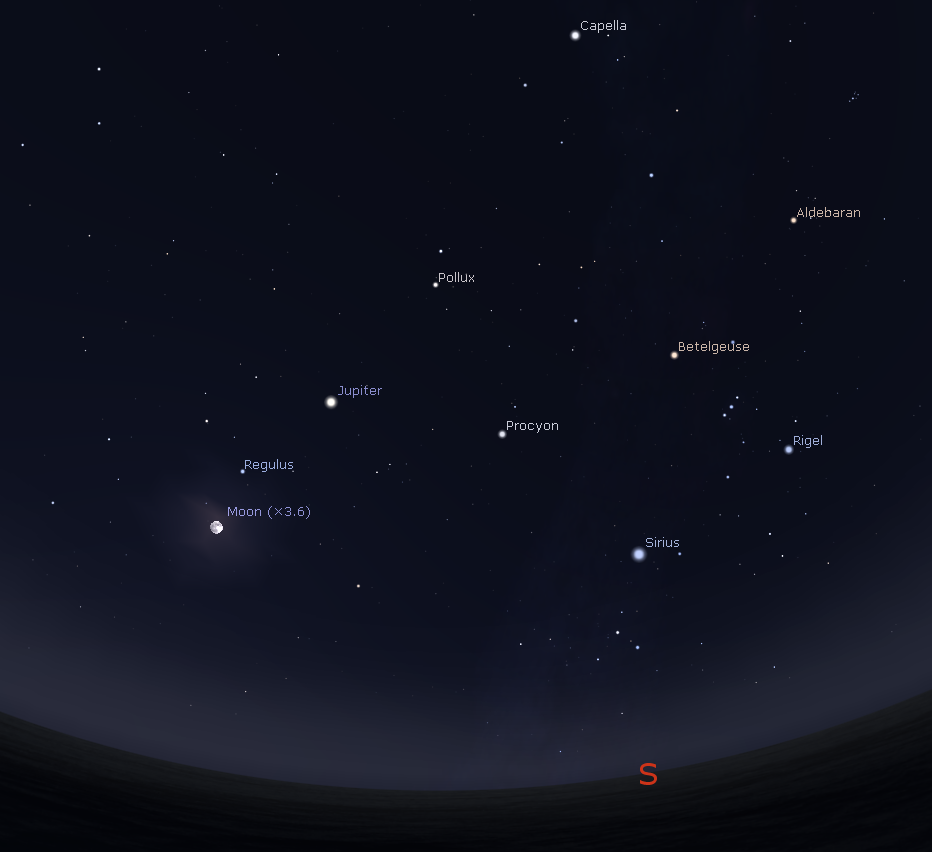
Jupiter, the full Moon and the winter stars at 9 p.m. on March 4, 2014. Created using Stellarium.
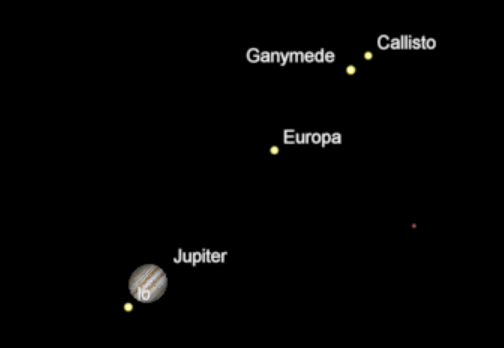
Jupiter and moons at 9:39 p.m., when Io leaves Jupiter’s shadow on March 4, 2015. Created using Cartes du Ceil (Sky Charts).
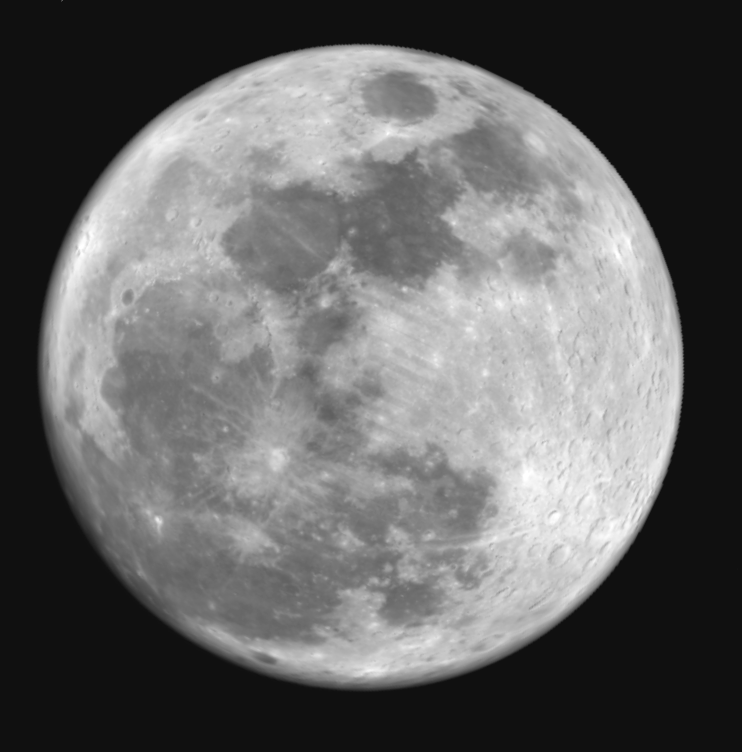
The nearly full moon at 9 p.m. on March 4, 2015. Created using Virtual Moon Atlas.
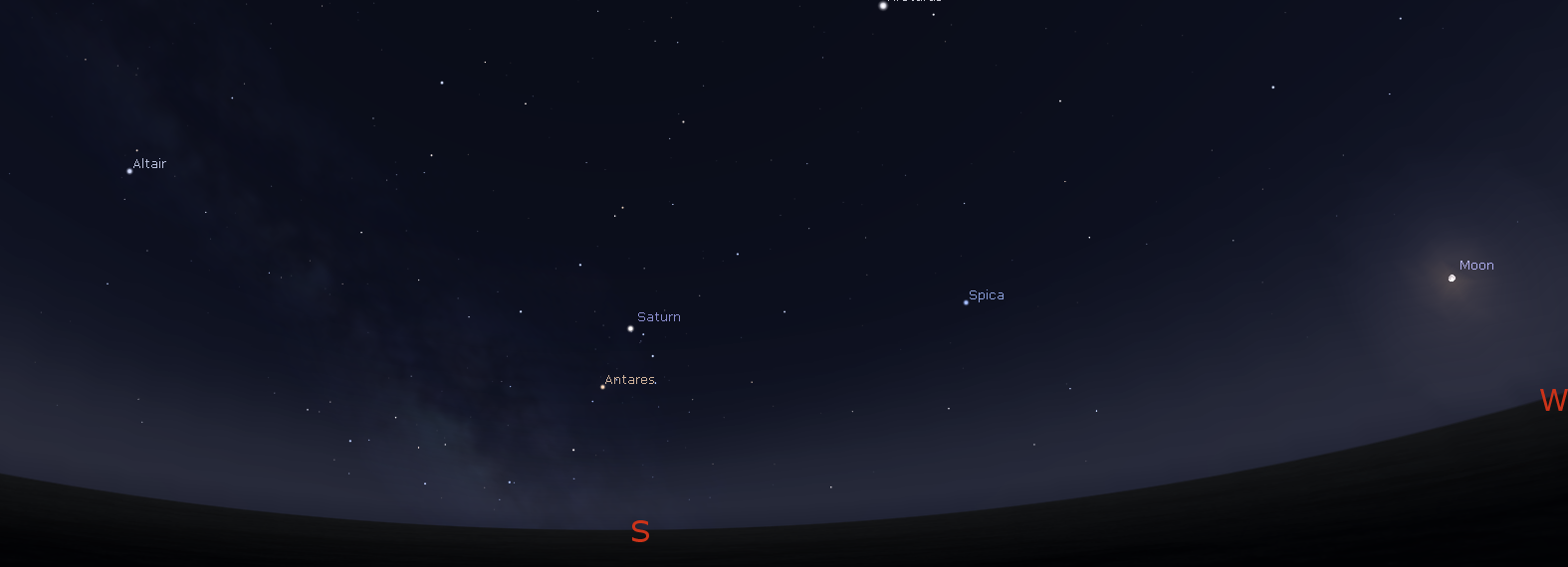
Looking south toward Saturn along with the summer stars and the setting Moon in the west at 6 a.m. March 5, 2015. Created using Stellarium.
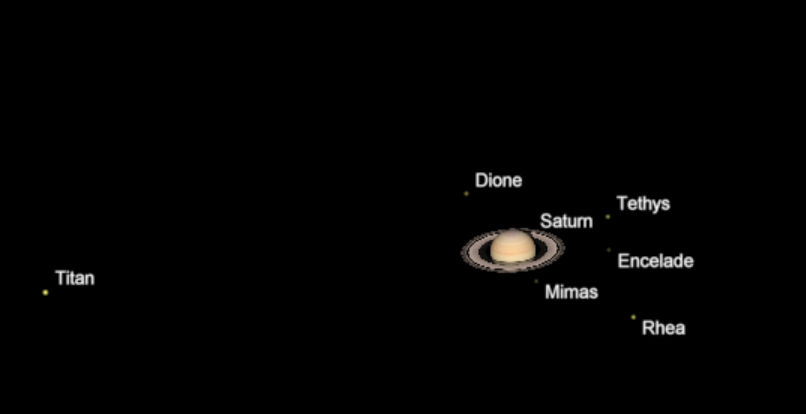
What Saturn and its moons might appear like in a telescope at 6 a.m., March 5, 2015. Small telescopes will show only the moon Titan. Created using Cartes du Ceil (Sky Charts).
03/02/2015 – Ephemeris – The Dawn spacecraft (The turtle wins the race)
Ephemeris for Monday, March 2nd. The sun will rise at 7:19. It’ll be up for 11 hours and 12 minutes, setting at 6:31. The moon, 3 days before full, will set at 6:00 tomorrow morning.
On Thursday March 5th NASA’s Dawn spacecraft will fall under the gravitational influence of the asteroid, or actually recently promoted dwarf planet Ceres and enter orbit. The journey took 7 years including an intermediate year-long stop at the asteroid Vesta. Dawn uses the latest in ion thrusters, or latest when it was launched. Using power generated by its solar panels it ejects xenon ions from one of its three ion thrusters to produce a thrust comparable to the weight of a piece of paper. It can accelerate the spacecraft from zero to 60 miles per hour in a few days. In the tale of the hare and the tortoise it’s in the tortoise class, at least to start. Ion engines are 10 times as efficient as chemical rockets and they can thrust for years.
Times are for the Traverse City/Interlochen area of Michigan. They may be different for your location.
Addendum
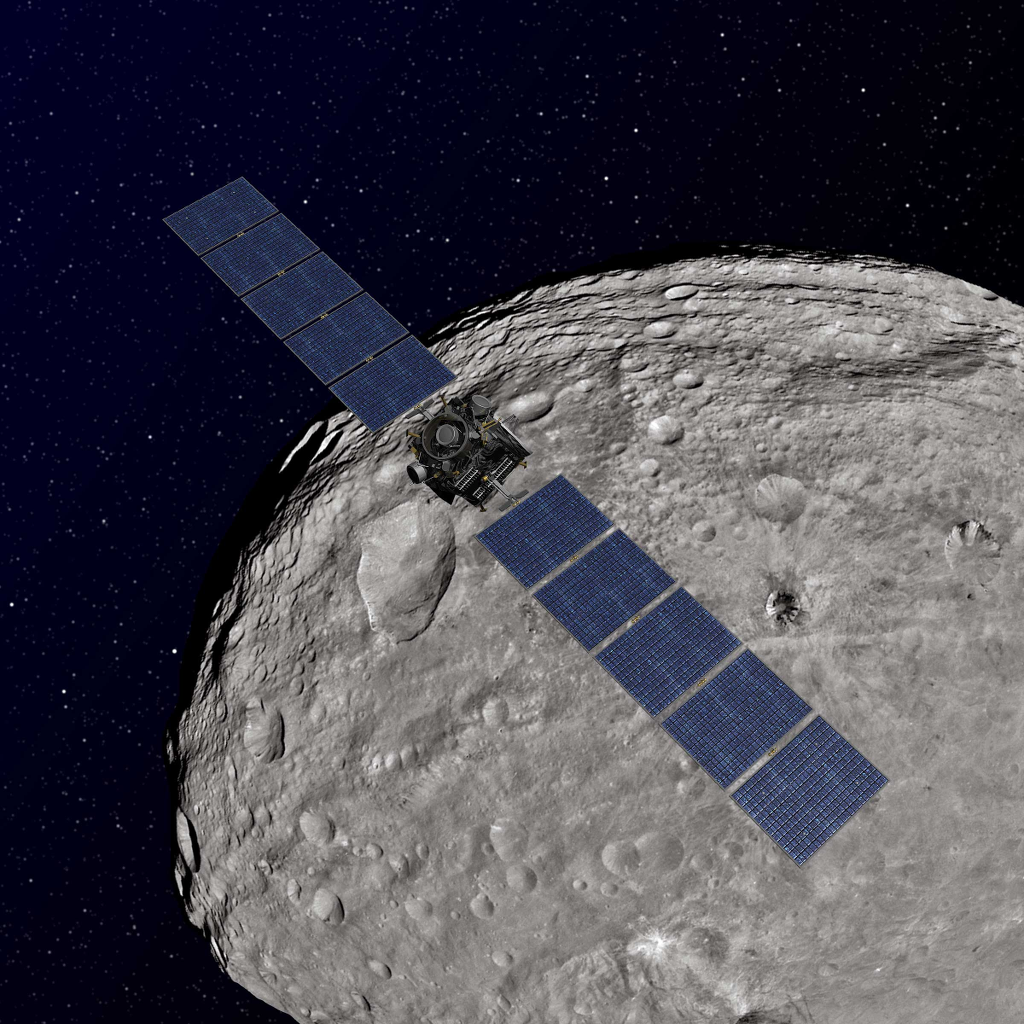
Artist’s rendition of the Dawn spacecraft at Vesta. Credit: NASA/JPL
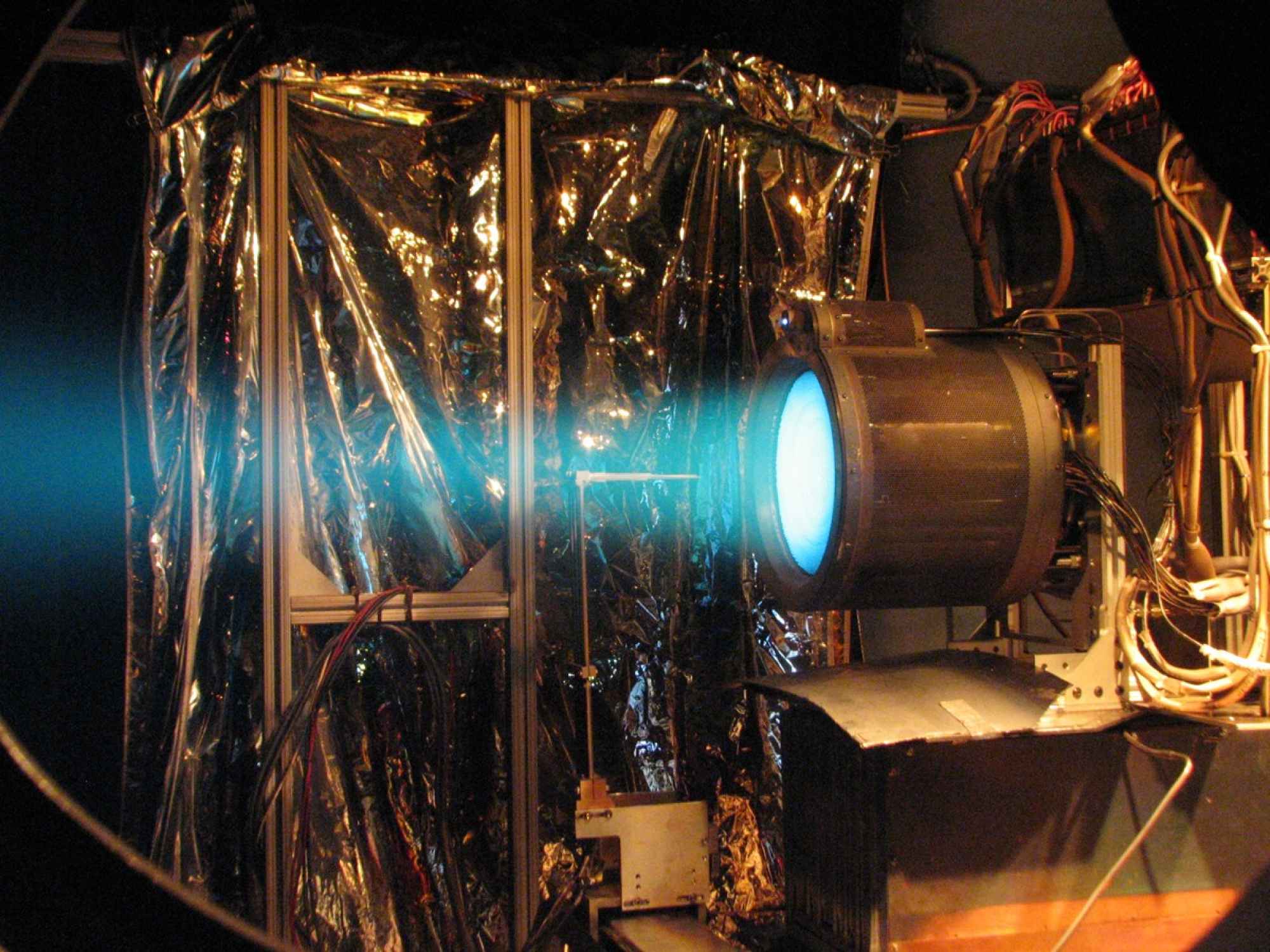
Ion engine test. Xenon ions glow blue. Credit NASA.
02/27/2015 – Ephemeris – Previewing the month of March
Ephemeris for Friday, February 27th. The sun will rise at 7:24. It’ll be up for 11 hours and 3 minutes, setting at 6:27. The moon, 2 days past first quarter, will set at 4:08 tomorrow morning.
During March the increase in daylight hours are at its greatest, with Spring 3 weeks away. Daylight hours will increase from 11 hours and 9 minutes Sunday to 12 hours and 42 minutes on the 31st. Along with that the altitude of the sun at noon will increase from 38 degrees Sunday to 49 ½ degrees at month’s end. Local noon, by the way for Interlochen and Traverse City is about 12:50 p.m, which is mainly due to the fact that our standard time meridian happens to run through Philadelphia. That’s before daylight time starts in a bit more than a week. Then our time meridian will run by the eastern tip of Nova Scotia, so local noon, when the Sun is due south will occur at 1:50 p.m.
Times are for the Traverse City/Interlochen area of Michigan. They may be different for your location.
Addendum
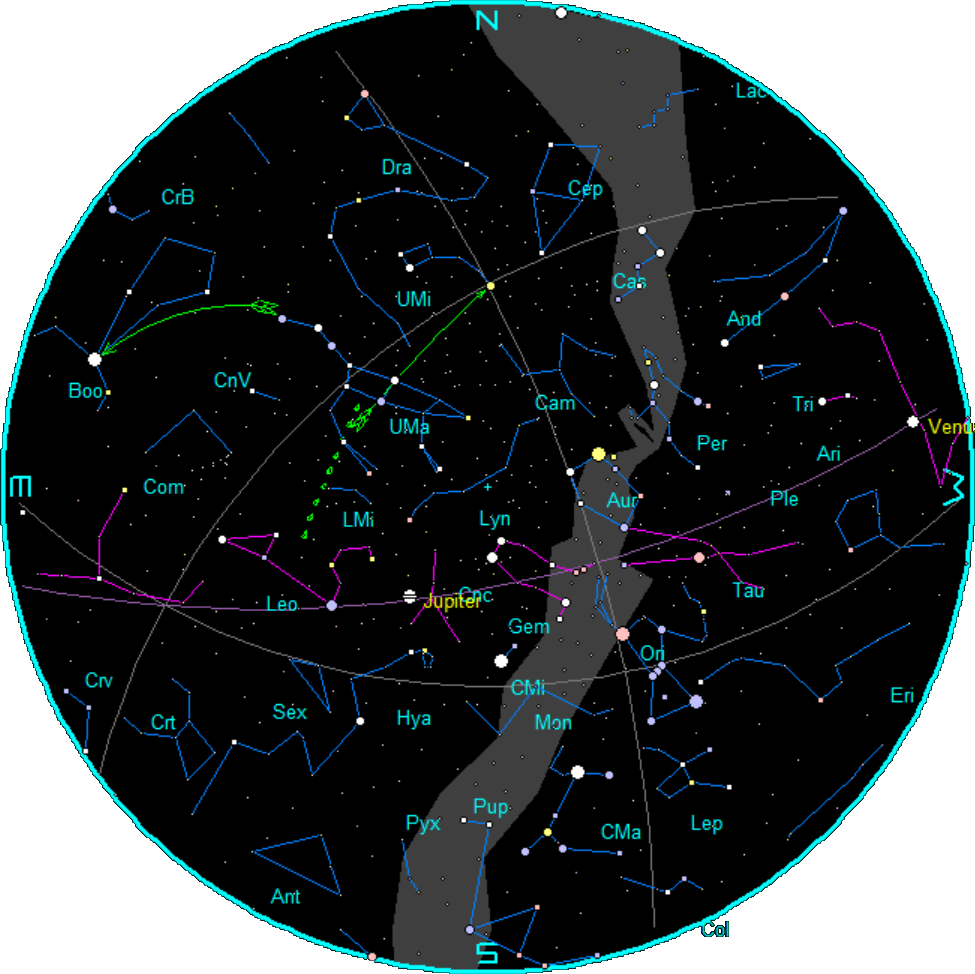
Star Chart for March 2015. Created using my LookingUp program.
The Moon is not plotted. The planets and stars are plotted for the 15th at 10 p.m. EDT. That is chart time.
Evening astronomical twilight ends at 8:07 p.m. EST on March 1st, increasing to 9:49 p.m. EDT on the 31st.
Morning astronomical twilight starts at 5:43 a.m. EST on March 1st, and decreasing to 5:45 a.m. EDT on the 31st. (Yes it is a decrease, thanks to the imposition of daylight time on March 8th)
Add a half hour to the chart time every week before the 15th and subtract and hour for every week after the 15th.
For a list of constellation names to go with the abbreviations click here.
The green pointer from the Big Dipper is:
- Pointer stars at the front of the bowl of the Big Dipper point to Polaris the North Star.
- Drill a hole in the bowl of the Big Dipper and the water will drip on the back of Leo the Lion.
- Follow the arc of the Big Dipper’s handle to Arcturus
Calendar of Planetary Events
Credit: Sky Events Calendar by Fred Espenak and Sumit Dutta (NASA’s GSFC)
To generate your own calendar go to http://eclipse.gsfc.nasa.gov/SKYCAL/SKYCAL.html
Times are Eastern Standard Time on a 24 hour clock. Some additions made to aid clarity.
Conjunctions like the Moon-Saturn: 2.4° S means Saturn will appear 2.4° south of the Moon.
| Mar | 01 | Su | Venus: 30.1° E | |
| 05 | Th | 02:35 | Moon Apogee: 406,400 km | |
| 05 | Th | 13:05 | Full Moon | |
| 07 | Sa | 16:04 | Moon Ascending Node | |
| 12 | Th | 04:25 | Moon-Saturn: 2.4° S | |
| 13 | Fr | 13:48 | Last Quarter | |
| 13 | Fr | 21:39 | Moon South Dec.: 18.3° S | |
| 19 | Th | 15:38 | Moon Perigee: 357,600 km | |
| 20 | Fr | 05:36 | New Moon | |
| 20 | Fr | 05:46 | Total Solar Eclipse | |
| 20 | Fr | 18:45 | Vernal Equinox | |
| 20 | Fr | 22:19 | Moon Descending Node | |
| 21 | Sa | 18:13 | Moon-Mars: 1° N | |
| 22 | Su | 15:51 | Moon-Venus: 2.9° N | |
| 25 | We | 02:55 | Moon-Aldebaran: 0.9° S | |
| 26 | Th | 10:29 | Moon North Dec.: 18.2° N | |
| 27 | Fr | 03:43 | First Quarter |
02/26/2015 – Ephemeris – The strange month of February
Ephemeris for Thursday, February 26th. The sun will rise at 7:25. It’ll be up for 11 hours and 1 minute, setting at 6:26. The moon, 1 day past first quarter, will set at 3:21 tomorrow morning.
Let’s take a shot at why February is the shortest month. Blame the ancient Romans and their poor timekeeping skills. The Roman calendar was based on the Sun, or rather the seasons, what we would call the tropical year, rather than the Moon. With a lunar calendar it was easy to tell if it was off by a day or two. The Romans apparently started with a 12 month calendar starting in March with spring. Before the calendar reform of 45 BC months had alternating days of 29 and 31 except for February which had 28. That left them a bit short, so it appears that they added a month Intercalaris every few years or so to fix it. That eventually came down to adding a day to February every 4 years to fix the problem.
Times are for the Traverse City/Interlochen area of Michigan. They may be different for your location.
02/25/2015 – Ephemeris – It’s planet day on Ephemeris
Ephemeris for Wednesday, February 25th. The sun will rise at 7:27. It’ll be up for 10 hours and 57 minutes, setting at 6:24. The moon, at first quarter today, will set at 2:28 tomorrow morning.
Lets take a look at the bright planets and a fading binocular comet for this week. Brilliant Venus is in the west-southwest by 7 p.m. It will set at 8:55 p.m. It’s separating from Mars which appears below and right of it. The Red Planet will set tonight at 8:46 p.m. Jupiter will appear In the southeastern sky in the evening. It will be up just about all night, and will set at 6:44 a.m. It’s near the sickle-shaped head of Leo the lion, and it’s the brightest star-like object in the sky. Early risers will be able to spot Saturn which will rise in the east-southeast at 1:48 a.m. It’s in the south at 6 a.m. Comet Lovejoy, visible in binoculars, is about half way from the star at the end of Andromeda, called Almaak and the “W” of Cassiopeia.
Times are for the Traverse City/Interlochen area of Michigan. They may be different for your location.
Addendum
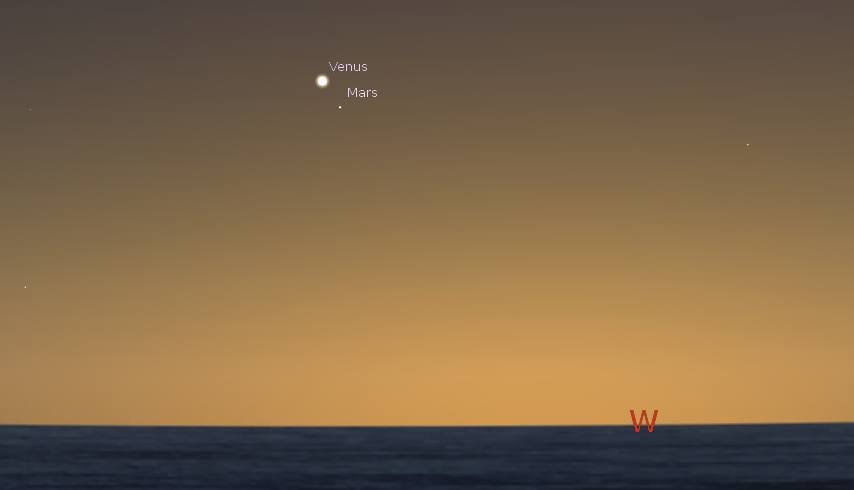
Venus and Mars low in the west after sunset. This is 7 p.m., February 25, 2015. Created using Stellarium.
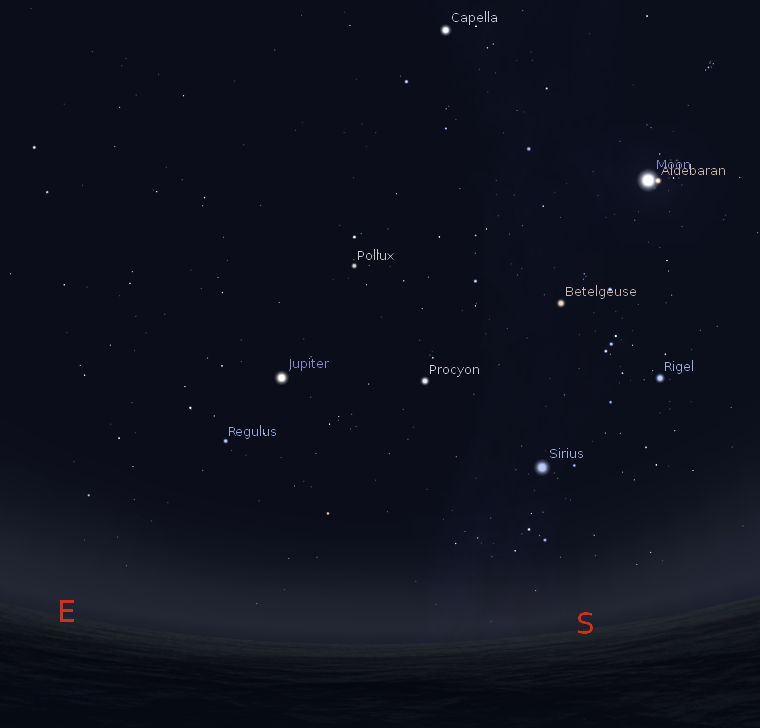
Jupiter with the first quarter moon and the winter stars at 9 p.m., February 25, 2015. Created using Stellarium.
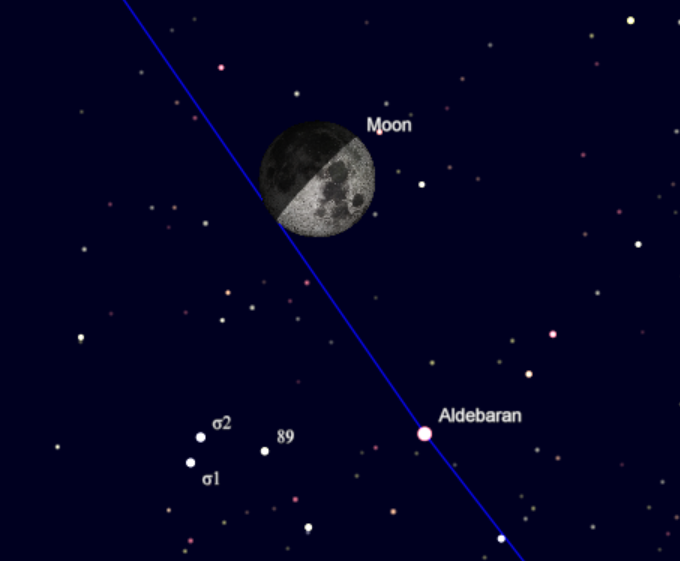
Closeup of the Moon and Aldebaran at 9 p.m. on February 25, 2015. They appeared their closest at 6 p.m. They might be glimpsed with binoculars or a small telescope at that time.
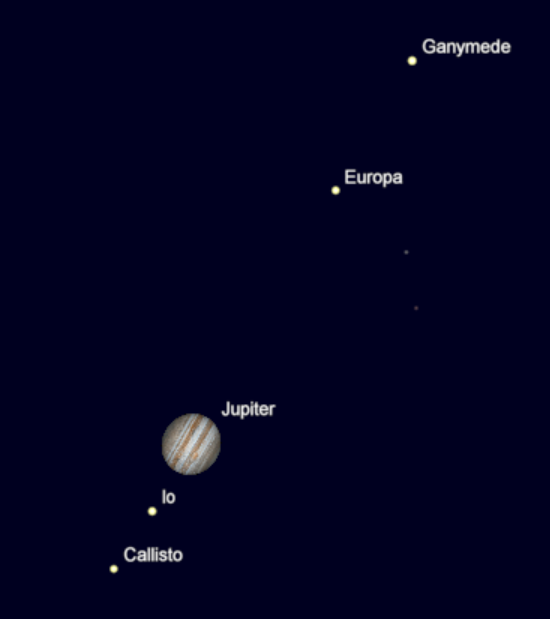
Jupiter and it’s moons at 9 p.m. February 25, 2015. Note that at this time the Great Red Spot is on the face if Jupiter. Created using Cartes du Ciel (Sky Charts).
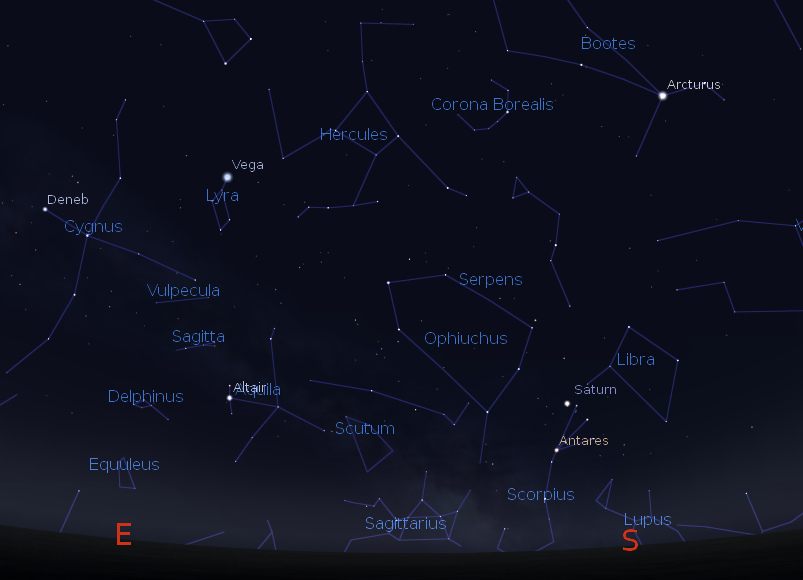
Looking southward at Saturn and a preview of the summer constellations at 6 a.m. February 26, 2015. Created using Stellarium.
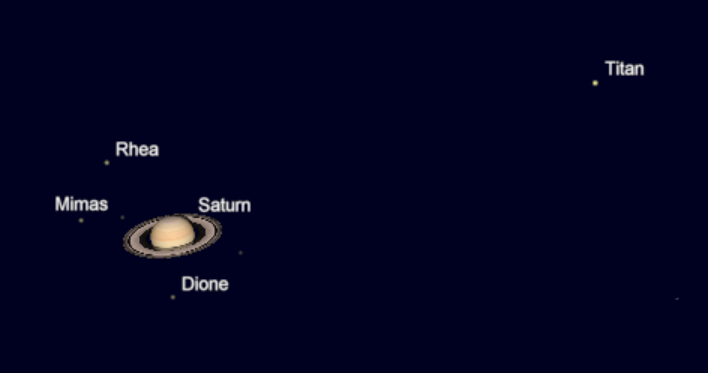
What Saturn and its moons might appear like in a telescope at 6 a.m., February 26, 2015. Small telescopes will show only the moon Titan. Created using Cartes du Ceil (Sky Charts).
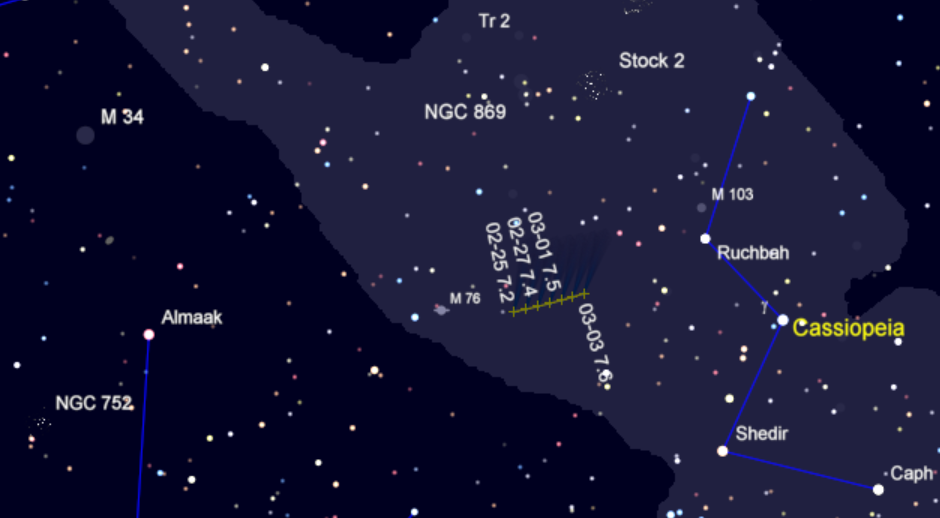
The track of Comet 2014 Q2 (Lovejoy) from 2/25/15 to 03/03/15 which will appear high in the west at 9 p.m. The comet is approaching Cassiopeia. The comet is dropping below binocular visibility, so this is the last time I will cover it on this blog. Created using Cartes du Ceil (Sky Charts).
02/24/2015 – Ephemeris – Not all greatest elongations of Mercury are equal
Ephemeris for Tuesday, February 24th. The sun will rise at 7:29. It’ll be up for 10 hours and 54 minutes, setting at 6:23. The moon, 1 day before first quarter, will set at 1:28 tomorrow morning.
Today Mercury is at its greatest distance west of the Sun. Don’t go out to view Mercury right before sunrise unless you’re way south of here, or better yet south of the equator. Because of the tilt of the Earth’s axis and our latitude the positions of the planets that appear near the sun at sunrise and sunset are easier or harder to spot depending on the season. The best time to spot Mercury when it’s at its greatest elongation or distance east of the Sun is on late winter and spring evenings, or late summer and autumn mornings when Mercury is west of the Sun. Since the seasons south of the equator are opposite ours the same rule holds. It’s late summer down there which is favorable to spot Mercury in the morning, but not here.
Times are for the Traverse City/Interlochen area of Michigan. They may be different for your location.
Addendum
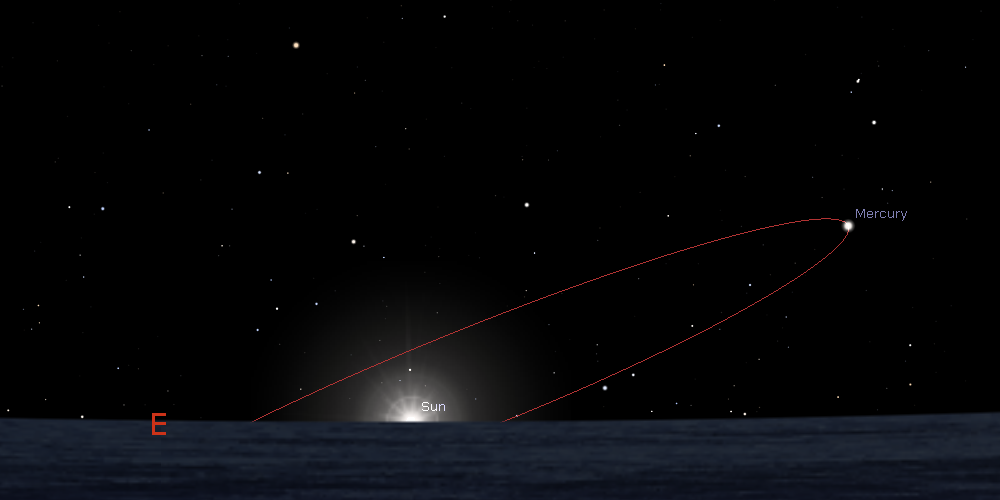
Mercury at greatest western elongation on late a winter morning. Mercury is off to the side of the Sun and quite low. This is a poor elongation for us in the northern hemisphere. Created using Stellarium.
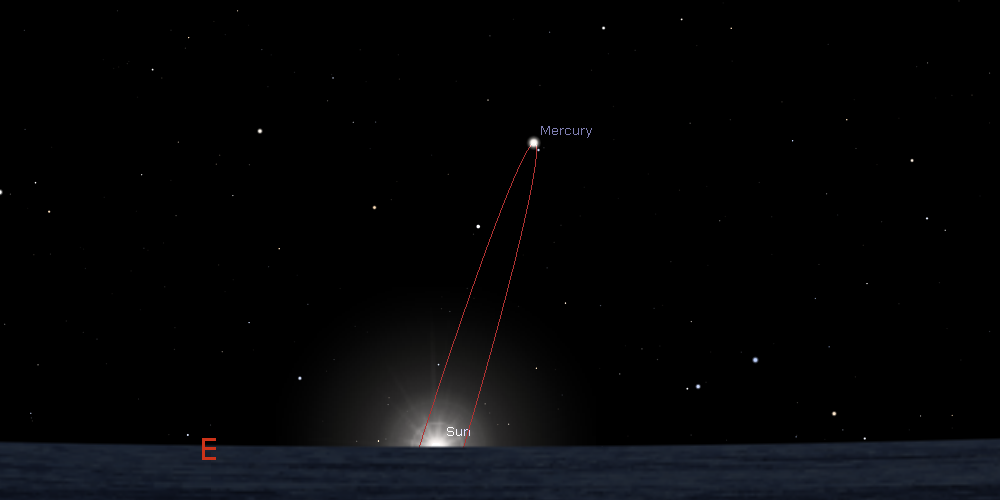
Mercury at greatest western elongation on an autumn morning. Mercury is above the Sun and quite high. This is a good elongation for us in the northern hemisphere. Created using Stellarium.
02/23/2015 – Ephemeris – The Launch of the DSCOVR satellite
Ephemeris for Monday, February 23rd. The sun will rise at 7:30. It’ll be up for 10 hours and 51 minutes, setting at 6:22. The moon, 2 days before first quarter, will set at 12:24 tomorrow morning.
On Wednesday the 11th the DSCOVR satellite was launched to a special point between the Earth and the Sun called the Lagrangian point 1 or the Earth-Sun L1 point. It’s a point of gravitational equilibrium between the Earth and the Sun, about a million miles sun-ward of the Earth, or four times the distance of the Moon. It will take the craft over 100 days to get there, which it will slowly orbit. It will act as an early warning sentinel, replacing the aging ACE spacecraft. It will give us about an hour’s warning of incoming coronal mass ejections or CMEs erupting from the Sun. It also has an earth pointing camera with various filters pointed to the full earth and occasionally the far side of the new Moon.
Times are for the Traverse City/Interlochen area of Michigan. They may be different for your location.
Addendum
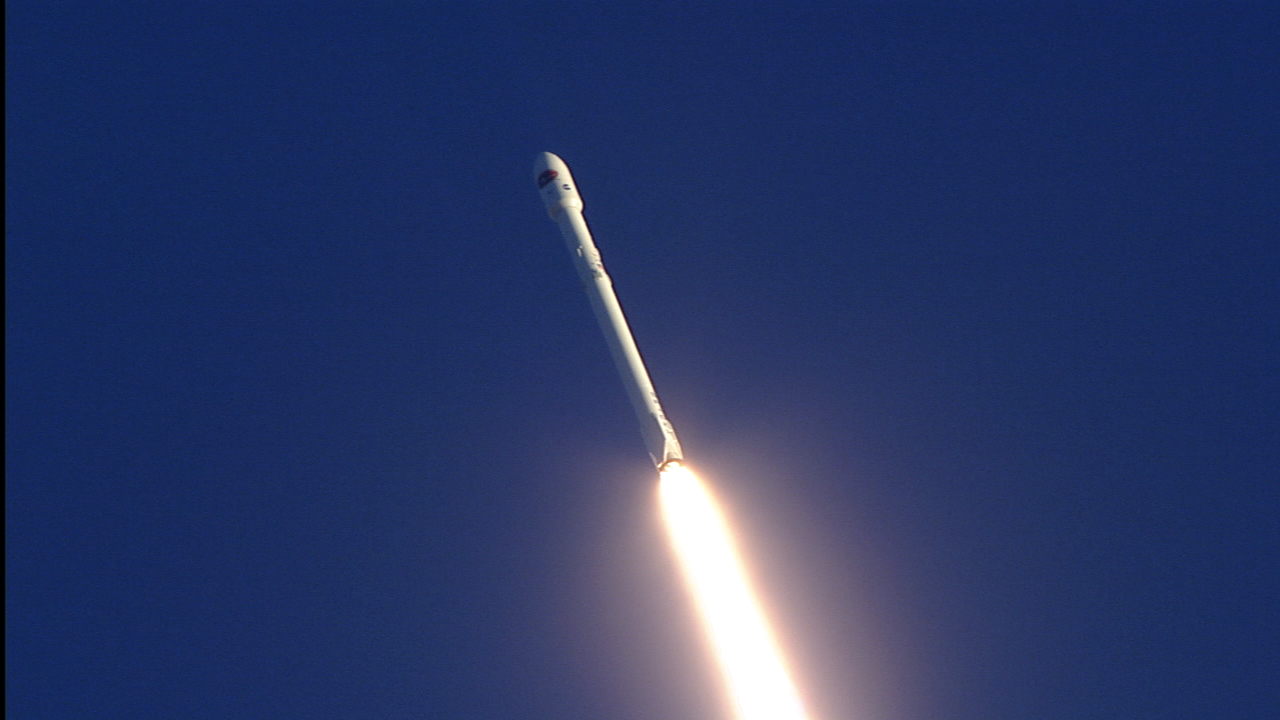
SpaceX Falcon 9 V1.1 first stage burns to launch DSCOVR to the Earth-Sun L1 point. Credit: NASA. Click to enlarge.
Click to enlarge
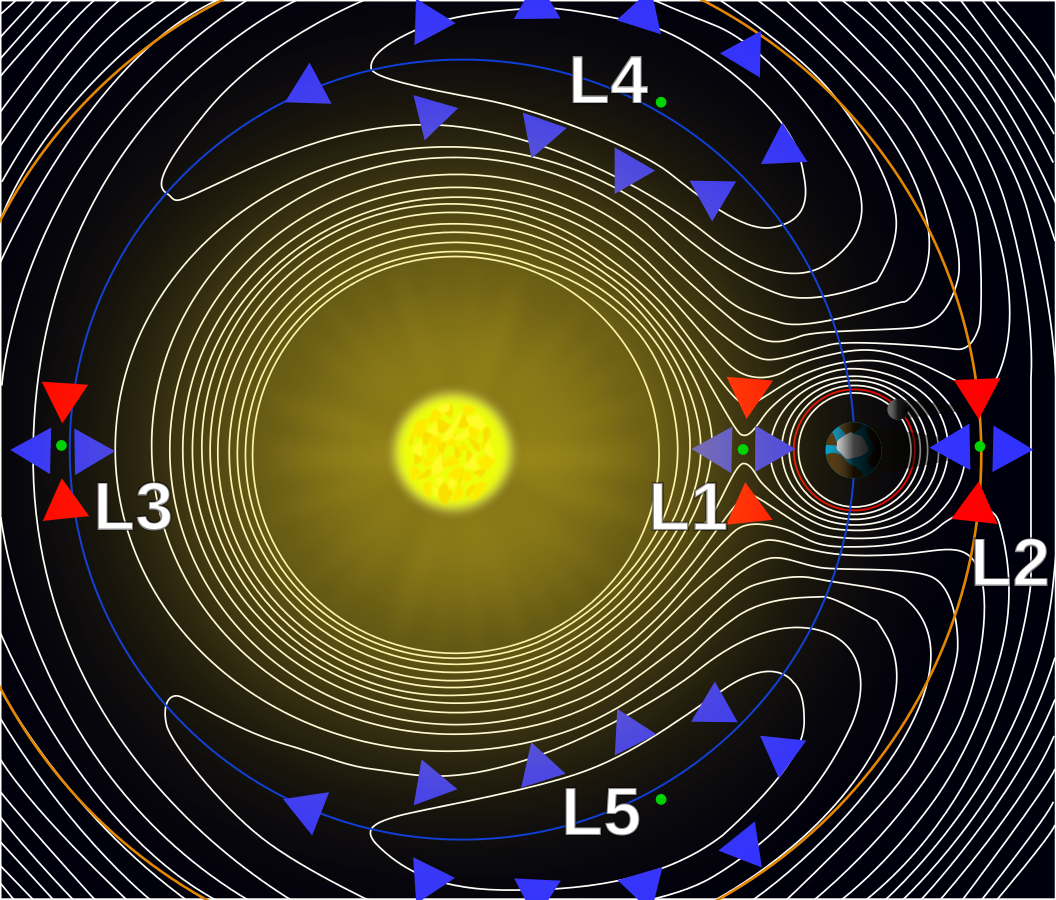
Earth-Sun Lagrangian Points. Source: Wikimedia Commons, Xander89. Click to enlarge.

