Archive
05/30/2014 – Ephemeris – Previewing June skies or Where’d the night go?
Ephemeris for Friday, May 30th. Today the sun will be up for 15 hours and 17 minutes, setting at 9:18. The moon, 2 days past new, will set at 10:51 this evening. Tomorrow the sun will rise at 6:01. | Let’s preview June skies. There will be a lot of sun in June and very little night. The daylight hours will increase a bit from 15 hours and 20 minutes Sunday to 15 hours and 33 minutes on the 21st, retreating back to 15 hours 30 minutes at month’s end. The altitude of the sun above the southern horizon at local noon will hover around 68 to 69 degrees. Local noon, when the sun is actually due south will occur at about 1:43 p.m. Summer begins on the 21st at 6:52 a.m. when the sun reaches its farthest north. The actual amount of night-time will be quite short mostly due to the length of daylight, but also because twilight last much longer than average because the sun sets at a shallow angle. On the 21st there’s only 3 ½ hours of total darkness, starting after midnight.
Times are for the Traverse City/Interlochen area of Michigan. They may be different for your location.
Addendum
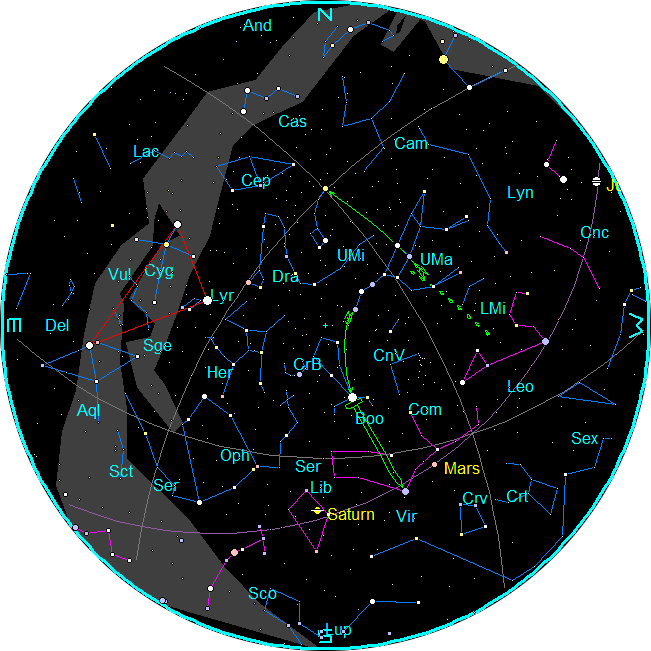
June star chart for 11 p.m. on June 15, 2014. Created by my LookingUp program.
Astronomical twilight ends about midnight in June.
Add a half hour to every week before the 15th and subtract and hour for every week after the 15th.
For a list of constellation names to go with the abbreviations click here.
Also shown is the Summer Triangle in red. Clockwise from the top star is Deneb in Cygnus, Vega in Lyra and Altair in Aquila.
The green pointers from the Big Dipper are:
- Pointer stars at the front of the bowl of the Big Dipper point to Polaris the North Star.
- The leaky bowl drips on the back of Leo the lion.
- The arc of the dipper’s handle points to Arcturus.
- The straighten the ark to a spike to point to Spica.
05/29/2014 – Ephemeris – Boötes the Herdsman
Ephemeris for Thursday, May 29th. Today the sun will be up for 15 hours and 15 minutes, setting at 9:18. The moon, 1 day past new, will set at 10:04 this evening. Tomorrow the sun will rise at 6:01.
High in the south southeastern sky at 10:30 tonight can be found the kite shaped constellation of Boötes the herdsman, chasing or herding the Great Bear Ursa Major of which the Big Dipper is the hind end, across the sky. The bright star at the base of the kite is the 4th brightest night-time star Arcturus. It can be found and name remembered by first locating the Big Dipper and by following the arc or curve of the handle to Arcturus. This star is an orange-colored giant star, 37 light years away. Its light was used open the 1933 Chicago Worlds Fair believing its light left the star in 1893 the year of the previous Chicago Worlds Fair. It turns out that Arcturus is 3 light years closer than what they thought.
Addendum
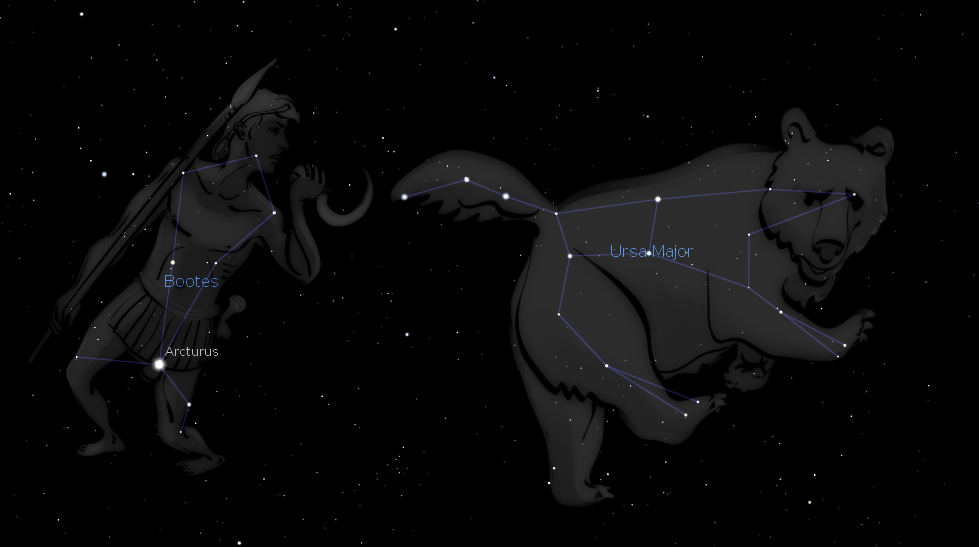
Bootes and Ursa Major high overhead on late spring evenings at 11 p.m. Created using Stellarium.
05/28/2014 – Ephemeris – Wednesday is planet day on Ephemeris
Ephemeris for Wednesday, May 28th. Today the sun will be up for 15 hours and 14 minutes, setting at 9:17. The moon is new today, and won’t be visible. Tomorrow the sun will rise at 6:02.
It’s Wednesday and once again time to locate the bright planets for this week. Mercury is showing up in the west shortly after sunset, It was at its farthest from the Sun 3 days ago. It will set at 11:09. Brilliant Jupiter will be in the western sky in Gemini as darkness falls tonight. It will set at 12:25 a.m. Reddish Mars is in Virgo in the south as darkness falls. It will pass due south at 9:52 p.m. It’s 72 million miles (115 million km) away now, and moving away, and will set at 3:41 a.m. Saturn will be low in the southeast as darkness falls. It’s in the faint constellation of Libra the scales this year. It will pass due south at 12:24 a.m. Brilliant Venus will rise in the east at 4:29 a.m. in morning twilight.
Times are for the Traverse City/Interlochen area of Michigan. They may be different for your location.
Addendum
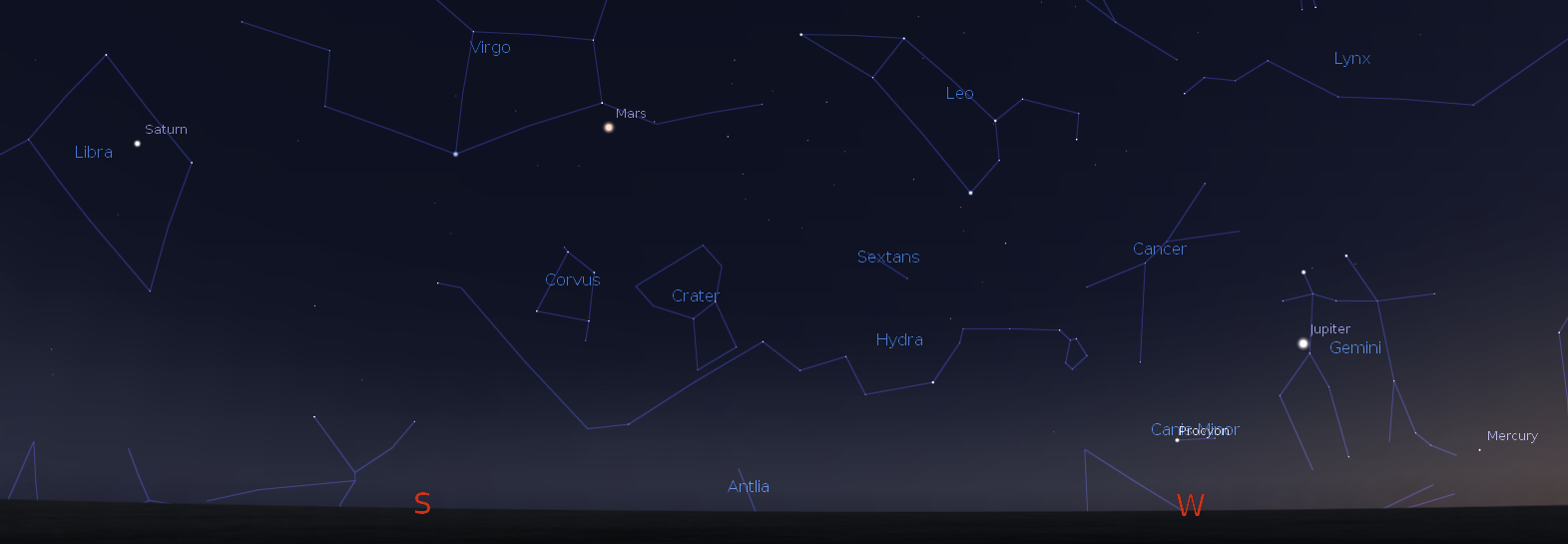
The planets Mercury, Jupiter, Mars and Saturn at 10:30 p.m. on May 28, 2014. Created using Stellarium.
Mercury barely shows a disc in telescopes.
In the planetary images below the scale is the same. It is the same as using the same magnifying power for each planet.
Jupiter is definitely the largest appearing planet.
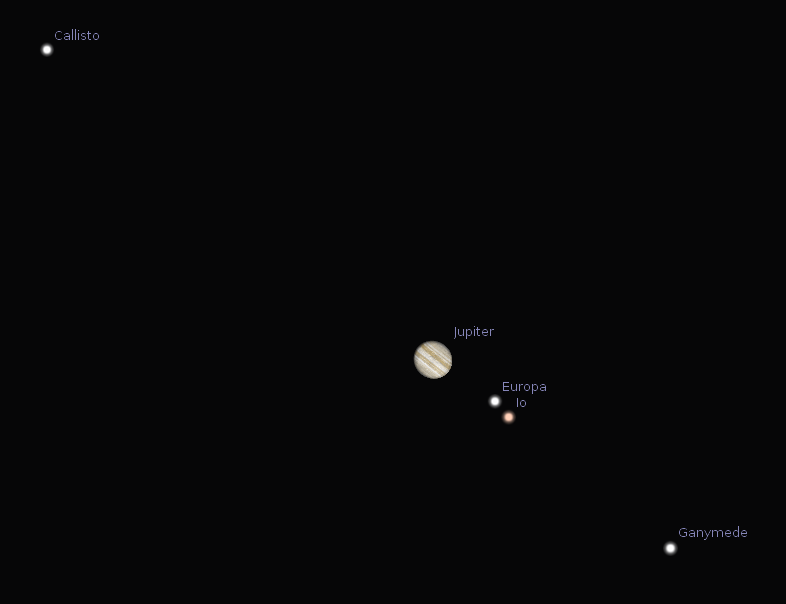
Jupiter and its four moons Galilean moons at 10:30 p.m. May 28, 2014. Created using Stellarium.

Mars at 10:30 p.m. May 28, 2014. Detail is difficult to see. Created using Stellarium.
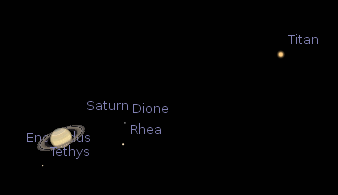
Saturn and moons as seen through a telescope at 10:30 p.m. on May 28, 2014. Created using Stellarium.
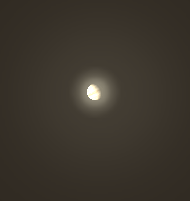
Venus in a telescope at 5:30 a.m. May 29, 2014. Created using Stellarium.

Venus in the eastern twilight at 5:30 a.m. May 29, 2014. Created using Stellarium.
05/27/2014 – Ephemeris – There was a meteor sprinkle but no storm
Ephemeris for Tuesday, May 27th. Today the sun will be up for 15 hours and 12 minutes, setting at 9:16. The moon, 1 day before new, will rise at 6:11 tomorrow morning. Tomorrow the sun will rise at 6:02.
The Camelopardalid meteors straggled in last Saturday morning. No real shower and definitely not a storm, but waiting through the night I saw a few genuine Camelopardalids, moving slowly that could be traced back to the north. There was no peak of activity, but what meteors we did see appeared randomly. I and others reporting via Twitter from around the country remarked the large percentage of really bright meteors. I saw one that left a smokey train that stayed visible a few seconds. I didn’t have binoculars to follow it further. Other observers had better luck with meteor trains. So yes, the Camelopardalids were a disappointment, but at least they were not a no show. This was a newly discovered comet which had no history of meteor shower activity before.
Times are for the Traverse City/Interlochen area of Michigan. They may be different for your location.
05/26/2014 – Ephemeris – In memory of the fallen Space Shuttle Astronauts
Ephemeris for Memorial Day, Monday, May 26th. Today the sun will be up for 15 hours and 10 minutes, setting at 9:15. The moon, 2 days before new, will rise at 5:29 tomorrow morning. Tomorrow the sun will rise at 6:03.
Memorial day is a day of remembrance for those who paid the ultimate price for our freedom. When astronomers name craters or other features on planets or moons, they are names of those who have gone before. For instance craters near the moon’s north and south poles are named for explorers of the corresponding earthly pole. The Challenger astronauts have craters named for them in the moon system of Uranus, from discovery pictures relayed to the earth by Voyager 2 a few days before the Challenger accident. The Mars Rover Spirit is a memorial and located in the Columbia Hills, its features named for the astronauts who died 11 months before Spirit landed.
Times are for the Traverse City/Interlochen area of Michigan. They may be different for your location.
Addendum

The Challenger crew. From the left: Ellison Onizuka, Michael Smith, Christa McAuliffe, Dick Scobee, Gregory Jarvis, Judith Resnick, and Ronald McNair. Credit: NASA

The Columbia crew. From the left: Mission Specialist David Brown, Commander Rick Husband, Mission Specialists Laurel Clark, Kalpana Chawla and Michael Anderson, Pilot William McCool and Payload Specialist Ilan Ramon. Credit: NASA.
I was remiss in my program to omit the Apollo 1 crew.
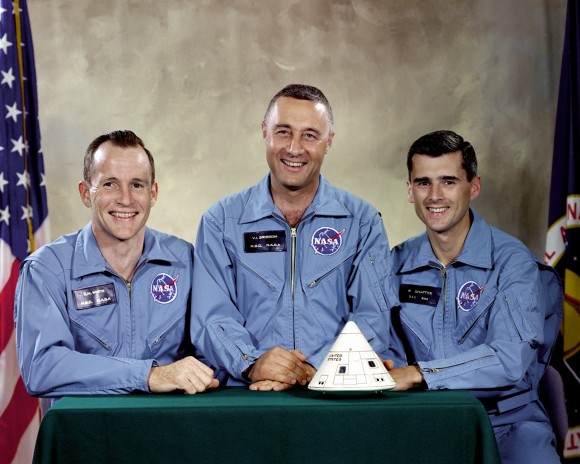
The Apollo 1 crew. From the left: Ed White, Gus Grissom, and Roger Chaffee. Credit: NASA
Apollo 1 never flew. A spark and the faulty design of the spacecraft doomed the men during a test on the pad. Roger Chaffee, from my home town of Grand Rapids, MI was the rookie and had never flown in space. They are immortalized with craters on the far side of the moon.
For more information check out Amy Shira Teitel’s excellent article in Universe Today.
05/23/2014 – Ephemeris – Possible Meteor Storm overnight tonight
Ephemeris for Friday, May 23rd. Today the sun will be up for 15 hours and 5 minutes, setting at 9:12. The moon, 2 days past last quarter, will rise at 3:45 tomorrow morning. Tomorrow the sun will rise at 6:05.
If you want to see a possible meteor storm, go out tomorrow morning and find a dark location. The meteors will be seen all over the sky, but will seem to come from the north. The Grand Traverse Astronomical Society will be at Sleeping Bear Dunes National Lakeshore at the Dune Climb with telescopes starting at 10 p.m. tonight, weather permitting, to enjoy the other wonders of the sky while we wait for the meteor storm to start. Dress warmly, bring a blanket or lounge chair so you can comfortably look up. The first meteors may show by 1:40 a.m. but the peak activity is expected about 3 a.m., but that estimate may be off by an hour or more. Check bobmoler.wordpress.com for cloud and meteor status from noon through 4 a.m. if it’s clear. The latter part depends on getting a decent data signal. The dunes seem to be the end of the world as far as cell phone service goes. I might have to climb the dune to get a good signal.
Times are for the Traverse City/Interlochen area of Michigan. They may be different for your location.
Addendum
Remember these meteors should be visible from anywhere in the continental United States. Convert the times to your location. 3 a.m. EDT is 7 hours UT.
Start the evening tonight with a talk by Dr. Tyler Nordgren, astronomer, artist and dark sky advocate at the Sleeping Bear Dunes National Lakeshore Philip A. Hart Visitor Center in Empire at 7 p.m. Afterward he will be signing copies of his beautiful new poster See the Stars from Sleeping Bear Dunes National Lakeshore featuring the Great and Little Bear constellations and the bluffs of the Sleeping Bear Dunes and the Manitou Islands. After that, weather permitting see the sunset from many of the park’s locations, then, for the hardy, settle down for an all night vigil for the possible meteor storm with the Grand Traverse Astronomical Society at the Dune Climb. We’ll be viewing out the planets and the other wonders of the spring and summer skies as we wait for the meteors to appear.
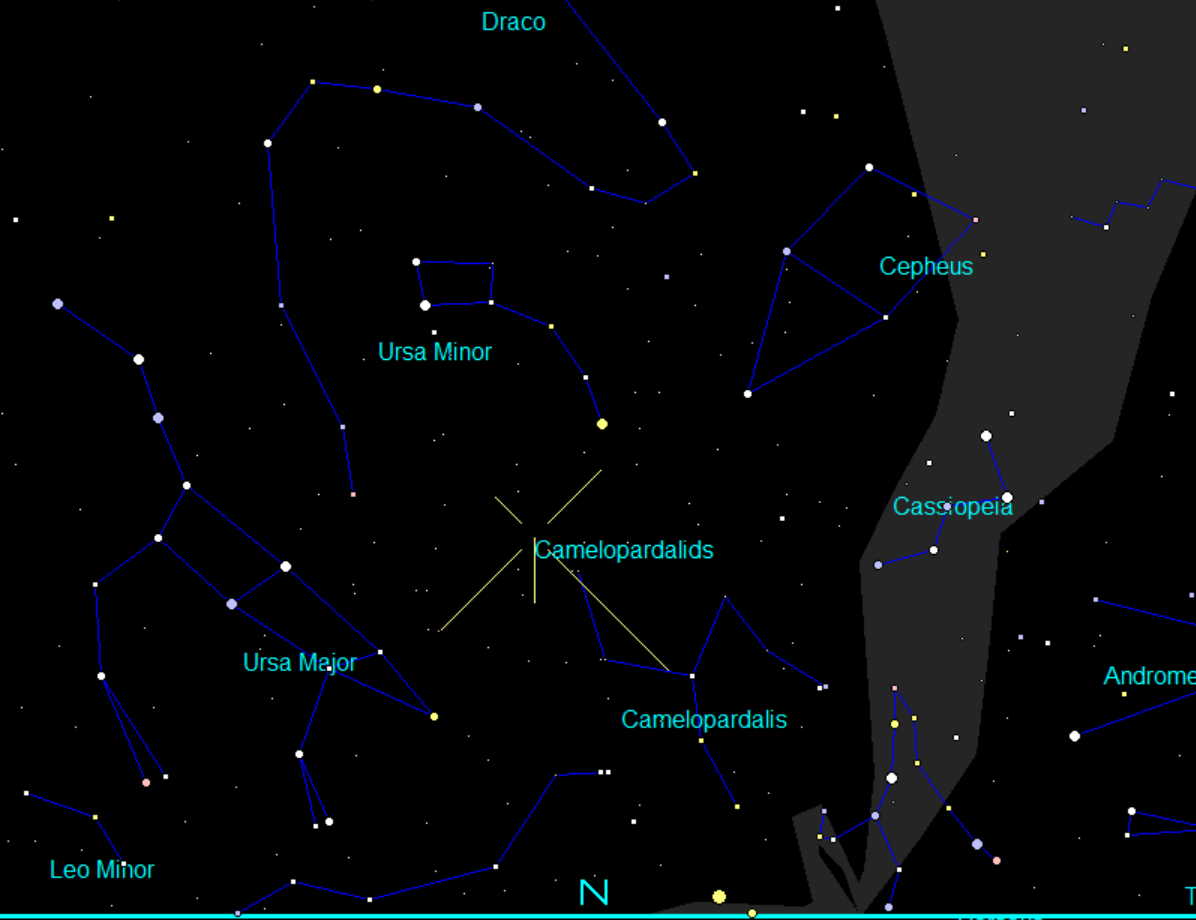
The expected radiant for the meteors of the May Camelopardalids, the meteors from the comet 209P/LINEAR at 3 a.m. on May 24, 2014. Credit: My LookingUp program.
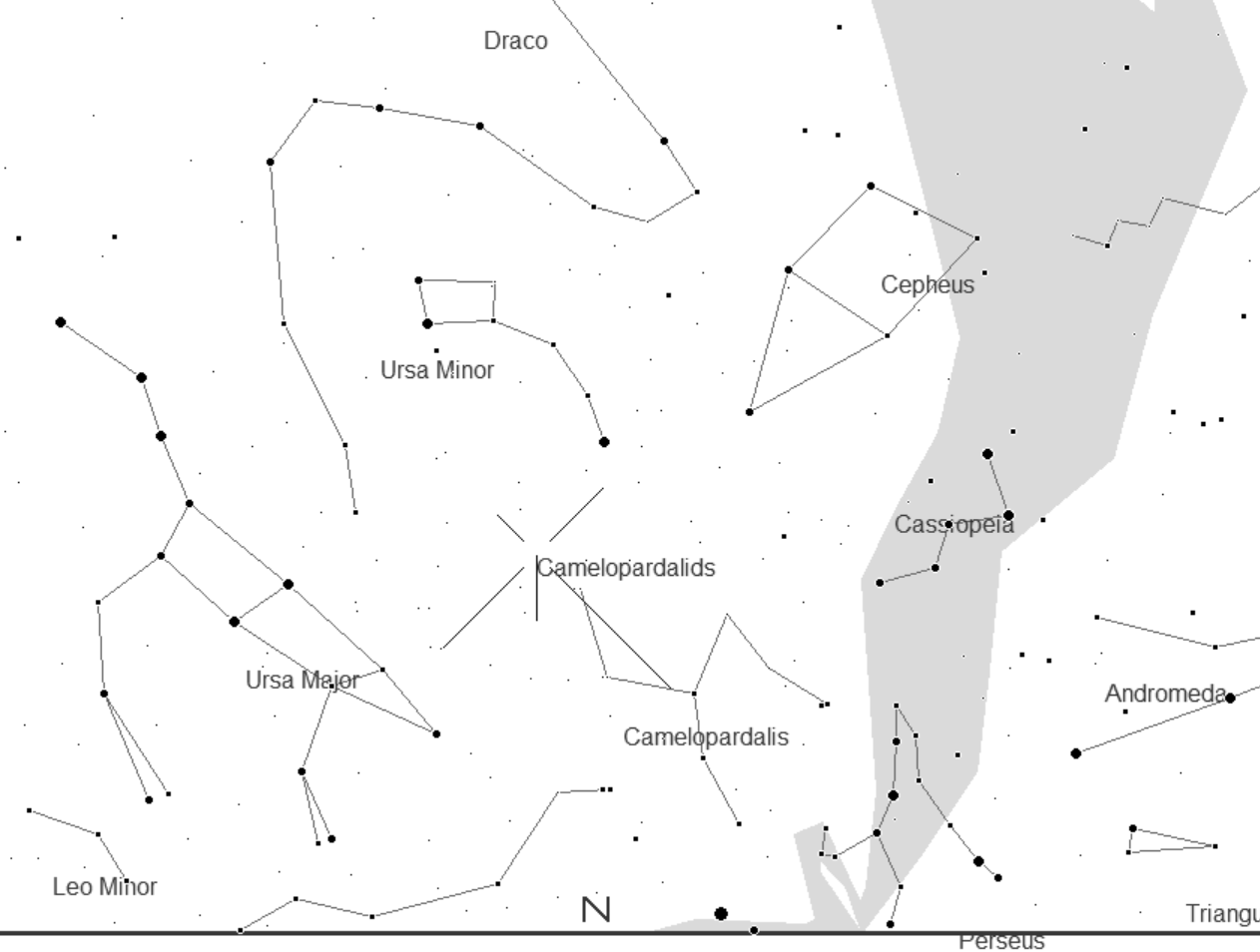
Same chart as above but black on white to save ink if you print it.
Here’s the culprit: Comet 209P/LINEAR

This May 17, 2014 image of Comet 209/LINEAR is the average of 5, 180-second exposures, taken remotely with the PlaneWave 17″+ Paramount ME+STL-6303E robotic unit of the Virtual Telescope Project. The telescope tracked the comet, so stars are trailing. This comet has the potential to generate an exceptional meteor shower (Camelopardalids) on May 24, 2014. Gianluca Masi / Virtual Telescope Project
Image and caption above from the Planetary Society blog from Bruce Betts: http://www.planetary.org/blogs/bruce-betts/20140522-one-night-only-a-new-meteor.html.
Want to find the comet?
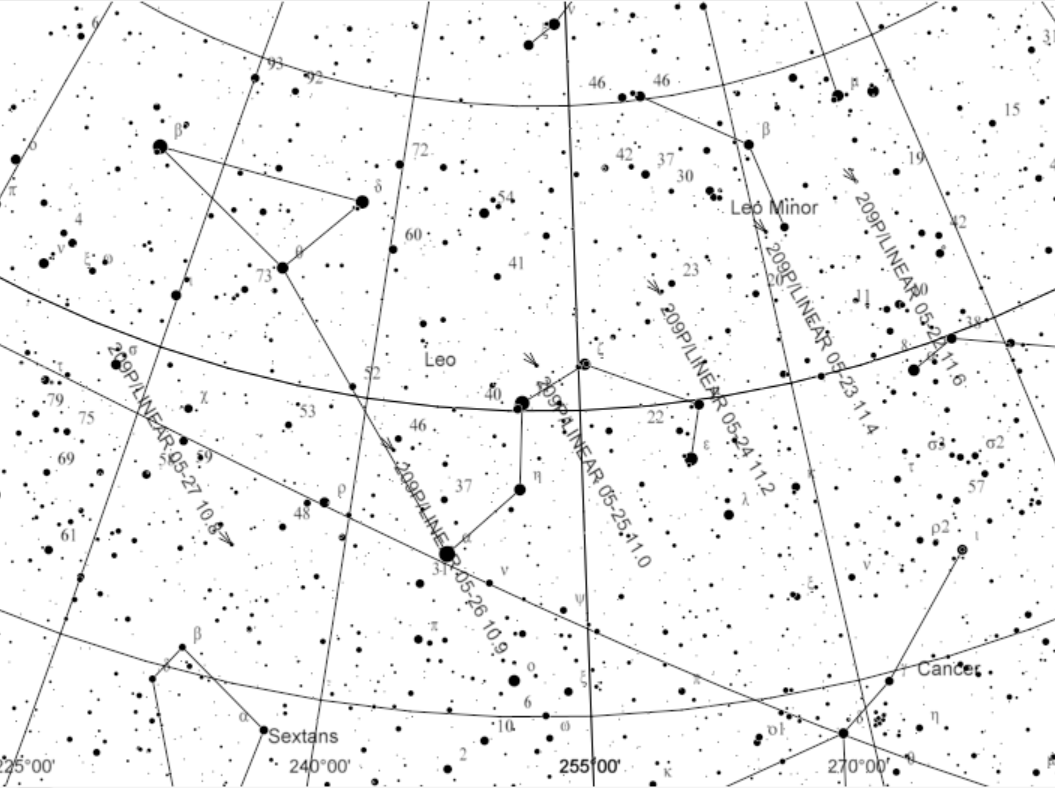
Finder chart for Comet 209P/LINEAR for 11 p.m. Note the dates are UT, 11 p.m. the 23rd is 3 a.m. UT on the 24th. Created using Cartes du Ciel (Sky Charts).
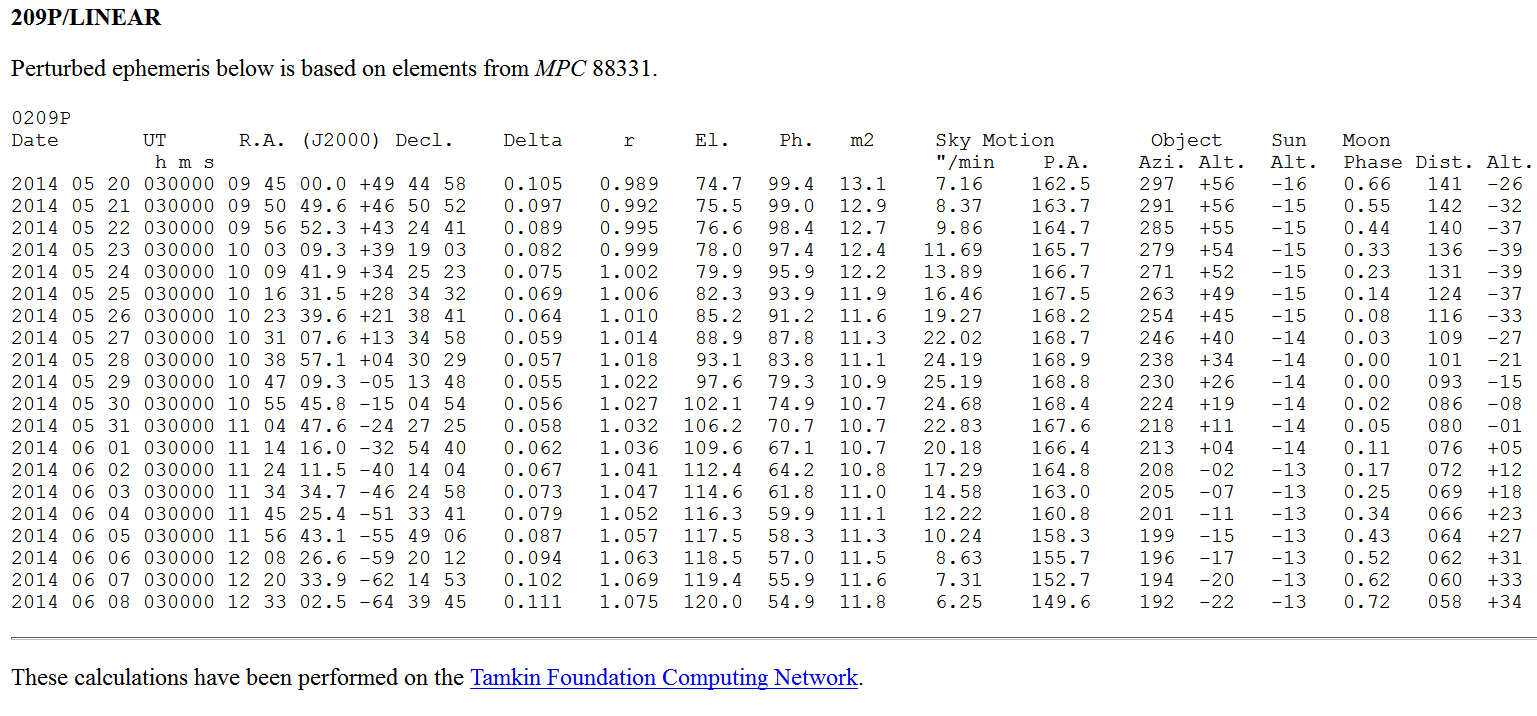
Ephemeris of positions for Comet 209P/LINEAR for May 20, 2014 to June 8, 2014 from the Minor Planet Center.
Got to http://www.minorplanetcenter.net/iau/MPEph/MPEph.html to print your own ephemeris for this or any comet. For purposes of this comet the comet name is: 209P/LINEAR.
All these images may be enlarged by clicking on them.
Note that:
Delta is the distance from Earth in Astronomical Units (AU)
r is the comet’s distance from the sun in AU.
El is the elongation in degrees from the sun
Ph. is the phase angle, not a big deal for comets.
m2 is the magnitude of the comet’s coma. Comets appear dimmer than their magnitude suggests.
05/22/2014 – Ephemeris – Meteor storms past and maybe this Saturday morning
Ephemeris for Thursday, May 22nd. Today the sun will be up for 15 hours and 3 minutes, setting at 9:11. The moon, 1 day past last quarter, will rise at 3:14 tomorrow morning. Tomorrow the sun will rise at 6:06.
The meteors from Comet 209P/LINEAR have not been completely unseen in the past, but their occurrence had never piqued the interest of meteor observers before. So the comet has left debris in its orbit. Some astronomers have been doing calculations on the orbital dynamics of a hypothetical meteor sward that may have developed near the comet. These swarms are not unprecedented. There’s the Leonid meteor storms that come every 33 years around November 17th that occur when its comet is near the Earth. Another is the less dramatic Draconids of early October, when its comet Giacobini-Zinner is in the neighborhood. The meteor storm is expected to peak around 3 a.m. this Saturday morning the 24th.
Times are for the Traverse City/Interlochen area of Michigan. They may be different for your location.
Addendum
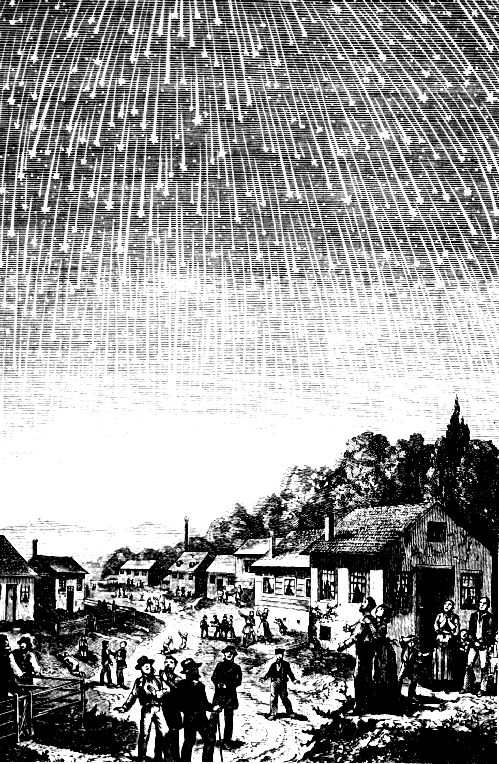
A famous woodcut of the 1833 Leonid meteor storm.
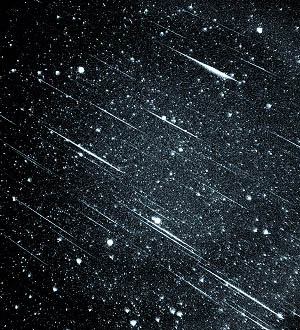
A photograph of the 1966 Leonid meteor storm by A. Scott Murrell. 40 meteors can be counted in the 10-12 minute exposure. Credit: P. Jenniskens/NASA-ARC http://leonid.arc.nasa.gov/.
05/20/2014 – Ephemeris – Special doings at the Sleeping Bear National Lakeshore Friday Night
Ephemeris for Tuesday, May 20th. Today the sun will be up for 14 hours and 59 minutes, setting at 9:09. The moon, 1 day before last quarter, will rise at 2:09 tomorrow morning. Tomorrow the sun will rise at 6:08.
This Friday evening Dr. Tyler Nordgren, astronomer, artist and dark sky advocate will give a presentation at the Sleeping Bear Dunes National Lakeshore Philip A. Hart Visitor Center in Empire at 7 p.m. Afterward he will be signing copies of his beautiful new poster See the Stars from Sleeping Bear Dunes National Lakeshore featuring the Great and Little Bear constellations and the bluffs of the Sleeping Bear Dunes and the Manitou Islands. After that, weather permitting see the sunset from many of the parks locations, then, for the hardy, settle down for an all night vigil for a possible meteor storm with the Grand Traverse Astronomical Society at the Dune Climb (The bottom, not the top, though you can climb up there for an all-sky view.).
Times are for the Traverse City/Interlochen area of Michigan. They may be different for your location.
Addendum

See the Stars from Sleeping Bear Dunes National Lakeshore Poster by Tyler Nordgren.
05/19/2014 – Ephemeris – The meteor storm and an all night star party to view it
Ephemeris for Monday, May 19th. Today the sun will be up for 14 hours and 57 minutes, setting at 9:08. The moon, 2 days before last quarter, will rise at 1:33 tomorrow morning. Tomorrow the sun will rise at 6:09.
This will be a first for the Grand Traverse Astronomical Society, an all night star party this Friday night and Saturday morning. The reason is the predicted meteor storm Saturday morning from Comet 209P/LINEAR, discovered in 2004. Near a I can tell no one has seen a single meteor from this comet. However several astronomers who work on cometary debris have some confidence that debris from this comet which orbits the Sun every 5 years will cross the Earth orbit on the morning of May 24th around 3 a.m. give or take. The hardiest of the GTAS members will be at the Dune Climb of the Sleeping Bear Dunes National Lakeshore all night. Join us if you can.
Times are for the Traverse City/Interlochen area of Michigan. They may be different for your location.
Addendum
The expected radiant for the meteors of the May Camelopardids, the meteors from the comet 209P/LINEAR at 3 a.m. on May 24, 2014. Credit: My LookingUp program.
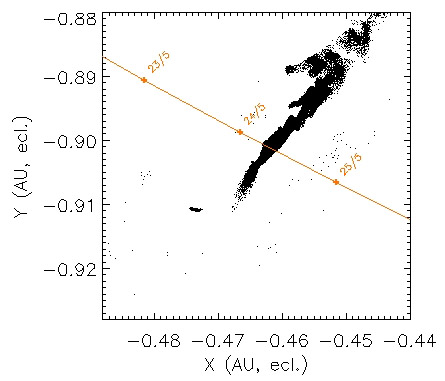
Earth’s motion in respect to the expected meteoroid stream from Comet 209P/LINEAR. Calculations by Jeremie Vaubaillon. From meteor.seti.org.
05/16/2014 – Ephemeris – A busy weekend for astronomy in the Grand Traverse Region
Ephemeris for Friday, May 16th. Today the sun will be up for 14 hours and 51 minutes, setting at 9:04. The moon, 2 days past full, will rise at 11:10 this evening. Tomorrow the sun will rise at 6:12.
This will be a busy weekend for the Grand Traverse Astronomical Society. Tonight the society will host a star party to celebrate the grand opening of the new Betsie Valley District Library in Thompsonville. It starts at 8:30 p.m. There will be a program inside by yours truly if it’s cloudy. Saturday night we’ll be observing the heavens with the students of the Interlochen Arts Academy. And on Sunday the society will have members with their telescopes showing the Sun if clear and have two rooms of exhibits in the Health and Science building for the Northwestern Michigan College’s annual Barbecue on the main campus. One of the society telescopes is a special solar telescope to view solar prominences.
Times are for the Traverse City/Interlochen area of Michigan. They may be different for your location.
Addendum

Observing the sun through GTAS members telescopes at the NMC Barbecue in 2012. Credit: Eileen Carlisle.
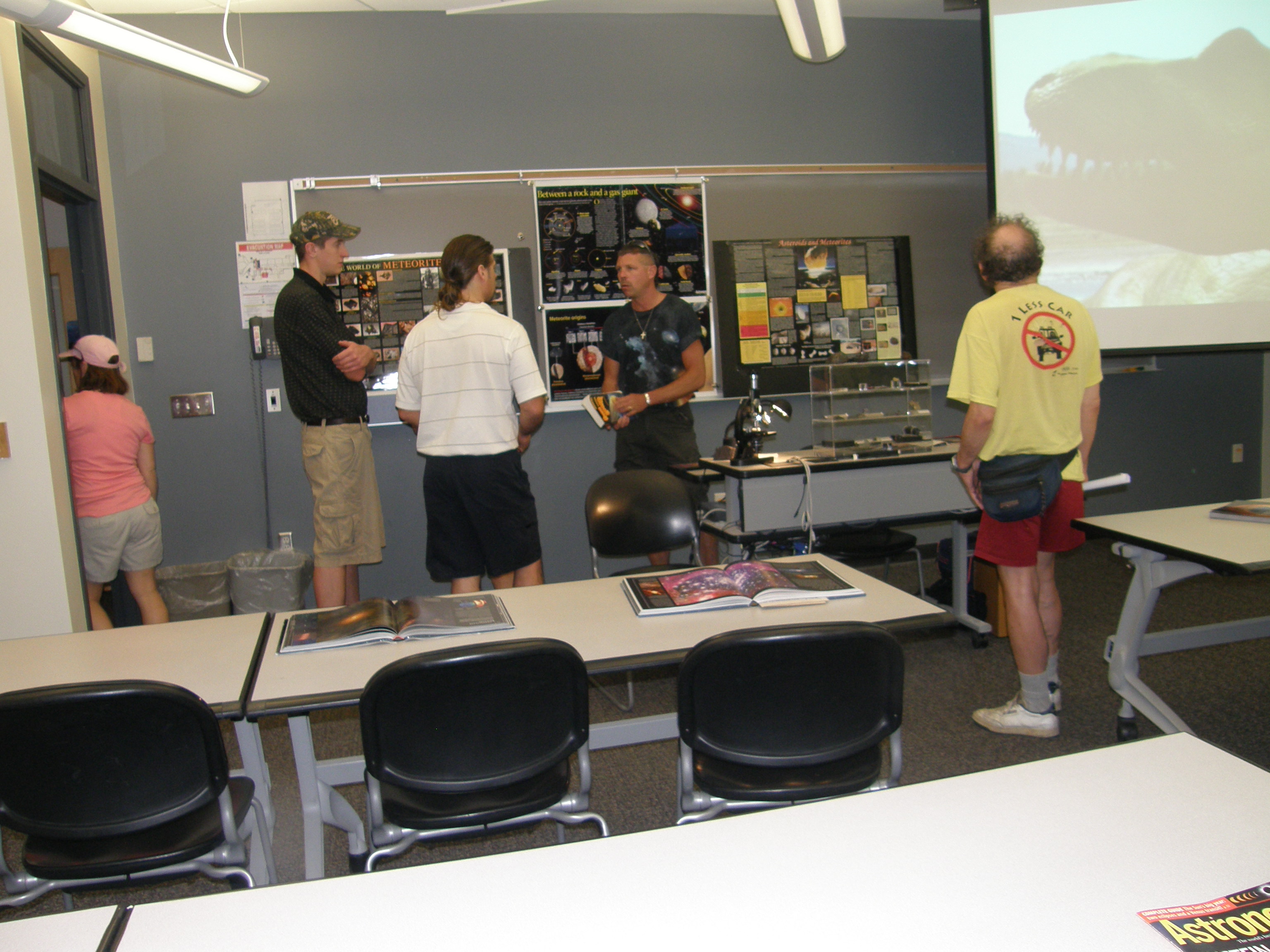
Joe Brooks, the GTAS “Meteorite Man” talks meteorites with Barbecue patrons. He has a video and meteorite samples. Photo credit: Eileen Carlisle.
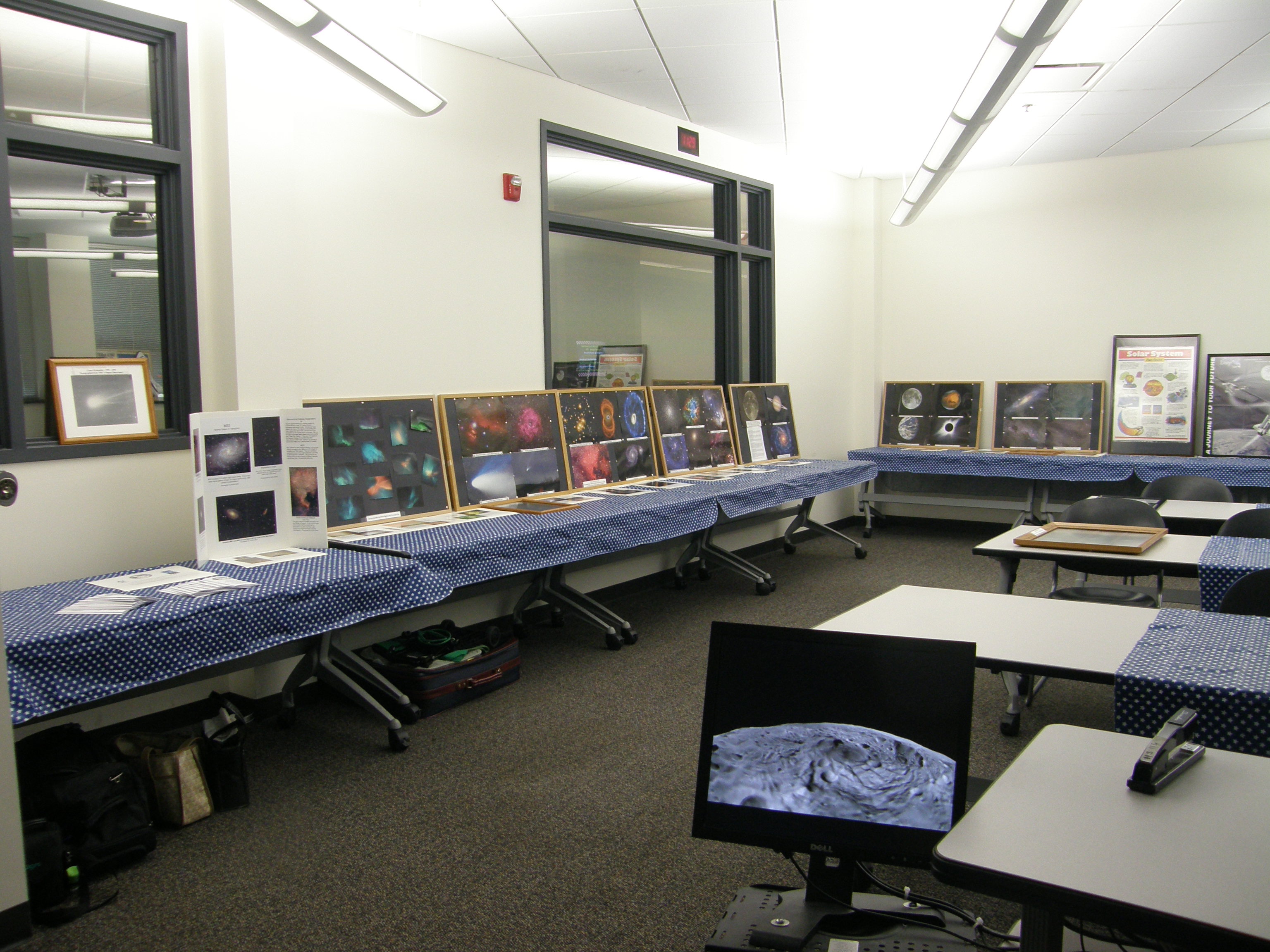
Astronomical photographs line the walls and tables of a classroom plus a series of astronomy videos are displayed at the NMC Barbecue. Credit: Eileen Carlisle.

