Archive
08/23/2013 – Ephemeris – Sidewalk astronomy at Friday Night Live tonight
Ephemeris for Friday, August 23rd. The sun rises at 6:54. It’ll be up for 13 hours and 39 minutes, setting at 8:34. The moon, 3 days past full, will rise at 9:42 this evening.
Tonight the Grand Traverse Astronomical Society will be down on Front Street in Traverse City for the last Friday Night Live of the year. The society sets up in front of Orvis Streamside, just west of the State Theater. The society will be setting up telescopes to view the sun. The society usually stays out until 10 pm or so to view Saturn and tonight possibly the moon. This will wrap up a busy August and summer for the society which saw 17 events since June, and 8 this month alone. The fun isn’t over. The society has five next month, including the Sleeping Bear Dunes at the Dune Climb, the Leland Heritage Celebration at Fish Town and the Acme Fall Festival. We end up October 21st, celebrating the 43rd anniversary of the Sleeping Bear Dunes National Lakeshore.
Times are for the Traverse City/Interlochen area of Michigan. They may be different for your location.
Addendum

The Sun in hydrogen alpha light through the Society’s solar telescope.

Looking at the Moon. Friday Night Live after hours.
08/22/2013 – Ephemeris – A new mission to the moon starts next month
Thursday, August 22nd. The sun rises at 6:53. It’ll be up for 13 hours and 42 minutes, setting at 8:36. The moon, 2 days past full, will rise at 9:11 this evening.
Though we all know that the moon is airless, surrounded by a better vacuum that we can pump down on the earth. Nonetheless the moon has a tenuous atmosphere of gas and dust. Next month NASA has scheduled the launch of another unmanned spacecraft to the moon. This one is LADEE, an acronym for Lunar Atmosphere and Dust Environment Explorer. It will take 30 days to reach the moon and will measure the dust and tenuous atmosphere of the moon. It will looking for the high altitude glows seen by the Apollo astronauts above the moon. There is also a demonstration laser communication system, at least six times faster than current radio technology.
Times are for the Traverse City/Interlochen area of Michigan. They may be different for your location.
Addendum
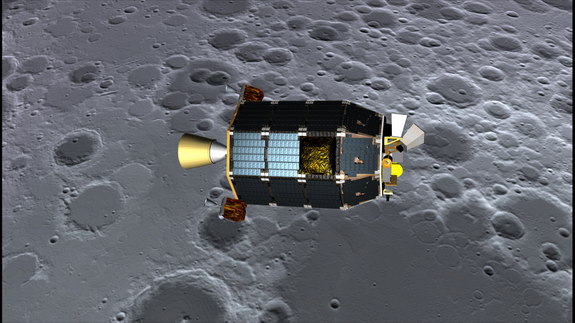
Artist’s depiction of LADEE in orbit of the Moon. Credit: NASA Ames / Dana Berry.
08/21/2013 – Ephemeris – Where are the bright planets this week?
Ephemeris for Wednesday, August 21st. The sun rises at 6:52. It’ll be up for 13 hours and 45 minutes, setting at 8:37. The moon, 1 day past full, will rise at 8:40 this evening.
Lets check out the planets visible now. Venus is now brilliant low in the western sky in evening twilight, It will set at 9:59 p.m. Holding forth in the west southwest will be Saturn this evening, the brightest star-like object in the constellation Virgo appearing yellowish to the left and above the extremely blue-white star Spica. It will set at 11:17 p.m. In the morning sky before twilight starts Jupiter will rise at 2:50 in the east northeast, with Mars rising a bit more than an hour later at 3:56. At about 5 a.m. Jupiter will be the brightest star-like object in the east northeast, with Mars barely visible below and left by about one and a half the width of your fist held at arm’s length. Castor and Pollux of Gemini point down to it.
Times are for the Traverse City/Interlochen area of Michigan. They may be different for your location.
Addendum
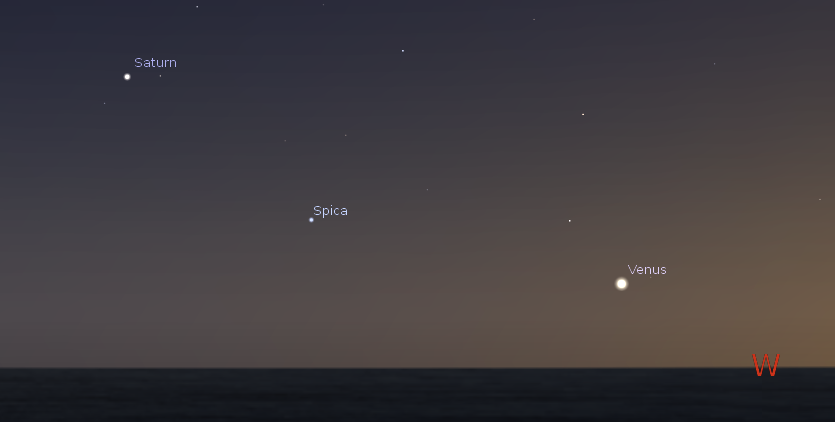
Venus and Saturn at 9:30 p.m. on August 21, 2013. Created using Stellarium.
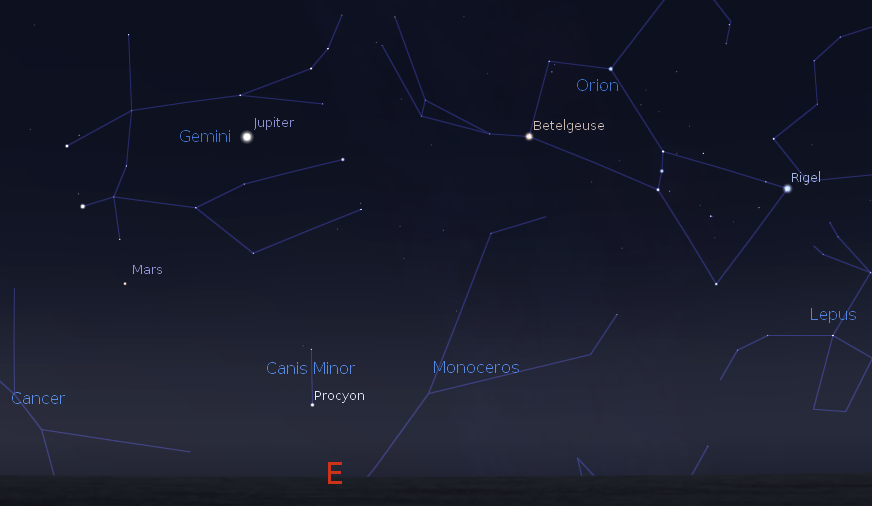
Jupiter and Mars with the rising winter constellations at 5:30 a.m. on August 22, 2013. Created using Stellarium.
08/20/2013 – Ephemeris – A “new” star in Delphinus
Ephemeris for Tuesday, August 20th. The sun rises at 6:51. It’ll be up for 13 hours and 48 minutes, setting at 8:39. The moon, at full today, will rise at 8:07 this evening.
There’s a new nova visible to the unaided eye, well just barely, if the moon wasn’t out. “New nova” is kind of redundant because Nova is Latin for new, The entire Latin term is Nova Stellum or new star. It isn’t really a new star, but one that brightened catastrophically, siphoning gas off a companion red giant star. At least that’s what we think. Detailed analysis will come later. It’s informal name is Nova Delphinus, which lies between the tiny constellation of Delphinus the dolphin and Sagitta the arrow in and near the Summer Triangle. http://www.skyandtelescope.com has a finder chart. It’s best to use binoculars to locate it. The Arrow points right to it, while the two stars that cross the body of the dolphin also point to it. Novae are unusual, but not rare.
Times are for the Traverse City/Interlochen area of Michigan. They may be different for your location.
Addendum
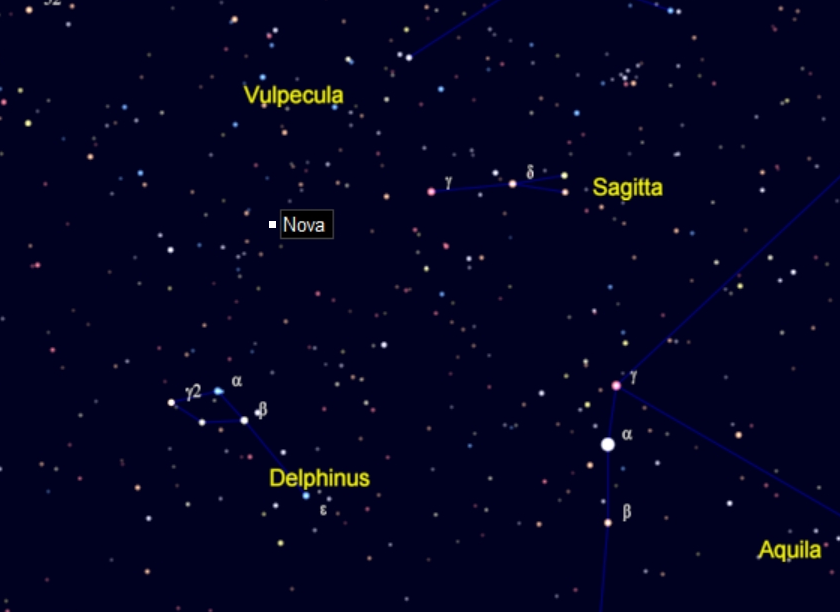
My finder chart for Nova Dephinus 2013. Created using Cartes du Ceil (Sky Charts)
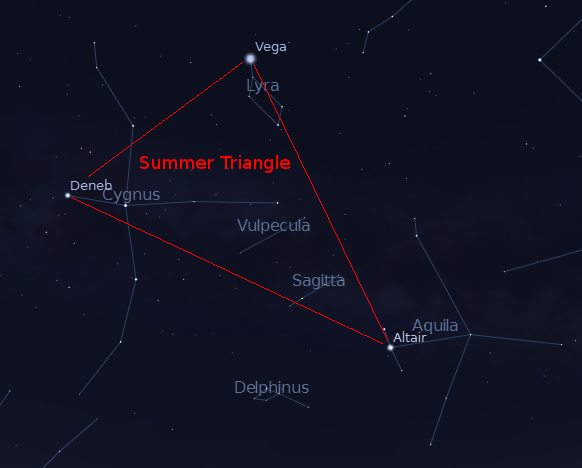
The Summer Triangle with Delphinus and Sagitta. Created using Stellarium and The Gimp.
08/19/2013 – Ephemeris – Comet ISON, final approach!
Ephemeris for Monday, August 19th. The sun rises at 6:50. It’ll be up for 13 hours and 51 minutes, setting at 8:41. The moon, 1 day before full, will set at 6:22 tomorrow morning.
Comet ISON is beginning to become visible from the earth after spending a few month’s behind the sun. It has shown earlier this year that it had not been brightening as predicted, but soon will be visible for better measurements. Tomorrow it the Mars Reconnaissance Orbiter will take its first image of ISON. The Curiosity and Opportunity rovers will also soon take photo’s of Comet ISON in the martian sky. When ISON becomes visible from Mercury, the MESSENGER spacecraft orbiting Mercury will get its chance. All available instruments on earth and deployed in the solar system will track the comet to see how it evolves and to see if it will survive its brush with the sun’s corona to become a bright autumn comet.
Times are for the Traverse City/Interlochen area of Michigan. They may be different for your location.
Addendum
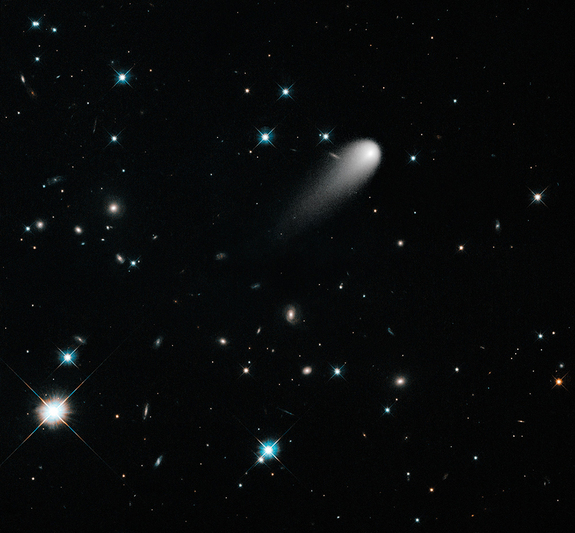
Hubble Space Telescope image of Comet ISON against a field of distant galaxies, April 30, 2013. Credit NASA.
08/16/2013 – Ephemeris – Another weekend under the stars
Ephemeris for Friday, August 16th. The sun rises at 6:46. It’ll be up for 13 hours and 59 minutes, setting at 8:45. The moon, 2 days past first quarter, will set at 2:44 tomorrow morning.
The Grand Traverse Astronomical Society will have a busy weekend, though not as busy as last weekend where we had four events on four nights. It starts this evening with Friday Night Live, viewing the sun if it’s clear. The society sets up in front of Orvis Streamside, just west of the State Theater. After the event closes we’ll stay after to view the moon and possibly Venus and Saturn. Saturday evening from 9 to 11 p.m. The crew will be out at Northwestern Michigan College’s Rogers Observatory on Birmley Road, south of Traverse City for a Star Party, again with the moon, Venus and Saturn. Some of the brighter objects beyond the solar system, we call them deep sky objects, will be viewed if it’s clear.
Times are for the Traverse City/Interlochen area of Michigan. They may be different for your location.
Addendum
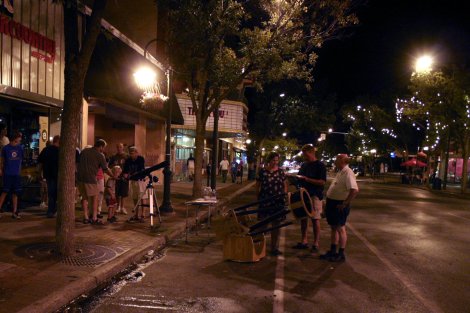
On Front Street after Friday Night Live.
08/15/2013 – Ephemeris – Plato and Copernicus (the craters)
Ephemeris for Thursday, August 15th. The sun rises at 6:45. It’ll be up for 14 hours and 2 minutes, setting at 8:47. The moon, 1 day past first quarter, will set at 1:43 tomorrow morning.
The moon now is slightly gibbous. The term gibbous comes from Latin meaning having a hump or humpbacked. In binoculars or a small telescope look to the upper left where the great Sea of Showers or Mare Imbrium is being revealed by the advance of sunrise. The flat walled plain, actually a crater called Plato is off the top of Imbrium. It is circular and 61 miles in diameter. It looks oval to us because of the curvature of the moon. Below or south at the other edge of Imbrium, just coming into sunlight is the marvelous crater Copernicus with it’s triple central peaks. It’s 56 miles in diameter. In a good enough telescope one can see that the crater walls appear terraced. Copernicus is 2 miles deep.
Times are for the Traverse City/Interlochen area of Michigan. They may be different for your location.
Addendum
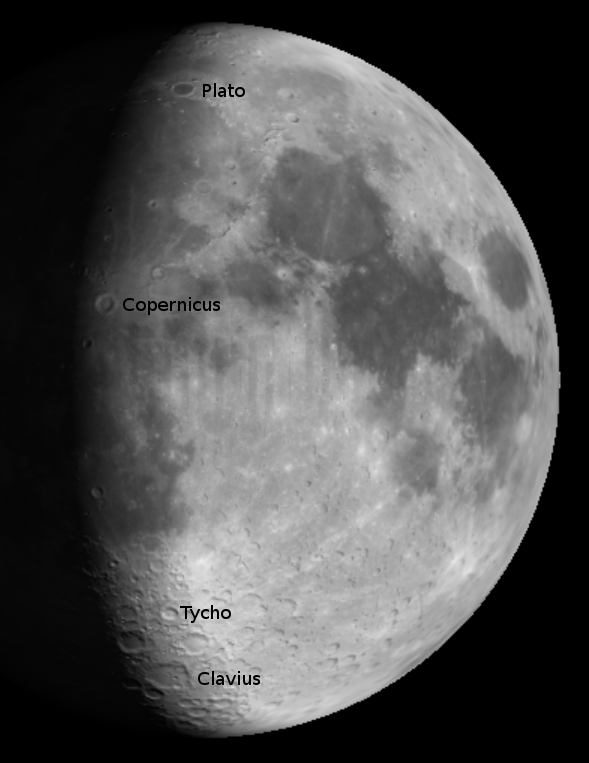
The moon a day after first quarter on August 15, 2013. Created using Virtual Moon Atlas.
The image also includs the craters Tycho and Clavius craters in the southern highlands.
08/14/2013 – Ephemeris – Where are the bright planets this week?
Ephemeris for Wednesday, August 14th. The sun rises at 6:44. It’ll be up for 14 hours and 4 minutes, setting at 8:49. The moon, at first quarter today, will set at 12:49 tomorrow morning.
Lets check out the planets visible now. Venus is now brilliant low in the western sky in evening twilight, It will set at 10:11 p.m. Holding forth in the west southwest will be Saturn this evening, the brightest star-like object in the constellation Virgo appearing yellowish to the left and above the extremely blue-white star Spica. It will set at 11:43 p.m. In the morning sky before twilight starts Jupiter will rise at 3:12, with Mars rising nearly an hour later at 4:01. At about 5 a.m. Jupiter will be the brightest star-like object in the east northeast, with Mars barely visible below and left by about the width of your fist held at arm’s length. Mercury is now to close to the sun to be seen, heading around the far side of the sun.
Times are for the Traverse City/Interlochen area of Michigan. They may be different for your location.
Addendum
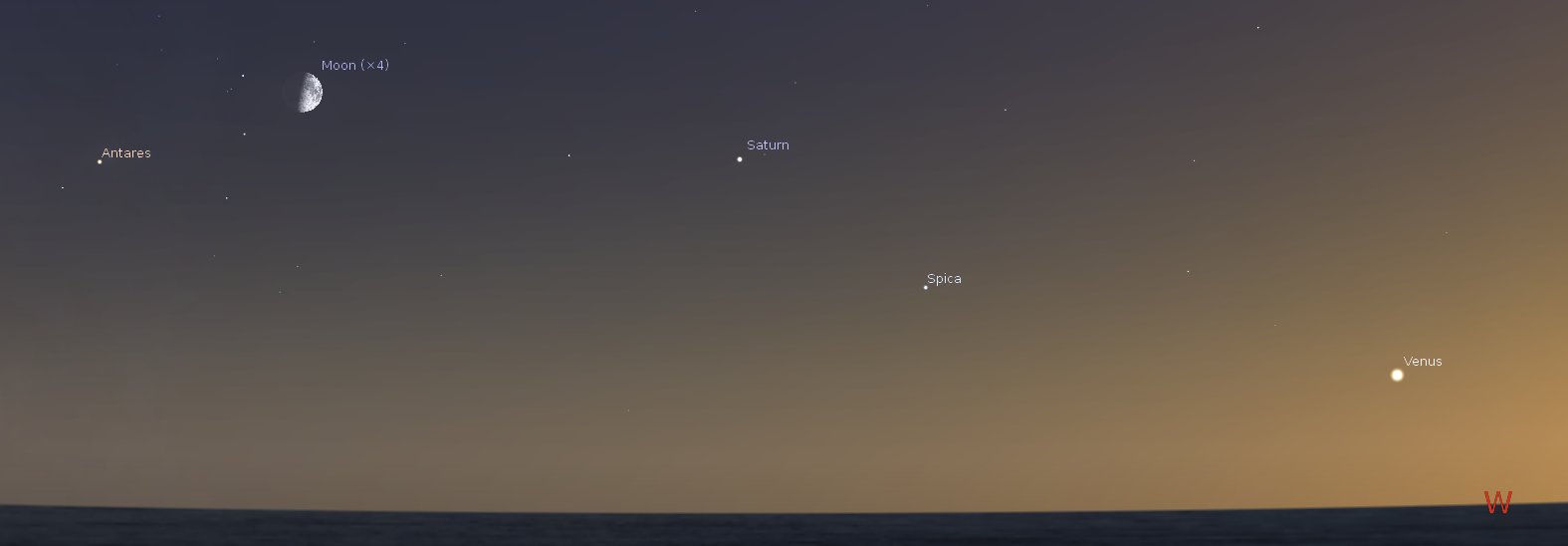
Venus, Saturn and the Moon at 10:30 p.m. on August 14, 2013. Note that the Moon is 4 times its normal size. Created using Stellarium. Click on the image to enlarge.
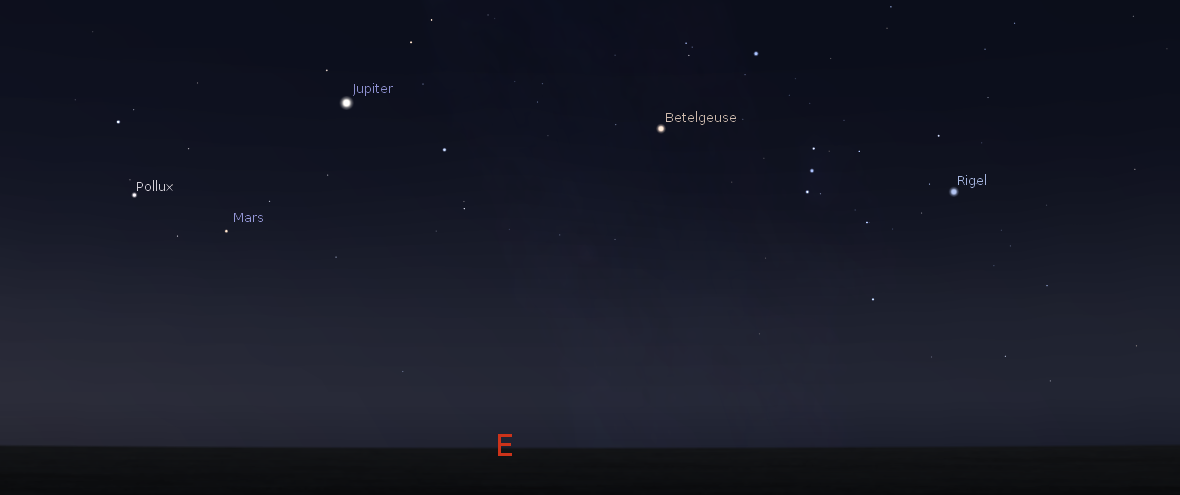
Jupiter and Mars with Orion and other morning stars at 5:30 a.m. August 15, 2013. Created using Stellarium. Click on the image to enlarge.
08/13/2013 – Ephemeris – Highs and lows on the moon
Ephemeris for Tuesday, August 13th. The sun rises at 6:43. It’ll be up for 14 hours and 7 minutes, setting at 8:50. The moon, 1 day before first quarter, will set at 12:04 tomorrow morning.
The moon passed Saturn a couple of hours ago while they were below the horizon. By this evening the moon will be to the left of Saturn. In each 24 hour period the moon moves about 24 times its diameter against the stars, or its own width in an hour. Looking at the moon tonight with binoculars or a telescope, the Sea of Serenity or Mare Serenitatis dominates the moon’s upper right quadrant. To me its shaped like a scallop shell. On the bottom part of the moon are the lunar highlands, bright and saturated with craters large and small. The highlands are really high, while the sea’s like Serenity are low. Should the moon have an atmosphere and water, the seas would be real, not just lava filled plains.
Times are for the Traverse City/Interlochen area of Michigan. They may be different for your location.
Addendum
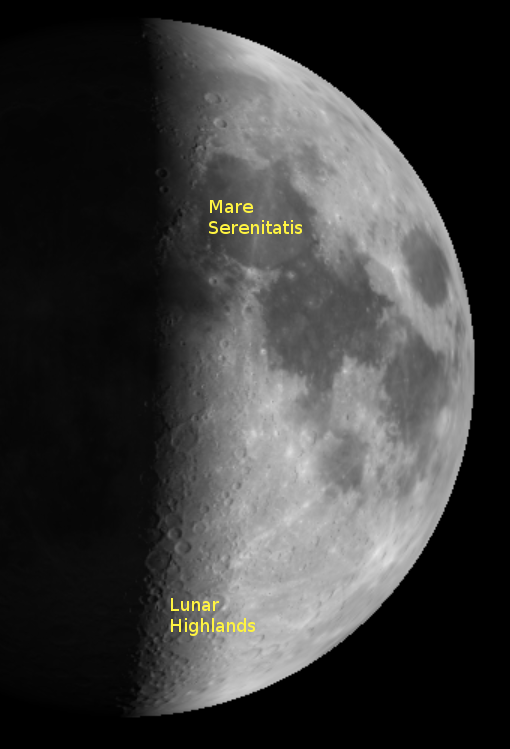
The Moon 1 day before first quarter. Created usinf Virtual Moon Atlas.
08/12/2013 – Ephemeris – The perseid meteors are not done yet
Ephemeris for Monday, August 12th. The sun rises at 6:41. It’ll be up for 14 hours and 10 minutes, setting at 8:52. The moon, 2 days before first quarter, will set at 11:26 this evening.
The Perseid meteor shower is still active. Their peak will be this afternoon. So starting at moon set at 11:26 or so it will be dark enough to see them. Meteor showers are caused when the earth crosses the path of a periodic comet and runs into the debris liberated by the comet’s past visits near the sun. Comet Swift-Tuttle is the comet responsible for the Perseids. It has an orbit of the sun of 130 years. Every time the comet comes close to the sun, it liberates a cloud of small gravel that’s too massive to be swept into the comet’s tail, however it is affected by the pressure of sunlight. These make the prediction of the time of the meteor shower interesting, or that a particular cloud may miss the earth this time to hit it some other passage.
Addendum
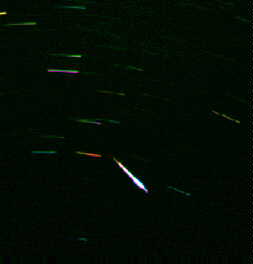
My best Perseid photo. From the 70’s.

