Archive
08/09/2013 – Ephemeris – A weekend full of local astronomical events
Ephemeris for Friday, August 9th. The sun rises at 6:38. It’ll be up for 14 hours and 18 minutes, setting at 8:56. The moon, 3 days past new, will set at 9:55 this evening.
This weekend is packed with events by the Grand Traverse Astronomical Society starting tonight with Friday Night Live on Front Street in Traverse City. We’ll start by looking at the sun if it’s clear, and at Saturn as night falls. Tomorrow night its a Star Party and meteor watch at Thoreson Farm at Sleeping Bear Dunes National Lakeshore see the map at http://www.gtastro.org for location. Sunday night it’s Meteors and S’mores at Leelanau State Park. The Perseid meteor shower will reach its peak between 2 and 4 Monday afternoon, but we’re already seeing its meteors, which seem to come from the northeastern sky. The moon really won’t interfere until Monday night before midnight, so this is an excellent year for the Perseid meteor shower.
Times are for the Traverse City/Interlochen area of Michigan. They may be different for your location.
Addendum
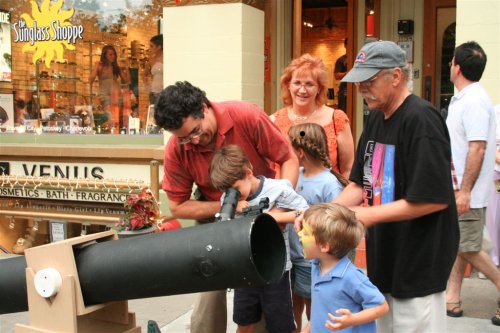
Friday Nite Live
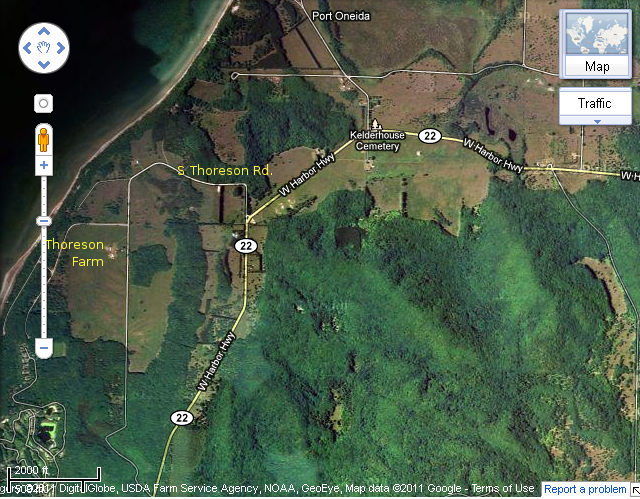
Map to Thoreson Farm, northeast of Glen Arbor.
08/08/2013 – Ephemeris – The wonders located in Scutum the shield
Ephemeris for Thursday, August 8th. The sun rises at 6:37. It’ll be up for 14 hours and 20 minutes, setting at 8:58. The moon, 2 days past new, will set at 9:28 this evening.
The teapot pattern of stars that is the constellation of Sagittarius lies at the southern end of the Milky Way this evening. It appears that the Milky Way is steam rising from the spout. The area above Sagittarius in the brightest part of the Milky Way is the dim constellation of Scutum the shield. Don’t bother looking for the stars that make up the constellation; what’s important is the star clouds of the Milky Way. Scan this area with binoculars or small telescope for star clusters and nebulae or clouds of gas. In binoculars both clusters and nebulae will appear fuzzy, but a small telescope will tell most of them apart. Even if you’ve never been able to find anything in your telescope, put on the lowest power eyepiece you have and scan back and forth for these wonders.
Times are for the Traverse City/Interlochen area of Michigan. They may be different for your location.
Addendum
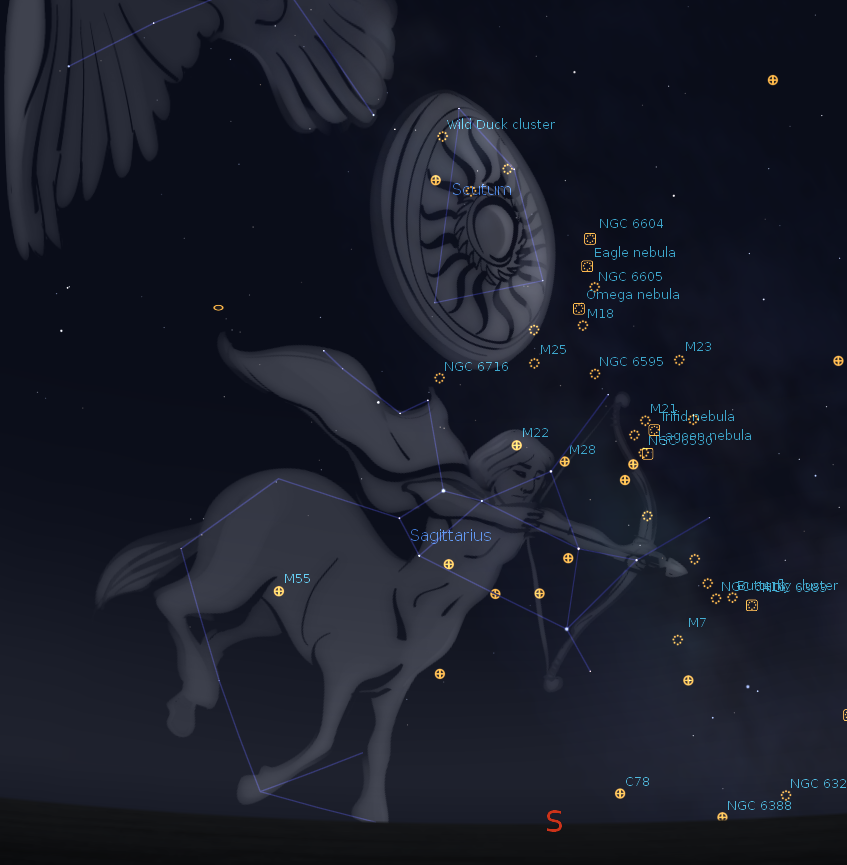
Binocular and telescope deep sky objects in Scutum and Sagittarius. Created using Stellarium.
The symbols mean:
Circle with embedded cross – Globular star cluster (Very old compact star cluster)
Open dotted circle – Open or galactic star cluster (Young loose star cluster)
Square – Nebula (Here emission nebulae. In many cases with associated open clusters)
Ellipse – Galaxy
08/07/2013 – Ephemeris – Where are the bright planets this week?
Ephemeris for Wednesday, August 7th. The sun rises at 6:36. It’ll be up for 14 hours and 23 minutes, setting at 8:59. The moon, 1 day past new, will set at 9:00 this evening.
Lets check out the planets visible now. Venus is now brilliant low in the western sky in evening twilight, It will set at 10:23 p.m. Holding forth in the southwest will be Saturn this evening, the brightest star-like object in the constellation Virgo appearing yellowish to the left of the extremely blue-white star Spica. It will set at 12:14 tomorrow morning. In the morning sky before sunrise Jupiter will rise at 3:33, with Mars rising shortly after at 4:06, which will appear below and left of Jupiter by four and a half degrees or half the width of your fist held at arm’s length. Mercury will rise at 5:12 a.m. tomorrow. It will nearly two widths of your fist below and left of Jupiter. For sharp-eyed observers we have 5 planets visible now.
Times are for the Traverse City/Interlochen area of Michigan. They may be different for your location.
Addendum
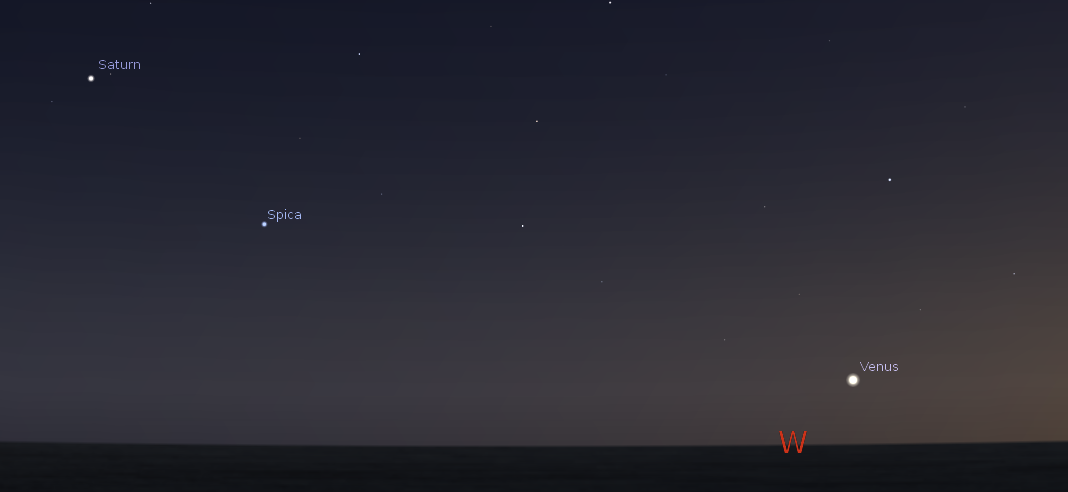
Venus and Saturn at 10 p.m. on August 7, 2013. Created using Stellarium.
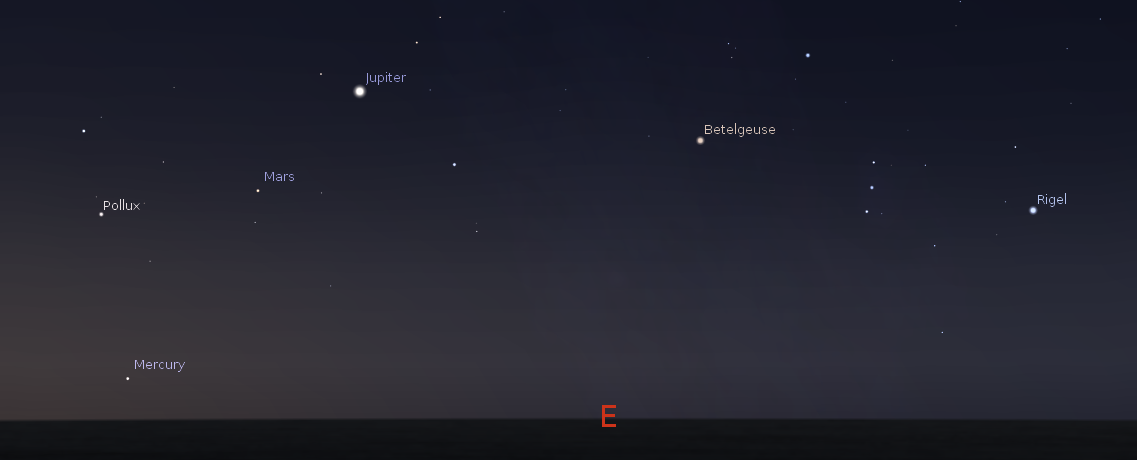
Morning planets and stars at 5:30 a.m. on August 8, 2013. Created using Stellarium.
08/06/2013 – Ephemeris – The constellation of Sagittarius: centaur or teapot?
Ephemeris for Tuesday, August 6th. The sun rises at 6:34. It’ll be up for 14 hours and 26 minutes, setting at 9:00. The moon is new today, and won’t be visible.
The Milky Way runs from north to south through the heavens at 11 p.m. You’ll notice that the Milky Way is brighter and broader just above the horizon in the south. In that glow in the south is a star pattern that looks like a stout little teapot, with a bright stream of the Milky Way rising from the spout, which faces the west. This pattern of stars is the major part of the constellation called Sagittarius. According to Greek mythology Sagittarius is a centaur with a bow and arrow poised to shoot Scorpius the scorpion to the right. This centaur is named Chiron, the most learned of the breed, centaurs usually being a rowdy bunch. The center of the pin wheel of our galaxy lies hidden beyond the stars near the spout of the teapot.
Times are for the Traverse City/Interlochen area of Michigan. They may be different for your location.
Addendum
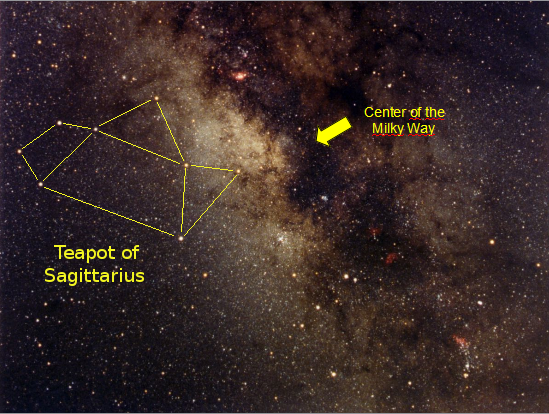
Location of the center of the Milky Way behind gas and dust clouds and the Teapot of Sagittarius.
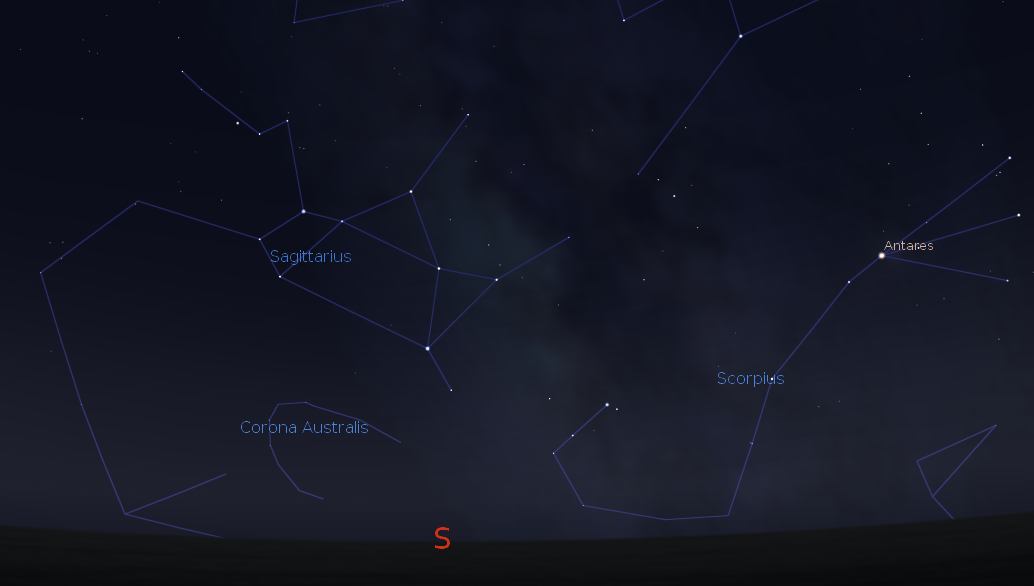
Sagittarius and Scorpius at 11 p.m. on August 6, 2013. Created using Stellarium.
08/05/2013 – Ephemeris – The celestial swan
Ephemeris for Monday, August 5th. The sun rises at 6:33. It’ll be up for 14 hours and 28 minutes, setting at 9:02. The moon, 1 day before new, will rise at 6:28 tomorrow morning.
High in the east as it gets dark flies the constellation of Cygnus the swan. This constellation is also known as the Northern Cross. The cross is seen lying on its side with the bright star Deneb, member of the Summer Triangle, at the head of the cross to the left. The rest of the cross is delineated in the stars to the right. As a swan, Deneb is the tail, the stars of the crosspiece of the cross are the leading edges of wings as Cygnus flies south through the Milky Way. There are faint stars that also define the trailing wing edges. It is a very good portrayal of a flying swan, like the mute swans we see on the wing around here. In Cygnus we are looking in the direction that the sun is traveling as it orbits the center of the Milky Way galaxy.
Times are for the Traverse City/Interlochen area of Michigan. They may be different for your location.
Addendum
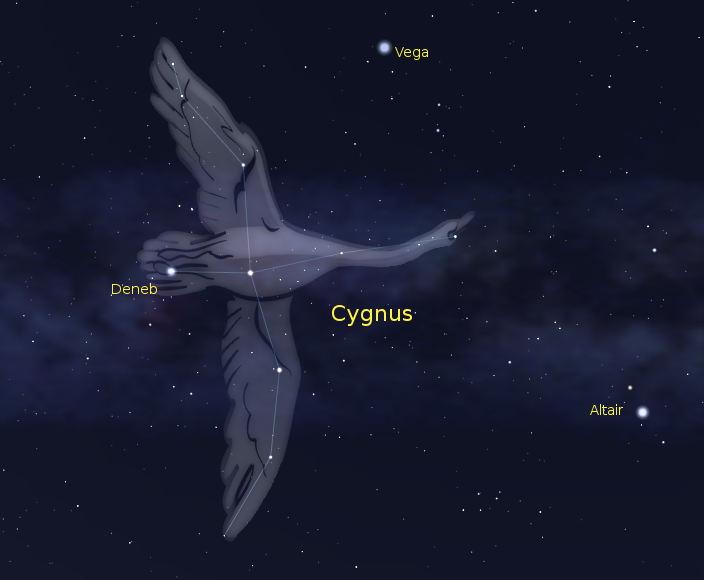
Cygnus The Swan Created using Stellarium.
08/02/2013 – Ephemeris – Star Party tonight!
Ephemeris for Friday, August 2nd. The sun rises at 6:30. It’ll be up for 14 hours and 35 minutes, setting at 9:06. The moon, half way from last quarter to new, will rise at 3:38 tomorrow morning.
Tonight the Grand Traverse Astronomical Society and the NMC Astronomy Club will host a star party at Northwestern Michigan College’s Rogers Observatory starting at 9 p.m. featuring, if it’s clear, the planets Venus and Saturn. Some of the wonders of the summer sky can be seen as it gets darker. There are sparkling binary stars and star clusters including the Great Globular Star Cluster in Hercules, the Wild Duck Cluster, the Ring Nebula, the expanding gasses of a dying star. There are also other wonders of the Milky Way to be seen. There will be a program if the skies are too cloudy to observe. The observatory is located south of Traverse City, on Birmley Road between Garfield and Keystone roads.
Times are for the Traverse City/Interlochen area of Michigan. They may be different for your location.
08/01/2013 – Ephemeris – Previewing August skies
Ephemeris for Thursday, August 1st. The sun rises at 6:29. It’ll be up for 14 hours and 38 minutes, setting at 9:07. The moon, 3 days past last quarter, will rise at 2:49 tomorrow morning.
Let’s look ahead at the month of August in the skies. Daylight hours will decrease from 14 hours and 38 minutes today to 13 hours 16 minutes on the 31st. The altitude of the sun at local noon, that is degrees of angle above the horizon will decrease from 63 degrees today to just over 53 degrees on the 31st. Straits area listeners can subtract one more degree from those angles. Local noon, when the sun is due south, is about 1:43 p.m. The Perseid meteor shower will reach its peak at between 2 and 4 p.m. on the 12th. That means that more than likely the morning of the 12th and 13th will be equally good. I tend to prefer viewing before the peak, if given a choice. There are some observing events planned for that time.
Times are for the Traverse City/Interlochen area of Michigan. They may be different for your location.
Addendum
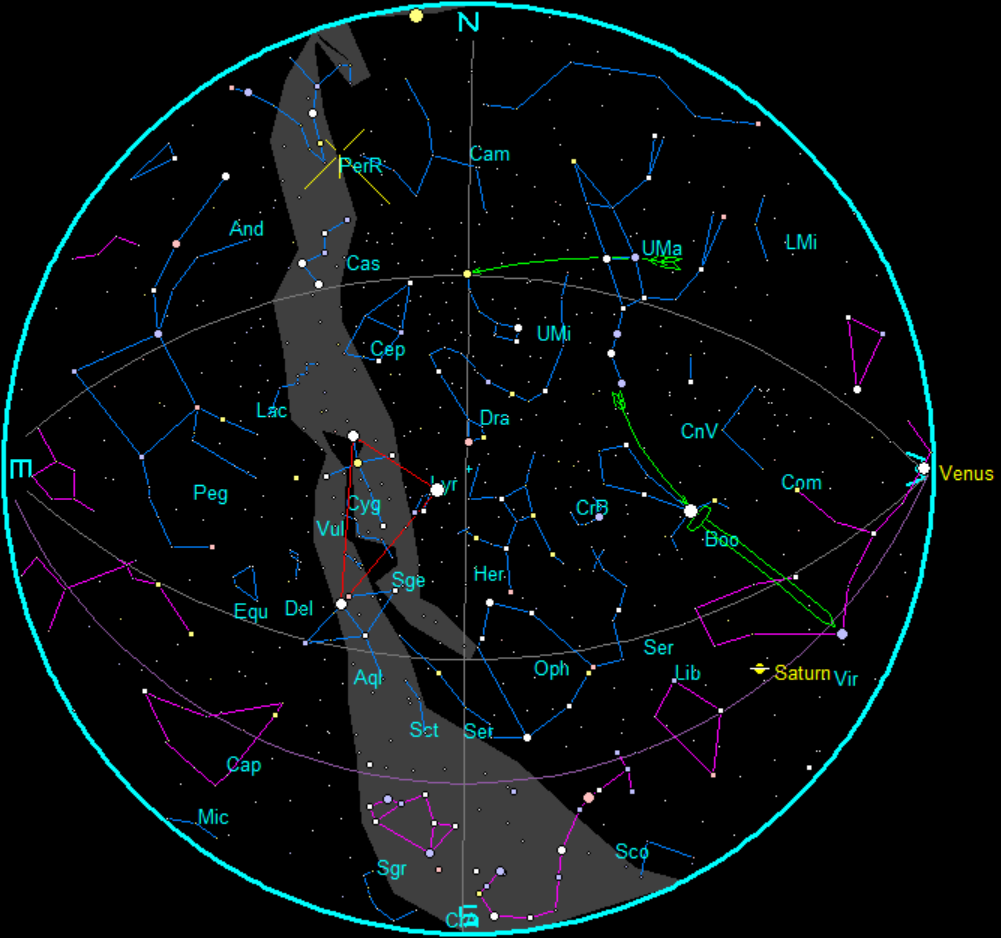
The sky as it would appear on August 15, 2013 at 10 p.m., without the moon.
The constellation abbreviations, names and bright star names are found here.
- The arrow from the pointer stars of the Big Dipper to Polaris the North Star, near the north celestial pole.
- Follow the arc of the handle of the Big Dipper to Arcturus.
- A Leaky Dipper drips on Leo
- Follow the spike to Spica.
- The Summer Triangle (in red)
- PerR is the Perseid meteor radiant
07/31/2013 – Ephemeris – All 5 bright planets are visible now
Ephemeris for Wednesday, July 24th. The sun rises at 6:20. It’ll be up for 14 hours and 56 minutes, setting at 9:16. The moon, 2 days past full, will rise at 10:12 this evening.
Lets check out the planets visible now. Venus is now low in the west northwestern sky in evening twilight, Venus will set at 10:44 p.m. Holding forth in the southwest will be Saturn this evening, the brightest star-like object in the constellation Virgo appearing yellowish to the left of the extremely blue-white star Spica. Saturn is a wonderful sight in a telescope of 20 power or more. In telescopes Saturn’s large moon Titan can be easily seen. Saturn will set at 1:04 tomorrow morning. Jupiter and Mars will rise close together at 4:14 and 4:17 a.m. Respectively in the east northeast in morning twilight. The much dimmer Mars will appear to the lower left of the brighter Jupiter, and may take binoculars to locate.
Times are for the Traverse City/Interlochen area of Michigan. They may be different for your location.
Addendum
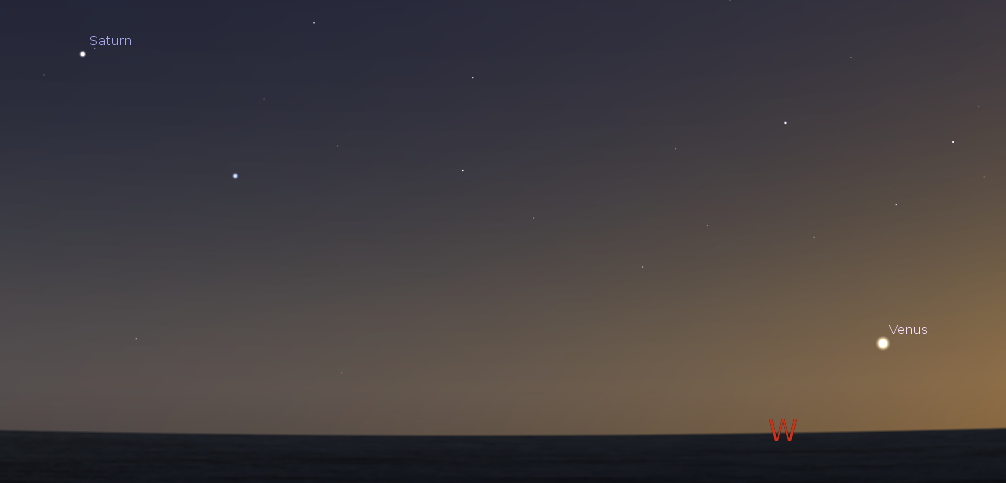
Venus and Saturn at 10 p.m. on July 31, 2013. Created using Stellarium
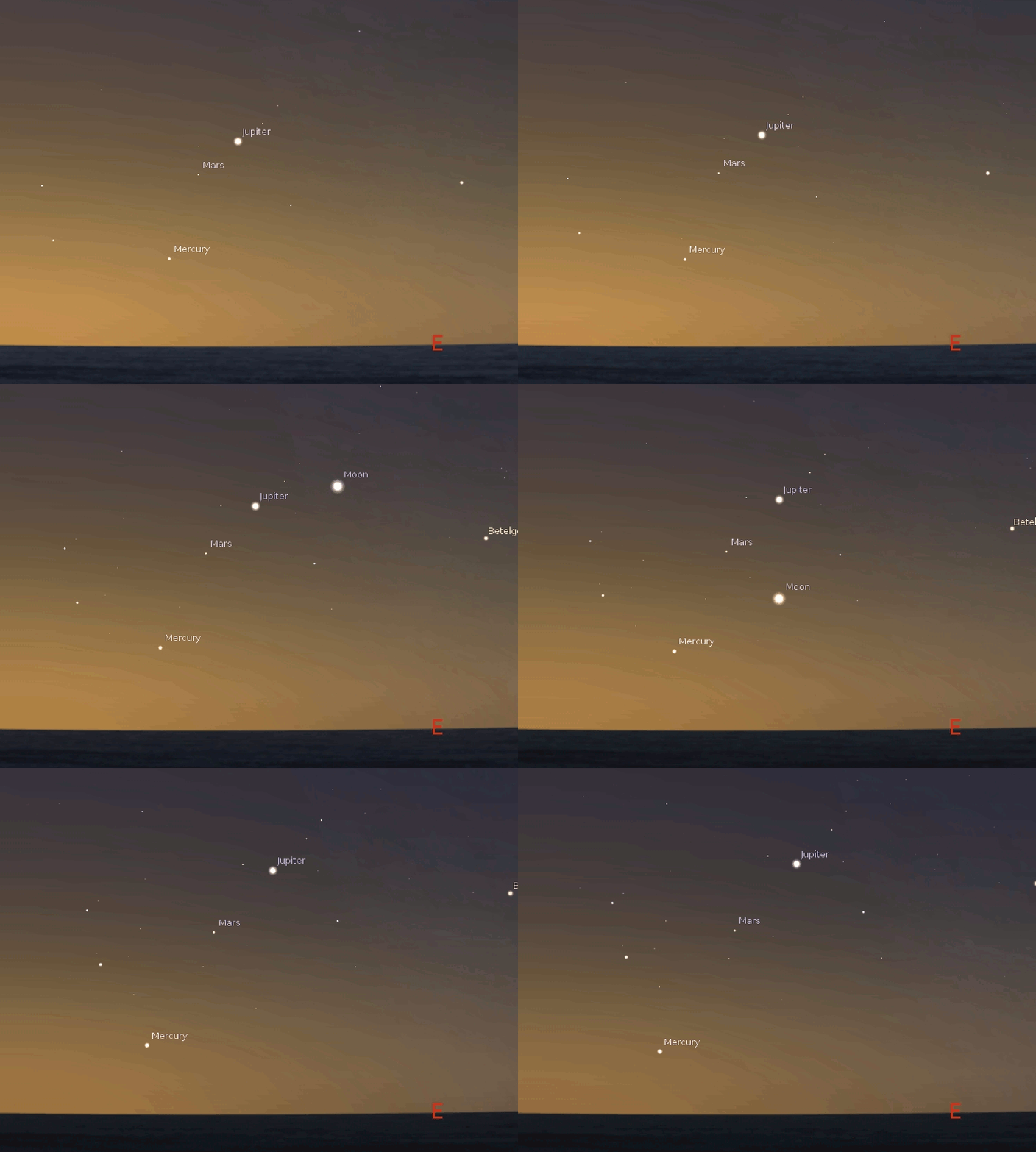
Animation of Mercury, Mars and Jupiter at one day intervals from July 31 to August 7, 2013 at 5:45 a.m. Created using Stellarium and the GIMP.
07/30/2013 – Ephemeris – Mercury appears in the morning
Ephemeris for Tuesday, July 30th. The sun rises at 6:27. It’ll be up for 14 hours and 43 minutes, setting at 9:10. The moon, 1 day past last quarter, will rise at 1:23 tomorrow morning.
Mercury is joining the morning planets Jupiter and Mars now. This morning is the time of its greatest elongation or separation from the sun of 20 degrees, but this planet will actually brighten as it starts its journey back around the sun. Mercury’s phase at greatest elongation is half illuminated. As it moves back around the sun the phase becomes fuller. To find Mercury it’s best to use binoculars. At around 5:30 look to the east northeast on a very low horizon. First locate Jupiter, the brightest and highest of the three. Then look below for reddish Mars. Once found, Mercury can be located by extending a line one and a half times further than Mars. These planets can be seen until 6 a.m. or a bit later.
Times are for the Traverse City/Interlochen area of Michigan. They may be different for your location.
Addendum
Animation of Mercury, Mars and Jupiter at one day intervals from July 31 to August 7, 2013 at 5:45 a.m. Created using Stellarium and the GIMP. Click to enlarge and animate.
07/29/2013 – Ephemeris – The constellation Aquila the eagle
Ephemeris for Monday, July 29th. The sun rises at 6:25. It’ll be up for 14 hours and 45 minutes, setting at 9:11. The moon, at last quarter today, will rise at 12:46 tomorrow morning.
Aquila the eagle is a constellation that lies in the Milky Way. It’s in the southeastern sky as it gets dark. Its brightest star, Altair is one of the stars of the Summer Triangle, a group of three bright stars seen now in the eastern sky in the evening. Altair, in the head of the eagle, is flanked by two slightly dimmer stars, the shoulders of the eagle. The eagle is flying northeastward through the Milky Way. Its wings are seen in the wing tip stars. A curved group of stars to the lower right of Altair is its tail. Within Aquila the Milky Way shows many dark clouds as part of the Great Rift that splits it here. The other summer bird is Cygnus the swan, above and left of Aquila, flying in the opposite direction, southward.
Times are for the Traverse City/Interlochen area of Michigan. They may be different for your location.
Addendum
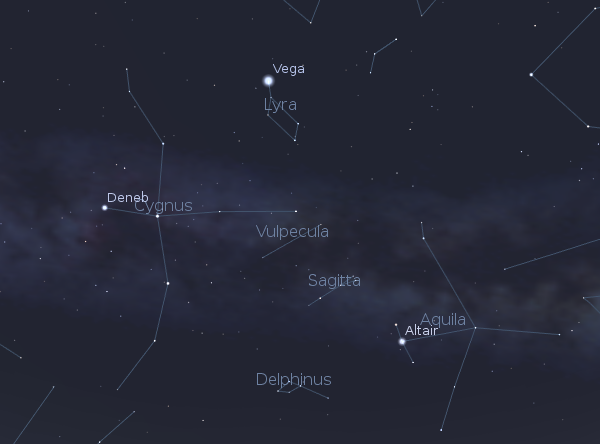
Aquila with the other constellations in the Summer Triangle. Created using Stellarium.

