Archive
04/02/2013 – Ephemeris – April Preview
Tuesday, April 2nd. The sun will rise at 7:21. It’ll be up for 12 hours and 50 minutes, setting at 8:11. The moon, 1 day before last quarter, will rise at 3:15 tomorrow morning.
The 4th month of the year began yesterday. Daylight hours in the Interlochen/Traverse City area and will increase from 12 hours and 50 minutes today to 14 hours 12 minutes on April 30th. The altitude, or angle, of the sun above the southern horizon at local noon will be 50 degrees tomorrow and will ascend to 60 degrees on April 30th. The altitude of the sun in the Straits area will be a degree lower. The actual time of local apparent noon this month for the Interlochen/Traverse City area, when the sun passes due south, will be about 1:43 p.m. For the straits area local noon occurs about 4 minutes earlier. The reason for the is that the straits, are about one degree of longitude east of Traverse City.
Times are for the Traverse City/Interlochen area of Michigan. They may be different for your location.
Addendum
Calendar of Astronomical Events for April 2013 for Eastern Daylight Time
Apr 03  00:37  LAST QUARTER MOON
    10  05:35  NEW MOON
    12  08:12  Moon at Descending Node
    14  06:51  Aldebaran 3.4°S of Moon
    14  14:23  Jupiter 2.1°N of Moon
    15  18:21  Moon at Apogee: 404865 km
    17  20     Mars in Conjunction with Sun
    18  08:31  FIRST QUARTER MOON
    21  00:44  Regulus 5.9°N of Moon
    22  07     Lyrid Meteor Shower
    24  20:10  Spica 0.0°N of Moon
               (Occultation visible across the southern Atlantic Ocean
                and South Africa.  Link)
    25  15:57  FULL MOON
    25  16:09  Partial Lunar Eclipse; mag=0.014
    25  22:28  Saturn 3.5°N of Moon
    26  10:07  Moon at Ascending Node
    27  15:48  Moon at Perigee: 362268 km
    28  04     Saturn at Opposition
Calendar of Astronomical Events Courtesy of Fred Espenak,
www.AstroPixels.com
Fred’s site has calendars for all the time zones in the United States. Foe daylight time use the time zone one zone east. This Eastern Daylight Time time zone above uses the Atlantic Standard Time zone.

Star Chart for mid April at 10 p.m. Created using my LookingUp program.
The chart includes the following finder aids:
- Big Dipper pointers point to Polaris.
- The arc of the Big Dipper’s handle points to Arcturus.
- Extend the arc as a spike to Spica.
- Leaky Big Dipper bowl leaks on Leo the lion’s back
04/01/2013 – Ephemeris – Orion the Fool
Ephemeris for April Fools Day, Monday, April 1st. The sun will rise at 7:22. It’ll be up for 12 hours and 47 minutes, setting at 8:10. The moon, 2 days before last quarter, will rise at 2:25 tomorrow morning.
Orion is one of the two constellations mentioned in the Bible, that have been deciphered. These are mentioned in the Book of Job. In the King James translation of the Bible the star Arcturus is mentioned. Modern scholars have changed that to the Bear, that is the Great Bear, Ursa Major, of which the Big Dipper is a part. The star cluster Pleiades, our Seven Sisters are also mentioned. There is no agreement of what Mazzeroth and the Mansions of the South are. The translation of Orion from the original Hebrew fits the day today. It’s Kesil, which means fool. Considering the mythology of Orion, a very minor character of Greek mythology, he was indeed, if not a fool, very unlucky in love.
Times are for the Traverse City/Interlochen area of Michigan. They may be different for your location.
Addendum
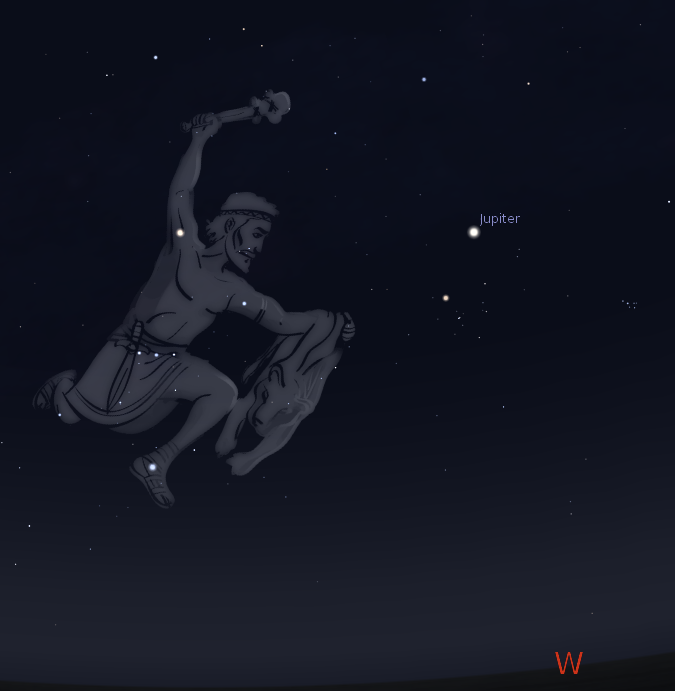
Orion the fool at 10 p.m. on April 3, 2013. Created using Stellarium. Note the Pleiades at the extreme right edge of the picture
03/29/2013 – Ephemeris – How we know this Sunday is Easter
Ephemeris for Good Friday, Friday, March 29th. The sun will rise at 7:28. It’ll be up for 12 hours and 38 minutes, setting at 8:06. The moon, 2 days past full, will rise at 11:14 this evening.
Wednesday was the day of the Paschal full moon, the full moon after the first day of spring, which is defined by Christian churches as March 21st. For the date of Easter the actual full moon isn’t used, but a rather complicated formula is used to find the new moon. There’s a complicated correction to then find the date of the full moon, which 2 days ago. This year that formula works out correctly. It can be a day off either way. The next Sunday then is Easter. Orthodox churches use the Julian calendar and a different formula but they’ll celebrate Easter on May 5th. The formula was set up to approximate the Jewish lunar calendar. It works out close this year because Passover started at sunset last Sunday night.
Times are for the Traverse City/Interlochen area of Michigan. They may be different for your location.
03/27/2013 – Ephemeris – Where’s Comet PanSTARRS and the bright planets this week?
Ephemeris for Wednesday, March 27th. The sun will rise at 7:32. It’ll be up for 12 hours and 31 minutes, setting at 8:04. The moon, at full today, will rise at 8:49 this evening.
It’s time to check out a comet and the two remaining bright planets for this week. Comet PanSTARRS is in the northwest, moving away from the sun, and getting a little higher in the sky as it moves northward rather than eastward. The comet will set at 10:26. The comet is now down to near 4th magnitude, as bright as a relatively faint naked eye star. Jupiter is located in the constellation of Taurus and is in the high southwest during the evening. It will set at 1:35 a.m. Jupiter is a wonderful sight in telescopes with its cloud bands and its moons which change positions each night. The other bright planet Saturn will rise at 10:43 p.m. in the east southeast. It’s located in eastern Virgo. It will pass due south at 3:55 a.m. Saturn is the most beautiful of planets in a telescope.
Times are for the Traverse City/Interlochen area of Michigan. They may be different for your location.
Addendum
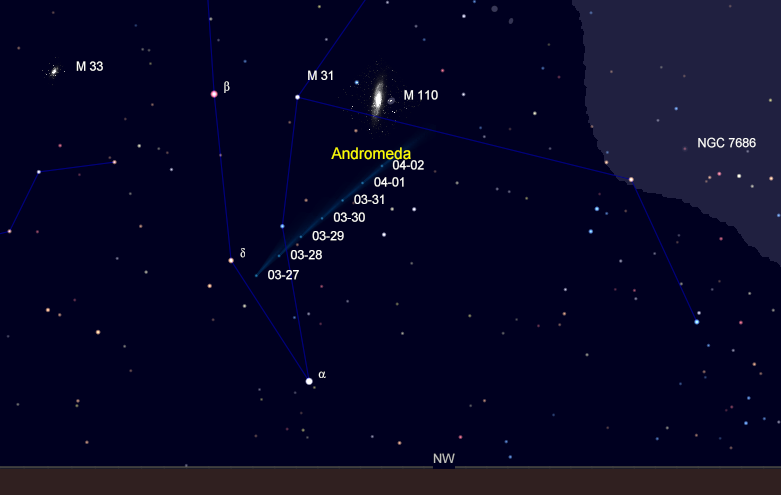
Comet PanSTARRS at about 9:15 p.m. from March 27 to April 2, 2013. Note that the comet will pass the Great Andromeda Galaxy in early April. Created using Cartes du Ciel.
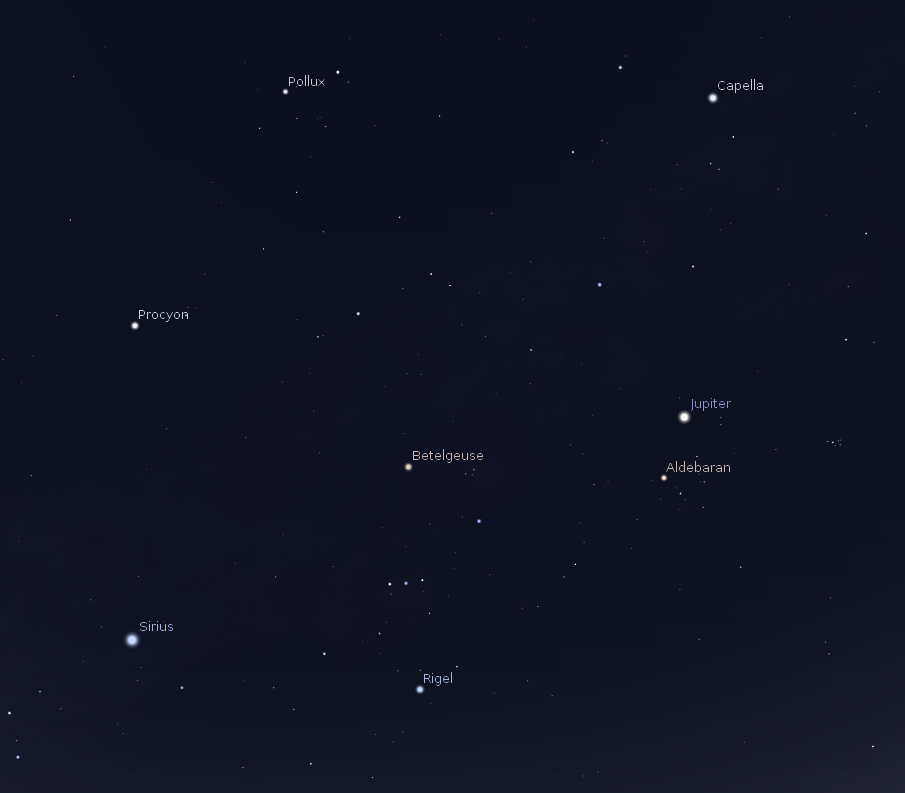
Jupiter with the stars of winter in a moon brightened sky at 9:30 p.m. March 27, 2013. Created using Stellarium.
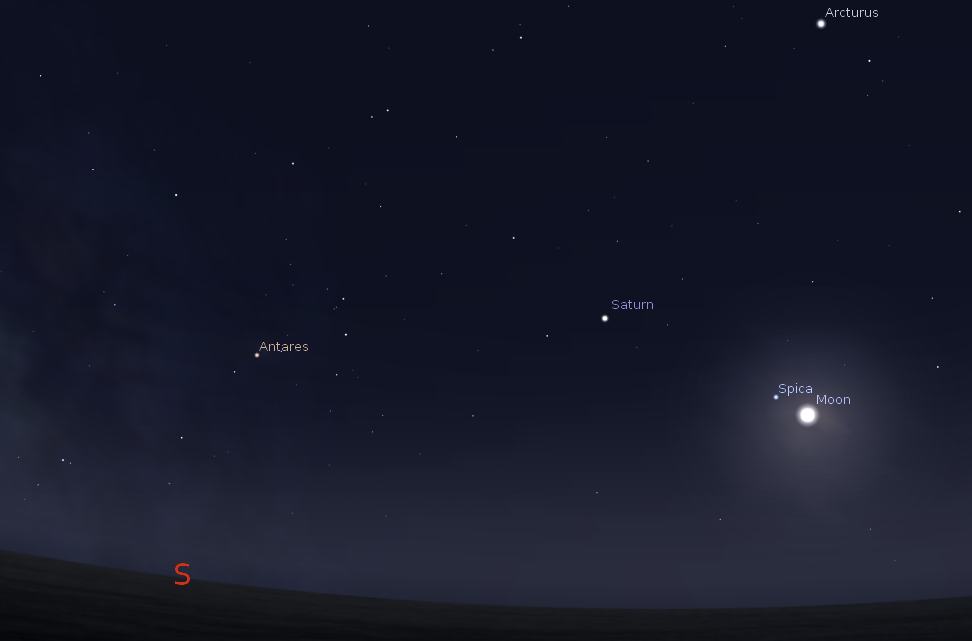
Saturn near Spica and the moon at 6 a.m. on March 28th. The moon will be passing Saturn on Friday afternoon, below the horizon. Created using Stellarium.
03/26/2013 – Ephemeris – The universe is slightly older than we thought
Ephemeris for Tuesday, March 26th. The sun will rise at 7:34. It’ll be up for 12 hours and 28 minutes, setting at 8:02. The moon, 1 day before full, will set at 7:20 tomorrow morning.
Last week NASA and the European Space Agency announced the findings from the Planck satellite. Along with a sharper map of the Cosmic Microwave Background, created at the moment the Universe became transparent some 380,000 years after the Big Bang, Planck data revealed a slightly older universe of 13.82 billion years. This is with the error thought to be in the last measurement. So it’s a refinement. Also the universe appears to be expanding at a slightly lower rate that had been. Of the three main constituents of the universe, ordinary matter out of which you, me and the stars are made of is 4.9 percent, dark matter that holds galaxy clusters together is at 26 percent, while dark energy is at 68.3 percent, a decrease for it.
Times are for the Traverse City/Interlochen area of Michigan. They may be different for your location.
Addendum
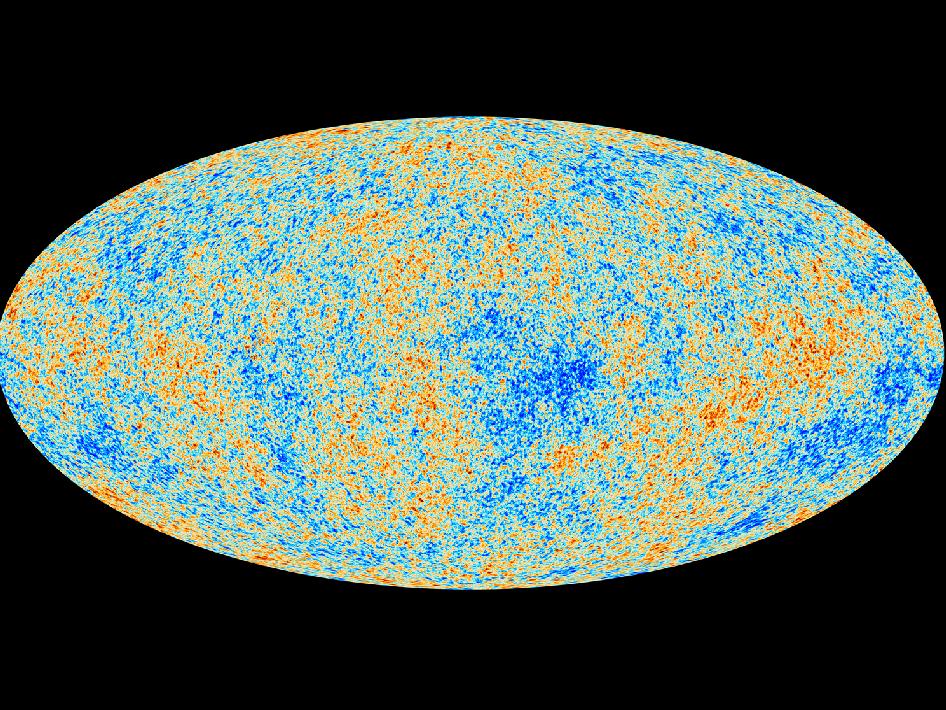
The Cosmic Microwave Background as determined by the Planck satellite. Image credit: ESA and the Planck Collaboration.
03/25/2013 – Ephemeris – What are comets made of?
Ephemeris for Monday, March 25th. The sun will rise at 7:35. It’ll be up for 12 hours and 25 minutes, setting at 8:01. The moon, 2 days before full, will set at 6:51 tomorrow morning.
For Jews this the first day of Passover, which began at sundown last night. I’ll have more to say about the relationship between Passover and Easter, and the astronomical connection later in the week. Comet PanSTARRS is definitely heading away from us now, about 116 million miles Its distance from the sun is now 51 million miles, between Mercury and Venus’s distance from the sun.. Our modern understanding of comets comes from the mid 20th century when Fred Whipple proposed that comets were composed of frozen gasses and dust and small particles of minerals. This has led to the popular description that comets are dirty snowballs. This described the nucleus of the comet, tiny compared to its head or coma.
Times are for the Traverse City/Interlochen area of Michigan. They may be different for your location.
03/22/2013 – Ephameris – Comet PanSTARRS: Ancient and not so ancient fears of comets
Ephemeris for Friday, March 22nd. The sun will rise at 7:41. It’ll be up for 12 hours and 16 minutes, setting at 7:57. The moon, 3 days past first quarter, will set at 5:24 tomorrow morning.
Comet PanSTARRS is moving northward and away from the sun. It is slowly being seen higher in the west northwest when first spotted. The head of PanSTARRS’ brightness should be down to 3rd magnitude, as bright as the star in the Big Dipper that connects the handle to the bowl. Comets, in ancient times, were thought to be omens of the death of kings, famines and the such. Ancient astronomers and astrologers. were used to the motions of the planets, though they never really understood them, they could model the motions with varying degrees of accuracy. Comets were the wild cards, disrupting the plan of the gods, and so were considered bad news. Western astronomers from Aristotle up to Kepler thought they were atmospheric phenomena.
Times are for the Traverse City/Interlochen area of Michigan. They may be different for your location.
Addendum
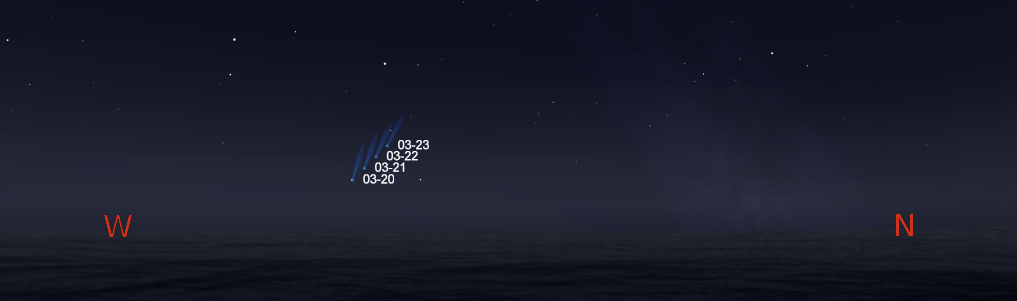
Comet PanSTARRS about an hour and a quarter after sunset for March 22 through the 25th. Created using Stellarium and Cartes du Ciel. Click on the image to enlarge.
Comets were thought to be bad news:

The comet of 1857
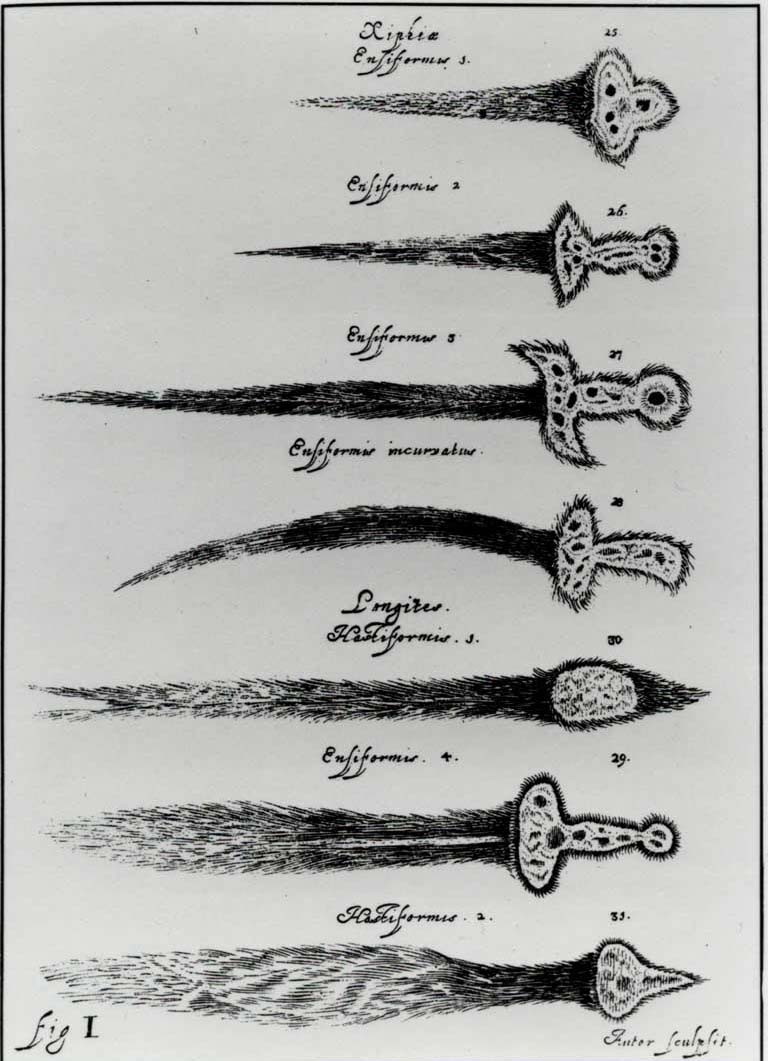
Comets as daggers or swords. Bad news? You bet.

Comet leaves destruction in its wake. A woodcut.
03/21/2013 – Ephemeris – Where did Comet PanSTARRS come from?
Ephemeris for Thursday, March 21st. The sun will rise at 7:43. It’ll be up for 12 hours and 13 minutes, setting at 7:56. The moon, 2 days past first quarter, will set at 4:52 tomorrow morning.
Comet PanSTARRS is heading away from both the sun and the earth. It heading northward. Its orbit is inclined nearly 90 degrees away from the plane of the earth’s orbit. PanSTARRS will recede far past Neptune or the Kuiper Belt of objects that include the dwarf planet Pluto into the Oort cloud of cometary objects that extend out to a light year or 6 trillion miles from the sun. This cloud was named after Dutch astronomer Jan Oort. The comet may be ejected from the solar system. It’s orbit is currently calculated to be slightly hyperbolic. If that holds up, it will drift among the stars. It is thought that occasionally, in millions of years a star comes close or through the Oort cloud and scatters them.
Times are for the Traverse City/Interlochen area of Michigan. They may be different for your location.
Addendum
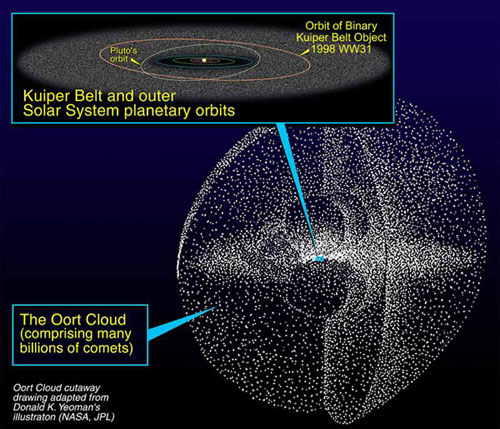
Artist’s impression of the Oort Cloud. (NASA/JPL). Hat Tip: Universe Today.
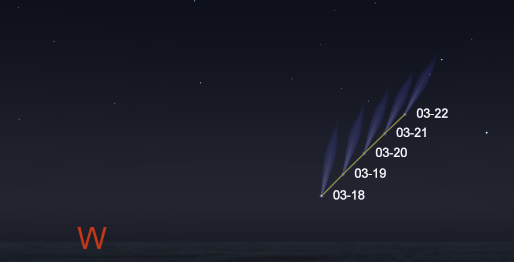
Comet PanSTARRS in the next 5 days at 9:15 p.m. Created using Stellarium and Cartes du Ciel.
03/19/2013 – Ephemeris – PanSTARRS, of course, plus a spring preview
Ephemeris for Tuesday, March 19th. The sun will rise at 7:47. It’ll be up for 12 hours and 6 minutes, setting at 7:53. The moon, at first quarter today, will set at 3:38 tomorrow morning.
Comet PanSTARRS continues to be seen low in evening twilight. It is moving now into the west northwest. When it becomes dark enough it will display a fan shaped tail in binoculars. It is moving away from both the sun and the earth. Tomorrow will see our own milestone as the earth moves into a position where the sun appears over the earth’s equator, and the sun sets at the south pole of the earth and rises at the north pole. It will be the vernal or spring equinox. Australians and other folks south of the equator may prefer to call it the March equinox, because for them autumn starts. The exact time the sun will appear to cross the equator heading northward will be 7:02 tomorrow morning. The sun will keep heading northward until June 21st.
Times are for the Traverse City/Interlochen area of Michigan. They may be different for your location.
Addendum
Comet PanSTARRS for this week’s weekdays at 9:15 p.m. Created using Stellarium and Cartes du Ciel.

The earth as seen from the sun near the vernal equinox. See the earth from north pole to south pole. Created using Celestia.
03/18/2013 – Ephemeris – Comet PanSTARRS, the view from Stereo B
Ephemeris for Monday, March 18th. The sun will rise at 7:48. It’ll be up for 12 hours and 3 minutes, setting at 7:52. The moon, 1 day before first quarter, will set at 2:54 tomorrow morning.
Comet PanSTARRS is now a prominent part of our twilight after sunset. It should be visible from maybe 8:40 until 9:41 p.m. when it sets, clear skies and a low horizon willing. Photographs are coming in from all over, including a time lapse movie from the satellite Stereo B, which is now nearly behind the sun looking back at the comet and the earth in the background. The dust tail of the comet was being ejected in sheets, possibly due to the rotation of the comet’s nucleus. Comets generally eject gas and dust from one of more hot spots. When rotated toward the sun they become active and begin to spew gas and dust. When rotated away, they become quiet once again. It looks like Comet PanSTARRS is matching its original brightness estimates.
Times are for the Traverse City/Interlochen area of Michigan. They may be different for your location.
Addendum
The video from Stereo B can be found here:
and here:
http://stereo.gsfc.nasa.gov/gallery/item.php?id=selects&iid=182
Comet PanSTARRS in the next 5 days at 9:15 p.m. Created using Stellarium and Cartes du Ciel.

