Archive
01/03/2013 – Ephemeris – The Quadrantid meteor shower will peak this morning.
Ephemeris for Thursday, January 3rd. The sun will rise at 8:19. It’ll be up for 8 hours and 55 minutes, setting at 5:15. The moon, 1 day before last quarter, will rise at 12:06 tomorrow morning.
This morning will see the peak of the Quadrantid meteor shower. There’s still time to spot them before the sky brightens too much. It’s one of the better meteor showers of the year, except it occurs in the cold and not very clear skies of January. Meteor showers are generally named for the constellation from which they seem to come. Trouble is, there’s no such constellation of the Quadrant. Now, that is. There is a sextant and an octant, but no quadrant. All these instruments were used by navigators and astronomers to measure the altitude of stars and planets. The obsolete constellation of the quadrant was located near the handle of the Big Dipper and north of the kite shaped spring constellation of Boötes. The Quadrantids will be around for the next few mornings.
Times are for the Traverse City/Interlochen area of Michigan. They may be different for your location.
Addendum
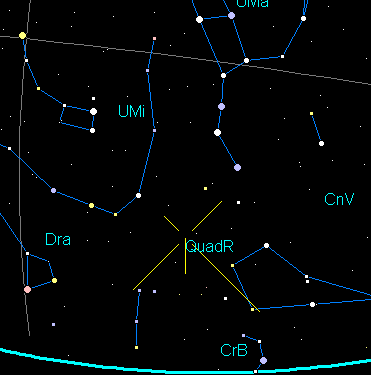
Quadrantid meteor shower radiant at 1:30 a.m.
01/02/2013 – Ephemeris – Where are the bright planets this week?
Ephemeris for Wednesday, January 2nd. The sun will rise at 8:19. It’ll be up for 8 hours and 54 minutes, setting at 5:14. The moon, 2 days before last quarter, will rise at 11:00 this evening.
Let’s check out the planets for this week. Mars can be seen low in the southwest. It will set at 7:07 p.m, two minutes later than last week because sunset times are increasing and Mars is starting to move northward. The sun will eventually catch up with it. Even before you can spot Mars, bright Jupiter will be visible in the east. Jupiter is located in the constellation of Taurus in the southeast in the evening. It will transit or pass due south at 10:14 p.m, and will set at 5:45 a.m. Jupiter is a wonderful sight in telescopes with its cloud bands and its moons which change positions each night. Saturn will be the next planet to rise at 3:10 a.m. in the east southeast. It’s located in eastern Virgo. Venus will rise at 6:52.
Times are for the Traverse City/Interlochen area of Michigan. They may be different for your location.
Note: The Quadrantid meteor shower will reach peak tomorrow morning. I will release tomorrow’s program about the meteor shower at noon today.
Addendum
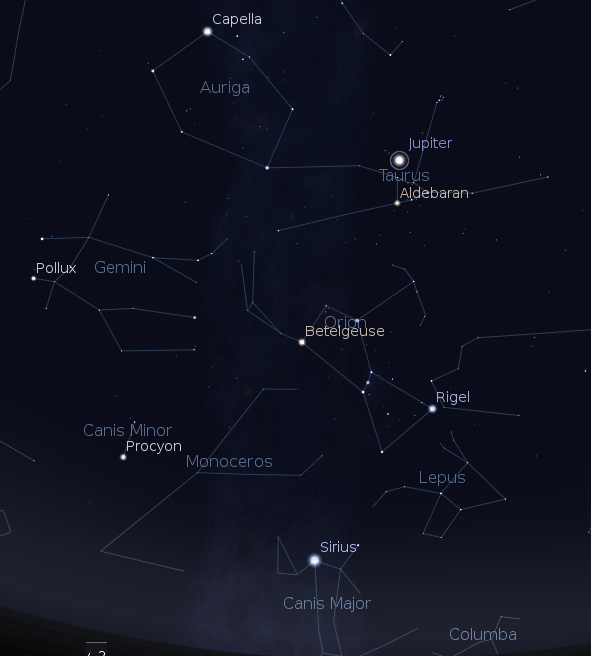
Jupiter and the winter stars and constellations as seen at 9 p.m. on January 2, 2013. Created using Stellarium.
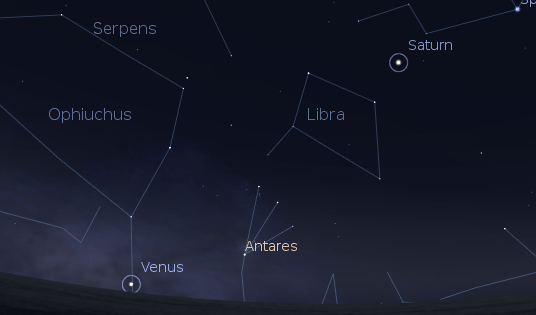
Jupiter and the winter stars and constellations at 7 a.m. on January 3, 2013. Created using Stellarium.
01/01/2013 – Ephemeris – We start the year with the sun closest to us.
Ephemeris for New Years Day, Tuesday, January 1st 2013. The sun will rise at 8:19. It’ll be up for 8 hours and 53 minutes, setting at 5:13. The moon, 3 days before last quarter, will rise at 9:55 this evening.
Happy New Year and happy perihelion Day. What’s a perihelion? Well. It’s not two helions, whatever they are. Perihelion is the point in an orbit of the sun that is nearest to the sun. This evening the earth will reach that point in its travels around the sun. Since its winter time, the sun’s distance apparently doesn’t cause the seasons. Actually the sun now as about a million and a half miles closer than mean, which isn’t much out of 93 million miles. But, although we don’t notice it in northern Michigan, it makes winter the shortest season at 89 days. The real cause of the seasons is the tilt of the earth’s axis. Now the sun appears highest over the southern hemisphere. The sun’s up less than 9 hours here and hangs low over the southern horizon at noon.
Times are for the Traverse City/Interlochen area of Michigan. They may be different for your location.
12/31/2012 – Ephemeris – Looking at the prospective comets of 2013
Ephemeris for New Years Eve, Monday, December 31st. The sun will rise at 8:19. It’ll be up for 8 hours and 53 minutes, setting at 5:12. The moon, 3 days past full, will rise at 8:51 this evening.
As we enter a new year tonight, let\s look ahead at what we expect to see in the skies in 2013. The big events next year will be two comets that could be quite bright. Mid-March will bring Comet PanSTARRS to the evening sky. This is a first time comet for astronomers, so its behavior may be unpredictable, but it is currently sticking to brightness projections and may be as bright as the brightest stars at its brightest. The second comet is Comet ISON. This will fly close to the sun on November 28th. It could disintegrate, its nucleus could split into multiple pieces, or it could survive intact. The last two scenarios will give us a bright morning comet in early December. So may we have a happy comet new year.
Times are for the Traverse City/Interlochen area of Michigan. They may be different for your location.
Addendum
Here are two links to the website of Seiichi Yoshida for each of the comets. Most revealing at this point are the magnitudes graphs showing the actual brightness measurements as black dots with the predicted magnitudes as an orange line, The vertical line is the perihelion date, the date the comet is closest to the sun. Comet ISON has a second magnitude graph for when the comet is closest the sun and may become bright enough to be seen in the daytime.
Magnitudes are like golf scores, the lower the number the better, or in this case brighter the comet is. the Faintest star visible to the naked eye is 6th magnitude. Jupiter is usually around -2, Venus -4, and the sun -26. As you can see from the scatter of the actual brightness estimates, pinning down the brightness of a fuzzy comet is rather difficult. Comets generally appear dimmer than their magnitudes would suggest.
Here are the ;inks:
12/28/2012 – Ephemeris – Using that new telescope
Ephemeris for Friday, December 28th. The sun will rise at 8:18. It’ll be up for 8 hours and 51 minutes, setting at 5:09. The moon, at full today, will rise at 5:48 this evening.
If you gotten a new telescope for Christmas, I’ve got a few tips. Always start out using your lowest power eyepiece. It has the largest field of view to help you find what you want. Once found you may use a higher power eyepiece. Higher powers may make the image larger, but will not make it sharper. The wider the telescope the sharper the image, and the higher powers that can be used. But note that amateur astronomers use their lowest power 90 percent of the time. The images are sharper and brighter. And besides most things in the sky don’t need that much magnification. We mostly need to make them brighter. That’s why telescopes are sometimes called light buckets. Good telescope companions are computer programs that show the sky and books on observing.
Times are for the Traverse City/Interlochen area of Michigan. They may be different for your location.
Addendum – Links for more information on telescopes and observing
Advice for First Time Telescope Buyers by Joe Roberts. It’s part of his Amateur Astronomers Notebook, whose link is at the top of the page.
Stargazing Basics from Sky and Telescope magazine.
Equipment How To from Astronomy magazine.
Your local astronomy club: In the Grand Traverse Area gtastro.org (Grand Traverse Astronomical Society) which meets at 8 p.m. on the first Friday of the month.
Also check out both Sky and Telescope and Astronomy web sites above for links to other astronomy clubs. They are all welcoming of beginners and a great source of telescope expertise.
12/27/2012 – Ephemeris – That was the year that was.
Ephemeris for Thursday, December 27th. The sun will rise at 8:18. It’ll be up for 8 hours and 50 minutes, setting at 5:09. The moon, 1 day before full, will set at 8:10 tomorrow morning.
The end of the year is the perfect time to look back at the astronomical events of the year. There was a partial solar eclipse in May and the rare transit of Venus across the sun in June. You’ll have to wait until 2117 for the next one. In July came news that the Large Hadron Collider had detected something that sure looked like the long sought Higgs Boson. August brought the spectacular landing of the Mars Science laboratory, aka: The Curiosity rover, on Mars to begin an at least one martian year exploration. In September the Dawn spacecraft bid farewell to the asteroid Vesta after a year exploring that remarkable asteroid, cranking up its ion engine for a three year journey to the dwarf planet Ceres. The satellites Ebb and Flow completed their mission to map the moon’s interior.
Times are for the Traverse City/Interlochen area of Michigan. They may be different for your location.
Addendum
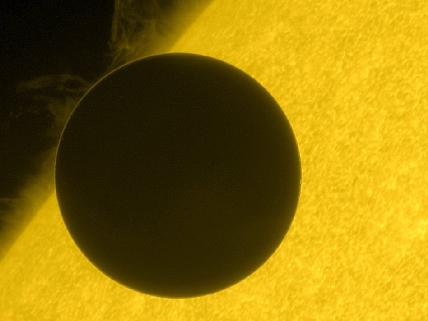
Hinode Views the 2012 Venus Transit. Credit: JAXA/NASA/Lockheed Martin
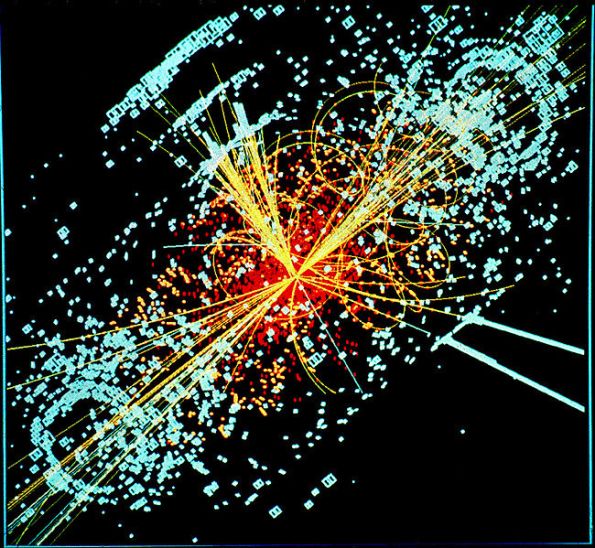
An example of simulated data modeled for the CMS particle detector on the Large Hadron Collider (LHC) at CERN. Here, following a collision of two protons, a Higgs boson is produced which decays into two jets of hadrons and two electrons. The lines represent the possible paths of particles produced by the proton-proton collision in the detector while the energy these particles deposit is shown in blue. Credit CERN.
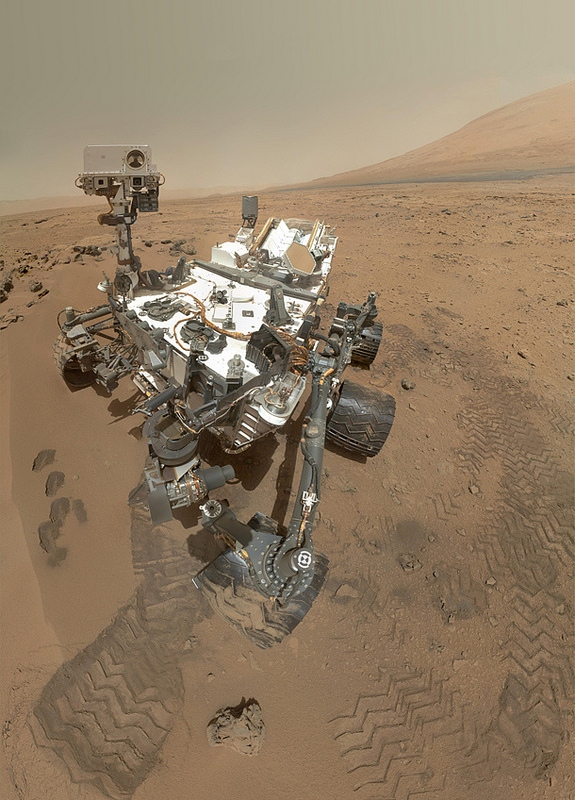
Curiosity rover self portrait. Credit: NASA/JPL-Caltech/Malin Space Science Systems
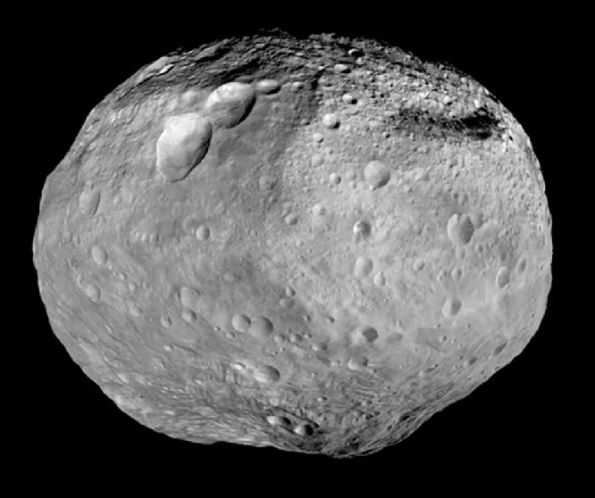
Looking back at Vesta as Dawn headed off to Ceres. Credit: NASA/JPL-Caltech/UCAL/MPS/DLR/IDA
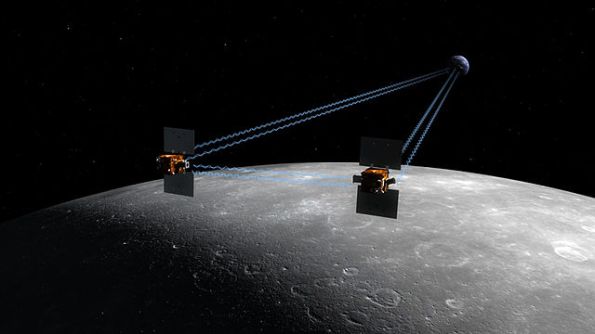
The Grail Spacecraft Ebb and Flow made the most detailed gravitational map of the moon to map its interior; orbiting as close as 15 miles above the surface. They were intentionally crashed into a crater wall on December 17th. Artist conception credit: NASA.
12/26/2012 – Ephemeris – Where are the bright planets this week?
Ephemeris for Wednesday, December 26th. The sun will rise at 8:18. It’ll be up for 8 hours and 50 minutes, setting at 5:08. The moon, 2 days before full, will set at 7:27 tomorrow morning.
Let’s check out the planets for this week. Mars can be seen low in the southwest. It will set at 7:05 p.m, one minute later than last week because sunset times are increasing and Mars is starting to move northward. The sun will eventually catch up with it. Even before you can spot Mars, bright Jupiter will be visible in the east. Jupiter is located in the constellation of Taurus in the southeast in the evening. It will transit or pass due south at 10:44 p.m, and will set at 6:16 a.m. Jupiter is a wonderful sight in telescopes with its cloud bands and its moons which change positions each night. Saturn will be the next planet to rise at 3:35 a.m. in the east southeast. It’s located in eastern Virgo. Venus will rise at 6:37 and is below and left of Saturn.
Times are for the Traverse City/Interlochen area of Michigan. They may be different for your location.
Addendum
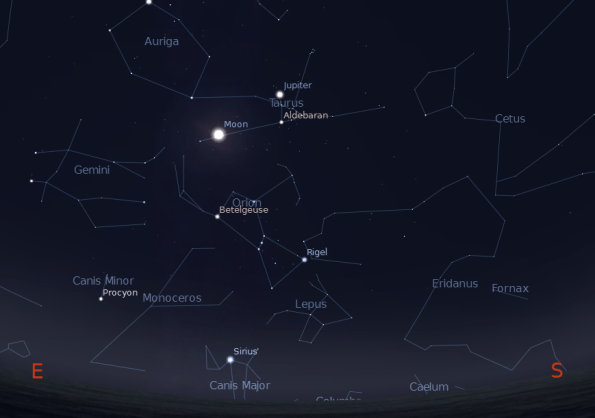
Jupiter, the bright moon and the winter stars and constellations at 9 p.m. on December 26, 2012. Created using Stellarium.
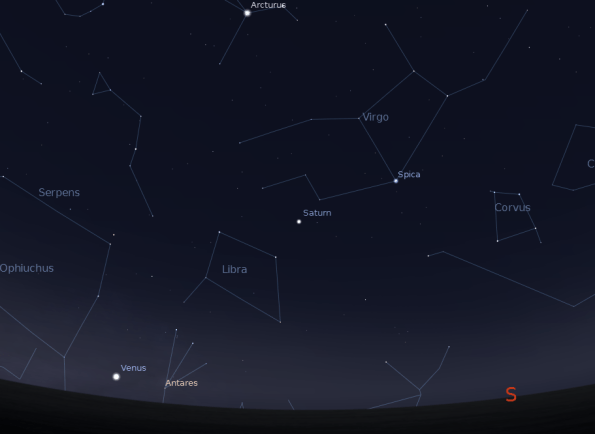
Saturn, Venus and the constellations of morning at 7 a.m. on December 27, 2012. Created using Stellarium.
12/25/2012 – Ephemeris – Why do we celebrate Christmas today?
Ephemeris for Christmas Day, Tuesday, December 25th. The sun will rise at 8:18. It’ll be up for 8 hours and 49 minutes, setting at 5:07. The moon, 3 days before full, will set at 6:40 tomorrow morning.
Merry Christmas. But why is this Christmas day? The Gospel of Luke puts Christ’s birth in the spring, during lambing season, the only time the Shepherds would be out with their flocks at night. It is said that Christians move the birthday celebration of Jesus to a time when the Romans were naturally celebrating: The time when the sun was going to return northward once again after the winter solstice. Christians could celebrate in a time of general merriment. That festival was Saturnalia. It honored the god Saturn, the god of hospitality. That’s quite a makeover of the Greek titan Cronos, who ate his children. Saturn did that too, but had reformed. The solstice was just the beginning of winter but spirits were buoyed by the return of the sun.
Times are for the Traverse City/Interlochen area of Michigan. They may be different for your location.
12/24/2012 – Ephemeris – Observing Jupiter
Ephemeris for Christmas Eve, Monday, December 24th. The sun will rise at 8:17. It’ll be up for 8 hours and 49 minutes, setting at 5:07. The moon, half way from first quarter to full, will set at 5:47 tomorrow morning.
The planet Jupiter is high in the east and southeast. If there’s a telescope under that tree this evening, the moon and Jupiter will be the first things to turn that telescope to. First take the telescope outside and look at a distant terrestrial object. Align the finder to the object you can see with telescope. That will make sure you can find what you’re looking for in the sky. Jupiter right now is above the face of Taurus the bull. In a telescope it’s a distinct disk with several stars, up to 4 that flank it, pretty much in a straight line. These are Jupiter’s 4 largest moons, originally discovered by Galileo in 1610. They will change position from night to night. The disc of the planet will have lines on it running in the same direction as the moons.
Times are for the Traverse City/Interlochen area of Michigan. They may be different for your location.
Addendum

Where to find Jupiter. Shown ay 9 p.m. Christmas eve 2012. Created using Stellarium.

Jupiter and its satellites. One of my old photos.
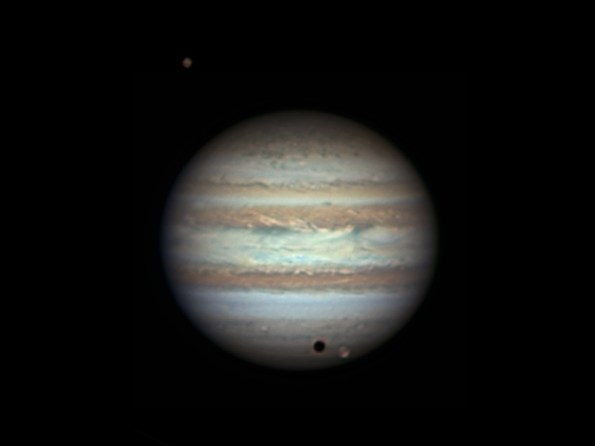
Jupiter with Callisto above, Ganymede and its shadow below on December 6, 2012 by Scott Anttila, Click to enlarge.
Jupiter will not show this detail in a small telescope, however the more one observes Jupiter or any planet more and more detail will be revealed.
12/21/2012 – Ephemeris – Well, we’re still here
Ephemeris for Friday, December 21st. The sun will rise at 8:16. It’ll be up for 8 hours and 48 minutes, setting at 5:05. The moon, 1 day past first quarter, will set at 2:53 tomorrow morning.
Well, we’re still here. The winter solstice arrived at 6:12 this morning, and nothing happened. There’s no planetary alignment. The supposed alignment with the center of the galaxy, which is 6 degrees off anyway was at its closest 15 years ago. And the supposed planet Nibiru that was to collide with the earth or interfere with the earth somehow, hasn’t shown up. Even we amateur astronomers would have seen it for at least the last 5 years. To those who say its sneaking up on us from behind the sun. I say we have spacecraft flying all over the solar system, so we don’t have any blind spots for it to hide in. So I wonder when the next prediction of the end of the world will pop up, to which I will sigh: “Not again.”
Times are for the Traverse City/Interlochen area of Michigan. They may be different for your location.
Addendum

The sun at the winter solstice 2012. The horizontal line is the sun’s path, the ecliptic, while the diagonal line is the galactic equator. Sagittarius A is the location of the center of the galaxy some 26,000 light years away behind a black cloud of dust and gas. Created using Cartes du Ciel.

