Archive
06/06/2023 – Ephemeris – Venus: sister planet or evil twin?
This is Ephemeris for Tuesday, June 6th. Today the Sun will be up for 15 hours and 26 minutes, setting at 9:25, and it will rise tomorrow at 5:57. The Moon, 3 days past full, will rise at 12:39 tomorrow morning.
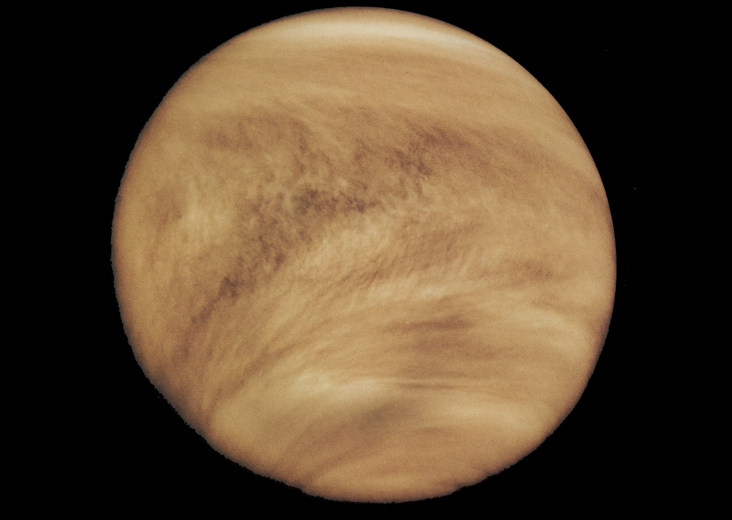
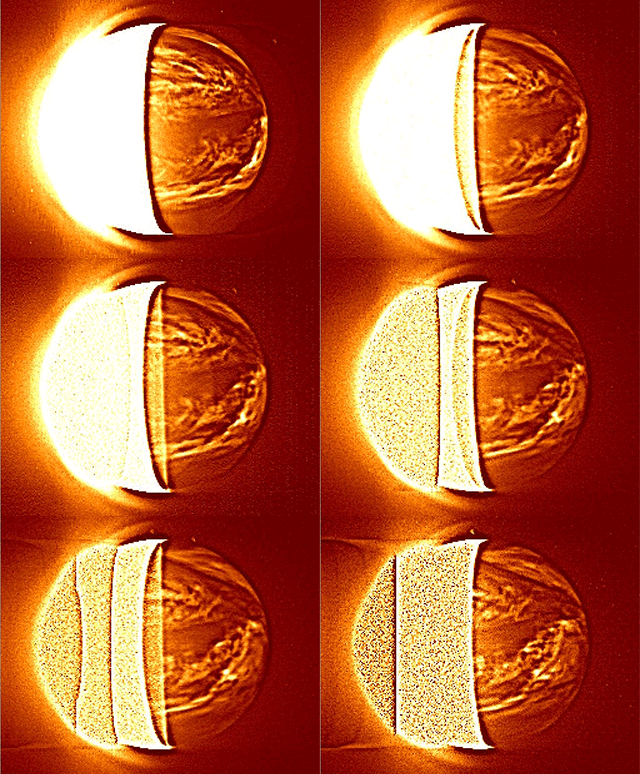
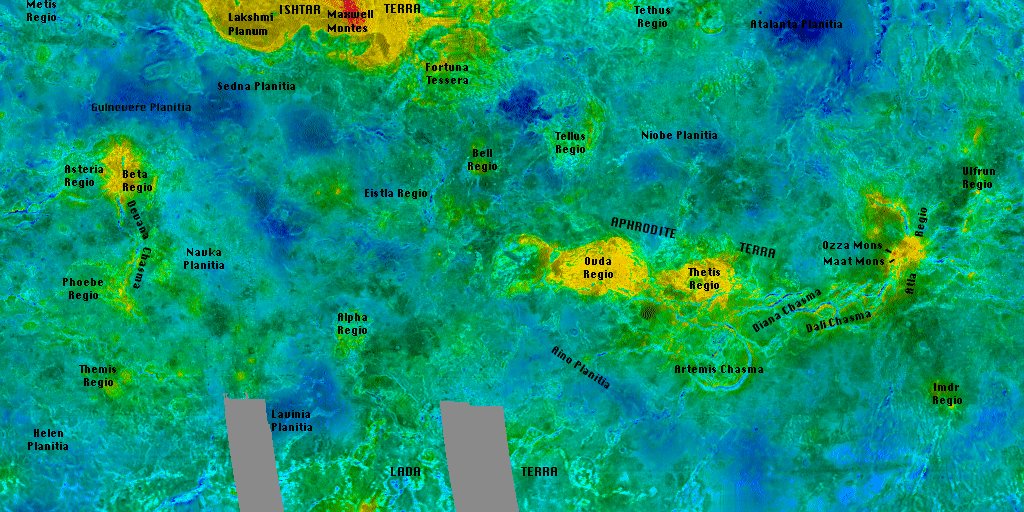
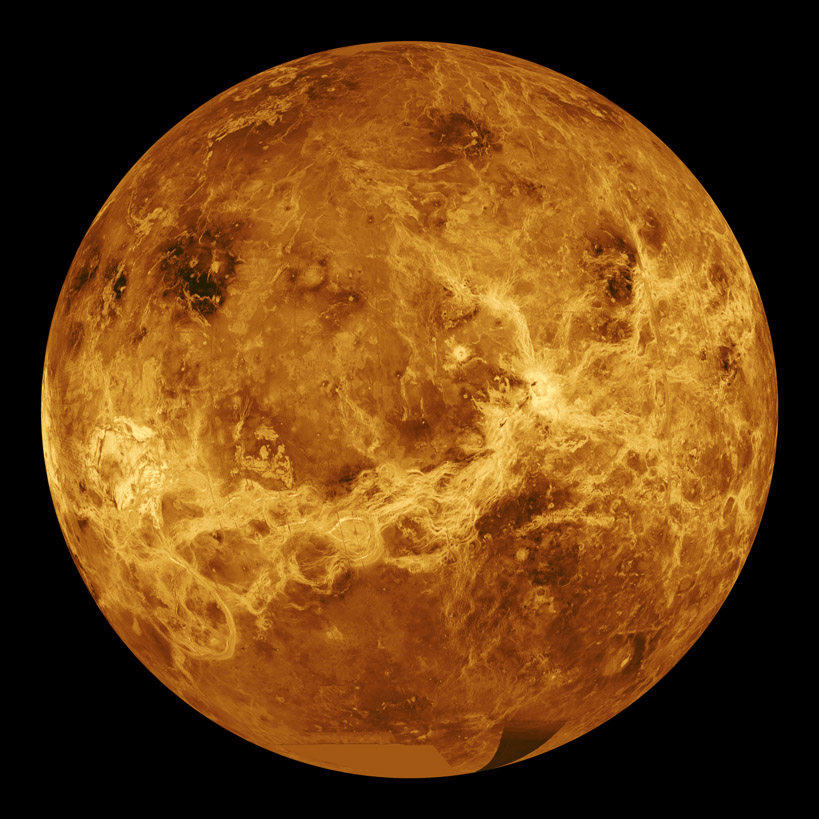
Venus has been called Earth’s sister planet, because it is nearly the same size as the Earth, only 5% smaller. It has also been called Earth’s evil twin. That was suspected as far back as 1962 when NASA’s Mariner 2 spacecraft flew past the planet and observed the planet in the infrared and microwaves. It found that though the cloud tops were relatively cool, the surface was extremely hot, averaging 867 ° Fahrenheit (464° Celsius). Venus cloud tops are featureless visually, but do show variation in the infrared and ultraviolet. Radar observations from Arecibo, and spacecraft have penetrated the clouds, showing a bleak landscape of volcanoes and lava flows. After many tries the Soviet Union successfully landed probes on it.
The astronomical event times given are for the Traverse City/Interlochen area of Michigan (EDT, UT –4 hours). They may be different for your location.
Addendum
06/05/2023 – Ephemeris – Venus was it’s farthest apparent distance from the Sun yesterday
This is Ephemeris for Monday, June 5th. Today the Sun will be up for 15 hours and 25 minutes, setting at 9:24, and it will rise tomorrow at 5:58. The Moon, 2 days past full, will rise at 11:47 this evening.
Yesterday, Venus was as far away from the Sun as it gets in this evening appearance of Venus. The event is called greatest eastern elongation, meaning it’s as far to the east of the Sun as it gets. Both Venus and Mercury have these events, because they orbit the Sun inside of the Earth’s orbit, they never stray far from the Sun. In less than two and a half months, Venus will leave the evening sky, pass between the Earth and Sun in inferior conjunction, and enter the morning sky. Until then Venus will get larger in telescopes and become a thinner and thinner crescent, as we see more of its night side and less of its day side. By mid July, Venus should appear large enough to see its tiny crescent in a pair of binoculars.
The astronomical event times given are for the Traverse City/Interlochen area of Michigan (EDT, UT –4 hours). They may be different for your location.
Addendum
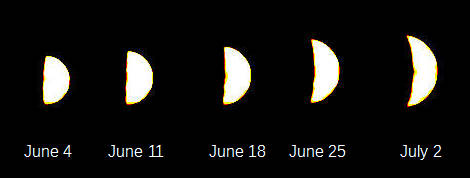
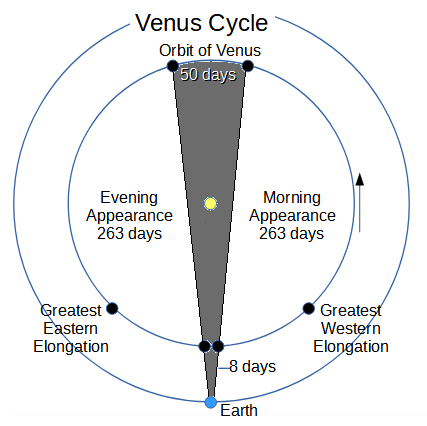
06/02/2023 – Ephemeris – A South Pole adventure and a comet collision presentation – Tonight!
This is Bob Moler with Ephemeris for Friday, June 2nd. Today the Sun will be up for 15 hours and 22 minutes, setting at 9:22, and it will rise tomorrow at 5:59. The Moon, 1 day before full, will set at 5:14 tomorrow morning.
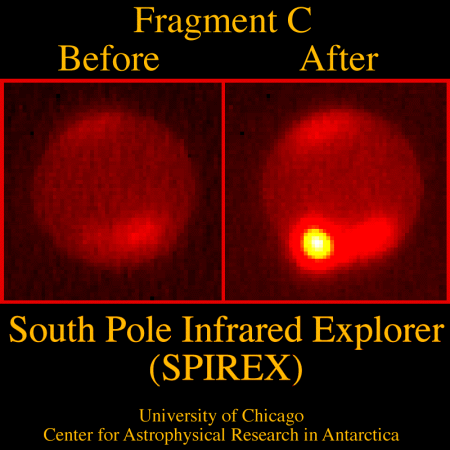
An Antarctic Odyssey: Winter-Over at South Pole Station will be the presentation by John W. Briggs, via Zoom, at tonight’s meeting of the Grand Traverse Astronomical Society at Northwestern Michigan College’s Rogers Observatory at 9 pm. John was a team member building a 24-inch infrared telescope and related experiments that were set up at the South Pole in time for him and colleagues to observe the July 1994, explosive crash of fragmented comet Shoemaker-Levy 9 into the planet Jupiter. There are two ways to attend: In person at the observatory, south of Traverse City on Birmley Road, or via Zoom with a link provided by the society’s website gtastro.org just prior to the meeting.
The astronomical event times given are for the Traverse City/Interlochen area of Michigan (EDT, UT –4 hours). They may be different for your location.
Addendum
About the Program
An Antarctic Odyssey: Winter-Over at South Pole Station
A presentation via Zoom by John W. Briggs
Abstract:
In a lavishly illustrated presentation, John W. Briggs of New Mexico will describe his year-long experience living at the Geographic South Pole while working for the Center for Astrophysical Research in Antarctica. In preparation for this at Yerkes Observatory of the University of Chicago, John was a team member building a 24-inch infrared telescope and related experiments that were set up at the Pole in time for him and colleagues to observe the July 1994, explosive crash of fragmented comet Shoemaker-Levy 9 into the planet Jupiter.
John weathered the “winter-over” with 26 other members of the U.S. Antarctic Program in an experience that many believe approximates what life will be like someday at a lunar or Martian outpost. Once begun, South Pole winter-over is an irreversible commitment, since the Program’s special LC-130 ski planes can’t land in the winter temperatures — in 1994, sometimes as low as 107 degrees F. below zero (with windchill, as low as -180 degrees). John will delight the audience with his perspective on the total South Pole experience — the strange natural environment, the odd social atmosphere, and the challenging, ongoing science.
06/01/2023 – Ephemeris – Previewing June Skies
This is Bob Moler with Ephemeris for Thursday, June 1st. Today the Sun will be up for 15 hours and 20 minutes, setting at 9:21, and it will rise tomorrow at 5:59. The Moon, 2 days before full, will set at 4:43 tomorrow morning.
Let’s begin this program’s 49th trip around the Sun by previewing the skies of June. There will be a lot of Sun in June and very little night. The daylight hours will increase a bit from 15 hours and 20 minutes today to 15 hours and 34 minutes on the 21st, retreating back to 15 hours 31 minutes at month’s end. At this time of the year the sunset times for Ludington, Interlochen, Petoskey and Mackinaw City are very nearly the same. However, the sunrise times are at their most divergent. With Ludington’s sunrise being 14 minutes later than Mackinaw City’s. The altitude of the Sun above the southern horizon at local noon around 1:43 p.m. will hover around 68 to 69 degrees. Summer will start on the 21st at 10:58 a.m. Venus will look great in our skies and in telescopes this month.
The astronomical event times given are for the Traverse City/Interlochen area of Michigan (EDT, UT –4 hours). They may be different for your location.
Addendum
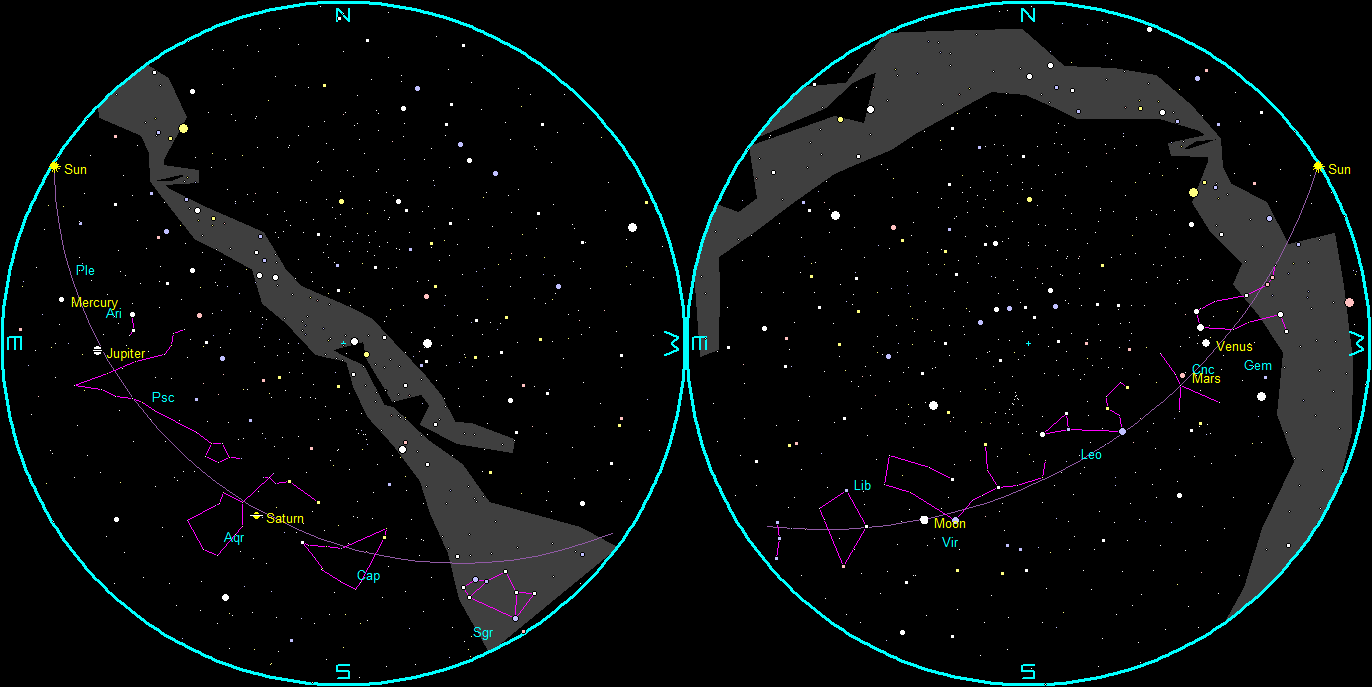
June Evening Star Chart
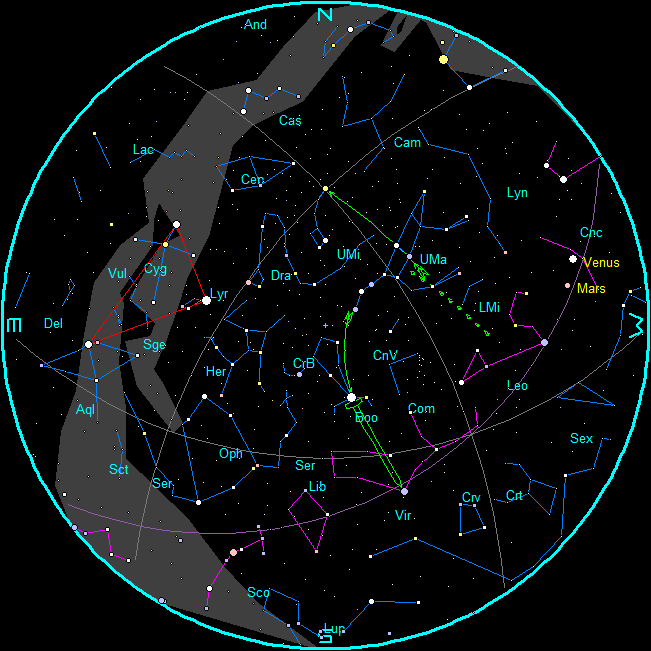
The planets and stars are plotted for the 15th at 11 p.m. EDT in the evening and 4 a.m. for the morning chart. These are the chart times. Note that Interlochen/Traverse City is located approximately 45 minutes behind our time meridian, West 75° longitude. (An hour 45 minutes behind our daylight saving time meridian during EDT). To duplicate the star positions on a planisphere you may have to set it to 1 hour 45 minutes earlier than the current time.
Note, the chart times of 11 p.m. and 4 a.m. are for the 15th. For each week before the 15th, add ½ hour (28 minutes if you’re picky). For each week after the 15th, subtract ½ hour, or 28 minutes. The planet positions are updated each Wednesday on this blog. For planet positions on dates other than the 15th, check the Wednesday planet posts on this blog for weekly positions.
June Morning Star Chart
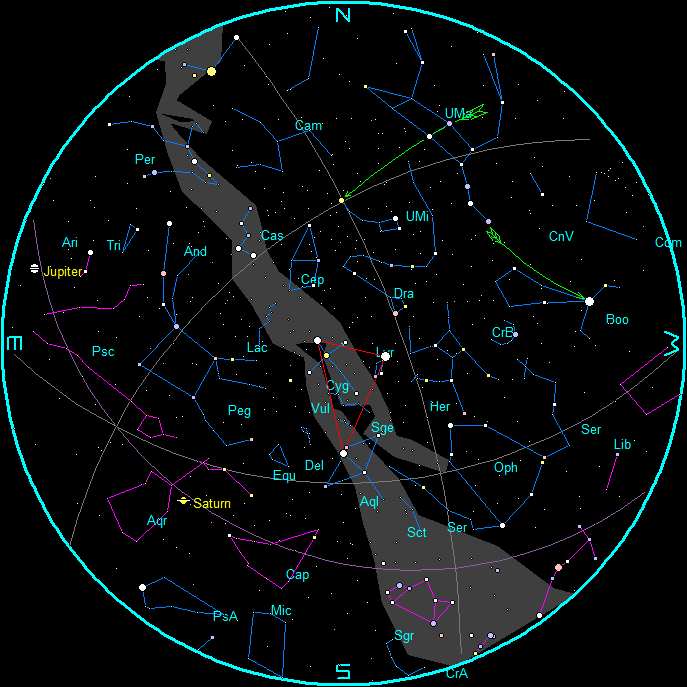
For a list of constellation names to go with the abbreviations, click here.
- Pointer stars at the front of the bowl of the Big Dipper point to Polaris, the North Star.
- Leaky dipper drips on Leo
- Follow the arc of the handle of the Big Dipper to the star Arcturus, and
- Extend like a spike to Spica,
Twilight Limits, Nautical and Astronomical
| EDT | |||||||
| Morning | Twilight | Evening | Twilight | Dark | Night | Moon | |
| Date | Astro. | Nautical | Nautical | Astro. | Start | End | Illum. |
| 2023-06-01 | 3h44m | 4h43m | 22h46m | 23h45m | – | – | 0.95 |
| 2023-06-02 | 3h43m | 4h42m | 22h48m | 23h47m | – | – | 0.99 |
| 2023-06-03 | 3h41m | 4h41m | 22h49m | 23h48m | – | – | 1.00 |
| 2023-06-04 | 3h40m | 4h40m | 22h50m | 23h50m | – | – | 0.98 |
| 2023-06-05 | 3h39m | 4h40m | 22h51m | 23h51m | – | – | 0.94 |
| 2023-06-06 | 3h38m | 4h39m | 22h52m | 23h53m | 23h53m | – | 0.87 |
| 2023-06-07 | 3h37m | 4h38m | 22h53m | 23h54m | 23h54m | 0h39m | 0.79 |
| 2023-06-08 | 3h36m | 4h38m | 22h53m | 23h55m | 23h55m | 1h18m | 0.68 |
| 2023-06-09 | 3h35m | 4h38m | 22h54m | 23h56m | 23h56m | 1h49m | 0.57 |
| 2023-06-10 | 3h35m | 4h37m | 22h55m | 23h58m | 23h58m | 2h13m | 0.46 |
| 2023-06-11 | 3h34m | 4h37m | 22h56m | 23h59m | 23h59m | 2h34m | 0.35 |
| 2023-06-12 | 3h33m | 4h36m | 22h57m | 0h00m | 0h00m | 2h54m | 0.25 |
| 2023-06-13 | 3h33m | 4h36m | 22h57m | 0h01m | 0h01m | 3h13m | 0.16 |
| 2023-06-14 | 3h32m | 4h36m | 22h58m | 0h01m | 0h01m | 3h32m | 0.09 |
| 2023-06-15 | 3h32m | 4h36m | 22h58m | 0h02m | 0h02m | 3h32m | 0.04 |
| 2023-06-16 | 3h32m | 4h36m | 22h59m | 0h03m | 0h03m | 3h32m | 0.01 |
| 2023-06-17 | 3h32m | 4h36m | 22h59m | 0h04m | 0h04m | 3h32m | 0.00 |
| 2023-06-18 | 3h32m | 4h36m | 23h00m | 0h04m | 0h04m | 3h32m | 0.01 |
| 2023-06-19 | 3h32m | 4h36m | 23h00m | 0h04m | 0h04m | 3h32m | 0.04 |
| 2023-06-20 | 3h32m | 4h36m | 23h00m | 0h05m | 0h05m | 3h32m | 0.08 |
| 2023-06-21 | 3h32m | 4h36m | 23h01m | 0h05m | 0h05m | 3h32m | 0.15 |
| 2023-06-22 | 3h32m | 4h37m | 23h01m | 0h05m | 0h28m | 3h32m | 0.22 |
| 2023-06-23 | 3h32m | 4h37m | 23h01m | 0h05m | 0h51m | 3h32m | 0.30 |
| 2023-06-24 | 3h33m | 4h37m | 23h01m | 0h05m | 1h11m | 3h33m | 0.39 |
| 2023-06-25 | 3h33m | 4h38m | 23h01m | 0h05m | 1h29m | 3h33m | 0.49 |
| 2023-06-26 | 3h34m | 4h38m | 23h01m | 0h05m | 1h46m | 3h34m | 0.59 |
| 2023-06-27 | 3h35m | 4h39m | 23h01m | 0h05m | 2h03m | 3h35m | 0.68 |
| 2023-06-28 | 3h35m | 4h39m | 23h01m | 0h04m | 2h22m | 3h35m | 0.78 |
| 2023-06-29 | 3h36m | 4h40m | 23h01m | 0h04m | 2h43m | 3h36m | 0.86 |
| 2023-06-30 | 3h37m | 4h40m | 23h00m | 0h03m | 3h10m | 3h37m | 0.93 |
The twilight calendar was generated using Cartes du Ciel (Sky Charts), with some corrections.
See my blog post: Twilight Zone for the definitions of the different periods of twilight here: https://bobmoler.wordpress.com/2018/09/27/.
NASA Calendar of Planetary Events
  Date       Time     Event
Jun  1  Th            Venus: 45.4° E
     1  Th   2:22 am  Moon Descending Node
     1  Th  11:30 pm  Mars-Beehive:  0.1° S
     3  Sa   5:19 pm  Moon-Antares: 1.6° S
     3  Sa  11:42 pm  Full Strawberry Moon
     4  Su   6:59 am  Venus Elongation: 45.4° E
     5  Mo  12:21 pm  Moon South Dec.: 27.9° S
     6  Tu   7:07 pm  Moon Perigee: 364,900 km
     9  Fr   4:19 pm  Moon-Saturn: 3° N
    10  Sa   3:31 pm  Last Quarter
    11  Su   1:50 pm  Mercury-Pleiades: 6.2° S
    13  Tu   7:05 am  Venus-Beehive:  0.5° N
    13  Tu   8:05 pm  Moon Ascending Node
    14  We   2:33 am  Moon-Jupiter: 1.6° S
    15  Th   8:47 pm  Moon-Pleiades: 2° N
    16  Fr   4:18 pm  Mercury-Aldebaran: 4.3° N
    18  Su  12:37 am  New Moon
    18  Su   5:07 pm  Moon North Dec.: 27.8° N
    20  Tu   5:10 am  Moon-Pollux: 1.9° N
    21  We   6:38 am  Moon-Beehive: 4° S
    21  We  10:58 am  Summer Solstice
    21  We   8:47 pm  Moon-Venus: 4.1° S
    22  Th   6:09 am  Moon-Mars: 4.2° S
    22  Th   2:31 pm  Moon Apogee: 405,400 km
    26  Mo   3:50 am  First Quarter
    28  We   8:22 am  Moon Descending Node
Jul  1  Sa            Venus: 41.7° E
Sky Events Calendar by Fred Espenak and Sumit Dutta (NASA’s GSFC),
http://eclipse.gsfc.nasa.gov/SKYCAL/SKYCAL.html.
Sun and Moon Rising and Setting Events
     LU                  Ephemeris of Sky Events for Interlochen/TC
June, 2023    Local time zone: EDT
+-----------------------------------------------------------------------+
| DATE |  SUN     SUN  DAYLIGHT|   TWILIGHT*    |MOON  RISE OR    ILLUM |
|      |  RISE    SET    HOURS |  END    START  |PHASE SET** TIME FRACTN|
+=======================================================================+
|Thu  1| 06:00a  09:21p  15:20 | 10:44p  04:37a |      Set  04:43a   94%|
|Fri  2| 05:59a  09:22p  15:22 | 10:45p  04:36a |      Set  05:14a   98%|
|Sat  3| 05:59a  09:22p  15:23 | 10:46p  04:35a |Full  Rise 09:27p  100%|
+------+-----------------------+----------------+-----------------------+
|Sun  4| 05:59a  09:23p  15:24 | 10:47p  04:35a |      Rise 10:42p   99%|
|Mon  5| 05:58a  09:24p  15:25 | 10:48p  04:34a |      Rise 11:47p   95%|
|Tue  6| 05:58a  09:25p  15:26 | 10:49p  04:33a |      Rise 12:39a   89%|
|Wed  7| 05:57a  09:25p  15:27 | 10:50p  04:33a |      Rise 01:18a   80%|
|Thu  8| 05:57a  09:26p  15:28 | 10:51p  04:32a |      Rise 01:48a   70%|
|Fri  9| 05:57a  09:27p  15:29 | 10:52p  04:32a |      Rise 02:13a   59%|
|Sat 10| 05:57a  09:27p  15:30 | 10:53p  04:31a |L Qtr Rise 02:34a   48%|
+------+-----------------------+----------------+-----------------------+
|Sun 11| 05:56a  09:28p  15:31 | 10:53p  04:31a |      Rise 02:53a   37%|
|Mon 12| 05:56a  09:28p  15:31 | 10:54p  04:31a |      Rise 03:13a   27%|
|Tue 13| 05:56a  09:29p  15:32 | 10:55p  04:30a |      Rise 03:34a   18%|
|Wed 14| 05:56a  09:29p  15:33 | 10:55p  04:30a |      Rise 03:59a   10%|
|Thu 15| 05:56a  09:30p  15:33 | 10:56p  04:30a |      Rise 04:28a    5%|
|Fri 16| 05:56a  09:30p  15:33 | 10:56p  04:30a |      Rise 05:04a    2%|
|Sat 17| 05:56a  09:30p  15:34 | 10:57p  04:30a |      Rise 05:49a    0%|
+------+-----------------------+----------------+-----------------------+
|Sun 18| 05:56a  09:31p  15:34 | 10:57p  04:30a |New   Set  10:36p    1%|
|Mon 19| 05:56a  09:31p  15:34 | 10:57p  04:30a |      Set  11:22p    3%|
|Tue 20| 05:56a  09:31p  15:34 | 10:58p  04:30a |      Set  11:58p    8%|
|Wed 21| 05:57a  09:32p  15:34 | 10:58p  04:30a |      Set  12:27a   13%|
|Thu 22| 05:57a  09:32p  15:34 | 10:58p  04:31a |      Set  12:51a   20%|
|Fri 23| 05:57a  09:32p  15:34 | 10:58p  04:31a |      Set  01:11a   28%|
|Sat 24| 05:57a  09:32p  15:34 | 10:58p  04:31a |      Set  01:29a   37%|
+------+-----------------------+----------------+-----------------------+
|Sun 25| 05:58a  09:32p  15:34 | 10:58p  04:32a |      Set  01:45a   47%|
|Mon 26| 05:58a  09:32p  15:33 | 10:58p  04:32a |F Qtr Set  02:02a   57%|
|Tue 27| 05:59a  09:32p  15:33 | 10:58p  04:33a |      Set  02:21a   66%|
|Wed 28| 05:59a  09:32p  15:32 | 10:58p  04:33a |      Set  02:43a   76%|
|Thu 29| 05:59a  09:32p  15:32 | 10:58p  04:34a |      Set  03:10a   84%|
|Fri 30| 06:00a  09:32p  15:31 | 10:57p  04:34a |      Set  03:45a   92%|
+-----------------------------------------------------------------------+
* Nautical Twilight
** Moonrise or moonset, whichever occurs between sunrise and sunset
Generated using my LookingUp for DOS program.
05/31/2023 – Ephemeris – Let’s find where the naked-eye planets have wandered off to this week
This is Bob Moler with Ephemeris for Wednesday, May 31st. Today the Sun will be up for 15 hours and 19 minutes, setting at 9:20 pm, and it will rise tomorrow at 6 am. The Moon, 3 days before full, will set at 4:19 am tomorrow.
Let’s find where the naked-eye planets have wandered off to this week. Venus is our blazing Evening Star, seen in the west all evening. It will set after midnight. The red planet Mars has moved into Cancer, and is seen above and left of Venus by 12 degrees, or a bit more than the width of one’s fist held at arm’s length. Venus is closing the gap between them, but will never quite reach Mars while they are in the evening sky. The closest they will get is three and a half degrees or 7 moon diameters apart, before Venus pulls back toward the Sun faster than Mars will. In the morning, Saturn will be visible low in the southeast at 5 am, rising at 2:28 am. Jupiter makes its morning appearance and is low in the east-northeast at that hour, rising at 4:27 am.
The astronomical event times given are for the Traverse City/Interlochen area of Michigan (EDT, UT –4 hours). They may be different for your location.
Addendum
05/30/2023 – Ephemeris – The Terminator… No, not Arnold Swartzenegger
This is Ephemeris for Tuesday, May 30th. Today the Sun will be up for 15 hours and 17 minutes, setting at 9:19, and it will rise tomorrow at 6:01. The Moon, 3 days past first quarter, will set at 3:59 tomorrow morning.
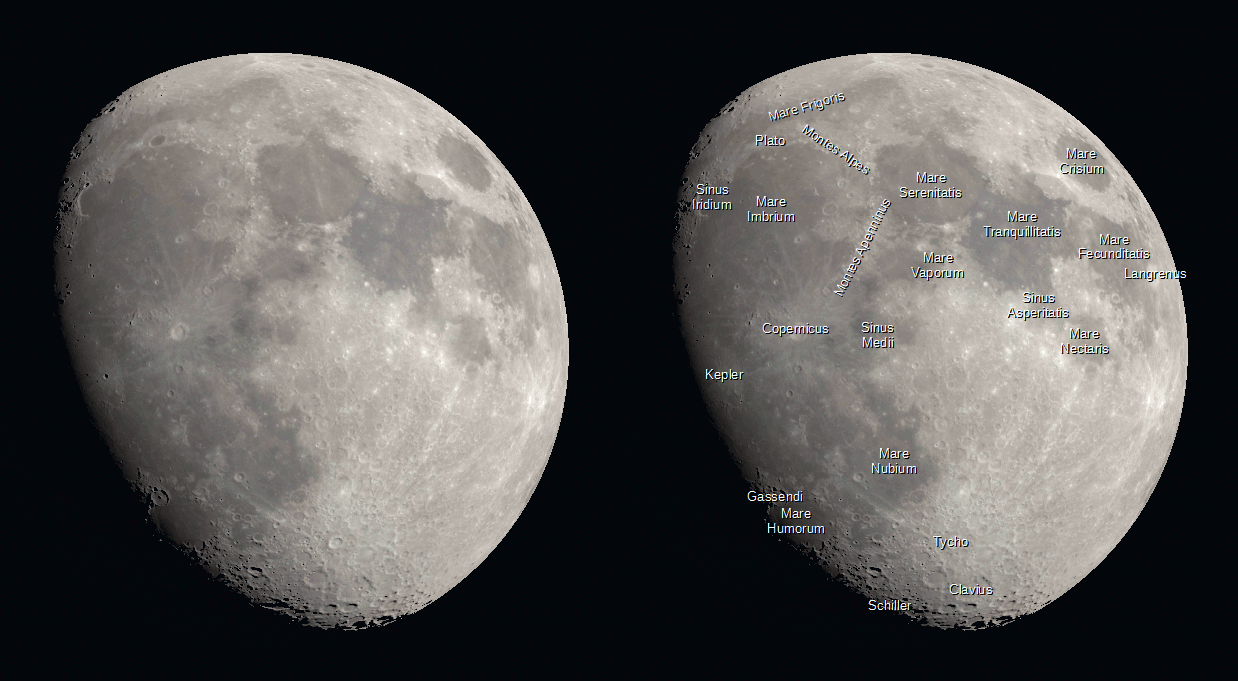
The Moon tonight is getting to be a fatter and fatter gibbous phase, until Saturday, when it will be full. The Moon will be blindingly bright in telescopes of low magnification. As always the case with the Moon, the most detail is seen near the terminator. The terminator, in the case of the waxing moon, is the sunrise line. After full moon, the terminator becomes the sunset line. This is where the shadows are longest, showing the detail of the craters. Farther from the terminator, where the Sun is higher in the Moon’s sky, shadows are short or nonexistent. Giving the surface a flat appearance. Even lacking wind and water, there is still erosion on the Moon, coming from meteoroid and asteroid impacts and their ejecta. And the breakdown of rocks due to the extreme day-night temperature swings.
The astronomical event times given are for the Traverse City/Interlochen area of Michigan (EDT, UT –4 hours). They may be different for your location.
Addendum
05/29/2023 – Ephemeris – Sinus Iridium, a hook into night
This is Bob Moler with Ephemeris for Memorial Day, Monday, May 29th. Today the Sun will be up for 15 hours and 16 minutes, setting at 9:18, and it will rise tomorrow at 6:01. The Moon, 2 days past first quarter, will set at 3:41 tomorrow morning.
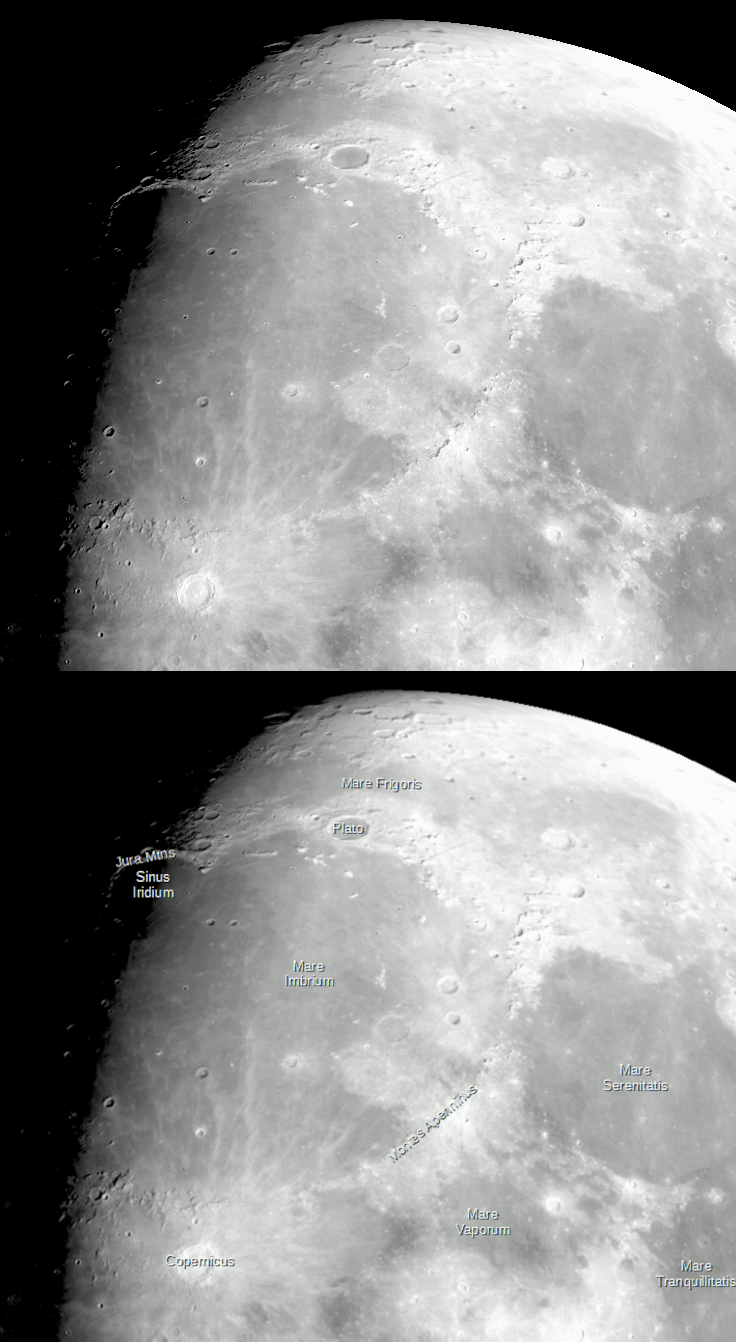
Let’s look at the Moon tonight. One of my favorite formations is coming into light. It is called Sinus Iridium or Bay of Rainbows. Sorry, there’s no color here. But if caught at right time, and tonight’s the night, this ruined crater will appear as a hook out into night off the upper left edge of the moon. Officially it’s a bay to the Sea of Showers or Mare Imbrium. The north edge of the bay are mountains called the Jura Mountains. The south edge disappears into Mare Imbrium. The floor of the Sinus Iridium is about twelve hundred feet lower than Mare Imbrium. The transition is gradual because it isn’t very noticeable. The formation is large enough to be seen in binoculars. Sinus Iridium is 242 miles wide, a good tenth the diameter of the Moon itself.
The astronomical event times given are for the Traverse City/Interlochen area of Michigan (EDT, UT –4 hours). They may be different for your location.
Addendum
05/26/2023 – Ephemeris – Sun & Star Party tomorrow at the Sleeping Bear Dunes National Lakeshore
This is Bob Moler with Ephemeris for Friday, May 26th. Today the Sun will be up for 15 hours and 11 minutes, setting at 9:15, and it will rise tomorrow at 6:03. The Moon, 1 day before first quarter, will set at 2:48 tomorrow morning.
Tomorrow, the Sleeping Bear Dunes National Lakeshore and the Grand Traverse Astronomical Society will host a Sun and Star Party at the Dune Climb area of the park. There will be a solar viewing period from 5 pm to about 7 pm. The society has two hydrogen alpha solar telescopes to view the Sun’s chromosphere and prominences. Plus, some members also have solar scopes and white light filtered telescopes to view sunspots on the face of the Sun. Night viewing will start at 9 pm, with the Moon and Venus featured, along with the brighter telescopic wonders of late spring. There will be a pass of the International Space Station from 10:11 to 10:18 pm. The rangers will have an alternate program if it’s cloudy.
The astronomical event times given are for the Traverse City/Interlochen area of Michigan (EDT, UT –4 hours). They may be different for your location.
Addendum
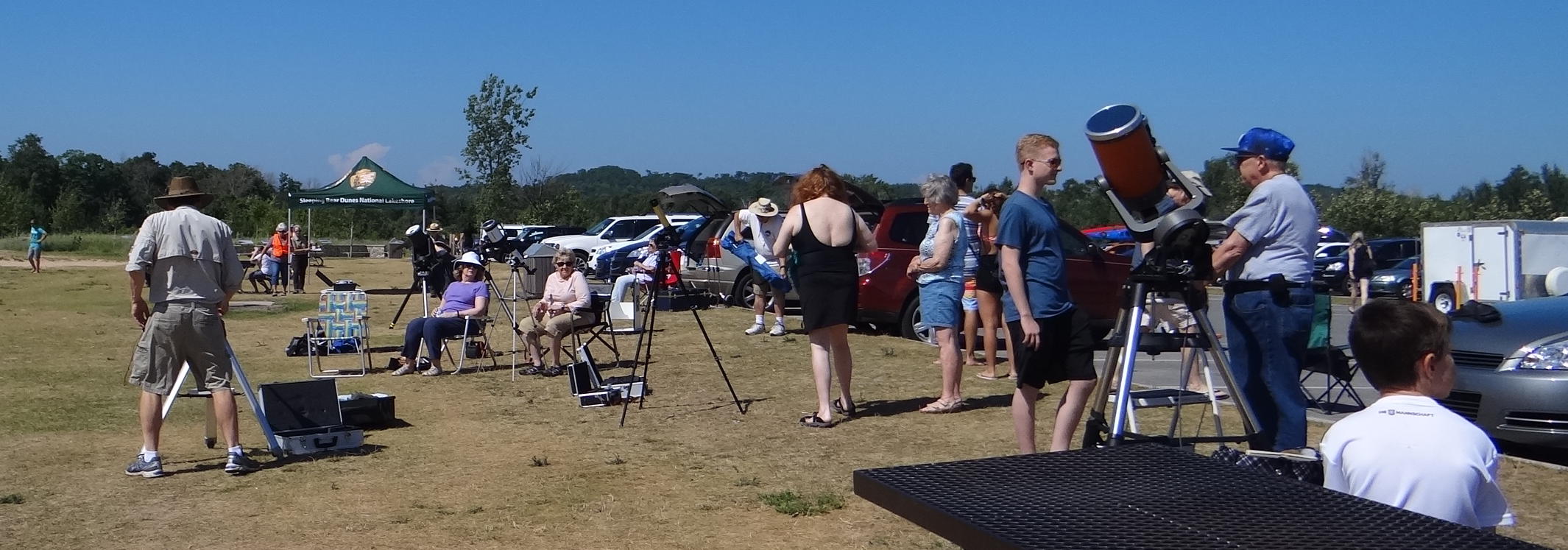
A Sun Party at the Dune Climb. Credit: Eileen Carlisle.
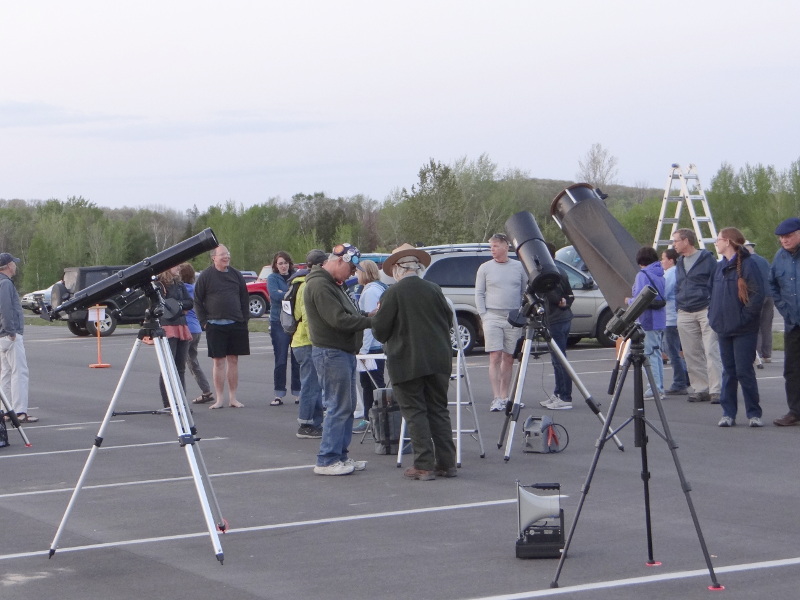
Preparing to start the May star party, several years ago at the Dune Climb. A few of the telescopes are visible, including the GTAS 25″ “Emmettron” telescope at the far right background. Credit: Eileen Carlisle.
05/25/2023 – Ephemeris – NASA awards contracts for a second lunar lander
This is Ephemeris for Thursday, May 25th. Today the Sun will be up for 15 hours and 9 minutes, setting at 9:14, and it will rise tomorrow at 6:04. The Moon, 2 days before first quarter, will set at 2:26 tomorrow morning.
A week ago, NASA announced that the contract for the second Artemis moon lander would go to a group of companies headed by Blue Origin for 3.4 billion dollars. Unlike Apollo, the rocket that sens crews to the Moon will not contain a moon landing craft. It will be sent out separately before the crew. SpaceX’s Lunar Starship will be used on the first two landings, for Artemis III and IV, while the Blue Origin lander will be used for Artemis V, sometime around 2029 or later. Little detail has been released about the lander, except for an artist’s rendering. It appears to be shorter than the Boeing lander first proposed, which would require an astronaut to climb up and down a very long ladder. SpaceX’s Starship would be taller still, but will have an elevator on the side.
The astronomical event times given are for the Traverse City/Interlochen area of Michigan (EDT, UT –4 hours). They may be different for your location.
Addendum
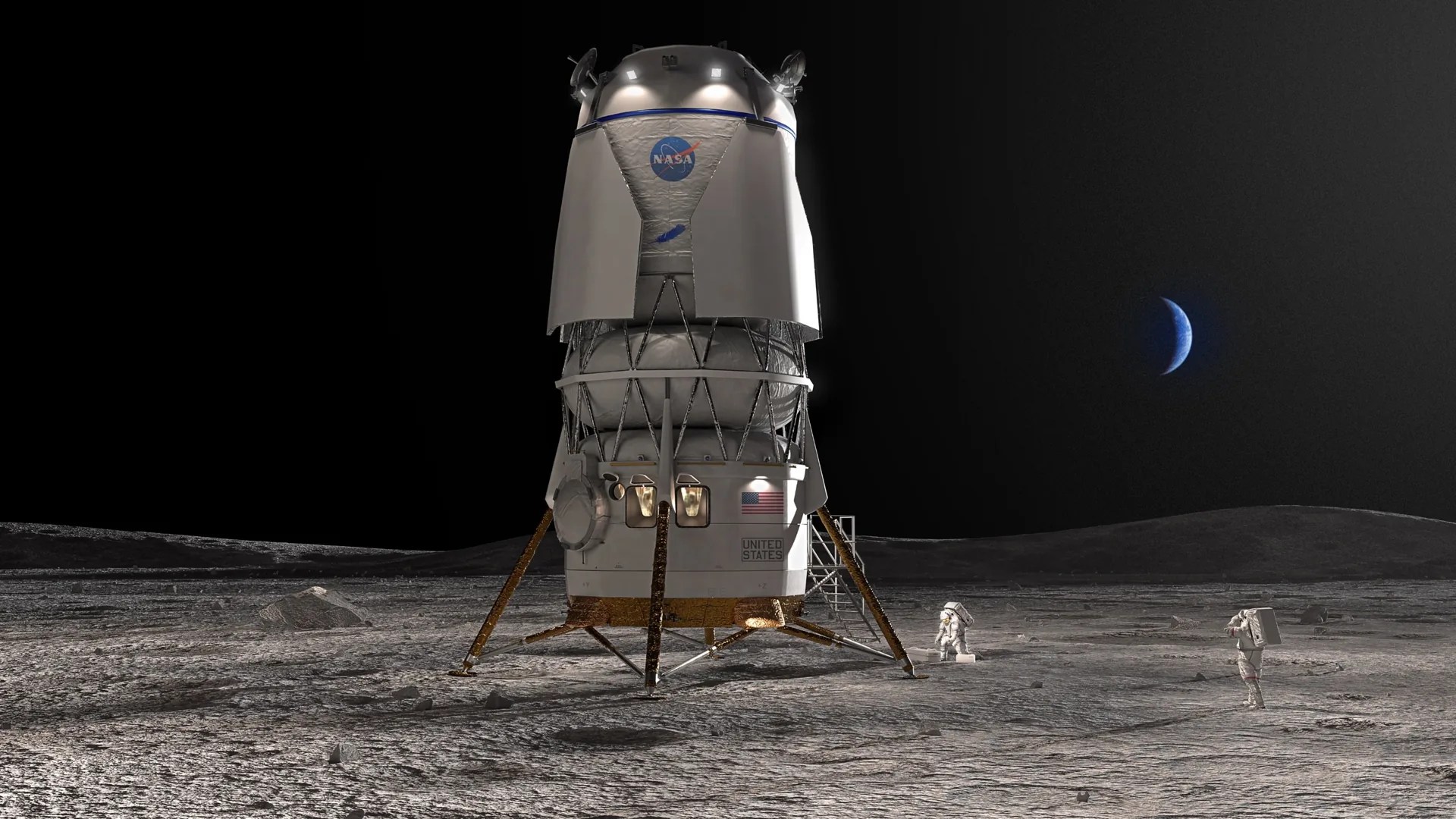
NASA picks Bezos’ Blue Origin to build second lunar lander. The crew compartment is on the bottom, allowing for a shorter ladder to the surface. The liquid oxygen (LOX) and hydrogen (LH) tanks are on top. The LH tank is on top with sun shields, with the LOX tank below. I’m guessing here, since very little information has been released. Credit: NASA.
The craft is officially known as the Human Landing System (HLS).
05/24/2023 – Ephemeris – Let’s find where the naked-eye planets have wandered off to this week
This is Ephemeris for Wednesday, May 24th. Today the Sun will be up for 15 hours and 7 minutes, setting at 9:13, and it will rise tomorrow at 6:05. The Moon, 3 days before first quarter, will set at 1:59 tomorrow morning.
Let’s find where the naked-eye planets have wandered off to this week. Venus is our blazing Evening Star, seen in the west all evening. It will set after midnight. The red planet Mars will appear below the Moon tonight. It has moved into Cancer, and is seen above and left of Venus by 14 degrees, or one and a half times the width of one’s fist held at arm’s length. Venus is closing the gap between them, but will never quite reach Mars while they are in the evening sky. The closest they will get is three and a half degrees or 7 moon diameters apart, before Venus pulls back toward the Sun faster than Mars will. In the morning, Saturn will be visible and low in the southeast at 5 am, rising at 2:47 am. Jupiter makes its morning appearance and is very low in the east-northeast at that hour.
The astronomical event times given are for the Traverse City/Interlochen area of Michigan (EDT, UT –4 hours). They may be different for your location.
Addendum
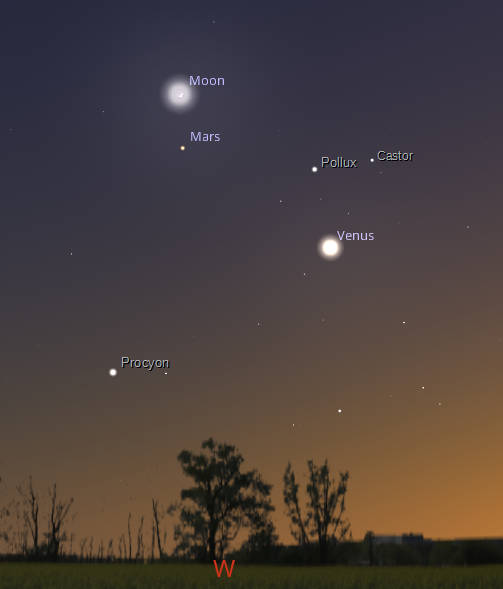
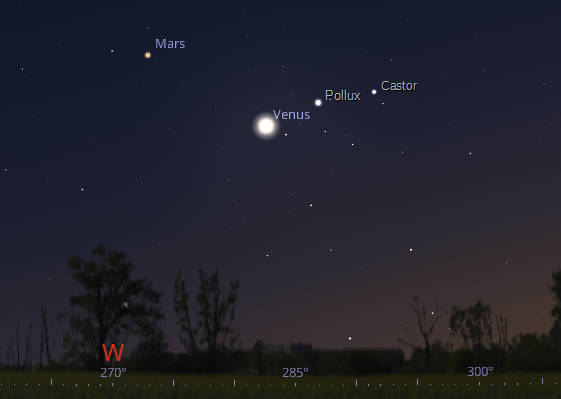
Evening planets and the Moon at 10 pm tonight, May 24, 2023. Created using Stellarium, LibreOffice Draw and GIMP.
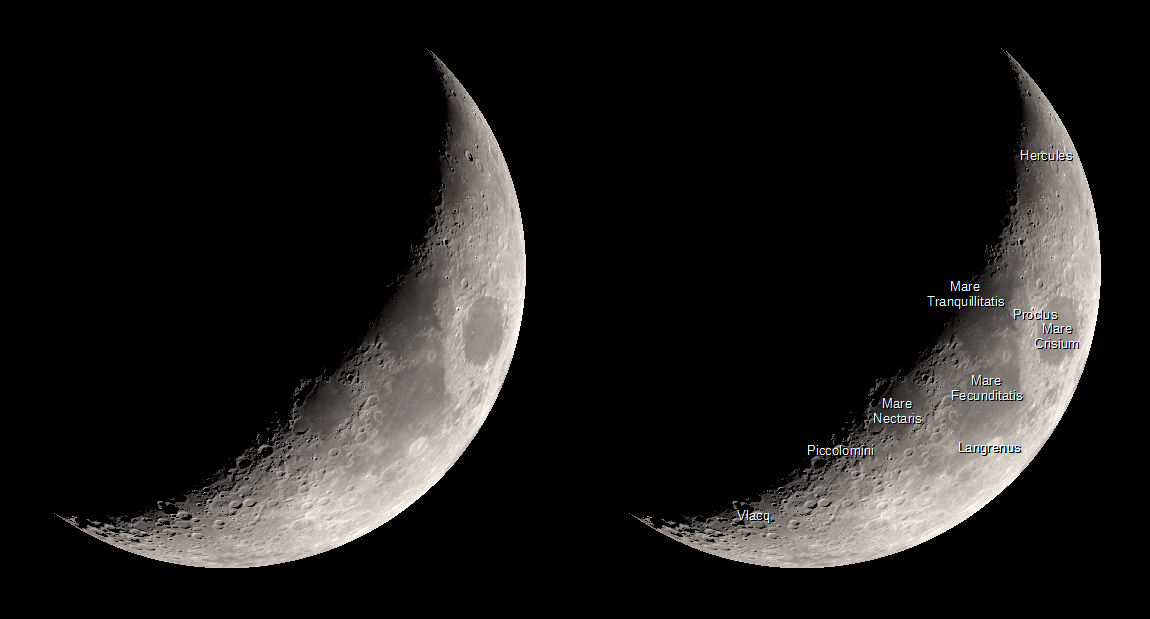
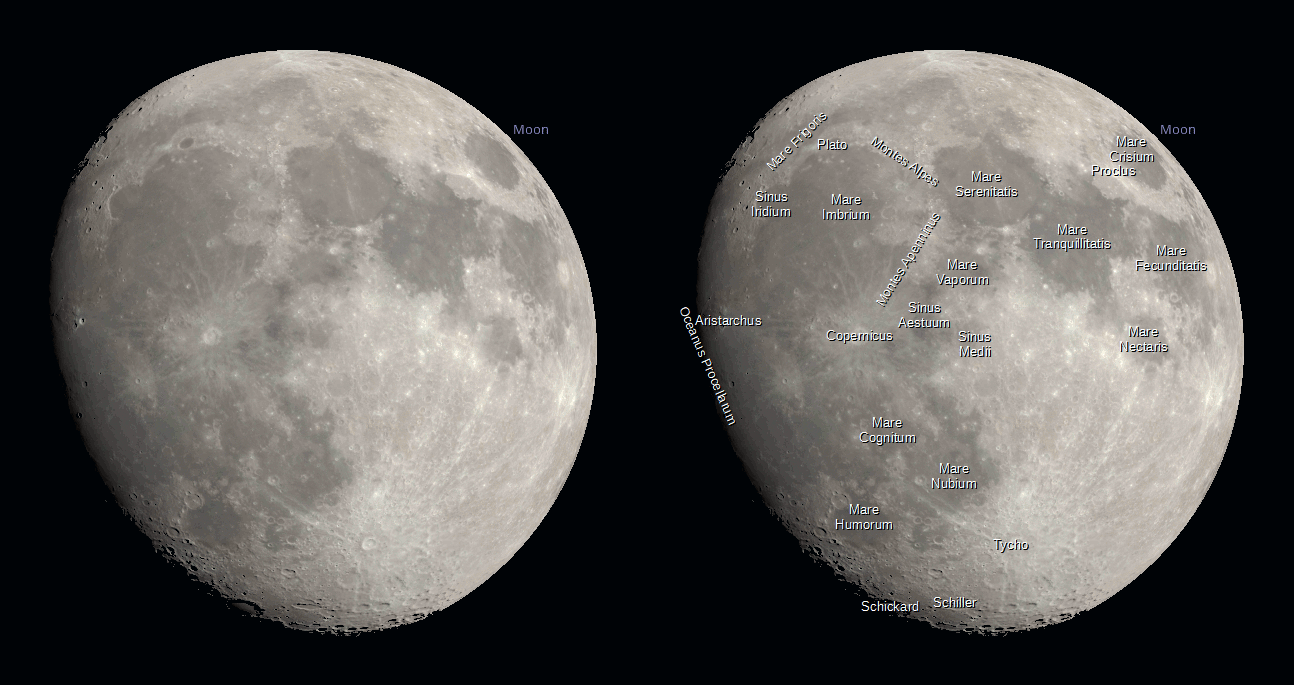
5 day old Moon with selected features labeled for May 24, 2023, at 10 pm. Created using Stellarium, LibreOffice and GIMP.
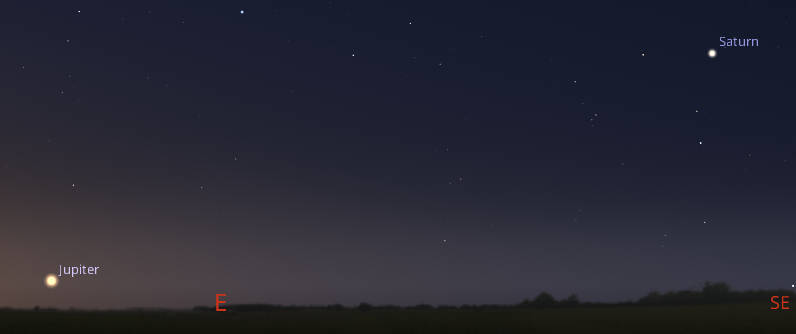
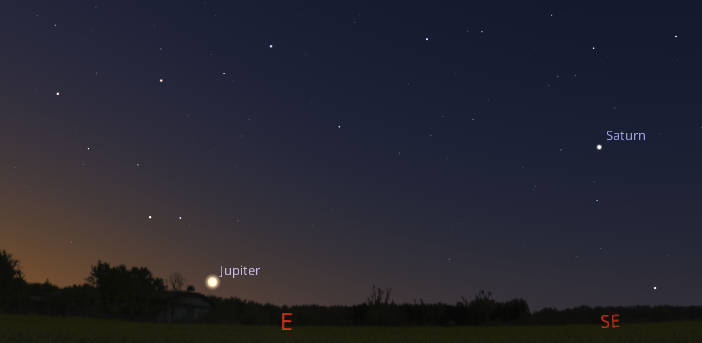
Saturn and Jupiter in early morning twilight at 5:00 am tomorrow, May 25, 2023. Created using Stellarium.
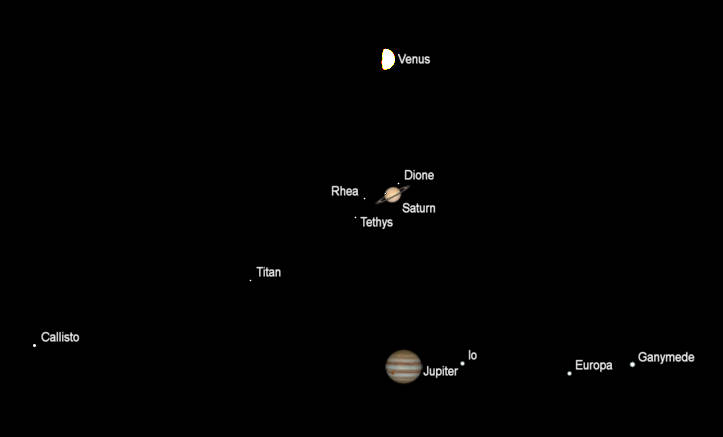
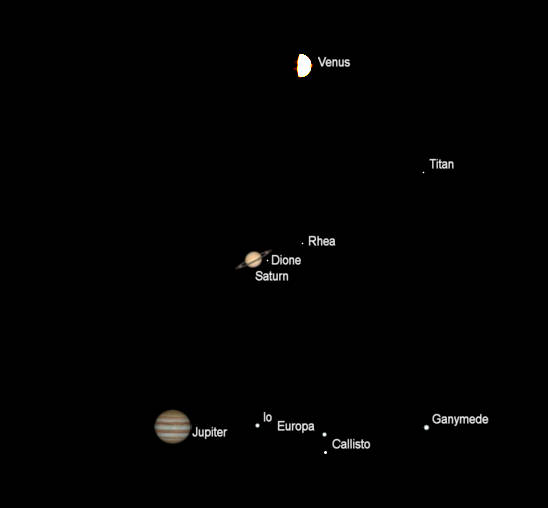
Telescopic Venus, Saturn and Jupiter (north up) as they would be seen in a small telescope, with the same magnification. Apparent diameters: Venus 21.03″ and is 55.4% illuminated; Saturn 16.96″, its rings 39.52″; Jupiter 34.07″. Mars, too small to be represented here, is 4.81″ in diameter. The ” symbol means seconds of arc (1/3600th of a degree.) Created using Cartes du Ciel (Sky Charts).
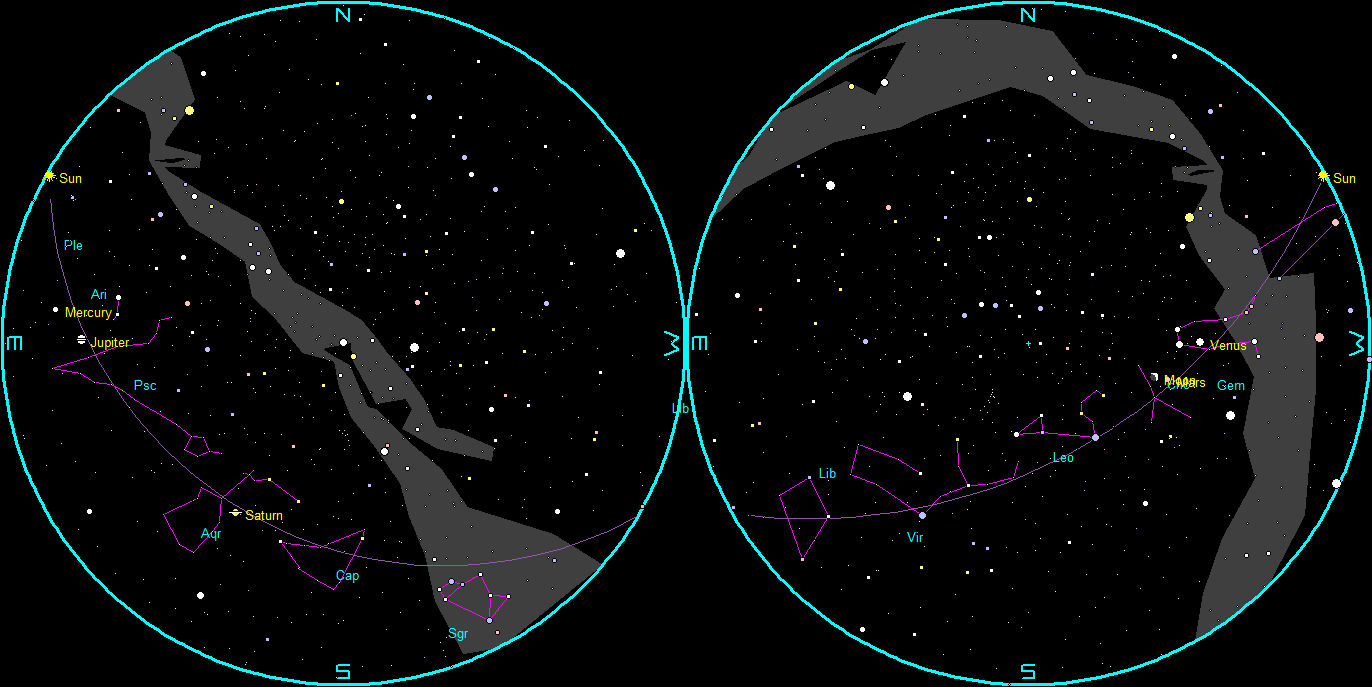
The naked-eye planets and the Moon at sunset and sunrise on a single night, starting with sunset on the right on May 24, 2023. The night ends on the left with sunrise on the 25th. Click or tap on the image to enlarge it. Created using my LookingUp app and GIMP.
 Bob Moler's Ephemeris Blog