Archive
11/07/2022 – Ephemeris – There will be a total eclipse of the Moon in the hours before sunrise tomorrow morning
This is Bob Moler with Ephemeris for Monday, November 7th. Today the Sun will be up for 9 hours and 54 minutes, setting at 5:23, and it will rise tomorrow at 7:30. The Moon, 1 day before full, will set at 7:40 tomorrow morning.
There will be a total eclipse of the Moon tomorrow morning. We in Michigan are near the eastern edge of the part of the Earth that can see the eclipse. The partial phase will begin at 4:09 am. More and more of the Moon will enter the Earth’s inner shadow, until 5:16 am, when the Moon will be completely eclipsed. We expect the Moon to have a reddish hue from sunlight leaking and bent through Earth’s atmosphere into the shadow. This total phase will last until 6:41 am, when the Moon will begin to emerge into sunlight to start the ending partial phase of the eclipse. By this time, the Moon will be getting low in the west. The Moon will set around 7:40 am, just before the end of the eclipse and a few minutes after sunrise.
The astronomical event times given are for the Traverse City/Interlochen area of Michigan (EDT, UT – 5 hours). They may be different for your location.
Addendum

Credit: NASA/GSFC, Fred Espenak. Click on the image for the full size PDF file from the NASA eclipse site.
The contact times again for Eastern Standard Time
Contact                     Time EST
U1 Partial eclipse starts...4:09 am
U2 Totality starts..........5:16 am
   Mid-eclipse..............6:00 am
U3 Totality ends............6:41 am
U4 Partial eclipse ends.....7:49 am
P1 and P4 are not noticeable, so are not listed. The penumbral shadow will be noticeable, generally for a half hour or so before U1 and again for a half hour or so after U4, if you are located far enough west of here to see the complete eclipse.

This is a not-to-scale diagram of the motion of the moon through the Earth’s shadow during a lunar eclipse. Assume we are looking down from the north, the motion of the Moon will be counterclockwise. The Moon will enter the shadow from the west or right, so the first “bite” of the shadow will be on the left side of the Moon. The penumbra is a gradually increasing shadow from the outer edge to the umbra, where the Sun is partially blocked by the Earth.
The Moon’s appearance in totality
The Moon will normally appear to have a dull reddish hue during totality, though the edge of the umbra will normally appear gray. When there is a spectacular volcanic eruption, the volcanic dust in the atmosphere can produce an especially dark eclipse. The normal red color is due to all the sunrises and sunsets occurring on the Earth during the eclipse. The atmosphere scatters out the blue component of the sunlight, giving us red sunrises and sunsets. Also, the atmosphere refracts or bends the sunlight into the Earth’s inner shadow, the umbra, at the Moon’s distance, so the totally eclipsed Moon isn’t completely dark.
10/25/2022 – Ephemeris – This eclipse season starts with a partial solar eclipse, but not for us
“But not for us” means not for Michigan in the United States. This is a script, as always, for a local radio program. Which also mentions the midterm election day, two weeks from now, which coincides with the total lunar eclipse that morning. I’ll have an Ephemeris Extra post before the lunar eclipse, which looks into the next few lunar and solar eclipses visible in Michigan and the United States.
This is Ephemeris for Tuesday, October 25th. Today the Sun will be up for 10 hours and 30 minutes, setting at 6:41, and it will rise tomorrow at 8:12. The Moon is new today, and won’t be visible.
The Moon will be visible in a negative way for some folks at this time. There is a partial solar eclipse in progress now for parts of Europe, Asia and Africa. So that thing blocking the northern part of the Sun for them will be the Moon. Being a partial eclipse means that an eclipse season has started, and we should have a lunar eclipse in about two weeks, when the Moon is full. There sure is, and it’s visible from here. In exactly two weeks, there will be. In the early morning hours of November 8th, Election Day, a total eclipse of the Moon. And if you’re standing outside the polling place waiting for the polls to open at 7 am, and it’s clear, and you have a view to the west, the partially eclipsed Moon will still be visible. That will be the ending partial phase of the eclipse.
The astronomical event times given are for the Traverse City/Interlochen area of Michigan (EDT, UT – 4 hours). They may be different for your location.
Addendum
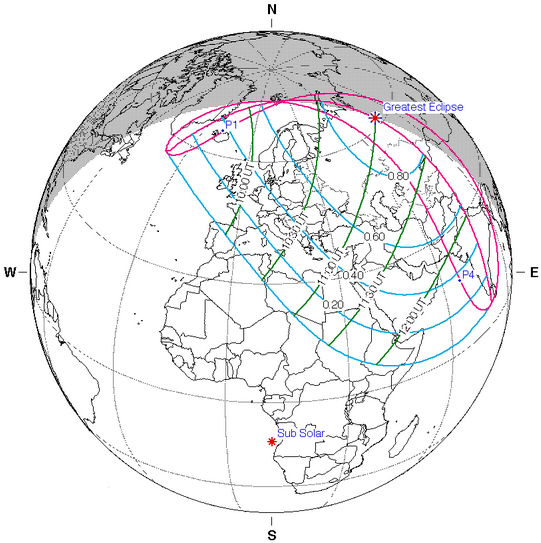
Map for the area on the Earth where the partial solar eclipse of October 25, 2022, will be visible. Credit: NASA/GSFC, Fred Espenak.
05/13/2022 – Ephemeris – Remember, there is going to be an eclipse of the Moon late Sunday night!
This is Bob Moler with Ephemeris for Friday, May 13th. Today the Sun will be up for 14 hours and 45 minutes, setting at 9:02, and it will rise tomorrow at 6:15. The Moon, 3 days before full, will set at 5:28 tomorrow morning.
There is going to be an eclipse of the Moon running from late Sunday night into the early Monday morning hours. That’s the night of May 15/16. By 10:30 pm, there will appear a noticeable “bite” out of the lower left edge of the Moon as it enters the Earth’s inner shadow, called the umbra. The shadow will creep across the Moon for the next hour. And by 11:30 the Moon is completely immersed in the Earth’s inner shadow. By now, one will notice that the shadow is not completely black. The Moon usually has a dim reddish hue caused by all the simultaneous sunrises and sunsets around the Earth. This is the total phase of the eclipse, which will last until almost 1 am. The Moon will slowly exit the inner shadow by 2 am.
The astronomical event times given are for the Traverse City/Interlochen area of Michigan (EDT, UT – 4 hours). They may be different for your location.
Addendum
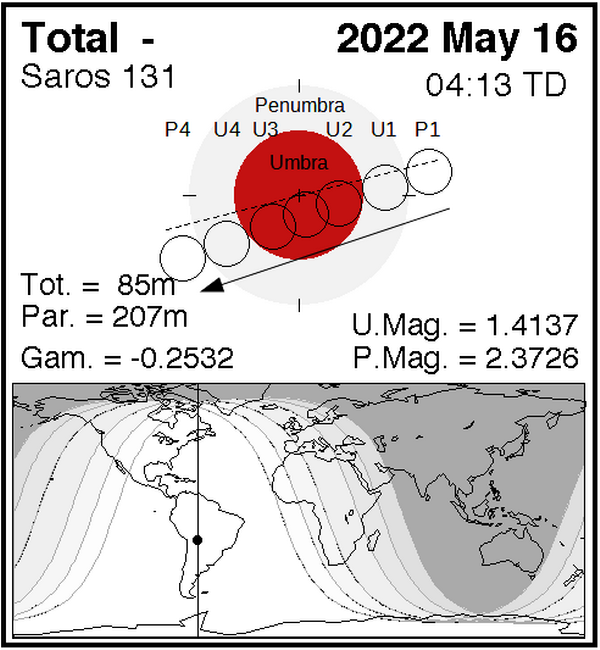
The eclipse occurs on the 16th for Universal Time, because the eclipse events take place after 8 pm EDT on the 15th. The Moon travels through the Earth’s shadow from right to left. What are seen are points of contact with the shadow and mid-eclipse. From Five Millennium Canon of Lunar Eclipses (Espenak & Meeus) NASA, with additions.
Contact times are labeled P1, U1, U2, U3, U4, and P4. P2 and P3 are omitted because they are synonymous with U1 and U4, respectively. Times are EDT unless noted:
- P1 – 9:32:07 pm (1:32:07 UT) Enter the penumbra (unseen). By about 10 pm, the duskiness on the left edge of the moon will start to be noticeable. Wearing sunglasses to dim the bright Moon will help show the effect.
- U1 – 10:27:53 pm (2:27:53 UT) Enter the umbra (partial eclipse begins).
- U2 – 11:29:03 pm (3:29:03 UT) Totality begins.
- Mid-eclipse 12:11:28.8 am (4:11:28.8 UT)
- U3 – 12:53:56 am (4:53:56 UT) Totality ends, the egress partial phase begins.
- U4 – 1:55:07 am (5:55:07 UT) Partial phase ends. The Moon’s upper right edge should appear dusky for the next half hour or so.
- P4 – 2:50:48 am (6:50:48 UT) Penumbral phase ends (unseen).
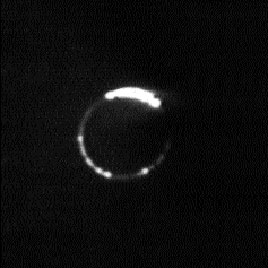
Solar eclipse by the Earth as photographed by Surveyor 3, which had landed on the Moon, April 24, 1967. The Earth was seeing a lunar eclipse at the time. Light seeps into the Earth’s shadow at the Moon’s distance due to atmospheric refraction. The amount of light depends on the atmospheric conditions at the time. Great volcanic eruptions can cause a very dark, nearly invisible, eclipsed Moon. Credit: NASA.
Update 7:30 pm, May 15th
In note for P1 time: Expected actual visibility of penumbral shadow is changed to 10 pm (2 hr UT).
05/12/2022 – Ephemeris – There will be a total eclipse of the Moon this Sunday night/Monday morning
This is Ephemeris for Thursday, May 12th. Today the Sun will be up for 14 hours and 43 minutes, setting at 9:01, and it will rise tomorrow at 6:16. The Moon, halfway from first quarter to full, will set at 5:06 tomorrow morning.
Late Sunday night through early Monday morning May 15/16 there will be a total eclipse of the Moon which will run from 10:28 pm Sunday night to 1:55 Monday morning. I’ll be more specific tomorrow. Also known as lunar eclipses, these only occur at full moon when the Moon crosses the earth’s shadow. Usually, the Moon passes too far north or south to run into earth’s shadow. In only in one in six full moons does this happen. To see it, one has to be on the night side of the Earth. And it has to be clear at your location, a big problem around here. Our last lunar eclipse in November was clouded out from my location, which is usually my luck with lunar eclipses. However, May is a better month. Here’s hoping.
The astronomical event times given are for the Traverse City/Interlochen area of Michigan (EDT, UT – 4 hours). They may be different for your location.
Addendum
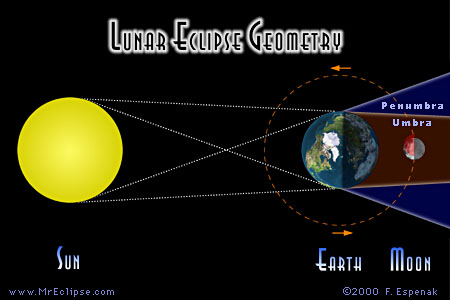
How lunar eclipses occur. Credit NASA/Fred Espenak.
The eclipse occurs on the 16th for Universal Time, because the eclipse events take place after 8 pm EDT on the 15th. The Moon travels through the Earth’s shadow from right to left. What are seen are points of contact with the shadow and mid-eclipse. On the world map, locations in the white or light part of the map can see all or part of the eclipse. From Five Millennium Canon of Lunar Eclipses (Espenak & Meeus) NASA, with additions by me.
Contact times are labeled P1, U1, U2, U3, U4, and P4. P2 and P3 are omitted because they are synonymous with U1 and U4, respectively. Times are EDT unless noted:
- P1 – 9:32:07 pm (1:32:07 UT) Enter the penumbra (unseen). By about 9 pm, the duskiness on the left edge of the moon will start to be noticeable. Wearing sunglasses to dim the bright Moon will help show the effect.
- U1 – 10:27:53 pm (2:27:53 UT) Enter the umbra (partial eclipse begins).
- U2 – 11:29:03 pm (3:29:03 UT) Totality begins.
- Mid-eclipse 12:11:28.8 am (4:11:28.8 UT)
- U3 – 12:53:56 am (4:53:56 UT) Totality ends, the egress partial phase begins.
- U4 – 1:55:07 am (5:55:07 UT) Partial phase ends. The Moon’s upper right edge should appear dusky for the next half hour or so.
- P4 – 2:50:48 am (6:50:48 UT) Penumbral phase ends (unseen).
11/18/2021 – Ephemeris – An almost total eclipse of the Moon will be visible early tomorrow morning
This is Ephemeris for Thursday, November 18th. Today the Sun will be up for 9 hours and 27 minutes, setting at 5:11, and it will rise tomorrow at 7:45. The Moon, 1 day before full, will set at 7:58 tomorrow morning.
Should our normal November clouds depart in the early morning hours tomorrow, we will be treated with a very deep partial eclipse of the Moon. At 4:03 am, the Moon will be 97% immersed into the Earth’s inner shadow, with lower left edge peeking out into sunlight. I haven’t heard of any massive volcanic eruptions in our Southern Hemisphere, so the light leaking and bent though the Earth’s atmosphere from all the simultaneous sunrises and sunsets during the eclipse won’t be too diminished and give us a coppery hue in the shadow. The shadow will touch the Moon at its top edge at 2:19 am. The maximum will occur at 4:03 am, and the last bit of the shadow will depart at the lower right edge of the Moon at 5:47 am.
The astronomical event times given are for the Traverse City/Interlochen area of Michigan (EST, UT – 5 hours). They may be different for your location.
Addendum
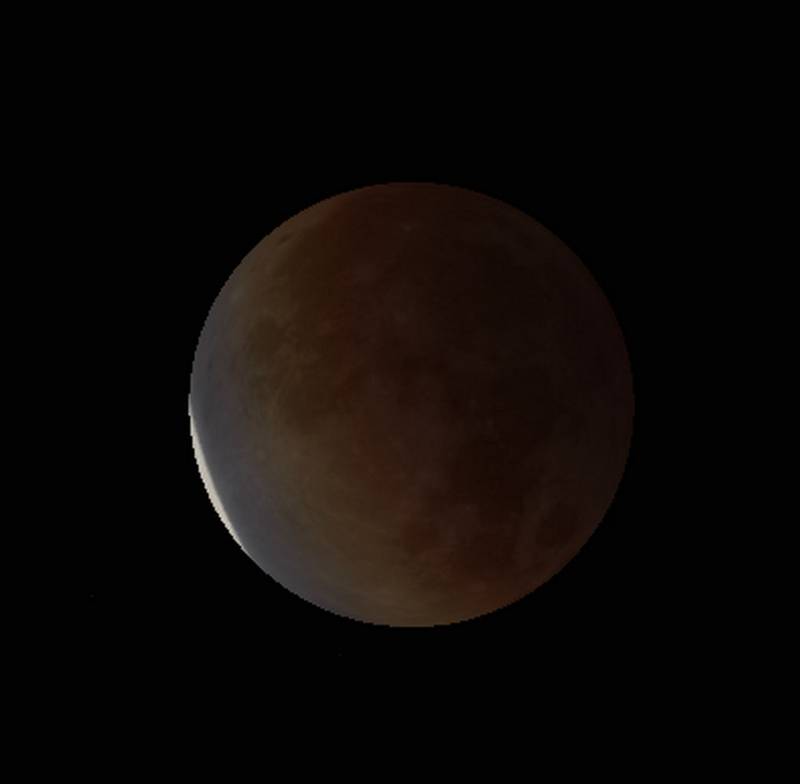
November 19, 2021, partial lunar eclipse maximum at 4:05 am EST. Orientation of the Moon and shadow could be different if not viewing from Northern Michigan. Created using Stellarium.
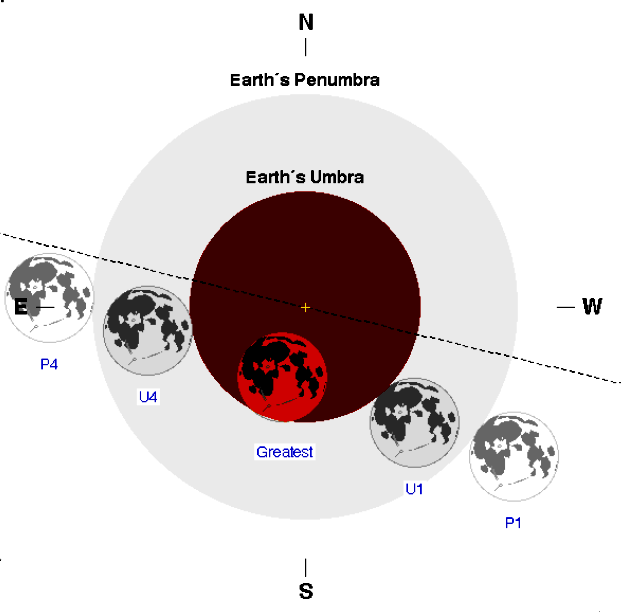
Lunar Eclipse Diagram for November 19, 2021. Effects of the eclipse on the Moon at P1 and P4 are not visible. U1 is the Moon at the beginning of the partial eclipse. U4 is the Moon at the end of the partial eclipse. A duskiness on the Moon’s face on the side closest to the umbral shadow will be visible just before and after the partial eclipse. Note that this diagram is not at the same orientation that an observer might experience. Created from a NASA PDF document on the NASA Eclipse Website. https://eclipse.gsfc.nasa.gov/eclipse.html.
05/27/2021 – Ephemeris – Miss yesterday’s eclipse? There’s 2 more in the next 12 months.
This is Bob Moler with Ephemeris for Thursday, May 27th. Today the Sun will be up for 15 hours and 13 minutes, setting at 9:17, and it will rise tomorrow at 6:02. The Moon, 1 day past full, will rise at 11:14 this evening.
While yesterday morning’s lunar eclipse may have been disappointing by setting just as it got going. That won’t happen with the next one. The next lunar eclipse visible from Northern Michigan will occur this November 19th, a Friday. It’s another morning eclipse, but doesn’t compete with sunrise or morning twilight. It’s not quite total, but nearly 97.5% of the Moon’s diameter will be covered by the Earth’s inner umbral shadow. The partial eclipse will start at 2:18 am and end at 5:47 am, which in November is nowhere near sunrise. We seem to be coming into a fortuitous period of eclipses in the next few years. Our next lunar eclipse after November will be next May 15th’s lunar eclipse, and it will be total and will conveniently happen in the evening.
The astronomical event times given are for the Traverse City/Interlochen area of Michigan. They may be different for your location.
05/25/2021 – Ephemeris – Viewing the lunar eclipse tomorrow morning
This post is for the appearance of the May 26th lunar eclipse in Michigan.
This is Ephemeris for Tuesday, May 25th. Today the Sun will be up for 15 hours and 10 minutes, setting at 9:15, and it will rise tomorrow at 6:04. The Moon, 1 day before full, will set at 6:09 tomorrow morning.
If we are really lucky tomorrow morning, and it is clear all the way down to the southwestern horizon at dawn we will witness the start of an eclipse of the Moon near sunrise and moonset. The eclipse starts at 4:48 am, but nothing unusual will be visible as the Moon starts to enter Earth’s outer, penumbral shadow. Perhaps by 5:15 the left edge of the Moon might appear dimmer than the right side. The Moon will be getting deeper in that shadow for the next half hour until at 5:45 it begins to enter the Earth’s inner shadow, the umbra. The only light in the umbra is that bent into it by the simultaneous sunrises and sunsets around the Earth. For the next 20 to 25 minutes the shadow will increase until the Sun rises and shortly after that the Moon sets around 6:09.
The astronomical event times given are for the Traverse City/Interlochen area of Michigan. They may be different for your location.
Addendum
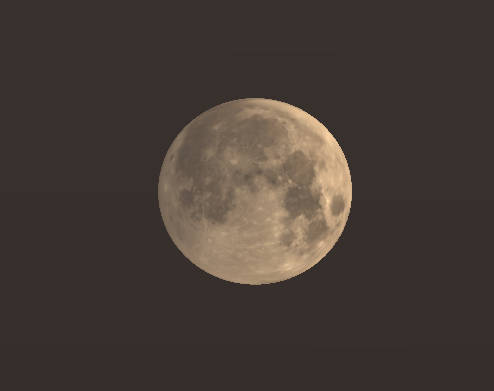
Simulated image of the Moon deep in the penumbra of the lunar eclipse of May 26, 2021 at 5:40 am. Notice that the left side of the Moon is darker than the right side. I find that the effect is more noticeable when wearing sunglasses to cut down the Moon’s bright glare. Created using Stellarium.
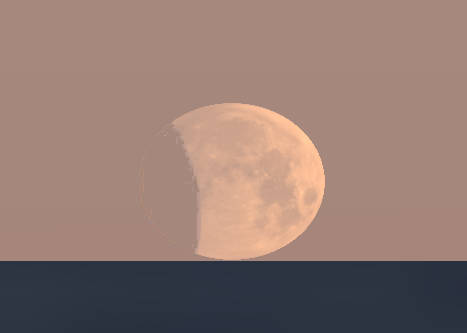
Simulated view of the partially eclipsed Moon of May 26, 2021 setting on a flat horizon. Created using Stellarium and touched up by using GIMP.
| Time | Event |
| 4:47 am | Nautical twilight starts |
| 4:48 am | The Moon enters penumbra (Nothing to see, the dimming on the left side is imperceptible) |
| 5:15 am | The penumbral shadow should become visible at the left edge of the Moon by this time |
| 5:45 am | The Moon enters the umbra (The partial part of the eclipse begins) |
| 6:04 am | Sunrise for Traverse City |
| 6:09 am | Moon sets for Traverse City |
The sunrise and moon set times may vary by more than a few minutes depending on your location.
05/24/2021 – Ephemeris – Get ready for Wednesday morning’s lunar eclipse
This is Bob Moler with Ephemeris for Monday, May 24th. Today the Sun will be up for 15 hours and 8 minutes, setting at 9:14, and it will rise tomorrow at 6:04. The Moon, 2 days before full, will set at 5:33 tomorrow morning.
If we are really lucky Wednesday morning, and it is clear all the way down to the southwestern horizon at dawn, we will witness the start of an eclipse of the Moon as the Sun rises and the Moon sets. The first inkling that something strange is happening to the Moon will come around 5:15 am or so. The Moon will be deep in the Earth’s outer, partial, shadow called the penumbra and the left side of the Moon should appear darker than the rest of it. The brightening of the twilight should enhance the effect. The partial phase of the eclipse will start at 5:45, where the left edge of the Moon will actually begin to disappear into the Earth’s inner shadow, the umbra. Within 20 to 25minutes later the Sun will rise and shortly after the Moon will set.
The astronomical event times given are for the Traverse City/Interlochen area of Michigan. They may be different for your location.
Addendum
Simulated image of the Moon deep in the penumbra of the lunar eclipse of May 26, 2021 at 5:40 am. Notice that the left side of the Moon is darker than the right side. I find that the effect is more noticeable when wearing sunglasses to cut down the Moon’s bright glare. Created using Stellarium.
Simulated view of the partially eclipsed Moon of May 26, 2021 setting on a flat horizon. Created using Stellarium and touched up by using GIMP.
| Time | Event |
| 4:47 am | Nautical twilight starts |
| 4:48 am | The Moon enters penumbra (Nothing to see, the dimming on the left side is imperceptible) |
| 5:15 am | The penumbral shadow should become visible at the left edge of the Moon by this time |
| 5:45 am | The Moon enters the umbra (The partial part of the eclipse begins) |
| 6:04 am | Sunrise for Traverse City |
| 6:09 am | Moon sets for Traverse City |
The sunrise and moon set times may vary by more than a few minutes depending on your location.
05/20/2021 – Ephemeris – Our first look at next Wednesday’s lunar eclipse
This is Bob Moler with Ephemeris for Thursday, May 20th. Today the Sun will be up for 15 hours and 1 minute, setting at 9:10, and it will rise tomorrow at 6:08. The Moon, 1 day past first quarter, will set at 3:51 tomorrow morning.
Next Wednesday’s lunar eclipse will be total as seen from half the Earth’s surface, but not the half we’re on. We will catch the start of the eclipse as the Moon is setting, and the Sun is rising. That puts us in a unique position. For 5 minutes between sunrise and moonset we will be able to see both the Sun and the Earth’s shadow falling on the Moon. The Earth’s atmosphere bends the Sun’s red rays into the Earth’s shadow, which is why the Moon usually appears red when totally eclipsed and not completely black. The Sun’s light rays that pass over our heads will continue through our atmosphere to be bent more and will pass into the Earth’s shadow so someone farther west of us can enjoy the red totally eclipsed Moon.
The astronomical event times given are for the Traverse City/Interlochen area of Michigan. They may be different for your location.
Addendum
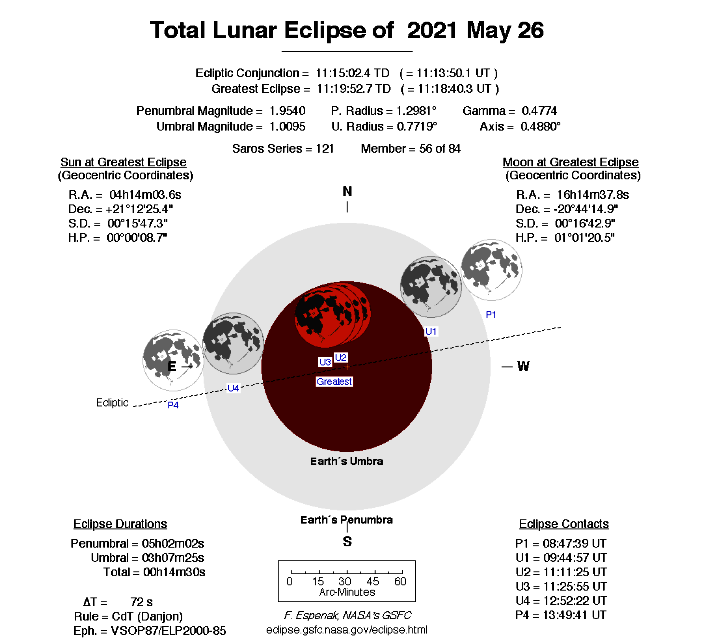
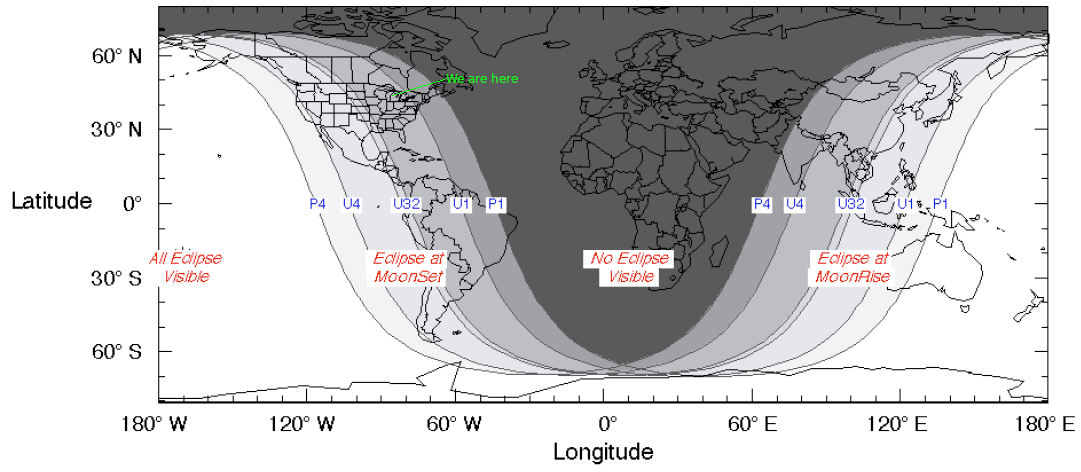
The two charts above are contained in a single PDF here-> https://eclipse.gsfc.nasa.gov/LEplot/LEplot2001/LE2021May26T.pdf.
UT (Universal Time) to EDT conversion: Subtract 4 hours.
05/18/2021 – Ephemeris – Eclipses visible in Northern Michigan this year
This is Ephemeris for Tuesday, May 18th. Today the Sun will be up for 14 hours and 56 minutes, setting at 9:08, and it will rise tomorrow at 6:10. The Moon, 1 day before first quarter, will set at 2:57 tomorrow morning.
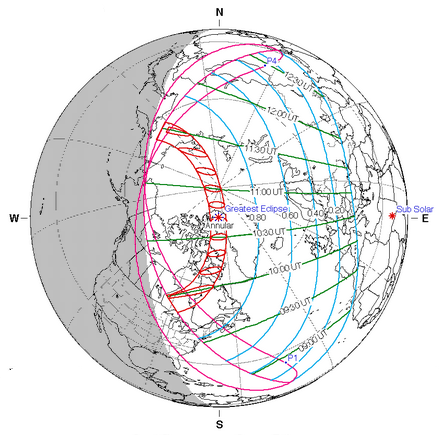
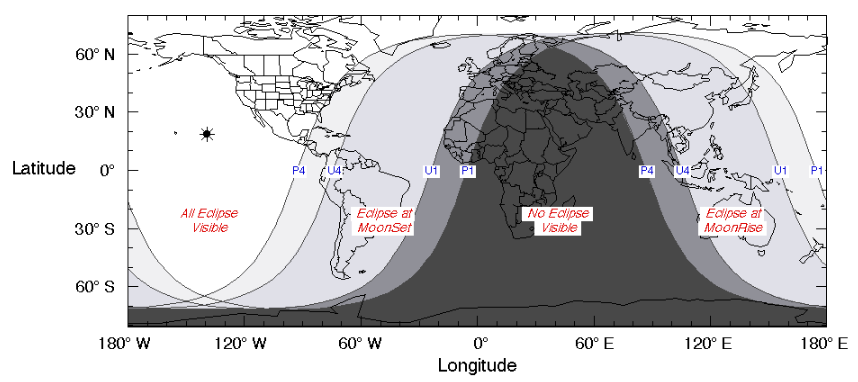
This year we will see in part or in full three eclipses from our Northern Michigan location. The first will be the start of a total lunar eclipse next week Wednesday, May 26th. It will start just before sunrise, which for a full moon is around moonset. Our next eclipse will be a solar eclipse that starts, for us, before sunrise on June 10th. In fact, most of the eclipse will occur before sunrise for us in Northern Michigan. The farther north and east of us the more of the eclipse you’ll see. I’ll have more information on the lunar in the next week of programs. And the solar eclipse as we approach that date. We have a final lunar eclipse this year. That will occur in the wee morning hours of November 19th, a partial, but almost total eclipse.
The astronomical event times given are for the Traverse City/Interlochen area of Michigan. They may be different for your location.
Addendum
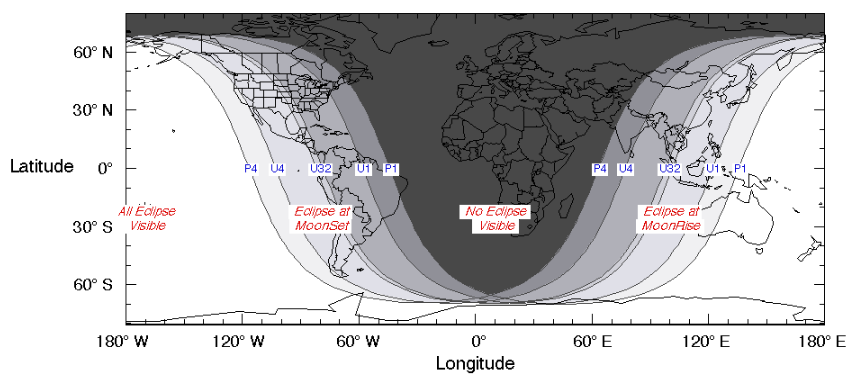
The four eclipses that occur in 2021
We in Northern Michigan we’ll see part of the first two and all of the third.
May 26, 2021 Total Lunar Eclipse
June 10, 2021 Annular Solar Eclipse
November 19, 2021 Partial Lunar Eclipse
December 4, 2021 Total Solar Eclipse