Archive
09/13/2012 – Ephemeris – The Great Rift
Ephemeris for Thursday, September 13th. The sun will rise at 7:19. It’ll be up for 12 hours and 36 minutes, setting at 7:55. The moon, 2 days before new, will rise at 5:43 tomorrow morning.
High overhead the Milky Way is seen passing through the Summer Triangle of three bright stars. Here we find the Milky Way split into two sections. The split starts in the constellation of Cygnus the Swan or Northern Cross nearly overhead and heads southward. The western part of the Milky Way ends southwest of the Aquila the eagle. This dark dividing feature is called the Great Rift. The rift is a great series of clouds obscures the light of the stars behind it. It appears to be about 300 light years away and obscures the light of the stars of the next spiral arm in. It may contain the mass of a million suns. Dust clouds like this are a prominent features of spiral galaxies, like the Milky Way.
Times are for the Traverse City/Interlochen area of Michigan. They may be different for your location.
Addendum
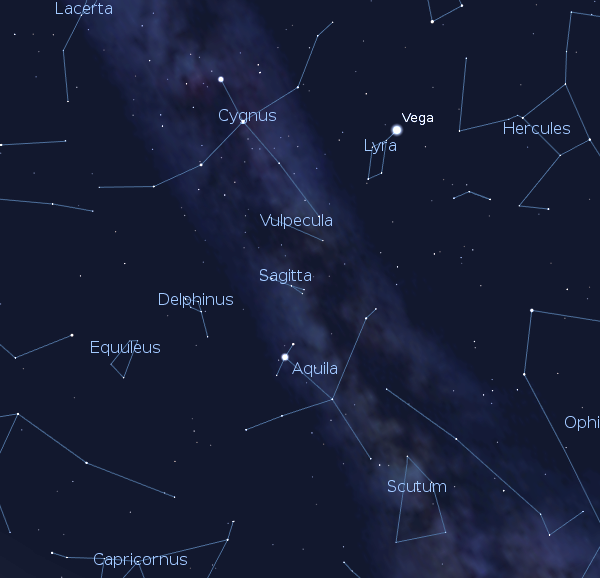
The Great Rift in the Milky Way. Created using Stellarium.
P.S.

Semper Fi
My grandson Chris the Marine celebrates his 22nd birthday today. He’s in the desert today in the US. Beats Afghanistan where he was last year at this time.
07/27/2012 – Ephemeris – I’ll be giving a presentation at the Eyaawing Museum & Culture Center in Peshawbestown tomorrow
Ephemeris for Friday, July 27th. The sun rises at 6:24. It’ll be up for 14 hours and 49 minutes, setting at 9:13. The moon, 1 day past first quarter, will set at 1:41 tomorrow morning.
Tomorrow yours truly will be giving a presentation Stars and Stories of the Summer Night Skies This will be a talk illustrated by a fantastic planetarium type program called Stellarium which is actually free from the Internet. There won’t be a planetarium dome however. I’ll be exploring the stars and constellations visible in the summer sky and how various cultures saw them and some of the wonderful stories of those who counted on the heavens to be their calendar in order to plant their crops and prepare for winter.. There’s the Greek constellations I tend to talk about on these programs, and others, especially those of the local Indian peoples. The presentation is at 1 p.m. at the Eyaawing Museum and Cultural Center in Peshawbestown.
Times are for the Traverse City/Interlochen area of Michigan. They may be different for your location.
02/21/2012 – Ephemeris – The winter Milky Way
Ephemeris for Fat Tuesday, Tuesday, February 21st. The sun will rise at 7:34. It’ll be up for 10 hours and 44 minutes, setting at 6:18. The moon is new today, and won’t be visible.
The winter Milky Way doesn’t seem as bright as the summer part. That’s mainly because we are looking away from the center of the Milky Way Galaxy. The galaxy appears to us as a band encircling the sky because we are within it, and our galaxy is a flat spiral galaxy. Our galaxy has the mass of maybe 200 billion suns and has a diameter of about 100 thousand light years. We are approximately 25 thousand light years from the center, which lies in the summer constellation of Sagittarius. There is a star forming region in the constellation of Orion, and part of it shows up as the Great Orion Nebula. There are more of these regions south of Orion, which we can’t see from Michigan. It’s said that the southern Milky Way is brighter than the one we see.
* Times are for the Traverse City/Interlochen area of Michigan. They may be different for your location.
Addendum
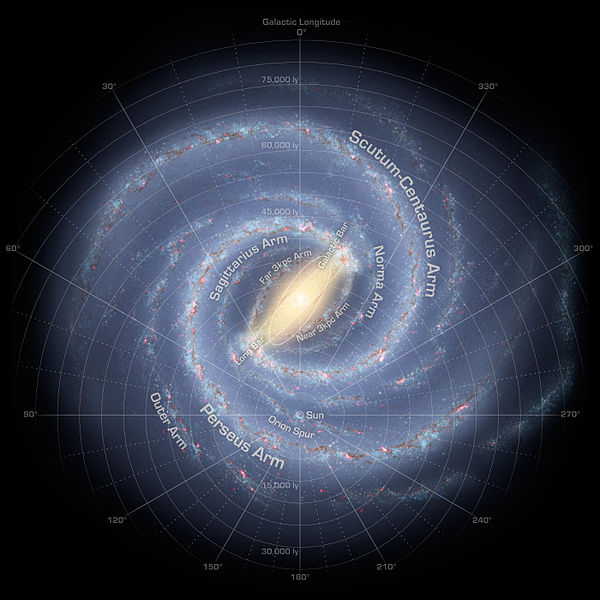
Artist's conception of the Milky Way. From NASA/JPL/Spitzer/Cal Tech
08/25/11 – Ephemeris – The Great Rift
Thursday, August 25th. The sun rises at 6:56. It’ll be up for 13 hours and 35 minutes, setting at 8:31. The moon, 3 days before new, will rise at 3:57 tomorrow morning.
High overhead the Milky Way is seen passing through the Summer Triangle of three bright stars. Here we find the Milky Way split into two sections. The split starts in the constellation of Cygnus the Swan or Northern Cross very high in the east. The western part of the Milky Way ends southwest of the Aquila the eagle. This dark dividing feature is called the Great Rift. Despite the lack of stars seen there, it doesn’t mean that there are fewer stars there than in the brighter patches of the Milky Way. The rift is a great dark cloud that obscures the light of the stars behind it. Sometimes binoculars can be used to find the edges of the clouds of the rift, as stars numbers drop off suddenly. This is especially easy in Aquila.
* Times are for the Traverse City/Interlochen area of Michigan. They may be different for your location.
Addendum
The Great Rift in the Milky Way. Created using Stellarium.
08/22/11 – Ephemeris – The constellation Sagittarius
Monday, August 22nd. The sun rises at 6:52. It’ll be up for 13 hours and 44 minutes, setting at 8:36. The moon, 1 day past last quarter, will rise at 12:50 tomorrow morning.
The Milky Way runs from north to south through the heavens at 11 p.m. You’ll notice that the Milky Way is brighter and broader just above the horizon in the south. In that glow in the south is a star pattern that looks like a stout little teapot, with a the Milky way like steam rising from the spout, which faces the west. This pattern of stars is the major part of the constellation called Sagittarius. According to Greek mythology Sagittarius is a centaur with a bow and arrow poised to shoot Scorpius the scorpion to the right. This centaur is called Chiron, the most learned of the breed, centaurs usually being a rowdy bunch. The center of the pinwheel of our galaxy lies hidden beyond the stars above the spout of the teapot.
* Times are for the Traverse City/Interlochen area of Michigan. They may be different for your location.
Addendum
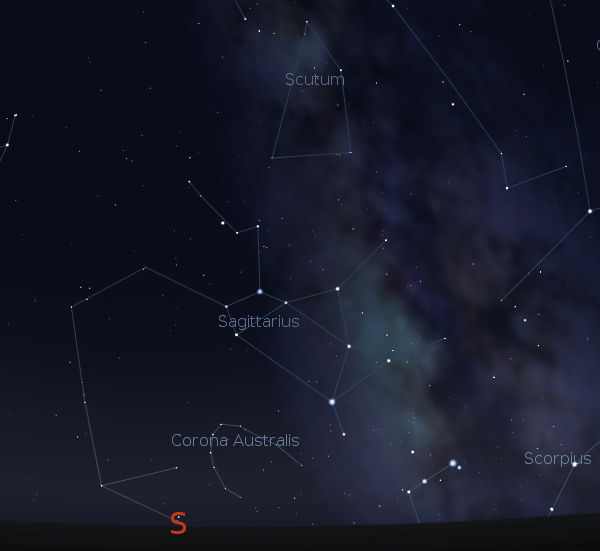
The constellations Sagittarius and Scutum. Created using Stellarium.
07/26/11 – Ephemeris – The Milky Way
Tuesday, July 26th. The sun rises at 6:22. It’ll be up for 14 hours and 53 minutes, setting at 9:15. The moon, 3 days past last quarter, will rise at 3:01 tomorrow morning.
The Milky Way, which is rising to pass overhead later in the evening is what we see of a huge structure of stars of which we are a part. We call it the Milky Way galaxy. It’s a spiral galaxy with a straight bar of stars through the center, a barred spiral galaxy about a hundred thousand light years across. It’s part of a small cluster of galaxies called the Local Group. Besides these three dozen galaxies, the Milky Way has small satellite galaxies orbiting it. The largest of these are the two Magellanic clouds seen from the southern hemisphere of earth. Even now a tiny galaxy is colliding with our galaxy. We can penetrate to the center of our own galaxy in infrared light, but not visible light from our location 26,000 light years away.
* Times are for the Traverse City/Interlochen area of Michigan. They may be different for your location.
Addendum

The Milky Way 360 degrees - Wikipedia
This is a mosaic of photographs showing the Milky Way as seen from the earth. The summer Milky Way we see is from just right of center to the left edge.
 Bob Moler's Ephemeris Blog