Archive
02/13/2018 – Ephemeris – Looking out the thin side of the Milky Way’s disk
Ephemeris for Fat Tuesday, February 13th. The Sun will rise at 7:46. It’ll be up for 10 hours and 22 minutes, setting at 6:08. The Moon, 2 days before new, will rise at 7:07 tomorrow morning.
With Orion and the winter stars grabbing our attention in the south, let’s look to the northeast to southeast where the stars are not as many, and with the exception of the Big Dipper and some other stars, not as bright. The inner stars of the Big Dipper are part of a sparse star cluster only about 80 light years away. The reason for the sparseness is that here we are looking out the thin side of the Milky Way’s disk. It will be our spring sky. To the west is the autumn evening skies. The thick part of the disk runs from the south-southeastern horizon, to just west of the zenith to the northwestern horizon. The reason the Milky Way isn’t as bright as the summer sections, is that we are looking away from the center to the outer spiral arms. We are in a small arm with the Great Orion Nebula.
The times given are for the Traverse City/Interlochen area of Michigan. They may be different for your location.
Addendum
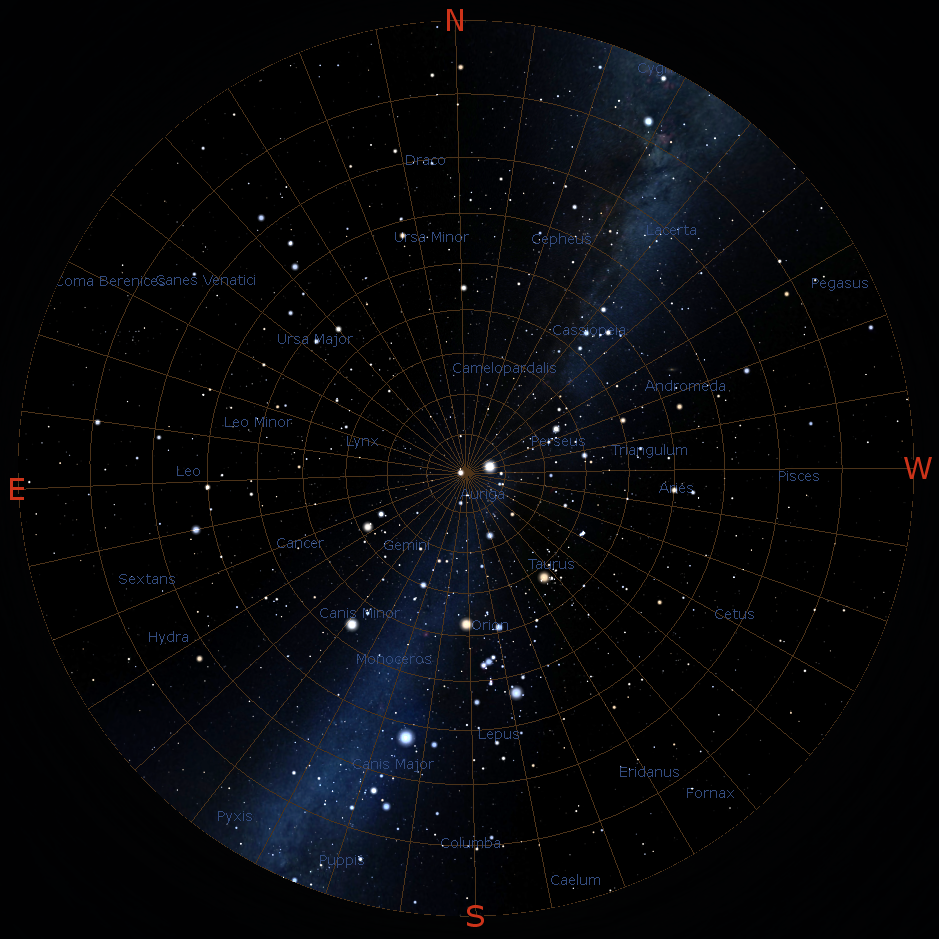
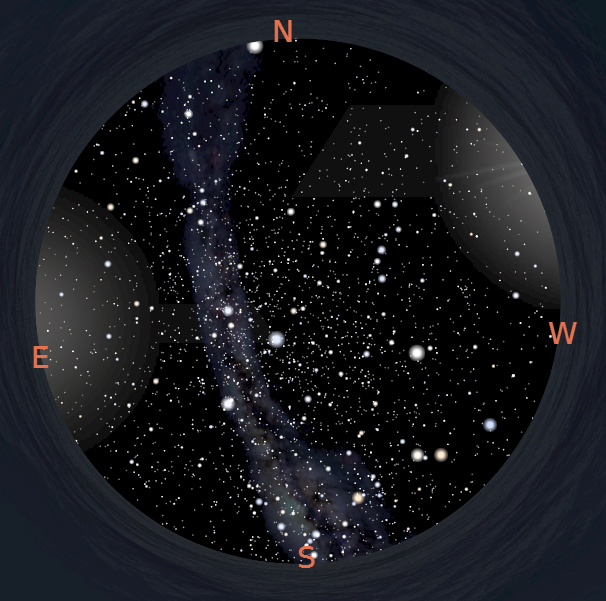
The dome of the sky at 9 p.m. February 13, 2018 showing an enhanced Milky Way. Showing also the drop off in stars off that band to the east and west. Click on image to enlarge. Created using Stellarium.
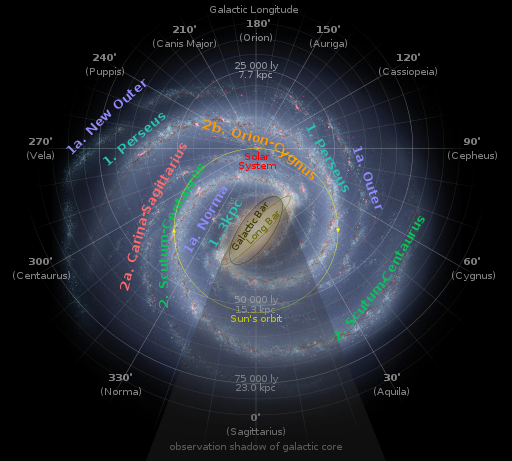
Our place in the Milky Way. Note that we appear to be in a barred spiral galaxy. The arms are numbered and named. 3kpc is the 3 kiloparsec arm. 1 parsec = 3.26 light years. The Sun is about 27,000 light years from the center. Credit NASA and Wikimedia Commons, via EarthSky.org
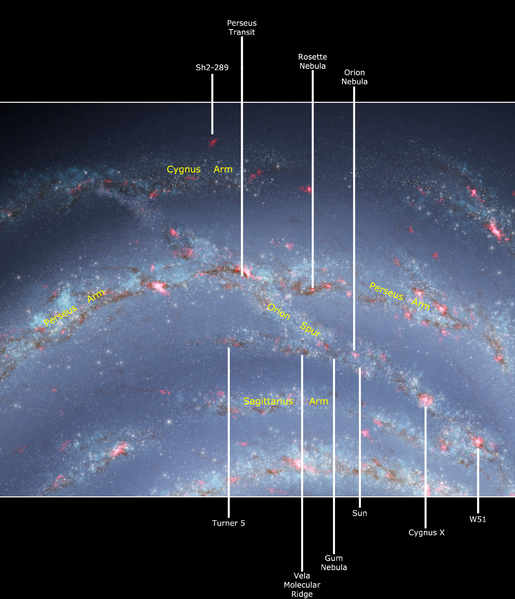
Our galactic neighborhood on the Orion spur or arm. Credit R. Hurt on Wikimedia Commons, via EarthSky.org.
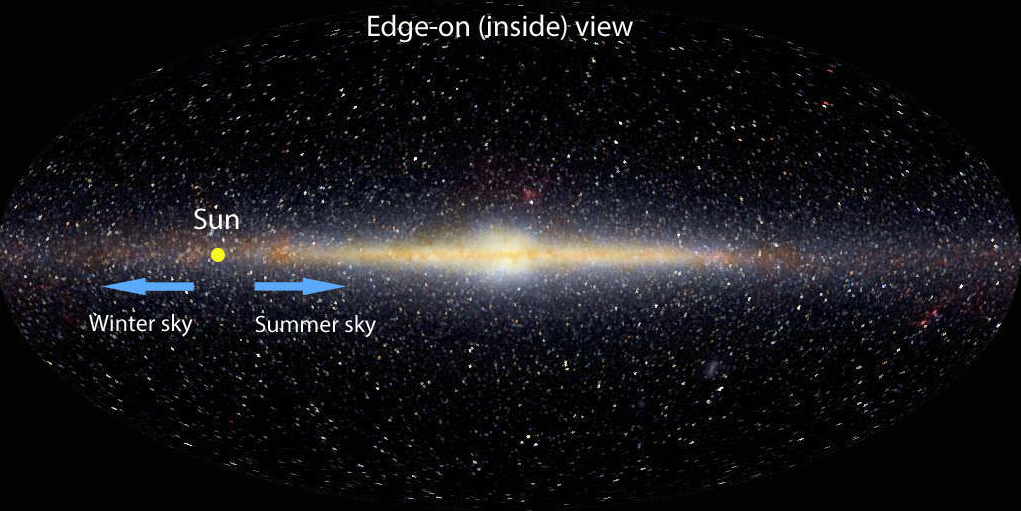
The summer and winter Milky Way viewing directions. During Spring and Autumn, we look out the sides to the universe beyond. Credit: NASA with annotations by Bob King at Universe Today.
09/19/2017 – Ephemeris – The Great Rift
Ephemeris for Tuesday, September 19th. The Sun will rise at 7:26. It’ll be up for 12 hours and 18 minutes, setting at 7:45. The Moon, 1 day before new, will rise at 7:43 tomorrow morning.
High overhead the Milky Way is seen passing through the Summer Triangle of three bright stars. Here we find the Milky Way split into two sections. The split starts in the constellation of Cygnus the Swan or Northern Cross very high in the east. The western part of the Milky Way ends southwest of the Aquila the eagle. This dark dividing feature is called the Great Rift. Despite the lack of stars seen there, it doesn’t mean that there are fewer stars there than in the brighter patches of the Milky Way. The rift is a great dark cloud that obscures the light of the stars behind it. Sometimes binoculars can be used to find the edges of the clouds of the rift, as stars numbers drop off suddenly. This is especially easy to spot in Aquila the eagle.
The times given are for the Traverse City/Interlochen area of Michigan. They may be different for your location.
Addendum
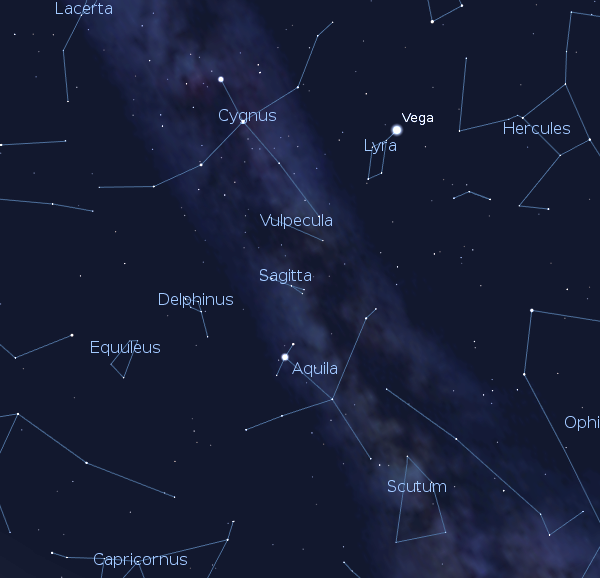
The Great Rift in the Milky Way. Created using Stellarium.
10/03/2016 – Ephemeris – Cassiopeia the celestial queen, and a look at Venus with the Moon
Ephemeris for Monday, October 3rd. The Sun will rise at 7:43. It’ll be up for 11 hours and 34 minutes, setting at 7:18. The Moon, 3 days past new, will set at 8:55 this evening.
The stars of autumn are in the northeastern to southeastern part of the evening sky. Look half way up the sky in the northeast at 9 p.m. and you can find the W shaped constellation of Cassiopeia the queen. Cassiopeia never sets for us in Michigan. It is opposite the pole star Polaris from the Big Dipper. Above Cassiopeia is a dim church steeple shaped constellation of Cepheus the king. The steeple is toppled to the left. The Milky Way flows through Cassiopeia and through a corner of Cepheus to the bright star Deneb in Cygnus the Swan, or Northern Cross, overhead. Below Cassiopeia it flows through the constellation of Perseus the hero, which kind of looks like a chicken, to the bright star Capella near the horizon.
Times are for the Traverse City/Interlochen area of Michigan. They may be different for your location.
Addendum
The crescent Moon will appear above Venus tonight.
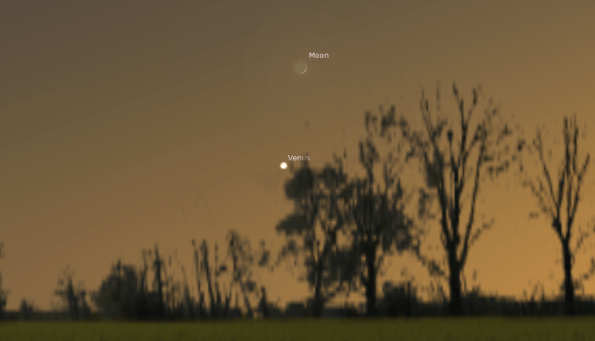
Looking very low in the west-southwest at 7:38 p.m., 20 minutes after sunset, October 3, 2016. The thin crescent Moon will appear about 4 degrees 15 minutes (8 1/2 moon diameters) above Venus. Created using Stellarium.
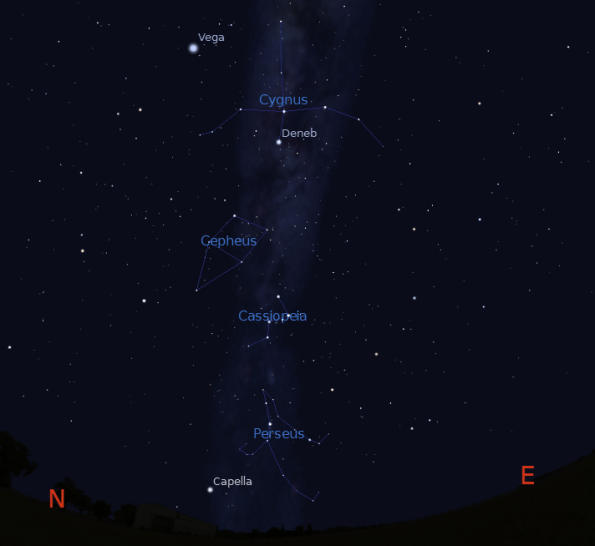
Cassiopeia with Cepheus, Cygnus and Perseus in the Milky Way in the northeastern sky. Created using Stellarium.
08/22/2016 – Ephemeris – The glorious summer Milky Way
Ephemeris for Monday, August 22nd. The Sun rises at 6:54. It’ll be up for 13 hours and 42 minutes, setting at 8:36. The Moon, 2 days before last quarter, will rise at 11:11 this evening.
We’ll get a bit of darkness tonight, but it will be the start of about two weeks of the best sky viewing of the year. Now is the time the summer Milky Way is displayed to its fullest to the southern horizon. City folk come to our area and are sometimes fooled by the brightness and expanse of the Milky Way and think it’s clouding up. Yes those are clouds indeed, but they are star clouds. Binoculars will begin to show them to be millions of stars, each too faint to be seen by themselves to the unaided eye, but whose combined glow give the impression of a luminous cloud. Binoculars are the ideal tool to begin to explore the Milky Way. Objects still too fuzzy can be checked out with a telescope to reveal their true nature.
Times are for the Traverse City/Interlochen area of Michigan. They may be different for your location.
Addendum
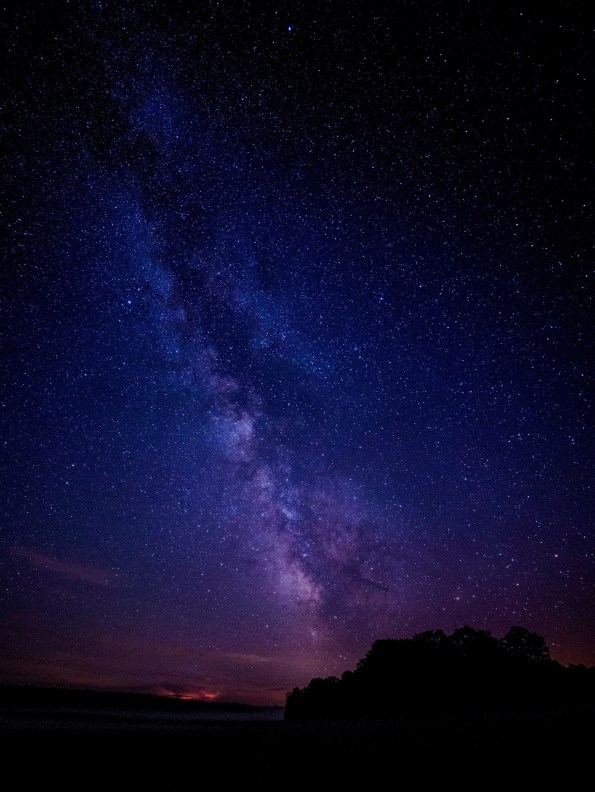
The Milky Way from the Sleeping Bear Dunes last August by Mark Stewart.
Note that this photo shows the Milky Way as brighter and with more stars than you’d see with the naked eye.
08/05/2016 – Ephemeris – Star party at NMC’s Rogers Observatory tonight
Ephemeris for Friday, August 5th. The Sun rises at 6:34. It’ll be up for 14 hours and 28 minutes, setting at 9:02. The Moon, 3 days past new, will set at 10:31 this evening.
There will be a star party this evening at Northwestern Michigan College’s Rogers Observatory hosted by the Grand Traverse Astronomical Society and the NMC Astronomy Club starting at 9 p.m. On tap, if it’s clear, will be Jupiter and the Moon early, then Mars and Saturn. Mars will appear quite small. As it gets darker the stars will appear. Some will show companion stars, while between the stars, what we call deep sky objects will be seen. Clusters of stars, and nebulae which can be either the birthplaces of stars or markers of dying stars. While other galaxies can be spotted our eyes are dazzled by our galaxy, the Milky Way spanning the sky from northeast to the south, in which these other objects dwell. The months of August and September are the months when the heart of the Milky Way is best seen.
Times are for the Traverse City/Interlochen area of Michigan. They may be different for your location.
Addendum
The Milky Way from the Sleeping Bear Dunes last August by Mark Stewart.
This year Saturn and Mars will be in the picture. In this picture Saturn is low and to the right.
08/13/2015 – Ephemeris – The constellation Sagittarius, toward the heart of the Milky Way
Thursday, August 13th. The Sun rises at 6:42. It’ll be up for 14 hours and 9 minutes, setting at 8:52. The Moon, 1 day before new, will rise at 6:48 tomorrow morning.
The Milky Way runs from north to south through the heavens at 11 p.m. You’ll notice that the Milky Way is brighter and broader just above the horizon in the south. In that glow in the south is a star pattern that looks like the stout little teapot of the children’s song, with a the Milky way like steam rising from the spout, which faces the west. This pattern of stars is the major part of the constellation called Sagittarius. According to Greek mythology Sagittarius is a centaur with a bow and arrow poised to shoot Scorpius the scorpion to the right. This centaur is called Chiron, the most learned of the breed, centaurs usually being a rowdy bunch. The center of the pin wheel of our galaxy lies hidden beyond the stars above the spout of the teapot.
Times are for the Traverse City/Interlochen area of Michigan. They may be different for your location.
Addendum
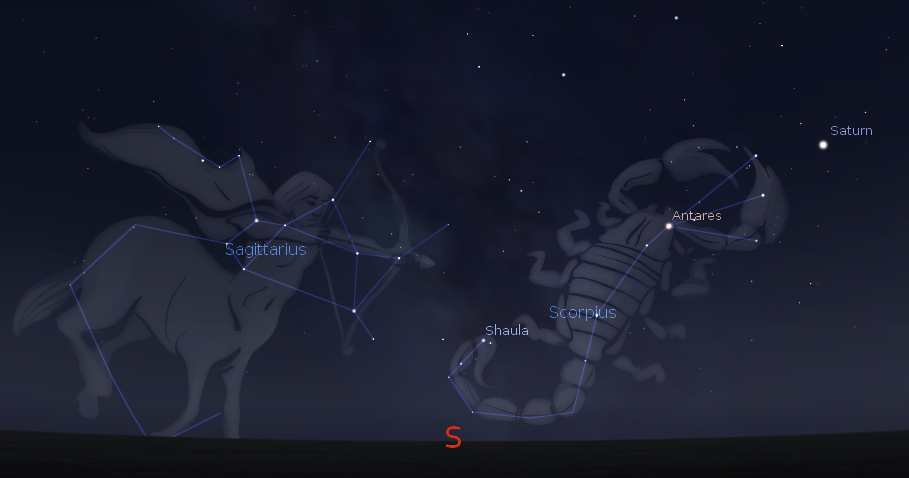
Sagittarius and Scorpius mythological view 10 p.m. August 13, 2015. Created using Stellarium.
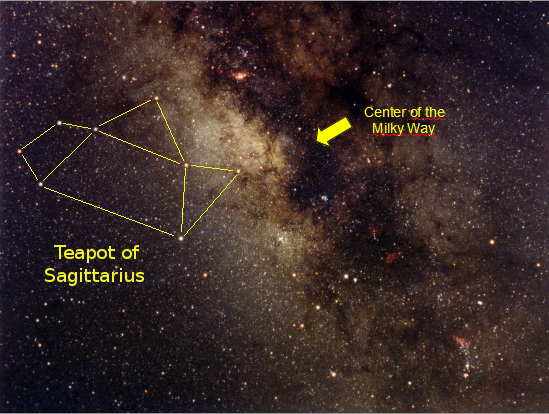
Location of the center of the Milky Way and the Teapot of Sagittarius.
07/03/2015 – Ephemeris – Astronomy in the Grand Traverse Region tonight
Ephemeris for Friday, July 3rd. Today the Sun will be up for 15 hours and 29 minutes, setting at 9:31. The Moon, 2 days past full, will rise at 10:33 this evening and tomorrow the Sun will rise at 6:02.
Dr. David Penney will investigate the structure of the Milky Way at this evening’s meeting of the Grand Traverse Astronomical Society at 8 p.m. at Northwestern Michigan College’s Rogers Observatory. The Milky Way is the band of light we see in the sky especially on summer and winter evenings. But it is more than a band of dim stars, it is what we can see of the huge disk of maybe 200 billion stars with an embedded pin wheel structure. Everyone is welcome. Also at 9 p.m. there will be a star party at the observatory. The astronomical objects of the evening will be the planets Venus, Jupiter and Saturn and the Moon later in the evening. The observatory is located south of Traverse City on Birmley Road.
Times are for the Traverse City/Interlochen area of Michigan. They may be different for your location.
Addendum
Dr. Penney has a Ph.D. in Physiology and Biochemistry, and is pretty much retired spending his time between Michigan in the summer and northern Florida in the winter, where he is a member of several astronomy clubs. He gives many talks there also.
05/08/2015 – Ephemeris – May’s missing Milky Way
Ephemeris for Friday, May 8th. Today the Sun will be up for 14 hours and 32 minutes, setting at 8:55. The Moon, 3 days before last quarter, will rise at 1:08 tomorrow morning. Tomorrow the Sun will rise at 6:22.
In May we look up to the sky and notice that the Milky Way is missing. Will not really it’s as if the sky has pattern baldness with the Milky Way as a fringe on the horizon around the north half of the sky. Overhead, where none should be is a galactic star cluster, a star cluster that should normally be in the Milky band. That cluster is the constellation of Coma Berenices. Its is a sparse star cluster of about 50 stars only 288 light years away. If we were a thousand light years from it, it would appear in the Milky band. One notes too that the stars of spring are also fewer, not the riot of stars we see in the winter or late summer. The Milky Way galaxy is a thin disk, and in spring we are looking out the thin side.
Times are for the Traverse City/Interlochen area of Michigan. They may be different for your location.
Addendum
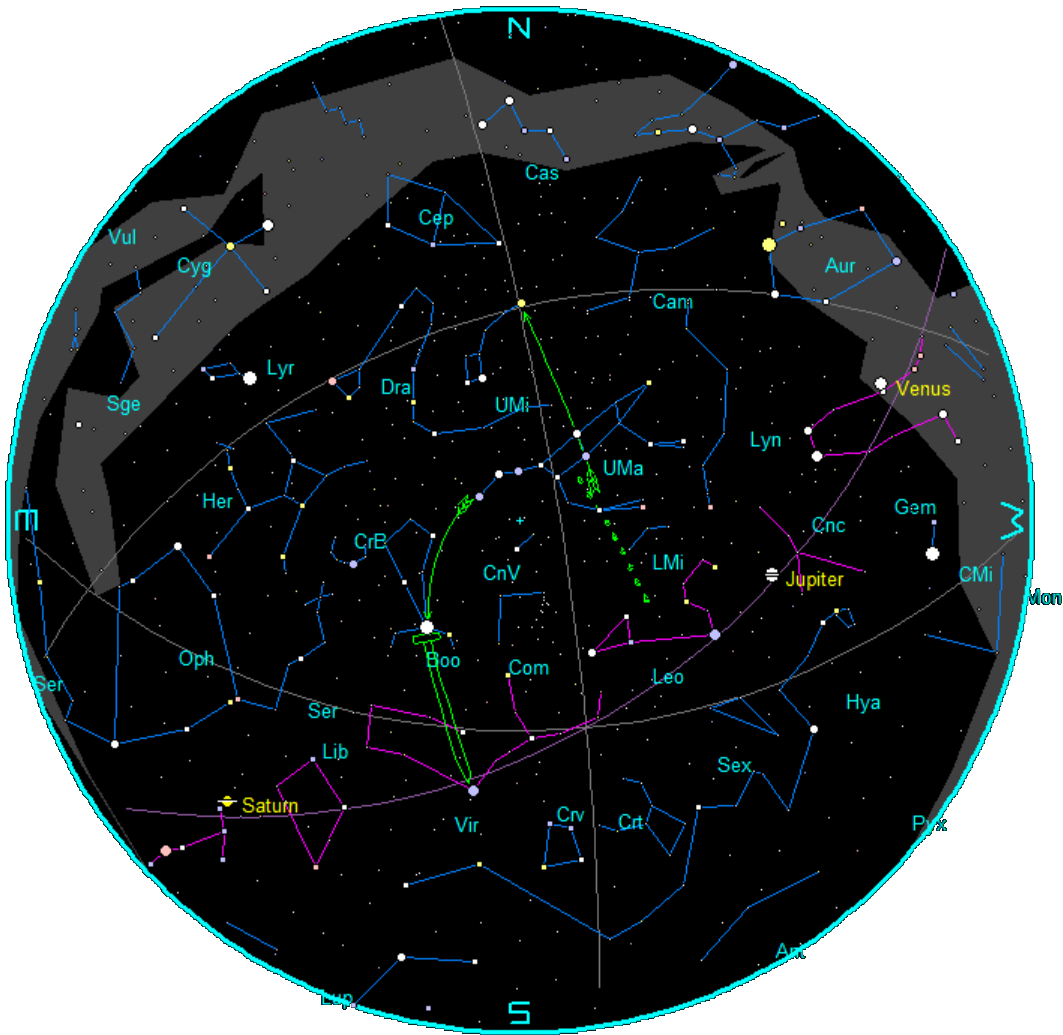
Star Chart for May 2015. Note the Milky way in the north. The Coma Berenices cluster is located between the labels CnV and Com. Created using my LookingUp program.
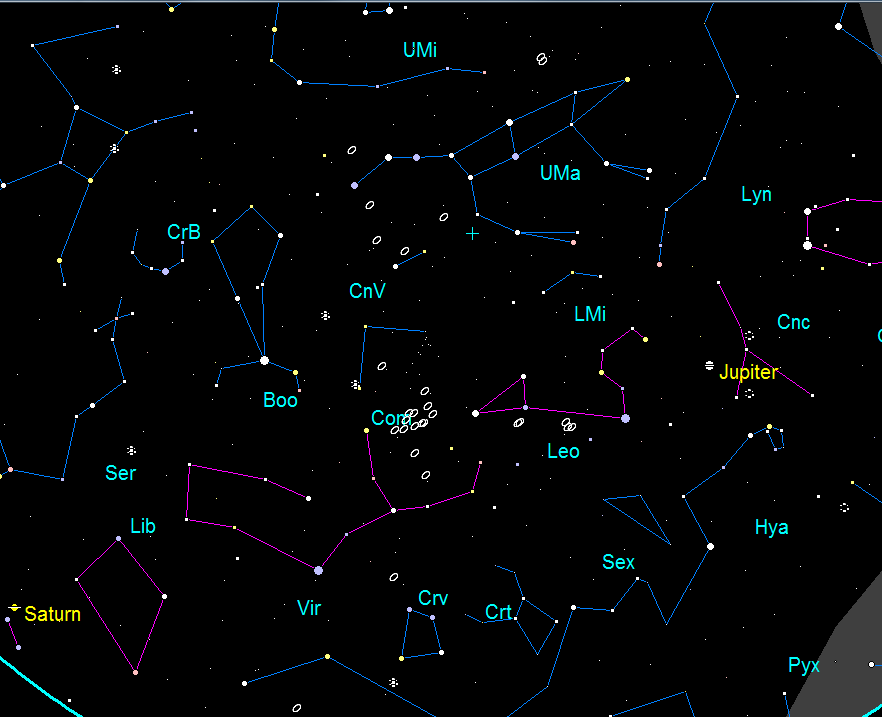
Messier objects, mostly galaxies (ovals) in the spring sky. Created using my LookingUp program.
Most of the galaxies in the above chart belong to the Virgo Cluster a cluster of several thousand galaxies about 53 million light years away. Charles Messier was a comet hunter active in the period around the time of the American Revolution at the Paris Observatory. He made a catalog of fuzzy objects he ran into that didn’t move and thus were not comets. The Messier catalog, which ran to 110 galaxies, star clusters and nebulae, some added posthumously, became a must-see list of some of the best sights for the telescope.
08/26/2014 – Ephemeris – The Great Rift
Ephemeris for Tuesday, August 26th. The sun rises at 6:57. It’ll be up for 13 hours and 31 minutes, setting at 8:29. The moon, 1 day past new, will set at 8:45 this evening.
High overhead the Milky Way is seen passing through the Summer Triangle of three bright stars. Here we find the Milky Way split into two sections. The split starts in the constellation of Cygnus the Swan or Northern Cross very high in the east. The western part of the Milky Way ends southwest of the Aquila the eagle. This dark dividing feature is called the Great Rift. Despite the lack of stars seen there, it doesn’t mean that there are fewer stars there than in the brighter patches of the Milky Way. The rift is a great dark cloud that obscures the light of the stars behind it. Sometimes binoculars can be used to find the edges of the clouds of the rift, as stars numbers drop off suddenly. This is especially easy to see in Aquila.
Times are for the Traverse City/Interlochen area of Michigan. They may be different for your location.
Addendum
The Great Rift in the Milky Way. Created using Stellarium.
08/14/2014 – Ephemeris – The Milky Way now spans the sky in the evening
Ephemeris for Thursday, August 14th. The sun rises at 6:43. It’ll be up for 14 hours and 5 minutes, setting at 8:49. The moon, 3 days before last quarter, will rise at 10:58 this evening.
We’ll get a bit of darkness tonight, but it will be the start of about two weeks of the best sky viewing of the year. Now is the time the summer Milky Way is displayed to its fullest to the southern horizon. City folk come to our area and are sometimes fooled by the brightness and expanse of the Milky Way and think it’s clouding up. Yes those are clouds indeed, but they are star clouds. Binoculars will begin to show them to be millions of stars, each too faint to be seen by themselves to the unaided eye, but whose combined glow give the impression of a luminous cloud. Binoculars are the ideal tool to begin to explore the Milky Way. Objects still too fuzzy can be checked out with a telescope to reveal their true nature.
Times are for the Traverse City/Interlochen area of Michigan. They may be different for your location.
Addendum
The Milky Way at 10 p.m. on August 14, 2014. Residual glow in the west is from the Sun, to the east is for the Soon to rise Moon. There is also an odd artifact connected to the solar glow. Created using Stellarium.
 Bob Moler's Ephemeris Blog