Archive
Ephemeris: 03/04/2026 – Taking our weekly look at the whereabouts of the naked-eye planets
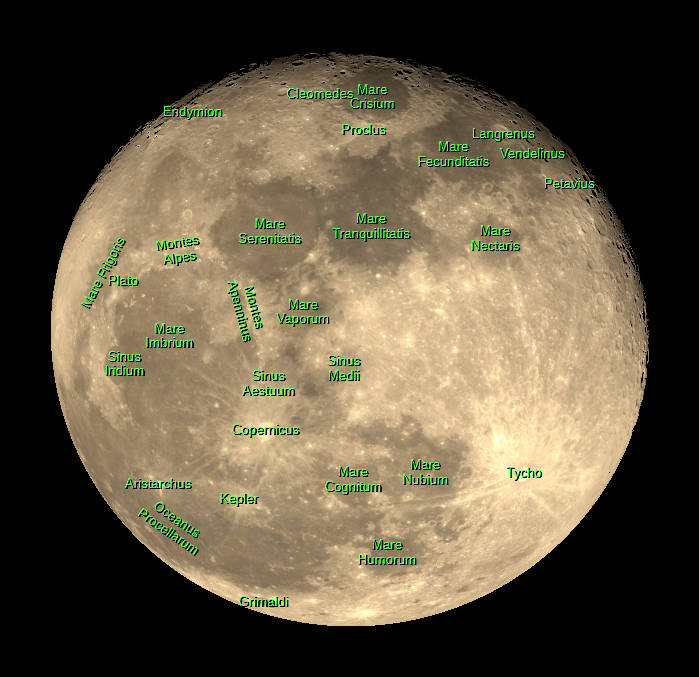
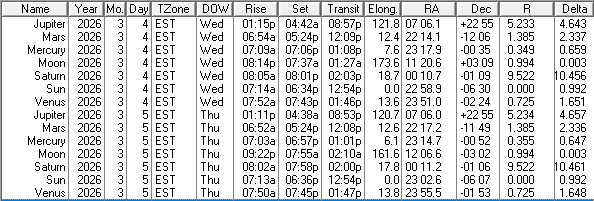
This is Ephemeris for Wednesday, March 4th. Today the Sun will be up for 11 hours and 19 minutes, setting at 6:34, and it will rise tomorrow at 7:13. The Moon, 1 day past full, will rise at 8:14 this evening.
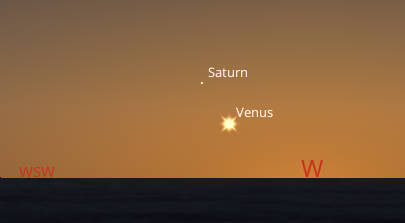
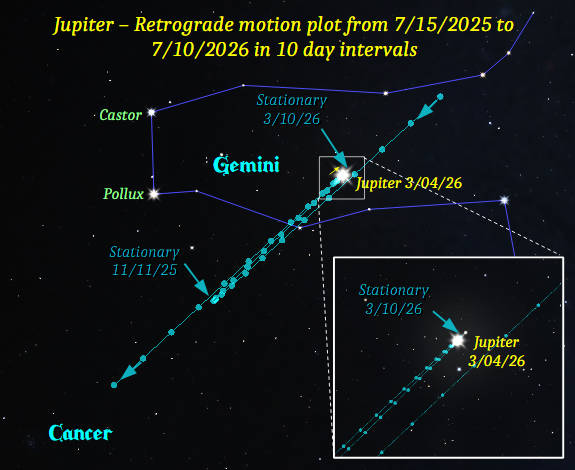
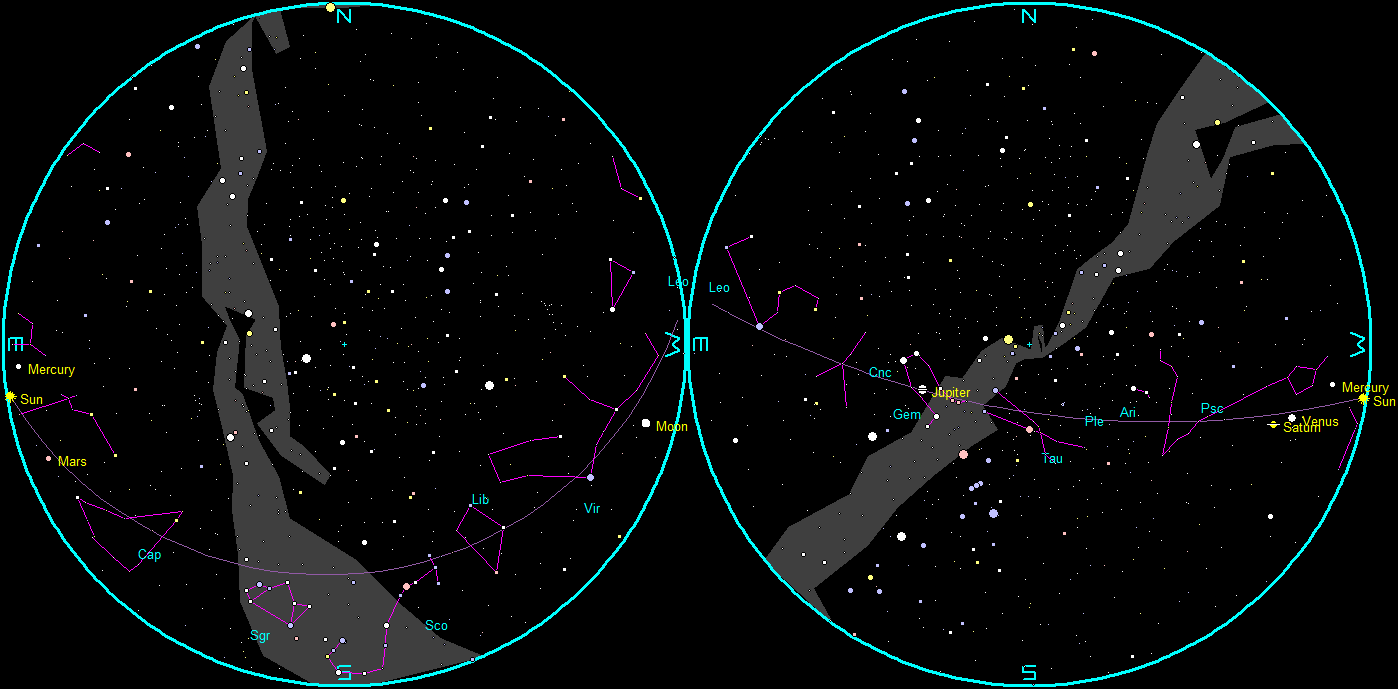
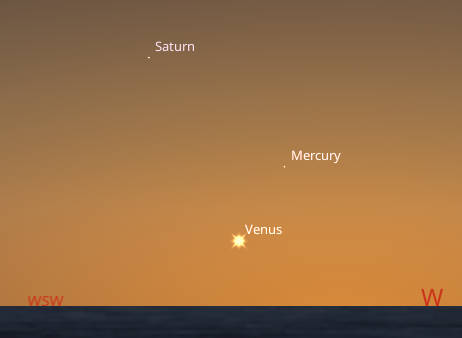
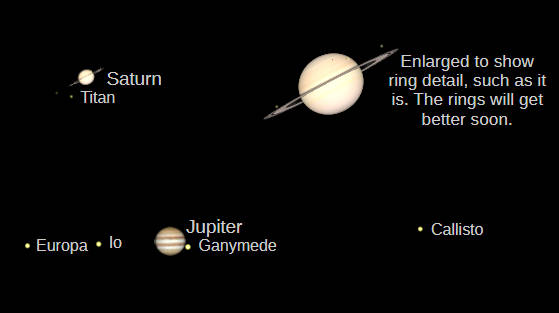
Let’s take our weekly look at the whereabouts of the naked-eye planets. At 7 PM or about a half hour after sunset, Venus may be seen very low in the West. Above it and a bit to the left might be Saturn which may not show up until a quarter of an hour later. We are in the last third of winter and the sunset times are increasing rapidly and taking with it Saturn. The evening sky will shift dramatically this Sunday when Daylight Saving Time returns, giving us darker mornings and brighter evenings. Jupiter is the brilliant star-like object more than halfway up in the southern sky. It’s the brightest star-like object in the sky. The planet and its moons are a treat for binoculars or a telescope.
The astronomical event times given in this blog are for the Traverse City/Interlochen area of Michigan (Lat 44.7° N, Long 85.7° W; EST, UT – 5 hours) unless stated otherwise. Times will be different for other locations.
Addendum

Ephemeris: 03/03/2026 – Eclipse prospects for the rest of the year
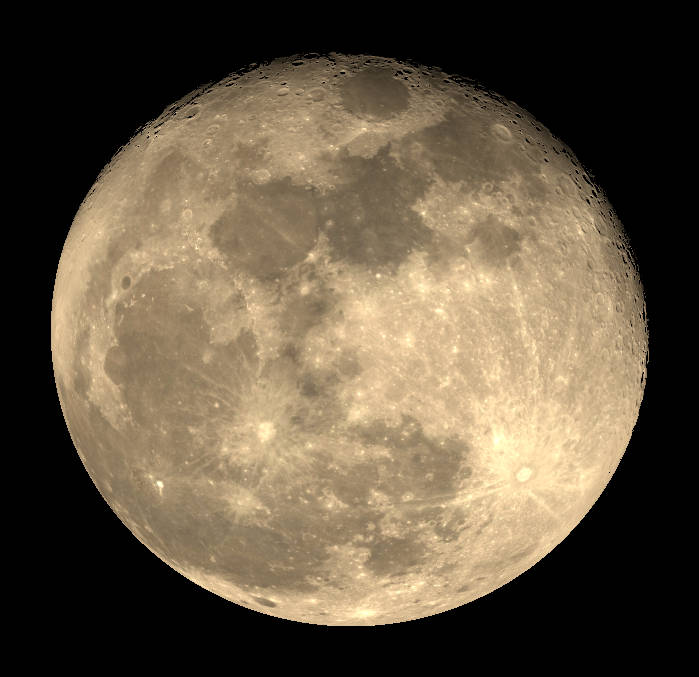
This is Ephemeris for Tuesday, March 3rd. Today the Sun will be up for 11 hours and 16 minutes, setting at 6:33, and it will rise tomorrow at 7:14. The Moon, at full today, will rise at 7:04 this evening.
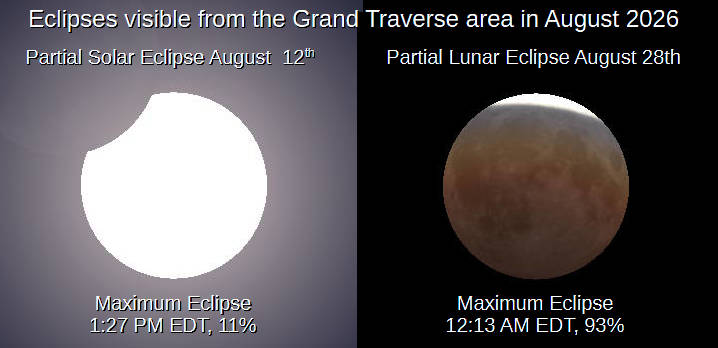
If you’re listening to me right now the total lunar eclipse this morning has ended or will shortly end. In any case it’s invisible because, even if it’s ongoing, twilight has wiped it out. Then there is the possibility of clouds, which I can’t predict from when I’m recording this Sunday night. We do have another chance to view a lunar eclipse, this year, on the night of August 27-28th. It’ll be a little bit earlier. It will start late in the evening and be almost total after midnight. There’s also going to be a solar eclipse on August 12th, but it will be just a little nibble of the moon on the sun for us. It’s going to be total for the east coast of Greenland, the northern Atlantic, and northern Spain, before ending at sunset in the Mediterranean Sea.
The astronomical event times given in this blog are for the Traverse City/Interlochen area of Michigan (Lat 44.7° N, Long 85.7° W; EST, UT – 5 hours) unless stated otherwise. Times will be different for other locations.
Addendum
Ephemeris: 03/02/2026 – There’s a total lunar eclipse tomorrow morning
This is Ephemeris for Monday, March 2nd. Today the Sun will be up for 11 hours and 13 minutes, setting at 6:32, and it will rise tomorrow at 7:16. The Moon, 1 day before full, will set at 7:19 tomorrow morning.
Early tomorrow morning* there will be total lunar eclipse. A lunar eclipse, also known as an eclipse of the Moon occurs when the full moon moves into the earth’s shadow cutting off most of its sunlight. A little sunlight does get in by being bent around the Earth by its atmosphere through all the sunrises and sunsets going on at that time. The moon’s color generally becomes dark red, this also depends on the Earth’s atmosphere and the amount of clouds, smoke and volcanic ash that are in it at the time. The partial phase will begin at 4:50 AM and will last until totality starts at 6:04 AM. Totality will last until 7:02 AM. The growing twilight may cause the totally eclipsed Moon to disappear before then.
The astronomical event times given in this blog are for the Traverse City/Interlochen area of Michigan (Lat 44.7° N, Long 85.7° W; EST, UT – 5 hours) unless stated otherwise. Times will be different for other locations.
* The Moon sets for us in Michigan before the end of the eclipse. Locations west of us in North America and the Pacific get to see the entire eclipse.
Addendum
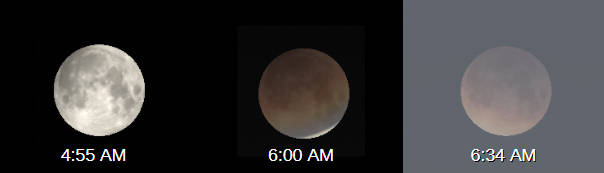
| Total Lunar Eclipse March 3, 2026 Events for the Grand Traverse area (Eastern Standard Time) |
|
| Time | Event |
| 03:44 AM | Begin Penumbral phase. This is the theoretical start of the eclipse. Nothing will appear to happen until about half an hour before the partial phase starts. Then the upper left part of the Moon will appear to darken. |
| 04:50 AM | Begin Partial phase. The umbra will encroach onto the Moon from upper left to lower right. The dull red of the umbral shadow may be discerned near the beginning of totality. |
| 05:40 AM | Astronomical Twilight begins. The Sun is 18° below the horizon. |
| 06:04 AM | Begin Totality. The expected dull red of the Moon will be brighter on the edge nearest the edge of the umbral shadow. How long will the totally eclipsed Moon be visible? |
| 06:14 AM | Nautical Twilight begins. The Sun is 12° below the horizon. |
| 06:34 AM | Mid-Eclipse |
| 07:03 AM | End Totality. Will a tiny slice of the Moon become visible in the brightening sky before it sets? |
| 07:18 AM | Sunrise |
| 07:19 AM | Moonset |
For more about lunar eclipses in general, see my post for last year’s lunar eclipse: Almost everything you wanted to know about lunar eclipses.
Ephemeris: 02/27/2026 – Previewing March skies
This is Ephemeris for Friday, February 27th. Today the Sun will be up for 11 hours and 4 minutes, setting at 6:28, and it will rise tomorrow at 7:21. The Moon, 3 days past first quarter, will set at 6:06 tomorrow morning.
Let’s look at the skies for the month of March, which will begin Sunday. The Sun will cross the celestial equator in March as the promising season of spring will begin. Daylight hours in the Interlochen/Traverse City area and will increase from 11 hours and 10 minutes Sunday to 12 hours 43 minutes on the 31st. The altitude, or angle, of the Sun above the southern horizon at local noon will be just under 38 degrees Sunday and will ascend to nearly 50 degrees on the 31st. Local apparent noon at mid-month, when the Sun passes due south, will be about 1:51 PM after Daylight Saving Time starts on the 8th. Spring will begin on the 20th at 10:46 AM. The big event of the month will be the total lunar eclipse early next Tuesday morning the 3rd.
The astronomical event times given in this blog are for the Traverse City/Interlochen area of Michigan (Lat 44.7° N, Long 85.7° W; EST, UT – 5 hours) unless stated otherwise. Times will be different for other locations.
Addendum
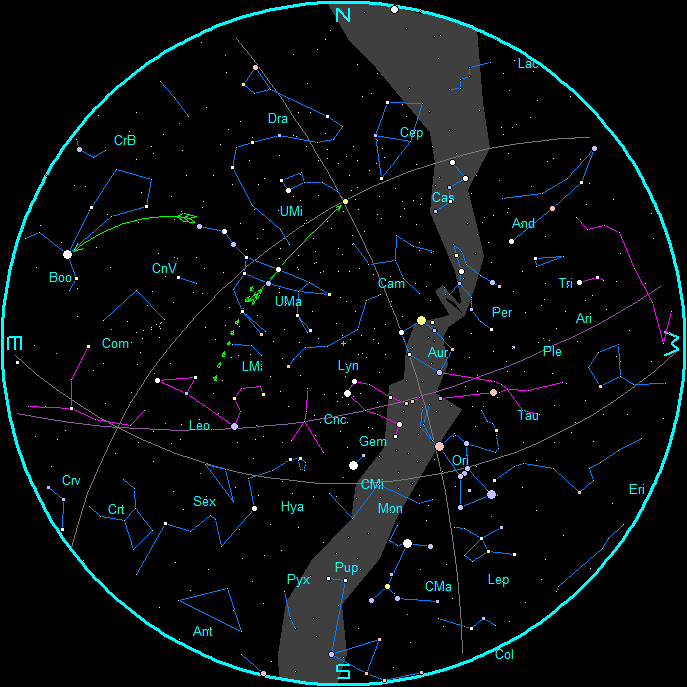
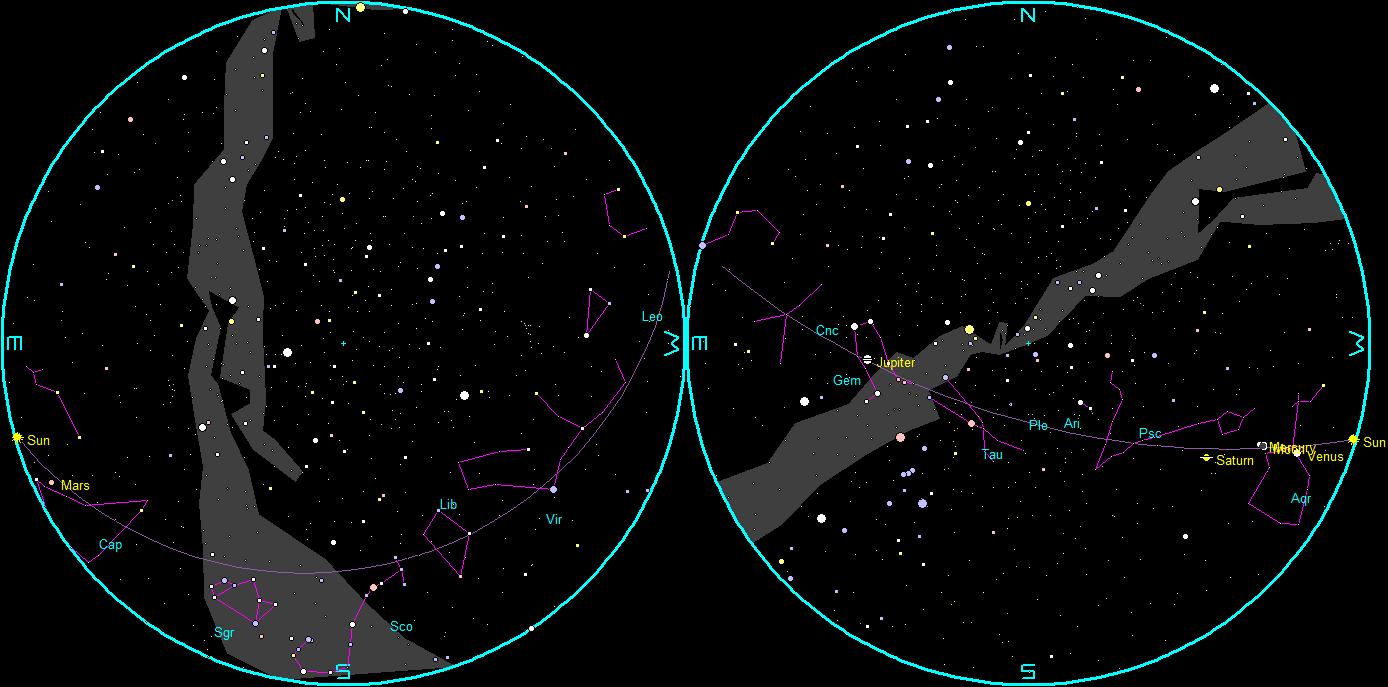
March Evening Star Chart
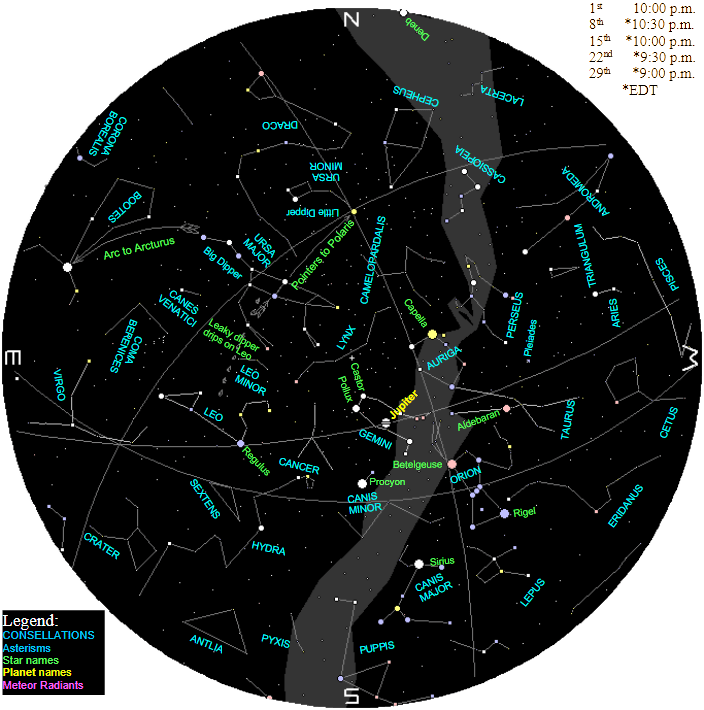
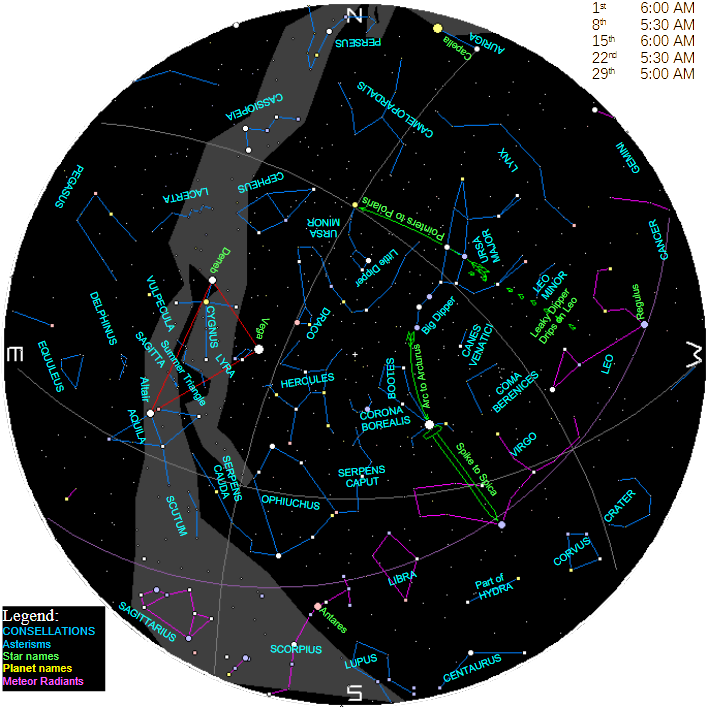
The planets and stars are plotted for the 15th at 10 p.m. EDT in the evening and 6 a.m. on the 16th for the morning chart. These are the chart times. Note that Traverse City is located approximately 45 minutes behind our time meridian. (An hour and 45 minutes behind our Daylight Saving Time meridian during EDT). To duplicate the star positions on a planisphere (rotating star finder) you may have to set it to 45 minutes or 1 hour 45 minutes earlier than your current time.
Note the chart times of 10 PM on the 15th, and 6 AM on the 16th. To find planet positions on dates other than the dates here, check the Wednesday planet posts on this blog.
March Morning Star Chart
Twilight Limits, Nautical and Astronomical
| EST | |||||||
| Morning | Twilight | Evening | Twilight | Dark | Night | Moon | |
| Date | Astro. | Nautical | Nautical | Astro. | Start | End | Illum. |
| 2026-03-01 | 5h44m | 6h18m | 19h36m | 20h10m | – | – | 98% |
| 2026-03-02 | 5h42m | 6h16m | 19h37m | 20h11m | – | – | 100% |
| 2026-03-03 | 5h40m | 6h14m | 19h39m | 20h13m | – | – | 99% |
| 2026-03-04 | 5h39m | 6h13m | 19h40m | 20h14m | 20h14m | 20h14m | 97% |
| 2026-03-05 | 5h37m | 6h11m | 19h41m | 20h15m | 20h15m | 21h23m | 92% |
| 2026-03-06 | 5h35m | 6h09m | 19h43m | 20h17m | 20h17m | 22h31m | 86% |
| 2026-03-07 | 5h33m | 6h07m | 19h44m | 20h18m | 20h18m | 23h39m | 79% |
| EDT | |||||||
| 2026-03-08 | 6h31m | 7h05m | 20h45m | 21h19m | 21h19m | 0h39m | 70% |
| 2026-03-09 | 6h30m | 7h04m | 20h46m | 21h21m | 21h21m | 1h46m | 61% |
| 2026-03-10 | 6h28m | 7h02m | 20h48m | 21h22m | 21h22m | 2h50m | 52% |
| 2026-03-11 | 6h26m | 7h00m | 20h49m | 21h23m | 21h23m | 3h50m | 43% |
| 2026-03-12 | 6h24m | 6h58m | 20h50m | 21h25m | 21h25m | 4h42m | 33% |
| 2026-03-13 | 6h22m | 6h56m | 20h52m | 21h26m | 21h26m | 5h26m | 24% |
| 2026-03-14 | 6h20m | 6h54m | 20h53m | 21h27m | 21h27m | 6h01m | 16% |
| 2026-03-15 | 6h18m | 6h53m | 20h54m | 21h29m | 21h29m | 6h18m | 9% |
| 2026-03-16 | 6h16m | 6h51m | 20h56m | 21h30m | 21h30m | 6h16m | 4% |
| 2026-03-17 | 6h14m | 6h49m | 20h57m | 21h32m | 21h32m | 6h14m | 1% |
| 2026-03-18 | 6h12m | 6h47m | 20h58m | 21h33m | 21h33m | 6h12m | 0% |
| 2026-03-19 | 6h10m | 6h45m | 21h00m | 21h35m | 21h35m | 6h10m | 2% |
| 2026-03-20 | 6h08m | 6h43m | 21h01m | 21h36m | 22h22m | 6h08m | 6% |
| 2026-03-21 | 6h06m | 6h41m | 21h02m | 21h37m | 23h44m | 6h06m | 13% |
| 2026-03-22 | 6h04m | 6h39m | 21h04m | 21h39m | – | 6h04m | 22% |
| 2026-03-23 | 6h02m | 6h37m | 21h05m | 21h40m | 1h06m | 6h02m | 32% |
| 2026-03-24 | 6h00m | 6h35m | 21h06m | 21h42m | 2h24m | 6h00m | 43% |
| 2026-03-25 | 5h58m | 6h33m | 21h08m | 21h43m | 3h32m | 5h58m | 55% |
| 2026-03-26 | 5h56m | 6h31m | 21h09m | 21h45m | 4h26m | 5h56m | 66% |
| 2026-03-27 | 5h54m | 6h29m | 21h10m | 21h46m | 5h08m | 5h54m | 76% |
| 2026-03-28 | 5h51m | 6h27m | 21h12m | 21h48m | 5h39m | 5h51m | 84% |
| 2026-03-29 | 5h49m | 6h25m | 21h13m | 21h49m | – | – | 91% |
| 2026-03-30 | 5h47m | 6h23m | 21h15m | 21h51m | – | – | 96% |
| 2026-03-31 | 5h45m | 6h21m | 21h16m | 21h52m | – | – | 99% |
Twilight calendar was generated using Cartes du Ciel (Sky Charts).
See my blog post: Twilight Zone for the definitions of the different periods of twilight here: https://bobmoler.wordpress.com/2019/09/27/
NASA Calendar of Planetary Events
Mar  1  Su            Venus: 13° E
     2  Mo   7:00 AM  Moon-Regulus: 0.4° S
     2  Mo  11:35 PM  Moon Descending Node
     3  Tu   6:35 AM  Total Lunar Eclipse
     3  Tu   6:38 AM  Full Moon
     6  Fr  12:24 PM  Moon-Spica: 2° N
     7  Sa   6:01 AM  Mercury Inferior Conj.
    10  Tu   7:32 AM  Moon-Antares: 0.8° N
    10  Tu   9:43 AM  Moon Apogee: 404400 km
    11  We   5:39 AM  Last Quarter
    11  We   5:12 PM  Moon South Dec.: 28.4° S
    15  Su   3:13 PM  Mercury-Mars: 3.4° N
    17  Tu  11:22 AM  Moon Ascending Node
    18  We   9:23 PM  New Moon
    20  Fr   8:39 AM  Moon-Venus: 4.7° S
    20  Fr  10:46 AM  Vernal Equinox
    22  Su   6:16 AM  Neptune Conjunction
    22  Su   7:40 AM  Moon Perigee: 366900 km
    23  Mo   4:32 AM  Moon-Pleiades: 1.1° S
    25  We  12:46 AM  Moon North Dec.: 28.4° N
    25  We   4:27 AM  Saturn Conjunction
    25  We   3:18 PM  First Quarter
    26  Th   8:13 AM  Moon-Jupiter: 4° S
    27  Fr  10:15 PM  Moon-Beehive: 1.3° S
    29  Su   3:00 PM  Moon-Regulus: 0.4° S
    30  Mo   7:34 AM  Moon Descending Node
Apr  1  We            Venus: 20.5° E
Sky Events Calendar by Fred Espenak and Sumit Dutta (NASA’s GSFC),
http://eclipse.gsfc.nasa.gov/SKYCAL/SKYCAL.html
If you go to the above site you can print out a list like the above for the entire year or calendar pages for your time zone.
Sun and Moon Rising and Setting Events
LU                  Ephemeris of Sky Events for Interlochen/TC
March, 2026    Local time zone: EST
+-----------------------------------------------------------------------+
| DATE |  SUN     SUN  DAYLIGHT|   TWILIGHT*    |MOON  RISE OR    ILLUM |
|      |  RISE    SET    HOURS |  END    START  |PHASE SET** TIME FRACTN|
+=======================================================================+
|Sun  1| 07:20a  06:30p  11:10 | 07:33p  06:17a |      Set  06:59a   97%|
|Mon  2| 07:18a  06:32p  11:13 | 07:35p  06:15a |      Set  07:19a  100%|
|Tue  3| 07:16a  06:33p  11:16 | 07:36p  06:13a |Full  Rise 07:04p  100%|
|Wed  4| 07:14a  06:34p  11:19 | 07:37p  06:12a |      Rise 08:14p   97%|
|Thu  5| 07:13a  06:36p  11:22 | 07:39p  06:10a |      Rise 09:22p   93%|
|Fri  6| 07:11a  06:37p  11:25 | 07:40p  06:08a |      Rise 10:30p   87%|
|Sat  7| 07:09a  06:38p  11:29 | 07:41p  06:06a |      Rise 11:38p   80%|
+------+-----------------------+----------------+-----------------------+
| EDT  |      Time Change      |                |                       |
|Sun  8| 08:07a  07:39p  11:32 | 08:42p  07:04a |      Rise 01:45a   72%|
|Mon  9| 08:06a  07:41p  11:35 | 08:44p  07:03a |      Rise 02:50a   63%|
|Tue 10| 08:04a  07:42p  11:38 | 08:45p  07:01a |      Rise 03:50a   54%|
|Wed 11| 08:02a  07:43p  11:41 | 08:46p  06:59a |L Qtr Rise 04:42a   44%|
|Thu 12| 08:00a  07:45p  11:44 | 08:48p  06:57a |      Rise 05:25a   35%|
|Fri 13| 07:58a  07:46p  11:47 | 08:49p  06:55a |      Rise 06:01a   26%|
|Sat 14| 07:56a  07:47p  11:50 | 08:50p  06:53a |      Rise 06:29a   18%|
+------+-----------------------+----------------+-----------------------+
|Sun 15| 07:55a  07:49p  11:54 | 08:52p  06:52a |      Rise 06:53a   11%|
|Mon 16| 07:53a  07:50p  11:57 | 08:53p  06:50a |      Rise 07:14a    5%|
|Tue 17| 07:51a  07:51p  12:00 | 08:54p  06:48a |      Rise 07:33a    1%|
|Wed 18| 07:49a  07:52p  12:03 | 08:56p  06:46a |New   Set  07:46p    0%|
|Thu 19| 07:47a  07:54p  12:06 | 08:57p  06:44a |      Set  09:02p    1%|
|Fri 20| 07:45a  07:55p  12:09 | 08:58p  06:42a |      Set  10:21p    5%|
|Sat 21| 07:43a  07:56p  12:12 | 09:00p  06:40a |      Set  11:43p   11%|
+------+-----------------------+----------------+-----------------------+
|Sun 22| 07:42a  07:57p  12:15 | 09:01p  06:38a |      Set  01:05a   20%|
|Mon 23| 07:40a  07:59p  12:19 | 09:02p  06:36a |      Set  02:23a   30%|
|Tue 24| 07:38a  08:00p  12:22 | 09:04p  06:34a |      Set  03:31a   41%|
|Wed 25| 07:36a  08:01p  12:25 | 09:05p  06:32a |F Qtr Set  04:26a   52%|
|Thu 26| 07:34a  08:03p  12:28 | 09:07p  06:30a |      Set  05:07a   63%|
|Fri 27| 07:32a  08:04p  12:31 | 09:08p  06:28a |      Set  05:39a   74%|
|Sat 28| 07:30a  08:05p  12:34 | 09:09p  06:26a |      Set  06:03a   83%|
+------+-----------------------+----------------+-----------------------+
|Sun 29| 07:29a  08:06p  12:37 | 09:11p  06:24a |      Set  06:24a   90%|
|Mon 30| 07:27a  08:08p  12:40 | 09:12p  06:22a |      Set  06:42a   95%|
|Tue 31| 07:25a  08:09p  12:43 | 09:13p  06:20a |      Set  07:00a   99%|
+-----------------------------------------------------------------------+
* Nautical Twilight
** Moonrise or moonset, whichever occurs between sunset and sunrise
Created using my LookingUp for MS-DOS app.
Ephemeris: 02/26/2026 – Get ready for next Tuesday morning’s Lunar Eclipse!
This is Ephemeris for Thursday, February 26th. Today the Sun will be up for 11 hours and 1 minute, setting at 6:26, and it will rise tomorrow at 7:23. The Moon, 2 days past first quarter, will set at 5:27 tomorrow morning.
Early next Tuesday morning there will be total lunar eclipse. A lunar eclipse, also known as an eclipse of the Moon occurs when the full moon moves into the earth’s shadow, causing it to become much darker. Usually a fair amount of sunlight does get in by being bent around the Earth by its atmosphere through all the sunrises and sunsets going on at that time. The moon’s color generally becomes very dark red, this also depends on the Earth’s atmosphere and the amount of clouds, smoke and volcanic ash that’s in the Earth’s atmosphere at that time. The partial phase will begin at 4:50 AM and will last until totality starts At 6:04 AM totality will last until 7:02 AM. The growing twilight may cause the moon to actually disappear.
The astronomical event times given in this blog are for the Traverse City/Interlochen area of Michigan (Lat 44.7° N, Long 85.7° W; EST, UT – 5 hours) unless stated otherwise. Times will be different for other locations.
Addendum
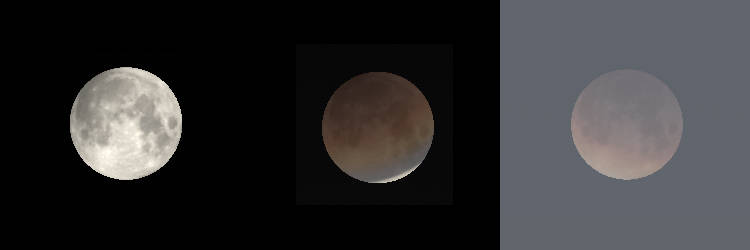
| Total Lunar Eclipse March 3, 2026 Events for the Grand Traverse area (Eastern Standard Time) | |
| Time | Event |
| 03:44 AM | Begin Penumbral phase. This is the theoretical start of the eclipse. Nothing will appear to happen until about half an hour before the partial phase starts. Then the upper left part of the Moon will appear to darken. |
| 04:50 AM | Begin Partial phase. The umbra will encroach onto the Moon from upper left to lower right. The dull red of the umbral shadow may be discerned near the beginning of totality. |
| 05:40 AM | Astronomical Twilight begins. The Sun is 18° below the horizon. |
| 06:04 AM | Begin Totality. The expected dull red of the Moon will be brighter on the edge nearest the edge of the umbral shadow. How long will the totally eclipsed Moon be visible? |
| 06:14 AM | Nautical Twilight begins. The Sun is 12° below the horizon. |
| 06:34 AM | Mid-Eclipse |
| 07:03 AM | End Totality. Will a tiny slice of the Moon become visible in the brightening sky before it sets? |
| 07:18 AM | Sunrise |
| 07:19 AM | Moonset |
Eclipse event times are strictly convertible by time zone. Twilight, sunrise and moonset events depend on one’s location. For locations west of Michigan, the eclipse may occur completely in darkness.
Ephemeris: 02/25/2026 – Taking our weekly look at the whereabouts of the naked-eye planets
This is Ephemeris for Wednesday, February 25th. Today the Sun will be up for 10 hours and 58 minutes, setting at 6:25, and it will rise tomorrow at 7:25. The Moon, 1 day past first quarter, will set at 4:37 tomorrow morning.
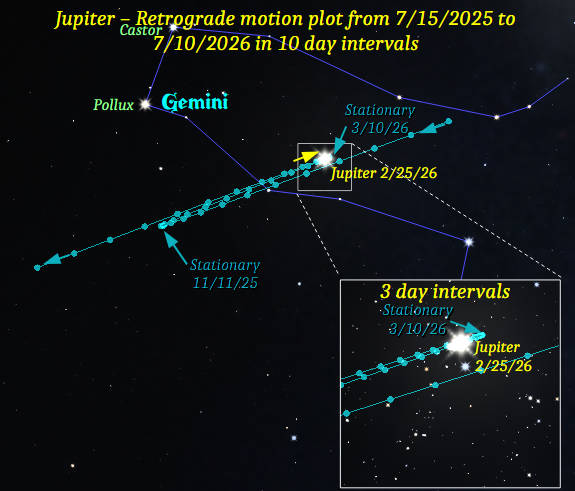
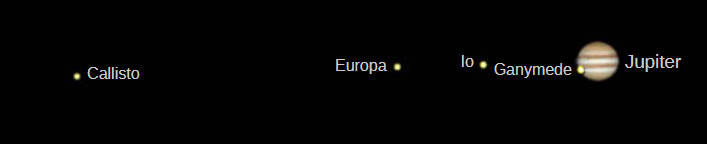
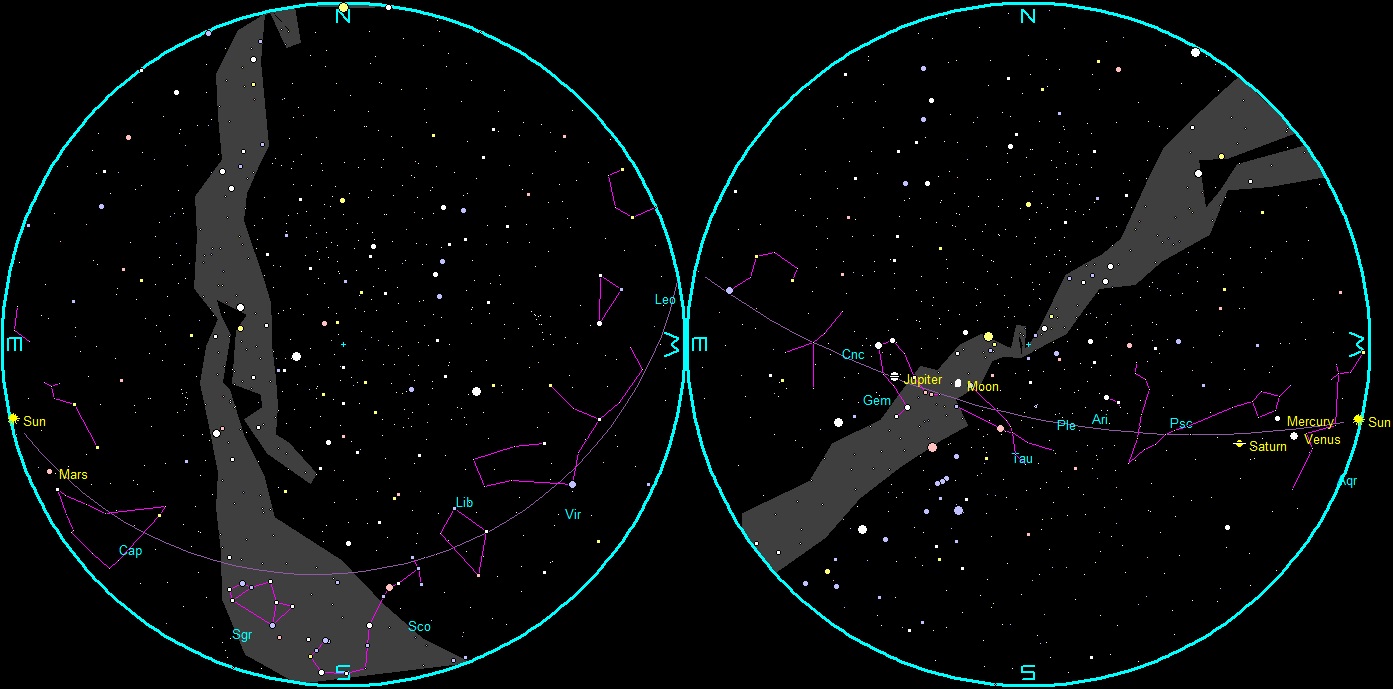
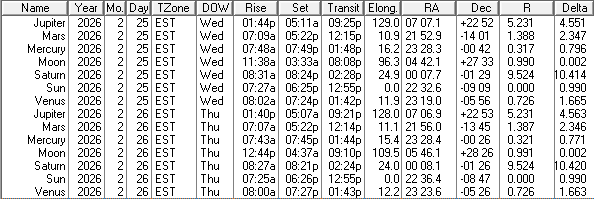
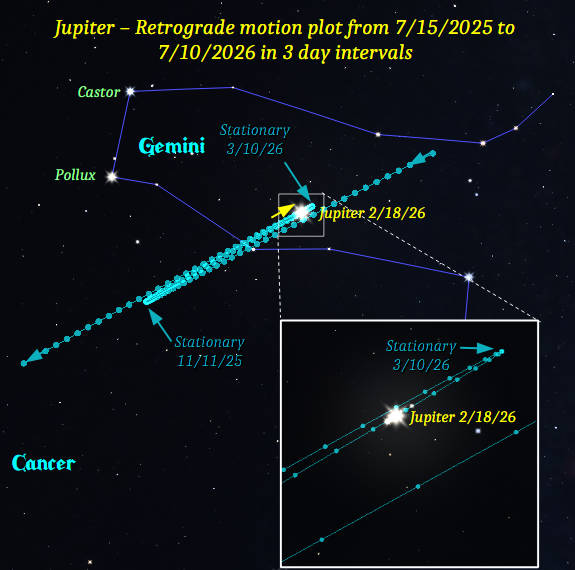
Let’s take our weekly look at the whereabouts of the naked-eye planets. At 7:00 PM or about and 1/2 hour after sunset Venus may be seen very low in the West above it and a bit to the right is Mercury which will be really difficult to spot since it is dimming now and above left of that is Saturn which is getting very low in the sky. We are in the last third of winter and the sunset times are increasing rapidly and taking with it the planets near the Sun including Saturn. By 8 PM Saturn will be very low in the West and not a very good object for telescope viewing. Jupiter is the brilliant star-like object more than halfway up in the southeastern sky, and tonight is below and left of the Moon. It’s the brightest star-like object in the sky. It is still moving to the west, but is slowing down and will stop and reverse its course 13 days from now.
The astronomical event times given in this blog are for the Traverse City/Interlochen area of Michigan (Lat 44.7° N, Long 85.7° W; EST, UT – 5 hours) unless stated otherwise. Times will be different for other locations.
Addendum
Ephemeris: 02/24/2026 – Three cool craters at the Moon’s first quarter
This is Ephemeris for Tuesday, February 24th. Today the Sun will be up for 10 hours and 55 minutes, setting at 6:23, and it will rise tomorrow at 7:27. The Moon, at first quarter today, will set at 3:33 tomorrow morning.
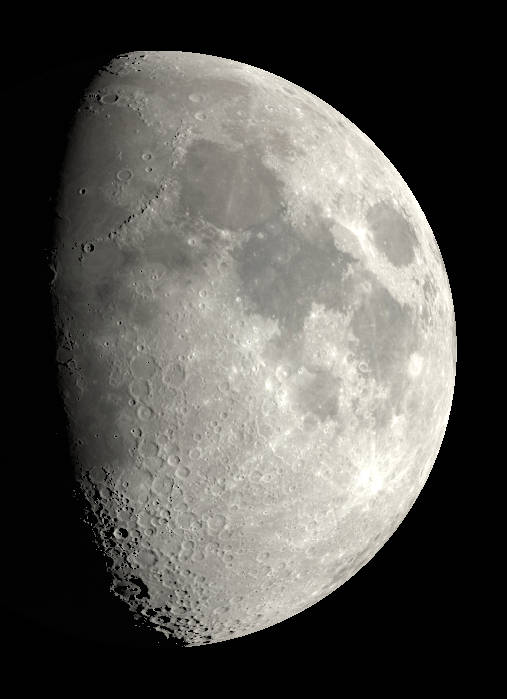
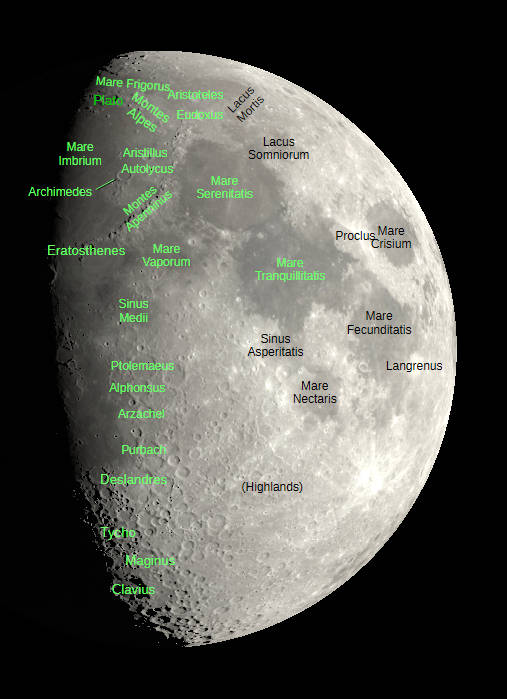
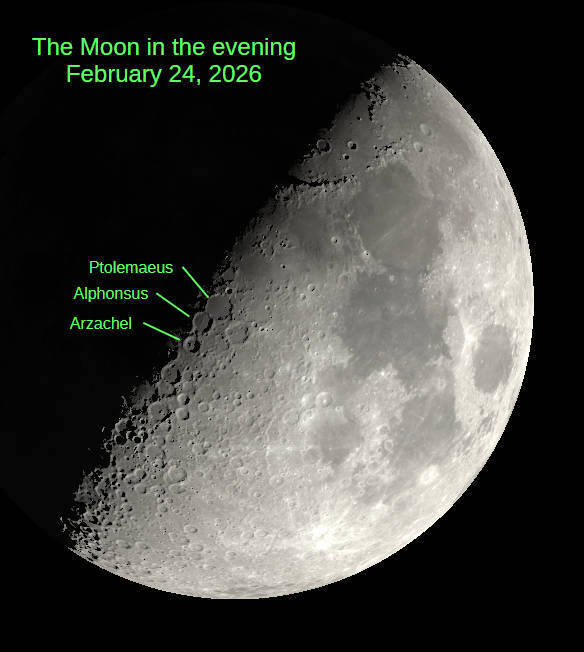
By the time we see the moon this evening it will be approximately half a day after became first quarter so it will be slightly gibbous tonight. Near the center of the moon near the terminator is a group of three craters . They are not a chain of craters in that they are of all of different ages. The largest in the north, called Ptolemaeus is named after Claudius Ptolemy the last great ancient Greek astronomer. The second is Alphonsus named after a Castilian king who was an astronomer. And the southern crater is Arzachel named after an 11th century Arabian astronomer and mathematician. In 1958 Soviet Astronomer Nikolai A. Kozyrev recorded the formation of a cloud near the center of the crater Alphonsus, suggesting perhaps some volcanic venting or activity.
The astronomical event times given in this blog are for the Traverse City/Interlochen area of Michigan (Lat 44.7° N, Long 85.7° W; EST, UT – 5 hours) unless stated otherwise. Times will be different for other locations.
Addendum
Ephemeris: 02/23/2026 – The Moon passes the Pleiades tonight
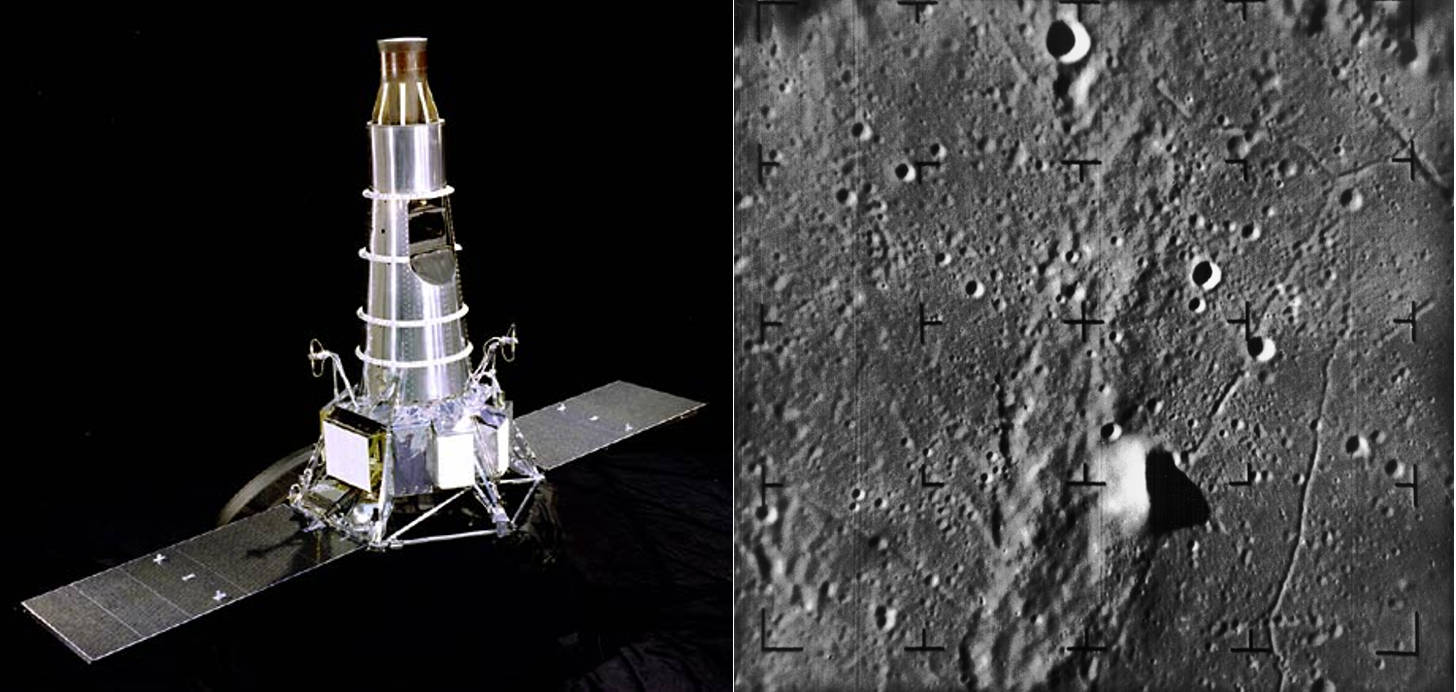
This is Ephemeris for Monday, February 23rd. Today the Sun will be up for 10 hours and 52 minutes, setting at 6:22, and it will rise tomorrow at 7:28. The Moon, 1 day before first quarter, will set at 2:18 tomorrow morning.
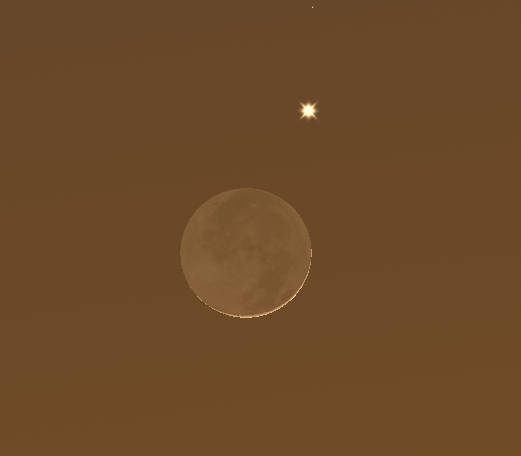
Tonight around 11o’clock the Pleiades star cluster will be just to the lower left of the nearly first quarter Moon. It will be very hard to spot them near the bright Moon, however they might be spotted with binoculars. Tonight the Moon will not occult or pass in front of the Pleiades’ brightest stars. The best time to see the Moon near or occulting the Pleiades is when it’s a crescent, and doesn’t overwhelm them, which will be later on this spring. However, the Moon passes by the Pleiades about a month apart, but they occur either in the afternoon or the morning hours so it won’t be as spectacular. The moon will also have close passages of the planet Venus this spring . The closest approach will be on May 18th.
The astronomical event times given in this blog are for the Traverse City/Interlochen area of Michigan (Lat 44.7° N, Long 85.7° W; EST, UT – 5 hours) unless stated otherwise. Times will be different for other locations.
Addendum
Ephemeris: 02/20/2026 – The star that’s called “Before the Dog”
This is Ephemeris for Friday, February 20th. Today the Sun will be up for 10 hours and 43 minutes, setting at 6:18, and it will rise tomorrow at 7:33. The Moon, 3 days past new, will set at 10:21 this evening.
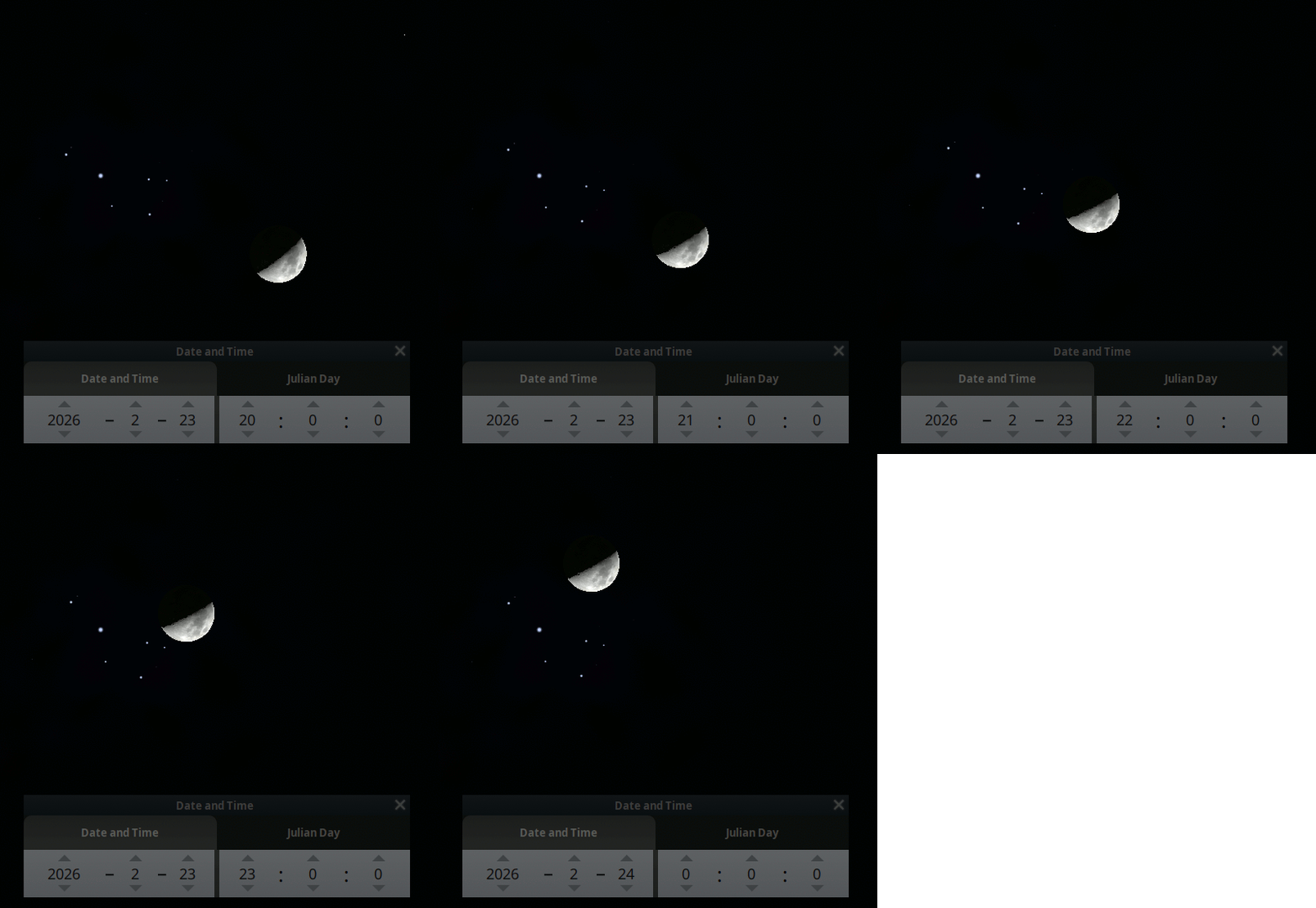
The star Procyon is in Orion’s little hunting dog, Canis Minor, which contains only one other star. It can be found by using the shoulder stars of Orion, Bellatrix and Betelgeuse, pointing to the left and down a bit to Procyon at 9 PM. With Jupiter above, Betelgeuse to the right and Sirius below, it makes an imposing diamond of stars. The word Procyon means “Before the Dog” meaning that rises before the Dog Star, Sirius, even though it is east of it. Procyon is also north of Sirius, which for observers above 30° north latitude, it does indeed rise before the Dog Star. It is a star like Sirius, though it’s not as bright, or white. Procyon is 11.5 light years away while Sirius is 8.6. Both have tiny white dwarf companion stars.
The astronomical event times given in this blog are for the Traverse City/Interlochen area of Michigan (Lat 44.7° N, Long 85.7° W; EST, UT – 5 hours) unless stated otherwise. Times will be different for other locations.
Addendum
Ephemeris: 02/18/2026 – Taking our weekly look at the whereabouts of the naked-eye planets
This is Ephemeris for Ash Wednesday, February 18th. Today the Sun will be up for 10 hours and 37 minutes, setting at 6:15, and it will rise tomorrow at 7:36. The Moon, 1 day past new, will set at 7:52 this evening.
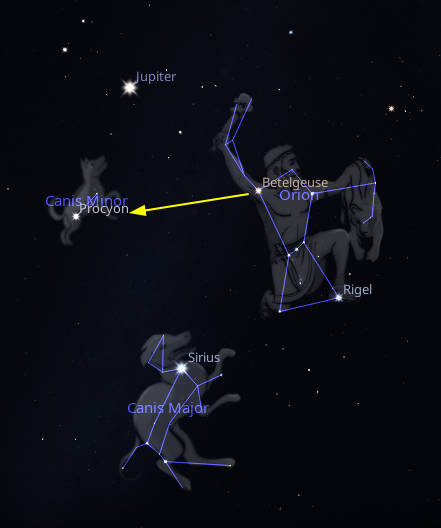
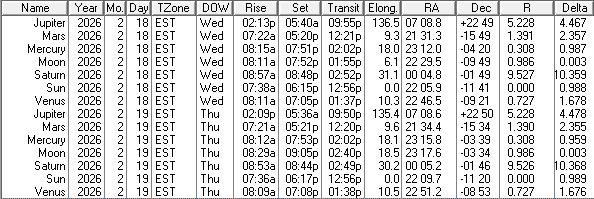
Let’s take our weekly look at the whereabouts of the naked-eye planets. After sunset Venus may show up very low in the West probably before 7:00 PM. Above Venus, tonight, will be the 1 1/2 day old Moon and above it and very close, the planet Mercury making a rare appearance in our evening sky. At 8 PM Saturn remains low in the west southwestern sky, and it will set before 9 PM. In a telescope Saturn sports a very thin ring, 3.1 degrees from being edge on and is slowly opening. Jupiter is the brilliant star-like object more than halfway up in the east-southeastern sky. It’s the brightest star-like object in the sky. It is still moving to the west, but is slowing down and will stop and reverse its course 20 days now.
The astronomical event times given in this blog are for the Traverse City/Interlochen area of Michigan (Lat 44.7° N, Long 85.7° W; EST, UT – 5 hours) unless stated otherwise. Times will be different for other locations.
Addendum
 Bob Moler's Ephemeris Blog