Archive

Archive for the ‘Observing’ Category

Ephemeris: 03/25/2026 – Taking our weekly look at the whereabouts of the naked-eye planets

March 25, 2026 Comments off

This is Ephemeris for Wednesday, March 25th. Today the Sun will be up for 12 hours and 25 minutes, setting at 8:01, and it will rise tomorrow at 7:34. The Moon, at first quarter today, will set at 4:26 tomorrow morning.

Let’s take our weekly look at the whereabouts of the naked-eye planets. Earlier this morning Saturn passed conjunction with the Sun becoming officially a morning planet. But it’ll be a couple of months before it’s visible in the morning and about seven months before it’s conveniently placed in the evening sky. By 8:30 PM tonight or about a half hour or so after sunset, Venus may be seen very low in the West. Binoculars or a telescope will show a very tiny disc on Venus, because it is pretty much behind the Sun, a good way from us. Over the next 7 months it will be moving closer to us and becoming much larger. Jupiter is the brilliant star-like object more than halfway up in the southwestern sky at 9 PM. Tonight, it’s below and left of the Moon.

The astronomical event times given in this blog are for the Traverse City/Interlochen area of Michigan (Lat 44.7° N, Long 85.7° W; EST, UT – 5 hours) unless stated otherwise. Times will be different for other locations.

Addendum
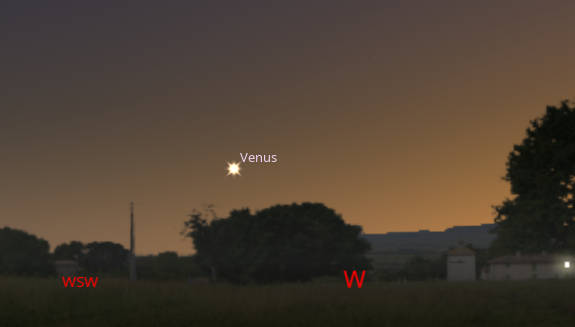
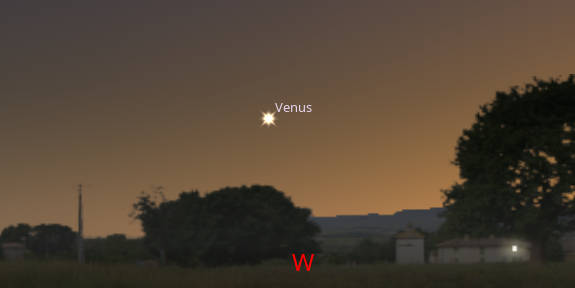
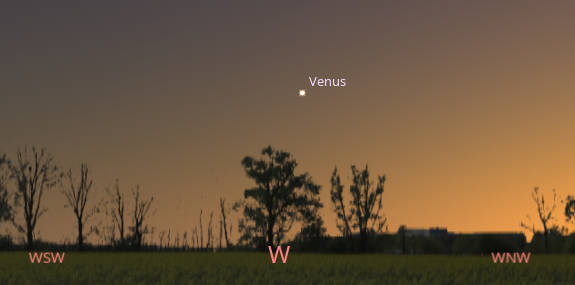
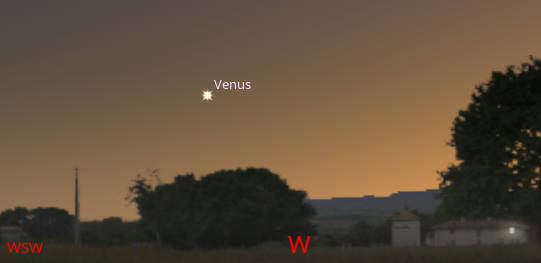
Venus is seen low in the western sky at 8:30 PM tonight.
Venus is seen low in the western sky at 8:30 PM tonight March 25, 2026, or 29 minutes after sunset. Created using Stellarium.
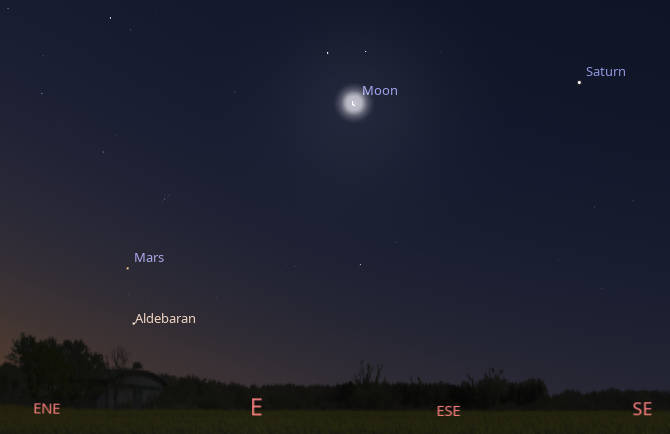
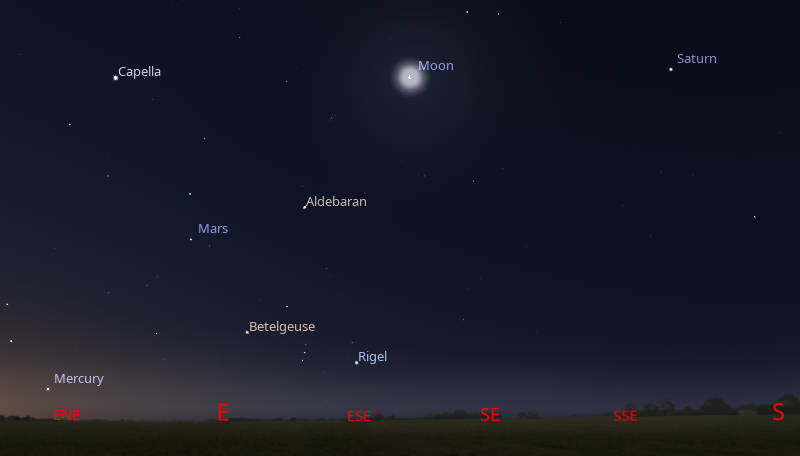
The Moon and Jupiter as they should appear tonight at 9 PM.
The Moon and Jupiter as they should appear tonight at 9 PM March 25, 2026. Created using Stellarium.
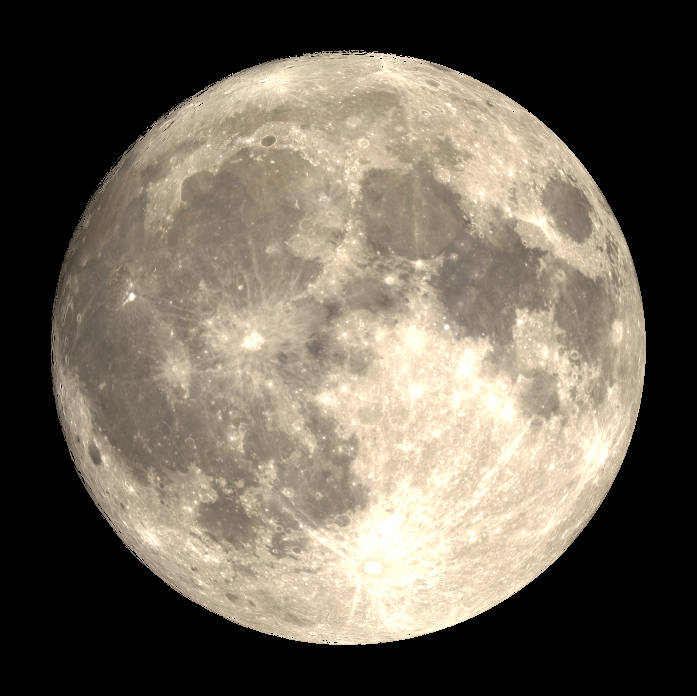
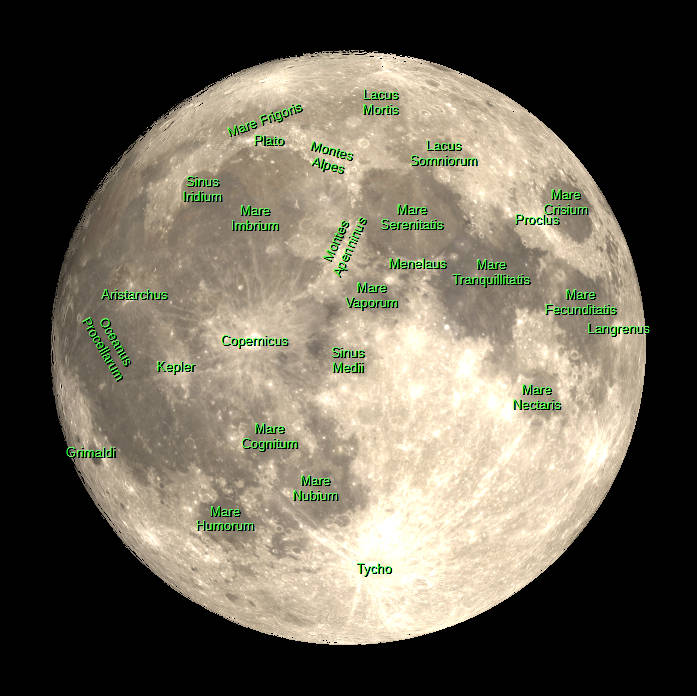
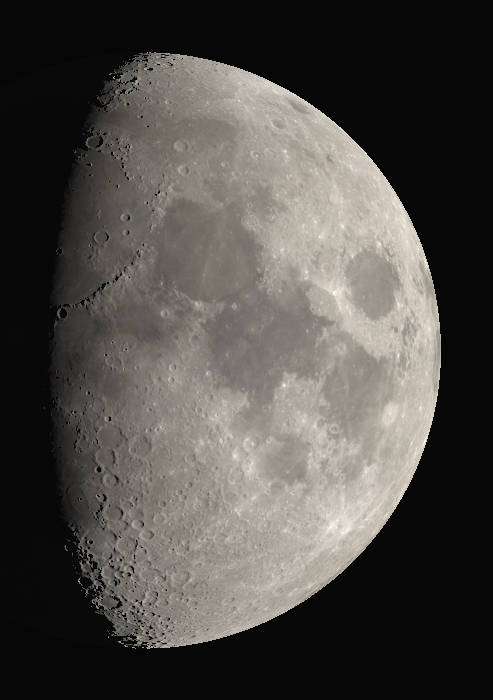
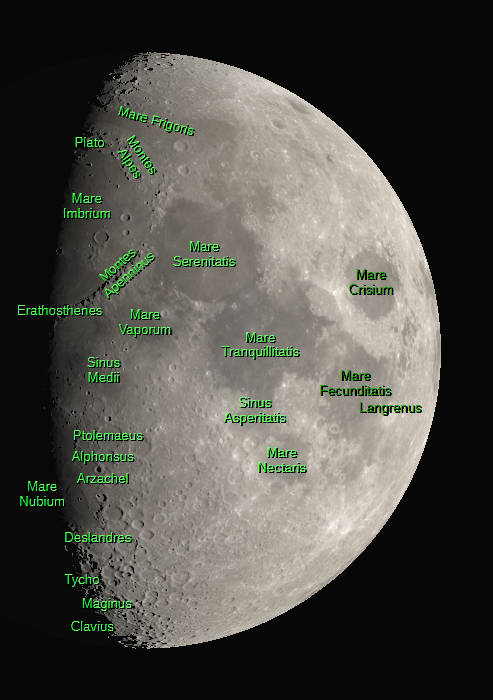
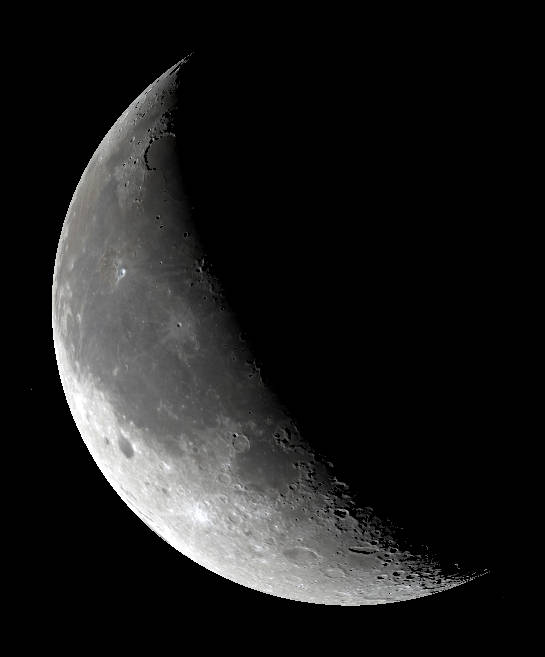
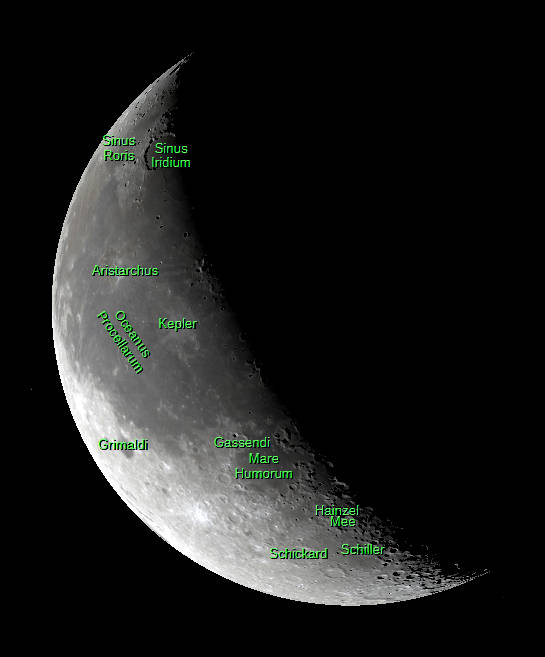
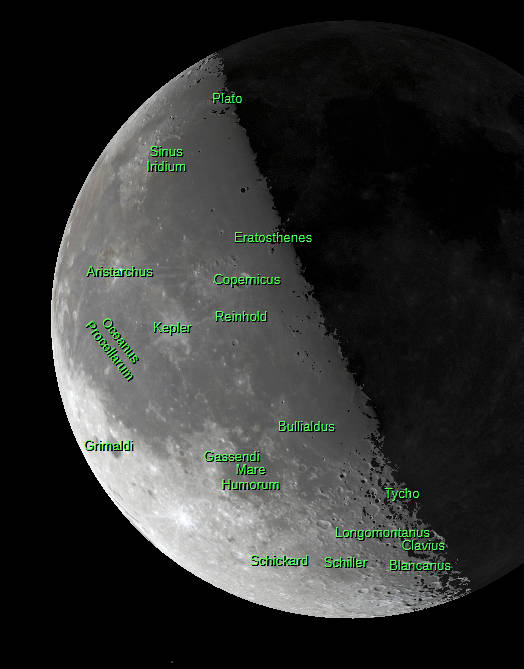
The Moon, at first quarter, as seen at 9 PM tonight, March 25, 2026. A view visible in small telescopes showing an image with and without selected features labeled. Created using Stellarium, LibreOffice Draw, and GIMP.
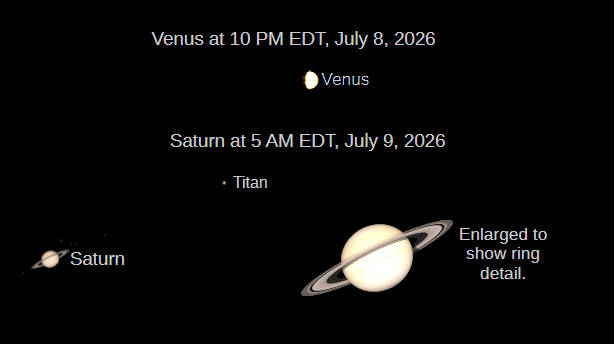
Telescopic Jupiter and Venus (north up) as they would be seen in a small telescope with the same magnification.
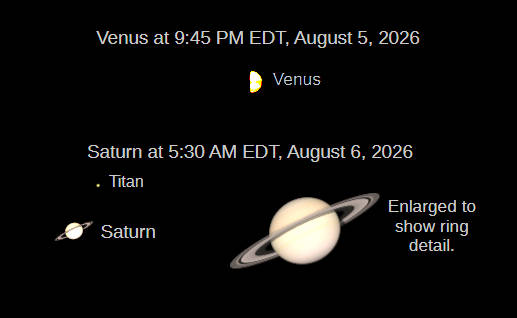
Telescopic Jupiter and Venus (north up) as they would be seen in a small telescope with the same magnification. Venus will be visible for a short time near the western horizon, while Jupiter is visible most of the night. Venus’ apparent diameter will be 10.5″, and be 94.7% illuminated. It’s on the far side of the Sun, 1.6 times the Sun’s distance from us. Jupiter will be 39.6″ in diameter, with its moons shown here for 9 PM, tonight March 25th, 2026. The moons can shift noticably over an hour. Callisto will pass behind the planet from 10:29 PM to 2:29 AM. The (”) symbol means seconds of arc, or 1/3600th of a degree. Created using Cartes du Ciel (Sky Charts), LibreOffice Draw and GIMP.
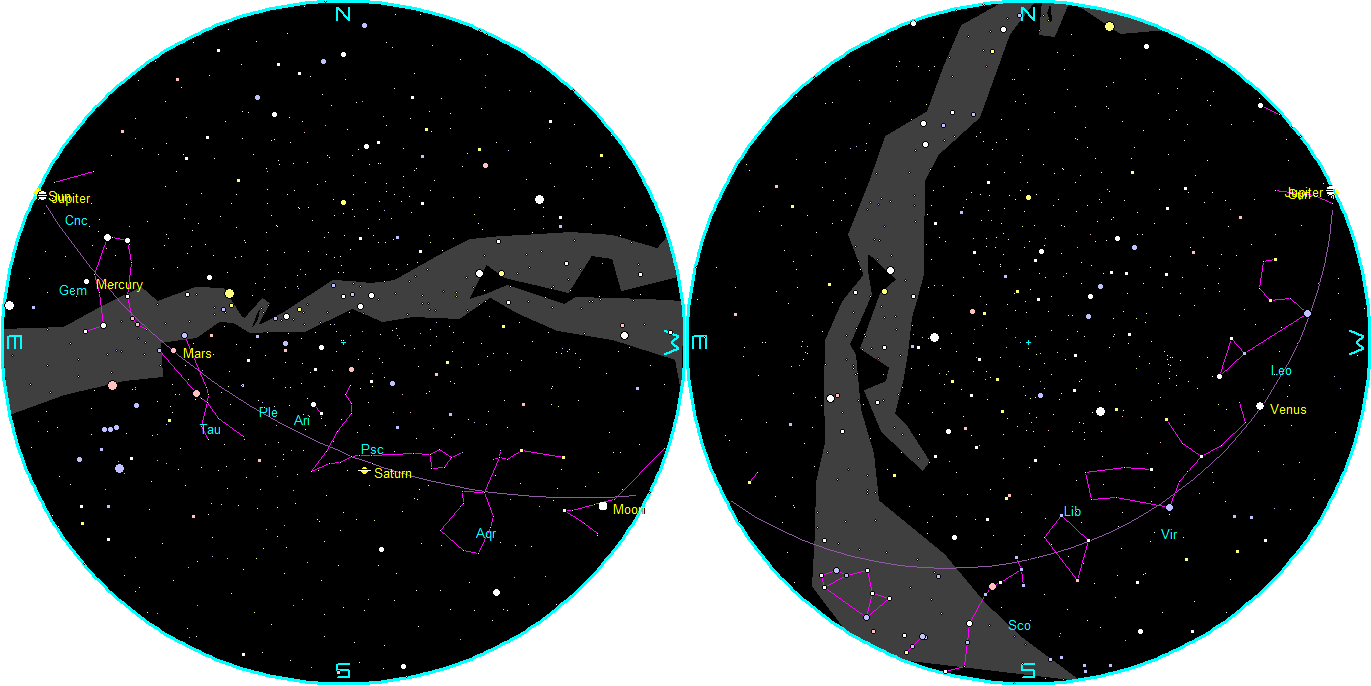
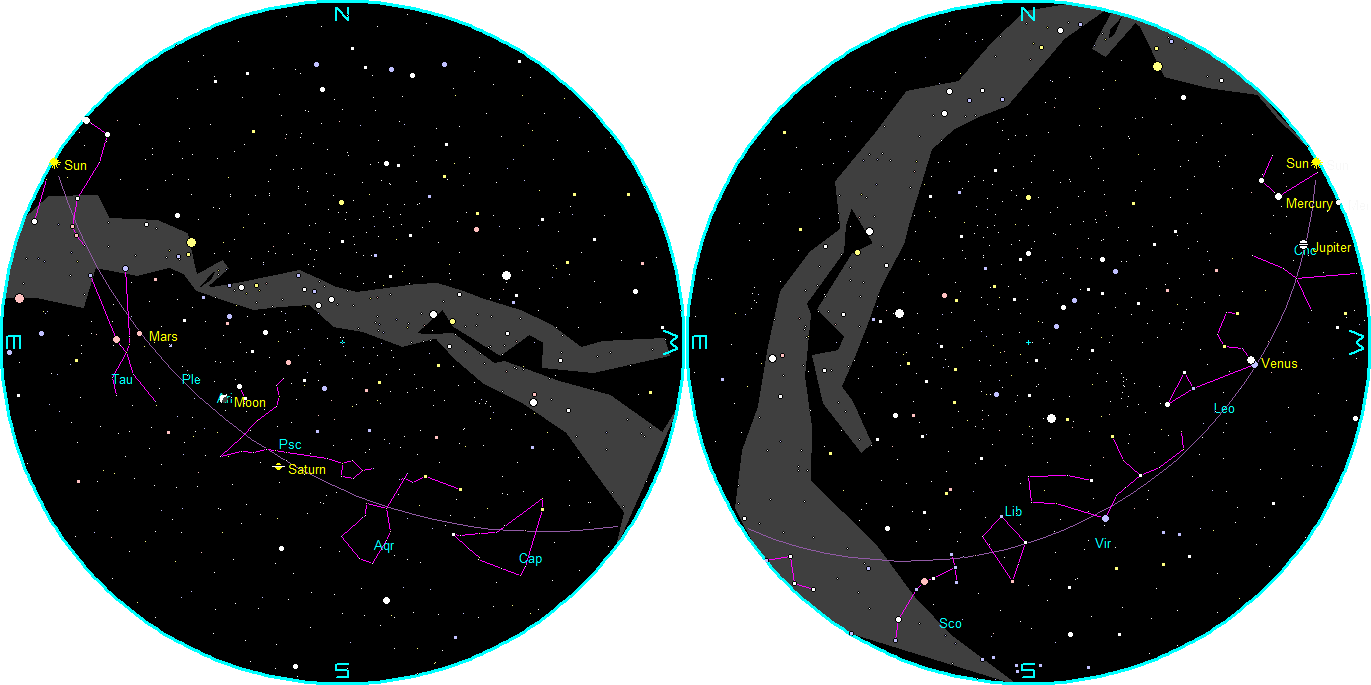
The naked-eye planets and the Moon at sunset and sunrise on a single night.
The naked-eye planets and the Moon at sunset and sunrise on a single night, starting with sunset on the right on March 25th, 2026. The night ends on the left with sunrise on the 26th. Click or tap on the image to enlarge it. Saturn is not visible, being too close to the direction of the Sun. Created using my LookingUp app and GIMP.
A low precision ephemeris of the Sun Moon and naked eye planet positions for today and tomorrow.
This is a low precision ephemeris of the Sun Moon and naked eye planet positions for today and tomorrow, March 25th and 26th, 2026. Some of the columns are self-explanatory, others are not. The transit column is the time that the body crosses the meridian and is due south. Elong, for elongation, is the angle between the Sun and that body. RA is right ascension, which is the object’s east-west position on the celestial sphere in hours and minutes. Dec is declination which is the north-south position of the object on the celestial sphere in degrees and minutes. R is the distance of that object from the Sun in astronomical units. An astronomical unit is about 93 million miles or 150 million kilometers. And Delta is the distance of that object from the Earth, also in astronomical units. I omit the ‘m’ in am and pm for compactness. The data was generated using my LookingUp for DOS app and displayed as a table by my Ephemeris Helper app.

Ephemeris: 03/24/2026 – Visibility of the Moon’s features

March 24, 2026 Comments off

This is Ephemeris for Tuesday, March 24th. Today the Sun will be up for 12 hours and 22 minutes, setting at 8:00, and it will rise tomorrow at 7:36. The Moon, 1 day before first quarter, will set at 3:31 tomorrow morning.

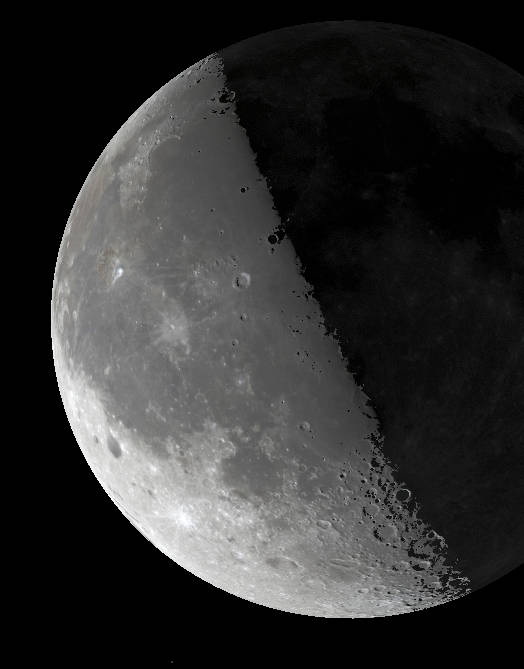
The Moon, tonight is just a day before first quarter. Its position in the sky is close to where the Sun will be around the 1st day of summer, so it’s quite high in the southwest as it gets dark. It’s a great time to view the Moon with the telescope, in that the moon isn’t too bright, and there are lots of craters showing up due to their shadows. The terminator nearly cuts the Moon in half. It is in this case, the sunrise line creeping across the surface. It is deep morning shadows that help delineate the features. Looking at the limb of the Moon, the curved edge, the craters are hard to spot, because they are under the midday sun, showing no shadows, which makes them very indistinct.

The astronomical event times given in this blog are for the Traverse City/Interlochen area of Michigan (Lat 44.7° N, Long 85.7° W; EST, UT – 5 hours) unless stated otherwise. Times will be different for other locations.

Addendum
The Moon, 1 day before first quarter, as seen at 9 PM tonight, March 25, 2026. A view visible in small telescopes showing an image with and without selected features labeled. Created using Stellarium, LibreOffice Draw, and GIMP.
Categories: Ephemeris Program, Observing Tags:

Ephemeris: 03/18/2026 – Taking our weekly look at the whereabouts of the naked-eye planets

March 18, 2026 Comments off

This is Ephemeris for Wednesday, March 18th. Today the Sun will be up for 12 hours and 3 minutes, setting at 7:52, and it will rise tomorrow at 7:47. The Moon is new today, and won’t be visible.

Let’s take our weekly look at the whereabouts of the naked-eye planets. By 8:30 PM or about a half hour or so after sunset, Venus may be seen very low in the West. Binoculars or a telescope will show a very tiny disc on Venus, because it is pretty much behind the Sun, a good way from us. However over the next 7 months it will be moving closer to us and becoming much larger. Jupiter is the brilliant star-like object more than halfway up in the southern sky at 9 PM. It’s the brightest object in the sky at that point. It has resumed its normal eastward motion, spending most of its evening appearance making up the ground it lost in its 4 months of retrograde motion. The planet and its moons are a treat for binoculars or a telescope.

The astronomical event times given in this blog are for the Traverse City/Interlochen area of Michigan (Lat 44.7° N, Long 85.7° W; EST, UT – 5 hours) unless stated otherwise. Times will be different for other locations.

Addendum
Venus is seen low in the western sky at 8:30 PM tonight.
Venus is seen low in the western sky at 8:30 PM tonight March 18, 2026, or 38 minutes after sunset. Created using Stellarium.
Jupiter is seen with the bright winter stars in the south at 9:00 PM tonight.
Jupiter is seen with the bright winter stars in the south at 9:00 PM tonight, March 18, 2026. Also showing are the zodiacal constellations of Taurus, Gemini, Cancer and Leo. Created using Stellarium.
Telescopic Jupiter and Venus as they would be seen in a small telescope with the same magnification.
Telescopic Jupiter and Venus (north up) as they would be seen in a small telescope with the same magnification. Venus will be visible for a short time near the western horizon, while Jupiter is visible mopst of the night. Venus’ apparent diameter will be 10.4″, and be 95.7% illuminated. It’s on the far side of the Sun, 1.6 times the Sun’s distance from us. Jupiter will be 40.5″ in diameter, with its moons shown here for 9 PM, tonight March 18th, 2026. The moons can shift noticably over an hour. . The (”) symbol means seconds of arc, or 1/3600th of a degree. Created using Cartes du Ciel (Sky Charts), LibreOffice Draw and GIMP.
The naked-eye planets and the Moon at sunset and sunrise on a single night.
The naked-eye planets and the Moon at sunset and sunrise on a single night, starting with sunset on the right on March 18th, 2026. The night ends on the left with sunrise on the 19th. Click or tap on the image to enlarge it. Created using my LookingUp app and GIMP.
A low precision ephemeris of the Sun Moon and naked eye planet positions for today and tomorrow.
This is a low precision ephemeris of the Sun Moon and naked eye planet positions for today and tomorrow, March 18th and 19th, 2026. Some of the columns are self-explanatory, others are not. The transit column is the time that the body crosses the meridian and is due south. Elong, for elongation, is the angle between the Sun and that body. RA is right ascension, which is the object’s east-west position on the celestial sphere in hours and minutes. Dec is declination which is the north-south position of the object on the celestial sphere in degrees and minutes. R is the distance of that object from the Sun in astronomical units. An astronomical unit is about 93 million miles or 150 million kilometers. And Delta is the distance of that object from the Earth, also in astronomical units. I omit the ‘m’ in am and pm for compactness. The data was generated using my LookingUp for DOS app and displayed as a table by my Ephemeris Helper app.

Ephemeris: 03/11/2026 – Taking our weekly look at the whereabouts of the naked-eye planets

March 11, 2026 Comments off

This is Ephemeris for Wednesday, March 11th. Today the Sun will be up for 11 hours and 41 minutes, setting at 7:43, and it will rise tomorrow at 8:00. The Moon, at last quarter today, will rise at 4:42 tomorrow morning.

Let’s take our weekly look at the whereabouts of the naked-eye planets. At 8:15 PM or about a half hour after sunset, Venus may be seen very low in the West. A very low western horizon will be necessary to spot it, like from the shore of Lake Michigan. Saturn is no longer visible, being too close to the direction of the Sun. Jupiter is the brilliant star-like object more than halfway up in the southern sky. It’s the brightest star-like object in the sky. The planet and its moons are a treat for binoculars or a telescope. Jupiter’s four brightest, so-called Galilean Moons are on the east side of the planet, though binoculars will probably show three. The moon closest to the planet are two moons close together, which are resolved in telescopes.

The astronomical event times given in this blog are for the Traverse City/Interlochen area of Michigan (Lat 44.7° N, Long 85.7° W; EST, UT – 5 hours) unless stated otherwise. Times will be different for other locations.

Addendum
Venus is seen low in the western sky at 8:15 PM tonight.
Venus is seen low in the western sky at 8:15 PM tonight March 11, 2026, or 32 minutes after sunset. Venus, at this time will be only 7½° above the horizon. Created using Stellarium.
Jupiter is seen with the bright winter stars in the south at 9:00 PM
Jupiter is seen with the bright winter stars in the south at 9:00 PM. Also showing are the zodiacal constellations of Taurus, Gemini where Jupiter is, and Cancer where it is heading to later this year . Created using stellarium.
The Moon 1 day past last quarter, as seen at 6 tomorrow morning, March 12, 2026. A view visible in small telescopes showing an image with and without selected features labeled. Created using Stellarium, LibreOffice Draw, and GIMP.
Telescopic Jupiter and Venus (north up) as they would be seen in a small telescope with the same magnification.
Telescopic Jupiter and Venus (north up) as they would be seen in a small telescope with the same magnification. Venus will be visible for a short time near the western horizon, while Jupiter is visible mopst of the night. Venus’ apparent diameter will be 10.3″, and be 96.6% illuminated. It’s on the far side of the Sun. Jupiter will be 41.4″ in diameter, with its moon shown here for 9 PM, tonight March 11th, 2026. The moons can shift noticable over an hour. . The (”) symbol means seconds of arc, or 1/3600th of a degree. Created using Cartes du Ciel (Sky Charts), LibreOffice Draw and GIMP.
The naked-eye planets and the Moon at sunset and sunrise on a single night, starting with sunset on the right on March 11th, 2026. The night ends on the left with sunrise on the 12th.
The naked-eye planets and the Moon at sunset and sunrise on a single night, starting with sunset on the right on March 11th, 2026. The night ends on the left with sunrise on the 12th. The Venus label is overprinting Saturn and its label. Click or tap on the image to enlarge it. Created using my LookingUp app and GIMP.
A low precision ephemeris of the Sun Moon and naked eye planet positions for today and tomorrow, March 11th and 12th, 2026.
This is a low precision ephemeris of the Sun Moon and naked eye planet positions for today and tomorrow, March 11th and 12th, 2026. Some of the columns are self-explanatory, others are not. The transit column is the time that the body crosses the meridian and is due south. Elong, for elongation, is the angle between the Sun and that body. RA is right ascension, which is the object’s east-west position on the celestial sphere in hours and minutes. Dec is declination which is the north-south position of the object on the celestial sphere in degrees and minutes. R is the distance of that object from the Sun in astronomical units. An astronomical unit is about 93 million miles or 150 million kilometers. And Delta is the distance of that object from the Earth, also in astronomical units. I omit the ‘m’ in am and pm for compactness. The data was generated using my LookingUp for DOS app and displayed as a table by my Ephemeris Helper app.

Ephemeris: 03/10/2026 – Finding Cancer the crab

March 10, 2026 Comments off

This is Ephemeris for Tuesday, March 10th. Today the Sun will be up for 11 hours and 38 minutes, setting at 7:42, and it will rise tomorrow at 8:02. The Moon, 1 day before last quarter, will rise at 3:50 tomorrow morning.

The constellation of Cancer the crab is made of dim stars, which are generally connected, in constellation charts, with lines that make either the letter K or an upside down Y. It lies directly between the star pair Castor and Pollux in Gemini and Regulus in Leo. In the center of the constellation is, what to the naked-eye is a fuzzy spot called Praesepe, or the manger. The two nearby stars, one above left, and one below left are Asellus Borealis, and Asellus Australis, the northern and southern donkey colts feeding out of the manger. Viewing that fuzzy spot with a pair of binoculars will reveal that it’s not fuzzy at all. It resolves into a cluster of stars, which astronomers, over the years, have called the Beehive cluster.

The astronomical event times given in this blog are for the Traverse City/Interlochen area of Michigan (Lat 44.7° N, Long 85.7° W; EST, UT – 5 hours) unless stated otherwise. Times will be different for other locations.

Addendum
Finding Cancer the crab in the southeastern sky at 9 PM around mid-March 2026 in five frames.
Finding Cancer the crab in the southeastern sky at 9 PM around mid-March 2026 in five frames. First the natural sky; second, with constellation art with Gemini and Leo; third, with constellation lines; fourth, showing an inset box; fifth showing a magnified view with the Beehive cluster. Created using Stellarium, LibreOffice Draw, and GIMP.

Ephemeris: 03/09/2026 – The Great Underwater Panther in the stars

March 9, 2026 Comments off

This is Ephemeris for Monday, March 9th. Today the Sun will be up for 11 hours and 35 minutes, setting at 7:41, and it will rise tomorrow at 8:04. The Moon, 2 days before last quarter, will rise at 2:50 tomorrow morning.

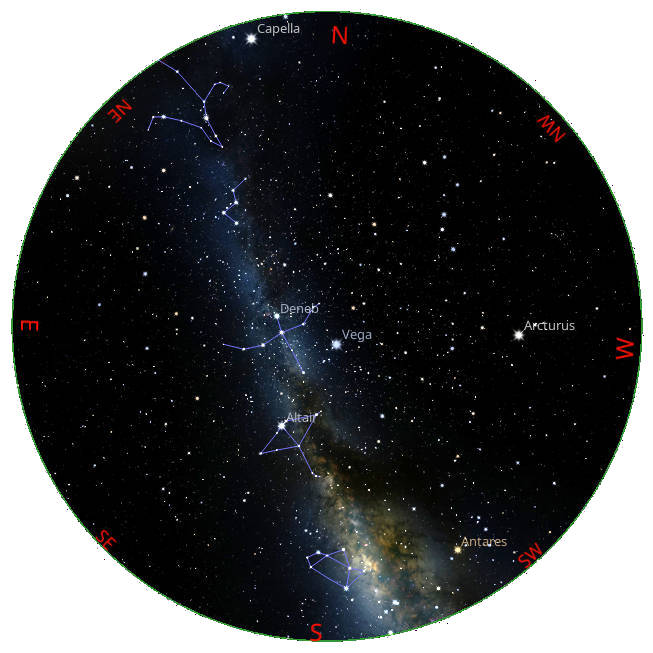
As Orion tilts into the southwest at 9 PM I’m reminded of our Anishinaabek native peoples here in Michigan, who saw it as the Winter Maker slowly beginning to leave the scene in the southwest. At this time in the southeast is Curly Tail, the Great Panther. I first knew him as the Great Underwater Panther, which tells us where he lives… beneath the ice. He’s in the sky to warn us that the warmer weather of spring is coming, and the ice on the lakes and rivers is getting thin. Be careful to not fall through and drown, becoming a victim of the Great Panther. The stars of the panther include those of the head of Leo the lion the great backwards question mark, as his curly tail, to his head, the head of what we call Hydra the water snake.

The astronomical event times given in this blog are for the Traverse City/Interlochen area of Michigan (Lat 44.7° N, Long 85.7° W; EST, UT – 5 hours) unless stated otherwise. Times will be different for other locations.

Addendum

Great Underwater Panther finder.
Great Underwater Panther finder, looking southeast at around 9 PM or about an hour and a half after sunset. Created using Stellarium, LibreOffice Draw and GIMP.
Great Underwater Panther
The constellation Great Underwater Panther screen shot taken from the YouTube video “Stellar Connections: Explorations in Cultural Astronomy – Pt. 2” by Michael Wassegijig Price
North Hegman Lake Pictographs
North Hegman Lake Pictographs with the Wintermaker (Orion), Curly Tail or Great Underwater Panther (Leo-Hydra), and Moose (Pegasus). Credit: Etphonehome.

Ephemeris: 03/06/2026 – The Fisher announces the coming of the maple sugaring season

March 6, 2026 Comments off

This is Ephemeris for Friday, March 6th. Today the Sun will be up for 11 hours and 25 minutes, setting at 6:37, and it will rise tomorrow at 7:09. The Moon, 3 days past full, will rise at 10:30 this evening.

March is a month of transitions. The stars of the winter skies, that is Orion and his merry band of bright stars, move to the west as those of spring rise in the east. The Big Dipper is ascending in the northeastern sky, after lying low in the north during the long dark evenings in the heart of winter. The dipper is the hind end of the Great Bear, officially Ursa Major. The Anishinaabe peoples of the Great Lakes region saw the Big Dipper as the hind end and tail of a magical creature called Fisher, or in their language Ojiig, who brought summer to the Earth. Its position in the sky around the pole announces the seasons. The Fisher’s ascension high into the northeastern sky signals the start of the maple sugaring season later this month.

The astronomical event times given in this blog are for the Traverse City/Interlochen area of Michigan (Lat 44.7° N, Long 85.7° W; EST, UT – 5 hours) unless stated otherwise. Times will be different for other locations.

Addendum
The Fisher announcing maple sugaring season – animation. Star positions for 2 hours after sunset, near 45 degrees north latitude, for a week into March. Created using Stellarium and GIMP.

For the story of the Fisher, and how he got that arrow stuck in his tail, check out The story of the Fisher Star.

Ephemeris: 03/04/2026 – Taking our weekly look at the whereabouts of the naked-eye planets

March 4, 2026 Comments off

This is Ephemeris for Wednesday, March 4th. Today the Sun will be up for 11 hours and 19 minutes, setting at 6:34, and it will rise tomorrow at 7:13. The Moon, 1 day past full, will rise at 8:14 this evening.

Let’s take our weekly look at the whereabouts of the naked-eye planets. At 7 PM or about a half hour after sunset, Venus may be seen very low in the West. Above it and a bit to the left might be Saturn which may not show up until a quarter of an hour later. We are in the last third of winter and the sunset times are increasing rapidly and taking with it Saturn. The evening sky will shift dramatically this Sunday when Daylight Saving Time returns, giving us darker mornings and brighter evenings. Jupiter is the brilliant star-like object more than halfway up in the southern sky. It’s the brightest star-like object in the sky. The planet and its moons are a treat for binoculars or a telescope.

The astronomical event times given in this blog are for the Traverse City/Interlochen area of Michigan (Lat 44.7° N, Long 85.7° W; EST, UT – 5 hours) unless stated otherwise. Times will be different for other locations.

Addendum
Saturn and Venus in the west-southwestern sky at 7:15 PM tonight.
Saturn and Venus in the west-southwestern sky at 7:15 PM tonight March 3, 2026, or 41 minutes after sunset. Spotting Mercury and Venus will be problematic: being too low in Venus’ case, and too faint in Saturn’s. The brightnesses of the planets are exagerated. Created using Stellarium.
Jupiter as it appears tonight, March 4, 2026, in its orientation at 9:00 PM moving against the stars of Gemini. Also shown is its track from last July to next July, and the retrograde loop that it is currently making,
Jupiter as it appears tonight, March 4, 2026, in its orientation at 9:00 PM moving against the stars of Gemini. Also shown is its track from last July to next July, and the retrograde loop that it is currently making, slowly moving to the West which it will do for the next 6 days until it stops (becomes stationary) on March 10th. Then it will resume its eastward motion. The inset shows a magnified view of the west end of the retrograde loop. Created using Stellarium, LibreOffice Draw and GIMP.
The Moon 1½ days past full, as seen tonight, March 3, 2026 at 9 PM. A view visible in small telescopes showing an image with and without selected features labeled. Created using Stellarium, LibreOffice Draw, and GIMP.
Jupiter is the one good planet available in a small telescope.
Jupiter is the one good planet available in a small telescope. Saturn is becoming too low in the sky to deliver a good image. This is how Jupiter will appear at 9 PM, its apparent diameter is 42.2″. Created using Cartes du Ciel (Sky Charts), LibreOffice Draw and GIMP.
The naked-eye planets and the Moon at sunset and sunrise on a single night, starting with sunset on the right on March 3rd, 2026. The night ends on the left with sunrise on the 4th.
The naked-eye planets and the Moon at sunset and sunrise on a single night, starting with sunset on the right on March 3rd, 2026. The night ends on the left with sunrise on the 4th. Click or tap on the image to enlarge it. Created using my LookingUp app and GIMP.
A low precision ephemeris of the Sun, Moon and naked eye planet positions for today and tomorrow
This is a low precision ephemeris of the Sun, Moon and naked eye planet positions for today and tomorrow, March 4th and 5th, 2026. Some of the columns are self-explanatory, others are not. The transit column is the time that the body crosses the meridian and is due south. Elong, for elongation, is the angle between the Sun and that body. RA is right ascension, which is the object’s east-west position on the celestial sphere in hours and minutes. Dec is declination which is the north-south position of the object on the celestial sphere in degrees and minutes. R is the distance of that object from the Sun in astronomical units. An astronomical unit is about 93 million miles or 150 million kilometers. And Delta is the distance of that object from the Earth, also in astronomical units. I omit the ‘m’ in am and pm for compactness. The data was generated using my LookingUp for DOS app and displayed as a table by my Ephemeris Helper app.

Ephemeris: 03/03/2026 – Eclipse prospects for the rest of the year

March 3, 2026 Comments off

This is Ephemeris for Tuesday, March 3rd. Today the Sun will be up for 11 hours and 16 minutes, setting at 6:33, and it will rise tomorrow at 7:14. The Moon, at full today, will rise at 7:04 this evening.

If you’re listening to me right now the total lunar eclipse this morning has ended or will shortly end. In any case it’s invisible because, even if it’s ongoing, twilight has wiped it out. Then there is the possibility of clouds, which I can’t predict from when I’m recording this Sunday night. We do have another chance to view a lunar eclipse, this year, on the night of August 27-28th. It’ll be a little bit earlier. It will start late in the evening and be almost total after midnight. There’s also going to be a solar eclipse on August 12th, but it will be just a little nibble of the moon on the sun for us. It’s going to be total for the east coast of Greenland, the northern Atlantic, and northern Spain, before ending at sunset in the Mediterranean Sea.

The astronomical event times given in this blog are for the Traverse City/Interlochen area of Michigan (Lat 44.7° N, Long 85.7° W; EST, UT – 5 hours) unless stated otherwise. Times will be different for other locations.

Addendum
Maximums of the two eclipses visible from the Grand Traverse area in August 2026,
The maximums of the two eclipses visible from the Grand Traverse area in August of 2026. The solar eclipse of August 12th only lasts a little more than an hour, and at maximum the Moon encroaches only 11% into the Sun’s diameter. The August 28th partial lunar eclipse is more substantial. It will last three in the third hours and the Moon will immerse 93% of its diameter into the Earth’s inner shadow called the umbra, where the only sunlight to reach it filters through the Earth’s atmosphere from all the sunrises and sunsets around the world at the time. Sun and Moon images created using Stellarium.

Ephemeris: 03/02/2026 – There’s a total lunar eclipse tomorrow morning

March 2, 2026 Comments off

This is Ephemeris for Monday, March 2nd. Today the Sun will be up for 11 hours and 13 minutes, setting at 6:32, and it will rise tomorrow at 7:16. The Moon, 1 day before full, will set at 7:19 tomorrow morning.

Early tomorrow morning* there will be total lunar eclipse. A lunar eclipse, also known as an eclipse of the Moon occurs when the full moon moves into the earth’s shadow cutting off most of its sunlight. A little sunlight does get in by being bent around the Earth by its atmosphere through all the sunrises and sunsets going on at that time. The moon’s color generally becomes dark red, this also depends on the Earth’s atmosphere and the amount of clouds, smoke and volcanic ash that are in it at the time. The partial phase will begin at 4:50 AM and will last until totality starts at 6:04 AM. Totality will last until 7:02 AM. The growing twilight may cause the totally eclipsed Moon to disappear before then.

The astronomical event times given in this blog are for the Traverse City/Interlochen area of Michigan (Lat 44.7° N, Long 85.7° W; EST, UT – 5 hours) unless stated otherwise. Times will be different for other locations.

* The Moon sets for us in Michigan before the end of the eclipse. Locations west of us in North America and the Pacific get to see the entire eclipse.

Addendum

Three views of the total lunar eclipse of March 3, 2026.
Three views of the total lunar eclipse of March 3, 2026. From left to right: Just after the beginning of the partial phase, when the Moon begina to enter the Earth’s umbra. Center is a few minutes before totality, when the Moon is almost completely imersed into the Earth’s umbra. On the right, the Moon at mid eclipse, with the brightening twilit sky. This is Stellarium’s rendition. I’m willing to bet that the Moon will actually be invisible at this point.
Total Lunar Eclipse March 3, 2026
Events for the Grand Traverse area (Eastern Standard Time)
Time Event
03:44 AM Begin Penumbral phase. This is the theoretical start of the eclipse. Nothing will appear to happen until about half an hour before the partial phase starts. Then the upper left part of the Moon will appear to darken.
04:50 AM Begin Partial phase. The umbra will encroach onto the Moon from upper left to lower right. The dull red of the umbral shadow may be discerned near the beginning of totality.
05:40 AM Astronomical Twilight begins. The Sun is 18° below the horizon.
06:04 AM Begin Totality. The expected dull red of the Moon will be brighter on the edge nearest the edge of the umbral shadow. How long will the totally eclipsed Moon be visible?
06:14 AM Nautical Twilight begins. The Sun is 12° below the horizon.
06:34 AM Mid-Eclipse
07:03 AM End Totality. Will a tiny slice of the Moon become visible in the brightening sky before it sets?
07:18 AM Sunrise
07:19 AM Moonset

For more about lunar eclipses in general, see my post for last year’s lunar eclipse: Almost everything you wanted to know about lunar eclipses.