Archive
11/12/2020 – Ephemeris – The Northern Taurid meteor shower is at its peak
This is Ephemeris for Thursday, November 12th. Today the Sun will be up for 9 hours and 40 minutes, setting at 5:17, and it will rise tomorrow at 7:37. The Moon, 3 days before new, will rise at 5:19 tomorrow morning.
The official peak of the North Taurid meteor shower is here. It’s a broad peak with a low per hour count that appears to be estimated from 5 to 15 meteors per hour. As such it doesn’t hold a candle to the Perseid meteor shower of August or the Geminids of December. However the Northern Taurid shower appears to have quite a few fireballs or really bright meteors. They seem to be most numerous at seven year intervals and the next peak year for fireballs is 2022. The Taurids will appear to come from Taurus the bull near the Pleiades star cluster low in the east in the early evening. Meteors are the streaks in the sky caused by tiny bits of rock hitting the atmosphere at interplanetary speeds and disintegrating.
The event times given are for the Traverse City/Interlochen area of Michigan. They may be different for your location.
Addendum
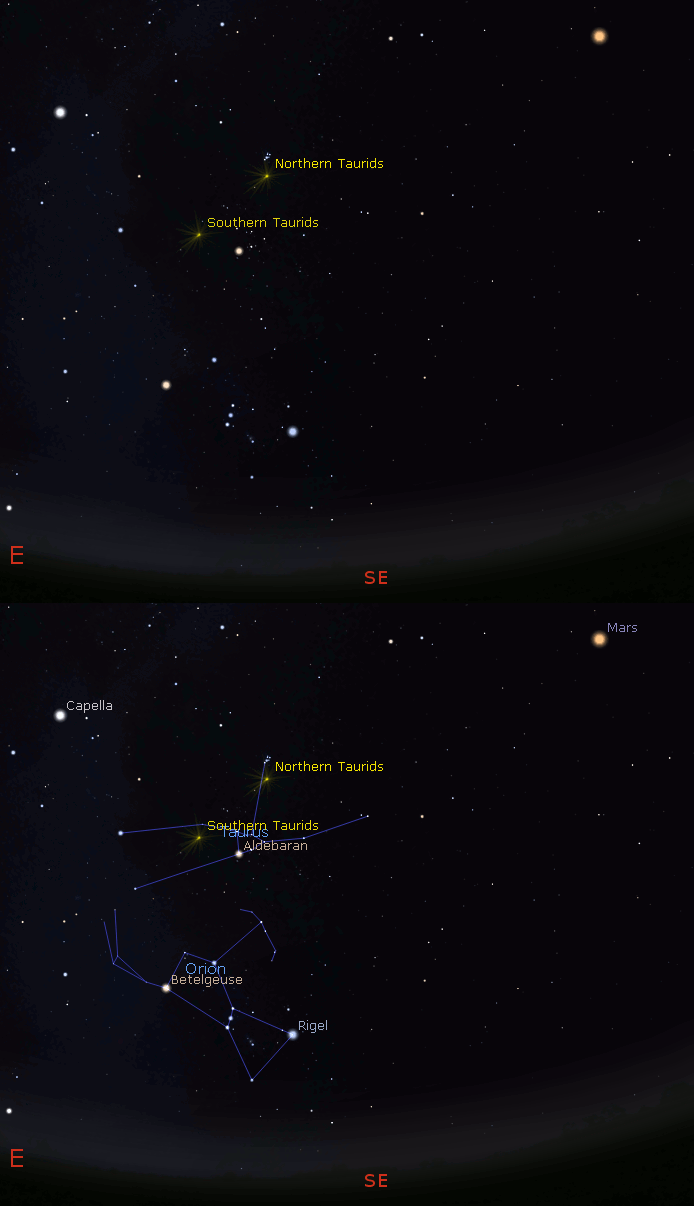
Finder chart for the radiants of the two Taurid meteor shower for about 11 pm for mid November. The Southern Taurids are ending, but a few may be spotted, while the Northern Taurids are near peak. The peak rate for the Northern Taurids has been estimated by various sources as being 5 to 15 meteors per hour. The Pleiades appears just above the Northern Taurid radiant. Compared to other meteor showers the Taurids appear to be a lot slower. Created using Stellarium and GIMP.
11/10/2020 – Ephemeris – Mercury will reach it greatest separation from the Sun in the morning today
This is Bob Moler with Ephemeris for Tuesday, November 10th. Today the Sun will be up for 9 hours and 45 minutes, setting at 5:19, and it will rise tomorrow at 7:35. The Moon, 2 days past last quarter, will rise at 2:42 tomorrow morning.
Mercury will reach its greatest western elongation from the Sun near noon today (17:00 UT). That means it was visible this morning before sunrise in the east. And will be visible again tomorrow morning. The next Mercury greatest elongation will be January 24th, next year. It will be a greatest eastern elongation, which will be visible in the western sky in the evening after sunset. So western elongations are seen in the east and eastern elongations are seen in the west. The “from the Sun” is usually omitted in astronomical lists of events, but implied. Sounds a bit confusing, but it makes weird sense. Mercury’s morning appearance will last about a week before it get too low to easily spot, below and left of Venus.
The event times given are for the Traverse City/Interlochen area of Michigan. They may be different for your location.
Addendum
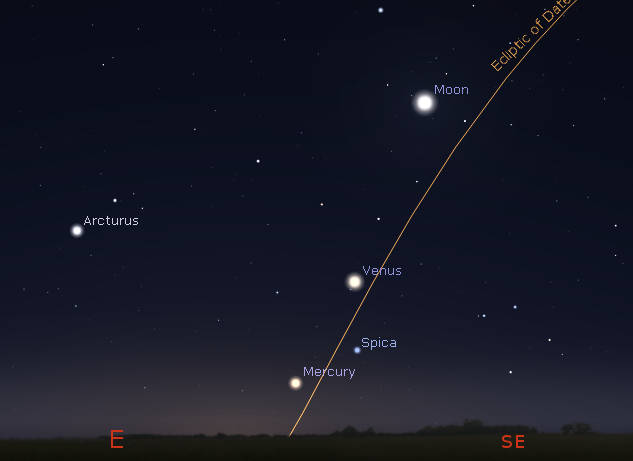
Mercury, Venus, Moon tomorrow morning November 11, 2020 at 6:30 am. The orange line is the ecliptic, the plane of the Earth’s orbit. It is the path of the Sun in the sky, The Moon and planets also stick close to that line. The Moon is a crescent, though that can’t be seen at this scale. Over the next week Venus and Mercury will slide downward along the ecliptic in relation to the stars, as will the Moon at greater speed. Created using Stellarium.
11/09/2020 – Ephemeris – Tiny Mercury makes an appearance in the morning sky
This is Ephemeris for Monday, November 9th. Today the Sun will be up for 9 hours and 48 minutes, setting at 5:20, and it will rise tomorrow at 7:33. The Moon, 1 day past last quarter, will rise at 1:26 tomorrow morning.
The tiny planet Mercury is now visible in the morning twilight. It will reach its greatest separation from the Sun in the morning sky. Astronomers call it “greatest western elongation”. It’s west of the Sun, but we’ll see it in the eastern sky as it rises at 5:49 am in the east-southeast. That’s an hour and 44 minutes before the Sun. By 6:15 or 6:30 am, it should be high enough to spot. That is if it’s clear, an iffy prospect this time of year. It will start to move back to the Sun and actually brighten retaining its best visibility for the next 7 days or so. Mercury has a very elliptical orbit of the Sun. During our two good seasons to view the planet, spring evenings and autumn mornings Mercury is closest to the Sun. Mercury is best seen in the southern hemisphere when its autumn morning appearances and spring evening appearances are seen when Mercury is farthest from the Sun.
The event times given are for the Traverse City/Interlochen area of Michigan. They may be different for your location.
Addendum
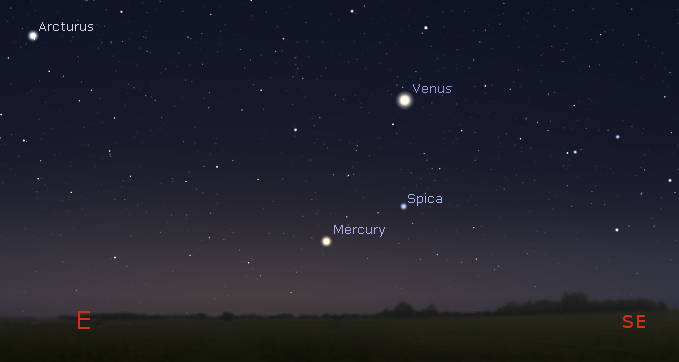
Mercury and Venus in the morning at 6:30 am. Created using Stellarium.
10/30/2020 – Ephemeris – The spookiest star in the sky
This is Ephemeris for Friday, October 30th. Today the Sun will be up for 10 hours and 14 minutes, setting at 6:33, and it will rise tomorrow at 8:20. The Moon, 1 day before full, will set at 8:08 tomorrow morning.
With the COVID virus around probably the only spooky thing out tomorrow night will be the star Algol. It’s out every night actually. It’s name, Algol, is from the Arabic for Ghoul Star or Demon Star. The Chinese had a name for it that meant “piled up corpses”. It’s normally the second brightest star in the constellation Perseus the hero, visible in the northeast this evening. The star is located where artists have drawn the severed head of Medusa, whom he had slain. Medusa was so ugly that she turned all who gazed upon her to stone. Algol is her still winking eye. The star got the name before astronomers found out what was wrong with it. They found out that it does a slow wink every two days, 21 hours. That’s because Algol is two stars that eclipse each other. Her next evening wink will be at its dimmest at 12:11 am November 13th. Remember, daylight time ends on Sunday.
The event times given are for the Traverse City/Interlochen area of Michigan. They may be different for your location.
Addendum
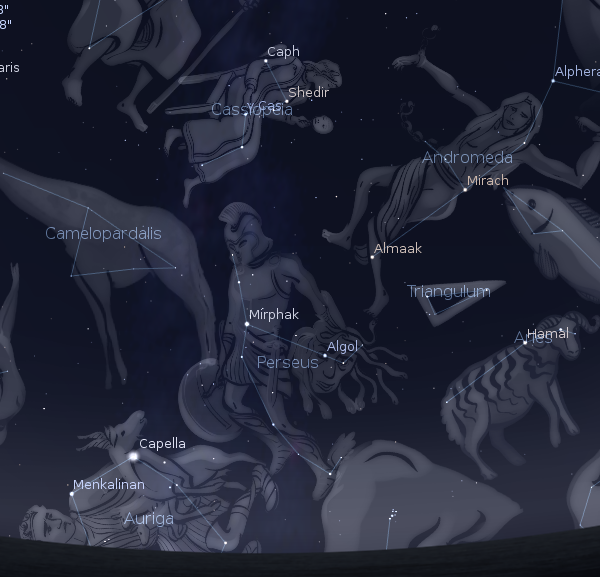
Algol at 7:30 p.m. on Halloween, in a modern portrayal. Created using Stellarium.
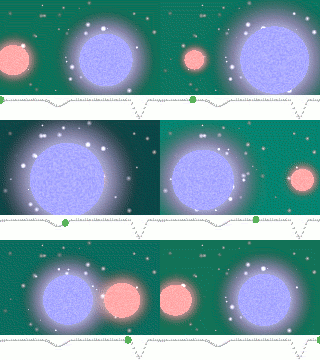
Animation of an eclipsing binary star like Algol. Credit: Wikimedia Commons h/t Earth and Sky
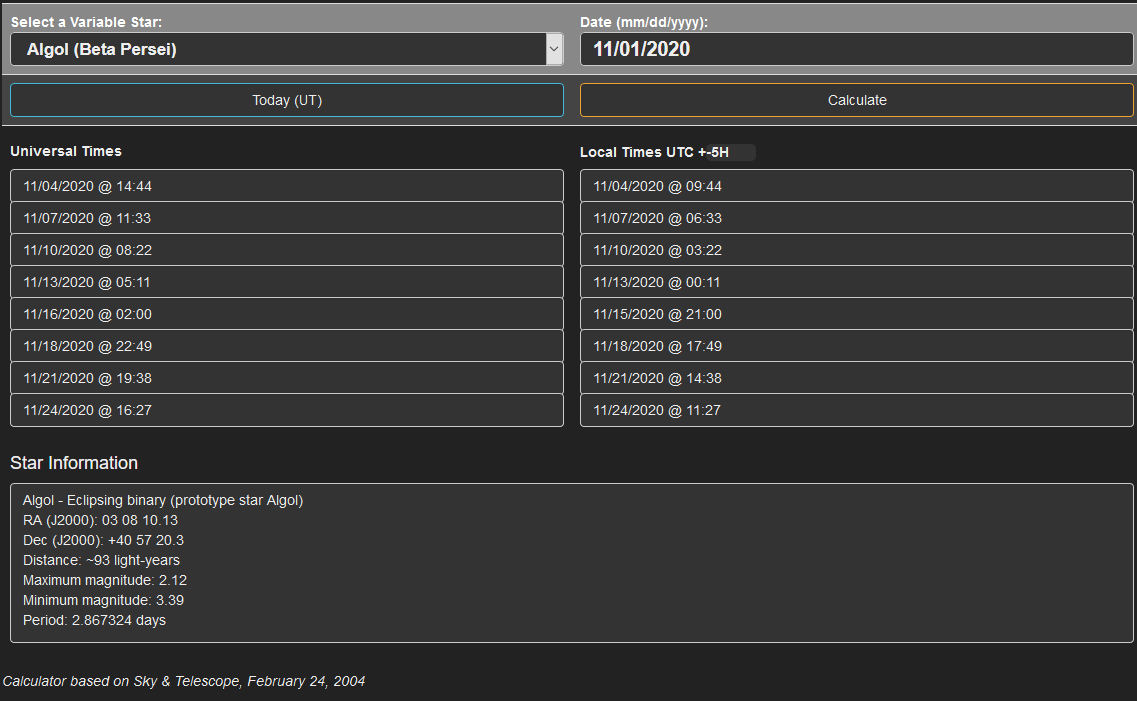
Algol Minima through November 24th 2020. Click on the image to enlarge. Eclipses are about 10 hours long with 5 hours of dimming and another 5 hours to regain brightness. Source: Insula Astra http://www.astropical.space/algol.php.
10/22/2020 – Ephemeris – Tonight the Moon is hanging out with Jupiter and Saturn
This is Ephemeris for Thursday, October 22nd. Today the Sun will be up for 10 hours and 37 minutes, setting at 6:45, and it will rise tomorrow at 8:09. The Moon, 1 day before first quarter, will set at 11:41 this evening.
The fat crescent Moon and the planets Jupiter and Saturn will make a pretty triangle low in the southwestern sky tonight. Jupiter has been noticeably approaching Saturn the last few years. Their paths will appear to cross for us the evening of December 21st, the first day of winter. I won’t make any bets on it being clear that night, or any night around here in December. On the 21st of December they will be seen low in the southwest in twilight a third of the diameter of the Moon apart, and both be seen together in binoculars or low power telescope. The eye should resolve them, though Jupiter’s brightness compared to Saturn may make that difficult. Jupiter passes Saturn on average every 20 years.
The event times given are for the Traverse City/Interlochen area of Michigan. They may be different for your location.
Addendum
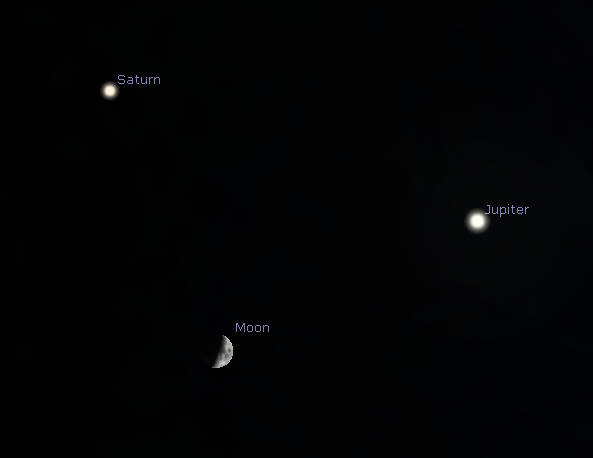
Jupiter, Saturn, and Moon triangle as it will appear in the south at 8 pm in the eastern US. In the western US the Moon will slide closer to Saturn at the same local time. Created using Stellarium.
10/20/2020 – Ephemeris – The Orionid meteor shower reaches peak overnight
This is Bob Moler with Ephemeris for Tuesday, October 20th. Today the Sun will be up for 10 hours and 43 minutes, setting at 6:48, and it will rise tomorrow at 8:06. The Moon, 3 days before first quarter, will set at 9:44 this evening.
Halley’s Comet is back! (Pronounced Hall-ee’s) Well sorta. In the form of the Orionid meteor shower. Bits of Halley’s Comet from previous passes by the Earth’s orbit make their twice-yearly show in our skies as these bits collide with the Earth’s atmosphere. Halley’s orbit passes close to the Earth’s orbit at points where the Earth is around May 6th and again near October 21st. Light dust and ionized gas get blown back into the tail of the comet. Heavier particles will roughly following the comet’s orbit. The radiant, a spot above the constellation Orion and below Gemini from which they will seem to come will rise around 11 pm. So view them any time after that as their numbers will increase until morning twilight begins.
The event times given are for the Traverse City/Interlochen area of Michigan. They may be different for your location.
Addendum
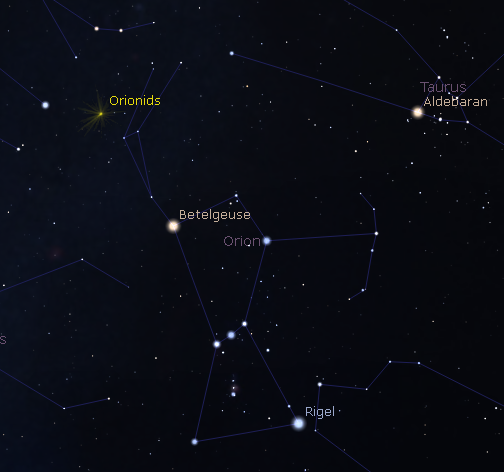
The Orionid meteor shower radiant at 5 a.m. October 21st. The radiant rises at 11 p.m., so the meteors will be visible from then into morning twilight. Despite the location of the radiant, the meteors will be seen all over the sky. However true Orionids can be traced back to the radiant point. Created using Stellarium.
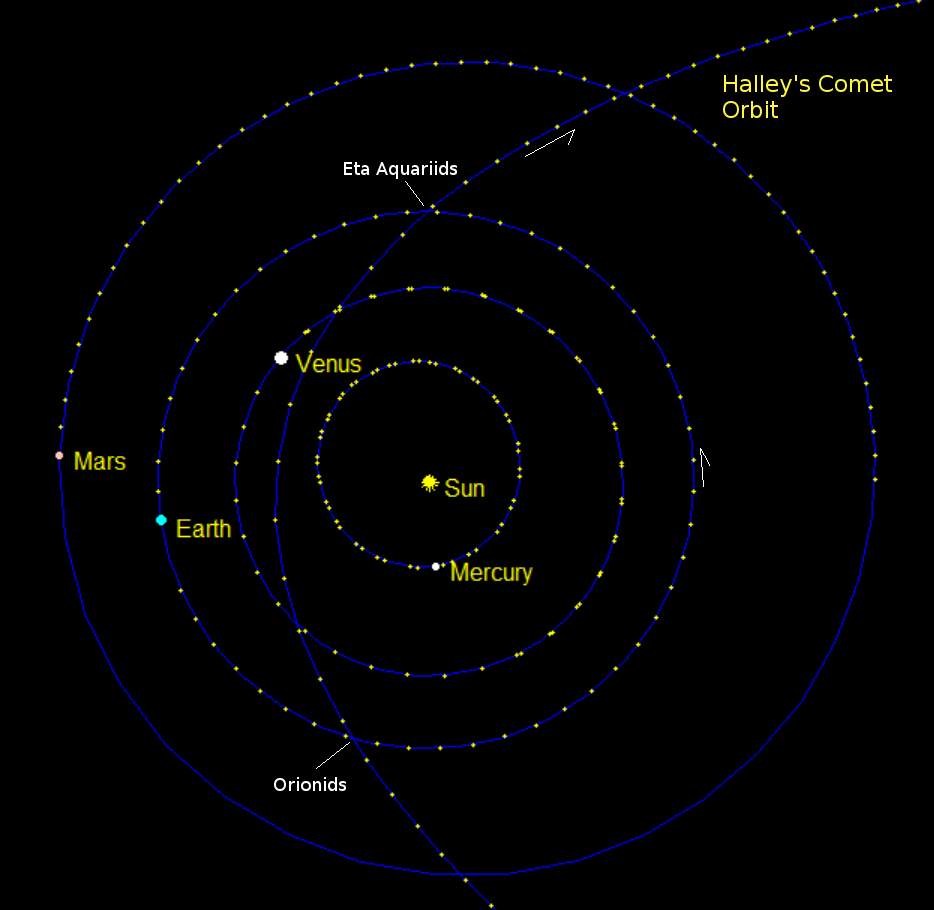
We get two meteor showers from Halley’s Comet. The Orionids, when Halley’s meteoroids are approaching the inner solar system, and the Eta Aquariids when they’re leaving. Created using my LookingUp program.
10/19/2020 – Ephemeris – This zodiacal constellation seems fishy
This is Bob Moler with Ephemeris for Monday, October 19th. Today the Sun will be up for 10 hours and 46 minutes, setting at 6:50, and it will rise tomorrow at 8:05. The Moon, 3 days past new, will set at 8:58 this evening.
High in the southeast at 9 p.m. are the four bright stars of the Great Square of Pegasus, the upside down flying horse. Lying along the left and bottom sides of the great square is the constellation of Pisces the fish, one of the 12 constellations of the Zodiac. Even though the constellation is called the fish, the fish themselves are not well represented in the stars. What can be traced in the stars is the rope, that’s tied to their tails, anchored at the extreme southeastern part of the constellation that is seen in the stars. It is near where the bright red planet Mars currently is. The right or western end of Pisces is the asterism, or informal constellation, of the Circlet. It’s the loop of 5 stars, the rope around the tail of one of the two fish.
The event times given are for the Traverse City/Interlochen area of Michigan. They may be different for your location.
Addendum
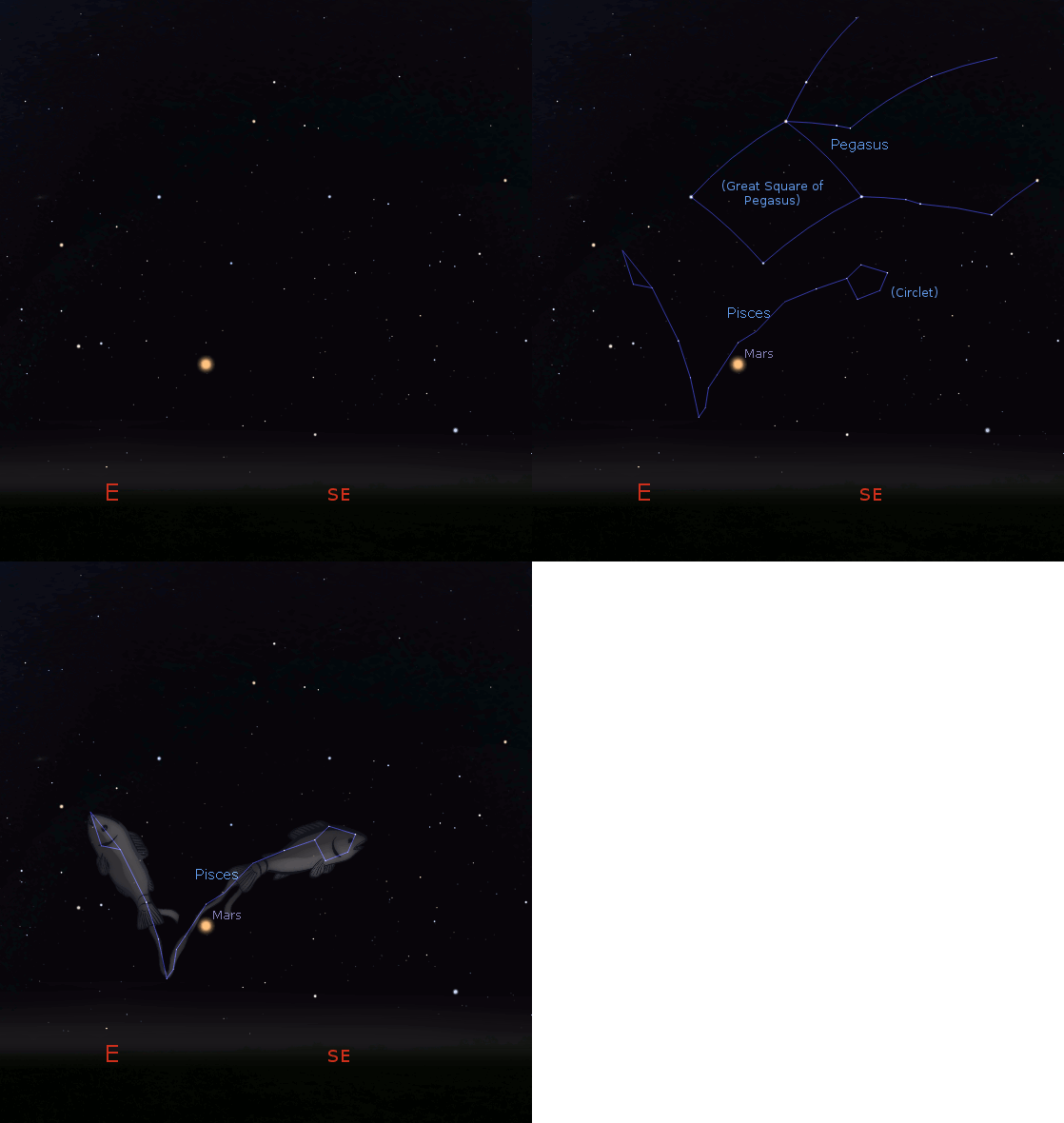
Pisces finder animation showing the Great Square of Pegasus as a way to find it, though this year bright Mars will show where it is. Created using Stellarium and GIMP.
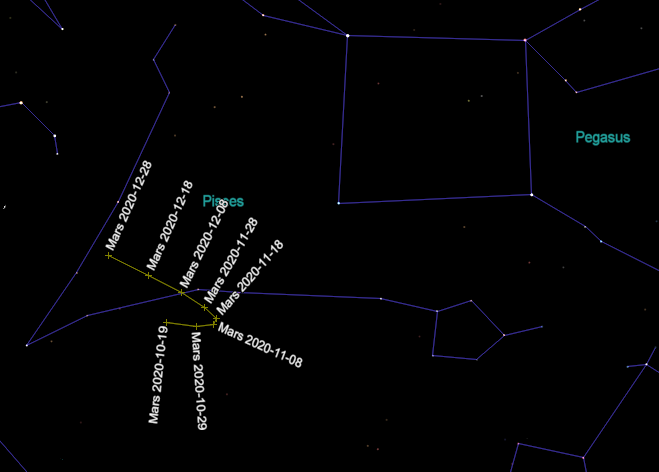
Mars’ apparent path for the rest of 2020 stays within Pisces. Mars doesn’t do a loop de loop as the ancients thought when they thought the Earth was motionless. It’s the effect of the Earth passing Mars in their orbits. Mars will stop its westward or retrograde motion around November 13th and resume its normal eastward motion. This view created using Cartes du Ciel (Sky Charts).
10/15/2020 – Ephemeris – The Great Andromeda Galaxy
This is Ephemeris for Thursday, October 15th. Today the Sun will be up for 10 hours and 58 minutes, setting at 6:57, and it will rise tomorrow at 8:00. The Moon, 1 day before new, will rise at 7:30 tomorrow morning.
The closest large galaxy to our Milky Way galaxy is the Great Andromeda Galaxy seen in the eastern sky when it gets dark. It is barely visible to the naked eye. To locate it first find the Great Square of Pegasus high in the east, standing on one corner. The left star of the square is the head of the constellation Andromeda. Follow two stars to the left and a bit downward, then two stars straight up. The galaxy is near that last star as a small smudge of light. Binoculars are the best way to see it as a thin spindle of light. Visually through a telescope one can see only the bright nucleus of the galaxy, that spans six Moon diameters in photographs. M31 is its most famous catalog designation and it is two and a half million light years away.
The event times given are for the Traverse City/Interlochen area of Michigan. They may be different for your location.
Addendum
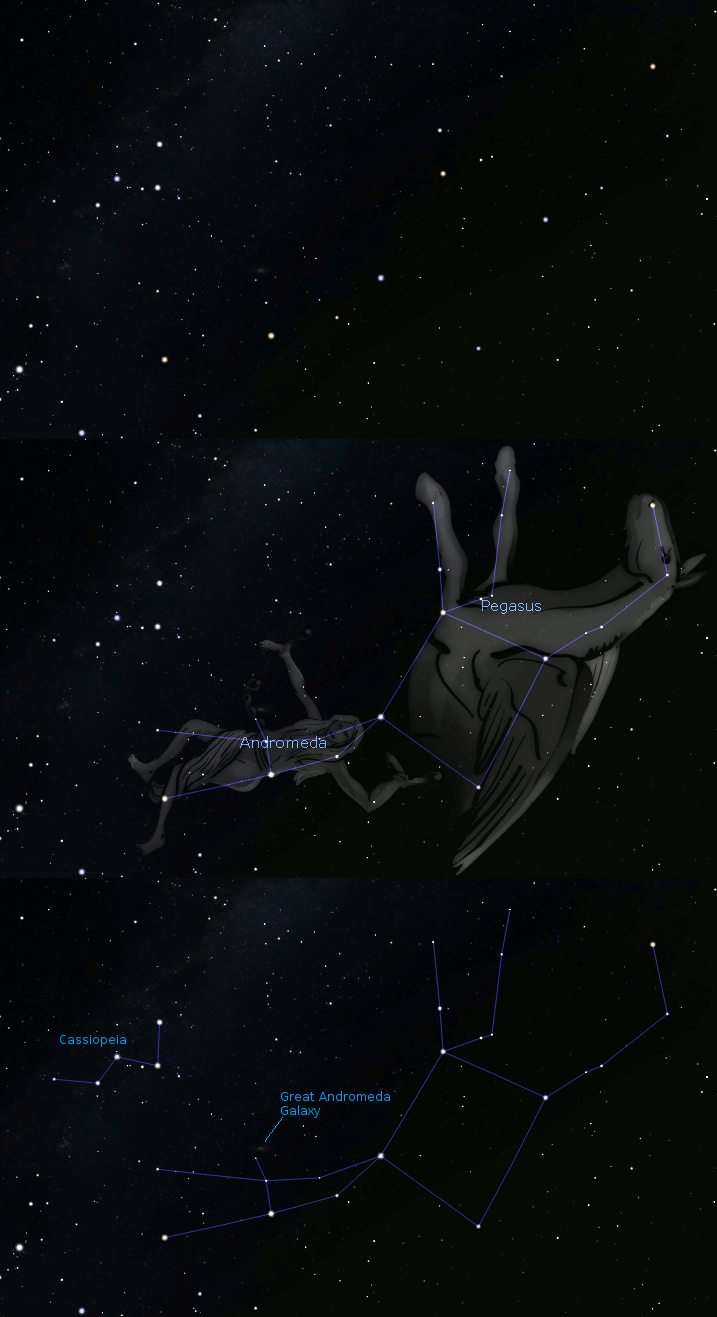
Andromeda animated finder, including the Great Andromeda Galaxy. I’ve added Cassiopeia that some folks use to find the galaxy. I start with the leftmost star of the Great Square of Pegasus that connects to Andromeda. I count off two star on the lower curve because they are brighter than the upper curve. Then count two stars up. Next to that top star is a little smudge. That is the core of the Great Andromeda Galaxy. Created using Stellarium and GIMP.
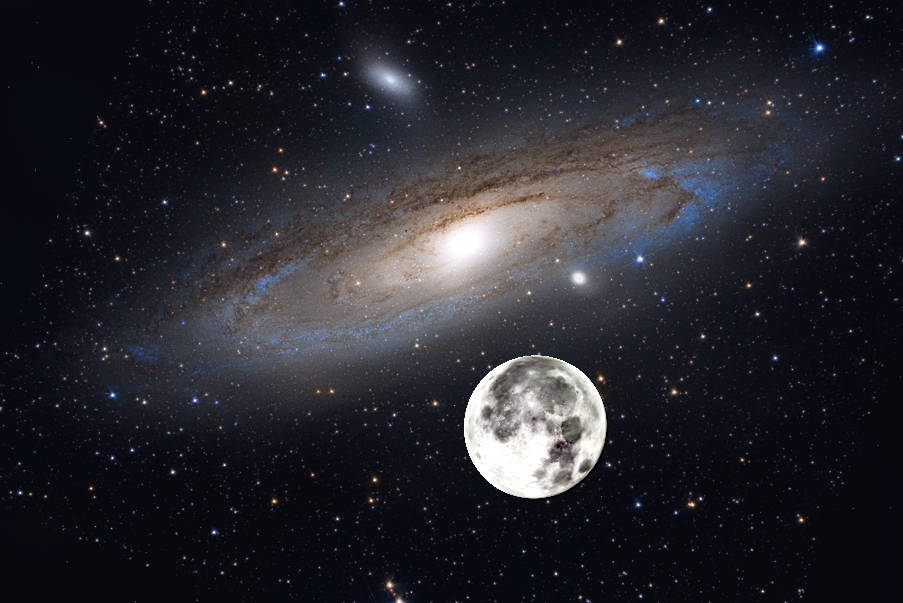
The moon superimposed on the Great Andromeda Galaxy, M31, for apparent size comparison. Created using Stellarium and the embedded image of the galaxy with that of the full Moon of October 31, 2020. M31 Image credit: Herm Perez License: “Feel free to use these images, if you use them in a commercial setting please attribute the source.”
10/08/2020 – Ephemeris – A lady with a not so hidden jewel
This is Ephemeris for Thursday, October 8th. Today the Sun will be up for 11 hours and 19 minutes, setting at 7:09, and it will rise tomorrow at 7:51. The Moon, 1 day before last quarter, will rise at 11:09 this evening.
The stars of the constellations Andromeda the chained princess look like they’re supposed to be the hind legs of Pegasus the flying horse which is high in the southern sky above Mars at 9 p.m. Andromeda is high in the southeast She is seen in the sky as two diverging curved strings of stars that curve to the left and up from the upper leftmost star of the Great Square of Pegasus. Her predicament was caused by her boastful mother Cassiopeia, and the wrath of the god Poseidon. She was rescued by the hero Perseus, a nearby constellation, riding his steed Pegasus. Andromeda’s claim to astronomical fame is the large galaxy barely visible to the unaided eye just above the upper line of stars, the Great Andromeda Galaxy 2.5 million light years away.
The event times given are for the Traverse City/Interlochen area of Michigan. They may be different for your location.
Addendum
Andromeda animated finder, including the Great Andromeda Galaxy. I’ve added Cassiopeia that some folks use to find the galaxy. I start with the leftmost star of the Great Square of Pegasus that connects to Andromeda. I count off two star on the lower curve because they are brighter than the upper curve. Then count two stars up. Next to that top star is a little smudge. That is the core of the Great Andromeda Galaxy. Created using Stellarium and GIMP.
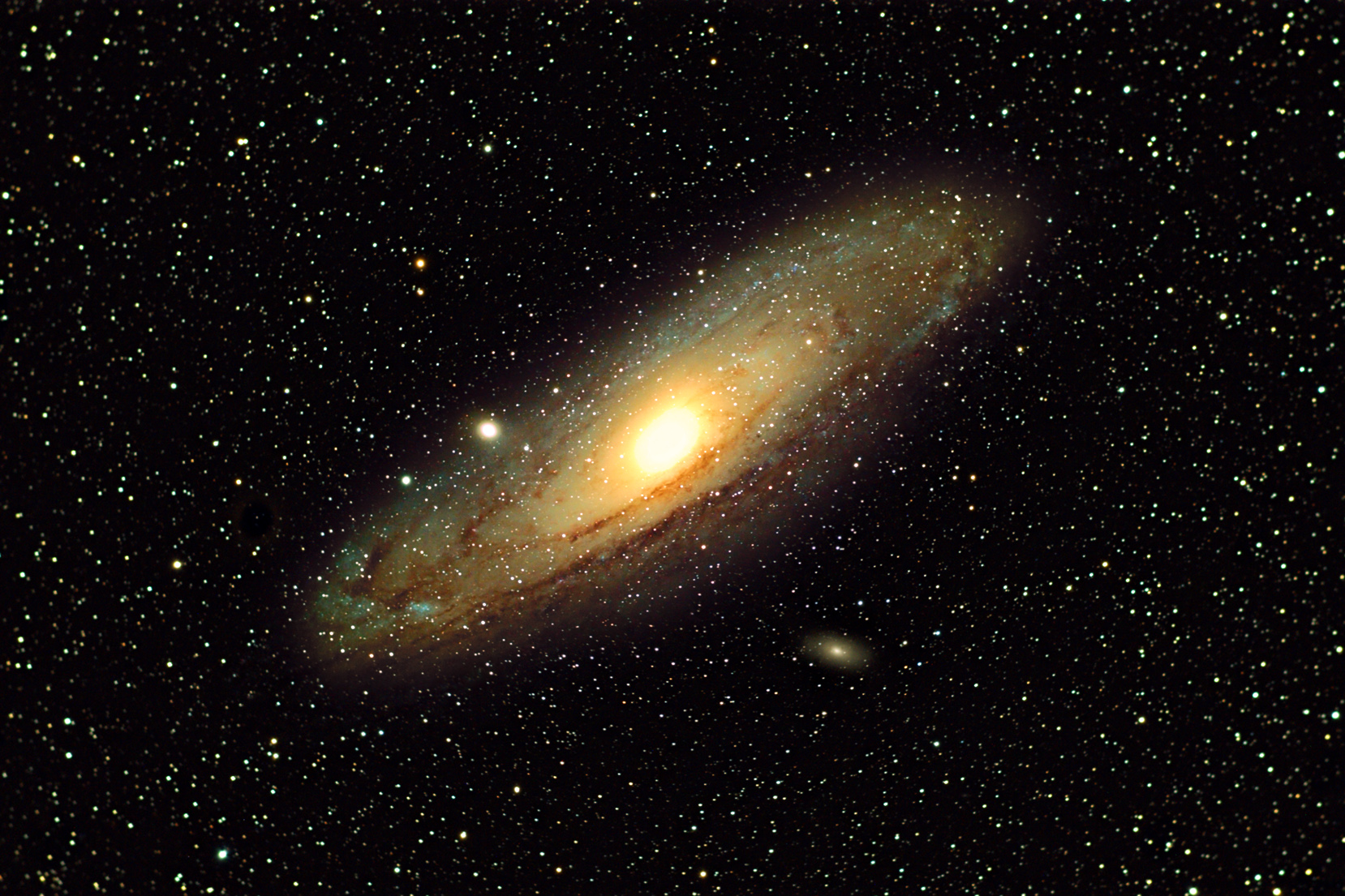
The Great Andromeda Galaxy (M31) and two of its satellite galaxies M31 (left) and M110. Image taken by Scott Anttila.
09/15/2020 – Ephemeris – The dolphin and the arrow, small summer constellations
This is Bob Moler with Ephemeris for Tuesday, September 15th. Today the Sun will be up for 12 hours and 30 minutes, setting at 7:52, and it will rise tomorrow at 7:23. The Moon, 2 days before new, will rise at 6:01 tomorrow morning.
Located below the eastern edge of the Summer Triangle of three of the brightest stars in the sky, which is nearly overhead in our sky at 10 p.m., is the tiny constellation of Delphinus the dolphin. Delphinus’ 6 stars in a small parallelogram with a tail, really does look like a dolphin leaping out of the water. The parallelogram itself has the name Job’s Coffin. The origin of this asterism or informal constellation is unknown. Of the dolphin itself: the ancient Greeks appreciated this aquatic mammal as we do, and told stories of dolphins rescuing shipwrecked sailors. There’s another tiny constellation to the right of Delphinus, Sagitta the arrow a small thin group of 5 stars, which represents Cupid’s dart.
The event times given are for the Traverse City/Interlochen area of Michigan. They may be different for your location.
Addendum

Delphinus and Sagitta finder animation. Created using Stellarium and GIMP.

