Archive
01/25/2021 – Ephemeris – Why is the sky with the full moon gray?
This is Bob Moler with Ephemeris for Monday, January 25th. Today the Sun will be up for 9 hours and 33 minutes, setting at 5:42, and it will rise tomorrow at 8:07. The Moon, 3 days before full, will set at 6:46 tomorrow morning.
The bright Moon is dominating the night sky now. Only the brighter stars are visible, with the fainter stars and constellations overwhelmed by the bright moonlit sky. It seems odd, but the gray clear moonlit sky that we see with our eyes is as blue as the daytime sky. Only it’s too dim to register on the cones in our retinas that can see color. The rods in our retinas can pick up light much better, especially if it is in the green part of the spectrum. We are pretty much insensitive to red at low light levels and color-blind as well. Star color is also subtle, and can be seen only in brighter stars. The colors run, from the hottest stars to the coolest: blue, white, yellow, orange and red. Also, there is a color shift at night. Stars with the same temperature as the Sun appear yellowish.
The event times given are for the Traverse City/Interlochen area of Michigan. They may be different for your location.
01/22/2021 – Ephemeris – Mercury will be at it’s greatest angular distance from the Sun in the evening tomorrow
This is Ephemeris for Friday, January 22nd. Today the Sun will be up for 9 hours and 26 minutes, setting at 5:37, and it will rise tomorrow at 8:10. The Moon, 2 days past first quarter, will set at 3:43 tomorrow morning.
The planet Mercury, tomorrow night, will reach its greatest elongation or separation east of the Sun. It will be visible low in the southwestern sky around and for a half hour or so after 6 pm. Mercury, being the closest planet to the Sun, never strays far from it. Here in the Northern Hemisphere never see it outside of twilight. It’s apparent angular separation from the Sun will be 18.6 degrees. We will have a somewhat better view of an evening appearance of Mercury in May when Venus will again be in our evening sky and near Mercury. Mercury takes 88 days on to orbit the Sun. However, we are viewing it from another moving planet. So it takes about 116 days for Mercury to appear to orbit the Sun from our vantage point.
The event times given are for the Traverse City/Interlochen area of Michigan. They may be different for your location.
Addendum
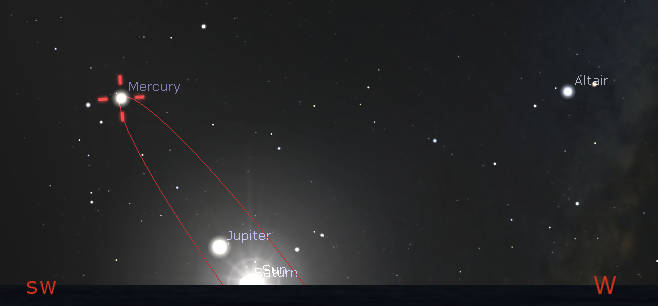
Mercury at greatest elongation at sunset January 23, 2021. It also shows Mercury’s orbit that evening plus Jupiter. Saturn is actually behind the Sun that evening as can be seen by the over display of the labels for Saturn and the Sun. Created using Stellarium by removing Earth’s atmosphere.
01/15/2021 – Ephemeris – The constellation Lepus the hare
This is Bob Moler with Ephemeris for Friday, January 15th. Today the Sun will be up for 9 hours and 12 minutes, setting at 5:28, and it will rise tomorrow at 8:15. The Moon, 2 days past new, will set at 8:17 this evening.
Orion, the central winter constellation is seen in the southern sky this evening. He is a hunter, as artists depict him, he is preoccupied with the charge of Taurus the bull from the upper right. At Orion’s feet, and unnoticed by him is the small constellation of Lepus the hare. It’s very hard to see a rabbit in its eight dim stars: however, I can see a rabbit’s head ears and shoulders. A misshapen box is the head and face of this critter facing to the left. His ears extend upwards from the upper right star of the box, and the bend forward a bit. Two stars to the right of the box and a bit farther apart hint at the front part of the body. In Lepus telescopes can find M79, a distant globular star cluster, one of the few visible in the winter sky.
The event times given are for the Traverse City/Interlochen area of Michigan. They may be different for your location.
Addendum
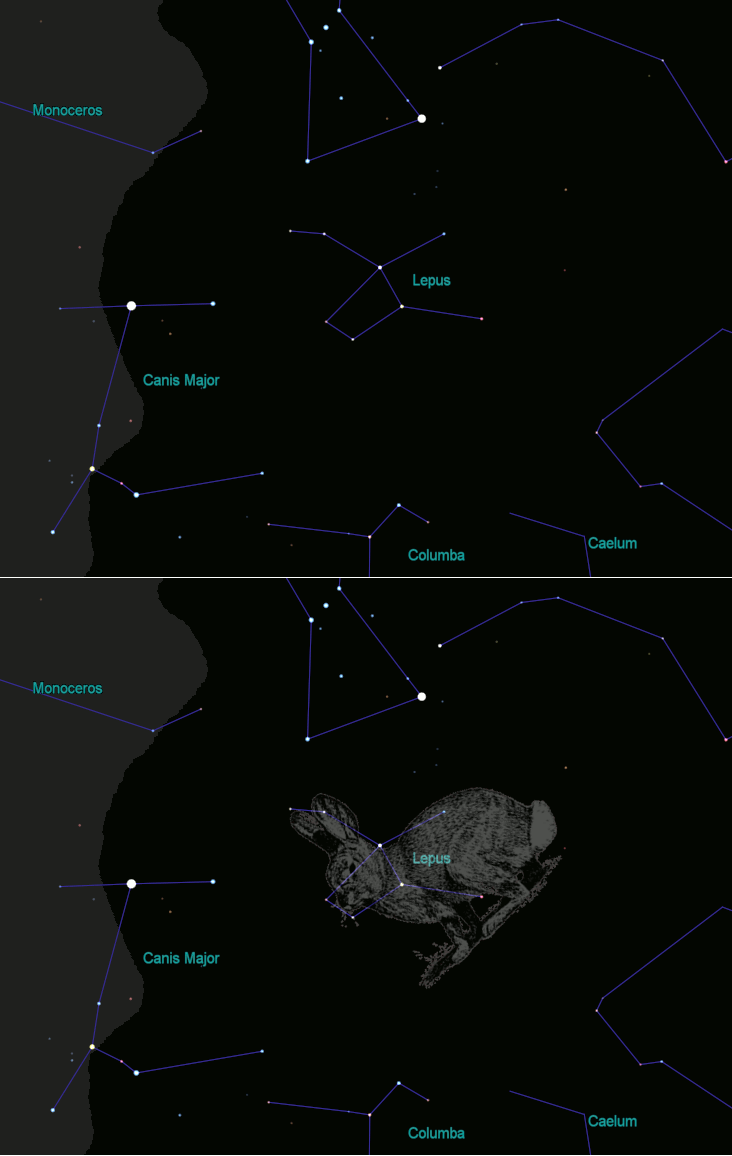
My view of Lepus the hare. Star field from Cartes du Ciel. Desert Cottontail drawing from Arizona-Senora Desert Museum website. Superimposed with GIMP.

An animation showing the stars, constellations and artwork of Lepus, Orion and Taurus from Stellarium. The constellation lines suggest a rabbit ears TV antenna. Created using Stellarium and GIMP.
01/12/2021 – Ephemeris – The celestial river Eridanus
This is Bob Moler with Ephemeris for Tuesday, January 12th. Today the Sun will be up for 9 hours and 7 minutes, setting at 5:25, and it will rise tomorrow at 8:17. The Moon, 1 day before new, will rise at 8:58 tomorrow morning.
One of the more obscure constellations around is Eridanus, which depicts a river. The river starts near the lower right corner of Orion, near the bright star Rigel and flows to the right then down near the southwestern horizon, then it meanders along the horizon to the south before turning below the horizon. One has to travel to the far south to see the southern terminus of the river, the bright star Achernar. Writers over the ages have seen here the Nile and the Earth circling river Ocean of the flat earth days. Achernar is actually two stars, the brightest was discovered to be the flattest star known, due to its rapid spin. The dimensions of Achernar A has been determined to be twice as wide across its equator than from pole to pole. It’s 139 light years away.
The event times given are for the Traverse City/Interlochen area of Michigan. They may be different for your location.
Addendum
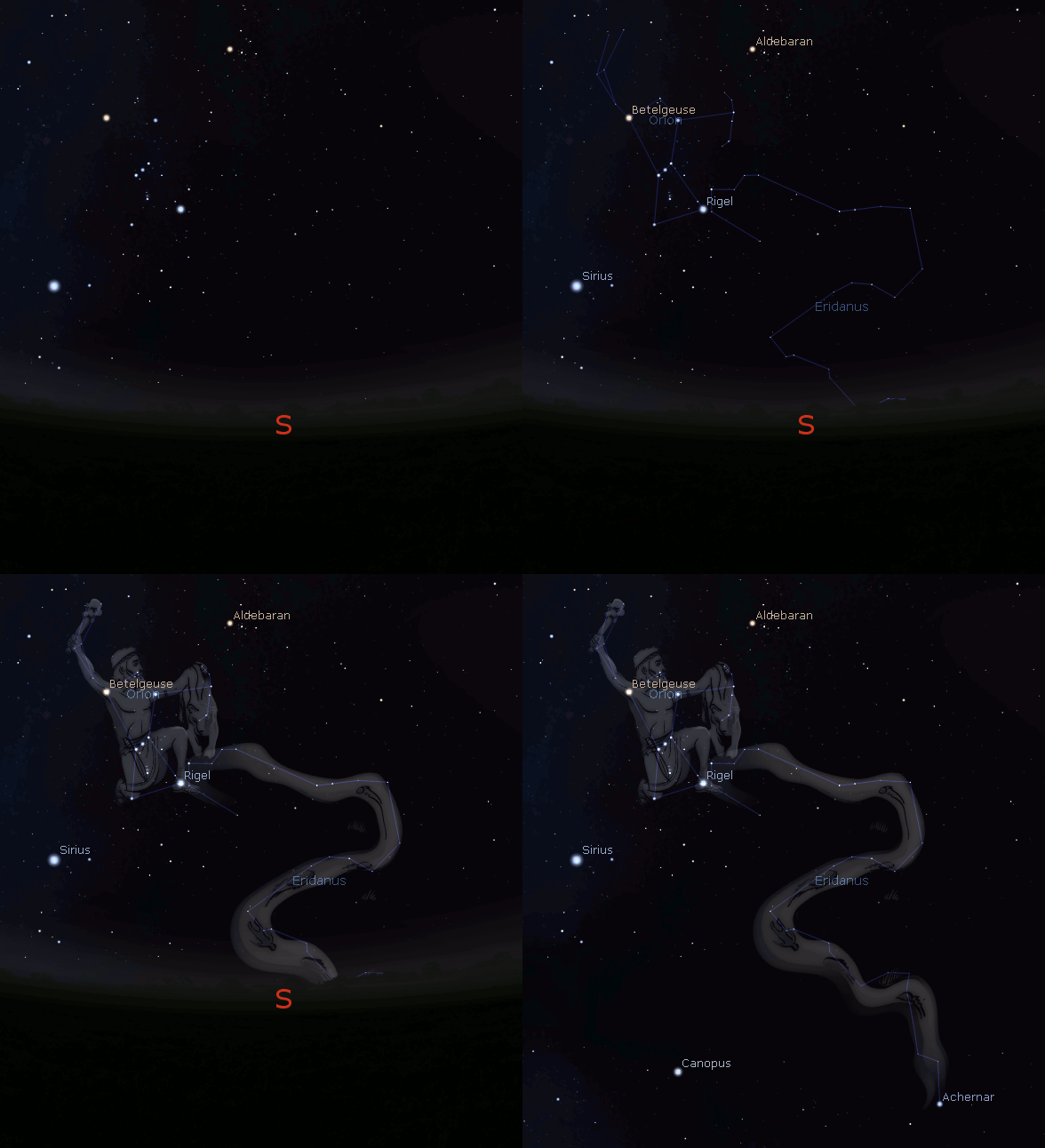
An animation of the constellation Eridanus which is a river that flows from Rigel in Orion to the star Achernar below our southern horizon at latitude 45 degrees north. Create using Stellarium and GIMP.
01/11/2021 – Ephemeris – Procyon, the before the Dog Star
This is Bob Moler with Ephemeris for Monday, January 11th. Today the Sun will be up for 9 hours and 5 minutes, setting at 5:23 pm, and it will rise tomorrow at 8:17 am. The Moon, 2 days before new, will rise at 8:05 tomorrow morning.
Visible low in the east at 8 p.m. appears the star Procyon. To its right and below is Sirius the brightest night-time star. Procyon is the bright star in the constellation Canis Minor, or lesser dog. I can find only one other star in Canis Minor. Perhaps it’s a hot dog. If Sirius, in Canis major is the Dog Star then Procyon should be the Little Dog Star. However, Procyon is an interesting name. It means “Before the dog”, which is an allusion to the fact that Procyon, though east of Sirius actually rises before it. This is due to Procyon’s more northerly position. This effect doesn’t work south of the equator, however. Sirius will rise at about 7:30 tonight. Procyon is a star much like Sirius but is 32% farther away. It’s 11.4 to Sirius’ 8.6 light years away.
The event times given are for the Traverse City/Interlochen area of Michigan. They may be different for your location.
Addendum
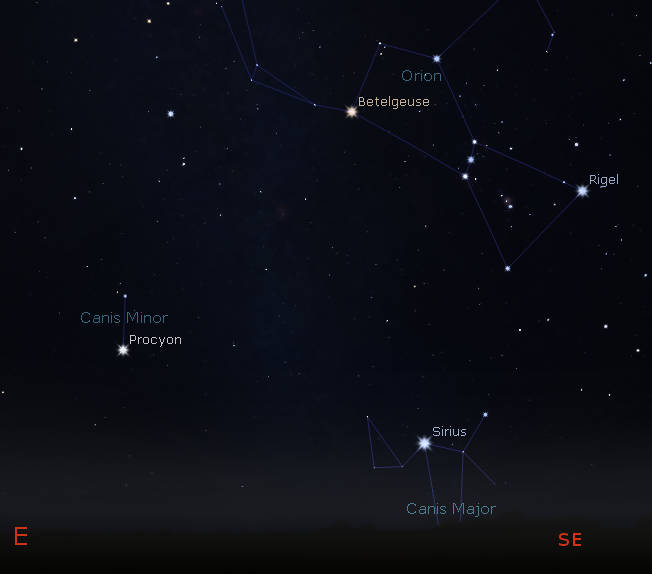
Orion and his hunting dogs in early winter (8 pm, January 11, 2021) showing that Procyon does rise before Sirius.
12/11/2020 – Ephemeris – More on the Geminid meteor shower peaking this weekend
This is Ephemeris for Friday, December 11th. Today the Sun will be up for 8 hours and 51 minutes, setting at 5:02, and it will rise tomorrow at 8:11. The Moon, 3 days before new, will rise at 5:33 tomorrow morning.
This weekend and specifically Sunday evening to Monday morning the Geminid meteor shower will be at its peak, with up to 120 meteors appearing an hour in the early morning hours of Monday. The meteors will appear to come from near the star Castor, the northernmost star of the constellation of Gemini the twins. Castor and Pollux are the namesake stars at the head of Gemini. While they will seem to come from a specific point in the sky, they will be seen all over the sky, and be traced back to the point. They are coming in on parallel trajectories, just as straight railroad tracks recede to a point in the distance. Let’s hope for clear skies. The meteor shower lasts all night.
The event times given are for the Traverse City/Interlochen area of Michigan. They may be different for your location.
Addendum
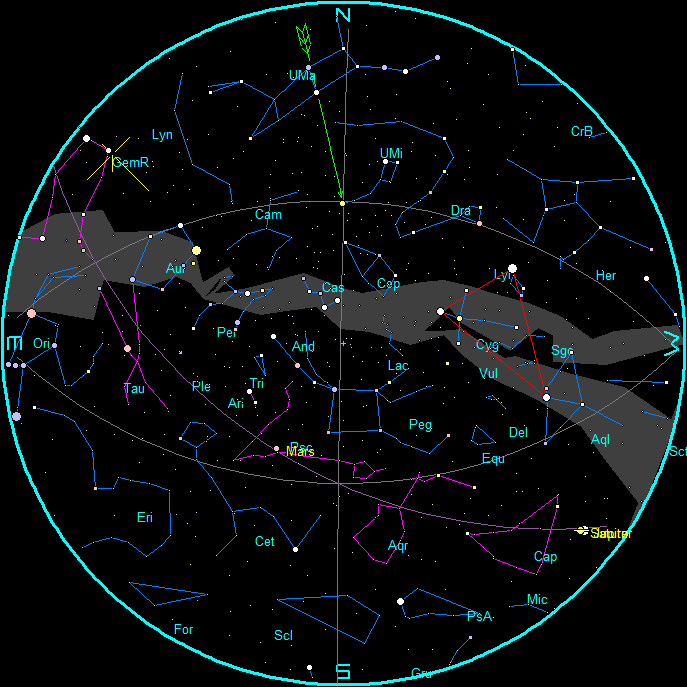
Star Chart for 7 pm, or about 2 hours after sunset. December 13, 2020. Click on image to enlarge. GemR is the location of the Geminid radiant low in the northeast. Click on image to enlarge. Created using my LookingUp program.
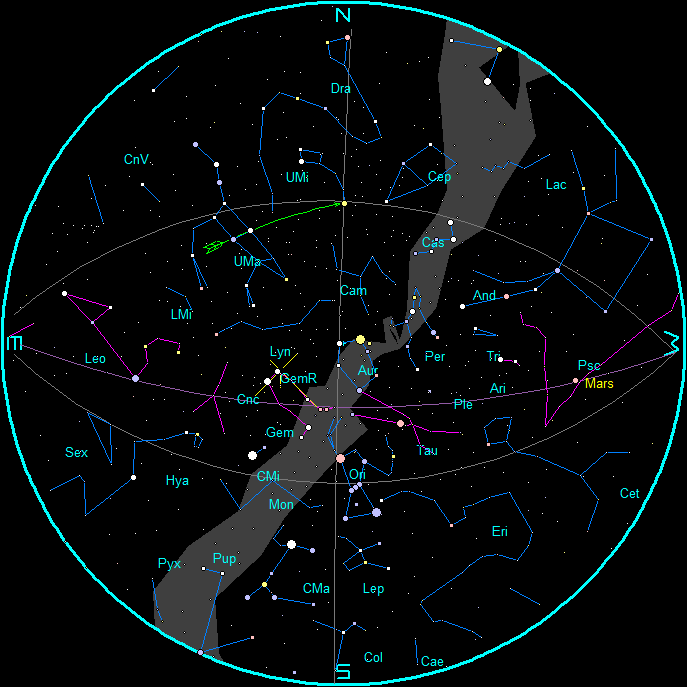
All sky chart of the Geminid Radiant 1 am Dec 14, 2020. GemR is the location of the Geminid radiant nearly overhead in the southeast.
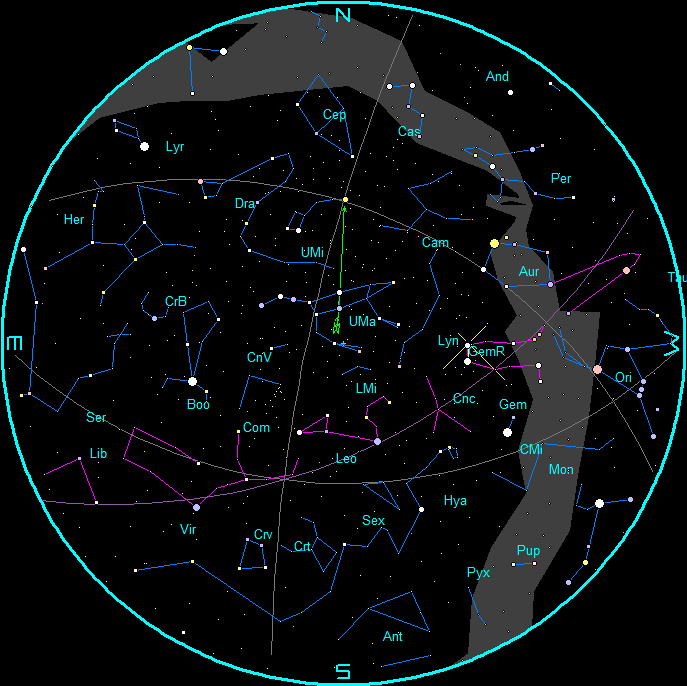
All sky chart of the Geminid Radiant 6 am Dec 14, 2020. GemR is the location of the Geminid radiant in the west.
12/10/2020 – Ephemeris – The Geminid meteor shower will reach its peak Sunday evening and Monday Morning December 13/14, 2020
This is Bob Moler with Ephemeris for Thursday, December 10th. Today the Sun will be up for 8 hours and 52 minutes, setting at 5:02 pm which will signal the beginning of the Jewish feast of Chanukah. Sunrise tomorrow will be at 8:10 am. The Moon, 3 days past last quarter, will rise at 4:13 tomorrow morning.
The Geminid meteor shower, the most active meteor shower of the year will be at its most active Sunday night and Monday morning. This year the Moon will be new on Monday and won’t interfere. Our problem is that it’s December, one of the cloudiest months of the year. The Geminid meteors will seem to come from near the star Castor, the second brightest star in Gemini. The actual source of the meteors is the asteroid or rock comet Phaethon. If it is an asteroid it comes closest to the Sun of any asteroid. It has been observed by spacecraft shedding dust when it’s heated near the Sun. It is probably a dead comet.
The event times given are for the Traverse City/Interlochen area of Michigan. They may be different for your location.
Addendum
Star Chart for 7 pm, or about 2 hours after sunset. December 13, 2020. Click on image to enlarge. Click on image to enlarge. Created using my LookingUp program.
All sky chart of the Geminid Radiant 1 am, or about 7 hours after sunset, Dec 14, 2020. Click on image to enlarge.
All sky chart of the Geminid Radiant 6 am, or about 2 hours before sunrise, Dec 14, 2020. Click on image to enlarge.
12/07/2020 – Ephemeris – Looking forward to the best of winter: Orion
This is Ephemeris for Monday, December 7th. Today the Sun will be up for 8 hours and 55 minutes, setting at 5:02, and it will rise tomorrow at 8:07. The Moon, at last quarter today, will rise at 12:25 tomorrow morning.
Orion, the central constellation of the winter evening sky will be completely risen by 9 this evening. Then it can be seen low in the east-southeast it’s upright rectangle of stars tilted to the left. The topmost star to the left in this rectangle is the famous red giant star Betelgeuse, which is reportedly dimming again. It’s in Orion’s shoulder. In his other shoulder is Bellatrix, a name known to Harry Potter fans. In his knees are Rigel, a blue-white giant star and Saiph. In the center of the rectangle are three stars in a straight line, now almost vertically arranged, Orion’s belt. And below his belt what seem to be three more stars, his sword. In the center of the sword stars can be found, with binoculars or telescope, Orion’s most famous feature, the Great Orion Nebula.
The event times given are for the Traverse City/Interlochen area of Michigan. They may be different for your location.
Addendum
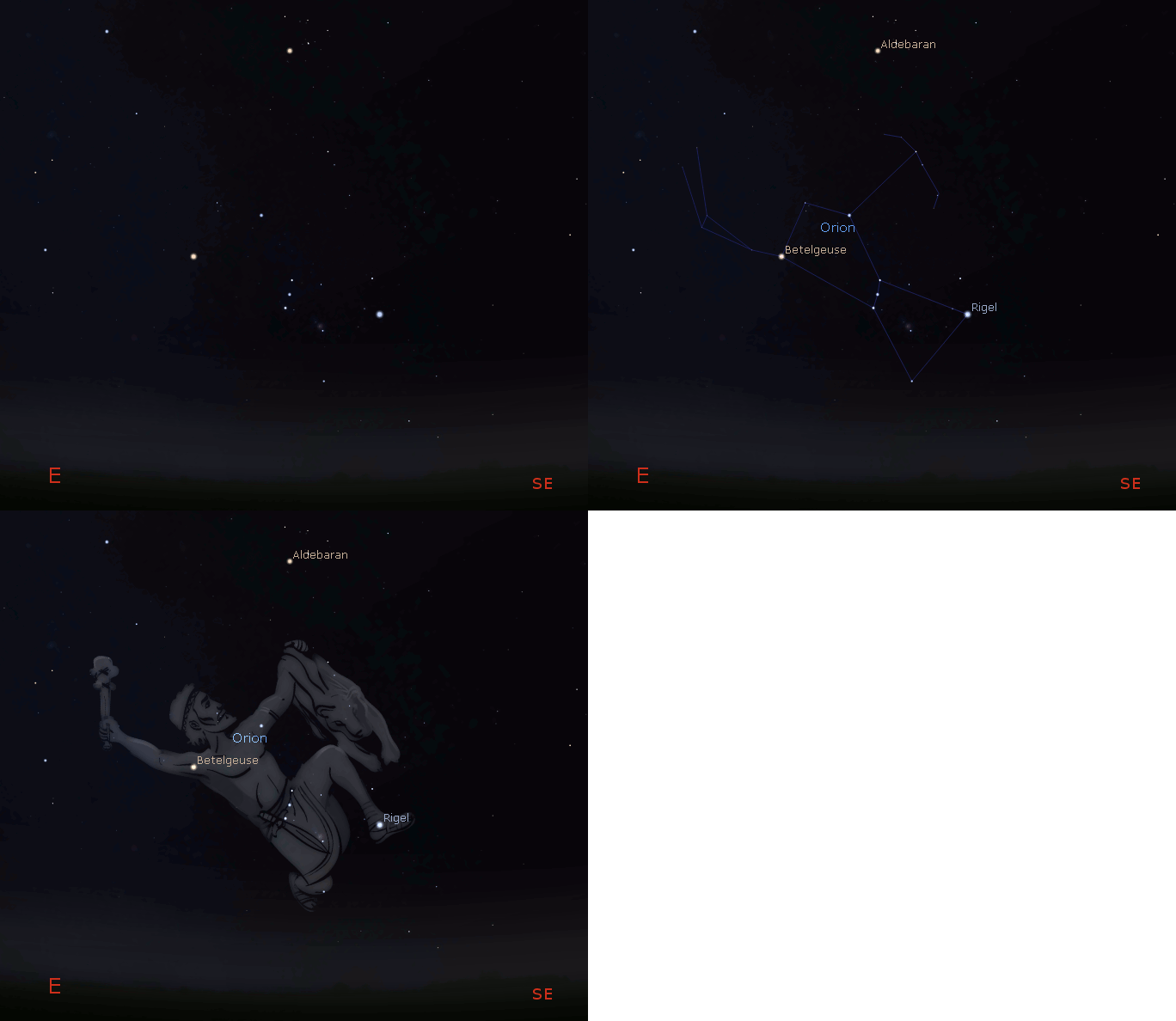
Orion early December finder animation for 9 pm December 7th. Created using Stellarium and GIMP.
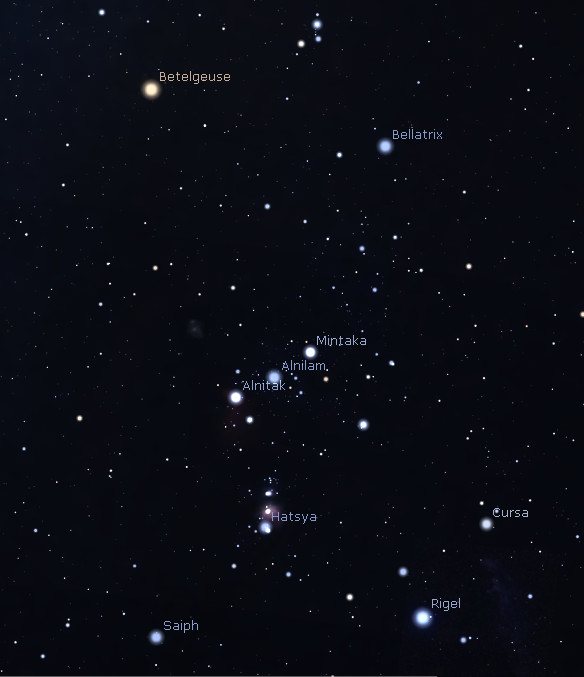
Orion’s named stars including the belt stars. Cursa, though named belongs to the neighboring constellation Eridanus the river. Created using Stellarium.
11/25/2020 – Ephemeris – Let’s look for the naked-eye planets for this week
This is Ephemeris for Wednesday, November 25th. Today the Sun will be up for 9 hours and 12 minutes, setting at 5:06, and it will rise tomorrow at 7:54. The Moon, 4 days past first quarter, will set at 3:58 tomorrow morning.
Let’s look for the naked-eye planets for this week. Jupiter and Saturn are both low in the southwestern sky from 7 to 8 pm. Jupiter is the very bright one. Above and left will be dimmer Saturn. They are slowly closing, so they will cross paths on the evening of December 21st and be seen in the same telescope field that evening. Jupiter will set first tonight at 8:41 with Saturn following at 8:56. Off in the southeast at that hour will be Mars above the bright gibbous Moon tonight. Mars’ distance is increasing to 55.6 million miles (89.6 million kilometers) away. Mars will set at 3:47 tomorrow morning. Brilliant Venus will rise at 5:21 am in the east-southeast as it retreats slowly toward, but actually around the back of the Sun.
The event times given are for the Traverse City/Interlochen area of Michigan. They may be different for your location.
Addendum
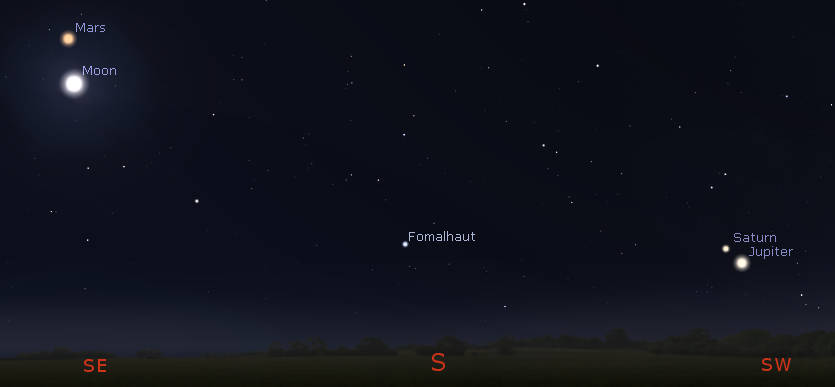
Evening planets and the Moon for 7 pm tonight November 25, 2020. Click on the image to enlarge. Created using Stellarium.
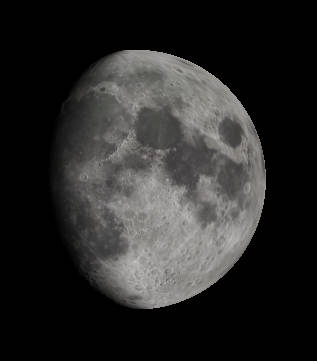
The gibbous Moon as it might be seen in binoculars this evening at 7 pm November 25, 2020. Created using Stellarium.
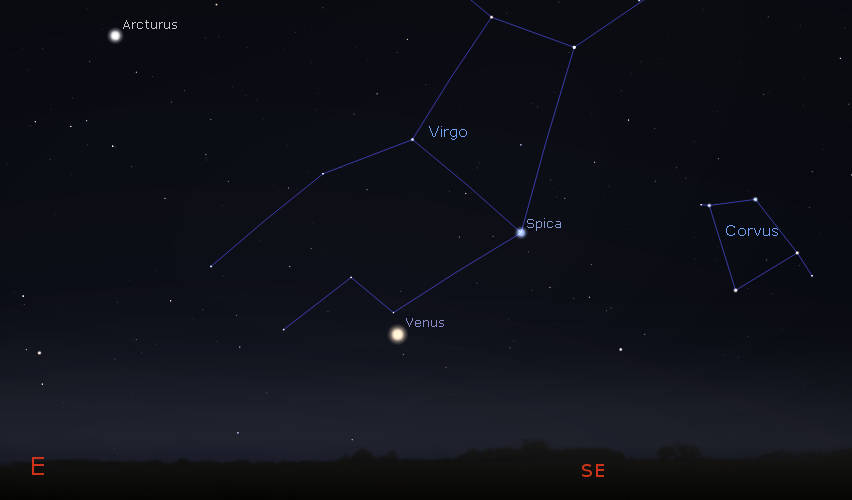
Venus and the morning constellations at 6:30 am tomorrow November 26, 2020. Created using Stellarium.
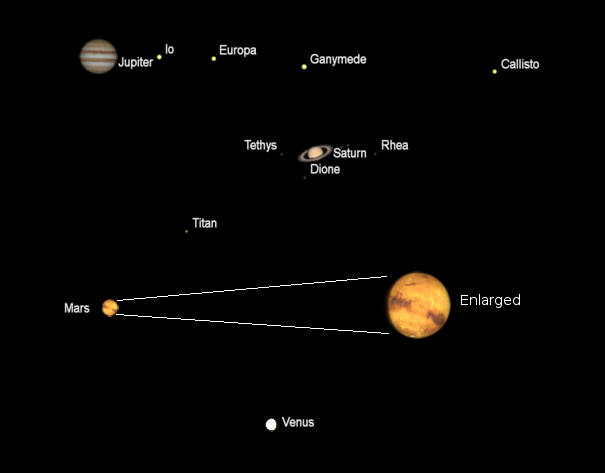
The planets as seen in a telescope (north up) with the same magnification for the night of November 25/26, 2020. Times of the display are: Jupiter and Saturn, 7 pm; Mars, 10 pm; Venus, 6:30 am. Apparent diameters: Jupiter, 34.76″; Saturn, 15.76″, rings, 36.72″; Mars, 15.45″, and Venus 11.85″. Mars also displays an enlargement showing surface detail. Mars was closest to the Earth this go-a-round on October 6. The ” symbol means seconds of arc (1/3600th of a degree.) Created using Cartes du Ciel (Sky Charts).
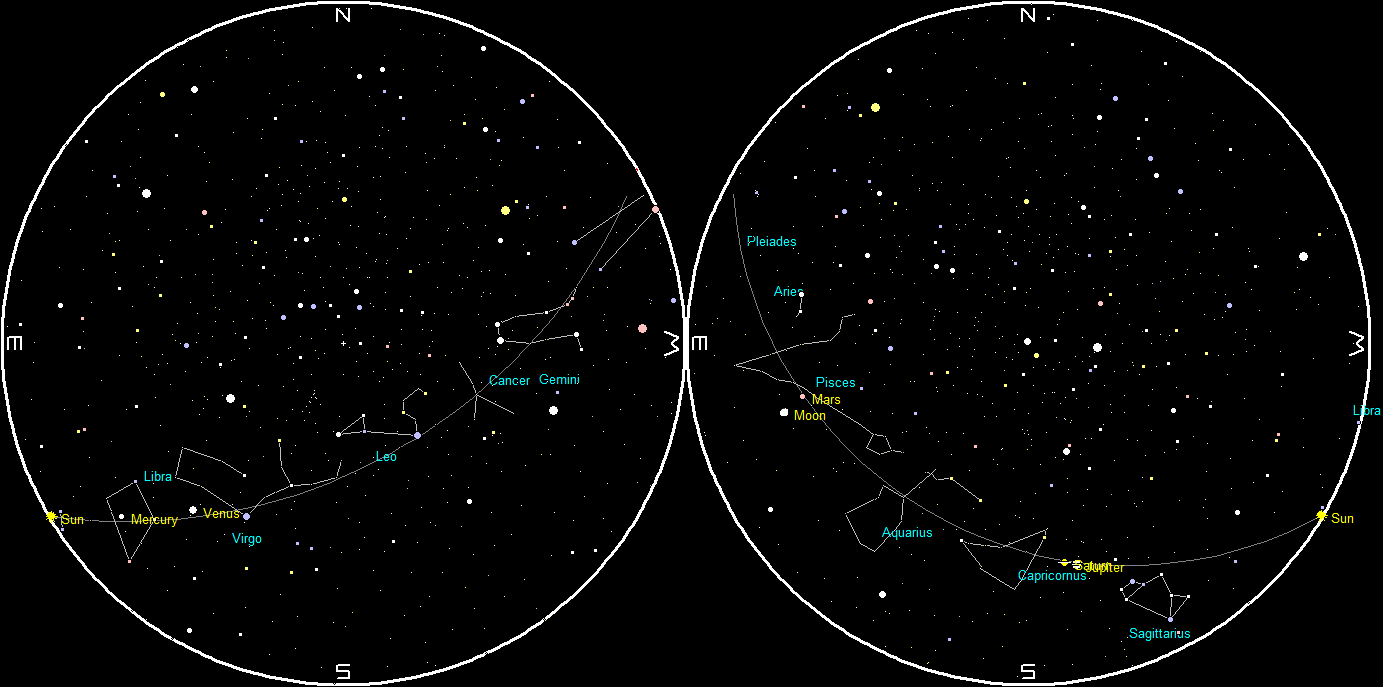
Planets and the Moon at sunset and sunrise of a single night starting with sunset on the right on November 25, 2020. The night ends on the left with sunrise on the 26th. I’m afraid that the labels for Jupiter and Saturn will overlap, since the planets are getting very close. Click on the image to enlarge. Created using my LookingUp program.
11/19/2020 – Ephemeris – Looking at the crescent Moon tonight
This is Ephemeris for Thursday, November 19th. Today the Sun will be up for 9 hours and 24 minutes, setting at 5:10, and it will rise tomorrow at 7:47. The Moon, 2 days before first quarter, will set at 9:31 this evening.
Tonight the Moon shows two seas. Easiest to spot is Mare Crisium or the Sea of Crises. It is a large gray basin near the edge. It is easily spotted in binoculars. Because it’s near the Moon’s limb or edge it is foreshortened into an ellipse, with the long axis running north and south. In actuality, it is elliptical with the long axis east and west. It looks funny on a geologic map of the whole moon or a Moon globe. Its dimensions are 345 by 375 miles (570 by 620 kilometers). It’s really a crater as are all seas whose impact asteroid reached down to the Moon’s magma and caused lava to well up to produce the flat floor. When the sunlight is low on the sea telescopes show wrinkle ridges that appear where successive lava flows have stopped and solidified.
The event times given are for the Traverse City/Interlochen area of Michigan. They may be different for your location.
Addendum
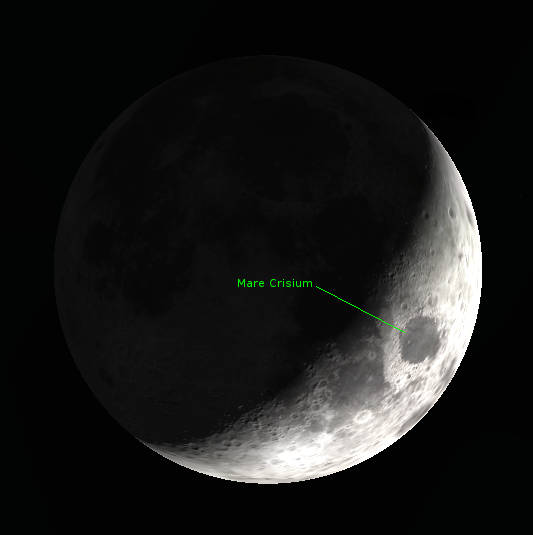
Crescent Moon with pointer to Mare Crisium at 8 pm tonight, November 19, 2020.
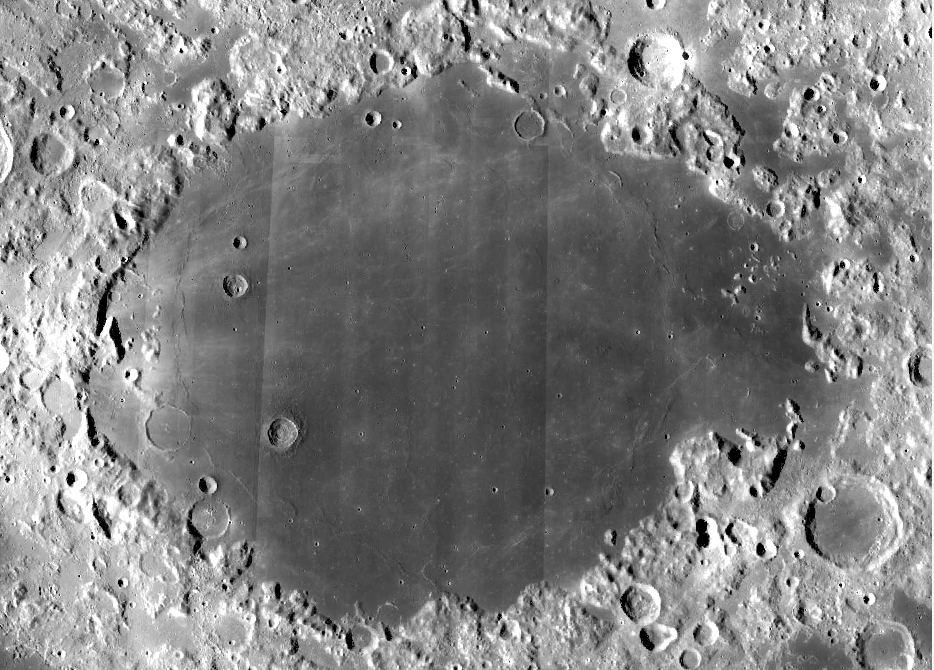
Mare Crisium from overhead with Lunar Reconnaissance Orbiter. The vertical lines are due to the north-south scans by the polar orbiting satellite. Credit: NASA/LRO/Virtual Moon Atlas.

