Archive

Archive for the ‘Planets’ Category

Ephemeris: 04/01/2026 – No fooling, we’re looking at the bright planets for this week

April 1, 2026 Leave a comment

This is Ephemeris for April Fools’ Day, Wednesday, April 1st. Today the Sun will be up for 12 hours and 47 minutes, setting at 8:10, and it will rise tomorrow at 7:21. The Moon, at full today, will rise at 8:06 this evening.

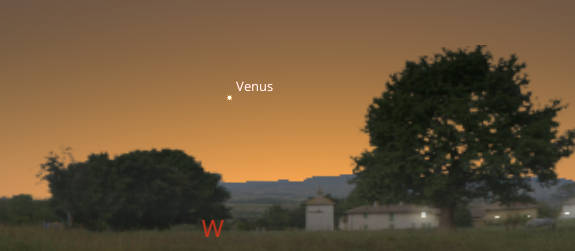
Let’s take our weekly look at the whereabouts of the naked-eye planets. By 8:40 PM tonight or about a half hour or so after sunset, Venus may be seen very low in the West. Binoculars or a telescope will show a very tiny disc on Venus, because it is pretty much behind the Sun, a good way from us. Over the next 7 months it will be moving closer to us and becoming much larger. Jupiter is the brilliant star-like object more than halfway up in the southwestern sky at 9 PM. At that time Venus will still be visible, setting at 9:57 PM. Mercury, Mars and Saturn are lined up just west of the Sun, but unfortunately are overwhelmed by bright morning twilight.

The astronomical event times given in this blog are for the Traverse City/Interlochen area of Michigan (Lat 44.7° N, Long 85.7° W; EST, UT – 5 hours) unless stated otherwise. Times will be different for other locations.

Addendum
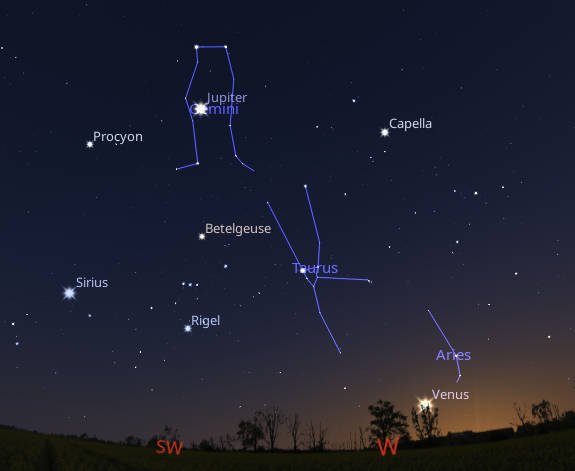
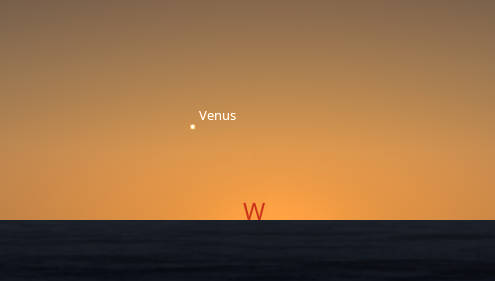
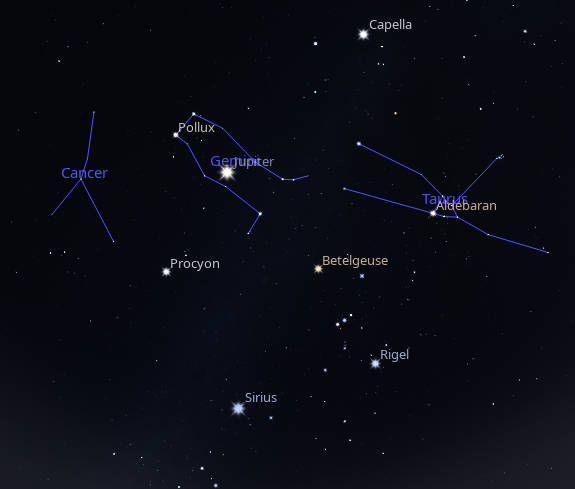
Jupiter and Venus with the constellations of the Zodiac at 9 PM.
Jupiter and Venus with the constellations of the Zodiac at 9 PM, or 50 minutes after sunset tonight, April 1, 2026. Created using Stellarium.
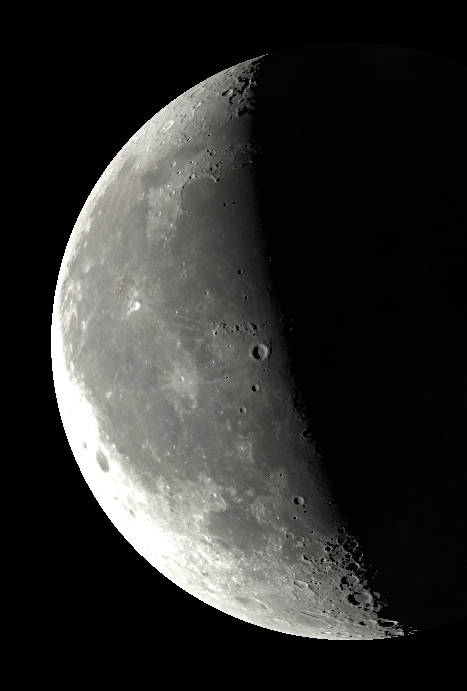
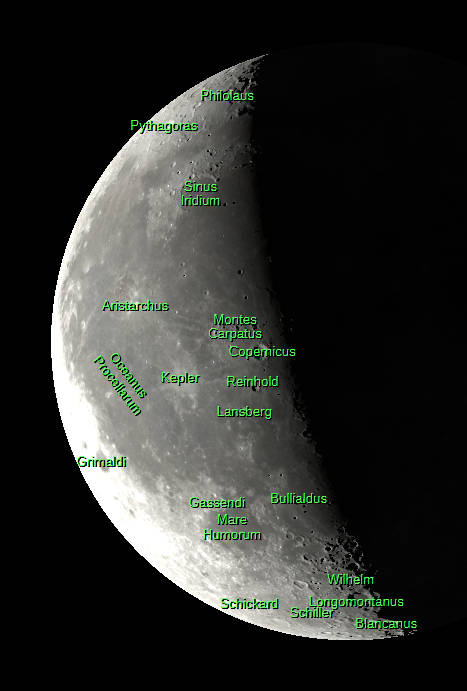
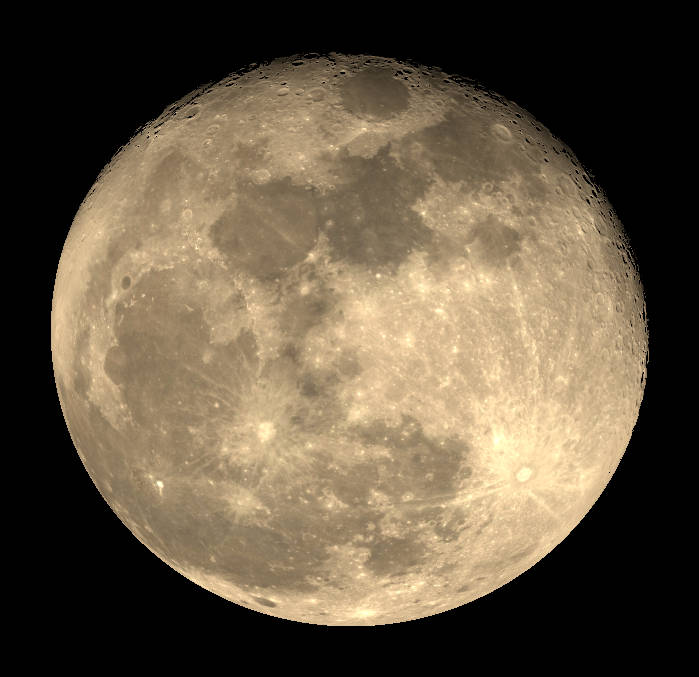
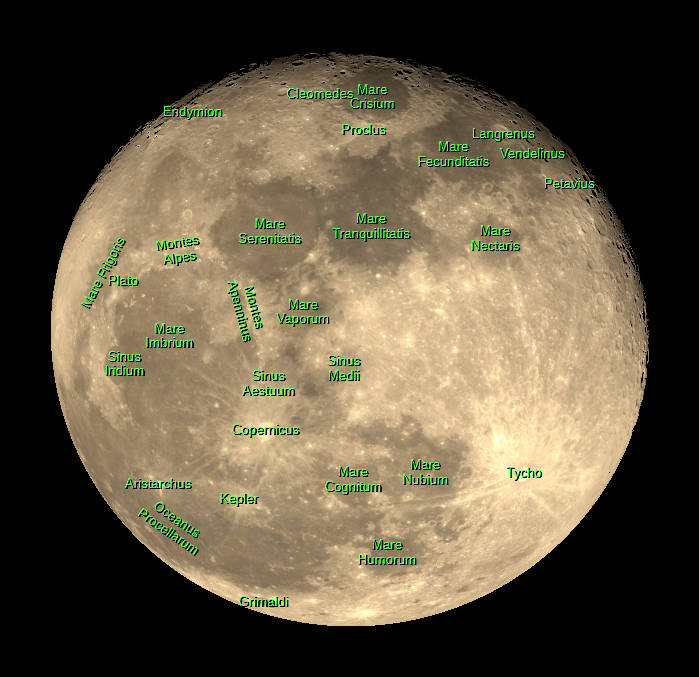
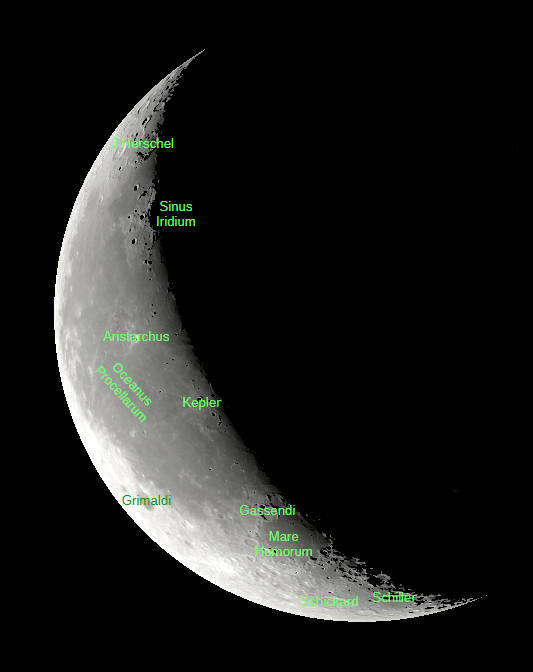
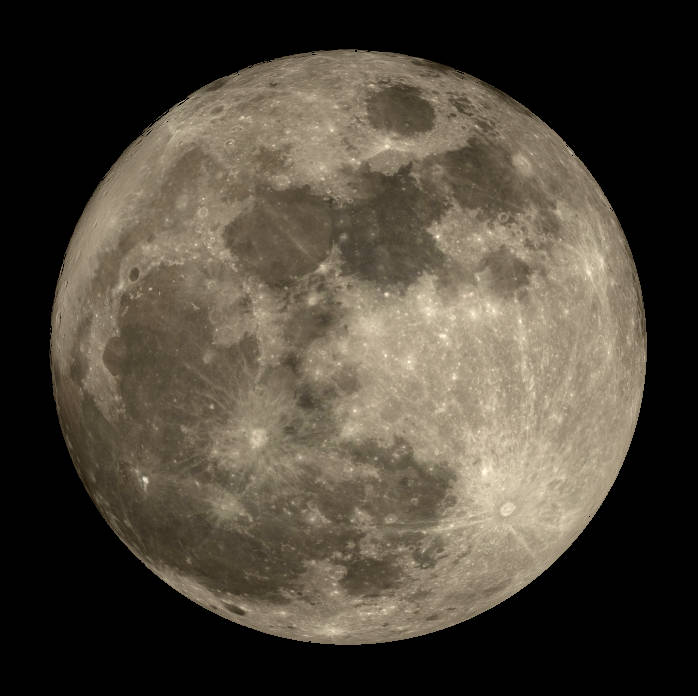
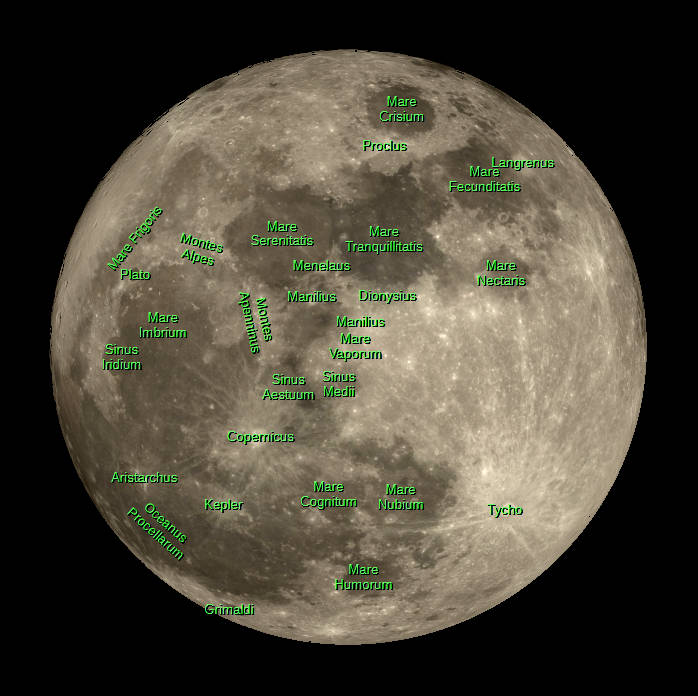
The full Moon as seen at 10 PM tonight, April 1, 2026. A view visible in small telescopes showing an image with and without selected features labeled. Created using Stellarium, LibreOffice Draw, and GIMP.
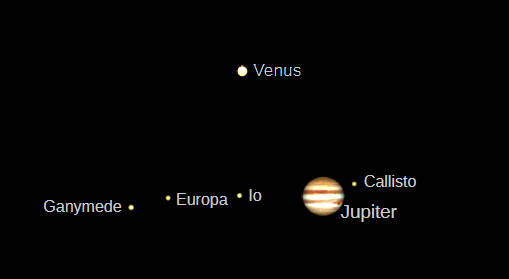
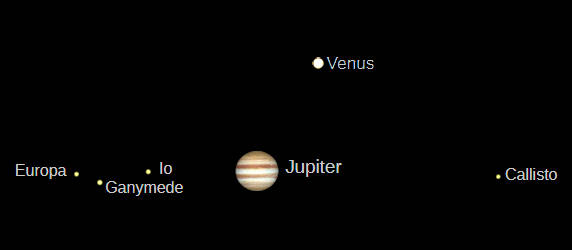
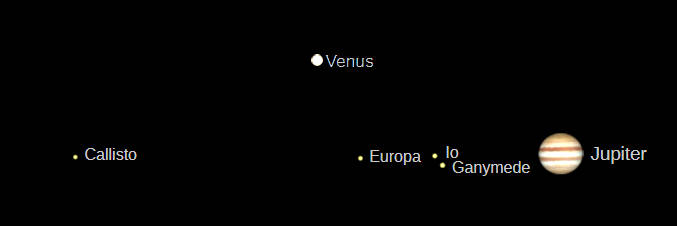
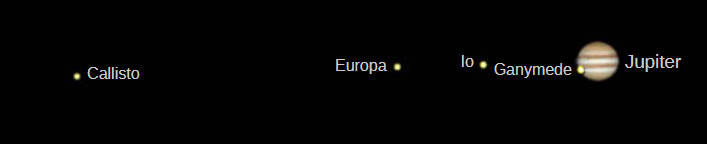
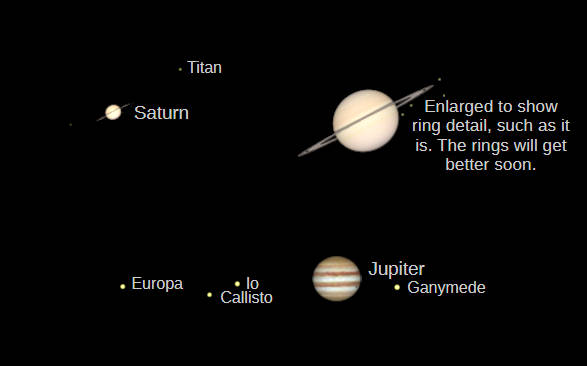
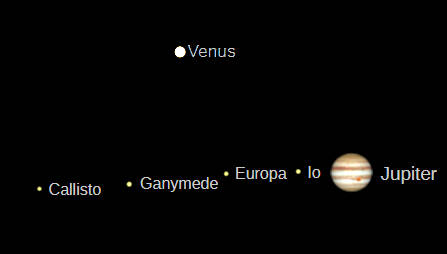
Telescopic Jupiter and Venus as they would be seen in a small telescope with the same magnification.
Telescopic Jupiter and Venus (north up) as they would be seen in a small telescope with the same magnification. Venus will be visible for a short time near the western horizon, while Jupiter is visible most of the night. Venus’ apparent diameter will be 10.7″, and be 93.6% illuminated. It’s on the far side of the Sun. Jupiter will be 38.8″ in diameter, with its moons shown here for 9 PM, tonight April 1st, 2026. The moons can shift noticably over an hour. The (”) symbol means seconds of arc, or 1/3600th of a degree. Created using Cartes du Ciel (Sky Charts), LibreOffice Draw and GIMP.
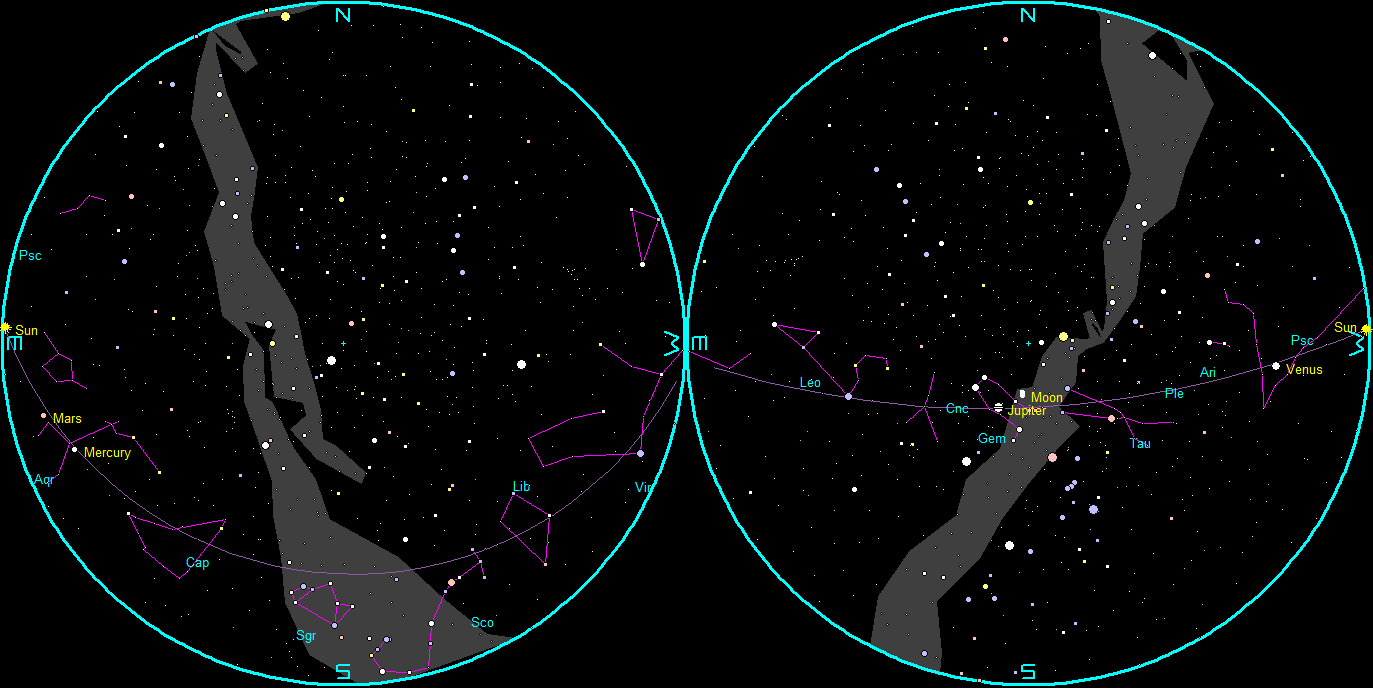
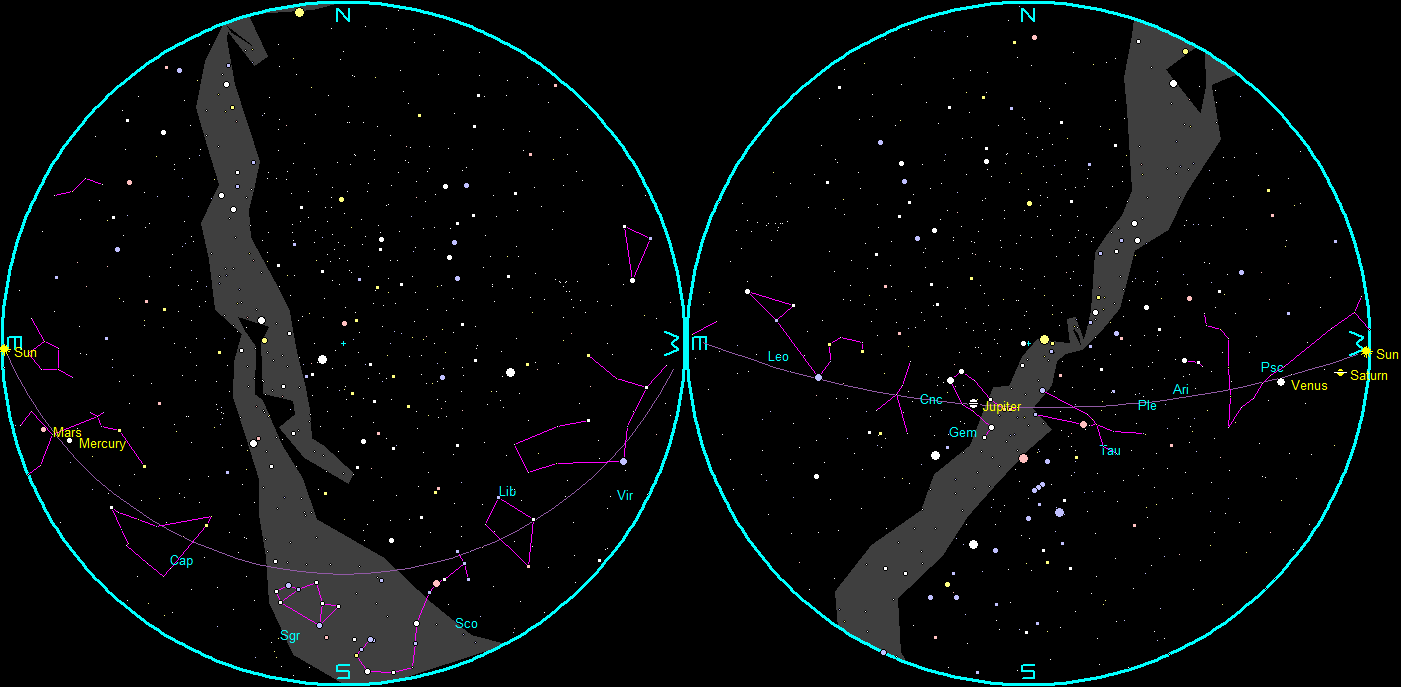
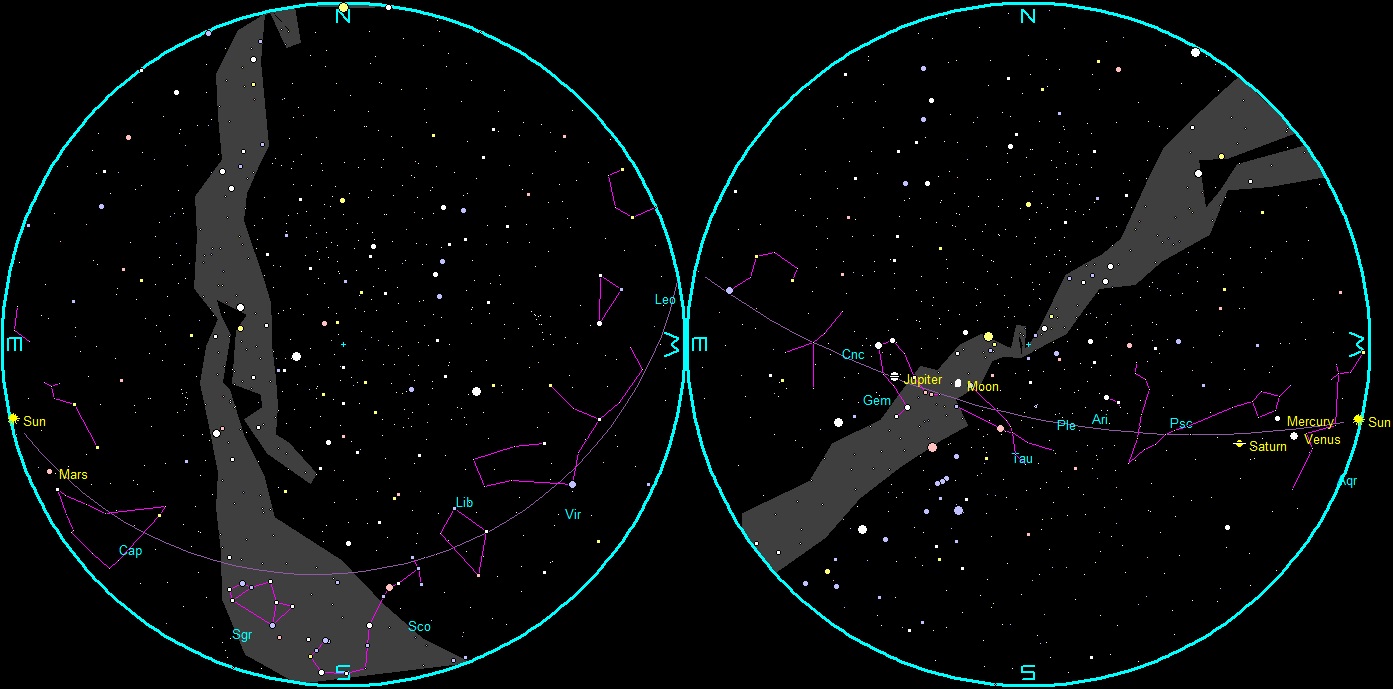
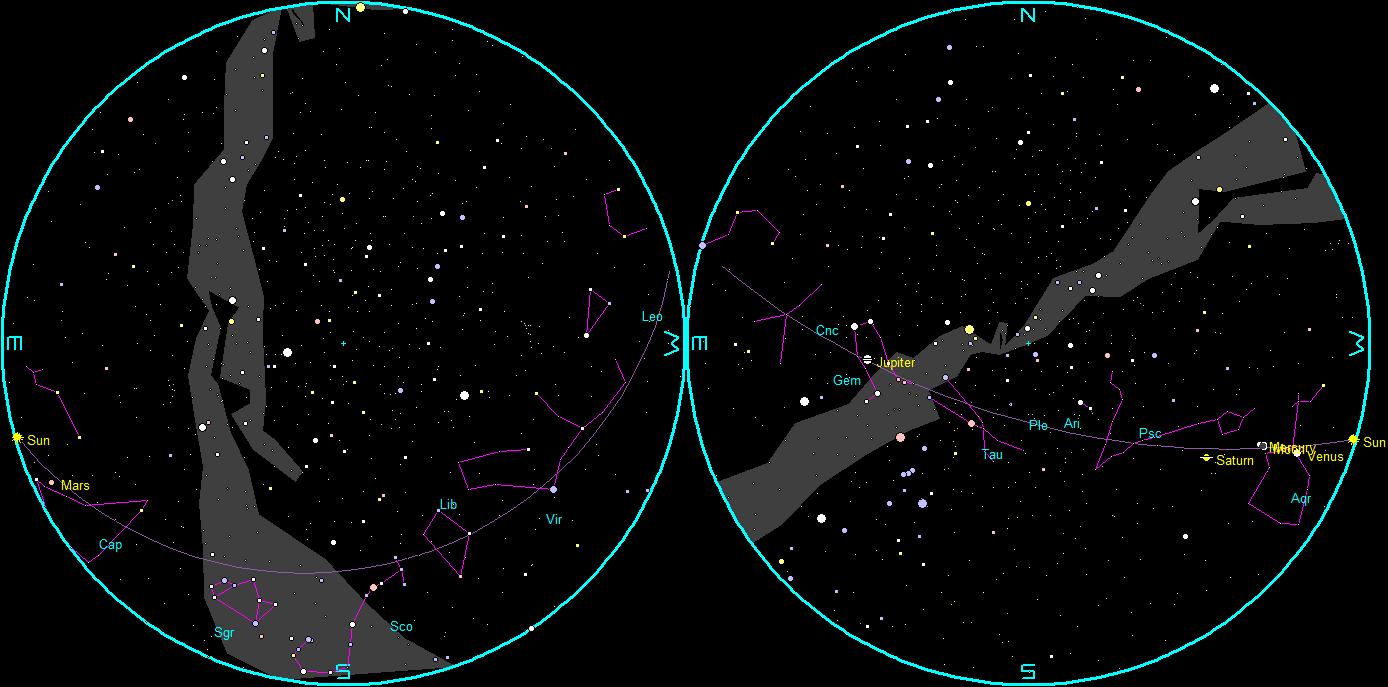
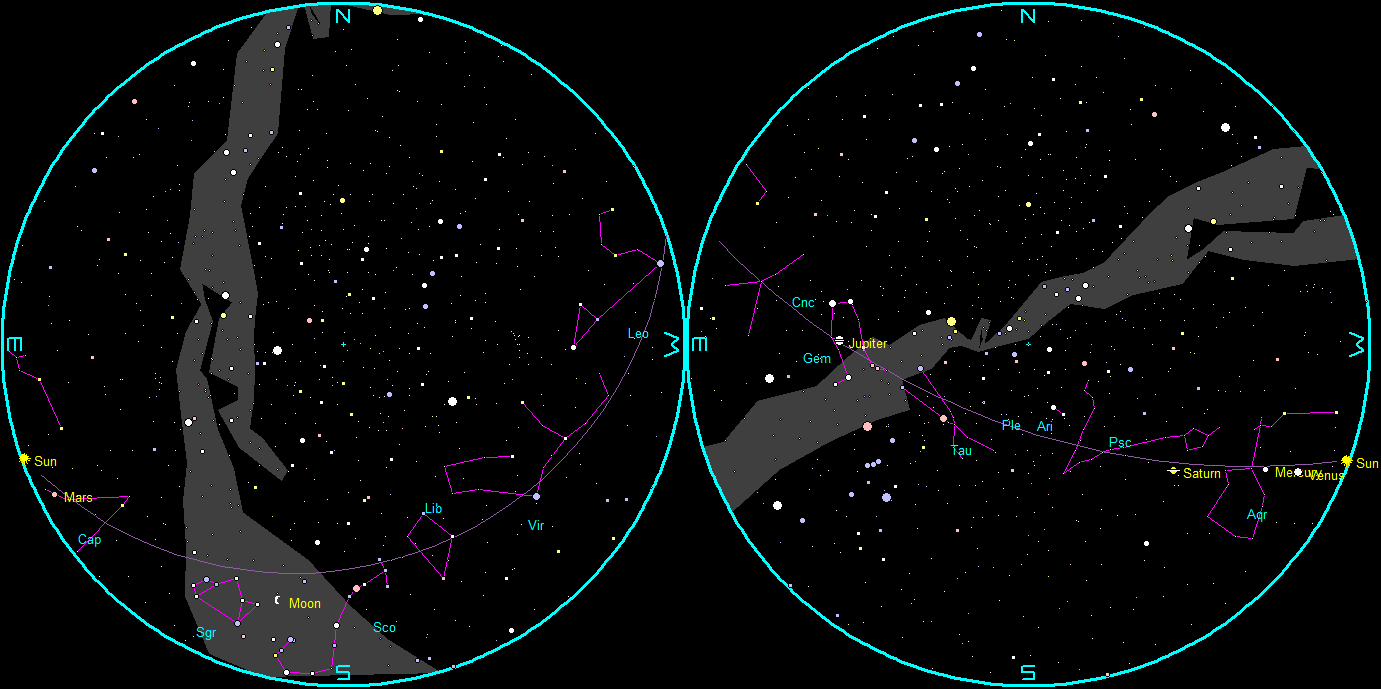
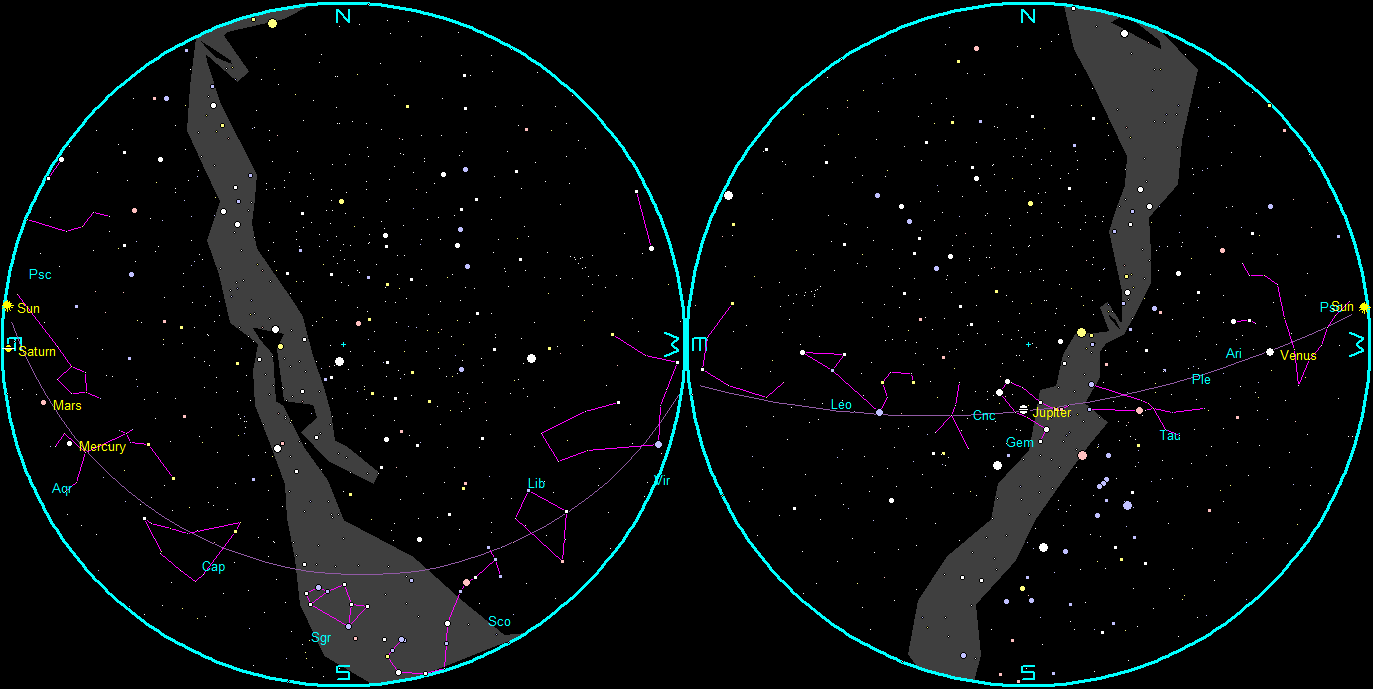
The naked-eye planets at sunset and sunrise on a single night.
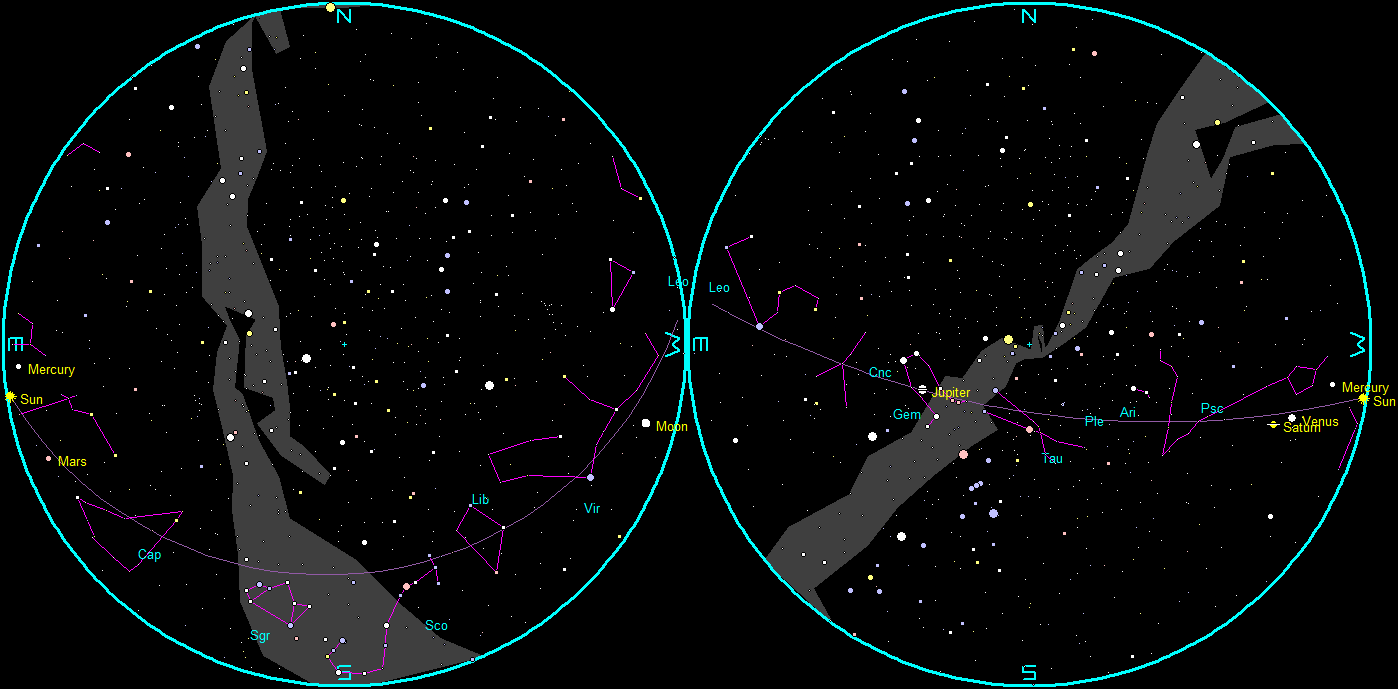
The naked-eye planets at sunset and sunrise on a single night, starting with sunset on the right on April 1, 2026. The night ends on the left with sunrise on the 2nd. The Moon is missing. It is full today but is south of the ecliptic, while we are viewing from a northerly location. So the full mon rises a bit after sunset and sets a bit before sunrise. Click or tap on the image to enlarge it. Saturn is not visible, being too close to the direction of the Sun. Created using my LookingUp app and GIMP.
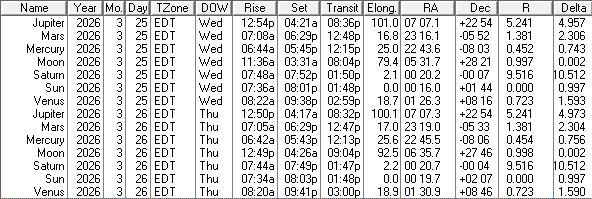
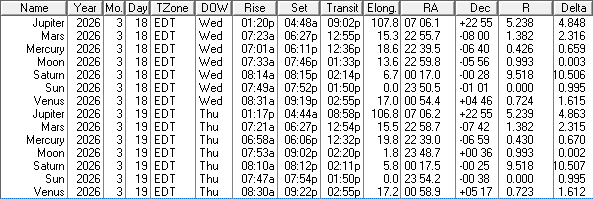
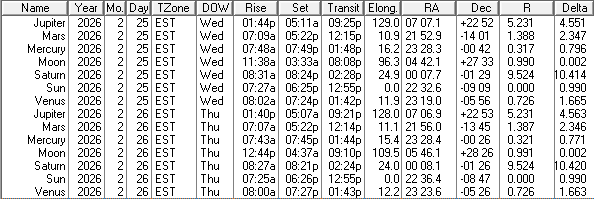
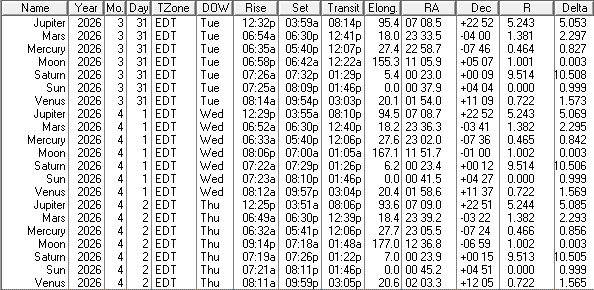
A low precision ephemeris of the Sun Moon and naked eye planet positions for today and tomorrow.
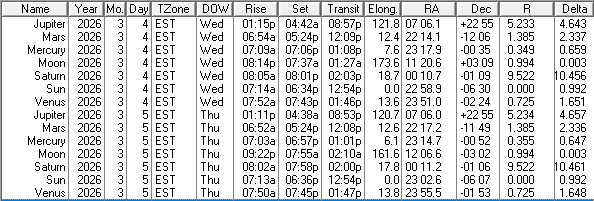
This is a low precision ephemeris of the Sun Moon and naked eye planet positions for today and tomorrow, April 1st and 2nd, 2026. Some of the columns are self-explanatory, others are not. The transit column is the time that the body crosses the meridian and is due south. Elong, for elongation, is the angle between the Sun and that body. RA is right ascension, which is the object’s east-west position on the celestial sphere in hours and minutes. Dec is declination which is the north-south position of the object on the celestial sphere in degrees and minutes. R is the distance of that object from the Sun in astronomical units. An astronomical unit is about 93 million miles or 150 million kilometers. And Delta is the distance of that object from the Earth, also in astronomical units. I omit the ‘m’ in am and pm for compactness. The data was generated using my LookingUp for DOS app and displayed as a table by my Ephemeris Helper app.

Ephemeris: 03/25/2026 – Taking our weekly look at the whereabouts of the naked-eye planets

March 25, 2026 Comments off

This is Ephemeris for Wednesday, March 25th. Today the Sun will be up for 12 hours and 25 minutes, setting at 8:01, and it will rise tomorrow at 7:34. The Moon, at first quarter today, will set at 4:26 tomorrow morning.

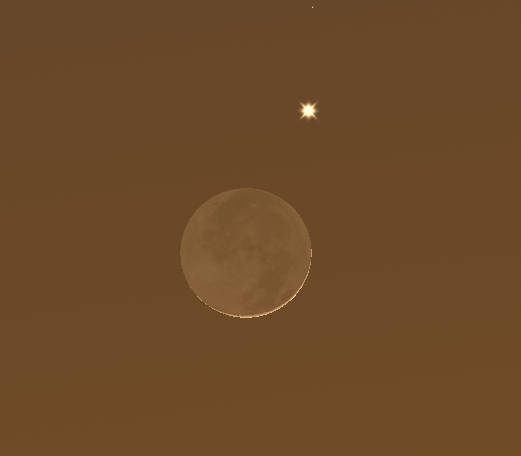
Let’s take our weekly look at the whereabouts of the naked-eye planets. Earlier this morning Saturn passed conjunction with the Sun becoming officially a morning planet. But it’ll be a couple of months before it’s visible in the morning and about seven months before it’s conveniently placed in the evening sky. By 8:30 PM tonight or about a half hour or so after sunset, Venus may be seen very low in the West. Binoculars or a telescope will show a very tiny disc on Venus, because it is pretty much behind the Sun, a good way from us. Over the next 7 months it will be moving closer to us and becoming much larger. Jupiter is the brilliant star-like object more than halfway up in the southwestern sky at 9 PM. Tonight, it’s below and left of the Moon.

The astronomical event times given in this blog are for the Traverse City/Interlochen area of Michigan (Lat 44.7° N, Long 85.7° W; EST, UT – 5 hours) unless stated otherwise. Times will be different for other locations.

Addendum
Venus is seen low in the western sky at 8:30 PM tonight.
Venus is seen low in the western sky at 8:30 PM tonight March 25, 2026, or 29 minutes after sunset. Created using Stellarium.
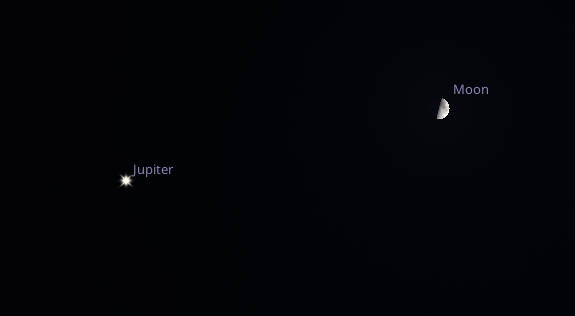
The Moon and Jupiter as they should appear tonight at 9 PM.
The Moon and Jupiter as they should appear tonight at 9 PM March 25, 2026. Created using Stellarium.
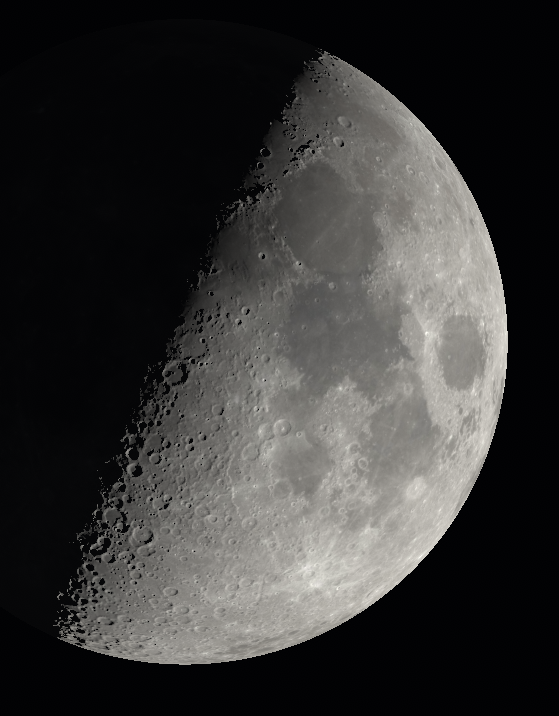
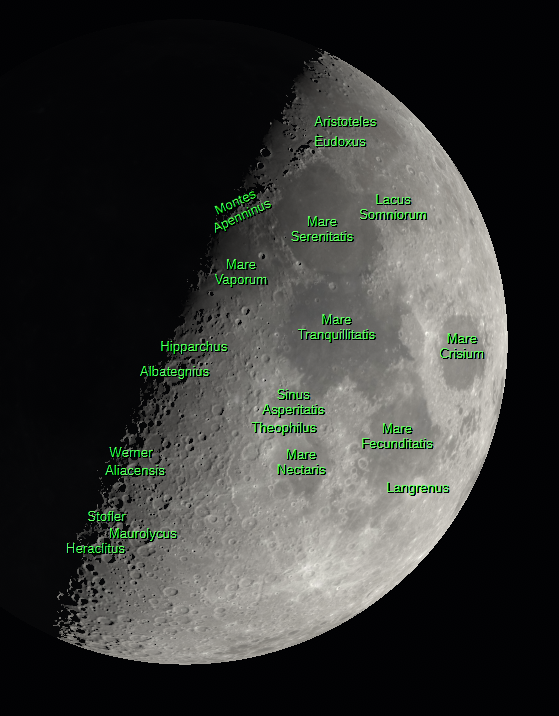
The Moon, at first quarter, as seen at 9 PM tonight, March 25, 2026. A view visible in small telescopes showing an image with and without selected features labeled. Created using Stellarium, LibreOffice Draw, and GIMP.
Telescopic Jupiter and Venus (north up) as they would be seen in a small telescope with the same magnification.
Telescopic Jupiter and Venus (north up) as they would be seen in a small telescope with the same magnification. Venus will be visible for a short time near the western horizon, while Jupiter is visible most of the night. Venus’ apparent diameter will be 10.5″, and be 94.7% illuminated. It’s on the far side of the Sun, 1.6 times the Sun’s distance from us. Jupiter will be 39.6″ in diameter, with its moons shown here for 9 PM, tonight March 25th, 2026. The moons can shift noticably over an hour. Callisto will pass behind the planet from 10:29 PM to 2:29 AM. The (”) symbol means seconds of arc, or 1/3600th of a degree. Created using Cartes du Ciel (Sky Charts), LibreOffice Draw and GIMP.
The naked-eye planets and the Moon at sunset and sunrise on a single night.
The naked-eye planets and the Moon at sunset and sunrise on a single night, starting with sunset on the right on March 25th, 2026. The night ends on the left with sunrise on the 26th. Click or tap on the image to enlarge it. Saturn is not visible, being too close to the direction of the Sun. Created using my LookingUp app and GIMP.
A low precision ephemeris of the Sun Moon and naked eye planet positions for today and tomorrow.
This is a low precision ephemeris of the Sun Moon and naked eye planet positions for today and tomorrow, March 25th and 26th, 2026. Some of the columns are self-explanatory, others are not. The transit column is the time that the body crosses the meridian and is due south. Elong, for elongation, is the angle between the Sun and that body. RA is right ascension, which is the object’s east-west position on the celestial sphere in hours and minutes. Dec is declination which is the north-south position of the object on the celestial sphere in degrees and minutes. R is the distance of that object from the Sun in astronomical units. An astronomical unit is about 93 million miles or 150 million kilometers. And Delta is the distance of that object from the Earth, also in astronomical units. I omit the ‘m’ in am and pm for compactness. The data was generated using my LookingUp for DOS app and displayed as a table by my Ephemeris Helper app.

Ephemeris: 03/18/2026 – Taking our weekly look at the whereabouts of the naked-eye planets

March 18, 2026 Comments off

This is Ephemeris for Wednesday, March 18th. Today the Sun will be up for 12 hours and 3 minutes, setting at 7:52, and it will rise tomorrow at 7:47. The Moon is new today, and won’t be visible.

Let’s take our weekly look at the whereabouts of the naked-eye planets. By 8:30 PM or about a half hour or so after sunset, Venus may be seen very low in the West. Binoculars or a telescope will show a very tiny disc on Venus, because it is pretty much behind the Sun, a good way from us. However over the next 7 months it will be moving closer to us and becoming much larger. Jupiter is the brilliant star-like object more than halfway up in the southern sky at 9 PM. It’s the brightest object in the sky at that point. It has resumed its normal eastward motion, spending most of its evening appearance making up the ground it lost in its 4 months of retrograde motion. The planet and its moons are a treat for binoculars or a telescope.

The astronomical event times given in this blog are for the Traverse City/Interlochen area of Michigan (Lat 44.7° N, Long 85.7° W; EST, UT – 5 hours) unless stated otherwise. Times will be different for other locations.

Addendum
Venus is seen low in the western sky at 8:30 PM tonight.
Venus is seen low in the western sky at 8:30 PM tonight March 18, 2026, or 38 minutes after sunset. Created using Stellarium.
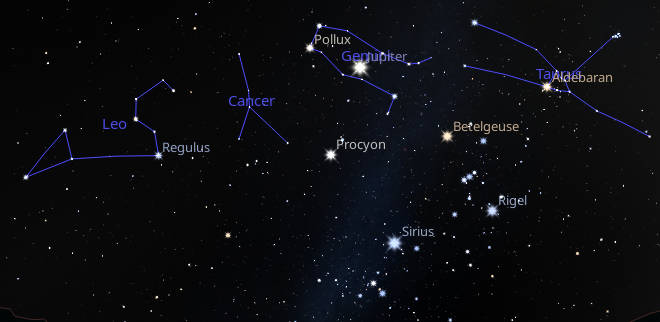
Jupiter is seen with the bright winter stars in the south at 9:00 PM tonight.
Jupiter is seen with the bright winter stars in the south at 9:00 PM tonight, March 18, 2026. Also showing are the zodiacal constellations of Taurus, Gemini, Cancer and Leo. Created using Stellarium.
Telescopic Jupiter and Venus as they would be seen in a small telescope with the same magnification.
Telescopic Jupiter and Venus (north up) as they would be seen in a small telescope with the same magnification. Venus will be visible for a short time near the western horizon, while Jupiter is visible mopst of the night. Venus’ apparent diameter will be 10.4″, and be 95.7% illuminated. It’s on the far side of the Sun, 1.6 times the Sun’s distance from us. Jupiter will be 40.5″ in diameter, with its moons shown here for 9 PM, tonight March 18th, 2026. The moons can shift noticably over an hour. . The (”) symbol means seconds of arc, or 1/3600th of a degree. Created using Cartes du Ciel (Sky Charts), LibreOffice Draw and GIMP.
The naked-eye planets and the Moon at sunset and sunrise on a single night.
The naked-eye planets and the Moon at sunset and sunrise on a single night, starting with sunset on the right on March 18th, 2026. The night ends on the left with sunrise on the 19th. Click or tap on the image to enlarge it. Created using my LookingUp app and GIMP.
A low precision ephemeris of the Sun Moon and naked eye planet positions for today and tomorrow.
This is a low precision ephemeris of the Sun Moon and naked eye planet positions for today and tomorrow, March 18th and 19th, 2026. Some of the columns are self-explanatory, others are not. The transit column is the time that the body crosses the meridian and is due south. Elong, for elongation, is the angle between the Sun and that body. RA is right ascension, which is the object’s east-west position on the celestial sphere in hours and minutes. Dec is declination which is the north-south position of the object on the celestial sphere in degrees and minutes. R is the distance of that object from the Sun in astronomical units. An astronomical unit is about 93 million miles or 150 million kilometers. And Delta is the distance of that object from the Earth, also in astronomical units. I omit the ‘m’ in am and pm for compactness. The data was generated using my LookingUp for DOS app and displayed as a table by my Ephemeris Helper app.

Ephemeris: 03/11/2026 – Taking our weekly look at the whereabouts of the naked-eye planets

March 11, 2026 Comments off

This is Ephemeris for Wednesday, March 11th. Today the Sun will be up for 11 hours and 41 minutes, setting at 7:43, and it will rise tomorrow at 8:00. The Moon, at last quarter today, will rise at 4:42 tomorrow morning.

Let’s take our weekly look at the whereabouts of the naked-eye planets. At 8:15 PM or about a half hour after sunset, Venus may be seen very low in the West. A very low western horizon will be necessary to spot it, like from the shore of Lake Michigan. Saturn is no longer visible, being too close to the direction of the Sun. Jupiter is the brilliant star-like object more than halfway up in the southern sky. It’s the brightest star-like object in the sky. The planet and its moons are a treat for binoculars or a telescope. Jupiter’s four brightest, so-called Galilean Moons are on the east side of the planet, though binoculars will probably show three. The moon closest to the planet are two moons close together, which are resolved in telescopes.

The astronomical event times given in this blog are for the Traverse City/Interlochen area of Michigan (Lat 44.7° N, Long 85.7° W; EST, UT – 5 hours) unless stated otherwise. Times will be different for other locations.

Addendum
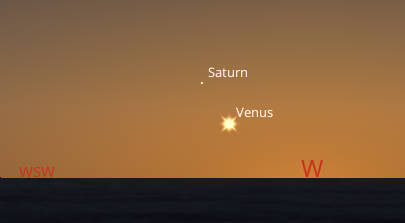
Venus is seen low in the western sky at 8:15 PM tonight.
Venus is seen low in the western sky at 8:15 PM tonight March 11, 2026, or 32 minutes after sunset. Venus, at this time will be only 7½° above the horizon. Created using Stellarium.
Jupiter is seen with the bright winter stars in the south at 9:00 PM
Jupiter is seen with the bright winter stars in the south at 9:00 PM. Also showing are the zodiacal constellations of Taurus, Gemini where Jupiter is, and Cancer where it is heading to later this year . Created using stellarium.
The Moon 1 day past last quarter, as seen at 6 tomorrow morning, March 12, 2026. A view visible in small telescopes showing an image with and without selected features labeled. Created using Stellarium, LibreOffice Draw, and GIMP.
Telescopic Jupiter and Venus (north up) as they would be seen in a small telescope with the same magnification.
Telescopic Jupiter and Venus (north up) as they would be seen in a small telescope with the same magnification. Venus will be visible for a short time near the western horizon, while Jupiter is visible mopst of the night. Venus’ apparent diameter will be 10.3″, and be 96.6% illuminated. It’s on the far side of the Sun. Jupiter will be 41.4″ in diameter, with its moon shown here for 9 PM, tonight March 11th, 2026. The moons can shift noticable over an hour. . The (”) symbol means seconds of arc, or 1/3600th of a degree. Created using Cartes du Ciel (Sky Charts), LibreOffice Draw and GIMP.
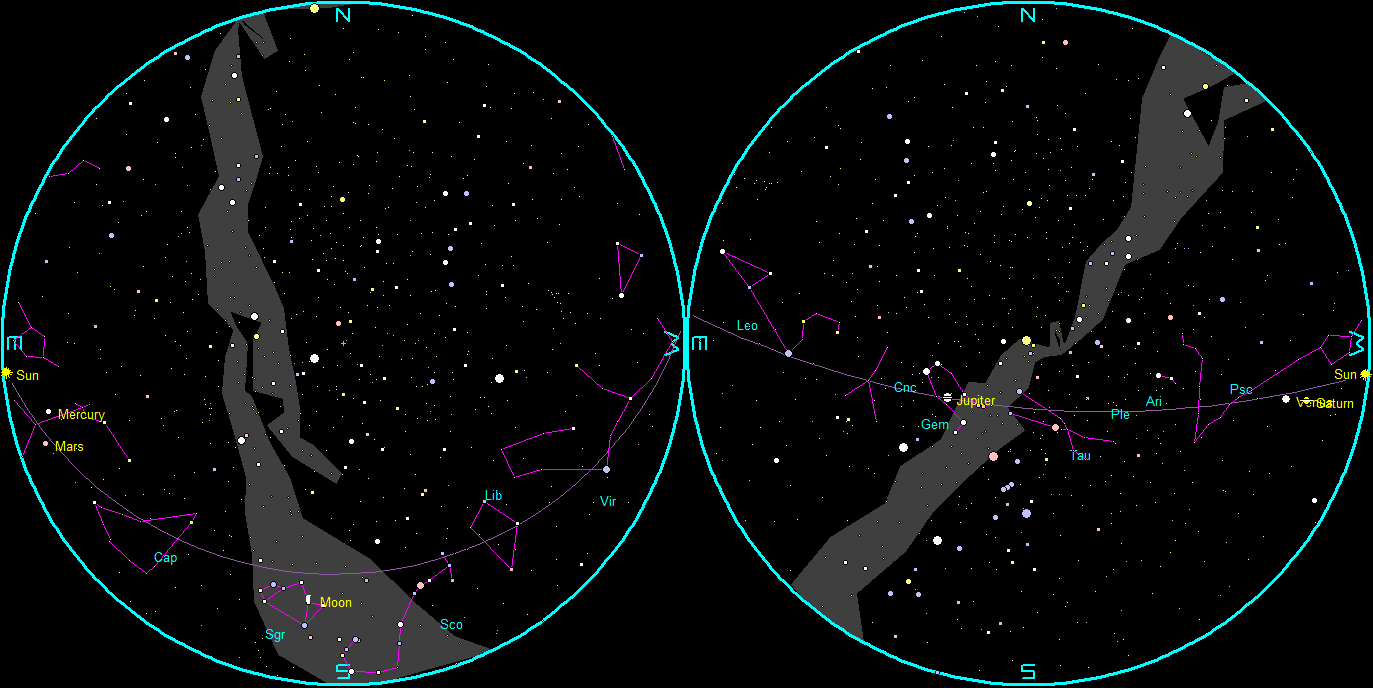
The naked-eye planets and the Moon at sunset and sunrise on a single night, starting with sunset on the right on March 11th, 2026. The night ends on the left with sunrise on the 12th.
The naked-eye planets and the Moon at sunset and sunrise on a single night, starting with sunset on the right on March 11th, 2026. The night ends on the left with sunrise on the 12th. The Venus label is overprinting Saturn and its label. Click or tap on the image to enlarge it. Created using my LookingUp app and GIMP.
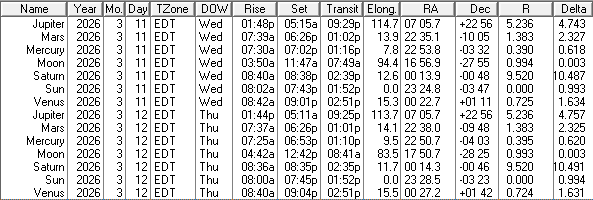
A low precision ephemeris of the Sun Moon and naked eye planet positions for today and tomorrow, March 11th and 12th, 2026.
This is a low precision ephemeris of the Sun Moon and naked eye planet positions for today and tomorrow, March 11th and 12th, 2026. Some of the columns are self-explanatory, others are not. The transit column is the time that the body crosses the meridian and is due south. Elong, for elongation, is the angle between the Sun and that body. RA is right ascension, which is the object’s east-west position on the celestial sphere in hours and minutes. Dec is declination which is the north-south position of the object on the celestial sphere in degrees and minutes. R is the distance of that object from the Sun in astronomical units. An astronomical unit is about 93 million miles or 150 million kilometers. And Delta is the distance of that object from the Earth, also in astronomical units. I omit the ‘m’ in am and pm for compactness. The data was generated using my LookingUp for DOS app and displayed as a table by my Ephemeris Helper app.

Ephemeris: 03/04/2026 – Taking our weekly look at the whereabouts of the naked-eye planets

March 4, 2026 Comments off

This is Ephemeris for Wednesday, March 4th. Today the Sun will be up for 11 hours and 19 minutes, setting at 6:34, and it will rise tomorrow at 7:13. The Moon, 1 day past full, will rise at 8:14 this evening.

Let’s take our weekly look at the whereabouts of the naked-eye planets. At 7 PM or about a half hour after sunset, Venus may be seen very low in the West. Above it and a bit to the left might be Saturn which may not show up until a quarter of an hour later. We are in the last third of winter and the sunset times are increasing rapidly and taking with it Saturn. The evening sky will shift dramatically this Sunday when Daylight Saving Time returns, giving us darker mornings and brighter evenings. Jupiter is the brilliant star-like object more than halfway up in the southern sky. It’s the brightest star-like object in the sky. The planet and its moons are a treat for binoculars or a telescope.

The astronomical event times given in this blog are for the Traverse City/Interlochen area of Michigan (Lat 44.7° N, Long 85.7° W; EST, UT – 5 hours) unless stated otherwise. Times will be different for other locations.

Addendum
Saturn and Venus in the west-southwestern sky at 7:15 PM tonight.
Saturn and Venus in the west-southwestern sky at 7:15 PM tonight March 3, 2026, or 41 minutes after sunset. Spotting Mercury and Venus will be problematic: being too low in Venus’ case, and too faint in Saturn’s. The brightnesses of the planets are exagerated. Created using Stellarium.
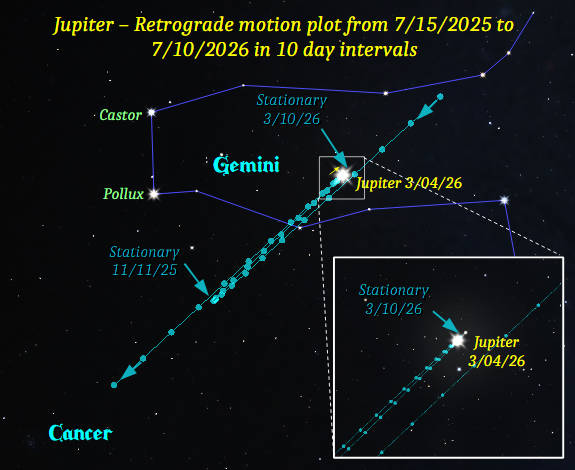
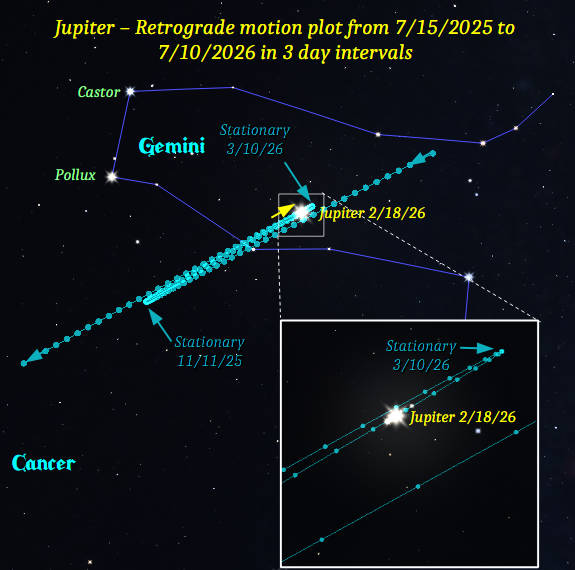
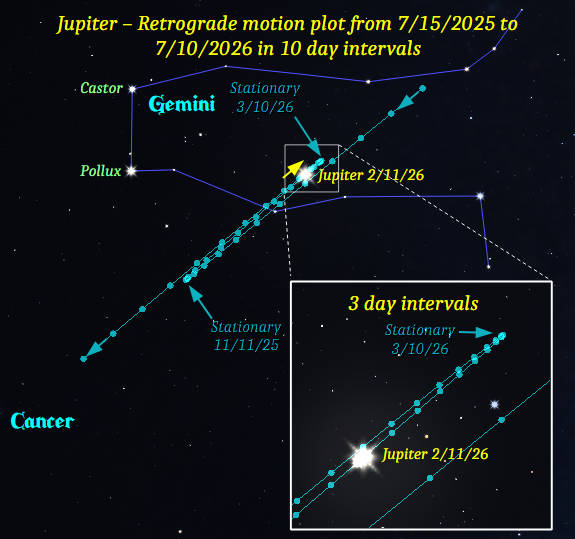
Jupiter as it appears tonight, March 4, 2026, in its orientation at 9:00 PM moving against the stars of Gemini. Also shown is its track from last July to next July, and the retrograde loop that it is currently making,
Jupiter as it appears tonight, March 4, 2026, in its orientation at 9:00 PM moving against the stars of Gemini. Also shown is its track from last July to next July, and the retrograde loop that it is currently making, slowly moving to the West which it will do for the next 6 days until it stops (becomes stationary) on March 10th. Then it will resume its eastward motion. The inset shows a magnified view of the west end of the retrograde loop. Created using Stellarium, LibreOffice Draw and GIMP.
The Moon 1½ days past full, as seen tonight, March 3, 2026 at 9 PM. A view visible in small telescopes showing an image with and without selected features labeled. Created using Stellarium, LibreOffice Draw, and GIMP.
Jupiter is the one good planet available in a small telescope.
Jupiter is the one good planet available in a small telescope. Saturn is becoming too low in the sky to deliver a good image. This is how Jupiter will appear at 9 PM, its apparent diameter is 42.2″. Created using Cartes du Ciel (Sky Charts), LibreOffice Draw and GIMP.
The naked-eye planets and the Moon at sunset and sunrise on a single night, starting with sunset on the right on March 3rd, 2026. The night ends on the left with sunrise on the 4th.
The naked-eye planets and the Moon at sunset and sunrise on a single night, starting with sunset on the right on March 3rd, 2026. The night ends on the left with sunrise on the 4th. Click or tap on the image to enlarge it. Created using my LookingUp app and GIMP.
A low precision ephemeris of the Sun, Moon and naked eye planet positions for today and tomorrow
This is a low precision ephemeris of the Sun, Moon and naked eye planet positions for today and tomorrow, March 4th and 5th, 2026. Some of the columns are self-explanatory, others are not. The transit column is the time that the body crosses the meridian and is due south. Elong, for elongation, is the angle between the Sun and that body. RA is right ascension, which is the object’s east-west position on the celestial sphere in hours and minutes. Dec is declination which is the north-south position of the object on the celestial sphere in degrees and minutes. R is the distance of that object from the Sun in astronomical units. An astronomical unit is about 93 million miles or 150 million kilometers. And Delta is the distance of that object from the Earth, also in astronomical units. I omit the ‘m’ in am and pm for compactness. The data was generated using my LookingUp for DOS app and displayed as a table by my Ephemeris Helper app.

Ephemeris: 02/25/2026 – Taking our weekly look at the whereabouts of the naked-eye planets

February 25, 2026 Comments off

This is Ephemeris for Wednesday, February 25th. Today the Sun will be up for 10 hours and 58 minutes, setting at 6:25, and it will rise tomorrow at 7:25. The Moon, 1 day past first quarter, will set at 4:37 tomorrow morning.

Let’s take our weekly look at the whereabouts of the naked-eye planets. At 7:00 PM or about and 1/2 hour after sunset Venus may be seen very low in the West above it and a bit to the right is Mercury which will be really difficult to spot since it is dimming now and above left of that is Saturn which is getting very low in the sky. We are in the last third of winter and the sunset times are increasing rapidly and taking with it the planets near the Sun including Saturn. By 8 PM Saturn will be very low in the West and not a very good object for telescope viewing. Jupiter is the brilliant star-like object more than halfway up in the southeastern sky, and tonight is below and left of the Moon. It’s the brightest star-like object in the sky. It is still moving to the west, but is slowing down and will stop and reverse its course 13 days from now.

The astronomical event times given in this blog are for the Traverse City/Interlochen area of Michigan (Lat 44.7° N, Long 85.7° W; EST, UT – 5 hours) unless stated otherwise. Times will be different for other locations.

Addendum
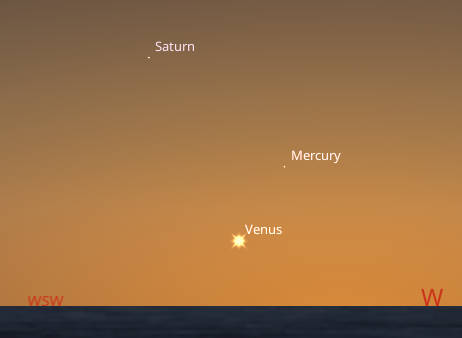
Saturn with Mercury and Venus in the west-southwestern sky at 7 PM tonight February 25, 2026, or 35 minutes after sunset. Spotting Mercury and Venus will be problematic: being too low in Venus' case, and too faint in Mercury's.
Saturn with Mercury and Venus in the west-southwestern sky at 7 PM tonight February 25, 2026, or 35 minutes after sunset. Spotting Mercury and Venus will be problematic: being too low in Venus’ case, and too faint in Mercury’s. Created using Stellarium.
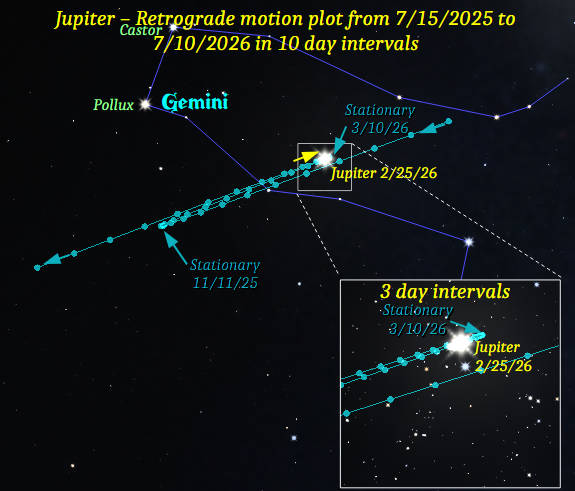
Jupiter as it appears tonight, February 25, 2026, in its orientation at 9:00 PM moving against the stars of Gemini.
Jupiter as it appears tonight, February 25, 2026, in its orientation at 9:00 PM moving against the stars of Gemini. Also shown is its track from last July to next July, and the retrograde loop that it is currently making, slowly moving to the West which it will do for the next 13 days until it stops (becomes stationary) on March 10th. Then it will resume its eastward motion. The inset shows a magnified view of the west end of the retrograde loop. Created using Stellarium, LibreOffice Draw and GIMP.
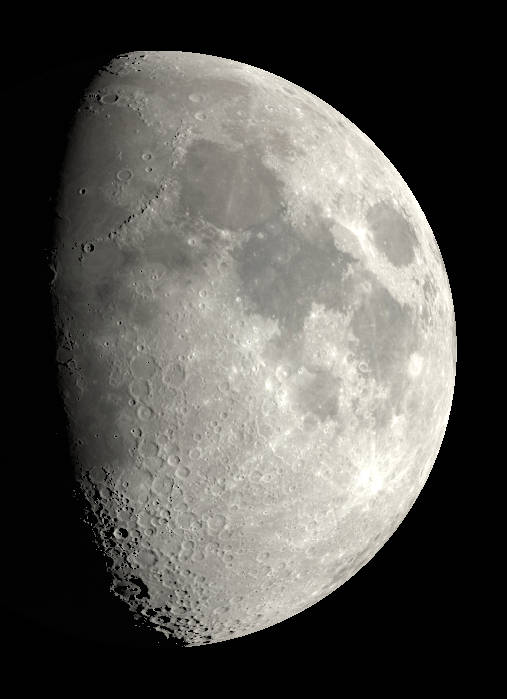
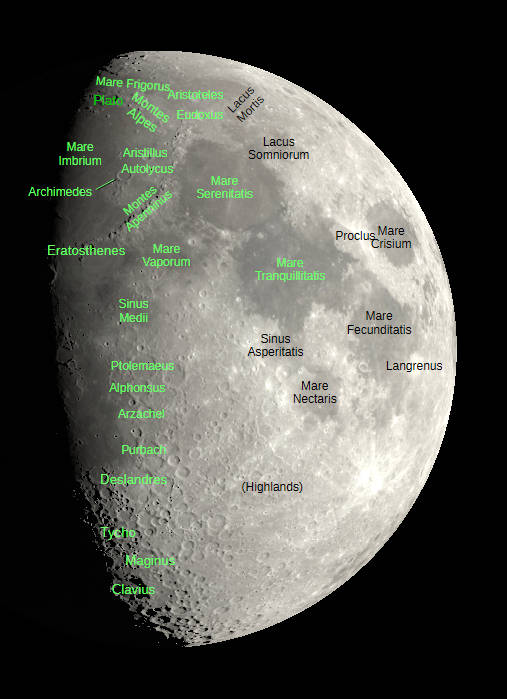
The Moon 1½ days past first quarter, as seen tonight, February 25, 2026. A view visible in small telescopes showing an image with and without selected features labeled. Created using Stellarium, LibreOffice Draw, and GIMP.
Jupiter is the one good planet available in a small telescope. Saturn is becoming too low in the sky to deliver a good image. This is how Jupiter will appear at 9 PM.
Jupiter is the one good planet available in a small telescope. Saturn is becoming too low in the sky to deliver a good image. This is how Jupiter will appear at 9 PM, with the exception of Ganymede with will begin its transit of the face of Jupiter at 8:56 PM EST. The satellites are shown much brighter compared to Jupiter than they actually are, so a satellite will seem to disappear against the brighter planet. Ganymede will not reappear before Jupiter sets for our location. Created using Cartes du Ciel (Sky Charts), LibreOffice Draw and GIMP.
The naked-eye planets and the Moon at sunset and sunrise on a single night, starting with sunset on the right on February 25th, 2026. The night ends on the left with sunrise on the 26th.
The naked-eye planets and the Moon at sunset and sunrise on a single night, starting with sunset on the right on February 25th, 2026. The night ends on the left with sunrise on the 26th. Click or tap on the image to enlarge it. Created using my LookingUp app and GIMP.
A low precision ephemeris of the Sun, Moon and naked eye planet positions for today and tomorrow.
This is a low precision ephemeris of the Sun, Moon and naked eye planet positions for today and tomorrow, February 25th and 26th, 2026. Some of the columns are self-explanatory, others are not. The transit column is the time that the body crosses the meridian and is due south. Elong, for elongation, is the angle between the Sun and that body. RA is right ascension, which is the object’s east-west position on the celestial sphere in hours and minutes. Dec is declination which is the north-south position of the object on the celestial sphere in degrees and minutes. R is the distance of that object from the Sun in astronomical units. An astronomical unit is about 93 million miles or 150 million kilometers. And Delta is the distance of that object from the Earth, also in astronomical units. I omit the ‘m’ in am and pm for compactness. The data was generated using my LookingUp for DOS app and displayed as a table by my Ephemeris Helper app.

Ephemeris: 02/18/2026 – Taking our weekly look at the whereabouts of the naked-eye planets

February 18, 2026 Comments off

This is Ephemeris for Ash Wednesday, February 18th. Today the Sun will be up for 10 hours and 37 minutes, setting at 6:15, and it will rise tomorrow at 7:36. The Moon, 1 day past new, will set at 7:52 this evening.

Let’s take our weekly look at the whereabouts of the naked-eye planets. After sunset Venus may show up very low in the West probably before 7:00 PM. Above Venus, tonight, will be the 1 1/2 day old Moon and above it and very close, the planet Mercury making a rare appearance in our evening sky. At 8 PM Saturn remains low in the west southwestern sky, and it will set before 9 PM. In a telescope Saturn sports a very thin ring, 3.1 degrees from being edge on and is slowly opening. Jupiter is the brilliant star-like object more than halfway up in the east-southeastern sky. It’s the brightest star-like object in the sky. It is still moving to the west, but is slowing down and will stop and reverse its course 20 days now.

The astronomical event times given in this blog are for the Traverse City/Interlochen area of Michigan (Lat 44.7° N, Long 85.7° W; EST, UT – 5 hours) unless stated otherwise. Times will be different for other locations.

Addendum
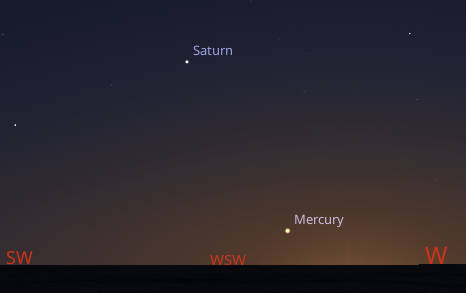
Saturn appears with Mercury, the Moon and maybe even Venus in the west-southwestern sky at 7 PM tonight.
Saturn appears with Mercury, the Moon and maybe even Venus in the west-southwestern sky at 7 PM tonight February 18, 2026, or 45 minutes after sunset. The planet Mercury will most likely be dimmer than it appears here. It is always hard to spot in the twilight, though being just above the Moon will help tonight. Start looking for it around 6:45 PM or about a half hour after sunset. Created using Stellarium.
A closeup of Mercury and the day and a half old Moon.
A closeup of Mercury and the day and a half old Moon. Created using Stellarium.
Jupiter as it appears tonight, February 18, 2026, in its orientation at 9:00 PM moving against the stars of Gemini. Also shown is its track from last July to next July, and the retrograde loop that is currently making.
Jupiter as it appears tonight, February 18, 2026, in its orientation at 9:00 PM moving against the stars of Gemini. Also shown is its track from last July to next July, and the retrograde loop that is currently making, slowly moving to the West which it will do for the next 20 days until it stops (becomes stationary) on March 10th. Then it will resume its eastward motion. The inset shows a magnified view of the west end of the retrograde loop. Created using Stellarium, LibreOffice Draw and GIMP.
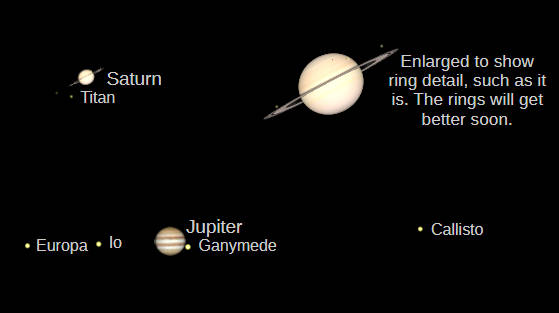
Telescopic Saturn, and Jupiter as they would be seen in a small telescope with the same magnification at 9 PM tonight.
Telescopic Saturn, and Jupiter (north up) as they would be seen in a small telescope with the same magnification at 9 PM tonight, February 18, 2026. Saturn will be 16.1″ in diameter, but its rings, being nearly edge on, may show up brighter than seen here, and extend to 37.4″. They are tilted 3.1° from being edge on. Jupiter will be 44.0″ in diameter. Earlier in the evening Mercury may be glimpsed just a bove the day and a half old Moon. Its too small to be represented here, because it’s only 7.0″ in diameter and is 52.8% illuminated. If you’re lucky enough to spot Venus, it’s 10″ in diameter and 98.4% illuminated. The (”) symbol means seconds of arc, or 1/3600th of a degree. Created using Cartes du Ciel (Sky Charts), LibreOffice Draw and GIMP.
The naked-eye planets and the Moon at sunset and sunrise on a single night.
The naked-eye planets and the Moon at sunset and sunrise on a single night, starting with sunset on the right on February 18th, 2026. The night ends on the left with sunrise on the 19th. The Moon and Mercury labels overlap near the sunset sun. Click or tap on the image to enlarge it. Created using my LookingUp app and GIMP.
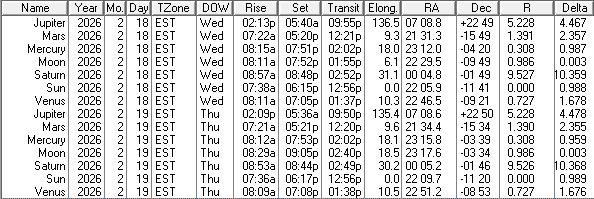
A low precision ephemeris of the Sun, Moon and naked eye planet positions for today and tomorrow, February 18th and 19th, 2026
This is a low precision ephemeris of the Sun, Moon and naked eye planet positions for today and tomorrow, February 18th and 19th, 2026. Some of the columns are self-explanatory, others are not. The transit column is the time that the body crosses the meridian and is due south. Elong, for elongation, is the angle between the Sun and that body. RA is right ascension, which is the object’s east-west position on the celestial sphere in hours and minutes. Dec is declination which is the north-south position of the object on the celestial sphere in degrees and minutes. R is the distance of that object from the Sun in astronomical units. An astronomical unit is about 93 million miles or 150 million kilometers. And Delta is the distance of that object from the Earth, also in astronomical units. I omit the ‘m’ in am and pm for compactness. The data was generated using my LookingUp for DOS app and displayed as a table by my Ephemeris Helper app.

Ephemeris: 02/13/2026 – The real cause of a planet’s retrograde motion

February 13, 2026 Comments off

This is Ephemeris for Friday, February 13th. Today the Sun will be up for 10 hours and 22 minutes, setting at 6:08, and it will rise tomorrow at 7:44. The Moon, halfway from last quarter to new, will rise at 6:30 tomorrow morning.

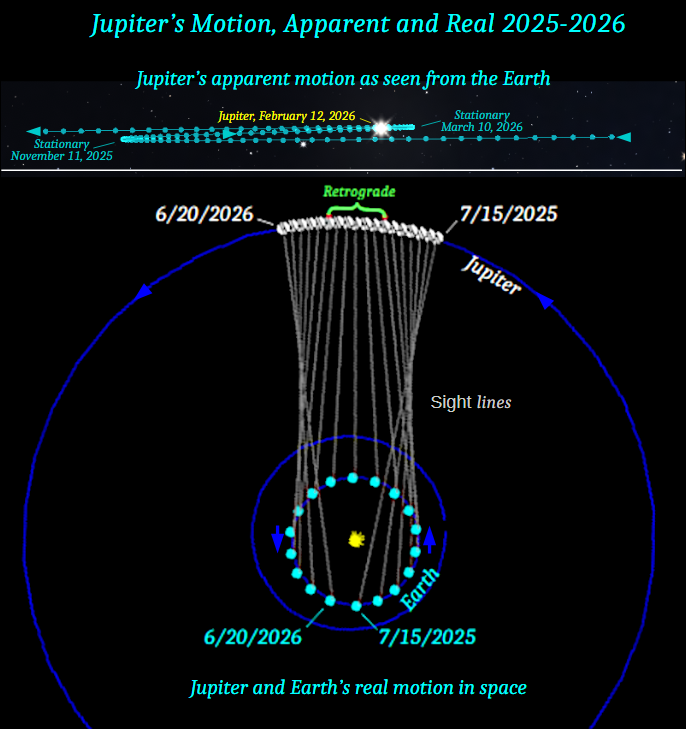
So what is the real reason that Jupiter is currently moving westward for a while in retrograde motion? Retrograde motion occurs in outer planets because the Earth is actually passing them. A simple analogy would be, if you were in a car that was passing another, the car you are passing would seem to move backwards compared to you. And that is exactly what’s happening. The Earth moves faster than the outer planets. Since the solar system is like a racetrack, and we get to lap these outer planets repeatedly when they are closest to us. For the inner planet it’s opposite. They go retrograde or backwards when they are passing us. This is a much simpler answer than all these circles upon circles the ancients invented.

The astronomical event times given in this blog are for the Traverse City/Interlochen area of Michigan (Lat 44.7° N, Long 85.7° W; EST, UT – 5 hours) unless stated otherwise. Times will be different for other locations.

Addendum
A diagram showing the Earth and Jupiter and above, the appearance of Jupiter in our sky and the retrograde motion as the Earth in essence passes Jupiter in our orbital motions around the Sun.
A diagram showing the Earth and Jupiter and above, the appearance of Jupiter in our sky and the retrograde motion as the Earth in essence passes Jupiter in our orbital motions around the Sun. When the sight lines from earth to Jupiter are trending counterclockwise, moving to the left, the planet appears to be moving eastward in its normal motion. As we pass Jupiter, at our closest point to it, the sight lines tend to rotate in the clockwise direction, which causes the appearance of retrograde motion of Jupiter in our sky. The plotting intervals on the top diagram is 10 days, 20 days on the bottom one. The diagram on the bottom was created using my LookingUp app, the upper diagram was created using Stellarium. Annotations added in LibreOffice Draw, all put together with GIMP.

Ephemeris: 02/12/2026 – Why do planets stop and move backward for a time? Part 1

February 12, 2026 Comments off

This is Ephemeris for Darwin Day, Thursday, February 12th. Today the Sun will be up for 10 hours and 19 minutes, setting at 6:07, and it will rise tomorrow at 7:45. The Moon, 3 days past last quarter, will rise at 5:49 tomorrow morning.

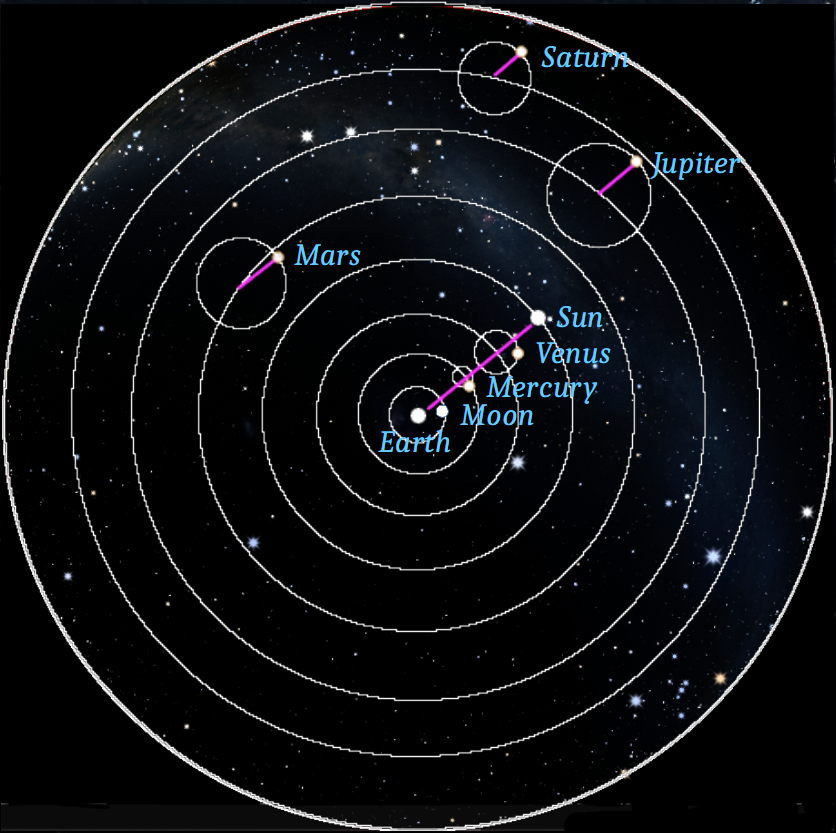
For the last month or so I’ve been talking about Jupiter in its retrograde or westward motion against the stars of Gemini. This motion isn’t due to just Jupiter itself. Jupiter orbits smoothly around the sun in one direction, in a little less than 12 years. The ancients thought that the earth was stationary, and everything in the sky orbited the earth. They thought that the planets orbited the earth in the same time that the planet orbits the sun, however every year and depending on where the planet was in the sky it would stop, reverse itself for a while and then resume its eastward motion through the sky. They thought that the planet moved on a small circle called an epicycle that rode on the larger circle called the deferent.

The astronomical event times given in this blog are for the Traverse City/Interlochen area of Michigan (Lat 44.7° N, Long 85.7° W; EST, UT – 5 hours) unless stated otherwise. Times will be different for other locations.

Addendum
A geocentric chart of the solar system.
The geocentric universe as imagined by the ancients with the Earth in the center. The outer ring is the celestial sphere of the stars. The other concentric circles around the Earth are deferents for each of the planets. Note that the line from the deferent to the planet on the epicycle is parallel to the line of the earth to the sun. One would think that screams the fact that somehow the Earth was in motion. But only the Greek astronomer Aristarchus figured it out. Then that idea was discarded until Copernicus in the 15th century of the modern era resurrected the idea.

Tomorrow, we’ll find out what’s really going on.

Ephemeris: 02/11/2026 – Taking our weekly look at the whereabouts of the naked-eye planets

February 11, 2026 Comments off

This is Ephemeris for Wednesday, February 11th. Today the Sun will be up for 10 hours and 16 minutes, setting at 6:05, and it will rise tomorrow at 7:47. The Moon, 2 days past last quarter, will rise at 5:00 tomorrow morning.

Let’s take our weekly look at the whereabouts of the naked-eye planets. Before twilight fades, Mercury may be spotted low in the west below and right of Saturn. Binoculars may help in finding it. Saturn is the brightest star-like object low in the west southwestern sky as soon as it gets dark, and it will set before 9:30. In a telescope Saturn sports a very thin ring, 2.6 degrees from being edge on and is slowly opening. Jupiter is the brilliant star-like object more than halfway up in the east-southeastern sky. It’s the brightest star-like object in the sky. It is still moving to the west, but is slowing down and will stop and reverse its course a month from now. Jupiter’s 4 brightest moons can be seen even in binoculars, if held steadily enough. They shift position night to night. At 8 PM tonight, all four Galilean moons can be seen.

The astronomical event times given in this blog are for the Traverse City/Interlochen area of Michigan (Lat 44.7° N, Long 85.7° W; EST, UT – 5 hours) unless stated otherwise. Times will be different for other locations.

Addendum
Saturn appears with Mercury in the west-southwestern sky at 7 PM tonight.
Saturn appears with Mercury in the west-southwestern sky at 7 PM tonight February 11, 2026. The tin planet Mercury will most likely be dimmer than it appears here. It is always hard to spot in the twilight. Start looking for it around 6:45 PM or about a half hour after sunset. Created using Stellarium.
Jupiter as it appears tonight, February 11, 2026, in its orientation at 9:00 PM moving against the stars of Gemini. Also shown is its track from last July to next July, and the retrograde loop that is currently making, slowly moving to the West which it will do for the next 27 days until it stops on March 10th. Then it will resume its eastward motion. The inset shows a magnified view of the west end of the retrograde loop.
Jupiter as it appears tonight, February 11, 2026, in its orientation at 9:00 PM moving against the stars of Gemini. Also shown is its track from last July to next July, and the retrograde loop that is currently making, slowly moving to the West which it will do for the next 27 days until it stops on March 10th. Then it will resume its eastward motion. The inset shows a magnified view of the west end of the retrograde loop. Created using Stellarium, LibreOffice Draw and GIMP.

Tomorrow, I’ll discuss, more fully, why planets are seen to move in retrograde motion.
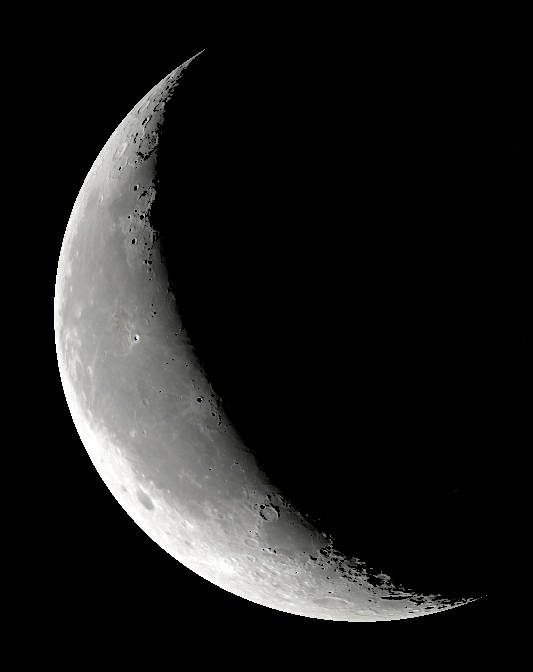
The Moon 3 days past last quarter, as seen tomorrow morning, February 12, 2026, at 6 am. A view visible in small telescopes showing an image with and without selected features labeled. Created using Stellarium, LibreOffice Draw, and GIMP.

R

Telescopic Saturn, and Jupiter (north up) as they would be seen in a small telescope with the same magnification at 8 PM tonight.
Telescopic Saturn, and Jupiter (north up) as they would be seen in a small telescope with the same magnification at 8 PM tonight, February 11, 2026. Saturn will be 16.2″ in diameter, but its rings, being nearly edge on, may show up brighter than seen here, and extend to 37.7″. They are tilted 2.8° from being edge on. Jupiter will be 44.4″ in diameter. Earlier in the evening Mercury may be glimpsed. Its too small to be represented here, because it’s only5.9″ in diameter and is 79.6% illuminated. The (”) symbol means seconds of arc, or 1/3600th of a degree. Created using Cartes du Ciel (Sky Charts), LibreOffice Draw and GIMP.
The naked-eye planets and the Moon at sunset and sunrise on a single night, starting with sunset on the right on February 11th, 2026. The night ends on the left with sunrise on the 12th
The naked-eye planets and the Moon at sunset and sunrise on a single night, starting with sunset on the right on February 11th, 2026. The night ends on the left with sunrise on the 12th. The Venus and Mercury labels overlap near the sunset sun. Click or tap on the image to enlarge it. Created using my LookingUp app and GIMP.
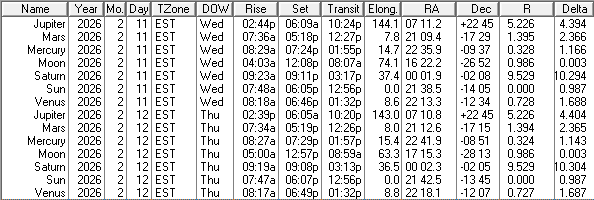
A low precision ephemeris of the Sun Moon and naked eye planet positions for today and tomorrow.
This is a low precision ephemeris of the Sun Moon and naked eye planet positions for today and tomorrow, February 11th and 12th, 2026. Some of the columns are self-explanatory, others are not. The transit column is the time that the body crosses the meridian and is due south. Elong, for elongation, is the angle between the Sun and that body. RA is right ascension, which is the object’s east-west position on the celestial sphere in hours and minutes. Dec is declination which is the north-south position of the object on the celestial sphere in degrees and minutes. R is the distance of that object from the Sun in astronomical units. An astronomical unit is about 93 million miles or 150 million kilometers. And Delta is the distance of that object from the Earth, also in astronomical units. I omit the ‘m’ in am and pm for compactness. The data was generated using my LookingUp for DOS app and displayed as a table by my Ephemeris Helper app.