Archive

Archive for the ‘Planets’ Category

Ephemeris: 02/13/2026 – The real cause of a planet’s retrograde motion

February 13, 2026 Comments off

This is Ephemeris for Friday, February 13th. Today the Sun will be up for 10 hours and 22 minutes, setting at 6:08, and it will rise tomorrow at 7:44. The Moon, halfway from last quarter to new, will rise at 6:30 tomorrow morning.

So what is the real reason that Jupiter is currently moving westward for a while in retrograde motion? Retrograde motion occurs in outer planets because the Earth is actually passing them. A simple analogy would be, if you were in a car that was passing another, the car you are passing would seem to move backwards compared to you. And that is exactly what’s happening. The Earth moves faster than the outer planets. Since the solar system is like a racetrack, and we get to lap these outer planets repeatedly when they are closest to us. For the inner planet it’s opposite. They go retrograde or backwards when they are passing us. This is a much simpler answer than all these circles upon circles the ancients invented.

The astronomical event times given in this blog are for the Traverse City/Interlochen area of Michigan (Lat 44.7° N, Long 85.7° W; EST, UT – 5 hours) unless stated otherwise. Times will be different for other locations.

Addendum
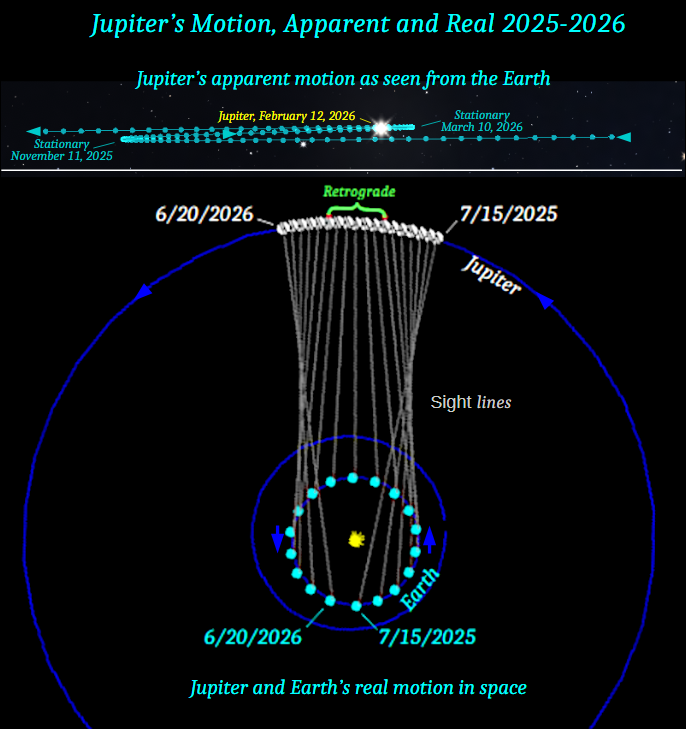
A diagram showing the Earth and Jupiter and above, the appearance of Jupiter in our sky and the retrograde motion as the Earth in essence passes Jupiter in our orbital motions around the Sun.
A diagram showing the Earth and Jupiter and above, the appearance of Jupiter in our sky and the retrograde motion as the Earth in essence passes Jupiter in our orbital motions around the Sun. When the sight lines from earth to Jupiter are trending counterclockwise, moving to the left, the planet appears to be moving eastward in its normal motion. As we pass Jupiter, at our closest point to it, the sight lines tend to rotate in the clockwise direction, which causes the appearance of retrograde motion of Jupiter in our sky. The plotting intervals on the top diagram is 10 days, 20 days on the bottom one. The diagram on the bottom was created using my LookingUp app, the upper diagram was created using Stellarium. Annotations added in LibreOffice Draw, all put together with GIMP.

Ephemeris: 02/12/2026 – Why do planets stop and move backward for a time? Part 1

February 12, 2026 Comments off

This is Ephemeris for Darwin Day, Thursday, February 12th. Today the Sun will be up for 10 hours and 19 minutes, setting at 6:07, and it will rise tomorrow at 7:45. The Moon, 3 days past last quarter, will rise at 5:49 tomorrow morning.

For the last month or so I’ve been talking about Jupiter in its retrograde or westward motion against the stars of Gemini. This motion isn’t due to just Jupiter itself. Jupiter orbits smoothly around the sun in one direction, in a little less than 12 years. The ancients thought that the earth was stationary, and everything in the sky orbited the earth. They thought that the planets orbited the earth in the same time that the planet orbits the sun, however every year and depending on where the planet was in the sky it would stop, reverse itself for a while and then resume its eastward motion through the sky. They thought that the planet moved on a small circle called an epicycle that rode on the larger circle called the deferent.

The astronomical event times given in this blog are for the Traverse City/Interlochen area of Michigan (Lat 44.7° N, Long 85.7° W; EST, UT – 5 hours) unless stated otherwise. Times will be different for other locations.

Addendum
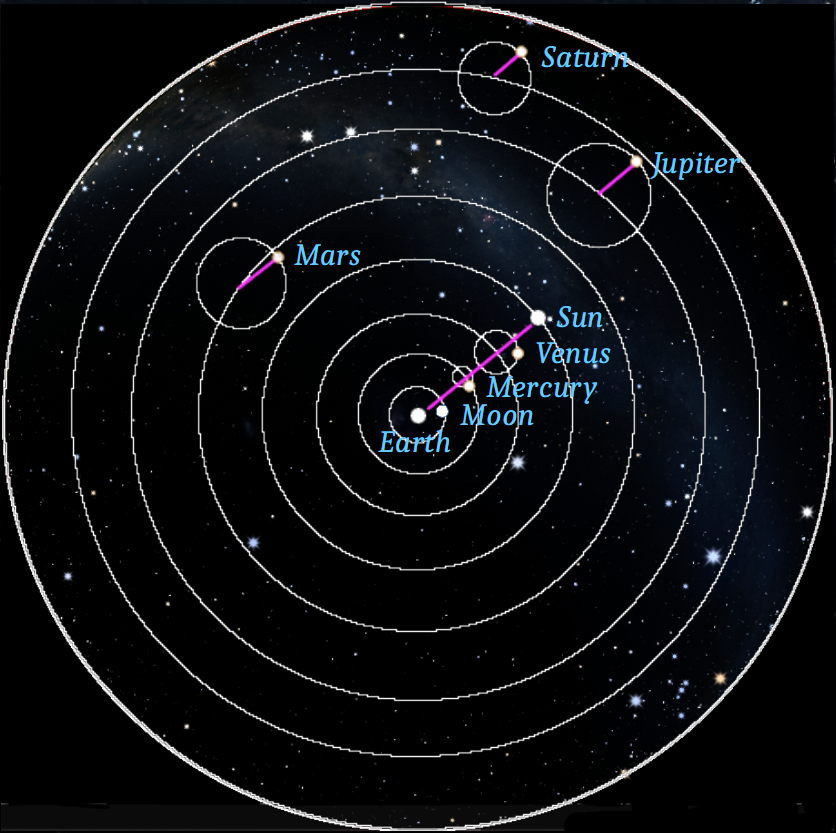
A geocentric chart of the solar system.
The geocentric universe as imagined by the ancients with the Earth in the center. The outer ring is the celestial sphere of the stars. The other concentric circles around the Earth are deferents for each of the planets. Note that the line from the deferent to the planet on the epicycle is parallel to the line of the earth to the sun. One would think that screams the fact that somehow the Earth was in motion. But only the Greek astronomer Aristarchus figured it out. Then that idea was discarded until Copernicus in the 15th century of the modern era resurrected the idea.

Tomorrow, we’ll find out what’s really going on.

Ephemeris: 02/11/2026 – Taking our weekly look at the whereabouts of the naked-eye planets

February 11, 2026 Comments off

This is Ephemeris for Wednesday, February 11th. Today the Sun will be up for 10 hours and 16 minutes, setting at 6:05, and it will rise tomorrow at 7:47. The Moon, 2 days past last quarter, will rise at 5:00 tomorrow morning.

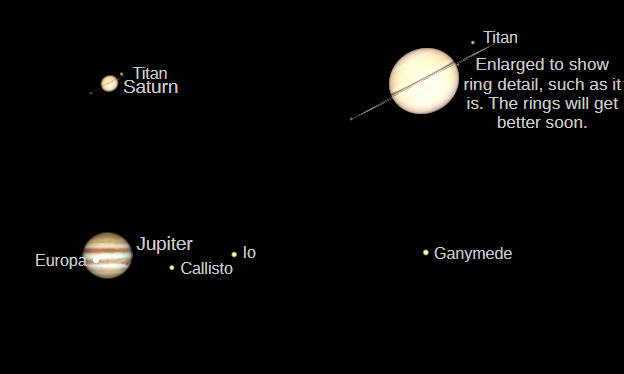
Let’s take our weekly look at the whereabouts of the naked-eye planets. Before twilight fades, Mercury may be spotted low in the west below and right of Saturn. Binoculars may help in finding it. Saturn is the brightest star-like object low in the west southwestern sky as soon as it gets dark, and it will set before 9:30. In a telescope Saturn sports a very thin ring, 2.6 degrees from being edge on and is slowly opening. Jupiter is the brilliant star-like object more than halfway up in the east-southeastern sky. It’s the brightest star-like object in the sky. It is still moving to the west, but is slowing down and will stop and reverse its course a month from now. Jupiter’s 4 brightest moons can be seen even in binoculars, if held steadily enough. They shift position night to night. At 8 PM tonight, all four Galilean moons can be seen.

The astronomical event times given in this blog are for the Traverse City/Interlochen area of Michigan (Lat 44.7° N, Long 85.7° W; EST, UT – 5 hours) unless stated otherwise. Times will be different for other locations.

Addendum
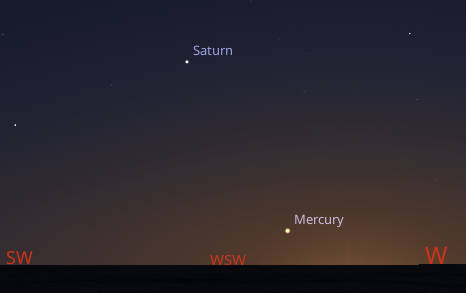
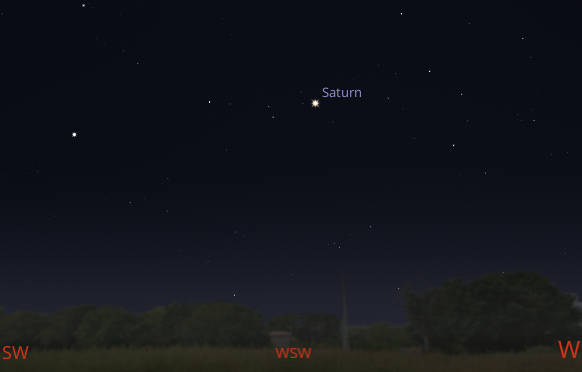
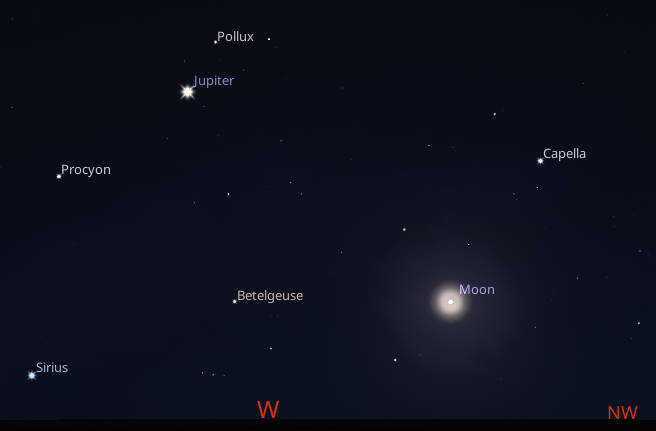
Saturn appears with Mercury in the west-southwestern sky at 7 PM tonight.
Saturn appears with Mercury in the west-southwestern sky at 7 PM tonight February 11, 2026. The tin planet Mercury will most likely be dimmer than it appears here. It is always hard to spot in the twilight. Start looking for it around 6:45 PM or about a half hour after sunset. Created using Stellarium.
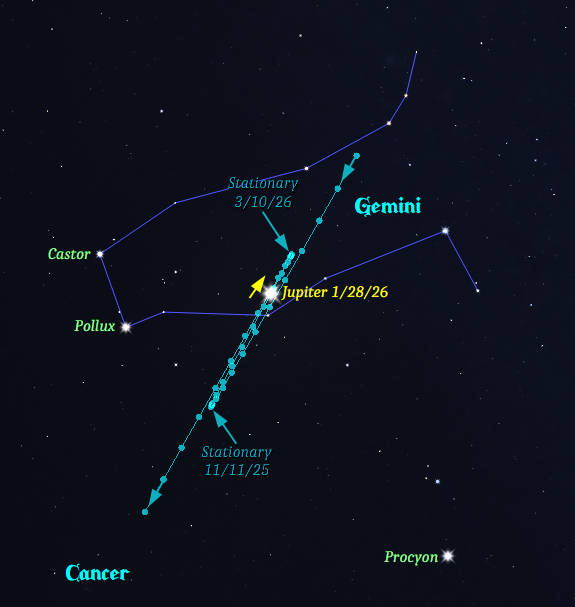
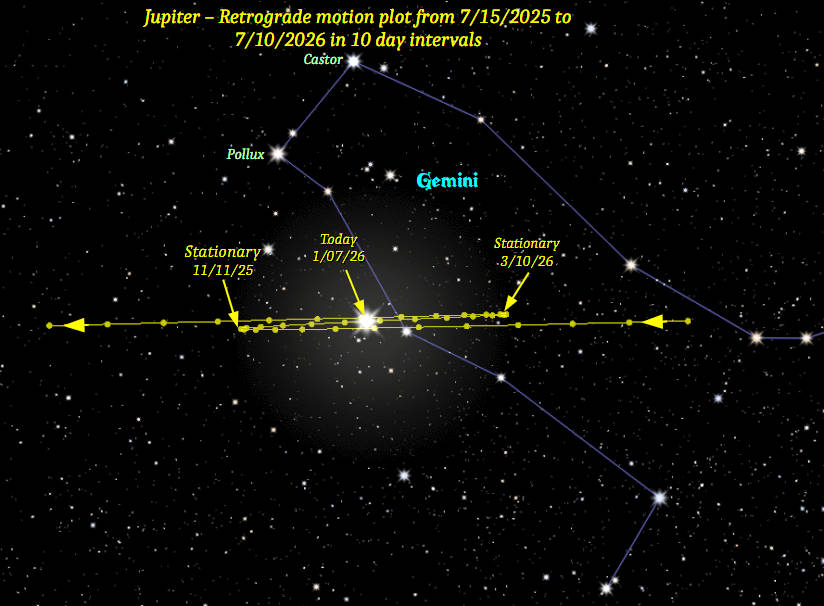
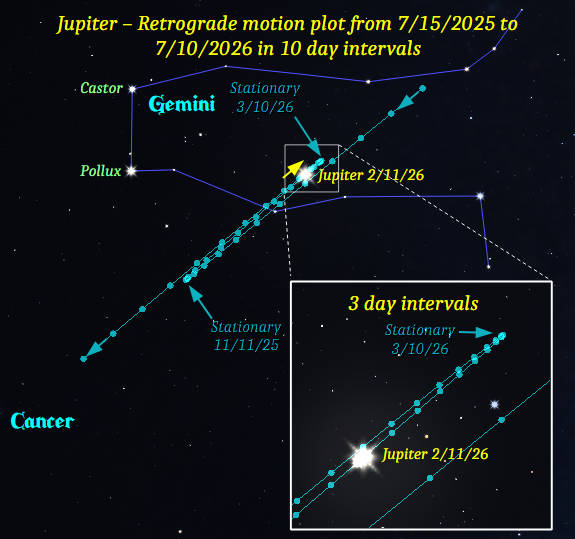
Jupiter as it appears tonight, February 11, 2026, in its orientation at 9:00 PM moving against the stars of Gemini. Also shown is its track from last July to next July, and the retrograde loop that is currently making, slowly moving to the West which it will do for the next 27 days until it stops on March 10th. Then it will resume its eastward motion. The inset shows a magnified view of the west end of the retrograde loop.
Jupiter as it appears tonight, February 11, 2026, in its orientation at 9:00 PM moving against the stars of Gemini. Also shown is its track from last July to next July, and the retrograde loop that is currently making, slowly moving to the West which it will do for the next 27 days until it stops on March 10th. Then it will resume its eastward motion. The inset shows a magnified view of the west end of the retrograde loop. Created using Stellarium, LibreOffice Draw and GIMP.

Tomorrow, I’ll discuss, more fully, why planets are seen to move in retrograde motion.

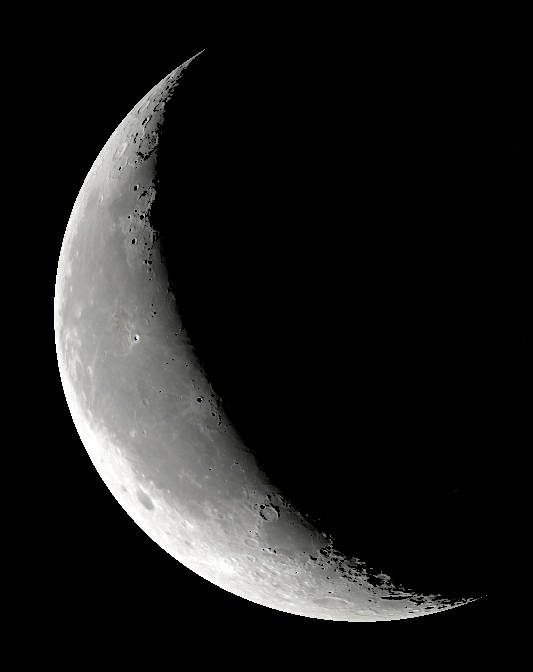
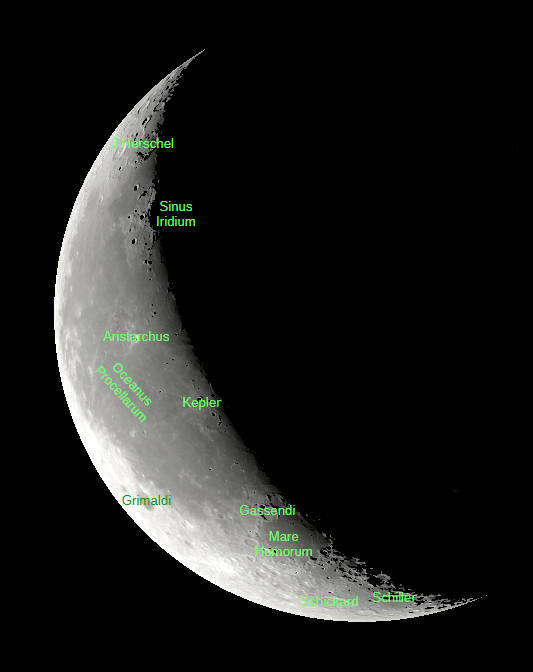
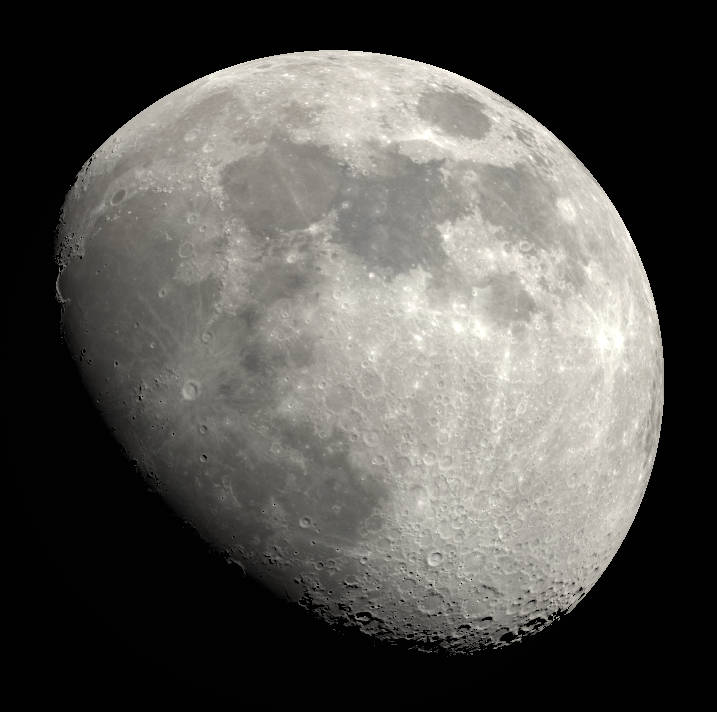
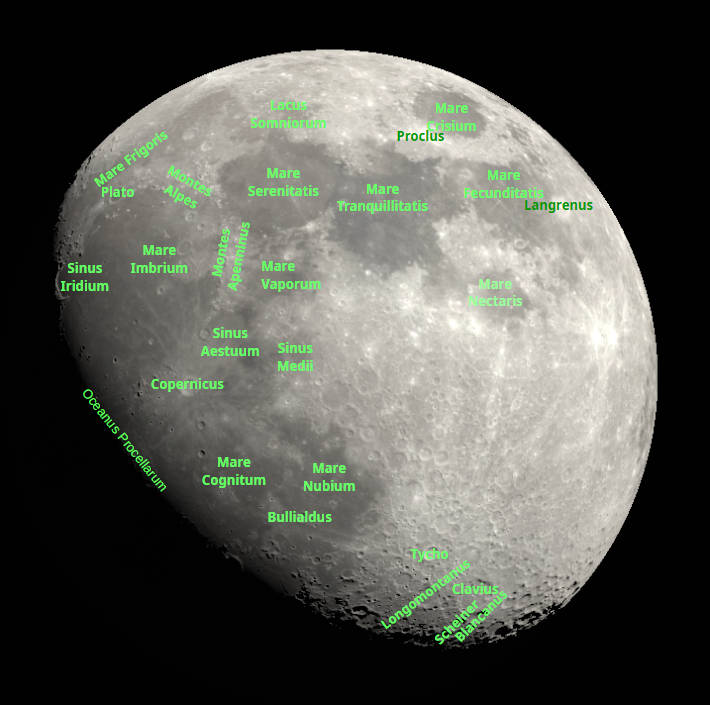
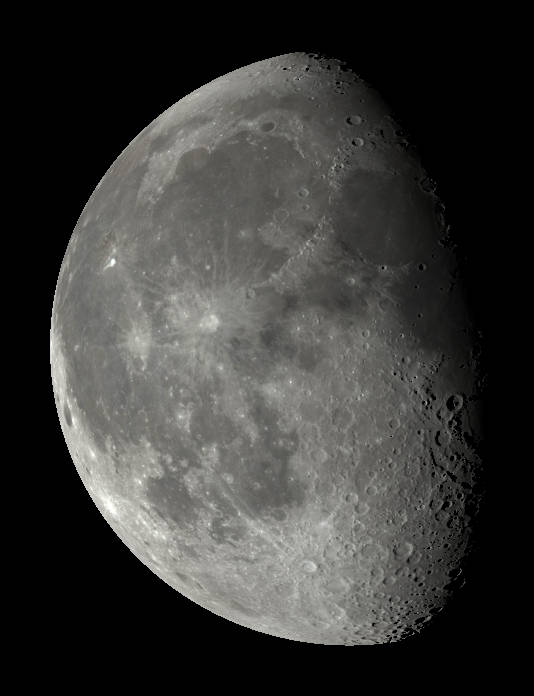
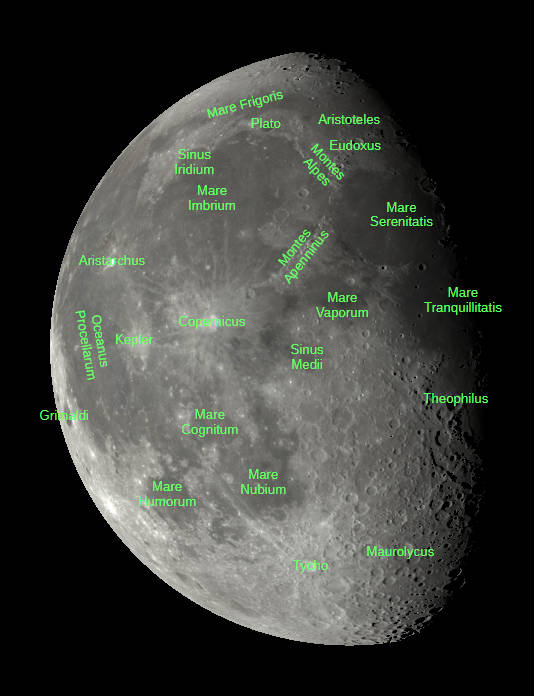
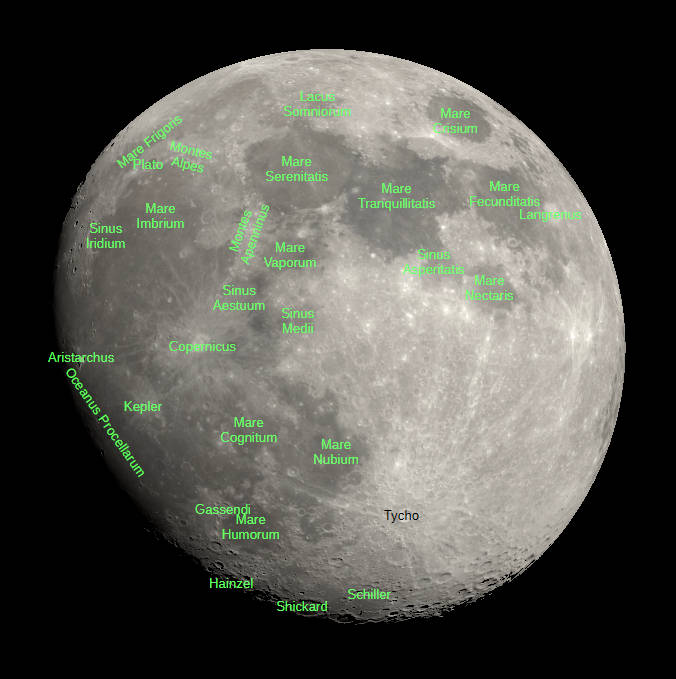
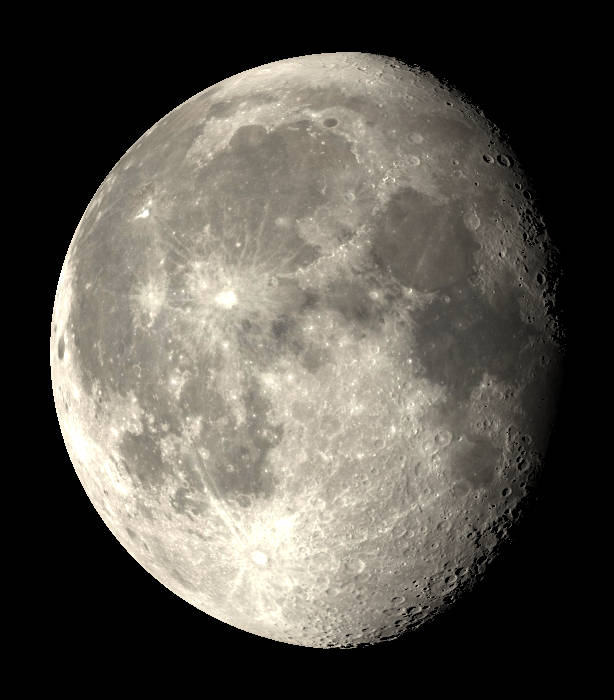
The Moon 3 days past last quarter, as seen tomorrow morning, February 12, 2026, at 6 am. A view visible in small telescopes showing an image with and without selected features labeled. Created using Stellarium, LibreOffice Draw, and GIMP.

R

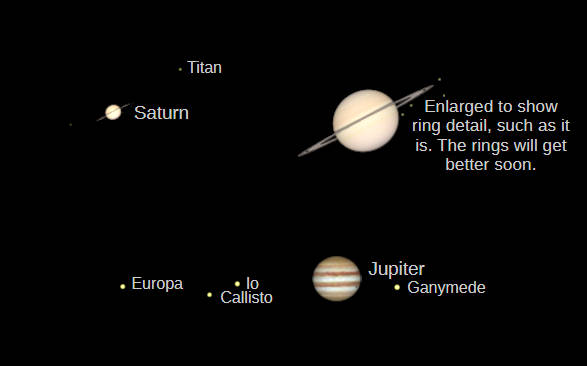
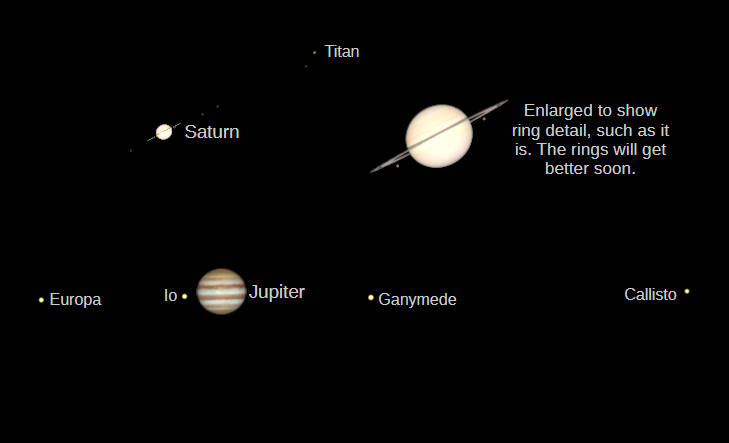
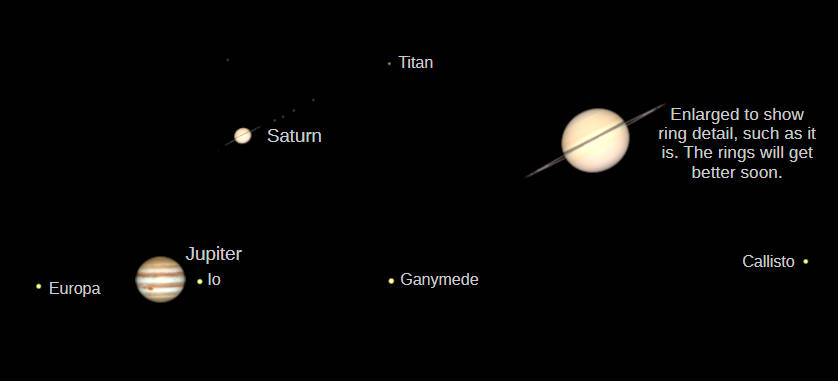
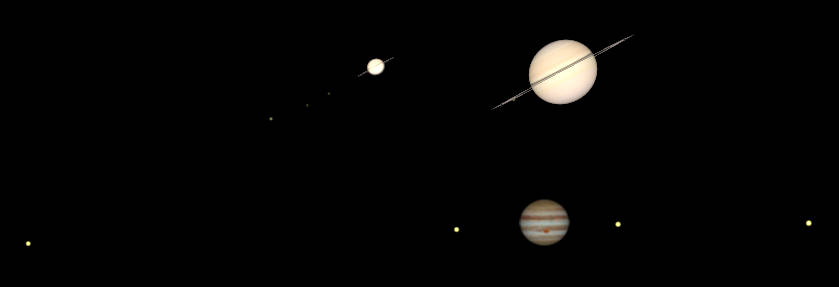
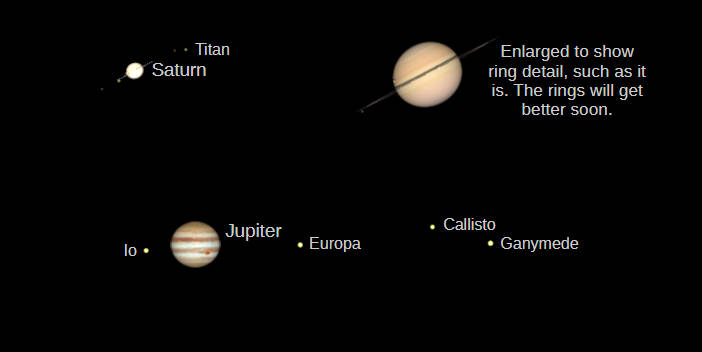
Telescopic Saturn, and Jupiter (north up) as they would be seen in a small telescope with the same magnification at 8 PM tonight.
Telescopic Saturn, and Jupiter (north up) as they would be seen in a small telescope with the same magnification at 8 PM tonight, February 11, 2026. Saturn will be 16.2″ in diameter, but its rings, being nearly edge on, may show up brighter than seen here, and extend to 37.7″. They are tilted 2.8° from being edge on. Jupiter will be 44.4″ in diameter. Earlier in the evening Mercury may be glimpsed. Its too small to be represented here, because it’s only5.9″ in diameter and is 79.6% illuminated. The (”) symbol means seconds of arc, or 1/3600th of a degree. Created using Cartes du Ciel (Sky Charts), LibreOffice Draw and GIMP.
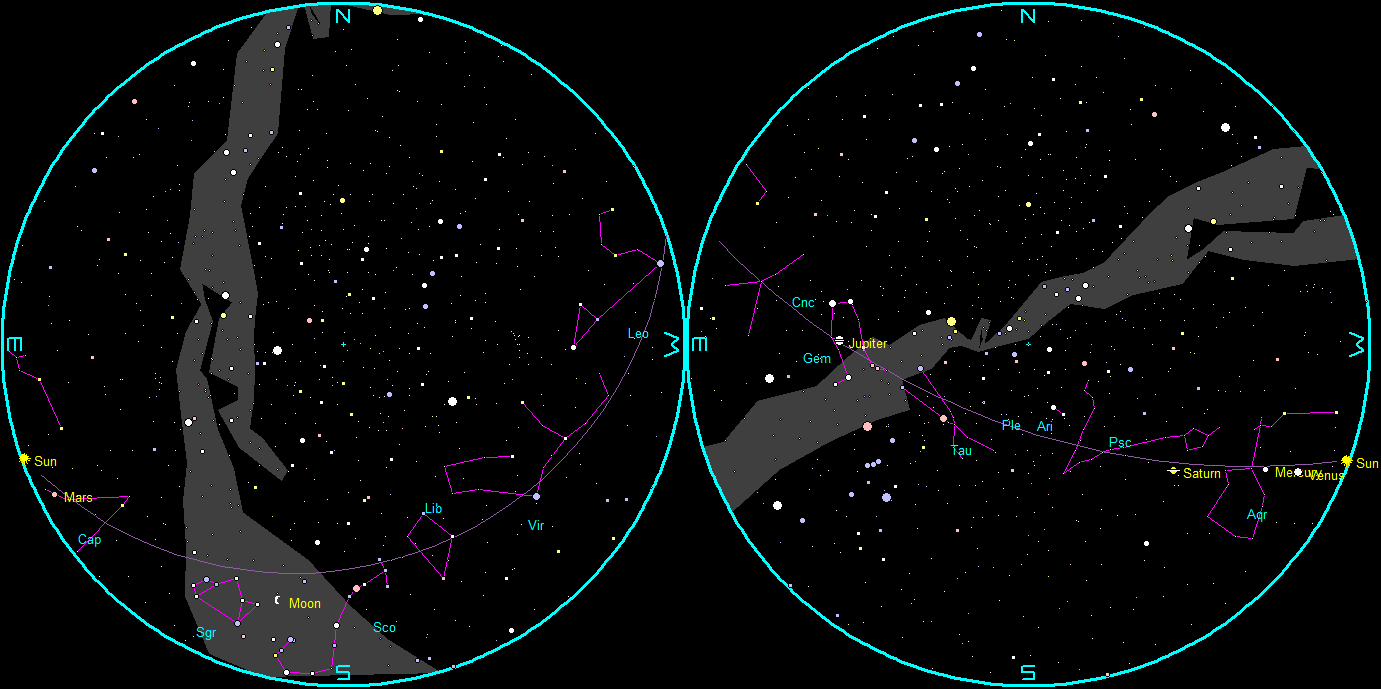
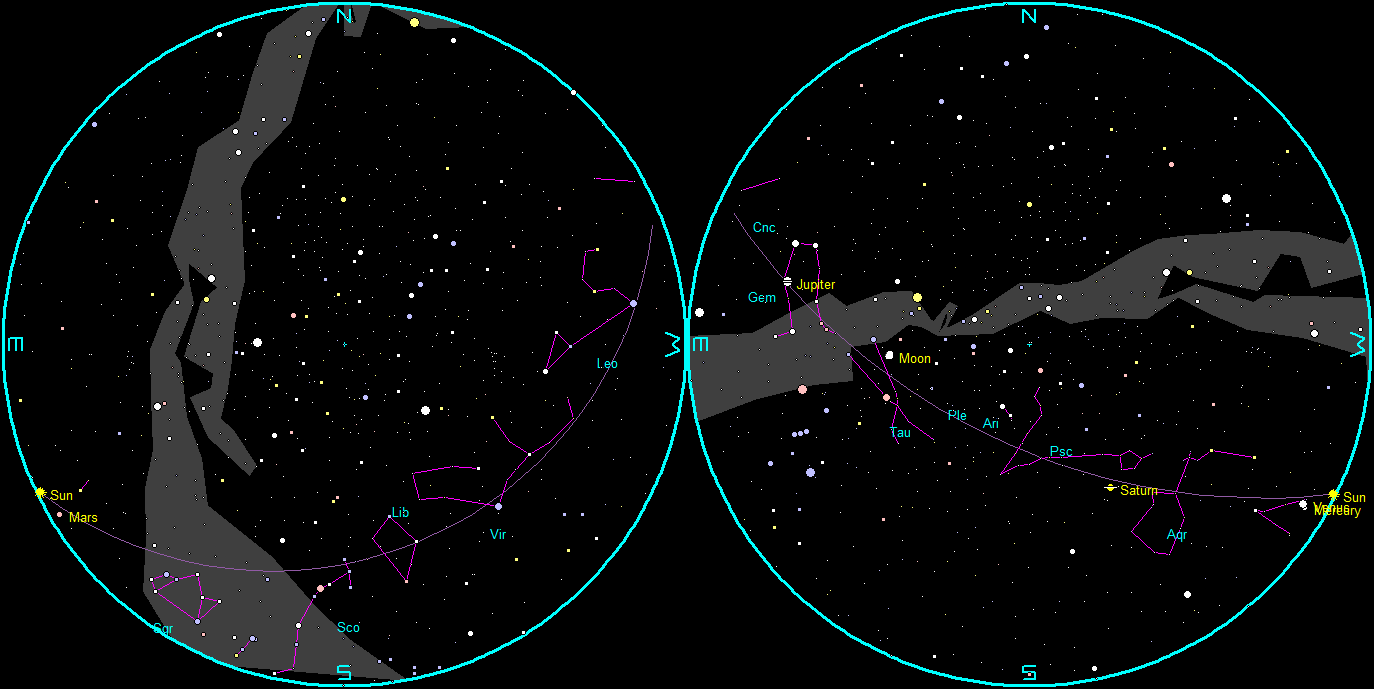
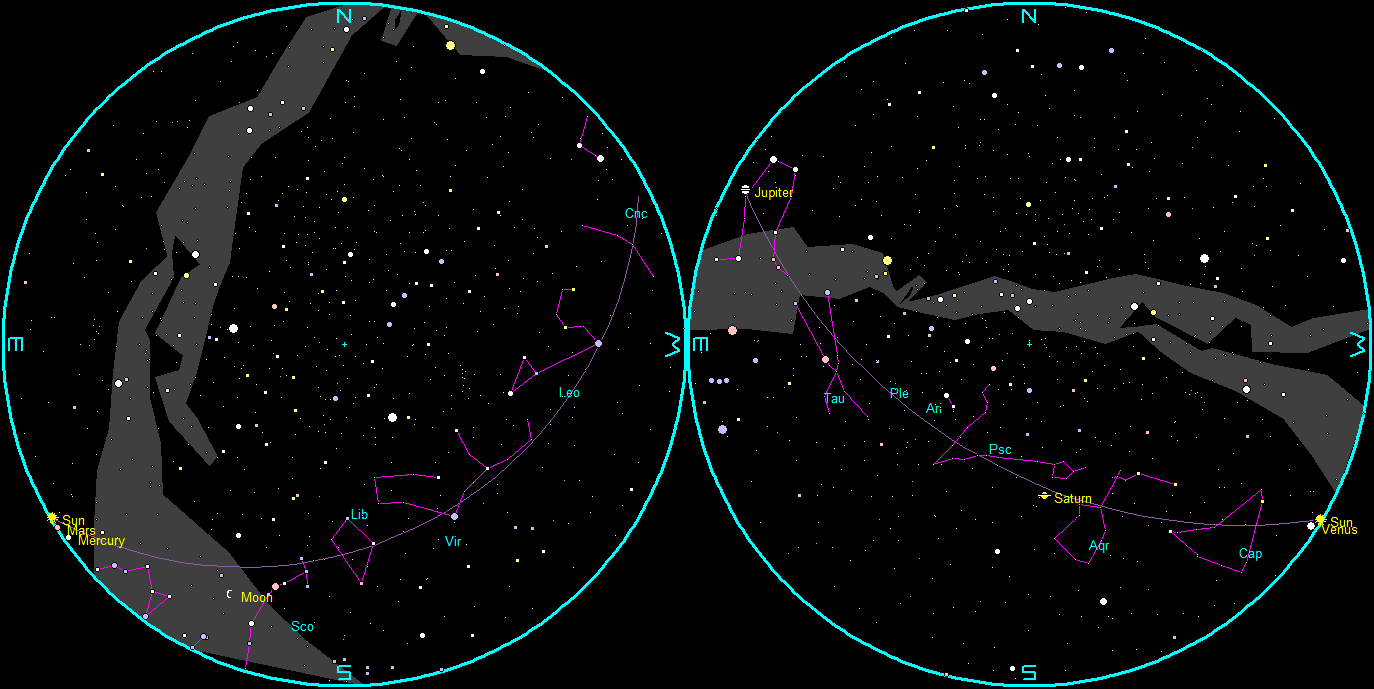
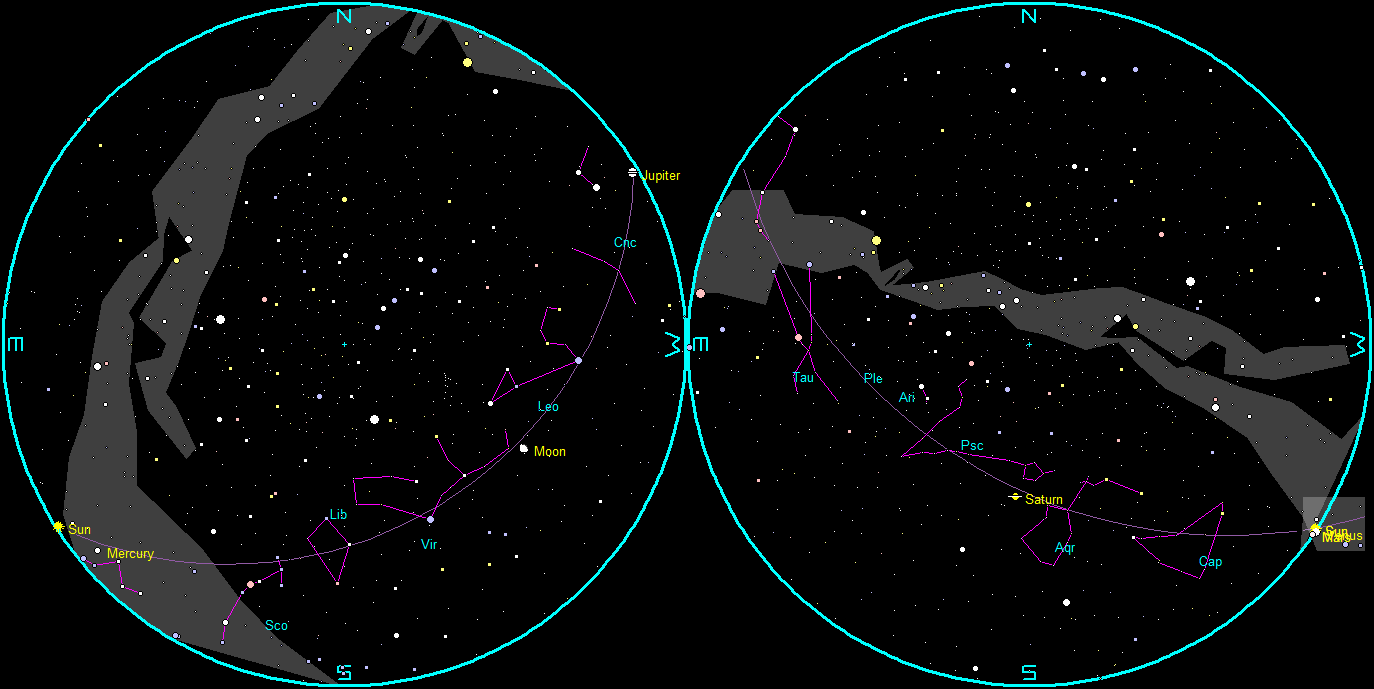
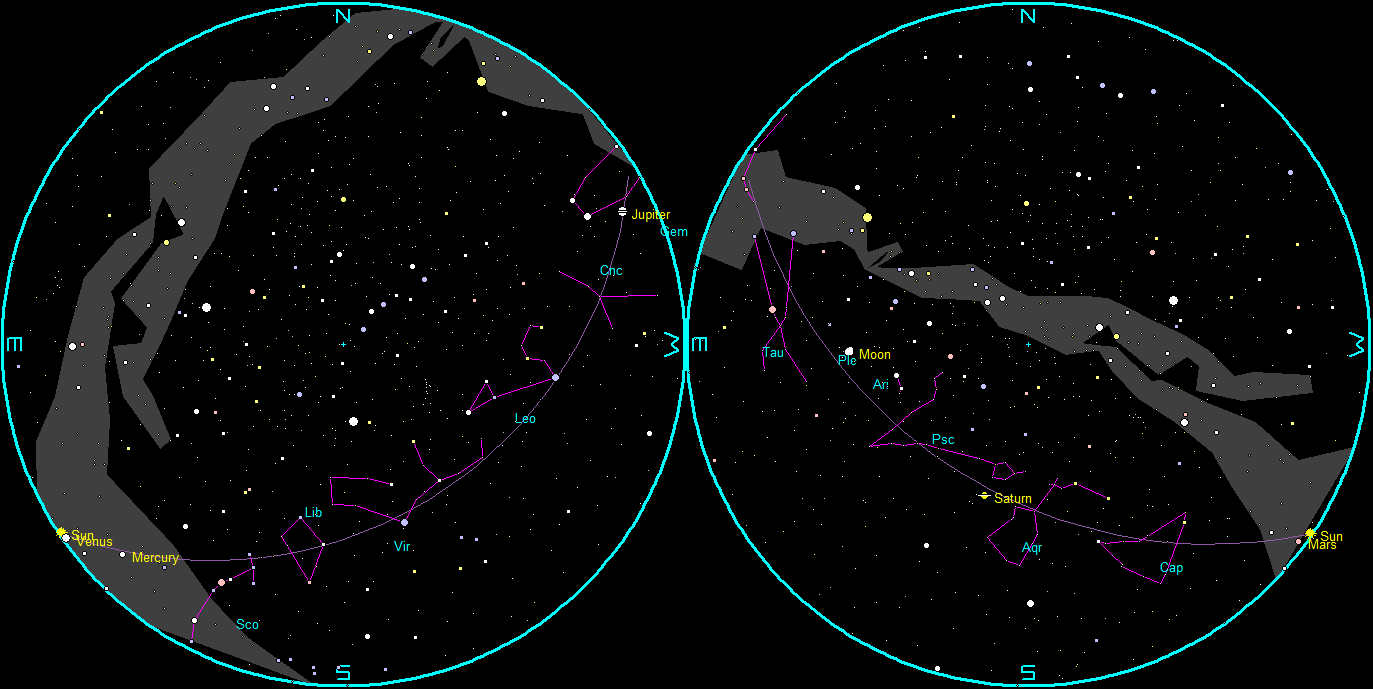
The naked-eye planets and the Moon at sunset and sunrise on a single night, starting with sunset on the right on February 11th, 2026. The night ends on the left with sunrise on the 12th
The naked-eye planets and the Moon at sunset and sunrise on a single night, starting with sunset on the right on February 11th, 2026. The night ends on the left with sunrise on the 12th. The Venus and Mercury labels overlap near the sunset sun. Click or tap on the image to enlarge it. Created using my LookingUp app and GIMP.
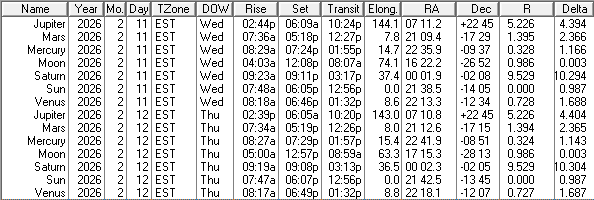
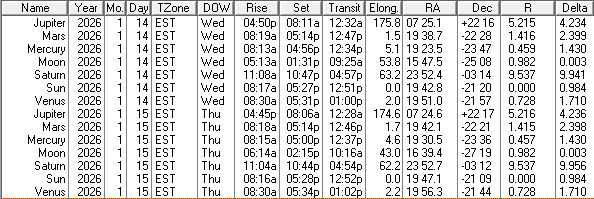
A low precision ephemeris of the Sun Moon and naked eye planet positions for today and tomorrow.
This is a low precision ephemeris of the Sun Moon and naked eye planet positions for today and tomorrow, February 11th and 12th, 2026. Some of the columns are self-explanatory, others are not. The transit column is the time that the body crosses the meridian and is due south. Elong, for elongation, is the angle between the Sun and that body. RA is right ascension, which is the object’s east-west position on the celestial sphere in hours and minutes. Dec is declination which is the north-south position of the object on the celestial sphere in degrees and minutes. R is the distance of that object from the Sun in astronomical units. An astronomical unit is about 93 million miles or 150 million kilometers. And Delta is the distance of that object from the Earth, also in astronomical units. I omit the ‘m’ in am and pm for compactness. The data was generated using my LookingUp for DOS app and displayed as a table by my Ephemeris Helper app.

Ephemeris: 02/04/2026 – Taking our weekly look at the whereabouts of the naked-eye planets

February 4, 2026 Comments off

This is Ephemeris for Wednesday, February 4th. Today the Sun will be up for 9 hours and 57 minutes, setting at 5:55, and it will rise tomorrow at 7:56. The Moon, 3 days past full, will rise at 9:25 this evening.

Let’s take our weekly look at the whereabouts of the naked-eye planets. Saturn is the brightest star-like object low in the west southwestern sky as soon as it gets dark. In a telescope Saturn sports a very thin ring, 2.4 degrees from being edge on and is slowly opening. Jupiter is the brilliant star-like object in the eastern sky, to the right of Pollux in the pair Castor and Pollux, the bright stars of Gemini. It is still moving slowly to the west, and will, until it stops and reverses its track on March 10th. Jupiter’s four brightest moons can be seen even in binoculars, if held steadily enough. They shift position night to night. At 8 PM tonight, all four Galilean moons can be seen, though two may too close together to be picked out separately in binoculars.

The astronomical event times given in this blog are for the Traverse City/Interlochen area of Michigan (Lat 44.7° N, Long 85.7° W; EST, UT – 5 hours) unless stated otherwise. Times will be different for other locations.

Addendum
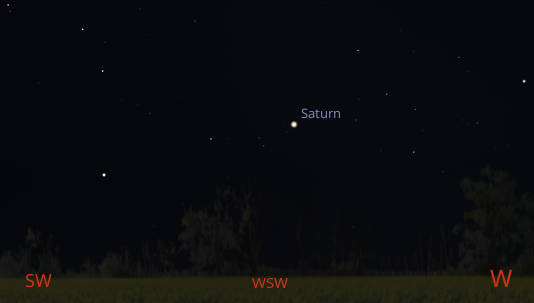
Saturn appears lonely in the west-southwestern sky at 8 PM
Saturn appears lonely in the west-southwestern sky at 8 PM. Created using Stellarium.
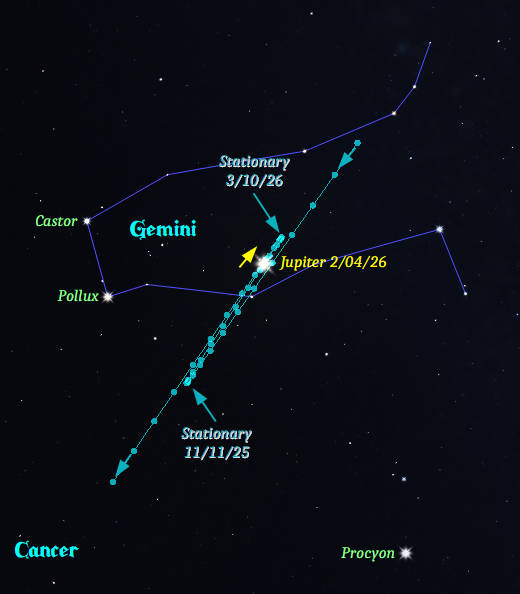
Jupiter as it appears tonight, February 4, 2026, in its orientation at 8:00 PM moving against the stars of Gemini.
Jupiter as it appears tonight, February 4, 2026, in its orientation at 8:00 PM moving against the stars of Gemini. Also shown is its track from last July to next July, and the retrograde loop that is currently making, slowly moving to the West which you will do for the next 34 days until it stops in March. Then it will resume its eastward motion. Created using Stellarium, LibreOffice Draw and GIMP.
The Moon halfway from full to last quarter, as seen tomorrow morning, February 5, 2026. A view visible in small telescopes showing an image with and without selected features labeled. Created using Stellarium, LibreOffice Draw, and GIMP.
Telescopic Saturn, and Jupiter (north up) as they would be seen in a small telescope.
Telescopic Saturn, and Jupiter (north up) as they would be seen in a small telescope with the same magnification at 8 PM tonight, February 4, 2026. Saturn will be 16.3″ in diameter, but its rings, being nearly edge on, may show up brighter than seen here, and extend to 37.9″. They are tilted 2.4° from being edge on. Jupiter will be 45.4″ in diameter. The (”) symbol means seconds of arc, or 1/3600th of a degree. Created using Cartes du Ciel (Sky Charts), LibreOffice Draw and GIMP.
The naked-eye planets and the Moon at sunset and sunrise on a single night, starting with sunset on the right on February 4th, 2026. The night ends on the left with sunrise on the 5th.
The naked-eye planets and the Moon at sunset and sunrise on a single night, starting with sunset on the right on February 4th, 2026. The night ends on the left with sunrise on the 5th. The Venus and Mercury labels overlap near the sunset sun. Click or tap on the image to enlarge it. Created using my LookingUp app and GIMP.
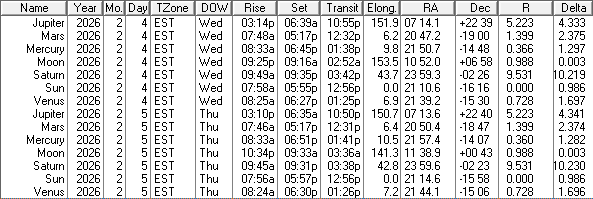
A low precision ephemeris of the Sun Moon and naked eye planet positions for today and tomorrow, February 4th and 5th, 2026.
This is a low precision ephemeris of the Sun Moon and naked eye planet positions for today and tomorrow, February 4th and 5th, 2026. Some of the columns are self-explanatory, others are not. The transit column is the time that the body crosses the meridian and is due south. Elong, for elongation, is the angle between the Sun and that body. RA is right ascension, which is the object’s east-west position on the celestial sphere in hours and minutes. Dec is declination which is the north-south position of the object on the celestial sphere in degrees and minutes. R is the distance of that object from the Sun in astronomical units. An astronomical unit is about 93 million miles or 150 million kilometers. And Delta is the distance of that object from the Earth, also in astronomical units. I omit the ‘m’ in am and pm for compactness. The data was generated using my LookingUp for DOS app and displayed as a table by my Ephemeris Helper app.

Ephemeris: 01/28/2026 – Taking our weekly look at the whereabouts of the naked-eye planets

January 28, 2026 Comments off

This is Ephemeris for Wednesday, January 28th. Today the Sun will be up for 9 hours and 39 minutes, setting at 5:45, and it will rise tomorrow at 8:05. The Moon, 3 days past first quarter, will set at 5:43 tomorrow morning.

Let’s take our weekly look at the whereabouts of the naked-eye planets. Saturn is the brightest star-like object in the southwestern sky as soon as it gets dark. In a telescope Saturn sports a very thin ring, 2 degrees from being edge on and is slowly opening. Jupiter is the brilliant star-like object in the eastern sky, to the right of Pollux in the pair Castor and Pollux, the bright stars of Gemini. It is still moving slowly to the west, and will, until it stops and reverses its track on March 10th. Jupiter’s 4 brightest moons can be seen even in binoculars, if held steadily enough. They shift position night to night. At 8 PM tonight, all four Galilean moons can be seen, though two may too close to the planet to be picked out in binoculars.

The astronomical event times given in this blog are for the Traverse City/Interlochen area of Michigan (Lat 44.7° N, Long 85.7° W; EST, UT – 5 hours) unless stated otherwise. Times will be different for other locations.

Addendum
Saturn appears lonely in the west- southwestern sky at 8 PM.
Saturn appears lonely in the west- southwestern sky at 8 PM. Created using Stellarium.
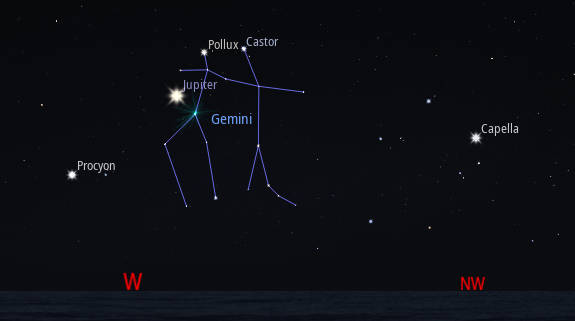
Jupiter as it appears tonight, January 28, 2026, in its orientation at 9:00 PM, moving against the stars of Gemini. Also shown is its track from last July to next July, and the retrograde loop that is currently making.
Jupiter as it appears tonight, January 28, 2026, in its orientation at 9:00 PM, moving against the stars of Gemini. Also shown is its track from last July to next July, and the retrograde loop that is currently making, slowly moving to the West which you will do for the next 41 days until it stops in March. Then it will resume its eastward motion. Created using Stellarium, Libreoffice Draw and GIMP.
The Moon three days past first quarter, as seen this evening, January 28, 2026. A view visible in small telescopes showing an image with and without selected features labeled. Created using Stellarium, LibreOffice Draw, and GIMP.
Telescopic Saturn, and Jupiter (north up) as they would be seen in a small telescope with the same magnification at 8 PM tonight.
Telescopic Saturn, and Jupiter (north up) as they would be seen in a small telescope with the same magnification at 8 PM tonight, January 28, 2026. Saturn will be 16.4″ in diameter, but its rings, being nearly edge on, may show up brighter than seen here, and extend to 38.2″. They are tilted 2.0° from being edge on. Jupiter will be 45.9″ in diameter. Io will begin transiting the planet at 8:35 PM EDT (1:35 UT on the 29th). Its shadow will begin crossing the planet at 9:02 PM EDT (2:02 UT). The transit will end at 10:51 PM EDT (3:51 UT), with the shadow leaving the planet at 11:19 PM EDT (4:19 UT). The (”) symbol means seconds of arc, or 1/3600th of a degree. Created using Cartes du Ciel (Sky Charts), LibreOffice Draw and GIMP.
The naked-eye planets and the Moon at sunset and sunrise on a single night.
The naked-eye planets and the Moon at sunset and sunrise on a single night, starting with sunset on the right on January 28th, 2026. The night ends on the left with sunrise on the 29th. Click or tap on the image to enlarge it. Created using my LookingUp app and GIMP.
A low precision ephemeris of the Sun Moon and naked eye planet positions for today and tomorrow.
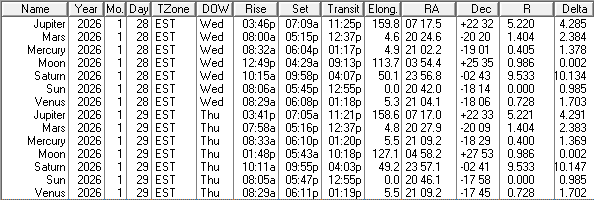
This is a low precision ephemeris of the Sun Moon and naked eye planet positions for today and tomorrow, January 28th and 29th, 2026. Some of the columns are self-explanatory, others are not. The transit column is the time that the body crosses the meridian and is due south. Elong, for elongation, is the angle between the Sun and that body. RA is right ascension, which is the object’s east-west position on the celestial sphere in hours and minutes. Dec is declination which is the north-south position of the object on the celestial sphere in degrees and minutes. R is the distance of that object from the Sun in astronomical units. An astronomical unit is about 93 million miles or 150 million kilometers. And Delta is the distance of that object from the Earth, also in astronomical units. I omit the ‘m’ in am and pm for compactness. The data was generated using my LookingUp for DOS app and displayed as a table by my Ephemeris Helper app.

Ephemeris: 01/21/2026 – Taking our weekly look at the whereabouts of the naked-eye planets

January 21, 2026 Comments off

This is Ephemeris for Wednesday, January 21st. Today the Sun will be up for 9 hours and 23 minutes, setting at 5:36, and it will rise tomorrow at 8:11. The Moon, 3 days past new, will set at 8:53 this evening.

Let’s take our weekly look at the whereabouts of the naked-eye planets. Saturn is the brightest star-like object in the west-southwestern sky as soon as it gets dark. At 8 PM, it is in roughly in the same direction as the Moon, but a good deal higher in the sky. In a telescope Saturn sports a very thin ring, 1.8 degrees from being edge on and is slowly opening. Jupiter is the brilliant star-like object in the eastern sky, to the right of Pollux in the pair Castor and Pollux, the bright stars of Gemini. Jupiter’s 4 brightest moons can be seen even in binoculars, if held steady enough. They shift position night to night. At 8 PM tonight, only three will be visible, but the 4th will be appearing from in front of Jupiter later this evening.

The astronomical event times given in this blog are for the Traverse City/Interlochen area of Michigan (Lat 44.7° N, Long 85.7° W; EST, UT – 5 hours) unless stated otherwise. Times will be different for other locations.

Addendum
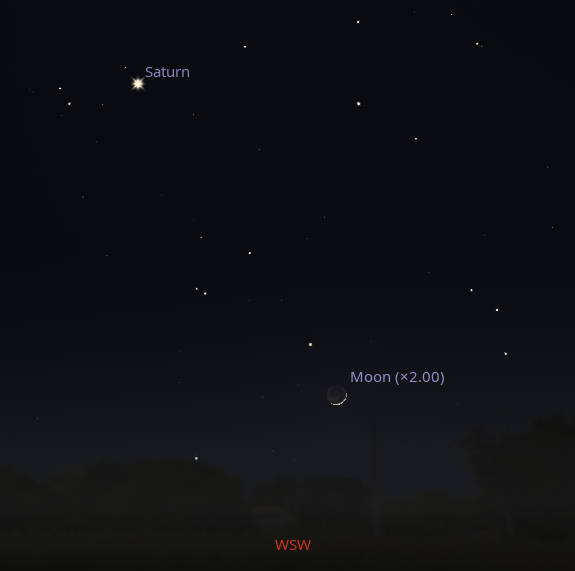
Saturn and the waxing crescent Moon as they might appear tonight.
Saturn and the waxing crescent Moon as they might appear tonight, January 21, 2026. The Moon is being enlarged by a factor of 2 to show it up better. Look off into the west southwest at 8:00 PM. Created using Stellarium.
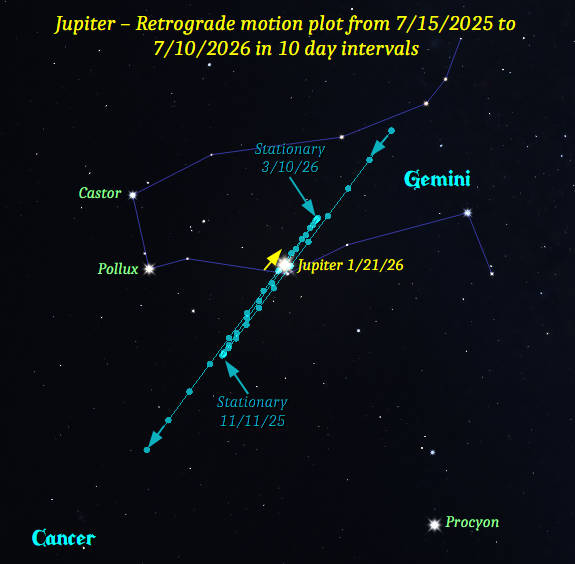
Jupiter as it appears tonight in its orientation at 8:00 PM, moving against the stars of Gemini. Also shown is its track from last July to next July, and the retrograde loop that is currently making.
Jupiter as it appears tonight, January 21, 2026, in its orientation at 8:00 PM, moving against the stars of Gemini. Also shown is its track from last July to next July, and the retrograde loop that is currently making, slowly moving to the West which you will do for the next 48 days until it stops in March. Then it will resume its eastward motion. Created using Stellarium, Libreoffice Draw and GIMP.
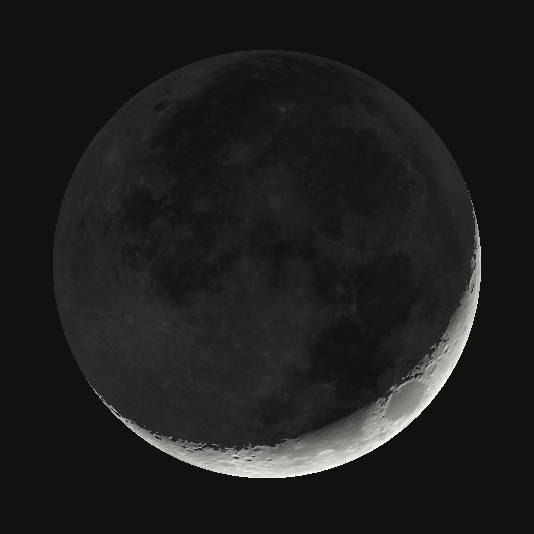
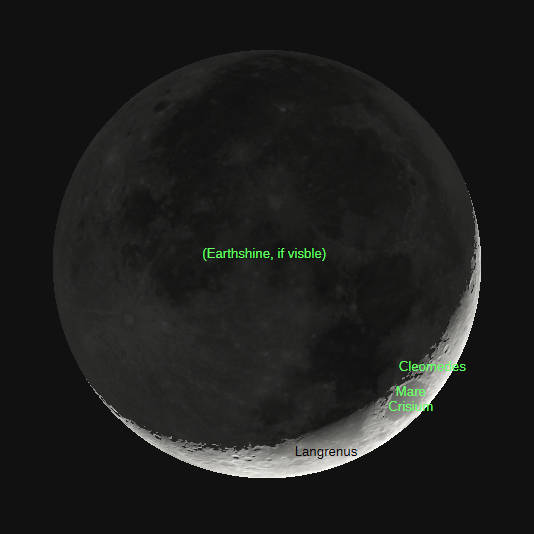
The Moon three days past new, as seen this evening, January 21, 2026. A view visible in small telescopes showing an image with and without selected features labeled. Created using Stellarium, LibreOffice Draw, and GIMP.
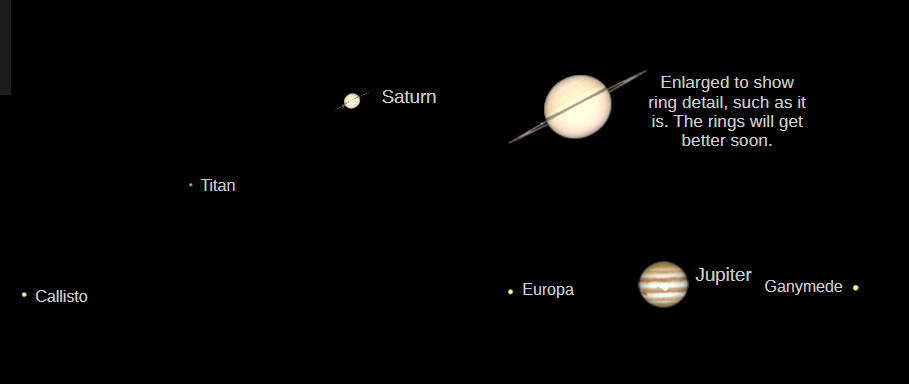
Telescopic Saturn, and Jupiter (north up) as they would be seen in a small telescope with the same magnification at 8 PM tonight.
Telescopic Saturn, and Jupiter (north up) as they would be seen in a small telescope with the same magnification at 8 PM tonight, January 21, 2026. Saturn will be 17.0″ in diameter, but its rings, being nearly edge on, may show up brighter than seen here, and extend to 38.6″. They are tilted 1.8° from being edge on. Jupiter will be 46.3″ in diameter. The (”) symbol means seconds of arc, or 1/3600th of a degree. Created using Cartes du Ciel (Sky Charts), LibreOffice Draw and GIMP.
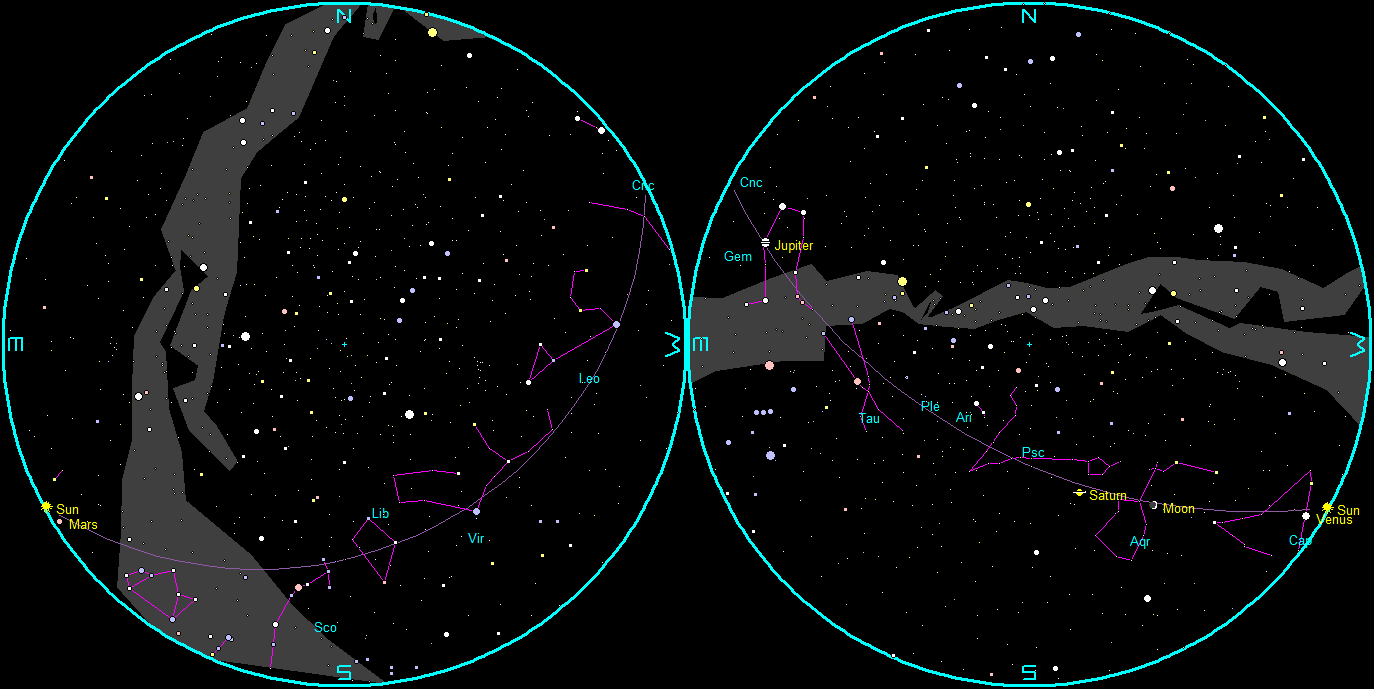
The naked-eye planets and the Moon at sunset and sunrise on a single night, starting with sunset on the right on January 21st, 2026. The night ends on the left with sunrise on the 22nd.
The naked-eye planets and the Moon at sunset and sunrise on a single night, starting with sunset on the right on January 21st, 2026. The night ends on the left with sunrise on the 22nd. Mercury is not plotted, being too close to, and south of the Sun. Click or tap on the image to enlarge it. Created using my LookingUp app and GIMP.
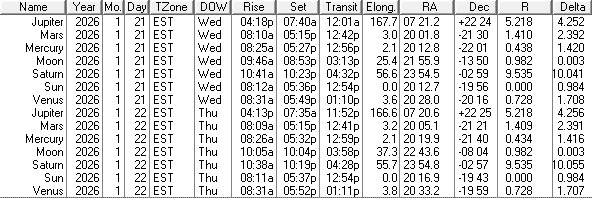
A low precision ephemeris of the Sun Moon and naked eye planet positions for today and tomorrow, January 21st and 22nd, 2026.
This is a low precision ephemeris of the Sun Moon and naked eye planet positions for today and tomorrow, January 21st and 22nd, 2026. Some of the columns are self-explanatory, others are not. The transit column is the time that the body crosses the meridian and is due south. Elong, for elongation, is the angle between the Sun and that body. RA is right ascension, which is the object’s east-west position on the celestial sphere in hours and minutes. Dec is declination which is the north-south position of the object on the celestial sphere in degrees and minutes. R is the distance of that object from the Sun in astronomical units. An astronomical unit is about 93 million miles or 150 million kilometers. And Delta is the distance of that object from the Earth, also in astronomical units. I omit the ‘m’ in am and pm for compactness. The data was generated using my LookingUp for DOS app and displayed as a table by my Ephemeris Helper app.

Ephemeris: 01/14/2026 – Only two naked-eye planets are visible this week, both in the evening

January 14, 2026 Comments off

This is Ephemeris for Wednesday, January 14th. Today the Sun will be up for 9 hours and 10 minutes, setting at 5:27, and it will rise tomorrow at 8:16. The Moon, halfway from last quarter to new, will rise at 6:14 tomorrow morning.

Let’s take our weekly look at the whereabouts of the naked-eye planets. Saturn is the brightest star-like object in the southwestern sky as soon as it gets dark. In a telescope Saturn sports a very thin ring, 1½ degrees from being edge on and is slowly opening. Jupiter is now officially an evening planet, rising before sunset. It’s seen in the evening to the right of Pollux in the pair Castor and Pollux, the bright stars of Gemini. Jupiter’s four brightest moons can be seen even in binoculars, and shift position night to night. Jupiter can still be seen in the morning sky. At 7 AM it will be low in the western sky. Venus, Mercury and Mars are too close to the direction of the Sun to be seen.

The astronomical event times given in this blog are for the Traverse City/Interlochen area of Michigan (Lat 44.7° N, Long 85.7° W; EST, UT – 5 hours) unless stated otherwise. Times will be different for other locations.

Addendum
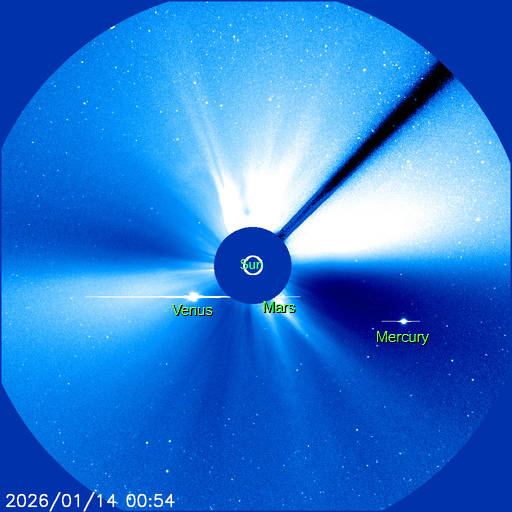
This is a photograph of the Sun, Venus and Mars taken through the Solar and Heliospheric Observatory‘s (SOHO) C3 coronagraph last night.
This is a photograph of the Sun, Venus and Mars taken through the Solar and Heliospheric Observatory‘s (SOHO) C3 coronagraph last night at 7:54 PM or 0:54 today Universal Time. Venus and Mercury are heading to the left, while Mars is heading to the right. They are all beyond the Sun. Venus will be entering our evening sky, and should be visible in about a month. Mercury too should be visible in the evening twilight by mid-February. Mars will be moving into the morning sky and it will take several months before it will be visible then. Credit: NOAA/ESA.
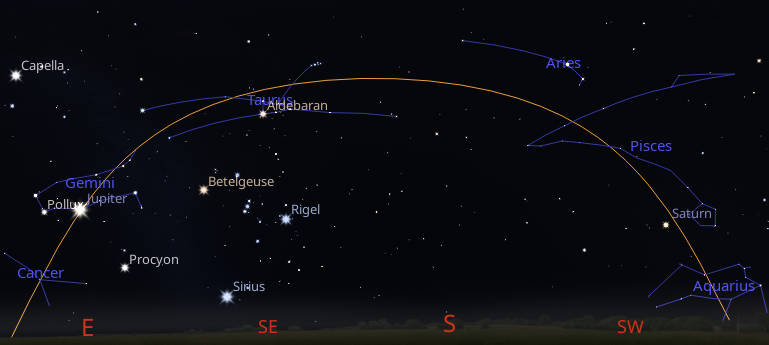
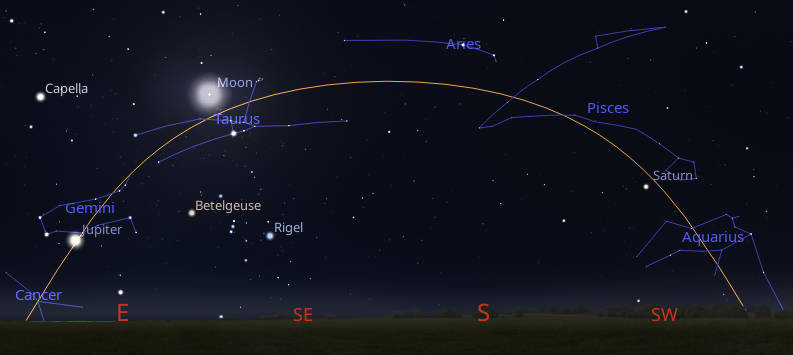
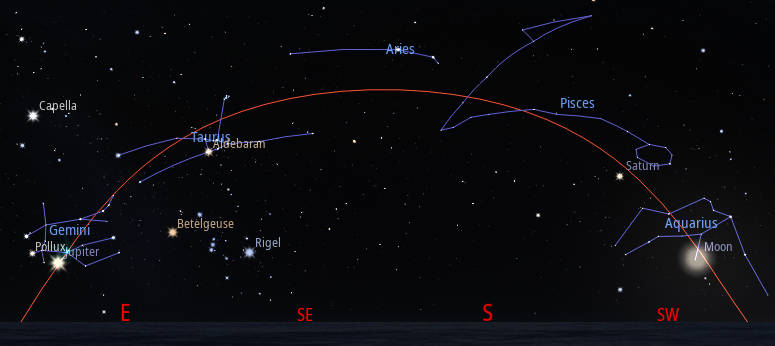
Jupiter, and Saturn along with the zodiacal constellations, and the path of the Sun (ecliptic) in orange, in this panorama at 8 PM tonight, January 14, 2026.
Jupiter, and Saturn along with the zodiacal constellations, and the path of the Sun (ecliptic) in orange, in this panorama at 8 PM tonight, January 14, 2026. Created using Stellarium.
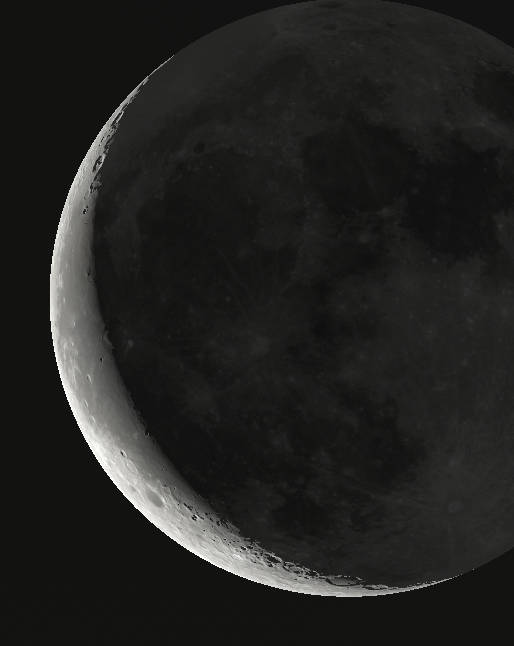
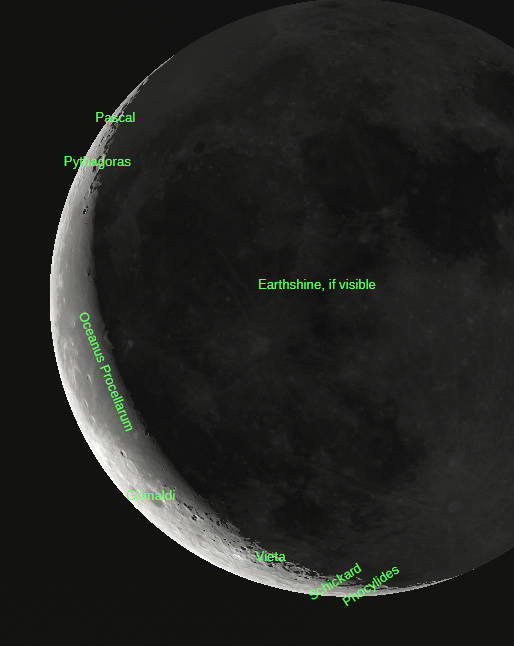
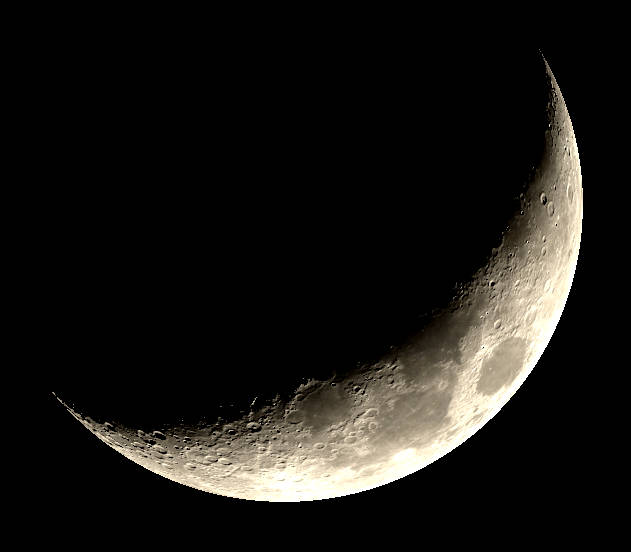
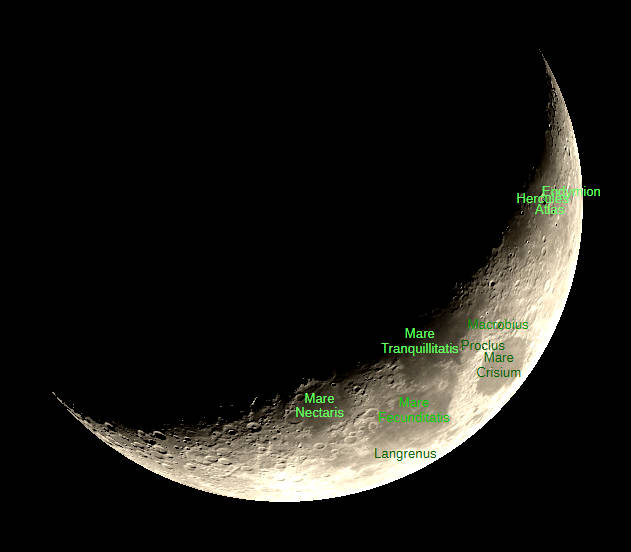
The Moon three days before last quarter as seen tomorrow morning, January 15, 2026. A view visible in small telescopes showing an image with and without selected features labeled. Created using Stellarium, LibreOffice Draw, and GIMP.
Telescopic Saturn, and Jupiter (north up) as they would be seen in a small telescope with the same magnification at 8 PM tonight, January 14, 2026.
Telescopic Saturn, and Jupiter (north up) as they would be seen in a small telescope with the same magnification at 8 PM tonight, January 14, 2026. Saturn will be 16.7″ in diameter, but its rings, being nearly edge on, may show up brighter than seen here, and extend to 39.0″. They are tilted 1.5° from being edge on. Jupiter will be 46.5″ in diameter. The (”) symbol means seconds of arc, or 1/3600th of a degree. Created using Cartes du Ciel (Sky Charts), LibreOffice Draw and GIMP.
The naked-eye planets and the Moon at sunset and sunrise on a single night.
The naked-eye planets and the Moon at sunset and sunrise on a single night, starting with sunset on the right on January 14th, 2026. The night ends on the left with sunrise on the 15th. Click or tap on the image to enlarge it. Created using my LookingUp app and GIMP.
A low precision ephemeris of the Sun Moon and naked eye planet positions for today and tomorrow, January 14th and 15th, 2026.
This is a low precision ephemeris of the Sun Moon and naked eye planet positions for today and tomorrow, January 14th and 15th, 2026. Some of the columns are self-explanatory, others are not. The transit column is the time that the body crosses the meridian and is due south. Elong, for elongation, is the angle between the Sun and that body. RA is right ascension, which is the object’s east-west position on the celestial sphere in hours and minutes. Dec is declination which is the north-south position of the object on the celestial sphere in degrees and minutes. R is the distance of that object from the Sun in astronomical units. An astronomical unit is about 93 million miles or 150 million kilometers. And Delta is the distance of that object from the Earth, also in astronomical units. I omit the ‘m’ in am and pm for compactness. The data was generated using my LookingUp for DOS app and displayed as a table by my Ephemeris Helper app.

Ephemeris: 01/07/2026 – Taking our first weekly look at the whereabouts of the naked-eye planets for 2026

January 7, 2026 1 comment

This is Ephemeris for Wednesday, January 7th. Today the Sun will be up for 8 hours and 59 minutes, setting at 5:19, and it will rise tomorrow at 8:19. The Moon, 3 days before last quarter, will rise at 10:37 this evening.

Let’s take our first weekly look at the whereabouts of the naked-eye planets for 2026. Saturn is the brightest star-like object in the southwestern sky as soon as it gets dark. In a telescope Saturn sports a very thin ring, 1.2 degrees from being edge on and is slowly opening. Jupiter will rise just after sunset. It is seen in the evening right of Pollux in the pair Castor and Pollux, the bright stars of Gemini. The giant planet is slowly moving westward with its retrograde motion. Jupiter’s 4 brightest moons can be seen even in binoculars, and shift position night to night. In the morning sky, only Jupiter can be seen. It will leave the morning sky, become an official evening planet Saturday. Venus crossed behind the Sun yesterday to become an evening planet. Mars will also cross behind the Sun Friday to become a morning planet.

The astronomical event times given in this blog are for the Traverse City/Interlochen area of Michigan (Lat 44.7° N, Long 85.7° W; EST, UT – 5 hours) unless stated otherwise. Times will be different for other locations.

Addendum
The apparent path of Jupiter from July 15, 2025 to July 10, 2026, showing its retrograde loop.
The apparent path of Jupiter from July 15, 2025 to July 10, 2026, showing its retrograde loop. We are 3 days from Jupiter’s opposition from the Sun. The retrograde (western) motion is due to the Earth’s faster speed in its orbit overtaking the planet. Created using Stellarium and LibreOffice Draw.
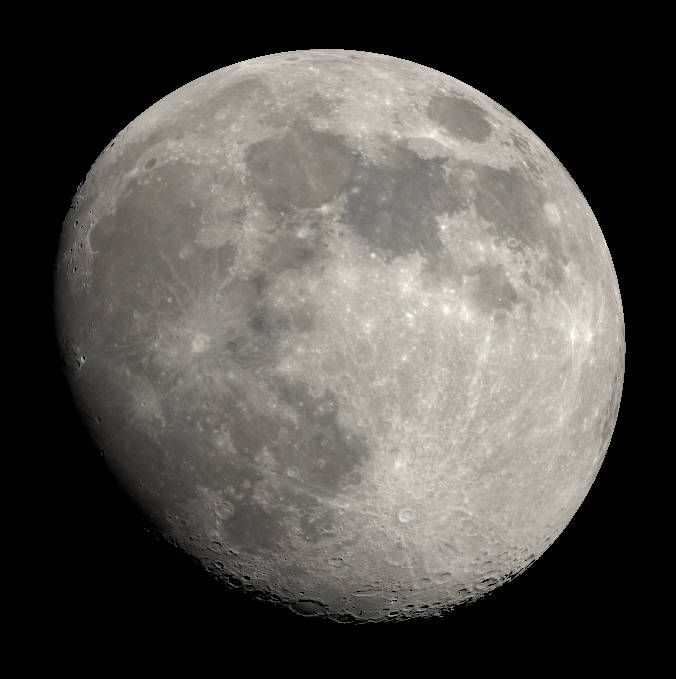
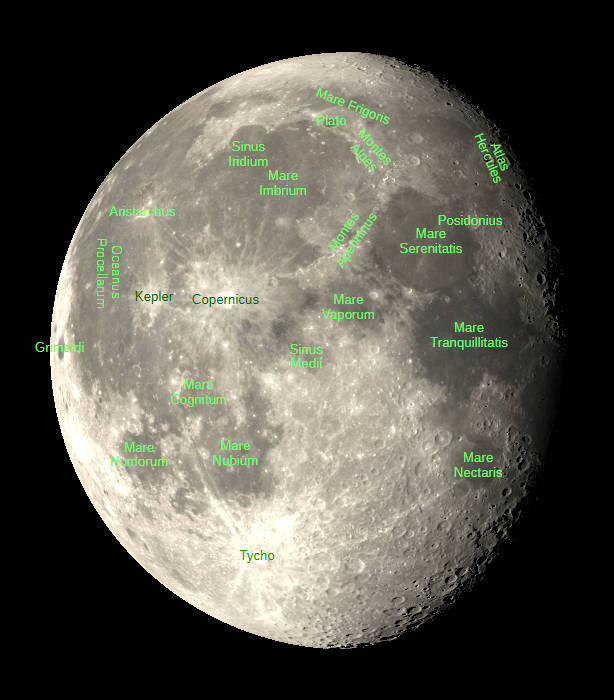
The Moon two days before last quarter as seen tomorrow morning, January 8, 2026. A view visible in small telescopes showing an image with and without selected features labeled. Created using Stellarium, LibreOffice Draw, and GIMP.
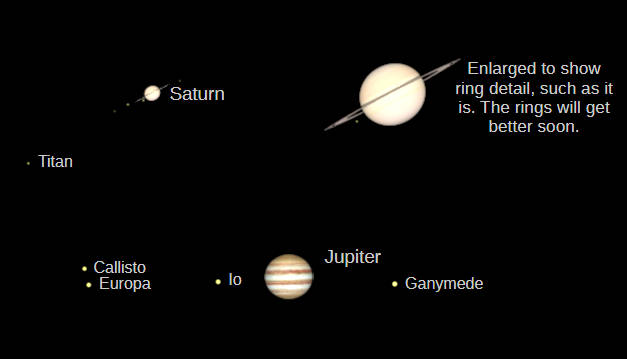
Telescopic Saturn, and Jupiter (north up) as they would be seen in a small telescope with the same magnification at 8 PM tonigh
Telescopic Saturn, and Jupiter (north up) as they would be seen in a small telescope with the same magnification at 8 PM tonight, January 7, 2026. Saturn will be 16.9″ in diameter, but its rings, being nearly edge on, may show up brighter than seen here, and extend to 39.4″. They are tilted 1.2° from being edge on. Jupiter will be 46.6″ in diameter. The (”) symbol means seconds of arc, or 1/3600th of a degree. Created using Cartes du Ciel (Sky Charts), LibreOffice Draw and GIMP.
The naked-eye planets and the Moon at sunset and sunrise on a single night.
The naked-eye planets and the Moon at sunset and sunrise on a single night, starting with sunset on the right on January 7th, 2026. The night ends on the left with sunrise on the 8th. Note the overlapping of Mars and Venus with the Sun. I’ve had to show a bit below the horizon to get Venus in on the sunset chart. See the image below to see them appear near the Sun. Click or tap on the image to enlarge it. Created using my LookingUp app and GIMP.
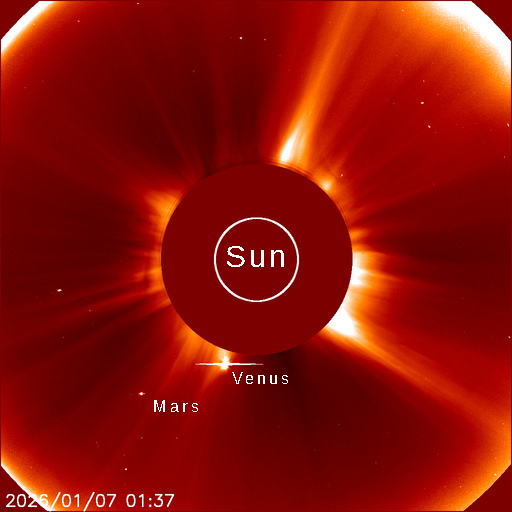
This this is a photograph of the Sun, Venus and Mars taken through the Solar and Heliospheric Observatory's (SOHO) C2 coronagraph.
This this is a photograph of the Sun, Venus and Mars taken through the Solar and Heliospheric Observatory‘s (SOHO) C2 coronagraph last night at 8:37 PM or 1:37 today Universal Time. Venus is heading to the left, while Mars is heading to the right. They are both beyond the Sun. Venus will be entering our evening sky, and should be visible in about a month. Mars will be moving into the morning sky and it will take several months before it will be visible then. Credit: NOAA/ESA.
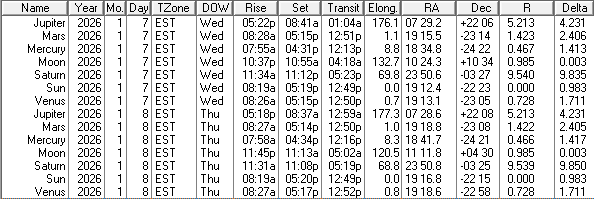
A low precision ephemeris of the Sun Moon and naked eye planet positions for today and tomorrow, January 7th and 8th, 2026
This is a low precision ephemeris of the Sun Moon and naked eye planet positions for today and tomorrow, January 7th and 8th, 2026. Some of the columns are self-explanatory, others are not. The transit column is the time that the body crosses the meridian and is due south. Elong, for elongation, is the angle between the Sun and that body. RA is right ascension, which is the object’s east-west position on the celestial sphere in hours and minutes. Dec is declination which is the north-south position of the object on the celestial sphere in degrees and minutes. R is the distance of that object from the Sun in astronomical units. An astronomical unit is about 93 million miles or 150 million kilometers. And Delta is the distance of that object from the Earth, also in astronomical units. I omit the ‘m’ in am and pm for compactness. The data was generated using my LookingUp for DOS app and displayed as a table by my Ephemeris Helper app.

Ephemeris: 12/31/2025 – A last look at the naked-eye planets for 2025

December 31, 2025 Comments off

This is Ephemeris for New Year’s Eve, Wednesday, December 31st. The Sun will rise at 8:20. It’ll be up for 8 hours and 52 minutes, setting at 5:12. The Moon, 3 days before full, will set at 6:49 tomorrow morning.

Let’s take our last weekly look at the whereabouts of the naked-eye planets for 2025. Saturn is the brightest star-like object in the southwestern sky as soon as it gets dark. In a telescope Saturn sports a very thin ring, one degree from being edge on and is slowly opening. Jupiter will rise at 5:54 PM in the east-northeast, below and right of Castor and Pollux, the bright stars of Gemini. The giant planet is slowly moving westward with its retrograde motion. Jupiter’s 4 brightest moons can be seen even in binoculars, and shift position night to night. In the morning sky, only Jupiter can be seen, descending in the western sky. It will leave the morning sky, officially on January 10th, as it reaches opposition with the Sun.

The astronomical event times given in this blog are for the Traverse City/Interlochen area of Michigan (Lat 44.7° N, Long 85.7° W; EST, UT – 5 hours) unless stated otherwise. Times will be different for other locations.

Addendum
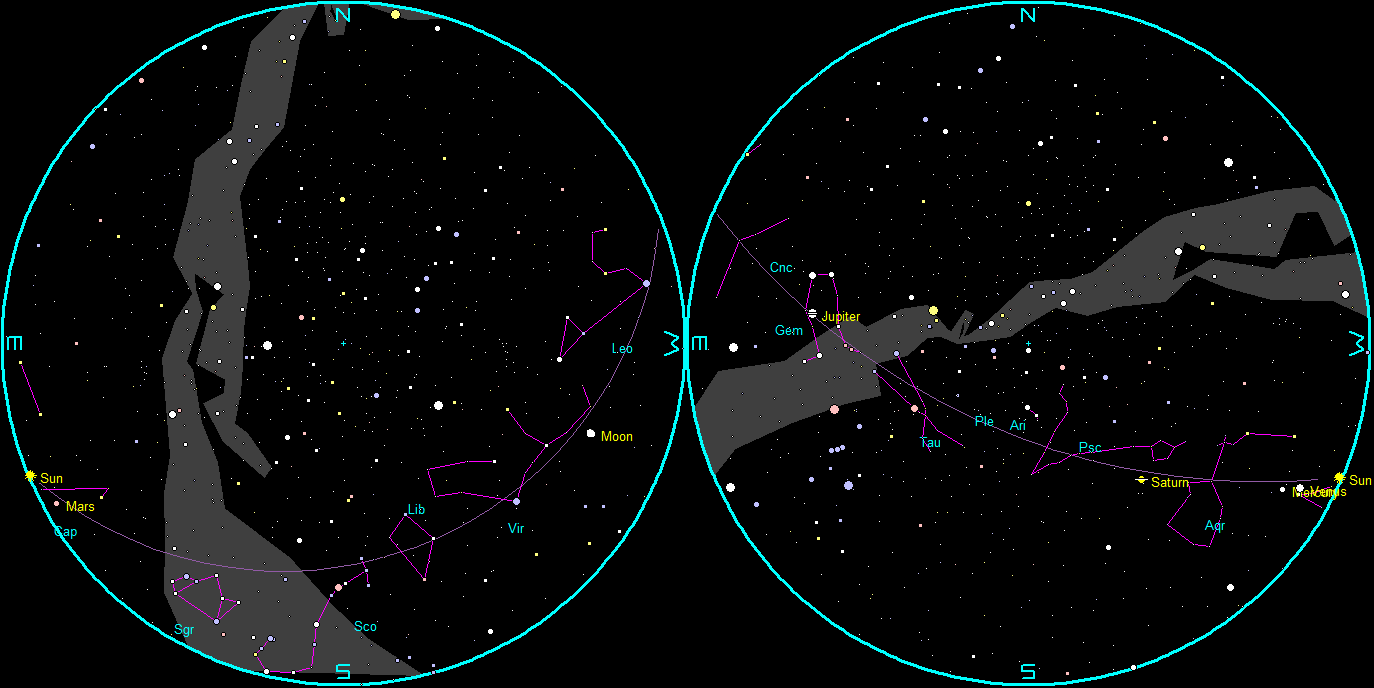
Jupiter, Saturn and the waxing gibbous Moon along with the zodiacal constellations tonight.
Jupiter, Saturn and the waxing gibbous Moon along with the zodiacal constellations, and the path of the Sun (ecliptic) in orange, in this panorama at 8 PM tonight, December 31, 2025. Created using Stellarium.
The Moon three days before full as seen in the tonight, December 31, 2025. A view visible in small telescopes showing an image with and without selected features labeled. Created using Stellarium, LibreOffice Draw, and GIMP.
Jupiter is the only visible morning planet, and soon it too will leave, as it is sinking in the west with the few remaining winter stars and the Moon at 7 AM tomorrow, January 1, 2026.
Jupiter is the only visible morning planet, and soon it too will leave, as it is sinking in the west with the few remaining winter stars and the Moon at 7 AM tomorrow, January 1, 2026. Created using Stellarium.
Telescopic Saturn, and Jupiter (north up) as they would be seen in a small telescope with the same magnification at 8 PM tonight, December 31, 2025. Saturn will be 17.1″ in diameter, but its rings, being nearly edge on, may show up brighter than seen here, and extend to 39.9″. They are tilted 1.0° from being edge on. Jupiter will be 46.5″ in diameter. Jupiter’s moon Io and its shadow will transit the planet later in the evening. The (”) symbol means seconds of arc, or 1/3600th of a degree. Created using Cartes du Ciel (Sky Charts), LibreOffice Draw and GIMP.
The naked-eye planets and the Moon at sunset and sunrise on a single night.
The naked-eye planets and the Moon at sunset and sunrise on a single night, starting with sunset on the right on December 31st, 2025. The night ends on the left with sunrise on the New Year’s morning, 2026. Click or tap on the image to enlarge it. Created using my LookingUp app and GIMP.

Ephemeris: 12/24/2025 – Taking our weekly look at the whereabouts of the naked-eye planets

December 24, 2025 Comments off

This is Ephemeris for Christmas Eve, Wednesday, December 24th. Today the Sun will be up for 8 hours and 48 minutes, setting at 5:06, and it will rise tomorrow at 8:18. The Moon, 3 days before first quarter, will set at 9:51 this evening.

Let’s take our weekly look at the whereabouts of the naked-eye planets. Saturn is the brightest star-like object in the southwestern sky as soon as it gets dark. In a telescope Saturn sports a very thin ring, eight tenths of a degree from being edge on and slowly opening. Jupiter will rise at 6:26 PM in the east-northeast, below Castor and Pollux, the bright stars of Gemini. The giant planet is slowly moving westward with its retrograde motion. Jupiter’s 4 brightest moons can be seen even in binoculars, and shift position night to night. In the morning sky, only Jupiter can be seen, descending in the western sky. It will leave the morning sky, officially on January 10th, as it reaches opposition to the Sun.

The astronomical event times given in this blog are for the Traverse City/Interlochen area of Michigan (Lat 44.7° N, Long 85.7° W; EST, UT – 5 hours) unless stated otherwise. Times will be different for other locations.

Addendum
Jupiter, Saturn and the waxing crescent Moon along with the zodiacal constellations, and the path of the Sun (ecliptic), in this panorama at 8 PM tonight.
Jupiter, Saturn and the waxing crescent Moon along with the zodiacal constellations, and the path of the Sun (ecliptic) in orange, in this panorama at 8 PM tonight, December 24, 2025. Created using Stellarium.
The Moon three days before first quarter as seen in the tonight, December 24, 2025. A view visible in small telescopes showing an image with and without selected features labeled. Created using Stellarium, LibreOffice Draw, and GIMP.
Jupiter is the only visible morning planet, and soon it too will leave, as it is sinking in the west with the few remaining winter stars at 7 AM tomorrow, December 25, 2025.
Jupiter is the only visible morning planet, and soon it too will leave, as it is sinking in the west with the few remaining winter stars at 7 AM tomorrow, December 25, 2025. Created using Stellarium.
Telescopic Saturn, and Jupiter (north up) as they would be seen in a small telescope with the same magnification at 8 PM tonight, December 24, 2025.
Telescopic Saturn, and Jupiter (north up) as they would be seen in a small telescope with the same magnification at 8 PM tonight, December 24, 2025. Saturn will be 17.3″ in diameter, but its rings, being nearly edge on, may show up brighter than seen here, and extend to 40.3″. They are tilted 0.8° from being edge on. Jupiter will be 45.2″ in diameter. There are some events with Jupiter’s moons tonight. Europa is already transiting the face of the planet, and will leave at 10:05 PM. It’s shadow, falling on the planet is preceding it, though not shown, and will leave at 9:15 PM. The (”) symbol means seconds of arc, or 1/3600th of a degree. Created using Cartes du Ciel (Sky Charts), LibreOffice Draw and GIMP.

A note about transits of Jovian moons: A transiting moon is extremely difficult to pick up, however the moon’s shadow falling on the planet is much more easily spotted.
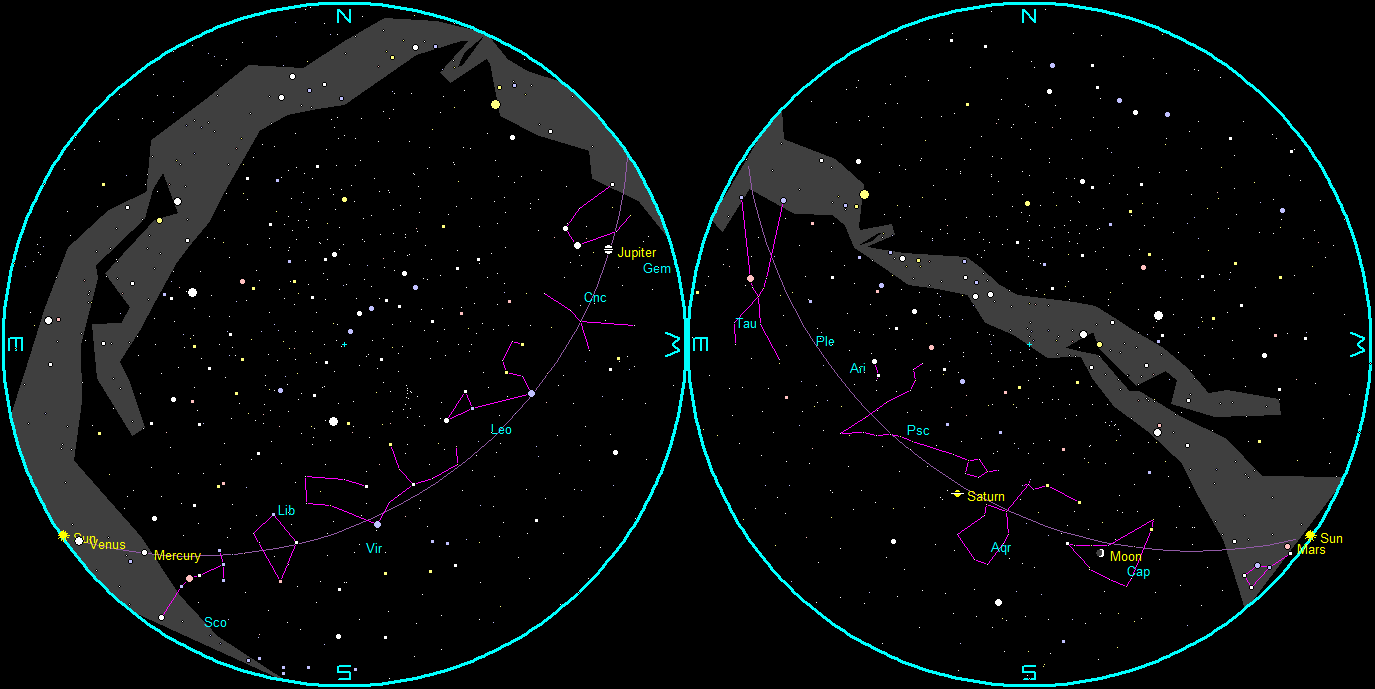
The naked-eye planets and the Moon at sunset and sunrise on a single night, starting with sunset on the right on December 24th, 2025. The night ends on the left with sunrise on the 25th.
The naked-eye planets and the Moon at sunset and sunrise on a single night, starting with sunset on the right on December 24th, 2025. The night ends on the left with sunrise on the 25th. Click or tap on the image to enlarge it. Created using my LookingUp app and GIMP.
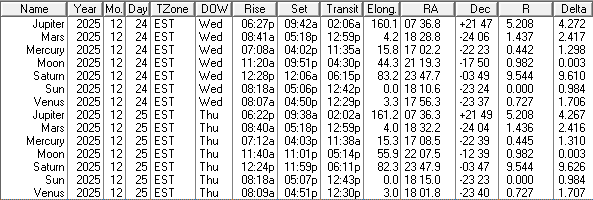
A low precision ephemeris of the Sun Moon and naked eye planet positions for today and tomorrow, December 24th and 25th, 2025.
This is a low precision ephemeris of the Sun Moon and naked eye planet positions for today and tomorrow, December 24th and 25th, 2025. Some of the columns are self-explanatory, others are not. The transit column is the time that the body crosses the meridian and is due south. Elong, for elongation, is the angle between the Sun and that body. RA is right ascension, which is the object’s east-west position on the celestial sphere in hours and minutes. Dec is declination which is the north-south position of the object on the celestial sphere in degrees and minutes. R is the distance of that object from the Sun in astronomical units. An astronomical unit is about 93 million miles or 150 million kilometers. And Delta is the distance of that object from the Earth, also in astronomical units. I omit the ‘m’ in am and pm for compactness. The data was generated using my LookingUp for DOS app and displayed as a table by my Ephemeris Helper app.