Archive
Ephemeris: 12/15/2023 – Jupiter is seen in Aries this year, also precession
This is Bob Moler with Ephemeris for Friday, December 15th. Today the Sun will be up for 8 hours and 49 minutes, setting at 5:02, and it will rise tomorrow at 8:13. The Moon, 3 days past new, will set at 7:50 this evening.
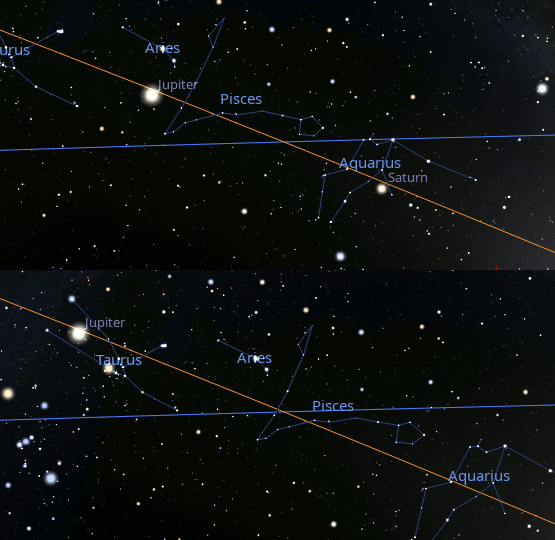
The planet Jupiter is seen against the stars of the constellation Aries the ram this year. The four stars of the constellation are seen above it, two of which are bright enough to be fairly easily seen. The other two are quite dim. The brightest is the star called Hamal. It is as bright as one of the stars of the Big Dipper. Aries used to be the constellation at the beginning of the Zodiac, where the Sun entered on the first day of spring. That honor has now moved westward to the western part of Pisces, the fish. The reason it has changed in the 1900 years since Ptolemy set up the Zodiac in the second century is that the Earth’s axis wobbles and the astrological signs of the Zodiac move with the seasons rather than the stars.
The astronomical event times given are for the Traverse City/Interlochen area of Michigan (EST, UT –5 hours). They may be different for your location.
Addendum
02/28/2022 – Ephemeris – Ancient Egypt’s most important star
This is Ephemeris for Monday, February 28th. Today the Sun will be up for 11 hours and 7 minutes, setting at 6:29, and it will rise tomorrow at 7:20. The Moon, 2 days before new, will rise at 7:17 tomorrow morning.
The Ancient Egyptian agricultural year began with the flooding of the Nile, which was announced by the heliacal rising of the brightest nighttime star, Sirius. A heliacal rising is the first appearance of a star in the morning twilight after disappearing in evening twilight some months before. The Greeks called the star Sothis, while the ancient Egyptians called the star Sopdet. The heliacal rising would occur on July 20th had our calendar been in use back then. The relationship between the summer solstice and the heliacal rising of Sothis, 29 days later, stayed the same for nearly three millennia, from at least 2900 BCE to 12 CE, despite precession* of the Earth’s axis moving the Sun from the middle of the constellation Leo at the summer solstice to the western edge of Cancer one and a half constellations west. Sopdet was personified by a goddess, who was the consort to Sah, who is what they called Orion.
———-
The astronomical event times given are for the Traverse City/Interlochen area of Michigan (EST, UT – 5 hours). They may be different for your location.
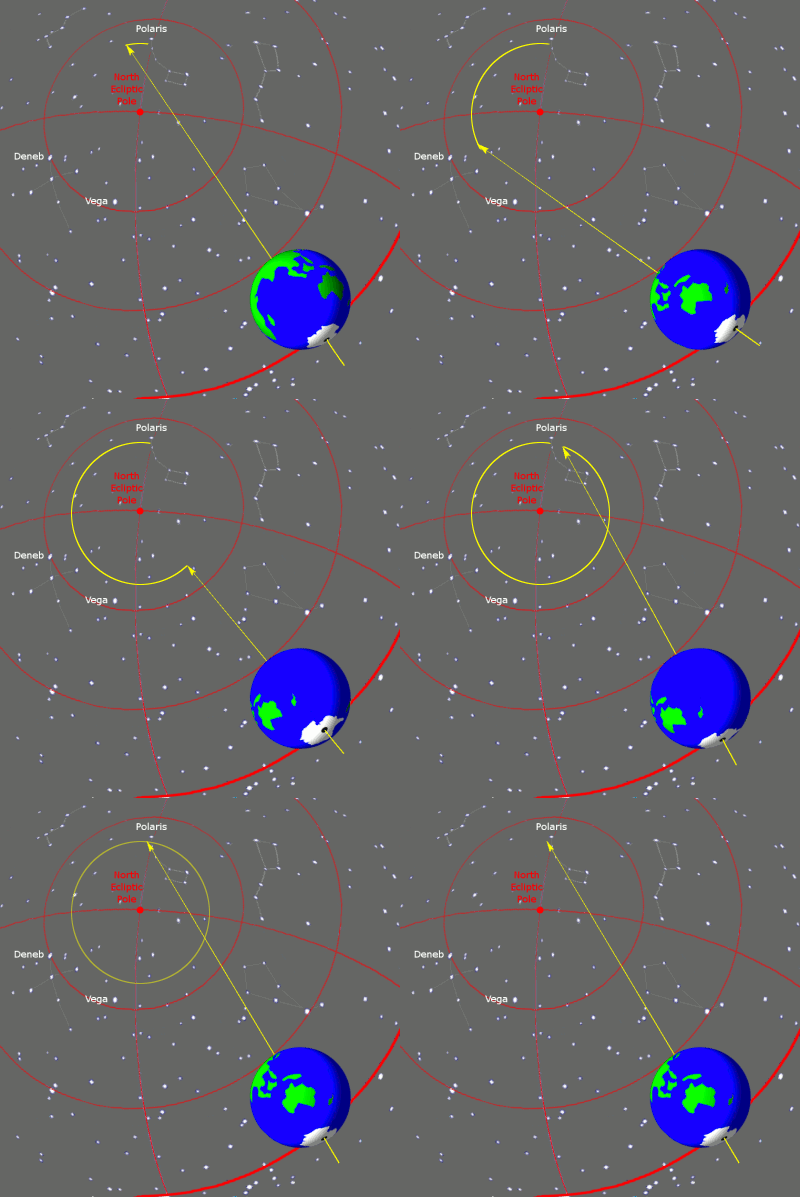
* Precession of the equinoxes. The slow, 26,000 year wobble of the Earth’s axis which causes the Earth, most of the time, to not have a pole star. We’re lucky to live at a time to have a bright star within a degree of the north celestial pole. That star is, of course, Polaris. Precession also changes the point in the sky, along the ecliptic and zodiac, where the Sun appears on the first day of spring, or any season. These points move westward along the ecliptic (the plane of the earth’s orbit of the Sun) one degree every 72 years.
Addendum
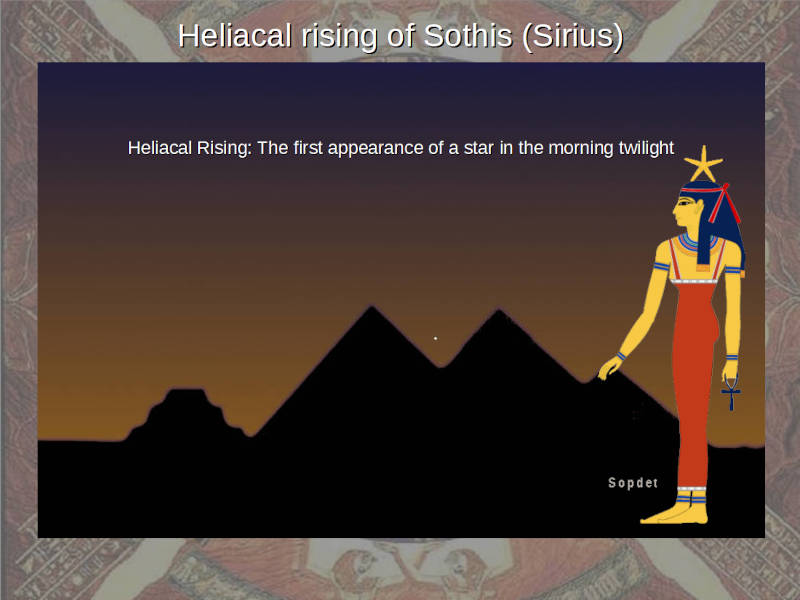
The Egyptian used the heliacal rising of Sirius as a signal that the flooding of the Nile was imminent, starting their agricultural year. The Greeks called the star Sothis, while the Egyptians themselves called it Sopdet, a goddess, and consort of the god Sah, our Orion.
Part of my presentation, December 2021 of Ancient Astronomy of the Egyptians and Babylonians.
09/24/2021 – Ephemeris – Capricornus, home this season to Jupiter and Saturn
This is Bob Moler with Ephemeris for Friday, September 24th. Today the Sun will be up for 12 hours and 3 minutes, setting at 7:35, and it will rise tomorrow at 7:33. The Moon, halfway from full to last quarter, will rise at 9:26 this evening.
Nearly 2000 years ago the southernmost of the constellations of the zodiac was Capricornus the water goat. That’s why the latitude on the Earth where the Sun is overhead on the winter solstice is called the Tropic of Capricorn. Not anymore, Sagittarius, one constellation west, has that honor today*. Capricornus is large, but made up of dim stars. To me, it looks like a 45 degree isosceles triangle, long side up, but which all the sides are sagging. The constellation is found low in the south at 10 to 11 p.m. The image that is supposed to be represented by the stars is that of a goat whose hind quarters are replaced by a fish’s tail, not a mermaid but a mer-goat. This autumn, Jupiter is at the left end of Capricornus, with Saturn on the right.
The astronomical event times given are for the Traverse City/Interlochen area of Michigan (EDT, UT-4 hours). They may be different for your location.
The reason for the shift is lunisolar precession, which I talked about yesterday.
Addendum
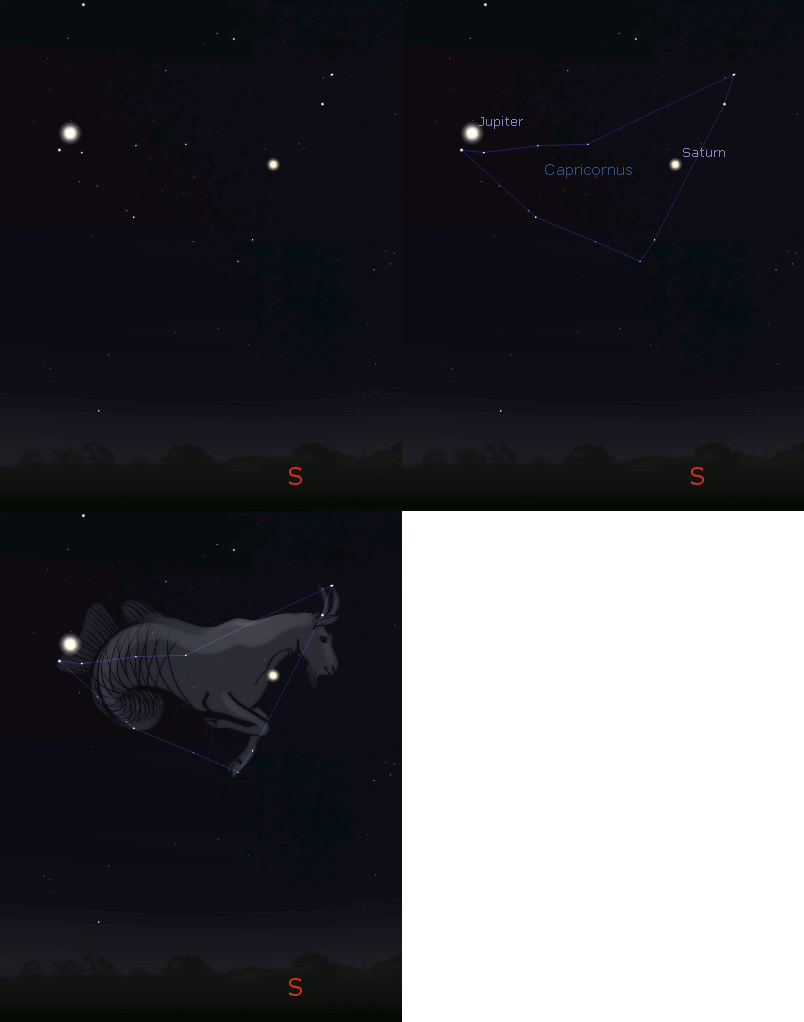
Capricornus w/Jupiter & Saturn finder animation for 10 pm, September 24, 2021. Created using Stellarium and GIMP.
09/23/2021 – Ephemeris – The Earth’s axial tilt gives us our seasons
This is Bob Moler with Ephemeris for Thursday, September 23rd. Today the Sun will be up for 12 hours and 6 minutes, setting at 7:37, and it will rise tomorrow at 7:32. The Moon, 3 days past full, will rise at 9:03 this evening.
The Earth has an axial tilt* of about 23 and a half degrees, which gives us our seasons. Because the Earth rotates on its axis, it has a slight equatorial bulge. Earth’s polar diameter is 7,900 miles (12,714 kilometers) while its equatorial diameter is 7,926 miles (12,756 kilometers), a difference of 26 miles (42 kilometers). The gravitational tug on that equatorial bulge by the Moon and Sun actually keeps the tilt stable, but does cause the Earth’s axis to precess like a top slowing down. It’s why Polaris will no longer be our North Pole star in centuries to come, just as it wasn’t in centuries past. It’s also why the constellations of the zodiac no longer align with the astrological signs of Ptolemy’s zodiac of the second century AD.
The astronomical event times given are for the Traverse City/Interlochen area of Michigan (EDT, UT-4 hours). They may be different for your location.
* Astronomers call axial tilt “obliquity” or “obliquity of the ecliptic”.
Addendum
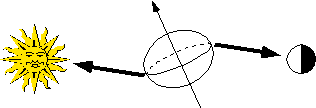
The Moon and Sun’s gravitational force act on the Earth’s equatorial bulge, attempting to cause the Earth to straighten up and fly right. Because the Earth is spinning, it acts like a gyroscope and the torque to straighten it up causes it to be applied 90 degrees away in the direction of the rotation causing the procession. Image credit: Open Course: Astronomy.
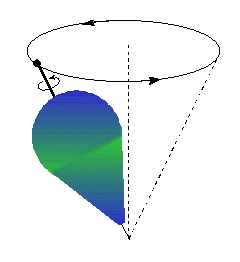
Precession of a spinning top: the spin axis traces the surface of a cone. The axis, in the case of the Earth, traces a circle of radius 23.5 degrees on the sky. Credit NASA.
The 25,700-year cycle of precession traced on the sky as seen from near the Earth. The current North Pole star is Polaris (top). In about 8,000 years it will be the bright star Deneb (left), and in about 12,000 years, Vega (left center). The Earth’s rotation is not depicted to scale – in this span of time, it would actually rotate over 9 million times. Credit image: Tfr000, caption: Wikipedia.
02/19/2015 – Ephemeris – What’s a conjunction?
Ephemeris for Thursday, February 19th. The sun will rise at 7:37. It’ll be up for 10 hours and 39 minutes, setting at 6:16. The moon, 1 day past new, will set at 7:32 this evening.
Saturday night* Venus will be in conjunction with Mars. To me the best sight will be tomorrow night when the thin crescent moon will join the two planets in a very picturesque triangle. Conjunctions are terms shared between astronomers and astrologers and why shouldn’t they be, astrology is, in my opinion, astronomy’s illegitimate parent. To astronomers conjunctions are when two solar system objects are directly north and south of each other (the same right ascension). Astrologers have the conjunction on the same date, but most will say it’s occurring in Aries. Astronomers in the other hand can see that the two planets are now seen against the stars of western Pisces. Most astrologers don’t recognize the precession of the earth’s axis, it’s 26,000 year wobble in their calculations.
Times are for the Traverse City/Interlochen area of Michigan. They may be different for your location.
* As reported in the radio program it was Sunday. However the two planets appear closest Saturday night. 7 p.m. EST ( UT – 5 hr) on the 21st is actually 0 hr UT on the 22nd (Sunday).
Addendum
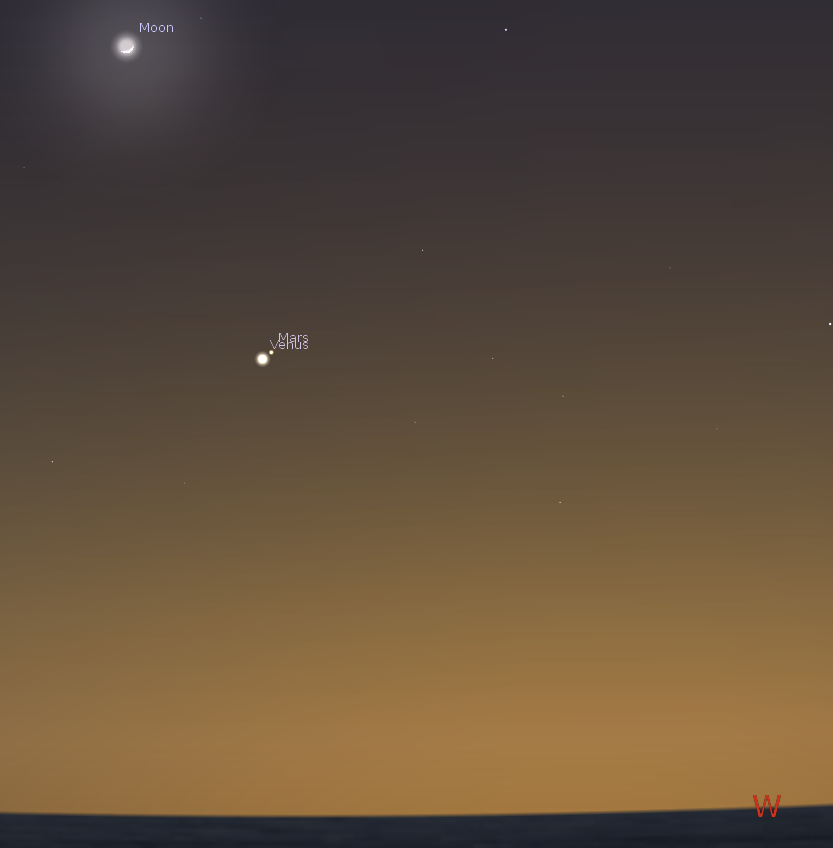
Venus and Mars in conjunction at 7 p.m. EST February 21, 2015. Created using Stellarium.
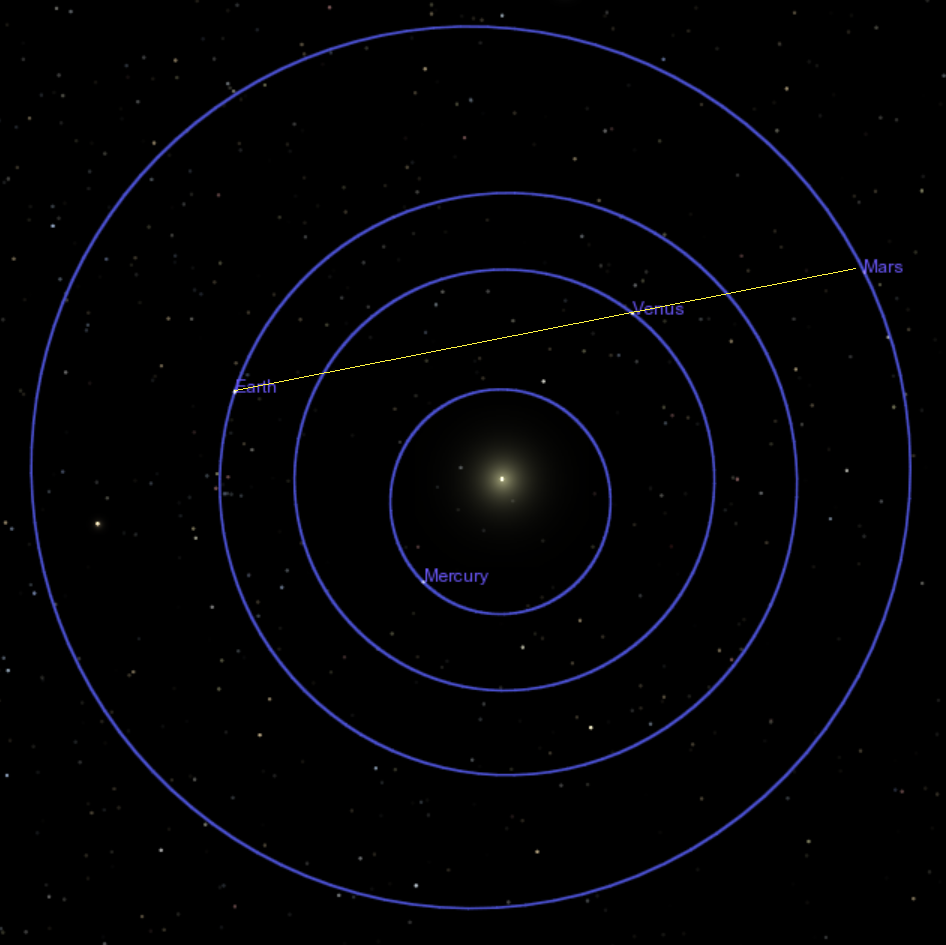
The big picture: In a conjunction planets simply happen to appear along a line of sight from the Earth. They have nothing to do with each other. This is the location of the planets Earth, Venus and Mars on February 22, 2015. Created using Celestia.
Below see the shift of the vernal equinox or first point of Aries, as it’s sometimes called has shifted from 150 CE in Ptolemy’s day to today.
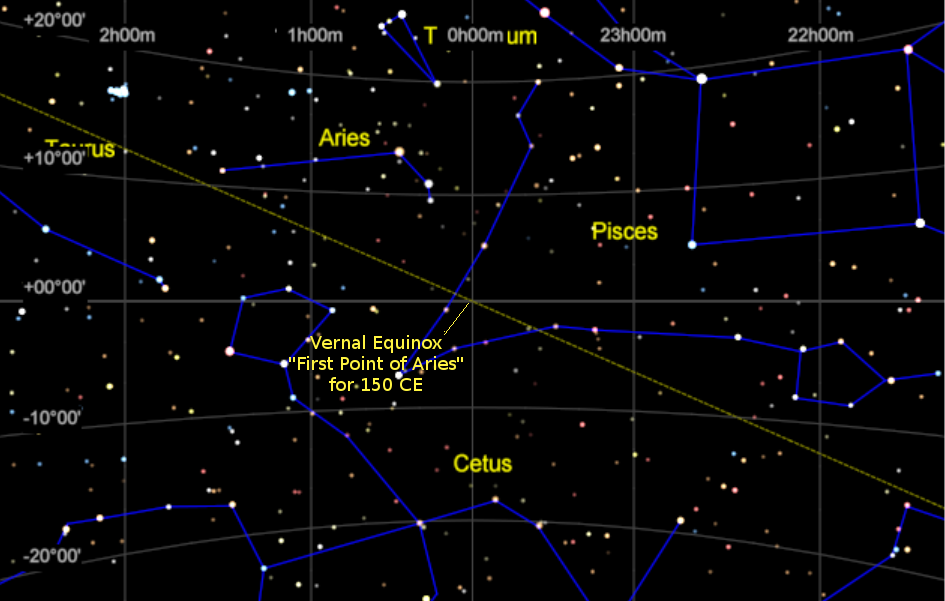
The vernal equinox in 150 CE. Note that Aries to the left. The Sun travels on the ecliptic line (The diagonal line) from right to left. Created using Cartes du Ciel (Sky Charts).
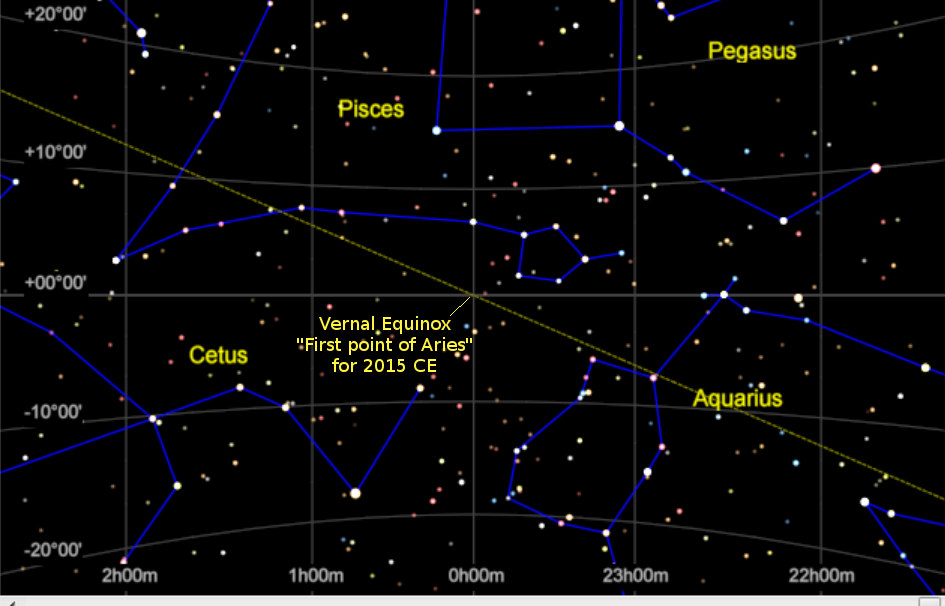
The vernal equinox today, in 2015 CE. Note that Aries has slid off to the left. The Sun travels on the ecliptic line (The diagonal line) from right to left. Created using Cartes du Ciel (Sky Charts).
 Bob Moler's Ephemeris Blog