Archive
04/25/2017 – Ephemeris – The Cassini spacecraft is on its last 22 orbits of Saturn
Ephemeris for Tuesday, April 25th. The Sun rises at 6:41. It’ll be up for 13 hours and 58 minutes, setting at 8:40. The Moon, 1 day before new, will rise at 7:08 tomorrow morning.
In the early hours of last Saturday, Earth Day, The Cassini spacecraft, orbiting Saturn for the last nearly 13 years, made its last pass of Saturn’s giant moon Titan. Over the past 13 years Cassini has been using Titan as a kind of fulcrum to leverage its orbits of Saturn, returning time and time again to both study this strange moon and to propel it via gravity assists into a myriad of orbits. This time however, with one last gravitational assist, Cassini was flung into a series of 22 daring orbits which will take it into a couple of thousand mile gap between the rings and the planet. On orbit 22, if it doesn’t collide with an errant ring particle, Cassini will burn up in Saturn’s atmosphere, going something like 70,000 miles an hour on September 15th.
The times given are for the Traverse City/Interlochen area of Michigan. They may be different for your location.
Addendum
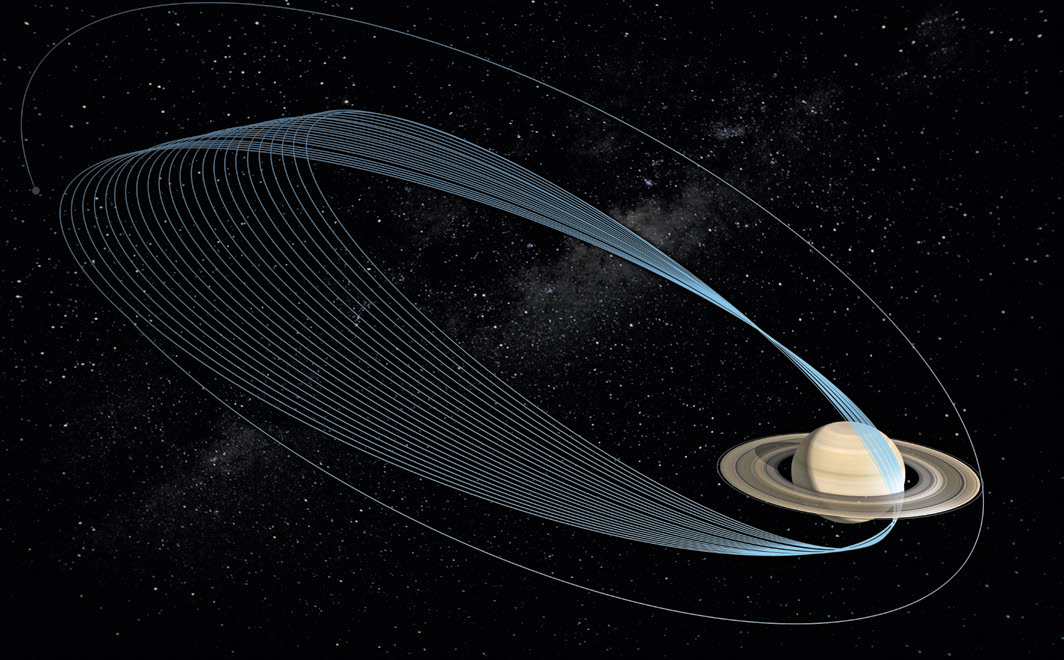
In its planned last 22 orbits of Saturn, the Cassini spacecraft will pass between the innermost ring and the planet itself. Credit NASA, JPL.
02/21/2017 – Ephemeris – Finding Saturn this morning and Cassini’s future
Ephemeris for Tuesday, February 21st. The Sun will rise at 7:32. It’ll be up for 10 hours and 47 minutes, setting at 6:19. The Moon, 3 days past last quarter, will rise at 4:48 tomorrow morning.
This morning the crescent Moon will act as a pointer to the planet Saturn. The ringed planet will appear to the right of our Moon. Saturn’s rings will show in any telescope with 20 times magnification or greater. Out at Saturn for the last 13 years and for the next 7 months the robot spacecraft Cassini has been orbiting the ringed planet using gravity assists from the giant moon Titan as a fulcrum to leverage itself into many different orbits to study Saturn’s rings and collection of moons. In a bit over seven months it’s fantastic journey will be over. Low on fuel, it will plunge between the rings and the cloud tops, spiraling in towards its doom September 30th into the planet’s atmosphere so as not to contaminate the icy moons which could possibly harbor life.
Times are for the Traverse City/Interlochen area of Michigan. They may be different for your location.
Addendum
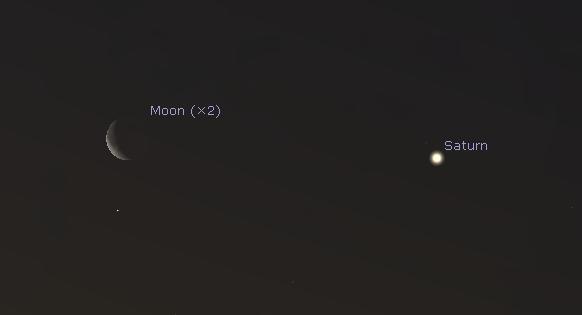
Using the Moon to locate Saturn in the southeast at 7 a.m. or earlier on February 21, 2017. The Moon is enlarged to show it better. Created using Stellarium.
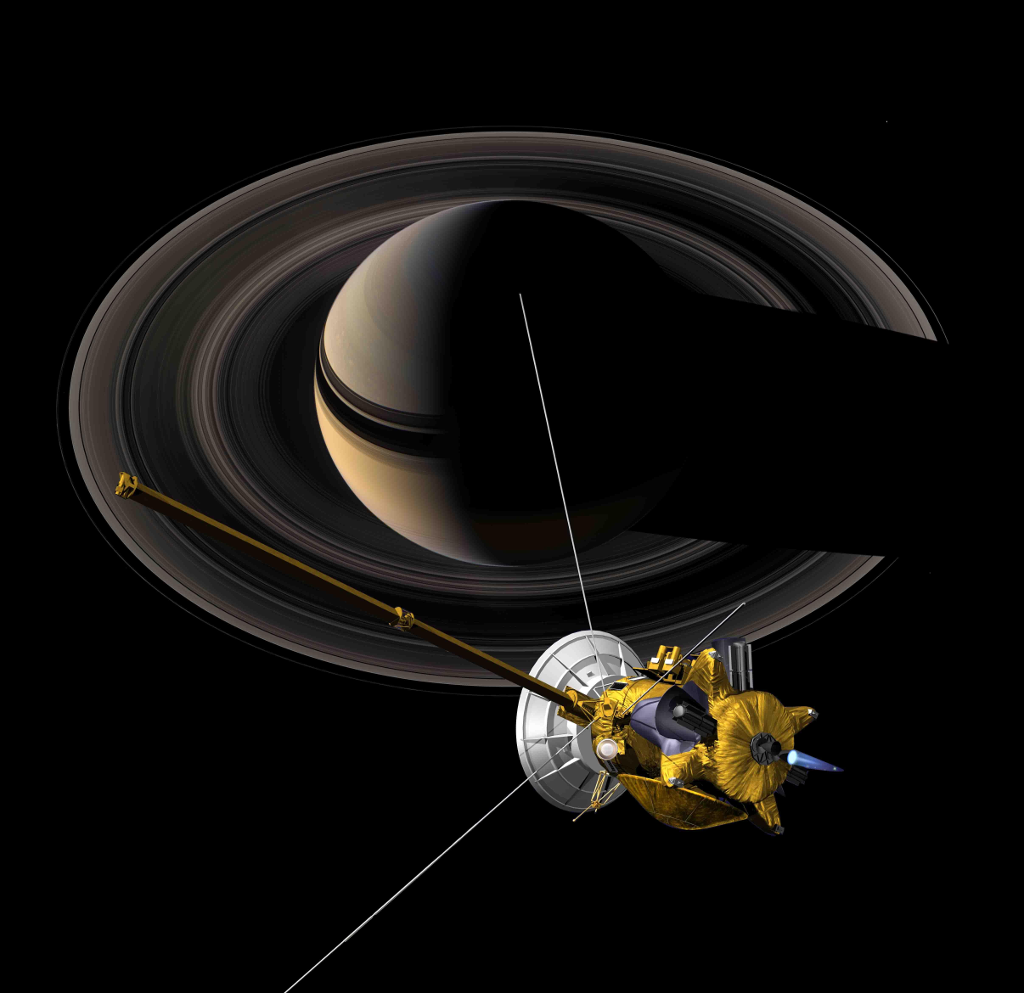
The Cassini spacecraft at Saturn. Credit: NASA/JPL.
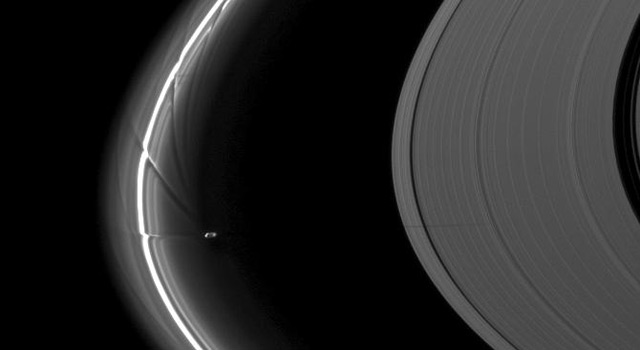
The shepherd satellite Prometheus leaving a wake in Saturn’s outer F Ring. Credit: NASA/JPL.
01/24/2017 – Ephemeris – The Moon is near Saturn this morning
Ephemeris for Tuesday, January 24th. The Sun will rise at 8:09. It’ll be up for 9 hours and 31 minutes, setting at 5:40. The Moon, 3 days before new, will rise at 6:08 tomorrow morning.
This morning look low in the southeast to see the thin crescent Moon with the planet Saturn below and to the right. The Moon passed Saturn a little after they rose. Saturn is quite far south in our skies, almost as far south as the Sun was on the winter solstice on December 21st. It will take a while to rise high enough in deep twilight or darkness for good views with a telescope. When Saturn or any planet is low on the horizon we are looking at it through a lot of our atmosphere. Beside draining about half its brightness that atmospheric motions make the planet fuzzy in telescopes. Yes, you can still see the rings, but the gaps on each end between the rings and the planet may not be distinct, and its large moon Titan may not be visible at all.
Times are for the Traverse City/Interlochen area of Michigan. They may be different for your location.
Addendum
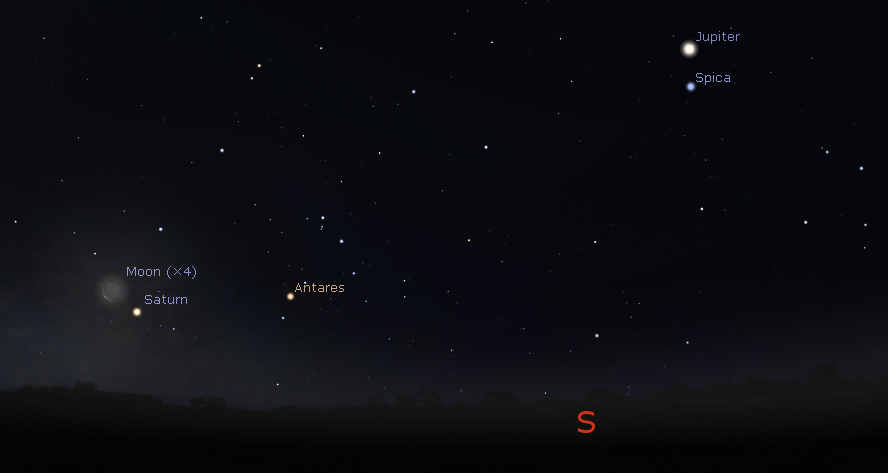
The morning planets and the Moon at 7 a.m. this morning, January 24th. Because planetarium programs don’t show a thin crescent very well, I’ve enlarged the Moon by a factor of 4 times to make the Moon show up at all. Click on the image to enlarge. Created using Stellarium.
08/02/2016 – Ephemeris – The Scorpion has visitors this year
Ephemeris for Tuesday, August 2nd. The Sun rises at 6:30. It’ll be up for 14 hours and 35 minutes, setting at 9:06. The Moon is new today, and won’t be visible.
There’s a large constellation located low in the south as it gets dark about 10:30 tonight It’s Scorpius the scorpion. Its brightest star is Antares in its heart, a red giant star whose name means “Rival of Mars”. From Antares to the right is a star then a vertical arc of three stars that is its head. The Scorpion’s tail is a line of stars running down to the left of Antares swooping near the horizon before coming back up and ending in a pair of stars that portray his poisonous stinger. This year the planet Saturn appears almost directly above Antares. Tonight Mars is right of Antares. On the 23rd of this month Mars will pass just above
Antares, between it and Saturn, making line of three bright objects. Mars is currently brighter than Antares.
Times are for the Traverse City/Interlochen area of Michigan. They may be different for your location.
Addendum
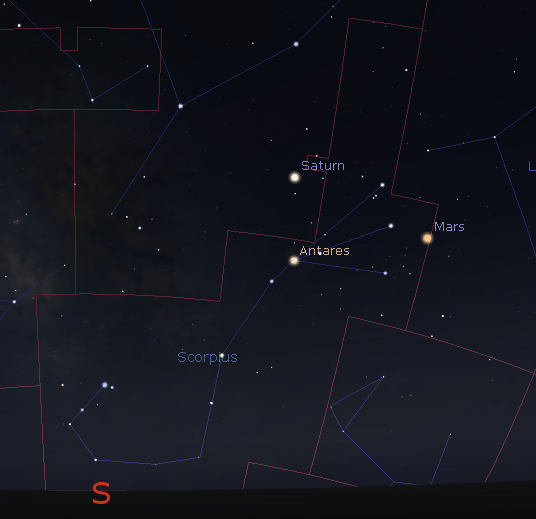
Scorpius with Mars and Saturn at 10:30 p.m. August 2, 2016. Created using Stellarium.
The red lines are the official constellation boundaries by the International Astronomical Union. From the look of some of the boundaries, astronomers apparently gerrymander as well as our politicians.
For those unfamiliar with gerrymandering put “gerrymander” in your favorite search engine or Wikipedia.
06/21/2016 – Ephemeris – Saturn’s rings are opened about their widest
Ephemeris for Tuesday, June 21st. Today the Sun will be up for 15 hours and 34 minutes, setting at 9:32, and it will rise tomorrow at 5:57. The Moon, 1 day past full, will rise at 10:20 this evening.
The planet Saturn, when viewed with anything more powerful than binoculars will see its rings open up to their maximum extent, where the planet itself cannot be seen beyond narrowest part of the rings. As Saturn moves away from its solar opposition point the shadows of the ring on the planet and planet on the rings becomes more pronounced. Saturn takes nearly 30 years to orbit the Sun, and like the Earth has an axial tilt. In Saturn’s case it’s nearly 27 degrees. Saturn’s north pole star is Polaris like the Earth, except for Saturn it’s 6½ degrees from Saturn’s actual pole. As Saturn orbits the Sun we seen the rings open up in 7½ years, then close down for another 7½ years, to where they disappear, and then open up again.
Times are for the Traverse City/Interlochen area of Michigan. They may be different for your location.
Addendum
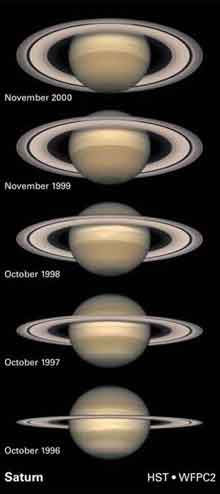
Saturn’s Rings over time as they opened the last time. Credit NASA/HST/WFPC2
06/02/2016 – Ephemeris – Saturn at opposition
Ephemeris for Thursday, June 2nd. Today the Sun will be up for 15 hours and 22 minutes, setting at 9:22, and it will rise tomorrow at 5:59. The Moon, 2 days before new, will rise at 5:11 tomorrow morning.
In the wee morning hours tomorrow Saturn will be in opposition from the Sun. It is a time Saturn will rise at sunset and set at sunrise. It is also a time that Saturn is closest to the Earth, so it will appear its largest in our telescopes. Saturn’s variance of apparent size over its appearance in our skies isn’t as dramatic as much closer and smaller Mars. For Saturn which orbits the Sun at nearly 10 times the Earth’s distance from the Sun varies in apparent size plus or minus 10% over it’s synodic period of 12½ months. The synodic period is the interval between oppositions or conjunctions of the Sun. One benefit of being in opposition is that Saturn and its glorious rings will be up all night.
Times are for the Traverse City/Interlochen area of Michigan. They may be different for your location.
Addendum
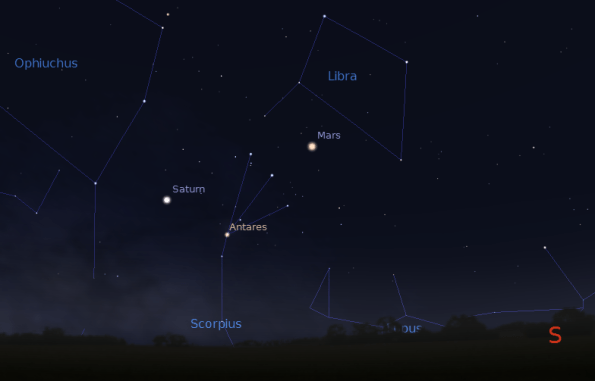
Saturn finder chart. Looking low in the south-southwest at 11 p.m., June 2, 2016. Created using Stellarium.
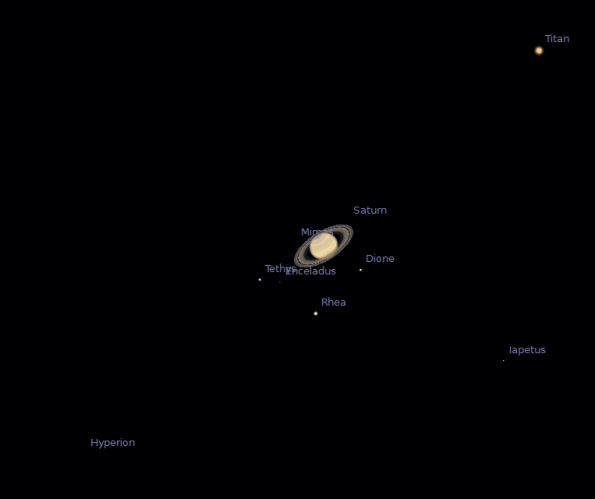
Saturn and some of its 63 moons at 11 p.m., June 2, 2016. Created using Stellarium.
05/28/2015 – Ephemeris – Saturn’s satellites
Thursday, May 28th. Today the Sun will be up for 15 hours and 14 minutes, setting at 9:17. The Moon, 3 days past first quarter, will set at 3:56 tomorrow morning and tomorrow the Sun will rise at 6:02.
Saturn has a lot of moons, even if you don’t count the billions of ring particles circling the planet. The count is up to 62, five short of Jupiter’s 67 at last count. The largest is Titan which is larger than Mercury, a world with a thick nitrogen atmosphere and liquid filled lakes. At its distance from the Sun, some 10 times Earth’s and receiving only one percent the heat we get the lakes are filled with methane and ethane while the surface rocks are water ice. The small moon Enceladus spews salty water geysers at its south pole. The more distant moon Iapetus is half black and half white and has an equatorial mountain range that rings it like a walnut. Another moon Hyperion appears like it’s honeycombed.
Times are for the Traverse City/Interlochen area of Michigan. They may be different for your location.
Addendum
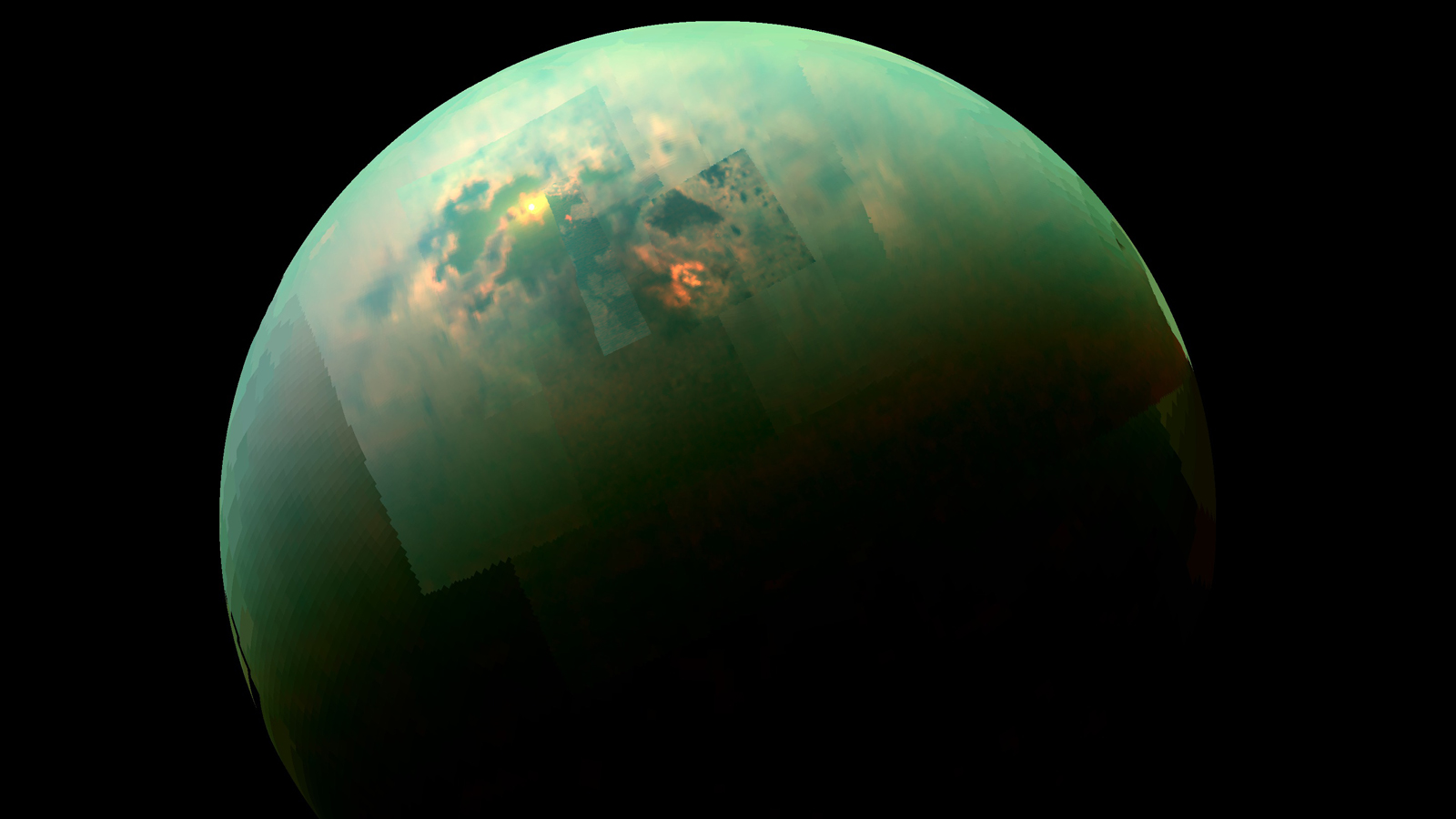
Titan in a false color near infrared view, showing the Sun’s light glinting off a north polar sea. Credit: NASA/JPL.
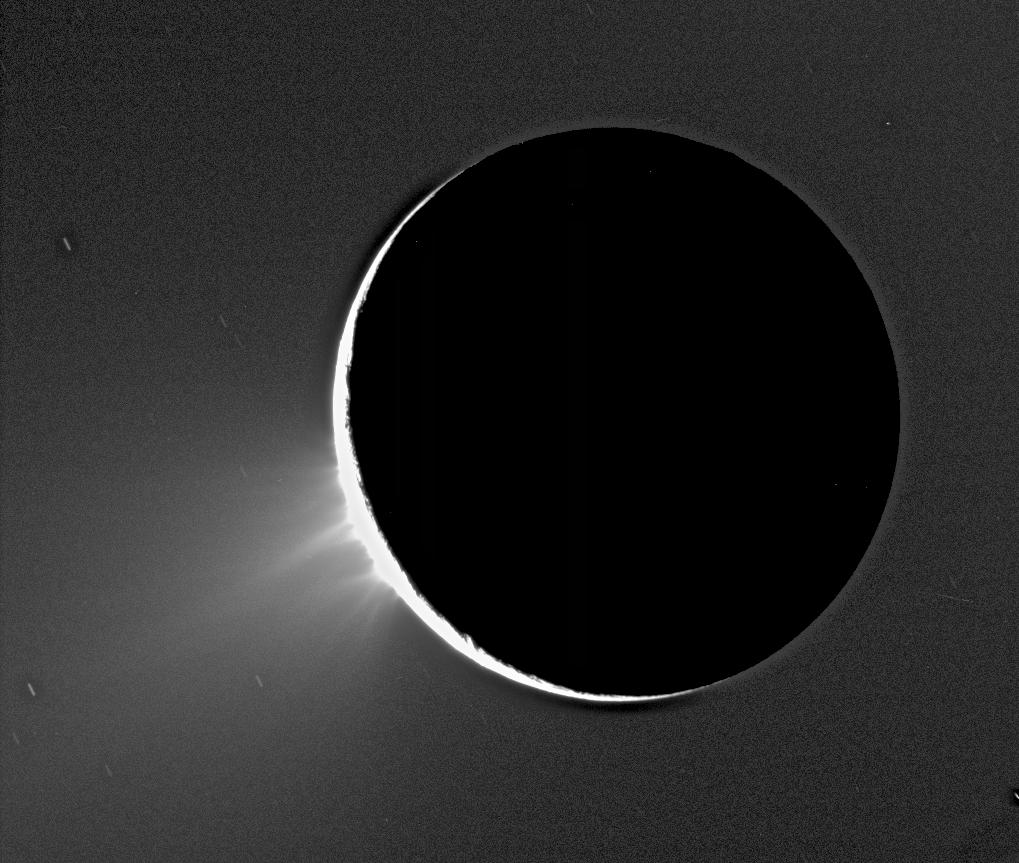
Enceladus’ south polar geysers create the E ring. Credit: NASA/JPL.
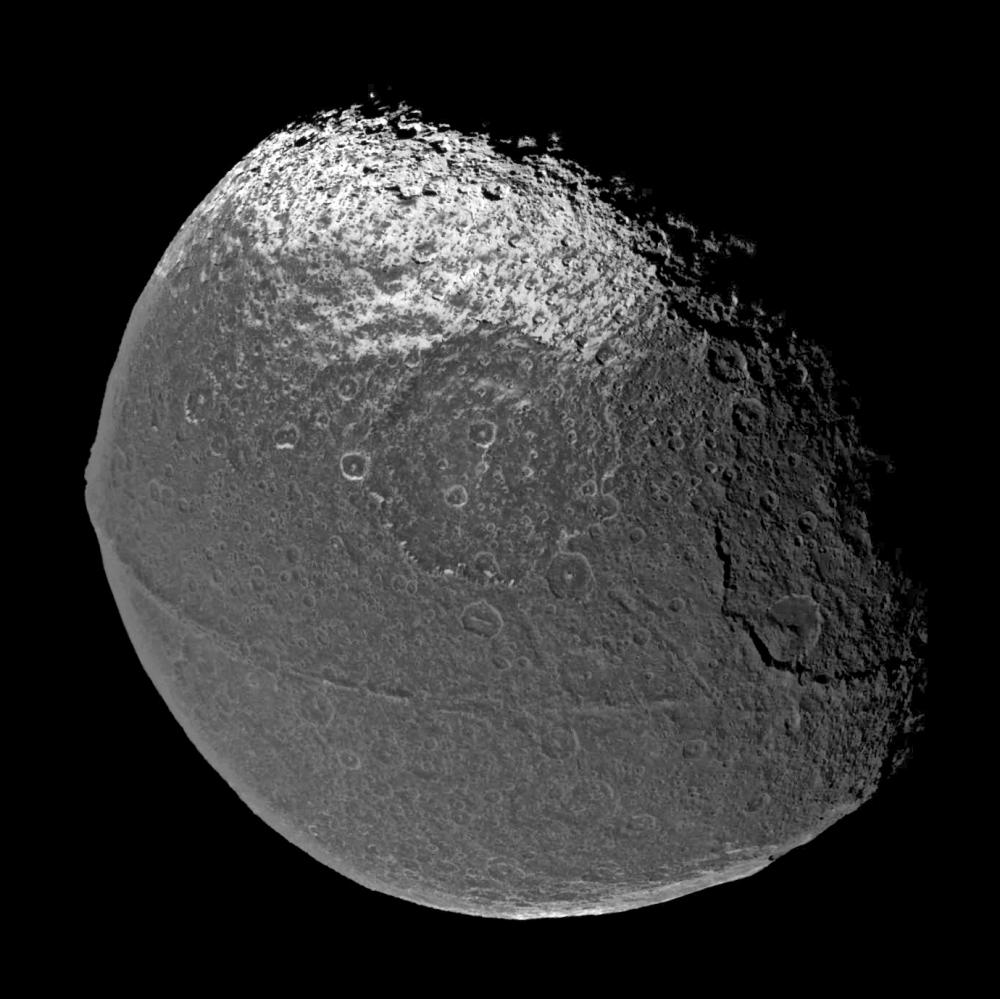
Iapetus showing mostly its dark side and equatorial mountain ridge. Credit: NASA/JPL.
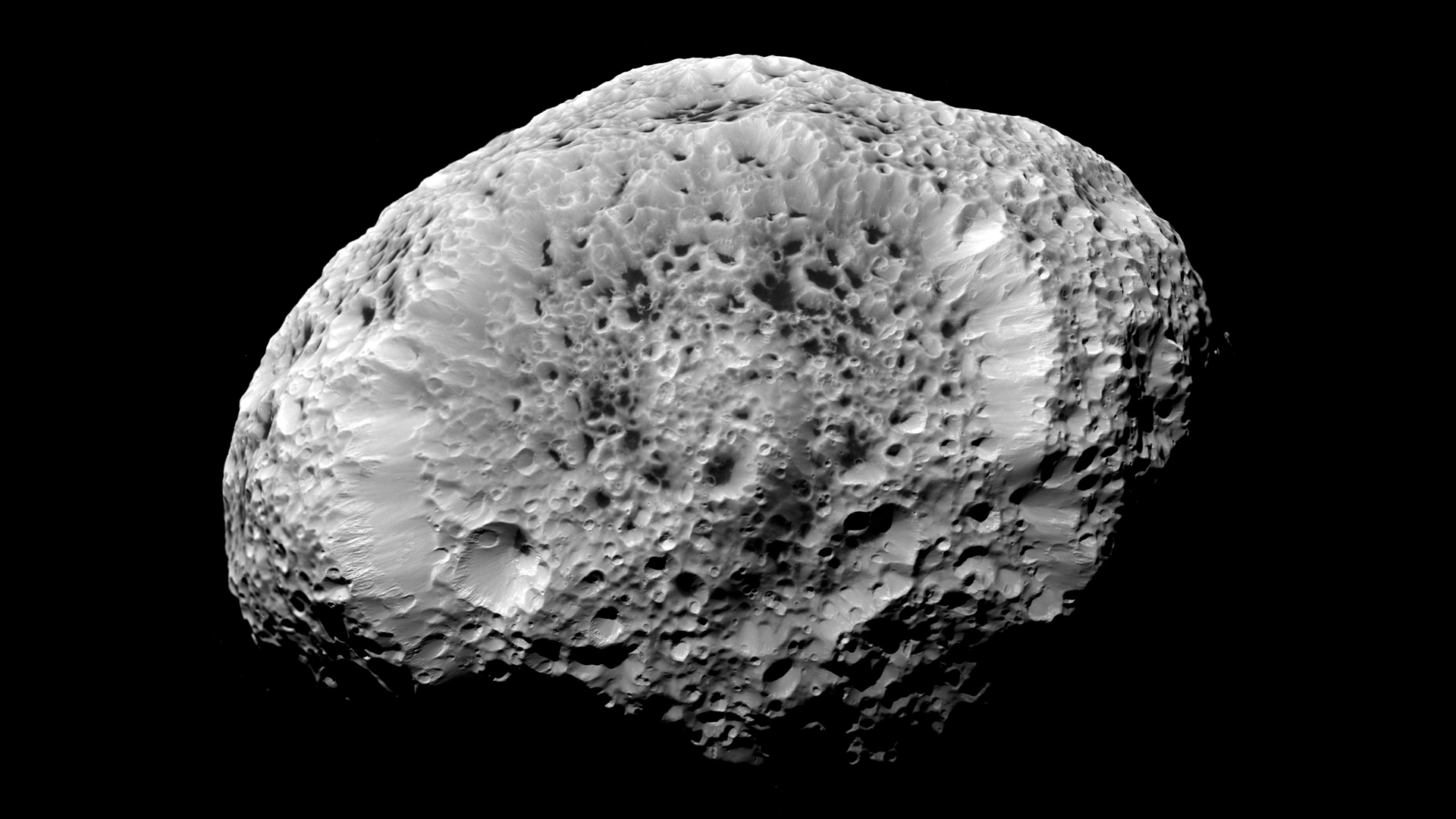
The weird moon Hyperion. It’s half as dense as ice. Credit: NASA/JPL:
05/26/2015 – Ephemeris – Saturn’s Rings
Ephemeris for Tuesday, May 26th. Today the Sun will be up for 15 hours and 11 minutes, setting at 9:15. The Moon, 1 day past first quarter, will set at 3:01 tomorrow morning and tomorrow the Sun will rise at 6:03.
The feature that makes Saturn so special are its rings. While astronomers have found rings around Jupiter Uranus and Neptune plus an asteroid, none are a grand a Saturn’s rings. Saturn’s rings are made of ice or icy particles, and have a higher reluctance (albedo) than the planet. Each of the ring particles has a separate orbit over Saturn, and the many collisions have restricted the ring particles to Saturn’s equator. While the rings are 170 thousand miles wide they are only 30 feet thick. Saturn has an axial tilt of 26 degrees close to the Earth’s 23 ½ degrees, so over Saturn’s nearly 30 year orbit of the sun, the rings go edge on about every 15 years. That last time was 2009.
Times are for the Traverse City/Interlochen area of Michigan. They may be different for your location.
Addendum
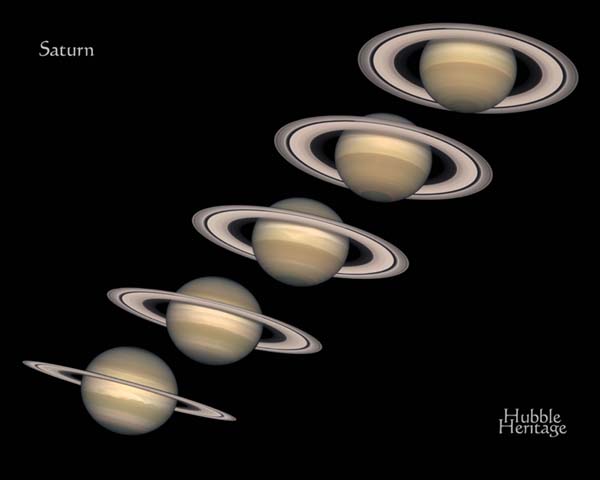
How the appearance of the rings change as Saturn orbits the Sun. Credit: NASA Hubble.
05/21/2015 – Ephemeris – Saturn will reach opposition tomorrow
Ephemeris for Thursday, May 21st. Today the Sun will be up for 15 hours and 1 minute, setting at 9:10. The Moon, 3 days past new, will set at 12:21 tomorrow morning, and tomorrow the Sun will rise at 6:07.
The Planet Saturn will be at opposition from the Sun tomorrow, meaning that it is opposite the Sun in the sky, rising at sunset and setting at sunrise. It also means that Saturn is about it’s closest, brightest, and its largest appearing in telescopes. It will be 835 million miles (1,344 million km) away tomorrow. It’s rings should also be at their brightest. The rings are made of billions of particles, mostly ice. At opposition we are essentially viewing Saturn from the same direction as the Sun, and ring particle shadows on one another disappear, so the rings are brighter. Other defining shadows also disappear such as the planet’s shadow on the rings and the ring’s on Saturn, so the planet may appear kind of flat.
Times are for the Traverse City/Interlochen area of Michigan. They may be different for your location.
Addendum
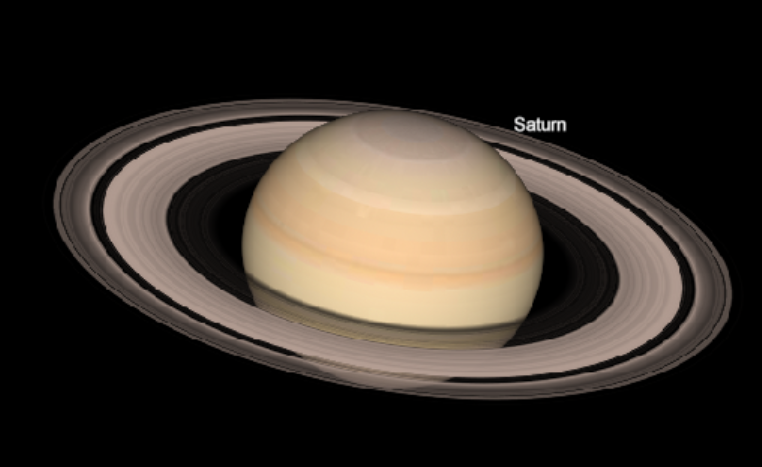
Saturn at opposition, May 22, 2015. Compare the shadow of the planet on the rings with the quadrature image below. Created using Cartes du Ceil (Sky Charts).
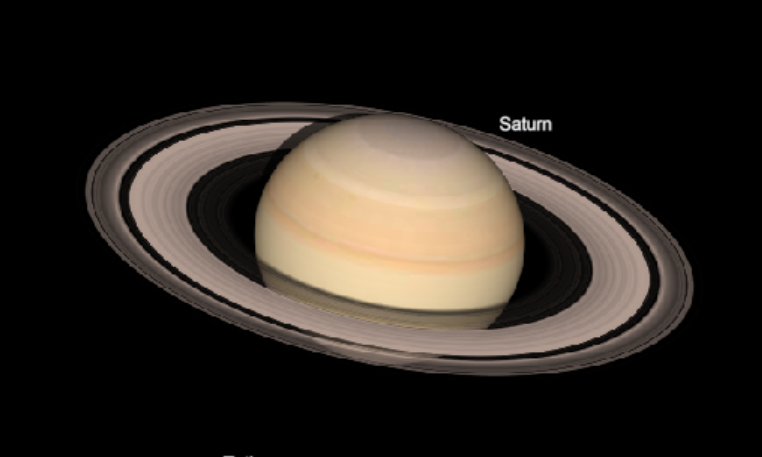
Saturn near quadrature, August 23, 2015. Compare the shadow of the planet on the rings with the opposition image above. Created using Cartes du Ceil (Sky Charts).
A superior planet’s quadrature position (90 degrees from the Sun) is the time we are the maximum amount out of line with the Sun from them. Any phase of shadows are the most pronounced. From the planet’s point of view the Earth is at greatest elongation from the Sun.
04/07/2015 – Ephemeris – The Moon will pass Saturn tomorrow morning
Ephemeris for Tuesday, April 7th. The Sun will rise at 7:13. It’ll be up for 13 hours and 4 minutes, setting at 8:17. The Moon, 3 days past full, will rise at 11:36 this evening.
The planet Saturn is now rising shortly after midnight. However it is still best seen in the early morning. The Moon will be near Saturn when it rises and will get closer as the morning progresses. By 6 a.m. the Moon will be about four of its widths above and right of Saturn. The Moon will get its closest about 10 a.m., but by then it will be daylight and both will have set. Every week Saturn will rise, and set about a half hour earlier. That’s about an hour every two weeks, and two hours a month. This works for the stars and is pretty close for slow-moving planets like Jupiter and Saturn. So next month at this time Saturn will rise about 10 p.m., and in another month 9 p.m. By then it will be in the sky at sunset, and visible all night.
Times are for the Traverse City/Interlochen area of Michigan. They may be different for your location.
Addendum
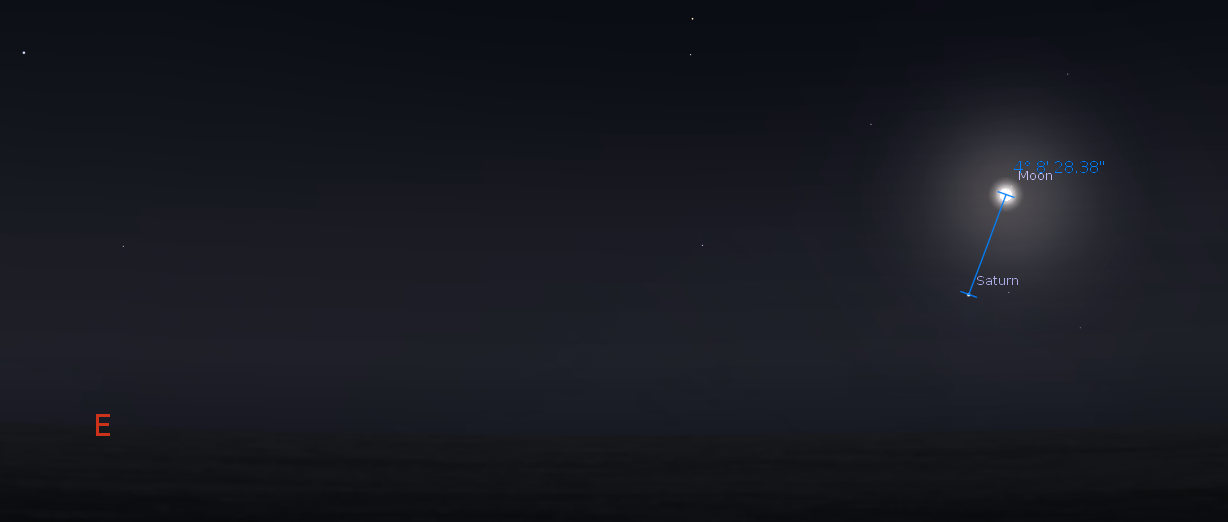
Saturn and the Moon shortly after rising. 12:44 a.m., April 8, 2015. Created using Stellarium.
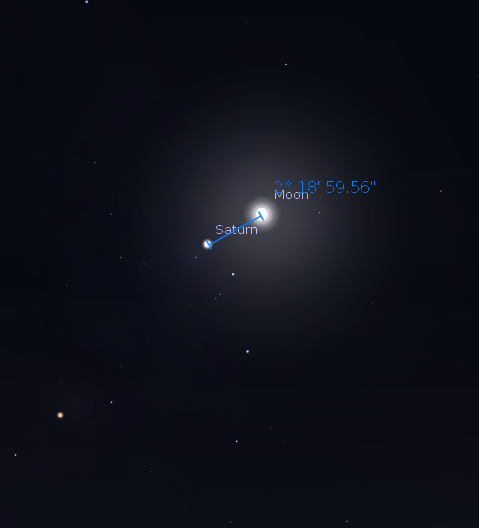
Saturn and the Moon shortly after twilight starts. 5:30 a.m., April 8, 2015. Created using Stellarium.
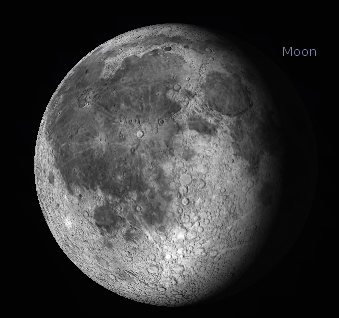
The Moon as it might appear in binoculars at 5:30 a.m. April 8, 2015. Created using Stellarium.
Some Rules of Thumb about the rotation of the earth and its revolution around the Sun.
These are approximate:
Stars rise or set 4 minutes earlier each night.
That’s about a half hour every week, and
It’s about 2 hours every month.
2 hours times 12 months = 24h hours, one rotation of the Earth
As far as viewing the stars and Constellations goes, that’s why we see the constellations in the same positions every year at the same time.
 Bob Moler's Ephemeris Blog