Archive
09/23/11 – Ephemeris – Autumn is already here
Friday, September 23rd. The sun will rise at 7:30. It’ll be up for 12 hours and 8 minutes, setting at 7:38. The moon, 3 days past last quarter, will rise at 4:00 tomorrow morning.
Autumn has arrived. It snuck in at 5:05 a.m. At that instant the sun passed over the celestial equator, earth’s equator projected on the sky, heading southward. By Monday the sun will be up less than 12 hours a day, heading to less than 9 hours at the start of winter, three month’s away. It is the tilt of the earth’s axis, which is fixed as the earth orbits the sun that causes the sun to appear to change its height in the sky at noon and the length of daylight that warms the earth. Its is not the small change in the distance of the earth from the sun. And besides the earth is currently moving closer to the sun and will arrive at its closest, called perihelion in early January.
* Times are for the Traverse City/Interlochen area of Michigan. They may be different for your location.
09/01/11 – Ephemeris – Preview of September skies
Thursday, September 1st. The sun will rise at 7:04. It’ll be up for 13 hours and 14 minutes, setting at 8:19. The moon, 3 days before first quarter, will set at 9:53 this evening.
Let’s look at the skies for the month of September. The sun will moving at its greatest speed in its retreat to the south. Daylight hours in the Interlochen/Traverse City area and will drop from 13 hours and 14 minutes today to 11 hours 46 minutes on the 30th. The altitude of the sun above the southern horizon at local noon will be 54 degrees today, and will descend to 42 degrees on the 30th. The Straits area will see the sun a degree lower. The season of summer is getting short, so enjoy it while you can. Summer ends and autumn begins at 5:05 a.m. on September 23rd. We are losing Saturn into the evening twilight but it will be replaced in the evening sky by Jupiter rising earlier by a half hour each week.
* Times are for the Traverse City/Interlochen area of Michigan. They may be different for your location.
08/15/11 – Ephemeris – Preview of next month’s harvest moon
Monday, August 15th. The sun rises at 6:44. It’ll be up for 14 hours and 3 minutes, setting at 8:48. The moon, 2 days past full, will rise at 9:16 this evening.
Last Saturday night under partly cloudy skies at the Port Oneida Fair Star Party we saw the full moon rise and it reminded me that the next full moon will be the Harvest Moon. The next few nights will preview the coming harvest moon effect. That is that the moon will rise at nearly the same time for several nights in a row. On average the moon will rise or set 50 minutes later each night. Due to the geometry of the situation the harvest moon for several nights will only rise later by down to 20 minutes a night. Back before electric lights the bright moonlight augmented twilight to increase the daily time available to harvest the crops. This slowdown in the moon’s rise times is affecting us now, though the moon is definitely waning.
* Times are for the Traverse City/Interlochen area of Michigan. They may be different for your location.
06/21/11 – Ephemeris – Summer solstice is today
Tuesday, June 21st. Today the sun will be up for 15 hours and 33 minutes, setting at 9:31. The moon, 2 days before last quarter, will rise at 12:46 tomorrow morning. Tomorrow the sun will rise at 5:57.
At 1:16 this afternoon the sun will reach its greatest angle north of the celestial equator or 23 ½ degrees. The date and the point in the sky where the sun is at that instant is called the summer solstice, or summer sun standstill. It means the point at which the sun seems poised farthest north before heading southward. This would be most noticeable if you were monitoring the height of the sun at noon or the sun’s rising or setting point day by day as the ancients did. Besides being the day with the longest sunlight we, in the northern hemisphere, are also receiving more intense heat from the sun than any other day of the year. Still hotter weather is in store as the northern hemisphere continues to warm up.
* Times are for the Traverse City/Interlochen area of Michigan. They may be different for your location.
What’s wrong with this picture?
I received this in an email. The picture’s pretty but is it real? If not, what’s wrong? Answer in the comments.
Sunset at the North Pole. This is one of the rarest picture that you mayever see in your life when the moon was closest to the earth. The date: Jan 13, 2011.This is the sunset at the North Pole with the moon at its closest point last week. a scene you will probably never get to see in person, so take a moment and enjoy God at work at the North Pole. And, you also see the sun below the moon, an amazing photo and not one easily duplicated. You may want to pass it on to others so they can enjoy it. The Chinese have a saying that goes something like this: 'When someone shares with you something of value, you have an obligation to share it with others!'

04/08/11 – Ephemeris – Looking out the thin side of the Milky Way
Friday, April 8th. The sun will rise at 7:11. It’ll be up for 13 hours and 7 minutes, setting at 8:18. The moon, 3 days before first quarter, will set at 1:39 tomorrow morning.
In winter and summer we see the Milky Way crossing the sky from north to south. In the autumn we see it cross nearly overhead from east to west. In the spring, especially next month the Milky way is barely visible low in the north. The Milky Way circles the sky as a great circle. It is what we see of our own galaxy. It is a spiral galaxy 100,000 light years in diameter and less than 5,000 light years thick where we are. So in the spring we look out the thin side of our galaxy. The stars are sparser than in other parts of the sky, the constellations generally are larger. The really cool part is that in telescopes we can see other galaxies, other Milky Ways beyond. In the spring we have a huge cluster of thousands of galaxies out there about 50 million light years away.
* Times are for the Traverse City/Interlochen area of Michigan. They may be different for your location.
Addendum
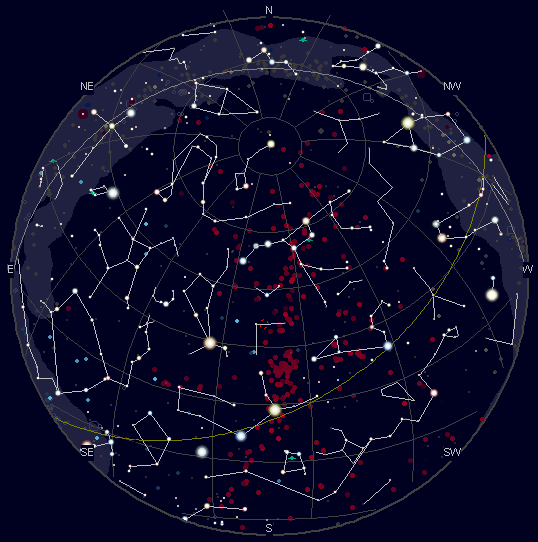
Looking out the thin side of the Milky Way. Created using Cartes duCiel
This is the entire dome of the sky on May 15th at 11 p.m. Note the Milky Way ringing the horizon. The red dots are galaxies, the blue and gray dots are star clusters in our galaxy, the green ones are nebulae, also in our galaxy.
03/18/11 – Ephemeris – Spring is almost here
Ephemeris for Friday, March 18th. The sun will rise at 7:49. It’ll be up for 12 hours and 2 minutes, setting at 7:52. The moon, 1 day before full, will set at 7:16 tomorrow morning.
We are now two days and some hours from the beginning of spring. Spring will arrive at 7:21 p.m. Sunday evening. At that instant the sun will appear to cross the celestial equator, the projection of the earth’s equator on the sky, heading northward. This will give us six months of over 12 hours daylight, culminating on June 21st with over 15 and a half hours of daylight for our listening area. This is the spring or vernal equinox, or to be hemisphericaly correct, the March equinox, because those folks south of the equator will begin autumn. Earth’s seasons are due to the tilt of its axis by 23 and a half degrees. The earth’s axis is nearly fixed in space, but changes its orientation with respect to the sun during our yearly orbit.
* Times are for the Traverse City/Interlochen area of Michigan. They may be different for your location.
 Bob Moler's Ephemeris Blog