Archive
07/03/2017 – Ephemeris – The Earth is farthest from the Sun today
Ephemeris for Monday, July 3rd. Today the Sun will be up for 15 hours and 28 minutes, setting at 9:30, and it will rise tomorrow at 6:03. The Moon, 3 days past first quarter, will set at 3:13 tomorrow morning.
At 8:59 tonight the Earth will pass a point in its orbit of the sun called aphelion, the farthest point from the sun of 94.5 million miles (152 million km). The whole Earth gets something like 6% less heat from the Sun than early January when the Sun is closest. So why is it summer now? The difference in distance from the sun pales as a cause of the seasons next to the tilt of the earth’s axis. Six months ago, because the sun was up for a shorter period each day, and didn’t rise very high in the sky, the sun gave us in northern Michigan something like 70% less heat than it does now. The real effect of aphelion coming in summer is that it makes summer the longest season at 94 days. This is because the farther the Earth is from the Sun, the slower it travels. Hey, it’s summer – take the hint and slow down and enjoy the season.
The times given are for the Traverse City/Interlochen area of Michigan. They may be different for your location.
06/20/2017 – Ephemeris – Summer will begin overnight tonight
Ephemeris for Tuesday, June 20th. Today the Sun will be up for 15 hours and 33 minutes, setting at 9:31, and it will rise tomorrow at 5:57. The Moon, half way from last quarter to new, will rise at 4:11 tomorrow morning.
Summer will begin overnight at 12:25 a.m. (4:25 UT June 21, 2017) The sun will at its highest at noon today and tomorrow, well at local solar noon that is, which is 1:44 p.m. in the Interlochen Traverse City area. At that time the Sun will reach an altitude or angle above the southern horizon of nearly 69 degrees. If you want to get an idea of the difference between that and the Sun at the winter solstice, check out Saturn tonight. It is almost to the point in the sky where the Sun was at the winter solstice. Notice how low it is in the sky, and how few hours it is up. The cause is the tilt of the earth’s axis of 23 and a half degrees. It gives us a 47 degree span of altitudes of the sun over the year. It is not the sun’s distance that causes seasons, as we’ll see next month.
The times given are for the Traverse City/Interlochen area of Michigan. They may be different for your location.
Addendum
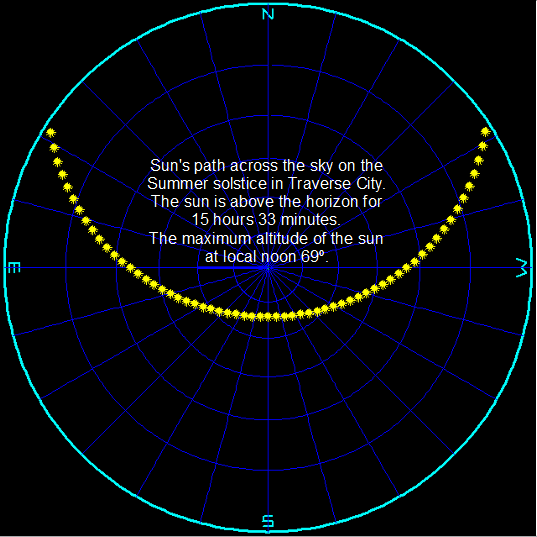
The Sun’s path through the sky on the summer solstice day from Traverse City, MI. Created using my LookingUp program.
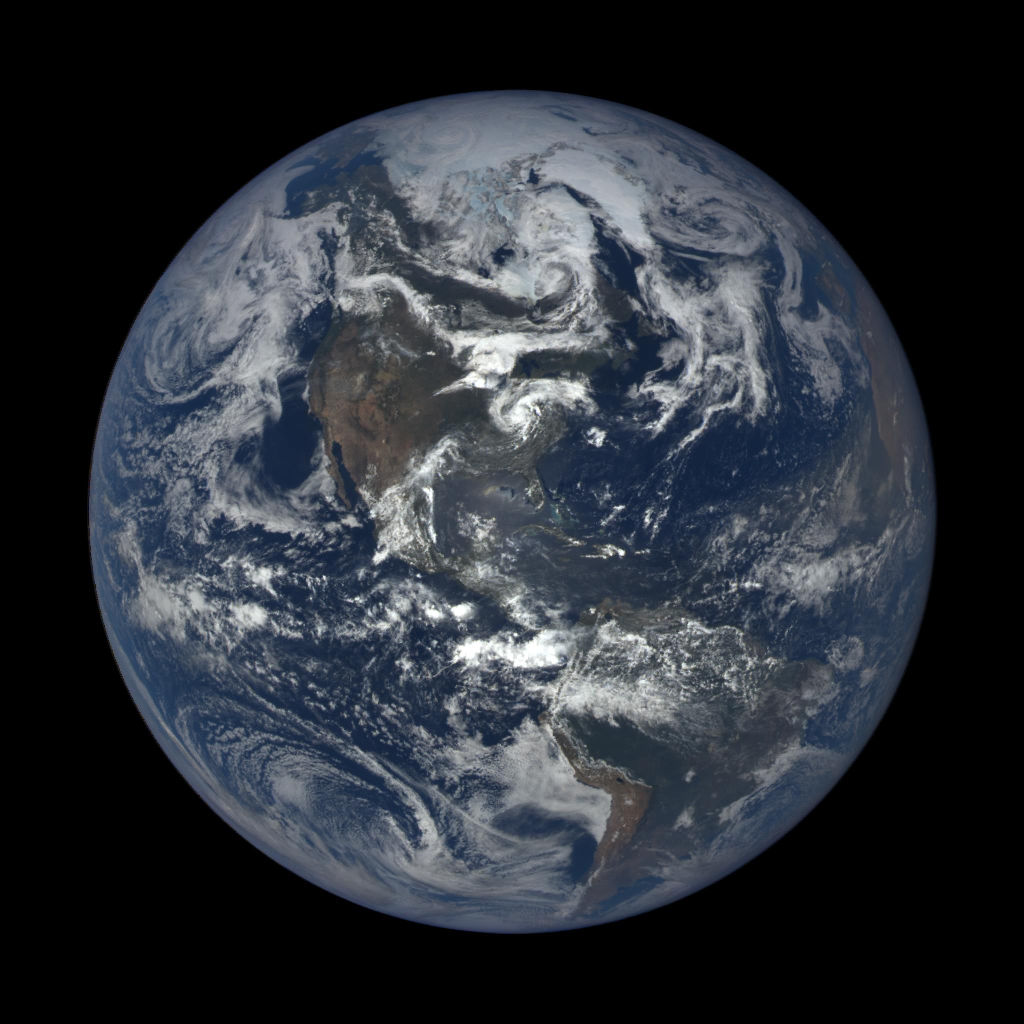
Earth from the DSCOVR satellite at the June solstice 2015. Credit NOAA
02/20/2017 – Ephemeris – The spring constellations are rising
Ephemeris for President’s Day, Monday, February 20th. The Sun will rise at 7:34. It’ll be up for 10 hours and 44 minutes, setting at 6:18. The Moon, 2 days past last quarter, will rise at 3:59 tomorrow morning.
With spring only a month away, lets turn our eyes eastward in the evening to the rising spring stars. In contrast to the brilliant stars of the winter skies still holding forth in the south, and running along the Milky Way overhead and to the northwest, the stars to the east are rather sparse and dull. The only exception is the Big Dipper to the northeast. The one bright star in the east is Regulus, whose rank as a first magnitude star is dead last in brightness. It is in the heart of the constellation of Leo the lion, and as such has gained a great amount of fame. Regulus is at the base of a backward question mark of stars that is informally known a the Sickle. It is also the characteristic head and mane of a male lion. A triangle of stars to the lower left are his back end ending with Leo’s second brightest star Denebola, literally “Lion’s Tail”.
Times are for the Traverse City/Interlochen area of Michigan. They may be different for your location.
Addendum
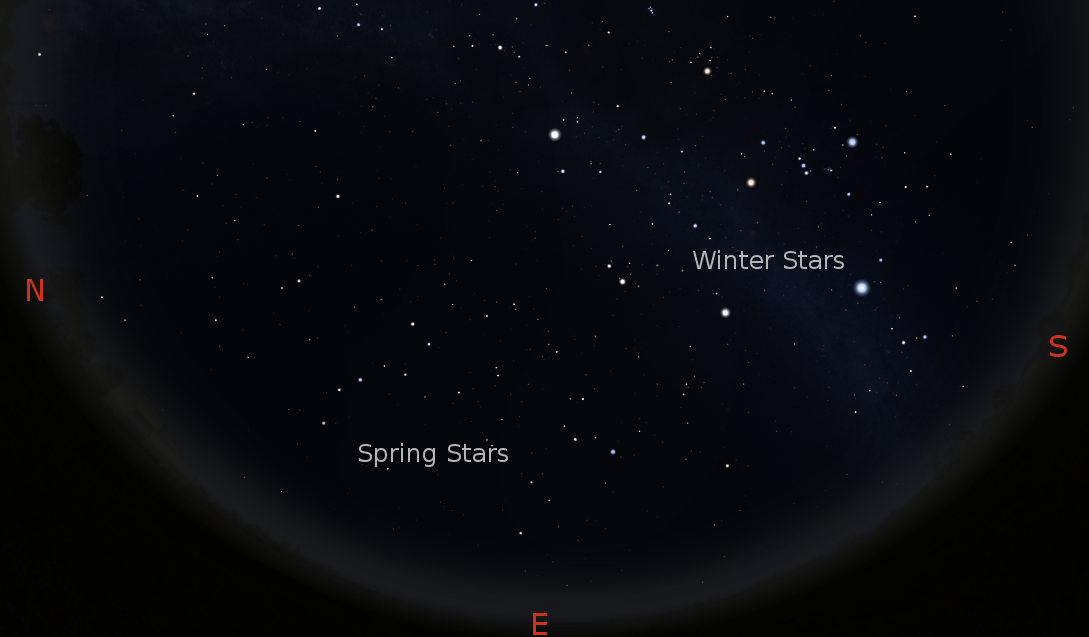
Comparison of winter stars vs. spring stars. Created using Stellarium.
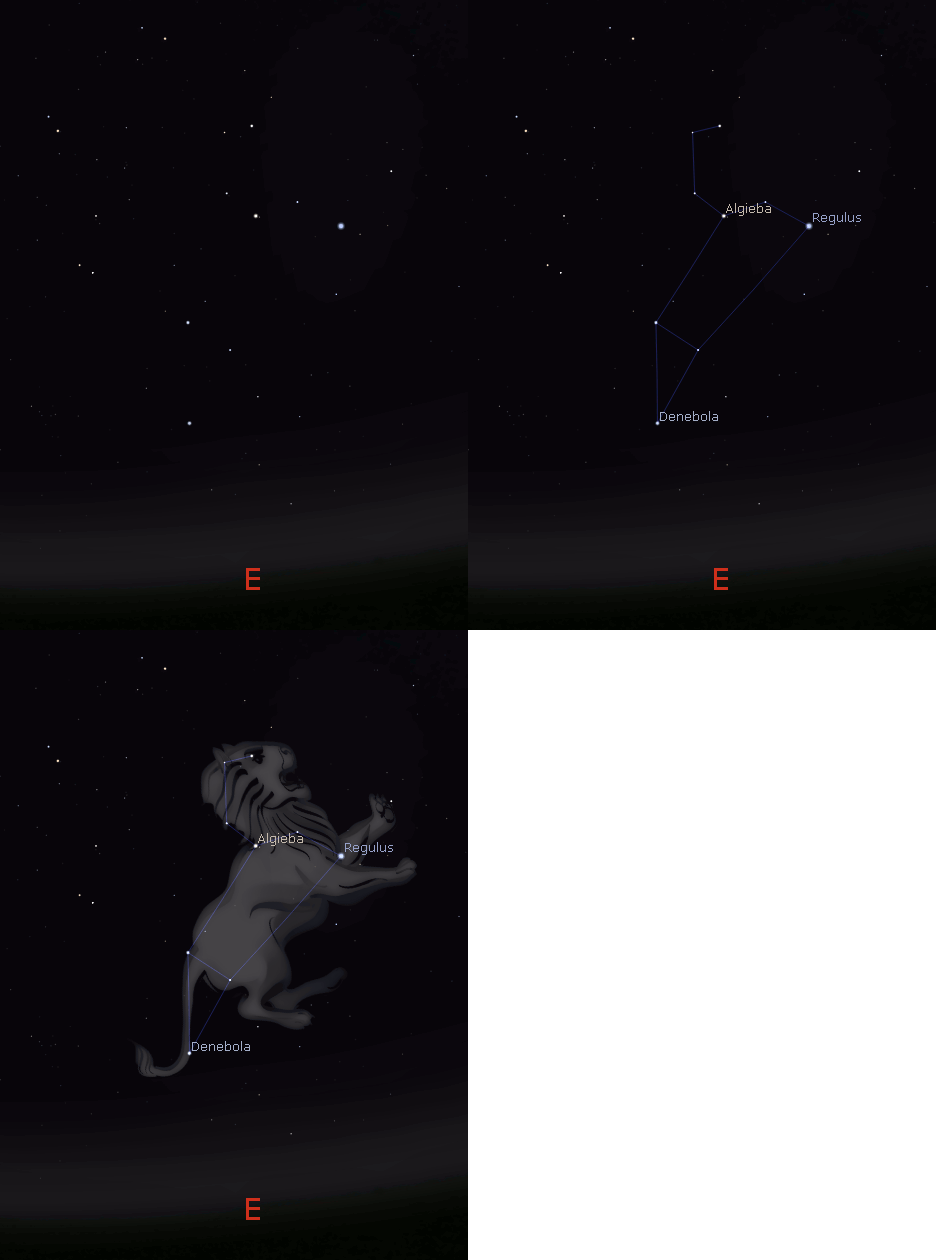
The constellation Leo animation. Created using Stellarium and GIMP.
01/03/2017 – Ephemeris – The Earth will be closest to the Sun tomorrow
Ephemeris for Tuesday, January 3rd. The Sun will rise at 8:19. It’ll be up for 8 hours and 55 minutes, setting at 5:15. The Moon, 2 days before first quarter, will set at 11:06 this evening.
The Earth has as elliptical orbit of the Sun, as do all planets. It is close to circular but not quite. The Earth’s distance from the Sun is 93 million miles (150 million km) plus or minus a million and a half miles. Tomorrow at about 6 a.m. the Sun will be at a point called perihelion, only 91.4 million miles (147 million km). It makes only a tiny difference in the Sun’s intensity, but since the Earth moves faster when closest to the Sun, it makes winter the shortest season at 89 days. Aphelion, Earth’s farthest distance from the sun occurs around July 4th which makes summer the longest season at 93 days. The eccentricity of an orbit can modify the seasons, but the seasons themselves are caused by the tilt of the planet’s axis alone.
Times are for the Traverse City/Interlochen area of Michigan. They may be different for your location.
Addendum
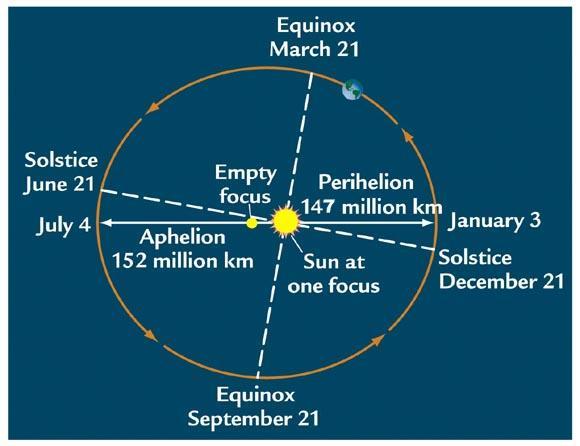
The Earth’s orbit, somewhat exaggerated, showing perihelion and the seasons. Credit “Starts with a Bang” blog by Ethan Siegel.
12/20/2016 – Ephemeris – The last full day of autumn
Ephemeris for Tuesday, December 20th. The Sun will rise at 8:16. It’ll be up for 8 hours and 48 minutes, setting at 5:04. The Moon, at last quarter today, will rise at 12:46 tomorrow morning.
Today is the last full day of autumn. Tomorrow at 5:45 a.m. winter will begin as the Sun passes the winter solstice and stops its southward movement in the sky. Immediately it will slowly climb northward again. It will lengthen the daytime hours and increase the power of the Sun as it gets higher in our sky. The cooling of the northern hemisphere will continue until late January, on average, until the lengthening days and increased solar altitude will finally overcome it. Prescientific cultures weren’t all that sure that Sun would come back, since they didn’t understand what was really happening. So when the solstice finally arrived it was a time for great celebrations which survive to this day.
Times are for the Traverse City/Interlochen area of Michigan. They may be different for your location.
Addendum
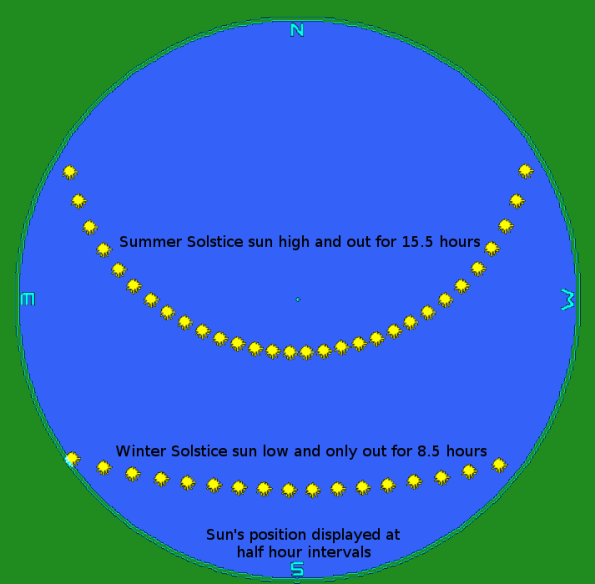
Comparing the sun’s path at the summer and winter solstices. This is a stereographic representation of the whole sky which distorts the sky and magnifies the size of the sun’s path near the horizon.
Take heart snow haters. Winter is the shortest season. You’ll find out why in early January.
12/09/2016 – Ephemeris – The earliest sunset
Ephemeris for Friday, December 9th. The Sun will rise at 8:08. It’ll be up for 8 hours and 53 minutes, setting at 5:02. The Moon, 2 days past first quarter, will set at 3:39 tomorrow morning.
In twelve days we will have the shortest day in terms of daylight hours. But the change isn’t uniformly distributed in the morning and evening. Tonight and tomorrow evening we will have the earliest sunsets Sunset times have been within the same minute for the last few days and will continue for the next few. The latest sunrise will occur on January second. The reason is that the Sun is traveling faster eastward than average, so the Earth’s rotation takes a little longer each day to catch up with it. Near the solstice the Sun is at a higher latitude, where the longitude lines are closer together, also the Earth is nearing its closest to the Sun, so moves faster its orbit adding to the effect. The effect exists in June but isn’t as noticeable.
Times are for the Traverse City/Interlochen area of Michigan. They may be different for your location.
Addendum
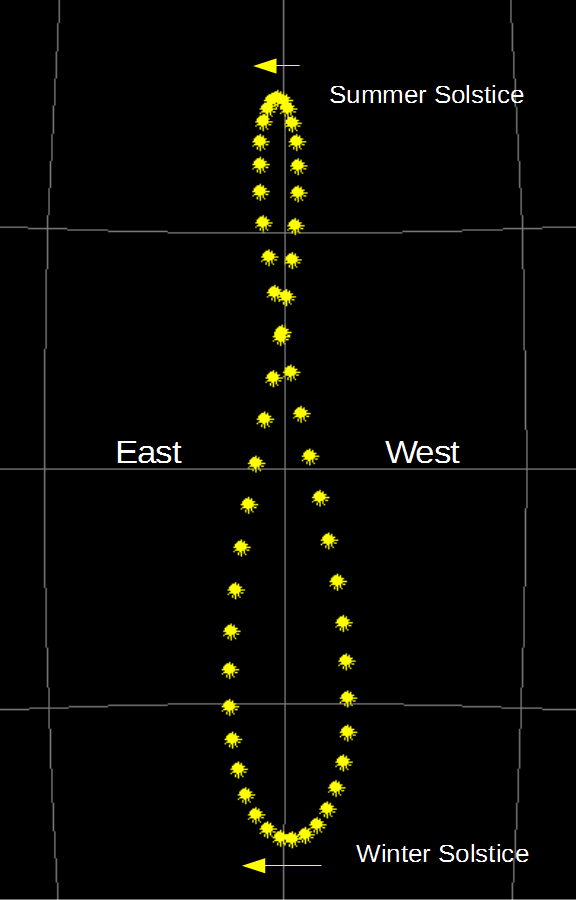
This figure 8 is called an analemma. One can find it on old globes in the Pacific Ocean. Explanation below. Created using my LookingUp program by plotting the Sun at 7 day intervals at local noon for a year.
At the bottom of the analemma is where the Sun is near the winter solstice when it is moving its fastest eastward. At the top, near the summer solstice the Sun is moving faster than average, but not as fast as it is now. The Earth will be nearest the Sun on January 4th, a point called perihelion. Aphelion next year, when the Earth is farthest from the Sun, will be July 3rd next year.
09/05/2016 – Ephemeris – Anticipating summer’s end
Ephemeris for Labor Day, Monday, September 5th. The Sun will rise at 7:10. It’ll be up for 13 hours and 0 minutes, setting at 8:11. The Moon, half way from new to first quarter, will set at 10:24 this evening.
Even though we have 17 more days officially, of summer, according to the actual seasons, today seems like it, the end of summer. Summer seems to be defined or confined to between the time that the kids get out of school, to Labor Day, after which the kids go back to school. Schools in other locales have been back for almost two weeks now. As far as the summer sky goes, the summer Milky Way will stick around until October, until we lose the Teapot of Sagittarius over the southwestern horizon. The Summer Triangle of bright summer stars, won’t leave the sky until December, as they move ever westward. However in the east the autumn stars are even now rising, pushing the Milky Way to the west.
Times are for the Traverse City/Interlochen area of Michigan. They may be different for your location.
Addendum
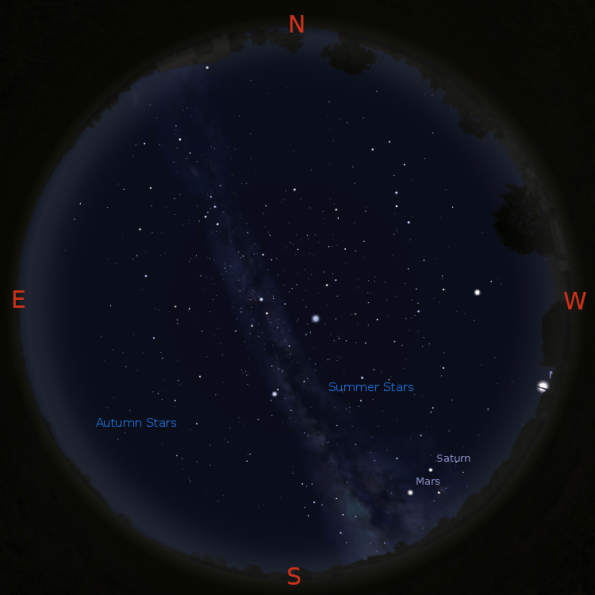
The transitional skies of 10 p.m. tonight 9/5/2016. Created using Stellarium.
07/19/2016 – Ephemeris – The bright Moon is seen low in the summer
Ephemeris for Tuesday, July 19th. Today the Sun will be up for 15 hours and 6 minutes, setting at 9:22, and it will rise tomorrow at 6:16. The Moon, at full today, will rise at 9:00 this evening.
In the summer time the moon appears to be seen low in the south. If you can remember back six month to winter and where the bright moon was then. It was very high in the sky then. The reason for the difference in altitude of the bright moon is that the Moon follows closely the Sun’s yearly track against the stars. That track is the ecliptic, along which the constellations of the Zodiac lie. The Moon’s own orbit of the Earth departs from that by five degrees. Tonight the Moon will be about 3 degrees, or 6 Moon diameters above of north of that line. The full Moon happens to be in the same place, plus or minus up to five degrees north or south of where the Sun was 6 months ago or will be 6 months hence.
Times are for the Traverse City/Interlochen area of Michigan. They may be different for your location.
Addendum
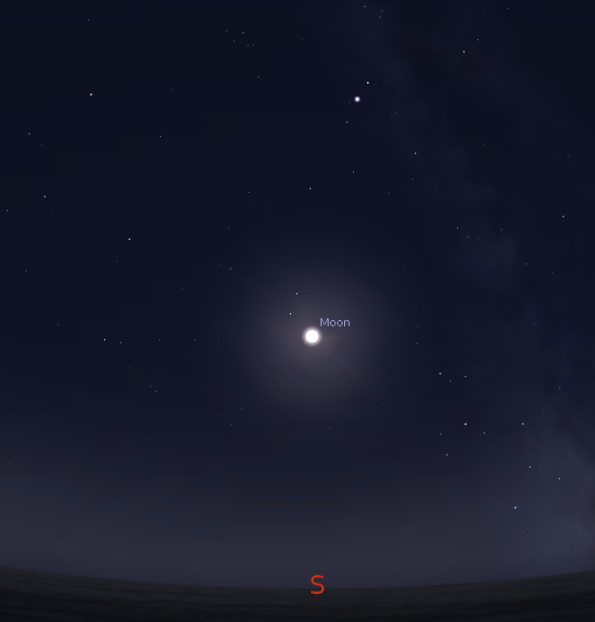
The Moon is low in the south on July 20, 2016. Created using Stellarium.
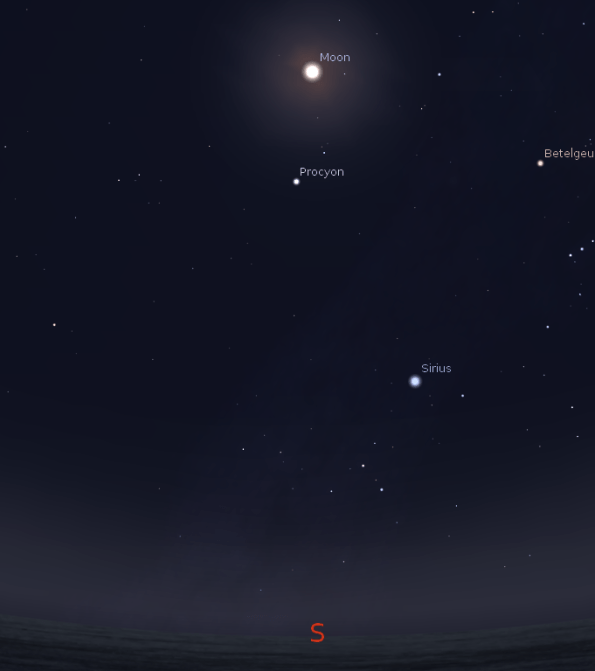
The Moon is high in the south on January 23, 2016. Created using Stellarium.
These images are the same scale.
06/27/2016 – Ephemeris – Astronomical twilight lasts till after midnight… Bummer!
Ephemeris for Monday, June 27th. Today the Sun will be up for 15 hours and 33 minutes, setting at 9:32, and it will rise tomorrow at 5:59. The Moon, at last quarter today, will rise at 1:57 tomorrow morning.
Here we are a week into summer and we find that the latest sunset was already last night. That means that the last vestiges of twilight* don’t end until just after midnight. It wouldn’t be so bad if the Sun was in the south at noon instead of 1:43 in the afternoon, due to being in the extreme western part of the eastern time zone and the imposition of daylight time. For latitudes north of 48 ½ degrees, twilight currently doesn’t end. That latitude will move northward as the Sun heads south. As it is now we in the Grand Traverse region are currently getting only 4 ½ hours of darkness Moon willing. And it won’t for the next few days at least. Our darkness situation will start to get better in about a month from now.
Times are for the Traverse City/Interlochen area of Michigan. They may be different for your location.
*Astronomical twilight begins and ends when the Sun is 18° below the horizon.
06/20/2016 – Ephemeris – Summer will start later today
Ephemeris for Monday, June 20th. Today the Sun will be up for 15 hours and 34 minutes, setting at 9:31, and it will rise tomorrow at 5:57. The Moon, at full today, will rise at 9:32 this evening.
Well, this is it, the last 12 hours of spring. Summer will begin at 6:35 this evening. In the southern hemisphere the season of winter will begin, and the south pole of the Earth will begin* is in the middle of its six months of darkness. The north above 66 ½ degrees north latitude is the land of the midnight Sun. Over summer that line will creep northward as the Sun heads southward. The seasons are caused by the tilt of the Earth’s axis, not by the Earth’s change in distance from the Sun. In fact we are approaching our farthest distance from the Sun, of about 94.5 million miles (152 million km) on the fourth of July called aphelion. The greater than normal distance makes summer the longest season at 93.7 days, winter being the shortest at 89 days.
Times are for the Traverse City/Interlochen area of Michigan. They may be different for your location.
* Thanks to Jeff Silagy for spotting the error.
Addendum
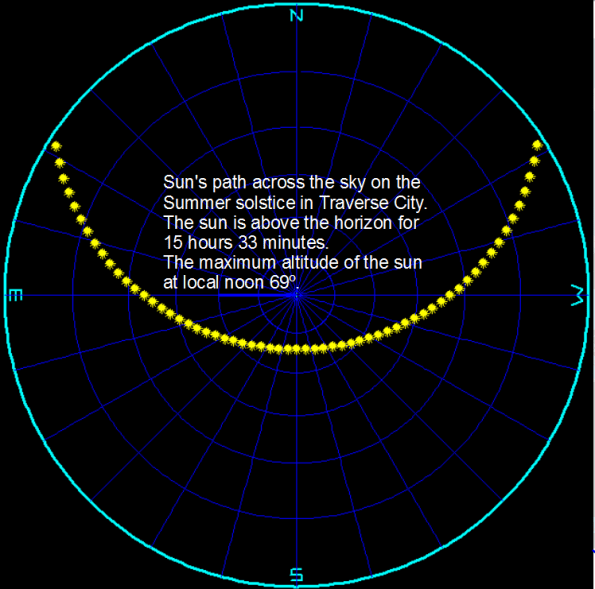
The sun’s daily path through the sky from horizon to horizon on the first day of summer, the summer solstice. Credit My LookingUp program.
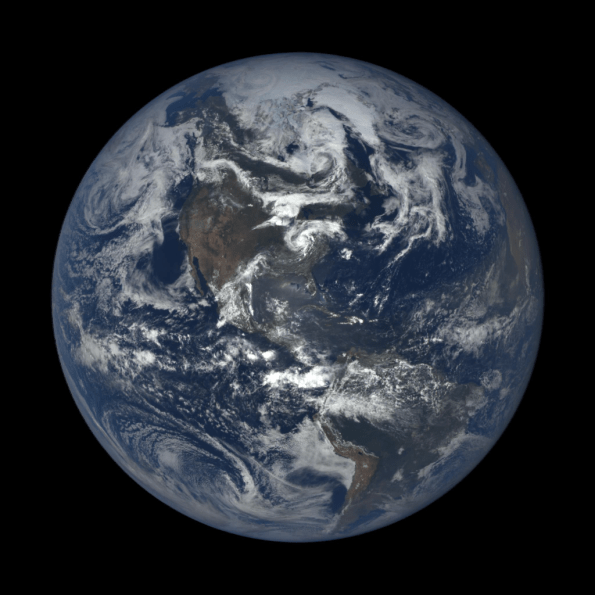
Earth from the DSCOVR satellite at the June solstice 2015. Credit NOAA.
 Bob Moler's Ephemeris Blog