Archive
07/20/2015 – Ephemeris – July 20th anniversaries
Ephemeris for Monday, July 20th. Today the Sun will be up for 15 hours and 5 minutes, setting at 9:21. The Moon, 4 days before first quarter, will set at 11:34 this evening, and tomorrow the Sun will rise at 6:16.
July 20th is a special date for this country’s space program and a personal one. On July 20, 1969 Apollo 11 landed on the Moon, the greatest achievement in the history of space flight. Seven years later the robot lander Viking 1 landed on Mars. NASA wanted it to be July 4th, 1976, the Bicentennial, but couldn’t find a smooth landing site in time. My own connection to the date came in 1963, my first total solar eclipse. We traveled to Quebec province along side the St. Maurice River. To view 60 seconds of totality. It was the first of four successful total solar eclipse trips I’ve been on.. I’m looking forward to my 5th on August 21st 2017, two years from now which is related to my first, I’ll tell you about that in my blog.
Times are for the Traverse City/Interlochen area of Michigan. They may be different for your location.
Addendum
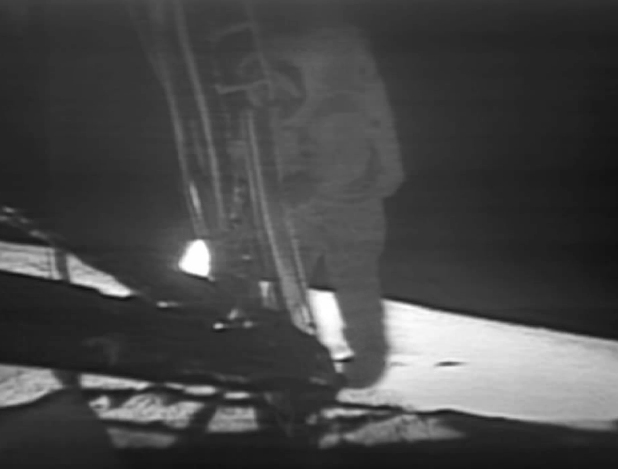
Neil Armstrong about to step off the LM onto the surface of the moon, July 20, 1969. Credit: NASA.
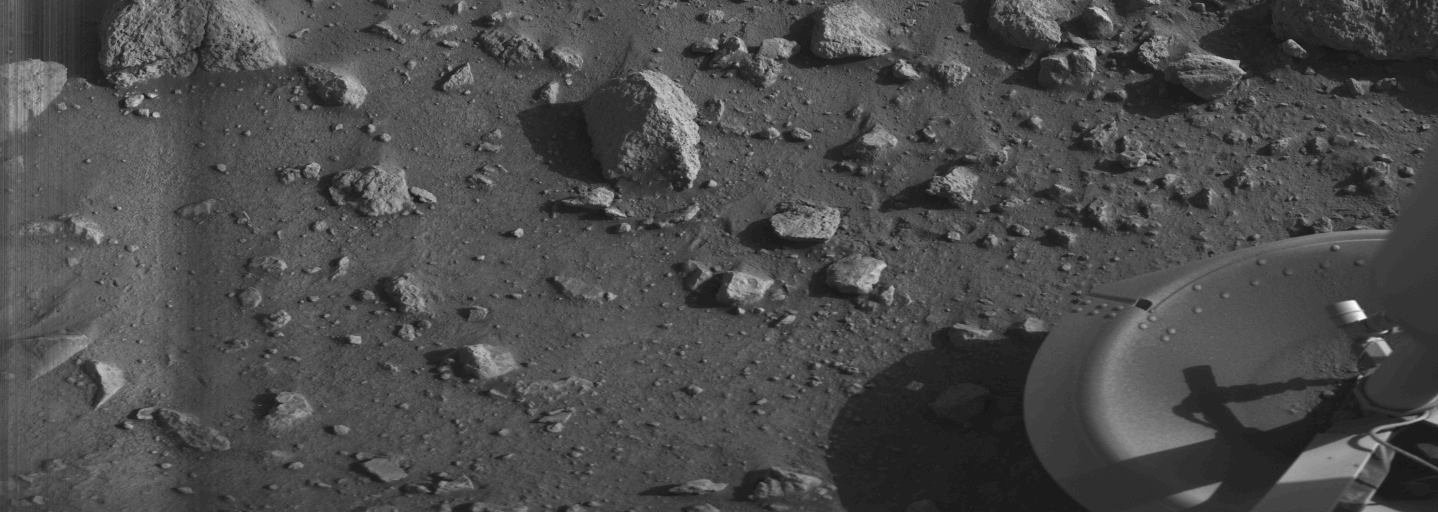
First image sent back from Viking 1 after landing on Mars, July 20, 1976. Credit: NASA/JPL. Click on image to enlarge.
Video of July 20, 1963 eclipse from the air. I got only one picture of the eclipse and it wasn’t very good. https://www.youtube.com/watch?v=OT3EW0KIjCc.
The date on the YouTube page is incorrect. It is July 20, 1963. I remember the corona being somewhat wedge-shaped, wider to one side than the other. Other than that it was a typical quiet sun corona.
In the program above I mentioned that the August 21, 2017 solar eclipse was related to my first total solar eclipse. This is the relationship: A couple of centuries BC the Chaldean astronomers of ancient Babylonia discovered that eclipses repeated in a cycle lasting 6,585 1/3 days. That’s 18 years 10 or 11 and 1/3 days depending on the number of leap years spanned. That period was called the Saros by Sir Edmund Halley or comet fame. So each eclipse would be visible 1/3 of the Earth farther west. Note that there are many Saros cycles occurring at the same time, and that eclipses of a particular Saros gradually move northward or southward. So to have an eclipse recur at the approximate same longitude one must wait 3 Saros cycles. or 54 years and one month approximately. Thus the third Saros of the July 20, 1963 total solar eclipse will be August 21, 2017. This Saros series (145) is moving southward. In 1963 it crosses the US at Alaska and Maine. Quebec was closer for us, s we went there. Good thing too. Maine was clouded and rained out. For us the clouds parted at the beginning of the eclipse. The 2015 eclipse will cross the continental US from Oregon to South Carolina.
A squished image of the July 20, 1963 eclipse path. Right click on the image and select view image to get a correct image. (works in Firefox).

A squished image of the August 21, 2017 eclipse path. Right click on the image and select view image to get a correct image. (works in Firefox).

10/23/2014 – Ephemeris – Partial solar eclipse tonight for most of the US
Ephemeris for Thursday, October 23rd. The sun will rise at 8:08. It’ll be up for 10 hours and 36 minutes, setting at 6:44. The moon is new today, and won’t be visible.
This evening there will be a partial solar eclipse, in which we will see only the first part before the sun sets. The eclipse will be visible for all but the extreme eastern part of the country. It will be a partial eclipse for all who can see it because the core of the Moon’s shadow will miss the Earth to the north. For the Interlochen Public Radio listening area (Northwestern Lower Michigan) the eclipse will star a couple of minutes before or after 5:32 p.m. and will end at sunset around 6:44 p.m. The low position of the sun make a lack of cloud cover necessary to be able to see it. Proper approved solar filters, or a projection method are necessary to view the eclipse. Do Not Look Directly at the Sun! The NMC Observatory south of Traverse City will be open, weather permitting starting at 5 p.m. Also the Platte River Point location at the Sleeping Bear Dunes National Lakeshore will also be available.
An added attraction for this eclipse is the appearance of the largest sunspot group to appear on the sun in years.
Times are for the Traverse City/Interlochen area of Michigan. They may be different for your location.
Addendum
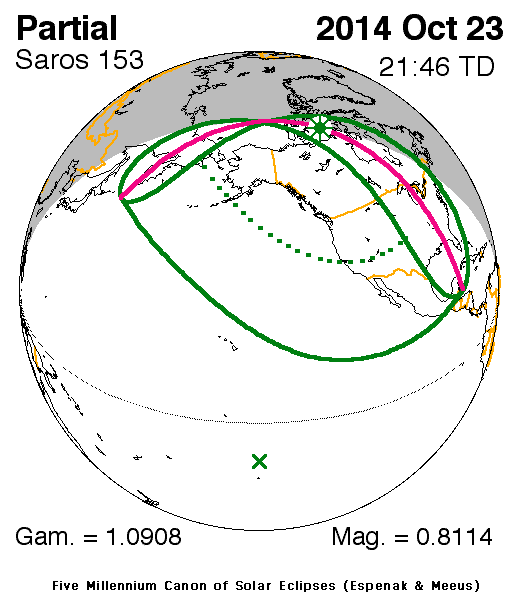
Coverage of the partial solar eclipse of October 23, 2014. Credit: NASA.

The setting partially eclipsed sun from Traverse City. Created using Stellarium.
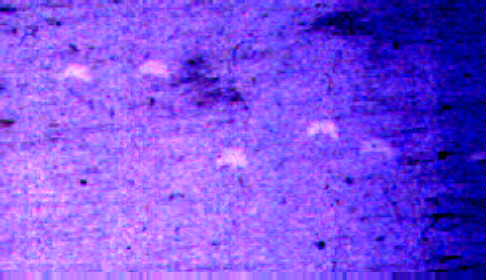
Partially eclipsed sun using a series of pinholes projected on a reasonably white surface.
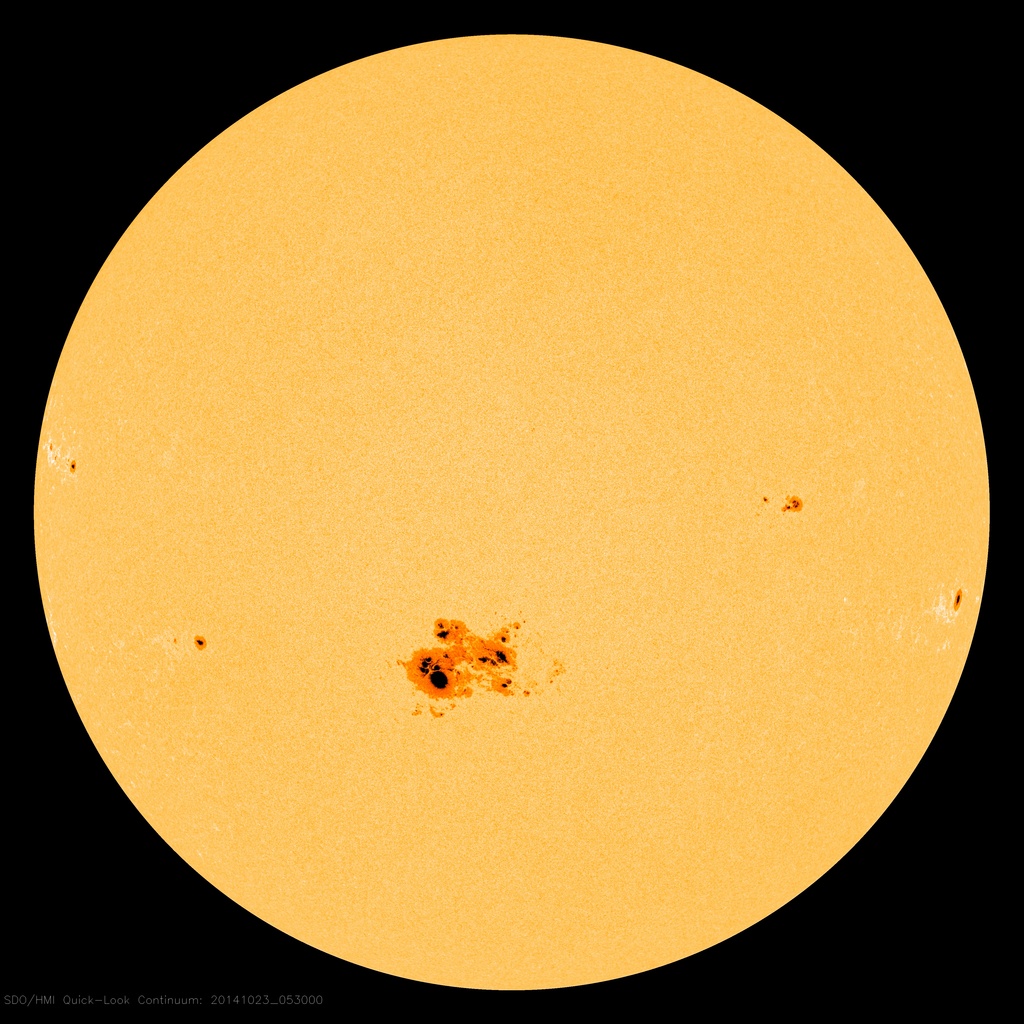
The Sun at 1:30 a.m. 10/23/2014 with large sunspot group AR 2192. Credit NASA – Solar Dynamics Observatory.
This baby gave off a X Class flare yesterday (10/22/2014). Could be more in store. Maybe we’ll see an aurora later this week.
10/22/2014 – Ephemeris – The bright planets this week plus a preview of Thursday’s partial solar eclipse
Ephemeris for Wednesday, October 22nd. The sun will rise at 8:06. It’ll be up for 10 hours and 39 minutes, setting at 6:46. The moon, 1 day before new, will rise at 7:46 tomorrow morning.
Tonight Saturn will be low in the west-southwest before it sets at 7:56 p.m. Mars will be low in the southwest at 9 p.m. and will set at 9:40 p.m. The sky will stay devoid of bright planets until Jupiter rises at 1:56 a.m. tomorrow morning. Jupiter is visible this morning in twilight in the south-southeast along with the brighter stars of winter visible, a preview of colder evenings to come. Tomorrow evening, weather permitting, we will get to see part of a partial solar eclipse. The exact times depend on your location, though shouldn’t deviate from these by a few minutes for the Interlochen Public Radio listening area (northwestern lower Michigan). The eclipse will start around 5:32 p.m. and will continue till sunset around 6:44 p.m. Use proper eye protection or use pinhole projection.
Times are for the Traverse City/Interlochen area of Michigan. They may be different for your location.
Addendum
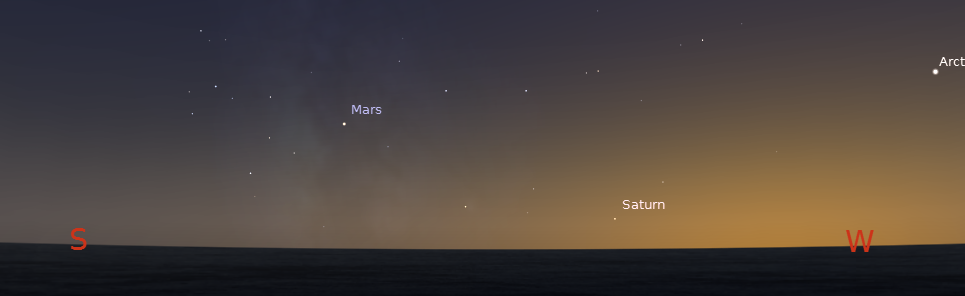
Saturn and Mars at 7:30 p.m. on October 22, 2014. Created using Stellarium.
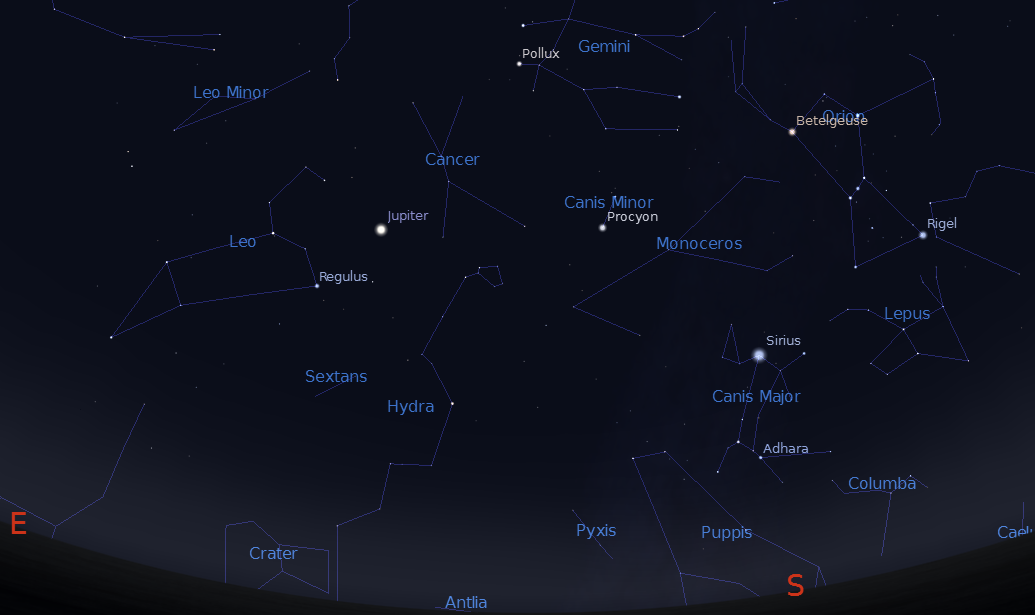
Jupiter and the morning constellations at 6:30 a.m., October 23, 2014. Created using Stellarium.
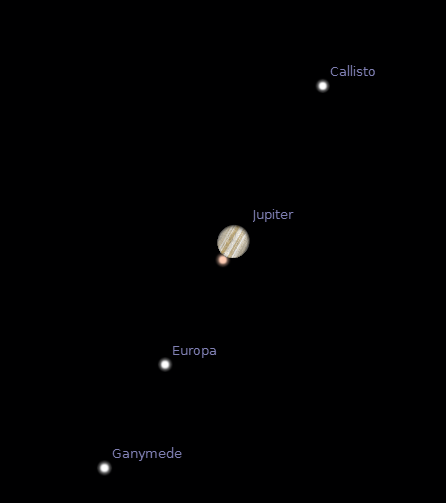
Jupiter through a telescope at 6:30 a.m. October 23, 2014. The unnamed moon is Io. Created using Stellarium.
Coverage of the partial solar eclipse of October 23, 2014. Credit: NASA. Click image for more information.
The setting partially eclipsed sun from Traverse City. Created using Stellarium.
Partially eclipsed sun using a series of pinholes projected on a reasonably white surface.
10/09/2014 – Ephemeris – The next lunar eclipses and recollections of what happened with yesterday’s eclipse
Ephemeris for Thursday, October 9th. The sun will rise at 7:50. It’ll be up for 11 hours and 18 minutes, setting at 7:08. The moon, 1 day past full, will rise at 8:01 this evening.
With the two total lunar eclipses done for this year, we can look forward to two more next year. The April 4th, 2015 eclipse won’t appear total here because the moon will set before totality. However the September 28th, 2015 lunar eclipse will be an evening eclipse. These 4 eclipses make a rare tetrad of total lunar eclipses that won’t be repeated until 2032 and 2033. After September 28th the next total lunar eclipse visible from northern Michigan will be in 2021. On the solar eclipse side there’s one on the 23rd of this month, a partial eclipse at sunset. I’ll have more on that later. After that is the big event, the total solar eclipse on August 21, 2017. The path of totality will run from coast to coast, running just south of St. Louis Missouri, and just north of Nashville Tennessee.
Times are for the Traverse City/Interlochen area of Michigan. They may be different for your location.
Addendum
What follows is my recollection of the October 8th lunar eclipse. Originally relayed in an email to Pat Stinson, freelance writer and author of the wonderful article in the Grand Traverse Insider about the activities of Space Week and the astronomical events in October:
The skies were trending clearer at midnight and again at 2:30 a.m. when I took a shower to prepare for the eclipse. After that it got slowly worse. That afternoon Ranger Marie Scott of the Sleeping Bear Dunes National Lakeshore said she’d go to our site, Platte River Point, clouds or not, and I was willing. In setting up the eclipse observing sites,earlier in the year, this site was the one place that if it were clear, we could see either the moon or the sun set onto the Lake Michigan horizon for the three eclipses this year. I loaded my van with my two telescopes, the C8 and an 11″ Dobsonian and lots of coffee.
I got to the site at 4:30 and began to set up. Marie arrived a few minutes later and another Grand Traverse Astronomical Society member Don Flegel arrived shortly after that. They had some rain in Kingsley, where he lived that morning. We had a strong, cold northwest wind. When we’re at the Point we commandeer the small parking lot to the north of the road that’s up against a hill. That hill and my van offered some protection from the wind. I got the C8 set up just in time to spot the moon emerging from the clouds a few minutes after first contact. We were able to follow the eclipse intermittently until about 5:45 when a large cloud covered the moon big time. We could see the glint of the moon off the water until after totality.
This was our situation until about 7:30 when the clouds began to break up, By then the moon was so low that the foreshortened breaks weren’t all that open. Then about 10 minutes before moon set it did peek out at intervals. Unlike the Cheshire Cat’s smile, the moon (cat) had a frown because the upper edge of the moon was coming back into sunlight. 5 minutes later the moon finally disappeared for good in a cloud bank as the puffy clouds overhead caught the sun’s golden sunrise rays.
Marie Scott counted 18 folks that at one time or another came out to witness the event. Marie also posted some pictures she took of the eclipse on the park’s Facebook page.
04/15/2014 – Ephemeris – One eclipse down, what’s next?
Ephemeris for Tuesday, April 15th, Tax Deadline Day. The sun rises at 6:58. It’ll be up for 13 hours and 29 minutes, setting at 8:27. The moon, at full today, will rise at 9:08 this evening.
Since I’m recording this before this morning’s eclipse, I don’t know if it was visible from the northern Lower Peninsula. However we do have a shot at another total lunar eclipse this year. That one is on October 8th. Though it’s in the morning, it’s closer to dawn. One which one can catch by going to bed early and getting up early to enjoy. The weather prospects are somewhat better in October than they are in April. That eclipse we’ll miss a bit of the ending partial phase as the moon sets during that time. As a bonus, 15 days later we will see half of a partial solar eclipse, because the sun will set around mid eclipse. That eclipse will not be total anywhere as the core of the moon’s shadow misses to the north of the Earth.
Times are for the Traverse City/Interlochen area of Michigan. They may be different for your location.
Addendum
There’s another eclipse I didn’t mention due to time. It follows this one by 14 days, on April 29th. It is an odd partial eclipse visible from the Indian Ocean, Australia and a bit of Antarctica. It is an annular eclipse, where the moon is too far away to completely cover the bright ball of the sun. The annular shadow touches the earth in Antarctica, but not the central part, which just misses the earth. It’s truly an odd eclipse. Next year will provide us with two more lunar eclipses. The first one we’ll see a part of before the moon sets, and the second will be an evening eclipse well placed for viewing. None of next years solar eclipses will be visible from North America.
Check out this and next year’s eclipses on the NASA Eclipse website.
05/09/2013 – Ephemeris – There’s an annular eclipse in the Pacific Ocean today
Ephemeris for Thursday, May 9th. The sun rises at 6:21. It’ll be up for 14 hours and 35 minutes, setting at 8:57. The moon is new today, and won’t be visible.
Solar eclipse in Pacific. Later this afternoon our time there will be an annular eclipse of the sun. However it will only be visible from parts of the Pacific Ocean including Australia. Since the shadow crosses the International Date Line and the moon’s shadow moves west to east, it start in Australia on the morning of the 10th, and end far southeast of Hawai’i on evening of the 9th. An annular eclipse is one in which the moon is farther than average from the earth and cannot cover the whole face of the moon for observers on the earth. He moon’s farthest distance from the earth this month is called apogee at 252,000 miles next Monday. The lunar eclipse paired with this is a very slight penumbral eclipse on the 25th, too slight to be noticeable.
Times are for the Traverse City/Interlochen area of Michigan. They may be different for your location.
Addendum
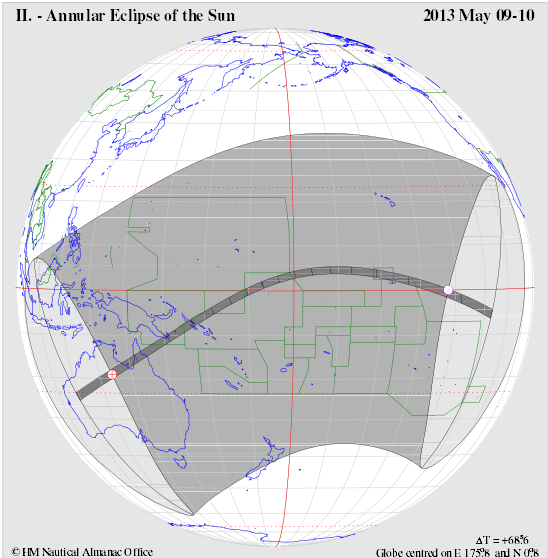
Annular eclipse path May 9-10, 2013.
From the Astronomical Almanac Online (USNO, HMNO).
The PDF version of the above image and eclipse times click here.
11/13/2012 – Ephemeris – Total Solar Eclipse in the South Pacific
Ephemeris for Tuesday, November 13th. The sun will rise at 7:37. It’ll be up for 9 hours and 39 minutes, setting at 5:16. The moon is new today, and won’t be visible.
There will be a total solar eclipse today for the South Pacific Ocean. The path of totality crosses almost no land except in the two northernmost tips of Australia. Australia, New Guinea, New Zealand parts of Antarctica, Chile and Argentina will get a partial eclipse. The moon’s shadow crosses the earth from west to east, so in crossing the International Date Line it will start at sunrise on November 14th local time and end at sunset November 13th local time. The solar eclipse we’re waiting for is the total solar eclipse of August 21st 2017, now less than 5 years away. This will be at least partial for the contiguous 48 states with the path of totality crossing the central United States. Being in the path of totality that day is high on my bucket list.
Times are for the Traverse City/Interlochen area of Michigan. They may be different for your location.
Addendum
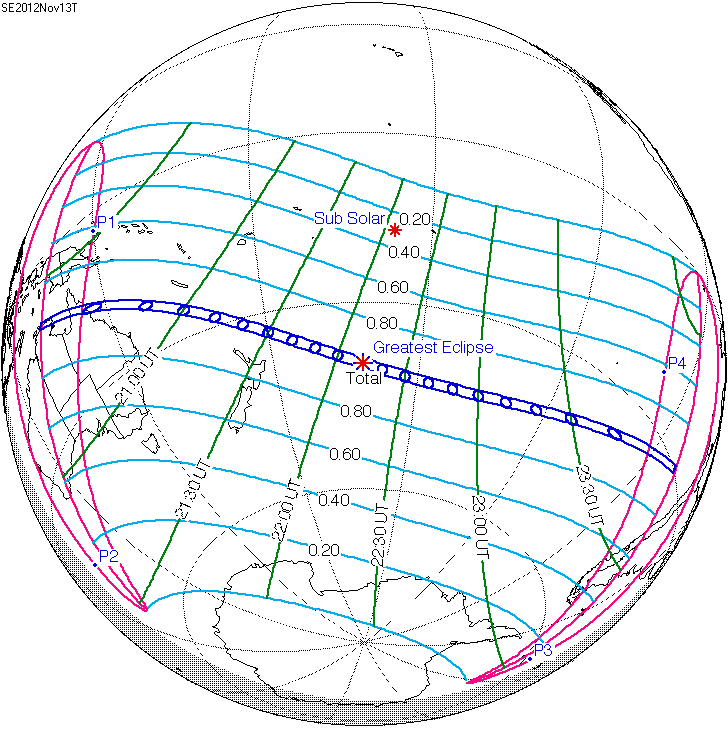
Diagram of the coverage of the November 13-14 total Solar Eclipse. Courtesy Fred Espanek, NASA.
Here’s an animation that brings the above chart to life.
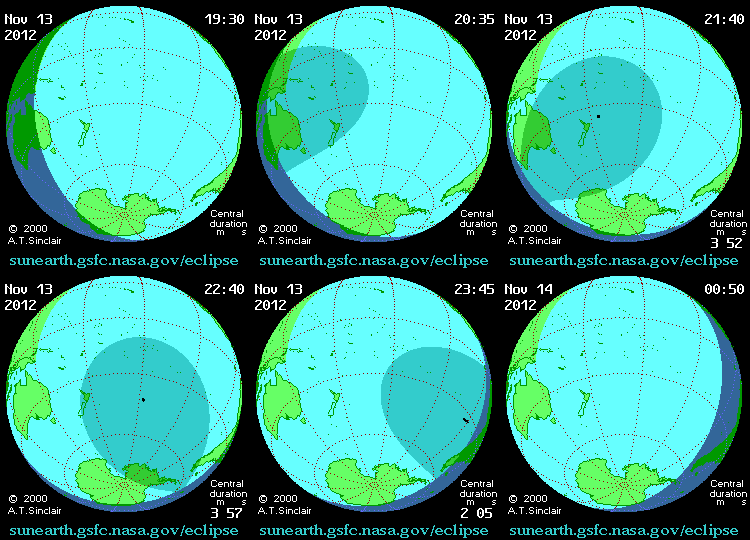
November 13-14 total solar eclipse animation. Courtesy NASA, A. T. Sinclair.
Our May 20th, 2012 solar eclipse experiences
We knew seeing the eclipse would be a close thing. We members of the Grand Traverse Astronomical Society had a full day of events. It started with a full day at Northwestern Michigan College at their annual fund raising Barbecue. Gary and Eileen Carlisle, Ron and Jan Uthe, Richard Kuschell, and myself had telescopes aimed at the sun. Joe Brooks our meteor man was holding forth in one of the classrooms with his meteorite collection. This went from 10 a.m. setup to 5 p.m. take down.
I immediately headed 30 miles westward to the Sleeping Bear Dunes National Lakeshore, and Pierce Stocking Scenic Drive and the Lake Michigan Overlook and our planned eclipse viewing party with the park rangers. The rest of our group except Joe followed a bit later. The sky was milky all day, and we had puffy clouds in Traverse City at the barbecue. Watching the cloud animations on weatherunderground.com gave me some hope that the cloud bank we knew was over Wisconsin might just hold off so we could get the major part of what we projected would be the first 50 minutes of the eclipse before sunset. There was also a spear of thunderstorms coming northward up the lake from the south. The sky was so milky that we had no idea how high the cloud bank we knew was there actually was.
When I arrived at the entrance to the scenic drive the rangers told me that they may change our location due to blowing sand. When I got to the overlook the sand was indeed being blown by gusts of wind coming from the southwest.

Lake Michigan Overlook Looking South
The above picture is from my scouting trip the week before. We set up near that dune, which sheltered us pretty well from the wind. However when I got home, I was full of sand, especially my hair.
It wasn’t until about 10 minutes before the start of the eclipse that the cloud bank was revealed. It then was a race between the moon and the cloud bank. The moon won by about 5 minutes. My old friend John Russell, a professional photographer, was there and has posted an eclipse image on his Facebook page.
About 10 minutes later we found that the clouds were getting ugly, and approaching rapidly.
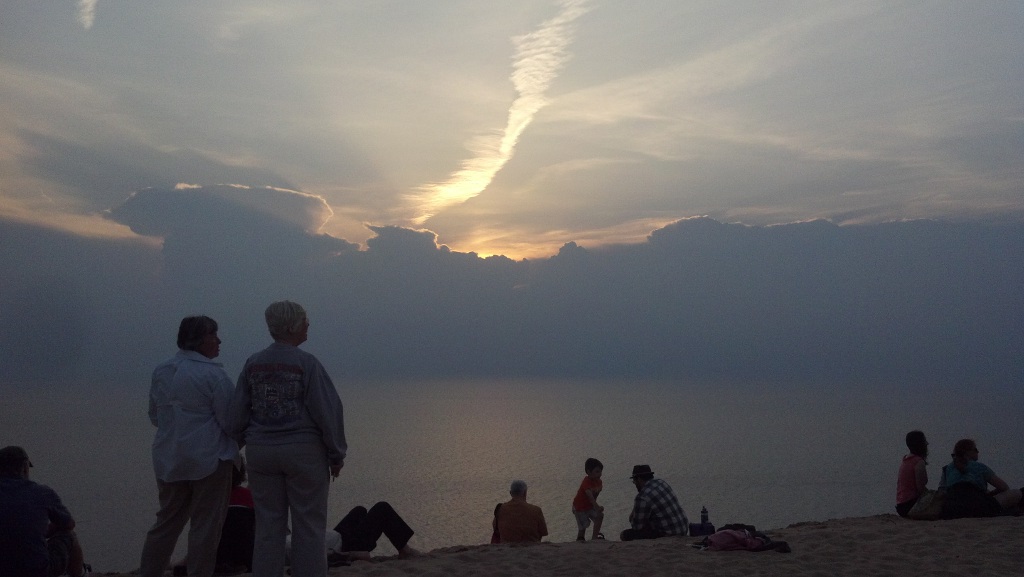
Looking in vain for the sun. Isn’t that a thunderhead on the left?
That was it for the eclipse. The rangers counted about 200 people who attended.
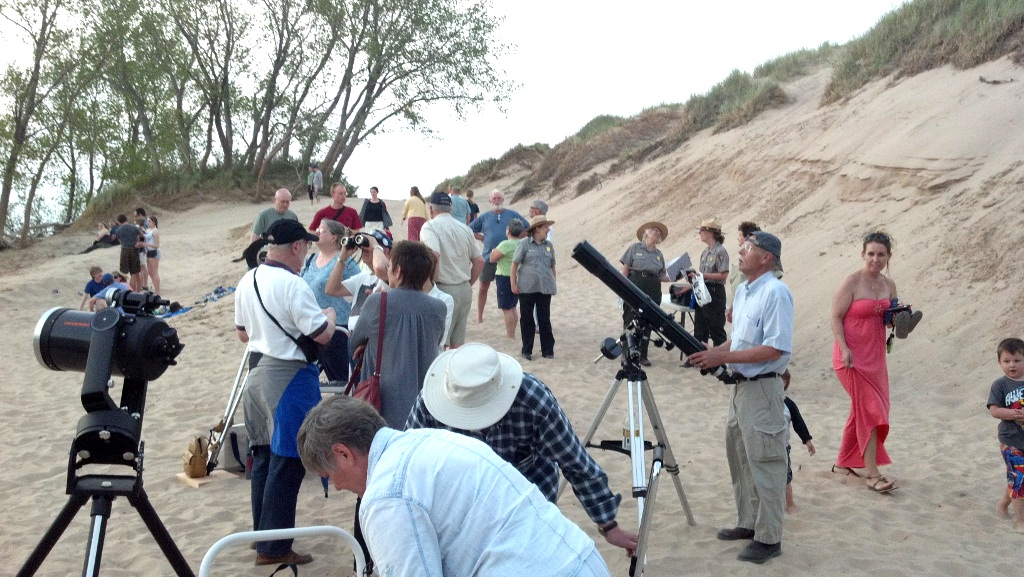
Gary Carlisle with binoculars and Richard Kuschell look for Venus above the cloud bank.
Gary Carlisle, who has a knack for finding planets in twilight, spotted Venus above the cloud bank and pointed his Celestron 8 telescope toward it. Richard Kuschell located it too with his 4″ refractor to give the folks remaining a bonus view of the thin crescent of Venus.
We then packed up and headed back home with lightning to the south and a smattering of rain.
05/21/2012 – Ephemeris – What are the next solar eclipses to be visile from Northern Michigan?
Ephemeris for Monday, May 21st. Today the sun will be up for 15 hours and 2 minutes, setting at 9:10. The moon, 1 day past new, will set at 10:01 this evening. Tomorrow the sun will rise at 6:07.
With yesterday’s solar eclipse now history, when will we see the next one? The next solar eclipse visible from northern Michigan is another partial eclipse interrupted by sunset. That one’s on October 24, 2014, about two and a half years from now. It will be a partial eclipse for anyone able to see it. The central part of the moon’s shadow will miss earth to the north. In three years after that is a total eclipse whose path of totality crosses the United States from Oregon to South Carolina. That one is special to me. It will be the third saros periods of the first total eclipse I saw, back on July 20, 1963. Eclipses repeat in 18 years 10 or 11 1/3 days called a saros. The August 21, 2017 is that eclipse.
Times are for the Traverse City/Interlochen area of Michigan. They may be different for your location.
05/18/2012 – Ephemeris – Eclipse viewing from the Sleeping Bear Dunes this Sunday
Ephemeris for Friday, May 18th. Today the sun will be up for 14 hours and 56 minutes, setting at 9:07. The moon, 2 days before new, will rise at 5:14 tomorrow morning. Tomorrow the sun will rise at 6:09.
For Sunday’s solar eclipse the Grand Traverse Astronomical Society will team up with the National Park Service for eclipse viewing at sunset on Pierce Stocking Scenic Drive at Sleeping Bear Dunes National Lakeshore. We’ll be stationed at either stop 3, the Dunes overlook, or stop 9 the Lake Michigan Overlook. There we will have telescopes for safe viewing of the eclipse, and the park service will have a number of eclipse viewer glasses that are safe to use. Our telescopes have special solar filters that fit in front of the telescope, and another special solar telescope to see the gasses above the bright ball of the sun. The eclipse will start at 8:19 p.m. And last until sunset at 9:10 p.m. If it’s overcast, the viewing will be canceled.
Times are for the Traverse City/Interlochen area of Michigan. They may be different for your location.
Addendum
Views from the observation points. I took these shots May 12th.
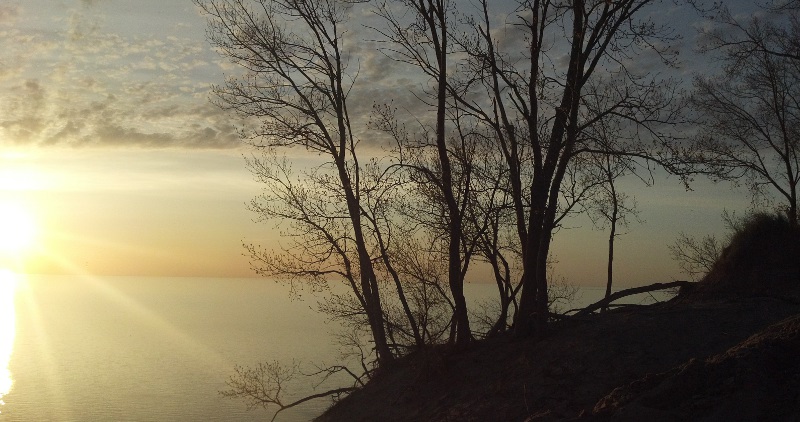
View from the Lake Michigan Overlook. The trees won’t interfere.
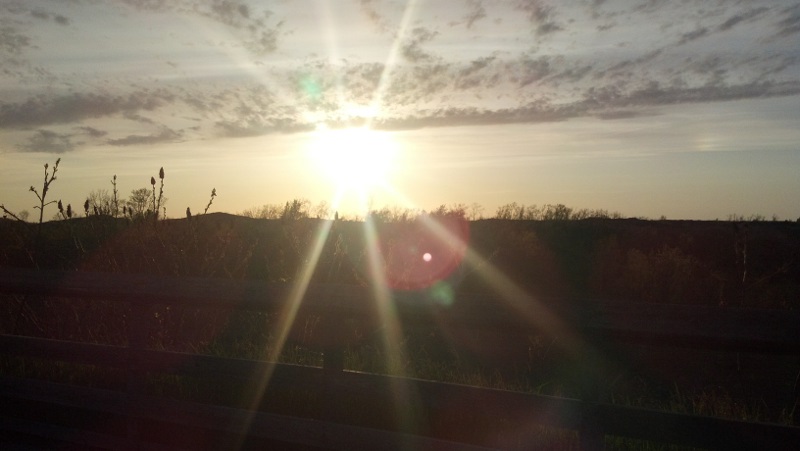
Sunset from the dune Overlook. The dunes and scrub will cause the sunset at that point up to 5 minutes before the Lake Michigan Overlook.
 Bob Moler's Ephemeris Blog