Archive
06/25/2020 – Ephemeris – The bright star Spica
This is Ephemeris for Thursday, June 25th. Today the Sun will be up for 15 hours and 33 minutes, setting at 9:32, and it will rise tomorrow at 5:58. The Moon, 3 days before first quarter, will set at 12:59 tomorrow morning.
Low in the southwest at 11 p.m. is the bright star Spica which can be found from all the way back overhead to the Big Dipper. Follow the arc of the handle of the Big Dipper to the bright star Arcturus high in the southwest. Then straighten the curve of the arc to a straight spike which points to Spica. Arcturus is much brighter than Spica and has an orange tint to Spica’s bluish hue. In fact Spica is the bluest of the 21 first magnitude stars. That means that it is hot. Actually Spica is really two blue stars orbiting each other in 4 days. Spica is 250 light years away, which is reasonably close. Spica was an important star to the ancient Greeks. One temple was built, and aligned to its setting point.
The event times given are for the Traverse City/Interlochen area of Michigan. They may be different for your location.
Addendum
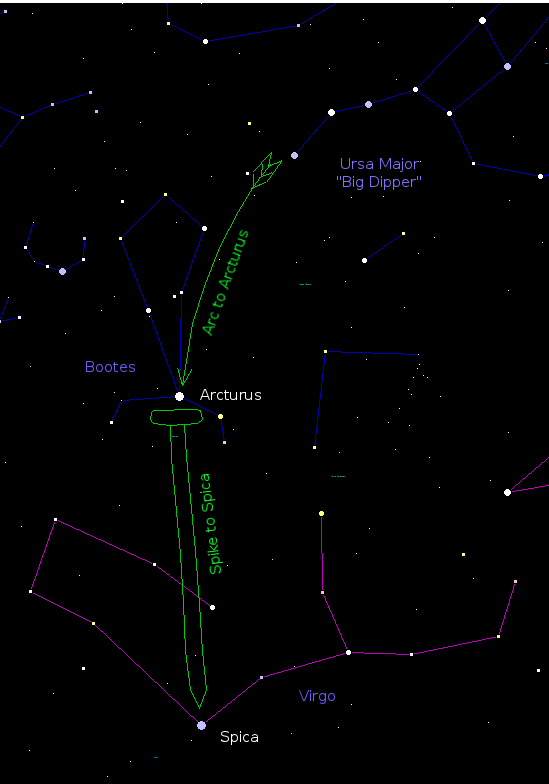
Spica finder chart using my LookingUp program fo 11 p.m. tonight June 25.
06/23/2020 – Ephemeris – Arcturus: a look at the Sun’s future
This is Ephemeris for Tuesday, June 23rd. Today the Sun will be up for 15 hours and 34 minutes, setting at 9:32, and it will rise tomorrow at 5:58. The Moon, 2 days past new, will set at 11:49 this evening.
Arcturus, a red giant star is about two thirds the way up the sky in the southwest at 11 p.m. It’s one of the earliest stars to appear in twilight, being nearly tied in brightness with Vega, a white star nearly as high in the east. A pointer to Arcturus is the handle of the Big Dipper, following the arc of the handle to Arcturus. Though only 37 light years away, it’s not from around here. It’s passing through the galactic disk from north to south. Arcturus is about 7 billion years old, and is about 8% more massive than our Sun. It appears to be starting its red giant phase, after running out of hydrogen to fuse to helium in its core and is beginning to fuse helium. It’s a preview of coming attractions for our Sun when it gets that old.
The event times given are for the Traverse City/Interlochen area of Michigan. They may be different for your location.
Addendum
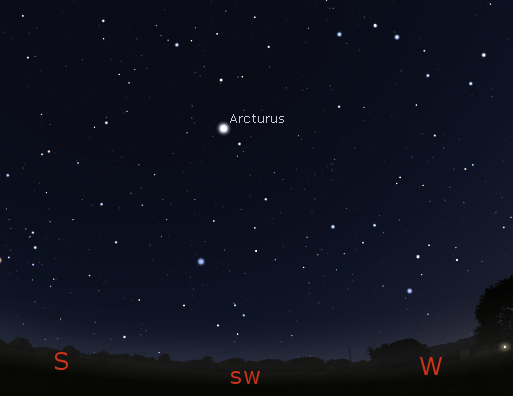
Arcturus is easy to find. It’s the brightest star in the southwest in the evening. This is 11 pm tonight June 23, 2020. Note the Big Dipper and its handle to the upper right. Created using Stellarium.
06/09/2020 – Ephemeris – The constellation of the crow and a star often mistaken for a UFO
This is Ephemeris for Tuesday, June 9th. Today the Sun will be up for 15 hours and 30 minutes, setting at 9:27, and it will rise tomorrow at 5:56. The Moon, half way from full to last quarter, will rise at 1:06 tomorrow morning.
I don’t want spring to get away from us without pointing out a small but distinctive constellation now low in the southwest at 11 pm called Corvus the crow that to me looks like an odd shaped box. Wider at the bottom than the top and left side taller than the right. It’s supposed to be a crow in flight diagonally to the upper right. I find it easy to find by that odd shaped box. Also at 11 pm, the summer constellation of Scorpius the scorpion is rising with its bright red star Antares twinkling madly. This red giant star stays low in the southern sky, so we always, here in Michigan, see it through lots of atmosphere whose turbulence accentuates its twinkling. I call it my UFO star. It’s a riot in binoculars or a telescope.
The event times given are for the Traverse City/Interlochen area of Michigan. They may be different for your location.
Addendum
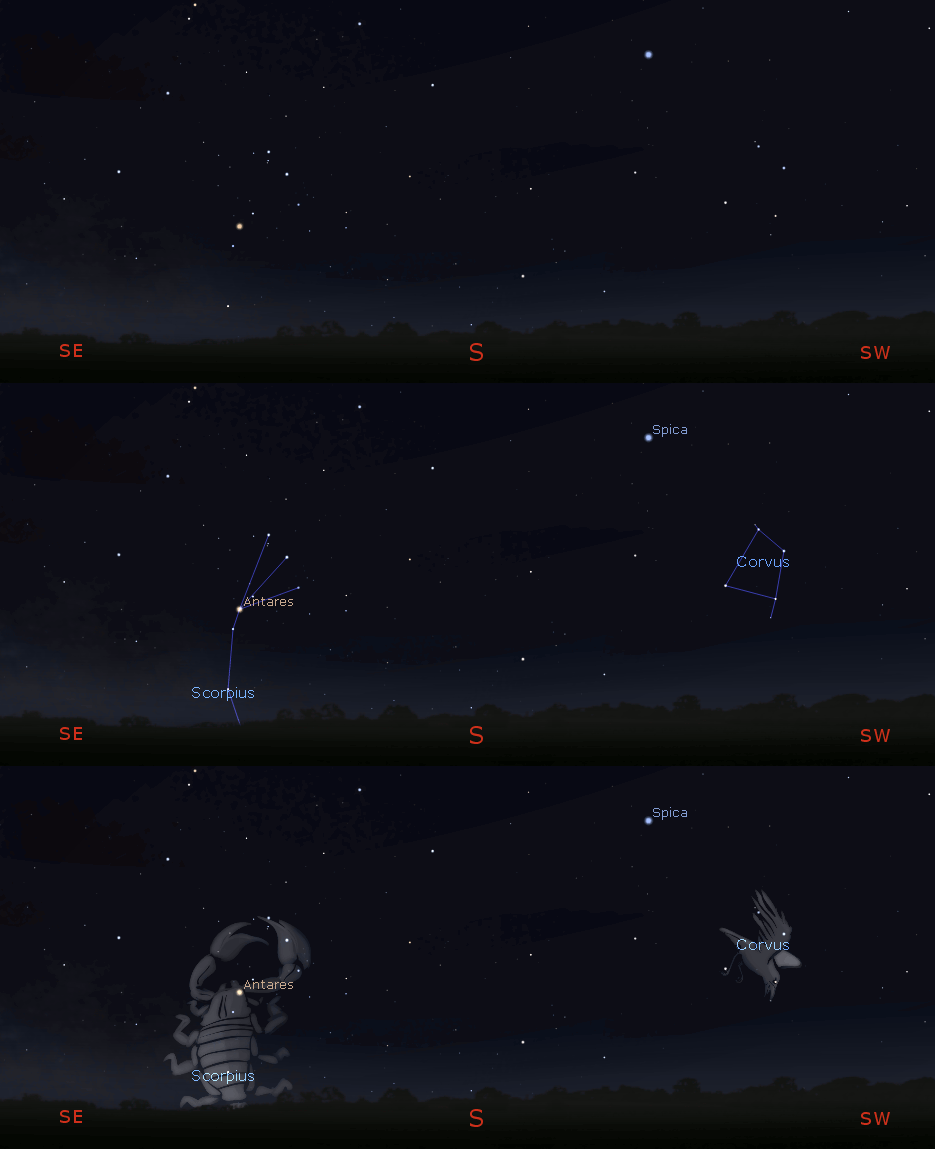
Corvus the crow and Antares the star in Scorpius at 11 pm tonight, June 9, 2020. Created using Stellarium and its embedded art. This is not how I see either constellation. Everyone gets to use their own imagination. Mine doesn’t agree with either image, but I’m not artistic enough to show how I imagine them. Though for Corvus I just see the distinctive box. Click on the image to enlarge it.
04/24/2020 – Ephemeris – The Big Dipper can be used to point to other stars and constellations
This is Bob Moler with Ephemeris for Arbor Day, Friday, April 24th. Today the Sun will be up for 13 hours and 57 minutes, setting at 8:39, and it will rise tomorrow at 6:41. The Moon, 2 days past new, will set at 10:21 this evening.
The Big Dipper can be used to point to other stars and constellations. Right now the Big Dipper is nearly overhead. The front bowl stars point to Polaris, the North Star which never seems to move in the sky. The handle can be used to find two stars. First follow the arc of the handle away from the bowl to find the fourth brightest night-time star Arcturus in the base of the kite shaped constellation of Boötes. Straighten the arc to a spike and continue to the south and you will come to the bright blue-white star Spica in Virgo the virgin. You can remember these stars with the phrase “Follow the arc of the handle to Arcturus and then spike to Spica” or if you prefer the alternate pronunciation of the latter star “Speak to Speeka”.
The event times given are for the Traverse City/Interlochen area of Michigan. They may be different for your location.
Addendum
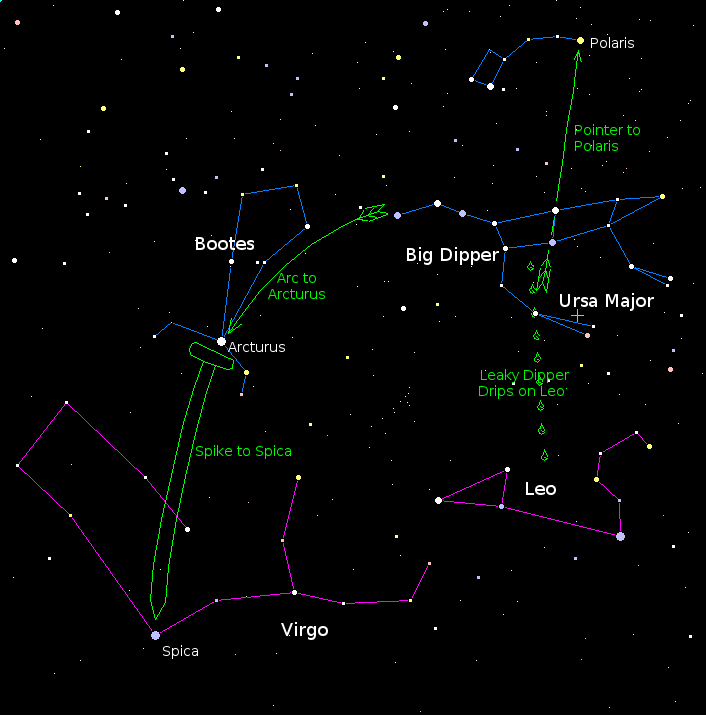
Finding stars and constellations using the Big Dipper. Click on the image to enlarge. Created using my LookingUp program for Windows.
04/20/2020 – Ephemeris – The Little King Star
This is Ephemeris for Monday, April 20th. Today the Sun will be up for 13 hours and 45 minutes, setting at 8:34, and it will rise tomorrow at 6:47. The Moon, 2 days before new, will rise at 6:37 tomorrow morning.
The brightest star in the constellation Leo, which is high in the south these evenings is Regulus, whose name means “Little King”. It is appropriate due to its position in the heart of the king of beasts Leo the lion. Regulus is dead last in brightness of the 21 first magnitude stars, the brightest night-time stars. Even so, it is much brighter than the Sun. It is 79 light years away. The Sun would require a telescope to be spotted at that distance. Regulus appears to be a quadruple star system. The bright star itself is really two stars with a bright star orbited by a much dimmer star every 40 days. There are two dimmer stars much further out that share Regulus’ motion through space. There are an infinite variety of star system arrangements in the galaxy and beyond.
The event times given are for the Traverse City/Interlochen area of Michigan. They may be different for your location.
Addendum
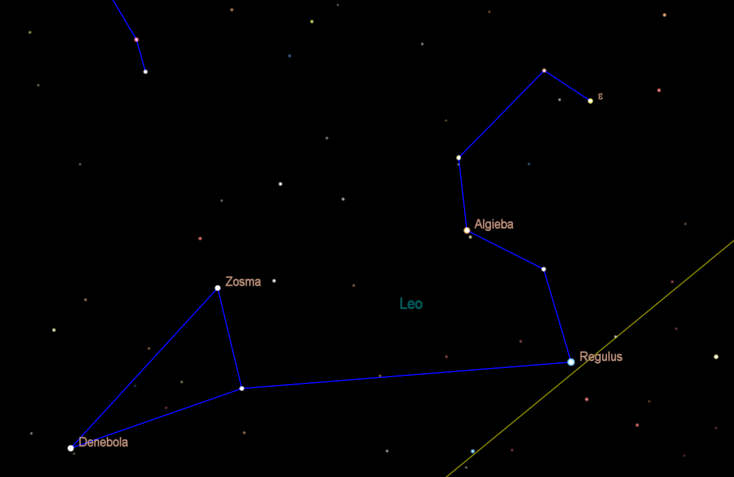
The naked eye stars of Leo, including Regulus at 9:30 p.m. April 20, 2020. Note that Algieba is a binary star that can be seen in small telescopes. The yellow line that passes Regulus is the ecliptic the apparent path of the Sun. The Moon and planets also hang out near that line. Created using Cartes du Ciel (Sky Charts).
03/13/2020 – Ephemeris – Looking for Cancer the crab
Ephemeris for Friday, March 13th. Today the Sun will be up for 11 hours and 49 minutes, setting at 7:47, and it will rise tomorrow at 7:56. The Moon, 3 days before last quarter, will rise at 1:01 tomorrow morning.
Between the stars Castor and Pollux in Gemini high in the southeast and the star Regulus in Leo the Lion in the east-southeast lies the dimmest constellation of the zodiac, Cancer the crab. To me its 5 brightest stars make an upside down Y. There’s the stars in the center of the constellation Asellus Borealis and Asellus Australis, the north and south donkeys. There’s a fuzzy spot between and just west of them called Praesepe, the manger from which they are supposedly eating. In binoculars it resolves into a cluster of stars called the Beehive cluster. We amateur astronomers also know it as M44, the 44th object on 18th century comet hunter Charles Messier’s list of fuzzy objects that might be mistaken for comets.
The event times given are for the Traverse City/Interlochen area of Michigan. They may be different for your location.
Addendum

Cancer the crab finder chart. Note the beehive cluster, also known to amateur astronomers as M44, along with other catalog names. Prior to the invention of the telescope this cluster was known as Praesepe which means “Manger”. Click on the image to enlarge. Created using Stellarium and GIMP.
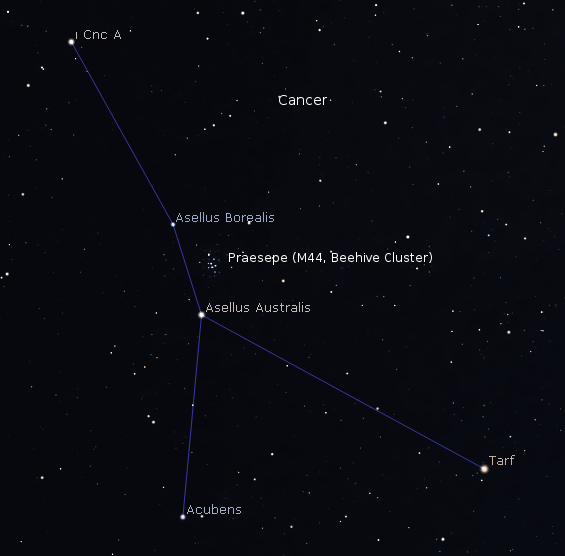
The constellation Cancer with star names and Praesepe. Asellus Borealis, the Northern Donkey; and Asellus Australis, the Southern Donkey are next to Praesepe the manger. Created using Stellarium.
We only hear about a manger at Christmas time. It is simply a trough that horses, donkeys, and cattle eat from.
03/10/2020 – Ephemeris – A Closeup look at Gemini’s namesake stars
Ephemeris for Tuesday, March 10th. Today the Sun will be up for 11 hours and 39 minutes, setting at 7:43, and it will rise tomorrow at 8:01. The Moon, 1 day past full, will rise at 9:07 this evening.
At 9 p.m. the constellation of Gemini the twins will be seen high in the south-southeast. The namesake stars of the two lads are the two bright stars at the upper left of the constellation. Pollux the pugilist, or boxer, is the lower of the two, while Castor, the horseman, is the other star, or rather a six star system. In telescopes two close stars may be seen each is a spectroscopic binary, meaning the two stars can be detected by the rainbow colors of light from the star. A faint nearby spectroscopic binary also belongs. Pollux, though a single star, does have at least one planet, over twice the mass of Jupiter orbiting it at a distance somewhat greater than Mars is from the Sun. Pollux is 34 light years away while Castor is 50 light years away.
The event times given are for the Traverse City/Interlochen area of Michigan. They may be different for your location.
Addendum
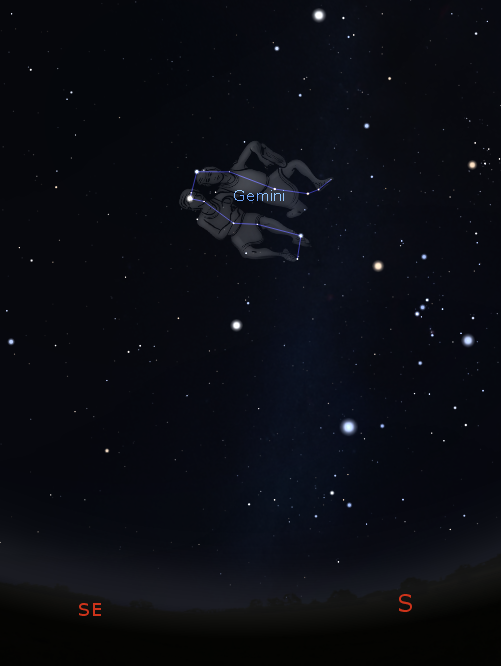
Gemini finder looking south-southeast at 9 p.m. March 10th, 2020. Created using Stellarium.

Castor and Pollux namesakes of the twins of Gemini in its position at 9 p.m. EDT March 10th. Created using Stellarium.
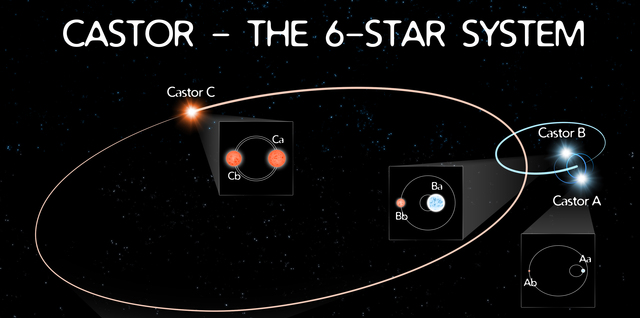
The Castor star system exploded in this JPL/NASA infographic.
03/05/2020 – Ephemeris – Apparently Betelgeuse, though dimming wasn’t cooling as expected
Ephemeris for Thursday, March 5th. Today the Sun will be up for 11 hours and 24 minutes, setting at 6:36, and it will rise tomorrow at 7:10. The Moon, 3 days past first quarter, will set at 5:31 tomorrow morning.
Betelgeuse, the red star in the constellation Orion’s shoulder has apparently stopped dimming and has begun to brighten. The guesses as to the cause of the dimming are many. One suggested by a photograph taken of the star in December shows the southern half dimmed like it was covered by something. Betelgeuse out gasses lots of material, some of which condenses into dust. Could some of this dust mask the star and make it dimmer? I suspect that we’ll find out before too long. Many astronomers are wishing Betelgeuse would explode in a core collapse or type 2 supernova. At its approximate 700 light year distance we’d be safe, though a bazillion neutrinos would pass harmlessly through each one of us just before the light would get here.
The times given are for the Traverse City/Interlochen area of Michigan. They may be different for your location.
Addendum

An image of the star Betelgeuse taken in infrared shows it’s surrounded by a vast cloud of dust that erupted from the surface (the bright star itself is masked out, though an image of it has been superposed there for scale — it’s about the size of the orbit of Jupiter, over a billion km wide). Credit: ESO/P. Kervella/M. Montargès et al., Acknowledgement: Eric Pantin via Phil Plait’s Bad Astronomy blog on syfy.com.

This comparison image shows the star Betelgeuse before and after its unprecedented dimming. The observations, taken with the SPHERE instrument on ESO’s Very Large Telescope in January and December 2019, show how much the star has faded and how its apparent shape has changed. Credit: ESO/M. Montargès et al.
More on this from Dr. Phil Plait’s Bad Astronomy blog on syfy.com: https://www.syfy.com/syfywire/mea-culpa-betelgeuse-and-its-dusty-convective-pulsations
03/03/2020 – Ephemeris – Betelgeuse, apparently, has stopped dimming and may be brightening
Ephemeris for Tuesday, March 3rd. Today the Sun will be up for 11 hours and 18 minutes, setting at 6:33, and it will rise tomorrow at 7:14. The Moon, 1 day past first quarter, will set at 3:41 tomorrow morning.
Betelgeuse the red giant star in the constellation Orion’s shoulder has apparently stopped dimming and may be brightening again. The process of recovery is slow. It may recover its former brightness. We’ll know this later in summer when Betelgeuse and the rest of Orion moves from behind the Sun and enters the morning sky. Betelgeuse is known to be irregular in brightness, but has never been recorded as being this dim, dropping it from being a first magnitude star. Betelgeuse is no longer dimming. There is lots of speculation as to why it’s now brightening. One is the thought that there are several periodic cycles that govern Betelgeuse’s variability. That the troughs of these cycles happen to coincide is one explanation.
The times given are for the Traverse City/Interlochen area of Michigan. They may be different for your location.
Addendum
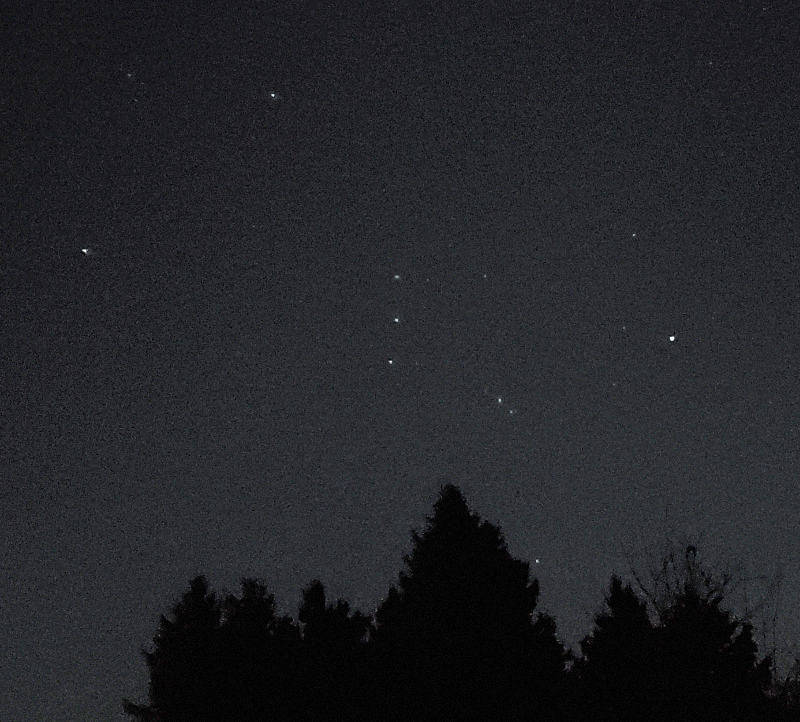
Betelgeuse in Orion (the bright star on the left) at 7:07 p.m. January 6, 2020. Taken with my Samsung Galaxy S10+ in the moonlight. Compare the brightness of Betelgeuse with Rigel, Bellatrix and the belt stars.
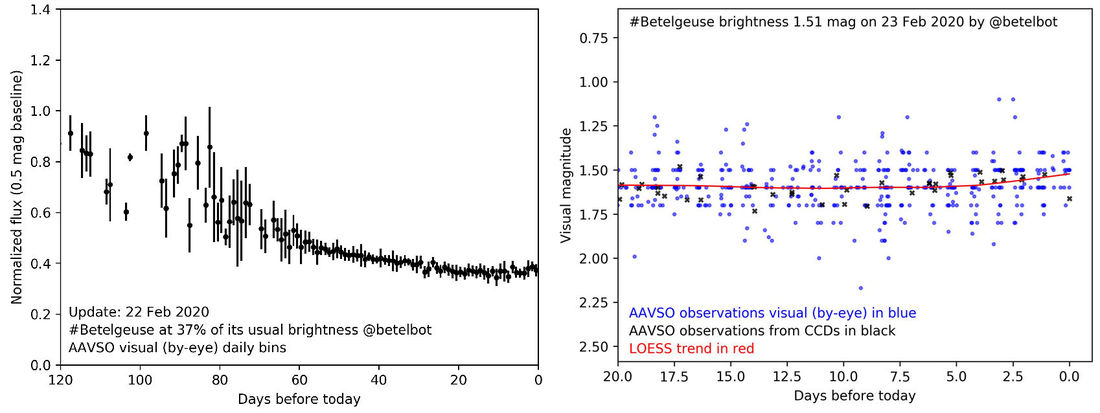
The brightness of Betelgeuse from late November 2019 to 23 Feb. 2020 shows it dimming dramatically (the y-axis is in magnitudes, where a bigger number is fainter). A close-up on just the past 20 days (right) shows it starting to rise again around 18 Feb. Blue dots are estimates by eye, black using digital cameras, and the red line is a smooth fit to the data. Credit: Betelbot on Twitter, run by Michael Hipke via Dr. Phil Plait’s Bad Astronomy post https://www.syfy.com/syfywire/no-supernova-for-you-betelgeuse-is-brightening-again-right-on-schedule
01/02/2020 – Ephemeris – Orion’s great red star Betelgeuse is dimming
Ephemeris for Thursday, January 2nd. The Sun will rise at 8:20. It’ll be up for 8 hours and 53 minutes, setting at 5:13. The Moon, at first quarter today, will set at 12:48 tomorrow morning.
The bright red giant star in the constellation Orion’s shoulder is in the news. It is dimming, and it is dimmer now than it has been for a very long time. A chart by the American Association of Variable Star Observers shows that this is the dimmest it’s been going back to 1970 and maybe a long time before that. Betelgeuse was first noticed to vary in brightness in 1838. It is the left star at the top of Orion’s upright rectangle of stars. Bellatrix is the right corner star. Betelgeuse is now only a little brighter than it, and much dimmer than Rigel the lower right corner star. A couple of years ago it was brighter than it had been since 1970. Astronomers are watching and waiting. They expect Betelgeuse to explode as a supernova sometime in the next million years.
The times given are for the Traverse City/Interlochen area of Michigan. They may be different for your location.
Addendum
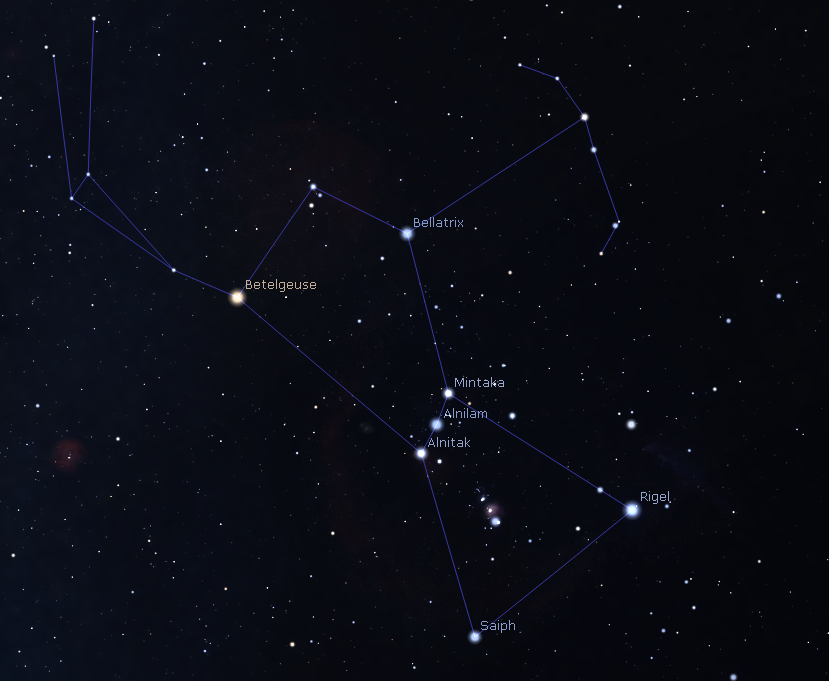
Orion’s brightest stars with their names for 9 p.m. January 7. Click on the image to make Orion a giant hunter. Created using Stellarium, which shows Betelgeuse at its average magnitude of 0.45.

Orion and Betelgeuse on Christmas night 2019 by David Dickinson. Photo from a smart phone from Virginia Beach. Note that Betelgeuse is not much brighter than Bellatrix and much dimmer than Rigel.
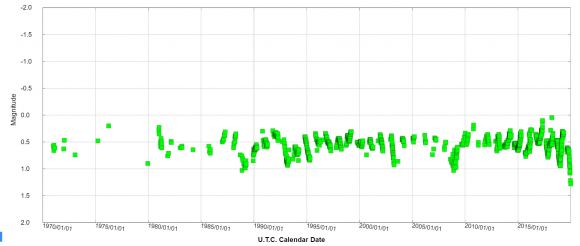
Magnitude estimates of Betelgeuse since 1970. Credit AAVSO.
Note on the magnitude scale: The lower the magnitude the brighter the star. Stars with magnitudes less than 1.5 are first magnitude stars. Second magnitude stars are between 1.5 and 2.5, and so on.
For more information check out Universe Today: https://www.universetoday.com/144465/waiting-for-betelgeuse-whats-up-with-the-tempestuous-star/
And Dr. Phil Plait’s Bad Astronomy: https://www.syfy.com/syfywire/dont-panic-betelgeuse-is-almost-certainly-not-about-to-explode
 Bob Moler's Ephemeris Blog