Archive
11/19/2019 – Ephemeris – Spying Capella low in the northeast
Ephemeris for Tuesday, November 19th. Today the Sun will be up for 9 hours and 26 minutes, setting at 5:11, and it will rise tomorrow at 7:46. The Moon, at last quarter today, will rise at 12:09 tomorrow morning.
As I was driving northward in the country at 6:15 Saturday night under partly cloudy skies I spied a bright star low in the north-northeast. It was Capella, the northernmost of the 21 first magnitude stars, and the 4th brightest star visible from our earthly location near 45 degrees north latitude. It’s in the pentagon shaped constellation of Auriga the Charioteer, which I couldn’t make out due to the clouds and the fact I was driving. Capella has the same color as the Sun, but there the similarity ends. Capella is made up of two massive stars that are so close that they appear as one. Capella is 43 light years away. At that distance a star the brightness of the Sun would barely be visible to the naked eye.
The times given are for the Traverse City/Interlochen area of Michigan. They may be different for your location.
Addendum
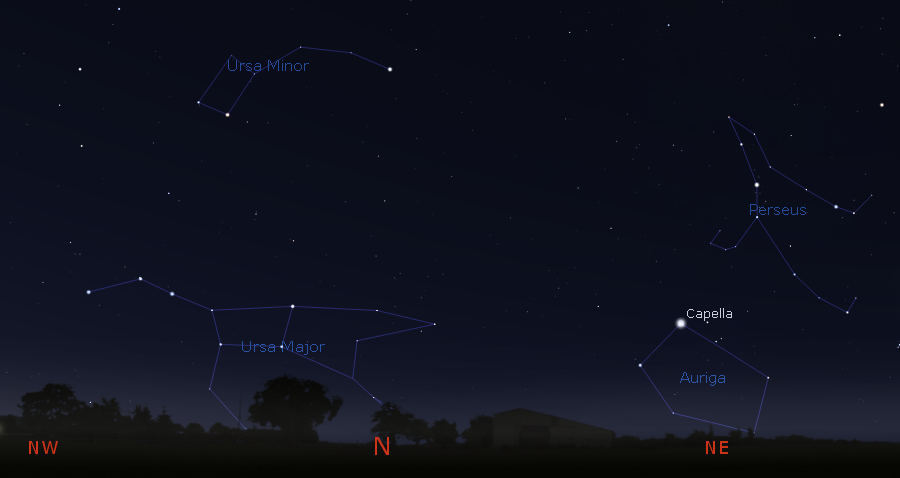
Low northern stars about an hour after sunset on November 19, 2019. Click on the image to enlarge. Created using Stellarium.
10/31/2019 – Ephemeris – The perfect Halloween star
Ephemeris for Halloween, Thursday, October 31st. Today the Sun will be up for 10 hours and 14 minutes, setting at 6:33, and it will rise tomorrow at 8:20. The Moon, half way from new to first quarter, will set at 9:22 this evening.
Not all the ghosts and goblins out tonight will be children. One is out every night, because it’s a star. Its name is Algol, from the Arabic for Ghoul Star or Demon Star. It’s the second brightest star in the constellation Perseus the hero, rising in the northeast this evening. The star is located where artists have drawn the severed head of Medusa, whom he had slain. Medusa was so ugly that she turned all who gazed upon her to stone. Algol is her still glittering eye. Astronomers finally found out what was wrong with Algol. It does a slow 6 hour wink every 2 days 21 hours because it is two very close stars that eclipse each other in that period. It’s next nighttime minimum will be 1:46 a.m. on November 12th.
The times given are for the Traverse City/Interlochen area of Michigan. They may be different for your location.
Addendum
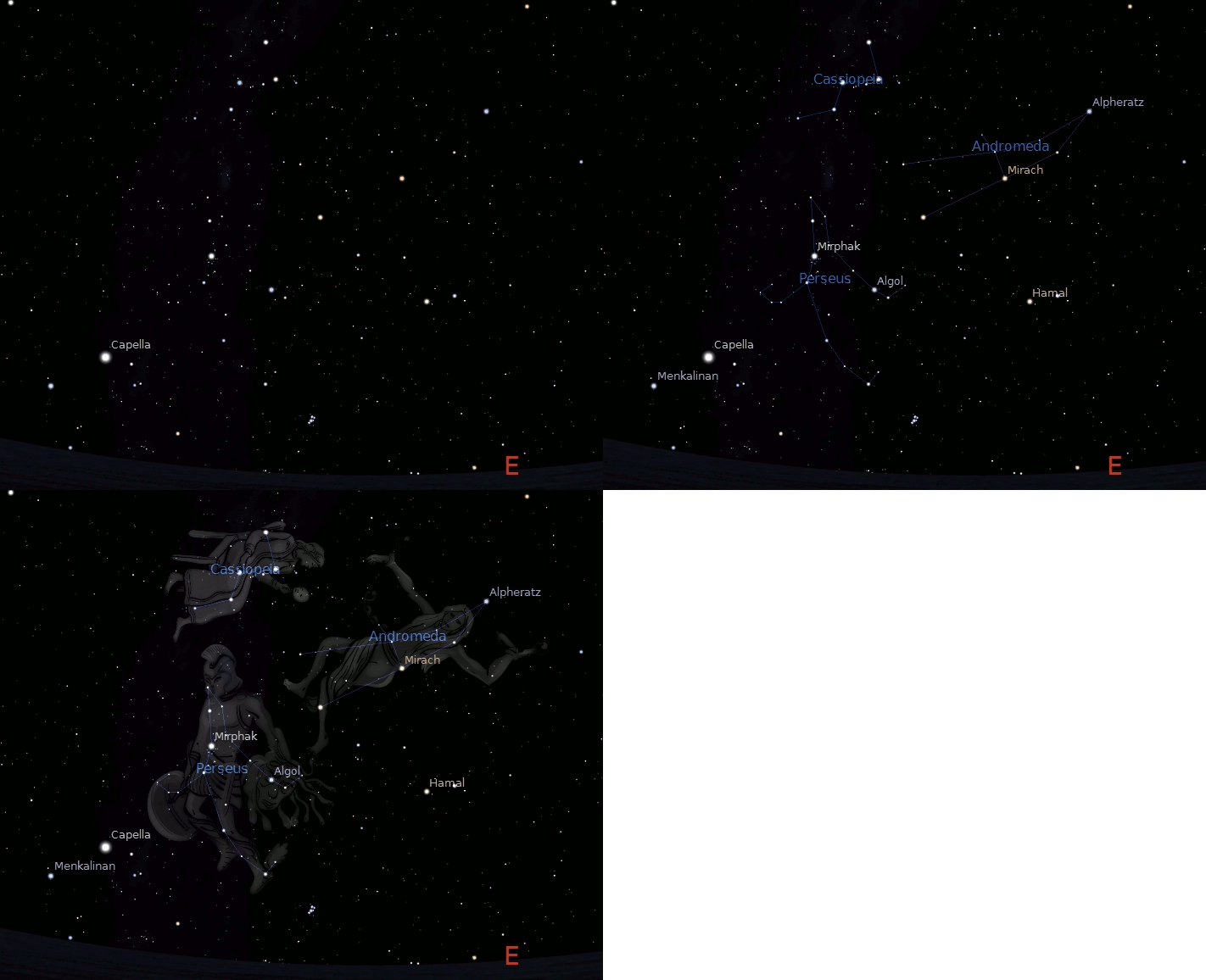
Perseus, Cassiopeia, Andromeda with Algol finder animation for Autumn evenings. Created using Stellarium and GIMP.
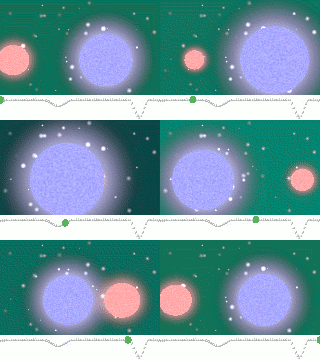
Animation of an eclipsing binary star like Algol. Credit: Wikimedia Commons h/t Earth and Sky
Here is a web sit where you can calculate the minima of Algol and other eclipsing stars: http://www.astropical.space/algol.php
10/18/2019 – Ephemeris – Capella rising
Ephemeris for Friday, October 18th. Today the Sun will be up for 10 hours and 51 minutes, setting at 6:53, and it will rise tomorrow at 8:03. The Moon, 3 days before last quarter, will rise at 9:59 this evening.
For those with the advantage of a low northeastern horizon, will see a bright star slowly rising, much slower than the stars in the east, or notice its change in position from night to night, moving in the northeast. The star is Capella, northernmost of the bright winter stars. It never quite sets for locations north of the latitude of Ludington (44° N), meaning it’s circumpolar like the Big Dipper. It’s slow motion, due to its position close to the north pole of the sky sometimes makes it seem odd. I’ve gotten several calls about it over the years. Capella is the brightest star in the constellation Auriga the charioteer, a constellation I see as a pentagon, with a small triangle of three stars on one side.
The times given are for the Traverse City/Interlochen area of Michigan. They may be different for your location.
Addendum
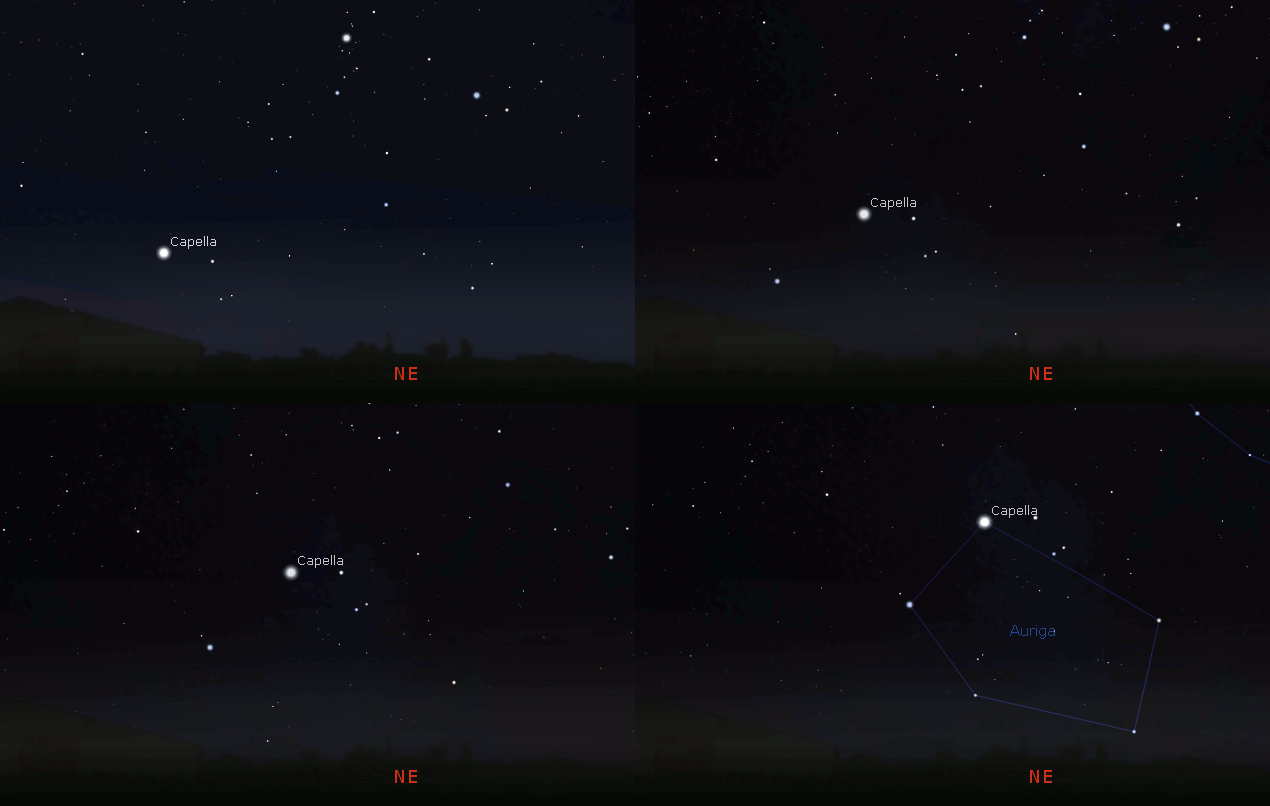
Capella rising animation at half hour intervals from 8 p.m. to 9:30 p.m. October 18th. Created using Stellarium and GIMP.
10/17/2019 – Ephemeris – Fomalhaut, the loneliest star in the sky
Ephemeris for Thursday, October 17th. Today the Sun will be up for 10 hours and 54 minutes, setting at 6:55, and it will rise tomorrow at 8:01. The Moon, half way from full to last quarter, will rise at 9:18 this evening.
There’s a bright star that appears for only seven and a half hours on autumn evenings. It’s appearance, low in the south-southeast at 9 p.m., is a clear indication of the autumn season. The star’s name is Fomalhaut, which means fish’s mouth. That’s fitting because it’s in the constellation of Piscis Austrinus, the southern fish. At our latitude it’s kind of the fish that got away, because Fomalhaut appears to be quite alone low in the sky. The dimness of the constellation’s other stars and location close to the horizon make the faint stars hard to spot. The Earth’s thick atmosphere near the horizon reduces their brightness by a factor of two or more, so Fomalhaut, one of the brightest stars in the sky, keeps a lonely vigil in the south.
The times given are for the Traverse City/Interlochen area of Michigan. They may be different for your location.
Addendum
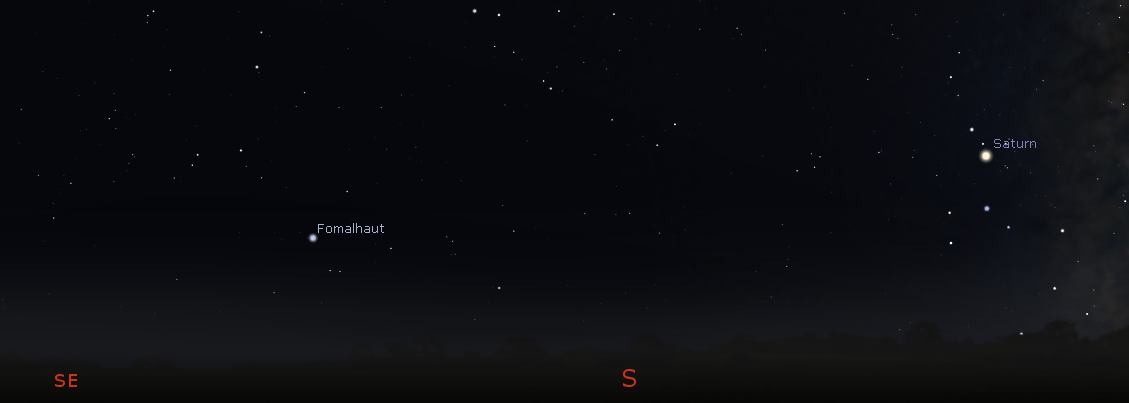
Fomalhaut, Saturn and the southern evening stars at 9 p.m. tonight, October 17, 2019. Click on image to enlarge. Created using Stellarium.
08/19/2019 – Ephemeris – The dimmest looking star of the Summer Triangle is by far the brightest
Ephemeris for Monday, August 19th. Today the Sun will be up for 13 hours and 52 minutes, setting at 8:42, and it will rise tomorrow at 6:50. The Moon, half way from full to last quarter, will rise at 10:53 this evening.
This evening when it gets dark the bright star Deneb in Cygnus the swan will be very high in the east. Deneb is the dimmest star of the summer triangle. Of the other stars of the triangle, Vega is higher nearly overhead, while Altair is lower in the southeast. While Deneb’s apparent magnitude, or brightness as seen from Earth, makes it the dimmest of the three bright stars, Deneb’s vast distance of possibly 2,600 light years* makes it over 90 times the distance of Vega. If brought as close as Vega, Deneb would be as bright at least as the quarter moon. It is possibly as bright as 196 thousand suns; and a huge star, possibly as large in diameter as the orbit of the Earth. For all this it is only 20 to 25 times the mass of the Sun.
The times given are for the Traverse City/Interlochen area of Michigan. They may be different for your location.
Addendum
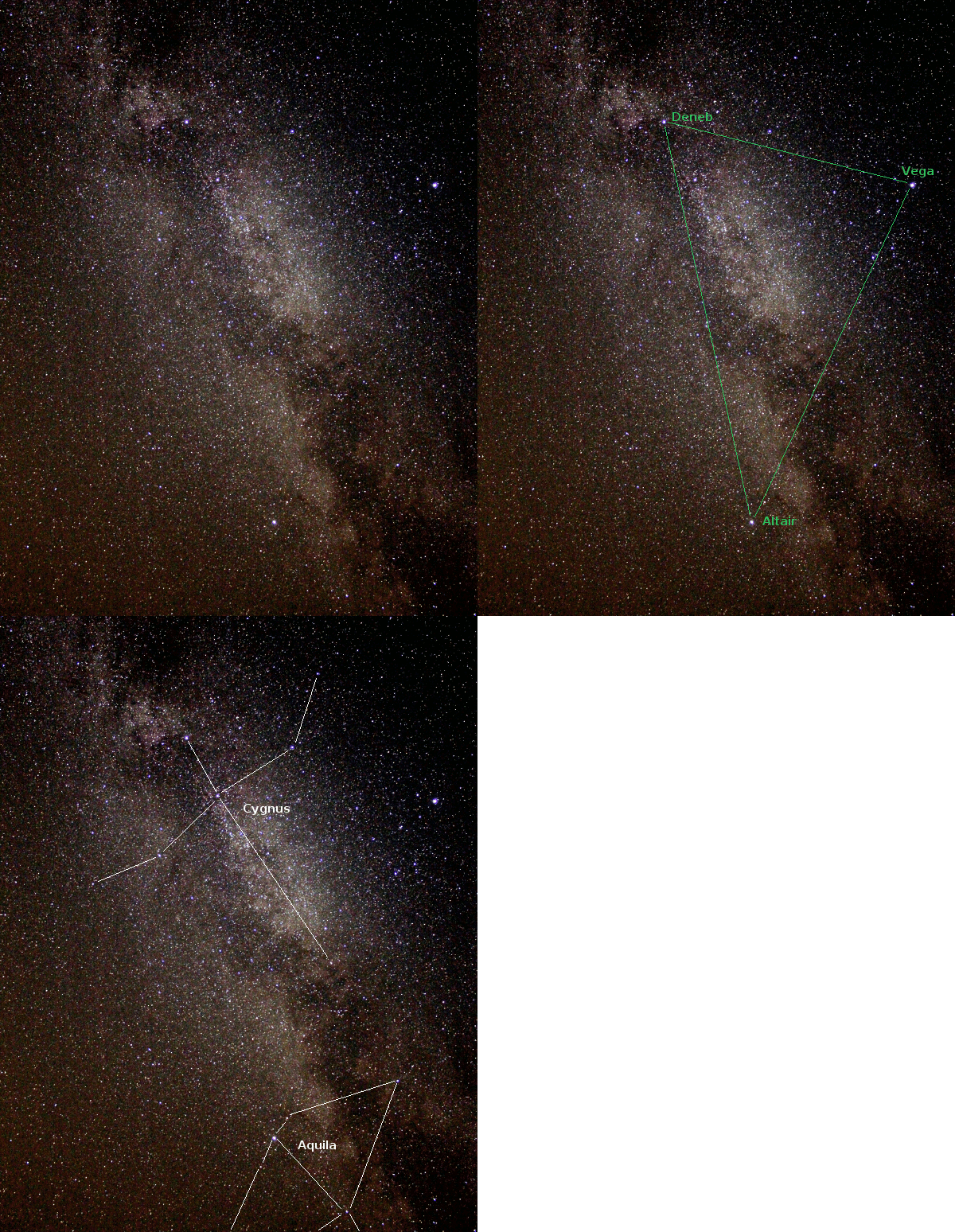
The Great Rift finder animation as seen in the Summer Triangle, also showing the constellations of Cygnus the swan and the the northern part of Aquila the Eagle. This image a stack of 5 30 second exposures taken the morning of the Perseid meteor shower last year in a vain attempt to capture some meteors.
07/08/2019 – Ephemeris – The bright star Vega
Ephemeris for Monday, July 8th. Today the Sun will be up for 15 hours and 24 minutes, setting at 9:29, and it will rise tomorrow at 6:06. The Moon, 1 day before first quarter, will set at 1:31 tomorrow morning.
The bright star high in the east is Vega, one of the stars of the Summer Triangle an informal constellation called an asterism. Vega belongs to the official constellation Lyra the harp, which includes a narrow parallelogram of stars to its south. Vega is regarded by astronomers as a standard calibration star. Though a first magnitude star, its actual magnitude is 0.03. It is a type A0 a pure white star, and is 25 light years away. Astronomers however got a shock in 1983 when calibrating the Infrared Astronomy Satellite (IRAS) on it: Vega showed an excess of Infrared radiation which means the star is orbited by a disk of dust, perhaps a Kuiper belt of its own. Due to the slow wobble of the earth’s axis Vega will become our pole star in about 14 thousand years.
The times given are for the Traverse City/Interlochen area of Michigan. They may be different for your location.
Addendum
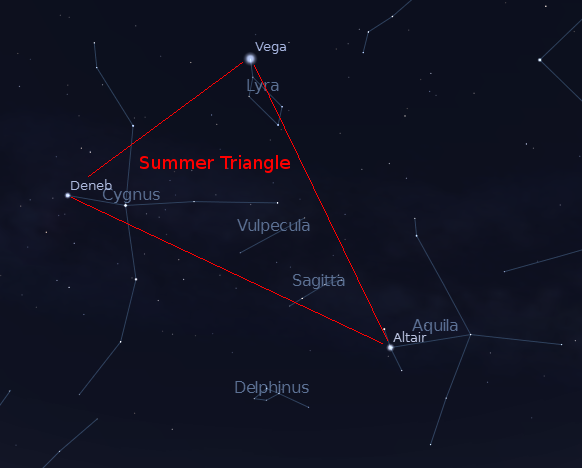
The Summer Triangle. Created using Stellarium.
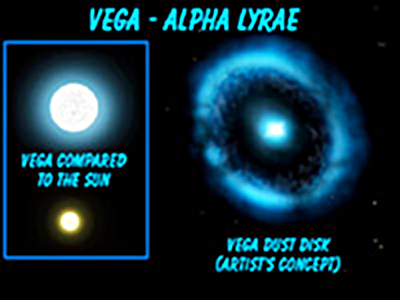
Vega: Comparison to the Sun and its dust ring. Credit Orange County Astronomers.
06/28/2019 – Ephemeris – Arcturus, just passing thru!
Ephemeris for Friday, June 28th. Today the Sun will be up for 15 hours and 33 minutes, setting at 9:32, and it will rise tomorrow at 5:59. The Moon, 3 days past last quarter, will rise at 3:42 tomorrow morning.
Arcturus is an orange-colored giant star, 37 light years away. We see it high in the south-southwest and pointed to by following the arc of the handle of the Big Dipper. Arcturus is a rapidly moving star. It’s velocity is about 76 miles per second (122 km/s). It’s almost at its nearest to the Sun now. In the next 1,500 years it will move about one degree, twice the width of the Moon toward Spica. Arcturus may have been part of a dwarf galaxy being assimilated by the Milky Way which may account to its rapid motion. Arcturus is thought to be close to 8% more massive than the Sun and about 6 to 8 ½ billion years old. It has entered its red giant stage after running out of hydrogen in its core. It may be a glimpse of what the Sun will look like in 5 billion years.
The times given are for the Traverse City/Interlochen area of Michigan. They may be different for your location.
Addendum
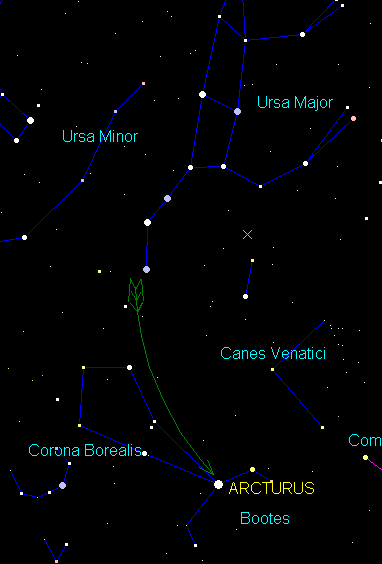
Bootes and the Big Dipper, a finder chart for Arcturus.
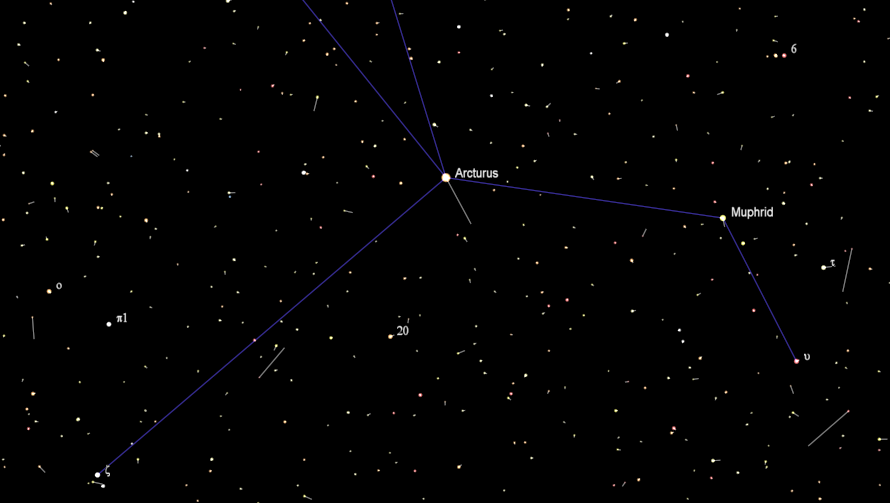
Closeup of the region around Arcturus. The short line toward 5 o’clock is the distance Arcturus will travel in the next 1,500 years. Note there are other stars, which are nearby like Arcturus, with comparable proper motions. Click on the image to enlarge. Created using Cartes du Ciel (Sky Charts).
05/27/2019 – Ephemeris – The bright star Spica
Ephemeris for Memorial Day, Monday, May 27th. Today the Sun will be up for 15 hours and 13 minutes, setting at 9:16, and it will rise tomorrow at 6:03. The Moon, 1 day past last quarter, will rise at 3:34 tomorrow morning.
Just about due south at 10:30 p.m. is the bright star Spica which can be found from all the way back overhead to the Big Dipper. Follow the arc of the handle of the Big Dipper to the bright star Arcturus high in the south-southeast. Then straighten the curve of the arc to a straight spike which points to Spica the brightest star in the zodiacal constellation of Virgo the virgin. Arcturus is much brighter than Spica and has an orange tint to Spica’s bluish hue. In fact Spica is the bluest of the 21 first magnitude stars. That means that it is hot. Actually Spica is really two blue stars orbiting each other every 4 days. Spica is 250 light years away, which is reasonably close. Spica was an important star to the ancient Greeks. One temple was built, and aligned to its setting point.
The times given are for the Traverse City/Interlochen area of Michigan. They may be different for your location.
Addendum
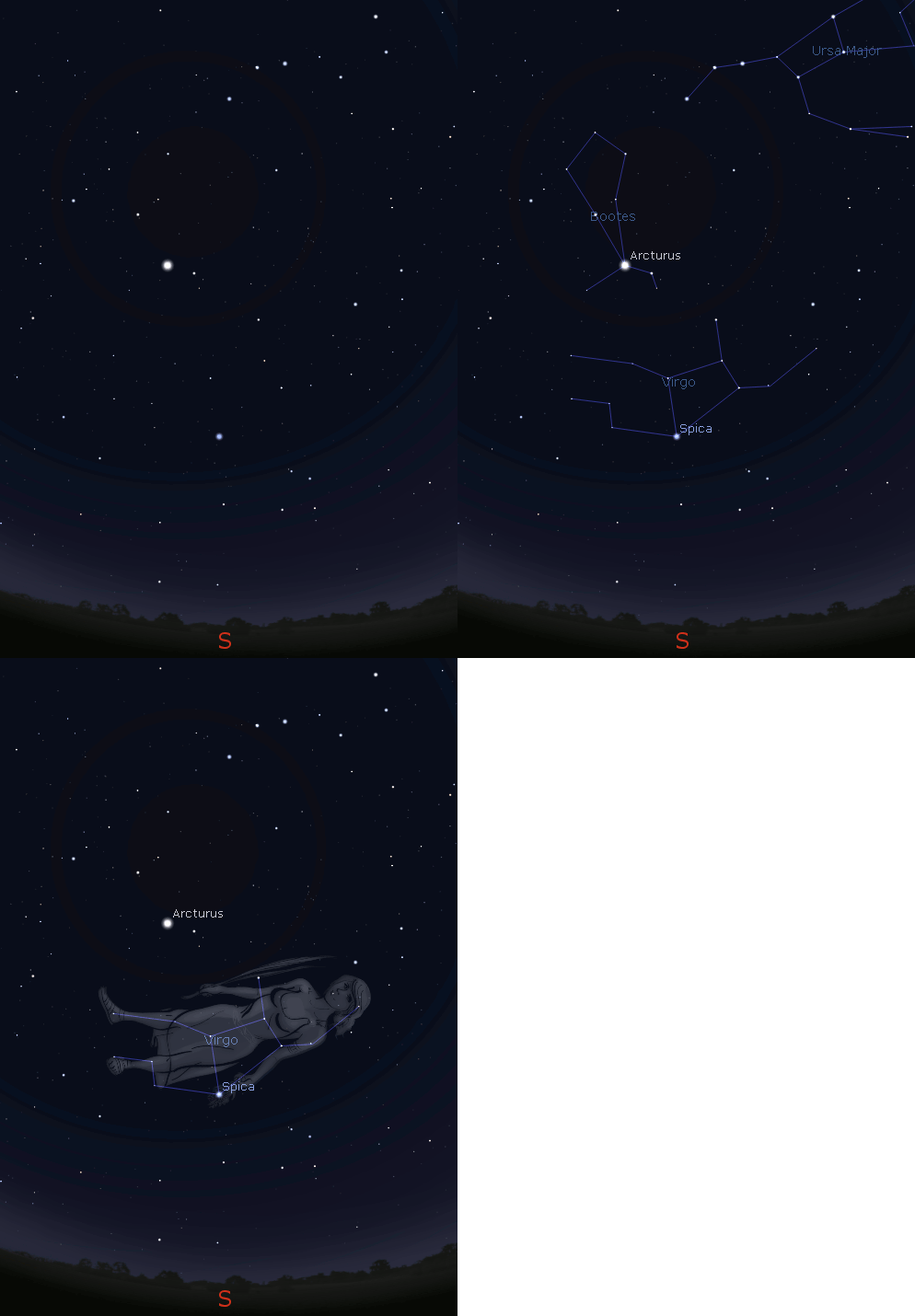
Spica finder animation for 10:30 p.m., May 27th. Click on the image to enlarge. Created using Stellarium and GIMP.
05/21/2019 – Ephemeris – The bright star Arcturus
Ephemeris for Tuesday, May 21st. Today the Sun will be up for 15 hours and 2 minutes, setting at 9:10, and it will rise tomorrow at 6:07. The Moon, 3 days past full, will rise at 12:07 tomorrow morning.
Let’s take a look at the star Arcturus, which with its pointer, the curve of the Big Dipper’s handle is very high in the southeastern sky at 11 p.m. Arcturus, one of the first stars to appear after sunset, is the 4th brightest night time star, though some think the star Vega, low in the northeast is brighter. They are different colors because Arcturus is orange, while Vega is whiter than the Sun. Arcturus is a preview of what the Sun will become in four or five billion years from now. It is only 10% more massive than the Sun and is that much older than the Sun, so it is turning into its red giant stage, after running out of hydrogen to turn into helium in its core to produce energy. The helium is now compressing and heating up, bloating size of the star.
The times given are for the Traverse City/Interlochen area of Michigan. They may be different for your location.
Addendum
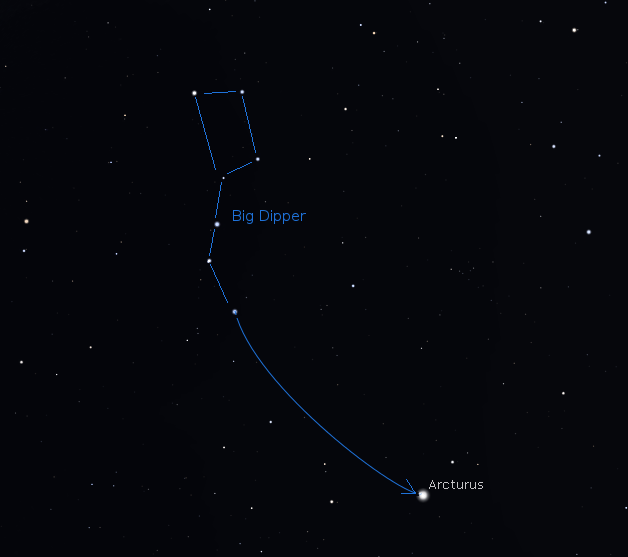
Look high in the southeast on a spring evening to follow the arc of the big Dipper handle to Arcturus. Created using Stellarium.
Another post of interest on Arcturus: Arcturus: Just passing through
04/29/2019 – Ephemeris – Follow the arc to Arcturus
Ephemeris for Monday, April 29th. Today the Sun will be up for 14 hours and 8 minutes, setting at 8:45, and it will rise tomorrow at 6:34. The Moon, 3 days past last quarter, will rise at 5:06 tomorrow morning.
The Big Dipper, now nearing the zenith at 10 p.m. points to several stars and constellations. It’s handle points to two bright stars. First we follow the arc of the handle to the bright orange star Arcturus, the 4th brightest night-time star. The reason I say night-time is that the sun is a star also but by definition is not out at night. The arc to Arcturus is a how to find Arcturus and a clue to its name. Arcturus, midway up the sky in the east, lies at the base point of the kite shaped constellation of Boötes the herdsman. From Arcturus, straighten out the arc to a spike and one soon arrives at Spica a blue-white star in Virgo the virgin, now low in the southeast. Spica is also sometimes pronounced ‘Speeka’.
The times given are for the Traverse City/Interlochen area of Michigan. They may be different for your location.
Addendum
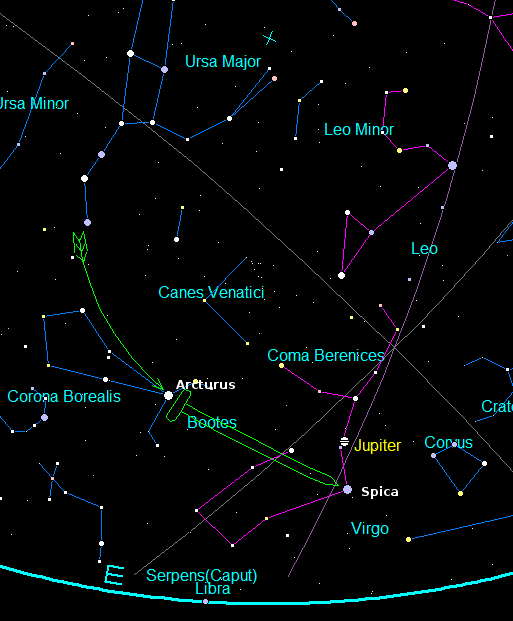
How to find the stars Arcturus and Spica from the Big Dipper in late April. Created using my LookingUp program.
 Bob Moler's Ephemeris Blog