Archive
07/08/2019 – Ephemeris – The bright star Vega
Ephemeris for Monday, July 8th. Today the Sun will be up for 15 hours and 24 minutes, setting at 9:29, and it will rise tomorrow at 6:06. The Moon, 1 day before first quarter, will set at 1:31 tomorrow morning.
The bright star high in the east is Vega, one of the stars of the Summer Triangle an informal constellation called an asterism. Vega belongs to the official constellation Lyra the harp, which includes a narrow parallelogram of stars to its south. Vega is regarded by astronomers as a standard calibration star. Though a first magnitude star, its actual magnitude is 0.03. It is a type A0 a pure white star, and is 25 light years away. Astronomers however got a shock in 1983 when calibrating the Infrared Astronomy Satellite (IRAS) on it: Vega showed an excess of Infrared radiation which means the star is orbited by a disk of dust, perhaps a Kuiper belt of its own. Due to the slow wobble of the earth’s axis Vega will become our pole star in about 14 thousand years.
The times given are for the Traverse City/Interlochen area of Michigan. They may be different for your location.
Addendum
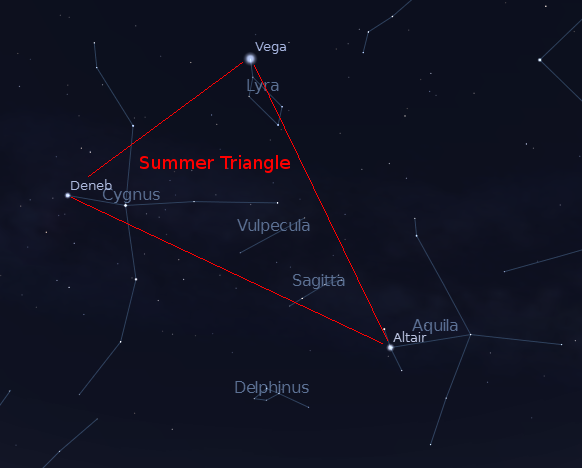
The Summer Triangle. Created using Stellarium.
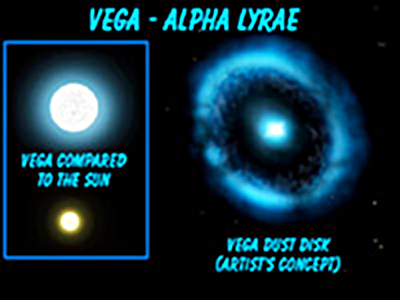
Vega: Comparison to the Sun and its dust ring. Credit Orange County Astronomers.
06/28/2019 – Ephemeris – Arcturus, just passing thru!
Ephemeris for Friday, June 28th. Today the Sun will be up for 15 hours and 33 minutes, setting at 9:32, and it will rise tomorrow at 5:59. The Moon, 3 days past last quarter, will rise at 3:42 tomorrow morning.
Arcturus is an orange-colored giant star, 37 light years away. We see it high in the south-southwest and pointed to by following the arc of the handle of the Big Dipper. Arcturus is a rapidly moving star. It’s velocity is about 76 miles per second (122 km/s). It’s almost at its nearest to the Sun now. In the next 1,500 years it will move about one degree, twice the width of the Moon toward Spica. Arcturus may have been part of a dwarf galaxy being assimilated by the Milky Way which may account to its rapid motion. Arcturus is thought to be close to 8% more massive than the Sun and about 6 to 8 ½ billion years old. It has entered its red giant stage after running out of hydrogen in its core. It may be a glimpse of what the Sun will look like in 5 billion years.
The times given are for the Traverse City/Interlochen area of Michigan. They may be different for your location.
Addendum
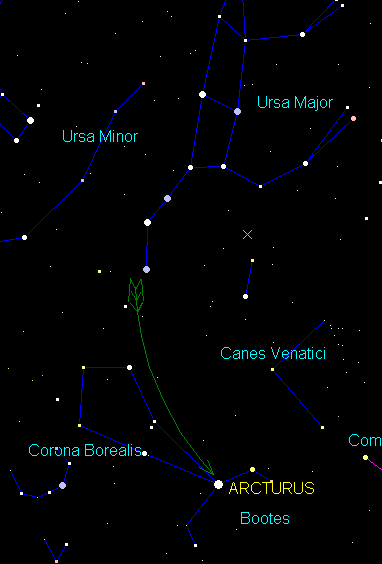
Bootes and the Big Dipper, a finder chart for Arcturus.
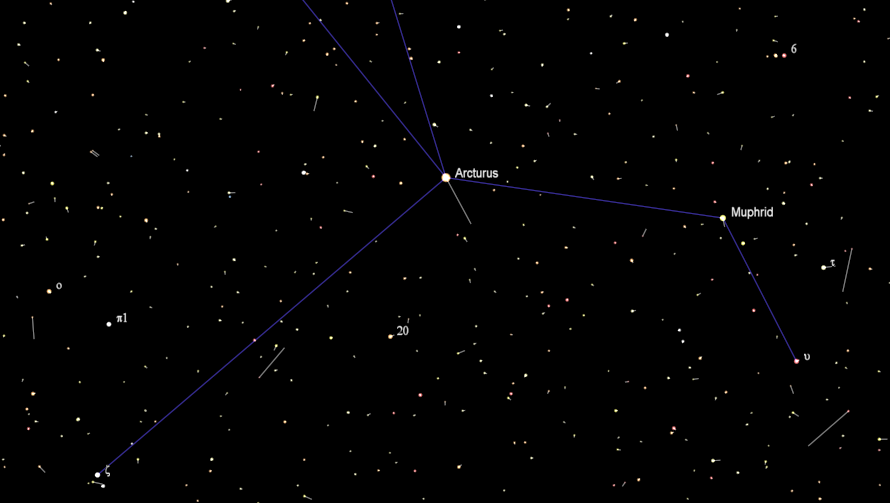
Closeup of the region around Arcturus. The short line toward 5 o’clock is the distance Arcturus will travel in the next 1,500 years. Note there are other stars, which are nearby like Arcturus, with comparable proper motions. Click on the image to enlarge. Created using Cartes du Ciel (Sky Charts).
05/27/2019 – Ephemeris – The bright star Spica
Ephemeris for Memorial Day, Monday, May 27th. Today the Sun will be up for 15 hours and 13 minutes, setting at 9:16, and it will rise tomorrow at 6:03. The Moon, 1 day past last quarter, will rise at 3:34 tomorrow morning.
Just about due south at 10:30 p.m. is the bright star Spica which can be found from all the way back overhead to the Big Dipper. Follow the arc of the handle of the Big Dipper to the bright star Arcturus high in the south-southeast. Then straighten the curve of the arc to a straight spike which points to Spica the brightest star in the zodiacal constellation of Virgo the virgin. Arcturus is much brighter than Spica and has an orange tint to Spica’s bluish hue. In fact Spica is the bluest of the 21 first magnitude stars. That means that it is hot. Actually Spica is really two blue stars orbiting each other every 4 days. Spica is 250 light years away, which is reasonably close. Spica was an important star to the ancient Greeks. One temple was built, and aligned to its setting point.
The times given are for the Traverse City/Interlochen area of Michigan. They may be different for your location.
Addendum
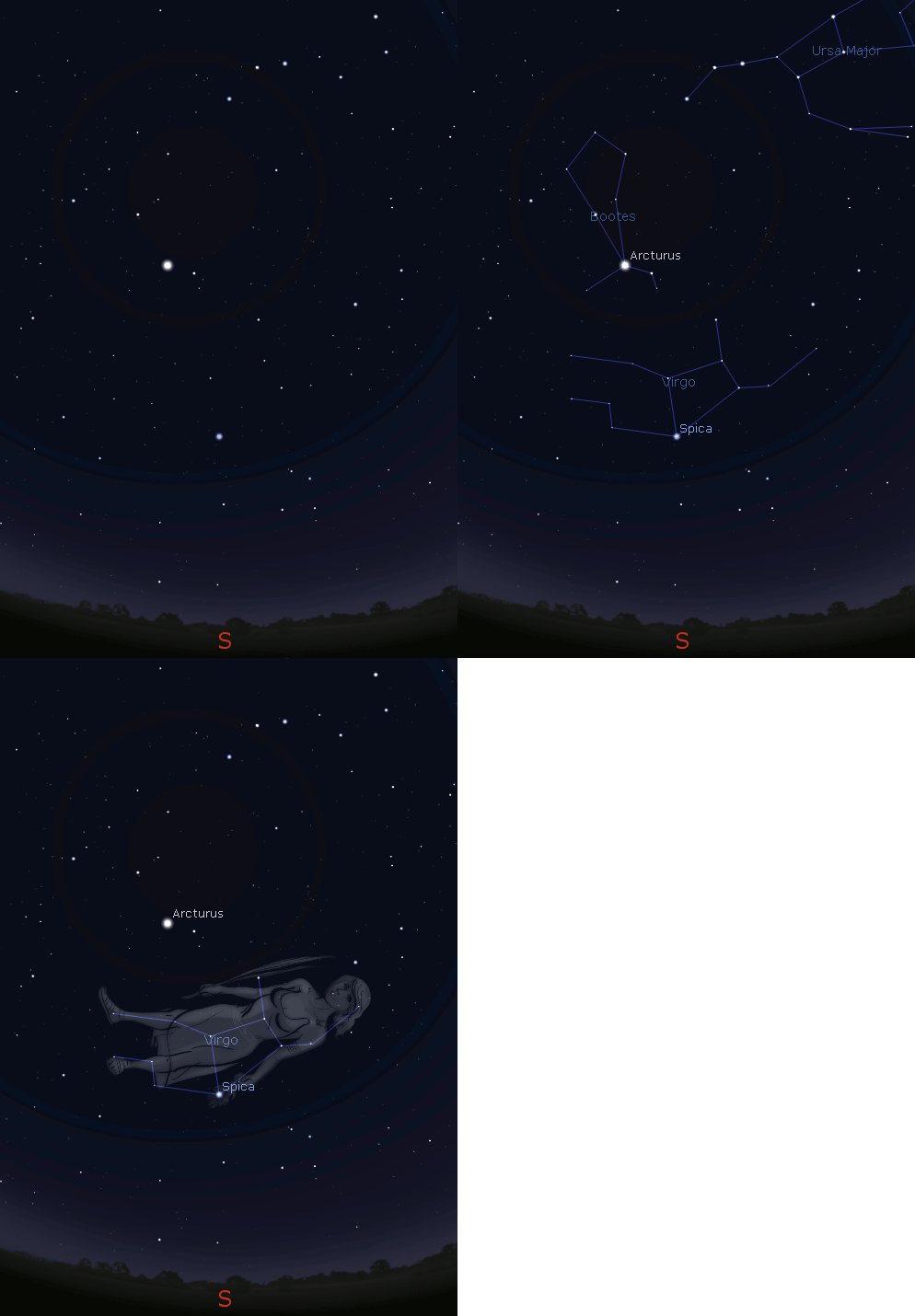
Spica finder animation for 10:30 p.m., May 27th. Click on the image to enlarge. Created using Stellarium and GIMP.
05/21/2019 – Ephemeris – The bright star Arcturus
Ephemeris for Tuesday, May 21st. Today the Sun will be up for 15 hours and 2 minutes, setting at 9:10, and it will rise tomorrow at 6:07. The Moon, 3 days past full, will rise at 12:07 tomorrow morning.
Let’s take a look at the star Arcturus, which with its pointer, the curve of the Big Dipper’s handle is very high in the southeastern sky at 11 p.m. Arcturus, one of the first stars to appear after sunset, is the 4th brightest night time star, though some think the star Vega, low in the northeast is brighter. They are different colors because Arcturus is orange, while Vega is whiter than the Sun. Arcturus is a preview of what the Sun will become in four or five billion years from now. It is only 10% more massive than the Sun and is that much older than the Sun, so it is turning into its red giant stage, after running out of hydrogen to turn into helium in its core to produce energy. The helium is now compressing and heating up, bloating size of the star.
The times given are for the Traverse City/Interlochen area of Michigan. They may be different for your location.
Addendum
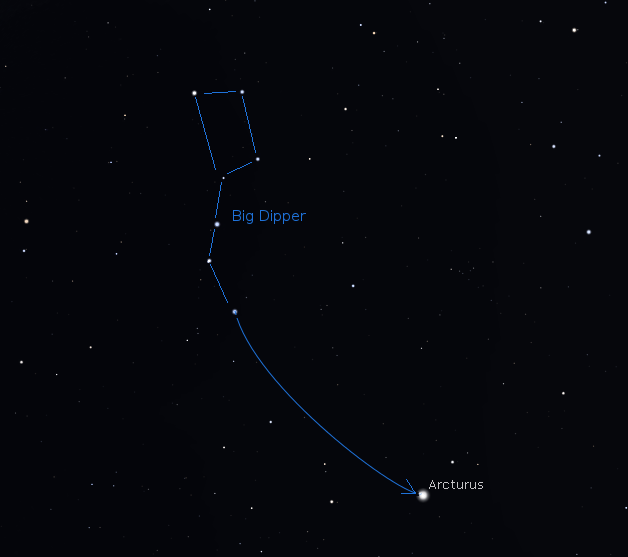
Look high in the southeast on a spring evening to follow the arc of the big Dipper handle to Arcturus. Created using Stellarium.
Another post of interest on Arcturus: Arcturus: Just passing through
04/29/2019 – Ephemeris – Follow the arc to Arcturus
Ephemeris for Monday, April 29th. Today the Sun will be up for 14 hours and 8 minutes, setting at 8:45, and it will rise tomorrow at 6:34. The Moon, 3 days past last quarter, will rise at 5:06 tomorrow morning.
The Big Dipper, now nearing the zenith at 10 p.m. points to several stars and constellations. It’s handle points to two bright stars. First we follow the arc of the handle to the bright orange star Arcturus, the 4th brightest night-time star. The reason I say night-time is that the sun is a star also but by definition is not out at night. The arc to Arcturus is a how to find Arcturus and a clue to its name. Arcturus, midway up the sky in the east, lies at the base point of the kite shaped constellation of Boötes the herdsman. From Arcturus, straighten out the arc to a spike and one soon arrives at Spica a blue-white star in Virgo the virgin, now low in the southeast. Spica is also sometimes pronounced ‘Speeka’.
The times given are for the Traverse City/Interlochen area of Michigan. They may be different for your location.
Addendum
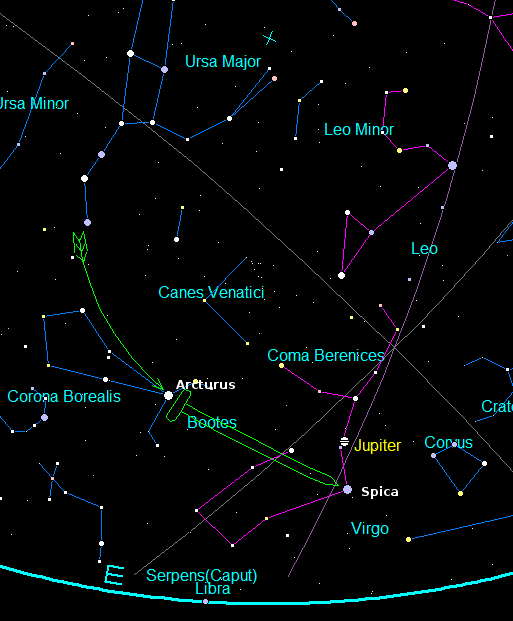
How to find the stars Arcturus and Spica from the Big Dipper in late April. Created using my LookingUp program.
03/29/2019 – Ephemeris – The Stars Mizar and Alcor in the Big Dipper
Ephemeris for Friday, March 29th. Today the Sun will be up for 12 hours and 36 minutes, setting at 8:06, and it will rise tomorrow at 7:27. The Moon, 1 day past last quarter, will rise at 5:03 tomorrow morning.
The most interesting star in the Big Dipper is Mizar and its dim companion Alcor. It is the second star from the end of the handle, where the bend in the handle takes place. Folks with good vision can see the dimmer star right next to Mizar. In ancient times it was used as an eye test for visual acuity for warriors. As such it was known as the “Horse and the Rider”. Mizar is second magnitude, in the second rank of star brightness invented by the Greek astronomer Hipparchus in the 2nd century BC. He ranked stars in 6 classes, from first magnitude for the brightest to 6th for the dimmest visible to the naked eye. Alcor comes in at 4th magnitude. It does suffer a bit by being very close to Mizar which is 6 times brighter.
The times given are for the Traverse City/Interlochen area of Michigan. They may be different for your location.
02/11/2019 – Ephemeris – The stars Castor and Pollux
Ephemeris for Monday, February 11th. Today the Sun will be up for 10 hours and 16 minutes, setting at 6:05, and it will rise tomorrow at 7:47. The Moon, 1 day before first quarter, will set at 12:57 tomorrow morning.
At 9 p.m. the constellation of Gemini the twins will be seen high in the southeast. The namesake stars of the two lads are the two bright stars at the top of the constellation. Pollux the pugilist, or boxer, is the lower of the two, while Castor, the horseman, is the other star, or rather a six star system. In telescopes two close stars may be seen each is a spectroscopic binary, meaning the lines of two stars can be seen in the spectrum. A faint nearby spectroscopic binary also belongs. Pollux, though a single star, does have at least one planet, over twice the mass of Jupiter orbiting the star at a distance somewhat greater than Mars is from the Sun. Pollux is 34 light years away while Castor is 50 light years away. Not too far away as stars go.
The times given are for the Traverse City/Interlochen area of Michigan. They may be different for your location.
Addendum
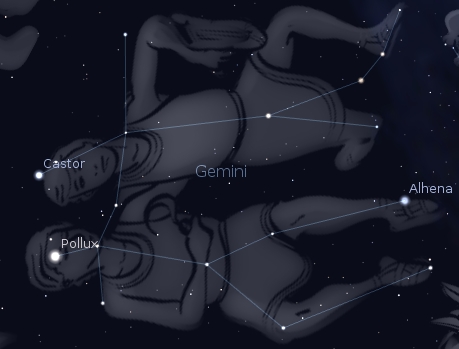
Gemini with Castor and Pollux. Created with Stellarium.
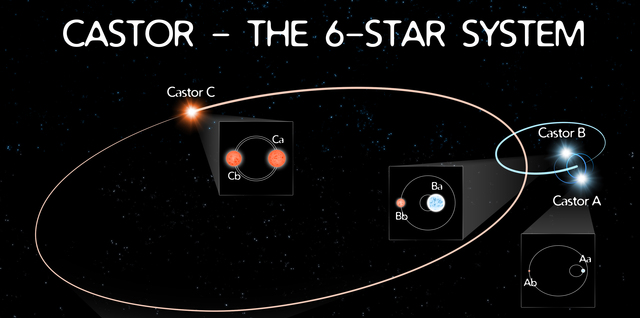
The Castor star system exploded in this JPL/NASA infographic.
02/08/2019 – Ephemeris – Sirius has a companion
Ephemeris for Friday, February 8th. Today the Sun will be up for 10 hours and 7 minutes, setting at 6:01, and it will rise tomorrow at 7:52. The Moon, half way from new to first quarter, will set at 9:48 this evening.
Sirius is the brightest night-time star and is located in the south-southeast at 9 p.m. below and a bit left of Orion the Hunter. We’ve visited Sirius yesterday. But there is another star in the Sirius system that is practically invisible due to Sirius’ dazzling glare. Its name is Sirius B, nicknamed the Pup, alluding to Sirius’ Dog Star title. The tiny star was suspected as far back as 1834 due to Sirius’ wavy path against the more distant stars. Sirius and the Pup have 50 year orbits of each other. The Pup was first seen in 1862. The Pup was the first of a new class of stars to be discovered, white dwarfs. The Pup is a dying star with the mass of the Sun, collapsed down to the size of the Earth.
The times given are for the Traverse City/Interlochen area of Michigan. They may be different for your location.
Addendum
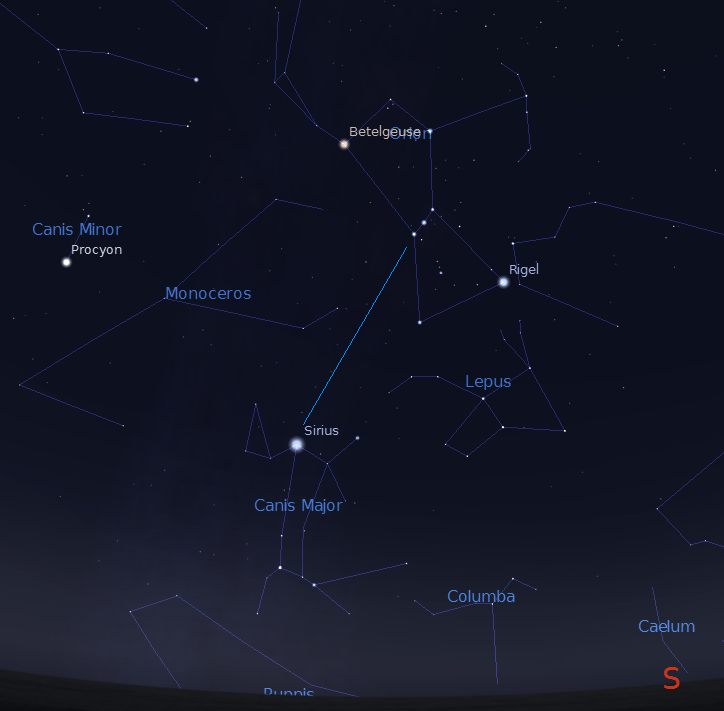
Orion’s Belt points to Sirius. Created using Stellarium.

Sirius A & B’s path in the sky showing the wobble that betrayed the Pup’s presence. Credit Mike Guidry, University of Tennessee.

Sirius A and B (near the diffraction spike to the lower left), A Hubble Space Telescope photograph. Credit NASA, ESA.
02/07/2019 – Ephemeris – Siriusly, folks.
Ephemeris for Friday, February 8th. Today the Sun will be up for 10 hours and 7 minutes, setting at 6:01, and it will rise tomorrow at 7:52. The Moon, half way from new to first quarter, will set at 9:48 this evening.
At 9 in the evening the great constellation of Orion the hunter can be seen in the south. Its large rectangle of bright stars is now upright, while in the center is a row of three stars, his belt. These stars tilt downward to the left to a very bright star merrily twinkling in the south-southeast. This star is called Sirius, also known as the Dog Star because it’s in the heart of Orion’s larger hunting dog, Canis Major. It is an arc light white star as seen in binoculars or telescope. It’s a neighboring star, just twice the distance of the closest star to the sun at 8.6 light years. It’s name, Sirius, has nothing to do with a dog, but is from the Greek meaning scorching for its brightness or sparkling, due to its intense twinkling.
The times given are for the Traverse City/Interlochen area of Michigan. They may be different for your location.
Addendum
Orion’s Belt points to Sirius. Created using Stellarium.
01/11/2019 – Ephemeris – The bright star in Orion’s knee: Rigel
Ephemeris for Friday, January 11th. The Sun will rise at 8:18. It’ll be up for 9 hours and 4 minutes, setting at 5:23. The Moon, 3 days before first quarter, will set at 10:55 this evening.
Yesterday I talked about the star Betelgeuse the bright red star in the top left of Orion’s upright rectangle. Orion is seen in the southeast at 9 in the evening. The blue-white star in Orion’s opposite corner is usually brighter. It is Rigel whose longer Arabic name of which Rigel is the first part means “Left Leg of the Giant”. Rigel is a giant itself, actually a super giant star, which is more a measure of its mass than its size, that of 23 solar masses. Its surface temperature is more than twice as hot as the sun. It is 120 thousand times as bright as the sun and 100 times its diameter. Its distance is around 860 light years. Those with telescopes might be able to spot a close companion star to Rigel, just at the edge of the bright arc light image of Rigel itself.
The times given are for the Traverse City/Interlochen area of Michigan. They may be different for your location.
Addendum
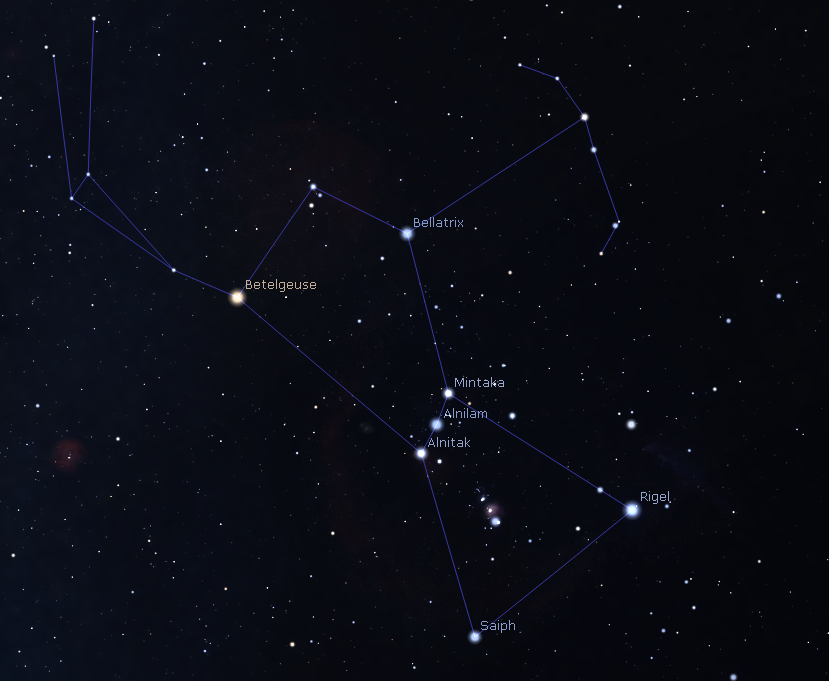
Orion’s brightest stars with their names for 9 p.m. January 7, 2019. Click on the image to make Orion a giant hunter. Created using Stellarium..

Rigel with its companion star as photographed through a telescope. No attribution. Source: http://washedoutastronomy.com/content/urban-orion?page=1
 Bob Moler's Ephemeris Blog