Archive
01/19/2016 – Ephemeris – The Moon will cover Aldebaran tonight!
Ephemeris for Tuesday, January 19th. The Sun will rise at 8:14. It’ll be up for 9 hours and 18 minutes, setting at 5:32. The Moon, 3 days past first quarter, will set at 4:51 tomorrow morning. | Tonight the Moon will pass in front of or occult the bright star Aldebaran, the bright star in Taurus the bull. The bright Moon will making spotting Aldebaran difficult without binoculars, or better yet, a telescope. Aldebaran will wink out at the Moon’s dark eastern or left edge around 9:06 p.m. The exact time depends on your location. It’s within a minute or 2 for the IPR listening area. Aldebaran will be uncovered by the Moon around 10:25 p.m. at the bright lower right edge of the Moon. Today’s posting on bobmoler.wordpress,com will have much more information on the event, and how to calculate times for other locations along the path of the occultation (see below). This is the best of the four Aldebaran occultations visible this year.
Times are for the Traverse City/Interlochen area of Michigan. They may be different for your location.
Addendum
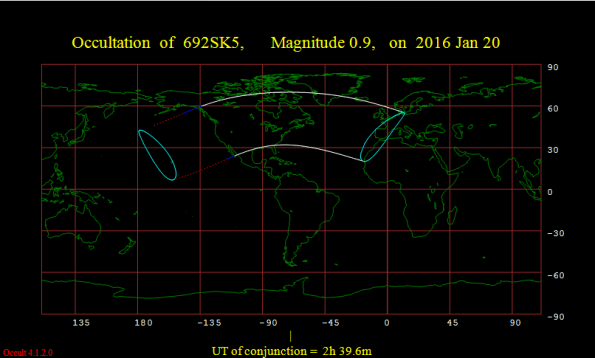
Occultation visibility map for January 19, 2016 EST (January 20 UT). Credit IOTA/Occult4 program. Looks like the followers of this blog in the UK will get a piece of this one too.
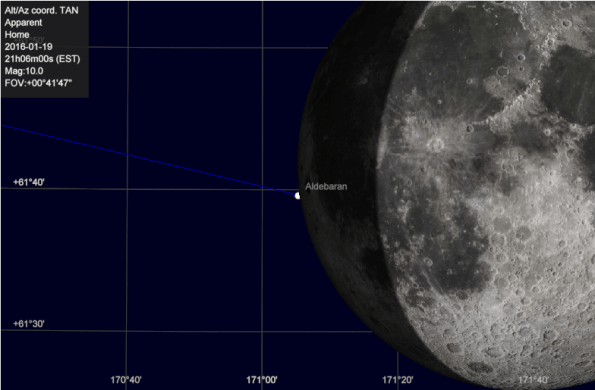
Aldebaran will disappear at the Moon’s dark leading edge at about 9:06 p.m. January 19, 2016. Created using Cartes du Ciel (Sky Charts).
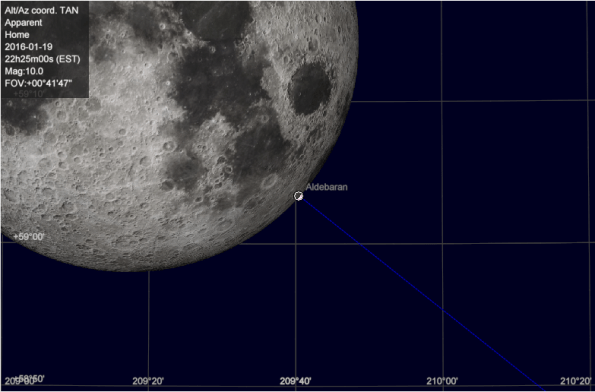
Aldebaran will reappear at the Moon’s bright trailing edge at about 10:25 p.m. January 19, 2016. Created using Cartes du Ciel (Sky Charts).
Estimating timings for your location
I used Cartes du Ciel the free software that I have a link to on the right. Make sure that the program is set for topocentric positions under Setup/Solar System. And you have entered your position under Setup/Observatory. You can find your location in Google Earth.
You can also use Stellarium. Just make sure the Moon is normal sized.
In both programs you can lock the Moon or Aldebaran in the center of the screen Pick a time in advance of the occultation and using the set time window walk the star towards the Moon, mark the time. Then walk the star out from the Moon and record the reappearance time. That’s it.
This should work with other planetarium programs too.
01/18/2015 – Ephemeris – Betelgeuse, a dying star
Ephemeris for Martin Luther King Day, Monday, January 18th. The Sun will rise at 8:15. It’ll be up for 9 hours and 16 minutes, setting at 5:31. The Moon, 2 days past first quarter, will set at 3:47 tomorrow morning.
Now that the Moon is getting brighter and making the fainter tars in the constellations harder to find, let’s look at the bright stars of Winter. Today, let’s look at Betelgeuse the reddish star in Orion the hunter’s shoulder. Lets get the basic facts out first. Betelgeuse is a red giant star 90 thousand to 150 thousand times brighter than the Sun and 7 to 20 times the Sun’s mass. It’s around a thousand times the diameter of the Sun, making it about the diameter of the orbit of Jupiter. It’s about 650 light years away, but that’s a bit uncertain. It is shedding gasses at a prestigious rate. Though only 7 million years old, it may explode as a supernova in the next million years. And yes, we’re far enough away.
Times are for the Traverse City/Interlochen area of Michigan. They may be different for your location.
Addendum
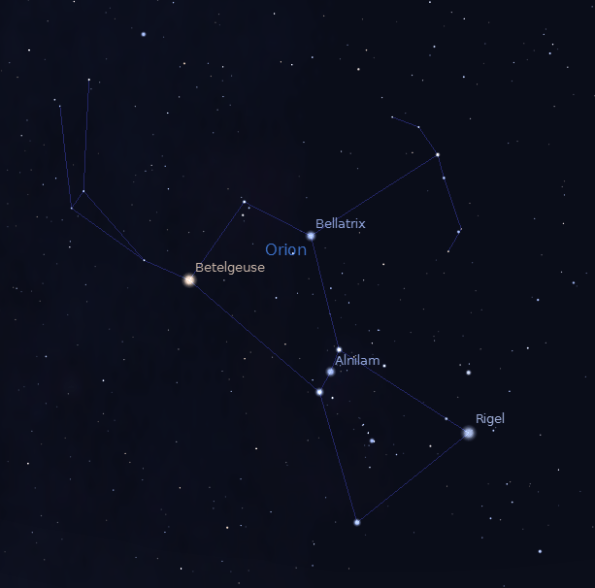
Some of Orion’s named stars, including Betelgeuse. Orion at 8 p.m. Created using Stellarium.
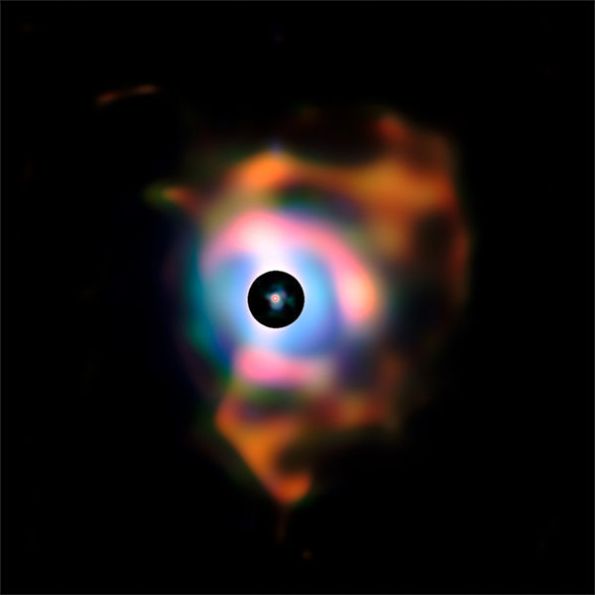
Betelgeuse and its nebula. From ESO’s Very Large Telescope.
12/25/2015 – Ephemeris – This year’s Christmas Stars
Merry Christmas. This is Bob Moler with Ephemeris for Christmas Day, Friday, December 25th. The Sun will rise at 8:18. It’ll be up for 8 hours and 48 minutes, setting at 5:07. The Moon, at full today, will rise at 5:53 this evening.
It’s Christmas morning, and if it’s clear the full Moon will low in the west. Venus the brilliant Morning Star will be low in the southeast, Jupiter, second only to Venus in brightness will appear half way up to the zenith in the south. Venus or perhaps Jupiter, take your pick can be this year’s Christmas Star. The bright stars in the evening sky tonight are those of winter, that have looked down on us in their familiar patterns for millennia. The bright planets and stars, or even a brilliant supernova, or the one at the top of our Christmas tree, cannot be, according to those astronomers who accept the Star of Bethlehem as a real phenomenon, as what the star was. The leading contenders for the Star have always involved two planets.
Times are for the Traverse City/Interlochen area of Michigan. They may be different for your location.
Addendum
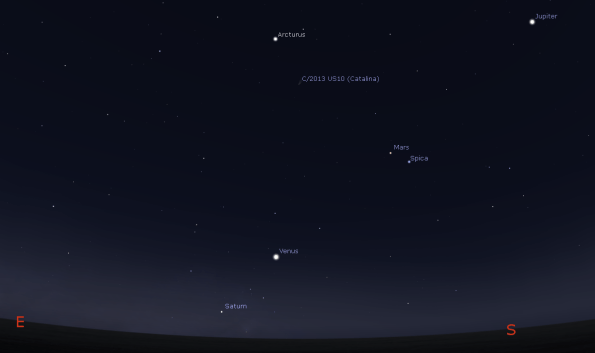
The morning planets, Jupiter, Mars, Venus and Saturn, plus Comet Catalina at 7 a.m. . Created using Stellarium.
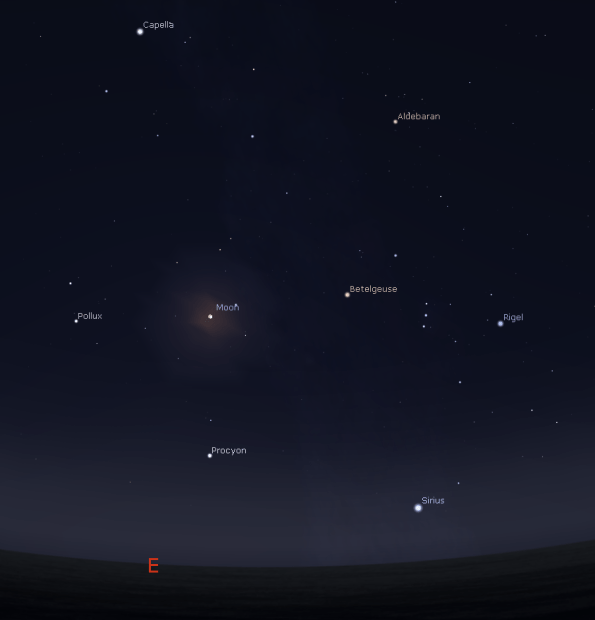
The bright stars of Christmas Night and the full Moon. Created using Stellarium.
12/17/2015 – Ephemeris – The bright star Aldebaran the “follower”
Ephemeris for Thursday, December 17th. The Sun will rise at 8:14. It’ll be up for 8 hours and 48 minutes, setting at 5:03. The Moon, 1 day before first quarter, will set at 12:07 tomorrow morning.
The central constellation of winter Orion, will be rising the east-southeast at 9 p.m. Above it is Taurus the bull. The bright orange star in Taurus is Aldebaran. Aldebaran appears at the lower left tip of a letter V group of stars that is the face of the bull. Aldebaran isn’t actually part of the group, called the Hyades star cluster. The cluster is about 151 light years away, while Aldebaran is 65. The star has an orange hue because its surface is cooler than the sun’s. However Aldebaran is 44 times larger in diameter, and shines 425 times brighter than the sun, if you include the infrared which our eyes can’t detect, or 150 times brighter in visible light. The name Aldebaran means “Follower” because it follows the Pleiades star cluster above through the night.
Times are for the Traverse City/Interlochen area of Michigan. They may be different for your location.
Addendum
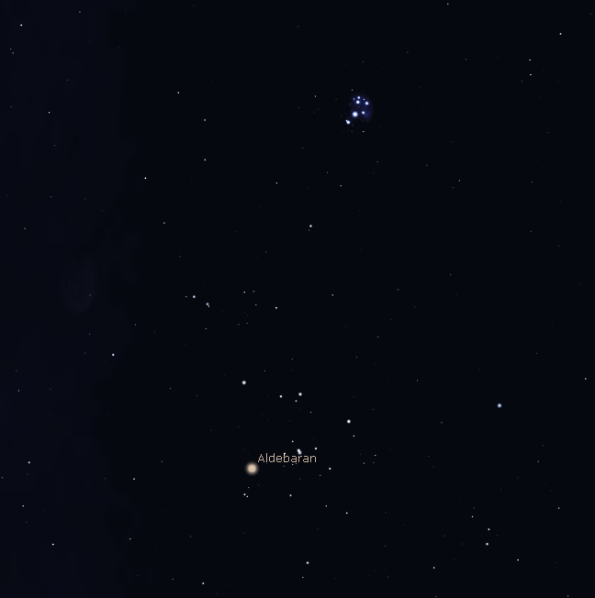
Aldebaran, the Hyades and Pleiades star clusters. Created using Stellarium.
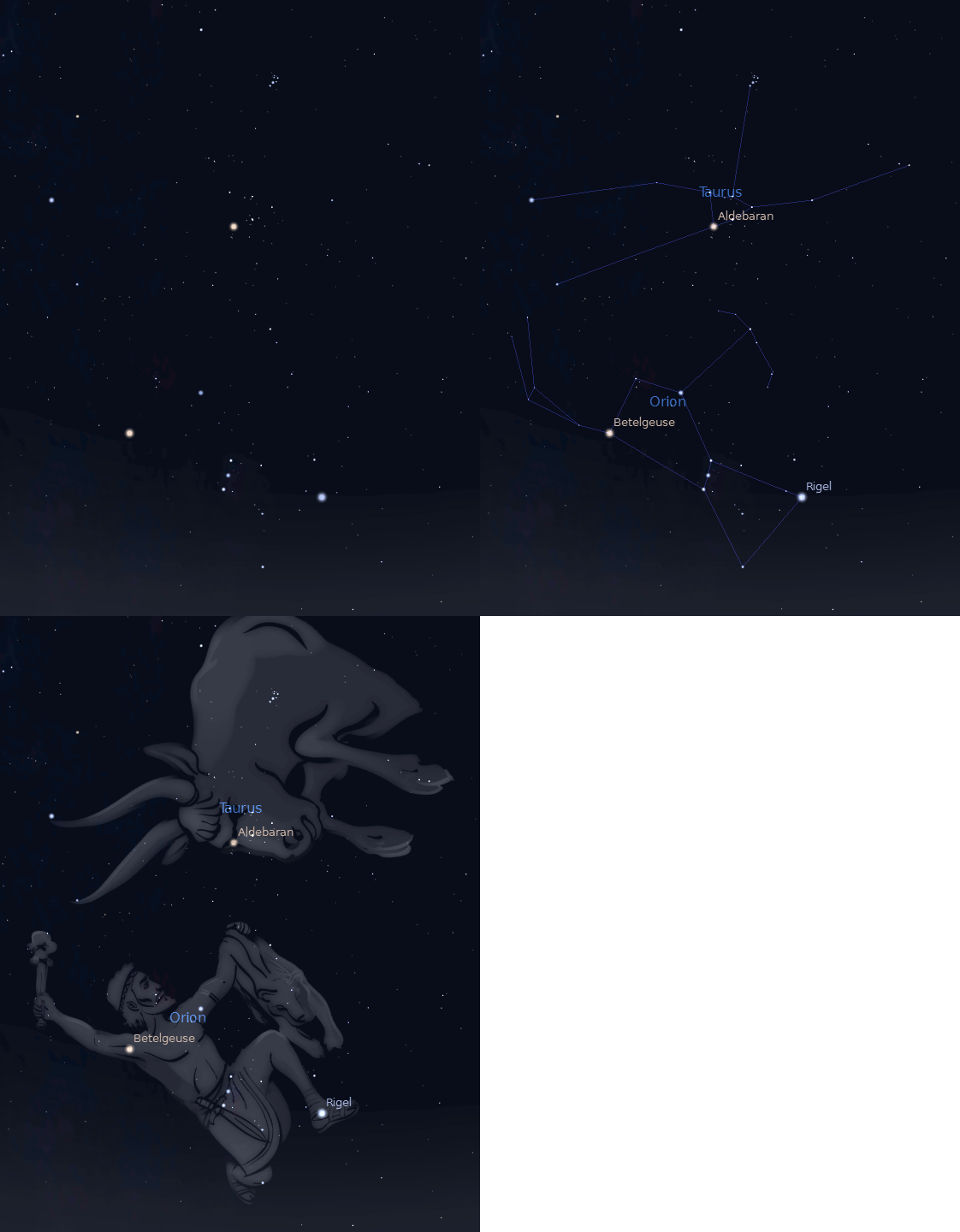
Three views of Taurus the bull and Orion the hunter for 9 p.m. on December 8, 2015. Created using Stellarium and GIMP.
12/15/2015 – Ephemeris – Procyon the star that’s “Before the dog”
Ephemeris for Tuesday, December 15th. The Sun will rise at 8:13. It’ll be up for 8 hours and 49 minutes, setting at 5:02. The Moon, 3 days before first quarter, will set at 9:48 this evening.
Visible low in the east at 9:30 p.m. appears the star Procyon to its lower left is Sirius the brightest night-time star. Procyon is the bright star in the constellation Canis Minor, or lesser dog. I can find only one other star in Canis Minor. Perhaps it’s a hot dog. If Sirius, in Canis major is the Dog Star then Procyon should be the Little Dog Star. However Procyon is an interesting name. It means “Before the dog”, which is an allusion to the fact that Procyon, though east of Sirius actually rises before it. This is due to Procyon’s more northerly position. This effect doesn’t work south of the equator, however. Sirius will rise at about 9 tonight. Procyon is a star much like Sirius but is 32% farther away. It’s 11.4 to Sirius’ 8.6 light years away.
Times are for the Traverse City/Interlochen area of Michigan. They may be different for your location.
Addendum
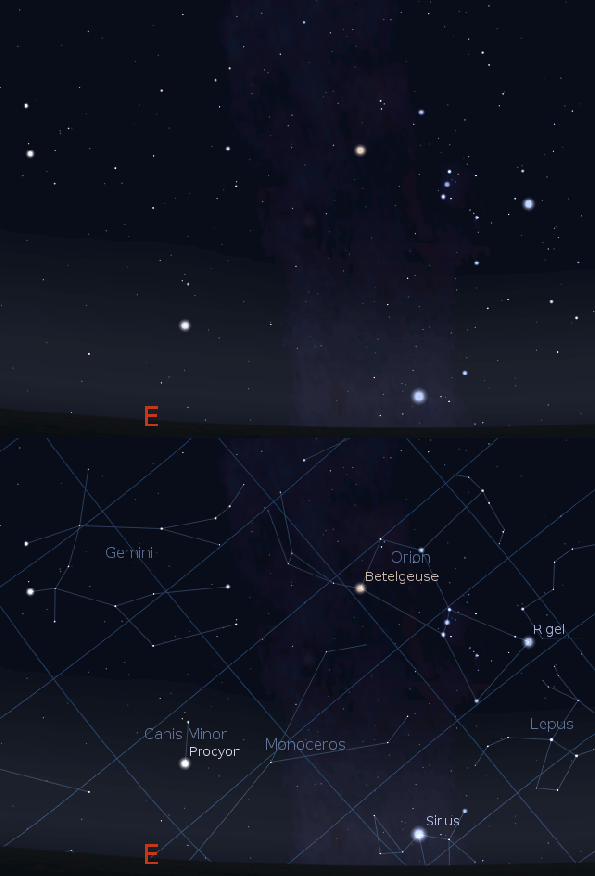
Procyon, Sirius and the stars of winter. Created using Stellarium
In the above chart, beside the constellation lines, we have the grid of right ascension, from lower left to upper right; and declination, from upper left to lower right. right ascension lines are like longitude on the Earth, while declination lines are latitude lines. They are tipped because I don’t live at either the equator or one of the poles. As the Earth rotates the Sun, stars and planets slide westward in the direction of the declination lines. Note that Sirius is closer to the horizon than Procyon. Also that Sirius is west of the 7 hour right ascension line. (Take my word for it.) Procyon is east of that line, thus Sirius is west of Procyon.
Other cool things can be seen in the chart. Note the declination line that touches the horizon at the east compass point and runs just above Orion’s belt. It is 0º declination, or the celestial equator. It extends to the west compass point on the western horizon. The Sun on the equinoxes will rise due east and set due west. The 6 hour right ascension line runs past Betelgeuse in Orion. At 23½º north declination, near Castor’s big toe in Gemini is where the Sun appears on the first day of summer, the summer solstice.
P.S. It was cloudy and rainy the last two days. Didn’t see a Geminid meteor again this year, keeping my record intact.
11/25/2015 – Ephemeris – The occultation of Aldebaran is tomorrow morning!
Ephemeris for Wednesday, November 25th. The Sun will rise at 7:52. It’ll be up for 9 hours and 14 minutes, setting at 5:06. The Moon, at full today, will rise at 5:26 this evening.
Tomorrow morning between about 5:38 and 6:29 a.m. the Moon will pass in front of the bright star Aldebaran. The event is called an occultation. Aldebaran is the bright reddish star in the V-shaped face of the constellation Taurus the bull, which is seen in the sky charging Orion the hunter in the evening sky now. By the time of this event, they will have moved into the west. Aldebaran, though bright, doesn’t hold a candle to the nearly full Moon. I know that a holiday is a good day to sleep in, unless you are getting an early start on preparing the Thanksgiving feast. In any case the earlier you get out to spot Aldebaran the easier it will be to find in the Moon’s glare. Check out my posts on bobmoler.wordpress.com for more information.
Times are for the Traverse City/Interlochen area of Michigan. They may be different for your location.
Addendum
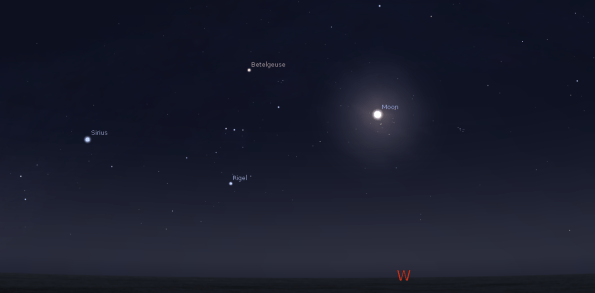
Here’s the Moon hiding Aldebaran in its glare at 5:30 a.m. tomorrow morning November 26, 2015. Created using Stellarium.
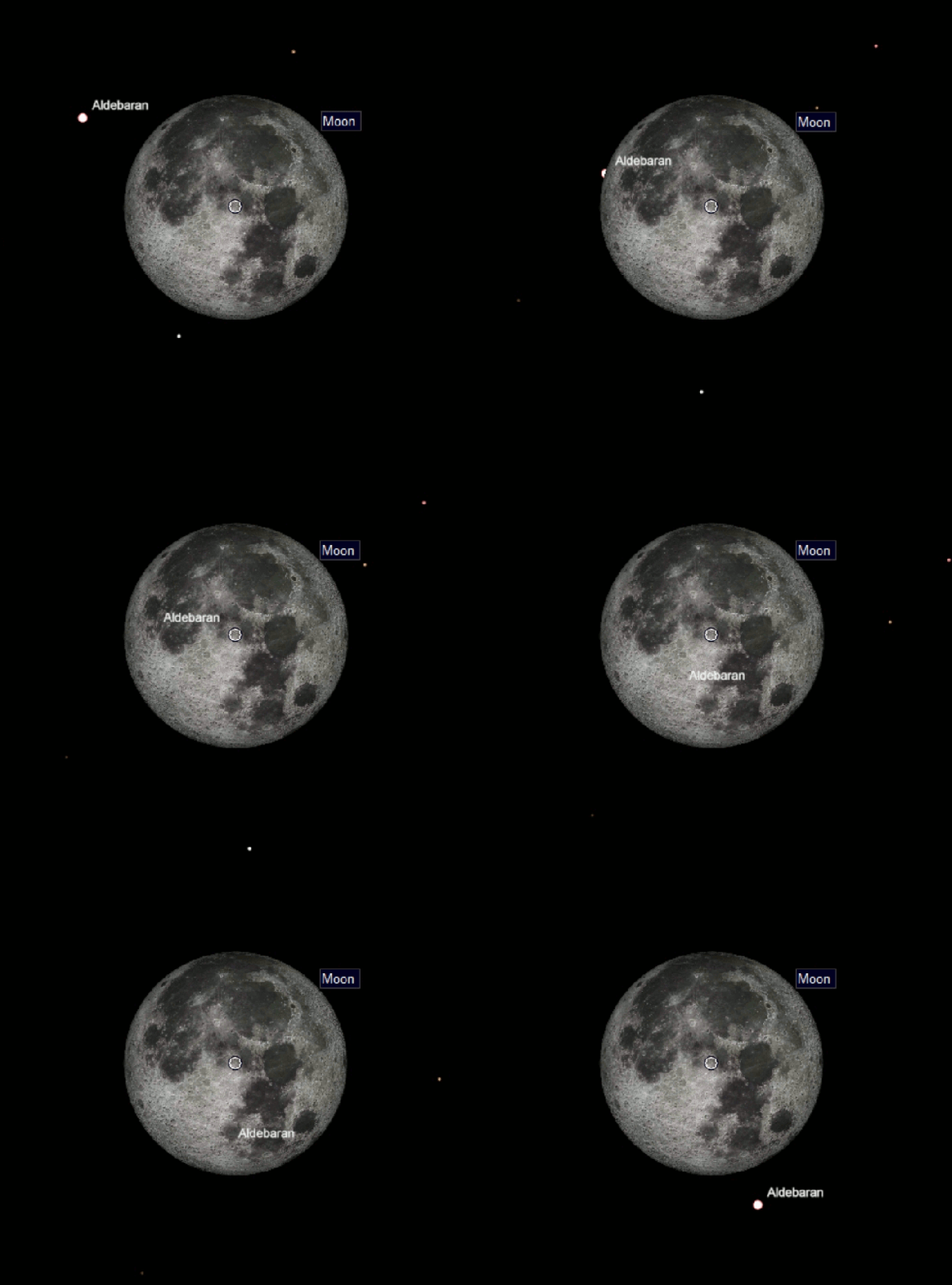
An occultation animation starting at 5:19 a.m. EST showing 10 minute intervals. Computer generated graphics cannot produce a point star. Aldebaran will wink out and back in an instant. Created using Cartes du Ciel (Sky Charts) and GIMP.
11/23/2015 – Ephemeris – An occultation of Aldebaran by the Moon will be visible to much of the northern US Thursday morning
Ephemeris for Monday, November 23rd. The Sun will rise at 7:49. It’ll be up for 9 hours and 18 minutes, setting at 5:08. The Moon, 2 days before full, will set at 5:58 tomorrow morning.
Thursday morning, Thanksgiving Day here in the US, the Moon will occult or pass in front of the bright star Aldebaran for the northern half of the United States, and Canada. I have a special post on my blog dated yesterday, November 22nd. It’s titled Aldebaran Occultation November 26, 2015 from Northern Michigan (click here) with all the details. My blog is bobmoler.wordpress.com, or do an Internet search for Bob Moler, That’s Moler spelled M-O-L-E-R, no extra letters. Aldebaran is the bright orange star in the face of the constellation Taurus the bull. You will need at least a pair of binoculars to pick out Aldebaran next to the Moon. Aldebaran will disappear at about 5:38 a.m. and reappear about 6:29 a.m. for Interlochen and Traverse City.
Times are for the Traverse City/Interlochen area of Michigan. They may be different for your location. The November 22 post has instructions on how to calculate the occultation times for your location, and has a map to see if you can view the occultation at all.
Addendum
An occultation animation starting at 5:19 a.m. EST showing 10 minute intervals. Not that the computer generated graphics cannot produce a point star. Aldebaran will wink out and back in an instant. Created using Cartes du Ciel (Sky Charts) and GIMP.
11/20/2015 – Ephemeris – Finding the bright stars of November
Ephemeris for Friday, November 20th. The Sun will rise at 7:46. It’ll be up for 9 hours and 24 minutes, setting at 5:10. The Moon, 1 day past first quarter, will set at 2:17 tomorrow morning.
The Moon is beginning to brighten up the sky making constellation spotting somewhat difficult, so I thought we’d look for the brightest stars. High in the west are the three stars of the Summer Triangle. At the bottom in the southwest is Altair, the first of these to set. A bit north of west the brightest, Vega. Highest in the west is Deneb, which won’t officially set for those Interlochen northward. Low in the south is the loneliest star Fomalhaut. In the northeast is the winter star Capella, which also doesn’t set for the IPR listener area, but spends summer nights hiding behind hills and trees in the north. Low in the east is the last of our bright stars, Aldebaran in Taurus the bull, which will be playing hide and seek with the Moon next week.
Times are for the Traverse City/Interlochen area of Michigan. They may be different for your location.
Addendum
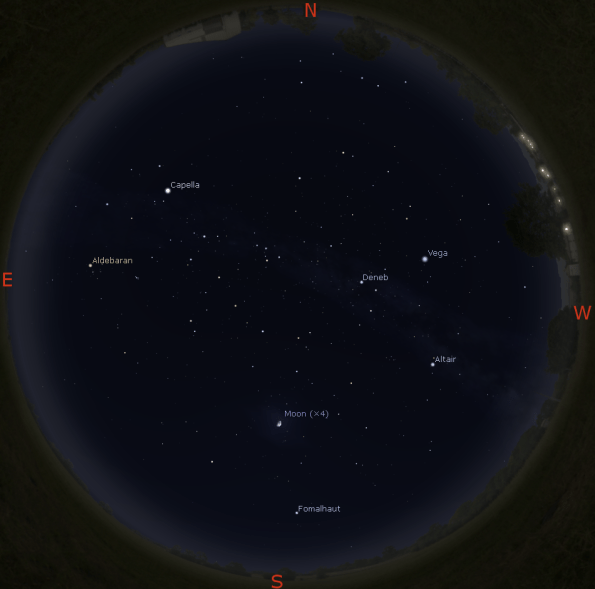
The bright first magnitude stars of autumn shown for 8 p.m. November 20, 2015. If you are closer to your time meridian, we’re 43 minutes behind ours, you will see two more bright stars in the east: Red Betelgeuse and blue-white Rigel. Created using Stellarium.
10/30/2015 – Ephemeris – The spookiest star
Ephemeris for Friday, October 30th. The Sun will rise at 8:17. It’ll be up for 10 hours and 16 minutes, setting at 6:34. The Moon, 3 days past full, will rise at 9:33 this evening.
Tomorrow night is the spookiest night of the year, so lets look at the spookiest star of all. It’s Algol, from Ghoul Star or Demon Star. The Chinese had a name for it that meant ‘piled up corpses’. It’s the second brightest star in the constellation Perseus the hero, rising in the northeast this evening. The star is located where artists have drawn the severed head of Medusa, whom he had slain. Medusa was so ugly that she turned all who gazed upon her to stone. Algol is her still glittering eye. Astronomers finally found out what was wrong with Algol. It does a slow 6 hour wink every two days 21 hours, because it is two stars that eclipse each other. It winked this morning and it will again centered on 11:45 p.m. Sunday night.
Times are for the Traverse City/Interlochen area of Michigan. They may be different for your location.
Addendum
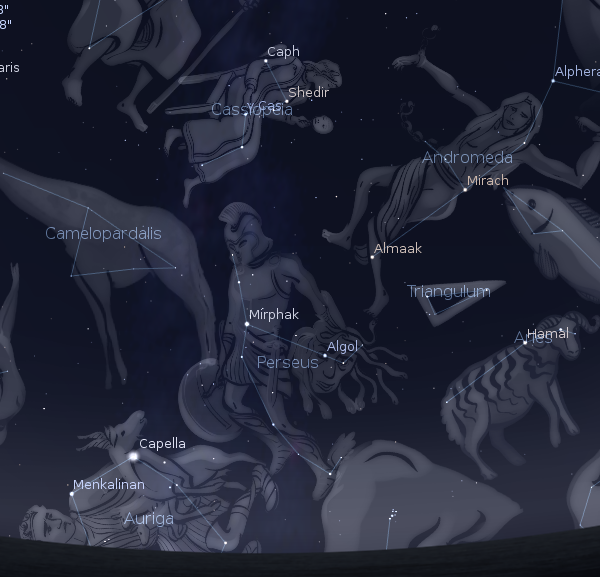
Algol at 7:30 p.m. on Halloween, in a modern portrayal. Created using Stellarium.
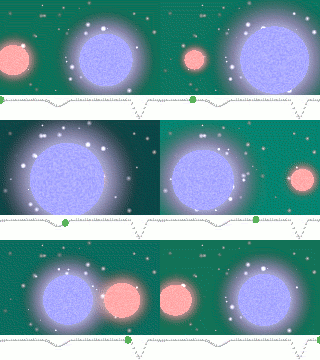
Animation of an eclipsing binary star like Algol. Credit: Wikimedia Commons h/t Earth and Sky
10/06/2015 – Ephemeris – Deneb our home-town star
Ephemeris for Tuesday, October 6th. The Sun will rise at 7:46. It’ll be up for 11 hours and 27 minutes, setting at 7:14. The Moon, 2 days past last quarter, will rise at 2:36 tomorrow morning.
We, here in Traverse City, Michigan have a pretty unique relation to the bright star Deneb, as is any location near 45 degrees north latitude. Tonight at 9:23 Deneb will be three-quarters of a degree due north of the zenith. Due north means that it’s on our meridian, a line you may remember from your school days. For astronomers it passes from the north point on the horizon, through the overhead point or zenith to the south point on the horizon. Also due to our latitude Deneb is circumpolar, meaning that it doesn’t quite set on a clean northern horizon. Deneb and 56 other stars are used for celestial navigation, which is still taught in case the GPS system goes down due to solar or enemy action.
Times are for the Traverse City/Interlochen area of Michigan. They may be different for your location.
Addendum
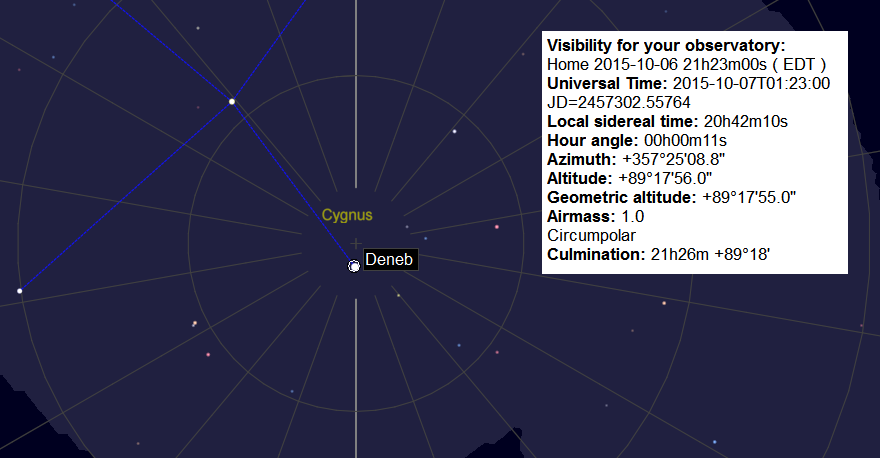
Deneb nearly at the zenith from Traverse City. Created using Cartes du Ciel.
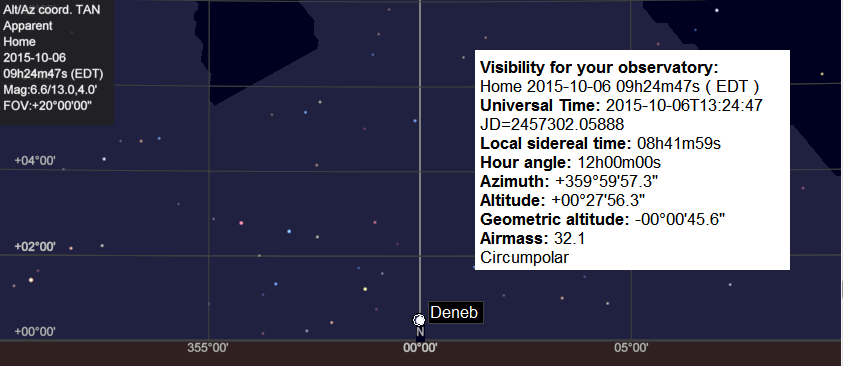
Deneb is close to the horizon due north. Created using Cartes du Ciel.
 Bob Moler's Ephemeris Blog