Archive
09/29/11 – Ephemeris – Deneb at the zenith
Thursday, September 29th. The sun will rise at 7:37. It’ll be up for 11 hours and 49 minutes, setting at 7:27. The moon, 2 days past new, will set at 8:28 this evening.
At 10 p.m. tonight the first magnitude star Deneb will be overhead, that is very near the zenith. Deneb is the northern most and dimmest of the three stars of the Summer Triangle. It is at the head of the Northern Cross, which extends to the south. This is an asterism, which is what astronomers call a informal constellation. The Big and Little Dippers are also examples of asterisms. You won’t find them in the list of the 88 official constellations. The actual constellation that Deneb belongs to is Cygnus the swan. In the swan Deneb is the tail. That’s actually what Deneb means. The swan is flying southwestward along the Milky Way with its wings outstretched. Stars can be followed around the wings to make out a very realistic flying swan.
* Times are for the Traverse City/Interlochen area of Michigan. They may be different for your location.
Addendum
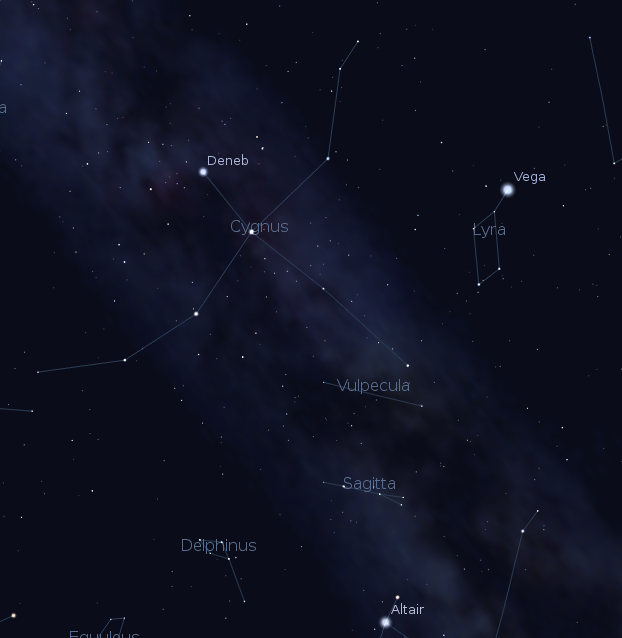
Deneb at the Zenith. Looking overhead while facing south. Created using Stellarium.
The Summer Triangle of bright stars Deneb, Vega and Altair are in this view.
08/30/11 – Ephemeris – The bright star Altair
Tuesday, August 30th. The sun will rise at 7:02. It’ll be up for 13 hours and 20 minutes, setting at 8:23. The moon, 2 days past new, will set at 8:48 this evening.
The Summer Triangle of bright stars is visible overhead and to the south.. Vega is highest, nearly overhead, while Deneb is high in the northeast. The southernmost star of the Summer Triangle is Altair. Altair is the closest of the three stars at a distance of 16.8 light years away. One light year is nearly 6 trillion miles. Altair is 10 times the brightness of the sun. If seen at Altair’s distance, the sun would only be as bright as one of the two stars that flank it. What is rather different about Altair is it’s rapid rotation. While its almost twice the sun’s diameter, it rotates once in only 6 ½ to 10 hours, and would show a decidedly squashed appearance if seen close up. Our sun’s a slow poke, taking nearly a month to rotate just once.
* Times are for the Traverse City/Interlochen area of Michigan. They may be different for your location.
08/29/11 – Ephemeris – The twinkly red star Antares
Monday, August 29th. The sun will rise at 7:01. It’ll be up for 13 hours and 23 minutes, setting at 8:24. The moon, 1 day past new, will set at 8:19 this evening.
As it gets dark this evening a bright reddish star will appear low in the south. It will appear to twinkle mightily. It is not the planet Mars, which is now in the morning sky, but its rival the star Antares in Scorpius the scorpion. The star’s name, Antares, notes the rivalry. “Ant” means anti, while “Ares” is the Greek name for the Roman god Mars. Antares literally means “Rival of Mars”. Antares appears red due to its cool surface temperature of 3,600 Kelvin, much cooler than the sun’s 6,000 Kelvin, while Mars is red due to rust. As Antares starts to set later in the evening its light will mass through more of earth’s turbulent atmosphere making it sparkle like a multicolored sparkler. Antares spectacular twinkling has sparked more than a few calls about a strange light in the sky.
* Times are for the Traverse City/Interlochen area of Michigan. They may be different for your location
07/19/11 – Ephemeris – The brightest stars visible now in the evening
Tuesday, July 19th. Today the sun will be up for 15 hours and 6 minutes, setting at 9:21. The moon, half way from full to last quarter, will rise at 11:11 this evening. Tomorrow the sun will rise at 6:15.
Let’s check out all the bright stars in the evening sky, as it gets dark tonight. High in the west is the bright yellow-orange star Arcturus. In the northwest is the Big Dipper, whose curved handle points to Arcturus. Straightening that curve to a spike will point to Spica a blue-white star low in the southwest. The bright star to its right isn’t. It’s the planet Saturn. In the south is the red star Antares which usually twinkles merrily. High in the east is the bright white star Vega. To its lower right is Altair, and to its lower left the star Deneb. Vega, Altair and Deneb make the Summer Triangle, whose rising in the east signals the coming of summer. Always present for us in northern Michigan is Capella very low in the north.
* Times are for the Traverse City/Interlochen area of Michigan. They may be different for your location.
Addendum
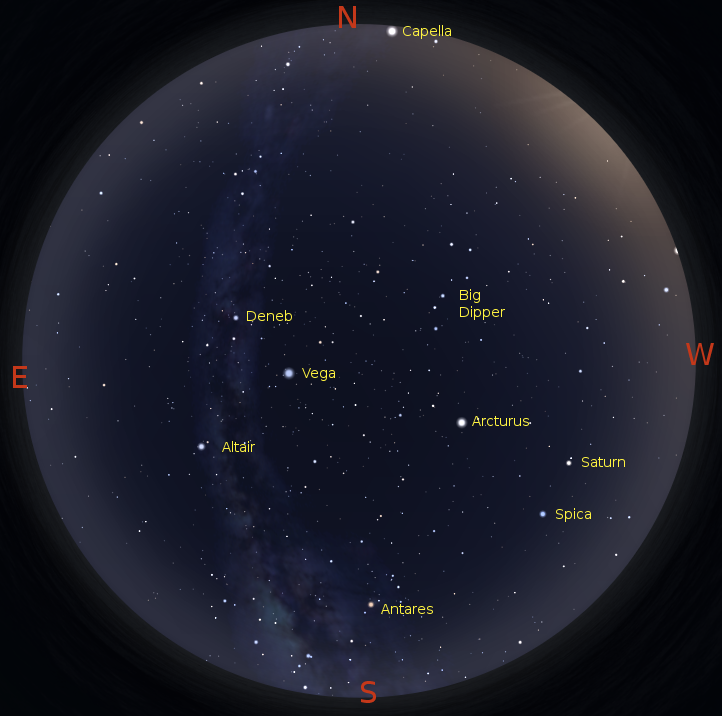
Bright Summer Stars. Created using Stellarium.
Click on the image to enlarge. This is a whole sky chart. The round edge is the horizon. BTW the star Capella, very low in the north, is a winter star, but it’s visible all year round for folks north of 44 degrees north latitude.
07/04/11 – Ephemeris – Red, white and blue stars
Independence Day, Monday, July 4th. Today the sun will be up for 15 hours and 27 minutes, setting at 9:30. The moon, 3 days past new, will set at 11:22 this evening. Tomorrow the sun will rise at 6:03.
Today’s Independence Day so let’s look for some red, white, and blue stars. Red is easy, the red star Antares is seen in the south at 11 p.m. White is easy too, the official white calibration star Vega high in the east at 11 p.m. The blue star is really blue-white. The brightest of these out at 11 p.m. is Spica, low in the southwest. The color is best seen in binoculars. Star colors are quite subtle, and are an indicator of the temperature of their outer gaseous layers. The temperature of a stars outer layers, in order of their increasing temperatures, red, white and blue, is not related to the temperature in their cores. Of these three the coolest on the outside, Antares is really the hottest inside, using helium as fuel.
* Times are for the Traverse City/Interlochen area of Michigan. They may be different for your location.
05/27/11 – Ephemeris – Spica, some thoughts about its future
Friday, May 27th. Today the sun will be up for 15 hours and 12 minutes, setting at 9:15. The moon, 3 days past last quarter, will rise at 3:27 tomorrow morning. Tomorrow the sun will rise at 6:03.
Yesterday I talked about Spica the bright star to the lower left of Saturn in the evening now. Spica is actually two very massive and hot stars orbiting each other in 4 days. One is 10 times the sun’s mass while the other is 7 times the sun’s mass. The more massive one will run out of hydrogen in its core first and begin to bloat in size. As it does so it will begin to transfer mass to the other star and speed up its evolution. The resulting show should be spectacular when seen at a safe distance. I’m not sure the stars 260 light year distance is safe enough. But we have many millions of years to wait before things get interesting, and that’s fine with me. What seems to be a silent, seemingly changeless sky can hide dramatic happenings.
* Times are for the Traverse City/Interlochen area of Michigan. They may be different for your location.
Addendum
Being only an amateur astronomer the above is rank speculation with no proof that the proposed events will happen. But it’s fun to think about.
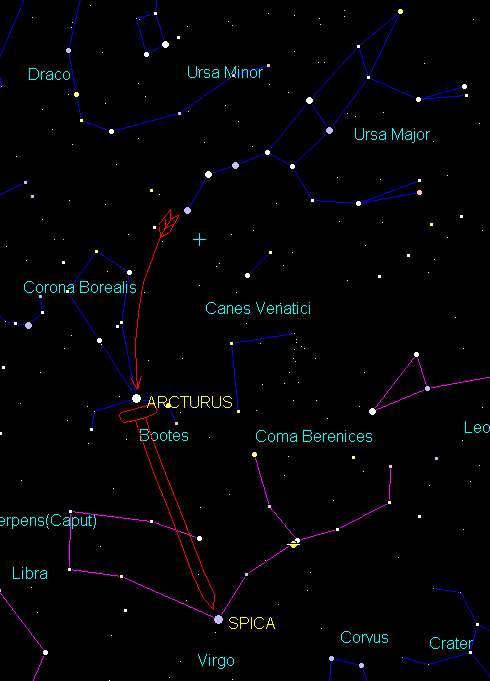
Follow the Spike to Spica, 5/26/2011
 Bob Moler's Ephemeris Blog