Archive
07/23/2012 – Ephemeris – The star Vega up close
Ephemeris for Monday, July 23rd. The sun rises at 6:19. It’ll be up for 14 hours and 57 minutes, setting at 9:17. The moon, 3 days before first quarter, will set at 11:14 this evening.
The star Vega, which is high in the east, near overhead or the zenith is a special star for astronomers. It’s part of the small constellation or Lyra the harp, which includes the parallelogram of stars near it. Vega is kind of a standard calibration star. It is the 5th brightest night time star with a brightness of 0.0 magnitude, although recent measurements place it at 0.03. Of the spectral types which denote the star’s color and surface temperature, Vega comes out to be pure white, with a surface temperature nearly twice the sun’s. It’s almost exactly 25 light years away, and so is one of the closer stars. It’s a tenth the sun’s age and 40 times the sun’s brightness. [It has perhaps a Jupiter sized planet, and a Kuiper belt of Pluto like objects.]
Times are for the Traverse City/Interlochen area of Michigan. They may be different for your location.
Addendum
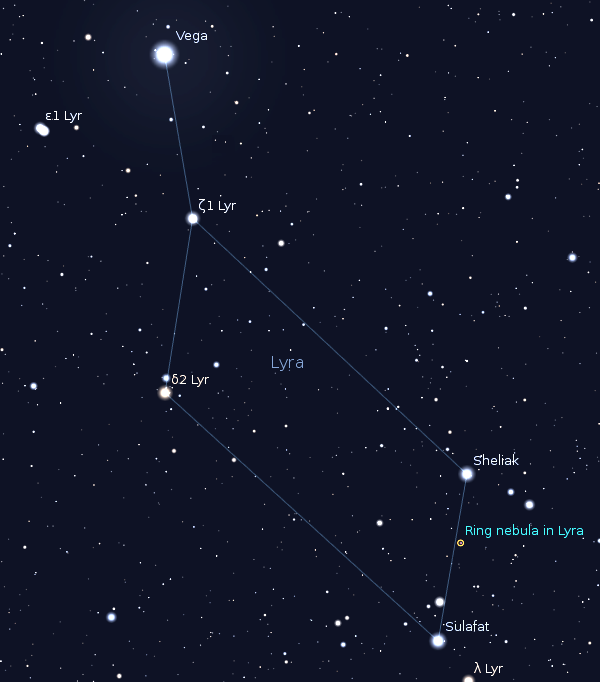
Lyra in Binoculars. Created using Stellarium.
07/24/2012 – Ephemeris – The star Antares up close
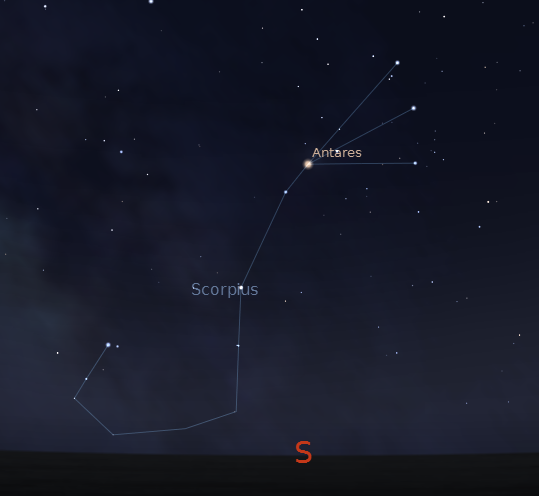
The constellation Scorpius with Antares. Created using Stellarium.
Ephemeris for Tuesday, July 24th. The sun rises at 6:20. It’ll be up for 14 hours and 55 minutes, setting at 9:16. The moon, 2 days before first quarter, will set at 11:44 this evening.
Antares is a most interesting star. It’s low in the south and red in color. Its the heart of the Scorpius the scorpion. Its name means Rival of Mars with which it shares its color. Antares is a huge star, a red giant star. Its mass is 12 times the mass of the sun, but it’s bloated out to a diameter somewhat larger than the orbit of Mars, over 300 million miles. This what happens to a star that has exhausted hydrogen in its core and is now fusing helium to produce energy and even more massive elements. Its surface temperature is close to the temperature of the filament of an incandescent light bulb, about 2/3rds the temperature of the sun. Antares also has a dim companion star.
Times are for the Traverse City/Interlochen area of Michigan. They may be different for your location.
07/12/2012 – Ephemeris – The constellation Lyra the harp
Thursday, July 12th. Today the sun will be up for 15 hours and 17 minutes, setting at 9:26. The moon, 2 days past last quarter, will rise at 1:50 tomorrow morning. Tomorrow the sun will rise at 6:10.
High in the east at 11 p.m. can be found a bright star called Vega just above a small, narrow, but very distinctive parallelogram of stars. They are the stars of the constellation Lyra the harp. Vega, the 5th brightest night time star, is one of the twenty one brightest stars, called first magnitude stars. The harp, according to Greek mythology, was invented by the god Hermes. The form of the harp in the sky, is as he had invented it: by stretching strings across a tortoise shell. Hermes gave it to his half-brother Apollo, who in turn gave it to the great musician Orpheus. In binoculars, near Vega, two stars appear together. They barely appear to the unaided eye as a single star, designated Epsilon Lyrae.
Times are for the Traverse City/Interlochen area of Michigan. They may be different for your location.
Addendum
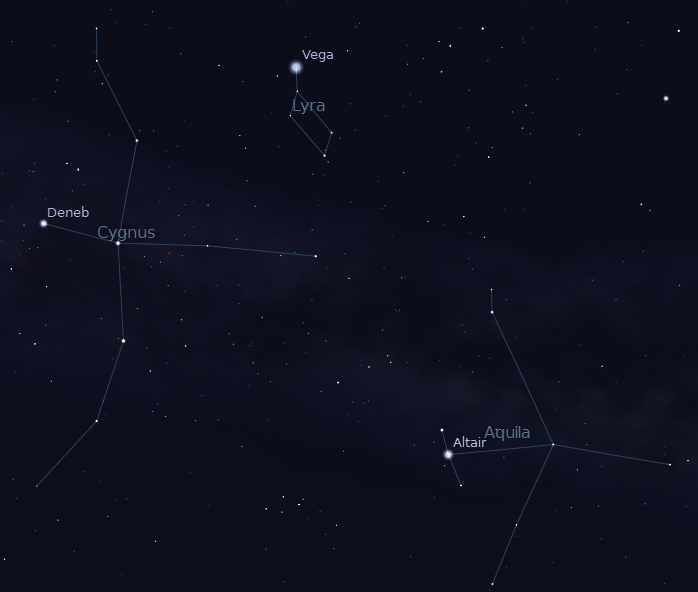
Summer Triangle and the constellation Lyra at 07-12-12 at 11 p.m. Created using Stellarium.
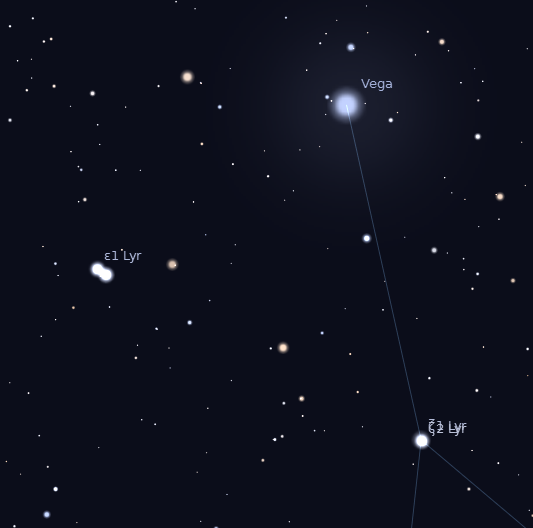
Closeup on Vega and Epsilon Lyrae. Created using Stellarium.
ε1 Lyrae is one of the stars of Epsilon Lyrae. The pair can be split better than this image with binoculars. Looking at the two with a good telescope and over 100 power can split each component into two more stars. We amateur astronomers call it the “Double-Double Star” Note too that Zeta (ζ) Lyrae is also a double star that can be split with a low power telescope.
07/05/2012 – Ephemeris – The Summer Triangle
Ephemeris for Thursday, July 5th. Today the sun will be up for 15 hours and 26 minutes, setting at 9:30. The moon, 2 days past full, will rise at 10:37 this evening. Tomorrow the sun will rise at 6:04.
Now that summer is here, the asterism or informal constellation called the Summer Triangle can be seen high in the east as it gets dark. Highest of the three bright stars is Vega in the constellation Lyra the harp, whose body is seen in a narrow parallelogram nearby. The second star of the triangle is Deneb lower and left of Vega, It appears dimmer than Vega because its is by far the most distant of the three. The third star of the Summer Triangle is seen farther below and right of Vega. It is Altair in Aquila the eagle, and the closest. Altair is 16.7 light years away, Vega is 25 light years while Deneb may be a whopping 1,550 light years away. [One light year is 6 about trillion miles. That’s 6 with 12 zeros after it.]
Times are for the Traverse City/Interlochen area of Michigan. They may be different for your location. Bracketed text was omitted from the broadcast due to time constraints.
Addendum
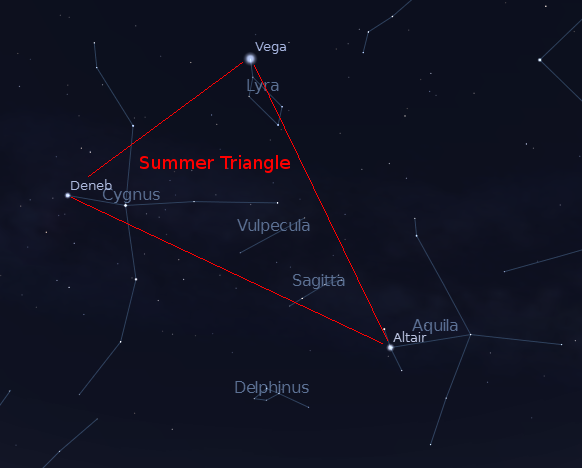
The Summer Triangle July 5, 2012 at 11 p.m. Created using Stellarium and The Gimp.
06/14/2012 – Ephemeris – Flag Day: Red, White and Blue Stars
Ephemeris for Flag Day, Thursday, June 14th. Today the sun will be up for 15 hours and 32 minutes, setting at 9:29. The moon, 3 days past last quarter, will rise at 3:16 tomorrow morning. Tomorrow the sun will rise at 5:56.
Since it’s Flag Day, lets look for some red white and blue stars. Red is easy, I talked about it Tuesday, It is Antares now low in the southeast in the evening in the heart of the constellation of Scorpius the scorpion. For the white star there is no purer white star than Vega, spectral type A0 (A zero), the astronomers definition of white. It is located midway up the sky in the east. It is the 5th brightest night time star, and is seen off a small parallelogram of stars that make up the body of Lyra the harp. For the blue star, the best is Spica, below Saturn this year and in the south in the evening. It is the bluest of the 21 brightest first magnitude stars. Color in stars is often subtle, so try to see these colors.
Times are for the Traverse City/Interlochen area of Michigan. They may be different for your location.
Addendum
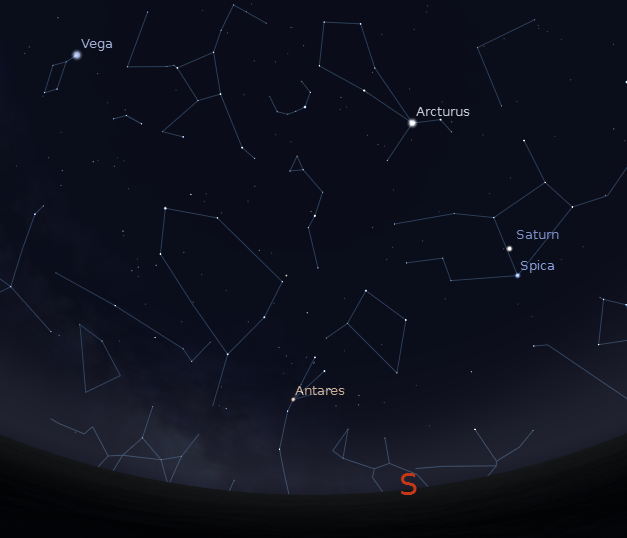
Red (Antares), White (Vega) and Blue (Spica) stars of spring. Created using Stellarium.
06/12/2012 – Ephemeris – The bright star Antares
Ephemeris for Tuesday, June 12th. Today the sun will be up for 15 hours and 31 minutes, setting at 9:28. The moon, 1 day past last quarter, will rise at 2:20 tomorrow morning. Tomorrow the sun will rise at 5:56.
A rival to Mars is now low in southeast at 10:30. It is the red star Antares, whose names literally means “Rival of Mars”. This is from the Greek who’s god of war was Ares. Mars is in the southwest now and a bit brighter than Antares. When Mars catches up with Antares around October 20th this year, they will be nearly the same brightness, and one would be hard put to tell them apart. Antares is in the heart of Scorpius the scorpion which lies close to our southern horizon later in the evening, and is best seen next month at an earlier time. Antares is also a star that appears strange as its twinkling is very pronounced being always close to the horizon for us sputtering all the colors of the rainbow.
Times are for the Traverse City/Interlochen area of Michigan. They may be different for your location.
Addendum
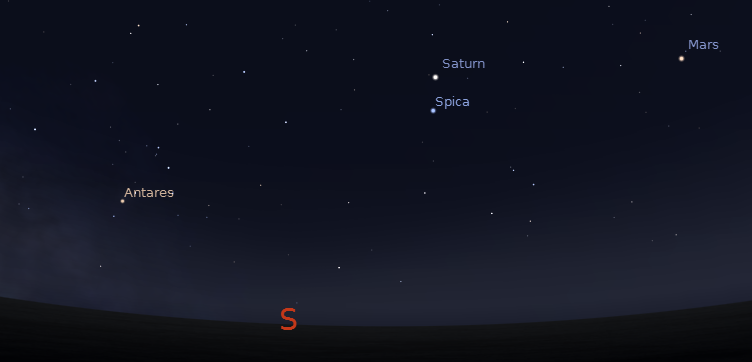
Antares and Mars at 11 p.m. on June 12, 2012. Created using Stellarium.
06/11/2012 – Ephemeris – The bright star Arcturus
Ephemeris for Monday, June 11th. Today the sun will be up for 15 hours and 30 minutes, setting at 9:27. The moon, at last quarter today, will rise at 1:55 tomorrow morning. Tomorrow the sun will rise at 5:56.
The bright star Arcturus appears high in the south at 10:30 in the evening. It’s at the base of a kite shaped constellation of Boötes the herdsman or bear chaser. Arcturus is remarkable for several reasons. It is only 10 percent more massive than the sun but is 110 times brighter and is orange in color. That’s because Arcturus has entered its red giant stage of life after depleting hydrogen in its core as its fuel source. Arcturus is much older than the sun to have evolved so far, being only a little more massive than the sun. Also Arcturus may be new to our galaxy, Its rapid motion of 76 miles per second with respect to the sun, along with 51 other stars known may have come from a small galaxy that collided with the Milky Way.
Times are for the Traverse City/Interlochen area of Michigan. They may be different for your location.
Addendum
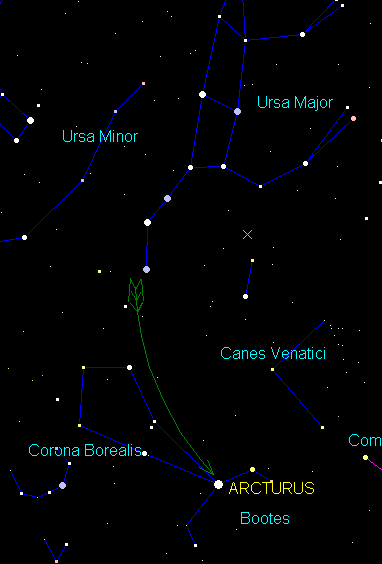
Arcturus, Boötes and the Big Dipper
05/11/2012 – Ephemeris – The bright star Spica
Ephemeris for Friday, May 11th. Today the sun will be up for 14 hours and 40 minutes, setting at 8:59. The moon, 1 day before last quarter, will rise at 2:09 tomorrow morning. Tomorrow the sun will rise at 6:17.
The bright blue star Spica can be found in the southeast as it gets dark now. It’s one of the fainter of the 21 first magnitude stars. It lies in the constellation of Virgo the virgin, and lies very close to the path of the sun, moon and planets in the sky. Saturn is just to the left of it this year. Spica is a binary star, whose brighter component is drawn into an ellipsoid by the tidal effect of the companion. They orbit each other in only 4 days. Spica is 260 light years away and over 3,000 times brighter than the sun. An Egyptian temple at Thebes was oriented to the setting point of Spica. The change in the setting point over time allowed the Greek astronomer Hipparchus to discover the precession of the equinoxes.
Times are for the Traverse City/Interlochen area of Michigan. They may be different for your location.
Addendum
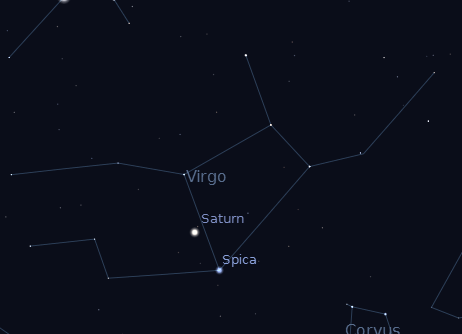
Saturn and Spica on May 11, 2012. Created using Stellarium.
02/09/2012 – Ephemeris – The star Betelgeuse
Ephemeris for Thursday, February 9th. The sun will rise at 7:51. It’ll be up for 10 hours and 10 minutes, setting at 6:02. The moon, 2 days past full, will rise at 8:38 this evening.
The bright red star at the upper left corner of the constellation Orion, high in the south at 9 p.n. Is Betelgeuse. The name is a contraction of an Arabic phrase that means “Armpit of the Central One”. Betelgeuse is a huge star with a diameter four times that of the earth’s orbit of the sun. It is throwing of gas and creating a nebula around itself. It’s distance from us isn’t accurately known, since it doesn’t have a companion star. It’s about 643 light years away, give or take 148 light years. Betelgeuse is about 18 times the mass of the sun and 140 thousand times brighter. It is in the latter stages of its short life,of 10 million year so far. Within another million years or so it will probably explode in a supernova. The good news is that it’s moving away from us.
* Times are for the Traverse City/Interlochen area of Michigan. They may be different for your location.
Addendum
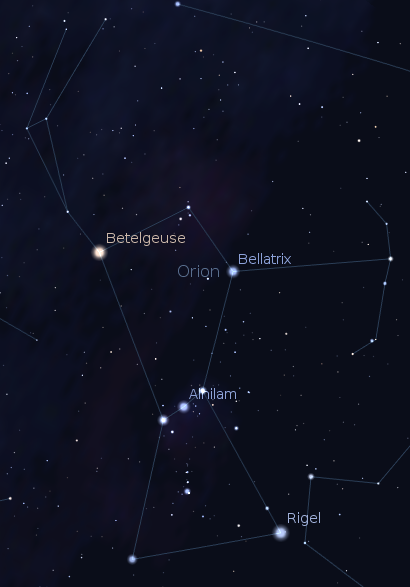
Orion upright and due south. Created using Stellarium.
Betegeuse in Orion
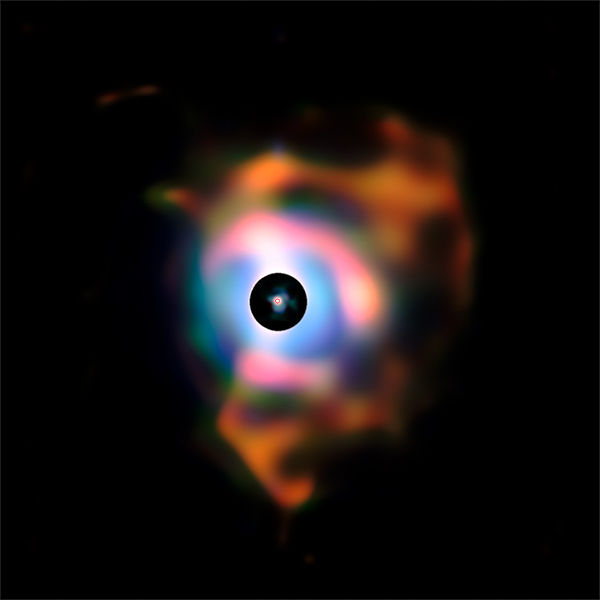
Betelgeuse and its nebula. From ESO's Very Large Telescope.
More information on the image above: http://www.eso.org/public/images/eso1121a/
01/30/2012 – Ephemeris – Getting Sirius about color
Ephemeris for Monday, January 30th. The sun will rise at 8:04. It’ll be up for 9 hours and 43 minutes, setting at 5:47. The moon, at first quarter today, will set at 1:51 tomorrow morning.
The bright star shining so bright low in the south southeast at 9 p.m. is Sirius the Dog Star. I talked about it Friday in the context of its constellation Canis Major, Orion’s larger hunting dog. Sirius itself is a remarkable star. It’s name means dazzling one and a look at it in binoculars or a telescope will prove it.. The twinkling effects are due to the earth’s atmosphere, but the bright arc light color is all his. Sirius is a perfect white star. Compare it with the brightest star now overhead Capella which has the same color as our sun. Star colors tell us the temperature of the star surfaces, which run from cool red to hot blue. On our Fahrenheit temperature scale, the sun’s surface is about 10,000 degrees, Sirius is nearly twice that.
* Times, as always are for the Traverse City/Interlochen area of Michigan.
Addendum
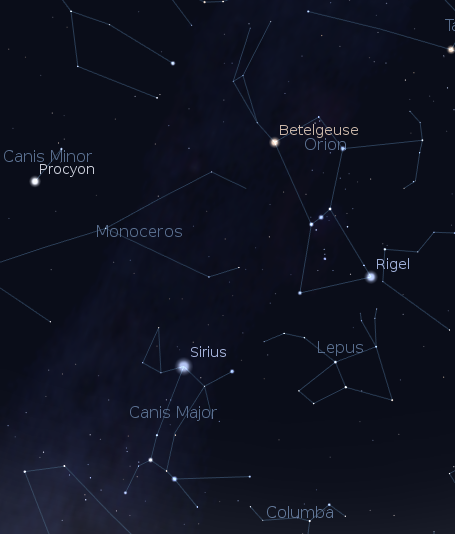
Orion and his Hunting Dogs. Created using Stellarium.
Sirius actually looks blue-white to me. Of course during the day our yellow sun looks white. I think it has to do with out night vision.
 Bob Moler's Ephemeris Blog