Archive
11/05/2020 – Ephemeris – Water found on the daylit side of the Moon
This is Ephemeris for Thursday, November 5th. Today the Sun will be up for 9 hours and 58 minutes, setting at 5:25, and it will rise tomorrow at 7:28. The Moon, 3 days before last quarter, will rise at 8:55 this evening.
Last week NASA announced some results from their SOFIA airborne observatory. They had detected the spectral signature of water in a large crater on the Moon named Clavius. This was a high latitude crater, 58.6 degrees south. Supposedly one could process a cubic meter of the regolith to extract a half liter of water. Clavius, which science fiction fans will note was the location of the American base on the Moon in 2001 a Space Odyssey. It is also one of my favorite lunar craters, one of the largest with a distinctive arc of diminishingly sized craters in its floor. As far as resources go, we’ve just literally scratched the surface of the Moon in its equatorial regions with our Apollo and other country’s robotic missions.
The event times given are for the Traverse City/Interlochen area of Michigan. They may be different for your location.
Addendum
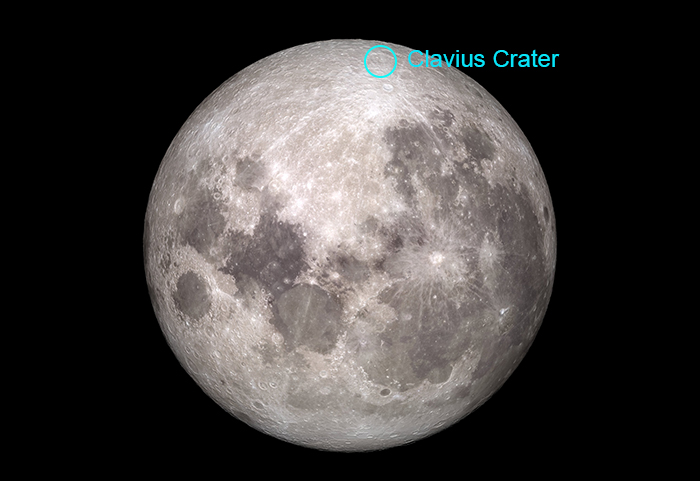
The Moon as seen from Australia (south up) with the crater Clavius circled. This is the same view of the Moon that users of a Newtonian reflector telescope in the northern hemisphere see, and how I first explored the Moon with my reflecting telescope. Source abc.net.au.
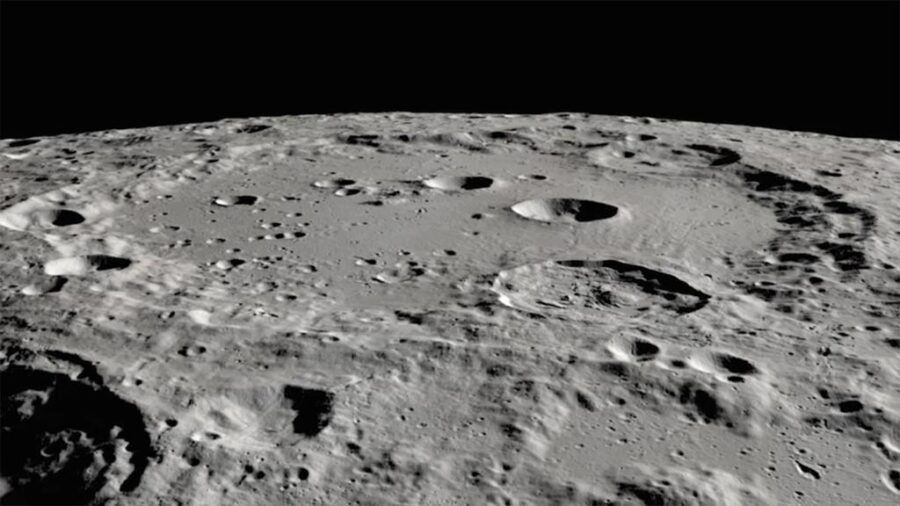
Closeup of Clavius from the Lunar Reconnaissance Orbiter. Credit: NASA/LRO.

The SOFIA Airborne Observatory. A modified Boeing 747 with a 106 inch (2.7 meter) telescope mounted crosswise in its fuselage. It is a joint project between NASA and the German Aerospace Center (DLR) and for some reason always on the verge of being canceled. Credit: NASA.
SOFIA is of course an acronym for Stratospheric Observatory for Infrared Astronomy. For more on SOFIA click here: https://www.nasa.gov/mission_pages/SOFIA/index.html.
10/26/2020 – Ephemeris – Why does everyone want to go to the Moon’s south pole?
This is Bob Moler with Ephemeris for Monday, October 26th. Today the Sun will be up for 10 hours and 26 minutes, setting at 6:39, and it will rise tomorrow at 8:14. The Moon, 3 days past first quarter, will set at 4:01 tomorrow morning.
Why are the United States and other countries interested in the south pole of the Moon? Two reasons: Water and power. The Moon’s axial tilt to the Earth’s orbit is only a degree and a half. And I’ve seen a mountain peak at the south pole of the Moon sticking out in sunlight in a telescope on a crescent moon, with black all around it. While most of the Moon gets two weeks of daylight and another two of night, that peak is probably always in sunlight. And on the Moon there’s no atmosphere to diminish the strength of the Sun when its low in the sky. And there’s the floors of craters that have never seen the Sun where water ice and other volatile compounds from comets have collected over the eons.
The event times given are for the Traverse City/Interlochen area of Michigan. They may be different for your location.
Addendum
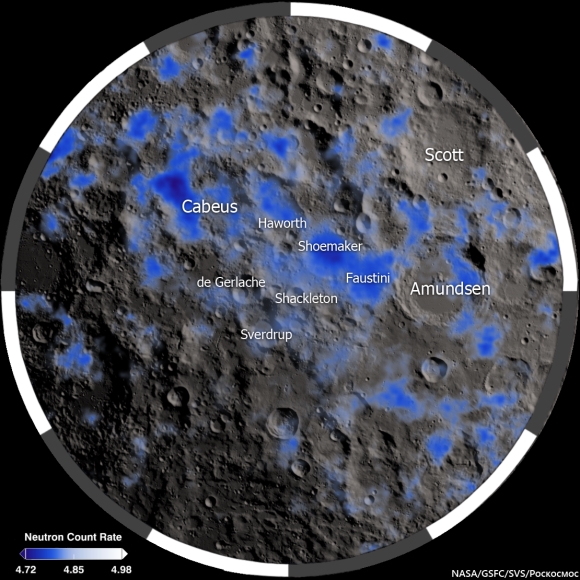
The south pole of the Moon where the presence of water ice is detected by the absorption of neutrons by the hydrogen atoms in the ice. Credit NASA/GSFC/SVS/Roscosmos.
09/29/2020 – Ephemeris – The Harvest Moon is in two days
This is Ephemeris for Tuesday, September 29th. Today the Sun will be up for 11 hours and 47 minutes, setting at 7:26, and it will rise tomorrow at 7:40. The Moon, 2 days before full, will set at 6:09 tomorrow morning.
This upcoming full moon is the Harvest Moon. It is the most famous of the named full moons, and was very useful in the days before electric lights. The reason is that the Moon, around the time it is full now doesn’t advance its rising time very much from night to night effectively extending the light of twilight to allow more time to gather in crops. This is because the Moon is moving north as well as eastward. The farther north it is the longer it stays up and retards the advance in rise times. On average the Moon rises 50 minutes later each night. This week the interval is down near 20 minutes advance in moonrise times per day extending twilight and the time each day to harvest the crops for a few more days.
The event times given are for the Traverse City/Interlochen area of Michigan. They may be different for your location.
Addendum
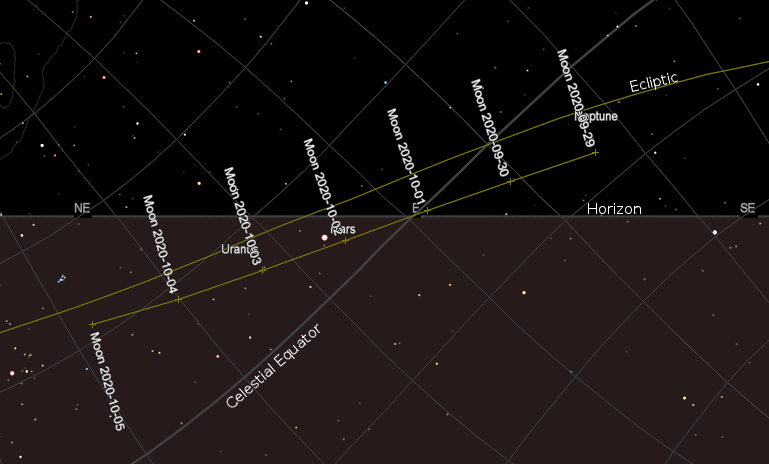
The motion of the moon from tonight through next Monday night. This is looking east at where the Moon will rise, and we’re able to see below the horizon. The celestial equator, a projection of the Earth’s equator on the sky, crosses the horizon at an angle equal to 90 minus one’s latitude. Around my location that’s 45.5 degrees. The Moon and stars will rise parallel to the celestial equator. Its daily orbital motion is at the shallow angle of 5 degrees to the ecliptic, the apparent path of the Sun. So the advance in rise times starts off at 20 minutes later each night, rather than the average 50 minutes.
09/03/2020 – Ephemeris – Why is the new NASA Moon landing program called Artemis?
This is Ephemeris for Thursday, September 3rd. Today the Sun will be up for 13 hours and 6 minutes, setting at 8:14, and it will rise tomorrow at 7:09. The Moon, 1 day past full, will rise at 9:20 this evening.
Why is the new NASA crewed Moon landing program called Artemis? And why is it crewed, and not manned? Artemis was a Greek deity and Apollo’s twin sister. He was the god of the Sun and she was goddess, among other things, of the Moon. So she has a greater connection to the Moon than Apollo did. Spacecraft now-a-days are crewed, rather than manned to denote that both sexes are chosen to be astronauts in nearly equal numbers now. Of course that’s crewed spelled c-r-e-w-e-d, not c-r-u-d-e, though they sound the same. Deities of the Moon tend to be female be they Artemis, Cynthia, Luna, Selene, or Chang’e. Astronomers use Cynthia, Luna, and Selene (pronounced Sel-e-nae) in naming various aspects of the Moon and Chang’e is the goddess that the Chinese name their lunar landers after.
The event times given are for the Traverse City/Interlochen area of Michigan. They may be different for your location.
Addendum

The logo chosen by NASA for the Artemis Program. The blue crescent at the bottom represents the earth. The gray ball at the top is the Moon. The curved red path is the stylized return path from the Moon to the Earth of the Orion capsule. Credit: NASA.
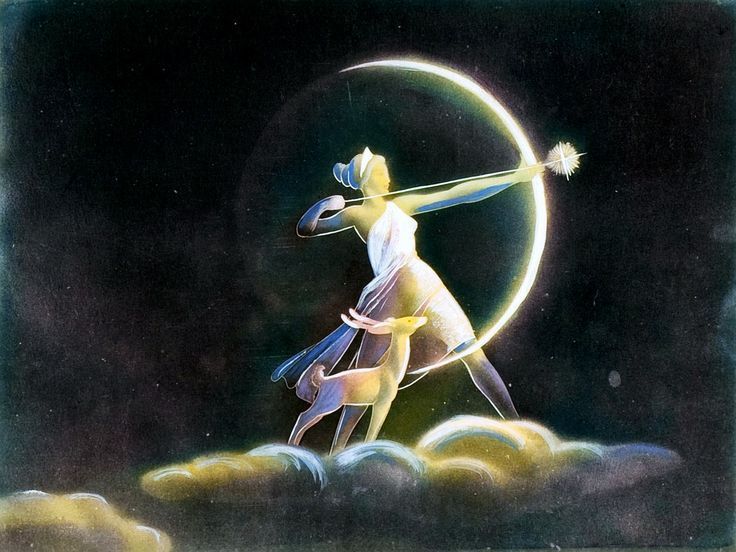
Artemis, goddess of the hunt and the Moon. Credit: Disney (Fantasia) source Daily Kos.
08/28/2020 – Ephemeris – Tonight Jupiter and the Moon will appear together in the sky
This is Ephemeris for Friday, August 28th. Today the Sun will be up for 13 hours and 24 minutes, setting at 8:25, and it will rise tomorrow at 7:02. The Moon, 3 days past first quarter, will set at 2:56 tomorrow morning.
Tonight at 9:33 pm the Moon will pass Jupiter in our skies. Jupiter will appear about 5 moon-widths above the Moon. It’s a good time to get out those binoculars or a small telescope to look at them. Jupiter will have its four brightest moons, two on each side. They are pretty close in. Tomorrow night they will all be on the west side of the planet. The waxing Gibbous Moon shows most of the Earth facing side now. The sunrise line a day ago brought the crater Copernicus into light on the east or left side of the Moon. Otherwise the east side of the Moon is flatter than the west side being dominated by two flat lunar seas, actually lava plains called the Sea of Clouds and Ocean of Storms. The Moon has never seen clouds or storms.
The event times given are for the Traverse City/Interlochen area of Michigan. They may be different for your location.
Addendum
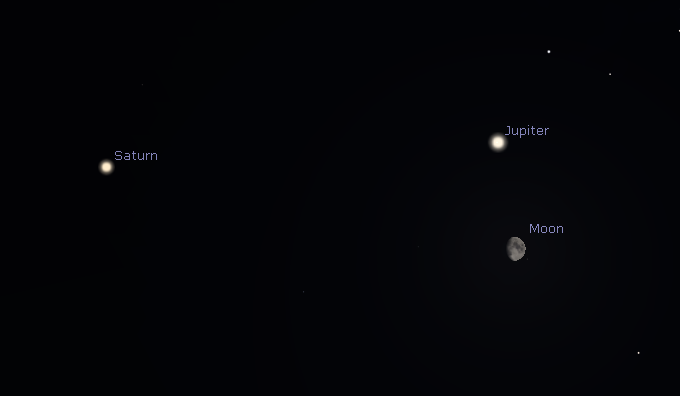
Jupiter, Saturn and the Moon as they would appear to the naked eye at 9:33 pm tonight August, 28, 2020. Created using Stellarium which unfortunately shows the Moon dimmer than the planets. In reality is that the Moon very much brighter, almost overpowering the planets.
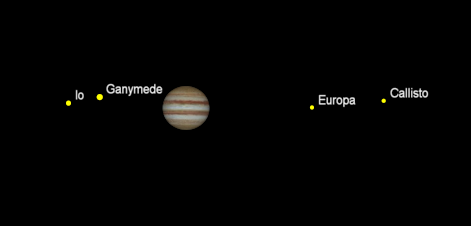
Jupiter and its 4 Galilean moons as the would appear in a telescope tonight August 28, 2020. Created using Cartes du Ciel (Sky Chart).
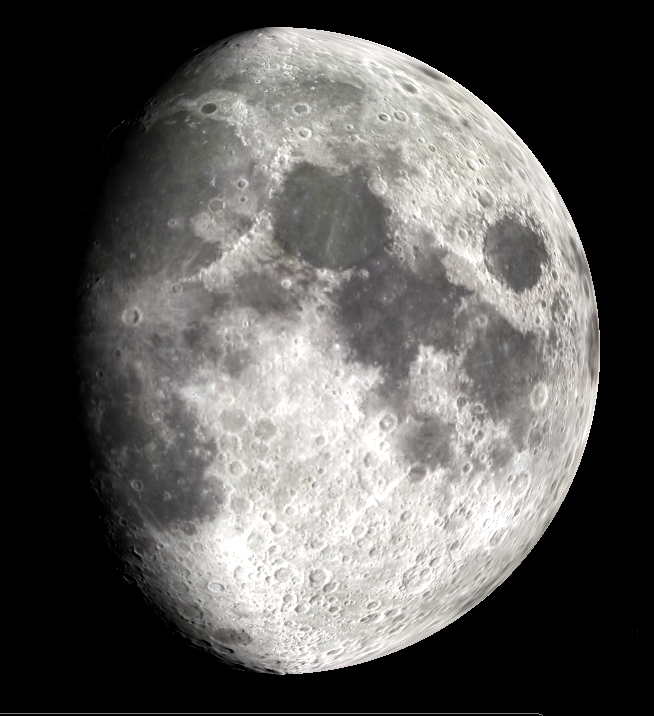
The gibbous Moon tonight as it might appear in a low power telescope. Created using Stellarium.
06/08/2020 – Ephemeris – Tomorrow’s Moon and the morning planets
This is Ephemeris for Monday, June 8th. Today the Sun will be up for 15 hours and 29 minutes, setting at 9:26, and it will rise tomorrow at 5:57. The Moon, 3 days past full, will rise at 12:28 tomorrow morning.
This afternoon the Moon will pass south of Jupiter, and this evening it will pass south of Saturn. By tomorrow morning the Moon will be to the lower left of both of them. However to see them one should get up by 5 am. By 5:30 the planets will be pretty much lost in twilight. The Moon should still be easily visible low in the south at that time. A careful observer, over time, may notice that both Jupiter and Saturn are moving slowly westward, rather than their normal eastward movement. We call this motion retrograde motion. This motion baffled the ancient Greeks, who thought the Earth to be stationary and the planets moved uniformly in perfect circles. They kind of solved it by adding smaller circles to the original ones.
The event times given are for the Traverse City/Interlochen area of Michigan. They may be different for your location.
Addendum
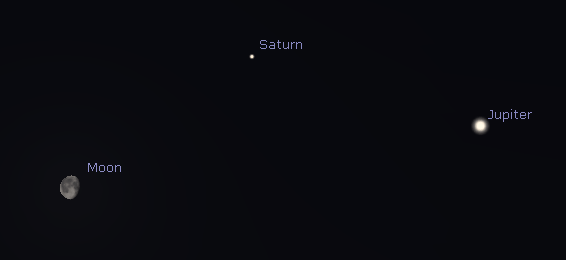
The Moon and morning planets at 5 a.m. tomorrow morning in the eastern US at 5 am, June 12, 2020. Created using Stellarium.
05/28/2020 – Ephemeris – The Moon tonight and the origin of the lunar seas
This is Ephemeris for Thursday, May 28th. Today the Sun will be up for 15 hours and 15 minutes, setting at 9:18, and it will rise tomorrow at 6:01. The Moon, 1 day before first quarter, will set at 2:25 tomorrow morning.
Tonight’s Moon is a fat crescent. The lower or southern part of the Moon are brighter. These are the lunar highlands, the more rugged crater filled part of the Moon. The darker areas are the so-called lunar seas, huge lava filled craters. Note that they appear to be roughly circular. They are thought to be the result of large asteroid impacts that occurred four billion years ago during what is known as the late heavy bombardment. The late heavy bombardment is still controversial. One theory has that the outer planets changed their orbits in time disrupting the two areas of small bodies, the asteroid belt inside Jupiter’s orbit and the Kuiper belt beyond Neptune, sending some of them into the inner solar system.
The event times given are for the Traverse City/Interlochen area of Michigan. They may be different for your location.
Addendum
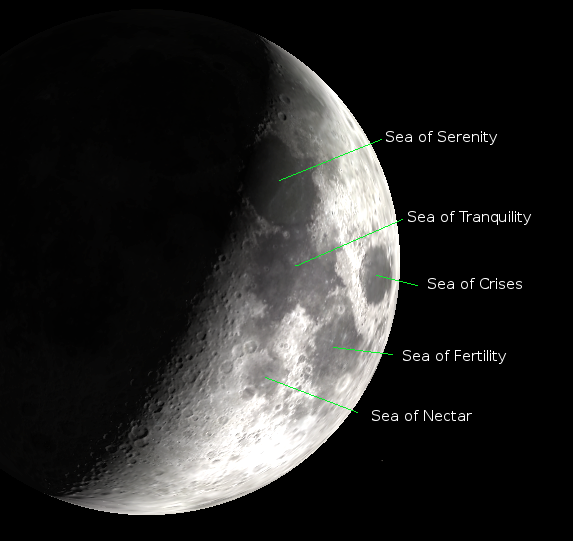
The Moon at low magnification this evening, May 28, 2020 with the English names for the visible lunar seas. Created using Stellarium.
04/27/2020 – Ephemeris – Sunrise at Theophilus
This is Ephemeris for Monday, April 27th. Today the Sun will be up for 14 hours and 5 minutes, setting at 8:43, and it will rise tomorrow at 6:36. The Moon, 3 days before first quarter, will set at 1:26 tomorrow morning.
If my Moon charting software is correct this is the one evening out of the month when the central peak of the crater Theophilus catches the first rays of the rising Sun, while the crater floor is in shadow. It kind of looks like a bulls eye. It can be spotted with binoculars on the inside of the crescent, on the terminator, the sunrise line about half way between the ends of the crescent. Theophilus is 61 miles (101 km) in diameter. A telescope of any size with 30 to 50 power magnification will really bring out the detail. More magnification may be warranted, but if the bigger image becomes fuzzy, back off the power. It may be the diameter of your telescope due to the wave nature of light or the atmosphere you’re looking through that’s causing the problem.
The event times given are for the Traverse City/Interlochen area of Michigan. They may be different for your location.
Addendum
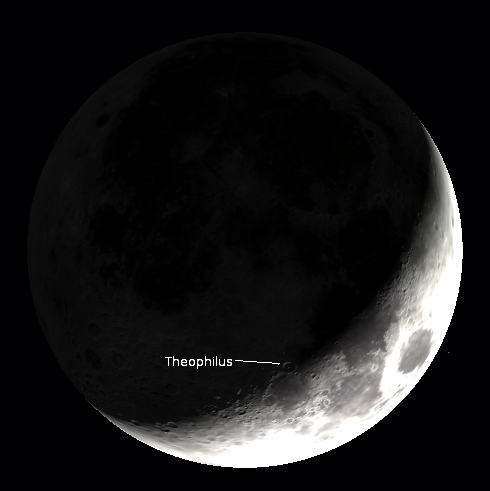
The Moon as it should appear at 10 p.m. tonight April 27, 2020 EDT (2:00 UT the 28th UT) with Theophilus on the terminator. Created with Stellarium.
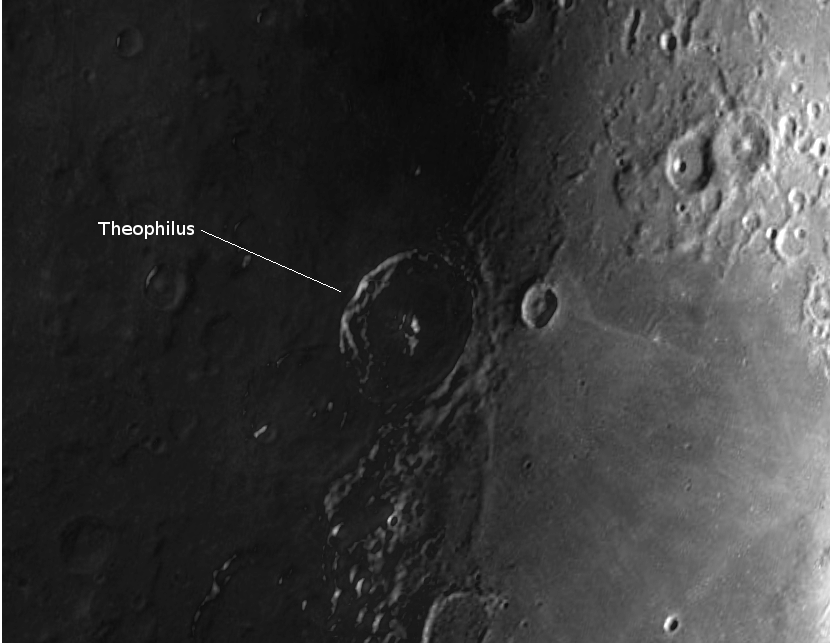
Theophilus at sunrise with the Sun illuminating the central peak and the far crater wall. Theophilus’ diameter is 61 miles or 101 kilometers in diameter. The crater walls rise 13 ,3000 feet or 4,400 meters above the crater floor, and the central mountain with four peaks rises 4,600 feet or 1,400 meters above the crater floor. Image and information from Virtual Moon Atlas. This image needs to be rotated clockwise about 45 degrees to match the image above.
04/07/2020 – Ephemeris – Today is the Paschal full moon
This is Ephemeris for Tuesday, April 7th. Today the Sun will be up for 13 hours and 6 minutes, setting at 8:18, and it will rise tomorrow at 7:09. The Moon, at full today, will rise at 7:55 this evening.
Tonight’s full moon is the Paschal full moon, the first full moon of spring which is tomorrow in the Holy Land, so Passover begins at sunset tomorrow. Easter for western churches falls on the first Sunday after the first full moon of spring, which is this next Sunday the 12th. Orthodox Easter rule adds that it must fall after Passover,a week long observance, which pushes their Easter celebration to a week later, April 19th. Both Christian churches attempt to mimic the Jewish Lunar Calendar by setting Easter by the first full moon of spring using solar based calendars and assuming that spring started on March 21st. This year actual spring started on the 20th in the Holy Land, and 19th here by 10 minutes, in our Gregorian Calendar and 13 days earlier by the old Julian Calendar. This is all very complicated.
The event times given are for the Traverse City/Interlochen area of Michigan. They may be different for your location.
04/06/2020 – Ephemeris – Tomorrow’s full moon is special in two ways
This is Ephemeris for Monday, April 6th. Today the Sun will be up for 13 hours and 3 minutes, setting at 8:17, and it will rise tomorrow at 7:11. The Moon, 1 day before full, will set at 7:21 tomorrow morning.
The Moon will be full tomorrow, and also it will reach perigee, that is, its closest to the Earth of its current orbit, and for 2020. That makes it a super moon. The orbit of the Moon is affected by the Sun, Venus, and Jupiter mostly. So all perigees are not equally close. At perigee tomorrow the Moon will be 221,772 miles (356,907* km). I its most distant point from the Earth of 252,564 miles (406,462* km). We won’t notice it because it will be nearly new at that time. Tomorrow’s full moon will be special in another way, because it it the full moon that announces Easter for both Christian churches, east and west, and Passover for the Jews. I’ll talk more about that tomorrow.
The event times given are for the Traverse City/Interlochen area of Michigan. They may be different for your location.
* According to Astronomical Tables of the Sun, Moon and Planets Third Edition by Jean Meeus.
 Bob Moler's Ephemeris Blog