Archive
04/26/2021 – Ephemeris – There’s a full supermoon tonight
This is Ephemeris for Monday, April 26th. Today the Sun will be up for 14 hours and 2 minutes, setting at 8:41, and it will rise tomorrow at 6:38. The Moon, at full today, will rise at 8:19 this evening.
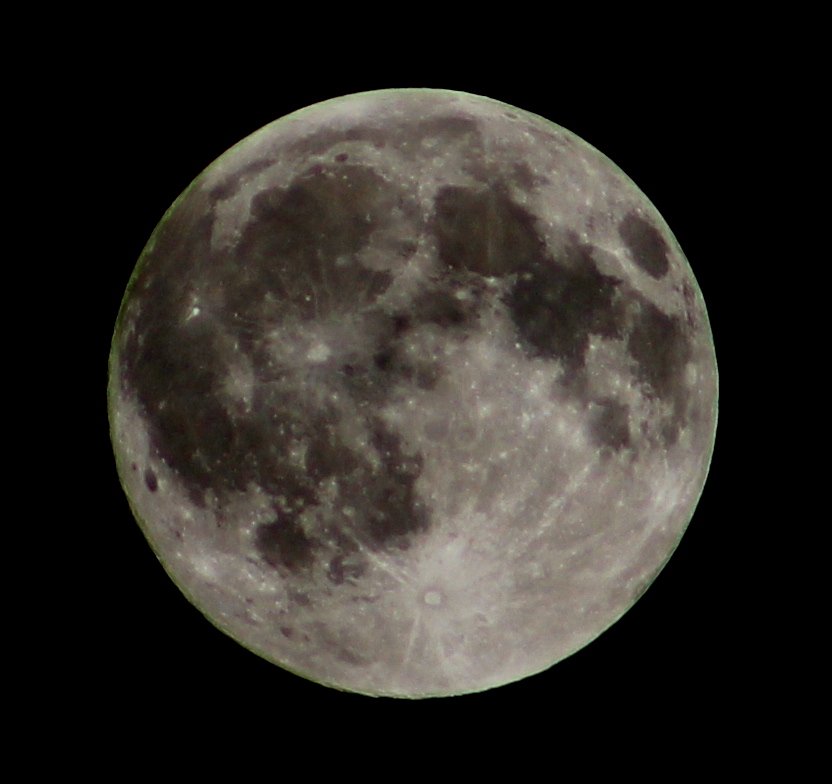
The full moon tonight is the full Pink Moon, and a supermoon. As down as I am about full moons due to the fact that they light up the sky and flood out the dimmer objects in the sky, I once in a while stop and view it. The time of the full moon is 11:31 tonight, so when it rises tonight we will be looking at the moon from very nearly the direction of the Sun, so there will be few shadows to be had. The crater Tycho is near the bottom or south end of the moon and has long rays of tiny ejecta craters. The full moon is the best time to see these rays, which are easily visible in binoculars, through which Tycho itself looks like a bright dot. In telescopes Tycho looks like a small bright crater with a dark ring around it. The full moon is super bright. It’s daytime over there.
The astronomical event times given are for the Traverse City/Interlochen area of Michigan. They may be different for your location.
Addendum
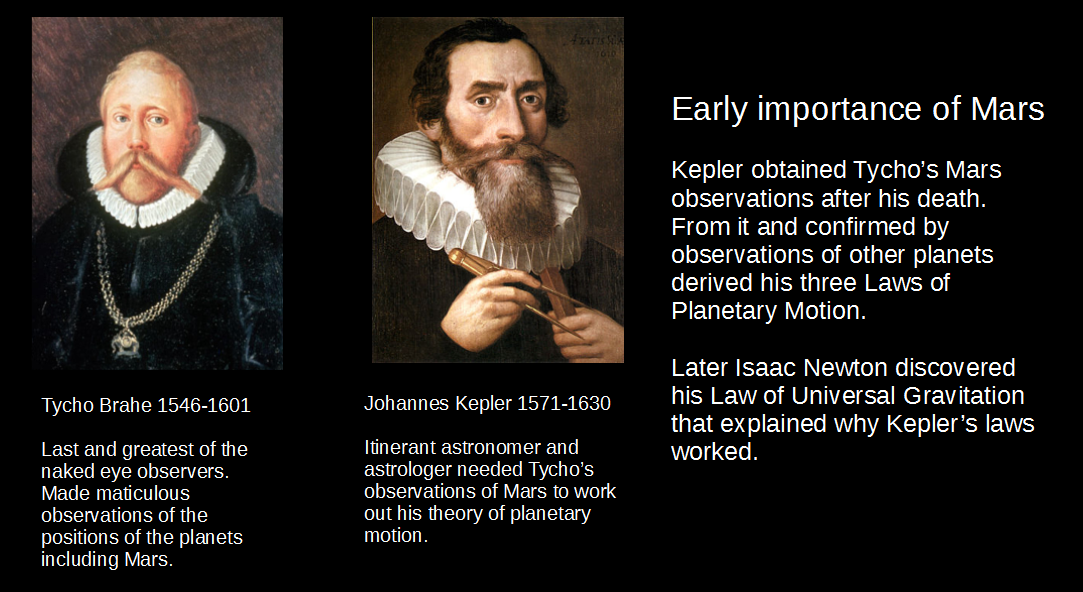
Tycho Brahe and Johannes Kepler are inexorably linked in astronomical history. Tycho was famously stingy with the results of his observations. It was only after his death that Kepler was able to have access to them. Mars was the planet that was hardest to model in both the Ptolemaic geocentric and Copernican heliocentric universes, since both assumed the planetary orbits were circular. So both resorted to epicycles in an attempt to tweak their models in an attempt to fit with observational reality.
Both Tycho and Kepler have craters named for them on the Moon. Tycho gets a splashy crater on the southern part of the Moon. Kepler, however, gets a small crater on the plains of Oceanus Procellarum west of the crater Copernicus on the left side of the Moon, as we see it
04/23/2021 – Ephemeris – The gibbous Moon tonight
This is Ephemeris for Friday, April 23rd. Today the Sun will be up for 13 hours and 53 minutes, setting at 8:38, and it will rise tomorrow at 6:43. The Moon, halfway from first quarter to full, will set at 5:49 tomorrow morning.
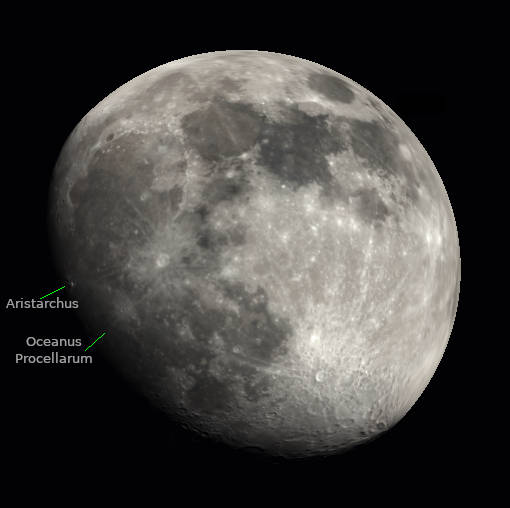
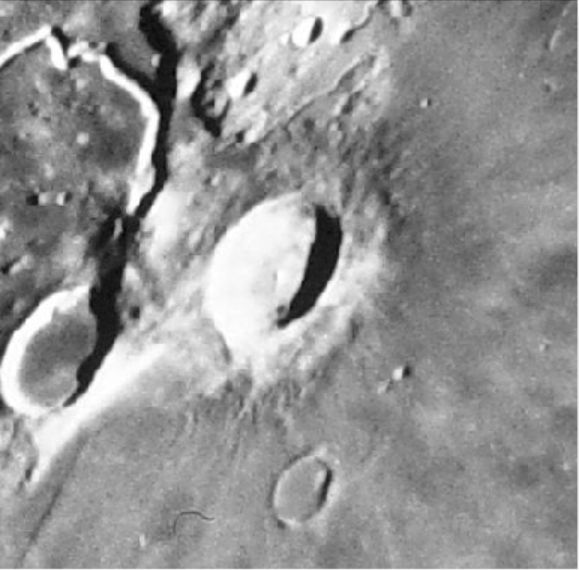
The Moon tonight is bright. The sunrise line or terminator on the Moon is crossing the large gray plain called Oceanus Procellarum, the largest of the Moon’s seas. These seas were figments of the first telescopic observer’s imagination. They are really huge impact basins into which interior lava flowed. On the upper left edge of the moon near the terminator is a bright spot visible in binoculars. In a telescope it is a crater called Aristarchus. It is a fairly new crater, probably 450 million years old. As a rule the brighter the crater the newer it is. Aristarchus is the brightest spot on the moon when it is seen during a full moon. Over the years visual astronomers have seen hazes and bright spots from time to time in and near Aristarchus.
The astronomical event times given are for the Traverse City/Interlochen area of Michigan. They may be different for your location.
Addendum
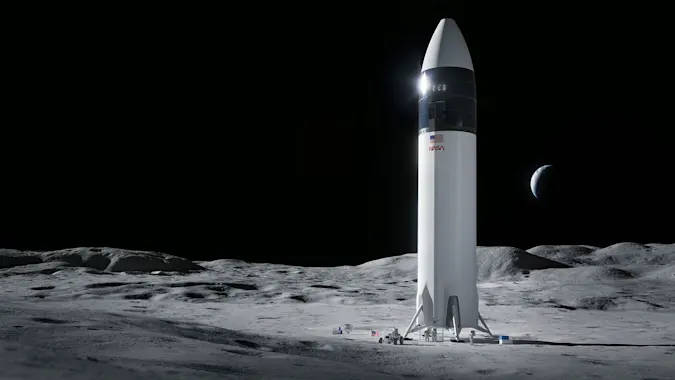
04/20/2021 – Ephemeris – SpaceX gets NASA contract for Human Landing System for the Artemis (Moon) Program
This is Bob Moler with Ephemeris for Tuesday, April 20th. Today the Sun will be up for 13 hours and 44 minutes, setting at 8:34, and it will rise tomorrow at 6:47. The Moon, at first quarter today, will set at 4:24 tomorrow morning.
Late last week NASA announced that it had selected SpaceX to provide the Human Lander System for the Artemis program. That lander is the lunar variant of the Starship SpaceX is currently testing near Boca Chica, Texas, just north of the mouth of the Rio Grande. A Starship consists of two stages: a booster called Super Heavy and the Starship upper stage. The Super Heavy returns to the launch site, while the Starship must be refueled several times in orbit to be able to head on out to the Moon. The astronauts would be launched as planned in an Orion capsule with the Space Launch System, then transfer the astronauts to the Starship waiting in lunar orbit or from the Lunar Gateway also in lunar orbit for the trip down to the lunar surface.
The astronomical event times given are for the Traverse City/Interlochen area of Michigan. They may be different for your location.
Addendum
NASA’s Source Selection Document (the rationale for their selection): https://www.nasa.gov/sites/default/files/atoms/files/option-a-source-selection-statement-final.pdf
04/19/2021 – Ephemeris – The Moon tonight, Yutu the Jade Rabbit
This is Ephemeris for Monday, April 19th. Today the Sun will be up for 13 hours and 42 minutes, setting at 8:33, and it will rise tomorrow at 6:49. The Moon, 1 day before first quarter, will set at 3:47 tomorrow morning.
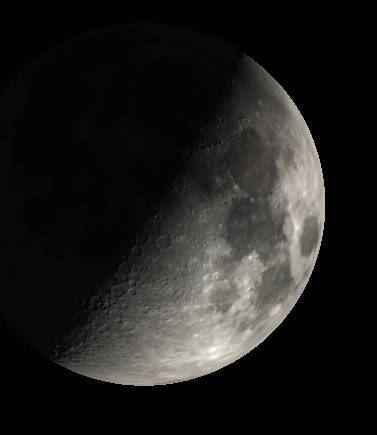
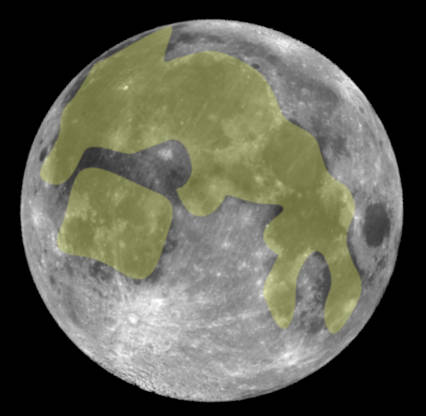
Let’s take a look at the Moon tonight. Binoculars or a small telescope will be handy for seeing the lunar features. The Moon will be at actual first quarter at 3 am tomorrow morning so the terminator or in this case sunrise line on the Moon will cut it nearly in half. To the naked eye the face of the Man in the Moon isn’t yet noticeable, but the top part of the upside down Chinese rabbit Yutu can be glimpsed. His ears are the seas of Fertility and Nectar, his head is the Sea of Tranquility, and the top part of his body is the Sea of Serenity. The lower part of his body and his arms pulverizing medicine with a mortar and pestle will have to wait until the Moon is nearer full. Yutu is the pet rabbit of the Chinese Moon goddess Chang’e.
The astronomical event times given are for the Traverse City/Interlochen area of Michigan. They may be different for your location.
Addendum
04/15/2021 – Ephemeris – The Moon tonight – libration
This is Bob Moler with Ephemeris for Thursday, April 15th. Today the Sun will be up for 13 hours and 30 minutes, setting at 8:28, and it will rise tomorrow at 6:56. The Moon, 4 days past new, will set at 12:14 tomorrow morning.
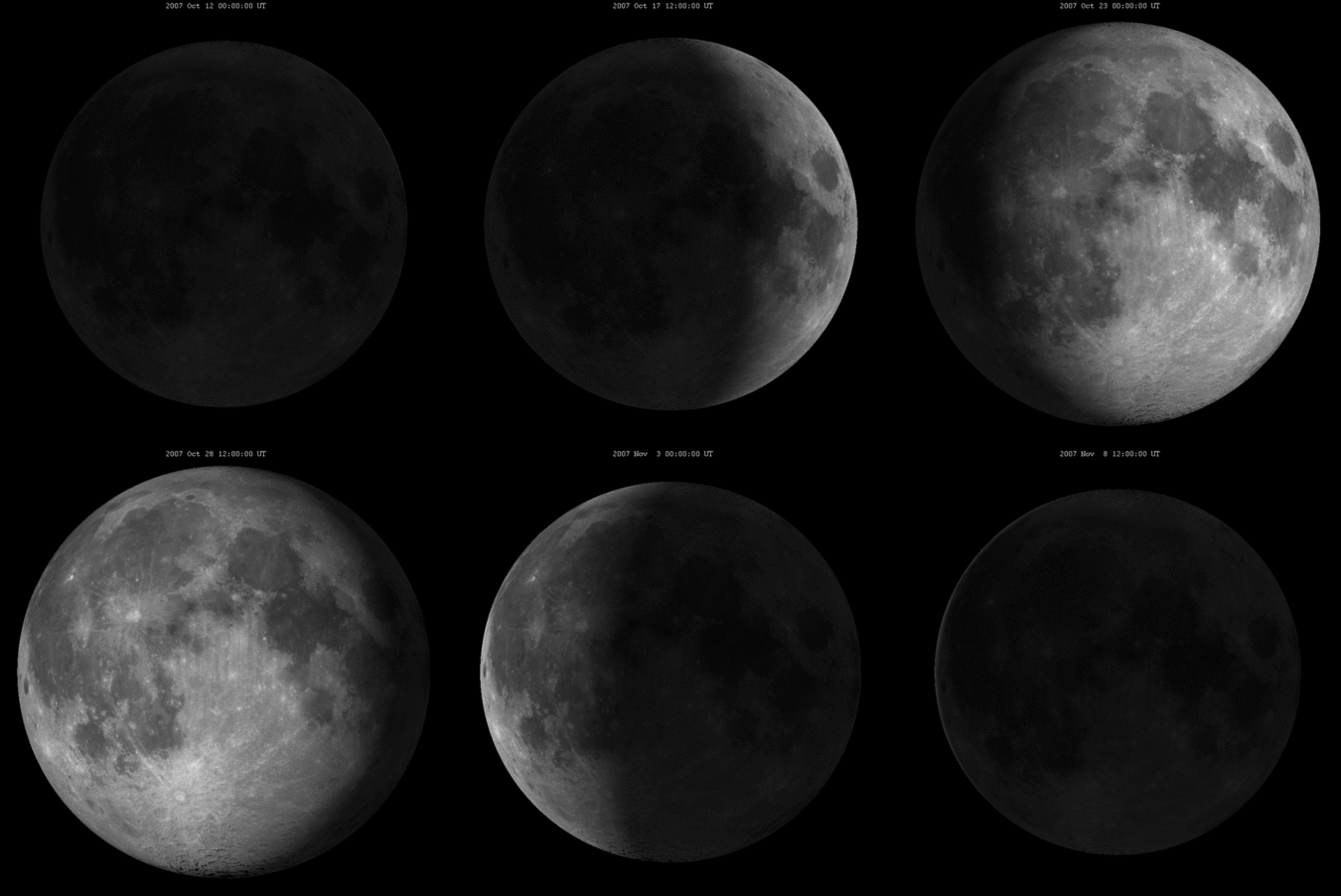
The crescent Moon tonight is in the constellation of Taurus the bull. The bright star Aldebaran will be just to the left of the Moon. In binoculars the dark oval spot visible on the Moon is the Sea of Crises or Mare Crisium a small dark lava plain. The Moon’s rotation is quite uniform, however its orbit isn’t circular, so the Moon’s appearance seems to rock a bit back and forth over the month. It’s an effect called libration. And one way to track that is to note how close the Sea of Crises is to the edge of the Moon. A week from now that sea will appear its closest to the edge. Astronomers call the edge of the Moon the limb. The phase line between day and night on the Moon is called the terminator. Now as the Moon is waxing, it is the morning or sunrise terminator.
The astronomical event times given are for the Traverse City/Interlochen area of Michigan. They may be different for your location.
Addendum
04/06/2021 – Ephemeris – The spring constellation of Leo
This is Bob Moler with Ephemeris for Tuesday, April 6th. Today the Sun will be up for 13 hours and 3 minutes, setting at 8:17, and it will rise tomorrow at 7:12. The Moon, 2 days past last quarter, will rise at 5:48 tomorrow morning.
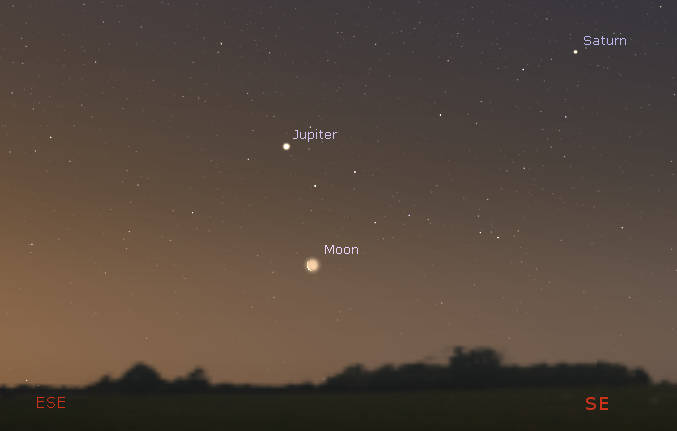
Tomorrow morning early risers will see the Moon near the planets Saturn and Jupiter. Specifically Jupiter, left of Saturn will be right above the waning crescent Moon.
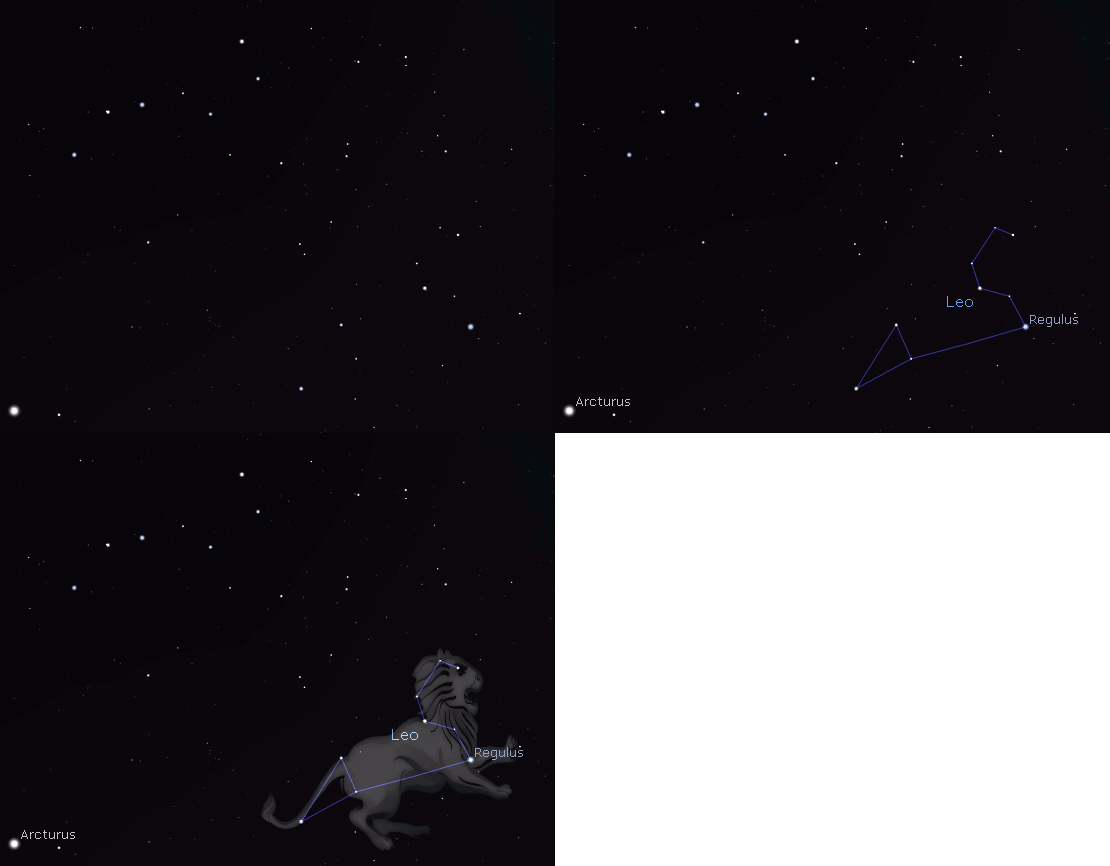
Tonight however, will be a good time to check out Leo the celestial lion high in the southeast. His distinctive pattern of stars is a backward question mark, with the bright star Regulus as the dot on the bottom of it. It delineates the male lion’s head and mane. That pattern is also called the Sickle. While Leo is one of the official 88 constellations, the Sickle is an asterism, or informal constellation. Completing Leo is a triangle of stars below left of Regulus, his rump ending with the star Denebola, at the root of Leo’s tail. Leo is rich in mythology.
The astronomical event times given are for the Traverse City/Interlochen area of Michigan. They may be different for your location.
Addenda
Jupiter and the Moon tomorrow morning
Leo tonight
03/23/2021 – Ephemeris – The Moon tonight: Bay of Rainbows
This is Bob Moler with Ephemeris for Tuesday, March 23rd. Today the Sun will be up for 12 hours and 19 minutes, setting at 7:59, and it will rise tomorrow at 7:37. The Moon, 2 days past first quarter, will set at 5:50 tomorrow morning.
A look at the Moon tonight will reveal that the sunrise line, or terminator has almost completely revealed the large Sea of Showers or Mare Imbrium to the upper left of the center of the gibbous disk. At the extreme upper left nearly completely in sunlight a very popular feature, the Bay of Rainbows or Sinus Iridium. It’s a colorful name for something that’s as gray as the rest of the Moon. It looks like a bay off of Imbrium, and has an arch like a rainbow. Its arch is the Jura Mountains, which jut into Mare Imbrium at Cape Heraclide, just catching sunlight, and Cape Laplace farther into morning. What’s cool is catching it as the sunlight is hitting the mountains while the convex floor, following the Moon’s curvature is only partially illuminated.
The astronomical event times given are for the Traverse City/Interlochen area of Michigan. They may be different for your location.
Addendum
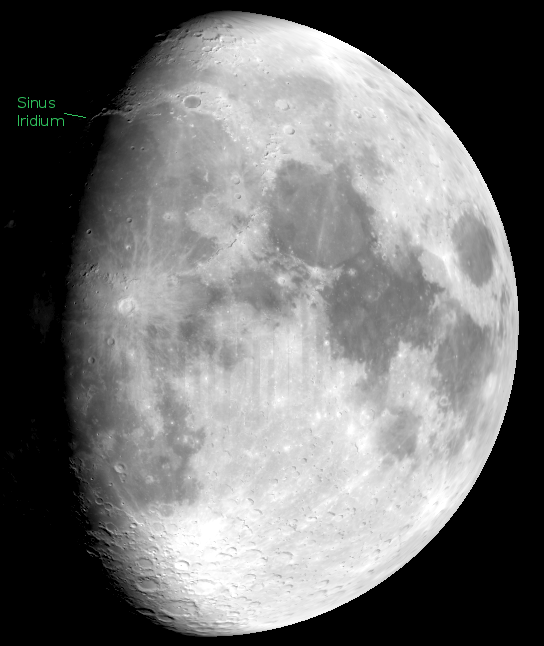
The Moon a little before how it will appear tonight highlighting Sinus Iridium. By tonight the floor of Sinus Iridium should be pretty much sunlit, and the Jura mountains completely lit. Created using Virtual Moon Atlas.
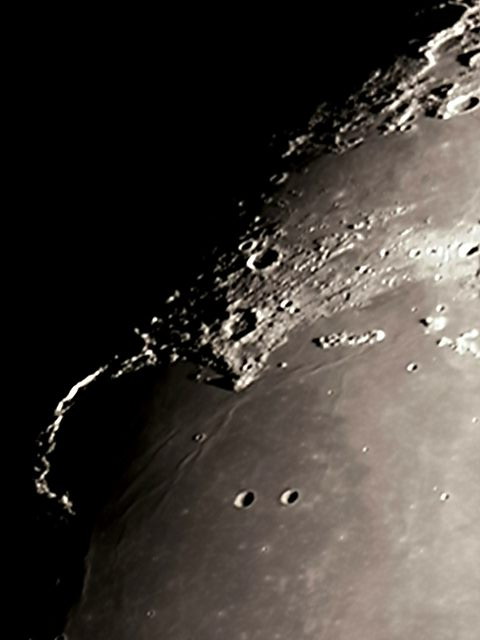
Sinus Iridium at sunrise. Photo by “Seb2003” on http://forums.futura-sciences.com/materiel-astronomique-photos-damateurs/5809-images-de-lune.html.
03/22/2021 – Ephemeris – The Moon and the week
This is Bob Moler with Ephemeris for Monday, March 22nd. Today the Sun will be up for 12 hours and 16 minutes, setting at 7:58, and it will rise tomorrow at 7:39. The Moon, 1 day past first quarter, will set at 5:08 tomorrow morning.
The Moon tonight is about as far north in the sky as it gets this month, and being six days before full, and this full Moon is the first full moon of spring, that means Easter is less than two weeks away. Did you notice that a week is nearly equal to a quarter of the Moon’s orbit of the Earth? If you look at a calendar that has the Moon’s phases on it the phases are 7 or 8 days apart. It’s a good thing that no one decided to adjust the length of the week to accommodate the Moon’s phases. It’d be hard to plan your weekend. Our calendar is pretty screwed up as it is with months of 28, 29, 30 and 31 days all set by politicians… Roman politicians at that. I haven’t heard much about calendar reform lately, so I guess we’re stuck with it.
The astronomical event times given are for the Traverse City/Interlochen area of Michigan. They may be different for your location.
Addendum
I wrote the above before actually checking out the historical origin of the time period we call a week. It turns out that the week is really related to a quarter of a lunation or lunar month. The Babylonians fixed the fact that seven days is a bit less than a quarter of a lunation by adding a day or two to the last week of the month, so the next month’s new moon started on the same day of the week.
Here the new moon is defined as the first appearance of the Moon in the evening sky after disappearing from the morning sky. We currently define the new moon as the Moon’s solar conjunction. Its first appearance in the evening sky would generally be the next day, or rather evening. The numbering still works out. Our new moon is day zero of the lunar month.
02/26/2021 – Ephemeris – Origin of the Moon
This is Ephemeris for Friday, February 26th. Today the Sun will be up for 11 hours and 1 minute, setting at 6:26, and it will rise tomorrow at 7:23. The Moon, 1 day before full, will set at 7:59 tomorrow morning.
The origin of the Moon is a question that has vexed astronomers for years. Did it break off the molten Earth like a cell dividing? Was it captured by passing too close to the Earth? Neither is satisfactory. Chemical elements have different isotopes depending on the number of neutrons in their nucleus. The rocks brought back by the Apollo astronauts show that the isotopes of the elements in the rocks are the same as for the Earth. We know that Mars and the asteroids have different isotope ratios. The hypothesis that seems most likely is that another planet, the size of Mars collided with the 100 million-year-old Earth in a glancing blow that gave rise to a disk of material that eventually coalesced to form the Moon.
The astronomical event times given are for the Traverse City/Interlochen area of Michigan. They may be different for your location.
Addendum
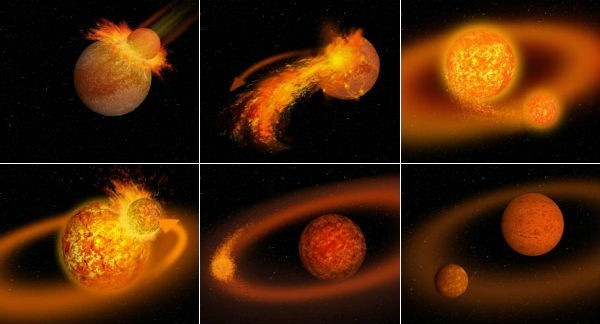
A progression of how the Moon may have formed by a small protoplanet crashed into the Earth. Credit: Brian Koberlein.
02/25/2021 – Ephemeris – Moon Dust, bad stuff
This is Ephemeris for Thursday, February 25th. Today the Sun will be up for 10 hours and 58 minutes, setting at 6:25, and it will rise tomorrow at 7:24. The Moon, 2 days before full, will set at 7:30 tomorrow morning.
One of the big problems that will have to be solved before the Artemis program sets up a permanent base on the Moon is what to do about lunar soil or Moon dust. That stuff gets into everything. The Apollo astronauts said it smelled like gunpowder. Unlike beach sand the particles aren’t rounded, but angular, being produced by rocks being hit by meteoroids large and micro over the eons by space weathering. With no atmosphere small particles can even weld themselves together. Though no studies have been done, any brought into the habitat would do damage to the lungs, like that to miners on Earth. Moon dust has compromised the seals on the containers of soil the Apollo crews brought back from the Moon.
The astronomical event times given are for the Traverse City/Interlochen area of Michigan. They may be different for your location.
Addendum
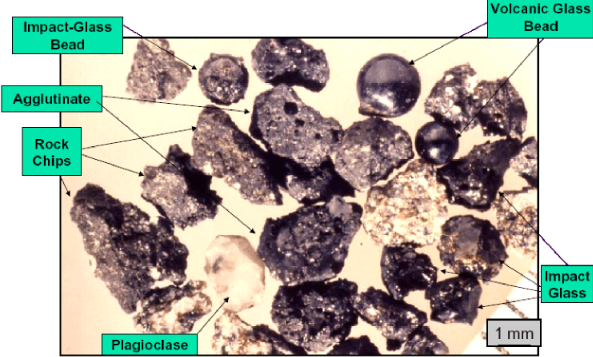
Lunar soil sample. Credit Larry Taylor U of TN Knoxville from https://ntrs.nasa.gov/api/citations/20090026015/downloads/20090026015.pdf
 Bob Moler's Ephemeris Blog