Archive
11/05/2017 – Ephemeris Extra – There will be an Occultation of Aldebaran tonight*
This posting will not be broadcast.
* Or tomorrow morning, depending where you are.
Ephemeris extra for Sunday, November 5th. The Sun will rise at 7:25. It’ll be up for 10 hours and 5 minutes, setting at 5:25. The Moon, 2 days past full, will rise at 7:01 this evening.
Tonight just after 8 p.m. the bright star Aldebaran will disappear at the left edge of the Moon. Aldebaran is angry red eye of Taurus the bull. The star will reappear at the dark upper right edge of the Moon. Start looking at 8 p.m. or before. Use binoculars or a small telescope to spot the star against the glare of the bright Moon. The star is nowhere as bright as shown in the illustrations below. Star appearances and disappearances appear instantaneous, unlike what the illustrations show.
Aldebaran Occultation begins at 8:07 p.m. EST (1:07 UTC Nov 6th)
Aldebaran Occultation ends at 9:00 p.m. EST (02:00 UTC Nov 6th)
Note the times are for the Traverse City/Interlochen area. It will vary by a few minutes for northern lower Michigan. The position angles of the entrance and exit points of Aldebaran will also be different.
Otherwise use a planetarium program like Stellarium to preview the event. However, set the program for topocentric coordinates. In Stellarium that’s in the Configuration window, Tools Tab and check the Topocentric coordinates box. Topocentric coordinates are the apparent positions for your location on the Earth. So also make sure your location is correct. The geocentric conjunction of the two bodies will be November 6, 2:42.9 UTC, so it will occur after midnight on the morning of November 6th for locations in northern Europe and Asia.
Addendum
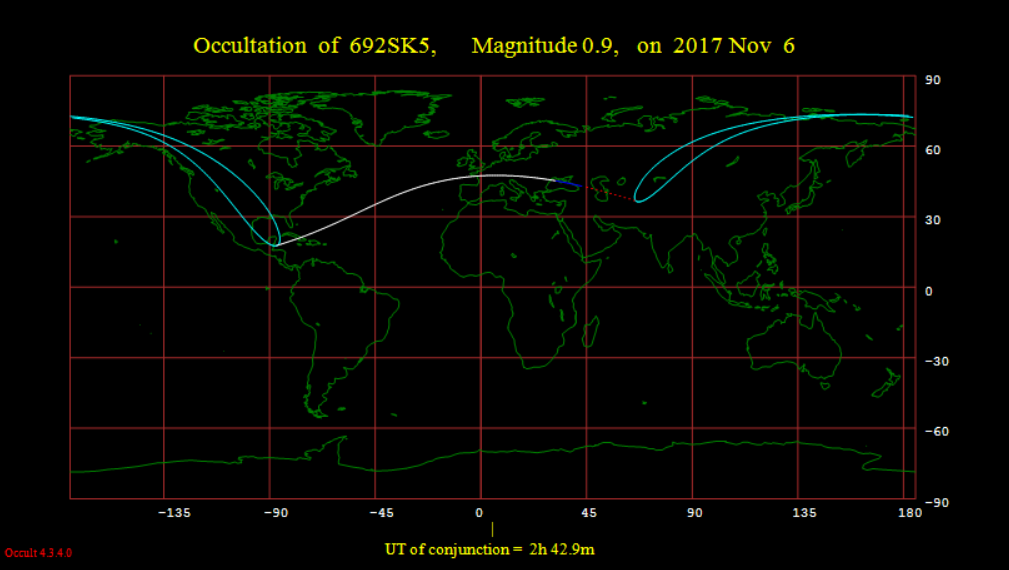
Occultation Map for the occultation of Aldebaran by the Moon . Credit Occult 4 program from IOTA.org.
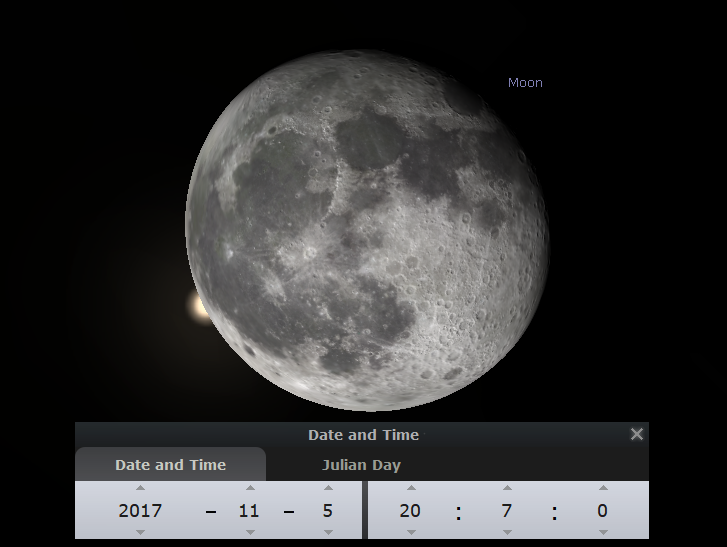
Aldebaran at the start of the occultation at 8:07 p.m. for the Traverse City/Interlochen area. Created using Stellarium.
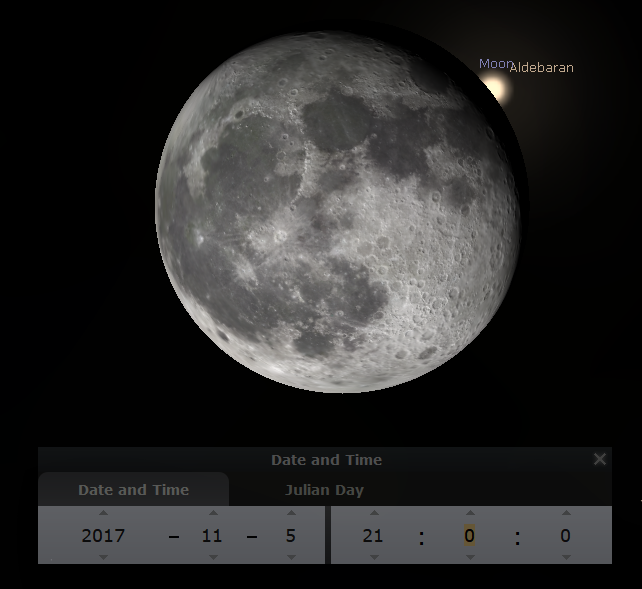
Aldebaran at the end of the occultation at 9:00 p.m. for the Traverse City/Interlochen area. Created using Stellarium.
10/27/2017 – Ephemeris – Tomorrow night is International Observe the Moon Night in downtown Traverse City
Ephemeris for Friday, October 27th. The Sun will rise at 8:13. It’ll be up for 10 hours and 24 minutes, setting at 6:38. The Moon, at first quarter today, will set at 12:44 tomorrow morning.
The annual International Observe the Moon Night will be observed this Saturday evening. Members of the Grand Traverse Astronomical Society will be stationed on the north side of the 200 block of East Front Street. Starting at 7 p.m. near Orvis Streamside and will be moving our telescopes eastward from time to time to keep up with the westward sinking motion of the Moon over the single story buildings to the south as long as we can. The moon will be a day past first quarter with lots of craters and lunar seas visible in telescopes. The society will also have some giveaway items from NASA for the young and not so young. The event will be canceled due to heavy overcast or other inclement weather.
The times given are for the Traverse City/Interlochen area of Michigan. They may be different for your location.
Addendum
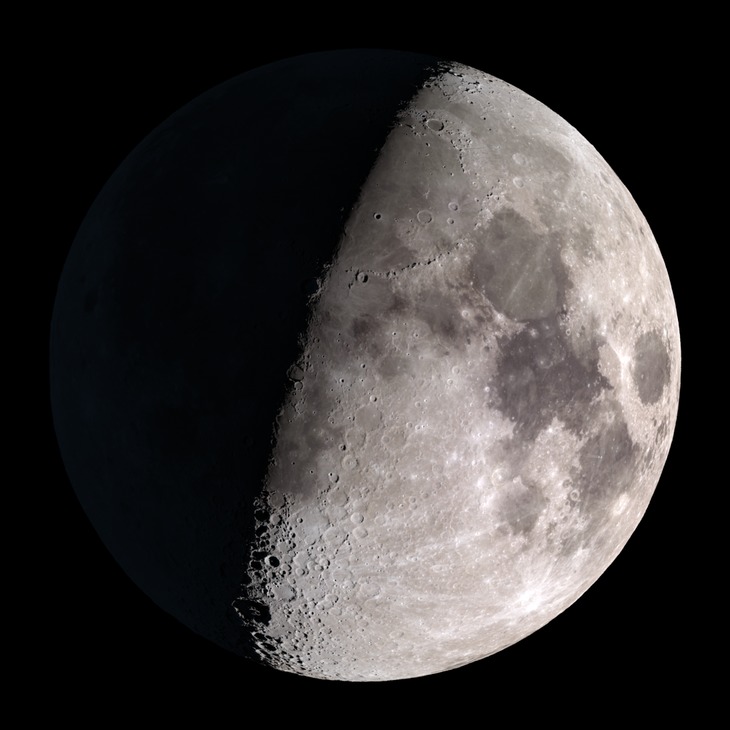
The Moon about as it would appear tomorrow night, October 28, 2017 at 8 p.m. Credit: NASA/Ernie Wright.
10/24/2017 – Ephemeris – Saturn and the Moon tonight
Ephemeris for Tuesday, October 24th. The Sun will rise at 8:09. It’ll be up for 10 hours and 32 minutes, setting at 6:42. The Moon, 3 days before first quarter, will set at 10:09 this evening.
The crescent Moon will be in the southwest as it gets dark tonight. The planet Saturn will appear below and to the right of our satellite. Saturn has those gorgeous rings, which are visible at as low as 20 power scopes and hinted at lower magnifications. The Moon shows a fat crescent with two whole gray seas, Crises, nearest the limb, and below Fertility. Partially illuminated are Tranquility above and the small sea of Nectar. At the bottom end of that small sea is a horse shoe shaped crater called Fracastorius. It looks like the lava welling up from the Nectar asteroid impact washed down the walls of Fracastorius. The bottom part of the Moon is the lunar highlands of brighter rugged craters.
The times given are for the Traverse City/Interlochen area of Michigan. They may be different for your location.
Addendum
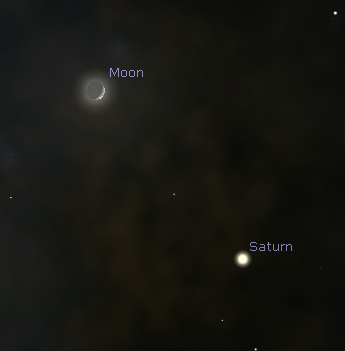
The Moon and Saturn at 8 p.m. October 24, 2017. Created using Stellarium.
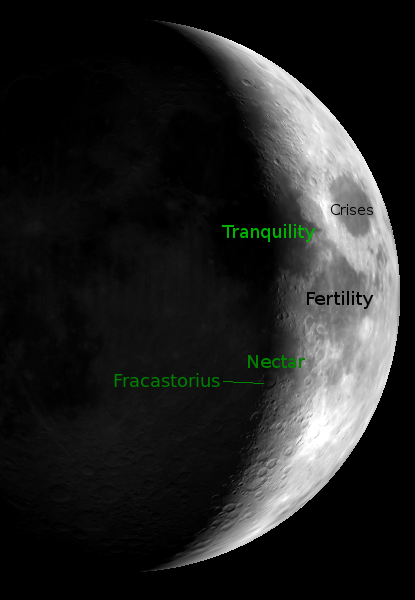
The Moon at 8 p.m. October 24, 2017 as it might be seen in binoculars. Created using Virtual Moon Atlas.
10/13/2017 – Ephemeris – The bright star Regulus dips behind the Moon Sunday morning
Note: The original program recorded for this day was erroneous in the timing and appearance of this event. Occurring about an hour later than reported here. The Interlochen personnel may or may not replace the original program with the one below. Also those who downloaded the audio from ephemeris.bjmoler.org before late Thursday night may have downloaded the incorrect mp3.
Ephemeris for Friday, October 13th. The Sun will rise at 7:55 a.m.. It’ll be up for 11 hours and 5 minutes, setting at 7:00 p.m. The Moon, 1 day past last quarter, will rise at 2:08 tomorrow morning.
On Sunday morning the Moon will pass in front of, or occult the bright star Regulus, the brightest star in Leo the lion. This will happen as morning twilight starts. Regulus will disappear at the left edge of the crescent Moon at around 5:47 a.m. A telescope or binoculars may be needed to spot Regulus. Go out at least 5 or 10 minutes early to make sure you can spot the star. Regulus will reemerge at 6:25 at the 11 o’clock position on the dark part of the Moon. Earth shine on the night side of the Moon may be bright enough to see its dark edge. Observers west of us in the United States except the northern most states west of Minnesota will also get a view. Those in specific locations in the northern tier of states will get to see Regulus just graze the north edge of the Moon.
The times given are for the Traverse City/Interlochen area of Michigan. They may be different for your location.
Addendum
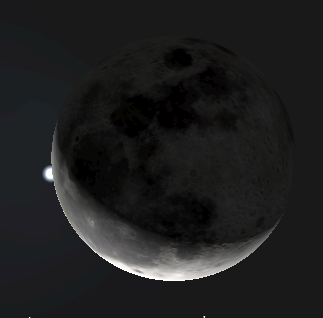
Occultation of Regulus by the Moon disappearance at around 5:47 a.m. for northern Michigan. Created using Stellarium.
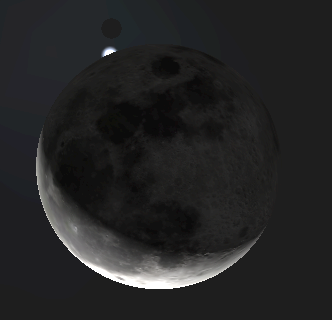
Occultation of Regulus by the Moon reappearance at around 6:25 a.m. for northern Michigan. Created using Stellarium.
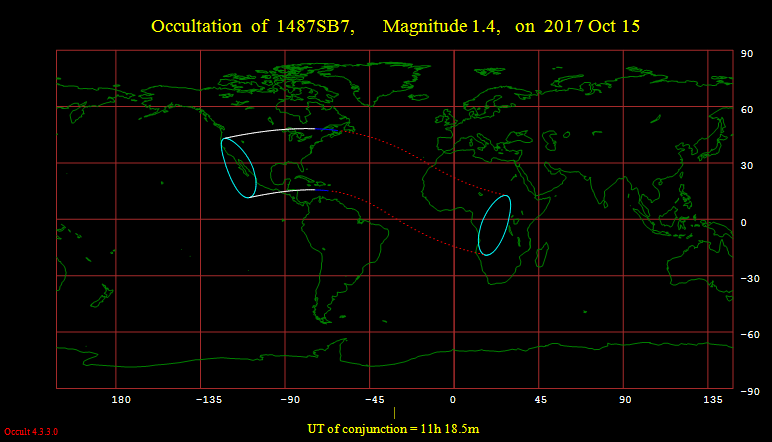
Map showing the locations where the occultation of Regulus will be visible. For the area bounded by heavy lines the occultation will occur at night. Click on image to enlarge. Credit: Occult4 by IOTA.
10/05/2014 – Ephemeris – The Harvest Moon
This is Bob Moler with Ephemeris for Thursday, October 5th. The Sun will rise at 7:45. It’ll be up for 11 hours and 29 minutes, setting at 7:15. The Moon, at full today, will rise at 7:38 this evening.
This is the day of the Harvest Moon. It will rise just before sunset and colored like a huge pumpkin. The huge size is an optical illusion, and the coloring is courtesy of our Earth’s atmosphere selectively bleeding out the blue from the Moon’s light. The reason the Harvest Moon is so special is that during this period the Moon rises for quite a few days just before and in twilight, effectively lengthening the hours of light that farmers can have to harvest their crops. Tomorrow the Moon will rise 32 minutes later than tonight, rather than the average 50 minutes. The effect is a bit diminished this year because the Moon is nearing perigee, its closest to the Earth and is traveling a bit faster than average. The Moon can get down to a 25 minute day-to-day difference.
The times given are for the Traverse City/Interlochen area of Michigan. They may be different for your location.
Addendum
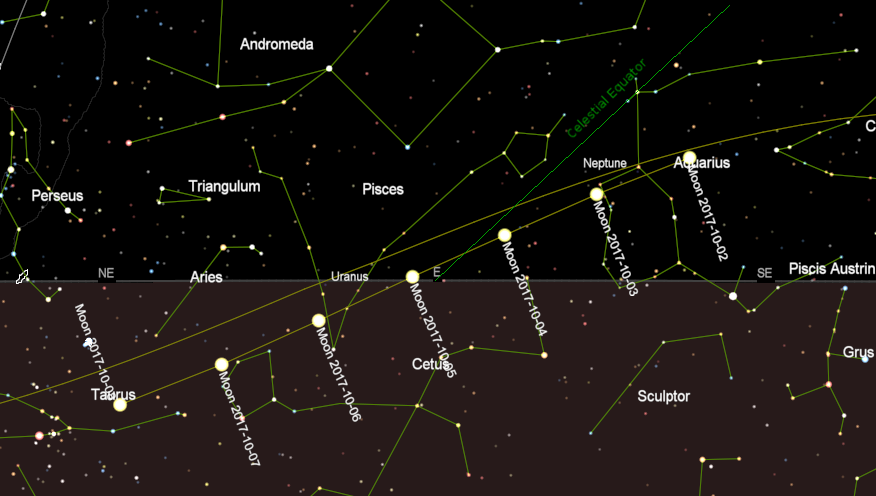
The position of the Moon for 7 nights centered on moon rise tonight (10/04/2017). The rotation of the Earth carries the Moon to rise parallel to the green celestial equator line. The brown area at the bottom is below the horizon. Click on the image to enlarge. Created using Cartes du Ciel (Sky Charts).
10/04/2017 – Ephemeris – Where are the bright planets tonight?
Ephemeris for Wednesday, October 4th. The Sun will rise at 7:44. It’ll be up for 11 hours and 32 minutes, setting at 7:17. The Moon, 1 day before full, will set at 7:21 tomorrow morning.
Let’s take our weekly look at the bright planets. Jupiter, for all intents and purposes is gone from the evening sky. It will cross into the morning sky later this month. Saturn too is sinking lower in the southwestern sky in the evening. Saturn’s rings are still spectacular in telescopes, but since Saturn is so low in the sky the turbulence of the thick atmosphere makes Saturn fuzzy and seemingly to go in and out of focus. Saturn will set at 10:43 p.m.
In the morning sky, brilliant Venus will rise at 5:11 a.m. in the east with much dimmer Mars below and right of it by half the width of the Moon. Mars is less than 100th the brightness of Venus, and will probably require binoculars to locate. (need a few words more)
The times given are for the Traverse City/Interlochen area of Michigan. They may be different for your location.
Addendum
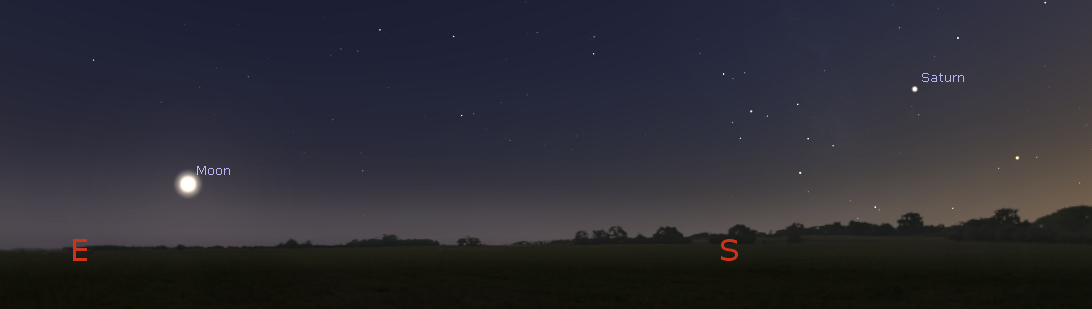
Saturn and the Moon in the evening at 8 p.m. October 4, 2017. Created using Stellarium.
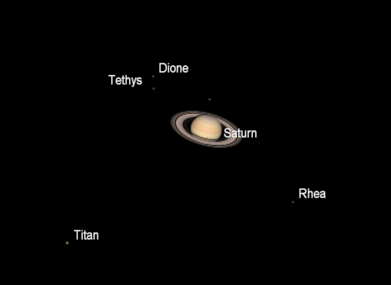
Saturn and its brightest moons overnight October 4/5, 2017. Created using Cartes du Ciel (Sky Charts).
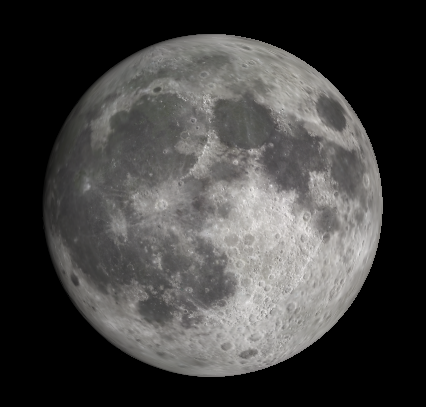
The Moon as it might be seen in binoculars, 8 p.m. October 4, 2017. Created using Stellarium.
Members of the Grand Traverse Astronomical Society and I are invited to the Chinese Mid-Autumn Festival being held for the Chinese exchange students in the Traverse City school system. Its held on the 15th day of the 8th month of the Chinese lunar calendar, the full moon, which works out to be October 4th this year. They will be having Chinese food and viewing the Moon afterward.
One of the legends celebrated then will be the Jade Rabbit pounding medicine. Jade Rabbit (Yutu) is the name of the Chinese rover that’s on the Moon. And the Jade Rabbit can actually be seen on the Moon:
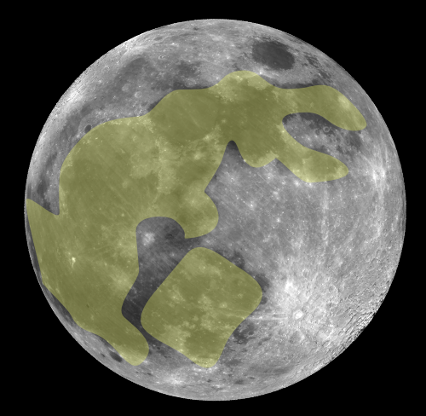
Jade Rabbit and Mortar on the Moon. Credit: Zeimusu, Creative Commons.
I hope they have Moon Cakes. They sound yummy.
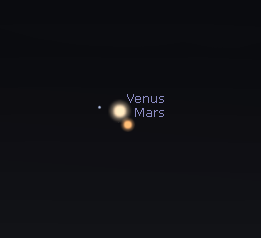
A closeup of Venus and Mars at 6:30 a.m. October 5, 2017. Created using Stellarium.
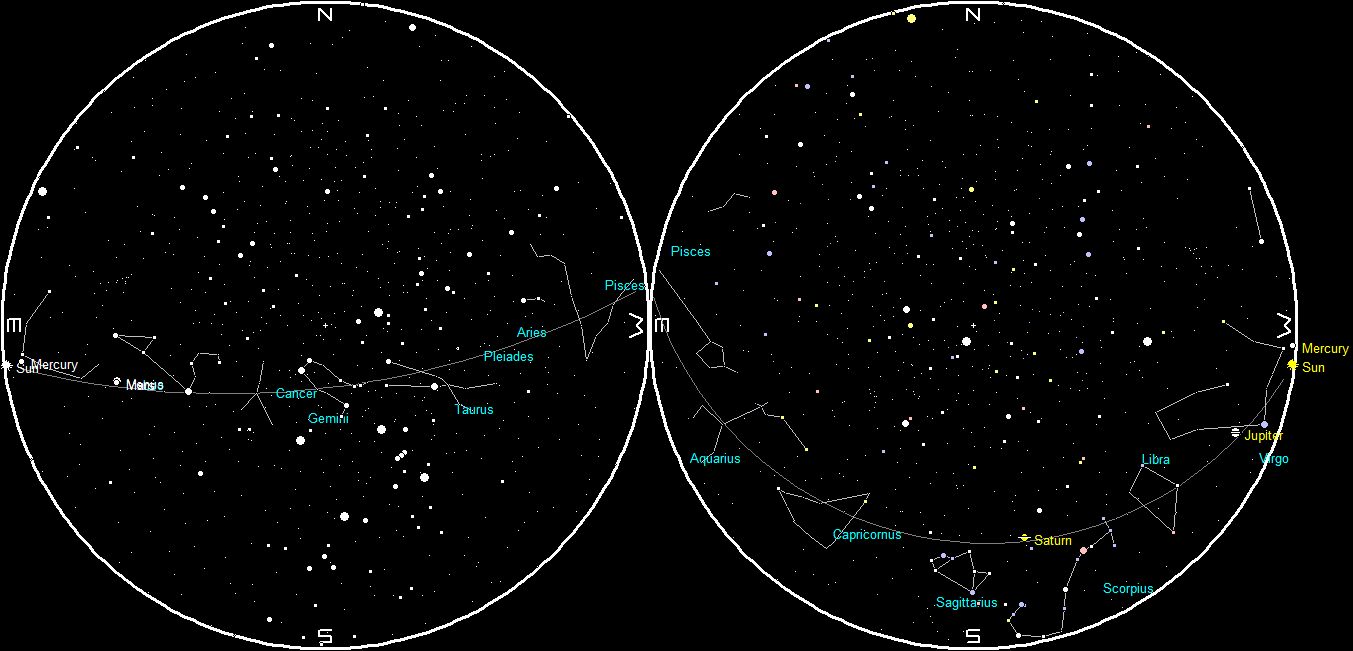
Planets at sunset and sunrise of a single night starting with sunset on the right on October 4, 2017. The night ends on the left with sunrise on the 5th. The full Moon has fallen in the cracks between the sunset and sunrise charts due to its position south of the ecliptic. Click on the image to enlarge. Created using my LookingUp program.
09/26/2017 – Ephemeris – Saturn appears near the Moon tonight
Ephemeris for Tuesday, September 26th. The Sun will rise at 7:34. It’ll be up for 11 hours and 57 minutes, setting at 7:31. The Moon, 1 day before first quarter, will set at 11:32 this evening.
Tonight the Moon will to be near the planet Saturn. At 9 p.m. the ringed planet will be seen below the crescent Moon. It’s a good way to spot Saturn if you’ve never be able to figure out which of those “stars” in the sky is Saturn. It’s easy to confirm with a small telescope. Even in binoculars Saturn is not quite a star-like point. Saturn’s rings begin to show distinctly with 20 power magnification. The Moon too is great to view at low power, even binoculars. A new sea has appeared since last night. It is the Sea of Serenity above the center of the Moon. The lunar seas are really large nearly circular lava filled craters that appear to have been the result of asteroid impacts about 3.8 or so billion years ago.
The times given are for the Traverse City/Interlochen area of Michigan. They may be different for your location.
Addendum
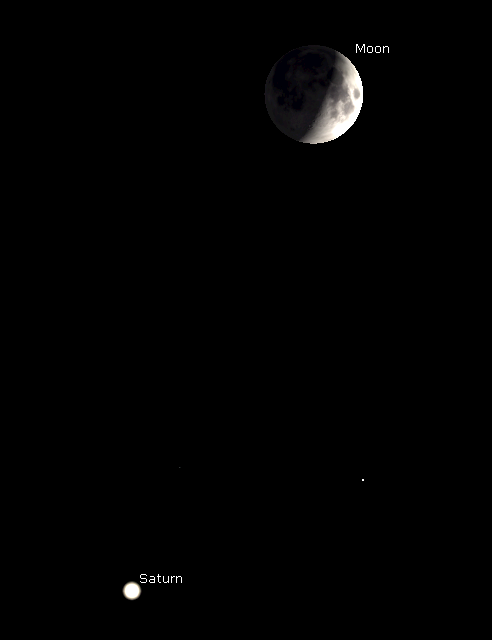
Saturn and the Moon tonight, 9 p.m. September 26, 2017. Created using Stellarium.
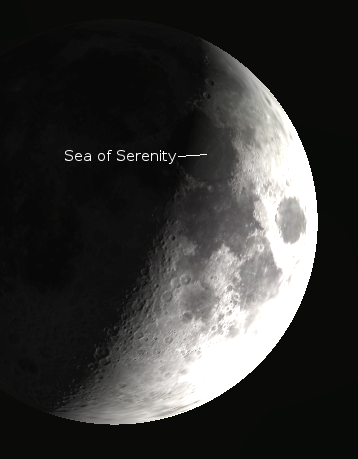
The Moon as it might be seen in binoculars, 9 p.m. September 26, 2017. Created using Stellarium.
Compare with last night’s Moon.
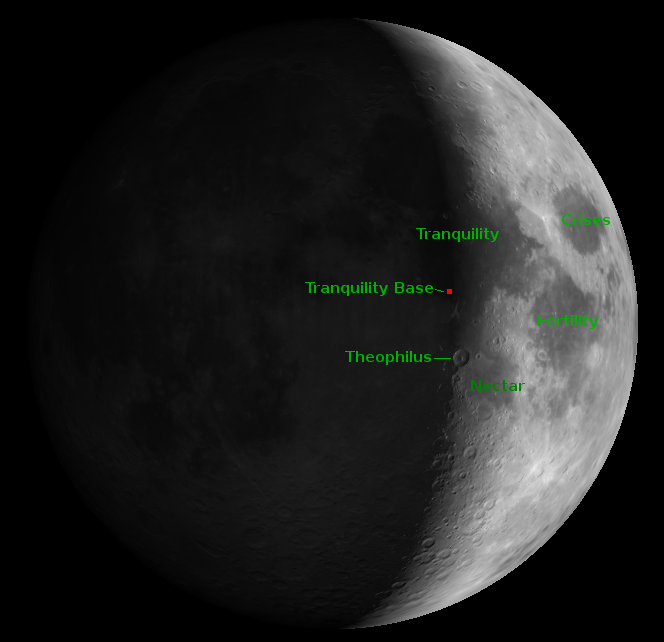
The annotated crescent moon tonight, September 25, 2017. Created using Virtual Moon Atlas.
09/25/2017 – Ephemeris – Lets look at the Moon tonight
Ephemeris for Monday, September 25th. The Sun will rise at 7:33 a.m. It’ll be up for 12 hours exactly, setting at 7:33 p.m. The Moon, 2 days before first quarter, will set at 10:52 this evening.
Let’s take a look at the crescent Moon tonight. It will be fairly low in the southwestern sky this evening. Four of the gray lava plains called seas are now visible in binoculars or small telescopes. Nearest the right limb of the Moon is the Sea of Crises, next nearest if the Sea of Fertility. A small sea next to that is the Sea of Nectar. Above that, mostly exposed to sunlight is the Sea of Tranquility. The Sun is just rising at Tranquility Base, where Apollo 11 landed, where the Lunar Module’s descent stage still lies, forlorn and empty. Below that is the beautiful crater Theophilus with its central peak. It is 61 miles (101 km) in diameter, and its crater walls rise over 13,000 feet (4,400 meters) above the crater floor.
The times given are for the Traverse City/Interlochen area of Michigan. They may be different for your location.
Addendum
The annotated crescent moon tonight, September 25, 2017. Created using Virtual Moon Atlas. Click on the image to enlarge.
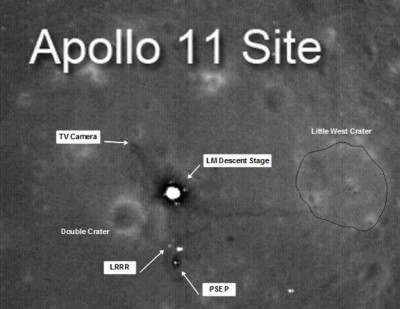
The Apollo 11 landing site in one photograph by the Lunar Reconnaissance Orbiter. There are many with varying Sun angles in the Internet. Search for: Apollo 11 LRO images. Credit NASA.
09/12/2017 – Ephemeris – The Moon will hide the bright star Aldebaran after sunrise this morning
Ephemeris for Tuesday, September 12th. The Sun will rise at 7:18. It’ll be up for 12 hours and 40 minutes, setting at 7:58. The Moon, 1 day before last quarter, will rise at 12:13 tomorrow morning.
This morning during daylight at around 8:40*. the bright star Aldebaran will disappear behind the Moon. Binoculars or a small telescope can be used to spot Aldebaran, the bright star in the constellation Taurus the bull’s eye. Taurus and the rest of the winter constellations are visible before sunrise. The sky needs to be absolutely clear to be able to spot the event. The star will be seen to approach the bright side of the Moon. The star will reappear around 9:53 a.m.* on the dark western edge of the Moon. These events are called occultations. They come from the word occult, which means hidden. In actuality the solar eclipse of three weeks ago was a spacial case of an occultation for those in the path of totality.
The times given are for the Traverse City/Interlochen area of Michigan. They may be different for your location.
* The disappearance and appearance times for Aldebaran are within a couple of minutes for Western Michigan. For other locations in the occultation path Stellarium will give pretty good times for the events by modeling the occultation as I did below. Like a solar eclipse where you are determines the timing of the event.
Addendum
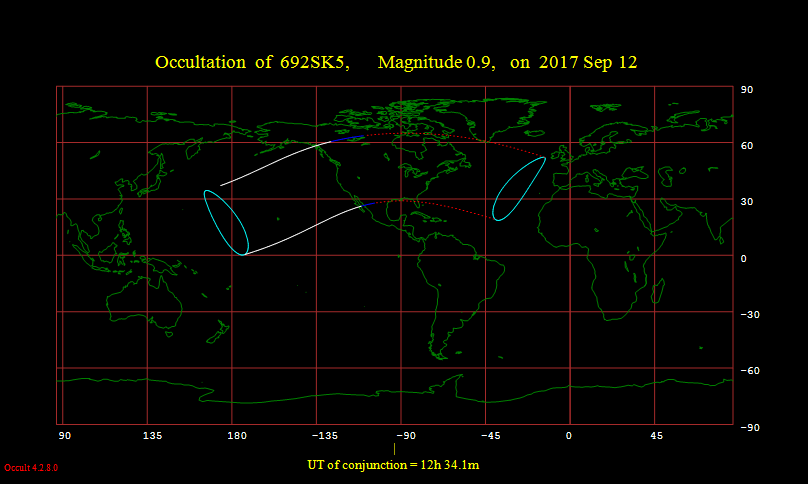
Map of where the occultation is visible. For the area bounded in red, the occultation is visible in the daytime. Credit: Occult4 by IOTA.
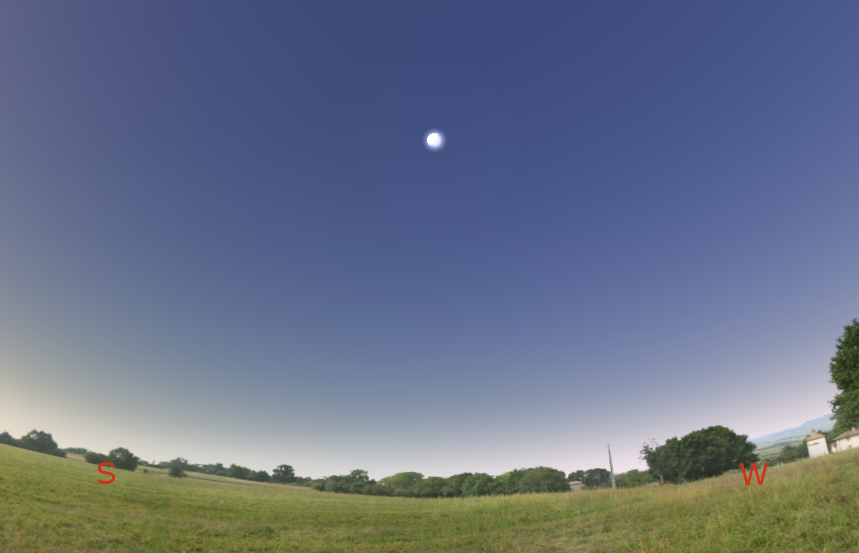
Position of the Moon in the sky near the start of the occultation, 8:35 a.m. September 12, 2017. Created using Stellarium.
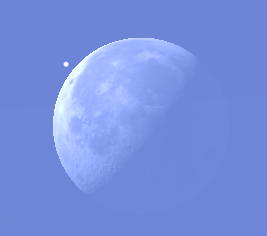
Aldebaran and the Moon at 8:35 a.m. September 12, 2017. Created using Stellarium.
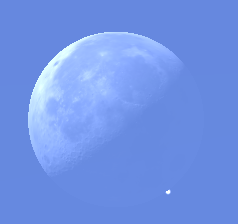
Aldebaran reappearing from behind the Moon at 9:53 a.m. September 12, 2017. Created using Stellarium.
07/06/2017 – Ephemeris – Saturn will appear near the Moon tonight
Ephemeris for Thursday, July 6th. Today the Sun will be up for 15 hours and 25 minutes, setting at 9:29, and it will rise tomorrow at 6:05. The Moon, 3 days before full, will set at 5:02 tomorrow morning.
The waxing gibbous Moon and the planet Saturn will appear together tonight. They are said to be in conjunction. The brightness of the Moon may make it hard to pick out Saturn which is right under the Moon by about seven Moon diameters. The Moon is very bright in binoculars or a telescope and looking at it destroys the dark adaption in the eye or eyes that look at it, at least for a while. So when viewing both Saturn and the Moon, concentrate of Saturn first. In a telescope Saturn’s rings are glorious. With a good telescope and enough magnification one might see the split in the rings, just inside the outer edge of them called Cassini’s Division, after it’s discoverer. The large moon Titan is off the western extremity of the rings tonight.
The times given are for the Traverse City/Interlochen area of Michigan. They may be different for your location.
Addendum
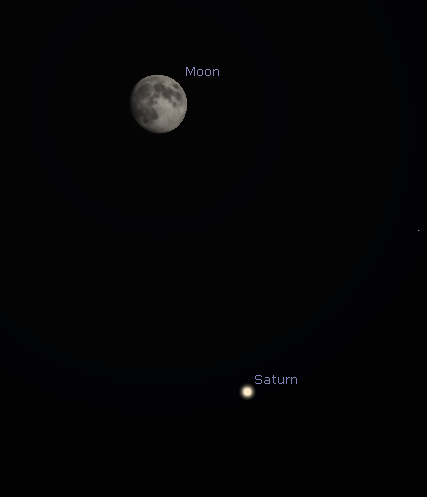
The Moon and Saturn at 10:30 p.m., July 6, 2017, as it would be seen from northern Michigan. Created using Stellarium.
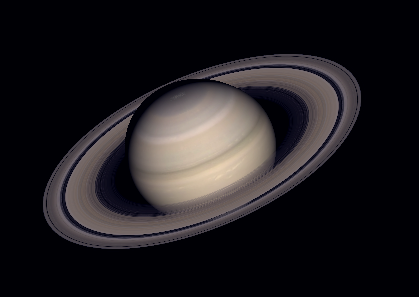
Saturn and its rings with Cassini’s Division. Created using Stellarium.
Ring particles at the distance of Cassini’s Division from Saturn orbit the planet twice in the time the satellite Mimas, nicknamed the Death Star, orbits the planet once. Ring particles are thus tugged by Mimas’ gravity away from Saturn in the same place every other orbit, which pulls them out of that particular orbital resonance.
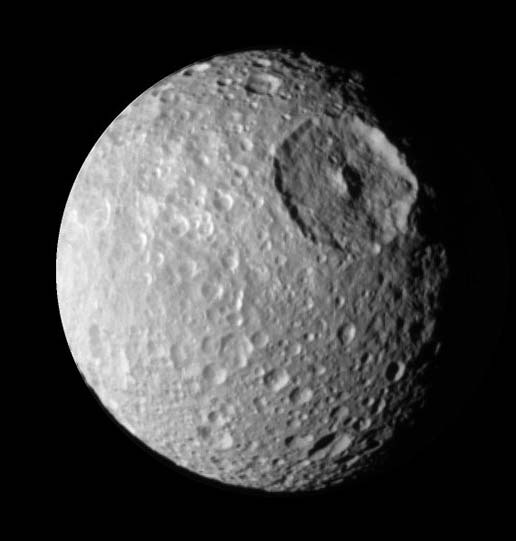
“That’s no moon!” Yes it is. Saturn’s moon Mimas, It’s diameter is 123 miles (198 km). The huge crater is named Herschel, after the moon’s discoverer William Herschel. Credit: NASA / JPL-Caltech / Space Science Institute.
 Bob Moler's Ephemeris Blog