Archive
04/17/2018 – Ephemeris – The Moon will appear near the planet Venus tonight
Ephemeris for Tuesday, April 17th. The Sun rises at 6:55. It’ll be up for 13 hours and 35 minutes, setting at 8:30. The Moon, 2 days past new, will set at 10:27 this evening.
This evening, while viewing Venus the Moon will be to the left and below our evening star. It will be a thin sliver of a crescent and in the twilight there will be the suggestion that there is more than the thin sliver of the Moon visible. Binoculars will confirm that the entire disk of the Moon will be visible. The effect is called earthshine. The nearly full Earth is illuminating the Moon to a much greater degree than the full Moon illuminates the Earth. The ancients had a more beautiful way to put it: “The old Moon in the new Moon’s arms.” There is the same effect in the morning of the few days prior to the new Moon. The instant of new Moon occurred at 9:57 p.m. Eastern Daylight Time Sunday night the 15th. That’s the 16th according to Universal time. What does your calendar say?*
The times given are for the Traverse City/Interlochen area of Michigan. They may be different for your location.
Addendum
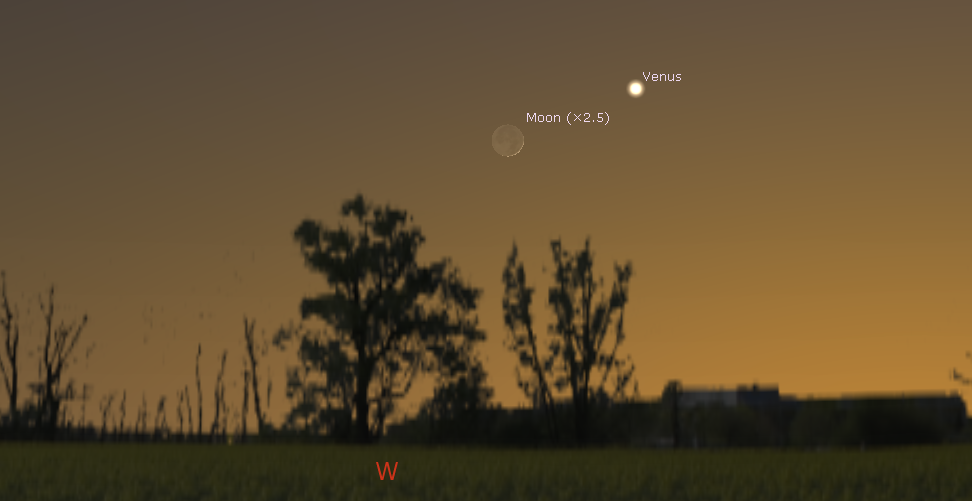
Venus and the Moon at 9 p.m. April 17, 2018. The Moon’s image has been enlarged two and a half times to show the earth shine and hint at the sliver of a crescent. Created using Stellarium.
* About the new moon this month. I have two wall calendars. One by NASA showing that the new moon occurred on April 16th based on Universal Time. Universal Time (UT) used to be known as Greenwich Mean Time (GMT). My other wall calendar is from the Old Farmers Almanac. It shows the new moon to be on the 15th. The almanac’s calendar pages are based on the location of Boston and the Eastern Time zone, standard or daylight saving. The calendar seems to be similarly based.
The Moon phase calculations for these programs are created by a DOS version of my LookingUp program, which is by now over 20 years old. I calculate them up a year at a time for the next year. These are based, of course on the Eastern Time zone.
03/26/2018 – Ephemeris – The Moon will slide below the Beehive star cluster tonight
Ephemeris for Monday, March 26th. The Sun will rise at 7:34. It’ll be up for 12 hours and 28 minutes, setting at 8:02. The Moon, 2 days past first quarter, will set at 5:34 tomorrow morning.
Tonight the gibbous Moon will be seen among the stars of Cancer the crab. It will just about completely drown Cancer’s dim stars out. That is no exception to one of the famous group of stars in Cancer, the Beehive star cluster. It is going to take binoculars or a small telescope to spot them. The star cluster will be at the 11 o’clock position from the Moon. When looking for the cluster try to keep the Moon out of your field of view. The cluster is about 4 moon-widths away, so aim high and slowly aim those binoculars down. There will be other times in the next few months to catch the Moon near the Beehive, when the Moon will be a not so overwhelming crescent as the cluster moves westward in the evening sky with the rest of the stars.
The times given are for the Traverse City/Interlochen area of Michigan. They may be different for your location.
Addendum
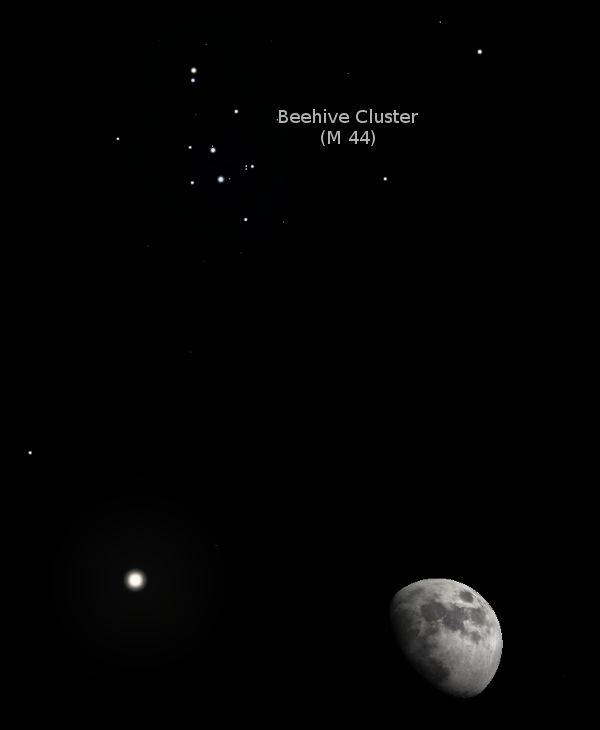
The Moon and the Beehive Star Cluster tonight at 9 p.m. March 26, 2018. The star cluster will be very difficult to spot. Created using Stellarium, however I had to boost the brightness of the stars and eliminate the atmosphere control to darken the sky enough to see the cluster. Good luck!
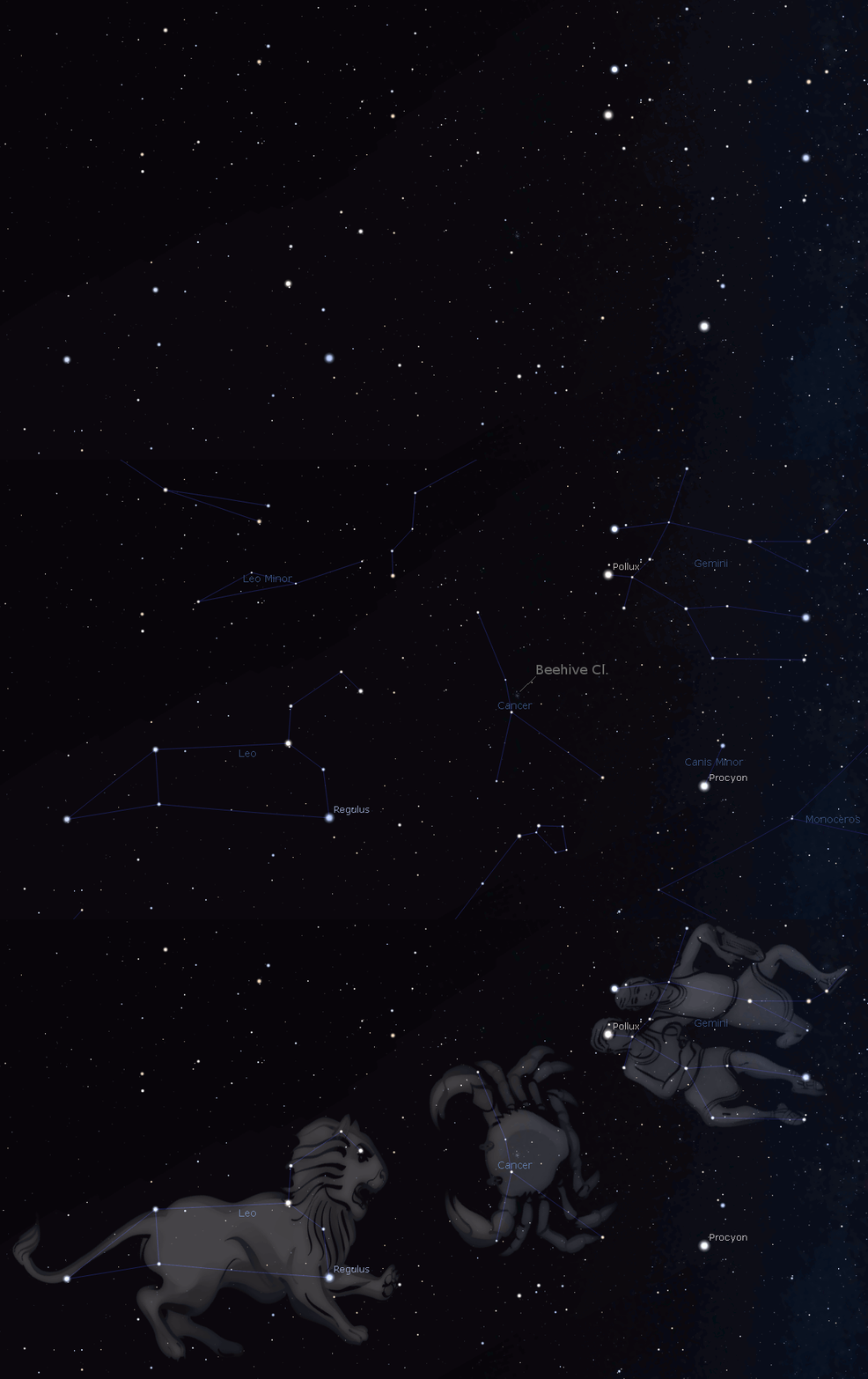
Cancer the crab finder chart for a dark night. Note the beehive cluster, also known to amateur astronomers as M44, along with other catalog names. Prior to the invention of the telescope this cluster was known as Praesepe which means “Manger”. Created using Stellarium and GIMP.
03/23/2018 – Ephemeris – After a crazy week sail on the Sea of Serenity
Ephemeris for Friday, March 23rd. The Sun will rise at 7:40. It’ll be up for 12 hours and 18 minutes, setting at 7:59. The Moon, 1 day before first quarter, will set at 2:53 tomorrow morning.
This evening the Moon will be at nearly first quarter and the terminator will be at the edge of the Sea of Serenity or Mare Serenitatis, with the morning Sun shining on its ramparts. Through binoculars or the naked eye the scallop shell shaped sea will be visible at the upper right part of the moon, the man in the moon’s left eye as he is facing us. In telescopes the moon will be inverted and even also reversed, so Serenity could appear in any other quadrant depending on what your telescope does to the image. There are two large craters above or north of Serenity if looking at them with a non-inverting telescope. The nearest to Serenity is Eudoxus, and the farther one is Aristoteles, named after Aristotle.
The times given are for the Traverse City/Interlochen area of Michigan. They may be different for your location.
Addendum
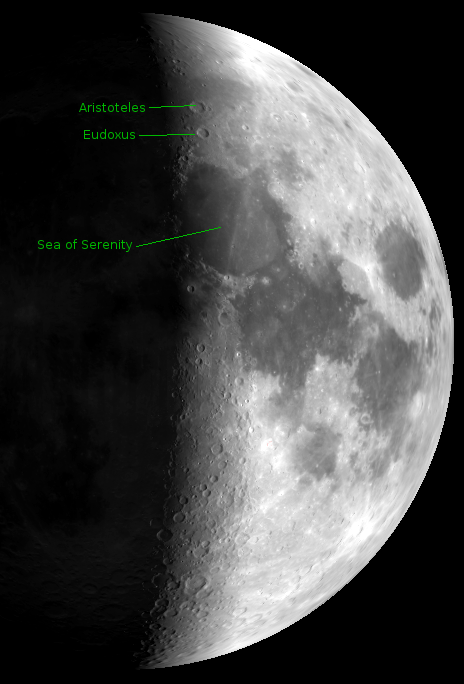
Tonight’s Moon with the Sea of Serenity and two isolated large craters. 9 p.m., March 23, 2018. Created using Virtual Moon Atlas.
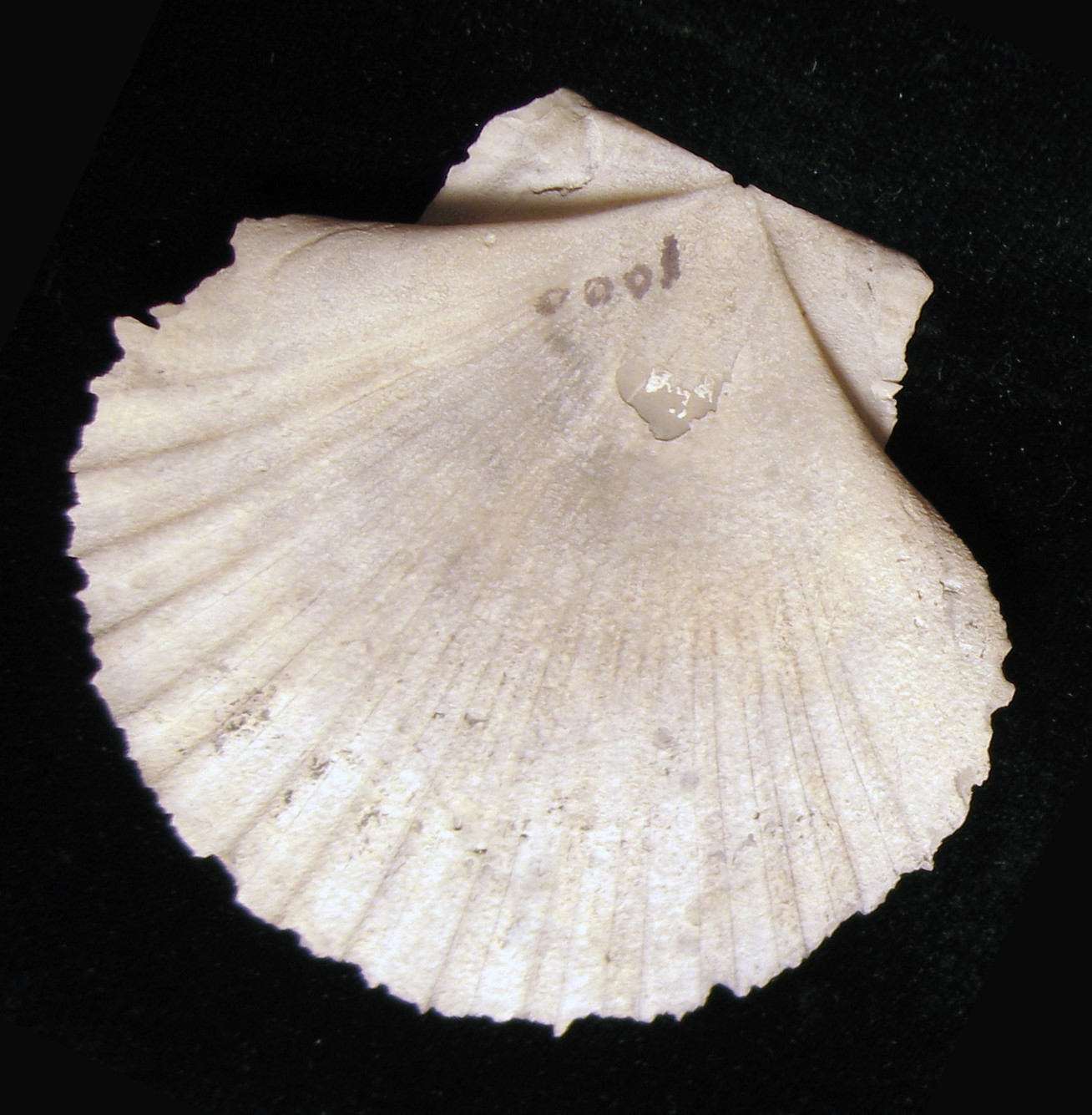
Image of a scallop shell rotated to match the Sea of Serenity. Credit Wikipedia user Kevmin. (Creative Commons)
03/22/2018 – Ephemeris – The bright star Aldebaran will appear below the Moon tonight
Ephemeris for Thursday, March 22nd. The Sun will rise at 7:42. It’ll be up for 12 hours and 15 minutes, setting at 7:57. The Moon, 2 days before first quarter, will set at 1:48 tomorrow morning.
The bright star Aldebaran will appear below the Moon tonight. Over the past two years we’ve seen the Moon cover Aldebaran in an event called an occultation on several occasions. There will be a similar occultation tonight for the far northern part of the Earth. Though the series of Aldebaran occultations won’t end until September this year, we won’t see any of them. The Next season of monthly Aldebaran occultations for the Earth won’t start until 2033. It will last a bit more than 2 years. We’ll see our share of those occultations then. Other bright, first magnitude, stars that can be occulted by the Moon are Pollux in Gemini, Regulus in Leo, Spica in Virgo and Antares in Scorpius.
The times given are for the Traverse City/Interlochen area of Michigan. They may be different for your location.
Addendum
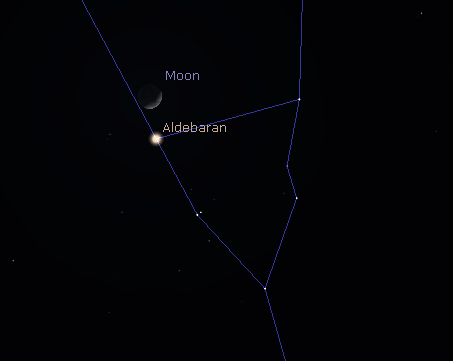
The star Aldebaran, the bloodshot eye of Taurus the bull at 9 p.m. tonight, March 22, 2018 to be seen below the crescent Moon. The rest of the face of Taurus, the V-shaped stars of the star cluster called the Hyades will be visible in binoculars. Created using Stellarium. The Moon will be brighter than Aldebaran, not the opposite as seen here.
03/06/2018 – Ephemeris – The Moon will pass the morning planets for the rest of the week
Ephemeris for Tuesday, March 6th. The Sun will rise at 7:11. It’ll be up for 11 hours and 25 minutes, setting at 6:37. The Moon, 3 days before last quarter, will rise at 11:57 this evening.
From tomorrow morning through the rest of the week the Moon will be passing above the morning planets one by one. Tomorrow morning the waning gibbous Moon will appear above and left of Jupiter the brightest of the morning planets in the south at 6 a.m. By Friday morning the then last quarter Moon will be approaching Mars and will be to the right and above the red planet. Saturday morning the then waning crescent Moon will appear above and right between Mars and Saturn. Sunday morning the waning crescent Moon will be left of Saturn. I love waning crescent Moons in morning twilight. In a couple of weeks, on the evening of the 19th to be exact the waxing crescent moon will pass Venus and Mercury.
The times given are for the Traverse City/Interlochen area of Michigan. They may be different for your location.
Addendum
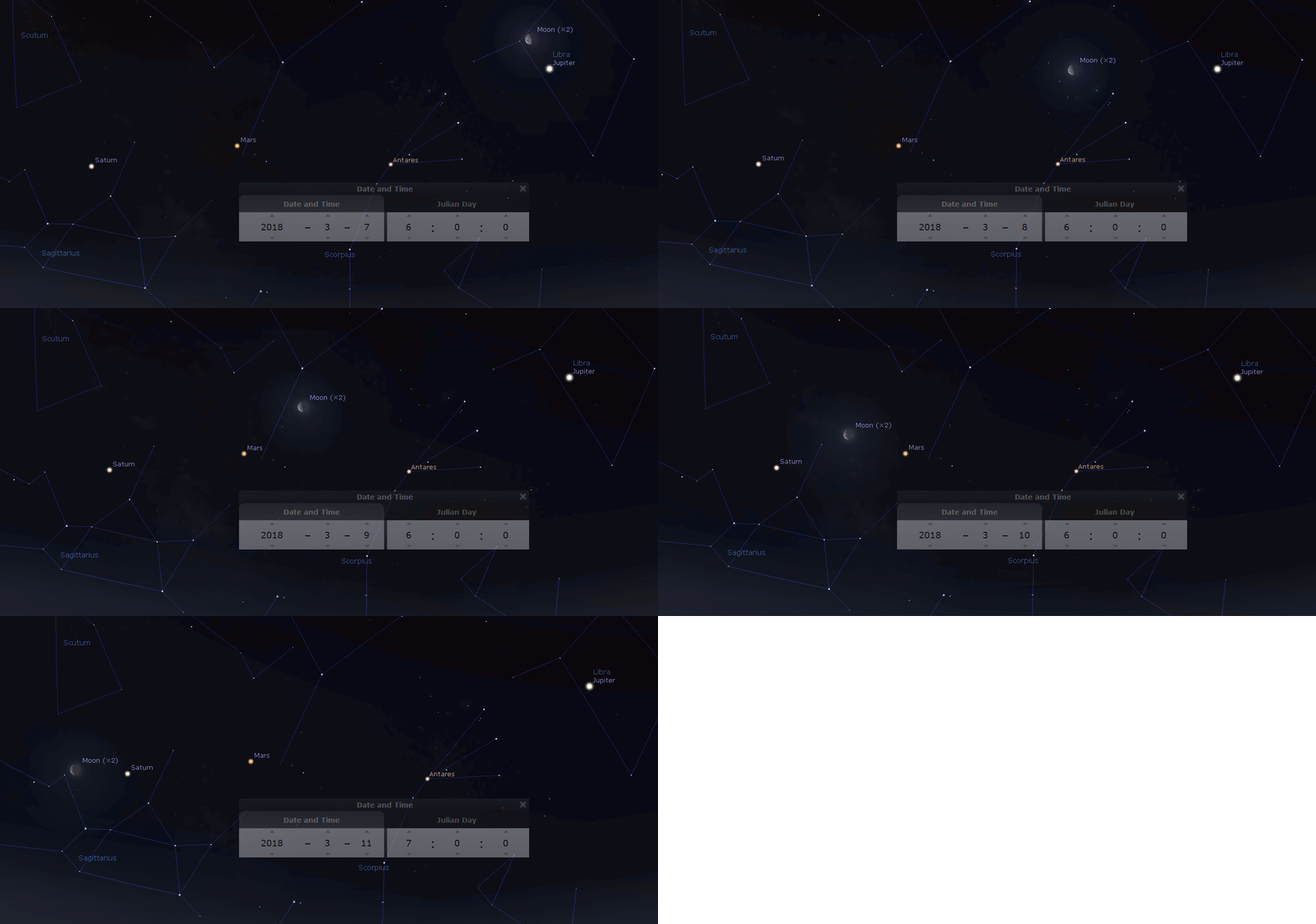
The Moon and morning planets at 6 a.m. each morning Wednesday through Sunday March 7-11, 2018. The Moon’s size has been doubled to show its phase. Note that due to Earth’s revolution of the Sun, that the sky will rotate about one degree westward per day. Click on the image to enlarge. Created using Stellarium and GIMP.
02/27/2018 – Ephemeris – The bright spot on the Moon tonight
Ephemeris for Tuesday, February 27th. The Sun will rise at 7:23. It’ll be up for 11 hours and 4 minutes, setting at 6:27. The Moon, 2 days before full, will set at 6:38 tomorrow morning.
The moon tonight is bright. The sunrise line or terminator on the moon is crossing the large gray plain called Oceanus Procellarum, the largest of the moon’s seas. These seas were figments of the first telescopic observers imagination. They are really huge impact basins into which interior lava flowed. On the upper left edge of the moon near the terminator is a bright spot on the moon visible in binoculars. In a telescope it is a crater called Aristarchus. It is a fairly new crater, probably less than a billion years old. As a rule the brighter the crater the newer it is. Aristarchus is the brightest spot on the moon. Over the years visual astronomers have seen hazes and bright spots from time to time in and near Aristarchus.
The times given are for the Traverse City/Interlochen area of Michigan. They may be different for your location.
Addendum
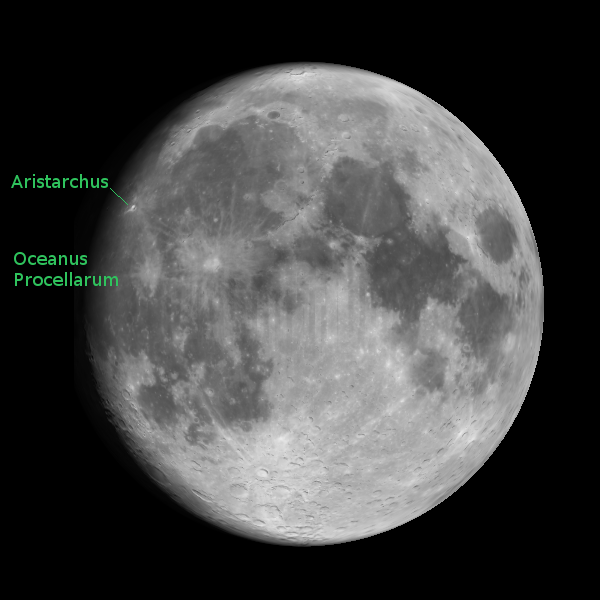
The Moon tonight at 9 p.m. February 27, 2018. Created using Virtual Moon Atlas.
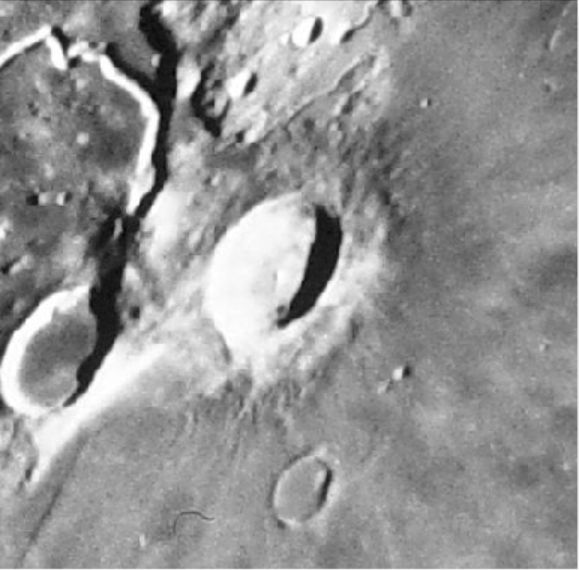
The crater Aristarchus. Credit: Lunar and Planetary Institute.
02/20/2018 – Ephemeris – Tonight’s the night to spot a chain of three of my favorite craters
Ephemeris for Tuesday, February 20th. The Sun will rise at 7:35. It’ll be up for 10 hours and 43 minutes, setting at 6:18. The Moon, 3 days before first quarter, will set at 11:29 this evening.
I was a day off in my Moon calculations yesterday. The three of my favorite craters, just south of the partially illuminated Sea of Tranquility will be visible tonight. From north to south or top to bottom, near the terminator or sunrise line is Theophilus, which slightly overlaps the crater wall of Cyrillus, then a bit farther south another older crater Catharina. These craters were named by a Jesuit astronomer Giovanni Battista Riccioli (Ri’cholli). He even named a crater Copernicus, even though he followed the Church teachings of the time he didn’t believe in the Copernican Sun centered system, but the system put forth by Danish astronomer Tycho Brahe where the Moon and Sun circled the Earth, but the other planets circled the Sun.
The times given are for the Traverse City/Interlochen area of Michigan. They may be different for your location.
Addendum
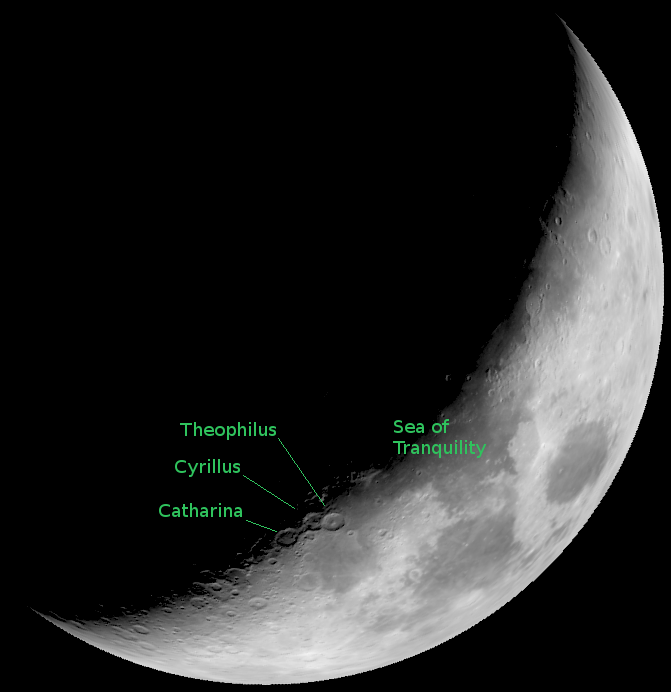
The crescent Moon on the evening of February 20th, 2018. showing the craters discussed in the test. Created using Virtual Moon Atlas and rotated to approximate its orientation in the sky after sunset.
Repeating from yesterday: For anyone east of here who can see the Moon at 19:00 UT, on the 20th should see Theophilus shadow filled with the crater rim and the central peak poking into sunlight. It should be visible from Europe and the Mid East. Let me know with a comment if I guessed right.
02/19/2018 – Ephemeris – A trio of craters emerge into sunlight on the moon tomorrow night
Whoops, I set my Virtual Moon Atlas app to the 20th instead of the 19th. I’m fixing the transcript for the blog readers, but the original program will go out as is. Tomorrow’s program will be substantially the same.
Ephemeris for President’s Day, Monday, February 19th. The Sun will rise at 7:36. It’ll be up for 10 hours and 40 minutes, setting at 6:16. The Moon, half way from new to first quarter, will set at 10:23 this evening.
The crescent Moon tomorrow will be revealing a trio of my favorite craters, just south of the partially illuminated Sea of Tranquility. From north to south or top to bottom, near the terminator or sunrise line is Theophilus, which slightly overlaps the crater wall of Cyrillus, than a bit farther south another older crater Catharina. These craters were named by a Jesuit astronomer Giovanni Battista Riccioli in his book New Almagest in 1651. Most of his crater names have stuck. He didn’t believe in the Copernican Sun centered system or the strict Earth centered system of Ptolemy, but the system put forth by Danish astronomer Tycho Brahe where the Moon and Sun circled the Earth, but the other planets circled the Sun.
The times given are for the Traverse City/Interlochen area of Michigan. They may be different for your location.
Addendum
The crescent Moon on the evening of February 20th, 2018. showing the craters discussed in the test. Created using Virtual Moon Atlas and rotated to approximate its orientation in the sky after sunset.
For anyone east of here who can see the Moon at 19:00 UT, on the 20th should see Theophilus shadow filled with the crater rim and the central peak poking into sunlight.
02/09/2018 – Ephemeris – Morning planet high jinx
Ephemeris for Friday, February 9th. The Sun will rise at 7:51. It’ll be up for 10 hours and 11 minutes, setting at 6:02. The Moon, 2 days past last quarter, will rise at 4:05 tomorrow morning.
This past Wednesday morning the Moon passed Jupiter, Earlier this morning the Moon passed north of Mars, and on Sunday morning Saturn will appear south of The Moon. There is a once in about 2 year event, that is red Mars passing Antares, the red giant star in Scorpius, one of the easiest constellations to spot because it actually resembles a scorpion. The name Antares means “Rival of Mars” because they have the same color: Ant meaning anti and Ares is the Greek god of war and counterpart of the Roman god Mars. Mars will pass Antares on average of
every 22 ½ months, its period around the Sun. Since we are viewing it from a moving Earth, it varies. Mars will pass Antares next on January 19th, 2020.
The times given are for the Traverse City/Interlochen area of Michigan. They may be different for your location.
Addendum
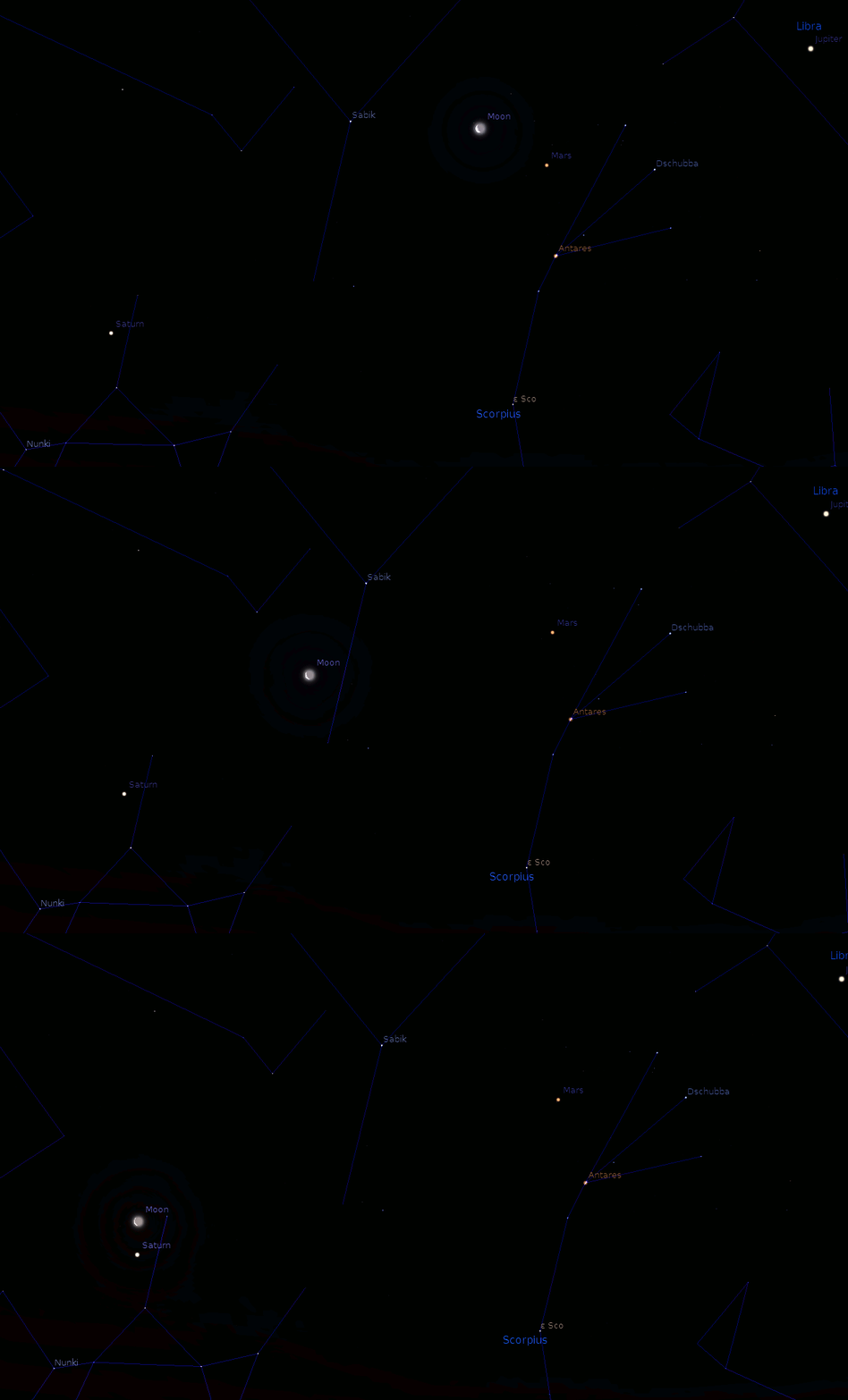
Morning planets and the Moon at 7 a.m. on the mornings of February 9, 10 and 11, 2018. See Mars changing position compared to Antares. Click on image to enlarge. Created using Stellarium and GIMP.
01/26/2018 – Ephemeris – The Moon tonight: The Bay of Rainbows
Ephemeris for Friday, January 26th. The Sun will rise at 8:08. It’ll be up for 9 hours and 34 minutes, setting at 5:43. The Moon, 2 days past first quarter, will set at 3:59 tomorrow morning.
A look at the Moon tonight will reveal that the sunrise line, or terminator has almost completely revealed the large sea of Showers or Mare Imbrium to the upper left of center of the gibbous disk. At the extreme upper left straddling the terminator is one of my favorite features, the Bay of Rainbows or Sinus Iridium. It’s a colorful name for something that’s as gray as the rest of the Moon. It looks like a bay off of Imbrium, and has an arch like a rainbow. It’s arch is the Jura Mountains, which jut into Mare Imbrium at Cape Heraclide, just catching sunlight, and Cape Laplace farther into morning. What’s cool is catching it as the sunlight is hitting the mountains while the convex floor, following the Moon’s curvature is only partially illuminated.
The times given are for the Traverse City/Interlochen area of Michigan. They may be different for your location.
Addendum
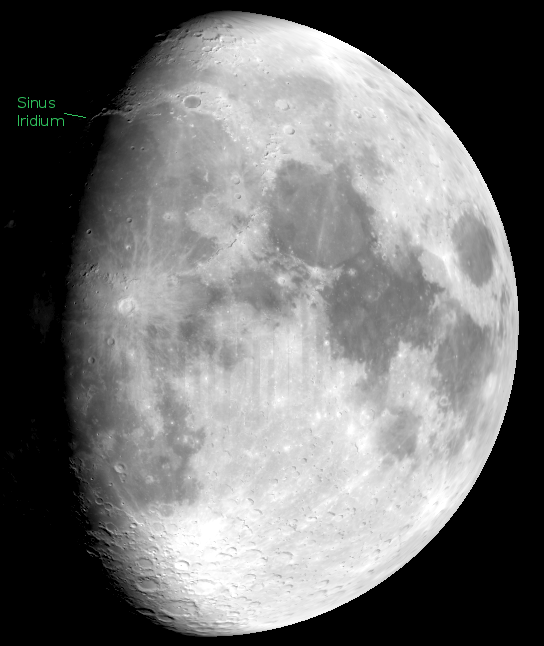
The Moon at 8 p.m. January 26, 2018 highlighting Sinus Iridium. Created using Virtual Moon Atlas.
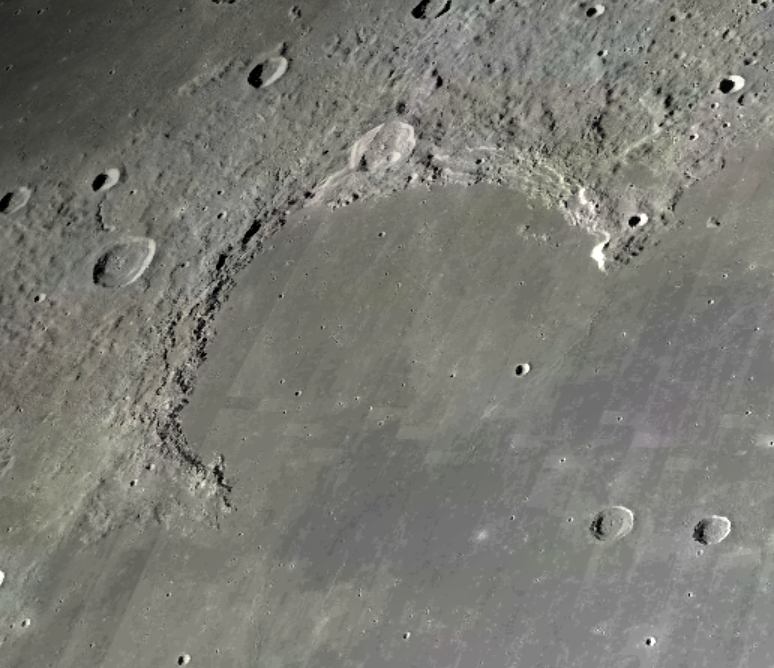
Sinus Iridium photographed by the Lunar Reconnaissance Orbiter as texture mapped on the globe of the Virtual Moon Atlas.
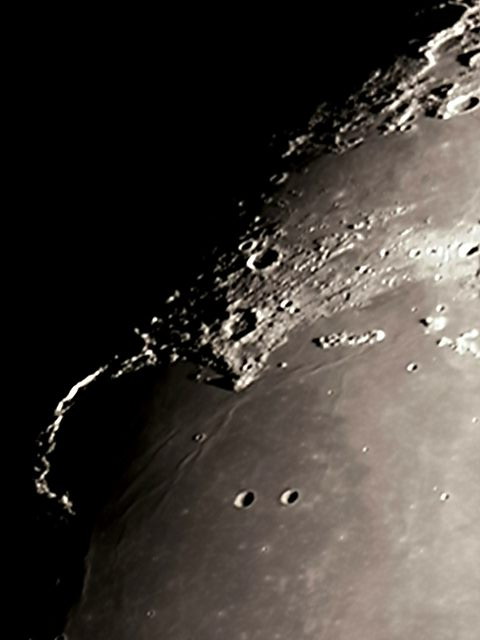
Sinus Iridium at sunrise. Photo by “Seb2003” on http://forums.futura-sciences.com/materiel-astronomique-photos-damateurs/5809-images-de-lune.html.
 Bob Moler's Ephemeris Blog