Archive
02/02/2017 – Ephemeris – Can you see the rabbit on the Moon?
Ephemeris for Ground Hog Day, Thursday, February 2nd. The Sun will rise at 7:59. It’ll be up for 9 hours and 53 minutes, setting at 5:53. The Moon, 1 day before first quarter, will set at 12:24 tomorrow morning.
The crescent Moon is in the southwestern sky. It is revealing a group of lunar seas, dark gray areas that portrays an upside down rabbit. From the top down are the seas Serenity as his body, the sea of Tranquility as his head. His two ears are different sizes, the larger is the Sea of Fertility, and the smaller ear is the Sea of Nectar. All of these seas seem to be connected. The unconnected sea is the Sea of Crises, a pretty good symbol for our times, but unconnected to our upside down rabbit. One word about the Latin names for these. The Latin name for a sea is Mare, spelled like the female horse but pronounced Mar-ē. The plural is Maria, spelled like the lady’s name but pronounced with the accent on the first syllable.
At 5:11 am EDT (10:11 UT) Venus and Mars will appear at their closest to each other at 5.4° or about 11 Moon diameters. From then on, Venus will back away. That is the Sun will overtake Venus faster than it will Mars. They will eventually pass each other on October 5, 2017.
Times are for the Traverse City/Interlochen area of Michigan. They may be different for your location.
Addendum
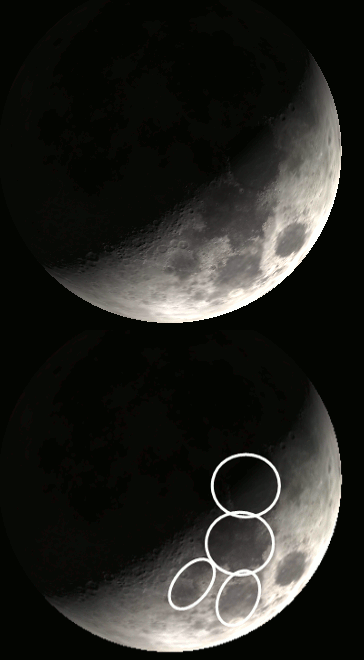
An animation showing how the rabbit in the Moon as might be seen tonight February 2, 2017, demonstrating my complete lack of artistic talent. Created from a Moon image from Stellarium, Overlay from Libreoffice Draw, and animated GIF from GIMP.
Search [rabbit in moon] in Google images for more artistic examples.
01/24/2017 – Ephemeris – The Moon is near Saturn this morning
Ephemeris for Tuesday, January 24th. The Sun will rise at 8:09. It’ll be up for 9 hours and 31 minutes, setting at 5:40. The Moon, 3 days before new, will rise at 6:08 tomorrow morning.
This morning look low in the southeast to see the thin crescent Moon with the planet Saturn below and to the right. The Moon passed Saturn a little after they rose. Saturn is quite far south in our skies, almost as far south as the Sun was on the winter solstice on December 21st. It will take a while to rise high enough in deep twilight or darkness for good views with a telescope. When Saturn or any planet is low on the horizon we are looking at it through a lot of our atmosphere. Beside draining about half its brightness that atmospheric motions make the planet fuzzy in telescopes. Yes, you can still see the rings, but the gaps on each end between the rings and the planet may not be distinct, and its large moon Titan may not be visible at all.
Times are for the Traverse City/Interlochen area of Michigan. They may be different for your location.
Addendum
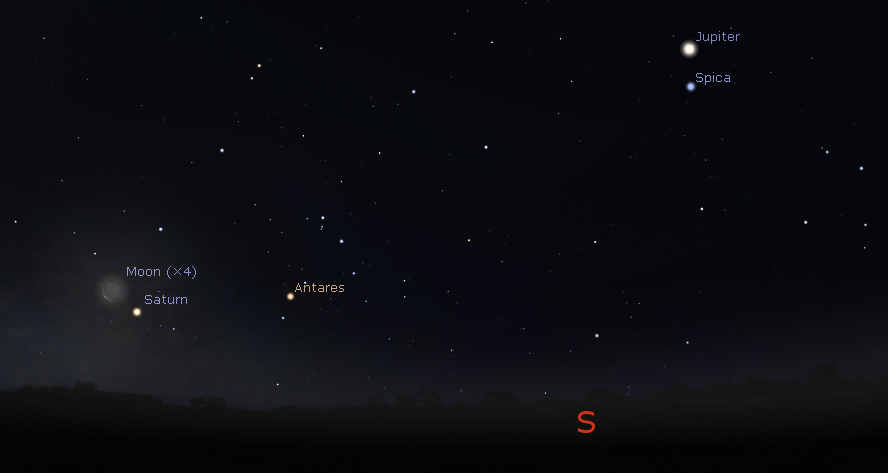
The morning planets and the Moon at 7 a.m. this morning, January 24th. Because planetarium programs don’t show a thin crescent very well, I’ve enlarged the Moon by a factor of 4 times to make the Moon show up at all. Click on the image to enlarge. Created using Stellarium.
12/21/2016 – Ephemeris – A look at the bright planets at the start of winter
Ephemeris for the winter solstice Wednesday, December 21st. The Sun will rise at 8:17. It’ll be up for 8 hours and 48 minutes, setting at 5:05. The Moon, 1 day past last quarter, will rise at 1:46 tomorrow morning.
Let’s look at the naked eye planets now that it’s officially winter as of 5:45 a.m. In the east-southeast before 7:30 these mornings. Jupiter can be glimpsed in the morning twilight. Jupiter will rise tomorrow at 2:16 a.m. and will appear below the Moon. Venus and Mars are in the evening sky. At 6 p.m. these planets will be seen in the southwest and low in the sky. Venus is unmistakable as the brilliant evening star, Mars will be above and left of it. Venus will set at 8:46. Mars will set at 10:12. Mars’ setting time hasn’t changed much in the last 2 months. Venus is slowly heading northward for the rest of it’s evening appearance, and is moving higher in the sky, and is closing in on it’s greatest eastern elongation from the Sun.
Times are for the Traverse City/Interlochen area of Michigan. They may be different for your location.
Addendum
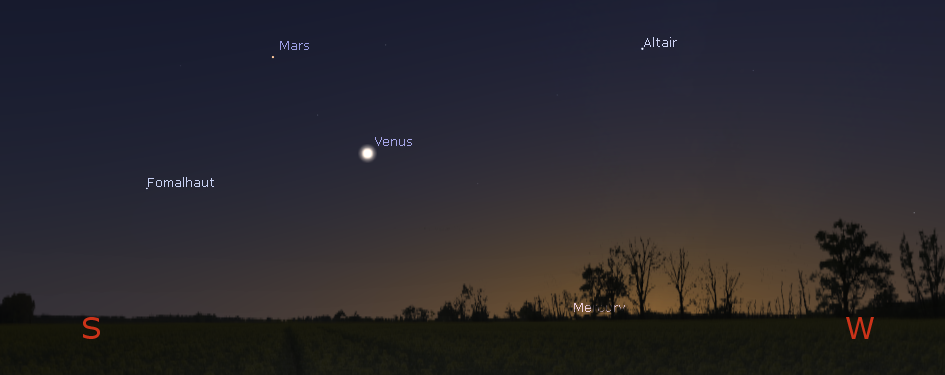
Venus and Mars in the evening twilight of about an hour after sunset. 6 p.m. December 21, 2016. Created using Stellarium.
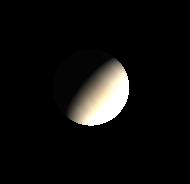
Venus as it might be seen in a telescope at 6 p.m. December 21, 2016. Created using Stellarium.
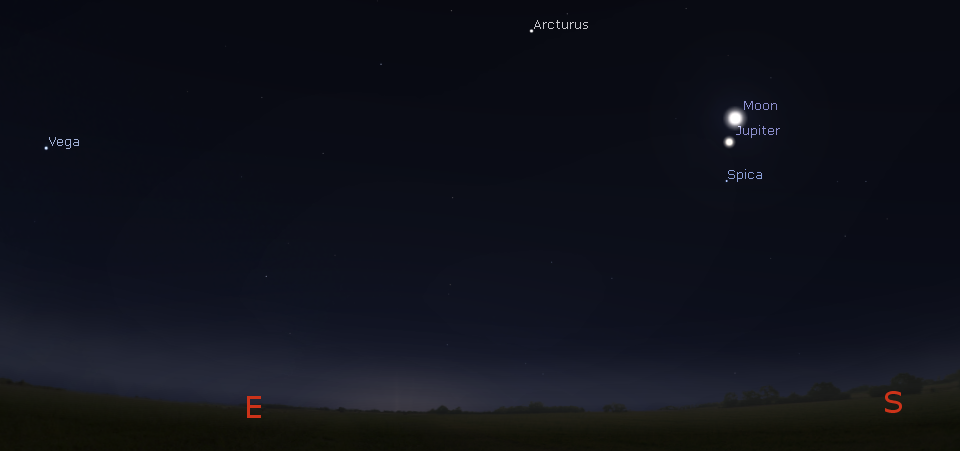
Jupiter and the Moon at 7 a.m. December 22, 2016. Created using Stellarium.
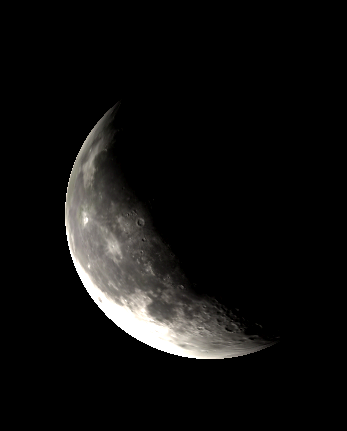
The Moon as it might appear in binoculars at 7 a.m. December 22, 2016. Created using Stellarium.
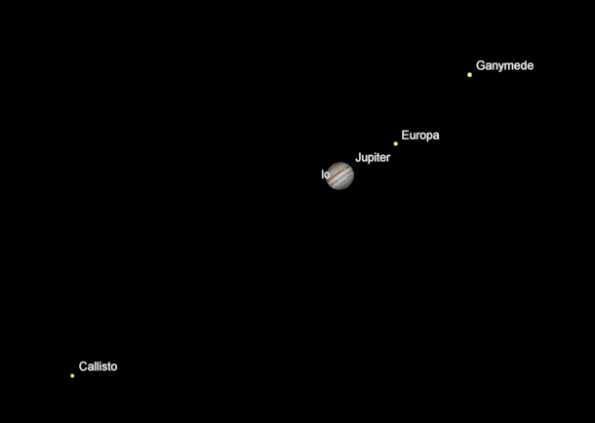
Jupiter and its Galilean moons at 7 a.m. December 22, 2016. Io is behind Jupiter at this time, however it will clear the planet by 7:38 a.m. EST (12:38 UT). Created using Cartes du Ciel (Sky Charts).
Update 8:10 a.m.
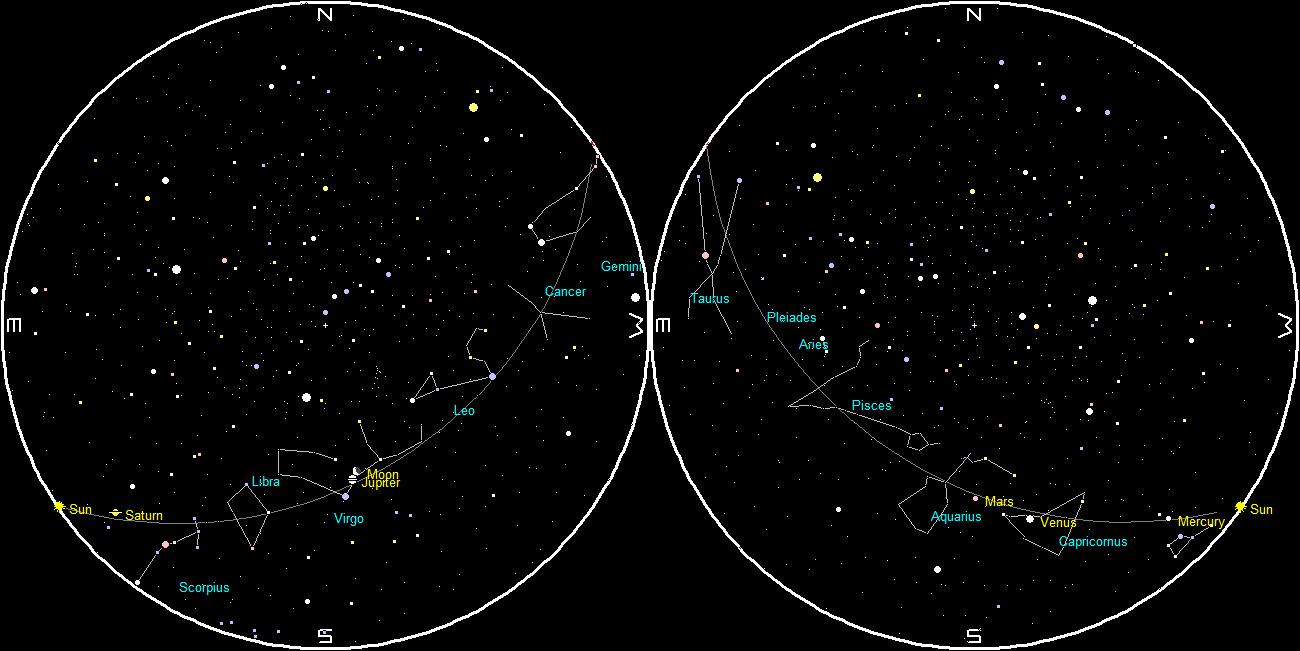
Planets and Moon at sunset and sunrise of a single night starting with sunset on the right on December 21, 2016. The night ends on the left with sunrise on December 22. Click on image to enlarge. Created using my LookingUp program.
12/07/2016 – Ephemeris – Where are the bright planets
Ephemeris for Wednesday, December 7th*. The Sun will rise at 8:06. It’ll be up for 8 hours and 55 minutes, setting at 5:02. The Moon, at first quarter today, will set at 1:16 tomorrow morning.
In the east-southeast before 7:30 these mornings. Jupiter can be glimpsed in the morning twilight. Jupiter will rise tomorrow at 3:01 a.m. We are approaching Jupiter as it appears to move away from the Sun. We will pass it on April 7th next year. Venus and Mars are in the evening sky. At 6 p.m. these planets will be seen in the southwest and low in the sky. Venus will be the lower and brighter of the two, Mars will be higher to the left. Venus will set at 8:14. Mars will hang on a bit longer and will set at 10:10. Mars’ setting time hasn’t changed much in the last month and a half. It’s losing to the Sun by only a little bit each day. Venus is slowly heading northward for the rest of it’s evening appearance, and is moving higher in the sky.
Times are for the Traverse City/Interlochen area of Michigan. They may be different for your location.
* 75th anniversary of the attack on Pearl Harbor. I was only 3 days old at the time, so had nothing to do with it.
Addendum
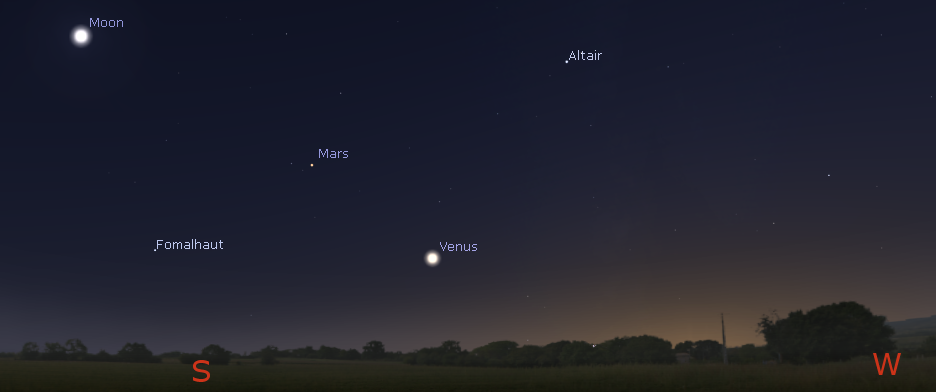
Venus, Mars and the Moon at 6 p.m., December 7, 2016. This is approximately one hour after sunset. Click on image to enlarge. Created using Stellarium.
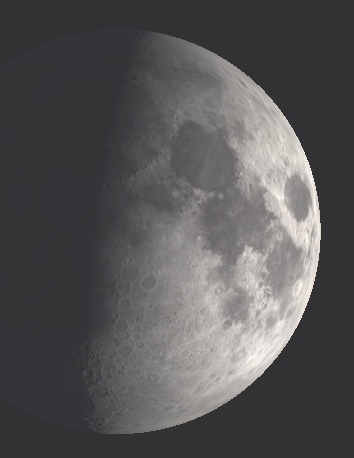
A closeup of the Moon at 6 p.m., December 7, 2016. Created using Stellarium.
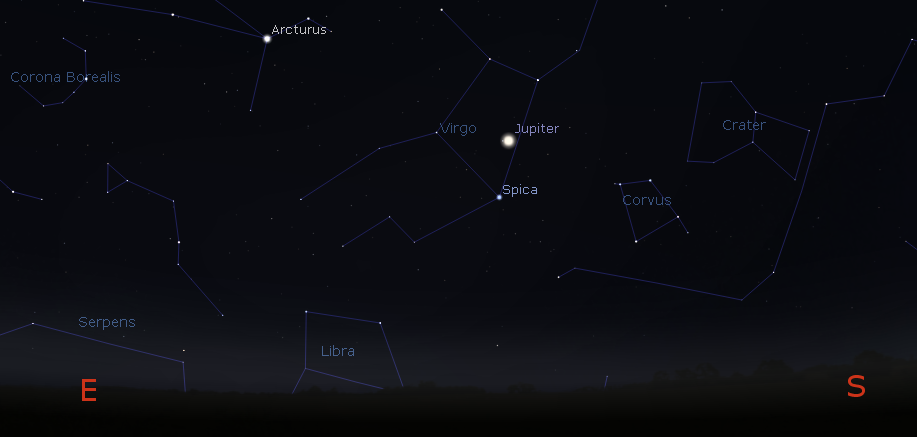
Jupiter and a preview of spring constellations at 6:30 a.m. December 8, 2016. Click on image to enlarge. Created using Stellarium.
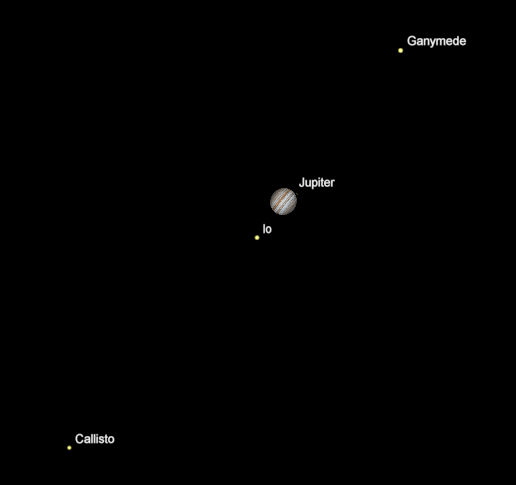
Jupiter and moons at 6:30 a.m. December 8, 2016. Europa is in Jupiter’s shadow at this time. It will disappear in its shadow at 4:46 a.m. (9:46 UT). Image created using Cartes du Ciel. Note that Europa was on the image, but was removed. Stellarium had it right, but I prefer Cartes’ rendering.
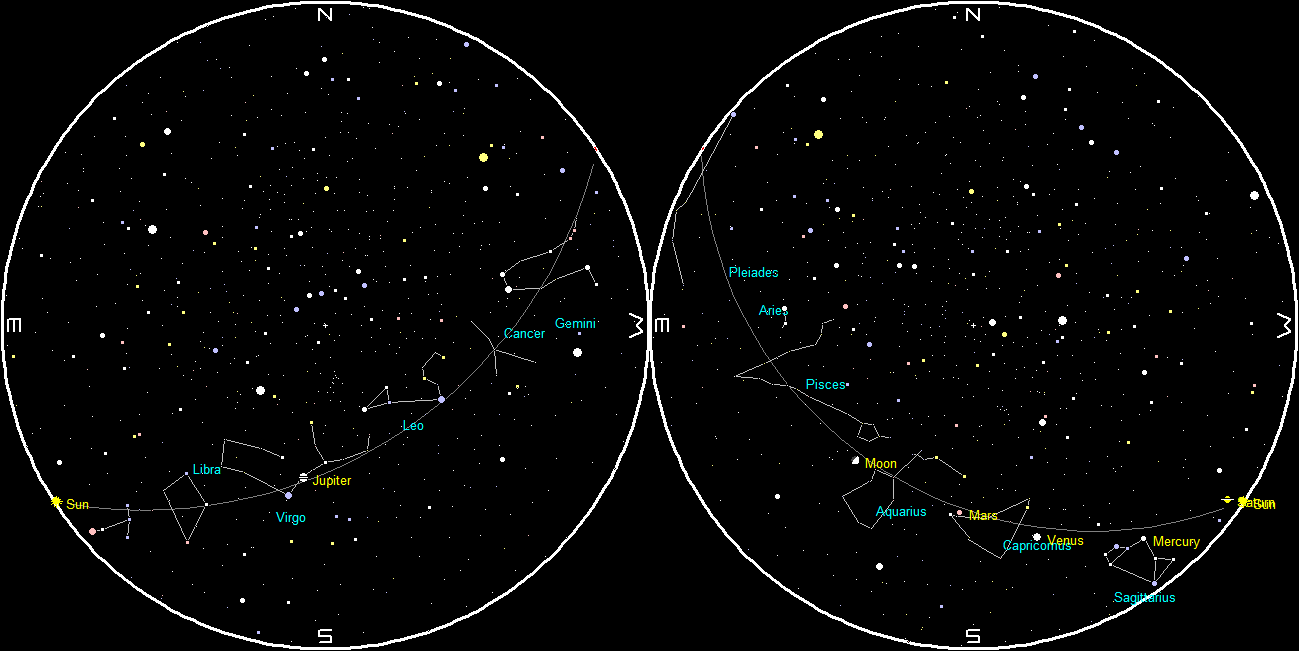
Planets and Moon at sunset and sunrise of a single night starting with sunset on the right on December 7, 2016. The night ends on the left with sunrise on December 8. Click on image to enlarge. Created using my LookingUp program.
Note that Saturn is practically plotted on top of the Sun. It will be in conjunction with the Sun on the 10th. After that it will enter the morning sky.
11/16/2016 – Ephemeris – Where are the bright planets now?
Ephemeris for Wednesday, November 16th. The Sun will rise at 7:41. It’ll be up for 9 hours and 31 minutes, setting at 5:13. The Moon, 2 days past full, will rise at 7:38 this evening.
Low in the east-southeast before 7:15 a.m. Jupiter can be glimpsed in the morning twilight. Jupiter will rise tomorrow at 4:05 a.m. We are approaching Jupiter, though it’s 5 times Earth’s distance from the Sun and will pass it April 7th. Venus, Saturn and Mars are in the evening sky. At 6 p.m. these planets will be seen in the southwest and low in the sky. Venus will be the brightest, Saturn might be picked out of the twilight to the right and below Venus, and Mars will be higher to the left. Saturn will set first at 6:30, with Venus setting at 7:33. Mars will hang on a bit longer and will set at 10:07. Mars’ setting time hasn’t changed from last week. Venus is slowly heading northward for the rest of it’s evening appearance.
Times are for the Traverse City/Interlochen area of Michigan. They may be different for your location.
Addendum
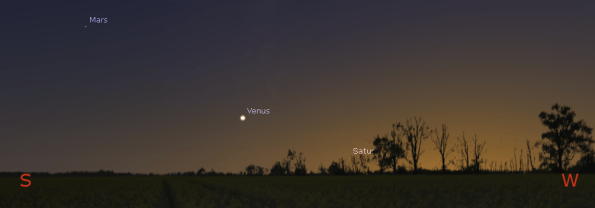
The evening planets in twilight in the southwestern sky at 6 p.m. Created using Stellarium.
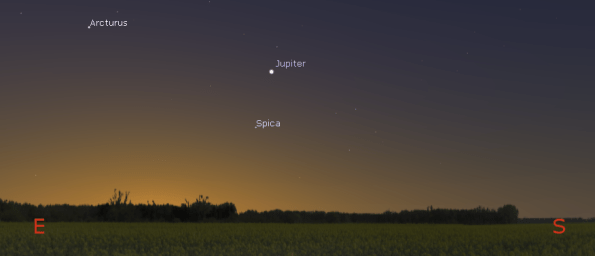
Jupiter rising in the morning sky this morning at 7 a.m. November 19, 2016. Created using Stellarium.
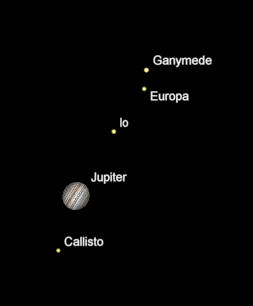
Jupiter and its Galilean moons, as they might be seen in a telescope at 7 a.m., this morning, November 16, 2016. Created using Cartes du Ciel (Sky Charts).
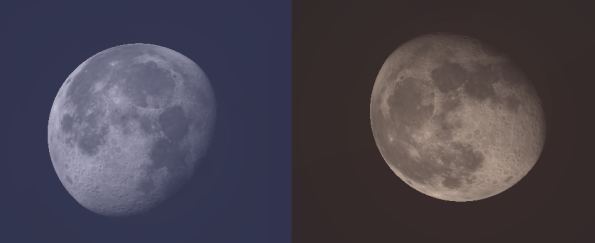
The Moon is visible both in the evening and the next morning. At right is the evening Moon at 8 p.m. On the left is the Moon at 7 a.m. A sharp-eyed person, with binoculars, can notice a slight change in the sunset terminator in the 11 hours between the two views. Created using Stellarium.
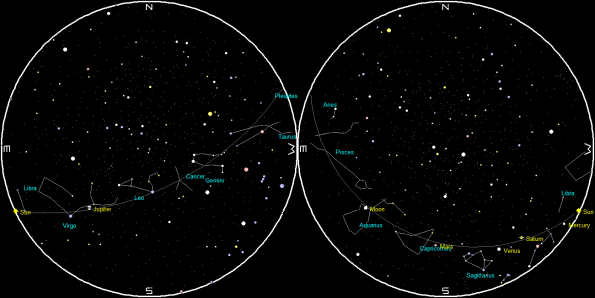
Planets and Moon at sunset and sunrise of a single night starting with sunset on the right on November 16, 2016. The night ends on the left with sunrise on November 17. If you are using Firefox right-click on the image and select View Image to enlarge the image. That goes for all the large images. Created using my LookingUp program.
11/14/2016 – Ephemeris – Watch the setting of the super moon this morning
Ephemeris for Monday, November 14th. The Sun will rise at 7:39. It’ll be up for 9 hours and 36 minutes, setting at 5:15. The Moon, at full today, will set this morning at 7:23 and will rise again at 5:53 this evening.
During the 6 to 7 o’clock hour this morning the Moon will be officially the closest super moon, most likely of your lifetime unless your 68 or older. Super moon’s apparently only count when the Moon is closest to the Earth at full moon. The Moon passes perigee, its closest point to the Earth once a month, but not always at full moon. It happens that both October and December’s full moons are also super moons. Rising and setting moon’s work the same way, to make the Moon appear even larger than it is. This is an optical illusion, but go with it. The Moon will be slightly farther away when it rises this evening. Moon set will occur at 7:23 or thereabouts this morning while moon rise will be at 5:53 this evening, somewhat earlier east of Traverse City, later west. Get out early if it’s clear.
Times are for the Traverse City/Interlochen area of Michigan. They may be different for your location.
Addendum
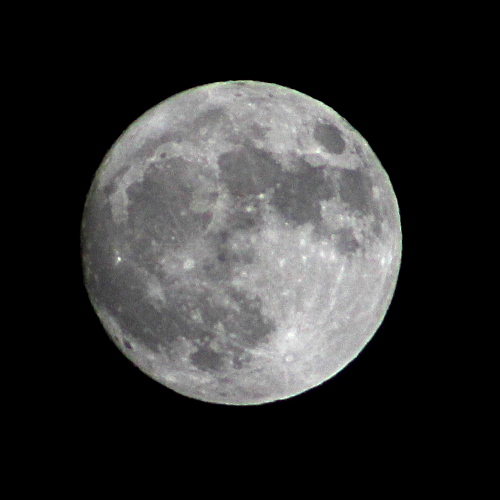
The nearly full super moon at 8 p..m. EST (1 hr UT) last night. The fact that the moon is not quite full is the dullness on the Moon’s left side and a hint of a crater shadow. The Moon will be as full as it gets at 8:52 a.m. EST (13:52 UT). Credit Bob Moler
For more facts on the super moon check out these links:
http://scienceblogs.com/startswithabang/2016/11/11/supermoon-fact-vs-fiction-synopsis/
11/10/16 – Ephemeris – Sunrise on Aristarchus
Ephemeris for Thursday, November 10th. The Sun will rise at 7:33. It’ll be up for 9 hours and 45 minutes, setting at 5:19. The Moon, 3 days past first quarter, will set at 3:35 tomorrow morning.
Tuesday I discussed the fact that the Moon appears to rock back and forth over the month due to it’s uneven motion around the Earth. Currently it’s still facing the direction of the Sun by nearly as far as it was on Tuesday, which is revealing a crater on the northeastern side of the Moon about a day earlier than average in the lunar monthly cycle. That crater is the brightest spot on the Moon, though it’s not that bright right now because that crater, called Aristarchus, is filled with shadow. That shadow will go away in a day or two. Aristarchus is visible in binoculars at the terminator, the advancing sunrise line on the Moon. Aristarchus is located on the flat lava plains that early telescopic astronomers thought were seas filled with water.
Times are for the Traverse City/Interlochen area of Michigan. They may be different for your location.
Addendum
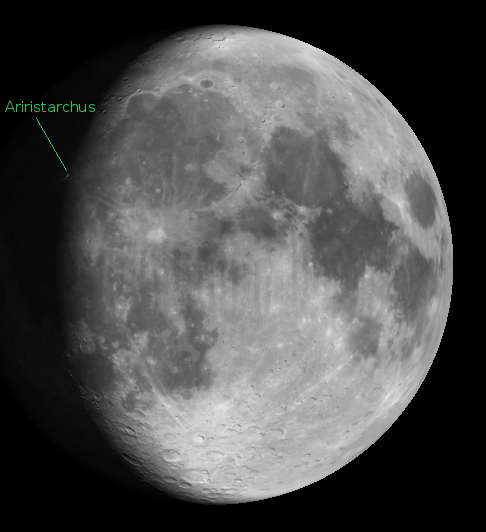
The moon with the Crater Aristarchus on the sunrise terminator at 9 p.m. November 10, 2016. Created using Virtual Moon Atlas.
11/08/2016 – Ephemeris – As the Moon wobbles
Ephemeris for Election Day, Tuesday, November 8th. The Sun will rise at 7:31. It’ll be up for 9 hours and 50 minutes, setting at 5:21. The Moon, 1 day past first quarter, will set at 1:14 tomorrow morning.
Tonight’s Moon bears close examination. The Moon has an elliptical orbit of the Earth, so its motion around the Earth moves fastest when nearer and slower when farther from the Earth. The Moon’s rotational speed, however is constant, Because of this the Moon appears to wobble back and forth. It also nods a bit. The effect is called libration. As of yesterday the Moon was rotated its greatest to the right for the month. It’s a small amount, only 8 degrees. On the 18th only 10 days from now the moon will nod 8 degrees to the left. A good way to tell the state of this libration for the waxing Moon is to check the position of the small gray sea near the right edge of the Moon, the Sea of Crises. Now it’s right at the edge of the Moon.
Times are for the Traverse City/Interlochen area of Michigan. They may be different for your location.
Addendum
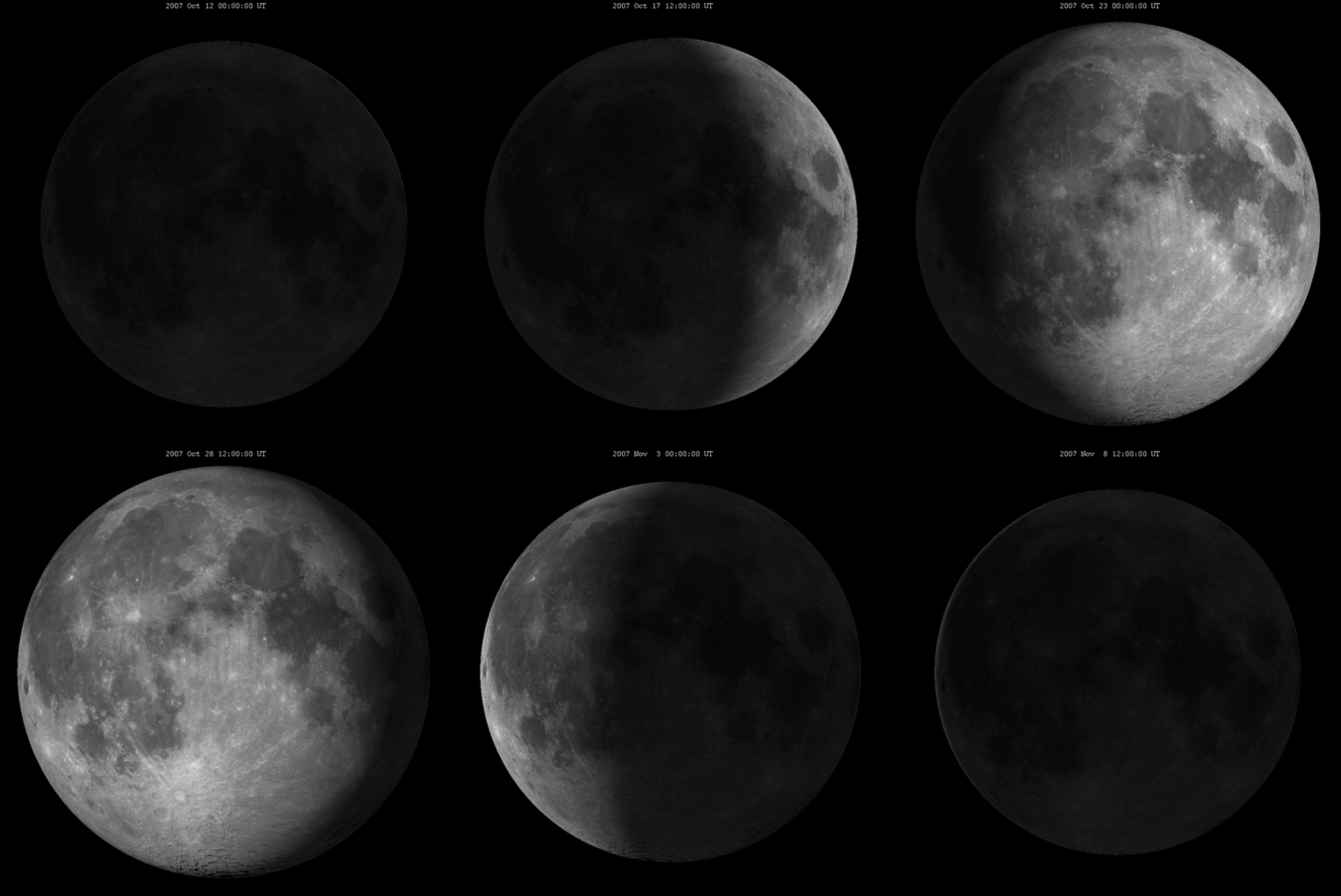
Simulation of the Moon’s phase and libration for October 2007 by Tomruen. Image is in the Public Domain. Downloaded from the Wikipedia entry for the Moon.
You can run a continuous simulation like this using the free program Virtual Moon Atlas.
10/28/2016 – Ephemeris – The Moon will hang by Jupiter this morning
Ephemeris for Friday, October 28th. The Sun will rise at 8:16. It’ll be up for 10 hours and 20 minutes, setting at 6:36. The Moon, 2 days before new, rose this morning at 6:02 and will rise at 7:01 tomorrow morning.
This morning the planet Jupiter and the Moon will appear close together in the morning sky. Jupiter rose at 6:03 a.m. After that until twilight becomes too bright both will appear together with Jupiter to the right of the thin waning crescent Moon. They passed each other at 4:18 (8:18 UT) this morning. Jupiter will appear to move farther from the Sun in the coming months, more the Sun moving away from it caused by the Earth’s motion around the Sun. Jupiter will enter the evening sky in April next year, passing in front of the zodiacal constellation of Virgo. By then we will have lost Venus as our Evening Star, so Jupiter will have no competition when it arrives from the east.
Times are for the Traverse City/Interlochen area of Michigan. They may be different for your location.
Addendum
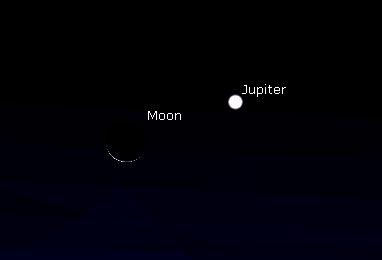
The Moon and Jupiter at 7 a.m. EDT (11:00 UT) this morning October 28, 2016. Stellarium and any other planetarium program cannot display the dynamic range of he sky. The sliver of the moon should be a lot brighter, including earthshine on its night side. I had to delete a star that was showing way too bright when it should be barely visible. Created using Stellarium and GIMP.
For observers in the UK and Europe the Moon will appear above Jupiter. As a rule of thumb, the Moon moves its own diameter in an hour against the stars. In the sky in the east just before sunrise the Moon will be moving down and to the left in relation to Jupiter.
10/14/2016 – Ephemeris – Super Moon Sunday and a weird comet
Ephemeris for Friday, October 14th. The Sun will rise at 7:57. It’ll be up for 11 hours and 1 minute, setting at 6:59. The Moon, 2 days before full, will set at 7:03 tomorrow morning.
The full moon on Sunday will be the Hunter’s Moon it will also be a super moon, though not quite as super as November’s super moon. I tend to disparage the effect because of the optical illusion that makes the Moon appear larger when near the horizon than when higher up. Besides there’s nothing out there of comparable size to compare it to. Farther out in space, the comet 29P/Schwassmann-Wachmann 1, which is weird among comets in having a nearly circular orbit between Jupiter and Saturn. It can be observed over it’s entire orbit. Normally a comet out that far is pretty much inactive. However every once in a while it produces an outburst, brightening and expelling a cloud of gas and dust. This can occur up to 7 times a year.
Times are for the Traverse City/Interlochen area of Michigan. They may be different for your location.
Addendum
This month’s super Moon will appear to be 33.4 minutes of arc in diameter when it will rise Sunday night at 7:40 p.m. in the Traverse City/Interlochen area. It will be 222,393 miles (357,906 km) away. November’s super Moon will rise November 14 at 5:53 p.m. and appear to be 33.6 minutes of arc in diameter. Note that half a degree is 30 minutes of arc. Last April 2nd’s mini Moon was 29.4 seconds of arc in diameter when it rose. It was 252,262 miles (405,977 km) away. This full Moon will appear 13.6% larger than last April’s full Moon.
 Bob Moler's Ephemeris Blog