Archive
11/16/2016 – Ephemeris – Where are the bright planets now?
Ephemeris for Wednesday, November 16th. The Sun will rise at 7:41. It’ll be up for 9 hours and 31 minutes, setting at 5:13. The Moon, 2 days past full, will rise at 7:38 this evening.
Low in the east-southeast before 7:15 a.m. Jupiter can be glimpsed in the morning twilight. Jupiter will rise tomorrow at 4:05 a.m. We are approaching Jupiter, though it’s 5 times Earth’s distance from the Sun and will pass it April 7th. Venus, Saturn and Mars are in the evening sky. At 6 p.m. these planets will be seen in the southwest and low in the sky. Venus will be the brightest, Saturn might be picked out of the twilight to the right and below Venus, and Mars will be higher to the left. Saturn will set first at 6:30, with Venus setting at 7:33. Mars will hang on a bit longer and will set at 10:07. Mars’ setting time hasn’t changed from last week. Venus is slowly heading northward for the rest of it’s evening appearance.
Times are for the Traverse City/Interlochen area of Michigan. They may be different for your location.
Addendum
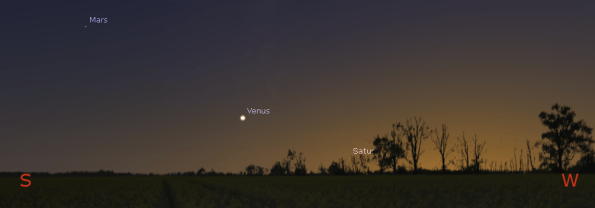
The evening planets in twilight in the southwestern sky at 6 p.m. Created using Stellarium.
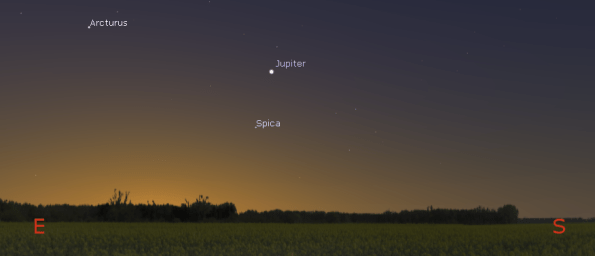
Jupiter rising in the morning sky this morning at 7 a.m. November 19, 2016. Created using Stellarium.
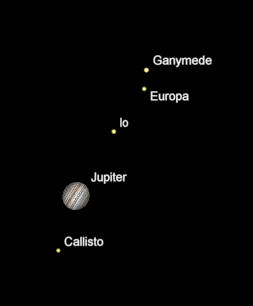
Jupiter and its Galilean moons, as they might be seen in a telescope at 7 a.m., this morning, November 16, 2016. Created using Cartes du Ciel (Sky Charts).
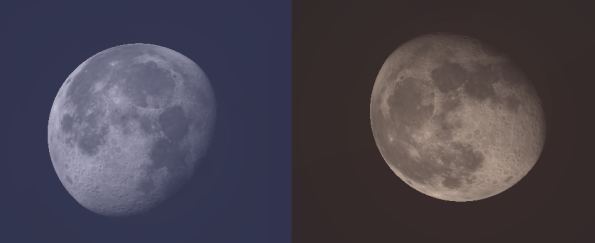
The Moon is visible both in the evening and the next morning. At right is the evening Moon at 8 p.m. On the left is the Moon at 7 a.m. A sharp-eyed person, with binoculars, can notice a slight change in the sunset terminator in the 11 hours between the two views. Created using Stellarium.
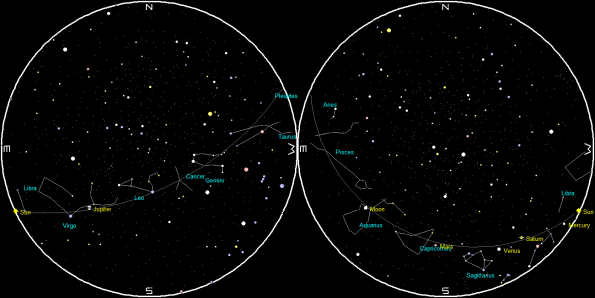
Planets and Moon at sunset and sunrise of a single night starting with sunset on the right on November 16, 2016. The night ends on the left with sunrise on November 17. If you are using Firefox right-click on the image and select View Image to enlarge the image. That goes for all the large images. Created using my LookingUp program.
11/14/2016 – Ephemeris – Watch the setting of the super moon this morning
Ephemeris for Monday, November 14th. The Sun will rise at 7:39. It’ll be up for 9 hours and 36 minutes, setting at 5:15. The Moon, at full today, will set this morning at 7:23 and will rise again at 5:53 this evening.
During the 6 to 7 o’clock hour this morning the Moon will be officially the closest super moon, most likely of your lifetime unless your 68 or older. Super moon’s apparently only count when the Moon is closest to the Earth at full moon. The Moon passes perigee, its closest point to the Earth once a month, but not always at full moon. It happens that both October and December’s full moons are also super moons. Rising and setting moon’s work the same way, to make the Moon appear even larger than it is. This is an optical illusion, but go with it. The Moon will be slightly farther away when it rises this evening. Moon set will occur at 7:23 or thereabouts this morning while moon rise will be at 5:53 this evening, somewhat earlier east of Traverse City, later west. Get out early if it’s clear.
Times are for the Traverse City/Interlochen area of Michigan. They may be different for your location.
Addendum
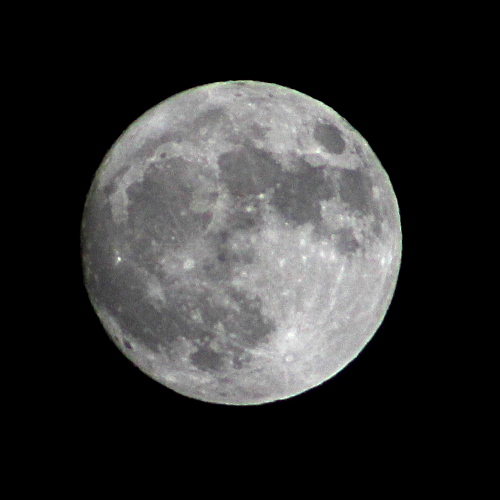
The nearly full super moon at 8 p..m. EST (1 hr UT) last night. The fact that the moon is not quite full is the dullness on the Moon’s left side and a hint of a crater shadow. The Moon will be as full as it gets at 8:52 a.m. EST (13:52 UT). Credit Bob Moler
For more facts on the super moon check out these links:
http://scienceblogs.com/startswithabang/2016/11/11/supermoon-fact-vs-fiction-synopsis/
11/10/16 – Ephemeris – Sunrise on Aristarchus
Ephemeris for Thursday, November 10th. The Sun will rise at 7:33. It’ll be up for 9 hours and 45 minutes, setting at 5:19. The Moon, 3 days past first quarter, will set at 3:35 tomorrow morning.
Tuesday I discussed the fact that the Moon appears to rock back and forth over the month due to it’s uneven motion around the Earth. Currently it’s still facing the direction of the Sun by nearly as far as it was on Tuesday, which is revealing a crater on the northeastern side of the Moon about a day earlier than average in the lunar monthly cycle. That crater is the brightest spot on the Moon, though it’s not that bright right now because that crater, called Aristarchus, is filled with shadow. That shadow will go away in a day or two. Aristarchus is visible in binoculars at the terminator, the advancing sunrise line on the Moon. Aristarchus is located on the flat lava plains that early telescopic astronomers thought were seas filled with water.
Times are for the Traverse City/Interlochen area of Michigan. They may be different for your location.
Addendum
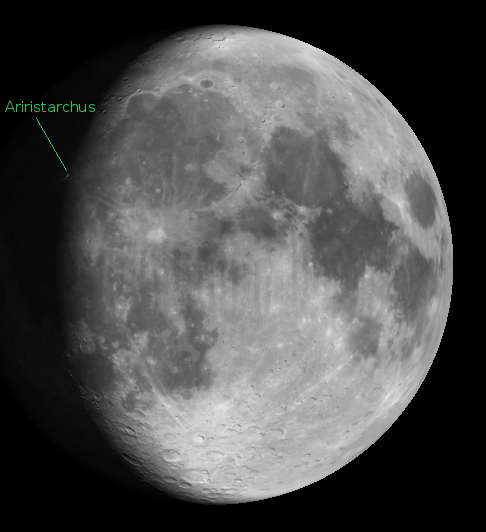
The moon with the Crater Aristarchus on the sunrise terminator at 9 p.m. November 10, 2016. Created using Virtual Moon Atlas.
11/08/2016 – Ephemeris – As the Moon wobbles
Ephemeris for Election Day, Tuesday, November 8th. The Sun will rise at 7:31. It’ll be up for 9 hours and 50 minutes, setting at 5:21. The Moon, 1 day past first quarter, will set at 1:14 tomorrow morning.
Tonight’s Moon bears close examination. The Moon has an elliptical orbit of the Earth, so its motion around the Earth moves fastest when nearer and slower when farther from the Earth. The Moon’s rotational speed, however is constant, Because of this the Moon appears to wobble back and forth. It also nods a bit. The effect is called libration. As of yesterday the Moon was rotated its greatest to the right for the month. It’s a small amount, only 8 degrees. On the 18th only 10 days from now the moon will nod 8 degrees to the left. A good way to tell the state of this libration for the waxing Moon is to check the position of the small gray sea near the right edge of the Moon, the Sea of Crises. Now it’s right at the edge of the Moon.
Times are for the Traverse City/Interlochen area of Michigan. They may be different for your location.
Addendum
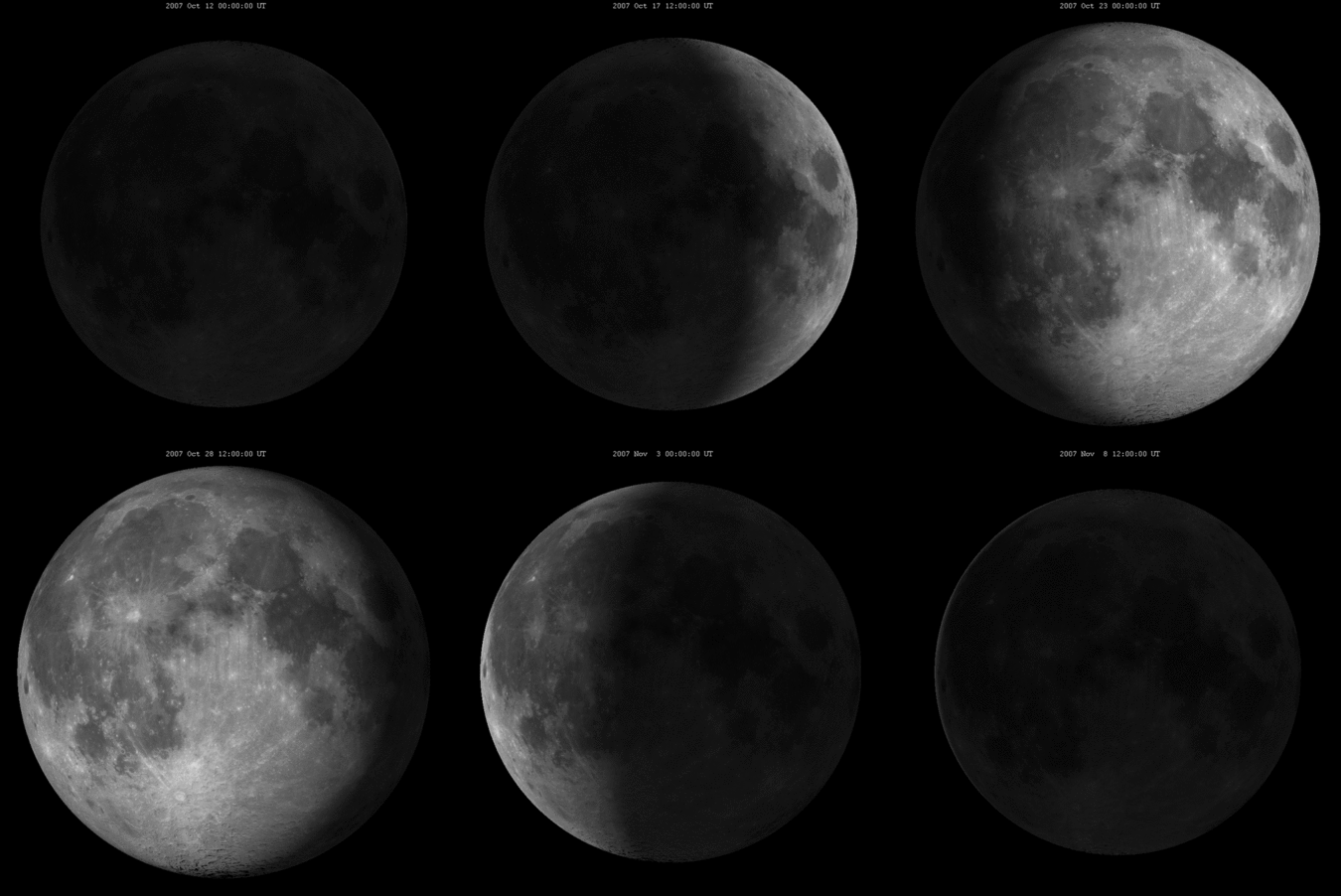
Simulation of the Moon’s phase and libration for October 2007 by Tomruen. Image is in the Public Domain. Downloaded from the Wikipedia entry for the Moon.
You can run a continuous simulation like this using the free program Virtual Moon Atlas.
10/28/2016 – Ephemeris – The Moon will hang by Jupiter this morning
Ephemeris for Friday, October 28th. The Sun will rise at 8:16. It’ll be up for 10 hours and 20 minutes, setting at 6:36. The Moon, 2 days before new, rose this morning at 6:02 and will rise at 7:01 tomorrow morning.
This morning the planet Jupiter and the Moon will appear close together in the morning sky. Jupiter rose at 6:03 a.m. After that until twilight becomes too bright both will appear together with Jupiter to the right of the thin waning crescent Moon. They passed each other at 4:18 (8:18 UT) this morning. Jupiter will appear to move farther from the Sun in the coming months, more the Sun moving away from it caused by the Earth’s motion around the Sun. Jupiter will enter the evening sky in April next year, passing in front of the zodiacal constellation of Virgo. By then we will have lost Venus as our Evening Star, so Jupiter will have no competition when it arrives from the east.
Times are for the Traverse City/Interlochen area of Michigan. They may be different for your location.
Addendum
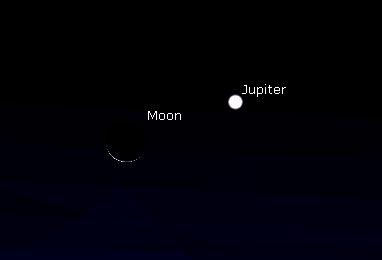
The Moon and Jupiter at 7 a.m. EDT (11:00 UT) this morning October 28, 2016. Stellarium and any other planetarium program cannot display the dynamic range of he sky. The sliver of the moon should be a lot brighter, including earthshine on its night side. I had to delete a star that was showing way too bright when it should be barely visible. Created using Stellarium and GIMP.
For observers in the UK and Europe the Moon will appear above Jupiter. As a rule of thumb, the Moon moves its own diameter in an hour against the stars. In the sky in the east just before sunrise the Moon will be moving down and to the left in relation to Jupiter.
10/14/2016 – Ephemeris – Super Moon Sunday and a weird comet
Ephemeris for Friday, October 14th. The Sun will rise at 7:57. It’ll be up for 11 hours and 1 minute, setting at 6:59. The Moon, 2 days before full, will set at 7:03 tomorrow morning.
The full moon on Sunday will be the Hunter’s Moon it will also be a super moon, though not quite as super as November’s super moon. I tend to disparage the effect because of the optical illusion that makes the Moon appear larger when near the horizon than when higher up. Besides there’s nothing out there of comparable size to compare it to. Farther out in space, the comet 29P/Schwassmann-Wachmann 1, which is weird among comets in having a nearly circular orbit between Jupiter and Saturn. It can be observed over it’s entire orbit. Normally a comet out that far is pretty much inactive. However every once in a while it produces an outburst, brightening and expelling a cloud of gas and dust. This can occur up to 7 times a year.
Times are for the Traverse City/Interlochen area of Michigan. They may be different for your location.
Addendum
This month’s super Moon will appear to be 33.4 minutes of arc in diameter when it will rise Sunday night at 7:40 p.m. in the Traverse City/Interlochen area. It will be 222,393 miles (357,906 km) away. November’s super Moon will rise November 14 at 5:53 p.m. and appear to be 33.6 minutes of arc in diameter. Note that half a degree is 30 minutes of arc. Last April 2nd’s mini Moon was 29.4 seconds of arc in diameter when it rose. It was 252,262 miles (405,977 km) away. This full Moon will appear 13.6% larger than last April’s full Moon.
10/12/2016 – Ephemeris – Jupiter joins Mercury in the morning sky22
Ephemeris for Wednesday, October 12th. The Sun will rise at 7:55. It’ll be up for 11 hours and 7 minutes, setting at 7:02. The Moon, 3 days past first quarter, will set at 4:35 tomorrow morning.
Low in the east this morning at 7:15 both Mercury and Jupiter might be glimpsed, with Mercury just below Jupiter which is a bit brighter. Jupiter will rise at 6:38 a.m. and Mercury will rise at 6:47 a.m. Venus, Saturn and Mars are in the evening sky. Venus is briefly visible after sunset, low in the west. It will set at 8:20 p.m., following the Sun’s earlier setting times. Venus is still moving a bit southward and will still be hugging the southwestern horizon for the next month or so. Mars and Saturn can be seen in the darkened sky after Venus sets. Mars is way out to the left of Saturn passing above the Teapot of Sagittarius. Saturn, spectacular in telescopes with its rings, will set at 9:35 p.m. Mars will set at 11:14 p.m.
Times are for the Traverse City/Interlochen area of Michigan. They may be different for your location.
Addendum
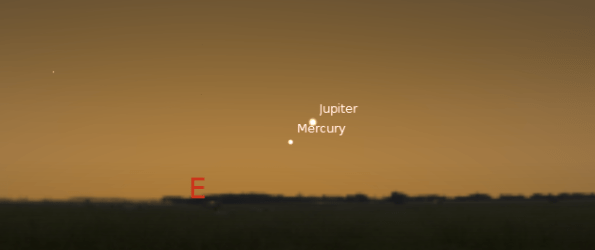
Jupiter and Mercury at 7:15 a.m. low in the east today October 12, 2016. Created using Stellarium.
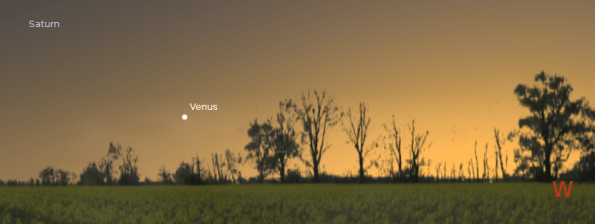
Venus and Saturn at 7:22 p.m. tonight October 12, 2016, looking to the southwest. I doubt if you could spot Saturn at this time. Created using Stellarium.
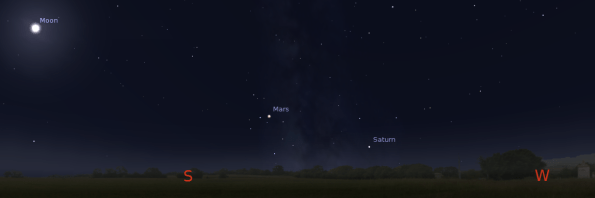
Saturn, Mars and the Moon at 8:30 p.m. October 12, 2016. Created using Stellarium.
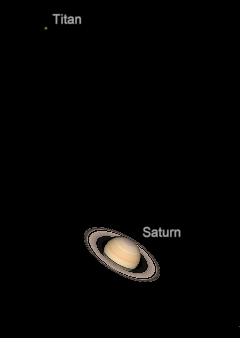
Saturn and moon as it might be seen in a telescope. at 8:30 p.m. October 12, 2016. More than likely only the satellite Titan would be seen with Saturn. Created using Cartes du Ciel (Sky Charts).
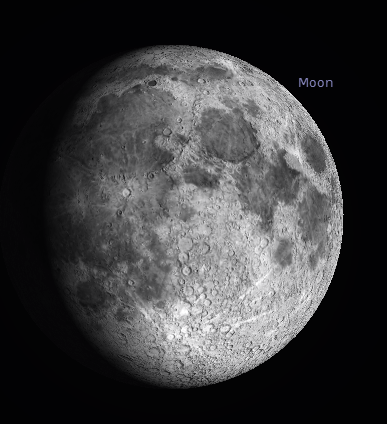
The Moon as it might be seen with binoculars tonight at 8:30 p.m. October 12, 2016. Created using Stellarium.
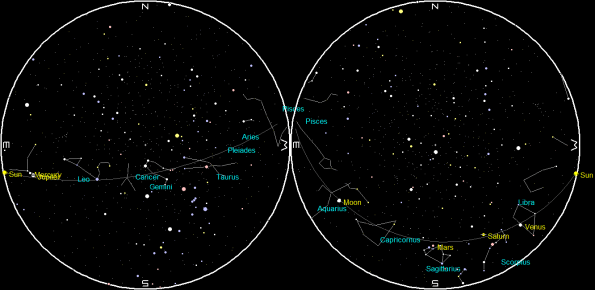
Planets and Moon at sunset and sunrise of a single night starting with sunset on the right on October 12, 2016. The night ends on the left with sunrise on October 13. If you are using Firefox right-click on the image and select View Image to enlarge the image. That goes for all the large images. Created using my LookingUp program.
10/11/2016 – Ephemeris – Looking at the Moon tonight
Ephemeris for Tuesday, October 11th. The Sun will rise at 7:53. It’ll be up for 11 hours and 10 minutes, setting at 7:04. The Moon, 2 days past first quarter, will set at 3:26 tomorrow morning.
We looked at the Moon in the last program, now 24 hours later the sunrise terminator has moved farther west, our east uncovering more landscape. The Moon rotates once in about 29 ½ days in relation with the Sun. This is the same time it orbits the Earth from new Moon to the next. We call that a lunation or lunar month. Near the upper left corner of the Moon is what looks like a half crater. It’s called Sinus Iridium, the Bay of Rainbows. It’s at the edge of Mare Imbrium or Sea of Showers. To the south cut by the terminator is Oceanus Procellarum, the flat Ocean of Storms. South of that is the small Mare Humorum, the Sea of Vapors. Between then is a distinctive crater Gassendi. South of all that is the odd shaped crater Schiller.
Times are for the Traverse City/Interlochen area of Michigan. They may be different for your location.
Addendum
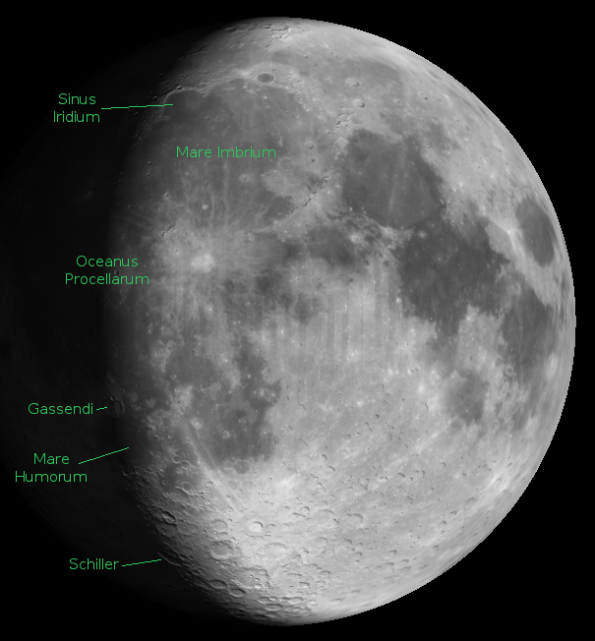
The Moon at 9 p.m. October 11, 2016. Created using Virtual Moon Atlas.
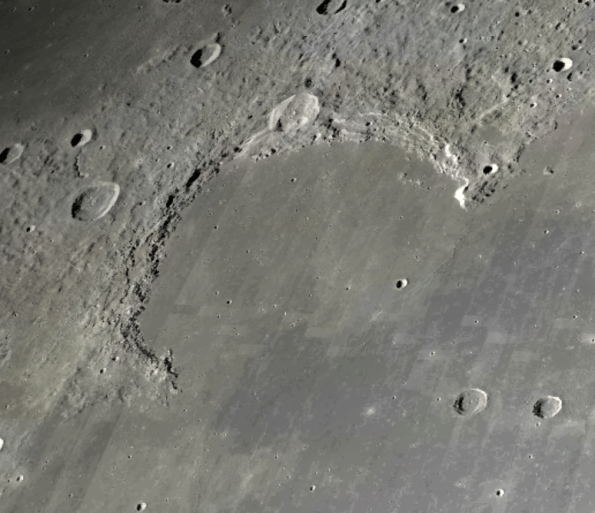
Sinus Iridium photographed by the Lunar Reconnaissance Orbiter as texture mapped on the globe of the Virtual Moon Atlas.
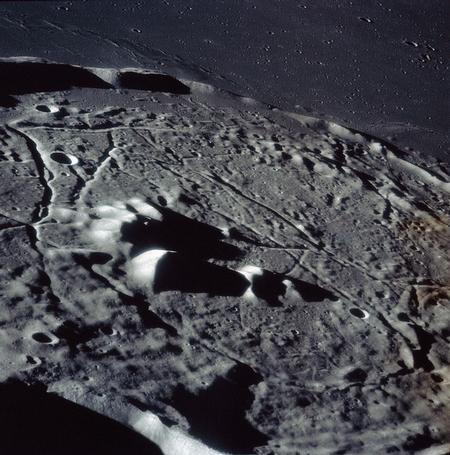
The crater Gassendi from Apollo 16 – NASA
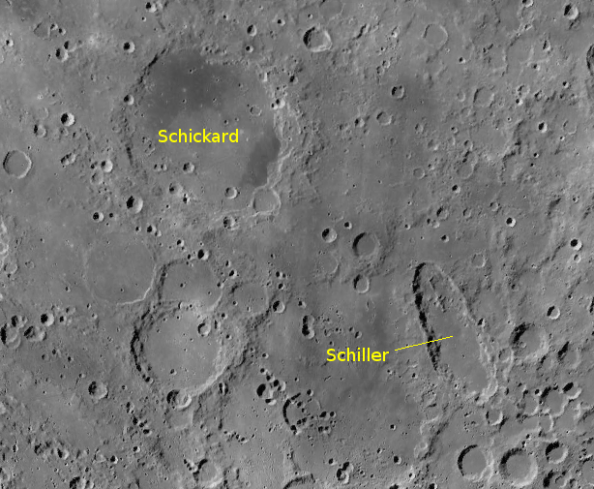
The craters Schickard and Schiller as seen from above from the Lunar Reconnaissance Orbiter. The Sun will start to rise on Schickard tomorrow night. Credit NASA from Virtual Moon Atlas.
10/10/2016 – Ephemeris – Checking out the gibbous Moon tonight
Ephemeris for Indigenous Peoples Day*, Monday, October 10th. The Sun will rise at 7:52. It’ll be up for 11 hours and 13 minutes, setting at 7:06. The Moon, 1 day past first quarter, will set at 2:20 tomorrow morning.
The Moon is beginning to dominate the evening sky. So it’s time to get out that telescope or powerful binoculars. The terminator which now is the sunrise line will be cutting through the Sea of Showers, also known as Mare Imbrium. Just south of it is the large crater Copernicus, 56 miles (93 km) in diameter. Copernicus, near the Moon’s equator hit a flat lunar sea, so it’s quite conspicuous. Another crater near the Moon’s south pole is conspicuous because it’s so big. It’s Clavius, with an arc of diminishing sized craters within. It is 136 miles (225 km) in diameter. In the book and movie 2001: A Space Odyssey, it is the location of the US Moon Base, with the monolith in the distinctive crater Tycho north of it.
Times are for the Traverse City/Interlochen area of Michigan. They may be different for your location.
Addendum
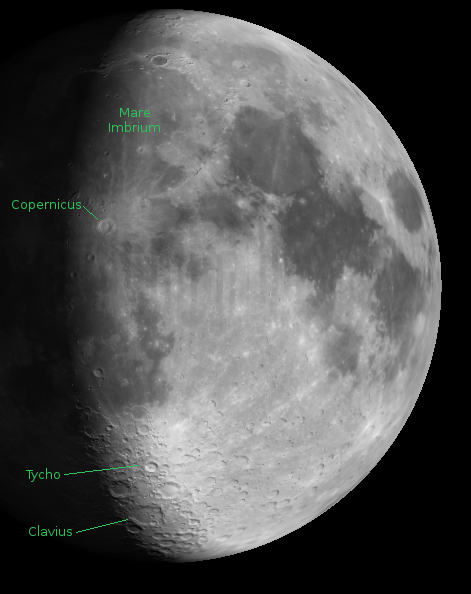
The Moon at 9 p.m. October 10, 2016, with the landmarks described in the text above,
* Indigenous Peoples Day – This is officially the Columbus Day holiday in the United States, which commemorates the landing of Christopher Columbus possibly on Plana Cay, which he named San Salvador. While in his four voyages he visited some Caribbean islands, Central and South America. He never made it to North America. Columbus was appointed the Viceroy and Governor of the Indies. He was accused of torture and other crimes. And the treatment of the Indigenous peoples as been horrific then and ever since, so pardon them if they don’t celebrate Columbus Day. This person of European ancestry tends to agree with them.
10/07/2016 – Ephemeris – Busy astronomical weekend in Traverse City
Ephemeris for Friday, October 7th. The Sun will rise at 7:48. It’ll be up for 11 hours and 22 minutes, setting at 7:11. The Moon, 2 days before first quarter, will set at 11:30 this evening.
This is another busy weekend for the Grand Traverse Astronomical Society. Tonight there will be a general meeting of the society at 8 p.m. followed by a star party at 9 p.m. at Northwestern Michigan College’s Rogers Observatory, located on Birmley Road south of Traverse City, to which all are welcome. The featured speaker for the meeting will be Randy Leach presenting Astrophotography for the Average Guy. Photographing the sky without spending big bucks. Tomorrow evening members of the society will be on the north side of the 200 block of East Front street in Traverse City with their telescopes for the International Observe the Moon Night. We’ll start at 7 p.m. if it’s clear.
Times are for the Traverse City/Interlochen area of Michigan. They may be different for your location.
Addendum
Substitute speaker: Yours truly: Personal recollections of 4 total solar eclipses and a look ahead at next year’s eclipse.
 Bob Moler's Ephemeris Blog