Archive
07/15/2016 – Ephemeris – The Moon tonight
Ephemeris for Friday, July 15th. Today the Sun will be up for 15 hours and 13 minutes, setting at 9:25, and it will rise tomorrow at 6:12. The Moon, half way from first quarter to full, will set at 3:35 tomorrow morning.
The Moon is bright as it moves toward full. In binoculars, the brightest spot on the Moon is visible on the left edge of the Moon at 10 p.m. In telescopes it becomes a crater named Aristarchus. The sea below Aristarchus where the terminator, the sunrise line cuts across is Oceanus Procellarum, the Ocean of Storms. Below that is the small circular sea called Mare Humorum, the Sea of Moisture. North of Humorum is a large crater with low walls and a multiple central peak called Gassendi. Below that we’re back in the lunar highlands with lots of large craters. One of those craters, near the terminator is oddly elongated. It’s Schiller, 108 by 43 miles (174 X 69 km) in size.
Times are for the Traverse City/Interlochen area of Michigan. They may be different for your location.
Addendum
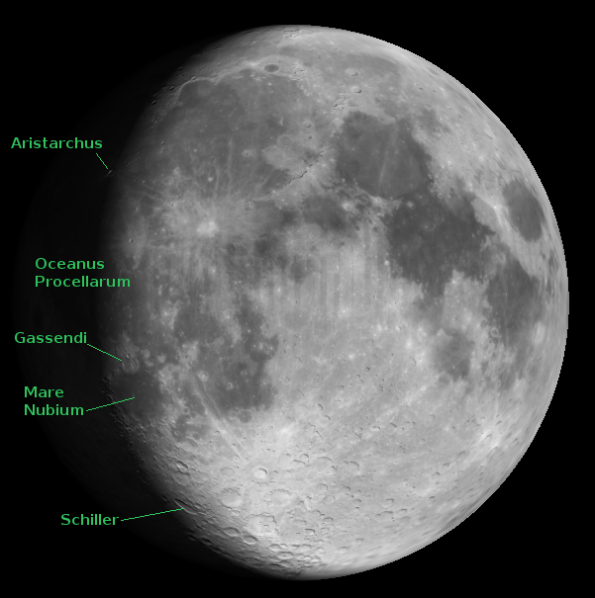
The gibbous Moo at 10 p.m. July 15, 2016 showing some interesting features near the terminator. Created using Virtual Moon Atlas.
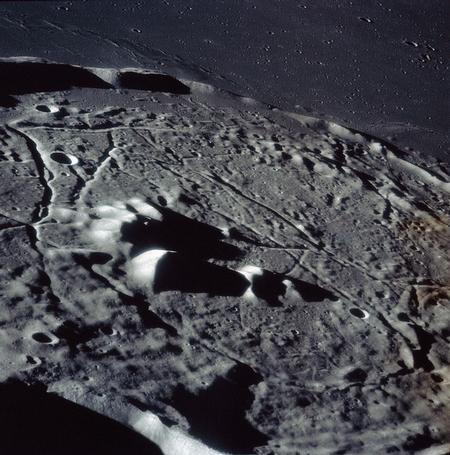
The crater Gassendi from Apollo 16 – NASA
07/11/2016 – Ephemeris – Checking out a crack on the Moon
Ephemeris for Monday, July 11th. Today the Sun will be up for 15 hours and 19 minutes, setting at 9:27, and it will rise tomorrow at 6:09. The Moon, at first quarter today, will set at 1:24 tomorrow morning.
Mostly when discussing the features visible on the Moon, I talk about craters. This feature, visible close to the terminator, the sunrise line on the moon is a rille or what appears as a long meandering groove. It’s called the Hyginus Rille, a 133 mile (220 km) long, 2 mile (4 km) wide groove with a small crater near the center named Hyginus. The crater doesn’t look like a normal collision caused crater. It has no raised crater walls. The best guess as to what the Hyginus Rille is a collapsed lava tube. Parts of the lava tube may be intact as the groove devolves into a line of craters. Lava tubes may be used as lunar bases since they can serve as protection from meteoroids, radiation and temperature swings of the lunar day/night cycle.
Times are for the Traverse City/Interlochen area of Michigan. They may be different for your location.
Addendum
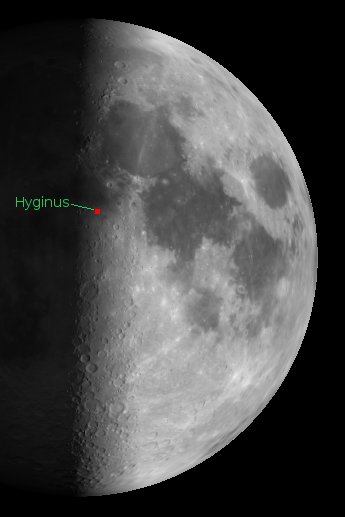
The Moon at 10:30 p.m. July 11, 2016 with the location of the Hyginus Rille located. Created using the Virtual Moon Atlas.
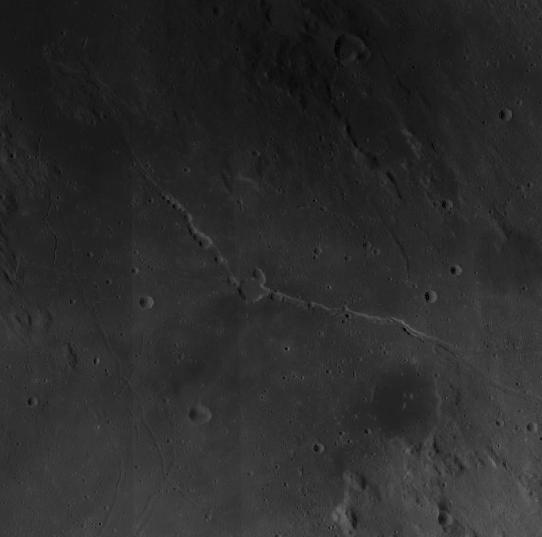
Closeup of the Hyginus Rille using the Lunar Reconnaissance Orbiter texture on the Virtual Moon Atlas.
06/16/2016 – Ephemeris – The Moon tonight
Ephemeris for Thursday, June 16th. Today the Sun will be up for 15 hours and 34 minutes, setting at 9:30, and it will rise tomorrow at 5:56. The Moon, half way from first quarter to full, will set at 4:23 tomorrow morning.
The Moon is bright as it moves toward full. In binoculars, the brightest spot on the Moon is visible on the left edge of the Moon at 10 p.m. In telescopes it becomes a crater named Aristarchus. The sea below Aristarchus where the terminator, the sunrise line cuts across is Oceanus Procellarum, the Ocean of Storms. Below that is the small circular sea called Mare Humorum, the Sea of Moisture. Below that we’re back in the lunar highlands with lots of large craters, rather to many
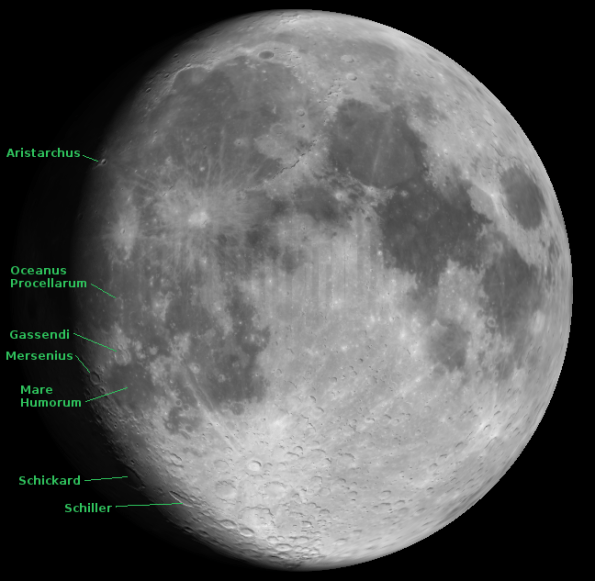
The Gibbous Moon at 10 p.m., June 16, 2016 showing some interesting features near the terminator.
to mention here. The transcripts of these programs with illustrations are available at bobmoler.wordpress.com. That’s Moler spelled simply M-O-L-E-R. The Moon illustration will point out the features I’ve discussed.
Times are for the Traverse City/Interlochen area of Michigan. They may be different for your location.
Addendum
06/13/2016 – Ephemeris – Two early astronomers honored by prominent craters on the Moon
Ephemeris for Monday, June 13th. Today the Sun will be up for 15 hours and 32 minutes, setting at 9:29, and it will rise tomorrow at 5:56. The Moon, 1 day past first quarter, will set at 2:54 tomorrow morning.
The Moon tonight sports two craters, named for important astronomers near the south end of the of our satellite. The first, the smaller of the two sticks out for its sharp edges and dark shadows. It is Tycho, which at full moon exhibits moon encircling rays. It’s 52 miles (86 km) in diameter. Named for Tycho Brahe that last great naked eye astronomer in the 16th century, whose precise positions of Mars allowed Johannes Kepler to formulate his Three Laws of Planetary Motion. Clavius is a large crater south and closer to the terminator, the sunrise line, than Tycho. It has a curious arc of several smaller craters on its floor. Clavius is 136 miles (225 km) in diameter. Clavius completed work on the Gregorian calendar.
Times are for the Traverse City/Interlochen area of Michigan. They may be different for your location.
Addendum
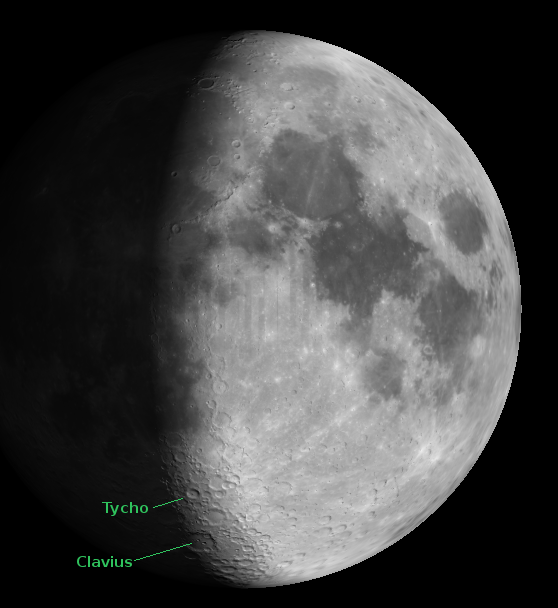
The Moon at 10 p.m. June 13, 2016 featuring the craters Tycho and Clavius. Created using Virtual Moon Atlas.
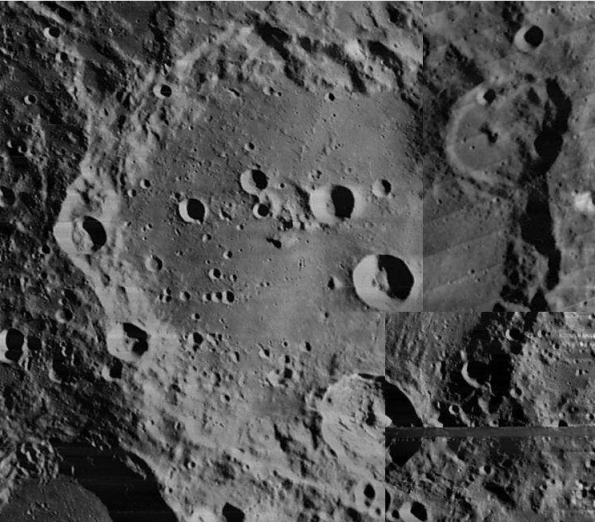
Clavius as photographed by one of the Lunar Orbiter spacecraft in the 1960s From Digital Lunar Orbital Photographic Atlas. Credit Jeff Gillis, Lunar and Planetary Institute.
06/07/2016 – Ephemeris – The Moon reappears in the evening sky
Ephemeris for Tuesday, June 7th. Today the Sun will be up for 15 hours and 28 minutes, setting at 9:26, and it will rise tomorrow at 5:57. The Moon, 3 days past new, will set at 11:41 this evening.
The Moon tonight is a thin crescent with the night side faintly illuminated by the Earth. The effect is called earthshine. The small dark sea of Crises, or Mare Crisium, near the right edge of the moon will be cut in half by the moon’s terminator, its sunrise line. Venus, which passed behind the Sun yesterday, though now an official evening planet probably won’t become easily visible till near the end of summer. The evening sky now through mid July is a time where it seems that twilight never ends. However for almost the next two weeks, we have the bright planets Jupiter, Mars and Saturn plus the Moon to help us forget the seemingly forever twilight blues. After that we’ll have just the planets. Not a bad deal.
Times are for the Traverse City/Interlochen area of Michigan. They may be different for your location.
Addendum
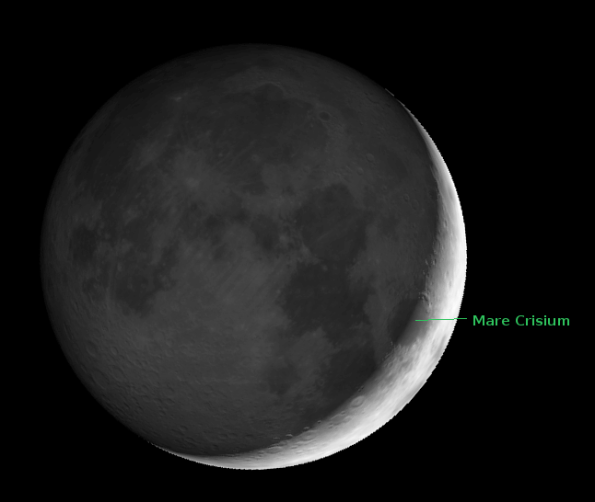
The Moon showing earthshine at 10:30 p.m. June 7, 2016. Created using Virtual Moon Atlas.
Note: The image, from Virtual Moon Atlas, has been rotated to show the approximate appearance in the sky of the Moon low in the southwest. I didn’t attempt to add the sky brightness and color.
05/18/2016 – Ephemeris – Three bright planets and the Moon grace the evening sky
Ephemeris for Wednesday, May 18th. Today the Sun will be up for 14 hours and 57 minutes, setting at 9:08. The Moon, 3 days before full, will set at 5:19 tomorrow morning. Tomorrow the Sun will rise at 6:09.
Let’s see what the bright naked eye planets are up to. Jupiter is in the south in the early evening, moving to the southwest. It will set at 3:28 a.m. It’s below the stars of Leo this year. Binoculars can make out some of Jupiter’s moons, but a telescope is required to see all four bright moons and Jupiter’s cloud features. Mars will rise at 9:26 p.m. in the east-southeast. It’s above and right of its look-a-like star Antares, whose name means Rival of Mars. Mars is getting closer to the Earth now, only 48 million miles (77 million km) away. It will be closest to the Earth on the 30th. Saturn will rise at 10:11 p.m. in the east-southeast. It’s to the left of Mars, and once it’s been up for an hour is a beautiful sight in any telescope.
Times are for the Traverse City/Interlochen area of Michigan. They may be different for your location.
Addendum
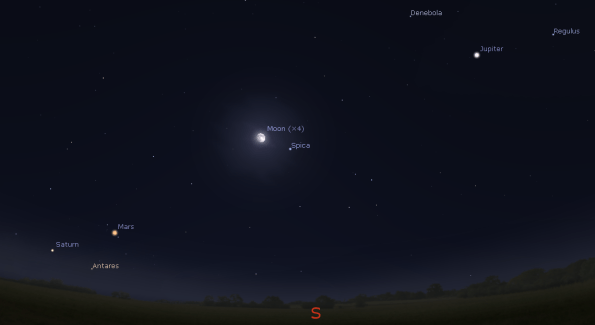
The Moon, Jupiter, Mars and Saturn at 11 p.m. May 18, 2016. Created using Stellarium.
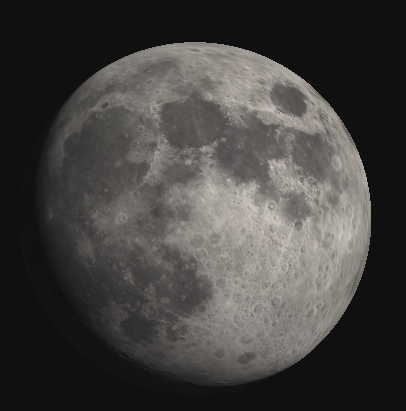
The Moon as it might be seen in binoculars at 11 p.m., May 18, 2016. Created using Stellarium.
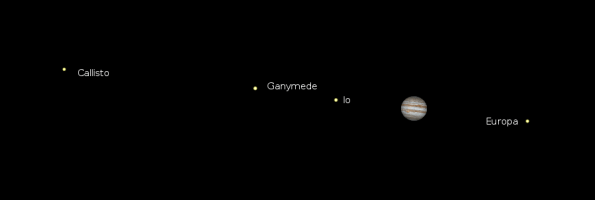
Jupiter and its moons as they might be seen through a telescope at 11 p.m. May 18, 2016. It’s 38.7″ in equatorial diameter. The Great Red Spot will cross the planet’s central meridian at 11:38 p.m. Created using Cartes du Ciel (Sky Charts).
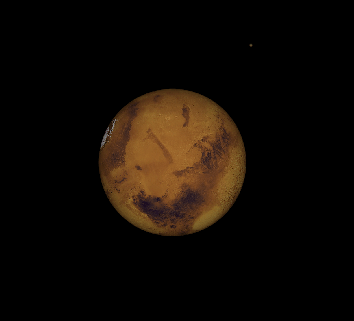
Mars as it might be seen in a large telescope with high power at 11 p.m. May 18, 2016. Mars apparent diameter is 18.2″. The central meridian will be 248.08 degrees. Syrtis Major is the large feature in the north near the polar cap. Created using Cartes du Ciel (Sky Charts).
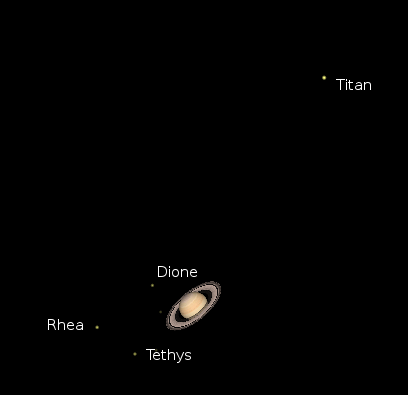
Saturn and its moons at 11 p.m. May 18, 2016. The apparent diameter of the planet will be 18.4″. The rings span 42.8″, a bit larger than the apparent diameter of Jupiter. Created using Cartes du Ciel (Sky Charts).
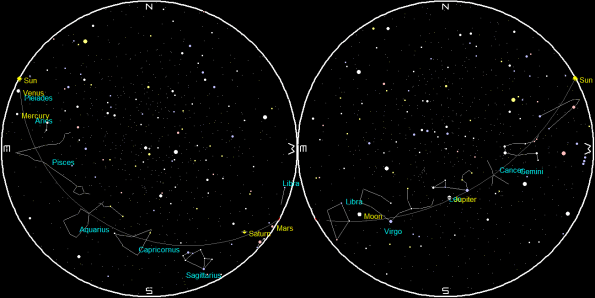
Planets at Sunrise and Sunset of a single night starting with sunset on the right on May 18, 2016. The night ends on the left with sunrise on May 19. If you are using Firefox right-click on the image and select View Image to enlarge the image. That goes for all the large images.
05/17/2016 – Ephemeris – Three heliocentrists memorialized on the Moon tonight
Ephemeris for Tuesday, May 17th. Today the Sun will be up for 14 hours and 55 minutes, setting at 9:07. The Moon, half way from first quarter to full, will set at 4:50 tomorrow morning. Tomorrow the Sun will rise at 6:10.
Tonight the gibbous Moon boasts the uncovering of three craters from lunar night whose namesakes were pioneers in putting forth the heliocentric theory. That is that the Earth and the other planets revolved about the Sun. Out the longest, and making the biggest splash is the crater Copernicus, named for the Polish cleric whose book On the Revolution of the Heavenly Spheres gave a new meaning to the word revolution, that is upheaval. The crater Kepler is about two-thirds the way from Copernicus and the terminator, named after the astronomer who discovered that the plants orbit the Sun in elliptical paths. Finally just catching sunlight is Aristarchus who in the 4th century BC first proposed a heliocentric solar system.
Times are for the Traverse City/Interlochen area of Michigan. They may be different for your location.
Addendum
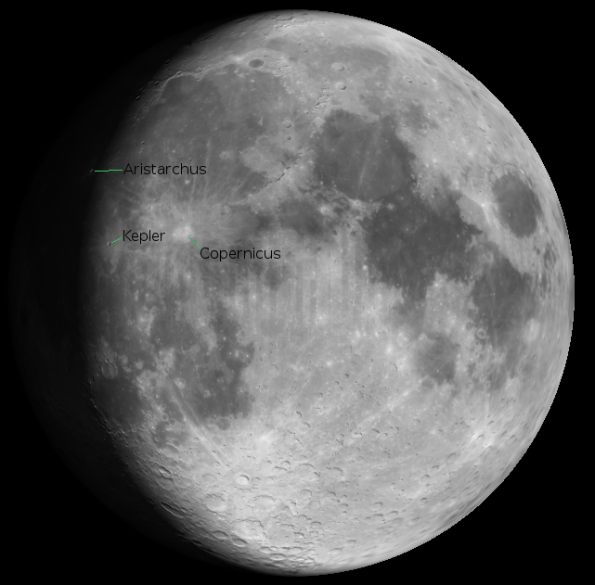
Three heliocentrists on the Moon at 10 p.m., May 17, 2016. Created using Virtual Moon Atlas.
05/16/2016 – Ephemeris – The Sun rises on the Bay of Rainbows
Ephemeris for Monday, May 16th. Today the Sun will be up for 14 hours and 53 minutes, setting at 9:06. The Moon, 3 days past first quarter, will set at 4:23 tomorrow morning. Tomorrow the Sun will rise at 6:11.
One of my favorite lunar formations is creeping into sunlight on the Moon this evening. Look to the upper left edge of the moon tonight. The large sea or dark area of the Moon, the Man in the Moon’s right eye as he’s looking at us is Mare Imbrium, the Sea of Showers. At the top left edge of that sea is a large notch. And keeping with of seas these of the first telescopic astronomers its name is Sinus Iridium, or Bay of Rainbows, a colorful name for something as colorless as the rest of the Moon. The terminator which is the sunrise line will be cutting across that bay, illuminating the semicircular mountain ring that surrounds it before all of the floor is illuminated. It can be seen in binoculars or a small telescope.
Times are for the Traverse City/Interlochen area of Michigan. They may be different for your location.
Addendum
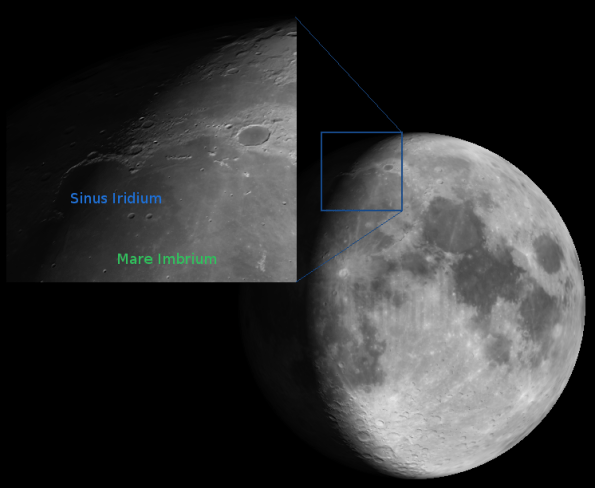
Image showing the Moon tonight at 10 p.m., May 16, 2016 (2 hr, May 17, 2016 UT) with Sinus Iridium (Bay of Rainbows) just coming into sunlight. Created using the Virtual Moon Atlas.
05/12/2016 – Ephemeris – The Moon tonight
Ephemeris for Thursday, May 12th. Today the Sun will be up for 14 hours and 44 minutes, setting at 9:01. The Moon, 1 day before first quarter, will set at 2:26 tomorrow morning. Tomorrow the Sun will rise at 6:16.
The moon tonight is a fat crescent. In binoculars the small Sea of Crises is prominently located as a gray patch at the edge of the moon. The Sea of Fertility is below it, while the sea of Tranquility is between them and near the terminator, the sunrise line on the moon. In telescopes there are three craters south of Tranquility, most prominent of which is Theophilus. With its prominent central peak. Farther to the north of Crises and near the partially exposed Sea of Serenity is the crater Posidonius, larger than Theophilus, but has a double crater wall on one side. Larger telescopes can see cracks in its floor . It has no central peak, and shows its age of maybe three and a half billion years.
Times are for the Traverse City/Interlochen area of Michigan. They may be different for your location.
Addendum
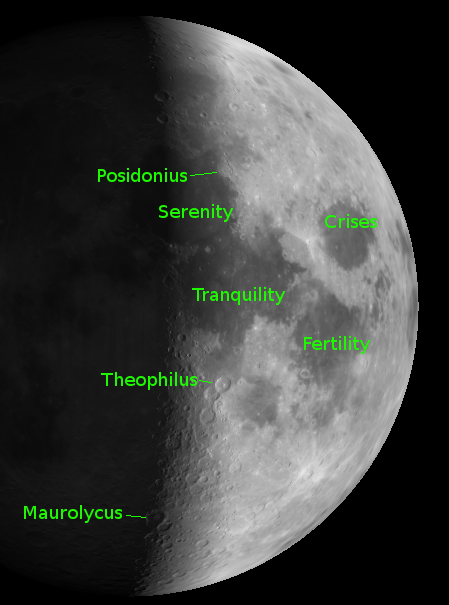
The Moon at 10 p.m. May 12, 2016. Created using Virtual Moon Atlas.
05/10/2016 – Ephemeris – The lunar Sea of Crises
Ephemeris for Tuesday, May 10th. The Sun rises at 6:19. It’ll be up for 14 hours and 39 minutes, setting at 8:59. The Moon, 3 days before first quarter, will set at 1:04 tomorrow morning.
Tonight the Moon shows one remarkable sea: Mare Crisium or the Sea of Crises. It is a large gray basin. The largest feature visible in binoculars. Because it’s near the Moon’s limb or edge it is foreshortened into an ellipse, with the long axis running north and south. In actuality it is elliptical with the long axis east and west. It looks funny on a geologic map of the whole moon or a Moon globe. Its dimensions are 345 by 375 miles (570 by 620km). It’s really a crater as are all seas whose impact asteroid reached down to the Moon’s magma and caused lava to well up to produce the flat floor. When the sunlight is low as it is now wrinkle ridges will appear showing where successive lava flows have stopped and solidified.
Times are for the Traverse City/Interlochen area of Michigan. They may be different for your location.
Addendum
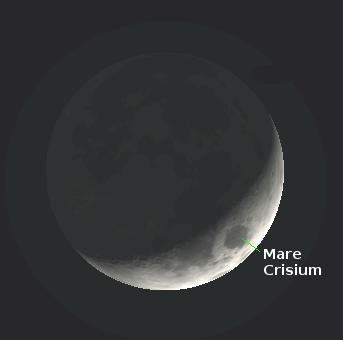
The Moon’s approximate orientation and phase at May 10, 2016. Created using Stellarium.
 Bob Moler's Ephemeris Blog