Archive
04/18/2016 – Ephemeris – A lunar crater that celebrates the first known proponent of a Sun centered solar system
Ephemeris for Monday, April 18th. The Sun rises at 6:52. It’ll be up for 13 hours and 39 minutes, setting at 8:32. The Moon, 4 days before full, will set at 5:52 tomorrow morning.
The Moon slipped past Jupiter at 1:30 this morning so this evening the planet is to the right of the Moon. The brightest spot on the Moon will appear to the upper left of it tonight in binoculars or a small telescope. It is the crater Aristarchus, named after the Greek philosopher who first proposed a Sun centered solar system in the 3rd century BC. Nobody else bought the idea until 19 centuries later. The crater Aristarchus is a relatively new crater, which on the Moon means it was formed probably less than 1.1 billion years ago, after most cratering had subsided. Mysteriously there have been reports over the years from amateur astronomers and even professionals of seeing transient bright spots or glows emanating from the crater.
Times are for the Traverse City/Interlochen area of Michigan. They may be different for your location.
Addendum
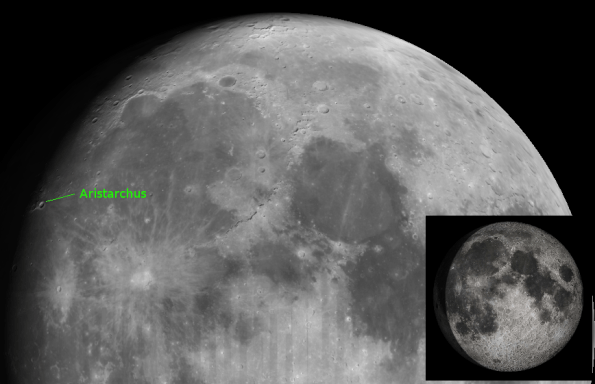
The sun rose on Aristarchus at the upper left side fo the Moon . Image from 10 p.m. April 18, 2016.
04/11/2016 – Ephemeris – The margins of the Moon
Ephemeris for Monday, April 11th. The Sun will rise at 7:04. It’ll be up for 13 hours and 18 minutes, setting at 8:23. The Moon, 2 days before first quarter, will set at 1:28 tomorrow morning.
Lets check out the Moon tonight. The Moon’s terminator, now the sunrise line traversing the Moon is beginning to uncover the dark Mare Tranquillitatis or Sea if Tranquility on the equator of the Moon. The small round prominent sea on the right side of the Moon is Mare Crisium, or Sea of Crises. At the limb beyond Crisium is Mare Marginis or sea at the Margin, and below it also at the edge is Mare Smythii, or Smith’s Sea, named after William Henry Smith a 19th century British astronomer. These last two seas are only visible when the Moon appears to rock to the left and reveals them. This is called libration caused by the fact the Moon rotates at a constant rate and it orbits the Earth in an ellipse, changing it’s speed.
Times are for the Traverse City/Interlochen area of Michigan. They may be different for your location.
Addendum
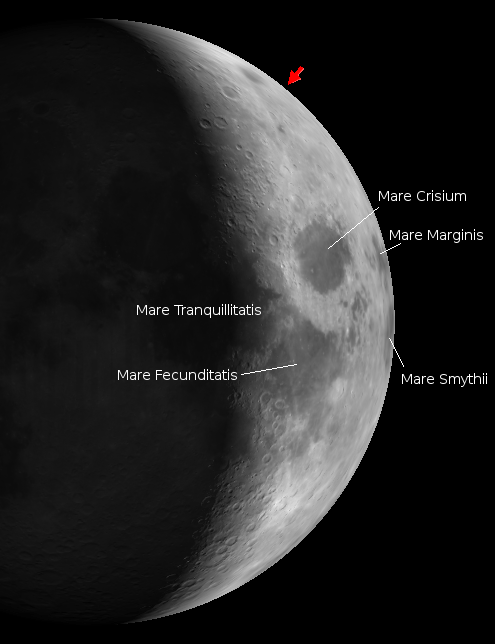
Map of the Moon for April 11, 2016. The arrow shows the point of maximum libration for that date. Created using Virtual Moon Atlas.
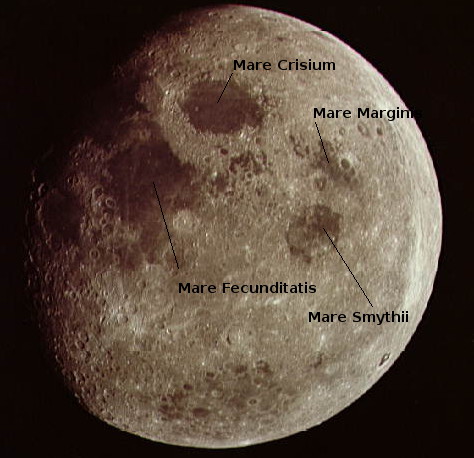
Photo of the receding Moon taken by the Crew of Apollo 8 as they started to head home showing the near side on the left and the far side on the right. I’ve annotated the seas which I’ve described above. Credit NASA.
03/11/2016 – Ephemeris – The lunar Sea of Crises
Ephemeris for Friday, March 11th. The Sun will rise at 7:01. It’ll be up for 11 hours and 42 minutes, setting at 6:44. The Moon, 3 days past new, will set at 10:14 this evening.
Tonight the Moon shows one remarkable sea: Mare Crisium or the Sea of Crises. It is a large gray basin. The largest feature visible in binoculars. Because it’s near the Moon’s limb or edge it is foreshortened into an ellipse, with the long axis running north and south. In actuality it is elliptical with the long axis east and west. It looks funny on a geologic map of the whole moon or a Moon globe. Its dimensions are 345 by 375 miles (570 by 620km). It’s really a crater as are all seas whose impact asteroid reached down to the Moon’s magma and caused lava to well up to produce the flat floor. When the sunlight is low as it is now wrinkle ridges will appear showing where successive lava flows have stopped and solidified.
Times are for the Traverse City/Interlochen area of Michigan. They may be different for your location.
Addendum
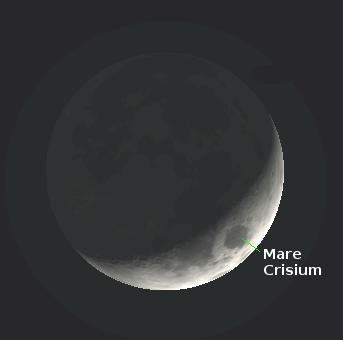
The Moon on its orientation in the southwest at 8 p.m.March 11, 2016. Created using Stellarium.
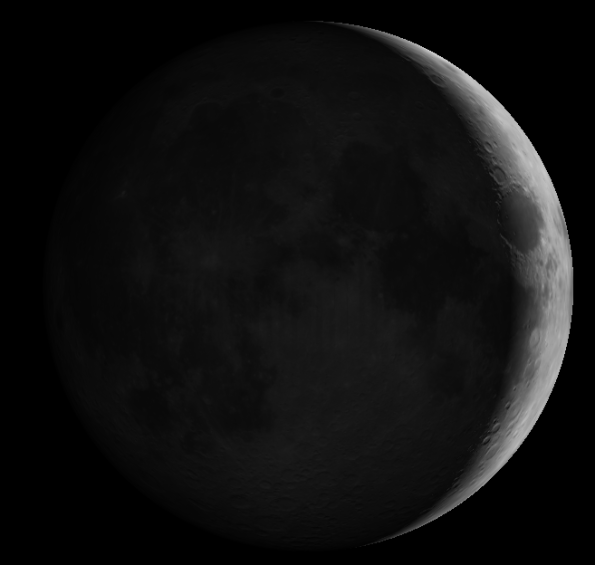
The Moon at 8 p.m. March 11, 2016 via Virtual Moon Atlas. Note that despite the difference in rotation, that the phase is s bit different. We’ll have to see which one is correct.
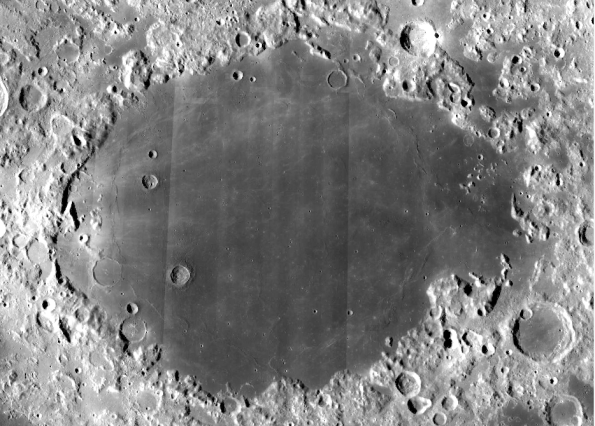
Mare Crisium from overhead with Lunar Reconnaissance Orbiter. The vertical lines are due to the north-south scans by the polar orbiting satellite. Credit: NASA/LRO/Virtual Moon Atlas.
03/02/2016 – Ephemeris – The morning planet gang is breaking up
Ephemeris for Wednesday, March 2nd. The Sun will rise at 7:17. It’ll be up for 11 hours and 14 minutes, setting at 6:32. The Moon, 1 day past last quarter, will rise at 3:08 tomorrow morning.
Let’s check out the whereabouts of the bright naked eye planets. All the classical planets visible from antiquity are officially now in the morning sky. I won’t be able to say that next week. Mercury is too close to the Sun and too dim to be spotted. Jupiter will rise at 6:53 p.m., in the east. Jupiter is going to be the morning sky defector as of next Tuesday. It’s below the stars of Leo. Mars will rise next at 12:59 a.m. in the east-southeast. It’s seen against the stars of Libra now. Saturn will rise at 2:23 a.m. in the east-southeast. It’s above the stars of Scorpius, actually in Ophiuchus. Venus will rise at 6:24 a.m. again in the east-southeast. Mercury will pass behind the Sun in superior conjunction on the 23rd.
Times are for the Traverse City/Interlochen area of Michigan. They may be different for your location.
Addendum
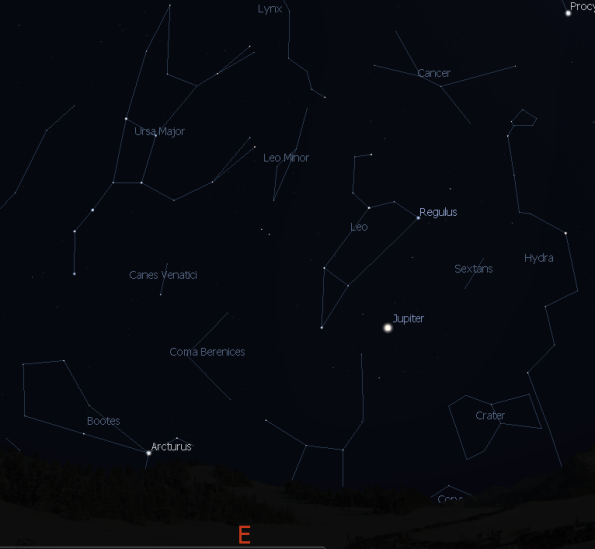
Jupiter and the rising spring constellations at 10 p.m. March 2, 2016. Created using Stellarium.
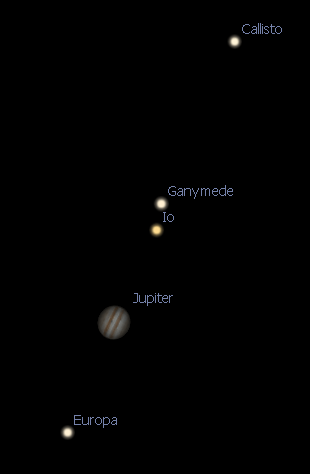
Jupiter and its moons as they would be seen in a telescope, at 10 p.m. March 2, 2016. Jupiter has an apparent diameter of 44.4″ Created using Stellarium.
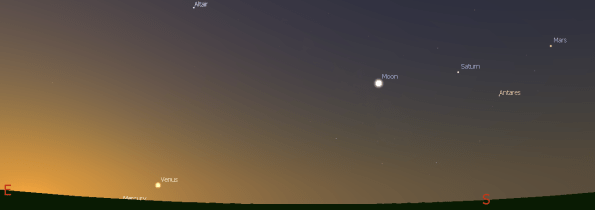
The morning planets and the Moon with the bright stars at 6:45 a.m. March 3, 2016. Created using Stellarium.
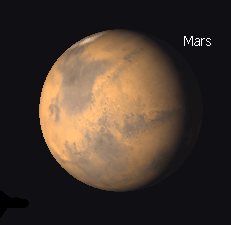
Mars as might look through a large amateur telescope at 6:45 a.m. March 3, 2016. North is at top. Apparent diameter is 8.9″.
In the Mars map below the center of the map pretty well matches the center of the Mars image above. The dark area to the upper left is Acidalia. The There’s a long dark feature to the right that has a blob at the end. The blob is Meridiani, where Mars’ prime meridian runs through. It is Meridiani where Opportunity landed, marked be MER-B.
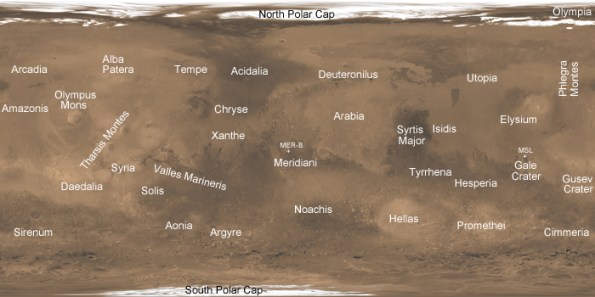
Annotated Mars Map. Credit NASA.
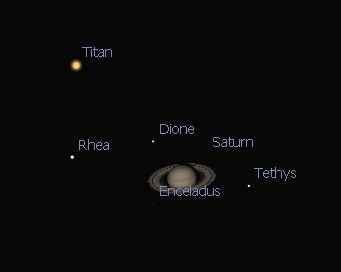
Saturn and its large satellite Titan and other moons as they should appear in a telescope in the morning of March 3, 2016. The planet is 16.6″ in diameter while the rings span 38.7″. Created using Stellarium.
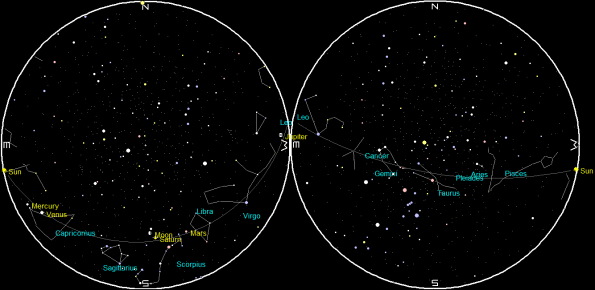
This is a chart showing the sunrise and sunset skies for March 2, 2016 showing the location of the planets and the Moon at that time. Created using my LookingUp program.
Some of these images above are shown smaller than actual size. Image expansion lately hasn’t worked. If you are using Firefox, right-click on the image, and then click on View Image.
02/23/2016 – Ephemeris – The king of the planets is planning to conquer the evening sky. Tonight its enlisting help from the Moon.
Ephemeris for Tuesday, February 23rd. The Sun will rise at 7:31. It’ll be up for 10 hours and 50 minutes, setting at 6:21. The Moon, 1 day past full, will rise at 7:32 this evening.
Rising with the Moon tonight will be the planet Jupiter which will appear to the left of the Moon as they rise, to the upper left of the Moon at 10 p.m. and above the Moon at midnight. NASA’s Juno spacecraft, launched in 2011, is planned to arrive at Jupiter on July 4th this year. No, it’s not a coincidence. It will orbit the planet for nearly two years. It’s the only solar-powered spacecraft that can operate as far from the Sun as Jupiter, which is 5 times farther from the Sun as the Earth, which gets one 5th squared or one twenty-fifth the intensity of sunlight. It has 3 huge solar panels making the spacecraft 66 feet wide. It’s mission is about Jupiter, its internal structure, atmosphere and magnetic and radiation fields.
Times are for the Traverse City/Interlochen area of Michigan. They may be different for your location.
Addendum
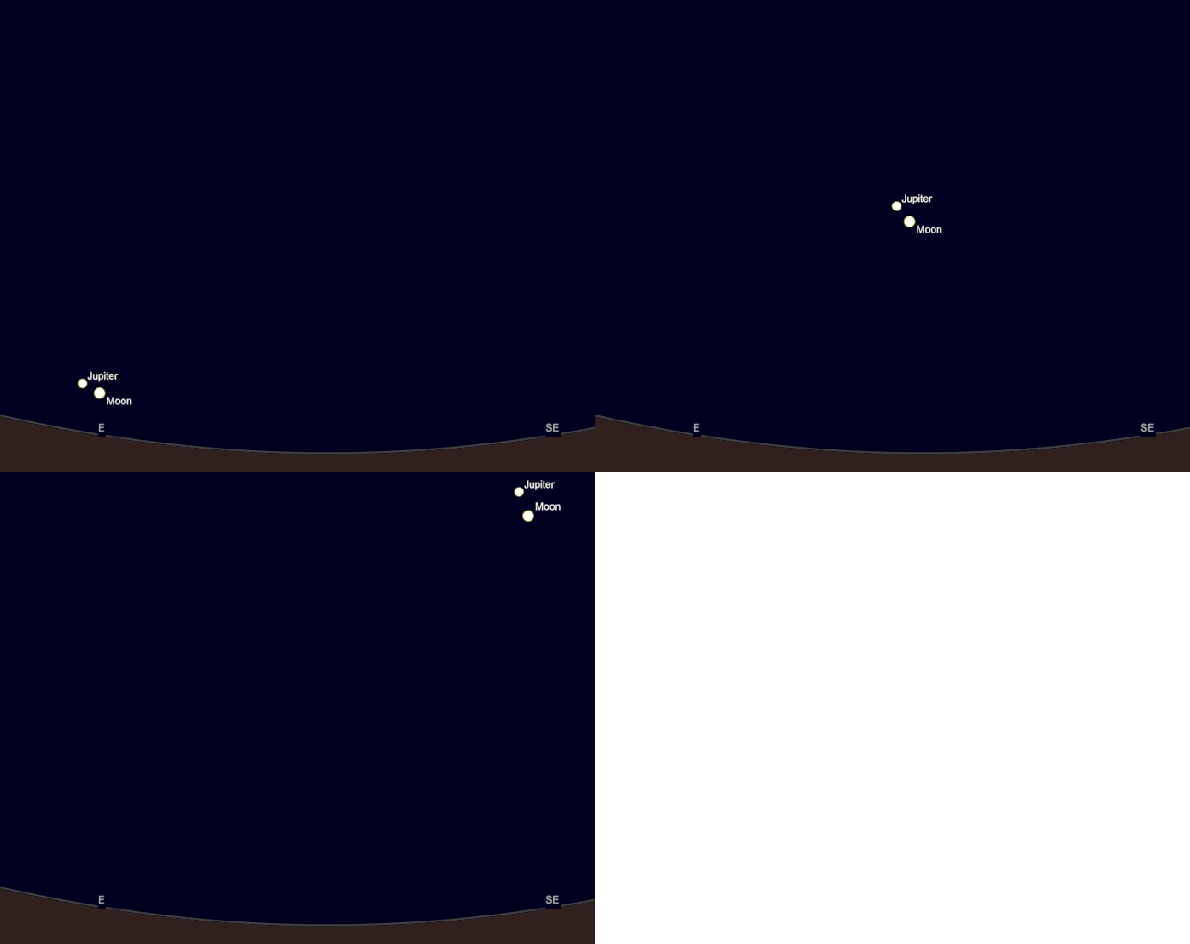
Jupiter and the Moon animation. Note their change in position relative to each other at 8 p.m., 10 p.m. and midnight. Created using Cartes du Ciel (Sky Chart) and GIMP.
.m.
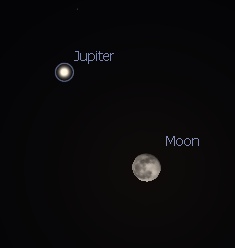
Closeup of Jupiter and the Moon at 10 p.m., February 23, 2016. The Moon is a whole lot brighter, and Jupiter dimmer than what’s shown here. Created using Stellarium.
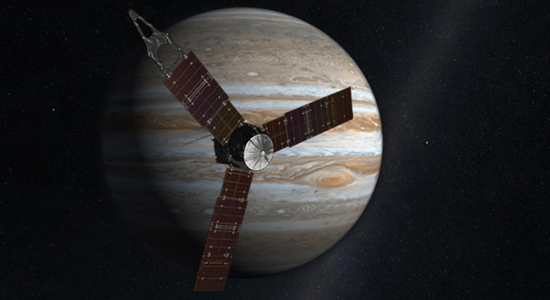
The Juno spacecraft. Credit: NASA.
02/17/2016 – Ephemeris – All the bright planets are in the morning sky, but two of them are trying to sneak out
Ephemeris for Wednesday, February 17th. The Sun will rise at 7:40. It’ll be up for 10 hours and 32 minutes, setting at 6:13. The Moon, 2 days past first quarter, will set at 4:39 tomorrow morning.
Let’s check out the whereabouts of the bright naked eye planets. All the classical planets visible from antiquity are officially now in the morning sky. Though Mercury is too close to the Sun to be spotted. Jupiter will rise at 7:57 p.m., in the east. Jupiter is still a morning planet since it’s not up at sunset. Mars will rise next at 1:24 a.m. in the east-southeast. It’s brighter than the bright star Spica growing even farther to the right of it.. Saturn will rise at 3:40 a.m. in the east-southeast. Venus will rise at 6:27 a.m. again in the east-southeast. Mercury is too deep in the twilight glare to be seen. Comet Catalina is up all night and is a binocular object and fading fast. At 10 p.m. is above the constellation of Cassiopeia and right of Perseus.
Times are for the Traverse City/Interlochen area of Michigan. They may be different for your location.
Addendum
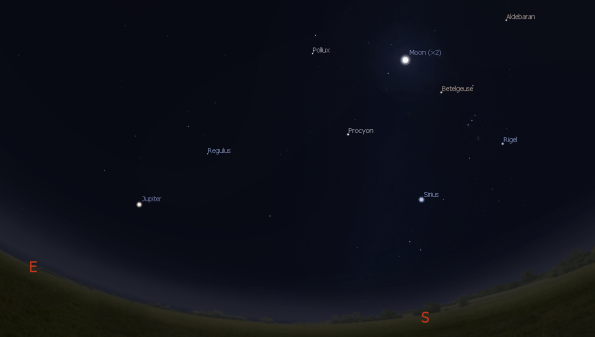
Jupiter, the Moon and the bright winter stars at 10 p.m. February 17, 2016. Created using Stellarium.
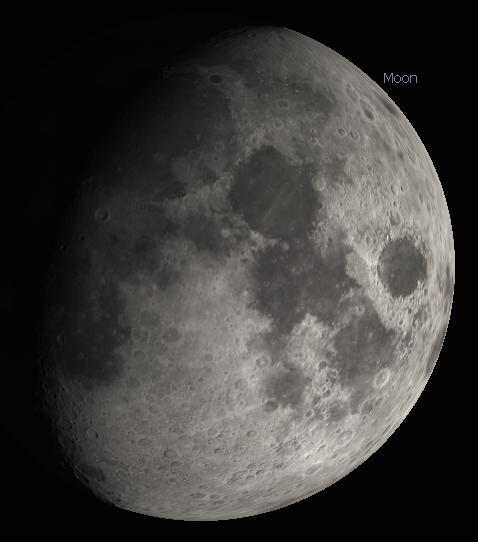
The Moon as it might be seen in binoculars at 10 p.m. February 17, 2016. Created using Stellarium.
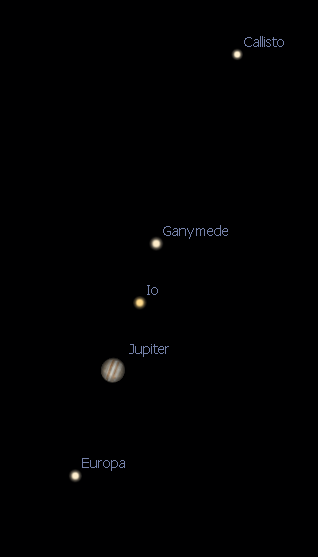
Jupiter and its moons as they would be seen in a telescope, at 10 p.m. February 17, 2016. Jupiter has an apparent diameter of 43.9″ Created using Stellarium.
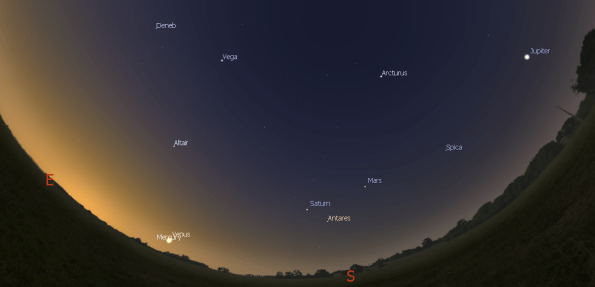
Morning planets and the bright s tar preview of summer. Mercury, though labeled can’t compete with the bright twilight. Observers south of here may have better luck. At 7 a.m. February 18, 2016. Created using Stellarium.
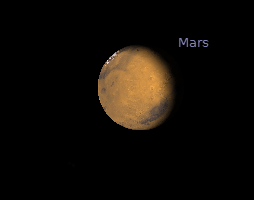
Mars in a telescope at high power. It’s apparent diameter is 7.9″. At 6 a.m. February 18, 2016. Created using Stellarium.
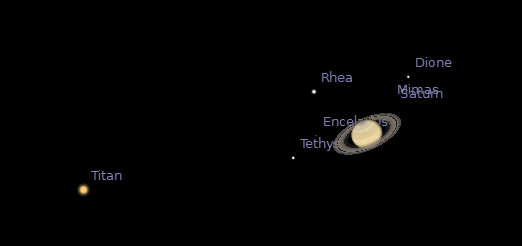
Saturn and its large satellite Titan and other moons as they should appear in a telescope at 6 a.m. February 18, 2016. The planet is 16.2″ in diameter while the rigs span 37.8″. Created using Stellarium.
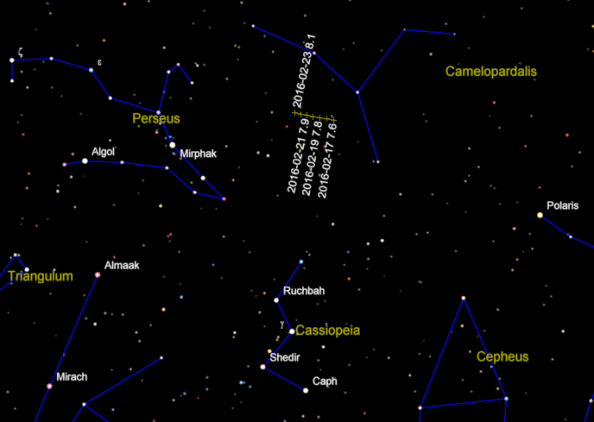
Comet Catalina’s path for the next week. Note that it is fading fast. It will take binoculars or a small telescope to spot the comet which will not show a tail visually. Created using Stellarium.
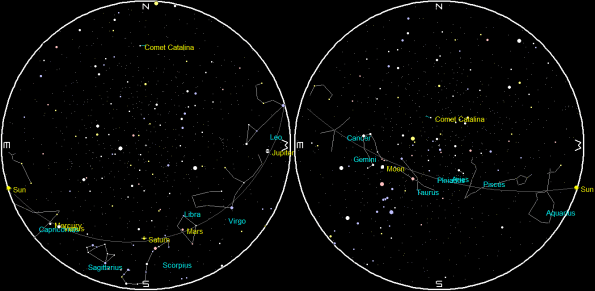
This is a chart showing the sunrise and sunset skies for February 17, 2016 showing the location of the planets, the Moon and Comet Catalina at that time. Created using my LookingUp program.
Some of these images above are shown smaller than actual size. Image expansion lately hasn’t worked. If you are using Firefox, right-click on the image, and then click on View Image.
02/03/2016 – Ephemeris – Though a morning planet, Jupiter can be seen in the late evening
Ephemeris for Wednesday, February 3rd. The Sun will rise at 8:00. It’ll be up for 9 hours and 53 minutes, setting at 5:53. The Moon, 3 days past last quarter, will rise at 4:27 tomorrow morning.
Let’s check out the whereabouts of the bright naked eye planets. All the classical planets visible from antiquity are officially now in the morning sky. However Jupiter actually will rise at 9 p.m., in the east. Jupiter is still a morning planet since it’s not up at sunset. Mars will rise next at 1:45 a.m. in the east-southeast. It’s left of the bright star Spica. Saturn will rise at 4:05 a.m. in the east-southeast. The Moon will be below, left of it tomorrow morning. Venus will rise at 6:19 a.m. again in the east-southeast. Mercury will rise behind Venus at 6:36. Comet Catalina is up all night and is a binocular object in the dark expanse of the constellation Camelopardalis between the bowl of the Big Dipper and the W shape of Cassiopeia.
Times are for the Traverse City/Interlochen area of Michigan. They may be different for your location.
Addenda
Planets
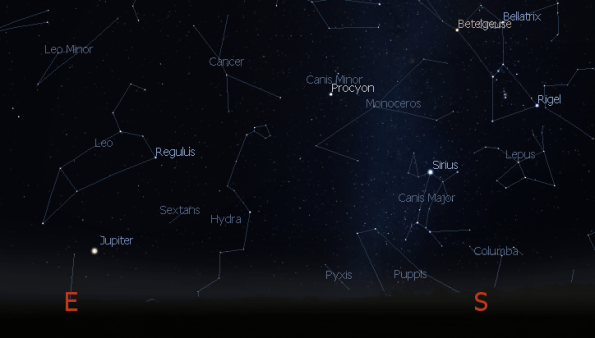
Jupiter low in the east at 10 p.m. on February 3rd, 2016. Created using Stellarium.
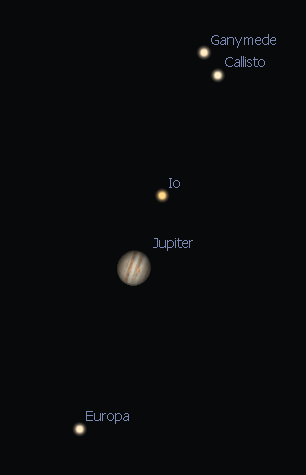
Jupiter and its moons as they would be seen in a telescope, at 10 p.m. February 3, 2016. I’d wait for an hour to let Jupiter rise above the thick atmosphere near the horizon for better clarity. Created using Stellarium.
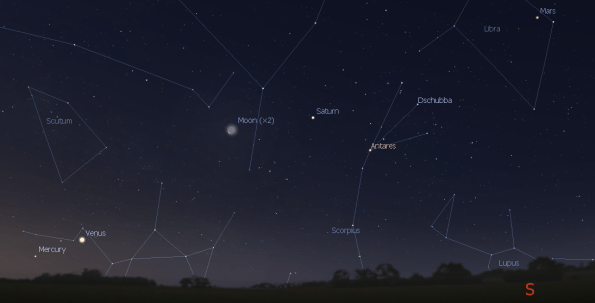
The planets in the morning sky at 7 a.m. on February 4, 2016. Jupiter is far to the west and out of this view. Created using Stellarium.
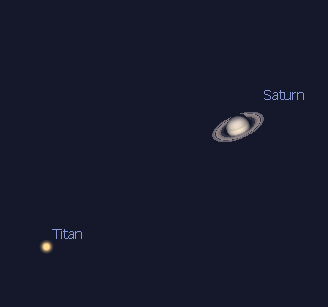
Saturn and its satellite Titan as they should appear in a telescope at 7 a.m. February 4, 2016
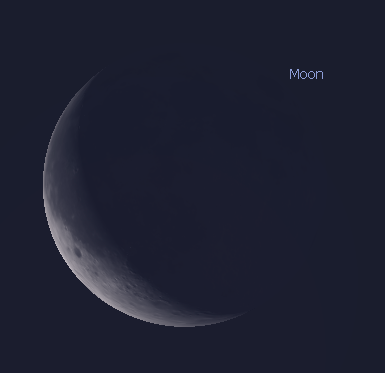
The Moon as it should appear in binoculars tomorrow morning at 7 a.m., February 4, 2016. Created using Stellarium.
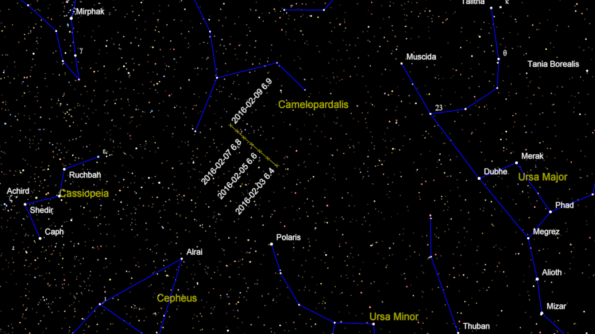
Comet Catalina’s path for the next week. Note that the magnitudes for the comet are about correct. It will take binoculars or a small telescope to spot the comet which will not show a tail visually. Created using Stellarium.
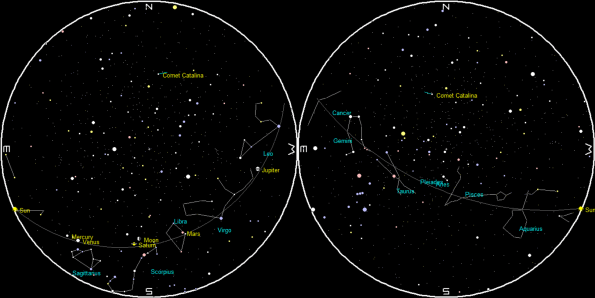
This is a chart showing the sunrise and sunset skies for February 3, 2016 showing the location of the planets, the Moon and Comet Catalina at that time. Created using my LookingUp program.
Off Topic
Stellarium
I’m now using Stellarium 0.14. It can detect older PCs and will not always crash, though I’m not thrilled with how it operates and some screen faults. The Portable Apps version has a patch that can be added to the application. The instructions for the patch are in the download page. Simply search “portable apps” to get started. The portable apps version worked better than the installed version, so I use the portable apps version. It turns out that my laptop can run 0.14, while my desktop cannot. The legacy version of Stellarium is 0.12.5.
It finally cleared up. For a while.
I bought myself a DSLR camera for my birthday/Christmas present a month and a half ago. I used to do a fair amount of astrophotography back before CCDs took over. I had some point and shoot digital cameras, which were not suitable for astrophotography. My last big spurge with film was for Comet Hale-Bopp in 1997.
But with the solar eclipse coming up next year the bug is biting again. I hate to brag but I’ve seen 4 total solar eclipses (1963, 1970, 1972, and 1979), plus 2 annular eclipses. I will recount my experiences with those eclipses in the year leading up to August 21, 2017.
In my film days I had developed a system for setting exposures for the Moon, planets, solar and lunar eclipses, and other possibly faint objects. It took a search to locate the data and used it when it finally cleared up on Ground Hog day. Below is one of the photos.
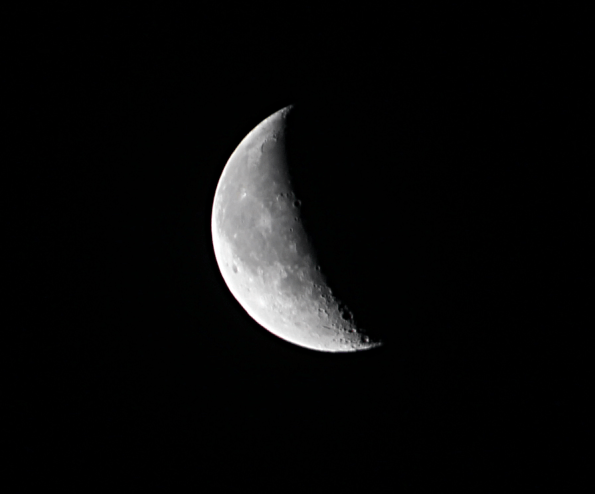
The fat crescent Moon at 7:02 a.m. February 2, 2016. ISO 100, 300mm focal length, f/11, 1/15 second.
01/27/2016 – Ephemeris – The Moon rises near Jupiter tonight
Ephemeris for Wednesday, January 27th. The Sun will rise at 8:07. It’ll be up for 9 hours and 36 minutes, setting at 5:43. The Moon, half way from full to last quarter, will rise at 9:43 this evening.
Let’s check out the whereabouts of the bright naked eye planets. All the classical planets visible from antiquity are officially now in the morning sky. However Jupiter actually will rise at 9:30 p.m., in the east. The Moon will be right below it tonight. Jupiter’s still a morning planet since it’s not up at sunset. Mars will rise next at 1:54 a.m. in the east-southeast. It’s below and left of the bright star Spica. Saturn will rise at 4:30 a.m. in the east-southeast. Venus will rise at 6:11 a.m. again in the east-southeast. Mercury is not favorably placed for northern hemispheric observers now. Comet Catalina is up all night and is a binocular object crossing the line from the pointer stars in the Big Dipper and the North Star Polaris tonight.
Times are for the Traverse City/Interlochen area of Michigan. They may be different for your location.
Addendum
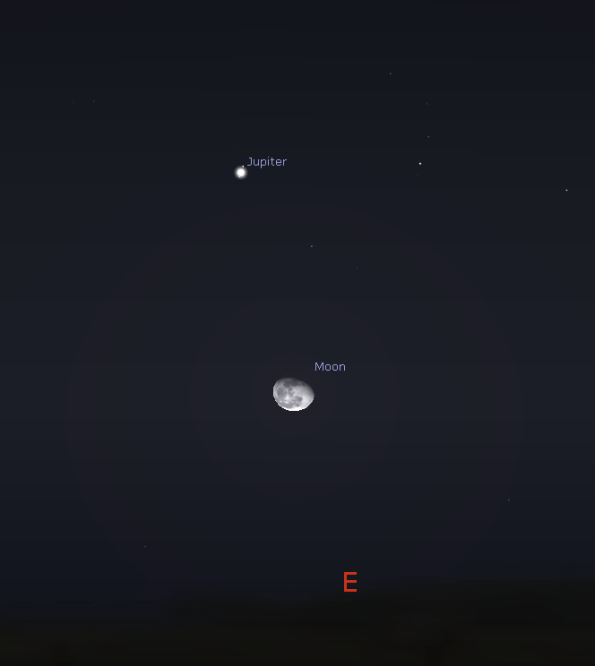
Jupiter and the Moon at 10 p.m. January 27, 2016. Created using Stellarium.
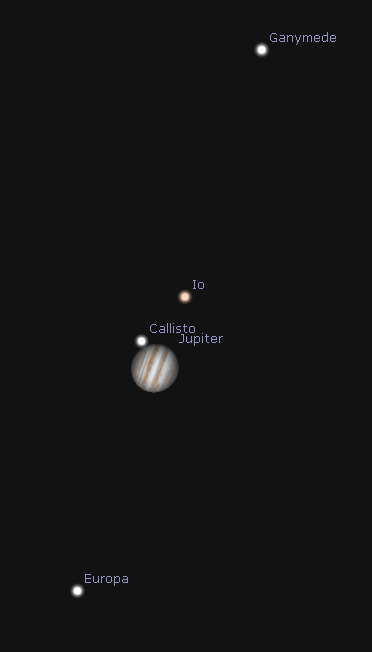
Jupiter and moons as they would appear in a telescope at 10 p.m. January 27, 2016. Created using Stellarium.
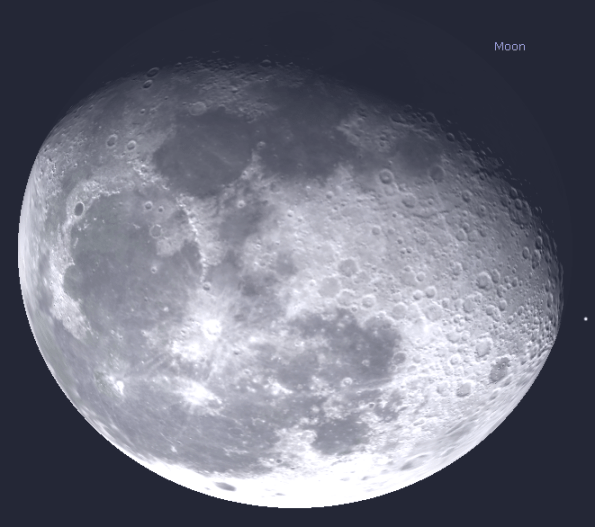
The Moon rising. Note the distortion of the atmospheric refraction squishes the Moon vertically being only a quarter-hour after it rose. 10 p.m., January 27, 2016. Created using Stellarium.
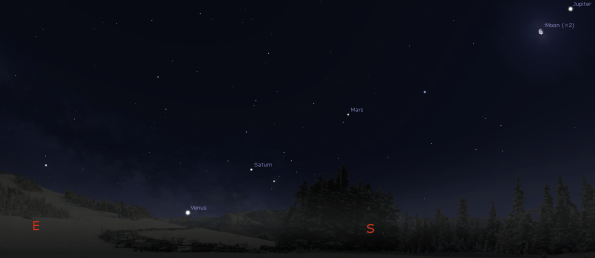
The morning planets and the Moon at 6:45 a.m., January 28, 2016. Created using Stellarium.
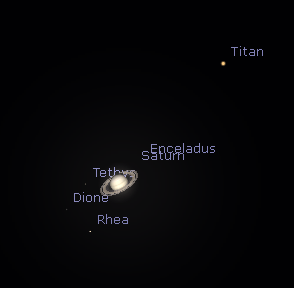
Saturn and its moons in a telescope on the morning of January 28, 2016. Created using Stellarium.
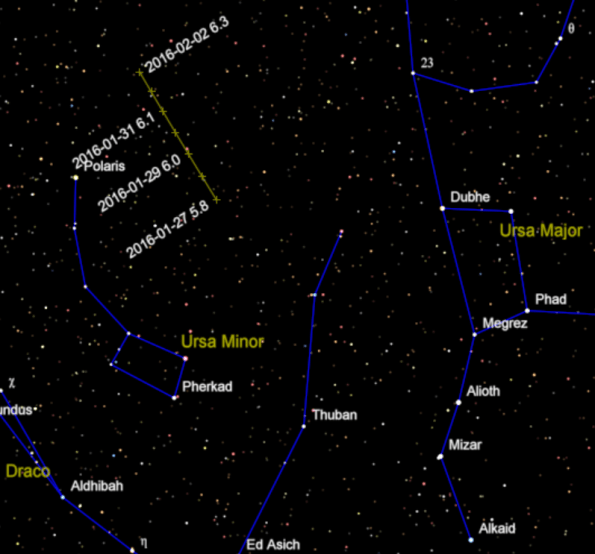
Comet Catalina’s path for the next week. Note the magnitudes for the comet are about correct. It will take binoculars or a small telescope to spot the comet which will not show a tail visually. Created using Stellarium.
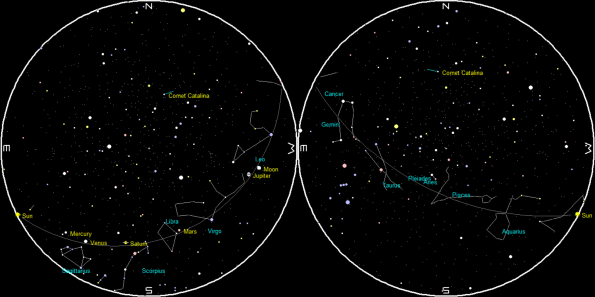
This is a chart showing the sunrise and sunset skies for January 27, 2016 showing the location of the planets, the Moon and Comet Catalina at that time. Created using my LookingUp program.
Some of these images above are shown smaller than actual size. Image expansion lately hasn’t worked. If you are using Firefox, right-click on the image, and then click on View Image.
01/19/2016 – Ephemeris – The Moon will cover Aldebaran tonight!
Ephemeris for Tuesday, January 19th. The Sun will rise at 8:14. It’ll be up for 9 hours and 18 minutes, setting at 5:32. The Moon, 3 days past first quarter, will set at 4:51 tomorrow morning. | Tonight the Moon will pass in front of or occult the bright star Aldebaran, the bright star in Taurus the bull. The bright Moon will making spotting Aldebaran difficult without binoculars, or better yet, a telescope. Aldebaran will wink out at the Moon’s dark eastern or left edge around 9:06 p.m. The exact time depends on your location. It’s within a minute or 2 for the IPR listening area. Aldebaran will be uncovered by the Moon around 10:25 p.m. at the bright lower right edge of the Moon. Today’s posting on bobmoler.wordpress,com will have much more information on the event, and how to calculate times for other locations along the path of the occultation (see below). This is the best of the four Aldebaran occultations visible this year.
Times are for the Traverse City/Interlochen area of Michigan. They may be different for your location.
Addendum
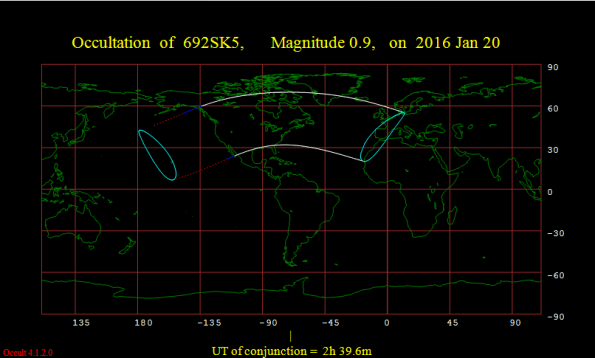
Occultation visibility map for January 19, 2016 EST (January 20 UT). Credit IOTA/Occult4 program. Looks like the followers of this blog in the UK will get a piece of this one too.
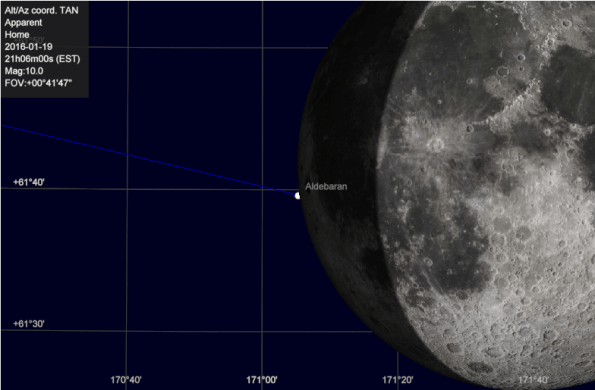
Aldebaran will disappear at the Moon’s dark leading edge at about 9:06 p.m. January 19, 2016. Created using Cartes du Ciel (Sky Charts).
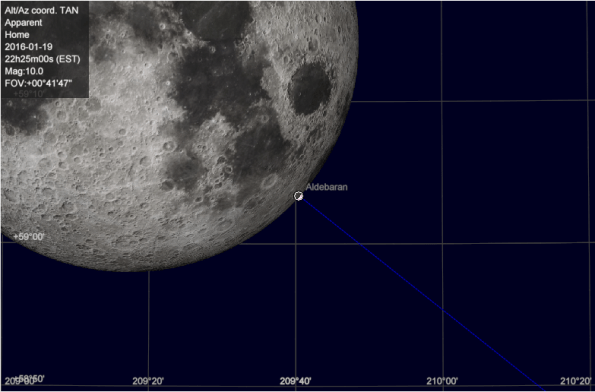
Aldebaran will reappear at the Moon’s bright trailing edge at about 10:25 p.m. January 19, 2016. Created using Cartes du Ciel (Sky Charts).
Estimating timings for your location
I used Cartes du Ciel the free software that I have a link to on the right. Make sure that the program is set for topocentric positions under Setup/Solar System. And you have entered your position under Setup/Observatory. You can find your location in Google Earth.
You can also use Stellarium. Just make sure the Moon is normal sized.
In both programs you can lock the Moon or Aldebaran in the center of the screen Pick a time in advance of the occultation and using the set time window walk the star towards the Moon, mark the time. Then walk the star out from the Moon and record the reappearance time. That’s it.
This should work with other planetarium programs too.
01/06/2016 – Ephemeris – The bright planet action is in the morning
Jan 6. This is Bob Moler with Ephemeris for Wednesday, January 6th. The Sun will rise at 8:19. It’ll be up for 8 hours and 57 minutes, setting at 5:17. The Moon, 3 days before new, will rise at 5:46 tomorrow morning.
Let’s check out the whereabouts of the bright naked eye planets. Mercury is now too close to the Sun in the evening sky, and is only 8 days from inferior conjunction with the Sun. The next inferior conjunction after this, May 9th Mercury will pass in front of the Sun. In the morning sky there are four bright planets. Jupiter will be the first to rise, actually at 10:56 p.m., in the east. Mars will rise next at 2:20 a.m. also in the east-southeast. It’s left of the bright star Spica. Venus will rise at 5:30 a.m. also in the east-southeast. Saturn will rise at 5:47 a.m. following Venus. Comet Catalina is a binocular object about a third of the way from the bright star Arcturus, and the star at the end of the handle of the Big Dipper named Alkaid.
Times are for the Traverse City/Interlochen area of Michigan. They may be different for your location.
Addendum
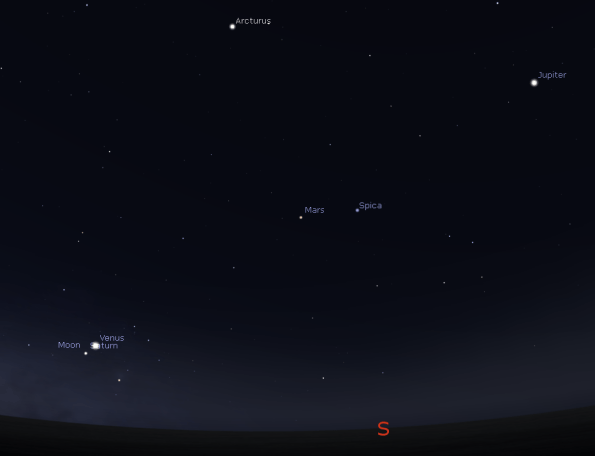
Here of the morning planets. From right to left, Jupiter, Mars and the traffic jam of Venus, Saturn and the Moon. Time: 7 a.m., January 7, 2016. Created using Stellarium.
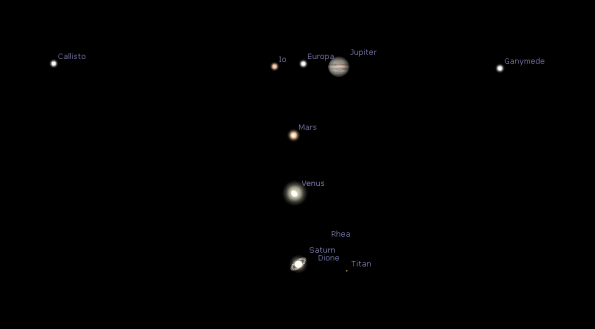
The planets to, mostly, the same scale of apparent sizes. Venus is the size of the small gibbous center of the overexposed glow. Mars is smaller than it’s image, about half the size of Venus. Created using Stellarium.
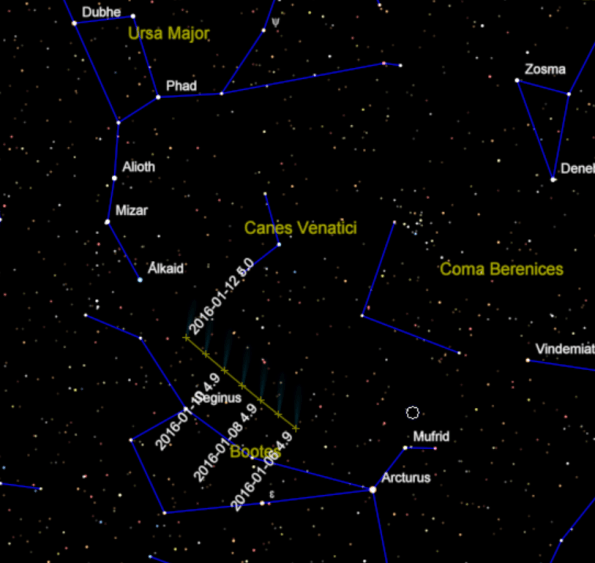
Comet Catalina’s path for the next week. Note the magnitudes for the comet are about 1 magnitude too bright. It will take binoculars or a small telescope to spot the comet which will not show a tail visually. Created using Cartes du Ciel (Sky Charts).
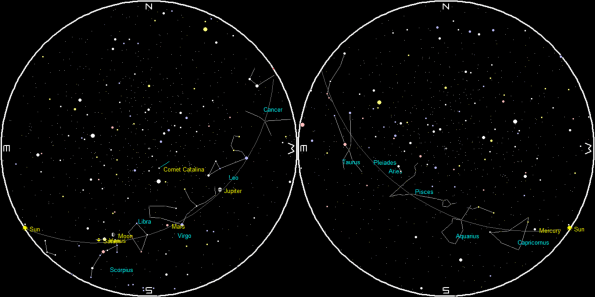
This is a chart showing the sunrise and sunset skies for January 6, 2016 showing the location of the planets, the Moon and Comet Catalina at that time. Created using my LookingUp program.
Several of the images above are shown smaller than actual size. Image expansion lately hasn’t worked. If you are using Firefox, right-click on the image, and then click on View Image.
 Bob Moler's Ephemeris Blog