Archive
11/07/2012 – Ephemeris – Where are the bright planets this week?
Ephemeris for Wednesday, November 7th. The sun will rise at 7:28. It’ll be up for 9 hours and 53 minutes, setting at 5:22. The moon, 1 day past last quarter, will rise at 1:11 tomorrow morning.
Let’s check out the planets for this week. At 6:15 p.m. Mars can be seen low in the southwest. Mars, being the nearest planet outside the earth’s orbit takes its own sweet time leaving the evening sky. Mars will set at 7:19. The planetary action will have already picked up on the other side of the sky. Jupiter, will rise at 6:48 p.m. in the east northeast. It is located in the constellation of Taurus. It will transit or pass due south at 2:23 a.m. The last bright planet of the night is the morning star Venus which will rise at 4:33 a.m. also in the east. Venus is now below the hind end of Leo, and actually in the constellation of Virgo. The planets Venus and Jupiter and the winter constellations are a great sight for early risers.
Times are for the Traverse City/Interlochen area of Michigan. They may be different for your location.
Addendum
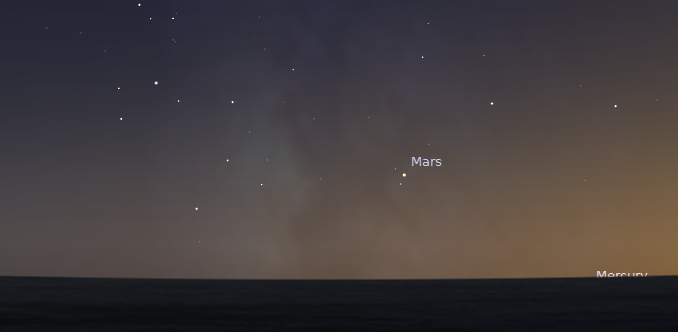
Mars low in the southwest at 6:15 p.m. on November 7, 2012. Created using Stellarium.
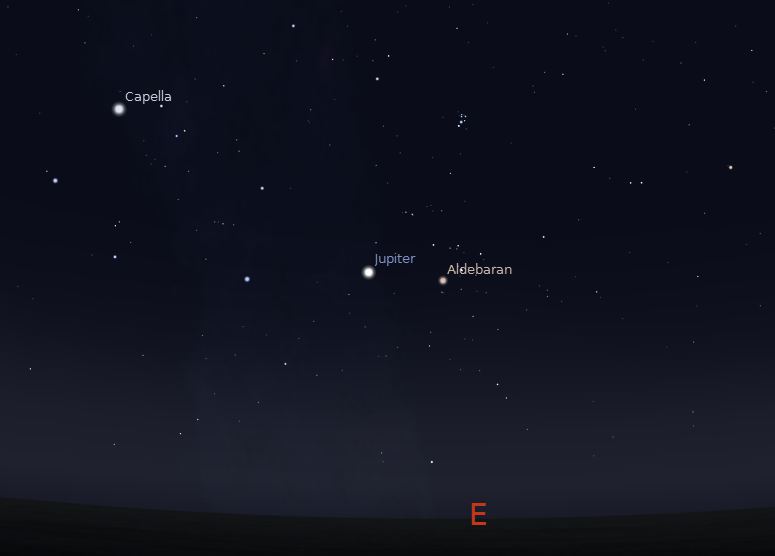
Jupiter rising at 9 p.m. on November 7, 2012. Created using Stellarium.
In the morning.
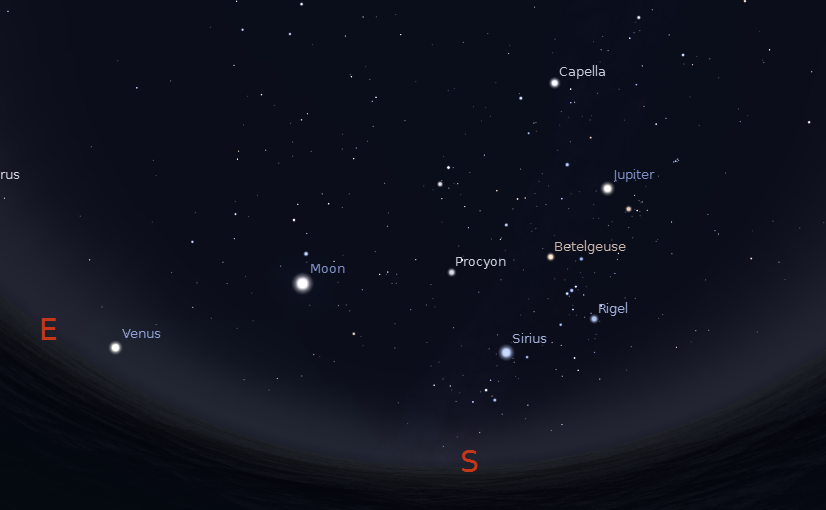
Jupiter and Venus with the winter stars at 5 a.m. November 8, 2012. Created using Stellarium.
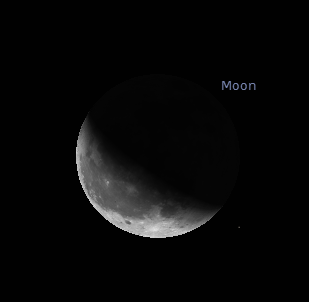
The waning crescent moon on November 8, 2012 at 5 a.m. Created using Stellarium.
10/29/2012 – Ephemeris – The full Hunters Moon and Tycho’s rays
Ephemeris for Monday, October 29th. The sun will rise at 8:16. It’ll be up for 10 hours and 18 minutes, setting at 6:34. The moon, at full today, will rise at 6:24 this evening.
The full moon tonight is the full Hunters Moon. As down as I am about full moons due to the fact that they light up the sky and flood out the dimmer objects in the sky, I once and a while stop and view it. The time of the full moon is about 3 this afternoon, so when it rises tonight we will be looking at the moon from very nearly the direction of the sun, so there will be few shadows to be had. Last week I talked about the crater Tycho near the bottom or south end of the moon and its long rays of ejecta. The full moon is the best time to see these rays, which are easily visible in binoculars, through which Tycho itself looks like a bright dot. In telescopes Tycho looks like a small bright ring. The full moon is super bright. It’s daytime there.
Times are for the Traverse City/Interlochen area of Michigan. They may be different for your location.
Addendum
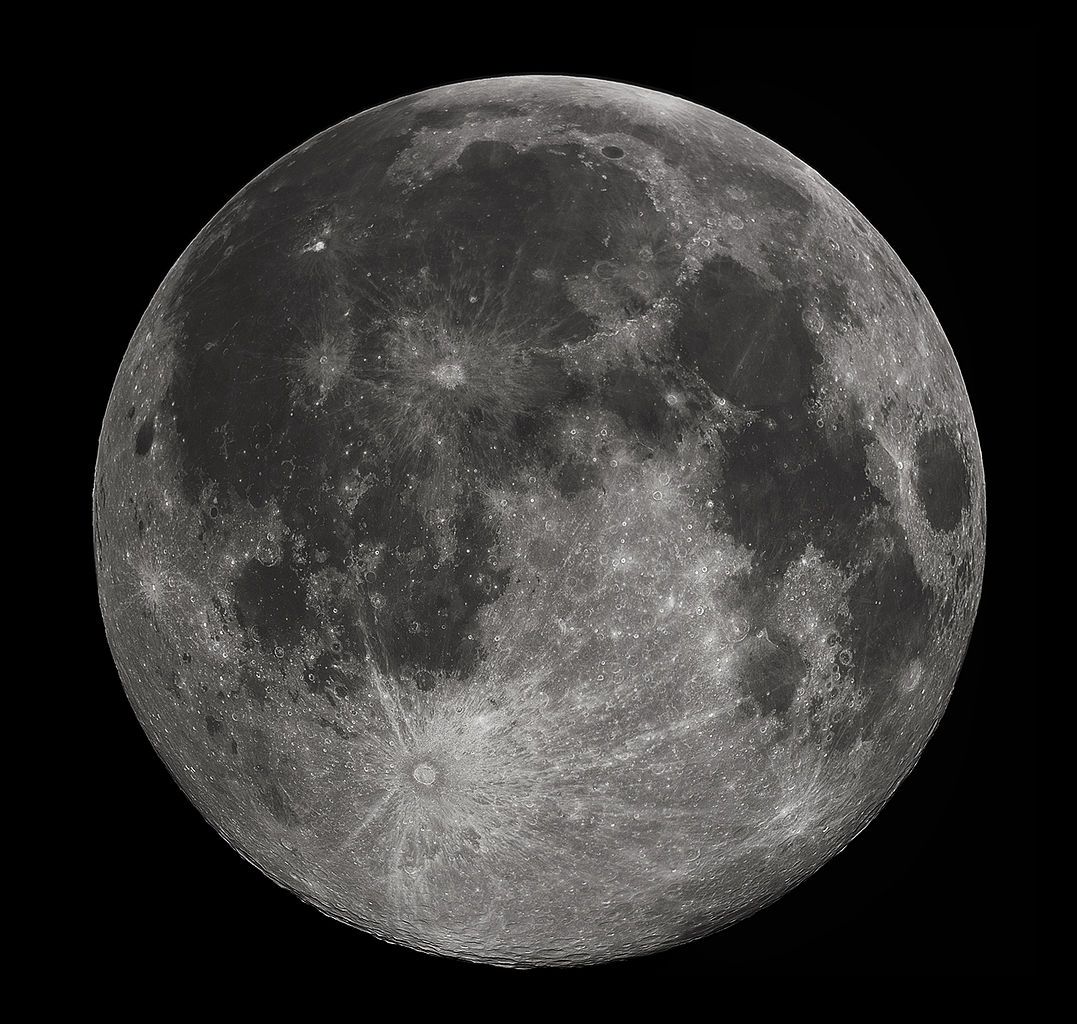
Photographed with a Celestron 9.25 Schmidt-Cassegrain telescope. Acquired with a Canon EOS Rebel T1i (EOS 500D), 20 images stacked to reduce noise. 200 ISO 1/640 sec. Gregory H. Revera
Tycho and its rays are prominent in the photo above. I found this image in the article Moon in Wikipedia.
10/25/2012 – Ephemeris – Exploring the bright gibbous moon
Ephemeris for Thursday, October 25th. The sun will rise at 8:11. It’ll be up for 10 hours and 29 minutes, setting at 6:40. The moon, half way from first quarter to full, will set at 5:02 tomorrow morning.
The moon tonight is very bright, so looking at it with a telescope can be almost painful. There are moon filters sold at telescope stores for standard sized eyepieces that will alleviate that problem. Remember it’s daytime on the moon and the sunlight is as strong on the moon as it is on the earth. Concentrate the telescope on the left edge of the moon, the sunrise line where the shadows are. The small crater Kepler, named for the astronomer who gave us the laws the govern the motion of the planets is located near the terminator near the moon’s equator. The Crater Gassendi, to the lower left, is a ringed plain with low walls and a flat floor that has a rille or crack in it. Another distinctive crater is Schiller lower to the south and very elongated.
Times are for the Traverse City/Interlochen area of Michigan. They may be different for your location.
Addendum
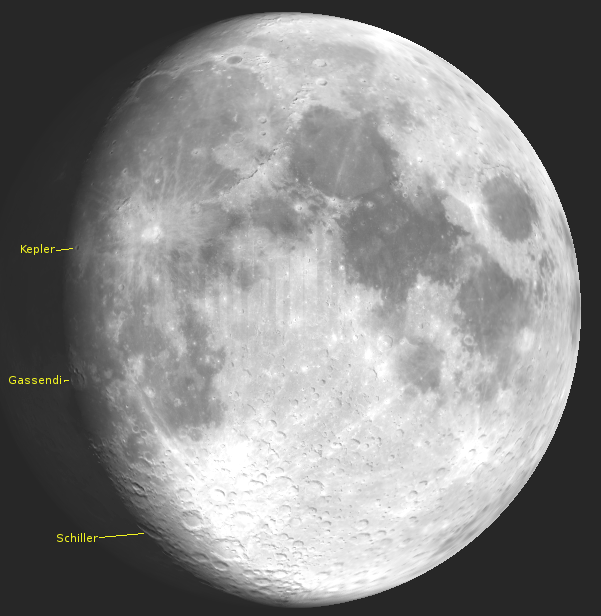
The bright gibbous moon highlighting three craters, Kepler, Gassendi, and Schiller. Created using the Virtual Moon Atlas.
Gassendi is named for Pierre Gassend, 17th French astronomer and pioneer in the use of a refractor telescope. Schiller is named for Julius Schiller a 17th century monk who came out with a Christian themed star atlas. These and other crater facts were obtained for the open source lunar program Virtual Moon Atlas.
10/23/2012 – Ephemeris – The remarkable lunar crater Tycho
Ephemeris for Tuesday, October 23rd. The sun will rise at 8:08. It’ll be up for 10 hours and 35 minutes, setting at 6:44. The moon, 2 days past first quarter, will set at 2:52 tomorrow morning.
Tonight the moon’s advancing sunrise line will reveal a young crater near the bottom of the moon. That crater is Tycho. In binoculars or a telescope it’s features appear sharper, and its floor deeper than the surrounding craters. Its age is in the range of hundreds of thousands of years rather than billions. Tycho has an extensive ray system that extends thousands of miles across the face of the moon. That is best seen at full moon, and the rays are probably a huge number of craterlets. They are normally shadow filled but at full moon are fully illuminated accentuating the brightness of the rays. The crater was named for 16th Century Danish astronomer Tycho Brahe, the greatest observational astronomer before the invention of the telescope. [ His observations allowed Kepler to formulate his three laws of planetary motion.]
Times are for the Traverse City/Interlochen area of Michigan. They may be different for your location.
Addendum
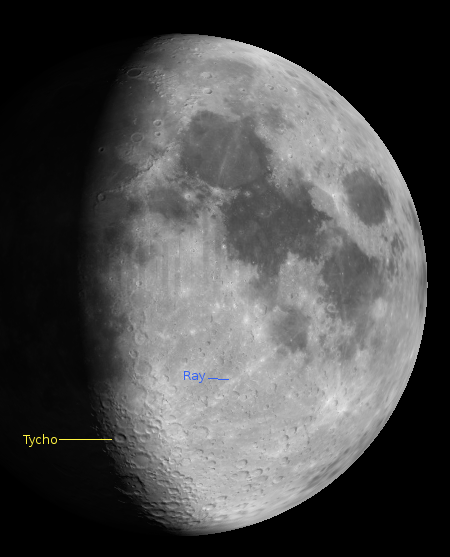
The crater Tycho and one of its rays at 9 p.m. on October 23 2012. Created using Virtual Moon Atlas.
10/22/2012 – Ephemeris – Three prominent craters on the moon tonight
Ephemeris for Monday, October 22nd. The sun will rise at 8:07. It’ll be up for 10 hours and 38 minutes, setting at 6:45. The moon, 1 day past first quarter, will set at 1:45 tomorrow morning.
Tonight’s slightly gibbous moon will reveal at its terminator a line of three craters just below the center of the moon. The one closest to the center of the moon, and the largest is Ptolemaeus, names for Claudius Ptolemy 2nd century astronomer. The next crater is Alphonsus named after Alphonse X, 13th century king of Castille, and responsible for improved astronomical tables. Alphonsus has been the site of transient reddish hazes that soggest to som of volcanis activity, but it’s never been proven. It was the target of the last Ranger spacecraft that crashed onto the moon taking pictures all the way down. The third crater is Arzackel , named after an 11th century Arabian astronomer.
Times are for the Traverse City/Interlochen area of Michigan. They may be different for your location.
Addendum
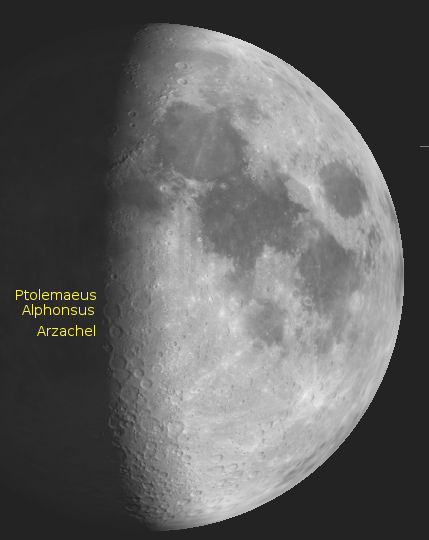
The moon at 10 p.m. on October 22, 2012. Created using Virtual Moon Atlas.
09/28/2012 – Ephemeris – Harvest moon tomorrow
Ephemeris for Friday, September 28th. The sun will rise at 7:37. It’ll be up for 11 hours and 50 minutes, setting at 7:27. The moon, 1 day before full, will set at 7:10 tomorrow morning.
Tomorrow is the Harvest Moon, the nearest full moon to the autumnal equinox. Here the path of the moon in the sky against the stars is shallow causing the moon to rise only a little later each night. Back before electricity was available to farms this gave extra time for farmers to gather in their crops each day. This effect lasts for a bit less than a week both before and after the full moon. We astronomers aren’t big fans of the effect because the sky stays bright longer and masks the faint things they want to see. Not all astronomers are bummed by bright moonlight. There’s plenty to study when the moon is out: planets and reasonably bright stars. It’s just that the fainter objects are lost.
Times are for the Traverse City/Interlochen area of Michigan. They may be different for your location.
Addendum
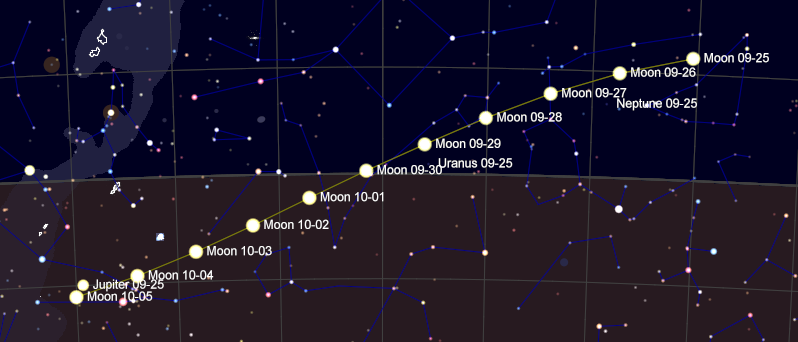
Shallow path of the moon for 11 nights centered on the Harvest Moon in 2012. Created using Cartes duCiel (Sky Charts).
Click on the image to enlarge.
09/25/2012 – Ephemeris – Sinus Iridium greets the sun
Ephemeris for Tuesday, September 25th. The sun will rise at 7:33. It’ll be up for 11 hours and 59 minutes, setting at 7:33. The moon, 3 days past first quarter, will set at 3:53 tomorrow morning.
Lets look at the moon again tonight. One of my favorite formations is coming into light it is called Sinus Iridium or Bay of Rainbows. Sorry there’s no color here. But if caught at right time this ruined crater will appear as a hook out into night off the upper left edge of the moon. Officially its a bay to the Sea of Showers or Mare Imbrium. The north edge of the bay are mountains called the Jura Mountains. The south edge disappears into Mare Imbrium. The floor of the Sinus Iridium is about twelve hundred feet lower than Imbrium. The transition is gradual because it isn’t very noticeable. The formation is large enough to be seen in binoculars. Sinus Iridium is 242 miles wide, a good tenth the diameter of the moon itself.
Times are for the Traverse City/Interlochen area of Michigan. They may be different for your location.
Addendum
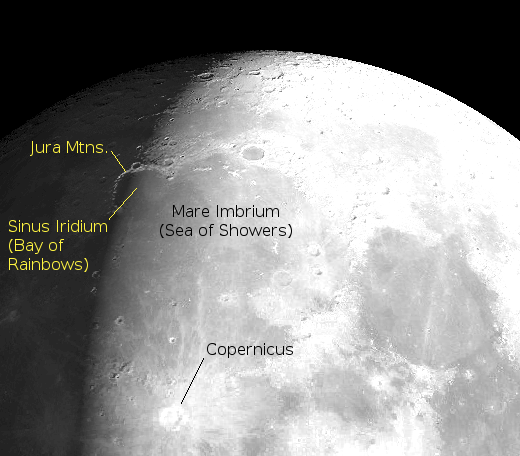
Bay of Rainbows and the crater Copernicus. Created using Virtual Moon Atlas.
09/24/2012 – Ephemeris – The lunar crater Copernicus
Ephemeris for Monday, September 24th. The sun will rise at 7:32. It’ll be up for 12 hours and 2 minutes, setting at 7:35. The moon, 2 days past first quarter, will set at 2:44 tomorrow morning.
Since the International Observe the Moon Night was cloudy in our area if its clear tonight there are still great views of the moon. You’re on your own, so dig out those binoculars and dust off that telescope for a great view of the moon. The sun will have risen on one of the great craters Copernicus. It’s near the terminator, the sunrise line on the moon on the left, close to half way from north to south. Copernicus was named for the Polish astronomer who put forth the heliocentric solar system in the 16th century. The crater is 56 miles in diameter with a vaguely hexagonal form and two miles deep. It has terraced walls and three central peaks. It may look deeper than that due to the low sun angle exaggerating its depth.
Times are for the Traverse City/Interlochen area of Michigan. They may be different for your location.
Addendum
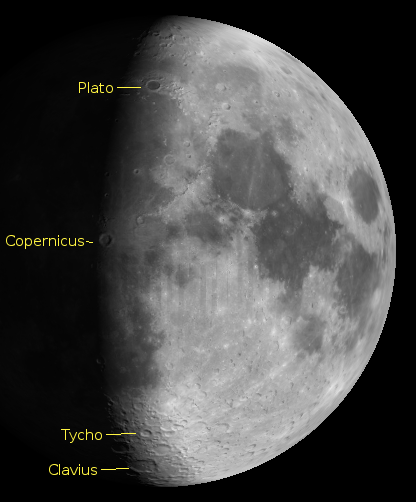
The moon on showing Copernicus and other large craters on the terminator. Created using Virtual Moon Atlas.
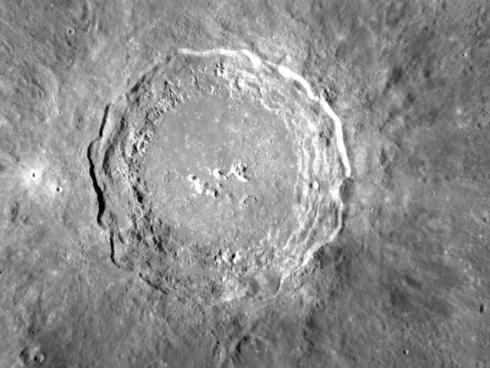
The crater Copernicus. Credit: NASA/GSFC/Arizona State University.
09/03/2012 – Ephemeris – Almost the Harvest Moon
Ephemeris for Labor Day, Monday, September 3rd. The sun will rise at 7:07. It’ll be up for 13 hours and 6 minutes, setting at 8:14. The moon, 3 days past full, will rise at 9:21 this evening.
Last Friday’s full moon wasn’t the Harvest Moon. That honor is reserved for the closest full moon to the autumnal equinox, which will occur on the 29th. Still we have the same effect of taking quite a few days for the waning gibbous moon to clear the evening twilight. So tonight the moon, some three days past full still rises within an hour and a half of sunset. In the spring the day after full, the moon will rise an hour and a half after sunset. The reason for the slow advance of rise times is that the moon’s path at this time is at a low angle to the eastern horizon, so the moon moves more horizontally than vertically with respect to the horizon each night. On average the moon moves about 26 times its diameter each day in its orbit of the earth.
Times are for the Traverse City/Interlochen area of Michigan. They may be different for your location.
Addendum
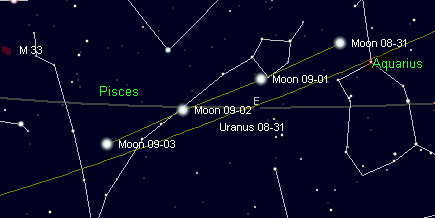
Almost the Harvest Moon Effect over 4 nights. Created using Cartes du Ciel (Sky Charts)
The shallow path of the moon rising from night to night allows the moon to rise much less than the 50 minutes average night to night moonrise interval.
08/31/2012 – Ephemeris – Once in a blue moon
Ephemeris for Friday, August 31st. The sun will rise at 7:04. It’ll be up for 13 hours and 15 minutes, setting at 8:19. The moon, at full today, will rise at 8:01 this evening.
Tonight’s moon has been dubbed by some to be a Blue Moon. No the color of the moon isn’t really blue. But it is as rare as a blue moon. Let me try to explain. Currently the label blue Moon is given to the second full moon in a month. August’s first full moon was on the first. This blue moon rule wasn’t always the case. Early American almanacs apparently gave the title of blue moon to the 4th full moon in a season. So could the moon ever appear blue? Yes it can. If seen through a lot of dust in a dust storm. A totally eclipsed moon can appear very dark and even have a blue tinge if there’s a lot of volcanic ash in the atmosphere. I’ve seen two of these eclipses and the moon didn’t appear blue to my eyes, but it was so dim the I could barely make it out without binoculars.
Times are for the Traverse City/Interlochen area of Michigan. They may be different for your location.
 Bob Moler's Ephemeris Blog